IMPLANT SUPPORTED
OVERDENTURES
Prepared by :
Abd El-Rahman Gamal Sanad
Osama Tarek Ali
Introduction
•An implant-supported hybrid prosthesis is an acrylic
resin complete fixed dental prosthesis supported by
implants
•Might be a solution in extreme cases that the need
of the restoration for esthetics, function, lip
support, and speech.
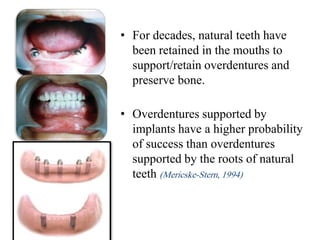
• For decades, natural teeth have
been retained in the mouths to
support/retain overdentures and
preserve bone.
• Overdentures supported by
implants have a higher probability
of success than overdentures
supported by the roots of natural
teeth (Mericske-Stern, 1994)
DEFINITION
• An overdenture is defined as a removable
prosthesis that covers the entire occlusal
surface of a root or implant
( Harold W Preiskel).
• Any removable dental prosthesis that covers and rests
on one or more remaining natural teeth, the roots of
natural teeth, and/or dental implants
DEVELOPMENT OF OVERDENTURES
• In 1856, Ledger described a prosthesis resembling an
overdenture. His restorations were referred to as “Plates
covering fangs”.
• In 1861 a conference held in Connecticut, increased the
awareness of the value of such roots in supporting a covering
denture.
• In 1888 Evans had described a method of using roots actually
to retain restorations.
• In 1896 Essig had prescribed a telescopic like
coping. At the same time Peeso also described a
removable telescopic prosthesis.
• In 1909 a great blow was delivered by William
Hunter by way of his “focal sepsis theory”.
• In 1976 Rothman stated that Hunter’s
comments gave dentistry a black eye.
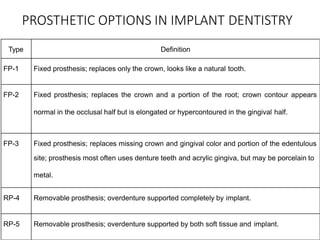
PROSTHETIC OPTIONS IN IMPLANT DENTISTRY
Type Definition
FP-1 Fixed prosthesis; replaces only the crown, looks like a natural tooth.
FP-2 Fixed prosthesis; replaces the crown and a portion of the root; crown contour appears
normal in the occlusal half but is elongated or hypercontoured in the gingival half.
FP-3 Fixed prosthesis; replaces missing crown and gingival color and portion of the edentulous
site; prosthesis most often uses denture teeth and acrylic gingiva, but may be porcelain to
metal.
RP-4 Removable prosthesis; overdenture supported completely by implant.
RP-5 Removable prosthesis; overdenture supported by both soft tissue and implant.
INDICATIONS
• Severe morphologic compromise of denture
supporting areas that significantly undermine denture
retention.
• Poor oral muscular coordination
• Low tolerance of mucosal tissues
• Parafunctional habits leading to recurrent soreness
and instability of prosthesis.
• Unrealistic prosthodontic expectations .
• Active or hyperactive gag reflexes.
CONTRAINDICATIONS
•Recent myocardial infarction
• Valvular prosthesis
•Severe renal disorder
•Treatment-resistant diabetes
•Generalized secondary osteoporosis
•Chronic and severe alcoholism
•Treatment – resistant osteomalacia
•Radiotherapy in progress
•Severe hormone deficiency
•Drug addiction
•Heavy smoking habits
ADVANTAGES
• Minimum anterior bone loss; prevents bone loss
• Improved esthetics
• Improved stability (reduces or eliminates prosthesis
movement)
• Improved occlusion (reproducible centric relation
occlusion)
• Decrease in soft tissue abrasions
• Improved chewing efficiency and force
• Improved retention
• Improved support
• Improved speech
• Reduced prosthesis size (eliminates
palate flanges)
• Improved maxillofacial prosthesis
CONVENTIONAL DENTURES Vs. IMPLANT
OVERDENTURES
• Patient satisfaction increased when mandibular implant
overdentures were used instead of conventional complete dentures
(Burns, 1995;Boerrigter, 1995).
• Implant overdentures generally offer the advantages of improved
comfort, support, retention, and stability.
• Annual bone resorption is more pronounced in patients who wear
conventional complete dentures than implant overdentures (Jacobs,
1993).
NATURAL TOOTH OVERDENTURES v/sIMPLANT
OVERDENTURES
•Overdentures supported by implants have a higher
probability of success than mandibular
overdentures supported by the roots of natural
teeth (Mericske-Stern, 1994).
IMPLANT OVERDENTURE VS FIXED
PROSTHESIS
• 1. A smaller number of implants are required and that decreases the
cost. (Johns, 1992; Cune, 1994).
• 2. It is possible to provide better support of the facial soft tissues
(Johns,1992; Cune, 1994; Mericske-Stern, 1998).
• 3. There is improved phonetics for completely edentulous patients.
(Jemt,1992; Smedberg, 1993; Cune, 1994; Mericske-Stern, 1998).
• 4. Patients have enhanced access for oral hygiene . (Johns, 1992;
Mericske-Stern, 1998).
• 5. There is a better result when unfavorable jaw relationships are
present (Cune, 1994).
• 6. When there is an opposing complete denture, it will be more stable;
particularly when there is a resorbed residual ridge (Johns, 1992;
Hutton,1995).
• 7. It is easier to make modifications to the prosthesis base (Mericske-
Stern,1998).
• 8. There is better access for inspection of the surgical site when
surgically created oral defects are present (Mericske-Stern, 1998).
DISADVANTAGES
• Does not satisfy the psychologic need of these
patients
• It requires proper plaque control and denture
hygiene.
• It is more costly compared to complete dentures.
• They are bulkier than many other restorations.
• More load to the prosthesis ,
• The lack of sufficient interarch space makes an
overdenture system more difficult to fabricate and
more prone to component fatigue and fracture.
OVERVIEW OF TREATMENT PLANNING
•Medical evaluation
•Dental evaluation
•Formulation of treatment plan
MEDICAL EVALUATION
•Medical history (like heart disease, hepatitis,
AIDS)
•Vital signs
•Complete blood count
•Urinalysis
•Chest X-ray and Electrocardiogram
DENTAL EVALUATION
• Dental history
• Clinical evaluation
• Diagnostic records
• Patient expectations
FORMULATION OF TREATMENT
PLANNING
•Diagnostic records
•Transitional prosthesis
•Surgical/fixture placement
•Surgical / fixture connection
•Definitive restoration
•Maintenance
• PM0 : No movement of prosthesis, requires implant support
similar to fixed prosthesis
• PM2: Prosthesis with hinge motion
• PM 3: Prosthesis with hinge and apicalmotion
• PM 4: Allows movement in fourdirections
• PM 6: All ranges of prosthesismovement
OVERDENTURE MOVEMENT: (PM)
Misch (1985)
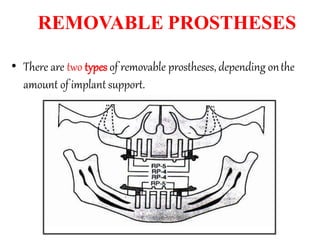
REMOVABLE PROSTHESES
• There are two types of removable prostheses, depending onthe
amount of implant support.
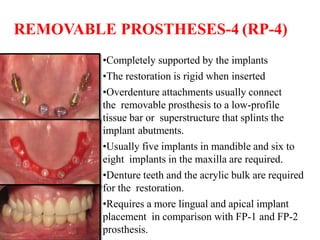
REMOVABLE PROSTHESES-4 (RP-4)
•Completely supported by the implants
•The restoration is rigid when inserted
•Overdenture attachments usually connect
the removable prosthesis to a low-profile
tissue bar or superstructure that splints the
implant abutments.
•Usually five implants in mandible and six to
eight implants in the maxilla are required.
•Denture teeth and the acrylic bulk are required
for the restoration.
•Requires a more lingual and apical implant
placement in comparison with FP-1 and FP-2
prosthesis.
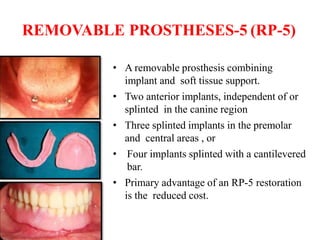
REMOVABLE PROSTHESES-5 (RP-5)
• A removable prosthesis combining
implant and soft tissue support.
• Two anterior implants, independent of or
splinted in the canine region
• Three splinted implants in the premolar
and central areas , or
• Four implants splinted with a cantilevered
bar.
• Primary advantage of an RP-5 restoration
is the reduced cost.
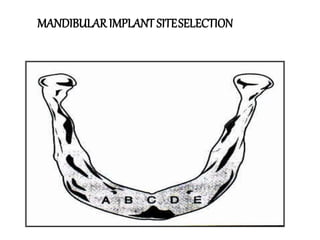
MANDIBULARIMPLANT SITESELECTION
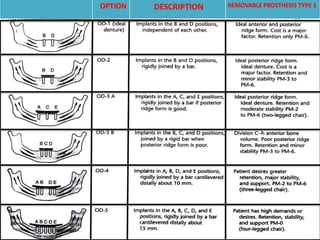
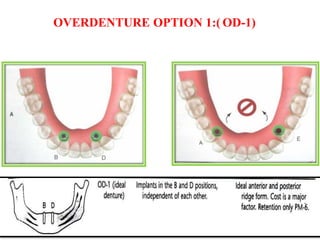
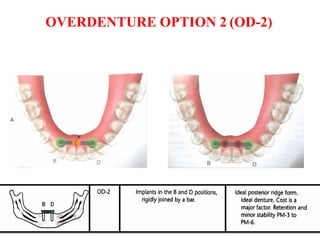
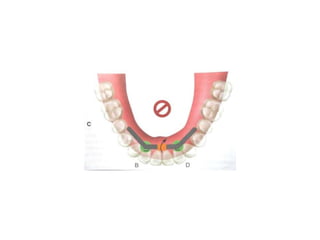
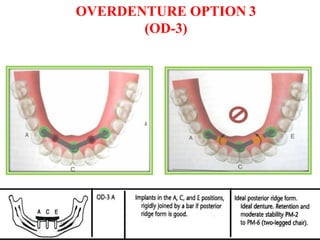
OPTION DESCRIPTION REMOVABLE PROSTHESIS TYPE 5
OVERDENTURE OPTION 1:( OD-1)
OVERDENTURE OPTION 2 (OD-2)
OVERDENTURE OPTION 3
(OD-3)
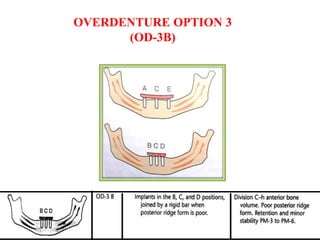
OVERDENTURE OPTION 3
(OD-3B)
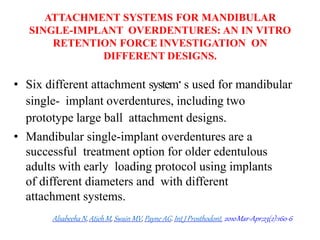
OVERDENTURE OPTION 4
(OD-4)
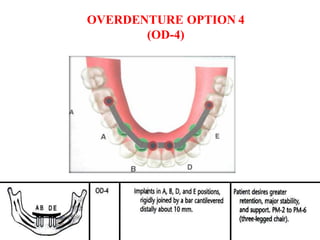
OVERDENTURE OPTION 5
(OD-5)
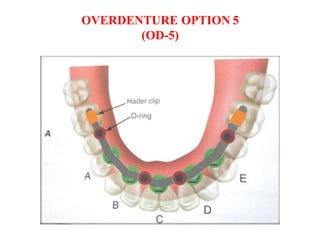
ARCH FORMS
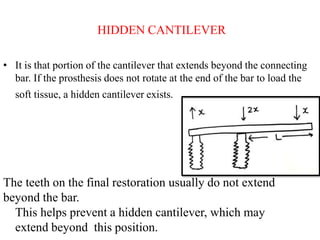
HIDDEN CANTILEVER
• It is that portion of the cantilever that extends beyond the connecting
bar. If the prosthesis does not rotate at the end of the bar to load the
soft tissue, a hidden cantilever exists.
The teeth on the final restoration usually do not extend
beyond the bar.
This helps prevent a hidden cantilever, which may
extend beyond this position.
MAXILLARY OVERDENTURE
• Only two treatment options are available.
• Independent implants are not an optionbecause bone
quality and force direction are severely compromised.
• Cantilever bars are usually not recommended for the
same reasons.
• The crown height space:
• 15 mm- anterior space
• 12 mm- posterior space
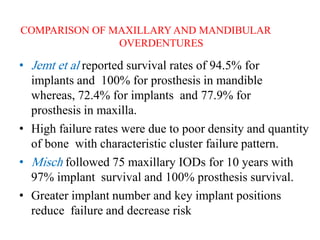
COMPARISON OF MAXILLARYAND MANDIBULAR
OVERDENTURES
• Jemt et al reported survival rates of 94.5% for
implants and 100% for prosthesis in mandible
whereas, 72.4% for implants and 77.9% for
prosthesis in maxilla.
• High failure rates were due to poor density and quantity
of bone with characteristic cluster failure pattern.
• Misch followed 75 maxillary IODs for 10 years with
97% implant survival and 100% prosthesis survival.
• Greater implant number and key implant positions
reduce failure and decrease risk
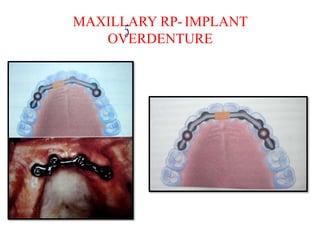
MAXILLARY RP- IMPLANT
OVERDENTURE
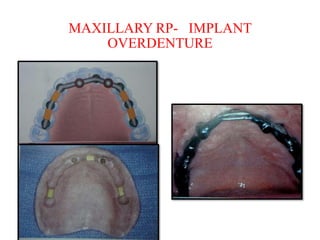
MAXILLARY RP- IMPLANT
OVERDENTURE
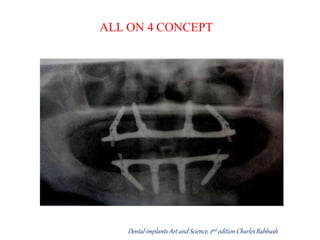
ALL ON 4 CONCEPT
Dental implantsArt and Science,2nd editionCharlesBabbush
ALL ON 4 CONCEPT
• Optimal number of four implants for supporting an
edentulous jaw with a complete arch prosthesis.
• The concept benefits from posterior tilting of the two distal implants
with a maximum of a two teeth distal cantilever in the prosthesis.
DentalimplantsArt and Science,2nd edition CharlesBabbush
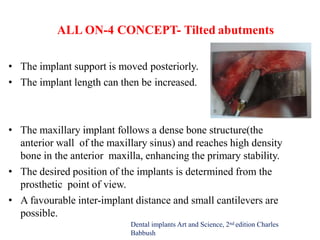
ALL ON-4 CONCEPT- Tilted abutments
• The implant support is moved posteriorly.
• The implant length can then be increased.
• The maxillary implant follows a dense bone structure(the
anterior wall of the maxillary sinus) and reaches high density
bone in the anterior maxilla, enhancing the primary stability.
• The desired position of the implants is determined from the
prosthetic point of view.
• A favourable inter-implant distance and small cantilevers are
possible.
Dental implants Art and Science, 2nd edition Charles
Babbush
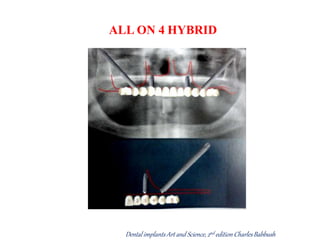
ALL ON 4 HYBRID
Dental implantsArt and Science,2nd editionCharlesBabbush
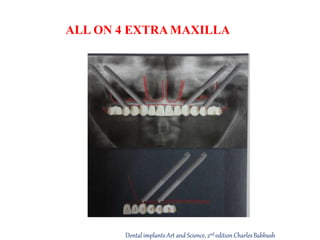
ALL ON 4 EXTRA MAXILLA
Dental implants Art and Science, 2nd edition CharlesBabbush
• Elimination of bone grafting procedures:
1. Shorter treatment plan,
2. Less patient morbidity,
3. Decreased cost,
4. Immediate restoration.
• Increase in A-P spread more stable prosthesis.
• Elimination or shortening of cantilevers.
• Avoidance of various anatomic structures.
• Fewer implants to support the prosthesis.
ALL ON 4 CONCEPTADVANTAGES
Maxillary All on Four Therapy using Angled Implants, Dent Clin N Am 55(2011) 779-794
SINGLE IMPLANT SUPPORTED OVERDENTURE
• High implant success rate have been achieved by
using 2 or more implants to anchor an overdenture
(Stephan et al., 2007; Bergendal and Engquist, 1998; Chiapasco et al., 2001;
Payne et al., 2001).
• Because mandible is hinge-like and its buttressing
lingual bone is shock absorbing, use of 2 implants
is optimal for support and retention of overdenture
and also some researches know this as a standard
for edentulous mandible (Lee and Agar, 2006; Sadowsky and
Caputo, 2004).
• Yet many patients could not receive implants
treatment because of financial problems and
with regard to a recent studies that report
immediate loaded single implant retained
overdenture as a safe, reliable and cost
effective treatment (Chiapasco et al., 2001; Liddelow and
Henry, 2007, 2010; Kronstrom and Davis, 2010).
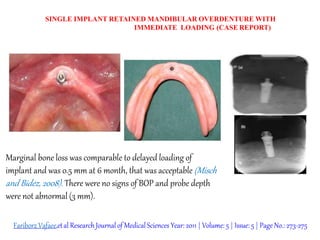
SINGLE IMPLANT RETAINED MANDIBULAR OVERDENTURE WITH
IMMEDIATE LOADING (CASE REPORT)
Marginal bone loss was comparable to delayed loading of
implant and was 0.5 mm at 6 month, that was acceptable (Misch
and Bidez, 2008). There were no signs of BOP and probe depth
were not abnormal (3 mm).
Fariborz Vafaee,etal ResearchJournal of Medical Sciences Year: 2011 | Volume: 5 | Issue: 5 | Page No.: 273-275
ATTACHMENT SYSTEMS FOR MANDIBULAR
SINGLE-IMPLANT OVERDENTURES: AN IN VITRO
RETENTION FORCE INVESTIGATION ON
DIFFERENT DESIGNS.
• Six different attachment system.s used for mandibular
single- implant overdentures, including two
prototype large ball attachment designs.
• Mandibular single-implant overdentures are a
successful treatment option for older edentulous
adults with early loading protocol using implants
of different diameters and with different
attachment systems.
AlsabeehaN, Atieh M, Swain MV, Payne AG. Int J Prosthodont. 2010Mar-Apr;23(2):160-6
THANK YOU

implant supported overdentures .pdf

  • 1.
    IMPLANT SUPPORTED OVERDENTURES Prepared by: Abd El-Rahman Gamal Sanad Osama Tarek Ali
  • 2.
    Introduction •An implant-supported hybridprosthesis is an acrylic resin complete fixed dental prosthesis supported by implants •Might be a solution in extreme cases that the need of the restoration for esthetics, function, lip support, and speech.
  • 3.
    • For decades,natural teeth have been retained in the mouths to support/retain overdentures and preserve bone. • Overdentures supported by implants have a higher probability of success than overdentures supported by the roots of natural teeth (Mericske-Stern, 1994)
  • 4.
    DEFINITION • An overdentureis defined as a removable prosthesis that covers the entire occlusal surface of a root or implant ( Harold W Preiskel). • Any removable dental prosthesis that covers and rests on one or more remaining natural teeth, the roots of natural teeth, and/or dental implants
  • 5.
    DEVELOPMENT OF OVERDENTURES •In 1856, Ledger described a prosthesis resembling an overdenture. His restorations were referred to as “Plates covering fangs”. • In 1861 a conference held in Connecticut, increased the awareness of the value of such roots in supporting a covering denture. • In 1888 Evans had described a method of using roots actually to retain restorations.
  • 6.
    • In 1896Essig had prescribed a telescopic like coping. At the same time Peeso also described a removable telescopic prosthesis. • In 1909 a great blow was delivered by William Hunter by way of his “focal sepsis theory”. • In 1976 Rothman stated that Hunter’s comments gave dentistry a black eye.
  • 7.
    PROSTHETIC OPTIONS INIMPLANT DENTISTRY Type Definition FP-1 Fixed prosthesis; replaces only the crown, looks like a natural tooth. FP-2 Fixed prosthesis; replaces the crown and a portion of the root; crown contour appears normal in the occlusal half but is elongated or hypercontoured in the gingival half. FP-3 Fixed prosthesis; replaces missing crown and gingival color and portion of the edentulous site; prosthesis most often uses denture teeth and acrylic gingiva, but may be porcelain to metal. RP-4 Removable prosthesis; overdenture supported completely by implant. RP-5 Removable prosthesis; overdenture supported by both soft tissue and implant.
  • 8.
    INDICATIONS • Severe morphologiccompromise of denture supporting areas that significantly undermine denture retention. • Poor oral muscular coordination • Low tolerance of mucosal tissues • Parafunctional habits leading to recurrent soreness and instability of prosthesis.
  • 9.
    • Unrealistic prosthodonticexpectations . • Active or hyperactive gag reflexes.
  • 10.
    CONTRAINDICATIONS •Recent myocardial infarction •Valvular prosthesis •Severe renal disorder •Treatment-resistant diabetes •Generalized secondary osteoporosis
  • 11.
    •Chronic and severealcoholism •Treatment – resistant osteomalacia •Radiotherapy in progress •Severe hormone deficiency •Drug addiction •Heavy smoking habits
  • 12.
    ADVANTAGES • Minimum anteriorbone loss; prevents bone loss • Improved esthetics • Improved stability (reduces or eliminates prosthesis movement) • Improved occlusion (reproducible centric relation occlusion) • Decrease in soft tissue abrasions • Improved chewing efficiency and force
  • 13.
    • Improved retention •Improved support • Improved speech • Reduced prosthesis size (eliminates palate flanges) • Improved maxillofacial prosthesis
  • 14.
    CONVENTIONAL DENTURES Vs.IMPLANT OVERDENTURES • Patient satisfaction increased when mandibular implant overdentures were used instead of conventional complete dentures (Burns, 1995;Boerrigter, 1995). • Implant overdentures generally offer the advantages of improved comfort, support, retention, and stability. • Annual bone resorption is more pronounced in patients who wear conventional complete dentures than implant overdentures (Jacobs, 1993).
  • 15.
    NATURAL TOOTH OVERDENTURESv/sIMPLANT OVERDENTURES •Overdentures supported by implants have a higher probability of success than mandibular overdentures supported by the roots of natural teeth (Mericske-Stern, 1994).
  • 16.
    IMPLANT OVERDENTURE VSFIXED PROSTHESIS • 1. A smaller number of implants are required and that decreases the cost. (Johns, 1992; Cune, 1994). • 2. It is possible to provide better support of the facial soft tissues (Johns,1992; Cune, 1994; Mericske-Stern, 1998). • 3. There is improved phonetics for completely edentulous patients. (Jemt,1992; Smedberg, 1993; Cune, 1994; Mericske-Stern, 1998). • 4. Patients have enhanced access for oral hygiene . (Johns, 1992; Mericske-Stern, 1998).
  • 17.
    • 5. Thereis a better result when unfavorable jaw relationships are present (Cune, 1994). • 6. When there is an opposing complete denture, it will be more stable; particularly when there is a resorbed residual ridge (Johns, 1992; Hutton,1995). • 7. It is easier to make modifications to the prosthesis base (Mericske- Stern,1998). • 8. There is better access for inspection of the surgical site when surgically created oral defects are present (Mericske-Stern, 1998).
  • 18.
    DISADVANTAGES • Does notsatisfy the psychologic need of these patients • It requires proper plaque control and denture hygiene. • It is more costly compared to complete dentures. • They are bulkier than many other restorations. • More load to the prosthesis , • The lack of sufficient interarch space makes an overdenture system more difficult to fabricate and more prone to component fatigue and fracture.
  • 19.
    OVERVIEW OF TREATMENTPLANNING •Medical evaluation •Dental evaluation •Formulation of treatment plan
  • 20.
    MEDICAL EVALUATION •Medical history(like heart disease, hepatitis, AIDS) •Vital signs •Complete blood count •Urinalysis •Chest X-ray and Electrocardiogram
  • 21.
    DENTAL EVALUATION • Dentalhistory • Clinical evaluation • Diagnostic records • Patient expectations
  • 22.
    FORMULATION OF TREATMENT PLANNING •Diagnosticrecords •Transitional prosthesis •Surgical/fixture placement •Surgical / fixture connection •Definitive restoration •Maintenance
  • 23.
    • PM0 :No movement of prosthesis, requires implant support similar to fixed prosthesis • PM2: Prosthesis with hinge motion • PM 3: Prosthesis with hinge and apicalmotion • PM 4: Allows movement in fourdirections • PM 6: All ranges of prosthesismovement OVERDENTURE MOVEMENT: (PM) Misch (1985)
  • 24.
    REMOVABLE PROSTHESES • Thereare two types of removable prostheses, depending onthe amount of implant support.
  • 25.
    REMOVABLE PROSTHESES-4 (RP-4) •Completelysupported by the implants •The restoration is rigid when inserted •Overdenture attachments usually connect the removable prosthesis to a low-profile tissue bar or superstructure that splints the implant abutments. •Usually five implants in mandible and six to eight implants in the maxilla are required. •Denture teeth and the acrylic bulk are required for the restoration. •Requires a more lingual and apical implant placement in comparison with FP-1 and FP-2 prosthesis.
  • 26.
    REMOVABLE PROSTHESES-5 (RP-5) •A removable prosthesis combining implant and soft tissue support. • Two anterior implants, independent of or splinted in the canine region • Three splinted implants in the premolar and central areas , or • Four implants splinted with a cantilevered bar. • Primary advantage of an RP-5 restoration is the reduced cost.
  • 27.
  • 28.
  • 29.
  • 30.
  • 32.
  • 33.
  • 34.
  • 35.
  • 36.
  • 37.
    HIDDEN CANTILEVER • Itis that portion of the cantilever that extends beyond the connecting bar. If the prosthesis does not rotate at the end of the bar to load the soft tissue, a hidden cantilever exists. The teeth on the final restoration usually do not extend beyond the bar. This helps prevent a hidden cantilever, which may extend beyond this position.
  • 38.
    MAXILLARY OVERDENTURE • Onlytwo treatment options are available. • Independent implants are not an optionbecause bone quality and force direction are severely compromised. • Cantilever bars are usually not recommended for the same reasons. • The crown height space: • 15 mm- anterior space • 12 mm- posterior space
  • 39.
    COMPARISON OF MAXILLARYANDMANDIBULAR OVERDENTURES • Jemt et al reported survival rates of 94.5% for implants and 100% for prosthesis in mandible whereas, 72.4% for implants and 77.9% for prosthesis in maxilla. • High failure rates were due to poor density and quantity of bone with characteristic cluster failure pattern. • Misch followed 75 maxillary IODs for 10 years with 97% implant survival and 100% prosthesis survival. • Greater implant number and key implant positions reduce failure and decrease risk
  • 40.
  • 41.
  • 42.
    ALL ON 4CONCEPT Dental implantsArt and Science,2nd editionCharlesBabbush
  • 43.
    ALL ON 4CONCEPT • Optimal number of four implants for supporting an edentulous jaw with a complete arch prosthesis. • The concept benefits from posterior tilting of the two distal implants with a maximum of a two teeth distal cantilever in the prosthesis. DentalimplantsArt and Science,2nd edition CharlesBabbush
  • 44.
    ALL ON-4 CONCEPT-Tilted abutments • The implant support is moved posteriorly. • The implant length can then be increased. • The maxillary implant follows a dense bone structure(the anterior wall of the maxillary sinus) and reaches high density bone in the anterior maxilla, enhancing the primary stability. • The desired position of the implants is determined from the prosthetic point of view. • A favourable inter-implant distance and small cantilevers are possible. Dental implants Art and Science, 2nd edition Charles Babbush
  • 45.
    ALL ON 4HYBRID Dental implantsArt and Science,2nd editionCharlesBabbush
  • 46.
    ALL ON 4EXTRA MAXILLA Dental implants Art and Science, 2nd edition CharlesBabbush
  • 47.
    • Elimination ofbone grafting procedures: 1. Shorter treatment plan, 2. Less patient morbidity, 3. Decreased cost, 4. Immediate restoration. • Increase in A-P spread more stable prosthesis. • Elimination or shortening of cantilevers. • Avoidance of various anatomic structures. • Fewer implants to support the prosthesis. ALL ON 4 CONCEPTADVANTAGES Maxillary All on Four Therapy using Angled Implants, Dent Clin N Am 55(2011) 779-794
  • 48.
    SINGLE IMPLANT SUPPORTEDOVERDENTURE • High implant success rate have been achieved by using 2 or more implants to anchor an overdenture (Stephan et al., 2007; Bergendal and Engquist, 1998; Chiapasco et al., 2001; Payne et al., 2001). • Because mandible is hinge-like and its buttressing lingual bone is shock absorbing, use of 2 implants is optimal for support and retention of overdenture and also some researches know this as a standard for edentulous mandible (Lee and Agar, 2006; Sadowsky and Caputo, 2004).
  • 49.
    • Yet manypatients could not receive implants treatment because of financial problems and with regard to a recent studies that report immediate loaded single implant retained overdenture as a safe, reliable and cost effective treatment (Chiapasco et al., 2001; Liddelow and Henry, 2007, 2010; Kronstrom and Davis, 2010).
  • 50.
    SINGLE IMPLANT RETAINEDMANDIBULAR OVERDENTURE WITH IMMEDIATE LOADING (CASE REPORT) Marginal bone loss was comparable to delayed loading of implant and was 0.5 mm at 6 month, that was acceptable (Misch and Bidez, 2008). There were no signs of BOP and probe depth were not abnormal (3 mm). Fariborz Vafaee,etal ResearchJournal of Medical Sciences Year: 2011 | Volume: 5 | Issue: 5 | Page No.: 273-275
  • 51.
    ATTACHMENT SYSTEMS FORMANDIBULAR SINGLE-IMPLANT OVERDENTURES: AN IN VITRO RETENTION FORCE INVESTIGATION ON DIFFERENT DESIGNS. • Six different attachment system.s used for mandibular single- implant overdentures, including two prototype large ball attachment designs. • Mandibular single-implant overdentures are a successful treatment option for older edentulous adults with early loading protocol using implants of different diameters and with different attachment systems. AlsabeehaN, Atieh M, Swain MV, Payne AG. Int J Prosthodont. 2010Mar-Apr;23(2):160-6
  • 52.