TOLERANCE
TOLERANCE
Dr kenneth Lado Lino
School of Medicine
School of Medicine
,
,
University of Juba
University of Juba
.
.
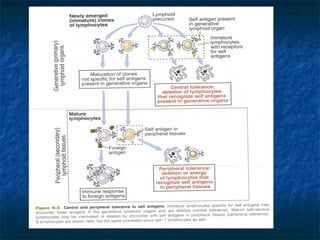
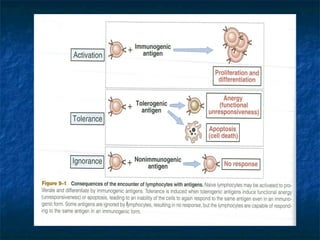
Tolerance
Tolerance
Topic:
Topic: Immunological Tolerance
Immunological Tolerance
Objectives:
Objectives:
 Define Immunological tolerance
Define Immunological tolerance
 Discuss mechanism of tolerance induction
Discuss mechanism of tolerance induction
 Know types of tolerance
Know types of tolerance
 Central thymic
Central thymic
 Peripheral post thymic
Peripheral post thymic
 Explain B cell tolerance to self antigens
Explain B cell tolerance to self antigens
 Discuss artificial induction of tolerance
Discuss artificial induction of tolerance
 Know therapeutic applications of tolerance
Know therapeutic applications of tolerance
Immune tolerance
Immune tolerance or
or
immunological tolerance

is the process by which the
is the process by which the immune system
does not attack an
does not attack an antigen.
.
 It can be either :
It can be either :
1) Natural' or 'self tolerance
1) Natural' or 'self tolerance', where the body
', where the body
does not mount an immune response to self
antigens.
antigens.
2) Induced tolerance
2) Induced tolerance', where tolerance to
', where tolerance to
external antigens can be created by
manipulating the immune system.
 It occurs in three forms: central tolerance,
It occurs in three forms: central tolerance,
peripheral tolerance and acquired tolerance.
Definitions
Definitions
:
:
 Tolerance
Tolerance is a state of unresponsiveness that is
is a state of unresponsiveness that is
specific for a particular antigen
 Self tolerance
Self tolerance is the mechanisms by which the
is the mechanisms by which the
body is prevented from mounting an immune
response against its own tissues.
 Self reactivity
Self reactivity is prevented by processes during
is prevented by processes during
development rather than being programmed.
Factors influencing tolerance
 Molecule structure
Molecule structure
 Stage of differentiation when
Stage of differentiation when
lymphocyte first encounter the epitopes
 The site of the encounter
The site of the encounter
 The nature of the cell presenting the
The nature of the cell presenting the
epitopes
epitopes
 Number of responding lymphocytes
Number of responding lymphocytes
Q. What is an epitope?
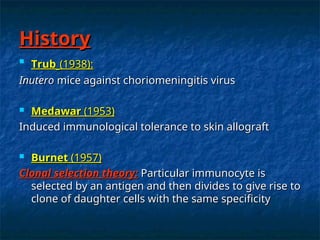
History
History

Trub
Trub (1938):
(1938):
Inutero
Inutero mice against choriomeningitis virus
mice against choriomeningitis virus
 Medawar
Medawar (1953)
(1953)
Induced immunological tolerance to skin allograft
 Burnet
Burnet (1957)
(1957)
Clonal selection theory:
Clonal selection theory: Particular immunocyte is
Particular immunocyte is
selected by an antigen and then divides to give rise to
clone of daughter cells with the same specificity
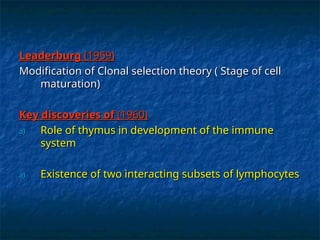
Leaderburg
Leaderburg (1959)
(1959)
Modification of Clonal selection theory ( Stage of cell
maturation)
maturation)
Key discoveries of
Key discoveries of (1960)
(1960)
a)
a) Role of thymus in development of the immune
Role of thymus in development of the immune
system
system
a)
a) Existence of two interacting subsets of lymphocytes
Existence of two interacting subsets of lymphocytes
Types of Tolerance
Types of Tolerance
 Central Tolerance
Central Tolerance :
:
It occurs during lymphocyte
development.
development.
[Thymus or Bone marrow]
[Thymus or Bone marrow]
 Peripheral Tolerance
Peripheral Tolerance :
:
Occurs after lymphocytes leave the
primary organs.
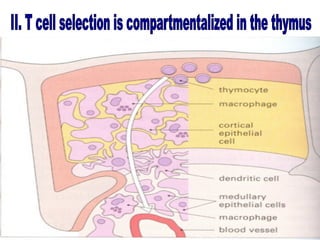
primary organs.
Central thymic Tolerance to Self Antigens
 The immune system generates a vast array of
The immune system generates a vast array of
TCRs
TCRs
 T cells are not only effector cells but are also
T cells are not only effector cells but are also
regulators of the immune system
 T cells become
T cells become “
“educated
educated”
” in the thymus
in the thymus
 They become dependant on self MHC for
They become dependant on self MHC for
survival
survival
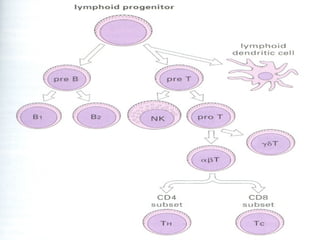
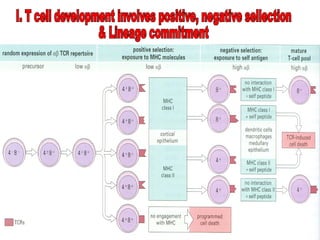
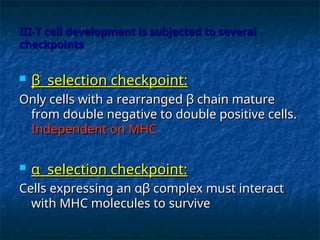
III-T cell development is subjected to several
checkpoints
checkpoints
 β
β selection checkpoint:
selection checkpoint:
Only cells with a rearranged
Only cells with a rearranged β
β chain mature
chain mature
from double negative to double positive cells.
Independent on MHC
Independent on MHC
 α
α selection checkpoint:
selection checkpoint:
Cells expressing an
Cells expressing an αβ
αβ complex must interact
complex must interact
with MHC molecules to survive
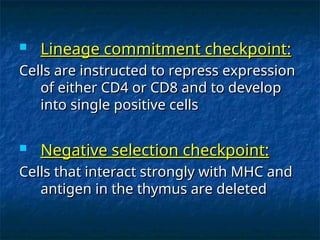
 Lineage commitment checkpoint:
Lineage commitment checkpoint:
Cells are instructed to repress expression
of either CD4 or CD8 and to develop
into single positive cells
 Negative selection checkpoint:
Negative selection checkpoint:
Cells that interact strongly with MHC and
antigen in the thymus are deleted
Peripheral or Post-Thymic Tolerance to
Self Antigens
Self Antigens
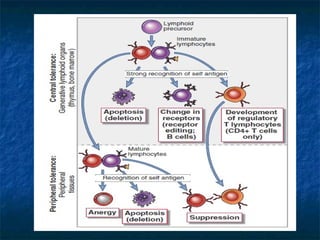
Many auto-reactive T cells escape central
tolerance due to:
tolerance due to:
a)
a) Antigens are absent
Antigens are absent
b)
b) Antigens are insufficient
Antigens are insufficient
However, tolerance is maintained by
mechanisms in peripheral lymphoid organs
1-Sequestration of antigens in some tissues:
Many self antigens are hidden in tissues that are
anatomically located away from T lymphocytes
2-
2- Privileged sites are protected by regulatory
Privileged sites are protected by regulatory
mechanisms
mechanisms:
:
Privileged sites include brain, testes and anterior champers
of the eye
of the eye
In these sites lymphocytes are controlled by apoptosis or
cytokines such as TNF
cytokines such as TNFβ
β and IL10
and IL10
These mechanisms include:
3- T cell death can be induced by persistent
activation or neglect:
-
-Cells possess Fas receptor , when it cross-links with its
Cells possess Fas receptor , when it cross-links with its
ligand FasL it promote apoptopic cell death.
- Activated lymphocyte will die by passive cell death (PCD)
Activated lymphocyte will die by passive cell death (PCD)
when deprived from its antigen
4- Regulation by suppressive cytokines
IL-2 and IL-2 receptor regulate sensitivity to Fas mediated
apoptosis
apoptosis
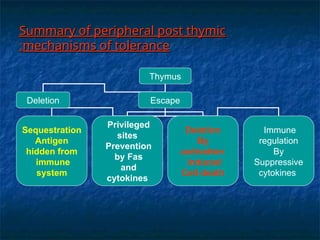
Summary of peripheral post thymic
mechanisms of tolerance
:
:
Thymus
Deletion Escape
Immune
regulation
By
Suppressive
cytokines
Deletion
By
activation
-
induced
Cell death
Sequestration
Antigen
hidden from
immune
system
Privileged
sites
Prevention
by Fas
and
cytokines
B- Cell Tolerance to Self Antigens
 High affinity IgG production is T cell dependent
High affinity IgG production is T cell dependent
 Lack of T cell leads to non-self reactivity by B
Lack of T cell leads to non-self reactivity by B
cells
cells
 Self reactive B cells either:
Self reactive B cells either:
a)
a) Edit their receptors to become non-reactive
Edit their receptors to become non-reactive
b)
b) Die by the process of apoptosis
Die by the process of apoptosis
 In peripheral B cell tolerance
In peripheral B cell tolerance,
, self reactive cells
self reactive cells
are removed by negative selection in the
spleen in a process that is similar to T cell
removal in the thymus.
B cell tolerance in the BM
During B cell development in the bone marrow:
 The complete antigen receptor (IgM) is first
The complete antigen receptor (IgM) is first
expressed on 'immature' B cells
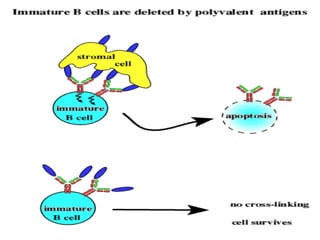
 If those cells encounter their target antigen in a form
If those cells encounter their target antigen in a form
which can
which can cross-link
cross-link their IgM then such cells are
their IgM then such cells are
programmed to die
programmed to die
 The requirement for cross-linking means that the
The requirement for cross-linking means that the
antigen has to be
antigen has to be polyvalent
polyvalent
Potential clinical applications for
tolerance
tolerance
:
:
 Understanding of tolerance is valuable in
Understanding of tolerance is valuable in
many ways
many ways:
:
 Promote tolerance to tissue graft
Promote tolerance to tissue graft
 Control damaging immune response in
Control damaging immune response in
hypersensitivity
hypersensitivity
 Control damaging in autoimmune disease
Control damaging in autoimmune disease
 Limit tumor growth
Limit tumor growth

Tolerance in immunology presentation..ppt

  • 1.
    TOLERANCE TOLERANCE Dr kenneth LadoLino Dr kenneth Lado Lino School of Medicine School of Medicine , , University of Juba University of Juba . .
  • 2.
    Tolerance Tolerance Topic: Topic: Immunological Tolerance ImmunologicalTolerance Objectives: Objectives:  Define Immunological tolerance Define Immunological tolerance  Discuss mechanism of tolerance induction Discuss mechanism of tolerance induction  Know types of tolerance Know types of tolerance  Central thymic Central thymic  Peripheral post thymic Peripheral post thymic  Explain B cell tolerance to self antigens Explain B cell tolerance to self antigens  Discuss artificial induction of tolerance Discuss artificial induction of tolerance  Know therapeutic applications of tolerance Know therapeutic applications of tolerance
  • 3.
    Immune tolerance Immune toleranceor or immunological tolerance immunological tolerance  is the process by which the is the process by which the immune system does not attack an does not attack an antigen. .  It can be either : It can be either : 1) Natural' or 'self tolerance 1) Natural' or 'self tolerance', where the body ', where the body does not mount an immune response to self does not mount an immune response to self antigens. antigens. 2) Induced tolerance 2) Induced tolerance', where tolerance to ', where tolerance to external antigens can be created by external antigens can be created by manipulating the immune system. manipulating the immune system.  It occurs in three forms: central tolerance, It occurs in three forms: central tolerance, peripheral tolerance and acquired tolerance. peripheral tolerance and acquired tolerance.
  • 4.
    Definitions Definitions : :  Tolerance Tolerance isa state of unresponsiveness that is is a state of unresponsiveness that is specific for a particular antigen specific for a particular antigen  Self tolerance Self tolerance is the mechanisms by which the is the mechanisms by which the body is prevented from mounting an immune body is prevented from mounting an immune response against its own tissues. response against its own tissues.  Self reactivity Self reactivity is prevented by processes during is prevented by processes during development rather than being programmed. development rather than being programmed.
  • 5.
    Factors influencing tolerance Factorsinfluencing tolerance  Molecule structure Molecule structure  Stage of differentiation when Stage of differentiation when lymphocyte first encounter the epitopes lymphocyte first encounter the epitopes  The site of the encounter The site of the encounter  The nature of the cell presenting the The nature of the cell presenting the epitopes epitopes  Number of responding lymphocytes Number of responding lymphocytes Q. What is an epitope? Q. What is an epitope?
  • 6.
    History History  Trub Trub (1938): (1938): Inutero Inutero miceagainst choriomeningitis virus mice against choriomeningitis virus  Medawar Medawar (1953) (1953) Induced immunological tolerance to skin allograft Induced immunological tolerance to skin allograft  Burnet Burnet (1957) (1957) Clonal selection theory: Clonal selection theory: Particular immunocyte is Particular immunocyte is selected by an antigen and then divides to give rise to selected by an antigen and then divides to give rise to clone of daughter cells with the same specificity clone of daughter cells with the same specificity
  • 7.
    Leaderburg Leaderburg (1959) (1959) Modification ofClonal selection theory ( Stage of cell Modification of Clonal selection theory ( Stage of cell maturation) maturation) Key discoveries of Key discoveries of (1960) (1960) a) a) Role of thymus in development of the immune Role of thymus in development of the immune system system a) a) Existence of two interacting subsets of lymphocytes Existence of two interacting subsets of lymphocytes
  • 10.
    Types of Tolerance Typesof Tolerance  Central Tolerance Central Tolerance : : It occurs during lymphocyte It occurs during lymphocyte development. development. [Thymus or Bone marrow] [Thymus or Bone marrow]  Peripheral Tolerance Peripheral Tolerance : : Occurs after lymphocytes leave the Occurs after lymphocytes leave the primary organs. primary organs.
  • 12.
    Central thymic Toleranceto Self Antigens Central thymic Tolerance to Self Antigens  The immune system generates a vast array of The immune system generates a vast array of TCRs TCRs  T cells are not only effector cells but are also T cells are not only effector cells but are also regulators of the immune system regulators of the immune system  T cells become T cells become “ “educated educated” ” in the thymus in the thymus  They become dependant on self MHC for They become dependant on self MHC for survival survival
  • 16.
    III-T cell developmentis subjected to several III-T cell development is subjected to several checkpoints checkpoints  β β selection checkpoint: selection checkpoint: Only cells with a rearranged Only cells with a rearranged β β chain mature chain mature from double negative to double positive cells. from double negative to double positive cells. Independent on MHC Independent on MHC  α α selection checkpoint: selection checkpoint: Cells expressing an Cells expressing an αβ αβ complex must interact complex must interact with MHC molecules to survive with MHC molecules to survive
  • 17.
     Lineage commitmentcheckpoint: Lineage commitment checkpoint: Cells are instructed to repress expression Cells are instructed to repress expression of either CD4 or CD8 and to develop of either CD4 or CD8 and to develop into single positive cells into single positive cells  Negative selection checkpoint: Negative selection checkpoint: Cells that interact strongly with MHC and Cells that interact strongly with MHC and antigen in the thymus are deleted antigen in the thymus are deleted
  • 19.
    Peripheral or Post-ThymicTolerance to Peripheral or Post-Thymic Tolerance to Self Antigens Self Antigens Many auto-reactive T cells escape central Many auto-reactive T cells escape central tolerance due to: tolerance due to: a) a) Antigens are absent Antigens are absent b) b) Antigens are insufficient Antigens are insufficient However, tolerance is maintained by However, tolerance is maintained by mechanisms in peripheral lymphoid organs mechanisms in peripheral lymphoid organs
  • 20.
    1-Sequestration of antigensin some tissues: 1-Sequestration of antigens in some tissues: Many self antigens are hidden in tissues that are Many self antigens are hidden in tissues that are anatomically located away from T lymphocytes anatomically located away from T lymphocytes 2- 2- Privileged sites are protected by regulatory Privileged sites are protected by regulatory mechanisms mechanisms: : Privileged sites include brain, testes and anterior champers Privileged sites include brain, testes and anterior champers of the eye of the eye In these sites lymphocytes are controlled by apoptosis or In these sites lymphocytes are controlled by apoptosis or cytokines such as TNF cytokines such as TNFβ β and IL10 and IL10 These mechanisms include: These mechanisms include:
  • 21.
    3- T celldeath can be induced by persistent 3- T cell death can be induced by persistent activation or neglect: activation or neglect: - -Cells possess Fas receptor , when it cross-links with its Cells possess Fas receptor , when it cross-links with its ligand FasL it promote apoptopic cell death. ligand FasL it promote apoptopic cell death. - Activated lymphocyte will die by passive cell death (PCD) Activated lymphocyte will die by passive cell death (PCD) when deprived from its antigen when deprived from its antigen 4- Regulation by suppressive cytokines 4- Regulation by suppressive cytokines IL-2 and IL-2 receptor regulate sensitivity to Fas mediated IL-2 and IL-2 receptor regulate sensitivity to Fas mediated apoptosis apoptosis
  • 22.
    Summary of peripheralpost thymic Summary of peripheral post thymic mechanisms of tolerance mechanisms of tolerance : : Thymus Deletion Escape Immune regulation By Suppressive cytokines Deletion By activation - induced Cell death Sequestration Antigen hidden from immune system Privileged sites Prevention by Fas and cytokines
  • 23.
    B- Cell Toleranceto Self Antigens B- Cell Tolerance to Self Antigens  High affinity IgG production is T cell dependent High affinity IgG production is T cell dependent  Lack of T cell leads to non-self reactivity by B Lack of T cell leads to non-self reactivity by B cells cells  Self reactive B cells either: Self reactive B cells either: a) a) Edit their receptors to become non-reactive Edit their receptors to become non-reactive b) b) Die by the process of apoptosis Die by the process of apoptosis  In peripheral B cell tolerance In peripheral B cell tolerance, , self reactive cells self reactive cells are removed by negative selection in the are removed by negative selection in the spleen in a process that is similar to T cell spleen in a process that is similar to T cell removal in the thymus. removal in the thymus.
  • 25.
    B cell tolerancein the BM B cell tolerance in the BM During B cell development in the bone marrow: During B cell development in the bone marrow:  The complete antigen receptor (IgM) is first The complete antigen receptor (IgM) is first expressed on 'immature' B cells expressed on 'immature' B cells  If those cells encounter their target antigen in a form If those cells encounter their target antigen in a form which can which can cross-link cross-link their IgM then such cells are their IgM then such cells are programmed to die programmed to die  The requirement for cross-linking means that the The requirement for cross-linking means that the antigen has to be antigen has to be polyvalent polyvalent
  • 27.
    Potential clinical applicationsfor Potential clinical applications for tolerance tolerance : :  Understanding of tolerance is valuable in Understanding of tolerance is valuable in many ways many ways: :  Promote tolerance to tissue graft Promote tolerance to tissue graft  Control damaging immune response in Control damaging immune response in hypersensitivity hypersensitivity  Control damaging in autoimmune disease Control damaging in autoimmune disease  Limit tumor growth Limit tumor growth