IMMUNIZATION
-LAKSHMISHA N
INTERNEE
 Immunity:
• Immunity is the resistance exhibited by the host to a
particular infection or toxin by the action of specific
antibodies or sensitized white blood cells.
Immunisation: Process of inducing immune response,
humoral or cell mediated.
• Seroconversion: Change from antibody negative state to
antibody positive state.
INTRODUCTION
Vaccines
• Vaccines are the preparations of live or killed
microorganisms or their products used for
immunisation
• Vaccine may contain
– live but avirulent organism, or
– killed microorganism , or
– purified macromolecular component of a
microorganism or
– a plasmid that contains a complementary DNA
encoding a microbial antigens.
Types of vaccines
• Live bacteria- BCG, Ty 21 a
• Live virus – OPV, MMR
• Killed bacteria – Pertussis, S.typhi
• Killed virus – IPV, Rabies, HAV
• Toxoid – DT, TT
• Capsular polysaccharide – HiB, Pneumo,
Meningo
• Viral subunit - HBsAg
• Bacterial subunit – Acellular pertussis
Vaccination versus Immunization
Vaccination
• Vaccination is a process of inoculating the
vaccine/ antigen into the body irrespective of
seroconversion
Immunization
• Immunization is the process of inducing
immune response in an individual either
humoral or cell mediated
National Immunization Schedule 2016
Age Vaccines
Birth BCG, OPV, Hepatitis BO
6 weeks IPV,OPV1, Pentavalent 1
10 weeks OPV2, Pentavalent 2
14 weeks IPV, OPV3, Pentavalent 3
9 months Measles
16-24 months DTwP B1, OPV4
5-6 years DTwP B2
10 years TT
16 years TT
Vitamin A 9,18,24, 30 & 36 months
Pentavalent Vaccine
• is a conjugate vaccine which combines antigens
against five infections – diphtheria, pertussis and
tetanus (DPT), hepatitis B and Hib - in a shot.
• The vaccine was rolled out as part of introducing a
vaccination against Haemophilus influenzae type B
(Hib) infection - a major cause of meningitis and
pneumonia deaths in children - in the national
immunisation schedule for infants.
-It has been estimated that control of Hib related
diseases would reduce U5MR by 4 percentage
IAP Immunization Time Table 2016
Age Vaccines
Birth BCG, OPV0, Hep-B 1
6 weeks DTwP 1, IPV 1, Hep-B 2, Hib 1, RV5 1, PCV 1
10 weeks DTwP 2, IPV 2, Hib 2, RV5 2, PCV 2
14 weeks DTwP 3, IPV 3, Hib 3, RV5 3, PCV 3
6 months OPV 1, Hep-B 3
9 months OPV 2, MMR-1
12 months Hep-A 1; 2 dose after 6 months
15 months MMR 2, Varicella 1, PCV Booster
16-18 months DTwP B1, IPV B1, Hib B1
18 months Hep-A2
2 years Booster of conjugate Typhoid vaccine
4-6 years DPT B2, OPV 3, MMR 3, Varicella 2,
10-12 years Tdap/Td every 10 years, HPV
IAP Immunization Time Table 2016
II: IAP recommended vaccines for HIGH-RISK children
(Vaccines under special circumstances)
1. Influenza vaccine
2. Meningococcal
vaccine
3. JE vaccine
4. Cholera vaccine
5. Rabies vaccine
6. Yellow fever
vaccine
7. PPSV 23
High-risk category of children:
Congenital/acquired immunodeficiency
Chronic cardiac, pulmonary, hematologic,
renal, liver disease & diabetes mellitus
Children on long term steroids, salicylates,
immunosuppressive or radiation therapy
Cerebrospinal fluid leak, Cochlear implant,
Malignancies
Children with functional/anatomic
asplenia/hyposplenia
During disease outbreaks
Laboratory personnel & health care workers
Travelers
Injection site
Intramuscular Injections Site
Preterms & neonates Anterolateral thigh (junction of
middle & lower third)Infants
Toddlers & older children Deltoid or Anterolateral thigh
Adolescents & adults Deltoid
Subcutaneous Injections Site
Infants thigh
>12 months Outer triceps
Intradermal Injections Site
All age Left deltoid
Bacille Calmette-Guerin Vaccine
 Supplied as a lyophilized freeze dried preparation in vacuum
sealed ampoules with normal saline as diluent
 In this form can be stored for 12 months at 2-8oC
 Light sensitive
 Site: Left deltoid; intradermal route; 26 gauze needle
 Dose :0.1ml
 A wheal of 5mm at injection site indicates successful i.d.
administration of the vaccine
Classical BCG reaction
2-3 weeks after BCG vaccination-
development of a papule
End of 5-6 weeks-papule increases to a size
of 4-8mm; get converted to pustule within
few days. Pustule bursts open & again get
sealed off.
This process continue for multiple times; at
the end it dries up & a crust is formed.
Crust falls off & a scar is formed by 6-12
weeks
Bacille Calmette-Guerin Vaccine
Recommendations for use
 At birth or at 6 weeks with other vaccines
 Catch-up vaccination with BCG: till 5 years of age
Polio Vaccines
 Two types of polio vaccines
 Bivalent vaccine grown in monkey kidney cell culture & stabilized
with MgCl2
 APRIL 25,2016-National Switch Date for
 tOPV bOPV
 Most heat sensitive vaccine, Strict cold
chain maintenance
 Given orally; two drops
 Contraindicated in immunodeficient children & their household
contacts
OPV
IPV
OPV
Polio Vaccines
 Formaldehyde killed poliovirus, grown in monkey
kidney cell or human diploid cells
 Contains 40, 8 & 32 D antigen units of types 1, 2 & 3
 Vaccine storage: 2-8oC; Dose: 0.5 ml i.m.
 Seroconversion rate: 90-100% after 2 doses given
after the age of 2 months & at 2 months interval.
IPV
Polio Vaccines
Recommendations for use
 Adoption of all IPV schedule; cessation of OPV from
schedule owing to its safety issues (VAPP & cVDPVs)
 The phased removal of Sabin viruses has resulted in
elimination of VDPV type 2 in parallel with eradication
of last wild polioviruses by switching from tOPV to
bOPV & mOPV
 The schedule that provide IPV first followed by OPV
can prevent VAPP while maintaining the critical
benefits conferred by OPV
 The birth dose of OPV is retained in countries where
the risk of PV transmission is high
IPV
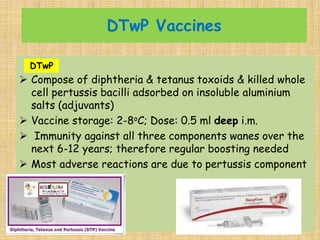
DTwP Vaccines
 Compose of diphtheria & tetanus toxoids & killed whole
cell pertussis bacilli adsorbed on insoluble aluminium
salts (adjuvants)
 Vaccine storage: 2-8oC; Dose: 0.5 ml deep i.m.
 Immunity against all three components wanes over the
next 6-12 years; therefore regular boosting needed
 Most adverse reactions are due to pertussis component
DTwP
DTwP Vaccines
 Absolute contraindications to ANY pertussis vaccine:
History of anaphylaxis or development of
encephalopathy within 7 days folllowing DTwP
vaccination
 Precaution to future dose of DTwP : persistent
inconsolable crying >3 hours, hyperpyrexia (>40.5oC),
HHE within 48 hours & seizures within 72 hours of
administration of DTwP
 Relative contraindication: progressive neurological
illness
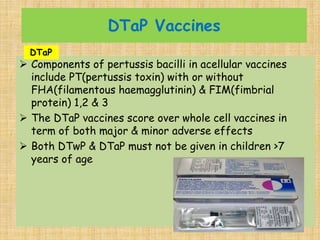
DTaP Vaccines
 Components of pertussis bacilli in acellular vaccines
include PT(pertussis toxin) with or without
FHA(filamentous haemagglutinin) & FIM(fimbrial
protein) 1,2 & 3
 The DTaP vaccines score over whole cell vaccines in
term of both major & minor adverse effects
 Both DTwP & DTaP must not be given in children >7
years of age
DTaP
 Live attenuated vaccine
 Strain: Edmonstan Zagreb strain
 Supplied as freeze-dried in single dose or multiple
dose vials with distilled water as a diluent
 Stored frozen at 2-80C
 Reconstituted vaccine: light & heat sensitive;
susceptible to contamination as it has no preservative;
should be kept at 2-80C, protected from light & used
within 4-6 hours
Measles Vaccine
 Dose: 0.5 ml by SC route at the age of completed 9
months
 In case of outbreaks, the vaccine can be given to
infants as young as completed 6 months
 In view of 15% cases of primary vaccine failure, an
additional dose of measles vaccine as MMR vaccine
at the age of 15 months is required for durable &
lifelong protection
Measles Vaccine
MMR Vaccine
 Live attenuated vaccine
 Stored frozen for long term storage
 Reconstituted vaccine should be kept at 2-80C,
protected from light & used within 4-6 hours
 Can be given with along with all others vaccine except
BCG vaccine
 Two doses:0.5ml s.c ,are recommended: one at the
age of 12-15 months & second at 4-6 years of age
 site-right deltoid
Hib conjugate Vaccine
 Conjugated vaccine- Hib polysaccharide conjugated
with a protein carrier
 Vaccine storage: 2-8oC; Dose: 0.5 ml
i.m.Anterolateral thigh
 Vaccination started between 6-12 months: two
primary doses & one booster at 18 months
 Vaccination started between 12-15 months: one
primary dose & one booster at 18 months
 Children >15 months: single dose only
 Not recommended for NORMAL children >5 years of
age
Hepatitis B Vaccine
 Vaccine contains surface antigen of Hep B, produced by
recombinant technology in yeast & adjuvanted with
aluminum salts & preserved with thiomersal
 Available as single & multidose vials
 Vaccine storage: 2-8oC; Dose: i.m 0.5 ml. for < 18 years
& 1 ml in those >18 years of age
Schedules:
 Birth, 1 & 6 months
 Birth, 6 & 14 weeks
 Birth, 6 weeks & 6 months
 No booster dose
 Catch-up vaccination: 0, 1 & 6 months
Hepatitis B Vaccine
Management of an infant born to Hep B positive
mother:
 HBIg (0.5 ml) along with Hep B vaccine within 12 hours
of birth using two separate syringes & on separate sites
 HBIg may be given upto 7 days of birth but the
efficacy of HBIg after 48 hours is not known
 Two more doses of Hep B vaccine at 1 & 6 months of
age
 If HBIg not available: Hep B vaccine at 0, 1 & 2 months
with an additional dose between 9-12 months
 All such infants should be tested for HBsAg & HBsAg
antibodies at the age of 9-15 months to identify
carriers or non-responders
Typhoid Vaccines
 The vaccine contain purified antigenic fraction of Vi-
Capsular polysaccharide antigen of S. typhi (Virulence
factor)
 Vaccine storage: 2-8oC; Dose: i.m 0.5 ml sc or im
 Not immunogenic in children below 2 years of age
 No immune memory; Efficacy 60%
 Recommended as a single dose in children >2 years of age
& revaccination every 3 years
 Can be safely given in immunocompromised children
Vi-Capsular polysaccharide vaccine
Typhoid Vaccines
 Conjugation of the Vi antigen with a protein carrier
induces a T-cell dependent response, make it
efficacious in <2 years of age & induces antibody
booster response
 Recently a oral vaccine that contains live attenuated
bacteria of Ty21a strain of Styphi is used
 Dose:3dose given on alternate days
as enteric coated capsule
Vi-Conjugate typhoid vaccine
Varicella Vaccine
 Derived from the Oka strain
 Dose is 0.5 ml by sc route;
 Supplied in lyophilized form
 Recommendation: two doses of varicella vaccine given at
the age of 15 months & second dose at 4-6 years
 VZIg: for individuals with significant contact with
varicella or herpes zoster who are at high risk for severe
disease
Hepatitis A Vaccines
 Strain: H2 strain of the virus attenuated after serial
passage in human diploid cell line (KMB 17 cell line)
 Now licensed & available in India
 Two doses of 1 ml sc in children aged 1-15 years
Live attenuated vaccine
Rotavirus Vaccines
 Rotavirus is a major cause of diarrhoea related
morbidity and mortality in children.
 Two live oral vaccines: human monovalent (RV1) and
human bovine pentavalent rotavirus (RV5) live vaccines
 The vaccine should be administered after
reconstitution as 1 ml orally
 Vaccine storage: 2-8oC
Rotavirus Vaccines
 Administered orally in a 2-dose schedule
 First dose should start at 10 weeks of age instead of
6 weeks in order to achieve better immune response
 The second dose can be administered at 14 weeks to fit
with existing national immunization schedule
 This is a human bovine reassortant vaccine
 Consists of 5 reassortant between the bovine WC3
strain & human G1, G2, G3, G4 & P1A(8) rotavirus strain
grown in vero cells
RV1 vaccine
RV5 vaccine
Rotavirus Vaccines
 The vaccine is available as a liquid virus mixed with
buffer
 Administered orally in a 3-dose schedule at 2, 4 & 6
months
 Vaccine storage: 2-8oC
RV5 vaccine
Pneumococcal Vaccines
 Three types: PCV 13, PCV 10 & unconjugated PPSV23
 PCV 10 is a preservative free vaccine & adsorbed on
aluminum phosphate
 Dose;0.5 ml, im route
 Primary schedule (PCV 13 & PCV 10): three doses at 6,
10 & 14 weeks with a booster at 12-15 months of age
 Catch-up vaccination: similar to Hib vaccine
 Recommended only for vaccination of children with
certain high-risk conditions
PCV 10 vaccine
PPSV23 vaccine
Pneumococcal Vaccines
 Administered by im route as a 0.5 ml dose
 Available in latex free, single dose prefilled syringes
 Can be given with all other childhood vaccines
PCV 13 vaccines
Human Papilloma Virus Vaccines
 HPV4 (Gardasil) & HPV2 (Cervarix) are licensed &
available
 Manufactured by recombinant technology that produces
non-infectious virus like particle comprising of HPV L1
protein, the major capsid protein of HPV
 HPV4 has serotypes 16, 18, 6 & 11 with aluminum
adjuvant
 HPV2 has serotypes 16 & 18 with ASO4 as an adjuvant
 Either HPV4 (0, 2, 6 months) or HPV2 (0, 1, 6 months) is
recommended in three dose series for females
Human Papilloma Virus Vaccines
 Both the vaccine provide protection against cervical
cancer & precancerous lesions
 HPV4 also protects against ano-genital warts
 Vaccine storage: 2-8oC
 Dose is 0.5 ml by im route in deltoid
 Catch-up vaccination till 45 years of age
 Should be avoided in pregnancy
 Contraindicated in those with history of previous
hypersensitivity to any vaccine
Influenza Vaccines
 INFLUENZA vaccine has 3 antigenic types and
several subtypes
 Two types of influenza vaccine
Inactivated
influenza vaccine
Live attenuated
influenza vaccine
Influenza Vaccines
 Trivalent/monovalent
 Trivalent vaccine contain WHO recommended two
influenza A strains (H1N1 & H3N2) & one influenza B
strains
 Monovalent vaccine contain novel H1N1 2009 strain
 Storage at 2-8O C
 Trivalent vaccine: used in children ≥6 months
 Should be avoided in patients with history of Gullian-
Barre syndrome
Inactivated influenza vaccine
Influenza Vaccines
 Composed of the live attenuated reassortant of the
three WHO recommended strains
 Administered as nasal spray
 Not available in India
Live attenuated influenza vaccine
Cholera Vaccines
 Wc-rBS vaccine composed of killed vibrio cholerae
01 recombinant to subunit of cholera toxoid
 Oral vaccine
 Administered as two doses one weeks apart
 Protection is available after two weeks of the
second dose
 Storage at 2-8O C
 Used for those aged 2 years & above
Meningococcal Vaccines
 Bivalent (A+C) or quadrivalent (A, C, Y & W-135)
 Available in lyophilized form, reconstituted with sterile
water
 Storage at 2-8O C
 Indicated for children above the age of 2 years
 Two different types of MCVs are licensed in India
 quadrivalent vaccine Menactra® & a monovalent
serogroup A vaccine from Serum Institute of India
Unconjugated meningococcal polysaccharide vaccine
Conjugated meningococcal polysaccharide vaccine
Meningococcal Vaccines
Recommendations for the use of meningococcal vaccine
 During disease outbreaks:
most of outbreaks in India are caused by Men A strain,
monovalent MCV should be employed in mass vaccination
 Children with terminal complement component
deficiencies
 Children with functional/ anatomic asplenia/ hyposplenia
(including sickle cell disease)
 Persons with Human Immunodeficiency Virus
Meningococcal Vaccines
Recommendations for the use of meningococcal vaccine
 Laboratory personnel and healthcare workers
 Adjunct to chemoprophylaxis
 International travelers:
 Students going for study abroad
 Hajj pilgrims
 Travelers to countries in the African meningitis belt
Japanese Encephalitis Vaccines
The vaccination against JE is not recommended for routine
use, but only for individuals living in endemic areas
 Recommendation is a primary schedule of 2 doses of
0.25mL for children aged 1-3 years and 2 doses of 0.5mL
for children >3 years.
Inactivated Vero cell culture-derived SA 14-14-2 JE Vaccine-
JEEV
Japanese Encephalitis Vaccines
 Recommendation of two doses of the vaccine (0.5 ml
each) administered im at 4 weeks interval for the
primary immunization series starting from 1 year of age
followed by a booster
Inactivated Vero cell culture-derived SA 14-14-2 JE Vaccine-
JENVAC
Vaccination of person with secondary
immune deficiencies
Category Contraindicated
Vaccines
Risk specific-recommended
vaccine
HIV/AIDS OPV, BCG, MMR,
varicella
Influenza (TIV),
pneumococcal, Hib,
meningococcal
Malignancy,
transplantation,
immunosuppressive or
radiation therapy,
Live vaccine Influenza (TIV),
pneumococcal
Asplenia none pneumococcal, Hib,
meningococcal
Chronic renal disease LAIV Pneumococcal, Influenza
(TIV), Hep B
Cold chain
 System of transporting & storing vaccines within
recommended temperature from the place of
manufacture to the point of administration
 Three main components:
 Trained personnel
 Transport & storage equipment
 Efficient management procedures
Deep freezer (-15 to -
25O C) for ice packs &
OPV stock for 3 months
ILR (+2 to +8OC) BCG,
DPT, DT, TT, measles,
Hep B stock for 3
months
Cold box (+2 to +8OC)
for transport & power
failure
Vaccine carrier (+2 to
+8OC) For 12 hours
Cold chain
COLD CHAIN
• Cold Chain is a system of
transporting and storing vaccines at
recommended temperature from
the point of manufacture to the
point of use
VACCINE VIAL MONITOR
3 = bad:
Don’t Utilize
4 = bad:
Don’t Utilize
The central square is equal to, or
darker than the surrounding circle
X
X
1 = good:
Utilize
2 = good:
Utilize
The central square is lighter
than the surrounding circle
Vaccination schedule for unimmunised child
<5 yrs >5 yrs
First visit BCG,OPV,DPT,
HepB
TT/Td,HepB
2ND visit(1 mo
later)
OPV,DPT,HepB TT/Td,HepB
3RD visit(1 mo
later)
OPV,DPT,MMR/
Measles,Typh
MMR,Typh
1 yr later OPV,DPT,HepB HepB
Every 3 yrs Typh booster Typh booster
National Immunisation Day
• Every year, India observes National Immunisation Day
in January to mark the launch of pulse polio
programme.
• India has been implementing the Pulse Polio
Programme since 1995. In India, the last case of wild
polio was reported on 13 January 2011.
• On 27 March 2014, India was certified as polio free
country along with other 11 countries of South-East
Asia Region of World Health Organisation (WHO)
Immunization
Immunization

Immunization

  • 1.
  • 2.
     Immunity: • Immunityis the resistance exhibited by the host to a particular infection or toxin by the action of specific antibodies or sensitized white blood cells. Immunisation: Process of inducing immune response, humoral or cell mediated. • Seroconversion: Change from antibody negative state to antibody positive state.
  • 3.
  • 4.
    Vaccines • Vaccines arethe preparations of live or killed microorganisms or their products used for immunisation • Vaccine may contain – live but avirulent organism, or – killed microorganism , or – purified macromolecular component of a microorganism or – a plasmid that contains a complementary DNA encoding a microbial antigens.
  • 5.
    Types of vaccines •Live bacteria- BCG, Ty 21 a • Live virus – OPV, MMR • Killed bacteria – Pertussis, S.typhi • Killed virus – IPV, Rabies, HAV • Toxoid – DT, TT • Capsular polysaccharide – HiB, Pneumo, Meningo • Viral subunit - HBsAg • Bacterial subunit – Acellular pertussis
  • 6.
    Vaccination versus Immunization Vaccination •Vaccination is a process of inoculating the vaccine/ antigen into the body irrespective of seroconversion Immunization • Immunization is the process of inducing immune response in an individual either humoral or cell mediated
  • 7.
    National Immunization Schedule2016 Age Vaccines Birth BCG, OPV, Hepatitis BO 6 weeks IPV,OPV1, Pentavalent 1 10 weeks OPV2, Pentavalent 2 14 weeks IPV, OPV3, Pentavalent 3 9 months Measles 16-24 months DTwP B1, OPV4 5-6 years DTwP B2 10 years TT 16 years TT Vitamin A 9,18,24, 30 & 36 months
  • 10.
    Pentavalent Vaccine • isa conjugate vaccine which combines antigens against five infections – diphtheria, pertussis and tetanus (DPT), hepatitis B and Hib - in a shot. • The vaccine was rolled out as part of introducing a vaccination against Haemophilus influenzae type B (Hib) infection - a major cause of meningitis and pneumonia deaths in children - in the national immunisation schedule for infants. -It has been estimated that control of Hib related diseases would reduce U5MR by 4 percentage
  • 11.
    IAP Immunization TimeTable 2016 Age Vaccines Birth BCG, OPV0, Hep-B 1 6 weeks DTwP 1, IPV 1, Hep-B 2, Hib 1, RV5 1, PCV 1 10 weeks DTwP 2, IPV 2, Hib 2, RV5 2, PCV 2 14 weeks DTwP 3, IPV 3, Hib 3, RV5 3, PCV 3 6 months OPV 1, Hep-B 3 9 months OPV 2, MMR-1 12 months Hep-A 1; 2 dose after 6 months 15 months MMR 2, Varicella 1, PCV Booster 16-18 months DTwP B1, IPV B1, Hib B1 18 months Hep-A2 2 years Booster of conjugate Typhoid vaccine 4-6 years DPT B2, OPV 3, MMR 3, Varicella 2, 10-12 years Tdap/Td every 10 years, HPV
  • 12.
    IAP Immunization TimeTable 2016 II: IAP recommended vaccines for HIGH-RISK children (Vaccines under special circumstances) 1. Influenza vaccine 2. Meningococcal vaccine 3. JE vaccine 4. Cholera vaccine 5. Rabies vaccine 6. Yellow fever vaccine 7. PPSV 23 High-risk category of children: Congenital/acquired immunodeficiency Chronic cardiac, pulmonary, hematologic, renal, liver disease & diabetes mellitus Children on long term steroids, salicylates, immunosuppressive or radiation therapy Cerebrospinal fluid leak, Cochlear implant, Malignancies Children with functional/anatomic asplenia/hyposplenia During disease outbreaks Laboratory personnel & health care workers Travelers
  • 13.
    Injection site Intramuscular InjectionsSite Preterms & neonates Anterolateral thigh (junction of middle & lower third)Infants Toddlers & older children Deltoid or Anterolateral thigh Adolescents & adults Deltoid Subcutaneous Injections Site Infants thigh >12 months Outer triceps Intradermal Injections Site All age Left deltoid
  • 14.
    Bacille Calmette-Guerin Vaccine Supplied as a lyophilized freeze dried preparation in vacuum sealed ampoules with normal saline as diluent  In this form can be stored for 12 months at 2-8oC  Light sensitive  Site: Left deltoid; intradermal route; 26 gauze needle  Dose :0.1ml  A wheal of 5mm at injection site indicates successful i.d. administration of the vaccine
  • 15.
    Classical BCG reaction 2-3weeks after BCG vaccination- development of a papule End of 5-6 weeks-papule increases to a size of 4-8mm; get converted to pustule within few days. Pustule bursts open & again get sealed off. This process continue for multiple times; at the end it dries up & a crust is formed. Crust falls off & a scar is formed by 6-12 weeks
  • 16.
    Bacille Calmette-Guerin Vaccine Recommendationsfor use  At birth or at 6 weeks with other vaccines  Catch-up vaccination with BCG: till 5 years of age
  • 17.
    Polio Vaccines  Twotypes of polio vaccines  Bivalent vaccine grown in monkey kidney cell culture & stabilized with MgCl2  APRIL 25,2016-National Switch Date for  tOPV bOPV  Most heat sensitive vaccine, Strict cold chain maintenance  Given orally; two drops  Contraindicated in immunodeficient children & their household contacts OPV IPV OPV
  • 18.
    Polio Vaccines  Formaldehydekilled poliovirus, grown in monkey kidney cell or human diploid cells  Contains 40, 8 & 32 D antigen units of types 1, 2 & 3  Vaccine storage: 2-8oC; Dose: 0.5 ml i.m.  Seroconversion rate: 90-100% after 2 doses given after the age of 2 months & at 2 months interval. IPV
  • 19.
    Polio Vaccines Recommendations foruse  Adoption of all IPV schedule; cessation of OPV from schedule owing to its safety issues (VAPP & cVDPVs)  The phased removal of Sabin viruses has resulted in elimination of VDPV type 2 in parallel with eradication of last wild polioviruses by switching from tOPV to bOPV & mOPV  The schedule that provide IPV first followed by OPV can prevent VAPP while maintaining the critical benefits conferred by OPV  The birth dose of OPV is retained in countries where the risk of PV transmission is high IPV
  • 20.
    DTwP Vaccines  Composeof diphtheria & tetanus toxoids & killed whole cell pertussis bacilli adsorbed on insoluble aluminium salts (adjuvants)  Vaccine storage: 2-8oC; Dose: 0.5 ml deep i.m.  Immunity against all three components wanes over the next 6-12 years; therefore regular boosting needed  Most adverse reactions are due to pertussis component DTwP
  • 21.
    DTwP Vaccines  Absolutecontraindications to ANY pertussis vaccine: History of anaphylaxis or development of encephalopathy within 7 days folllowing DTwP vaccination  Precaution to future dose of DTwP : persistent inconsolable crying >3 hours, hyperpyrexia (>40.5oC), HHE within 48 hours & seizures within 72 hours of administration of DTwP  Relative contraindication: progressive neurological illness
  • 22.
    DTaP Vaccines  Componentsof pertussis bacilli in acellular vaccines include PT(pertussis toxin) with or without FHA(filamentous haemagglutinin) & FIM(fimbrial protein) 1,2 & 3  The DTaP vaccines score over whole cell vaccines in term of both major & minor adverse effects  Both DTwP & DTaP must not be given in children >7 years of age DTaP
  • 23.
     Live attenuatedvaccine  Strain: Edmonstan Zagreb strain  Supplied as freeze-dried in single dose or multiple dose vials with distilled water as a diluent  Stored frozen at 2-80C  Reconstituted vaccine: light & heat sensitive; susceptible to contamination as it has no preservative; should be kept at 2-80C, protected from light & used within 4-6 hours Measles Vaccine
  • 24.
     Dose: 0.5ml by SC route at the age of completed 9 months  In case of outbreaks, the vaccine can be given to infants as young as completed 6 months  In view of 15% cases of primary vaccine failure, an additional dose of measles vaccine as MMR vaccine at the age of 15 months is required for durable & lifelong protection Measles Vaccine
  • 25.
    MMR Vaccine  Liveattenuated vaccine  Stored frozen for long term storage  Reconstituted vaccine should be kept at 2-80C, protected from light & used within 4-6 hours  Can be given with along with all others vaccine except BCG vaccine  Two doses:0.5ml s.c ,are recommended: one at the age of 12-15 months & second at 4-6 years of age  site-right deltoid
  • 26.
    Hib conjugate Vaccine Conjugated vaccine- Hib polysaccharide conjugated with a protein carrier  Vaccine storage: 2-8oC; Dose: 0.5 ml i.m.Anterolateral thigh  Vaccination started between 6-12 months: two primary doses & one booster at 18 months  Vaccination started between 12-15 months: one primary dose & one booster at 18 months  Children >15 months: single dose only  Not recommended for NORMAL children >5 years of age
  • 27.
    Hepatitis B Vaccine Vaccine contains surface antigen of Hep B, produced by recombinant technology in yeast & adjuvanted with aluminum salts & preserved with thiomersal  Available as single & multidose vials  Vaccine storage: 2-8oC; Dose: i.m 0.5 ml. for < 18 years & 1 ml in those >18 years of age Schedules:  Birth, 1 & 6 months  Birth, 6 & 14 weeks  Birth, 6 weeks & 6 months  No booster dose  Catch-up vaccination: 0, 1 & 6 months
  • 28.
    Hepatitis B Vaccine Managementof an infant born to Hep B positive mother:  HBIg (0.5 ml) along with Hep B vaccine within 12 hours of birth using two separate syringes & on separate sites  HBIg may be given upto 7 days of birth but the efficacy of HBIg after 48 hours is not known  Two more doses of Hep B vaccine at 1 & 6 months of age  If HBIg not available: Hep B vaccine at 0, 1 & 2 months with an additional dose between 9-12 months  All such infants should be tested for HBsAg & HBsAg antibodies at the age of 9-15 months to identify carriers or non-responders
  • 29.
    Typhoid Vaccines  Thevaccine contain purified antigenic fraction of Vi- Capsular polysaccharide antigen of S. typhi (Virulence factor)  Vaccine storage: 2-8oC; Dose: i.m 0.5 ml sc or im  Not immunogenic in children below 2 years of age  No immune memory; Efficacy 60%  Recommended as a single dose in children >2 years of age & revaccination every 3 years  Can be safely given in immunocompromised children Vi-Capsular polysaccharide vaccine
  • 30.
    Typhoid Vaccines  Conjugationof the Vi antigen with a protein carrier induces a T-cell dependent response, make it efficacious in <2 years of age & induces antibody booster response  Recently a oral vaccine that contains live attenuated bacteria of Ty21a strain of Styphi is used  Dose:3dose given on alternate days as enteric coated capsule Vi-Conjugate typhoid vaccine
  • 31.
    Varicella Vaccine  Derivedfrom the Oka strain  Dose is 0.5 ml by sc route;  Supplied in lyophilized form  Recommendation: two doses of varicella vaccine given at the age of 15 months & second dose at 4-6 years  VZIg: for individuals with significant contact with varicella or herpes zoster who are at high risk for severe disease
  • 32.
    Hepatitis A Vaccines Strain: H2 strain of the virus attenuated after serial passage in human diploid cell line (KMB 17 cell line)  Now licensed & available in India  Two doses of 1 ml sc in children aged 1-15 years Live attenuated vaccine
  • 33.
    Rotavirus Vaccines  Rotavirusis a major cause of diarrhoea related morbidity and mortality in children.  Two live oral vaccines: human monovalent (RV1) and human bovine pentavalent rotavirus (RV5) live vaccines  The vaccine should be administered after reconstitution as 1 ml orally  Vaccine storage: 2-8oC
  • 34.
    Rotavirus Vaccines  Administeredorally in a 2-dose schedule  First dose should start at 10 weeks of age instead of 6 weeks in order to achieve better immune response  The second dose can be administered at 14 weeks to fit with existing national immunization schedule  This is a human bovine reassortant vaccine  Consists of 5 reassortant between the bovine WC3 strain & human G1, G2, G3, G4 & P1A(8) rotavirus strain grown in vero cells RV1 vaccine RV5 vaccine
  • 35.
    Rotavirus Vaccines  Thevaccine is available as a liquid virus mixed with buffer  Administered orally in a 3-dose schedule at 2, 4 & 6 months  Vaccine storage: 2-8oC RV5 vaccine
  • 36.
    Pneumococcal Vaccines  Threetypes: PCV 13, PCV 10 & unconjugated PPSV23  PCV 10 is a preservative free vaccine & adsorbed on aluminum phosphate  Dose;0.5 ml, im route  Primary schedule (PCV 13 & PCV 10): three doses at 6, 10 & 14 weeks with a booster at 12-15 months of age  Catch-up vaccination: similar to Hib vaccine  Recommended only for vaccination of children with certain high-risk conditions PCV 10 vaccine PPSV23 vaccine
  • 37.
    Pneumococcal Vaccines  Administeredby im route as a 0.5 ml dose  Available in latex free, single dose prefilled syringes  Can be given with all other childhood vaccines PCV 13 vaccines
  • 38.
    Human Papilloma VirusVaccines  HPV4 (Gardasil) & HPV2 (Cervarix) are licensed & available  Manufactured by recombinant technology that produces non-infectious virus like particle comprising of HPV L1 protein, the major capsid protein of HPV  HPV4 has serotypes 16, 18, 6 & 11 with aluminum adjuvant  HPV2 has serotypes 16 & 18 with ASO4 as an adjuvant  Either HPV4 (0, 2, 6 months) or HPV2 (0, 1, 6 months) is recommended in three dose series for females
  • 39.
    Human Papilloma VirusVaccines  Both the vaccine provide protection against cervical cancer & precancerous lesions  HPV4 also protects against ano-genital warts  Vaccine storage: 2-8oC  Dose is 0.5 ml by im route in deltoid  Catch-up vaccination till 45 years of age  Should be avoided in pregnancy  Contraindicated in those with history of previous hypersensitivity to any vaccine
  • 40.
    Influenza Vaccines  INFLUENZAvaccine has 3 antigenic types and several subtypes  Two types of influenza vaccine Inactivated influenza vaccine Live attenuated influenza vaccine
  • 41.
    Influenza Vaccines  Trivalent/monovalent Trivalent vaccine contain WHO recommended two influenza A strains (H1N1 & H3N2) & one influenza B strains  Monovalent vaccine contain novel H1N1 2009 strain  Storage at 2-8O C  Trivalent vaccine: used in children ≥6 months  Should be avoided in patients with history of Gullian- Barre syndrome Inactivated influenza vaccine
  • 42.
    Influenza Vaccines  Composedof the live attenuated reassortant of the three WHO recommended strains  Administered as nasal spray  Not available in India Live attenuated influenza vaccine
  • 43.
    Cholera Vaccines  Wc-rBSvaccine composed of killed vibrio cholerae 01 recombinant to subunit of cholera toxoid  Oral vaccine  Administered as two doses one weeks apart  Protection is available after two weeks of the second dose  Storage at 2-8O C  Used for those aged 2 years & above
  • 44.
    Meningococcal Vaccines  Bivalent(A+C) or quadrivalent (A, C, Y & W-135)  Available in lyophilized form, reconstituted with sterile water  Storage at 2-8O C  Indicated for children above the age of 2 years  Two different types of MCVs are licensed in India  quadrivalent vaccine Menactra® & a monovalent serogroup A vaccine from Serum Institute of India Unconjugated meningococcal polysaccharide vaccine Conjugated meningococcal polysaccharide vaccine
  • 45.
    Meningococcal Vaccines Recommendations forthe use of meningococcal vaccine  During disease outbreaks: most of outbreaks in India are caused by Men A strain, monovalent MCV should be employed in mass vaccination  Children with terminal complement component deficiencies  Children with functional/ anatomic asplenia/ hyposplenia (including sickle cell disease)  Persons with Human Immunodeficiency Virus
  • 46.
    Meningococcal Vaccines Recommendations forthe use of meningococcal vaccine  Laboratory personnel and healthcare workers  Adjunct to chemoprophylaxis  International travelers:  Students going for study abroad  Hajj pilgrims  Travelers to countries in the African meningitis belt
  • 47.
    Japanese Encephalitis Vaccines Thevaccination against JE is not recommended for routine use, but only for individuals living in endemic areas  Recommendation is a primary schedule of 2 doses of 0.25mL for children aged 1-3 years and 2 doses of 0.5mL for children >3 years. Inactivated Vero cell culture-derived SA 14-14-2 JE Vaccine- JEEV
  • 48.
    Japanese Encephalitis Vaccines Recommendation of two doses of the vaccine (0.5 ml each) administered im at 4 weeks interval for the primary immunization series starting from 1 year of age followed by a booster Inactivated Vero cell culture-derived SA 14-14-2 JE Vaccine- JENVAC
  • 49.
    Vaccination of personwith secondary immune deficiencies Category Contraindicated Vaccines Risk specific-recommended vaccine HIV/AIDS OPV, BCG, MMR, varicella Influenza (TIV), pneumococcal, Hib, meningococcal Malignancy, transplantation, immunosuppressive or radiation therapy, Live vaccine Influenza (TIV), pneumococcal Asplenia none pneumococcal, Hib, meningococcal Chronic renal disease LAIV Pneumococcal, Influenza (TIV), Hep B
  • 50.
    Cold chain  Systemof transporting & storing vaccines within recommended temperature from the place of manufacture to the point of administration  Three main components:  Trained personnel  Transport & storage equipment  Efficient management procedures
  • 51.
    Deep freezer (-15to - 25O C) for ice packs & OPV stock for 3 months ILR (+2 to +8OC) BCG, DPT, DT, TT, measles, Hep B stock for 3 months Cold box (+2 to +8OC) for transport & power failure Vaccine carrier (+2 to +8OC) For 12 hours Cold chain
  • 52.
    COLD CHAIN • ColdChain is a system of transporting and storing vaccines at recommended temperature from the point of manufacture to the point of use
  • 53.
    VACCINE VIAL MONITOR 3= bad: Don’t Utilize 4 = bad: Don’t Utilize The central square is equal to, or darker than the surrounding circle X X 1 = good: Utilize 2 = good: Utilize The central square is lighter than the surrounding circle
  • 54.
    Vaccination schedule forunimmunised child <5 yrs >5 yrs First visit BCG,OPV,DPT, HepB TT/Td,HepB 2ND visit(1 mo later) OPV,DPT,HepB TT/Td,HepB 3RD visit(1 mo later) OPV,DPT,MMR/ Measles,Typh MMR,Typh 1 yr later OPV,DPT,HepB HepB Every 3 yrs Typh booster Typh booster
  • 55.
    National Immunisation Day •Every year, India observes National Immunisation Day in January to mark the launch of pulse polio programme. • India has been implementing the Pulse Polio Programme since 1995. In India, the last case of wild polio was reported on 13 January 2011. • On 27 March 2014, India was certified as polio free country along with other 11 countries of South-East Asia Region of World Health Organisation (WHO)

Editor's Notes

  • #3  typically by the administration of a vaccine