Measles and
Measles Vaccine
Epidemiology and Prevention of Vaccine-
Preventable Diseases
National Immunization Program
Centers for Disease Control and Prevention
Revised March 2002
Measles
• Highly contagious viral illness
• First described in 7th century
• Near universal infection of
childhood in prevaccination era
• Frequent and often fatal in
developing areas
• Paramyxovirus (RNA)
• One antigenic type
• Hemagglutinin important surface
antigen
• Rapidly inactivated by heat and light
Measles Virus
Measles Pathogenesis
• Respiratory transmission of virus
• Replication in nasopharynx and regional
lymph nodes
• Primary viremia 2-3 days after exposure
• Secondary viremia 5-7 days after
exposure with spread to tissues
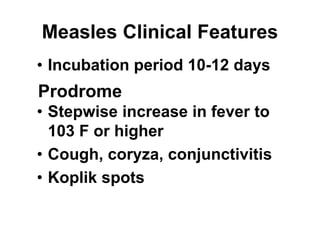
Measles Clinical Features
• Incubation period 10-12 days
• Stepwise increase in fever to
103 F or higher
• Cough, coryza, conjunctivitis
• Koplik spots
Prodrome
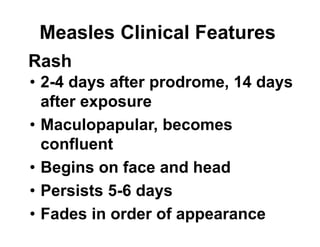
Measles Clinical Features
• 2-4 days after prodrome, 14 days
after exposure
• Maculopapular, becomes
confluent
• Begins on face and head
• Persists 5-6 days
• Fades in order of appearance
Rash
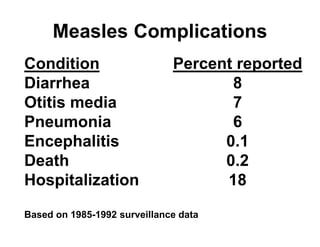
Condition
Diarrhea
Otitis media
Pneumonia
Encephalitis
Death
Hospitalization
Percent reported
8
7
6
0.1
0.2
18
Measles Complications
Based on 1985-1992 surveillance data
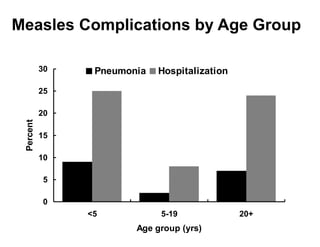
0
5
10
15
20
25
30
<5 5-19 20+
Age group (yrs)
Percent
Pneumonia Hospitalization
Measles Complications by Age Group
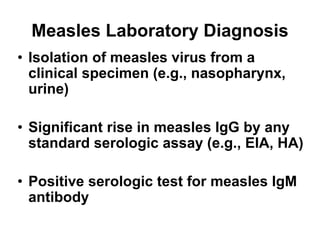
Measles Laboratory Diagnosis
• Isolation of measles virus from a
clinical specimen (e.g., nasopharynx,
urine)
• Significant rise in measles IgG by any
standard serologic assay (e.g., EIA, HA)
• Positive serologic test for measles IgM
antibody
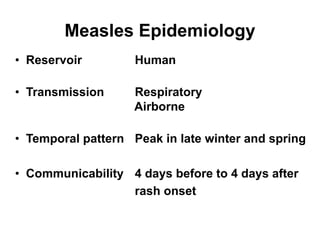
Measles Epidemiology
• Reservoir Human
• Transmission Respiratory
Airborne
• Temporal pattern Peak in late winter and spring
• Communicability 4 days before to 4 days after
rash onset
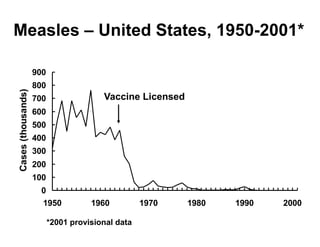
0
100
200
300
400
500
600
700
800
900
1950 1960 1970 1980 1990 2000
Cases
(thousands)
Vaccine Licensed
Measles – United States, 1950-2001*
*2001 provisional data
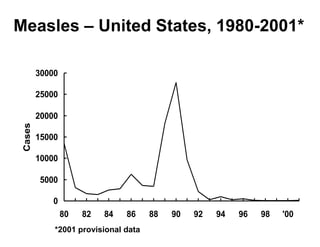
0
5000
10000
15000
20000
25000
30000
80 82 84 86 88 90 92 94 96 98 '00
Cases
Measles – United States, 1980-2001*
*2001 provisional data
0
10
20
30
40
50
60
70
80
90
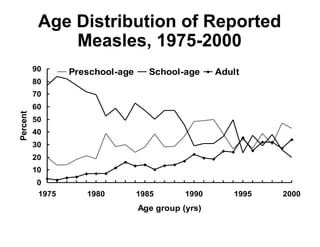
1975 1980 1985 1990 1995 2000
Age group (yrs)
Percent
Preschool-age School-age Adult
Age Distribution of Reported
Measles, 1975-2000
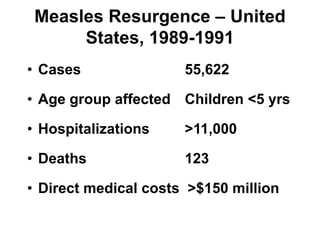
Measles Resurgence – United
States, 1989-1991
• Cases 55,622
• Age group affected Children <5 yrs
• Hospitalizations >11,000
• Deaths 123
• Direct medical costs >$150 million
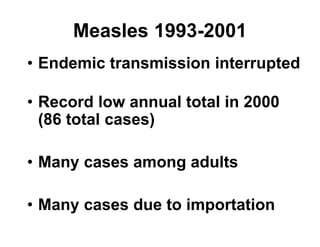
Measles 1993-2001
• Endemic transmission interrupted
• Record low annual total in 2000
(86 total cases)
• Many cases among adults
• Many cases due to importation
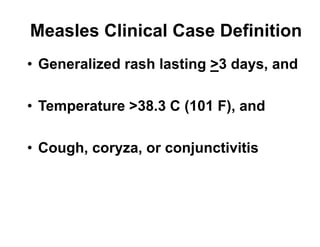
Measles Clinical Case Definition
• Generalized rash lasting >3 days, and
• Temperature >38.3 C (101 F), and
• Cough, coryza, or conjunctivitis
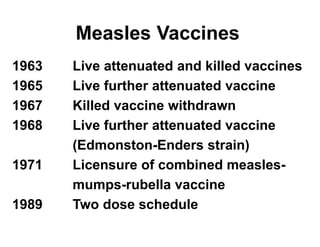
1963 Live attenuated and killed vaccines
1965 Live further attenuated vaccine
1967 Killed vaccine withdrawn
1968 Live further attenuated vaccine
(Edmonston-Enders strain)
1971 Licensure of combined measles-
mumps-rubella vaccine
1989 Two dose schedule
Measles Vaccines
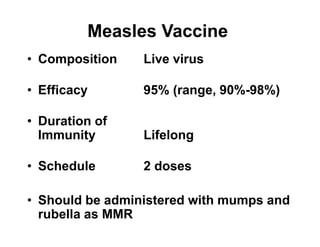
Measles Vaccine
• Composition Live virus
• Efficacy 95% (range, 90%-98%)
• Duration of
Immunity Lifelong
• Schedule 2 doses
• Should be administered with mumps and
rubella as MMR
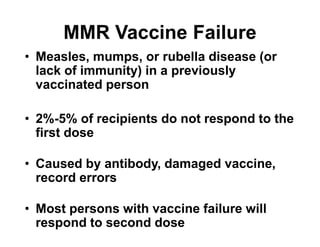
• Measles, mumps, or rubella disease (or
lack of immunity) in a previously
vaccinated person
• 2%-5% of recipients do not respond to the
first dose
• Caused by antibody, damaged vaccine,
record errors
• Most persons with vaccine failure will
respond to second dose
MMR Vaccine Failure
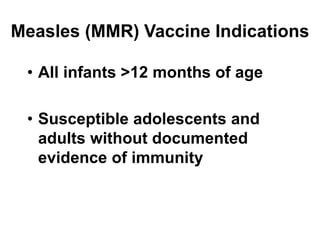
Measles (MMR) Vaccine Indications
• All infants >12 months of age
• Susceptible adolescents and
adults without documented
evidence of immunity
• 12 months is the recommended
and minimum age
• MMR given before 12 months
should not be counted as a valid
dose
• Revaccinate at >12 months of age
Measles Mumps Rubella Vaccine
Second Dose of Measles Vaccine
• Intended to produce measles
immunity in persons who failed to
respond to the first dose (primary
vaccine failure)
• May boost antibody titers in some
persons
Second Dose Recommendation
• First dose of MMR at 12-15 months
• Second dose of MMR at 4-6 years
• Second dose may be given any
time >4 weeks after the first dose
ACIP Recommendations
• All states ensure that 2 doses of
MMR required for school entry
• All children in kindergarten
through grade 12 have 2 doses of
MMR by 2001
• College students
• International travelers
• Health-care personnel
Adults at Increased
Risk of Measles
Measles Immunity in
Health Care Personnel
• All persons who work in
medical facilities should
be immune to measles
• Born before 1957
• Documentation of physician-
diagnosed measles
• Serologic evidence of immunity
• Documentation of receipt of
measles-containing vaccine
Measles Immunity
Measles Vaccine
Indications for Revaccination
• Vaccinated before the first birthday
• Vaccinated with killed measles vaccine
• Vaccinated prior to 1968 with an
unknown type of vaccine
• Vaccinated with IG in addition to a
further attenuated strain or vaccine of
unknown type
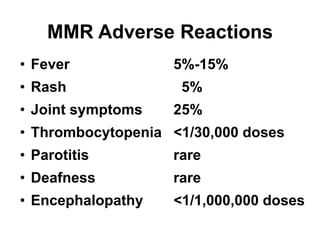
MMR Adverse Reactions
• Fever 5%-15%
• Rash 5%
• Joint symptoms 25%
• Thrombocytopenia <1/30,000 doses
• Parotitis rare
• Deafness rare
• Encephalopathy <1/1,000,000 doses
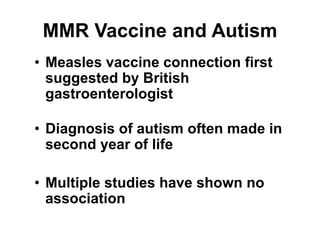
MMR Vaccine and Autism
• Measles vaccine connection first
suggested by British
gastroenterologist
• Diagnosis of autism often made in
second year of life
• Multiple studies have shown no
association
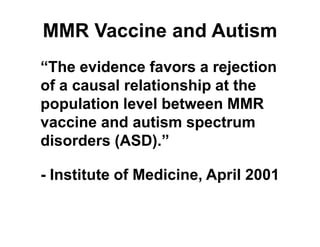
MMR Vaccine and Autism
“The evidence favors a rejection
of a causal relationship at the
population level between MMR
vaccine and autism spectrum
disorders (ASD).”
- Institute of Medicine, April 2001
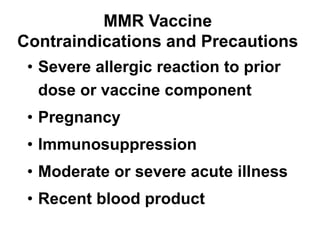
• Severe allergic reaction to prior
dose or vaccine component
• Pregnancy
• Immunosuppression
• Moderate or severe acute illness
• Recent blood product
MMR Vaccine
Contraindications and Precautions
• Measles and mumps viruses
grown in chick embryo fibroblast
culture
• Studies have demonstrated safety
of MMR in egg allergic children
• Vaccinate without testing
Measles and Mumps Vaccines
and Egg Allergy
• MMR recommended for persons with
asymptomatic and mildly
symptomatic HIV infection
• NOT recommended for those with
evidence of severe immuno-
suppression
• Prevaccination HIV testing not
recommended
Measles Vaccine and HIV Infection
PPD and Measles Vaccine
• Apply PPD at same visit as MMR
• Delay PPD >4 weeks if MMR given
first
• Apply PPD first - give MMR when
skin test read
National Immunization Program
• Hotline 800.232.2522
• Email nipinfo@cdc.gov
• Website www.cdc.gov/nip

1-Measles-Vaccine.ppt

  • 1.
    Measles and Measles Vaccine Epidemiologyand Prevention of Vaccine- Preventable Diseases National Immunization Program Centers for Disease Control and Prevention Revised March 2002
  • 2.
    Measles • Highly contagiousviral illness • First described in 7th century • Near universal infection of childhood in prevaccination era • Frequent and often fatal in developing areas
  • 3.
    • Paramyxovirus (RNA) •One antigenic type • Hemagglutinin important surface antigen • Rapidly inactivated by heat and light Measles Virus
  • 4.
    Measles Pathogenesis • Respiratorytransmission of virus • Replication in nasopharynx and regional lymph nodes • Primary viremia 2-3 days after exposure • Secondary viremia 5-7 days after exposure with spread to tissues
  • 5.
    Measles Clinical Features •Incubation period 10-12 days • Stepwise increase in fever to 103 F or higher • Cough, coryza, conjunctivitis • Koplik spots Prodrome
  • 6.
    Measles Clinical Features •2-4 days after prodrome, 14 days after exposure • Maculopapular, becomes confluent • Begins on face and head • Persists 5-6 days • Fades in order of appearance Rash
  • 7.
  • 8.
    0 5 10 15 20 25 30 <5 5-19 20+ Agegroup (yrs) Percent Pneumonia Hospitalization Measles Complications by Age Group
  • 9.
    Measles Laboratory Diagnosis •Isolation of measles virus from a clinical specimen (e.g., nasopharynx, urine) • Significant rise in measles IgG by any standard serologic assay (e.g., EIA, HA) • Positive serologic test for measles IgM antibody
  • 10.
    Measles Epidemiology • ReservoirHuman • Transmission Respiratory Airborne • Temporal pattern Peak in late winter and spring • Communicability 4 days before to 4 days after rash onset
  • 11.
    0 100 200 300 400 500 600 700 800 900 1950 1960 19701980 1990 2000 Cases (thousands) Vaccine Licensed Measles – United States, 1950-2001* *2001 provisional data
  • 12.
    0 5000 10000 15000 20000 25000 30000 80 82 8486 88 90 92 94 96 98 '00 Cases Measles – United States, 1980-2001* *2001 provisional data
  • 13.
    0 10 20 30 40 50 60 70 80 90 1975 1980 19851990 1995 2000 Age group (yrs) Percent Preschool-age School-age Adult Age Distribution of Reported Measles, 1975-2000
  • 14.
    Measles Resurgence –United States, 1989-1991 • Cases 55,622 • Age group affected Children <5 yrs • Hospitalizations >11,000 • Deaths 123 • Direct medical costs >$150 million
  • 15.
    Measles 1993-2001 • Endemictransmission interrupted • Record low annual total in 2000 (86 total cases) • Many cases among adults • Many cases due to importation
  • 16.
    Measles Clinical CaseDefinition • Generalized rash lasting >3 days, and • Temperature >38.3 C (101 F), and • Cough, coryza, or conjunctivitis
  • 17.
    1963 Live attenuatedand killed vaccines 1965 Live further attenuated vaccine 1967 Killed vaccine withdrawn 1968 Live further attenuated vaccine (Edmonston-Enders strain) 1971 Licensure of combined measles- mumps-rubella vaccine 1989 Two dose schedule Measles Vaccines
  • 18.
    Measles Vaccine • CompositionLive virus • Efficacy 95% (range, 90%-98%) • Duration of Immunity Lifelong • Schedule 2 doses • Should be administered with mumps and rubella as MMR
  • 19.
    • Measles, mumps,or rubella disease (or lack of immunity) in a previously vaccinated person • 2%-5% of recipients do not respond to the first dose • Caused by antibody, damaged vaccine, record errors • Most persons with vaccine failure will respond to second dose MMR Vaccine Failure
  • 20.
    Measles (MMR) VaccineIndications • All infants >12 months of age • Susceptible adolescents and adults without documented evidence of immunity
  • 21.
    • 12 monthsis the recommended and minimum age • MMR given before 12 months should not be counted as a valid dose • Revaccinate at >12 months of age Measles Mumps Rubella Vaccine
  • 22.
    Second Dose ofMeasles Vaccine • Intended to produce measles immunity in persons who failed to respond to the first dose (primary vaccine failure) • May boost antibody titers in some persons
  • 23.
    Second Dose Recommendation •First dose of MMR at 12-15 months • Second dose of MMR at 4-6 years • Second dose may be given any time >4 weeks after the first dose
  • 24.
    ACIP Recommendations • Allstates ensure that 2 doses of MMR required for school entry • All children in kindergarten through grade 12 have 2 doses of MMR by 2001
  • 25.
    • College students •International travelers • Health-care personnel Adults at Increased Risk of Measles
  • 26.
    Measles Immunity in HealthCare Personnel • All persons who work in medical facilities should be immune to measles
  • 27.
    • Born before1957 • Documentation of physician- diagnosed measles • Serologic evidence of immunity • Documentation of receipt of measles-containing vaccine Measles Immunity
  • 28.
    Measles Vaccine Indications forRevaccination • Vaccinated before the first birthday • Vaccinated with killed measles vaccine • Vaccinated prior to 1968 with an unknown type of vaccine • Vaccinated with IG in addition to a further attenuated strain or vaccine of unknown type
  • 29.
    MMR Adverse Reactions •Fever 5%-15% • Rash 5% • Joint symptoms 25% • Thrombocytopenia <1/30,000 doses • Parotitis rare • Deafness rare • Encephalopathy <1/1,000,000 doses
  • 30.
    MMR Vaccine andAutism • Measles vaccine connection first suggested by British gastroenterologist • Diagnosis of autism often made in second year of life • Multiple studies have shown no association
  • 31.
    MMR Vaccine andAutism “The evidence favors a rejection of a causal relationship at the population level between MMR vaccine and autism spectrum disorders (ASD).” - Institute of Medicine, April 2001
  • 32.
    • Severe allergicreaction to prior dose or vaccine component • Pregnancy • Immunosuppression • Moderate or severe acute illness • Recent blood product MMR Vaccine Contraindications and Precautions
  • 33.
    • Measles andmumps viruses grown in chick embryo fibroblast culture • Studies have demonstrated safety of MMR in egg allergic children • Vaccinate without testing Measles and Mumps Vaccines and Egg Allergy
  • 34.
    • MMR recommendedfor persons with asymptomatic and mildly symptomatic HIV infection • NOT recommended for those with evidence of severe immuno- suppression • Prevaccination HIV testing not recommended Measles Vaccine and HIV Infection
  • 35.
    PPD and MeaslesVaccine • Apply PPD at same visit as MMR • Delay PPD >4 weeks if MMR given first • Apply PPD first - give MMR when skin test read
  • 36.
    National Immunization Program •Hotline 800.232.2522 • Email nipinfo@cdc.gov • Website www.cdc.gov/nip