IMCI
      University of Liverpool
               LSTM
MSc Infectious Disease and Tropical
              Medicine
        Dr. Wail Bajhmoum
INTEGRATED MANAGEMENT OF
    CHILDHOOD ILLNESS
Outline
Background and Brief History.

Definition.

Objectives and Goals.
Outline
Strategy.

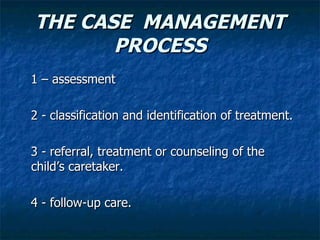
THE CASE MANAGEMENT PROCESS.

Examples.
Background
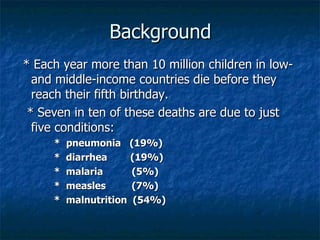
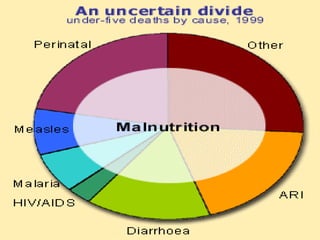
* Each year more than 10 million children in low-
  and middle-income countries die before they
  reach their fifth birthday.
 * Seven in ten of these deaths are due to just
  five conditions:
     *   pneumonia (19%)
     *   diarrhea     (19%)
     *   malaria      (5%)
     *   measles      (7%)
     *   malnutrition (54%)
Background

IMCI was first developed in 1992 by UNICEF
  and the World Health Organization (WHO)
Definition

* IMCI is an integrated approach to child
  health that focuses on the well-being of
  the whole child.

* IMCI includes both preventive and
  curative elements.
* IMCI is designed for use in outpatient
  clinical settings with limited diagnostic
  tools and medications.

ie. rural areas- specifically in developing
 countries
Objectives and Goals
1. Reducing mortality.

2. Reducing the incidence and seriousness
  of illnesses and health problems .

3. Improving growth and development
  during the first five years of a child’s life.
Strategy.
*Improving case management skills of
  health-care staff.

*Improving overall health systems.

*Improving family and community health
  practices.
THE CASE MANAGEMENT
       PROCESS
1 – assessment

2 - classification and identification of treatment.

3 - referral, treatment or counseling of the
child’s caretaker.

4 - follow-up care.
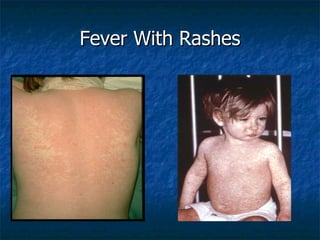
Fever With Rashes
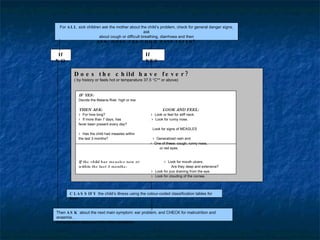
For A L L sick children ask the mother about the child’s problem, check for general danger signs,
                                                 ask
                       about cough or difficult breathing, diarrhoea and then
                      A S K : D O E S T H E C H IL D H A V E F E V E R ?


 If                                               If
NO                                                YE S

         D o e s t h e c h ild h a v e f e v e r ?
         ( by history or feels hot or temperature 37.5 °C** or above)


           IF YES:
           Decide the Malaria Risk: high or low

           THEN ASK:                                        LOOK AND FEEL:
              For how long?                            Look or feel for stiff neck.
              If more than 7 days, has                 Look for runny nose.
           fever been present every day?
                                                      Look for signs of MEASLES
             Has the child had measles within
           the last 3 months?                           Generalized rash and
                                                       One of these: cough, runny nose,
                                                         or red eyes.


           If the child has me as le s now or                  Look for mouth ulcers.
           w ithin the las t 3 months :                          Are they deep and extensive?
                                                       Look for pus draining from the eye.
                                                       Look for clouding of the cornea.


      C L A S S IF Y the child’s illness using the colour-coded classification tables for
      fever.


Then A S K about the next main symptom: ear problem, and CHECK for malnutrition and
anaemia,
immunization status and for other problems.
Is it effective ?!
The Multi-Countries Evaluation of (IMCI)
includes studies of the effectiveness, cost,
 and impact of the IMCI strategy in
  Bangladesh, Brazil, Peru, Tanzania, and
  Uganda.
*MCE conclude : more detailed descriptions
 of methodological and analytic approaches
 developed to address specific issues need
 to be provided.


*The MCE will continue these and other
  methodological challenges in future
  articles
Thank you
Imci DR wail Bajhmoum

Imci DR wail Bajhmoum

  • 1.
    IMCI University of Liverpool LSTM MSc Infectious Disease and Tropical Medicine Dr. Wail Bajhmoum
  • 2.
    INTEGRATED MANAGEMENT OF CHILDHOOD ILLNESS
  • 3.
    Outline Background and BriefHistory. Definition. Objectives and Goals.
  • 4.
  • 5.
    Background * Each yearmore than 10 million children in low- and middle-income countries die before they reach their fifth birthday. * Seven in ten of these deaths are due to just five conditions: * pneumonia (19%) * diarrhea (19%) * malaria (5%) * measles (7%) * malnutrition (54%)
  • 8.
    Background IMCI was firstdeveloped in 1992 by UNICEF and the World Health Organization (WHO)
  • 9.
    Definition * IMCI isan integrated approach to child health that focuses on the well-being of the whole child. * IMCI includes both preventive and curative elements.
  • 10.
    * IMCI isdesigned for use in outpatient clinical settings with limited diagnostic tools and medications. ie. rural areas- specifically in developing countries
  • 11.
    Objectives and Goals 1.Reducing mortality. 2. Reducing the incidence and seriousness of illnesses and health problems . 3. Improving growth and development during the first five years of a child’s life.
  • 12.
    Strategy. *Improving case managementskills of health-care staff. *Improving overall health systems. *Improving family and community health practices.
  • 14.
    THE CASE MANAGEMENT PROCESS 1 – assessment 2 - classification and identification of treatment. 3 - referral, treatment or counseling of the child’s caretaker. 4 - follow-up care.
  • 15.
  • 16.
    For A LL sick children ask the mother about the child’s problem, check for general danger signs, ask about cough or difficult breathing, diarrhoea and then A S K : D O E S T H E C H IL D H A V E F E V E R ? If If NO YE S D o e s t h e c h ild h a v e f e v e r ? ( by history or feels hot or temperature 37.5 °C** or above) IF YES: Decide the Malaria Risk: high or low THEN ASK: LOOK AND FEEL: For how long? Look or feel for stiff neck. If more than 7 days, has Look for runny nose. fever been present every day? Look for signs of MEASLES Has the child had measles within the last 3 months? Generalized rash and One of these: cough, runny nose, or red eyes. If the child has me as le s now or Look for mouth ulcers. w ithin the las t 3 months : Are they deep and extensive? Look for pus draining from the eye. Look for clouding of the cornea. C L A S S IF Y the child’s illness using the colour-coded classification tables for fever. Then A S K about the next main symptom: ear problem, and CHECK for malnutrition and anaemia, immunization status and for other problems.
  • 17.
  • 18.
    The Multi-Countries Evaluationof (IMCI) includes studies of the effectiveness, cost, and impact of the IMCI strategy in Bangladesh, Brazil, Peru, Tanzania, and Uganda.
  • 19.
    *MCE conclude :more detailed descriptions of methodological and analytic approaches developed to address specific issues need to be provided. *The MCE will continue these and other methodological challenges in future articles
  • 20.