HPE PERSISTENT MEMORY PORTFOLIO
June 2019
CONFIDENTIAL | AUTHORIZED HPE PARTNER USE ONL
Y
HPE PERSISTENT MEMORY
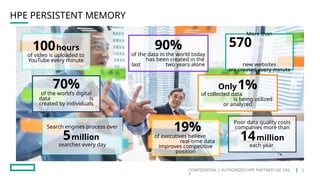
70%
of the world’s digital
data is
created by individuals
90%
of the data in the world today
has been created in the
last two years alone
100hours
of video is uploaded to
YouTube every minute
More than
570
new websites
are created every minute
Only1%
of collected data
is being utilized
or analyzed
Poor data quality costs
companies more than
14million
each year
19%
of executives believe
real-time data
improves competitive
position
Search engines process over
5million
searches every day
2
CONFIDENTIAL | AUTHORIZED HPE PARTNER USE ONL
Y
3
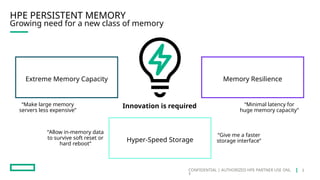
Growing need for a new class of memory
HPE PERSISTENT MEMORY
Innovation is required
Extreme Memory Capacity Memory Resilience
Hyper-Speed Storage
“Make large memory
servers less expensive”
“Allow in-memory data
to survive soft reset or
hard reboot”
“Give me a faster
storage interface”
“Minimal latency for
huge memory capacity”
CONFIDENTIAL | AUTHORIZED HPE PARTNER USE ONL
Y
HPE PERSISTENT MEMORY
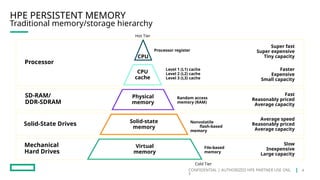
Traditional memory/storage hierarchy
Processor
Hot Tier
Cold Tier
Super fast
Super expensive
Tiny capacity
CPU
CPU
cache
Processor register
Level 1 (L1) cache
Level 2 (L2) cache
Level 3 (L3) cache
SD-RAM/
DDR-SDRAM
Physical
memory
Random access
memory (RAM)
Faster
Expensive
Small capacity
Fast
Reasonably priced
Average capacity
Solid-State Drives Nonvolatile
flash-based
memory
Solid-state
memory
Average speed
Reasonably priced
Average capacity
Mechanical
Hard Drives
Virtual
memory
File-based
memory
Slow
Inexpensive
Large capacity
4
CONFIDENTIAL | AUTHORIZED HPE PARTNER USE ONL
Y
HPE PERSISTENT MEMORY
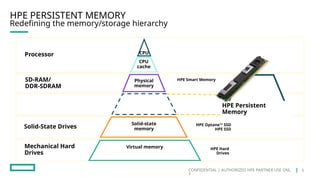
Processor CPU
CPU
cache
SD-RAM/
DDR-SDRAM
Physical
memory
HPE Smart Memory
Solid-State Drives HPE Optane™ SSD
HPE SSD
Solid-state
memory
Mechanical Hard
Drives
Virtual memory HPE Hard
Drives
HPE Persistent
Memory
Redefining the memory/storage hierarchy
5
CONFIDENTIAL | AUTHORIZED HPE PARTNER USE ONL
Y
HPE PERSISTENT MEMORY
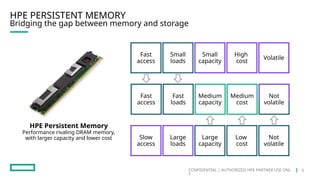
Bridging the gap between memory and storage
HPE Persistent Memory
Performance rivaling DRAM memory,
with larger capacity and lower cost
Fast
access
Medium
capacity
Fast
loads
Medium
cost
Slow
access
Large
loads
Large
capacity
Low
cost
Not
volatile
Fast
access
Small
capacity
Small
loads
High
cost
Volatile
Not
volatile
6
CONFIDENTIAL | AUTHORIZED HPE PARTNER USE ONL
Y
HPE PERSISTENT MEMORY PORTFOLIO
7
CONFIDENTIAL | AUTHORIZED HPE PARTNER USE ONL
Y
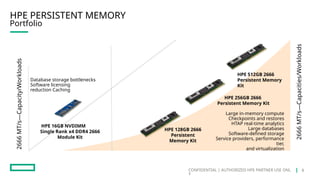
HPE PERSISTENT MEMORY
Portfolio
HPE 16GB NVDIMM
Single Rank x4 DDR4 2666
Module Kit
Large in-memory compute
Checkpoints and restores
HTAP real-time analytics
Large databases
Software-defined storage
Service providers, performance
tier,
and virtualization
Database storage bottlenecks
Software licensing
reduction Caching
HPE 512GB 2666
Persistent Memory
Kit
HPE 256GB 2666
Persistent Memory Kit
HPE 128GB 2666
Persistent
Memory Kit
2666
MT/s—Capacities/Workloads
2666
MT/s—Capacity/Workloads
8
CONFIDENTIAL | AUTHORIZED HPE PARTNER USE ONL
Y
HPE PERSISTENT MEMORY NVDIMM-NS
9
CONFIDENTIAL | AUTHORIZED HPE PARTNER USE ONL
Y
NVDIMM-Ns
HPE PERSISTENT MEMORY
Ideal for:
• Smaller database storage bottlenecks, write-caching tiers,
and any workload constrained by storage
bottlenecks
• The first generation of Intel Xeon Scalable processors
Key features:
• DRAM-level performance for fastest performing
persistent memory
• Up to 192 GB total capacity in a single server
• HPE Smart Storage battery for backup power
• 2x the capacity of first generation HPE NVDIMM-Ns1
• Up to 50% reduction in Oracle database licensing costs using the
fastest tier of storage on HPE servers2
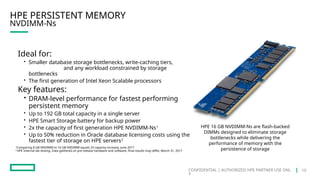
HPE 16 GB NVDIMM-Ns are flash-backed
DIMMs designed to eliminate storage
bottlenecks while delivering the
performance of memory with the
persistence of storage
1
Comparing 8 GB NVDIMM to 16 GB NVDIMM equals 2X capacity increase, June 2017
2
HPE Internal lab testing. Data gathered on pre-release hardware and software, final results may differ, March 31, 2017
10
CONFIDENTIAL | AUTHORIZED HPE PARTNER USE ONL
Y
NVDIMM-N anatomy
HPE PERSISTENT MEMORY
Industry-standard Innovation
Type: NVDIMM-N (JEDEC standard)
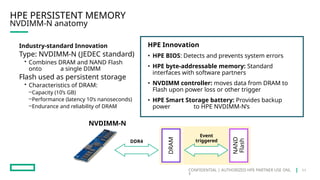
• Combines DRAM and NAND Flash
onto a single DIMM
Flash used as persistent storage
• Characteristics of DRAM:
–Capacity (10’s GB)
–Performance (latency 10’s nanoseconds)
–Endurance and reliability of DRAM
HPE Innovation
• HPE BIOS: Detects and prevents system errors
• HPE byte-addressable memory: Standard
interfaces with software partners
• NVDIMM controller: moves data from DRAM to
Flash upon power loss or other trigger
• HPE Smart Storage battery: Provides backup
power to HPE NVDIMM-N’s
DDR4
Event
triggered
NAND
Flash
DRAM
NVDIMM-N
11
CONFIDENTIAL | AUTHORIZED HPE PARTNER USE ONL
Y
HPE PERSISTENT MEMORY
Database benefits of NVDIMM-Ns
Database NVDIMMs
• Transaction log writes 2x faster than NVMe SSDs increasing overall application
performance
• 50% reduction in licensing costs via fewer cores while maintaining
performance levels of higher core count
• Accelerate log writes for faster application performance
• Reduce software licensing costs through fewer cores
• Fast caching tier where writes hit the low-latency DRAM
• Better CPU use through byte-addressable storage
• Faster checkpoints and restores
12
CONFIDENTIAL | AUTHORIZED HPE PARTNER USE ONL
Y
HPE PERSISTENT MEMORY, AVAILABLE IN
128, 256, AND 512 GB MODULES,
FEATURING INTEL® OPTANE™ DC
PERSISTENT MEMORY
13
CONFIDENTIAL | AUTHORIZED HPE PARTNER USE ONL
Y
New technology
HPE PERSISTENT MEMORY
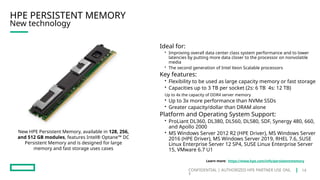
Ideal for:
• Improving overall data center class system performance and to lower
latencies by putting more data closer to the processor on nonvolatile
media
• The second generation of Intel Xeon Scalable processors
Key features:
• Flexibility to be used as large capacity memory or fast storage
• Capacities up to 3 TB per socket (2s: 6 TB 4s: 12 TB)
Up to 4x the capacity of DDR4 server memory
• Up to 3x more performance than NVMe SSDs
• Greater capacity/dollar than DRAM alone
Platform and Operating System Support:
• ProLiant DL360, DL380, DL560, DL580, SDF, Synergy 480, 660,
and Apollo 2000
• MS Windows Server 2012 R2 (HPE Driver), MS Windows Server
2016 (HPE Driver), MS Windows Server 2019, RHEL 7.6, SUSE
Linux Enterprise Server 12 SP4, SUSE Linux Enterprise Server
15, VMware 6.7 U1
New HPE Persistent Memory, available in 128, 256,
and 512 GB modules, features Intel® Optane™ DC
Persistent Memory and is designed for large
memory and fast storage uses cases
Learn more: https://www.hpe.com/info/persistentmemory
14
CONFIDENTIAL | AUTHORIZED HPE PARTNER USE ONL
Y
PHASE-CHANGE MEMORY TECHNOLOGY
15
CONFIDENTIAL | AUTHORIZED HPE PARTNER USE ONL
Y
HPE PERSISTENT MEMORY
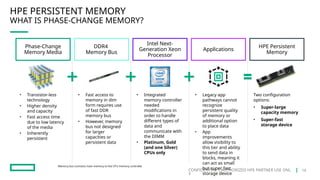
WHAT IS PHASE-CHANGE MEMORY?
Memory bus connects main memory to the CPU memory controller
Phase-Change
Memory Media
DDR4
Memory Bus
Applications
HPE Persistent
Memory
Intel Next-
Generation Xeon
Processor
• Transistor-less
technology
• Higher density
and capacity
• Fast access time
due to low latency
of the media
• Inherently
persistent
• Fast access to
memory in dim
form requires use
of fast DDR
memory bus
• However, memory
bus not designed
for larger
capacities or
persistent data
• Legacy app
pathways cannot
recognize
persistent quality
of memory or
additional option
to place data
• App
improvements
allow visibility to
this tier and ability
to send data in
blocks, meaning it
can act as small
but super fast
storage device
Two configuration
options:
• Super-large
capacity memory
• Super-fast
storage device
• Integrated
memory controller
needed
modifications in
order to handle
different types of
data and
communicate with
the DIMM
• Platinum, Gold
(and one Silver)
CPUs only
16
CONFIDENTIAL | AUTHORIZED HPE PARTNER USE ONL
Y
MODES OF OPERATION
17
CONFIDENTIAL | AUTHORIZED HPE PARTNER USE ONL
Y
HPE PERSISTENT MEMORY
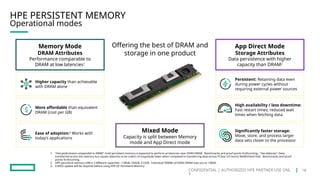
Operational modes
1. “Fast performance comparable to DRAM” -Intel persistent memory is expected to perform at latencies near DDR4 DRAM. Benchmarks and proof points forthcoming. “low latencies” -Data
transferred across the memory bus causes latencies to be orders of magnitude lower when compared to transferring data across PCIeor I/O bus’to NAND/Hard Disk. Benchmarks and proof
points forthcoming.
2. HPE persistent memory offers 3 different capacities –128GB, 256GB, 512GB. Individual DIMMs of DDR4 DRAM max out at 128GB.
3. A BIOS update will be required before using HPE DC Persistent Memory
Offering the best of DRAM and
storage in one product
Memory Mode
DRAM Attributes
Performance comparable to
DRAM at low latencies1
App Direct Mode
Storage Attributes
Data persistence with higher
capacity than DRAM2
Higher capacity than achievable
with DRAM alone
Persistent: Retaining data even
during power cycles without
requiring external power sources
More affordable than equivalent
DRAM (cost per GB)
High availability / less downtime:
Fast restart times; reduced wait
times when fetching data
Ease of adoption:3
Works with
today’s applications
Significantly faster storage:
Move, store, and process larger
data sets closer to the processor
Mixed Mode
Capacity is split between Memory
mode and App Direct mode
18
CONFIDENTIAL | AUTHORIZED HPE PARTNER USE ONL
Y
HPE PERSISTENT MEMORY
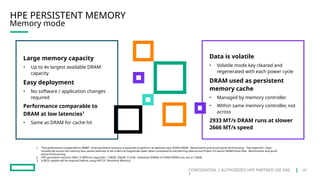
Memory mode
1. “Fast performance comparable to DRAM” -Intel persistent memory is expected to perform at latencies near DDR4 DRAM. Benchmarks and proof points forthcoming. “low latencies” -Data
transferred across the memory bus causes latencies to be orders of magnitude lower when compared to transferring data across PCIeor I/O bus’to NAND/Hard Disk. Benchmarks and proof
points forthcoming.
2. HPE persistent memory offers 3 different capacities –128GB, 256GB, 512GB. Individual DIMMs of DDR4 DRAM max out at 128GB.
3. A BIOS update will be required before using HPE DC Persistent Memory
Large memory capacity
• Up to 4x largest available DRAM
capacity
Easy deployment
• No software / application changes
required
Performance comparable to
DRAM at low latencies1
• Same as DRAM for cache hit
Data is volatile
• Volatile mode key cleared and
regenerated with each power cycle
DRAM used as persistent
memory cache
• Managed by memory controller
• Within same memory controller, not
across
2933 MT/s DRAM runs at slower
2666 MT/s speed
19
CONFIDENTIAL | AUTHORIZED HPE PARTNER USE ONL
Y
HPE PERSISTENT MEMORY
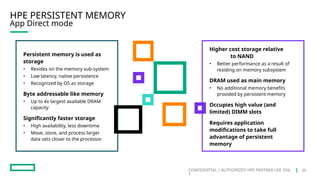
App Direct mode
Persistent memory is used as
storage
• Resides on the memory sub-system
• Low latency, native persistence
• Recognized by OS as storage
Byte addressable like memory
• Up to 4x largest available DRAM
capacity
Significantly faster storage
• High availability, less downtime
• Move, store, and process larger
data sets closer to the processor
Higher cost storage relative
to NAND
• Better performance as a result of
residing on memory subsystem
DRAM used as main memory
• No additional memory benefits
provided by persistent memory
Occupies high value (and
limited) DIMM slots
Requires application
modifications to take full
advantage of persistent
memory
20
CONFIDENTIAL | AUTHORIZED HPE PARTNER USE ONL
Y
WORKLOADS AND USE CASES
21
CONFIDENTIAL | AUTHORIZED HPE PARTNER USE ONL
Y
HPE PERSISTENT MEMORY
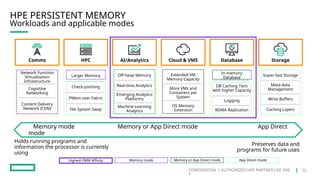
Workloads and applicable modes
Cloud & VMS
Extended VM
Memory Capacity
More VMs and
Containers per
System
OS Memory
Extension
Storage
Super-fast Storage
Meta-data
Management
Write Buffers
Caching Layers
Database
In-memory
Database
DB Caching Tiers
with higher Capacity
Logging
RDMA Replication
HPC
Larger Memory
Check-pointing
PMem over Fabric
File System Swap
AI/Analytics
Off-heap Memory
Real-time Analytics
Emerging Analytics
Platforms
Machine Learning
Analytics
Memory mode Memory or App Direct mode App Direct mode
Comms
Network Function
Virtualization
Infrastructure
Cognitive
Networking
Content Delivery
Network (CDN)
Memory mode Memory or App Direct mode App Direct
mode
Holds running programs and
information the processor is currently
using
Preserves data and
programs for future uses
Highest PMM Affinity
22
CONFIDENTIAL | AUTHORIZED HPE PARTNER USE ONL
Y
HPE PERSISTENT MEMORY
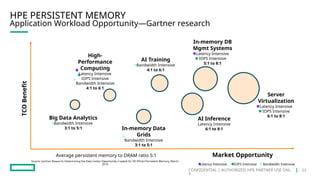
Application Workload Opportunity—Gartner research
Source: Gartner Research; Determining the Data Center Opportunity Created for 3D XPoint Persistent Memory, March
2019
Average persistent memory to DRAM ratio 5:1
Server
Virtualization
Latency Intensive
IOPS Intensive
6:1 to 8:1
In-memory DB
Mgmt Systems
Latency Intensive
IOPS Intensive
5:1 to 8:1
AI Inference
Latency Intensive
6:1 to 8:1
In-memory Data
Grids
Bandwidth Intensive
3:1 to 5:1
Big Data Analytics
Bandwidth Intensive
3:1 to 5:1
AI Training
Bandwidth Intensive
4:1 to 6:1
High-
Performance
Computing
Latency Intensive
IOPS Intensive
Bandwidth Intensive
4:1 to 6:1
Market Opportunity
TCO
Benefit
Latency Intensive IOPS Intensive Bandwidth Intensive
23
CONFIDENTIAL | AUTHORIZED HPE PARTNER USE ONL
Y
HPE PERSISTENT MEMORY
Improve business outcomes with fast executive decision support
8.4x
Average improved
performance with
HDD as main storage
Tech Brief:
https://h20195.www2.hpe.com/V2/GetDocument.aspx?docname=a00074596enw
Up to 26x
Faster in making key
executive decisions
Executive Dashboard
Medical Diagnosis
Agricultural Production
Transportation Systems
24
CONFIDENTIAL | AUTHORIZED HPE PARTNER USE ONL
Y
Big Data analytics with Spark
HPE PERSISTENT MEMORY
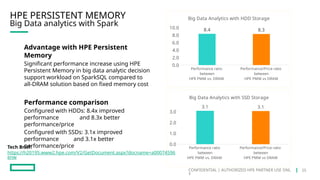
Advantage with HPE Persistent
Memory
Significant performance increase using HPE
Persistent Memory in big data analytic decision
support workload on SparkSQL compared to
all-DRAM solution based on fixed memory cost
Performance comparison
Configured with HDDs: 8.4x improved
performance and 8.3x better
performance/price
Configured with SSDs: 3.1x improved
performance and 3.1x better
performance/price
Performance ratio
between
HPE PMM vs. DRAM
Performance/Price ratio
between
HPE PMM vs DRAM
0.0
2.0
4.0
6.0
8.0
10.0 8.4 8.3
Big Data Analytics with HDD Storage
Performance ratio
between
HPE PMM vs. DRAM
Performance/Price ratio
between
HPE PMM vs DRAM
0.0
1.0
2.0
3.0
3.1 3.1
Big Data Analytics with SSD Storage
Tech Brief:
https://h20195.www2.hpe.com/V2/GetDocument.aspx?docname=a00074596
enw
25
CONFIDENTIAL | AUTHORIZED HPE PARTNER USE ONL
Y
Big Data analytics with Spark
HPE PERSISTENT MEMORY
Benchmark Setup
9 I/O intense TPC-DS queries
Fixed memory cost
• 768 GB DRAM—24x 32 GB
• 192 GB DRAM + 1 TB PMM
Storage over App Direct mode
Deploy Optimized Analytics Package for Spark
• 1 TB persistent memory vs. 610 GB DRAM
• Spark OAP Cache updated for persistent storage
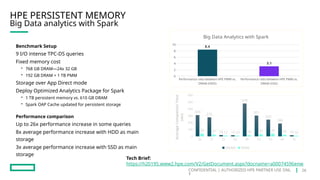
Performance comparison
Up to 26x performance increase in some queries
8x average performance increase with HDD as main
storage
3x average performance increase with SSD as main
storage
Performance ratio between HPE PMM vs.
DRAM (HDD)
Performance ratio between HPE PMM vs.
DRAM (SSD)
0
2
4
6
8
10
8.4
3.1
Big Data Analytics with Spark
26 27 32 42 48 53 55 68 76
0
100
200
300
400
500
600
309
276
18 15
478
301
243
186
15
39 27 12 10 18 32 39 24 10
DRAM PMM
Average
Completion
Time
(sec)
Tech Brief:
https://h20195.www2.hpe.com/V2/GetDocument.aspx?docname=a00074596enw
26
CONFIDENTIAL | AUTHORIZED HPE PARTNER USE ONL
Y
HPE PERSISTENT MEMORY
Pharmaceutical research at unprecedented speed
48%
Improved
performance/price
Up to
21%
Faster to process
coefficient search
identifying chemical
similarity
Tech Brief:
https://h20195.www2.hpe.com/V2/GetDocument.aspx?docname=a00074594en
w
Smart Cities
Insurance
Fraud Detection
Pharmaceutical
27
CONFIDENTIAL | AUTHORIZED HPE PARTNER USE ONL
Y
GraphX on Cloudera Analytics platform
HPE PERSISTENT MEMORY
Advantage with HPE
Persistent Memory
Significant performance / price
advantage using larger capacity
HPE Persistent Memory on a GraphX
pharmaceutical workload compared
to using all-DRAM configuration
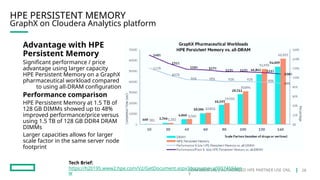
Performance comparison
HPE Persistent Memory at 1.5 TB of
128 GB DIMMs showed up to 48%
improved performance/price versus
using 1.5 TB of 128 GB DDR4 DRAM
DIMMs
Larger capacities allows for larger
scale factor in the same server node
footprint
Tech Brief:
https://h20195.www2.hpe.com/V2/GetDocument.aspx?docname=a00074594en
w
28
CONFIDENTIAL | AUTHORIZED HPE PARTNER USE ONL
Y
GraphX on Cloudera Analytics platform
HPE PERSISTENT MEMORY
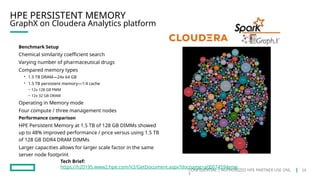
Benchmark Setup
Chemical similarity coefficient search
Varying number of pharmaceutical drugs
Compared memory types
• 1.5 TB DRAM—24x 64 GB
• 1.5 TB persistent memory—1:4 cache
– 12x 128 GB PMM
– 12x 32 GB DRAM
Operating in Memory mode
Four compute / three management nodes
Performance comparison
HPE Persistent Memory at 1.5 TB of 128 GB DIMMs showed
up to 48% improved performance / price versus using 1.5 TB
of 128 GB DDR4 DRAM DIMMs
Larger capacities allows for larger scale factor in the same
server node footprint
Tech Brief:
https://h20195.www2.hpe.com/V2/GetDocument.aspx?docname=a00074594enw
29
CONFIDENTIAL | AUTHORIZED HPE PARTNER USE ONL
Y
HPE PERSISTENT MEMORY
Improve business outcomes and reduce TCO
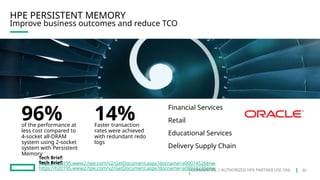
96%
of the performance at
less cost compared to
4-socket all-DRAM
system using 2-socket
system with Persistent
Memory
14%
Faster transaction
rates were achieved
with redundant redo
logs
Tech Brief:
https://h20195.www2.hpe.com/v2/GetDocument.aspx?docname=a00074526enw
Tech Brief:
https://h20195.www2.hpe.com/v2/GetDocument.aspx?docname=a00074230enw
Financial Services
Retail
Educational Services
Delivery Supply Chain
30
CONFIDENTIAL | AUTHORIZED HPE PARTNER USE ONL
Y
Oracle in-memory analytics
HPE PERSISTENT MEMORY
Advantage with HPE Persistent
Memory
The use of HPE Persistent Memory
enables a larger capacity memory
configuration in a 2S server, providing
the opportunity to use a 2S server
where a 4S system would otherwise be
needed due to memory requirements
Performance comparison
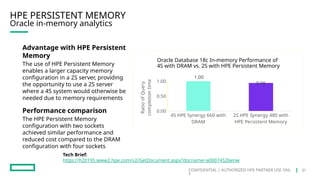
The HPE Persistent Memory
configuration with two sockets
achieved similar performance and
reduced cost compared to the DRAM
configuration with four sockets
4S HPE Synergy 660 with
DRAM
2S HPE Synergy 480 with
HPE Persistent Memory
0.00
0.50
1.00
1.00
0.96
Ratio
of
Query
completion
time
Oracle Database 18c In-memory Performance of
4S with DRAM vs. 2S with HPE Persistent Memory
Tech Brief:
https://h20195.www2.hpe.com/v2/GetDocument.aspx?docname=a00074526enw
31
CONFIDENTIAL | AUTHORIZED HPE PARTNER USE ONL
Y
Oracle in-memory analytics
HPE PERSISTENT MEMORY
Benchmark Setup
OLAP workload
Synergy 660 Compute Module
Synergy 480 Compute Module
Oracle Database 18c
Compared memory type
• 48 x 64 GB DRAM
• 12 x 256 GB persistent memory
Memory mode
• 22 query set with degree of parallelism=56
and 1 user on 2 TB scale factor
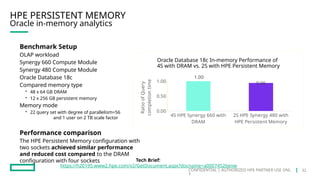
Performance comparison
The HPE Persistent Memory configuration with
two sockets achieved similar performance
and reduced cost compared to the DRAM
configuration with four sockets
4S HPE Synergy 660 with
DRAM
2S HPE Synergy 480 with
HPE Persistent Memory
0.00
0.50
1.00
1.00
0.96
Ratio
of
Query
completion
time
Tech Brief:
https://h20195.www2.hpe.com/v2/GetDocument.aspx?docname=a00074526enw
Oracle Database 18c In-memory Performance of
4S with DRAM vs. 2S with HPE Persistent Memory
32
CONFIDENTIAL | AUTHORIZED HPE PARTNER USE ONL
Y
Oracle redo log
HPE PERSISTENT MEMORY
Advantage with HPE
Persistent Memory
Reduced online transaction
processing latency is a key benefit
when using HPE Persistent Memory
as redo log storage
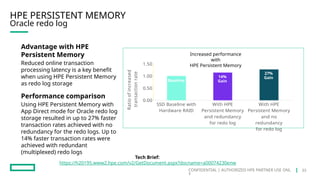
Performance comparison
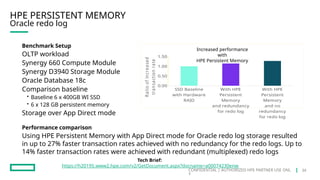
Using HPE Persistent Memory with
App Direct mode for Oracle redo log
storage resulted in up to 27% faster
transaction rates achieved with no
redundancy for the redo logs. Up to
14% faster transaction rates were
achieved with redundant
(multiplexed) redo logs
SSD Baseline with
Hardware RAID
With HPE
Persistent Memory
and redundancy
for redo log
With HPE
Persistent Memory
and no
redundancy
for redo log
0.00
0.50
1.00
1.50
Ratio
of
increased
transaction
rate
Increased performance
with
HPE Persistent Memory
Baseline
14%
Gain
27%
Gain
Tech Brief:
https://h20195.www2.hpe.com/v2/GetDocument.aspx?docname=a00074230enw
33
CONFIDENTIAL | AUTHORIZED HPE PARTNER USE ONL
Y
Oracle redo log
HPE PERSISTENT MEMORY
Benchmark Setup
OLTP workload
Synergy 660 Compute Module
Synergy D3940 Storage Module
Oracle Database 18c
Comparison baseline
• Baseline 6 x 400GB WI SSD
• 6 x 128 GB persistent memory
Storage over App Direct mode
Performance comparison
Using HPE Persistent Memory with App Direct mode for Oracle redo log storage resulted
in up to 27% faster transaction rates achieved with no redundancy for the redo logs. Up to
14% faster transaction rates were achieved with redundant (multiplexed) redo logs
SSD Baseline
with Hardware
RAID
With HPE
Persistent
Memory
and redundancy
for redo log
With HPE
Persistent
Memory
and no
redundancy
for redo log
0.00
0.50
1.00
1.50
R
a
tio
of
in
cre
a
se
d
tra
n
sa
ction
ra
te
Increased performance
with
HPE Persistent Memory
Tech Brief:
https://h20195.www2.hpe.com/v2/GetDocument.aspx?docname=a00074230enw
34
CONFIDENTIAL | AUTHORIZED HPE PARTNER USE ONL
Y
WHY HPE?
35
CONFIDENTIAL | AUTHORIZED HPE PARTNER USE ONL
Y
HPE PERSISTENT MEMORY
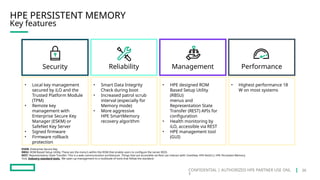
Key features
Security
• Local key management
secured by iLO and the
Trusted Platform Module
(TPM)
• Remote key
management with
Enterprise Secure Key
Manager (ESKM) or
SafeNet Key Server
• Signed firmware
• Firmware rollback
protection
Reliability
• Smart Data Integrity
Check during boot
• Increased patrol scrub
interval (especially for
Memory mode)
• More aggressive
HPE SmartMemory
recovery algorithm
Management
• HPE designed ROM
Based Setup Utility
(RBSU)
menus and
Representation State
Transfer (REST) APIs for
configuration
• Health monitoring by
iLO, accessible via REST
• HPE management tool
(GUI)
Performance
• Highest performance 18
W on most systems
ESKM: Enterprise Secure Key
RBSU: ROM Based Setup Utility: These are the menu’s within the ROM that enable users to configure the server BIOS
REST: Representation State Transfer: This is a web communication architecture. Things that are accessible via Rest can interact with: OneView, HPE RestCLI, HPE Persistent Memory
Tool, Industry standard tools. We open up management to a multitude of tools that follow the standard.
36
CONFIDENTIAL | AUTHORIZED HPE PARTNER USE ONL
Y
Configure for different workloads
HPE PERSISTENT MEMORY
37
CONFIDENTIAL | AUTHORIZED HPE PARTNER USE ONL
Y
SUMMARY
38
CONFIDENTIAL | AUTHORIZED HPE PARTNER USE ONL
Y
HPE PERSISTENT MEMORY
Summary
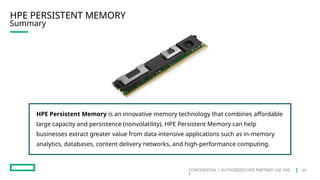
HPE Persistent Memory is an innovative memory technology that combines affordable
large capacity and persistence (nonvolatility). HPE Persistent Memory can help
businesses extract greater value from data-intensive applications such as in-memory
analytics, databases, content delivery networks, and high-performance computing.
39
CONFIDENTIAL | AUTHORIZED HPE PARTNER USE ONL
Y
RESOURCES
40
CONFIDENTIAL | AUTHORIZED HPE PARTNER USE ONL
Y
Collateral
HPE PERSISTENT MEMORY
Document name
Document
type
External URL
Applicatio
ns
HPE Persistent Memory Delivers up to 8.4x
Improved Performance and 3.1x Better
Performance/Price
Performance
brief
http://h20195.www2.hpe.com/V2/GetDocument.aspx?docname=a0
0074596enw
Spark-SQL
Major Performance/Price Advantage, Scalability
Gains with HPE Persistent Memory on GraphX
workload
Performance
brief
http://h20195.www2.hpe.com/V2/GetDocument.aspx?docname=a0
0074594enw
Cloudera
GraphX
Reduce Oracle Database In-Memory Analytics
Solution Cost Using HPE Persistent Memory
with DRAM-Like Performance
Performance
brief
https://h20195.www2.hpe.com/v2/GetDocument.aspx?docname=a
00074526enw
Oracle
Improve Oracle Database Performance with
HPE Persistent Memory as Redo Log Storage
Performance
brief
https://h20195.www2.hpe.com/v2/GetDocument.aspx?docname=a
00074230enw
Oracle
Cost-Effective Virtualized OLTP SQL Server
Performance with HPE Persistent Memory
Performance
brief
http://h20195.www2.hpe.com/V2/GetDocument.aspx?docname=a0
0069717enw
MS-SQL
HPE ProLiant DL560 Gen10 Server Solutions for
SAP HANA®
Performance
brief
https://www.hpe.com/h20195/V2/GetDocument.aspx?docname=a0
0072566enw
SAP-HANA
Revolutionize: Move storage into memory Solution brief https://www.hpe.com/h20195/v2/Getdocument.aspx?docname=a0
0073688enw
NoSQL DBs
Frequently asked questions: HPE Persistent
Memory
FAQs https://www.hpe.com/h20195/v2/Getdocument.aspx?docname=a0
0067771enw
Server memory and persistent memory
population rules for HPE Gen10 servers with
Intel Xeon Scalable processors
Whitepaper https://www.hpe.com/h20195/v2/getmobile.aspx?docname=a0001
7079enw
HPE Persistent Memory Whiteboard Video Video https://youtu.be/BHrzQTOeCB0
Additional collateral is available in the HPE Persistent Memory folder on Seismic at https://hpe.seismic.com/Link/Folder/DC5df9d6
41
CONFIDENTIAL | AUTHORIZED HPE PARTNER USE ONL
Y
THANK YOU
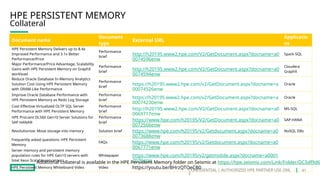
A00069616ENW 42

Customer Presentation - HPE Persistent Memory Portfolio.PPTX

  • 1.
    HPE PERSISTENT MEMORYPORTFOLIO June 2019
  • 2.
    CONFIDENTIAL | AUTHORIZEDHPE PARTNER USE ONL Y HPE PERSISTENT MEMORY 70% of the world’s digital data is created by individuals 90% of the data in the world today has been created in the last two years alone 100hours of video is uploaded to YouTube every minute More than 570 new websites are created every minute Only1% of collected data is being utilized or analyzed Poor data quality costs companies more than 14million each year 19% of executives believe real-time data improves competitive position Search engines process over 5million searches every day 2
  • 3.
    CONFIDENTIAL | AUTHORIZEDHPE PARTNER USE ONL Y 3 Growing need for a new class of memory HPE PERSISTENT MEMORY Innovation is required Extreme Memory Capacity Memory Resilience Hyper-Speed Storage “Make large memory servers less expensive” “Allow in-memory data to survive soft reset or hard reboot” “Give me a faster storage interface” “Minimal latency for huge memory capacity”
  • 4.
    CONFIDENTIAL | AUTHORIZEDHPE PARTNER USE ONL Y HPE PERSISTENT MEMORY Traditional memory/storage hierarchy Processor Hot Tier Cold Tier Super fast Super expensive Tiny capacity CPU CPU cache Processor register Level 1 (L1) cache Level 2 (L2) cache Level 3 (L3) cache SD-RAM/ DDR-SDRAM Physical memory Random access memory (RAM) Faster Expensive Small capacity Fast Reasonably priced Average capacity Solid-State Drives Nonvolatile flash-based memory Solid-state memory Average speed Reasonably priced Average capacity Mechanical Hard Drives Virtual memory File-based memory Slow Inexpensive Large capacity 4
  • 5.
    CONFIDENTIAL | AUTHORIZEDHPE PARTNER USE ONL Y HPE PERSISTENT MEMORY Processor CPU CPU cache SD-RAM/ DDR-SDRAM Physical memory HPE Smart Memory Solid-State Drives HPE Optane™ SSD HPE SSD Solid-state memory Mechanical Hard Drives Virtual memory HPE Hard Drives HPE Persistent Memory Redefining the memory/storage hierarchy 5
  • 6.
    CONFIDENTIAL | AUTHORIZEDHPE PARTNER USE ONL Y HPE PERSISTENT MEMORY Bridging the gap between memory and storage HPE Persistent Memory Performance rivaling DRAM memory, with larger capacity and lower cost Fast access Medium capacity Fast loads Medium cost Slow access Large loads Large capacity Low cost Not volatile Fast access Small capacity Small loads High cost Volatile Not volatile 6
  • 7.
    CONFIDENTIAL | AUTHORIZEDHPE PARTNER USE ONL Y HPE PERSISTENT MEMORY PORTFOLIO 7
  • 8.
    CONFIDENTIAL | AUTHORIZEDHPE PARTNER USE ONL Y HPE PERSISTENT MEMORY Portfolio HPE 16GB NVDIMM Single Rank x4 DDR4 2666 Module Kit Large in-memory compute Checkpoints and restores HTAP real-time analytics Large databases Software-defined storage Service providers, performance tier, and virtualization Database storage bottlenecks Software licensing reduction Caching HPE 512GB 2666 Persistent Memory Kit HPE 256GB 2666 Persistent Memory Kit HPE 128GB 2666 Persistent Memory Kit 2666 MT/s—Capacities/Workloads 2666 MT/s—Capacity/Workloads 8
  • 9.
    CONFIDENTIAL | AUTHORIZEDHPE PARTNER USE ONL Y HPE PERSISTENT MEMORY NVDIMM-NS 9
  • 10.
    CONFIDENTIAL | AUTHORIZEDHPE PARTNER USE ONL Y NVDIMM-Ns HPE PERSISTENT MEMORY Ideal for: • Smaller database storage bottlenecks, write-caching tiers, and any workload constrained by storage bottlenecks • The first generation of Intel Xeon Scalable processors Key features: • DRAM-level performance for fastest performing persistent memory • Up to 192 GB total capacity in a single server • HPE Smart Storage battery for backup power • 2x the capacity of first generation HPE NVDIMM-Ns1 • Up to 50% reduction in Oracle database licensing costs using the fastest tier of storage on HPE servers2 HPE 16 GB NVDIMM-Ns are flash-backed DIMMs designed to eliminate storage bottlenecks while delivering the performance of memory with the persistence of storage 1 Comparing 8 GB NVDIMM to 16 GB NVDIMM equals 2X capacity increase, June 2017 2 HPE Internal lab testing. Data gathered on pre-release hardware and software, final results may differ, March 31, 2017 10
  • 11.
    CONFIDENTIAL | AUTHORIZEDHPE PARTNER USE ONL Y NVDIMM-N anatomy HPE PERSISTENT MEMORY Industry-standard Innovation Type: NVDIMM-N (JEDEC standard) • Combines DRAM and NAND Flash onto a single DIMM Flash used as persistent storage • Characteristics of DRAM: –Capacity (10’s GB) –Performance (latency 10’s nanoseconds) –Endurance and reliability of DRAM HPE Innovation • HPE BIOS: Detects and prevents system errors • HPE byte-addressable memory: Standard interfaces with software partners • NVDIMM controller: moves data from DRAM to Flash upon power loss or other trigger • HPE Smart Storage battery: Provides backup power to HPE NVDIMM-N’s DDR4 Event triggered NAND Flash DRAM NVDIMM-N 11
  • 12.
    CONFIDENTIAL | AUTHORIZEDHPE PARTNER USE ONL Y HPE PERSISTENT MEMORY Database benefits of NVDIMM-Ns Database NVDIMMs • Transaction log writes 2x faster than NVMe SSDs increasing overall application performance • 50% reduction in licensing costs via fewer cores while maintaining performance levels of higher core count • Accelerate log writes for faster application performance • Reduce software licensing costs through fewer cores • Fast caching tier where writes hit the low-latency DRAM • Better CPU use through byte-addressable storage • Faster checkpoints and restores 12
  • 13.
    CONFIDENTIAL | AUTHORIZEDHPE PARTNER USE ONL Y HPE PERSISTENT MEMORY, AVAILABLE IN 128, 256, AND 512 GB MODULES, FEATURING INTEL® OPTANE™ DC PERSISTENT MEMORY 13
  • 14.
    CONFIDENTIAL | AUTHORIZEDHPE PARTNER USE ONL Y New technology HPE PERSISTENT MEMORY Ideal for: • Improving overall data center class system performance and to lower latencies by putting more data closer to the processor on nonvolatile media • The second generation of Intel Xeon Scalable processors Key features: • Flexibility to be used as large capacity memory or fast storage • Capacities up to 3 TB per socket (2s: 6 TB 4s: 12 TB) Up to 4x the capacity of DDR4 server memory • Up to 3x more performance than NVMe SSDs • Greater capacity/dollar than DRAM alone Platform and Operating System Support: • ProLiant DL360, DL380, DL560, DL580, SDF, Synergy 480, 660, and Apollo 2000 • MS Windows Server 2012 R2 (HPE Driver), MS Windows Server 2016 (HPE Driver), MS Windows Server 2019, RHEL 7.6, SUSE Linux Enterprise Server 12 SP4, SUSE Linux Enterprise Server 15, VMware 6.7 U1 New HPE Persistent Memory, available in 128, 256, and 512 GB modules, features Intel® Optane™ DC Persistent Memory and is designed for large memory and fast storage uses cases Learn more: https://www.hpe.com/info/persistentmemory 14
  • 15.
    CONFIDENTIAL | AUTHORIZEDHPE PARTNER USE ONL Y PHASE-CHANGE MEMORY TECHNOLOGY 15
  • 16.
    CONFIDENTIAL | AUTHORIZEDHPE PARTNER USE ONL Y HPE PERSISTENT MEMORY WHAT IS PHASE-CHANGE MEMORY? Memory bus connects main memory to the CPU memory controller Phase-Change Memory Media DDR4 Memory Bus Applications HPE Persistent Memory Intel Next- Generation Xeon Processor • Transistor-less technology • Higher density and capacity • Fast access time due to low latency of the media • Inherently persistent • Fast access to memory in dim form requires use of fast DDR memory bus • However, memory bus not designed for larger capacities or persistent data • Legacy app pathways cannot recognize persistent quality of memory or additional option to place data • App improvements allow visibility to this tier and ability to send data in blocks, meaning it can act as small but super fast storage device Two configuration options: • Super-large capacity memory • Super-fast storage device • Integrated memory controller needed modifications in order to handle different types of data and communicate with the DIMM • Platinum, Gold (and one Silver) CPUs only 16
  • 17.
    CONFIDENTIAL | AUTHORIZEDHPE PARTNER USE ONL Y MODES OF OPERATION 17
  • 18.
    CONFIDENTIAL | AUTHORIZEDHPE PARTNER USE ONL Y HPE PERSISTENT MEMORY Operational modes 1. “Fast performance comparable to DRAM” -Intel persistent memory is expected to perform at latencies near DDR4 DRAM. Benchmarks and proof points forthcoming. “low latencies” -Data transferred across the memory bus causes latencies to be orders of magnitude lower when compared to transferring data across PCIeor I/O bus’to NAND/Hard Disk. Benchmarks and proof points forthcoming. 2. HPE persistent memory offers 3 different capacities –128GB, 256GB, 512GB. Individual DIMMs of DDR4 DRAM max out at 128GB. 3. A BIOS update will be required before using HPE DC Persistent Memory Offering the best of DRAM and storage in one product Memory Mode DRAM Attributes Performance comparable to DRAM at low latencies1 App Direct Mode Storage Attributes Data persistence with higher capacity than DRAM2 Higher capacity than achievable with DRAM alone Persistent: Retaining data even during power cycles without requiring external power sources More affordable than equivalent DRAM (cost per GB) High availability / less downtime: Fast restart times; reduced wait times when fetching data Ease of adoption:3 Works with today’s applications Significantly faster storage: Move, store, and process larger data sets closer to the processor Mixed Mode Capacity is split between Memory mode and App Direct mode 18
  • 19.
    CONFIDENTIAL | AUTHORIZEDHPE PARTNER USE ONL Y HPE PERSISTENT MEMORY Memory mode 1. “Fast performance comparable to DRAM” -Intel persistent memory is expected to perform at latencies near DDR4 DRAM. Benchmarks and proof points forthcoming. “low latencies” -Data transferred across the memory bus causes latencies to be orders of magnitude lower when compared to transferring data across PCIeor I/O bus’to NAND/Hard Disk. Benchmarks and proof points forthcoming. 2. HPE persistent memory offers 3 different capacities –128GB, 256GB, 512GB. Individual DIMMs of DDR4 DRAM max out at 128GB. 3. A BIOS update will be required before using HPE DC Persistent Memory Large memory capacity • Up to 4x largest available DRAM capacity Easy deployment • No software / application changes required Performance comparable to DRAM at low latencies1 • Same as DRAM for cache hit Data is volatile • Volatile mode key cleared and regenerated with each power cycle DRAM used as persistent memory cache • Managed by memory controller • Within same memory controller, not across 2933 MT/s DRAM runs at slower 2666 MT/s speed 19
  • 20.
    CONFIDENTIAL | AUTHORIZEDHPE PARTNER USE ONL Y HPE PERSISTENT MEMORY App Direct mode Persistent memory is used as storage • Resides on the memory sub-system • Low latency, native persistence • Recognized by OS as storage Byte addressable like memory • Up to 4x largest available DRAM capacity Significantly faster storage • High availability, less downtime • Move, store, and process larger data sets closer to the processor Higher cost storage relative to NAND • Better performance as a result of residing on memory subsystem DRAM used as main memory • No additional memory benefits provided by persistent memory Occupies high value (and limited) DIMM slots Requires application modifications to take full advantage of persistent memory 20
  • 21.
    CONFIDENTIAL | AUTHORIZEDHPE PARTNER USE ONL Y WORKLOADS AND USE CASES 21
  • 22.
    CONFIDENTIAL | AUTHORIZEDHPE PARTNER USE ONL Y HPE PERSISTENT MEMORY Workloads and applicable modes Cloud & VMS Extended VM Memory Capacity More VMs and Containers per System OS Memory Extension Storage Super-fast Storage Meta-data Management Write Buffers Caching Layers Database In-memory Database DB Caching Tiers with higher Capacity Logging RDMA Replication HPC Larger Memory Check-pointing PMem over Fabric File System Swap AI/Analytics Off-heap Memory Real-time Analytics Emerging Analytics Platforms Machine Learning Analytics Memory mode Memory or App Direct mode App Direct mode Comms Network Function Virtualization Infrastructure Cognitive Networking Content Delivery Network (CDN) Memory mode Memory or App Direct mode App Direct mode Holds running programs and information the processor is currently using Preserves data and programs for future uses Highest PMM Affinity 22
  • 23.
    CONFIDENTIAL | AUTHORIZEDHPE PARTNER USE ONL Y HPE PERSISTENT MEMORY Application Workload Opportunity—Gartner research Source: Gartner Research; Determining the Data Center Opportunity Created for 3D XPoint Persistent Memory, March 2019 Average persistent memory to DRAM ratio 5:1 Server Virtualization Latency Intensive IOPS Intensive 6:1 to 8:1 In-memory DB Mgmt Systems Latency Intensive IOPS Intensive 5:1 to 8:1 AI Inference Latency Intensive 6:1 to 8:1 In-memory Data Grids Bandwidth Intensive 3:1 to 5:1 Big Data Analytics Bandwidth Intensive 3:1 to 5:1 AI Training Bandwidth Intensive 4:1 to 6:1 High- Performance Computing Latency Intensive IOPS Intensive Bandwidth Intensive 4:1 to 6:1 Market Opportunity TCO Benefit Latency Intensive IOPS Intensive Bandwidth Intensive 23
  • 24.
    CONFIDENTIAL | AUTHORIZEDHPE PARTNER USE ONL Y HPE PERSISTENT MEMORY Improve business outcomes with fast executive decision support 8.4x Average improved performance with HDD as main storage Tech Brief: https://h20195.www2.hpe.com/V2/GetDocument.aspx?docname=a00074596enw Up to 26x Faster in making key executive decisions Executive Dashboard Medical Diagnosis Agricultural Production Transportation Systems 24
  • 25.
    CONFIDENTIAL | AUTHORIZEDHPE PARTNER USE ONL Y Big Data analytics with Spark HPE PERSISTENT MEMORY Advantage with HPE Persistent Memory Significant performance increase using HPE Persistent Memory in big data analytic decision support workload on SparkSQL compared to all-DRAM solution based on fixed memory cost Performance comparison Configured with HDDs: 8.4x improved performance and 8.3x better performance/price Configured with SSDs: 3.1x improved performance and 3.1x better performance/price Performance ratio between HPE PMM vs. DRAM Performance/Price ratio between HPE PMM vs DRAM 0.0 2.0 4.0 6.0 8.0 10.0 8.4 8.3 Big Data Analytics with HDD Storage Performance ratio between HPE PMM vs. DRAM Performance/Price ratio between HPE PMM vs DRAM 0.0 1.0 2.0 3.0 3.1 3.1 Big Data Analytics with SSD Storage Tech Brief: https://h20195.www2.hpe.com/V2/GetDocument.aspx?docname=a00074596 enw 25
  • 26.
    CONFIDENTIAL | AUTHORIZEDHPE PARTNER USE ONL Y Big Data analytics with Spark HPE PERSISTENT MEMORY Benchmark Setup 9 I/O intense TPC-DS queries Fixed memory cost • 768 GB DRAM—24x 32 GB • 192 GB DRAM + 1 TB PMM Storage over App Direct mode Deploy Optimized Analytics Package for Spark • 1 TB persistent memory vs. 610 GB DRAM • Spark OAP Cache updated for persistent storage Performance comparison Up to 26x performance increase in some queries 8x average performance increase with HDD as main storage 3x average performance increase with SSD as main storage Performance ratio between HPE PMM vs. DRAM (HDD) Performance ratio between HPE PMM vs. DRAM (SSD) 0 2 4 6 8 10 8.4 3.1 Big Data Analytics with Spark 26 27 32 42 48 53 55 68 76 0 100 200 300 400 500 600 309 276 18 15 478 301 243 186 15 39 27 12 10 18 32 39 24 10 DRAM PMM Average Completion Time (sec) Tech Brief: https://h20195.www2.hpe.com/V2/GetDocument.aspx?docname=a00074596enw 26
  • 27.
    CONFIDENTIAL | AUTHORIZEDHPE PARTNER USE ONL Y HPE PERSISTENT MEMORY Pharmaceutical research at unprecedented speed 48% Improved performance/price Up to 21% Faster to process coefficient search identifying chemical similarity Tech Brief: https://h20195.www2.hpe.com/V2/GetDocument.aspx?docname=a00074594en w Smart Cities Insurance Fraud Detection Pharmaceutical 27
  • 28.
    CONFIDENTIAL | AUTHORIZEDHPE PARTNER USE ONL Y GraphX on Cloudera Analytics platform HPE PERSISTENT MEMORY Advantage with HPE Persistent Memory Significant performance / price advantage using larger capacity HPE Persistent Memory on a GraphX pharmaceutical workload compared to using all-DRAM configuration Performance comparison HPE Persistent Memory at 1.5 TB of 128 GB DIMMs showed up to 48% improved performance/price versus using 1.5 TB of 128 GB DDR4 DRAM DIMMs Larger capacities allows for larger scale factor in the same server node footprint Tech Brief: https://h20195.www2.hpe.com/V2/GetDocument.aspx?docname=a00074594en w 28
  • 29.
    CONFIDENTIAL | AUTHORIZEDHPE PARTNER USE ONL Y GraphX on Cloudera Analytics platform HPE PERSISTENT MEMORY Benchmark Setup Chemical similarity coefficient search Varying number of pharmaceutical drugs Compared memory types • 1.5 TB DRAM—24x 64 GB • 1.5 TB persistent memory—1:4 cache – 12x 128 GB PMM – 12x 32 GB DRAM Operating in Memory mode Four compute / three management nodes Performance comparison HPE Persistent Memory at 1.5 TB of 128 GB DIMMs showed up to 48% improved performance / price versus using 1.5 TB of 128 GB DDR4 DRAM DIMMs Larger capacities allows for larger scale factor in the same server node footprint Tech Brief: https://h20195.www2.hpe.com/V2/GetDocument.aspx?docname=a00074594enw 29
  • 30.
    CONFIDENTIAL | AUTHORIZEDHPE PARTNER USE ONL Y HPE PERSISTENT MEMORY Improve business outcomes and reduce TCO 96% of the performance at less cost compared to 4-socket all-DRAM system using 2-socket system with Persistent Memory 14% Faster transaction rates were achieved with redundant redo logs Tech Brief: https://h20195.www2.hpe.com/v2/GetDocument.aspx?docname=a00074526enw Tech Brief: https://h20195.www2.hpe.com/v2/GetDocument.aspx?docname=a00074230enw Financial Services Retail Educational Services Delivery Supply Chain 30
  • 31.
    CONFIDENTIAL | AUTHORIZEDHPE PARTNER USE ONL Y Oracle in-memory analytics HPE PERSISTENT MEMORY Advantage with HPE Persistent Memory The use of HPE Persistent Memory enables a larger capacity memory configuration in a 2S server, providing the opportunity to use a 2S server where a 4S system would otherwise be needed due to memory requirements Performance comparison The HPE Persistent Memory configuration with two sockets achieved similar performance and reduced cost compared to the DRAM configuration with four sockets 4S HPE Synergy 660 with DRAM 2S HPE Synergy 480 with HPE Persistent Memory 0.00 0.50 1.00 1.00 0.96 Ratio of Query completion time Oracle Database 18c In-memory Performance of 4S with DRAM vs. 2S with HPE Persistent Memory Tech Brief: https://h20195.www2.hpe.com/v2/GetDocument.aspx?docname=a00074526enw 31
  • 32.
    CONFIDENTIAL | AUTHORIZEDHPE PARTNER USE ONL Y Oracle in-memory analytics HPE PERSISTENT MEMORY Benchmark Setup OLAP workload Synergy 660 Compute Module Synergy 480 Compute Module Oracle Database 18c Compared memory type • 48 x 64 GB DRAM • 12 x 256 GB persistent memory Memory mode • 22 query set with degree of parallelism=56 and 1 user on 2 TB scale factor Performance comparison The HPE Persistent Memory configuration with two sockets achieved similar performance and reduced cost compared to the DRAM configuration with four sockets 4S HPE Synergy 660 with DRAM 2S HPE Synergy 480 with HPE Persistent Memory 0.00 0.50 1.00 1.00 0.96 Ratio of Query completion time Tech Brief: https://h20195.www2.hpe.com/v2/GetDocument.aspx?docname=a00074526enw Oracle Database 18c In-memory Performance of 4S with DRAM vs. 2S with HPE Persistent Memory 32
  • 33.
    CONFIDENTIAL | AUTHORIZEDHPE PARTNER USE ONL Y Oracle redo log HPE PERSISTENT MEMORY Advantage with HPE Persistent Memory Reduced online transaction processing latency is a key benefit when using HPE Persistent Memory as redo log storage Performance comparison Using HPE Persistent Memory with App Direct mode for Oracle redo log storage resulted in up to 27% faster transaction rates achieved with no redundancy for the redo logs. Up to 14% faster transaction rates were achieved with redundant (multiplexed) redo logs SSD Baseline with Hardware RAID With HPE Persistent Memory and redundancy for redo log With HPE Persistent Memory and no redundancy for redo log 0.00 0.50 1.00 1.50 Ratio of increased transaction rate Increased performance with HPE Persistent Memory Baseline 14% Gain 27% Gain Tech Brief: https://h20195.www2.hpe.com/v2/GetDocument.aspx?docname=a00074230enw 33
  • 34.
    CONFIDENTIAL | AUTHORIZEDHPE PARTNER USE ONL Y Oracle redo log HPE PERSISTENT MEMORY Benchmark Setup OLTP workload Synergy 660 Compute Module Synergy D3940 Storage Module Oracle Database 18c Comparison baseline • Baseline 6 x 400GB WI SSD • 6 x 128 GB persistent memory Storage over App Direct mode Performance comparison Using HPE Persistent Memory with App Direct mode for Oracle redo log storage resulted in up to 27% faster transaction rates achieved with no redundancy for the redo logs. Up to 14% faster transaction rates were achieved with redundant (multiplexed) redo logs SSD Baseline with Hardware RAID With HPE Persistent Memory and redundancy for redo log With HPE Persistent Memory and no redundancy for redo log 0.00 0.50 1.00 1.50 R a tio of in cre a se d tra n sa ction ra te Increased performance with HPE Persistent Memory Tech Brief: https://h20195.www2.hpe.com/v2/GetDocument.aspx?docname=a00074230enw 34
  • 35.
    CONFIDENTIAL | AUTHORIZEDHPE PARTNER USE ONL Y WHY HPE? 35
  • 36.
    CONFIDENTIAL | AUTHORIZEDHPE PARTNER USE ONL Y HPE PERSISTENT MEMORY Key features Security • Local key management secured by iLO and the Trusted Platform Module (TPM) • Remote key management with Enterprise Secure Key Manager (ESKM) or SafeNet Key Server • Signed firmware • Firmware rollback protection Reliability • Smart Data Integrity Check during boot • Increased patrol scrub interval (especially for Memory mode) • More aggressive HPE SmartMemory recovery algorithm Management • HPE designed ROM Based Setup Utility (RBSU) menus and Representation State Transfer (REST) APIs for configuration • Health monitoring by iLO, accessible via REST • HPE management tool (GUI) Performance • Highest performance 18 W on most systems ESKM: Enterprise Secure Key RBSU: ROM Based Setup Utility: These are the menu’s within the ROM that enable users to configure the server BIOS REST: Representation State Transfer: This is a web communication architecture. Things that are accessible via Rest can interact with: OneView, HPE RestCLI, HPE Persistent Memory Tool, Industry standard tools. We open up management to a multitude of tools that follow the standard. 36
  • 37.
    CONFIDENTIAL | AUTHORIZEDHPE PARTNER USE ONL Y Configure for different workloads HPE PERSISTENT MEMORY 37
  • 38.
    CONFIDENTIAL | AUTHORIZEDHPE PARTNER USE ONL Y SUMMARY 38
  • 39.
    CONFIDENTIAL | AUTHORIZEDHPE PARTNER USE ONL Y HPE PERSISTENT MEMORY Summary HPE Persistent Memory is an innovative memory technology that combines affordable large capacity and persistence (nonvolatility). HPE Persistent Memory can help businesses extract greater value from data-intensive applications such as in-memory analytics, databases, content delivery networks, and high-performance computing. 39
  • 40.
    CONFIDENTIAL | AUTHORIZEDHPE PARTNER USE ONL Y RESOURCES 40
  • 41.
    CONFIDENTIAL | AUTHORIZEDHPE PARTNER USE ONL Y Collateral HPE PERSISTENT MEMORY Document name Document type External URL Applicatio ns HPE Persistent Memory Delivers up to 8.4x Improved Performance and 3.1x Better Performance/Price Performance brief http://h20195.www2.hpe.com/V2/GetDocument.aspx?docname=a0 0074596enw Spark-SQL Major Performance/Price Advantage, Scalability Gains with HPE Persistent Memory on GraphX workload Performance brief http://h20195.www2.hpe.com/V2/GetDocument.aspx?docname=a0 0074594enw Cloudera GraphX Reduce Oracle Database In-Memory Analytics Solution Cost Using HPE Persistent Memory with DRAM-Like Performance Performance brief https://h20195.www2.hpe.com/v2/GetDocument.aspx?docname=a 00074526enw Oracle Improve Oracle Database Performance with HPE Persistent Memory as Redo Log Storage Performance brief https://h20195.www2.hpe.com/v2/GetDocument.aspx?docname=a 00074230enw Oracle Cost-Effective Virtualized OLTP SQL Server Performance with HPE Persistent Memory Performance brief http://h20195.www2.hpe.com/V2/GetDocument.aspx?docname=a0 0069717enw MS-SQL HPE ProLiant DL560 Gen10 Server Solutions for SAP HANA® Performance brief https://www.hpe.com/h20195/V2/GetDocument.aspx?docname=a0 0072566enw SAP-HANA Revolutionize: Move storage into memory Solution brief https://www.hpe.com/h20195/v2/Getdocument.aspx?docname=a0 0073688enw NoSQL DBs Frequently asked questions: HPE Persistent Memory FAQs https://www.hpe.com/h20195/v2/Getdocument.aspx?docname=a0 0067771enw Server memory and persistent memory population rules for HPE Gen10 servers with Intel Xeon Scalable processors Whitepaper https://www.hpe.com/h20195/v2/getmobile.aspx?docname=a0001 7079enw HPE Persistent Memory Whiteboard Video Video https://youtu.be/BHrzQTOeCB0 Additional collateral is available in the HPE Persistent Memory folder on Seismic at https://hpe.seismic.com/Link/Folder/DC5df9d6 41
  • 42.
    CONFIDENTIAL | AUTHORIZEDHPE PARTNER USE ONL Y THANK YOU A00069616ENW 42

Editor's Notes

  • #2 Welcome to the data-centric era… where data is being generated by an ever-growing number of devices and expanding at an unprecedented rate. The amount of data being produced today is increasing at an exponential growth rate for a number of reasons. Yet, we’re just at the beginning of learning what’s possible given the vast amounts of data being generated. In fact, while 90% of the world’s data has been created within the last two years, however, only about 1% of that data is being utilized or analyzed.
  • #3 As data continues to grow at exponential rates, the need for high density, high performance memory and storage is critical. HPE Persistent Memory provides fast, high capacity, cost effective memory and storage and will transform big data workloads and analytics possibilities in the data center by enabling data to be stored, moved, and processed at unprecedented speed, which improves Total Cost of Ownership.
  • #4 Technology at the top of the pyramid have the highest speed / shortest latency (best performance) but come at a higher cost relative to the items at the bottom of the pyramid. These are the technology layers comprised of DRAM (memory) and the CPU cache and registers. All of these components are accessed directly by the application—also known as load/storage access. Technology at the bottom of the pyramid—represented by Magnetic media (HDDs and tape) and NAND flash (represented by SSDs and PCIe Workload Accelerators) have longer latency and lower costs relative to the technology at the top of the pyramid. These technology components have block access meaning data is typically communicated in blocks of data and the applications are not accessed directly.
  • #5 Technology at the top of the pyramid have the highest speed / shortest latency (best performance) but come at a higher cost relative to the items at the bottom of the pyramid. These are the technology layers comprised of DRAM (memory) and the CPU cache and registers. All of these components are accessed directly by the application—also known as load/storage access. Technology at the bottom of the pyramid—represented by Magnetic media (HDDs and tape) and NAND flash (represented by SSDs and PCIe Workload Accelerators) have longer latency and lower costs relative to the technology at the top of the pyramid. These technology components have block access meaning data is typically communicated in blocks of data and the applications are not accessed directly.
  • #8 NVDIMM-Ns are ideal for smaller write storage bottlenecks with low-latency DRAM backed by Flash. Software licensing reduction achieved through using NVDIMMs with fewer server core pairs (reduced core pair licensing from database vendors) vs. using block storage devices. New HPE Persistent Memory is an innovative, new class of memory based on phase-change memory (PCM) technology. It approaches the speed of traditional DRAM with the persistence of storage, ensuring large capacity, high performance, and ongoing data safety even in the event of an interruption in power due to an unexpected power loss, system crash, or normal system shutdown
  • #10 --HPE 16GB NVDIMM-Ns are flash-backed DIMMs designed to eliminate smaller storage bottlenecks --Ideal for smaller database storage bottlenecks write caching tiers and any workload constrained by storage bottlenecks. --Double the capacity of 1st generation HPE NVDIMM-Ns --Software licensing reduction achieved through using NVDIMM-Ns with fewer server core pairs (reduced core pair licensing from database vendors) vs. using block storage devices. --Supported Platforms: DL360, DL380, DL560, DL580, BL460c, Synergy 480, and Synergy 660
  • #14 HPE has been on the forefront of developing persistent memory for over three years. We believe that it’s going to usher in an entirely new era of computing called Memory Driven Computing. Rather than having data move about from server to server, instead we believe that data needs to stay in a central repository—inside a Persistent Memory repository and then have that data accessed remotely from compute elements. We’d much rather move the compute to the data than move the data between multiple servers. While HPE Persistent Memory doesn’t run at the exact speed of DRAM, it is tremendously better performing than running on any other storage media bus. Pairing a system filled with 512GB of HPE Persistent Memory with traditional system memory, we can produce system of tiered memory options which is ideal for workloads like in-memory databases. This makes HPE Persistent Memory perfect for caching and storing items like re-do and transaction logs. This is especially important when you’re trying to restart cold and in-memory databases. Unfortunately more than just a power failure can crash a server, so we have to make sure that persistent memory is resilient to all types of failures. At HPE labs, we are working on building solutions that make persistent memory even more and more reliable. We need to make sure that your data is safe, no matter what happens to the server. Intel has been a fantastic HPE partner from the very beginning. In fact we have been co-developing persistent memory from the earliest days because we both understand the promise of this new Persistent Memory technology. Intel brings some interesting innovation with Optane technology that is simply not available any place else.
  • #18 HPE Persistent Memory is the first persistent memory product that offers two different operating modes―Memory Mode and App Direct Mode. Customers can choose which mode is active and available to software. Mixed mode is also available, which is a combination of Memory Mode and App Direct Mode, where a portion of the capacity of the PMM is used for the Memory Mode operations, and the remaining capacity of the DCPMMs is used for the App Direct Mode operations.
  • #19 HPE Persistent Memory is the first persistent memory product that offers two different operating modes―Memory Mode and App Direct Mode. Customers can choose which mode is active and available to software.
  • #20 HPE Persistent Memory is the first persistent memory product that offers two different operating modes―Memory Mode and App Direct Mode. Customers can choose which mode is active and available to software.
  • #24 Decision Support can be used for—Medical diagnosis, Executive dashboards, Agricultural production, or Transportation systems HPE performed I/O intense TPC-DS queries on SparkSQL in Storage over App Direct mode using unstructured data with a scale factor of 2000GB. -Using fixed memory cost to configure max available DRAM or Persistent Memory configuration 1. 768GB DRAM 2. 192GB DRAM + 1TB HPE Persistent Memory Deploy optimized analytics package for Spark—Using HPE Persistent Memory resulting in 50% cache size vs 30% cache size - 1TB HPE Persistent Memory vs 610GB DRAM
  • #25 Decision Support can be used for—Medical diagnosis, Executive dashboards, Agricultural production, or Transportation systems HPE performed I/O intense TPC-DS queries on SparkSQL in Storage over App Direct mode using unstructured data with a scale factor of 2000GB. -Using fixed memory cost to configure max available DRAM or Persistent Memory configuration 1. 768GB DRAM 2. 192GB DRAM + 1TB HPE Persistent Memory Deploy optimized analytics package for Spark—Using HPE Persistent Memory resulting in 50% cache size vs 30% cache size - 1TB HPE Persistent Memory vs 610GB DRAM
  • #26 Decision Support can be used for—Medical diagnosis, Executive dashboards, Agricultural production, or Transportation systems HPE performed I/O intense TPC-DS queries on SparkSQL in Storage over App Direct mode using unstructured data with a scale factor of 2000GB. -Using fixed memory cost to configure max available DRAM or Persistent Memory configuration 1. 768GB DRAM 2. 192GB DRAM + 1TB HPE Persistent Memory Deploy optimized analytics package for Spark—Using HPE Persistent Memory resulting in 50% cache size vs 30% cache size - 1TB HPE Persistent Memory vs 610GB DRAM
  • #27 Graph relations are used in multiple industries—Smart cities, Automotive, Insurance, Telecom, Disaster detection, Page rank, Fraud detection, GIS This benchmark was done on the basis of a real world customer use case, using publically available data set from pharma database, Replicate base data, prune bad data Store results in Hive (SQL database)—part of measurement DRAM vs HPE Persistent Memory config (per compute) 1. 1.5TB DRAM 2. 1.5TB Persistent Memory—1:4 cache Operating in memory mode across 4 compute nodes and 3 management nodes The results shows that for smaller scale factor, HPE Persistent Memory outperforms DRAM solution. Scaling to larger scale factor, the performance/price is higher with HPE Persistent Memory. 1 scale factor—1100 drugs 10 scale factor—11000 drugs 140 scale factor—154000 drugs (Future update—provide a $ compare on solution cost for higher memory config)
  • #28 Graph relations are used in multiple industries—Smart cities, Automotive, Insurance, Telecom, Disaster detection, Page rank, Fraud detection, GIS This benchmark was done on the basis of a real world customer use case, using publically available data set from pharma database, Replicate base data, prune bad data Store results in Hive (SQL database)—part of measurement DRAM vs HPE Persistent Memory config (per compute) 1. 1.5TB DRAM 2. 1.5TB Persistent Memory—1:4 cache Operating in memory mode across 4 compute nodes and 3 management nodes The results shows that for smaller scale factor, HPE Persistent Memory outperforms DRAM solution. Scaling to larger scale factor, the performance/price is higher with HPE Persistent Memory. 1 scale factor—1100 drugs 10 scale factor—11000 drugs 140 scale factor—154000 drugs (Future update—provide a $ compare on solution cost for higher memory config)
  • #29 Graph relations are used in multiple industries—Smart cities, Automotive, Insurance, Telecom, Disaster detection, Page rank, Fraud detection, GIS This benchmark was done on the basis of a real world customer use case, using publically available data set from pharma database, Replicate base data, prune bad data Store results in Hive (SQL database)—part of measurement DRAM vs HPE Persistent Memory config (per compute) 1. 1.5TB DRAM 2. 1.5TB Persistent Memory—1:4 cache Operating in memory mode across 4 compute nodes and 3 management nodes The results shows that for smaller scale factor, HPE Persistent Memory outperforms DRAM solution. Scaling to larger scale factor, the performance/price is higher with HPE Persistent Memory. 1 scale factor—1100 drugs 10 scale factor—11000 drugs 140 scale factor—154000 drugs (Future update—provide a $ compare on solution cost for higher memory config)
  • #31 This test is to understand how HPE Persistent Memory can impact OLAP workload performance. Compare done between SY480 and SY660 Database analytical compute platforms often need multi-terabyte (TB) memory capacity for Oracle In-Memory (IM) analytics workloads. Sometimes this requires a server with more compute capacity than necessary, and the overall solution cost can be staggering Using HPE Persistent Memory, we achieved similar performance with that would usually require a 4 socket system with only 2 socket. This would significantly help reduce Oracle licensing cost due to the reduced # of processors.

  • #32 This test is to understand how HPE Persistent Memory can impact OLAP workload performance. Compare done between SY480 and SY660 Database analytical compute platforms often need multi-terabyte (TB) memory capacity for Oracle In-Memory (IM) analytics workloads. Sometimes this requires a server with more compute capacity than necessary, and the overall solution cost can be staggering Using HPE Persistent Memory, we achieved similar performance with that would usually require a 4 socket system with only 2 socket. This would significantly help reduce Oracle licensing cost due to the reduced # of processors.
  • #33 This benchmark was done with the intent of understanding the performance impact on an OLTP workload using the HPE Persistent Memory solution on Synergy 660 Comparing the Oracle Redo Log performance between HPE Persistent Memory and SAS write intensive SSD based configuration Running Persistent Memory aware Oracle SQL, the redo log performance can achieve up to 14% faster transaction rate in a redundant environment (real world use case) For comparison, in a non-redundant environment, performance can be up to 27% faster transaction rate. (Future update—higher capacity HPE Persistent Memory cost compare vs Oracle licensing cost reduction—scale up vs scale out)
  • #36 HPE Persistent Memory offers a number of security, management, and reliability features that provide an advantage over the competition. Increased security with multiple methods of managing Intel’s data-at-rest encryption offering A secure local key management solution to increase data security (via HPE integrated Lights Out [iLO] and HPE Trusted Platform Module [TPM]) Remote key management for customers interested in scale out deployments ProLiant generates a 32-byte random value to use as a PMM password Password stored in flash memory shared by iLO and system firmware Export to a USB key for migration ProLiant supports storing HPE Persistent Memory in a remote key management server Must be attached to iLO’s management network Key management servers supported Enterprise Key Management Server Firmware images includes a cryptographic has value encrypted using RSA public-private key encryption Hash value encrypted using the private key PMM decrypts using the public key PMM refuses security firmware version rollback to prevent security flaws Local system management options using the HPE BIOS/Platform Configuration (RBSU), HPE iLO, and a configuration GUI --Support the HPE iLO RESTful API ecosystem for customers that would like to use their own tools to manage HPE Persistent Memory on HPE servers ---Uses both the HPE iLO RESTful API and HPE iLO RESTful CLI for scriptable, scale out deployments Takes advantage of a DRAM reliability feature while in Memory Mode --HPE’s advanced error correcting code (ECC) feature makes it possible to correct memory errors that might go uncorrected and cause unplanned downtime (Advanced ECC memory is the default memory protection mode for HPE servers)
  • #39 HPE Persistent Memory works with DRAM to provide fast, high capacity, cost effective memory and storage to transform big data workloads and analytics by enabling data to be stored, moved, and processed at exceptional speed.