INTRODUCING A NON-VOLATILE GENERIC OBJECT
PROGRAMMING MODEL FOR IN-MEMORY COMPUTING
(SPARK) PERFORMANCE IMPROVEMENT
YANPING WANG
APACHE MNEMONIC (INCUBATING) PROJECT LEADER
YANPINGW@APACHE.ORG
STORAGE MEDIA
EVOLUTION IS
CHANGING FUTURE SW
PROGRAMING
STORAGE MEDIA EVOLUTION
 Storage Media
Evolution: NAND
and 3D XPoint are
filling the Speed
and Capacity
gap between
DRAM and Hard
Disk Drives
 Software is facing
the challenge on
how to use them
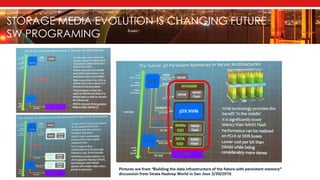
STORAGE MEDIA EVOLUTION IS CHANGING FUTURE
SW PROGRAMING
FROM IN-MEMORY TO IN-PLACE
 Moving from In-Memory
Computing to In-Place
Computing
 Mnemonic is a
pioneering project to
extend in-memory
computing to in-place
computing using next
generation NVM
storage media.
(Picture was taken from Ken
Gibson’s Storage Industry Summit
January, 20, 2016)
A NON-VOLATILE
PROGRAMMING MODEL
FOR JAVA APPLICATION
DEVELOPERS
WHY JAVA?
• There are 300+ open source initiatives at the ASF. 221 of them are
Java based, accounts for 59.9%.
• Top Level Big Data Projects are Java based projects, include
Hadoop, CloudStack, Spark, Cassandra, Hive, HBase, Flink, Solr…..
• Java related optimization has significantly contributed to Big Data
applications’ performance improvement.
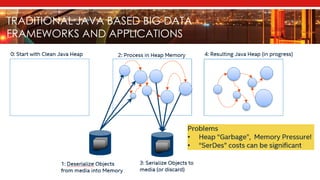
TRADITIONAL JAVA BASED BIG DATA
FRAMEWORKS AND APPLICATIONS
OUR PROPOSAL: OFF-HEAP, LEAVE DATA IN-PLACE
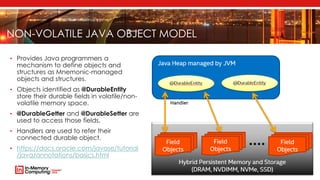
NON-VOLATILE JAVA OBJECT MODEL
• Provides Java programmers a
mechanism to define objects and
structures as Mnemonic-managed
objects and structures.
• Objects identified as @DurableEntity
store their durable fields in volatile/non-
volatile memory space.
• @DurableGetter and @DurableSetter are
used to access those fields.
• Handlers are used to refer their
connected durable object.
• https://docs.oracle.com/javase/tutorial
/java/annotations/basics.html
AN EXAMPLE OF NON-VOLATILE LINKED LIST
(LAZY LOADING)
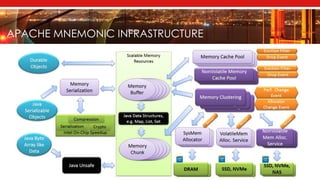
APACHE MNEMONIC INFRASTRUCTURE
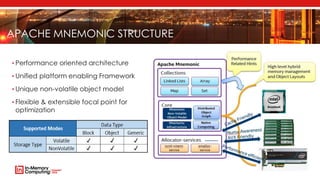
APACHE MNEMONIC STRUCTURE
• Performance oriented architecture
• Unified platform enabling Framework
• Unique non-volatile object model
• Flexible & extensible focal point for
optimization
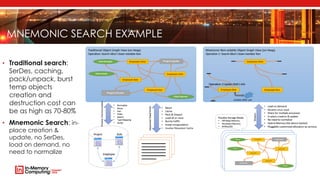
MNEMONIC SEARCH EXAMPLE
• Traditional search:
SerDes, caching,
pack/unpack, burst
temp objects
creation and
destruction cost can
be as high as 70-80%
• Mnemonic Search: in-
place creation &
update, no SerDes,
load on demand, no
need to normalize
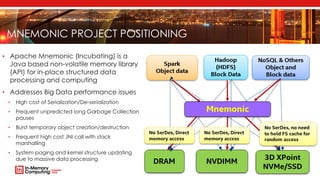
MNEMONIC PROJECT POSITIONING
• Apache Mnemonic (Incubating) is a
Java based non-volatile memory library
(API) for in-place structured data
processing and computing
• Addresses Big Data performance issues
• High cost of Serialization/De-serialization
• Frequent unpredicted long Garbage Collection
pauses
• Burst temporary object creation/destruction
• Frequent high cost JNI call with stack
marshalling
• System paging and kernel structure updating
due to massive data processing
USE CASE EXAMPLE:
SPARK + MNEMONIC
=IN-PLACE MACHINE
LEARNING COMPUTING
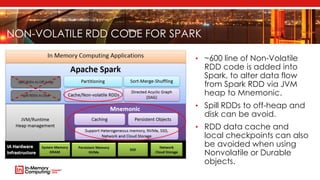
NON-VOLATILE RDD CODE FOR SPARK
• ~600 line of Non-Volatile
RDD code is added into
Spark, to alter data flow
from Spark RDD via JVM
heap to Mnemonic.
• Spill RDDs to off-heap and
disk can be avoid.
• RDD data cache and
local checkpoints can also
be avoided when using
Nonvolatile or Durable
objects.
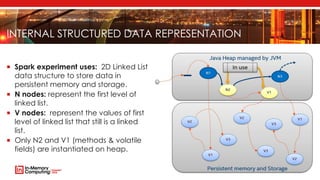
INTERNAL STRUCTURED DATA REPRESENTATION
 Spark experiment uses: 2D Linked List
data structure to store data in
persistent memory and storage.
 N nodes: represent the first level of
linked list.
 V nodes: represent the values of first
level of linked list that still is a linked
list.
 Only N2 and V1 (methods & volatile
fields) are instantiated on heap.
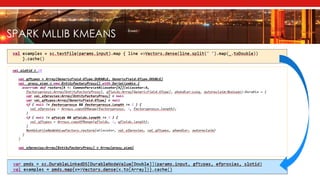
SPARK MLLIB KMEANS
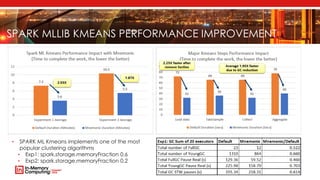
SPARK MLLIB KMEANS PERFORMANCE IMPROVEMENT
• SPARK ML Kmeans implements one of the most
popular clustering algorithms
• Exp1: spark.storage.memoryFraction 0.6
• Exp2: spark.storage.memoryFraction 0.2
CONFIGURATION FOR PERFORMANCE MEASUREMENT
 Platform Software Configuration
 OS: CentOS 7
 JVM: JDK8 update 60
 ParallelOldGC is used for Spark ML throughput
workload Kmeans
 Spark1.5.0
 Platform Hardware
 Haswell EP (72 cores, E5-2699 v3 @ 2.3GHz)
 256GB DDR4-2133 on-board Memory
 Storage media: SATA SSD
 Device Model: INTEL SSDSC2BB016T4
 Serial Number: BTWD442601311P6HGN
 User Capacity: 1.60 TB
 SATA Version is: SATA 3.0, 6.0 Gb/s
 Spark Kmeans Experiments Setting:
– System memory is reduced to 128G via
static dummy ramfile occupancy
– 20 executors with 4 GB JVM heap, 3 cores
– Both of datasets are stored on SSD
– Experiment 1
– spark.storage.memoryFraction 0.6
– 100,000,000 records with vector in 12
dimension (20 partitions)
– Experiment 2
– spark.storage.memoryFraction 0.2
– 100,000,000 records with vector in 6
dimension (20 partitions)
DISCLAIMERS
Apache Mnemonic is an effort undergoing incubation at The Apache Software Foundation
(ASF), sponsored by Apache Incubator PMC. Incubation is required of all newly accepted
projects until a further review indicates that the infrastructure, communications, and
decision making process have stabilized in a manner consistent with other successful ASF
projects. While incubation status is not necessarily a reflection of the completeness or
stability of the code, it does indicate that the project has yet to be fully endorsed by the
ASF.
While Mnemonic is operating within the time period where the application is processing
their durable data, Mnemonic guarantees the persistency once Mnemonic is closed
gracefully.
PROJECT LINKS
Mnemonic Community: dev@mnemonic.incubator.apache.org
Source Code: https://github.com/apache/incubator-mnemonic
JIRA Tracking: https://issues.apache.org/jira/browse/MNEMONIC
Website: http://mnemonic.incubator.apache.org/
Contact:
yanpingw@apache.org; garyw@apache.org

IMC Summit 2016 Breakout - Yanping Wang - Non-volatile Generic Object Programming Model for In-Memory Computing (Spark) Performance Improvement

  • 1.
    INTRODUCING A NON-VOLATILEGENERIC OBJECT PROGRAMMING MODEL FOR IN-MEMORY COMPUTING (SPARK) PERFORMANCE IMPROVEMENT YANPING WANG APACHE MNEMONIC (INCUBATING) PROJECT LEADER YANPINGW@APACHE.ORG
  • 2.
  • 3.
    STORAGE MEDIA EVOLUTION Storage Media Evolution: NAND and 3D XPoint are filling the Speed and Capacity gap between DRAM and Hard Disk Drives  Software is facing the challenge on how to use them
  • 4.
    STORAGE MEDIA EVOLUTIONIS CHANGING FUTURE SW PROGRAMING
  • 5.
    FROM IN-MEMORY TOIN-PLACE  Moving from In-Memory Computing to In-Place Computing  Mnemonic is a pioneering project to extend in-memory computing to in-place computing using next generation NVM storage media. (Picture was taken from Ken Gibson’s Storage Industry Summit January, 20, 2016)
  • 6.
    A NON-VOLATILE PROGRAMMING MODEL FORJAVA APPLICATION DEVELOPERS
  • 7.
    WHY JAVA? • Thereare 300+ open source initiatives at the ASF. 221 of them are Java based, accounts for 59.9%. • Top Level Big Data Projects are Java based projects, include Hadoop, CloudStack, Spark, Cassandra, Hive, HBase, Flink, Solr….. • Java related optimization has significantly contributed to Big Data applications’ performance improvement.
  • 8.
    TRADITIONAL JAVA BASEDBIG DATA FRAMEWORKS AND APPLICATIONS
  • 9.
    OUR PROPOSAL: OFF-HEAP,LEAVE DATA IN-PLACE
  • 10.
    NON-VOLATILE JAVA OBJECTMODEL • Provides Java programmers a mechanism to define objects and structures as Mnemonic-managed objects and structures. • Objects identified as @DurableEntity store their durable fields in volatile/non- volatile memory space. • @DurableGetter and @DurableSetter are used to access those fields. • Handlers are used to refer their connected durable object. • https://docs.oracle.com/javase/tutorial /java/annotations/basics.html
  • 11.
    AN EXAMPLE OFNON-VOLATILE LINKED LIST (LAZY LOADING)
  • 12.
  • 13.
    APACHE MNEMONIC STRUCTURE •Performance oriented architecture • Unified platform enabling Framework • Unique non-volatile object model • Flexible & extensible focal point for optimization
  • 14.
    MNEMONIC SEARCH EXAMPLE •Traditional search: SerDes, caching, pack/unpack, burst temp objects creation and destruction cost can be as high as 70-80% • Mnemonic Search: in- place creation & update, no SerDes, load on demand, no need to normalize
  • 15.
    MNEMONIC PROJECT POSITIONING •Apache Mnemonic (Incubating) is a Java based non-volatile memory library (API) for in-place structured data processing and computing • Addresses Big Data performance issues • High cost of Serialization/De-serialization • Frequent unpredicted long Garbage Collection pauses • Burst temporary object creation/destruction • Frequent high cost JNI call with stack marshalling • System paging and kernel structure updating due to massive data processing
  • 16.
    USE CASE EXAMPLE: SPARK+ MNEMONIC =IN-PLACE MACHINE LEARNING COMPUTING
  • 17.
    NON-VOLATILE RDD CODEFOR SPARK • ~600 line of Non-Volatile RDD code is added into Spark, to alter data flow from Spark RDD via JVM heap to Mnemonic. • Spill RDDs to off-heap and disk can be avoid. • RDD data cache and local checkpoints can also be avoided when using Nonvolatile or Durable objects.
  • 18.
    INTERNAL STRUCTURED DATAREPRESENTATION  Spark experiment uses: 2D Linked List data structure to store data in persistent memory and storage.  N nodes: represent the first level of linked list.  V nodes: represent the values of first level of linked list that still is a linked list.  Only N2 and V1 (methods & volatile fields) are instantiated on heap.
  • 19.
  • 20.
    SPARK MLLIB KMEANSPERFORMANCE IMPROVEMENT • SPARK ML Kmeans implements one of the most popular clustering algorithms • Exp1: spark.storage.memoryFraction 0.6 • Exp2: spark.storage.memoryFraction 0.2
  • 21.
    CONFIGURATION FOR PERFORMANCEMEASUREMENT  Platform Software Configuration  OS: CentOS 7  JVM: JDK8 update 60  ParallelOldGC is used for Spark ML throughput workload Kmeans  Spark1.5.0  Platform Hardware  Haswell EP (72 cores, E5-2699 v3 @ 2.3GHz)  256GB DDR4-2133 on-board Memory  Storage media: SATA SSD  Device Model: INTEL SSDSC2BB016T4  Serial Number: BTWD442601311P6HGN  User Capacity: 1.60 TB  SATA Version is: SATA 3.0, 6.0 Gb/s  Spark Kmeans Experiments Setting: – System memory is reduced to 128G via static dummy ramfile occupancy – 20 executors with 4 GB JVM heap, 3 cores – Both of datasets are stored on SSD – Experiment 1 – spark.storage.memoryFraction 0.6 – 100,000,000 records with vector in 12 dimension (20 partitions) – Experiment 2 – spark.storage.memoryFraction 0.2 – 100,000,000 records with vector in 6 dimension (20 partitions)
  • 22.
    DISCLAIMERS Apache Mnemonic isan effort undergoing incubation at The Apache Software Foundation (ASF), sponsored by Apache Incubator PMC. Incubation is required of all newly accepted projects until a further review indicates that the infrastructure, communications, and decision making process have stabilized in a manner consistent with other successful ASF projects. While incubation status is not necessarily a reflection of the completeness or stability of the code, it does indicate that the project has yet to be fully endorsed by the ASF. While Mnemonic is operating within the time period where the application is processing their durable data, Mnemonic guarantees the persistency once Mnemonic is closed gracefully.
  • 23.
    PROJECT LINKS Mnemonic Community:dev@mnemonic.incubator.apache.org Source Code: https://github.com/apache/incubator-mnemonic JIRA Tracking: https://issues.apache.org/jira/browse/MNEMONIC Website: http://mnemonic.incubator.apache.org/ Contact: yanpingw@apache.org; garyw@apache.org