Integrated Marketing Communications
Customers… Segmentation, Targeting and positioning
3
1
2
3
4
5
6
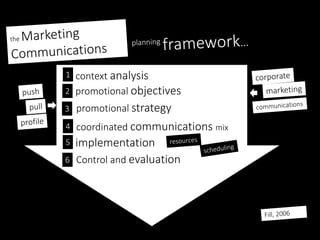
context analysis
promotional objectives
promotional strategy
coordinated communications mix
implementation
Control and evaluation
Corporate… Marketing… Marketing Communications
mission statement...
Should set out customers, their needs and the offering
This provides a framework for setting objectives…
…these will be within a hierarchy…
communications objectives...
avoid solely focusing on sales, what are the key metrics?
Business… sales, market share and profit,
Behavioural… penetration and loyalty,
Intermediate… awareness, attitudes, perceptions
help highlight the balance of tactics needed
provide a time frame
provide a means of evaluation and measurement
…SMART
…why SMART?
Specific… to a market, an audience, a goal,
Measureable… something quantifiable – how much, how many?
Achievable… do we have the resources and capacity to achieve it?
Realistic/Relevant… is it appropriate, does it fit with audit findings?
Time-bound… when do we want to achieve it by?
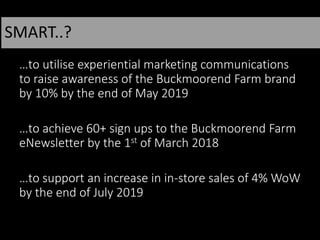
…to utilise experiential marketing communications
to raise awareness of the Buckmoorend Farm brand
by 10% by the end of May 2019
…to achieve 60+ sign ups to the Buckmoorend Farm
eNewsletter by the 1st of March 2018
…to support an increase in in-store sales of 4% WoW
by the end of July 2019
SMART..?
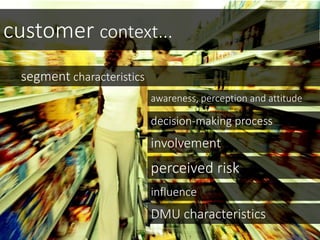
customer context...
segment characteristics
decision-making process
involvement
perceived risk
awareness, perception and attitude
influence
DMU characteristics
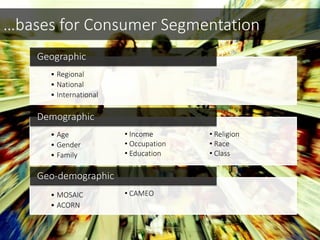
…bases for Consumer Segmentation
• Regional
• National
• International
Geographic
• Age
• Gender
• Family
Demographic
• MOSAIC
• ACORN
Geo-demographic
• Income
• Occupation
• Education
• Religion
• Race
• Class
• CAMEO
• Lifestyle
• Personality
Psychographic
• Benefits sought
• Purchase occasion
• Attitude to product
Behavioural
• Usage rate
• User status
• Loyalty
…bases for Consumer Segmentation
• Interests
• Values
different approaches...
changing nature of disposable income
Family lifecycle
Ageing population
Gender roles
Technology use and acceptance
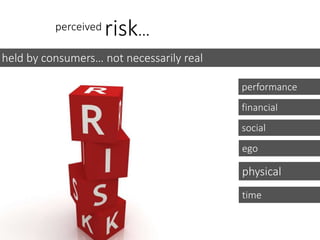
perceived risk…
held by consumers… not necessarily real
performance
financial
social
ego
physical
time
Benefit segmentation…
Segment by benefits sought by consumers
transcends geographic and demographic
identify common characteristics
or usage patterns
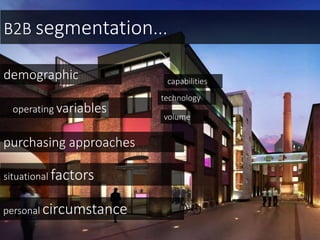
B2B segmentation...
demographic
operating variables
purchasing approaches
situational factors
personal circumstance
technology
volume
capabilities
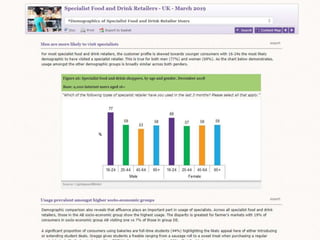
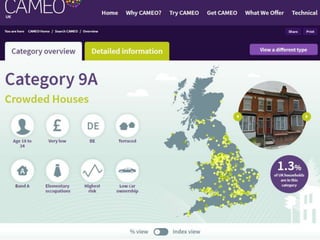
CAMEO
ACORN
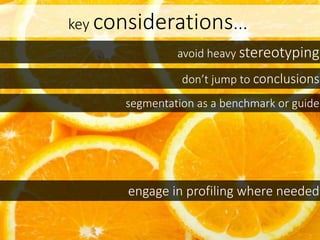
key considerations...
avoid heavy stereotyping
don’t jump to conclusions
segmentation as a benchmark or guide
engage in profiling where needed
…chips!
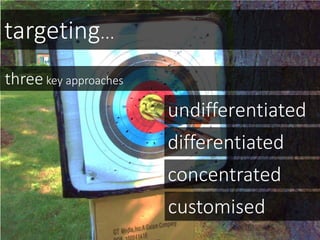
targeting...
three key approaches
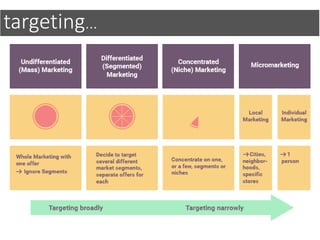
undifferentiated
differentiated
concentrated
customised
targeting...
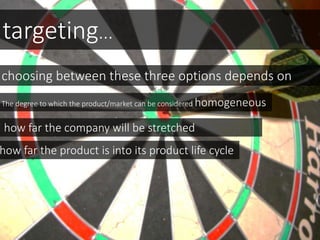
targeting...
choosing between these three options depends on
The degree to which the product/market can be considered homogeneous
how far the company will be stretched
how far the product is into its product life cycle
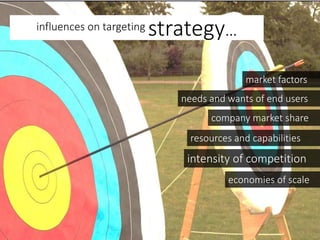
influences on targeting strategy…
market factors
needs and wants of end users
company market share
resources and capabilities
intensity of competition
economies of scale
DAMP framework… (Kotler, 1984)
Discernible
Accessible
Measurable
Profitable
…chips!
positioning…
products can be positioned in the market by focusing on specific factors
such as…
features, benefits or advantages
solutions presented
specific usage (occasions)
positioned against other products
class disassociation
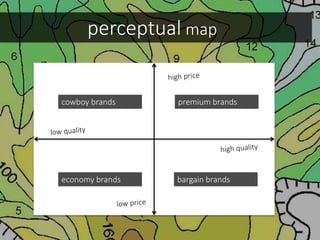
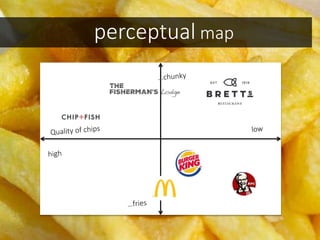
perceptual map
cowboy brands premium brands
economy brands bargain brands
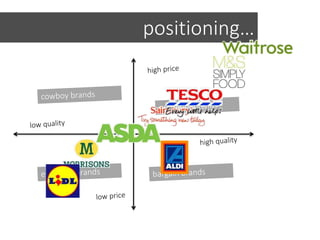
positioning…
Other influences on positioning...
benefits
age group targeted
innovation
features
style
perceptual map
perceptual mapping...
think
why does the gap exist?
what are the reasons?
may need more research
What’s important here?
Communications objectives need to deliver on broader
business and marketing objectives…
…and they must be SMART
Segmentation is a guide or a benchmark, not a definitive science
Target segments need to fit certain criteria to be viable
Offerings can be positioned in a variety of ways but they must
be relevant to the consumer

IMC Lecture 3