4/24/2015
1
Evaluating IMC
Learning Objectives
• Discuss the role of evaluation as part of the IMC process.
• Recommend forms of pre and post-evaluation relevant to
differing IMC scenarios.
4/24/2015
2
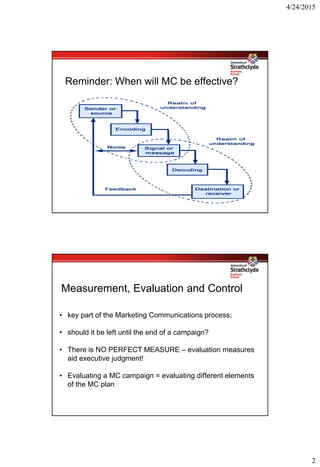
Reminder: When will MC be effective?
Measurement, Evaluation and Control
• key part of the Marketing Communications process;
• should it be left until the end of a campaign?
• There is NO PERFECT MEASURE – evaluation measures
aid executive judgment!
• Evaluating a MC campaign = evaluating different elements
of the MC plan
4/24/2015
3
Role and Purpose of Evaluation
• ensure that communication objectives have been met;
• ensure that Communications strategy(ies) have been
effective;
• ensure cost efficiency;
• for guidance and development;
• also : prediction and evaluation;
• Inform whether IMC has been an effective approach.
Evaluation
• Efficiency – doing things right
• Effectiveness – doing the right things
• Economy – doing things within budget
4/24/2015
4
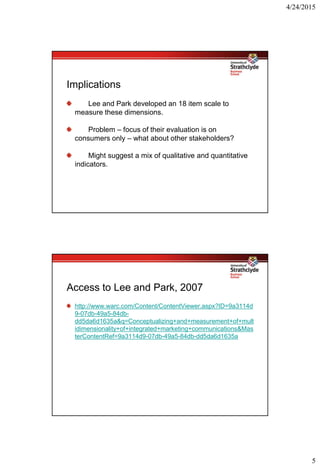
Planning Marketing Communications
(Fill)
4 dimensions of IMC (Lee & Park, 2007)
• Unified communications: communicate to create a clear, single
position in the target market & deliver a consistent message
through multiple channels.
• Differentiated communications to multiple groups: use hierarchy of
effects to create different campaigns targeting groups at different
stages of readiness.
• Database-centred communications: generate behavioural
responses through direct activities informed by information stored
in databases.
• Relationship fostering communications: retain customers 7 develop
LT relationships is a critical dimension of IMC.
4/24/2015
5
Implications
Lee and Park developed an 18 item scale to
measure these dimensions.
Problem – focus of their evaluation is on
consumers only – what about other stakeholders?
Might suggest a mix of qualitative and quantitative
indicators.
Access to Lee and Park, 2007
http://www.warc.com/Content/ContentViewer.aspx?ID=9a3114d
9-07db-49a5-84db-
dd5da6d1635a&q=Conceptualizing+and+measurement+of+mult
idimensionality+of+integrated+marketing+communications&Mas
terContentRef=9a3114d9-07db-49a5-84db-dd5da6d1635a
4/24/2015
6
Evaluation process
Typically covers 3 areas:
• Media
• Message
• Sales effect
Sales effects are difficult to capture:
• The collective effect of variables in the marketing environment
• The uniqueness of individuals
• Lagged variables
• Cumulative effects
Evaluation Process
• Involves both pre and post testing of marketing
communications.
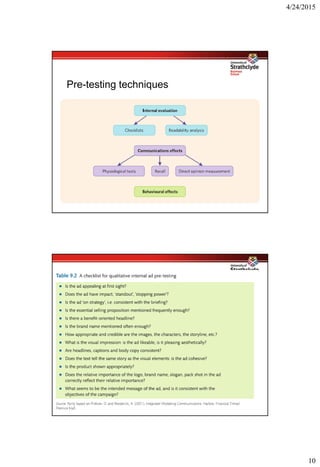
• Pre-evaluation : test concepts with focus groups;
consumer juries; readability and theater tests.
• Post-evaluation : no. inquiries; recall; recognition; sales
figures; image analyses; familiarity and favorability
scales.
4/24/2015
7
ALSO CAN BE INFORMED BY EARLY-
STAGE ANALYSIS OF TARGET AND BUYER
READINESS OR AWARENESS, INTEREST,
DESIRE, ACTION.
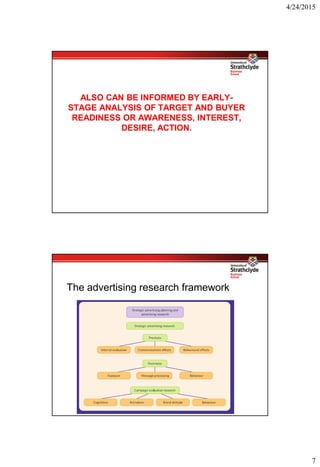
The advertising research framework
4/24/2015
8
Advertising research
To improve decision-making in each stage of the advertising
planning process
Supports the linkages between MC – marketing – business
strategies
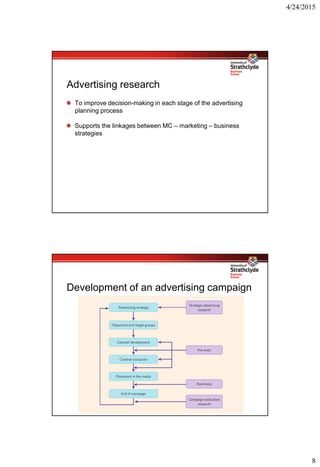
Development of an advertising campaign
4/24/2015
9
Strategic advertising research
Elements studied and prepared in this stage are:
Product – USP, advertising platform and convincing arguments
Market – size ,shares, etc.
Environment – PESTLE
Tools used:
Desk research
Qualitative interviews
Communications audit
Management judgement tests.
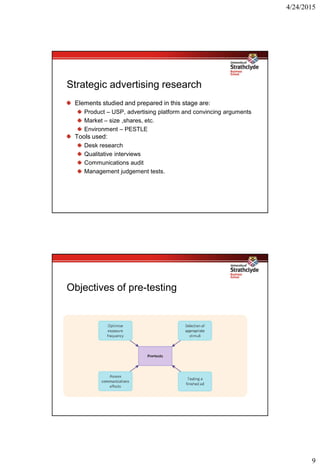
Objectives of pre-testing
4/24/2015
10
Pre-testing techniques
4/24/2015
11
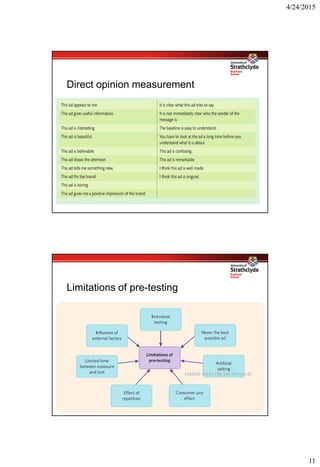
Direct opinion measurement
Limitations of pre-testing
4/24/2015
12
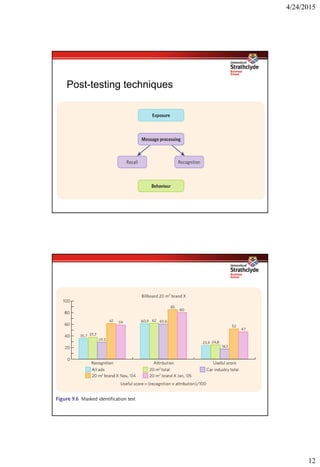
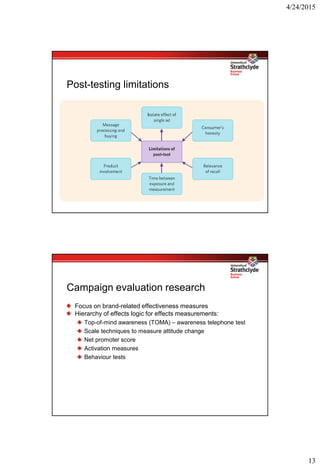
Post-testing techniques
4/24/2015
13
Post-testing limitations
Campaign evaluation research
Focus on brand-related effectiveness measures
Hierarchy of effects logic for effects measurements:
Top-of-mind awareness (TOMA) – awareness telephone test
Scale techniques to measure attitude change
Net promoter score
Activation measures
Behaviour tests
4/24/2015
14
Evaluation of the integration of MCs
The integration of MC exists on multiple levels:
• Promotional mix integration
• Promotional mix with marketing mix integration
• Creative integration
• Intra-organisation integration
• Inter-organisational integration
• Integration of communications
• Integration of corporate and product/brand
communications
• Geographical integration
4/24/2015
15
Evaluation Techniques
These will be dependent upon :
a) The objectives of the campaign: consider hierarchy of
effects;
b) Intended audience;
c) Types of communication tools and media employed.
Planning for evaluation
• agree in advance when and how IMC are to be both
measured and evaluated;
• take action if it is required - contingencies; use of
scenario planning;
• take action at the correct time - do not leave
measurement and evaluation until the end;
• prepare for crisis management!
4/24/2015
16
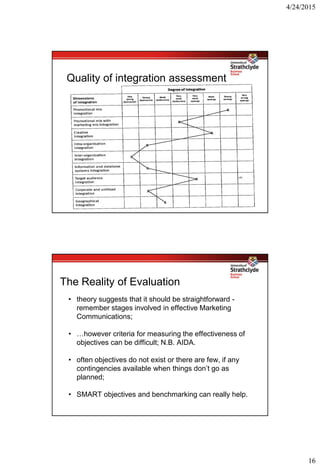
Quality of integration assessment
profile
The Reality of Evaluation
• theory suggests that it should be straightforward -
remember stages involved in effective Marketing
Communications;
• …however criteria for measuring the effectiveness of
objectives can be difficult; N.B. AIDA.
• often objectives do not exist or there are few, if any
contingencies available when things don’t go as
planned;
• SMART objectives and benchmarking can really help.
4/24/2015
17
Contingency
When Results are less than expected
• remember actual and potential costs;
• contingency depends upon ‘damage limitation’ required;
• management of reputation;
• Choices : stop communication (drastic?); change
communication; change packaging or price?; support with
additional communication; deliver what you communicate.
Implications
• Measureable gaps between image and customer
perception of brands based upon their experiences.
• Where expectations are exceeded the promise gap is
positive and where not met it is positive.
• These gaps will be reflected in the financial
performance of brands.
• How to use communications to encourage brand
advocacy and endorsement – may require more direct,
below the line communications integrated with engaging
above the line communications.
4/24/2015
18
Online communications
Easy to measure and evaluation?
Perhaps not accurate.....
Within an IMC how readily can the impact of WOM,
blogging and on-line PR be isolated?
Strong ethical issues related to cookies which are
heavily used in developing complex customer
profiles.....

Session evaluation

  • 1.
    4/24/2015 1 Evaluating IMC Learning Objectives •Discuss the role of evaluation as part of the IMC process. • Recommend forms of pre and post-evaluation relevant to differing IMC scenarios.
  • 2.
    4/24/2015 2 Reminder: When willMC be effective? Measurement, Evaluation and Control • key part of the Marketing Communications process; • should it be left until the end of a campaign? • There is NO PERFECT MEASURE – evaluation measures aid executive judgment! • Evaluating a MC campaign = evaluating different elements of the MC plan
  • 3.
    4/24/2015 3 Role and Purposeof Evaluation • ensure that communication objectives have been met; • ensure that Communications strategy(ies) have been effective; • ensure cost efficiency; • for guidance and development; • also : prediction and evaluation; • Inform whether IMC has been an effective approach. Evaluation • Efficiency – doing things right • Effectiveness – doing the right things • Economy – doing things within budget
  • 4.
    4/24/2015 4 Planning Marketing Communications (Fill) 4dimensions of IMC (Lee & Park, 2007) • Unified communications: communicate to create a clear, single position in the target market & deliver a consistent message through multiple channels. • Differentiated communications to multiple groups: use hierarchy of effects to create different campaigns targeting groups at different stages of readiness. • Database-centred communications: generate behavioural responses through direct activities informed by information stored in databases. • Relationship fostering communications: retain customers 7 develop LT relationships is a critical dimension of IMC.
  • 5.
    4/24/2015 5 Implications Lee and Parkdeveloped an 18 item scale to measure these dimensions. Problem – focus of their evaluation is on consumers only – what about other stakeholders? Might suggest a mix of qualitative and quantitative indicators. Access to Lee and Park, 2007 http://www.warc.com/Content/ContentViewer.aspx?ID=9a3114d 9-07db-49a5-84db- dd5da6d1635a&q=Conceptualizing+and+measurement+of+mult idimensionality+of+integrated+marketing+communications&Mas terContentRef=9a3114d9-07db-49a5-84db-dd5da6d1635a
  • 6.
    4/24/2015 6 Evaluation process Typically covers3 areas: • Media • Message • Sales effect Sales effects are difficult to capture: • The collective effect of variables in the marketing environment • The uniqueness of individuals • Lagged variables • Cumulative effects Evaluation Process • Involves both pre and post testing of marketing communications. • Pre-evaluation : test concepts with focus groups; consumer juries; readability and theater tests. • Post-evaluation : no. inquiries; recall; recognition; sales figures; image analyses; familiarity and favorability scales.
  • 7.
    4/24/2015 7 ALSO CAN BEINFORMED BY EARLY- STAGE ANALYSIS OF TARGET AND BUYER READINESS OR AWARENESS, INTEREST, DESIRE, ACTION. The advertising research framework
  • 8.
    4/24/2015 8 Advertising research To improvedecision-making in each stage of the advertising planning process Supports the linkages between MC – marketing – business strategies Development of an advertising campaign
  • 9.
    4/24/2015 9 Strategic advertising research Elementsstudied and prepared in this stage are: Product – USP, advertising platform and convincing arguments Market – size ,shares, etc. Environment – PESTLE Tools used: Desk research Qualitative interviews Communications audit Management judgement tests. Objectives of pre-testing
  • 10.
  • 11.
  • 12.
  • 13.
    4/24/2015 13 Post-testing limitations Campaign evaluationresearch Focus on brand-related effectiveness measures Hierarchy of effects logic for effects measurements: Top-of-mind awareness (TOMA) – awareness telephone test Scale techniques to measure attitude change Net promoter score Activation measures Behaviour tests
  • 14.
    4/24/2015 14 Evaluation of theintegration of MCs The integration of MC exists on multiple levels: • Promotional mix integration • Promotional mix with marketing mix integration • Creative integration • Intra-organisation integration • Inter-organisational integration • Integration of communications • Integration of corporate and product/brand communications • Geographical integration
  • 15.
    4/24/2015 15 Evaluation Techniques These willbe dependent upon : a) The objectives of the campaign: consider hierarchy of effects; b) Intended audience; c) Types of communication tools and media employed. Planning for evaluation • agree in advance when and how IMC are to be both measured and evaluated; • take action if it is required - contingencies; use of scenario planning; • take action at the correct time - do not leave measurement and evaluation until the end; • prepare for crisis management!
  • 16.
    4/24/2015 16 Quality of integrationassessment profile The Reality of Evaluation • theory suggests that it should be straightforward - remember stages involved in effective Marketing Communications; • …however criteria for measuring the effectiveness of objectives can be difficult; N.B. AIDA. • often objectives do not exist or there are few, if any contingencies available when things don’t go as planned; • SMART objectives and benchmarking can really help.
  • 17.
    4/24/2015 17 Contingency When Results areless than expected • remember actual and potential costs; • contingency depends upon ‘damage limitation’ required; • management of reputation; • Choices : stop communication (drastic?); change communication; change packaging or price?; support with additional communication; deliver what you communicate. Implications • Measureable gaps between image and customer perception of brands based upon their experiences. • Where expectations are exceeded the promise gap is positive and where not met it is positive. • These gaps will be reflected in the financial performance of brands. • How to use communications to encourage brand advocacy and endorsement – may require more direct, below the line communications integrated with engaging above the line communications.
  • 18.
    4/24/2015 18 Online communications Easy tomeasure and evaluation? Perhaps not accurate..... Within an IMC how readily can the impact of WOM, blogging and on-line PR be isolated? Strong ethical issues related to cookies which are heavily used in developing complex customer profiles.....