Integrated Marketing Communications
Integration and campaign planning
5
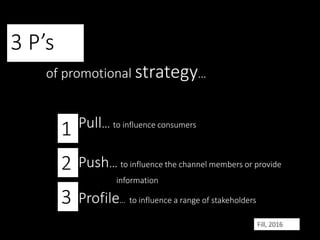
3 P’s
• Pull… to influence consumers
• Push… to influence the channel members or provide
information
• Profile… to influence a range of stakeholders
of promotional strategy…
1
2
3
Fill, 2016
Pull strategy...
designed to influence consumer and customers
focused on messages about the product
Ultimate goal is to influence purchase
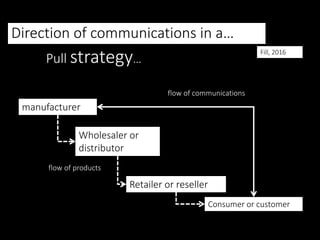
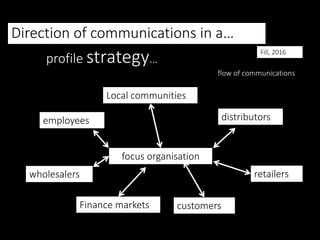
Direction of communications in a…
Pull strategy…
manufacturer
Wholesaler or
distributor
Retailer or reseller
Consumer or customer
Fill, 2016
flow of communications
flow of products
Pull strategy...
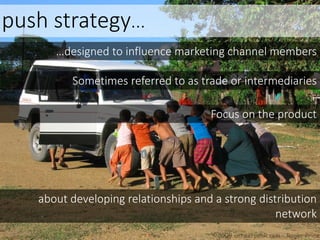
push strategy...
…designed to influence marketing channel members
Sometimes referred to as trade or intermediaries
Focus on the product
about developing relationships and a strong distribution
network
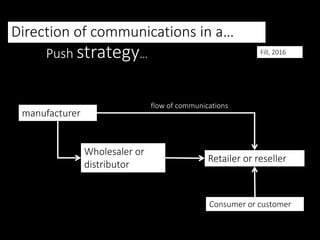
Direction of communications in a…
Push strategy…
manufacturer
Wholesaler or
distributor
Retailer or reseller
Consumer or customer
Fill, 2016
flow of communications
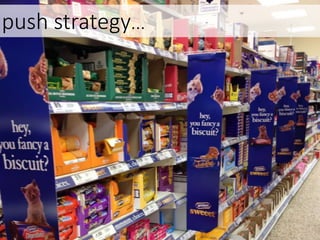
push strategy...
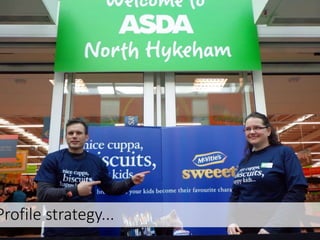
Profile strategy...
Targets all relevant stakeholders
Focuses on the organisation
Is all about building reputation
Direction of communications in a…
profile strategy…
focus organisation
Local communities
Finance markets customers
Fill, 2016
flow of communications
distributorsemployees
wholesalers retailers
Profile strategy...
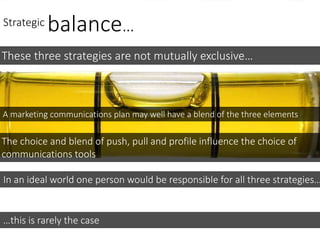
Strategic balance…
These three strategies are not mutually exclusive…
A marketing communications plan may well have a blend of the three elements
The choice and blend of push, pull and profile influence the choice of
communications tools
In an ideal world one person would be responsible for all three strategies…
…this is rarely the case
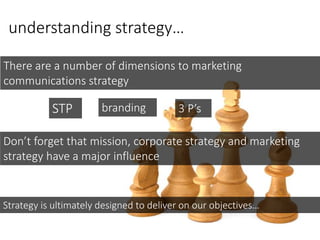
understanding strategy…
There are a number of dimensions to marketing
communications strategy
Don’t forget that mission, corporate strategy and marketing
strategy have a major influence
Strategy is ultimately designed to deliver on our objectives…
brandingSTP 3 P’s
defining integrated marketing communications…
IMC is a strategic approach to the planned
management of an organisation’s communications. IMC
requires that organisations coordinate their various
strategies, resources and messages in order
that it engage coherently and meaningfully with target
audiences. the main purpose is to develop
relationships with audiences that are of mutual
value.
Fill, 2016
defining integrated marketing communications…
it is a new way of looking at the whole, where once we
saw only parts such as advertising, public relations, sales
promotions, purchasing, employee communications and
so forth, to look at it the way the consumer sees it – as a
flow of information from indistinguishable
sources
De Pelsmaker et.al., 2013
what do we integrate?
simply put, it is about the synergistic use of the marketing
communications tools…
…but we also need to integrate the corporate and marketing objectives and
strategies
the message needs to be consistent
we need to bring in corporate identity and image…
…as well as brand identity and image
combining marketing communications tools to create
synergies…
Integrating the various tools can lead to synergies in a number of
ways - here are some examples:
The sales team have an easier job if their product or company is well known as a result
of sponsorship or advertising
In-store or point-of-sale communications that are consistent with advertising are more
effective
A promotional campaign that is supported by advertising is generally more successful
Direct mailing is more effective when prepared by an awareness-increasing advertising
campaign and supported by a sales promotion campaign
Public relations, corporate advertising and sponsorship can have synergistic effects on
company image-building
Websites will be more frequently visited when announced in mass media advertising
Advertising for a trade show will be more effective if an incentive is to visit the stand is
offered
De Pelsmaker et.al., 2015
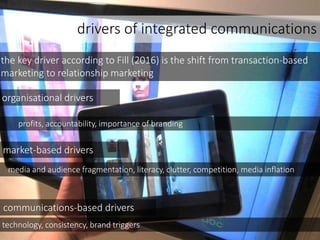
drivers of integrated communications
the key driver according to Fill (2016) is the shift from transaction-based
marketing to relationship marketing
organisational drivers
market-based drivers
communications-based drivers
media and audience fragmentation, literacy, clutter, competition, media inflation
technology, consistency, brand triggers
profits, accountability, importance of branding
barriers to integration…
opposition/reluctance to change internally
financial issues in relation to structure and frameworks
hierarchies, traditions and management structures
attitudes and structures of suppliers and agencies
perceived complexity
implementing IMC
the most important consideration is that of customer focus
this needs to be recognised organisation-wide and may require training,
support and planning
systems, processes, procedures and structures may need to be adapted
or changed
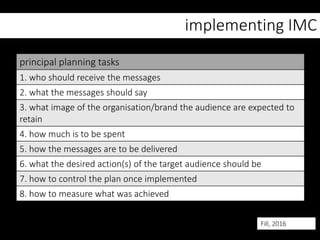
implementing IMC
principal planning tasks
1. who should receive the messages
2. what the messages should say
3. what image of the organisation/brand the audience are expected to
retain
4. how much is to be spent
5. how the messages are to be delivered
6. what the desired action(s) of the target audience should be
7. how to control the plan once implemented
8. how to measure what was achieved
Fill, 2016

IMC Lecture Five...

  • 1.
  • 2.
    3 P’s • Pull…to influence consumers • Push… to influence the channel members or provide information • Profile… to influence a range of stakeholders of promotional strategy… 1 2 3 Fill, 2016
  • 3.
    Pull strategy... designed toinfluence consumer and customers focused on messages about the product Ultimate goal is to influence purchase
  • 4.
    Direction of communicationsin a… Pull strategy… manufacturer Wholesaler or distributor Retailer or reseller Consumer or customer Fill, 2016 flow of communications flow of products
  • 5.
  • 6.
    push strategy... …designed toinfluence marketing channel members Sometimes referred to as trade or intermediaries Focus on the product about developing relationships and a strong distribution network
  • 7.
    Direction of communicationsin a… Push strategy… manufacturer Wholesaler or distributor Retailer or reseller Consumer or customer Fill, 2016 flow of communications
  • 8.
  • 9.
    Profile strategy... Targets allrelevant stakeholders Focuses on the organisation Is all about building reputation
  • 10.
    Direction of communicationsin a… profile strategy… focus organisation Local communities Finance markets customers Fill, 2016 flow of communications distributorsemployees wholesalers retailers
  • 11.
  • 12.
    Strategic balance… These threestrategies are not mutually exclusive… A marketing communications plan may well have a blend of the three elements The choice and blend of push, pull and profile influence the choice of communications tools In an ideal world one person would be responsible for all three strategies… …this is rarely the case
  • 13.
    understanding strategy… There area number of dimensions to marketing communications strategy Don’t forget that mission, corporate strategy and marketing strategy have a major influence Strategy is ultimately designed to deliver on our objectives… brandingSTP 3 P’s
  • 14.
    defining integrated marketingcommunications… IMC is a strategic approach to the planned management of an organisation’s communications. IMC requires that organisations coordinate their various strategies, resources and messages in order that it engage coherently and meaningfully with target audiences. the main purpose is to develop relationships with audiences that are of mutual value. Fill, 2016
  • 15.
    defining integrated marketingcommunications… it is a new way of looking at the whole, where once we saw only parts such as advertising, public relations, sales promotions, purchasing, employee communications and so forth, to look at it the way the consumer sees it – as a flow of information from indistinguishable sources De Pelsmaker et.al., 2013
  • 16.
    what do weintegrate? simply put, it is about the synergistic use of the marketing communications tools… …but we also need to integrate the corporate and marketing objectives and strategies the message needs to be consistent we need to bring in corporate identity and image… …as well as brand identity and image
  • 17.
    combining marketing communicationstools to create synergies… Integrating the various tools can lead to synergies in a number of ways - here are some examples: The sales team have an easier job if their product or company is well known as a result of sponsorship or advertising In-store or point-of-sale communications that are consistent with advertising are more effective A promotional campaign that is supported by advertising is generally more successful Direct mailing is more effective when prepared by an awareness-increasing advertising campaign and supported by a sales promotion campaign Public relations, corporate advertising and sponsorship can have synergistic effects on company image-building Websites will be more frequently visited when announced in mass media advertising Advertising for a trade show will be more effective if an incentive is to visit the stand is offered De Pelsmaker et.al., 2015
  • 18.
    drivers of integratedcommunications the key driver according to Fill (2016) is the shift from transaction-based marketing to relationship marketing organisational drivers market-based drivers communications-based drivers media and audience fragmentation, literacy, clutter, competition, media inflation technology, consistency, brand triggers profits, accountability, importance of branding
  • 19.
    barriers to integration… opposition/reluctanceto change internally financial issues in relation to structure and frameworks hierarchies, traditions and management structures attitudes and structures of suppliers and agencies perceived complexity
  • 20.
    implementing IMC the mostimportant consideration is that of customer focus this needs to be recognised organisation-wide and may require training, support and planning systems, processes, procedures and structures may need to be adapted or changed
  • 21.
    implementing IMC principal planningtasks 1. who should receive the messages 2. what the messages should say 3. what image of the organisation/brand the audience are expected to retain 4. how much is to be spent 5. how the messages are to be delivered 6. what the desired action(s) of the target audience should be 7. how to control the plan once implemented 8. how to measure what was achieved Fill, 2016