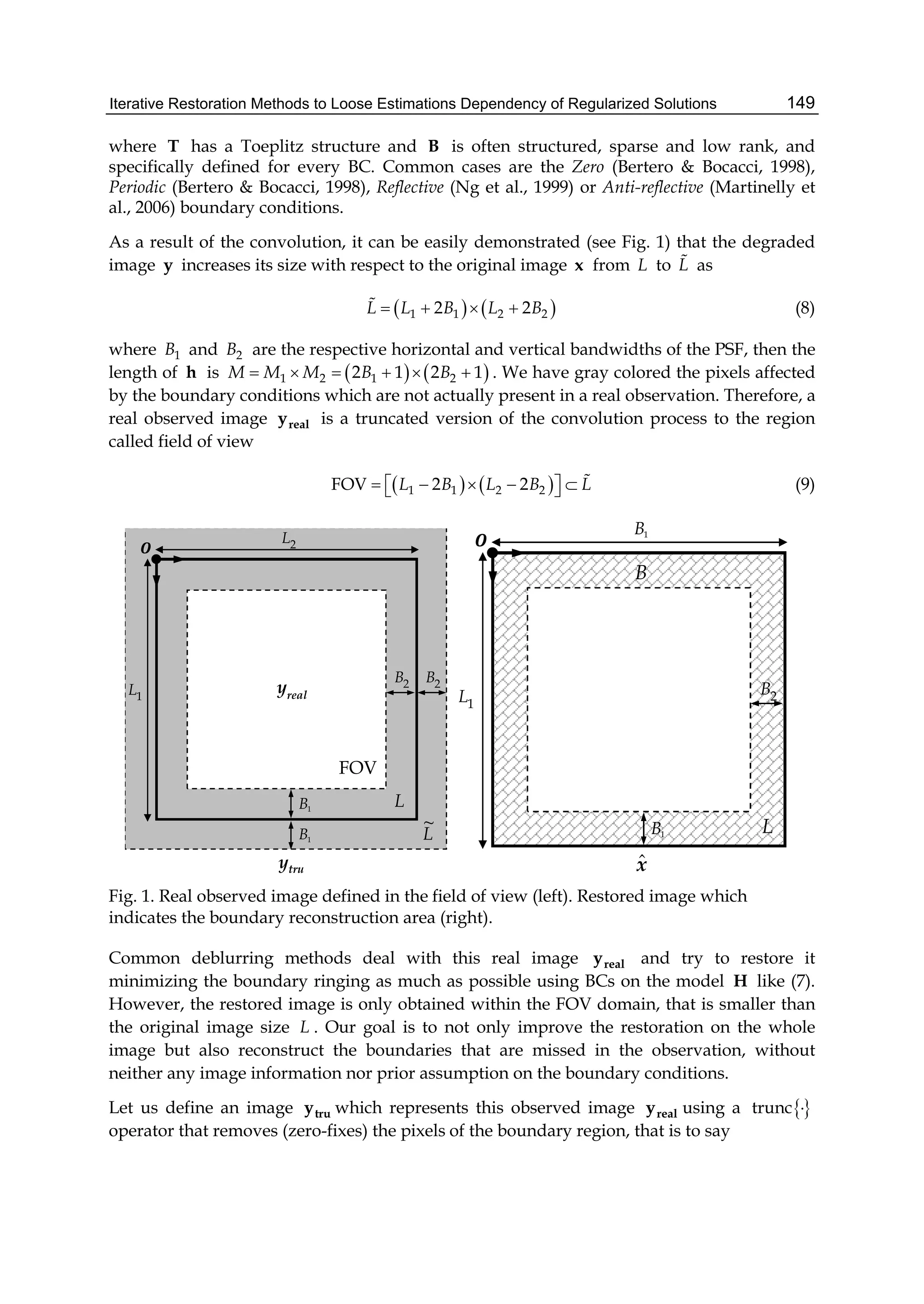
IMAGE RESTORATION
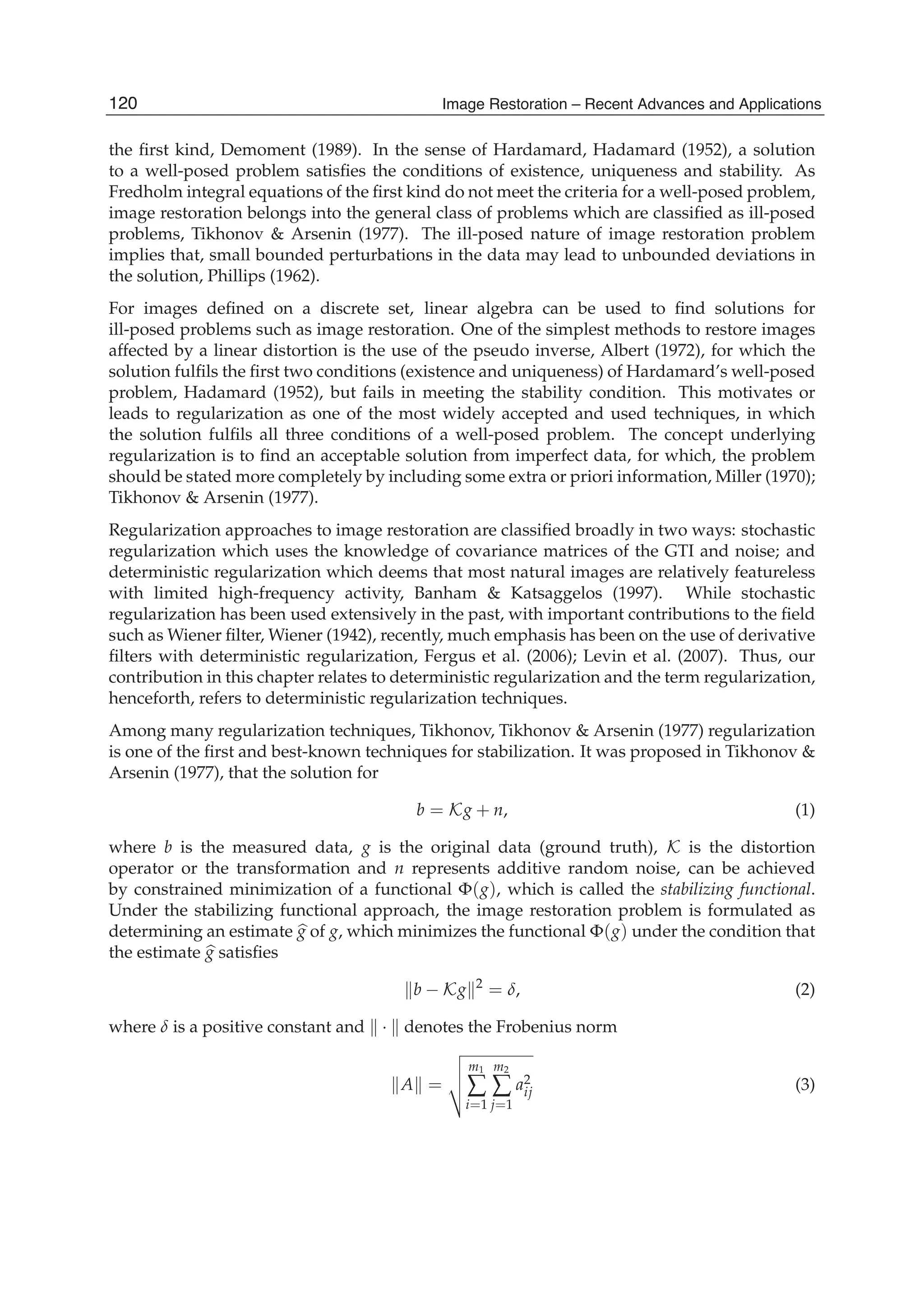
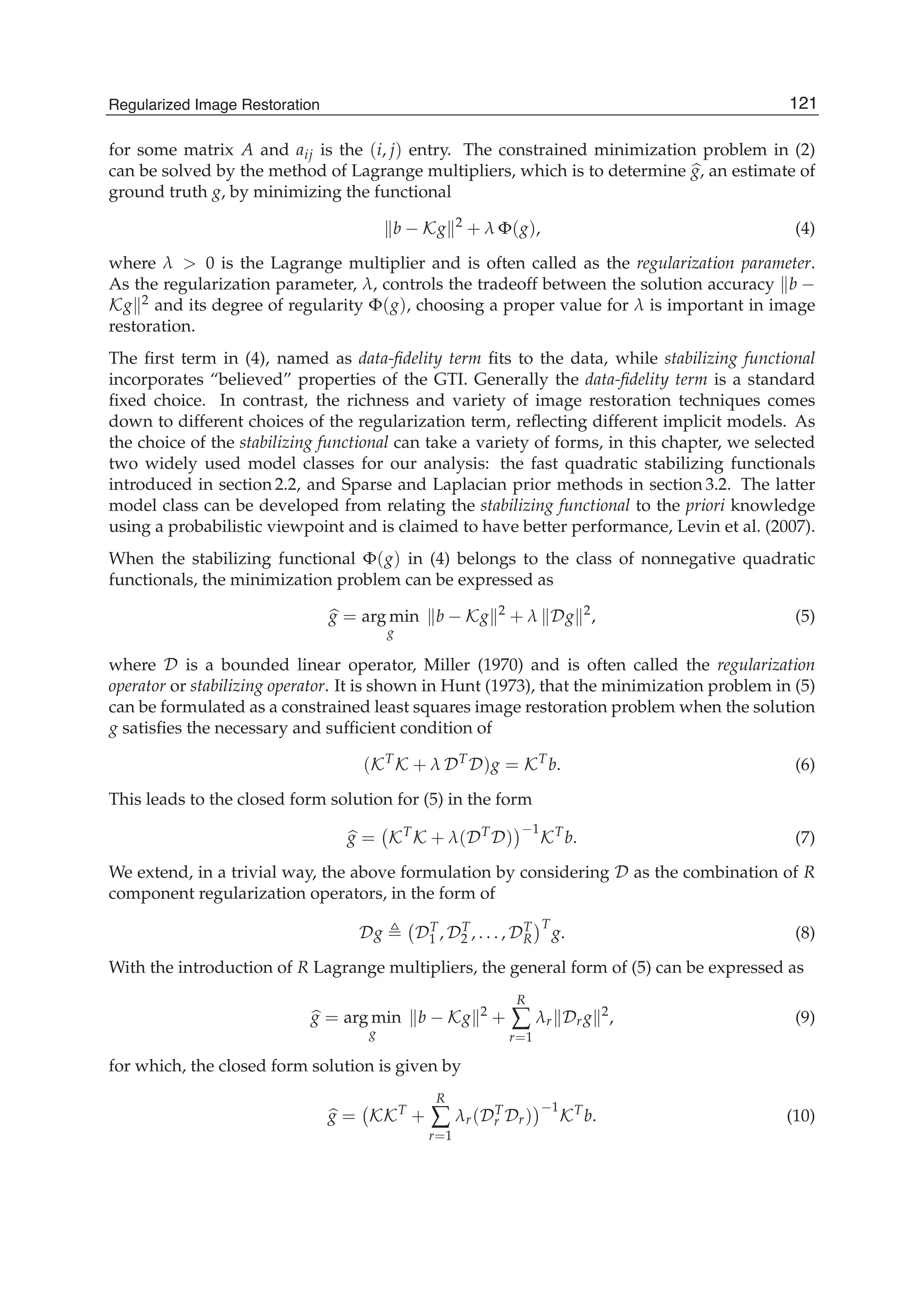
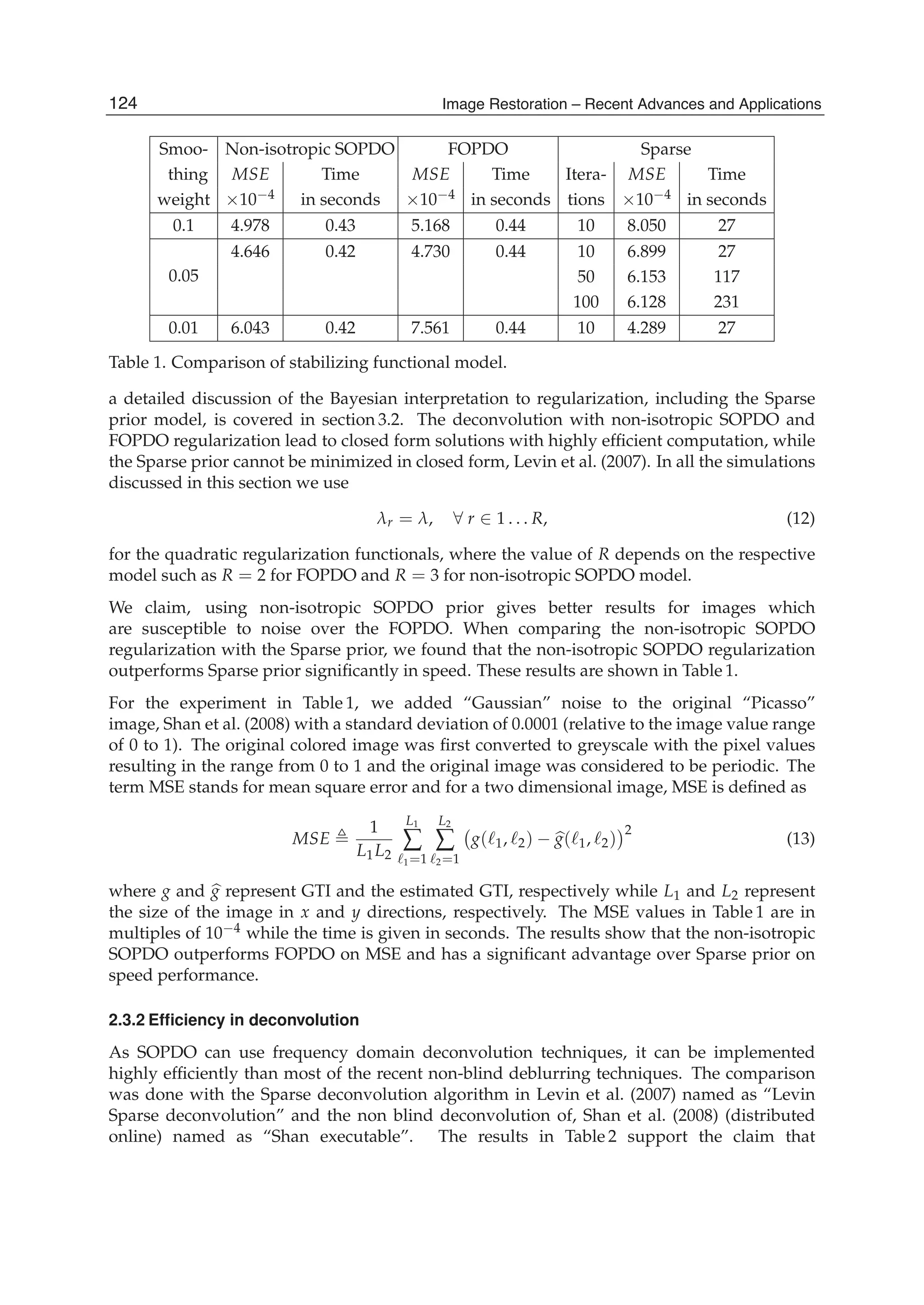
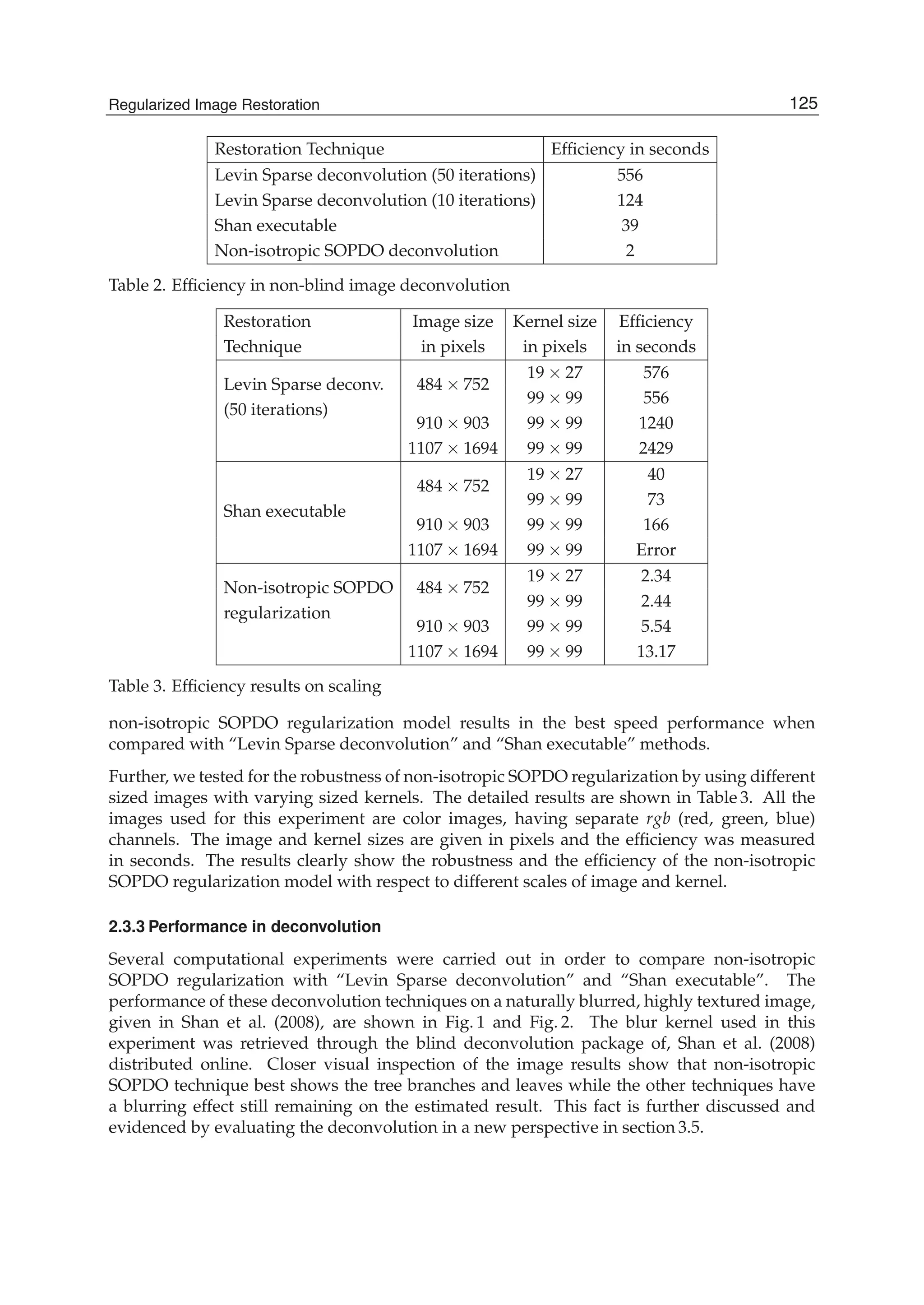
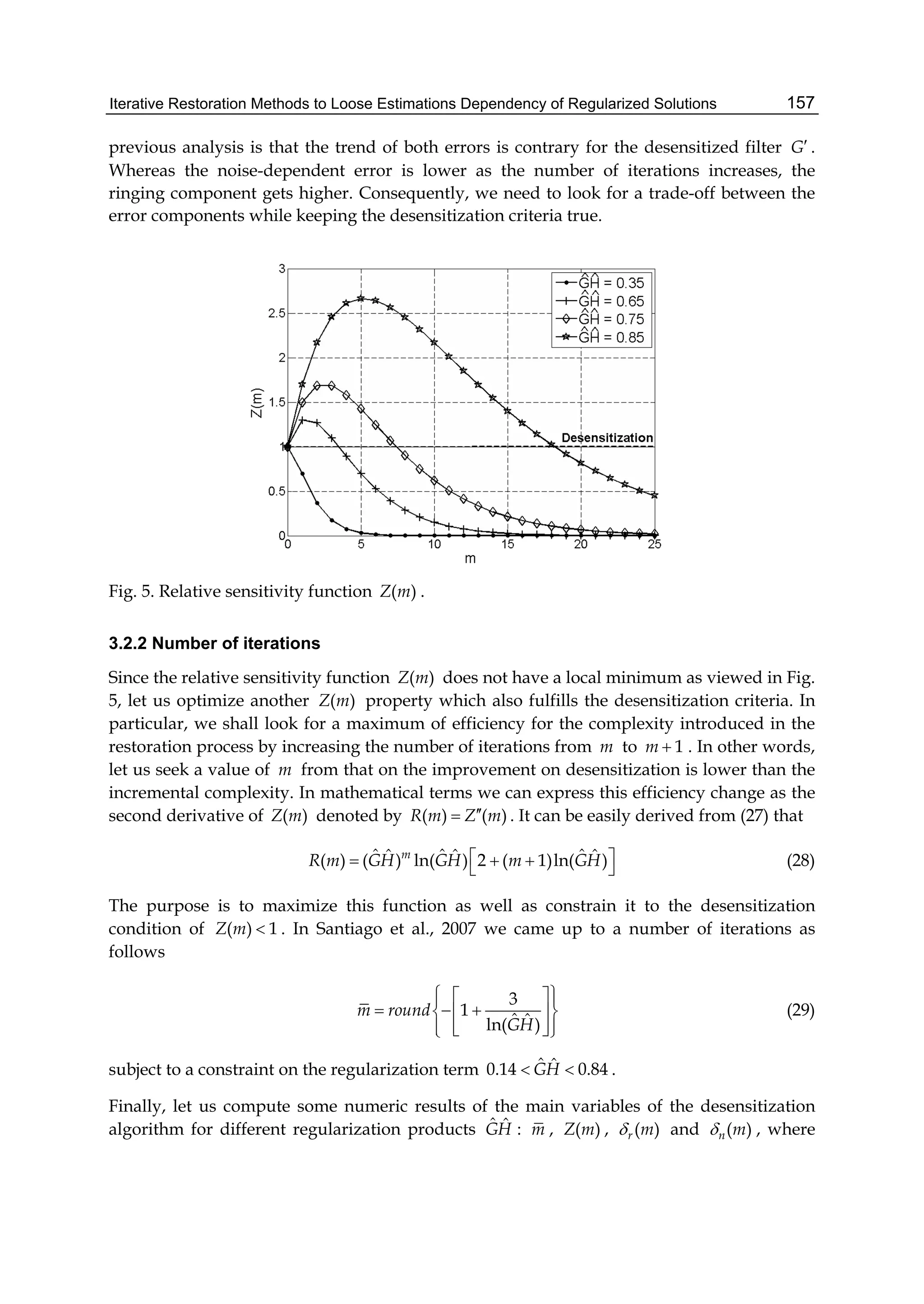
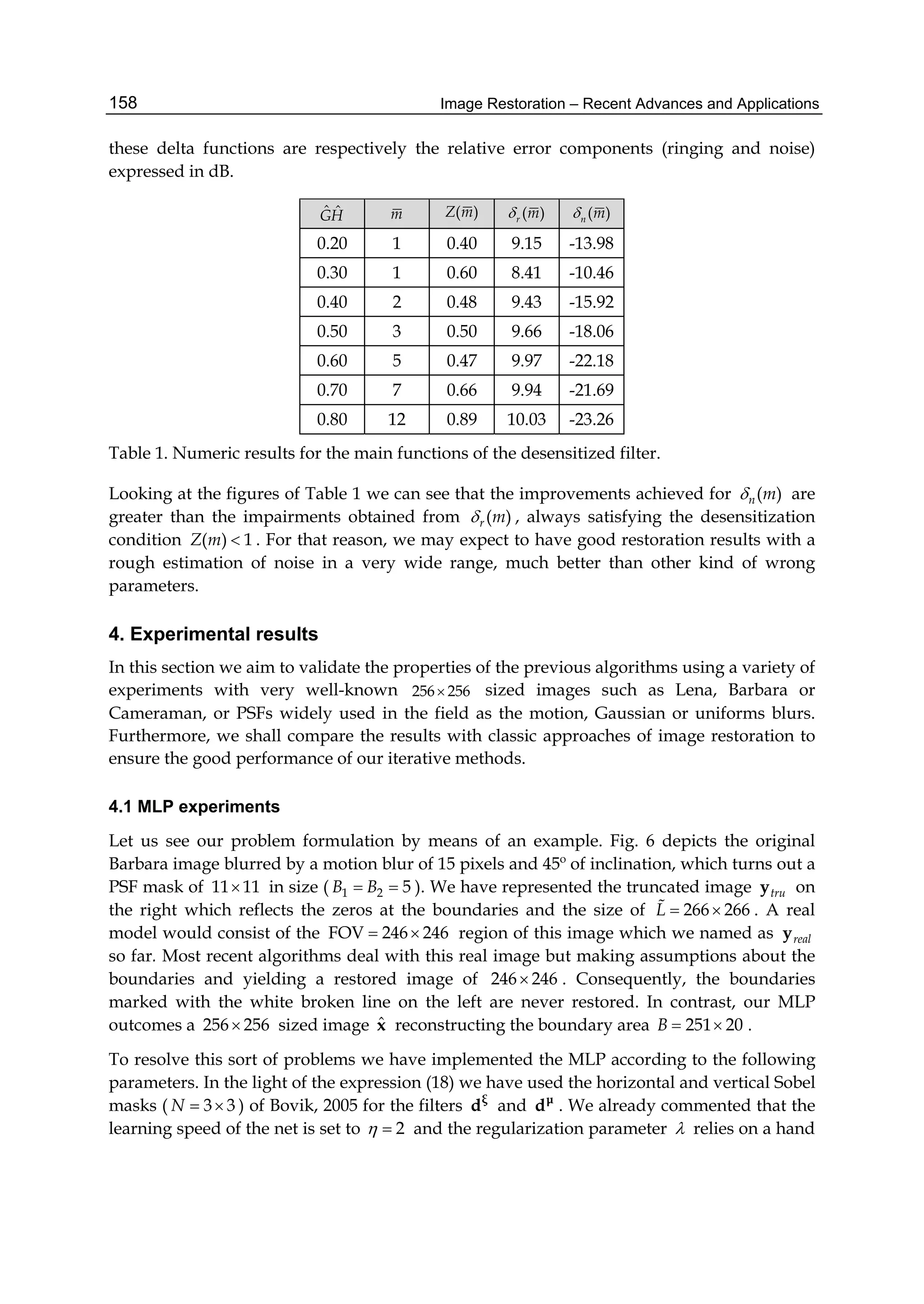
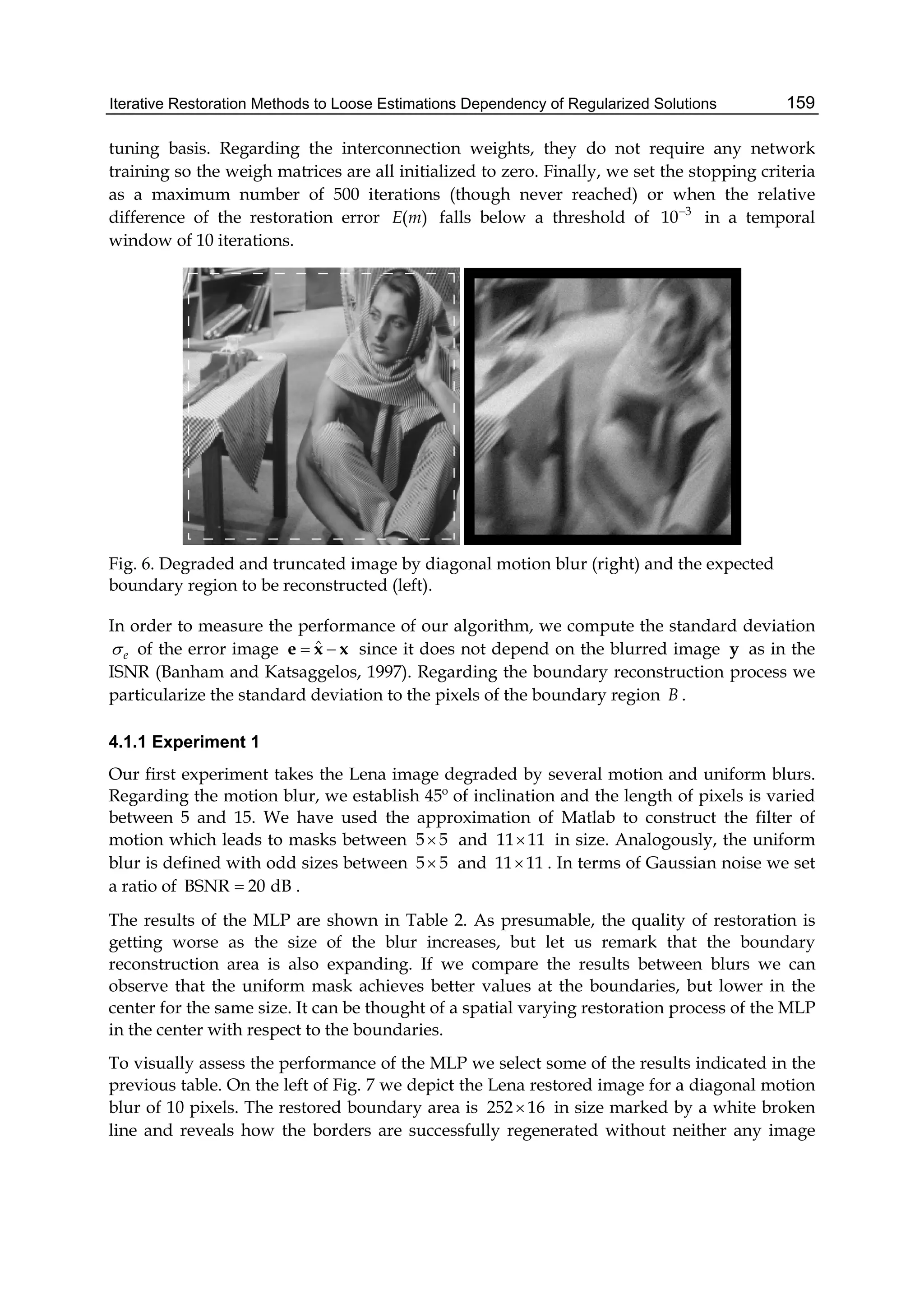
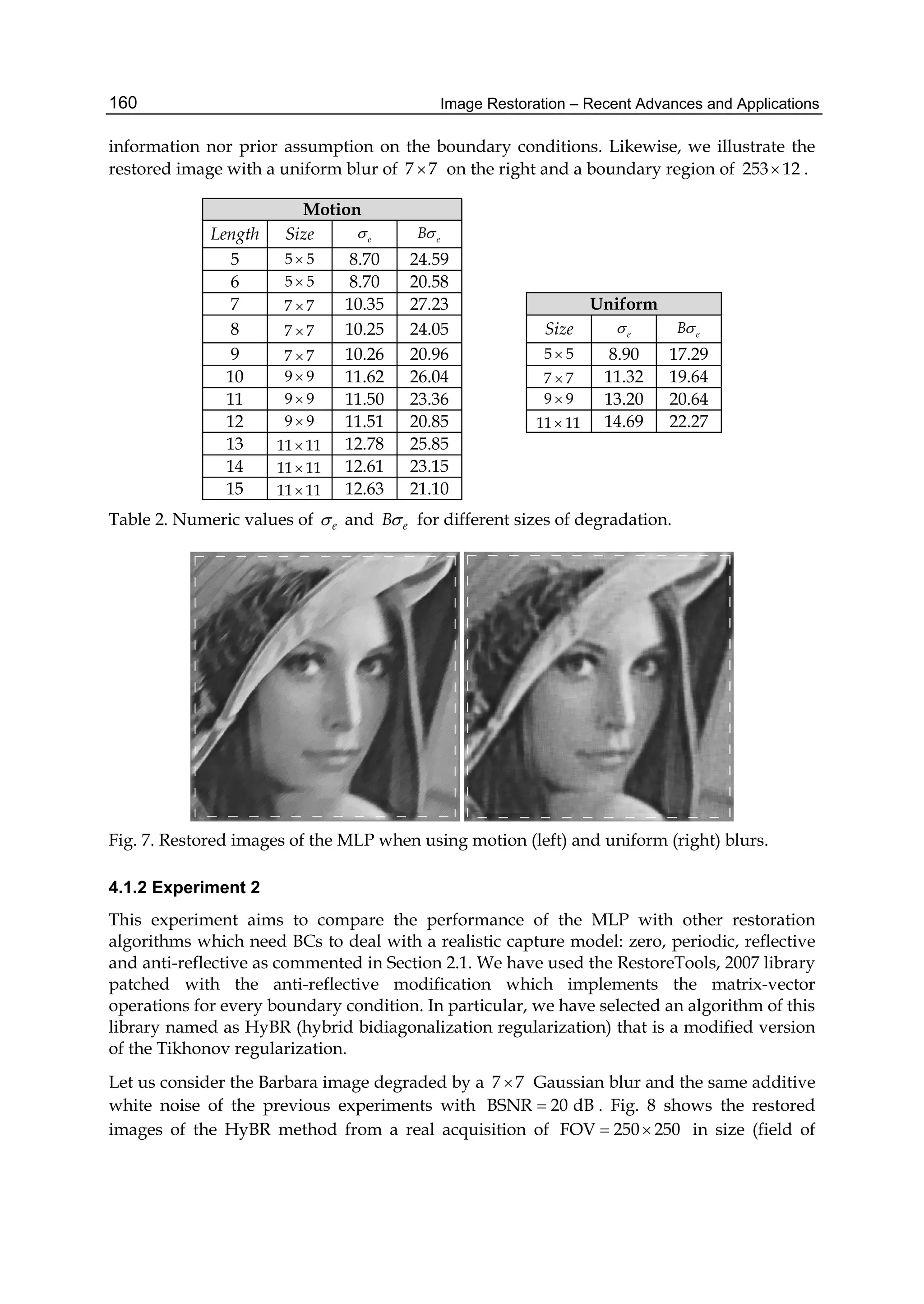
– RECENT ADVANCES
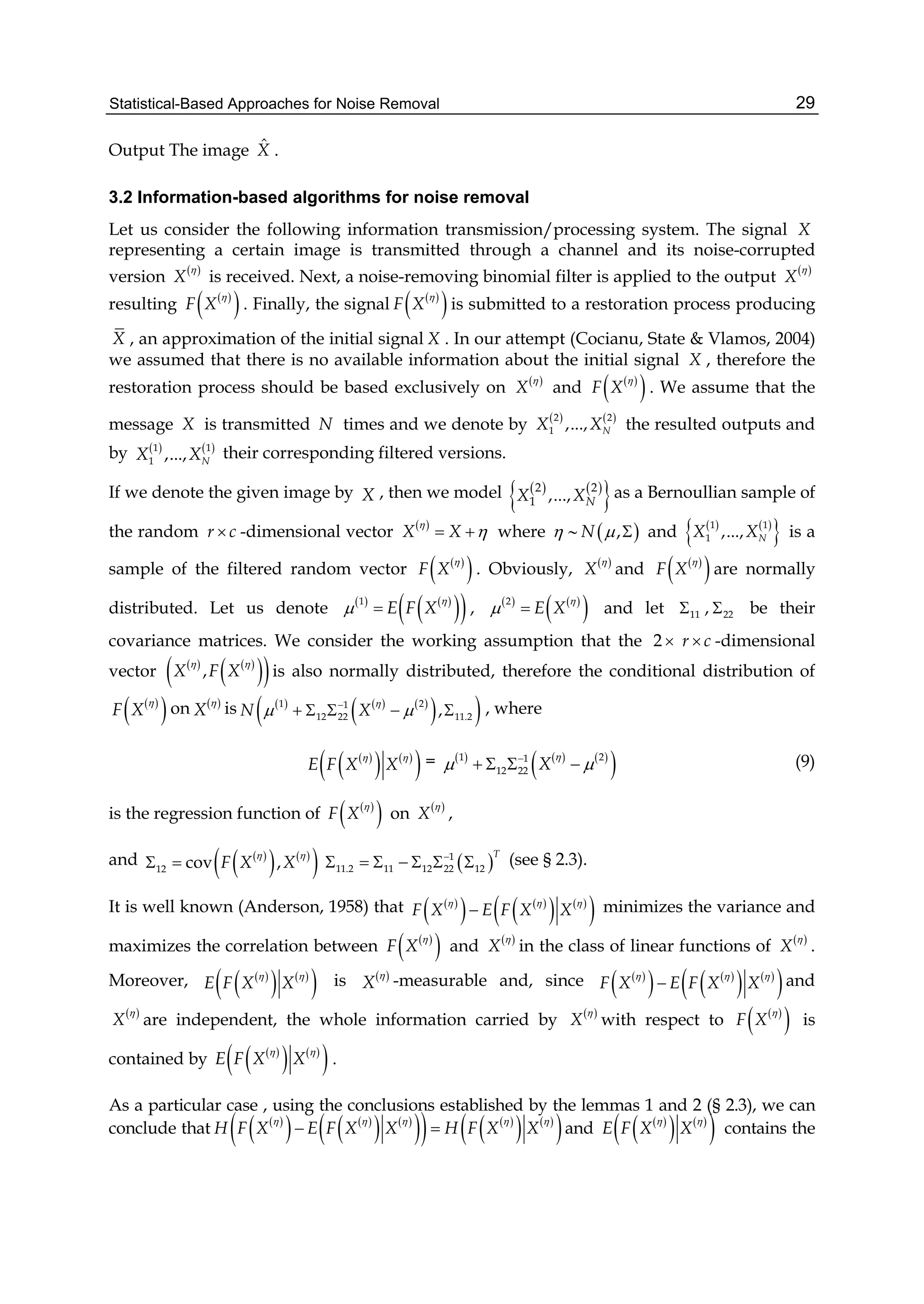
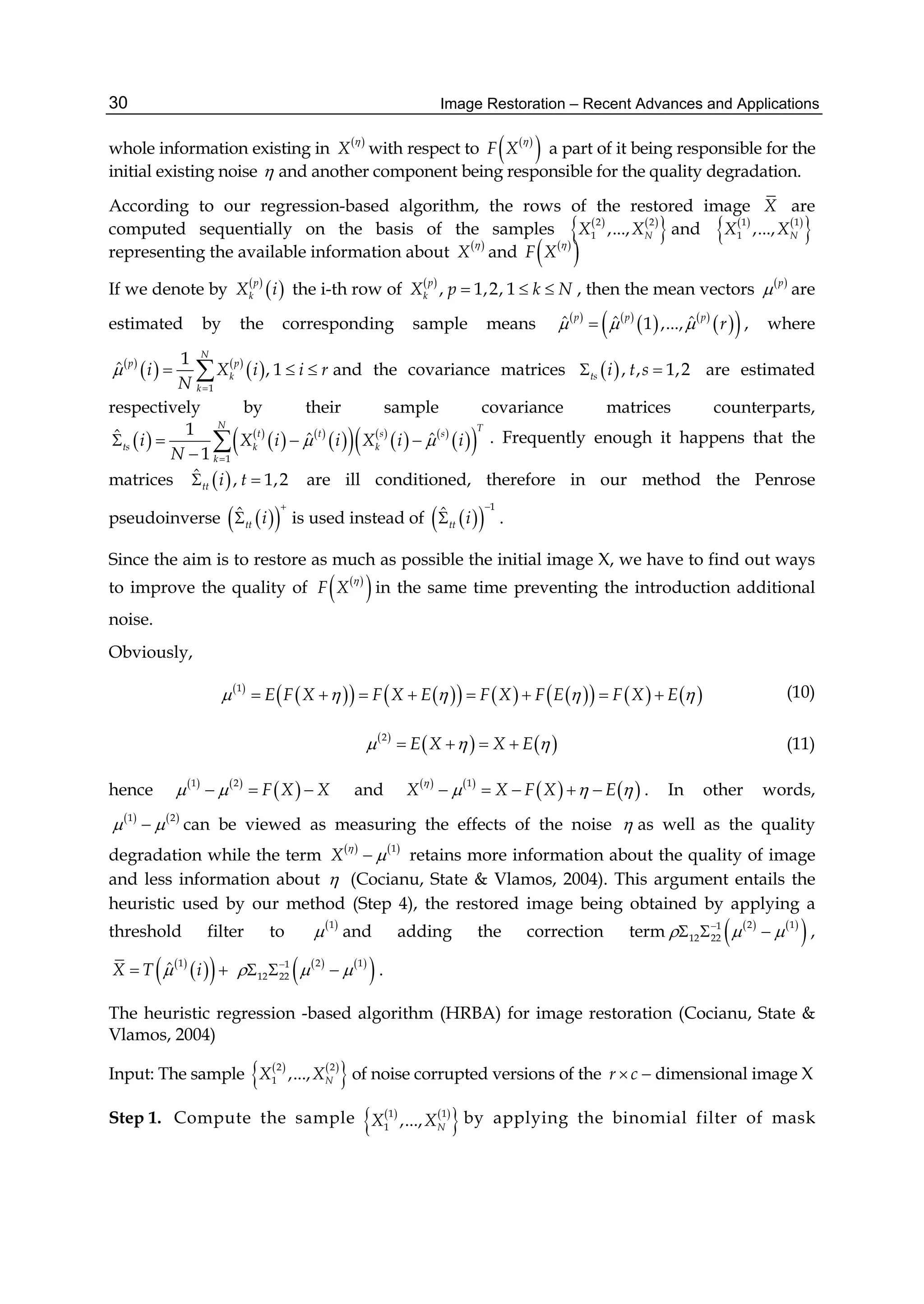
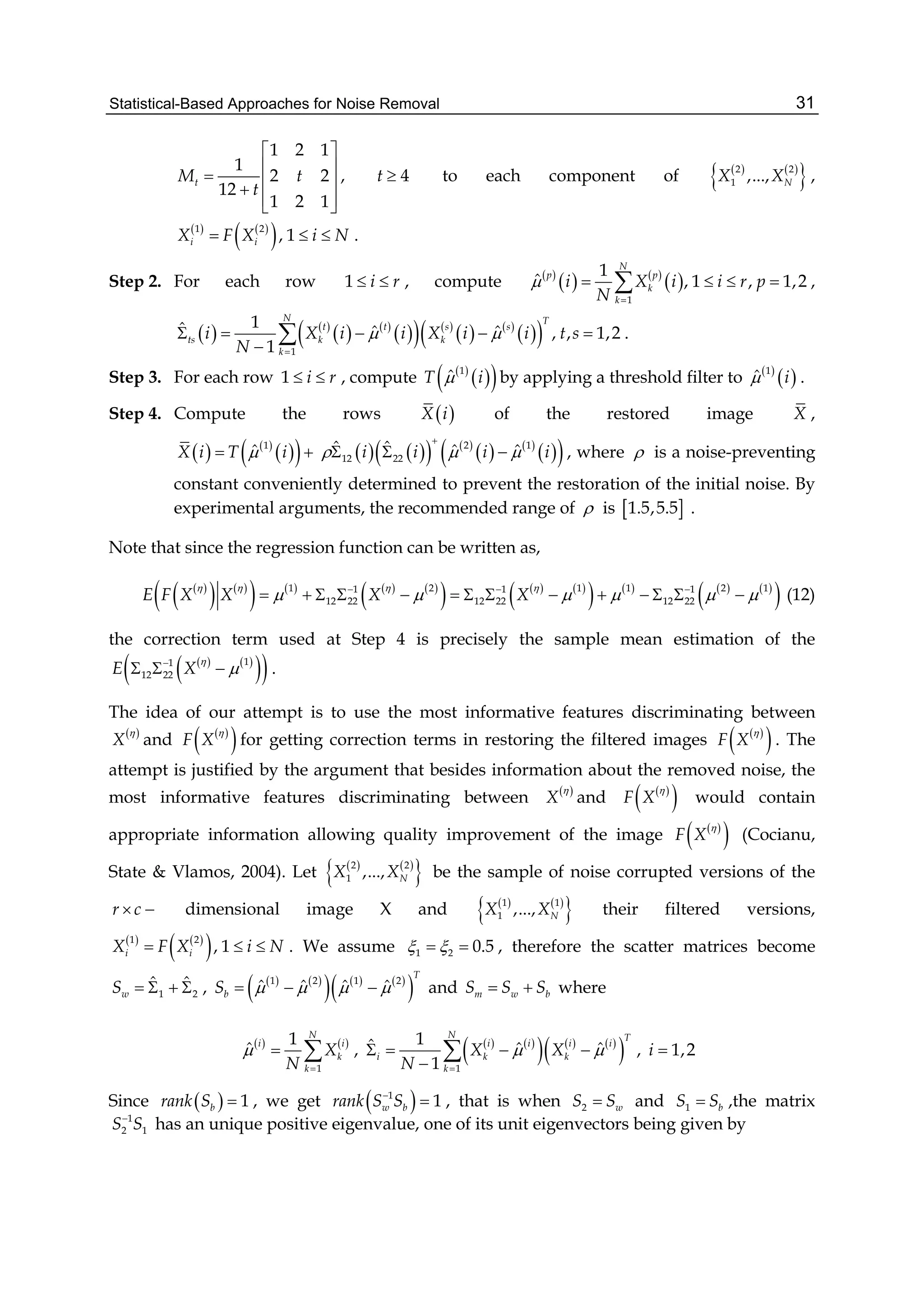
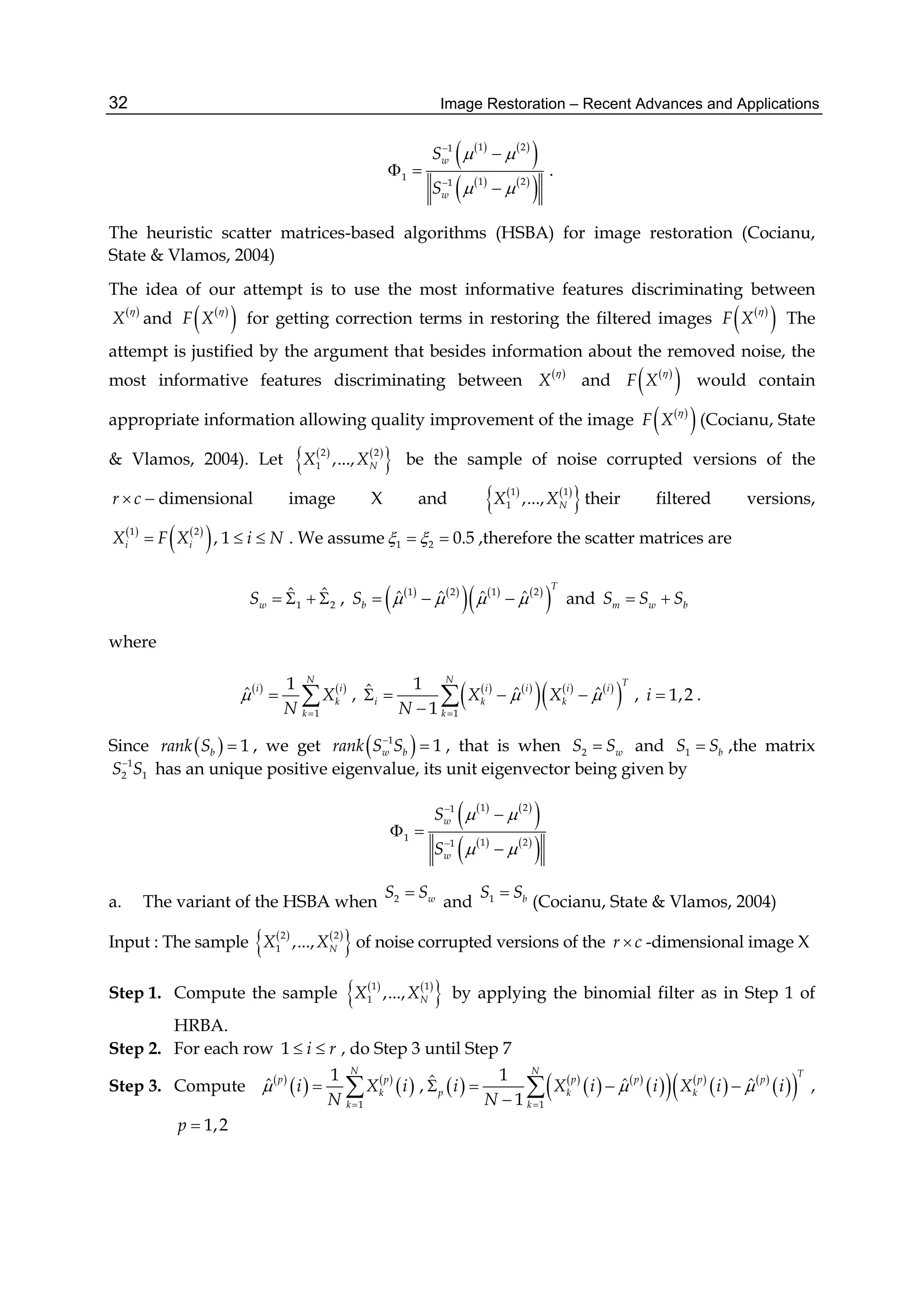
AND APPLICATIONS
Edited by Aymeric Histace
Image Restoration – Recent Advances and Applications
Edited by Aymeric Histace
Published by InTech
Janeza Trdine 9, 51000 Rijeka, Croatia
Copyright © 2012 InTech
All chapters are Open Access distributed under the Creative Commons Attribution 3.0
license, which allows users to download, copy and build upon published articles even for
commercial purposes, as long as the author and publisher are properly credited, which
ensures maximum dissemination and a wider impact of our publications. After this work
has been published by InTech, authors have the right to republish it, in whole or part, in
any publication of which they are the author, and to make other personal use of the
work. Any republication, referencing or personal use of the work must explicitly identify
the original source.
As for readers, this license allows users to download, copy and build upon published
chapters even for commercial purposes, as long as the author and publisher are properly
credited, which ensures maximum dissemination and a wider impact of our publications.
Notice
Statements and opinions expressed in the chapters are these of the individual contributors
and not necessarily those of the editors or publisher. No responsibility is accepted for the
accuracy of information contained in the published chapters. The publisher assumes no
responsibility for any damage or injury to persons or property arising out of the use of any
materials, instructions, methods or ideas contained in the book.
Publishing Process Manager Marija Radja
Technical Editor Teodora Smiljanic
Cover Designer InTech Design Team
First published April, 2012
Printed in Croatia
A free online edition of this book is available at www.intechopen.com
Additional hard copies can be obtained from orders@intechopen.com
Image Restoration – Recent Advances and Applications, Edited by Aymeric Histace
p. cm.
ISBN 978-953-51-0388-2
Contents
Preface IX
Part 1 Theory and Scientific Advances 1
Chapter 1 Space-Variant Image Restoration
with Running Sinusoidal Transforms 3
Vitaly Kober
Chapter 2 Statistical-Based Approaches for Noise Removal 19
State Luminiţa, Cătălina-Lucia Cocianu and Vlamos Panayiotis
Chapter 3 Entropic Image Restoration
as a Dynamic System with Entropy Operator 45
Yuri S. Popkov
Chapter 4 Surface Topography and Texture Restoration
from Sectional Optical Imaging by Focus Analysis 73
Mathieu Fernandes, Yann Gavet and Jean-Charles Pinoli
Chapter 5 Image Restoration via Topological Derivative 97
Ignacio Larrabide and Raúl A. Feijóo
Chapter 6 Regularized Image Restoration 119
Pradeepa D. Samarasinghe and Rodney A. Kennedy
Chapter 7 Iterative Restoration Methods to Loose Estimations
Dependency of Regularized Solutions 145
Miguel A. Santiago, Guillermo Cisneros and Emiliano Bernués
Chapter 8 Defocused Image Restoration
with Local Polynomial Regression and IWF 171
Liyun Su
Chapter 9 Image Restoration Using Two-Dimensional Variations 185
Olga Milukova, Vitaly Kober and Victor Karnaukhov
VI Contents
Chapter 10 Harnessing the Potentials
of Image Extrema for Blind Restoration 201
Rachel Mabanag Chong and Toshihisa Tanaka
Part 2 Applications 227
Chapter 11 Image Restoration
for Long-Wavelength Imaging Systems 229
Min-Cheng Pan
Chapter 12 Super-Resolution Restoration
and Image Reconstruction
for Passive Millimeter Wave Imaging 259
Liangchao Li, Jianyu Yang and Chengyue Li
Chapter 13 Blind Image Restoration
for a Microscanning Imaging System 297
José Luis López-Martínez and Vitaly Kober
Chapter 14 2D Iterative Detection Network Based Image Restoration:
Principles, Applications and Performance Analysis 315
Daniel Kekrt and Miloš Klima
Part 3 Interdisciplinarity 351
Chapter 15 An Application of Digital Image
Restoration Techniques to Error Control Coding 353
Pål Ellingsen
Preface
This book represents a sample of recent contributions of researchers all around the
world in the field of image restoration.
The book consists of 15 chapters organized in three main sections (Theory, Applications,
Interdisciplinarity). Topics cover some different aspects of the theory of image
restoration. But this book is also an occasion to highlight some new topics of research
related to the emergence of some original imaging devices (see “Applications”
Section). From this arise some real challenging problems related to image
reconstruction/restoration that open the way to some new fundamental scientific
questions closely related with the world we interact with.
An effort has been made by each author to give a large access to their work: Image
restoration is not only a problem that interests specialists but also other researchers
from different areas (like Robotic, AI, etc.) who can find some inspiration in the
proposed Chapters (let have a look to Chapter 15 for instance!)
This book is certainly a small sample of the research activity going on around the
globe as you read it, but it surely covers a good deal of what has been done in the field
recently, and as such it works as a valuable source for researchers interested in the
involved subjects.
Special thanks to all authors who have interested a great deal of time to write such
interesting chapters and who have accepted to share their work.
Aymeric Histace
University of Cergy-Pontoise, Cergy,
France
Part 1
Theory and Scientific Advances
1
Space-Variant Image Restoration
with Running Sinusoidal Transforms
Vitaly Kober
Computer Science Department, CICESE,
Mexico
1. Introduction
Various restoration methods (linear, nonlinear, iterative, noniterative, deterministic,
stochastic, etc.) optimized with respect to different criteria have been introduced (Bertero &
Boccacci, 1998; Biemond et al., 1990; Kundur, & Hatzinakos, 1996; Banham & Katsaggelos,
1997; Jain, 1989; Bovik, 2005; Gonzalez & Woods, 2008). These techniques may be broadly
divided in two classes: (i) fundamental algorithms and (ii) specialized algorithms. One of
the most popular fundamental techniques is a linear minimum mean square error (LMMSE)
method. It finds the linear estimate of the ideal image for which the mean square error
between the estimate and the ideal image is minimum. The linear operator acting on the
observed image to determine the estimate is obtained on the basis of a priori second-order
statistical information about the image and noise processes. In the case of stationary
processes and space-invariant blurs, the LMMSE estimator takes the form of the Wiener
filter (Jain, 1989). The Kalman filter determines the causal LMMSE estimate recursively.
Specialized algorithms can be viewed as extensions of the fundamental algorithms to
specific restoration problems. It is based on a state-space representation of the imaging
system, and image data are used to define the state vectors. Specialized algorithms can be
viewed as extensions of the fundamental algorithms to specific restoration problems. In this
paper we deal with restoration of images degraded by space-variant blurs. Basically, all
fundamental algorithms apply to the restoration of images degraded by space-variant blurs.
However, because Fourier transforms cannot be utilized when the blur is space-variant,
space-domain implementations of these algorithms may be computationally formidable due
to large matrix operations. Several specialized methods were developed to attack the space-
variant restoration problem. The first class referred to as sectioning is based on assumption
that the blur is approximately space-invariant within local regions of the image. Therefore,
the entire image can be restored by applying well-known space-invariant techniques to the
local image regions. A drawback of sectioning methods is the generation of artifacts at the
region boundaries. The second class is based on a coordinate transformation (Sawchuk,
1974), which is applied to the observed image so that the blur in the transformed
coordinates becomes space-invariant. Therefore, the transformed image can be restored by a
space-invariant filter and then transformed back to obtain the final restored image. However,
the statistical properties of the image and noise processes are affected by the
Image Restoration – Recent Advances and Applications4
coordinate transformation. In particular, the stationarity in the original spatial coordinates is
not preserved in the transform coordinate system.
In this chapter, we carry out the space-variant restoration using running discrete sinusoidal
transform coefficients. The running transform is based on the concept of short-time signal
processing (Oppenheim & Shafer 1989). A short-time orthogonal transform of a signal xk is
defined as
 ,k
s k n n
n
X x w n s



  , (1)
where wn is a window sequence, (n,s) represents the basis functions of an orthogonal
transform. We use one-dimensional notation for simplicity. Equation (1) can be
interpreted as the orthogonal transform of xk+n as viewed through the window wn. k
sX
displays the orthogonal transform characteristics of the signal around time k. Note that
while increased window length and resolution are typically beneficial in the spectral
analysis of stationary data, for time-varying data it is preferable to keep the window
length sufficiently short so that the signal is approximately stationary over the window
duration. Assume that the window has finite length around n=0, and it is unity for all
n-N1, N2. Here N1 and N2 are integer values. This leads to signal processing in a
running window (Vitkus & Yaroslavsky, 1987; Yaroslavsky & Eden, 1996). In other words,
local filters in the domain of an orthogonal transform at each position of a moving
window modify the orthogonal transform coefficients of a signal to obtain only an
estimate of the pixel xk of the window. The choice of orthogonal transform for running
signal processing depends on many factors.
We carry out the space-variant restoration using running discrete transform coefficients. The
discrete cosine transforms (DCT) and discrete sine transforms (DST) are widely used. This is
because the DCT and DST perform close to the optimum Karhunen-Loeve transform (KLT)
for the first-order Markov stationary data (Jain, 1989). For signals with the correlation
coefficient near to unity, the DCT provides a better approximation of the KLT than the DST.
On the other hand, the DST is closer to the KLT, when the correlation coefficient lies in the
interval (-0.5, 0.5). Since the KLT is constructed from the eigenvectors of the covariance
matrix of data, there are neither single unique transform for all random processes nor fast
algorithms. Unlike the KLT, the DCT and DST are not data dependent, and many fast
algorithms were proposed. To provide image processing in real time, fast recursive
algorithms for computing the running sinusoidal transforms are utilized (Kober, 2004, 2007).
We introduce local adaptive restoration of nonuniform degraded images using several
running sinusoidal transforms. Computer simulation results using a real image are
provided and compared with those of common restoration techniques.
2. Fast algorithms of running discrete sinusoidal transforms
The discrete cosine and sine transforms are widely used in signal processing applications.
Recently, forward and inverse algorithms for fast computing of various DCTs ({DCT-I, DCT-II,
DCT-III, DCT-IV) and DSTs (DST-I, DST-II, DST-III, DST-IV) were proposed (Kober, 2004).
Space-Variant Image Restoration with Running Sinusoidal Transforms 5
2.1 Discrete sinusoidal transforms
First, we recall the definitions for various discrete sinusoidal transforms. Notation {.}
denotes a matrix, the order of which is represented by a subscript. For clarity, the
normalization factor 2 N for all forward transforms is neglected until the inverse
transforms. The kernel of the orthogonal DCT-I for the order N+1 is defined as
1 cos ,N s n
ns
DCT I k k
N

  
    
  
(2)
where n, s=0,…, N;  
1 2 0 ,
1 .
m m n or m s
if m or m N
k
otherwise
 
  
 

The kernels of the DCT-II, DCT-III, and DCT-IV for the order N are given as
 1 /2
cosN s
s n
DCT II k
N

    
    
   
, (3)
 1 /2
cosN n
n s
DCT III k
N

    
    
   
, (4)
  1 /2 1 /2
cosN
n s
DCT IV
N

     
    
   
, (5)
where n, s=0, 1,…, N-1. The kernel of the DST-I for the order N-1 is defined as
1 sinN
ns
DST I
N

  
    
  
, (6)
where n, s=1, 2,…, N-1. The kernels of the DST-II, DST-III, and DST-IV for the order N are
given as follows:
 1 /2
sinN s
s n
DST II k
N

    
    
   
, (7)
 1 /2
sinN n
n s
DST III k
N

    
    
   
, (8)
  1 /2 1 /2
sinN
n s
DST IV
N

     
    
   
, (9)
where n, s=1, 2,…, N.
Image Restoration – Recent Advances and Applications6
2.2 Fast forward algorithms for computing running discrete sinusoidal transforms
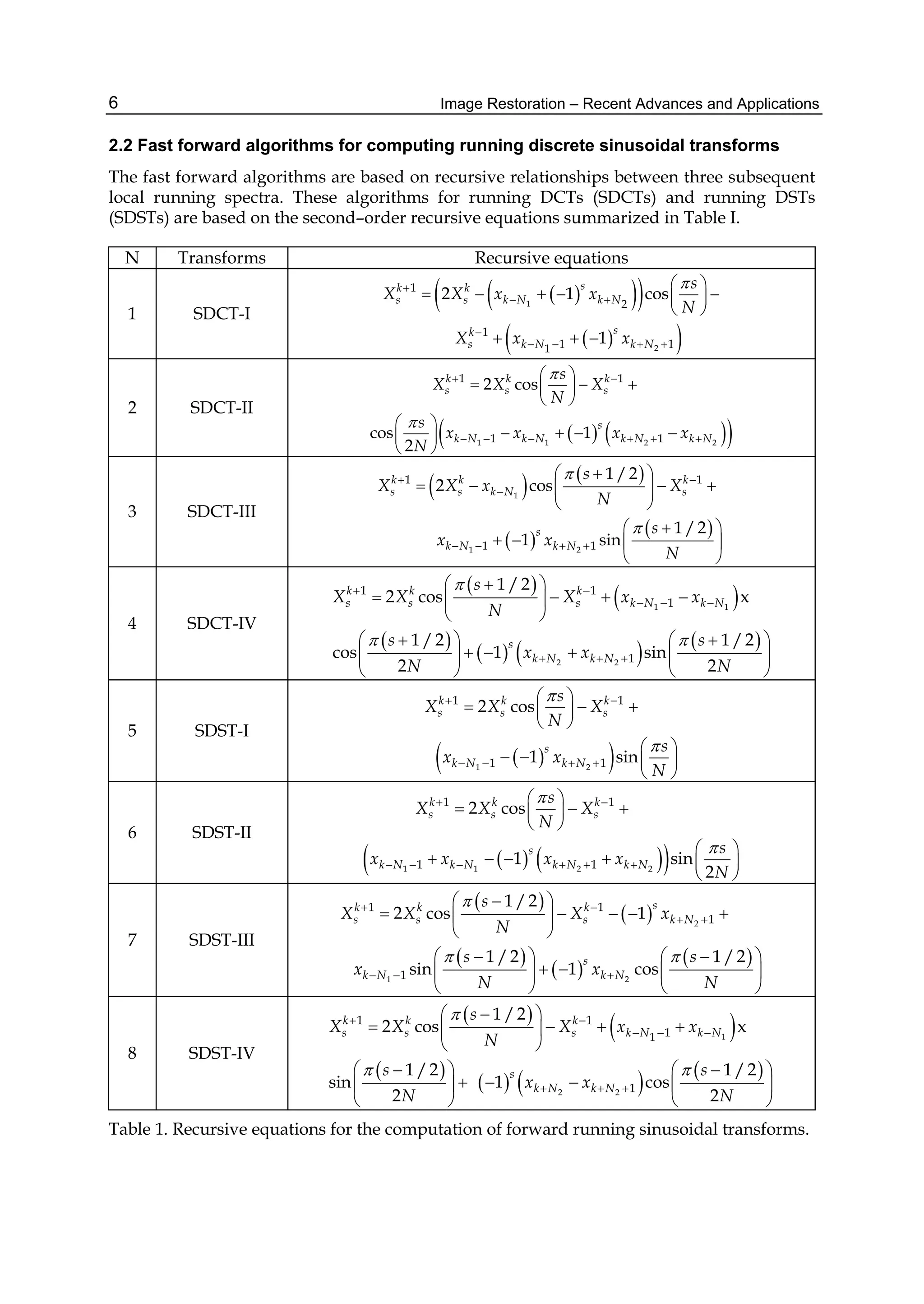
The fast forward algorithms are based on recursive relationships between three subsequent
local running spectra. These algorithms for running DCTs (SDCTs) and running DSTs
(SDSTs) are based on the second–order recursive equations summarized in Table I.
N Transforms Recursive equations
1 SDCT-I
   
  
1
2
2
1
1
1
1 1
2 1 cos
1
sk k
s s k N k N
sk
s k N k N
s
X X x x
N
X x x

 

   
 
     
 
  
2 SDCT-II
    1 1 2 2
1 1
1 1
2 cos
cos 1
2
k k k
s s s
s
k N k N k N k N
s
X X X
N
s
x x x x
N


 
     
 
   
 
 
    
 
3 SDCT-III
   
 
 
1
1 2
1 1
1 1
1 /2
2 cos
1 /2
1 sin
k k k
s s k N s
s
k N k N
s
X X x X
N
s
x x
N


 

   
  
    
 
  
   
 
4 SDCT-IV
 
 
 
     
1 1
2 2
1 1
1
1
1 /2
2 cos x
1 /2 1 /2
cos 1 sin
2 2
k k k
s s s k N k N
s
k N k N
s
X X X x x
N
s s
x x
N N

 
 
  
  
  
    
 
     
     
   
5 SDST-I
  1 2
1 1
1 1
2 cos
1 sin
k k k
s s s
s
k N k N
s
X X X
N
s
x x
N


 
   
 
   
 
 
   
 
6 SDST-II
    1 1 2 2
1 1
1 1
2 cos
1 sin
2
k k k
s s s
s
k N k N k N k N
s
X X X
N
s
x x x x
N


 
     
 
   
 
 
     
 
7 SDST-III
 
 
 
 
 
2
1 2
1 1
1
1
1 /2
2 cos 1
1 /2 1 /2
sin 1 cos
sk k k
s s s k N
s
k N k N
s
X X X x
N
s s
x x
N N

 
 
 
  
  
     
 
     
    
   
8 SDST-IV
 
 
 
     
1
2 2
1
1 1
1
1
1 /2
2 cos x
1 /2 1 /2
sin 1 cos
2 2
k k k
s s s k N k N
s
k N k N
s
X X X x x
N
s s
x x
N N

 
 
  
  
  
    
 
     
     
   
Table 1. Recursive equations for the computation of forward running sinusoidal transforms.
Space-Variant Image Restoration with Running Sinusoidal Transforms 7
The number of arithmetic operations required for computing the running discrete cosine
transforms at a given window position is evaluated as follows. The SDCT-I for the order
N+1 with N=N1+N2 requires N-1 multiplication operations and 4(N+2) addition operations.
The SDCT-II for the order N with N= N1+ N2+1 requires 2(N-1) multiplication operations
and 2N+5 addition operations. A fast algorithm for the SDCT-III for the order N with N=N1+
N2+1 is based on the recursive equation given in line 3 of Table 1. Next it is useful to
represent the equation as
   
 
 
2
1 1
1
1 /2 1 /2
cos 1 sin
sk k k k
s s s s k N
s s
X X X X x
N N
  
 
     
       
   
  , (10)
where the array  1
; 0 1 . 1k k
s s k NX X x s , ,.. N    is stored in a memory buffer of N
elements. From the property of symmetry of the sine function,   sin 1 /2s N  
  sin 1 /2 , 0,1,...[ /2]N s N s N    (here [x/y] is the integer quotient) and Eq. (10), the
number of operations required to compute the DSCT-III can be evaluated as [3/2N]
multiplication operations and 4N addition operations. An additional memory buffer of N
elements is also required. Finally, the SDCT-IV for the order N with N=N1+ N2+1 requires
3N multiplication operations and 3N+2 addition operations.
The number of arithmetic operations required for computing the running discrete sine
transforms at a given window position can be evaluated as follows. The SDST-I for the order
N-1 with N=N1+ N2+1 requires 2(N-1) multiplication operations and 2N addition operations.
However, if N is even,       1 21 11 sin
s
k N k Nf s x x s N      in line 5 of Table I is
symmetric on the interval [1, N-1]; that is, f(s)=f(N-s), s=1,..N/2-1. Therefore, only N/2-1
multiplication operations are required to compute this term. The total number of
multiplications is reduced to 3N/2-2. The SDST-II for the order N with N=N1+ N2+1 requires
2(N-1) multiplication operations and 2N+5 addition operations. Taking into account the
property of symmetry of the sine and cosine functions, the SDST-III for the order N with
N=N1+ N2+1 requires 2N multiplications and 4N addition operations. However, if N is even,
the sum        1 21( ) sin 1 /2 1 cos 1 /2
s
k N k Ng s x s N x s N        in line 7 of Table I
is symmetric on the interval [1, N]; that is, g(s)=g(N-s+1), s=1,..N/2. Therefore, only N/2
addition operations are required to compute the sum. If N is odd, the sum
      1 21 1sin 1 /2 1
s
k N k Np s x s N x       in line 7 of Table I is symmetric on the
interval [1, N]; that is, p(s)=p(N-s+1), s=1,..[N/2]. Hence, [N/2] addition operations are
required to compute this sum. So, the total number of additions can be reduced to [7N/2].
Finally, the SDST-IV for the order N with N=N1+ N2+1 requires 3N multiplication operations
and 3N+2 addition operations. The length of a moving window for the proposed algorithms
may be an arbitrary integer.
2.3 Fast inverse algorithms for running signal processing with sinusoidal transforms
The inverse discrete cosine and sine transforms for signal processing in a running window
are performed for computing only the pixel xk of the window. The running signal
processing can be performed with the use of the SDCT and SDST algorithms.
Image Restoration – Recent Advances and Applications8
The inverse algorithms for the running DCTs can be written as follows.
IDCT-I:
  1
1
1
0
1
1
2 cos 1
N
Nk k k
k s N
s
N s
x X X X
N N



  
     
  
 , (11)
where N=N1+N2. If xk is the central pixel of the window; that is, N1=N2 then the inverse
transform is simplified to
   
1
1
1
2 0
1
1
2 1 1
N
s Nk k k
k s N
s
x X X X
N


 
      
 
 . (12)
Therefore, in the computation only the spectral coefficients with even indices are involved.
The number of required operations of multiplication and addition becomes one and N1+1,
respectively.
IDCT-II:
 1
1
0
1
1 /21
2 cos
N
k k
k s
s
N s
x X X
N N



   
    
  
 , (13)
where N=N1+N2+1. If xk is the central pixel of the window, that is, N1=N2 then the inverse
transform is given by
 
1
2 0
1
1
2 1
N
s k k
k s
s
x X X
N 
 
    
 
 . (14)
We see that in the computation only the spectral coefficients with even indices are involved.
The computation requires one multiplication operation and N1+1 addition operations.
IDCT-III:
 1
1
0
1 /22
cos
N
k
k s
s
N s
x X
N N



  
  
 
 , (15)
where N=N1+N2+1. If xk is the central pixel of the window, that is, N1=N2 then the inverse
transform is
    
 
     1
1
1 1
1
1
1
[ /2]1
1
0
1 1 1 11 /22
1 cos 1
4
N N
N
N Nk k
k s N s N
s
kN s
x X X X
N N



 

       
       
  

 . (16)
If N1 is even, then the computation requires N1+1 multiplication operations and 2N1
addition operations. Otherwise, the complexity is reduced to N1 multiplication operations
and 2N1 - 1 addition operations.
IDCT-IV:
Space-Variant Image Restoration with Running Sinusoidal Transforms 9
  1
1
0
1 /2 1 /22
cos
N
k
k s
s
N s
x X
N N



   
  
 
 , (17)
where N=N1+N2+1. If xk is the central pixel of the window, that is, N1=N2 then the inverse
transform is given by
   
1
2 2 1 0
1
2
1
N
s k k k
k s s
s
x X X X
N


 
     
 
 . (18)
One multiplication operation and N-1 addition operations are required to perform this
computation.
The inverse algorithms for the running DSTs are given as follows.
IDST-I:
 1
1
1
12
sin
N
k
k s
s
N s
x X
N N



  
  
 
 , (19)
where N=N1+N2+2. If xk is the central pixel of the window; that is, N1=N2 then the inverse
transform is simplified to
 
1
2 1
0
2
1
N
s k
k s
s
x X
N


  . (20)
Therefore, in the computation only the spectral coefficients with odd indices are involved.
The complexity is one multiplication operation and N1 addition operations.
IDST-II:
 
  1
1
1
1
1 /21
2 sin 1
N
Nk k
k s N
s
N s
x X X
N N



   
     
  
 , (21)
where N=N1+N2+1. If xk is the central pixel of the window; that is, N1=N2 then the inverse
transform is given by
   
1
1
1
2 1
0
1
2 1 1
N
s Nk k
k s N
s
x X X
N



 
     
 
 . (22)
In the computation only the spectral coefficients with odd indices are involved. The
computational complexity is one multiplication operation and N1+1 addition operations.
IDST-III:
  1
1
1 1 /22
sin
N
k
k s
s
N s
x X
N N


   
  
 
 , (23)
Image Restoration – Recent Advances and Applications10
where N=N1+N2+1. If xk is the central pixel of the window; that is, N1=N2 then we can
rewrite
     
        1
1
1 1
1
1
21
1 1
1
1 1 1 11 1 22
1 sin 1
4
N N
N
N Nk k
k s N s N
s
kN s
x X X X
N N


  

       
        
  

 . (24)
If N1 is even, then the computation requires N1+1 multiplication operations and 2N1
addition operations. Otherwise, the complexity is reduced to N1 multiplication operations
and 2N1 - 1 addition operations.
IDST-IV:
  1
1
1 /2 1 /22
sin
N
k
k s
s
N s
x X
N N


   
  
 
 , (25)
where =N1+N2+1. If xk is the central pixel of the window; that is, N1=N2, then the inverse
transform is given by
     
1
11
2 2 1
1
2
1 1
N
s Nk k k
k s s N
s
x X X X
N



 
      
 
 . (26)
The complexity is one multiplication operation and N-1 addition operations.
3. Local image restoration with running transforms
First we define a local criterion of the performance of filters for image processing and then
derive optimal local adaptive filters with respect to the criterion. One the most used
criterion in signal processing is the minimum mean-square error (MSE). Since the processing
is carried out in a moving window, then for each position of a moving window an estimate
of the central element of the window is computed. Suppose that the signal to be processed is
approximately stationary within the window. The signal may be distorted by sensor’s noise.
Let us consider a generalized linear filtering of a fragment of the input one-dimensional
signal (for instance for a fixed position of the moving window). Let a=[ak] be undistorted
real signal, x=[xk] be observed signal, k=1,…, N, N be the size of the fragment, U be the
matrix of the discrete sinusoidal transform, E{.} be the expected value, superscript T denotes
the transpose. Let a Hx be a linear estimate of the undistorted signal, which minimizes
the MSE averaged over the window
    a a a a
T
MMSE E N   . (27)
The optimal filter for this problem is the Wiener filter (Jain, 1989):
   
1
H ax xxT T
E E

 
 
. (28)
Let us consider the known model of a linear degradation:
Space-Variant Image Restoration with Running Sinusoidal Transforms 11
,k k n n k
n
x w a v  , (29)
where W=[wk,n] is a distortion matrix, ν=[vk] is additive noise with zero mean, k,n=1,…N, N
is the size of fragment. The equation can be rewritten as
x=Wa+v , (30)
and the optimal filter is given by
1
H K W WK W KT T
aa aa 

    , (31)
where      K aa , K , a 0T T T
aa E E E  νν ν are the covariance matrices. It is assumed
that the input signal and noise are uncorrelated.
The obtained optimal filter is based on an assumption that an input signal within the
window is stationary. The result of filtering is the restored window signal. This corresponds
to signal processing in nonoverlapping fragments. The computational complexity of the
processing is O(N2). However, if the matrix of the optimal filter is diagonal, the complexity
is reduced to O(N). Such filter is referred as a scalar filter. Actually, any linear filtering can
be performed with a scalar filter using corresponding unitary transforms. Now suppose that
the signal is processed in a moving window in the domain of a running discrete sinusoidal
transform. For each position of the window an estimate of the central pixel should be
computed. Using the equations for inverse sinusoidal transforms presented in the previous
section, the point-wise MSE (PMSE) for reconstruction of the central element of the window
can be written as follows:
             
2
2
1
N
l
PMSE k E a k a k E l A l A l

   
        
   
 , (32)
where      A A l H l X l    is a vector of signal estimate in the domain of a sinusoidal
transform,  HU H l    is a diagonal matrix of the scalar filter,  l   α is a diagonal
matrix of the size xN N of the coefficients of an inverse sinusoidal transform (see Eqs. (12),
(14), (16), (18), (20), (22), (24), and (26)). Minimizing Eq. (32), we obtain
  1
x axH P P IU x 

 , (33)
where         I 1 , 2 ,...,diag N          is a diagonal matrix of the size xN N ,
  1 if 0, else 0x x   ,          ax xP , PxE A l X k E X l X k        . Note that matrix
 l   α is sparse; the number of its non-zero entries is approximately twice less than the
size of the window signal. Therefore, the computational complexity of the scalar filters in
Eq. (33) and signal processing can be significantly reduced comparing to the complexity for
the filter in Eq. (31). For the model of signal distortion in Eq. (30) the filter matrix is given as
Image Restoration – Recent Advances and Applications12
 
1
H U WK W K U UK W U IT T T T
U aa aa 

  
 
. (34)
If the matrices  U WK W K UT T
aa  and UK W UT T
aa in Eq. (34) are close to diagonal, the
matrix of the scalar filter in (34) is close to diagonal, and the filter can be written as
 
 
   
1
2
P l
H l
P l P l


, (35)
where      1 2, , nnP l P l P l are diagonal elements of the following matrices
UK W U I ,T T
aa  UWK W UT T
aa , UK UT
 , l=1,… N .
For a real symmetric matrix of the covariance function, say K , there exists a unitary matrix
U such that UKUT
is a diagonal matrix. Actually, it is the KLT. It was shown (Jain, 1989)
that some discrete sinusoidal transforms perform close to the optimum KLT for the first-
order Markov stationary data under specific conditions. In our case, the covariance matrices
K W UT T
aa and WK WT
aa are not symmetric. Therefore, under different conditions of
degradation different discrete sinusoidal transforms can better diagonalize these matrices.
For instance, if a signal has a high correlation coefficient and a smoothed version of the
signal is corrupted by additive, weakly-correlated noise, then the matrix
 U WK W K UT T
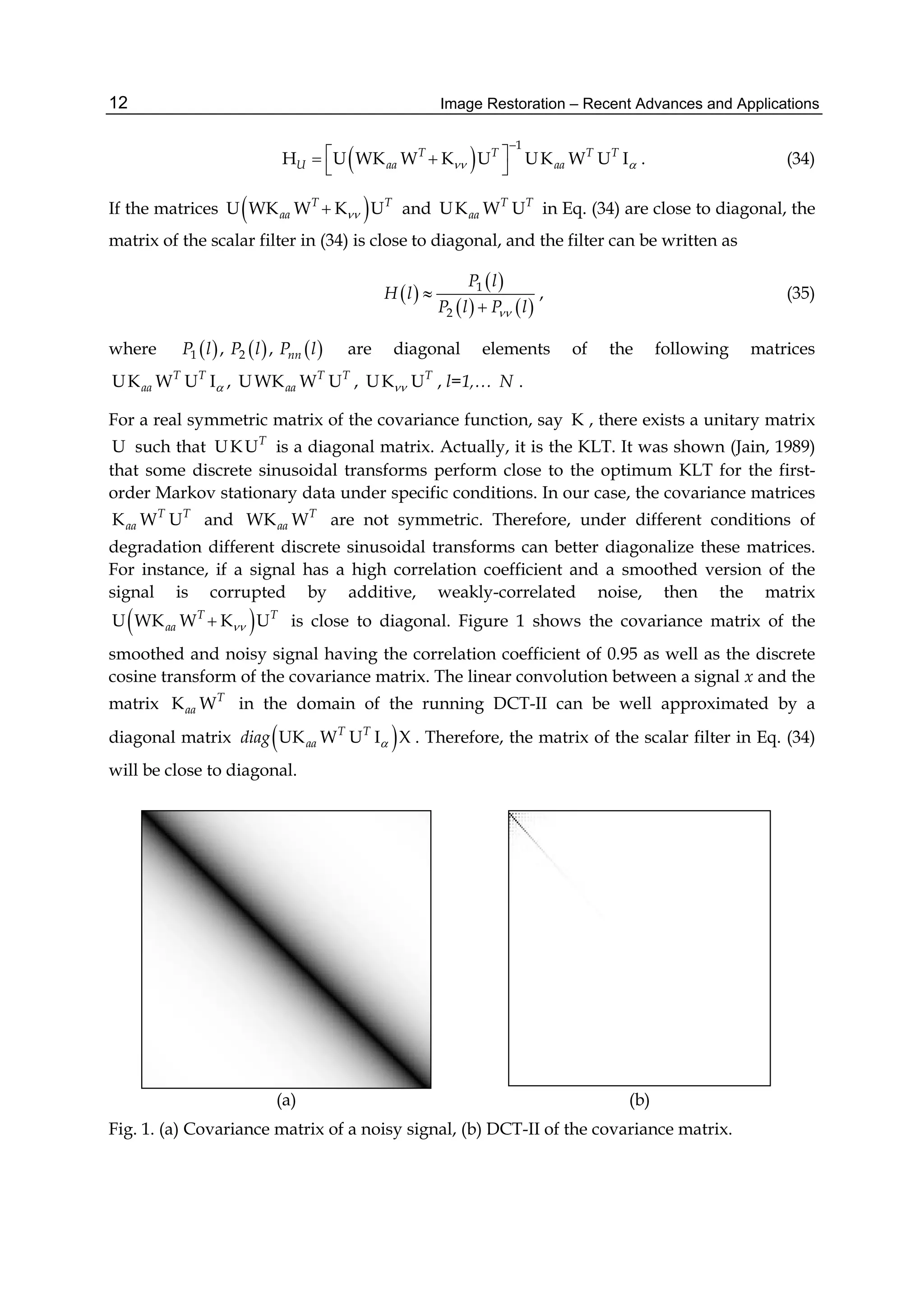
aa  is close to diagonal. Figure 1 shows the covariance matrix of the
smoothed and noisy signal having the correlation coefficient of 0.95 as well as the discrete
cosine transform of the covariance matrix. The linear convolution between a signal x and the
matrix K WT
aa in the domain of the running DCT-II can be well approximated by a
diagonal matrix  UK W U I XT T
aadiag  . Therefore, the matrix of the scalar filter in Eq. (34)
will be close to diagonal.
(a) (b)
Fig. 1. (a) Covariance matrix of a noisy signal, (b) DCT-II of the covariance matrix.
Space-Variant Image Restoration with Running Sinusoidal Transforms 13
For the design of local adaptive filters in the domain of running sinusoidal transforms the
covariance matrices and power spectra of fragments of a signal are required. Since they are
often unknown, in practice, these matrices can be estimated from observed signals
(Yaroslavsky & Eden, 1996).
4. Computer simulation results
The objective of this section is to develop a technique for local adaptive restoration of
images degraded by nonuniform motion blur. Assume that the blur is owing to horizontal
relative motion between the camera and the image, and it is approximately space-invariant
within local regions of the image. It is known that point spread functions for motion and
focus blurs do have zeros in the frequency domain, and they can be uniquely identified by
the location of these zero crossings (Biemond et al., 1990). We assume also that the
observation noise is a zero-mean, white Gaussian process that is uncorrelated to the image
signal. In this case, the noise field is completely characterized by its variance, which is
commonly estimated by the sample variance computed over a low-contrast local region of
the observed image. To guarantee statistically correct results, 30 statistical trials of each
experiment for different realizations of the random noise process were performed. The MSE
criterion is used for comparing the quality of restoration. Additionally, a subjective visual
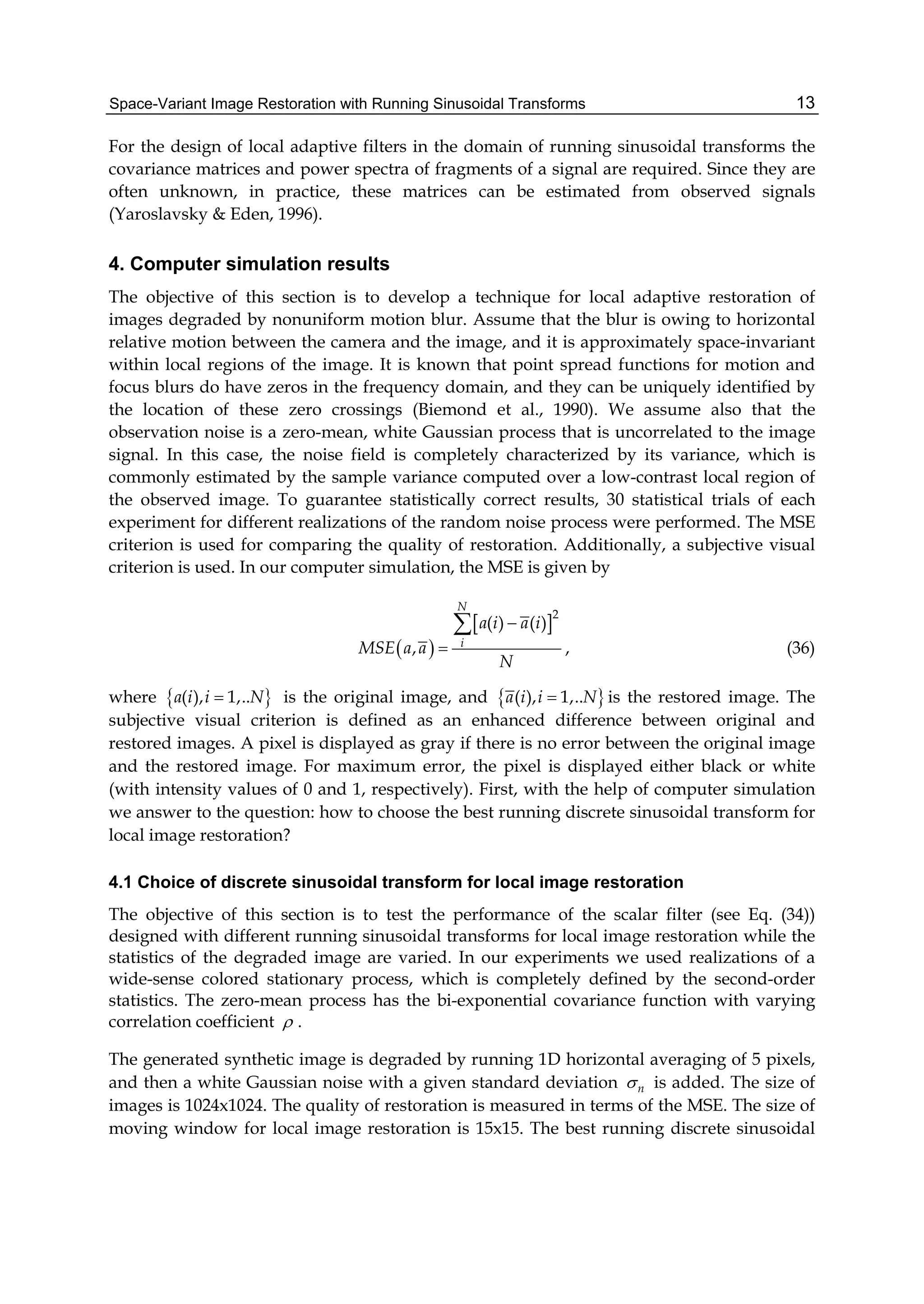
criterion is used. In our computer simulation, the MSE is given by
 
 2
( ) ( )
,
N
i
a i a i
MSE a a
N



, (36)
where  ( ), 1,..a i i N is the original image, and  ( ), 1,..a i i N is the restored image. The
subjective visual criterion is defined as an enhanced difference between original and
restored images. A pixel is displayed as gray if there is no error between the original image
and the restored image. For maximum error, the pixel is displayed either black or white
(with intensity values of 0 and 1, respectively). First, with the help of computer simulation
we answer to the question: how to choose the best running discrete sinusoidal transform for
local image restoration?
4.1 Choice of discrete sinusoidal transform for local image restoration
The objective of this section is to test the performance of the scalar filter (see Eq. (34))
designed with different running sinusoidal transforms for local image restoration while the
statistics of the degraded image are varied. In our experiments we used realizations of a
wide-sense colored stationary process, which is completely defined by the second-order
statistics. The zero-mean process has the bi-exponential covariance function with varying
correlation coefficient  .
The generated synthetic image is degraded by running 1D horizontal averaging of 5 pixels,
and then a white Gaussian noise with a given standard deviation n is added. The size of
images is 1024x1024. The quality of restoration is measured in terms of the MSE. The size of
moving window for local image restoration is 15x15. The best running discrete sinusoidal
Image Restoration – Recent Advances and Applications14
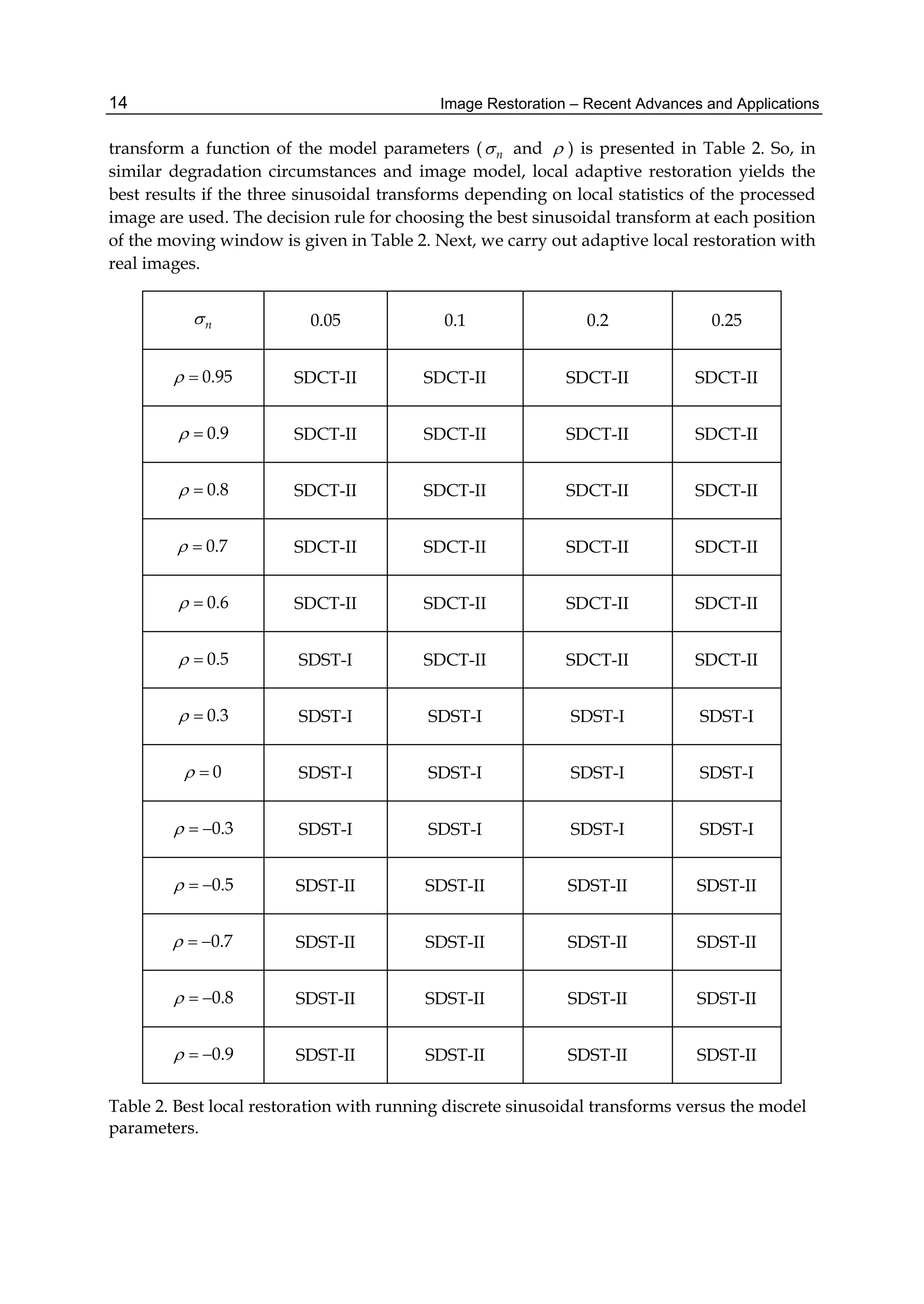
transform a function of the model parameters ( n and  ) is presented in Table 2. So, in
similar degradation circumstances and image model, local adaptive restoration yields the
best results if the three sinusoidal transforms depending on local statistics of the processed
image are used. The decision rule for choosing the best sinusoidal transform at each position
of the moving window is given in Table 2. Next, we carry out adaptive local restoration with
real images.
n 0.05 0.1 0.2 0.25
0.95  SDCT-II SDCT-II SDCT-II SDCT-II
0.9  SDCT-II SDCT-II SDCT-II SDCT-II
0.8  SDCT-II SDCT-II SDCT-II SDCT-II
0.7  SDCT-II SDCT-II SDCT-II SDCT-II
0.6  SDCT-II SDCT-II SDCT-II SDCT-II
0.5  SDST-I SDCT-II SDCT-II SDCT-II
0.3  SDST-I SDST-I SDST-I SDST-I
0  SDST-I SDST-I SDST-I SDST-I
0.3   SDST-I SDST-I SDST-I SDST-I
0.5   SDST-II SDST-II SDST-II SDST-II
0.7   SDST-II SDST-II SDST-II SDST-II
0.8   SDST-II SDST-II SDST-II SDST-II
0.9   SDST-II SDST-II SDST-II SDST-II
Table 2. Best local restoration with running discrete sinusoidal transforms versus the model
parameters.
Space-Variant Image Restoration with Running Sinusoidal Transforms 15
4.2 Local adaptive restoration of real degraded image
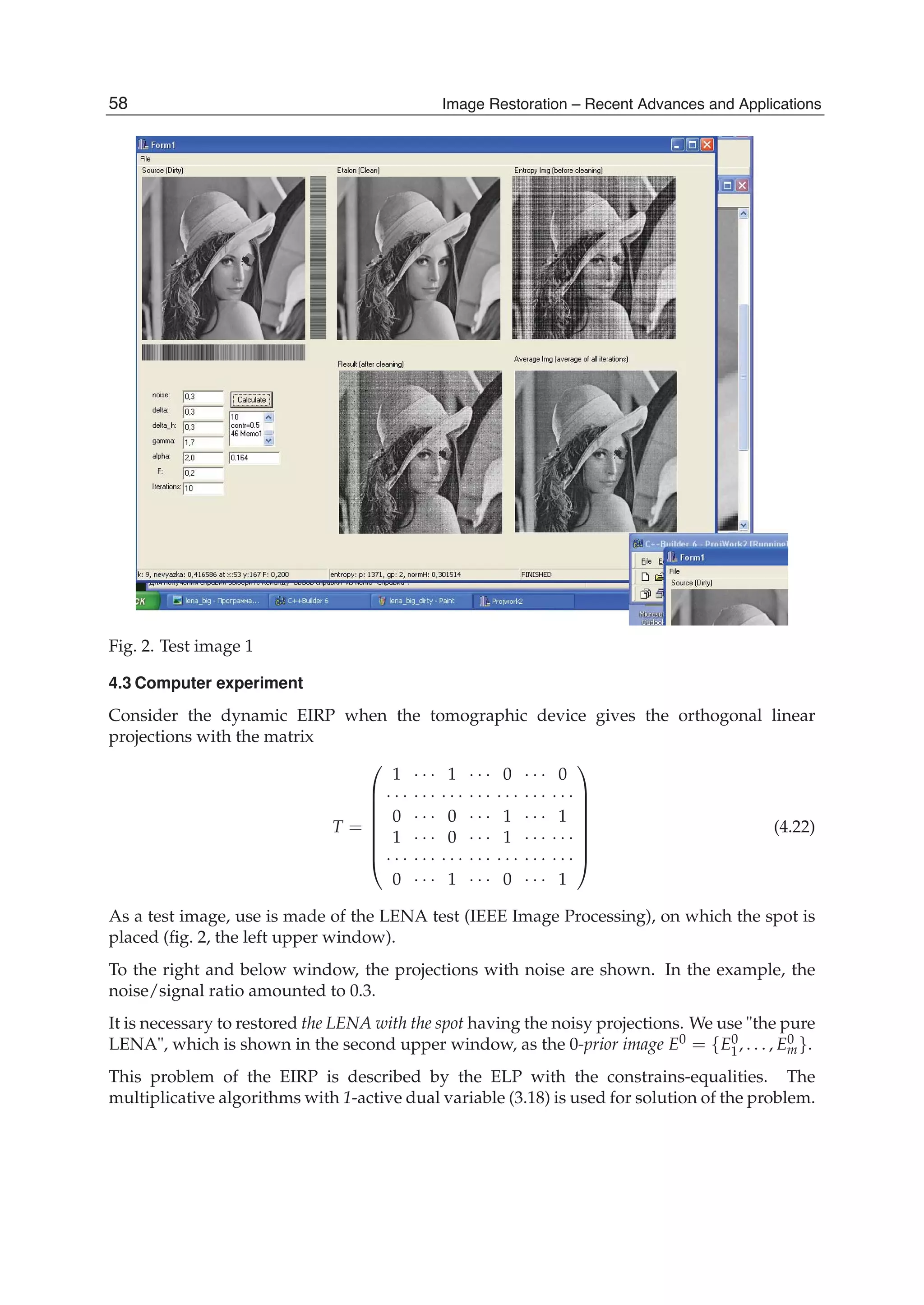
A real test aerial image is shown in Fig. 2(a). The size of image is 512x512, each pixel has 256
levels of quantization. The signal range is [0, 1]. The image quadrants are degraded by
running 1D horizontal averaging with the following sizes of the moving window: 5, 6, 4,
and 3 pixels (for quadrants from left to right, from top to bottom). The image is also
corrupted by a zero-mean additive white Gaussian noise. The degraded image with the
noise standard deviation of 0.05 is shown in Fig. 2(b).
In our tests the window length of 15x15 pixels is used, it is determined by the minimal size
of details to be preserved after filtering. Since there exists difference in spectral distributions
of the image signal and wide-band noise, the power spectrum of noise can be easily
measured from the experimental covariance matrix. We carried out three parallel processing
of the degraded image with the use of SDCT-II, SDST-I, and SDST-II transforms. At each
position of the moving window the local correlation coefficient is estimated from the
restored images. On the base of the correlation value and the standard deviation of noise,
the resultant image is formed from the outputs obtained with either SDCT-II or SDST-I, or
SDST-II according to Table 2.
(a) (b)
Fig. 2. (a) Test image, (b) space-variant degraded test image.
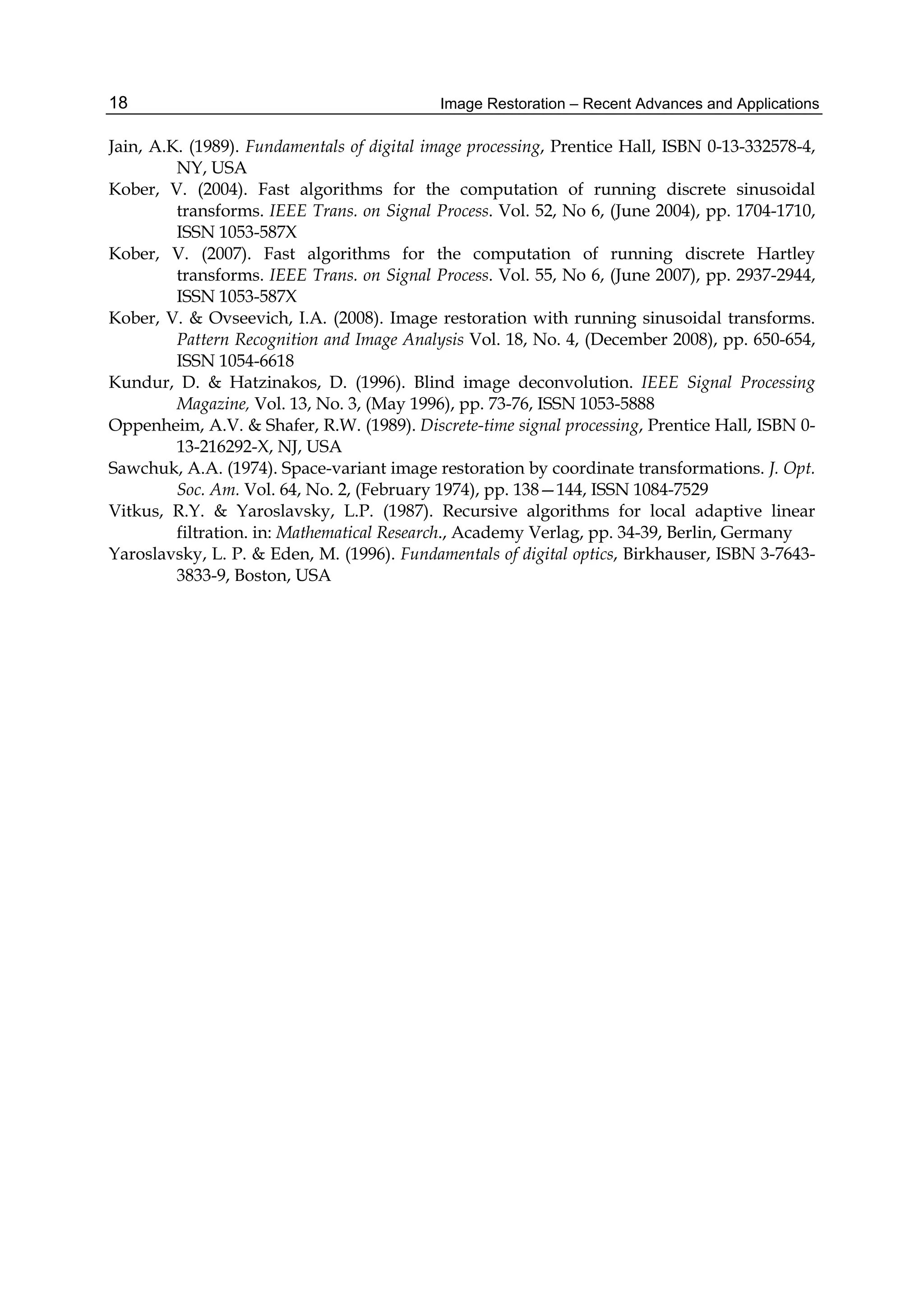
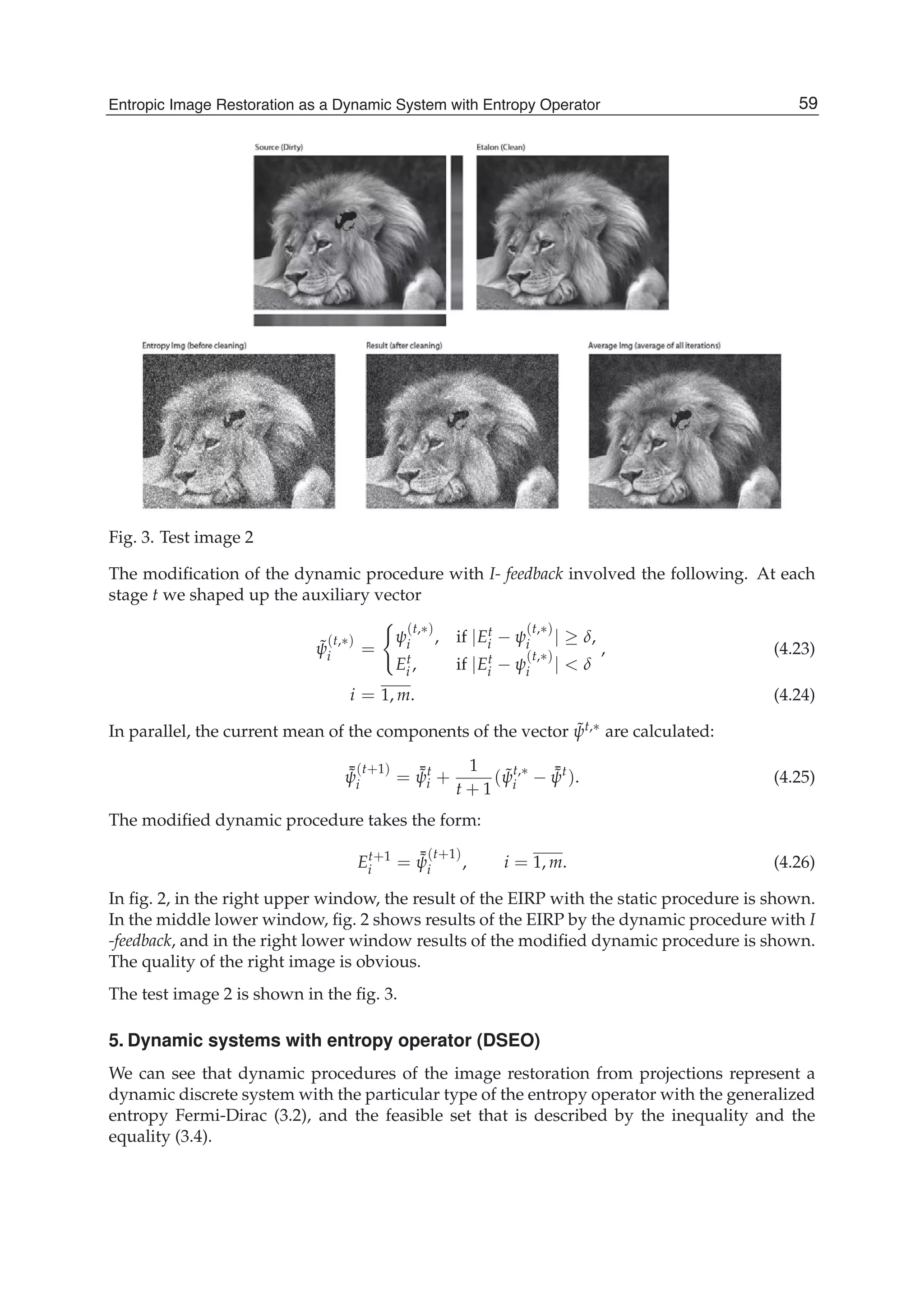
The results of image restoration by the global parametric Wiener filtering (Jain, 1989) and
the proposed method are shown in Figs. 3(a) and 3(b), respectively. Figs. 3(c) and 3(d) show
differences between the original image and images restored by global Wiener algorithm and
by the proposed algorithm, respectively.
We also performed local image restoration using only the SDCT. As expected, the result of
restoration is slightly worse than that of adaptive local restoration. We see that the proposed
Image Restoration – Recent Advances and Applications16
algorithm is capable to perform a good space-variant image restoration and noise
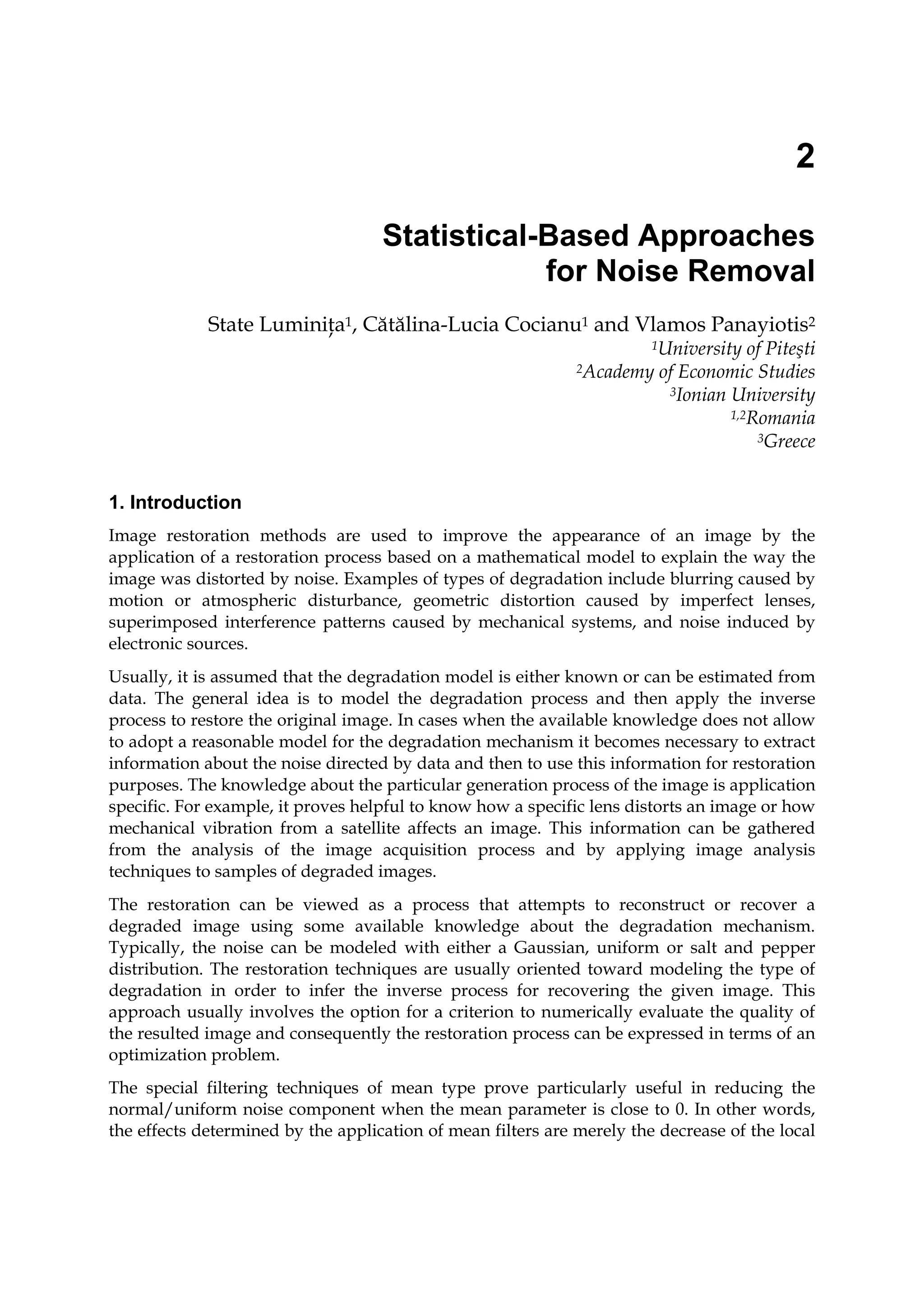
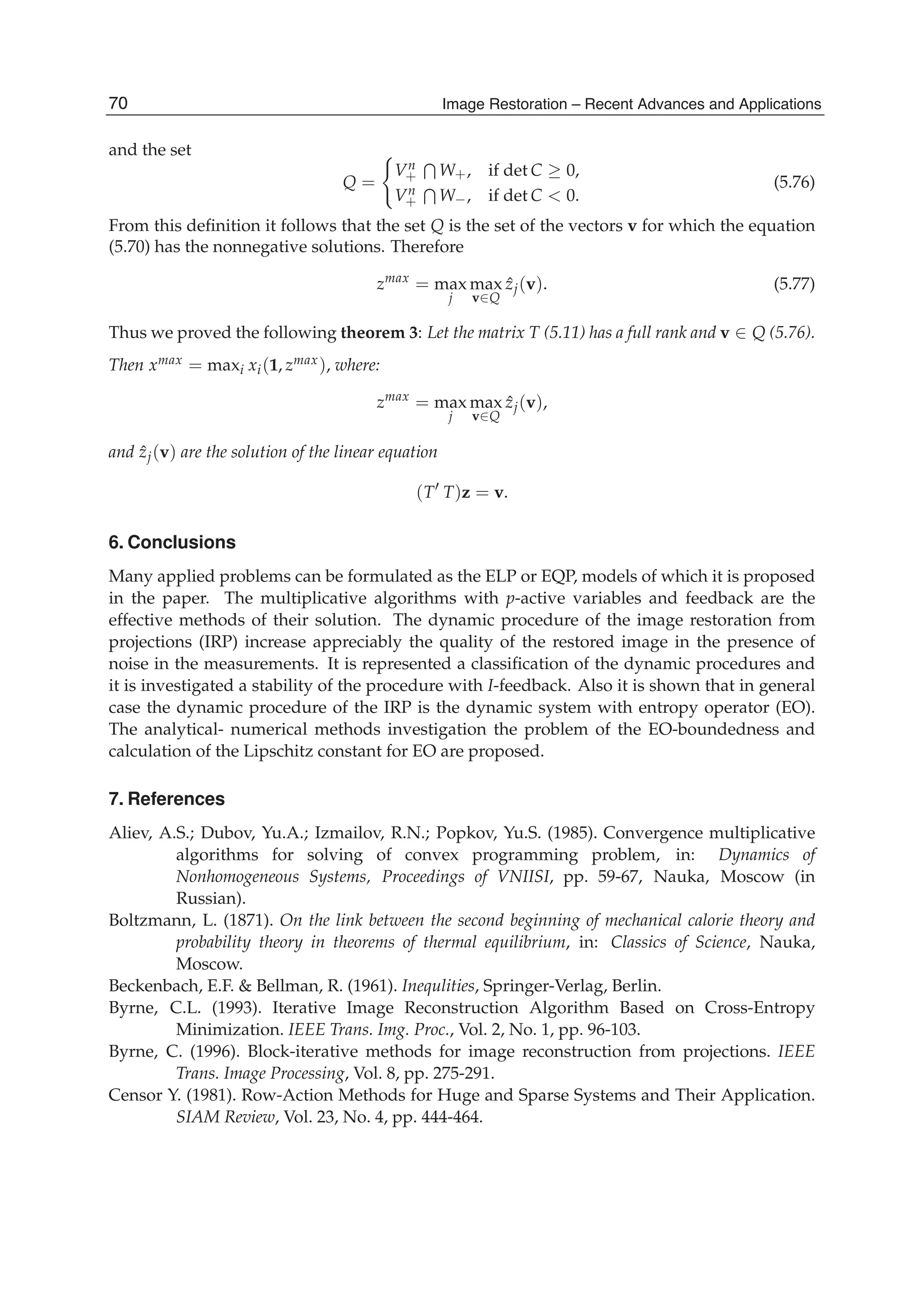
suppression. Finally, we investigate the robustness of the tested restoration techniques to
additive noise. The performance of the global parametric Wiener filtering and the local
adaptive filtering is shown in Fig. 4.
(a) (b)
(c) (d)
Fig. 3. (a) Global Wiener restoration, (b) local adaptive restoration in domain of running
transforms, (c) difference between the original image and restored image by Wiener filtering,
(d) difference between the original image and restored image by proposed algorithm.
Space-Variant Image Restoration with Running Sinusoidal Transforms 17
Fig. 4. Performance of restoration algorithms in terms of MSE versus standard deviation of
additive noise.
4. Conclusion
In this chapter we treated the problem of local adaptive technique for space-variant
restoring linearly degraded and noisy images. The minimum MSE estimator in the
domain of running discrete sinusoidal transforms was derived. To provide image
processing at high rate, fast recursive algorithms for computing the running sinusoidal
transforms were utilized. Extensive testing using various parameters of degradations
(nonuniform motion blurring and corruption by noise) has shown that the original image
can be well restored by proper choice of the parameters of the proposed adaptive local
restoration algorithm.
5. References
Banham, M. & Katsaggelos, A. (1997). Digital image restoration. IEEE Signal Processing
Magazine, Vol. 14, No.2, (March 1997), pp. 24-41, ISSN 1053-5888
Bertero, M. & Boccacci, P. (1998). Introduction to inverse problems in imaging, Institute of
Physics Publishing, ISBN 0-7503-0435-9, Bristol, UK
Biemond, J., Lagendijk, R.L. & Mersereau, R.M. (1990). Iterative methods for image
deblurring. Proc. IEEE. Vol. 78, No. 5, (May 1990) (856-883), ISSN 0018-9219
Bovik, A. (2005). Handbook of image and video processing (2nd ed.), Academic Press, ISBN 0-12-
119792-1, NJ, USA
González, R. & Woods, R. (2008). Digital image processing (3rd ed.), Prentice Hall, ISBN 0-13-
1687288, NJ, USA
Image Restoration – Recent Advances and Applications18
Jain, A.K. (1989). Fundamentals of digital image processing, Prentice Hall, ISBN 0-13-332578-4,
NY, USA
Kober, V. (2004). Fast algorithms for the computation of running discrete sinusoidal
transforms. IEEE Trans. on Signal Process. Vol. 52, No 6, (June 2004), pp. 1704-1710,
ISSN 1053-587X
Kober, V. (2007). Fast algorithms for the computation of running discrete Hartley
transforms. IEEE Trans. on Signal Process. Vol. 55, No 6, (June 2007), pp. 2937-2944,
ISSN 1053-587X
Kober, V. & Ovseevich, I.A. (2008). Image restoration with running sinusoidal transforms.
Pattern Recognition and Image Analysis Vol. 18, No. 4, (December 2008), pp. 650-654,
ISSN 1054-6618
Kundur, D. & Hatzinakos, D. (1996). Blind image deconvolution. IEEE Signal Processing
Magazine, Vol. 13, No. 3, (May 1996), pp. 73-76, ISSN 1053-5888
Oppenheim, A.V. & Shafer, R.W. (1989). Discrete-time signal processing, Prentice Hall, ISBN 0-
13-216292-X, NJ, USA
Sawchuk, A.A. (1974). Space-variant image restoration by coordinate transformations. J. Opt.
Soc. Am. Vol. 64, No. 2, (February 1974), pp. 138—144, ISSN 1084-7529
Vitkus, R.Y. & Yaroslavsky, L.P. (1987). Recursive algorithms for local adaptive linear
filtration. in: Mathematical Research., Academy Verlag, pp. 34-39, Berlin, Germany
Yaroslavsky, L. P. & Eden, M. (1996). Fundamentals of digital optics, Birkhauser, ISBN 3-7643-
3833-9, Boston, USA
2
Statistical-Based Approaches
for Noise Removal
State Luminiţa1, Cătălina-Lucia Cocianu1 and Vlamos Panayiotis2
1University of Piteşti
2Academy of Economic Studies
3Ionian University
1,2Romania
3Greece
1. Introduction
Image restoration methods are used to improve the appearance of an image by the
application of a restoration process based on a mathematical model to explain the way the
image was distorted by noise. Examples of types of degradation include blurring caused by
motion or atmospheric disturbance, geometric distortion caused by imperfect lenses,
superimposed interference patterns caused by mechanical systems, and noise induced by
electronic sources.
Usually, it is assumed that the degradation model is either known or can be estimated from
data. The general idea is to model the degradation process and then apply the inverse
process to restore the original image. In cases when the available knowledge does not allow
to adopt a reasonable model for the degradation mechanism it becomes necessary to extract
information about the noise directed by data and then to use this information for restoration
purposes. The knowledge about the particular generation process of the image is application
specific. For example, it proves helpful to know how a specific lens distorts an image or how
mechanical vibration from a satellite affects an image. This information can be gathered
from the analysis of the image acquisition process and by applying image analysis
techniques to samples of degraded images.
The restoration can be viewed as a process that attempts to reconstruct or recover a
degraded image using some available knowledge about the degradation mechanism.
Typically, the noise can be modeled with either a Gaussian, uniform or salt and pepper
distribution. The restoration techniques are usually oriented toward modeling the type of
degradation in order to infer the inverse process for recovering the given image. This
approach usually involves the option for a criterion to numerically evaluate the quality of
the resulted image and consequently the restoration process can be expressed in terms of an
optimization problem.
The special filtering techniques of mean type prove particularly useful in reducing the
normal/uniform noise component when the mean parameter is close to 0. In other words,
the effects determined by the application of mean filters are merely the decrease of the local
Image Restoration – Recent Advances and Applications20
variance corresponding to each processed window, and consequently to inhibit the variance
component of the noise. The AMVR algorithm (Adaptive Mean Variance Removal) allows
the removal of the normal/uniform noise whatever the mean of the noise is (Cocianu, State,
& Vlamos, 2002). Similar to MMSE (Minimum Mean Square Error) filtering technique
(Umbaugh, 1998) the application of the AMVR algorithm requires that the noise parameters
and some additional features are known.
The multiresolution support set is a data structure suitable for developing noise removal
algorithms. (Bacchelli & Papi, 2006; Balster et al., 2003). The multiresolution algorithms
perform the restoration tasks by combining, at each resolution level, according to a certain
rule, the pixels of a binary support image. Some others use a selective wavelet shrinkage
algorithm for digital image denoising aiming to improve the performance. For instance
Balster (Balster, Zheng & Ewing, 2003) proposes an attempt of this sort together with a
computation scheme, the denoising methodology incorporated in this algorithm involving a
two-threshold validation process for real time selection of wavelet coefficients.
A new solution of the denoising problem based on the description length of the noiseless
data in the subspace of the basis is proposed in (Beheshti & Dahleh, 2003), where the desired
description length is estimated for each subspace and the selection of the subspace
corresponding to the minimum length is suggested.
In (Bacchelli & Papi, 2006), a method for removing Gaussian noise from digital images based
on the combination of the wavelet packet transform and the PCA is proposed. The method
leads to tailored filters by applying the Karhunen-Loeve transform in the wavelet packet
domain and acts with a suitable shrinkage function on these new coefficients, allowing the
noise removal without blurring the edges and other important characteristics of the images.
Wavelet thresholding methods modifying the noisy coefficients were proposed by several
authors (Buades, Coll & Morel, 2005; Stark, Murtagh & Bijaoui, 1995). The attempts are
based on the idea that images are represented by large wavelet coefficients that have to be
preserved whereas the noise is distributed across the set of small coefficients that have to be
canceled. Since the edges lead to a considerable amount of wavelet coefficients of lower
values than the threshold, the cancellation of these wavelet coefficients may cause small
oscillations near the edges resulting spurious wavelets in the restored image.
2. Mathematics behind the noise removal and image restoration algorithms
2.1 Principal Component Analysis (PCA) and Independent Component Analysis (ICA)
We assume that the signal is represented by a n-dimensional real-valued random vector X of
0 mean and covariance matrix Σ. The principal directions of the repartition of X are the
directions corresponding to the maximum variability, where the variability is expressed in
terms of the variance.
Definition. The vector 1  Rn is the first principal direction if 1 1  and
   1
1
var supvar
n
T T
R
X X

 
   .
The value 1
T
X is referred as the first principal component of X.
Statistical-Based Approaches for Noise Removal 21
Now, recursively, for any k, 2 k n  , if we denote by  1 1,..., kL
  the linear subspace
orthogonal on the linear subspace generated by the first (k-1) directions, k Rn is the k-th
principal direction if 1k  and  
 
 
1 1,...,
1
var sup var
k
T T
k
L
X X

  
 
   .
The value T
k X is referred as the k-th principal component of the signal X.
Note that the principal directions 1 ,..., n  of any signal are an orthogonal basis of Rn , and
T
Y X  is the signal representation in terms of the principal directions, where
 1 ,..., n    . Obviously, T T
nI     ,   0E Y  and  , T T
Cov Y Y    .
Consequently, if 1 ,..., n  are unit eigen vectors of Σ, then    1, ,...,T
nCov Y Y diag     ,
where 1 ,..., n  are the eigen values of Σ, that is the linear transform of matrix T
 de-
correlates the components of X. In the particular case of Gaussian signals, X~  0,N  , the
components of Y are also normal distributed, iY ~  0, iN  , 1 i n  .
The fundamental result is given by the celebrated Karhunen-Loeve theorem:
Theorem. Let X be a n-dimensional real-valued random vector such that   0E X  and
 , T
Cov X X   . If we denote by 1 2 ... n     the eigen values of Σ, then, for any k,
1 k n  , the k-th principal direction is an eigen vector of Σ associated to k .
A series of approaches are based on the assumption that the signal results as a mixture of a
finite number of hidden independent sources and noise. This sort of attempts are usually
referred as techniques of Independent Component Analysis type. The simplest model is the
linear one, given by X=AS+ η , where A is an unknown matrix (mixing matrix), S is the n-
dimensional random vector whose components are independent and  1 2, ,...,
T
nη    is a
random vector representing the noise. The problem is to recover the hidden sources being
given the signal X without knowing the mixing matrix A.
For simplicity sake, the noise model is of Gaussian type, that is  ~  0,N  . Then, if we
denote V AS , then, for any vector w Rn , T T T
w X w V w   . Consequently, the non-
Gaussianity of T
w V can be maximized on the basis of T
w X if we use an expression that
vanishes the component T
w  .
The kurtosis (the fourth-order cumulant) corresponding to a real-valued random variable Y
is defined as       
2
4 2
3kurt Y E Y E Y  . In case Y is normally distributed, we get
  0kurt Y  . Since  ~  0,N  , for any w Rn , T
w  ~  0, T
N w w , that is   0T
kurt w   .
The non-Gaussianity can be also measured using the Shannon neg-entropy (mutual
information). Being given the computational difficulty of evaluating the exact expression of
neg-entropy, usually an approximation of it is used instead, for instance the approximation
proposed in (Hyvarinen, Karhunen & Oja, 2001),        
2
E ET T
GJ w V G w V G ν  
 
, where
G is a non-polynomial function and  ~  0,1N .
Usually the maximization of non-Gaussianity is performed on the pre-processed signal
version X , applied in order to whiten the original clean signal. In case of the additive noise
superposition model, 0X X   , where 0X is the original clean signal (unknown) and
Image Restoration – Recent Advances and Applications22
 ~  0,N  . In case 0X and  are independent and  , T
Cov     is known, we
get  0 0, T
Cov X X     , where  , T
Cov X X   and the covariance matrix 
corresponding to the observed signal X is assumed to be estimated from data. Then
       
1 1 1 1
2 2 2 2
0 0X X X X    
   
             , where  
1
2
0X

   and
 are independent and the covariance matrix of  
1
2
0X

   is the unit matrix nI .If
0X results by the linear transform of matrix A applied to the sources S, 0X AS , then
X BS    , where  
1
2B A

    . Consequently, the sources S are determined by
maximizing the non-Gaussianity of X BS    . Usually, for simplicity sake, the matrix B is
assumed to be orthogonal.
2.2 The use of concepts and tools of multiresolution analysis for noise removal and
image restoration purposes
The multiresolution based algorithms perform the restoration tasks by combining, at each
resolution level, according to a certain rule, the pixels of a binary support image. The values of
the support image pixels are either 1 or 0 depending on their significance degree. At each
resolution level, the contiguous areas of the support image corresponding to 1-value pixels are
taken as possible objects of the image. The multiresolution support is the set of all support
images and it can be computed using the statistically significant wavelet coefficients.
Let j be a certain multiresolution level. Then, for each pixel  ,x y of the input image I, the
multiresolution support at the level j is  ; , , 1M I j x y   I contains significant information
at the level j about the pixel (x,y).
If we denote by  be the mother wavelet function, then the generic evaluation of the
multiresolution support set results by computing the wavelet transform of the input image
using  followed by the computation of  ; , ,M I j x y on the basis of the statistically
significant wavelet coefficients for each resolution level j and for each pixel (x,y).
The computation of the wavelet transform of an one dimensional signal can be performed
using the algorithm “À Trous” (Stark, Murtagh & Bijaoui, 1995). The algorithm can be
extended to perform this computation in case of two-dimensional signals as, for instance,
image signals
Using the resolution levels 1,2,...,p , where p is a selected level, the “À Trous” algorithm
computes the wavelet coefficients according to the following scheme (Stark, Murtagh &
Bijaoui, 1995).
Input: The sampled signal   0c k
For j=0,1,…,p do
Step 1. j=j+1; compute,      1
1 2j
j j
l
c k h l c k l
  .
Step 2. Step 2. Compute      1j j jk c k c k  
Statistical-Based Approaches for Noise Removal 23
End-for
Output: The set    1,...,
,j p
j p
k c

.
Note that the computation of  jc k carried out in Step 1 imposes that either the periodicity
condition    j jc k N c k  or the continuity property    j jc k N c N  holds.
Since the representation of the original sampled signal is      0
1
p
p j
j
c k c k k

   , in case of
images, the values of 0c are computed for each pixel (x,y) as      0
1
, , ,
p
p j
j
c x y c x y x y

   .
If the input image I encodes a noise component  , then the wavelet coefficients also encode
some information about  . A label procedure is applied to each  ,j x y in order to remove
the noise component from the wavelet coefficients computed for I. In case for each pixel (x,y)
of I, the distribution of the coefficients is available, the significance level corresponding to
each component  ,j x y can be established using a statistical test. We say that I is local
constant at the resolution level j in case the amount of noise in I at this resolution level can
be neglected. Let 0 be the hypothesis 0 : I is local constant at the resolution level j. In
case there is significant amount of noise in I at the resolution level j, we get that the
alternative hypothesis  0 :  ,j x y ~  2
0, jN  . In order to define the critical region W of
the statistical test we proceed as follows. Let 0 1  be the a priori selected significance
level and let z be such that when  0 is true,
  
2
2
1
1 Prob , exp
22
z
j
jzj
t
x y z dt


 
 
 
     
 
 (1)
In other words, the probability of rejecting  0 (hence accept 0 ) when  0 is true is 
and consequently, the critical region is  ,W z z   . Accordingly, the significance level of
the wavelet coefficients is given by the rule:  ,j x y is a significant coefficient if and only if
 ,j x y W  .
Usually, z is taken as jk , where k is a selected constant 3k  , because
        , , ,j j j j j jP x y k P x y k P x y k           
      2 , 2 1 ,j j j jP x y k P x y k       
    , 2 1jk j jz P x y k        
Using the significance level, we set to 1 the statistically significant coefficient and
respectively we set to 0 the non-significant ones. The restored image I is,
        
1
, , , , ,
p
p j j j
j
I x y c x y g x y x y  

   , (2)
where g is defined by
Image Restoration – Recent Advances and Applications24
  
 
 
1, ,
, ,
0, ,
j j
j j
j j
x y k
g x y
x y k
 
 
 
 
 

.
2.3 Information-based approaches in image restoration
The basics of the informational-based method for image restoration purposes are given by
the following theoretical results (State, Cocianu & Vlamos, 2001).
Lemma 1 Let X be a continuous n -dimensional random vector and  nA M R a non-
singular matrix, Y AX . Then,  H X =   lnH Y A , where
 H X =-    ln
n
R
f x f x dx
is the differential entropy (Shannon), and f is the density function of X .
Lemma 2 Let X be a continuous n -dimensional normally distributed random vector,
X   0,N  and let q be a natural number, 1 q <n. If
 
 
1
2
X
X
X
 
 
 
 
where  1
X is q -
dimensional, then, for any  2
x Rn-q,      
 1 2 2
H X X x =        
  1 1 2 2
H X E X X x  , where
     
 1 2 2
E X X x
is the regression function of  1
X on    2 2
X x , and      
 1 2 2
H X X x is the conditional
entropy of  1
X on    2 2
X x .
Since      
 1 2 2
H X X x represents a measure of the amount of incertitude still remaining
with respect to  1
X when  2
X is known, we get that the whole information carried by  2
X
with respect to  1
X is concentrated on      
 1 2 2
E X X x .
If we denote    
 1 1
11 cov ,
T
X X  ,    
 2 2
22 cov ,
T
X X  ,    
 1 2
12 cov ,
T
X X  , we get
     
 1 2 2
E X X x =  21
12 22x
  and  1
Y   11.20,N  ,
where              
 1 1 2 1 1 2 21
12 22Y X x X E X X x
       , and  1
11.2 11 12 22 12
T
      
Consequently        
  1 1 2 2
H X E X X x  =      
 1 2 2
H X X x = 11.2
1
ln 2 ln
2 2
q
e   .
2.4 The image restoration method based on scatter matrices and on bounds on the
probability of error
In statistical discriminant analysis, within-class, between-class and mixture scatter matrices
are used to formulate criteria of class separability.
In case we need to discriminate between m classes , 1,iH i m and    
 1 ,...,
i i
NX X are
examples of patterns coming respectively from these classes, the within -class scatter matrix
Statistical-Based Approaches for Noise Removal 25
shows the scatter of samples around their class expected vectors and it is typically given by
the expression  
   
 1 1
ˆ ˆ
m N T
i i
w i k i k i
i k
S X X  
 
    , where ˆi is the prototype of iH and i is
the a priori probability of , 1,iH i m .
Very often, the a priori probabilities are taken
1
i
m
  and each prototype is computed as the
weighted mean of the patterns belonging to the respective class.
The between-class scatter matrix is the scatter of the expected vectors around the mixture
mean as   0 0
1 1
ˆ ˆ
m N
T
b i i i
i k
S     
 
    where 0 represents the expected vector of the
mixture distribution; usually 0 is taken as 0
1
ˆ
m
i i
i
  

  .
The mixture scatter matrix is the covariance matrix of all samples regardless of their class
assignments and it is defined by m w bS S S  . Note that all these scatter matrices are
invariant under coordinate shifts.
In order to formulate criteria for class separability, these matrices should be converted into a
number. This number should be larger when the between-class scatter is larger or the
within-class scatter is smaller. Typical criteria are  1
1 2 1J tr S S
 , 1
2 2 1lnJ S S
 , where
          1 2, , , , , , , ,b w b m w m m wS S S S S S S S S S and their values can be taken as measures of
overall class separability. Obviously, both criteria are invariant under linear non-singular
transforms and they are currently used for feature extraction purposes [8]. When the linear
feature extraction problem is solved on the base of either 1J or 2J , their values are taken as
numerical indicators of the loss of information implied by the reduction of dimensionality
and implicitly deteriorating class separability. Consequently, the best linear feature
extraction is formulated as the optimization problem   *
arg inf ,n m k k
A R
J m A J

 where m
stands for the desired number of features ,  ,kJ m A is the value of the criterion , 1,2kJ k  in
the transformed m-dimensional space of T
Y A X , where A is a *n m matrix .
If the pattern classes are represented by the noisy image  
X

and the filtered image  
 F X

respectively, the value of each of the criteria , 1,2kJ k  is a measure of overall class
separability as well as well as a measure of the amount of information discriminating
between these classes. In other words, , 1,2kJ k  can be taken as measuring the effects of the
noise removing filter expressing a measure of the quantity of information lost due to the use
of the particular filter.
Lemma 3. For any m, 1 m n  ,
     *
*
1 2arg inf , , ,..., , , 0n m
m m
k k m
A R
J m A J A A R

           , where 1 ,..., m  are
unit eigenvectors corresponding to the m largest eigenvalues of 1
2 1S S
(Cocianu, State &
Vlamos, 2004).
The probability of error is the most effective measure of a classification decision rule
usefulness, but its evaluation involves integrations on complicated regions in high
Image Restoration – Recent Advances and Applications26
dimensional spaces. When a closed-form expression for the error probability can not be
obtained, we may seek either for approximate expressions, or upper/lower bounds for the
error probability.
Assume that the design of the Bayes classifier is intended to discriminate between two
pattern classes and the available information is represented by mean vectors i , 1,2i  and
the covariance matrices i , 1,2i  corresponding to the repartitions of the classes
respectively. The Chernoff upper bounds of the Bayesian error (Fukunaga, 1990) are given
by      
11
1 2 1 2
s ss s
s f x f x dx  

  ,  0,1s , where  1 2,   is the a priori distribution
and if is the density function corresponding to the i th class, 1,2i  . When both density
functions are normal, if   ,i iN   1,2i  , the integration can be carried out to obtain a
closed-form expression for s , that is      
1
1 2
s s
f x f x dx

 =   exp s where
 s =
 
      
1
2 1 1 2 2 1
1
1
2
Ts s
s s   

      +
 1 2
1
1 2
11
ln
2 s s
s s

   
 
(3)
The upper bound
1
2

 
 
 
=    
1
1 2
2 1 2 1
1
8 2
T
   

   
  
 
+
1 2
1 2
1 2
ln
2
  
 
is called the
Bhattacharyya distance and it is frequently used as a measure of the separability between
two repartitions. Using straightforward computations, the Bhattacharyya distance can be
written as,
1
2

 
 
 
=    1
2 1 2 1
1
8
T
tr    
   + 1 1
1 2 2 1
1
ln 2
4
nI  
      - ln2
4
n
(4)
where
1 2
2
  
 
Note that one of the first two terms in (4) vanishes, when 1 2  , 1 2   respectively, that
is the first term expresses the class separability due to the mean-difference while the second
one gives the class separability due to the covariance difference.
The Bhattacharyya distance can be used as criterion function as well to express the quality of
a linear feature extractor of matrix nxm
A R .
When 1 2   =  ,
1
2
J 
 
  
 
=    1
2 1 2 1
1
8
T
tr    
   therefore J is a particular case of
the criterion 1J for 2S   and   1 2 1 2 1
T
bS S        . Consequently the whole
information about the class separability is contained by an unique feature
 
 
1
2 1
1 1
2 1
 
 


 
 
 
. When 1 2  and 1 2   ,
Statistical-Based Approaches for Noise Removal 27
J = 1 1
2 1 1 2
1
ln 2
4
nI  
      - ln2
4
n
=
1
1 1
2
4
n
j
j j


 
  
 
 
 - ln 2
4
n
(5)
where , 1,j j n  are the eigenvalues of 1
1 2

  .
If the linear feature extractor is defined by the matrix nxm
A R , then the value of the
Bhattacharyya distance in the transformed space T
Y A X is given by,
J  ,m A =        
1 1
2 1 1 2
1
ln 2
4
T T T T
mI A A A A A A A A
 
      - ln2
4
m
. (6)
The critical points of J  ,m A are the solutions of the equation
 ,
0
J m A
A


 that is,
        1 1 1
2 2 1 2 1 2B A m m m A m  
       +         1 1 1
1 2 2 1 2 1B A m m m A m  
       =0 (7)
where
  T
i im A A   , 1,2i  and        
11 1
1 2 2 1 2T T T T
mB A A A A A A A A I
 
       
  
.
Suboptimal solutions can be identified as the solutions of the system
       
       
1 1 1
2 2 1 2 1 2
1 1 1
1 1 2 1 2 1
0
0
A m m m A m
A m m m A m
  
  
       

       
(8)
or equivalently,    1 1
2 1 2 1A A m m 
     .
Obviously the criterion function J is invariant with respect to non-singular transforms and,
using standard arguments, one can prove that  
 1 ,...,
m
m    can be taken as the
suboptimal linear feature extractor where , 1,i i m  are unit eigenvectors corresponding to
the eigenvalues 1, ..., m  of 1
2 1

  such that 1
1
1 1 1
... ...m n
m n
  
  
       .
But, in case of image restoration problem, each of the assumptions 1 2  , 1 2   is
unrealistic, therefore, we are forced to accept the hypothesis that 1 2  and 1 2   .
Since there is no known procedure available to optimize the criterion J when 1 2   and
1 2  , a series of attempts to find suboptimal feature extractors have been proposed
instead (Fukunaga, 1990)
3. Noise removal algorithms
3.1 Minimum mean-square error filtering (MMSE), and the adaptive mean-variance
removal algorithm (AMVR)
The minimum mean-square error filter (MMSE) is an adaptive filter in the sense that its
basic behavior changes as the image is processed. Therefore an adaptive filter could process
Image Restoration – Recent Advances and Applications28
differently on different segments of an image. The particular MMSE filter may act as a mean
filter on some windows of the image and as a median filter on other windows of the image.
The MMSE filter allows the removal of the normal/uniform additive noise and its
computation is carried out as
     
2
.2
,
, , , l c
l c
X l c Y l c Y l c



      ,
for ,t l R t t c C t      , where Y is a R C noisy image, Wl,c is the n n window
centered in (l,c), where 2 1, ,n t t l R t t c C t        , 2
 is the noise variance, 2
.l c is the
local variance (in the window ,l cW ), and 2
.l c is the local mean (average in the window ,l cW ).
Note that since the background region of the image is an area of fairly constant value in the
original uncorrupted image, the noise variance is almost equal to the local variance, and
consequently the MMSE performs as a mean filter. In image areas where the local variances
are much larger than the noise variance, the filter computes a value close to the pixel value
corresponding to the unfiltered image data. The magnitude of the original and local means
respectively used to modify the initial image are weighted by
2
2
,l c


, the ratio of noise to local
variance. As the value of the ratio increases, implying primarily noise in the window, the
filter returns primarily the value of the local average. As this ratio decreases, implying high
local detail, the filter returns more of the original unfiltered image. Consequently, the MMSE
filter adapts itself to the local image properties, preserving image details while removing
noise.(Umbaugh,1998).
The special filtering techniques of mean type prove particularly useful in reducing the
normal/uniform noise component when the mean parameter is close to 0. In other words, the
effects determined by the application of mean filters are merely the decrease of each processed
window local variance and consequently the removal of the variance component of the noise.
The AMVR algorithm allows to remove the normal/uniform noise whatever the mean of the
noise is. Similar to MMSE filtering technique in application of the AMVR algorithm, the
noise parameters and features are known. Basically, the AMVR algorithm works in two
stages, namely the removal of the mean component of the noise (Step 1 and Step 2), and the
decrease of the variance of the noise using the adaptive filter MMSE. The description of the
AMVR algorithm is (Cocianu, State & Vlamos, 2002) is,
Input The image Y of dimensions R C , representing a normal/uniform disturbed version
of the initial image X,     0
,, , l cY l c X l c   , 1 , 1l R c C    , where 0
,l c is a sample of the
random variable ,l c distributed either  2
, ,,l c l cN   or  2
, ,,l c l cU   .
Step 1. Generate the sample of images  1 2, ,..., nX X X , by subtracting the noise ,l c from
the processed image Y, where     ,, , i
i l cX l c Y l c   , 1 , 1l L c C    and ,
i
l c is a
sample of the random variable ,l c .
Step 2. Compute X , the sample mean estimate of the initial image X, by averaging the
pixel values,    
1
1
, ,
n
i
i
X l c X l c
n 
  , 1 , 1l R c C    .
Step 3. Compute the estimate ˆX of X using the adaptive filter MMSE,  ˆX MMSE X .
Statistical-Based Approaches for Noise Removal 29
Output The image ˆX .
3.2 Information-based algorithms for noise removal
Let us consider the following information transmission/processing system. The signal X
representing a certain image is transmitted through a channel and its noise-corrupted
version  
X

is received. Next, a noise-removing binomial filter is applied to the output  
X

resulting  
 F X

. Finally, the signal  
 F X

is submitted to a restoration process producing
X , an approximation of the initial signal X . In our attempt (Cocianu, State & Vlamos, 2004)
we assumed that there is no available information about the initial signal X , therefore the
restoration process should be based exclusively on  
X

and  
 F X

. We assume that the
message X is transmitted N times and we denote by    2 2
1 ,..., NX X the resulted outputs and
by    1 1
1 ,..., NX X their corresponding filtered versions.
If we denote the given image by X , then we model    
 2 2
1 ,..., NX X as a Bernoullian sample of
the random r c -dimensional vector  
X X

  where    ,N   and    
 1 1
1 ,..., NX X is a
sample of the filtered random vector  
 F X

. Obviously,  
X

and  
 F X

are normally
distributed. Let us denote    
  1
E F X

  ,    
 2
E X

  and let 11 , 22 be their
covariance matrices. We consider the working assumption that the 2  r c -dimensional
vector    
  ,X F X
 
is also normally distributed, therefore the conditional distribution of
 
 F X

on  
X

is      
  1 21
12 22 11.2,N X

 
     , where
 
   
 E F X X
 
=      
 1 21
12 22 X

 
    (9)
is the regression function of  
 F X

on  
X

,
and  
   
 12 cov ,F X X
 
   1
11.2 11 12 22 12
T
       (see § 2.3).
It is well known (Anderson, 1958) that  
   
   
 F X E F X X
  
 minimizes the variance and
maximizes the correlation between  
 F X

and  
X

in the class of linear functions of  
X

.
Moreover,  
   
 E F X X
 
is  
X

-measurable and, since  
   
   
 F X E F X X
  
 and
 
X

are independent, the whole information carried by  
X

with respect to  
 F X

is
contained by  
   
 E F X X
 
.
As a particular case , using the conclusions established by the lemmas 1 and 2 (§ 2.3), we can
conclude that  
   
   
    
   
 H F X E F X X H F X X
    
  and  
   
 E F X X
 
contains the
Image Restoration – Recent Advances and Applications30
whole information existing in  
X

with respect to  
 F X

a part of it being responsible for the
initial existing noise  and another component being responsible for the quality degradation.
According to our regression-based algorithm, the rows of the restored image X are
computed sequentially on the basis of the samples    
 2 2
1 ,..., NX X and    
 1 1
1 ,..., NX X
representing the available information about  
X

and  
 F X

If we denote by  
 p
kX i the i-th row of  
, 1,2, 1
p
kX p k N   , then the mean vectors  p
 are
estimated by the corresponding sample means    
   
  ˆ ˆ ˆ1 ,...,
p p p
r   , where
 
   
 
1
1
ˆ , 1
N
p p
k
k
i X i i r
N


   and the covariance matrices  , , 1,2ts i t s  are estimated
respectively by their sample covariance matrices counterparts,
   
   
    
   
  1
1ˆ ˆ ˆ
1
N T
t t s s
ts k k
k
i X i i X i i
N
 

   

 . Frequently enough it happens that the
matrices  ˆ , 1,2tt i t  are ill conditioned, therefore in our method the Penrose
pseudoinverse   ˆ
tt i

 is used instead of   
1
ˆ
tt i

 .
Since the aim is to restore as much as possible the initial image X, we have to find out ways
to improve the quality of  
 F X

in the same time preventing the introduction additional
noise.
Obviously,
 
              1
E F X F X E F X F E F X E            (10)
 
   2
E X X E      (11)
hence    
 1 2
F X X    and    
   1
X X F X E

       . In other words,
   1 2
  can be viewed as measuring the effects of the noise  as well as the quality
degradation while the term    1
X

 retains more information about the quality of image
and less information about  (Cocianu, State & Vlamos, 2004). This argument entails the
heuristic used by our method (Step 4), the restored image being obtained by applying a
threshold filter to  1
 and adding the correction term    
 2 11
12 22  
   ,
 
  1
ˆX T i     
 2 11
12 22  
   .
The heuristic regression -based algorithm (HRBA) for image restoration (Cocianu, State &
Vlamos, 2004)
Input: The sample    
 2 2
1 ,..., NX X of noise corrupted versions of the r c  dimensional image X
Step 1. Compute the sample    
 1 1
1 ,..., NX X by applying the binomial filter of mask
Statistical-Based Approaches for Noise Removal 31
1 2 1
1
2 2
12
1 2 1
tM t
t
 
 
  
  
, 4t  to each component of    
 2 2
1 ,..., NX X ,
   
 1 2
, 1i iX F X i N   .
Step 2. For each row 1 i r  , compute  
   
 
1
1
ˆ , 1 , 1,2
N
p p
k
k
i X i i r p
N


    ,
   
   
    
   
  1
1ˆ ˆ ˆ , , 1,2
1
N T
t t s s
ts k k
k
i X i i X i i t s
N
 

    

 .
Step 3. For each row 1 i r  , compute  
  1
ˆT i by applying a threshold filter to  
 1
ˆ i .
Step 4. Compute the rows  X i of the restored image X ,
   
  1
ˆX i T i        
   
  2 1
12 22
ˆ ˆ ˆ ˆi i i i  

   , where  is a noise-preventing
constant conveniently determined to prevent the restoration of the initial noise. By
experimental arguments, the recommended range of  is  1.5,5.5 .
Note that since the regression function can be written as,
 
   
       
     
       
 1 2 1 1 2 11 1 1
12 22 12 22 12 22E F X X X X
   
       
              (12)
the correction term used at Step 4 is precisely the sample mean estimation of the
   
  11
12 22E X


   .
The idea of our attempt is to use the most informative features discriminating between
 
X

and  
 F X

for getting correction terms in restoring the filtered images  
 F X

. The
attempt is justified by the argument that besides information about the removed noise, the
most informative features discriminating between  
X

and  
 F X

would contain
appropriate information allowing quality improvement of the image  
 F X

(Cocianu,
State & Vlamos, 2004). Let    
 2 2
1 ,..., NX X be the sample of noise corrupted versions of the
r c  dimensional image X and    
 1 1
1 ,..., NX X their filtered versions,
   
 1 2
, 1i iX F X i N   . We assume 1 2 0.5   , therefore the scatter matrices become
1 2
ˆ ˆ
wS     ,    
     
 1 2 1 2
ˆ ˆ ˆ ˆ
T
bS       and m w bS S S  where
   
1
1
ˆ
N
i i
k
k
X
N


  ,    
     
 1
1ˆ ˆ ˆ
1
N T
i i i i
i k k
k
X X
N
 

   

 , 1,2i 
Since   1brank S  , we get  1
1w brank S S
 , that is when 2 wS S and 1 bS S ,the matrix
1
2 1S S
has an unique positive eigenvalue, one of its unit eigenvectors being given by
Image Restoration – Recent Advances and Applications32
   
 
   
 
1 21
1 1 21
w
w
S
S
 
 



 

.
The heuristic scatter matrices-based algorithms (HSBA) for image restoration (Cocianu,
State & Vlamos, 2004)
The idea of our attempt is to use the most informative features discriminating between
 
X

and  
 F X

for getting correction terms in restoring the filtered images  
 F X

The
attempt is justified by the argument that besides information about the removed noise, the
most informative features discriminating between  
X

and  
 F X

would contain
appropriate information allowing quality improvement of the image  
 F X

(Cocianu, State
& Vlamos, 2004). Let    
 2 2
1 ,..., NX X be the sample of noise corrupted versions of the
r c  dimensional image X and    
 1 1
1 ,..., NX X their filtered versions,
   
 1 2
, 1i iX F X i N   . We assume 1 2 0.5   ,therefore the scatter matrices are
1 2
ˆ ˆ
wS     ,    
     
 1 2 1 2
ˆ ˆ ˆ ˆ
T
bS       and m w bS S S 
where
   
1
1
ˆ
N
i i
k
k
X
N


  ,    
     
 1
1ˆ ˆ ˆ
1
N T
i i i i
i k k
k
X X
N
 

   

 , 1,2i  .
Since   1brank S  , we get  1
1w brank S S
 , that is when 2 wS S and 1 bS S ,the matrix
1
2 1S S
has an unique positive eigenvalue, its unit eigenvector being given by
   
 
   
 
1 21
1 1 21
w
w
S
S
 
 



 

a. The variant of the HSBA when 2 wS S
and 1 bS S
(Cocianu, State & Vlamos, 2004)
Input : The sample    
 2 2
1 ,..., NX X of noise corrupted versions of the r c -dimensional image X
Step 1. Compute the sample    
 1 1
1 ,..., NX X by applying the binomial filter as in Step 1 of
HRBA.
Step 2. For each row 1 i r  , do Step 3 until Step 7
Step 3. Compute  
   
 
1
1
ˆ
N
p p
k
k
i X i
N


  ,    
   
    
   
  1
1ˆ ˆ ˆ
1
N T
p p p p
p k k
k
i X i i X i i
N
 

   

 ,
1,2p 
Statistical-Based Approaches for Noise Removal 33
Step 4. Compute    
   
    
   
  1 2 1 2
ˆ ˆ ˆ ˆ
T
bS i i i i i      and the Penrose pseudoinverse
 wS i
of the matrix      1 2
ˆˆ ˆ
wS i i i   
Step 5. Compute the optimal linear feature extractor  
 
   
  
 
   
  
1 21
1 1 21
w
w
S i i
i
S i i
 
 



 

containing the information about class separability between  
   
  2 2
1 ,..., NX i X i and
 
   
  1 1
1 ,..., NX i X i expressed in terms of the criterion function 1J (see §2.4)
Step 6. Compute  
  1
ˆT i by applying a threshold filter to  
 1
ˆ i and the correction term
  1
T
Y i    
 1
ˆ i
Step 7. Compute the row  X i of the restored image X by correcting the filtered image
 
  1
ˆT i using the most informative feature,  X i =  
    1
1
ˆT i Y i   ,where 
is a noise-preventing constant conveniently determined to prevent the restoration
of the initial noise, 0< <1.
Note that at Step 4, the computation of  wS i
is carried out instead of  1
wS i
, this
modification being needed because the matrix  wS i could happen to be ill-conditioned.
b. The variant of the HSBA when 2 mS S and 1 wS S (Cocianu, State & Vlamos, 2004)
Let   1 ,..., ndiag   be the eigenvalue matrix of mS and  the matrix having as columns
the corresponding unit eigenvectors. According to the algorithm of simultaneous
diagonalization (Duda & Hart, 1973), the optimal linear feature extractor is given by
1
2
A

   where  is an orthogonal matrix whose columns are unit eigenvectors of
1 1
2 2
T
wK S
  
   
 
. The most informative features about the separability of the classes
represented by the samples    
 2 2
1 ,..., NX X and    
 1 1
1 ,..., NX X are the entries ofY A
  1
ˆ ,
therefore the restoration can be performed by adding the correction term AY to
 
  1
ˆT i the filtered prototype of    
 1 1
1 ,..., NX X .
The number of significant features is either pre-established or dynamically determined by
the magnitude of the eigenvalues of 1
2 1S S
.
The variant of HSBA when 2 mS S and 1 wS S can be described as follows.
Input : The sample    
 2 2
1 ,..., NX X of noise corrupted versions of the r c -dimensional image X
Step 1. Compute the sample    
 1 1
1 ,..., NX X as described in Step 1 of the variant (a) of the
HSBA
Image Restoration – Recent Advances and Applications34
Step 2. For each row 1 i r  , do Step 3 until Step 8
Step 3. Compute
 
   
 
1
1
ˆ
N
p p
k
k
i X i
N


  ,    
   
    
   
  1
1ˆ ˆ ˆ
1
N T
p p p p
p k k
k
i X i i X i i
N
 

   

 ,
1,2p 
Step 4. Compute      1 2
ˆˆ ˆ
wS i i i    and      
   
    
   
  1 2 1 2
ˆ ˆ ˆ ˆ
T
m wS i S i i i i i      
Step 5. Compute the eigenvalues     1 ,..., ni i  and the corresponding unit eigenvectors
    1 ,..., ni i  of  mS i . Select the largest t eigenvalues and let
      1 ,...,t ti diag i i   ,  
      1 ,...,
t
ti i i   
   
     
   
1 1
2 2
T
t t
t w tK i i i S i i
    
       
   
.
Step 6. Compute   i a matrix whose columns are unit eigenvectors of K i . The most
informative feature vectors responsible for the class separability between
 
   
  2 2
1 ,..., NX i X i and  
   
  1 1
1 ,..., NX i X i are the columns of
   
     
1
2t
tA i i i i

    .
Step 7. Compute  
  1
ˆT i by applying a threshold filter to  
 1
ˆ i and the correction term
   Y i A i
  
  1
ˆT i
Step 8. Compute the row  X i of the restored image X by correcting the filtered image
 
  1
ˆT i using the information contained by the selected
features,  X i =  
      1
ˆT i A i Y i  , where  is a noise-preventing constant
conveniently determined to prevent the restoration of the initial noise, 0< <1.
c. The variant of the HSBA when 2 wS S and 1 mS S (Cocianu, State & Vlamos, 2004)
In case we take 2 wS S and 1 mS S we obtain a variant of the HSBA similar to the variant
(b). In our approach, for each row 1 i r  of the processed images, the most informative
features used in getting the correction term are determined using the matrix  M i whose
columns are eigenvectors of wS mS
such that      T
wM i M i S i
 .
Our image restoration algorithm based on the Bhattacharyya distance can be described as
follows.
The HBA for image restoration (Cocianu, State & Vlamos, 2004)
Input : The sample    
 2 2
1 ,..., NX X of noise corrupted versions of the r c -dimensional image
X and the number k of desired features.
Step 1. Compute the sample    
 1 1
1 ,..., NX X as described in Step 1 of the variant (a) of the
HSBA
Step 2. For each row 1 i r  , do Step 3 until Step 8
Statistical-Based Approaches for Noise Removal 35
Step 3. Compute
 
   
 
1
1
ˆ
N
p p
k
k
i X i
N


  ,    
   
    
   
  1
1ˆ ˆ ˆ
1
N T
p p p p
p k k
k
i X i i X i i
N
 

   

 , 1,2p 
Step 4. Compute
1
,
2
i
 
 
 
=  
   
        
   
  
1
2 1 2 11 2
ˆ ˆ1
ˆ ˆ ˆ ˆ
8 2
T i i
i i i i   

   
   
 
+
   
   
1 2
1 2
ˆ ˆ
21
ln
2 ˆ ˆ
i i
i i
  
 
Step 5. Compute the eigenvalues  1 ,..., c  of the matrix    1
2 1
ˆ ˆi i
  and a matrix  A i
whose columns i are eigenvectors of    1
2 1
ˆ ˆi i
  such that      1
2
ˆT
A i A i i
  ,
1,i c .
Step 6. Arrange the eigenvalues such that for any 1 s j c   ,
 
   
    
   
  
2 2
2 1 2 1
ˆ ˆ ˆ ˆ1 1
ln 2 ln 2
1 1s
T T
s j
s j
s j j
i i i i   
 
   
                    
       
and select the feature matrix    1 ,...,
T
kM i    .
Step 7. Compute  
  1
ˆT i by applying a threshold filter to  
 1
ˆ i
and the correction term    T
Y i M i  
  1
ˆT i
Step 8. Compute the row  X i of the restored image X by correcting the filtered image
 
  1
ˆT i using the information contained by the selected features,
 X i =  
      1
ˆT i M i Y i 
where  is a noise-preventing constant conveniently determined to prevent the restoration
of the initial noise, 0< <1.
3.3 Wavelet-based denoising
The multiresolution support provides a suitable framework for noise filtering and image
restoration by noise removal. Briefly, the idea is to determine a set of statistically significant
wavelet coefficients from which the multiresolution support is extracted, that is the
procedure is mainly based on an underlying statistical image model governing the whole
process. The multiresolution support is the basis of subsequent filtering process.
We extend the MNR algorithm to the algorithm GMNR to allow the noise removal in more
general cases when the noise mean can be any real number, and compare the performances
of the resulted method against the most frequently used restoration algorithms (MMSE and
AMVR). Briefly, the MNR algorithm is described as follows (Stark, Murtagh & Bijaoui,
1995). The parameter k used in Step 2 controls the width of the confidence interval, its value
being set to a value around 3.
Input: The image 0X , the number of resolution levels p and the heuristic threshold k.
Image Restoration – Recent Advances and Applications36
Step 1. Compute the sequence of image variants   1,
j
j p
X

using a discrete low-pass filter h
and get the wavelet coefficients by applying the “À Trous” algorithm
     1 1
1, , 2 , 2j j
j j
l k
X r c h l k X r l c k 
   ,      1, , ,j j jr c X r c X r c   ,
Step 2. Select the significant coefficients where  ,j r c is taken as being significant if
 ,j jr c k  , for 1,...,j p
Step 3. Use the filter g defined by   
 
 
1, ,
, ,
0, ,
j j
j j
j j
r c k
g r c
r c k
 
 
 
 
 

to compute the
restored image,         
1
, , , , ,
p
p j j j
j
X r c X r c g r c r c  

   ,
Output The restored image X .
In the following, the algorithm GMNR is an extension of the MNR algorithm aiming to get
the multiresolution support set in case of arbitrary noise mean, and to use this support set
for noise removal purposes (Cocianu, State, Stefanescu, Vlamos, 2004). Let us denote by X
the original “clean” image, and  ~  2
,N m  be the additively superimposed noise, that is
the image to be processed is Y X   . Using the two-dimensional filter  , the sampled
variants of X, Y and  result by convoluting them with  respectively,
     0 , , , ,c x y Y l c x l y c   ,      0 , , , ,I x y X l c x l y c   ,
     0 , , , ,E x y l c x l y c    , 0 0 0c I E  .
The wavelet coefficients of 0c computed by the algorithm “À Trous” are,
 0
,c
j x y     0 0
, ,I E
j jx y x y  , where  
1 1
2 2 2 2
x x
x  
   
    
   
.
For any pixel  ,x y , we get  ,pc x y    , ,p pI x y E x y  , where p stands for the number of
the resolution levels, and the image 0c is
 0 ,c x y         0 0
1 1
, , , ,
p p
I E
p p j j
j j
I x y E x y x y x y 
 
    (13)
The noise mean can be inhibited by applying the following “white-wall” type technique.
Step 1. Get the set of images  i
E , 1 i n  , by additively superimposing noise  2
,N m  on
a “white wall” image.
Step 2. Compute jc ,
 i
jE , and the coefficients
 
0
,
i
c E
j j  , 1 i n  , 1 j p  , by applying the
“À Trous” algorithm.
Step 3. Get the image I by averaging the resulted versions,
Statistical-Based Approaches for Noise Removal 37
     
   
 
  0
1 1
1
, , , , ,
i
pn
i c E
p p j j
i j
I x y c x y E x y x y x y
n
 
 

    

  .
Step 4. Compute an approximation of the original image 0I using the multiresolution
filtering based on the statistically significant wavelet coefficients.
Note that I computed at Step 3 is 0 ',I I E  where E’~  2
', 'N m  , ' 0m  and
 2 2
'E   .
3.4 A combined noise removal method based on PCA and shrinkage functions
In the following, the data X is a collection of image representations modeled as a sample
0X coming from a multivariate wide sense stationary stochastic process of mean μ and
covariance matrix Σ , each instance being affected by additively superimposed random
noise. In general, the parameters μ and Σ can not be assumed as been known and they are
estimated from data. The most frequently used model for the noise component η is also a
wide sense multivariate stationary stochastic process of Gaussian type. Denoting by n the
dimensionality of the image representations, the simplest noise model is the “white” model,
that is   , 0,t t  η η , where for any t≥0, η t ~  2
N , n0 I . Consequently, the
mathematical model for the noisy image versions is, 0 X X η .
The aim is to process the data X using estimates of μ , Σ and 2
 to derive accurate
approximations of 0X .
The data are preprocessed to get normalized and centered representations. The
preprocessing step is needed to enable the hypotheses that 2
0 1  . If 0  Y X μ η ,
then   2
Cov , T
n Y Y Σ I . Let 1 2 ... n     be the eigen values of Σ ,
Φ 1 2( , ,..., )n Φ Φ Φ an orthogonal matrix whose columns are unit eigen vectors of Σ ,
and  1 2diag , ,..., n  Λ the diagonal matrix whose entries are
2
1i
i



  .
We apply the linear transform of matrix
1
2T T

A Λ Φ to Y and get the representation
 0
T T T
   Z A Y A X μ A η . Using the assumptions concerning the noise,
T
A η ~  2 1
N , 
0 Λ and consequently, the components of T
A η are independent, each
component being of Gaussian type.
By applying the shrinkage function    
2
sign max 0, 2
i
g y y y


 
  
 
to Z (Hyvarinen,
2001), we get the estimate 0Z of 0Z =  0
T
A X μ . Finally, using the equation AAT=Σ-1, we
get the estimate 0 0
ˆ  X μ ΣAZ of X0.
In the following, we combine the above described estimation process with a
compression/decompression scheme, in order to remove the noise in a feature space of less
dimensionality. For given , 1m m n  , we denote by  1 2, ,...,m
mΦ Φ Φ Φ and
 1 2diag , ,...,m m  Λ the matrix having as columns the first m columns of  and the
diagonal matrix having as entries the first m entries of  respectively.
Image Restoration – Recent Advances and Applications38
The noise removal process in the m-dimensional feature space applied to
   
1
2
Tm
mF

 Λ Φ Y produces the cleaned version 0F , and consequently the estimate of
0X results by decompressing
0F ,    
1
2
0 0
ˆ Tm
m F

 
  
 
X Λ Φ .
The model-free version of CSPCA is a learning from data method that computes estimates
of the first and second order statistics on the basis of a series of n-dimensional noisy images
1 2 NX ,X ,...,X ,... (State, Cocianu, Sararu, Vlamos, 2009). Also, the estimates of the eigen
values and eigen vectors of the sample covariance matrix are obtained using first order
approximations derived in terms of perturbation theory. The first and second order statistics
are computed in a classical way, that is
1
1 N
N i
iN 
 μ X and   
1
1
1
N
T
N i N i N
iN 
  

Σ X μ X μ .
Using staightforward computation, the following recursive equations can be derived
1 1
1
1 1
N N N
N
N N
  
 
μ μ X , 1
1
N N N
N
   Σ Σ Σ   1 1
1
1
T
N N N N
N
  

X μ X μ .
Denoting by 1N N N  Σ Σ Σ , in case the eigen values of NΣ are pairwise distinct, using
arguments of perturbation theory type, the recursive equations for the eigen values and
eigen vectors can be also derived (State, Cocianu, Vlamos, Stefanescu, 2006)
 1 TN N N N
i i i N i 
  ψ Σ ψ ,
 1
1
Tj N
n
N N iN N N
i i jN N
j i j
j i
 




 


ψ Σ ψ
ψ ψ ψ .
Assume that the information is represented by , , ,N N N Nμ Σ Λ Φ , and a new noisy image XN+1
is presented as input. Then the cleaned version 1
ˆ
NX of XN+1 is computed and supplied as
output followed by the updating 1, 1 1 1, ,N N N N   μ Σ Λ Φ . The updated values of these
parameters are fed into the restoration module and they will be used for the next test.
The restoring algorithm can be described as follows. Assuming that 01 2 NX ,X ,...,X is the
initial collection of noisy images, we evaluate 0 0 0 0, , ,N N N Nμ Σ Λ Φ . On the basis of these
information, a number of M noisy images 0 01N N M X ,...,X are next processed according to
the following scheme.
1k 
While  k M
Get 0N kX
Compute 0 0,N k N k μ Σ 0 0
, ,N k N k Λ Φ (M1)
Statistical-Based Approaches for Noise Removal 39
Compute 0
ˆ
N kX (M2)
Output 0
ˆ
N kX
1k k 
Endwhile
The computations carried out in the module M1 involve the stored parameters
0 01, 1N k N k   μ Σ 0 01 1, ,N k N k   Λ Φ and the noisy current image 0N kX to update the new values
of the parameters 0 0,N k N k μ Σ 0 0
, ,N k N k Λ Φ . The new values of the parameters are fed into
the module M2 and they are used to clean the input. The computation of the new values of
the parameters is performed as,
0 0 0
0
1
0 0
1 1
N k N k N k
N k
N k N k
   
 
 
 
μ μ X
0 0 01 1
0
1
1
N k N k N k
N k
      
 
Σ Σ Σ   0 0 0 01 1
0
1 T
N k N k N k N k
N k
      

X μ X μ
 0 0 0 0
0
1 1 1
1
T
N k N k N k N k
i i i N k i       
   ψ Σ ψ
 0 0
00 0 0
0 0
1 1
11 1
1 1
1
TN k N k
n N kj iN k N k N k
i i jN k N k
j i j
j i
 
   
     
   



 


ψ Σ ψ
ψ ψ ψ
 0 0
0 1 ,..,N k N k
N k ndiag   
 Λ
 0 0
0 1 ,...,N k N k
N k n
 
 Φ ψ ψ
The cleaned version 0
ˆ
N kX of each input 0N kX is obtained by applying the previously
described shrinkage technique, as follows.
0 0 0N k N k N k   Y X μ
 0 0 0
1
2
N kN k N k 

 A Φ Λ
 0 0 0
T
N k N k N k  Z A Y
Compute 0N kZ by applying the shrinkage function to 0N kZ .
0 0 0 0 0
ˆ
N k N k N k N k N k     X μ Σ A Z
Image Restoration – Recent Advances and Applications40
Let us assume that the L gray levels of the initial image X are affected by noise of Gaussian
type  ~  0,N  , and denote by  an orthogonal n n matrix whose columns are unit eigen
vectors of  , where n is the dimension of the input space. If  is known, the matrix  can
be computed by classical techniques, respectively in cases when  is not known, the
columns of  can be learned adaptively by PCA networks (Rosca, State, Cocianu, 2008).
We denote by Y the resulted image, Y X   . The images are represented by RxC matrices,
they are processed by blocks of size 1R C , 1 , 2C pC p C   . In the preprocessing step,
using the matrix  , the noise is removed by applying the MNR algorithm to the de-
correlated blocks of ' T
Y Y  .
The restoration process of the image Y using the learned features is performed as follows
(State, Cocianu, 2007)
Step 1. Compute the image Y’ on the basis of the initial image by de-correlating the noise
component , , ,' 'T T
i j i j i jY Y X      , 1 i R  , 11 j C  , where  is a matrix of
unit eigen vectors of the noise covariance matrix. Then ' T
   ~  0,N  because
 1 2, ,...,T
ndiag        , where  1 2, ,..., n   are the eigen values of  .
Step 2. Remove the noise ' from the image Y’ using its multirezolution support. The
image Y” results by labeling each wavelet coefficient of each pixel.
 , , ," ' T
i j i j i jY MNR Y X   , 1,...,i R  , 11,...,j C ,
Step 3. Compute an approximation X X of the initial image X by applying the linear
transform of matrix  to Y”, , , , ," T
i j i j i j i jX Y X X     , 1,...,i R  , 11,...,j C
4. Conclusions and experimental comparative analysis on the performances
of some noise removal and restoration algorithms
In order to evaluate the performance of the proposed noise removal algorithms, a series of
experiments were performed on different 256 gray level images. We compare the
performance of our algorithm NFPCA against MMSE, AMVR, and GMNR. The
implementation of the GMNR algorithm used the masks
1
1 1 3 1 1
256 64 128 64 256
1 1 3 1 1
64 16 32 16 64
3 3 9 3 3
128 32 64 32 128
1 1 3 1 1
64 16 32 16 64
1 1 3 1 1
256 64 128 64 256
h
 
 
 
 
 
 
 
 
 
 
 
 
 
 
and 2
1 1 1
20 10 20
1 2 1
10 5 10
1 1 1
20 10 20
h
 
 
 
   
 
 
 
 
.
Some of the conclusions experimentally derived concerning the comparative analysis of the
restoration algorithms presented in the paper against some similar techniques are presented
Statistical-Based Approaches for Noise Removal 41
in Table 1, and Table 2. The aims of the comparative analysis were to establish quantitative
indicators to express both the quality and efficiency of each algorithm. The values of the
variances in modeling the noise in images processed by the NFPCA represent the maximum
of the variances per pixel resulted from the decorrelation process. We denote by U(a,b) the
uniform distribution on the interval [a,b] and by  2
,N   the Gaussian distribution of
mean  and variance 2
 .
It seems that the AMVR algorithm proves better performances from the point of view of mean
error per pixel in case of uniform distributed noise as well as in case of Gaussian type noise.
Also, it seems that at least for 0-mean Gaussian distributed noise, the mask 2h provides less
mean error per pixel when the restoration is performed by the MNR algorithm.
Several tests were performed to investigate the potential of the proposed CSPCA. The tests
were performed on data represented by linearized monochrome images decomposed in
blocks of size 8x8. The preprocessing step was included in order to get normalized, centered
representations. Most of the tests were performed on samples of volume 20, the images of
each sample sharing the same statistical properties. The proposed method proved good
performance for cleaning noisy images keeping the computational complexity at a
reasonable level. An example of noisy image and its cleaned version respectively are
presented in Figure 1.
Restoration algorithm Type of noise Mean error/pixel
MMSE
U(30,80)
52.08
AMVR 10.94
MMSE
U(40,70)
50.58
AMVR 8,07
MMSE
N(40,200)
37.51
AMVR 11.54
GMNR 14.65
NFPCA 12.65
MMSE
N(50,100)
46.58
AMVR 9.39
GMNR 12.23
NFPCA 10.67
Table 1. Comparative analysis on the performance of the proposed algorithms
Restoration algorithm Type of noise Mean error/pixel
MNR
 1h
N(0,100)
11.6
MNR
 2h 9.53
MNR
 1h
N(0,200)
14.16
MNR
 2h 11.74
Table 2. Comparative analysis on MNR
The tests performed on new sample of images pointed out good generalization capacities
and robustness of CSPCA. The computational complexity of CSPCA method is less than the
complexity of the ICA code shrinkage method.
Image Restoration – Recent Advances and Applications42
A synthesis of the comparative analysis on the quality and efficiency corresponding to the
restoration algorithms presented in section 3.2 is supplied in Table 3.
So far, the tests were performed on monochrome images only. Some efforts that are still in
progress aim to adapt and extend the proposed methodology to colored images. Although
the extension is not straightforward and some major modifications have to be done, the
already obtained results encourage the hopes that efficient variants of these algorithms can
be obtained for noise removal in case of colored images too.
The tests on the proposed algorithms were performed on images of size 256x256 pixels, by
splitting the images in blocks of smaller size, depending on the particular algorithm. For
instance, in case of algorithms MNR and GMNR, the images are processed pixel by pixel,
and the computation of the wavelet coefficients by the “A Trous” algorithm is carried out
using 3x3 and 5x5 masks. The tests performed on NFPCA, CSPCA, and the model free
version of CSPCA processed blocks of 8x8 pixels.
Restoration
algorithm
Mean error/pixel
Noise distributed
N(30,150)
Mean error/pixel
Noise distributed
N(50,200)
Mean 9.422317 12.346784
HRBA 9.333114 11.747860
HSBA 9.022712 11.500245
HBA 9.370968 11.484837
Table 3. Comparative analysis on the performance of the proposed algorithms
The initial noisy image The cleaned version of the initial image
Fig. 1. The performance of model-free version of CSPCA
The comparison of the proposed algorithm NFPCA and the currently used approaches
MMSE and AMVR points out better results of NFPCA in terms of the mean error per pixel.
Some of the conclusions are summarized in Table 1 and Table 2, where the noise was
modeled using the uniform and normal distributions. As it is shown in Table 1, in case of
the AMVR algorithm the mean error per pixel is slightly less than in case of using NFPCA,
but the AMVR algorithm induces some blur effect in the image while the use of the NFPCA
seems to assure reasonable small errors without inducing any annoying side effects.
Statistical-Based Approaches for Noise Removal 43
The tests performed on new sample of images pointed out good generalization capacities
and robustness of CSPCA. The computational complexity of CSPCA method is less than the
complexity of the ICA code shrinkage method. The authors aim to extend the work from
both, methodological and practical points of view. From methodological point of view, some
refinements of the proposed procedures and their performances are going to be evaluated
on standard large size image databases are in progress. From practical point of view, the
procedures are going to be extended in solving specifics GIS tasks.
So far, the tests were performed on monochrome images only. Some efforts that are still in
progress aim to adapt and extend the proposed methodology to colored images. Although
the extension is not straightforward and some major modifications have to be done, the
already obtained results encourage the hopes that efficient variants of these algorithms can
be obtained for noise removal in case of colored images too.
The tests on the proposed algorithms were performed on images of size 256x256 pixels, by
splitting the images in blocks of smaller size, depending on the particular algorithm. For
instance, in case of the algorithms MNR and GMNR, the images are processed pixel by
pixel, and the computation of the wavelet coefficients by the “A Trous” algorithm is carried
out using 3x3 and 5x5 masks. The tests performed on NFPCA, CSPCA, and the model free
version of CSPCA processed blocks of 8x8 pixels.
5. References
Anderson, T.W. (1958) An Introduction to Multivariate Statistical Analysis, John Wiley &Sons
Bacchelli, S., Papi S. (2006). Image denoising using principal component analysis in the
wavelet domain. Journal of Computational and Applied Mathematics, Volume 189,
Issues 1-2, 1 May 2006, 606-62
Balster, E. J., Zheng, Y. F., Ewing, R. L. (2003). Fast, Feature-Based Wavelet Shrinkage
Algorithm for Image Denoising. In: International Conference on Integration of
Knowledge IntensiveMulti-Agent Systems. KIMAS '03: Modeling, Exploration, and
Engineering Held in Cambridge, MA on 30 September-October 4
Beheshti, S. and Dahleh, M.A. , (2003 ) A new information-theoretic approach to signal denoising
and best basis selection In: IEEE Trans. On Signal Processing, Volume: 53, Issue:10,Part
1, 2003: 3613- 3624
Buades, A., Coll, B., and Morel, J.-M., (2005) A non-local algorithm for image denoising, In:IEEE
Computer Society Conference on Computer Vision and Pattern Recognition. CVPR
2005. Volume 2, Issue , 20-25 June 2005 Page(s): 60 - 65 vol. 2
Chatterjee, C., Roychowdhury, V.P., Chong, E.K.P. (1998). On Relative Convergence
Properties of Principal Component Analysis Algorithms. In: IEEE Transaction on
Neural Networks, vol.9,no.2
Chellappa, R. , Jinchi, H. (1985). A nonrecursive Filter for Edge Preserving Image Restoration
In: Proc. Intl.Conf.on Acoustic, Speech and Signal Processing, Tampa 1985
Cocianu, C., State, L., Stefanescu, V., Vlamos, P. (2004) On the Efficiency of a Certain Class
of Noise Removal Algorithms in Solving Image Processing Tasks. In: Proceedings
of the ICINCO 2004, Setubal, Portugal
Cocianu, C., State, L., Vlamos, P. (2002). On a Certain Class of Algorithms for Noise Removal in
Image Processing:A Comparative Study, In: Proceedings of the Third IEEE Conference
on Information Technology ITCC-2002, Las Vegas, Nevada, USA, April 8-10, 2002
Image Restoration – Recent Advances and Applications44
Cocianu, C., State, L., Vlamos, P. (2007). Principal Axes – Based Classification with
Application in Gaussian Distributed Sample Recognition. Economic Computation
and Economic Cybernetics Studies and Research, Vol. 41, No 1-2/2007, 159-166
Deng, G., Tay, D., Marusic, S. (2007). A signal denoising algorithm based on overcomplete wavelet
representations and Gaussian models. Signal Processing Volume 87, Issue 5 (May 2007),
866-876
Diamantaras, K.I., Kung, S.Y. (1996). Principal Component Neural Networks: theory and
applications,. John Wiley &Sons
Duda, R.O., Hart,P.E. Pattern Classification and Scene Analysis,Wiley&Sons, 1973
Fukunaga K., Introduction to Statistical Pattern Recognition, Academic Press,Inc. 1990
Gonzales, R., Woods, R. (2002) Digital Image Processing, Prentice Hall
Haykin, S. (1999) Neural Networks A Comprehensive Foundation, Prentice Hall, Inc.
Hyvarinen, A., Hoyer, P., Oja, P. (1999). Image Denoising by Sparse Code Shrinkage,
www.cis.hut.fi/projects/ica,
Hyvarinen, A., Karhunen, J., Oja,E. (2001) Independent Component Analysis, John Wiley &Sons
J. Karhunen, E. Oja. (1982). New Methods for Stochastic Approximations of Truncated
Karhunen-Loeve Expansions, In: Proceedings 6th International Conference on
Pattern Recognition, Springer Verlag
Jain, A. K., Kasturi, R., Schnuck, B. G. (1995) Machine Vision, McGraw Hill
Pitas, I. (1993). Digital Image Processing Algorithms, Prentice Hall
Rioul, O., Vetterli, M. (1991). Wavelets and signal processing. IEEE Signal Processing Mag.
8(4), 14-38
Rosca, I., State, L., Cocianu, C. (2008) Learning Schemes in Using PCA Neural Networks for
Image Restoration Purposes. WSEAS Transactions on Information Science and
Applications, Vol. 5, July 2008, 1149-1159,
Sanger, T.D. (1989). An Optimality Principle for Unsupervised Learning, Advances in
Neural Information Systems, ed. D.S. Touretzky, Morgan Kaufmann
Sonka, M., Hlavac, V. (1997). Image Processing, Analyses and Machine Vision, Chapman &
Hall Computing
Stark, J.L., Murtagh, F., Bijaoui, A. (1995). Multiresolution Support Applied to Image
Filtering and Restoration, Technical Report
State L, Cocianu C, Panayiotis V., Attempts in Using Statistical Tools for Image Restoration
Purposes, The Proceedings of SCI2001, Orlando, USA, July 22-25, 2001
State, L, Cocianu, C, Vlamos, P. (2008). A New Unsupervized Learning Scheme to Classify
Data of Relative Small Volume. Economic Computation and Economic Cybernetics
Studies and Research, 2008, 109-120
State, L, Cocianu, C, Vlamos, P., Stefanescu, V. (2006) PCA-Based Data Mining Probabilistic
and Fuzzy Approaches with Applications in Pattern Recognition.In: Proceedings of
ICSOFT 2006
State, L., Cocianu, C., Săraru, C., Vlamos, P. (2009) New Approaches in Image Compression
and Noise Removal, Proceedings of the First International Conference on Advances
in Satellite and Space Communications, SPACOMM 2009, IEEE Computer Society
Press, 2009
State, L., Cocianu, C., Vlamos, P. (2007) The Use of Features Extracted from Noisy Samples
for Iimage Restoration Purposes, Informatica Economică, Nr. 41/2007
State, L., Cocianu, C., Vlamos, P., Stefanescu, V.(2005) Noise Removal Algorithm Based on
Code Shrinkage Technique, Proceedings of the 9th World Multiconference on
Systemics, Cybernetics and Informatics (WMSCI 2005), Orlando, USA
Umbaugh, S. (1998). Computer Vision and Image Processing, Prentice Hall
0
Entropic Image Restoration as a Dynamic System
with Entropy Operator
Yuri S. Popkov
Institute for Systems Analysis
Russia
1. Introduction
Entropy and the classical variational principle of the statistical physics are the effective tools
for modeling and solving a lot of applied problems. There are many definitions of "entropy"
functions. The book by Kapur (1989) contains some of them. The classical definition of the
physical entropy was introduced by L.Boltzmann Boltzmann (1871) and was developed for
Fermi- and Einstein-statistics Landau & Livshitz (1964). Notion of entropy was introduced for
para-statistics that have position between Fermi- and Einstein-statistics (Ohnuki & Kamefuchi
(1982), Dorofeev et al. (2008)).
Variation principle of entropy maximization turned out very useful for information theory,
the base of which connected with Shannon (Shannon (1948), Kullback & Leibler (1951)).
This direction is developed in the book Popkov (1995), where introduced generalized
information entropies by Fermi-Dirac and Bose-Einstein (entropy with parameters). Entropy
maximization are applied to image reconstruction from projections Byrne (1993). A large
number of applications of the entropy maximization principle is contained in Fang et al.
(1997), Maslov (2003).
In these papers the entropy conditional maximization problems with linear constraints
equalities were considered only. However there are many problems of entropy maximization
with feasible set that is described by a system of inequalities and not only a linear one.
In this paper we design the models of the entropy image reconstruction from projections
(EIRP) as the entropy linear (ELP) and quadratic maximization problems (EQP), where the
feasible sets are described by the system of the equalities and inequalities of appropriate types
(linear and quadratic one).
The regular procedure for design of multiplicative algorithms with p-active variables with
respect to dual variables and to mixed (dual and primal) variables proposed for the problem
solving. The choice of the active variables is implemented by feedback control with respect to
the current state of the iterative process.
The problem of reconstruction of images of the objects distorted by noises and hidden
from direct observation arises in the different fields. One of the trends in the solution of
the problem is based on the tomographic investigation of an object, i.e., the construction
of its layer-by-layer projections. The projections can be formed as external irradiation
sources(X-ray, ultrasonic sources) and internal ones (positron emission) as also with the aid of
3
2 Will-be-set-by-IN-TECH
their combination (nuclear magnetic resonance) (Herman (1980), Dhawan (2003)). In Popkov
(1997) is shown that a distribution of the absobed photons in slab maximizes the generalized
entropy by Fermi-Dirac under the set of projections. A generalization consists in the inclusion
of an additional parameters in entropy function, through which it is possible to take into
account prior information on the object.
Our contribution to the theory and applications of the EIRP consists in three parts.
The first contribution is the general entropy models in the terms of entropy linear programming
(ELP) or entropy quadratic programming (EQP) that underlie in the static procedures of
computer tomography. At the beginning of the static procedure, it is occured an accumulation
of a complete set of the projections by means of the external irradiation of the object. Then
it is solved the ELP or EQP. As a result, for the prescribed prior image, we obtain an
entropy-optimal restored image, which we will be called a posterior image.
It calls for a rather high irradiation intensity so as to afford a sufficient noise immunity
of a reconstructed image. However, for some classes of tomographic investigations a high
irradiation intensity is extremely undesirable.
Multiplicative procedures represent to the ELP and EQP solving. Apparently, the first
general approach for synthesis of such procedures was proposed in (Dubov et al. (1983)).
Simple multiplicative algorithm was applied to minimization of strictly convex functions on
nonnegative orthant. Later, the multiplicative algorithms with respect to dual variables are
used for solving conditional minimization and mathematical programming problems (Aliev
et al. (1985), Popkov (1988), Popkov (1995a)). Also, the multiplicative algorithms are used
for solving nonlinear equations (Popkov (1996)). The multiplicative procedures for finding
nonnegative solutions of the minimization problems over nonnegative optant were proposed
again in the paper (Iusem et al. (1996)).
Some types of the multiplicative algorithms are derived from approach based on the Bregman
function and generalized projections with Shannon’s entropy. In this case we obtain so-called
row-action algorithms, iterations of which have a multiplicative form. The algorithms of this
type was developed and modified (Herman (1982), Censor (1981), Censor (1987), Byrne (1996),
Censor & Zenios (1997)).
It is necessary to note that in the most cited works the multiplicative algorithms are applied
to the problems of entropy maximization with linear constraints equalities. We consider
the ELP problem, where a feasible set is described by the system of the linear equalities
and inequalities. The regular procedure for design of multiplicative algorithms with p-active
variables is proposed for solving of this problem. On the basis of the procedure above we
sinthesize the algorithms with respect to dual variables and to mixed (dual and primal)
variables simultaneously. The choice of the active variables is implemented by feedback
control with respect to the current state of the iterative process. Convergence study of
the multiplicative algorithms is based on the continuous analogues of the algorithms and
equivalence of the iterative sequences generated by the dual and mixed type algorithms.
(Popkov (2006)).
Our second contribution is connected with a basically another approach to the EIRP. It is a dynamic
procedure consisting in the sequential refinement in time of the image synthesized. The
suggested procedures do not require a high irradiation intensity and display a high noise
stability.
46 Image Restoration – Recent Advances and Applications
Entropic Image Restoration as a Dynamic System with Entropy Operator 3
On the each step t of the dynamic procedure t-posterior image is build up as a solution of the
ELP or EQP, using the current t-prior image and the current projection. The (t − s), (t − s +
1), . . . , t-posterior images take part in formation of (t+1)-prior image. So the dynamic procedures
are procedures with feedback.
The dynamic procedures are closed in the sense that at each stage for the current t-prior image
and the t-projection, the entropy-optimal t-posterior image is built up, by which the (t+1)-prior
image is corrected.
We consider a diverse structures of the dynamic procedures with feedback and investigate
their properties. The example of application of these procedures is presented.
It is shown that the proposed dynamic procedures of the EIRP represent the dynamic systems
with entropy operator (DSEO). And our third contribution is an elements of the qualitative
analysis of the DSEO. We consider the properties of the entropy operator (boundedness,
Lipschitz constant).
2. Mathematical model of the static EIRP procedure
Consider a common diagram of monochrome tomographic investigation (fig. 1), where
external beams of photons S irradiate the flat object in the direction AB. The object is
monochromatic, and is described by the two-dimensional function of optical density ψ(x, y)
in the system of Cartesian coordinates. Positive values of the density function are limited:
0 < a ≤ ψ(x, y) ≤ b < 1. (2.1)
The intensity of irradiation (projection) w at the point B of the detector D (fig. 1) is related by
the Radon transformation:
w(B) = exp −
l∈AB
ψ(x, y)dl , (2.2)
where the integration is realized along straight AB.
It is common to manipulate the digital representation of the density function ψ(l, s), (l =
1, L, s = 1, S). Introduce i = S(l − 1) + s, i = 1, m, m = LS, and martix Ψ = [ψ(l, s)| l =
1, L, s = 1, S] as a vector ¯ψ = {ψ1, . . . , ψm}.
The tomographic procedure form some feasible sets for the vector ¯ψ:
L = { ¯ψ : L( ¯ψ) ≤ g}, (2.3)
where L( ¯ψ) is the h-vector function, and g is the h-vector. We consider the quadratic
approximation of the function L:
L( ¯ψ) = L ¯ψ + Q( ¯ψ), (2.4)
where L is the (h × m)-matrix with nonnegative elements lki ≥ 0; Q( ¯ψ) is the h-vector of the
quadratic forms:
Q( ¯ψ) = ¯ψ Qk ¯ψ, (2.5)
where Qk is the symmetric (m × m)-matrix with elements qk
ij ≥ 0.
47Entropic Image Restoration as a Dynamic System with Entropy Operator
4 Will-be-set-by-IN-TECH
Fig. 1. Tomography scheme
Now it is returned to the projection function (2.2), and we use its quadratic approximation:
w(B) T ¯ψ + F( ¯ψ) = u, (2.6)
where: w(B) = {w(B1), . . . , w(Bn)}, T is the (n × m)-matrix with elements tki ≥ 0; F( ¯ψ) is the
n-vector function with components Fr ¯ψ) = ¯ψ Fr ¯ψ, where Fr is the symmetric (m × m)-matrix
with elements fr
ij ≥ 0.
Any tomographic investigation occurs in the presence of noises. So the n-projections vector
u is a random vector with independent components un, n = 1, m, M u = u0 ≥ 0, M (u −
u0)2 = diag [σ2], where u0 is the ideal projections vector (without noise), and σ2 is the
dispersion of the noise. It is assumed that the dispersions of the noise components are equal.
Thus, the feasible set D( ¯ψ) is described the following expressions:
- the projections are
T ¯ψ + F( ¯ψ) = u, (2.7)
- the possible set of the density vectors is
L ¯ψ + Q( ¯ψ) ≤ g. (2.8)
48 Image Restoration – Recent Advances and Applications
Entropic Image Restoration as a Dynamic System with Entropy Operator 5
The class P of the density vectors is characterized by the following inequalities:
0 < a ≤ ¯ψ ≤ b < 1. (2.9)
It is assumed that among dimensions of the density vectors (m), the projection vectors (n), and
the possible set (h) the following inequality exists:
m > n + h. (2.10)
It is assumed that the feasible set is nonempty for the class (2.9), and there exists a set of the
density vectors ¯ψ (2.9), that belong to the feasible set D (2.7, 2.8).
We will use the variation principle of the EIRP Popkov (1997), according to which the
realizable density vector (function) ¯ψ maximizes the entropy (the generalized information
entropy by Fermi-Dirac):
H( ¯ψ | a, b, E) = −[ ¯ψ − a] ln
¯ψ − a
E
− [b − ¯ψ] ln[b − ¯ψ], (2.11)
where:
- E = {E1, . . . , Em} is the m-vector characterizing the prior image (prior probabilities of photon
absorption in the object);
- ln[( ¯ψ − a) / E] is the vector with components ln[(ψi − ai) / Ei];
- ln[b − ¯ψ] is the vector with components ln(bi − ψi).
If there is information about more or less "grey" object then we can use the next entropy
function (the generalized information entropy by Boltzmann):
H( ¯ψ | E) = − ¯ψ ln
¯ψ
eE
, (2.12)
where e = 2, 73.
Thus, the problem of the EIRP can be formulated in the next form:
H( ¯ψ | a, b, E) ⇒ max
¯ψ
, ¯ψ ∈ D( ¯ψ) P, (2.13)
where the feasible set D( ¯ψ) is described by the expressions (2.7 - 2.8) and the class P is
described by the inequalities (2.9). This problem is related to the EQP or the ELP depend
on the feasible set construction.
3. Statements and algorithms for the ELP and the EQP
Transform the problem (2.13) to the general form, for that introduce the following
designations:
x = ¯ψ − a, ˜b = b − a,
˜g = g − {a Qk
a, k = 1, h} − La, (3.1)
˜u = u − {a Fr
a, r = 1, n} − Ta.
49Entropic Image Restoration as a Dynamic System with Entropy Operator
6 Will-be-set-by-IN-TECH
Then the problem (2.13) takes a form:
H(x, ˜b, E) = −x ln
x
E
− [˜b − x] ln[˜b − x] ⇒ max, (3.2)
under the following constraints:
- the projections
˜Tx + {x Fr
x, r = 1, n} = ˜u, (3.3)
- the possible set
˜Lx + {x Qk
x, k = 1, h} ≤ ˜g, (3.4)
where
˜T = T + AF, , AF = 2[ a Fr
, r = 1, n],
˜L = L + AQ, AQ = 2[ a Qk
, k = 1, h] (3.5)
Remark that the constraints (2.9) are absent in the problem (3.2, 3.4), as they are included to
the goal function.
3.1 The ELP problem
1. Optimality conditions. The feasible set in the ELP problem is described by the next
expressions:
Tx = ˆu, Lx ≤ ˆg, (3.6)
where
ˆu = u − Ta, ˆg = g − La. (3.7)
Consider the Lagrange function for the ELP (3.2, 3.6):
L(x, ¯λ, ¯μ) = H(x, ˜b, E) + [ˆu − Tx] ¯λ + [ˆg − Lx] ¯μ, (3.8)
where ¯λ, ¯μ are the Lagrange multipliers for constraints-equalities and -inequalities (3.6)
correspondingly. Assume that the Slater conditions are valid, i.e., there exists a vector x0
such that Lx0 < ˆg, Tx0 = ˆu.
According to Polyak (1987) the following expressions give the necessary and sufficient
conditions optimality of the triple (x, ¯λ, ¯μ) for the problem (3.2 - 3.5):
∇xL = 0, ∇¯λL = 0, ∇ ¯μL ≥ 0, (3.9)
¯μ ⊗ ∇μL = 0, ¯μ ≥ 0, (3.10)
where ⊗ designates a coordinate-wise multiplication.
The following designations are used in these expressions:
∇xL =
∂H
∂x
− T ¯λ − L ¯μ, (3.11)
∇¯λL = ˆu − Tx, (3.12)
∇ ¯μL = ˆg − Lx, (3.13)
(3.14)
50 Image Restoration – Recent Advances and Applications
Entropic Image Restoration as a Dynamic System with Entropy Operator 7
From the optimality conditions (3.9) we have:
xi(z, ¯μ) = yi(z) di( ¯μ),
yi(z) = ˜bi
⎡
⎣1 +
1
Ei
n
∏
j=1
z
tji
j
⎤
⎦
−1
, (3.15)
di( ¯μ) = ˜bi 1 +
1
Ei
exp
h
∑
k=1
μklki
−1
,
˜bi = bi, i = 1, m.
The Lagrange multipliers ¯μ and the exponential Lagrange multipliers z = exp(¯λ) are defined
by the next equations and inequalities:
Θj(z, ¯μ) =
1
uj
m
∑
i=1
tjiyi(z)di( ¯μ) = 1, j = 1, n,
Γk(z, ¯μ) = gk −
m
∑
i=1
lkiyi(z)di( ¯μ) ≥ 0, (3.16)
μkΓk(z, ¯μ) = 0, μk ≥ 0, k = 1, h.
2. Multiplicative algorithms with (p+q)-active variables An active variables are vary at
the sth iteration, and the remaining variables are not vary. We will consider multiplicative
algorithms with respect to dual variables (z, ¯μ) for solution of the system (3.16). At the each
step of iteration it will be used p components of the vector z, and q components of the vector
¯μ. The number of the active variables is valid to the next relation:
p + q ≤ n + h. (3.17)
The multiplicative algorithms with p+q-active variables can be represented in the following
form:
(a)initial step
z0
≥ 0, ¯μ0
≥ 0;
(b)iterative step
zs+1
j1(s)
= zs
j1(s)Θ
γ
j1(s)
(zs
, ¯μs
),
· · · · · · · · · · · · , (3.18)
zs+1
jp(s)
= zs
jp(s)Θ
γ
jp(s)
(zs
, ¯μs
),
zs+1
j = zs
j , j = 1, n, j = j1(s), . . . , jp(s);
μs+1
t1(s)
= μs
t1(s)[1 − αΓt1(s)(zs
, ¯μs
),
· · · · · · · · · · · · , (3.19)
μs+1
tq(s)
= μs
tq(s)[1 − αΓtq(s)(zs
, ¯μs
),
μs+1
t = μs
t, t = 1, h, t = t1(s), . . . , tq(s);
51Entropic Image Restoration as a Dynamic System with Entropy Operator
8 Will-be-set-by-IN-TECH
The parameters γ, α are the step coefficients. In Popkov (2006) the multiplicative algorithms
in respect to the mixed type (prime and dual variables) are introduced, and the method of the
convergence of these algorithms are proposed.
3.2 The EQL problem
1. Optimality condition. Consider the EQL problem (3.2 - 3.5), and introduce the Lagrange
function:
L(x, ¯λ, ¯μ) = H(x, ˜b, E) + ¯λ [ ˜u − ˜Tx − {x Fr
x, r = 1, n}] + (3.20)
+ ¯μ [ ˜g − ˜Lx − {x Qk
x, k = 1, h} ].
According to the optimality conditions (3.9, 3.10) we have:
∇xL =
∂H
∂x
− [ T + Φ(x) ] ¯λ − [ L + Π(x) ] ¯μ = 0,
∇¯λL = ˜u − Tx − {x Fr
x, r = 1, n}, (3.21)
∇ ¯μL = ˜g − Lx − {x Qk
x, k = 1, n} ≥ 0,
¯μ ⊗ ∇ ¯μL = 0, x ≥ 0, ¯μ ≥ 0,
where
Φ(x) = [ϕri(x) | r = 1, n, i = 1, m], ϕri(x) = 2
m
∑
j=1
xj fr
ij,
Π(x) = [πki(x) | k = 1, h, i = 1, m], πkj(x) = 2
m
∑
j=1
xjqk
ij.
Transform these equations and inequalities to the conventional form in which all variables are
nonnegative one:
Aj(x, z, ¯μ) Ej
xj[1 + Aj(x, z, ¯μ) Ej]
= Aj(x, z, ¯μ) = 1, j = 1, m,
1
˜ur
m
∑
i=1
˜trixi +
m
∑
i,l=1
xi xl fr
il = Br(x) = 1, r = 1, n, (3.22)
μk
˜gk
m
∑
i=1
˜lkixi +
m
∑
i,l=1
xi xl qk
il = Ck(x) = 0, k = 1, h,
x ≥ 0, z = exp(−¯λ) ≥ 0, ¯μ ≥ 0,
where
Aj(x, z, ¯μ) =
n
∏
r=1
z
˜trj
r
n
∏
p=1
z
ϕrj(x)
r ×
× exp −
h
∑
k=1
μk
˜lkj exp −
h
∑
k=1
μk
m
∑
l=1
xlqk
jl . (3.23)
52 Image Restoration – Recent Advances and Applications
Entropic Image Restoration as a Dynamic System with Entropy Operator 9
2. Multiplicative algorithms of the mixed type with (p+q+w)-active variables. We use p
active prime x variables, q active dual variables z for the constraints-equalities, and w active
dual ¯μ variables for the the constraints-inequalities. The algorithm takes a form:
(a)initial step
x0
≥ 0, z0
≥ 0, ¯μ0
≥ 0;
(b)iterative step
xs+1
j1(s)
= xs
j1(s)A
β
j1(s)
(xs
, zs
, ¯μs
),
· · · · · · · · · · · · , (3.24)
xs+1
jp(s)
= xs
jp(s)A
β
jp(s)
(xs
, zs
, ¯μs
),
xs+1
j = xs
j , j = 1, m, j = j1(s), . . . , jp(s);
zs+1
t1(s)
= zs
t1(s)Bγ
t1
(xs
),
· · · · · · · · · · · · , (3.25)
zs+1
tq(s)
= zs
tq(s)Bγ
tq
(x)s
,
zs+1
t = zs
t, t = 1, n, t = t1(s), . . . , tq(s);
μs+1
k1(s)
= μs
k1(s)[1 − αCk1
(xs
)],
· · · · · · · · · · · · , (3.26)
μs+1
kw(s)
= μs
kw(s)[1 − αCkw
(xs
)],
μs+1
k = μs
k, k = 1, h, k = k1(s), . . . , kw(s);
The parameters β, γ, α are the step coefficients.
3. Active variables. To choice active variables we use feedback control with respect to the
residuals on the each step of iteration. Consider the choosing rule of the active variables for
the ELP problem (3.2, 3.3, 3.4). Introduce the residuals
ϑi(zs
, ¯μs
) = |1 − Θi(zs
, ¯μs
)|, i = 1, n;
εk(zs
, ¯μs
) = μkΓk(zs
, ¯μs
), k = 1, h. (3.27)
One of the possible rules is a choice with respect the maximum residual. In this case it is
necessary to select p maximum residual ϑi1
, . . . , ϑip
and q maximum residual εk1
, . . . , εkq
for
the each iterative step s. The numbers i1, . . . , ip and k1, . . . , kq belong to the intervals [1, n] and
[1, h] respectively.
Consider the step s and find the maximal residual ϑi1
(zs, ¯μs) among ϑ1(zs, ¯μs), . . . , ϑn(zs, ¯μs).
Exclude the residual ϑi1
(zs, ¯μs) from the set ϑ1(zs, ¯μs),
. . . , ϑn(zs, ¯μs), and find the maximal residual ϑi2
(zs, ¯μs) among ϑ1(zs, ¯μs), . . . ,
ϑi1−1(zs, ¯μs), ϑi1+1(zs, ¯μs)ϑn(zs, ¯μs), and etc., until all p maximal residuals will be found.
Selection of the maximal residuals εk1
(zs, ¯μs), . . . , εkq
(zs, ¯μs) is implemented similary.
53Entropic Image Restoration as a Dynamic System with Entropy Operator
10 Will-be-set-by-IN-TECH
Now we represent the formalized procedure of selection. Introduce the following
designations:
n
p
= I + δ, I =
n
p
, 0 ≤ δ ≤ p − 1;
h
q
= J + ω, J =
h
q
, 0 ≤ ω ≤ q − 1. (3.28)
= s (mod (I + 1)), κ = s (mod (J + 1)). (3.29)
Consider the index sets:
N = {1, . . . , n} Nr(s) = {i1(s), . . . , ir(s)};
K = {1, . . . , h} Kv(s) = {k1(s), . . . , kv(s)}, (3.30)
where
r =
⎧
⎪⎪⎪⎨
⎪⎪⎪⎩
[1, p], if < I;
[1, δ], if = I;
0, if δ = 0
, v =
⎧
⎪⎪⎪⎨
⎪⎪⎪⎩
[1, q], if κ < J;
[1, ω] if κ = J;
0, if ω = 0.
(3.31)
Introduce the following sets:
Pr−1(s) =
l=1
Np(s − l) Nr−1(s), Gr−1 = N  Pr−1(s).
Qv−1(s) =
κ
l=1
Kv(s − l) Kv−1(s), Rv−1 = K  Qv−1(s).
(3.32)
The numbers r and v are determined by the equalities (3.31), and
N0(s) = K0(s) = P0(s) = G0(s) = Q0(s) = R0(s) = ∅, for all s.
Now we define the rule of the (p+q)-maximal residual in the following form:
ij(s) = arg max
[i∈Gj−1(s)]
ϑi(zs
, ¯μs
),
kl(s) = arg max
[k∈Rl−1(s)]
εk(zs
, ¯μs
). (3.33)
According to this rule we have the chain of inequalities:
ϑip
(zs
, ¯μs
) < ϑip−1
(zs
, ¯μs
) < · · · < ϑi1
(zs
, ¯μs
),
εkq
(zs
, ¯μs
) < εkq−1
(zs
, ¯μs
) < · · · < εk1
(zs
, ¯μs
). (3.34)
We can see that all dual variables are sequentially transformed to active ones during I + J + 2
iterations It is repeated with a period of I + J + 2.
54 Image Restoration – Recent Advances and Applications
Entropic Image Restoration as a Dynamic System with Entropy Operator 11
4. Dynamic EIRP procedure with feedback
The basic idea of the dynamic procedure lies in the sequential (stage by stage) obtaining of
the projections and the solution of the sequence of the appropriate ELP or EQP. The feasible
sets in these problems consist on two subsets. One of them describes the class of the possible
density functions (2.7), and it is not depends from irradiation of the object. The other subset
depends on the measured projections (2.8).
On the stage t we have the t-prior image Et, the projection’s vector ut, measured with noise ¯ξ.
The problem (2.7 - 2.9, 2.13) is solved and we have t-posteriori image
¯ψt
∗(Et
|ut
) = arg max
¯ψ
H( ¯ψ, Et
)| ¯ψt
∈ D(ut
) . (4.1)
On the next (t + 1)-stage the prior image E(t+1) is formed on the basis of t, (t − 1), . . . , (t −
s)-posterior images ¯ψ(t,∗), ¯ψ((t−1),∗), . . . , ¯ψ((t−s),∗). Each of posterior images are reconstructed
by the rule (4.1).
In the general case the procedure holds
E(t+1)
= ˜L(Et
, ¯ψ(t,∗)
, . . . , ¯ψ((t−s),∗)
), (4.2)
where L is the feedback operator, which characterizes the transformation of the t-prior image,
and t, (t − 1), ..., (t − s)-posterior images to the (t + 1)-prior image.
Represent the operator ˜L in the following form:
˜L(Et
, ¯ψ(t,∗)
, . . . , ¯ψ((t−s),∗)
) = Et
+ L(Et
, ¯ψ(t,∗)
, . . . , ¯ψ((t−s),∗)
), (4.3)
where is a small positive real number.
Then the dynamic EIRP procedure (the discrete procedure) takes a form:
E(t+1)
= Et
+ L(Et
, ¯ψ(t,∗)
, . . . , ¯ψ((t−s),∗)
). (4.4)
Now let the variable t is continuous one. Then under → 0 we will have the continuous
dynamic EIRP that is described be the differential equation:
dE(t)
dt
= L(Et
, ¯ψ(t,∗)
, . . . , ¯ψ((t−s),∗)
). (4.5)
The t, (t − 1), ..., (t − s)-posterior images are defined by the ELP or EQP problems, which
represent the appropriate entropy operators (4.1). So the dynamic EIRP procedure (4.1, 4.2, (4.4))
represents the discrete dynamic system with entropy operator (the discrete DSEO) and its the
continuous analog (4.5) represents the continuous dynamic system with entropy operator (the
continuous DSEO). Some general properties of the DSEO will be described in the next section.
4.1 Structures of the dynamic EIRP procedures
Let us consider some partial cases. One of them relates to the examination of a Markov version
of the procedure when the information only on the t-posterior image is used to shape up
E(t+1):
E(t+1)
= L(Et
, ¯ψt,∗
). (4.6)
55Entropic Image Restoration as a Dynamic System with Entropy Operator
12 Will-be-set-by-IN-TECH
In the second case, information collections at t, t − 1, . . . , t − s stages are used for the estimation
of the current mean ¯¯ψt of the posterior image:
E(t+1)
= L(Et
, ¯¯ψt
). (4.7)
Finally, in the third case, information collections at t, t − 1, . . . , t − s stages are used for the
estimation of the current mean ¯¯ψt and dispersion dt
of the posterior image:
E(t+1)
= L(Et
, ¯¯ψt
, dt
). (4.8)
We will introduce the following types of the dynamic procedures of the EIRP:
• the identical feedback (I − f eedback)
E(t+1)
= arg max
ψt
H( ¯ψt
)|Et
) | ¯ψt
∈ D(ut
); (4.9)
• the feedback with respect to the current mean of image (CM − f eedback)
E(t+1)
= Et
+ α(Et
− ¯¯ψt
), (4.10)
¯¯ψ(t+1)
= ¯¯ψt
+
1
t + 1
ψ(t,∗)
− ¯¯ψt
;
¯ψ(t,∗)
= arg max
ψ
{H( ¯ψt
, Et
)| ¯ψt
∈ D(ut
)};
(4.11)
• the feedback with respect to the current mean and dispersion of image (CMD − f eedback)
E(t+1)
= Et
+ α(dt
)(Et
− ¯¯ψt
), (4.12)
¯¯ψ(t+1)
= ¯¯ψt
+
1
t + 1
¯ψ(t,∗)
− ¯¯ψt
, (4.13)
d(t+1)
= dt
+
1
t + 1
dt
+ [ ¯ψ(t,∗)
− ¯¯ψt
]2
,
¯ψ(t,∗)
= arg max
ψ
{H( ¯ψ, Et
) | ¯ψt
∈ D(ut
)}.
(4.14)
4.2 Investigation of the dynamic EIRP procedure with I-feedback
Consider the problem (2.13) in which the feasible set is the polyhedron, a = 0, b = 1, and the
constraints to the possible density functions (2.7) are absent. In this case t-posterior density
function hold:
ψt,∗
i =
Et
i
Et
i + ∏n
j=1[zt
j]tji
, i = 1, m. (4.15)
The exponential Lagrange multipliers z1, . . . , zn are defined from the following equations:
Φj(zt
) =
m
∑
i=1
tjiEt
i
Et
i + ∏n
j=1[zt
j]tji
= uj, j = 1, n. (4.16)
56 Image Restoration – Recent Advances and Applications
Entropic Image Restoration as a Dynamic System with Entropy Operator 13
According to the definition of the I-feedback procedure we have:
Et+1
i = Ψi(Et
) =
Et
i
Et
i + ϕi[zt(Et)]
, i = 1, m, (4.17)
where
ϕi[zt
(Et
)] =
n
∏
j=1
[zt
j]tji
≥ 0. (4.18)
The iterative process (4.17) can be considered as the method of the simple iteration applying
to the eguations:
Ei =
Ei
Ei + ϕi[z(E)]
, i = 1, m. (4.19)
Theorem 1.Let ϕi[z(E)] ≤ 1 for all i = 1, m, z ≥ 0, 0 ≤ E ≤ 1.
Then the system of equations (4.19) has the unique solution E∗.
Proof. Consider the auxiliary equation:
x = Ψ(x) =
x
x + a
, x ≥ 0.
We can see that the function Ψ(x) is strictly monotone increasing (Ψ (x) > 0 for all x > 0 and Ψ(∞) = 0),
and is strictly convex (Ψ (x) < 0, x > 0 and Ψ (∞) = 0).
If Ψ (0) = 1/a ≥ 1, (a ≤ 1), then the auxiliary equation has the unique solution, and the method of the
simple iteration is converged to this solution.
Now it is necessary to find a conditions when ϕi[z(E)] ≤ 1. The sufficient conditions for it is
formed by the following theorem.
Theorem 2. Let the matrix T in (2.7) has the complete rank n, and the following conditions be valid:
max
j∈[1,n]
m
∑
i=1
tji − umax > 0, umax = max
j∈[1,n]
uj; (4.20)
min
j∈[1,n]
m
∑
i=1
tji
Et
i
Et
i + 1
− umin < 0, umin = min
j∈[1,n]
uj. (4.21)
Then ϕi[z(E)] ≤ 1 for all i = 1, m.
Proof. Consider the Jacobian of the vector-function ¯Φ(zt). Its elements take a form:
∂Φj(zt)
∂zk
= −
1
zk
m
∑
i=1
tji tki Et
i ϕi(zt)
[Et
i + ϕi(zt)]2
≤ 0, (j, k) = 1, n.
The equality to zero is reached when z → ∞. So, the functions Φ1, . . . , Φn are strictly monotone
decreasing.
Therefore, under the theorem’s conditions, the solution of the equations (4.16) z∗
j ∈ [0, 1], j = 1, n, and
the functions 0 < φj(z(E)) ≤ 1.
57Entropic Image Restoration as a Dynamic System with Entropy Operator
14 Will-be-set-by-IN-TECH
Fig. 2. Test image 1
4.3 Computer experiment
Consider the dynamic EIRP when the tomographic device gives the orthogonal linear
projections with the matrix
T =
⎛
⎜
⎜
⎜
⎜
⎜
⎜
⎝
1 · · · 1 · · · 0 · · · 0
· · · · · · · · · · · · · · · · · · · · ·
0 · · · 0 · · · 1 · · · 1
1 · · · 0 · · · 1 · · · · · ·
· · · · · · · · · · · · · · · · · · · · ·
0 · · · 1 · · · 0 · · · 1
⎞
⎟
⎟
⎟
⎟
⎟
⎟
⎠
(4.22)
As a test image, use is made of the LENA test (IEEE Image Processing), on which the spot is
placed (fig. 2, the left upper window).
To the right and below window, the projections with noise are shown. In the example, the
noise/signal ratio amounted to 0.3.
It is necessary to restored the LENA with the spot having the noisy projections. We use "the pure
LENA", which is shown in the second upper window, as the 0-prior image E0 = {E0
1, . . . , E0
m}.
This problem of the EIRP is described by the ELP with the constrains-equalities. The
multiplicative algorithms with 1-active dual variable (3.18) is used for solution of the problem.
58 Image Restoration – Recent Advances and Applications
Entropic Image Restoration as a Dynamic System with Entropy Operator 15
Fig. 3. Test image 2
The modification of the dynamic procedure with I- feedback involved the following. At each
stage t we shaped up the auxiliary vector
˜ψ
(t,∗)
i =
ψ
(t,∗)
i , if |Et
i − ψ
(t,∗)
i | ≥ δ,
Et
i , if |Et
i − ψ
(t,∗)
i | < δ
, (4.23)
i = 1, m. (4.24)
In parallel, the current mean of the components of the vector ˜ψt,∗ are calculated:
¯˜ψ
(t+1)
i = ¯˜ψt
i +
1
t + 1
( ˜ψt,∗
i − ¯˜ψt
). (4.25)
The modified dynamic procedure takes the form:
Et+1
i = ¯˜ψ
(t+1)
i , i = 1, m. (4.26)
In fig. 2, in the right upper window, the result of the EIRP with the static procedure is shown.
In the middle lower window, fig. 2 shows results of the EIRP by the dynamic procedure with I
-feedback, and in the right lower window results of the modified dynamic procedure is shown.
The quality of the right image is obvious.
The test image 2 is shown in the fig. 3.
5. Dynamic systems with entropy operator (DSEO)
We can see that dynamic procedures of the image restoration from projections represent a
dynamic discrete system with the particular type of the entropy operator with the generalized
entropy Fermi-Dirac (3.2), and the feasible set that is described by the inequality and the
equality (3.4).
59Entropic Image Restoration as a Dynamic System with Entropy Operator
16 Will-be-set-by-IN-TECH
In general case the class of the continuous DSEO is described by the following differential
equations:
du(t)
dt
= U (u(t), v(t), y[t, u(t), v(t)]) , u(0) = u0
. (5.1)
dv(t)
dt
= V (u(t), v(t), y[t, u(t), v(t)]) , v(0) = v0
. (5.2)
with the entropy operator:
y[t, u(t), v(t)] = arg max
y
{H(t, y, u(t)) | y ∈ D[t, v(t)]} , (5.3)
where: H(t, y | u) is an entropy function with the H-parameters u; the vectors (y, u) ∈
Rn, v ∈ Rm , and D(t, v) is a feasible set depended from the D-parameters v.
In these equations U is the n-vector-function, and V is the m-vector-function.
5.1 Classification of the DSEO
Some physical analogues we will use for construction of the classificatory graph. In particular,
from the equations (5.1, 5.2) it is seen the rates of parameters is proportional to the flows. The
entropy function is a probability characteristics of a stochastic process. So the H-parameters
are the parameters of this process.
We will use the following classificatory indicators:
• (A), types of the state coordinates ( H -coordinates u, D -coordinates v,
HD -coordinates u, v);
• (B), flows ( Add - an additive flow, Mlt - a multiplicative flow);
• (C), entropy functions ( F -Fermi-, E -Einstein-, B -Boltzmann-entropy functions);
• (D), models of the feasible sets ( Eq -equalities, Ieq -inequalities, Mx -mixed);
• (F), types of the feasible sets ( Plh - polyhedron, Cnv -convex, nCnv -non-convex).
The classificatory graph is shown in the fig. 4.
At the beginning we consider some properties of the entropy operator, notably, the
HD, B, Eq, Plh -entropy operator that is included to the HD -DSEO:
y[u, v] = arg max HB[y, u] | y ∈ ˜D[v] , (5.4)
where Boltzmann-entropy function is
H(y | u) = − y ln
y
eu
, y ∈ Rm
+, (5.5)
and the feasible set is
˜D[v] = {y : ˜T y = v, y ≥ 0}. (5.6)
In these expressions the vector ln
y
eu = {ln
y1
eu1
, . . . , ln
ym
eum
}, and the vectors
u ∈ Um
+(u−
, u+
) ⊂ Rm
+, v ∈ Vn
+(v−
, v+
) ⊂ Rn
+, n < m, (5.7)
and
Um
+(u−
, u+
) = {u : 0 < u−
≤ u ≤ u+
≤ 1},
Vn
+(v−
, v+
) = {v : 0 < v−
≤ v ≤ v+
}. (5.8)
The (n × m)-matrix ˜T = [˜tki ≥ 0] has a full rank equal n.
60 Image Restoration – Recent Advances and Applications
Entropic Image Restoration as a Dynamic System with Entropy Operator 17
Fig. 4. Classificatory graph
5.2 Estimation of the local Lipschitz-constants for the HD, B, Eq, Plh -entropy operator.
The HD, B, Eq, Plh -entropy operator describes the mapping of the sets Um
+(u−, u+) and
Vn
+(v−, v+) into the set Y ⊂ Rm
+ of the operator’s values. We will characterize this mapping
by two local Lipschitz-constants - LU and LV, i.e.
y[u(1)
, v(1)
] − y[u(2)
, v(2)
] ≤ LU u(1)
− u(2)
+ LV v(1)
− v(2)
. (5.9)
We will use the upper estimations of local Lipschitz-constant:
LU ≤ max
Um
+
YU , LV = max
Vn
+
YV , (5.10)
where YU and YV are the U-Jacobian and the V-Jacobian of the operator y[u, v] respectively.
Evaluate the normalized entropy operator in the following form:
x(u, v) = arg max (H[x, u] | Tx = v, x ≥ 0) , (5.11)
where
H(x | u) = − x ln
x
eu
. (5.12)
ti =
n
∑
k=1
˜tki, tki =
˜tki
ti
, i = 1, m. (5.13)
The matrix T in (5.11) has a full rank n and the normalized elements, i.e. ∑n
k=1 tki = 1 for
all i = 1, m. Also it is assumed that the condition of the dominating diagonal is valid for the
quadratic matrix T T , i.e. the following inequalities take a form:
m
∑
i=1
⎛
⎝t2
ki −
n
∑
j=k
tkitji
⎞
⎠ ≥ > 0, k = 1, n. (5.14)
61Entropic Image Restoration as a Dynamic System with Entropy Operator
18 Will-be-set-by-IN-TECH
The feasible set D = {x : T x = v, x ≥ 0} is not empty, notable, there exists some subset of
the nonnegative vectors x ∈ D.
Designate the Lipschitz-constant for the normalized operator (5.11) as ˜LU and ˜LV respectively,
i.e.
x[u(1)
, v(1)
] − x[u(2)
, v(2)
] ≤ ˜LU u(1)
− u(2)
+ ˜LV v(1)
− v(2)
. (5.15)
We will use the upper estimations of local Lipschitz-constant:
˜LU ≤ max
Um
+
XU , ˜LV = max
Vn
+
XV , (5.16)
where XU and XV are the U-Jacobian and the V-Jacobian of the operator x[u, v] respectively.
According to (5.13), the following relation between the operators y(u, v) (5.4) and x(u, v) (5.11)
exists:
y(u, v) = t−1
⊗ x(u, v), (5.17)
where the vector t−1 = {t−1
1 , . . . , t−1
m }, where the components ti are defined by the equalities
(5.13), and ⊗ implies the coordinate-wise multiplication of the vectors.
Thus we have the following equalities:
LU = t−1 ˜LU, LV = t−1 ˜LV, (5.18)
Thus, we will calculate the local Lipschitz-constants estimations for the normalized entropy
operator (5.11, 5.12) and then apply the formulas (5.17, 5.18).
The normalized entropy operator x(u, v) can be represented by the form:
xi(u, v) = ui exp
⎛
⎝−
n
∑
j=1
λj(u, v) tji
⎞
⎠ , i = 1, m, (5.19)
where the Lagrange multipliers λj(u, v), (j = 1, n) as the implicit functions from u, v define
by the equations:
Φk[u, λ(u, v)] =
m
∑
i=1
uitki exp
⎛
⎝−
n
∑
j=1
λj(u, v) tji
⎞
⎠ = vk, k = 1, n. (5.20)
1. Estimations of the norm’s matrix XU. The (m × m)-matrix XU takes a form:
XU =
∂xi
∂uj
, (i, j) = 1, m ,
We will use Euclidean vector norm ( y 2), with which two matrix norm are consisted (see Voevodin
(1984)):
- the spectral norm
A 2 =
√
σmax,
where σmax is the maximal eigenvalue of the matrix A;
62 Image Restoration – Recent Advances and Applications
Entropic Image Restoration as a Dynamic System with Entropy Operator 19
- and the Euclidean norm
A E = ∑
i,j
|aij|2.
It is known that
A 2 ≤ A E
It is assumed that XU = XU 2. We have from (5.19) the following equality:
XU = Xu + Xλ ΛU, (5.21)
where the (m × m)-matrix
Xu = diag [
xi
ui
| i = 1, m]; (5.22)
the (m × n)-matrix
Xλ = −x ⊗ T ; (5.23)
and the n × m-matrix
ΛU =
∂λj
∂ui
, j = 1, n, i = 1, m (5.24)
In these expressions ⊗ is coordinate-wise multiplication of the vector’s components to the
rows of the matrix.
According to (5.21) and the relation between the spectral norm and the Euclidean norm, we
have:
XU 2 ≤ Xu E + Xλ E ΛU E, (5.25)
where
Xu E ≤
√
m
xmax
u−
min
, (5.26)
xmax
= max
(i,u,v)
xi(u, v), u−
min = min
i
u−
i . (5.27)
Xλ E ≤ xmax
T E = xmax
m,n
∑
i=1,j=1
t2
ij. (5.28)
Now consider the equations (5.20), and differentiate the left and right sides of these equations
by u. We obtain the following matrix equation:
Φλ ΛU = −Φu, (5.29)
From this implies that
ΛU =
∂λk
∂ui
| k = 1, n, i = 1, m = −Φ−1
λ Φu. (5.30)
Here the (n × n)-matrix Φλ has elements
φλ
ks = −
m
∑
i=1
uitkitjs exp
⎛
⎝−
n
∑
j=1
λj(u, v)tji
⎞
⎠ , (k, s) = 1, n; (5.31)
63Entropic Image Restoration as a Dynamic System with Entropy Operator
20 Will-be-set-by-IN-TECH
and the (n × m)-matrix Φu has elements
φu
ki = tki exp
⎛
⎝−
n
∑
j=1
λj(u, v)tji
⎞
⎠ , k = 1, n, i = 1, m. (5.32)
According to (5.30) we have
ΛU 2 ≤ Φ−1
λ 2
xmax
u−
min
n,m
∑
j=1,i=1
t2
ji. (5.33)
Thus the norm’s estimation of the matrix XU takes a form:
XU 2 ≤
xmax
u−
min
⎛
⎝
√
m + xmax
Φ−1
λ 2
m,n
∑
i=1,j=1
t2
ij
⎞
⎠ . (5.34)
2. Estimations of the norm’s matrix XV.The (m × n)-matrix XV takes a form
XV =
∂xi
∂vk
, i = 1, m, k = 1, n .
It is assumed that XV = XV 2. We have from (5.19) the following equality:
XU = Xλ ΛV, (5.35)
where the (m × n)-matrix
Xλ = −x ⊗ T ; (5.36)
and the n × n-matrix
ΛV =
∂λk
∂vj
, (k, j) = 1, n . (5.37)
According to (5.36) and the relation between the spectral norm and the Euclidean norm, we
have:
XV 2 ≤ Xλ E ΛV E, (5.38)
where
Xλ E ≤ xmax
T E = xmax
m,n
∑
i=1,j=1
t2
ij. (5.39)
Now consider the equations (5.20), and differentiate the left and right sides of these equations
by v. We obtain the following matrix equation:
Φλ ΛV = I. (5.40)
From this implies that
ΛU = Φ−1
λ . (5.41)
Here the (n × n)-matrix Φλ is defined by (5.31). According to (5.41) we have
ΛV 2 ≤ Φ−1
λ 2. (5.42)
64 Image Restoration – Recent Advances and Applications
Entropic Image Restoration as a Dynamic System with Entropy Operator 21
Thus the norm’s estimation of the matrix XV takes a form:
XV 2 ≤ Φ−1
λ 2 xmax
m,n
∑
i=1,j=1
t2
ij. (5.43)
So, we can see that it is necessary to construct the norm’s estimation for the matrix Φ−1
λ , as
well as for the norm’s estimation of the matrix XU .
3. Estimation of the spectral norm of the matrix Φ−1
λ . The matrix Φλ (5.31) is symmetric and
strictly negative defined for all λ. Therefore, it has n real, various, and negative eigenvalues
(see Wilkinson (1970)). We will order them in the following way:
μ1 = μmin < μ2 < · · · < μn = μmax < 0, |μmax| > M. (5.44)
The spectral norm of an inverse matrix is equal to the inverse value of the modulus of the
maximum eigenvalue μmax of the initial matrix, i.e.
Φ−1
λ ≤ M−1
. (5.45)
To definite the value M we resort to the Gershgorin theorem (see Wilkinson (1970)). According
to the theorem any eigenvalue of a symmetric strictly negative definite matrix lies at least in
one of the intervals with center −ck(λ) and the width 2 ρk(λ):
− g+
k (λ) = −ck(λ) − ρk(λ) ≤ μ ≤ −ck(λ) + ρk(λ) = −g−
k (λ), k = 1, n, (5.46)
where according to (5.19)
g+
k (λ) =
m
∑
i=1
xi
⎛
⎝t2
ki +
n
∑
j=k
tkitji
⎞
⎠ ,
g−
k (λ) =
m
∑
i=1
xi
⎛
⎝t2
ki −
n
∑
j=k
tkitji
⎞
⎠ ,
(5.47)
From the conditions (5.46) it follows that
|μmax| ∈ [min
k,λ
g−
k (λ) , max
k,λ
g+
k (λ)]. (5.48)
We can apply the lower estimation for the left side of this interval using (5.14):
min
k,λ
g−
k (λ) ≥ M = xmin
, (5.49)
where
xmin
= min
(i,u,v)
xi(u, v). (5.50)
Thus, in a view of (5.28), we have
Φ−1
λ 2 ≤ ( xmin)−1
. (5.51)
65Entropic Image Restoration as a Dynamic System with Entropy Operator
22 Will-be-set-by-IN-TECH
4. Estimation of the local Lipschitz-constants. According to (5.34) and (5.51), the estimation
of the local U-Lipshitz-constant for the normalized entropy operator (5.19) takes a form:
˜LU ≤
xmax
u−
min
⎛
⎝
√
m +
xmax
xmin
m,n
∑
i=1,j=1
t2
ij
⎞
⎠ . (5.52)
The estimation (5.43) of the local V-Lipschitz-constant for the normalized entropy operator
(5.19) takes a form:
˜LV ≤
xmax
xmin
m,n
∑
i=1,j=1
t2
ij. (5.53)
Using the links (5.18) between the normalized entropy operator (5.19) and the entropy
operator (5.4) we will have:
LU ≤
m
∑
i=1
n
∑
k=1
tki
2
xmax
u−
min
⎛
⎝
√
m +
xmax
xmin
m,n
∑
i=1,j=1
t2
ij
⎞
⎠ ,
LV ≤
m
∑
i=1
n
∑
k=1
tki
2
xmax
(xmin )
m,n
∑
i=1,j=1
t2
ij. (5.54)
5.3 Boundedness of the normalized entropy operator
Let us consider the normalized entropy operator (5.11, 5.19, 5.20), the parameters of which
u ∈ Um
+(u−, u+) and , v ∈ Vn
+(v−, v+).
Rewrite the equations (5.19, 5.20) in respect to the exponential Lagrange multipliers zj =
exp(−λj):
xi(z, u) = ui
n
∏
j=1
z
tji
j , 1, m, (5.55)
Ψk[z, u] =
m
∑
i=1
tki ui
n
∏
j=1
z
tji
j = vk, z ≥ 0, k = 1, n. (5.56)
It is known some properties of the operator (5.55, 5.56) are defined by the Jacobians of the
functions x(z, u) and Φ(z, u) in respect to the variables z, u.
Consider the function x(z, u). We have the Jacobians:
- Gz with the elements
gz
ik = uitki
1
zk
n
∏
j=1
z
tji
j ≥ 0, i = 1, m, k = 1, n; (5.57)
and
- Gu with the elements
gu
is =
n
∏
j=1
z
tji
j ≥ 0, (i, s) = 1, m (5.58)
66 Image Restoration – Recent Advances and Applications
Entropic Image Restoration as a Dynamic System with Entropy Operator 23
We can see that the elements of these Jacobians are nonnegative for all z ≥ 0 and u ∈
Um
+(u−, u+), where u− > 0, u+ ≤ 1. Thus the functions x(z, u) increase in a monotone
way on these sets.
Now consider the function Ψ(z, u) and its the Jacobians:
- Pz with the elements
pz
kl =
m
∑
i=1
uitki
1
zl
n
∏
j=1
z
tji
j ≥ 0, (k, l) = 1, n; (5.59)
and
- Pu with the elements
pu
ks = tks
n
∏
j=1
z
tjs
j ≥ 0, k = 1, n, s = 1, m. (5.60)
The elements of the matrix Pz and Pu are nonnegative. Thus, the function Ψ(z, u) increase in
a monotone way on the sets z ≥ 0 and u ∈ Um
+(u−, u+).
According to (5.55) the function x(z, u) is analytical one. The system of the equations define
the unique differentiable implicit function z(u, v) on the sets Um
+(u−, u+) and Vn
+(v−, v+) (see
theorem 5, pp. 91-92; theorems 1, 2, pp. 95-96, Popkov (1995)).
1. Estimation of the minimum value of the normalized HD, B, Eq, Plh -entropy operator.
The solution of the problem can be represented by the following theorem.
Theorem 2.Let the matrix T (5.11) has a full rank and u ∈ Um
+(u−, u+).
Then xmin = mini xi(u−, zmin), where:
zmin
= min
j
˜zj, j = 1, n,
and ˜z1, . . . , ˜zn are the components of the solution of the equation
Ψ(z, u−
) = v−
,
and the vectors u−, v− have enough small components.
Proof. According to (5.55) x(z, 0) = 0 and x(z1, . . . , zi−1, 0, zi+1, . . . , zn; u) = 0. As the function
(5.55) increases in a monotone way and analytical one, then xmin = mini xi(u−, zmin) for
enough small components u−.
Consider the equations (5.56). We have Ψ(z, 0), = Ψ(z1, . . . , zi−1, 0, zi+1, . . . , zn;
u) = 0. As the function Ψ(z, u) increase in a monotone way and analytical one, then the
proposition of the theorem is valid.
2. Estimation of the maximum value of the normalized HD, B, Eq, Plh -entropy operator.
This problem is more complicated then the previous one. So, at the beginning we describe the
general procedure of the estimation forming.
On the first step we reduce the equations (5.56) to the equations with a monotone operator,
which also depends on the variable z and parameters u, v.
67Entropic Image Restoration as a Dynamic System with Entropy Operator
24 Will-be-set-by-IN-TECH
On the second step we define the variable z0 < zmin, where the vector zmin has the components
zmin (theorem 2). The vector z0 = {z0, . . . , z0} such that the values of the monotone operator
at the point z0 is more or equal to z0.
On the third, we define the vector zmax = {zmax, . . . , zmax} such that the monotone operator is
less then zmax. For determination of the zmax we use the majorant of the monotone operator.
Consider each of the steps in detail.
2.1. Transformation of the equations (5.56). Introduce the monotone increasing operator
A(z, u, v) with the components:
Ak(z, u, v) =
zk
vk
Ψk[z, u], k = 1, n. (5.61)
Represent the equations (5.56) in the form:
A(z, u, v) = z. (5.62)
This equation has the unique zero-solution z∗[u, v] ≡ 0 and the unique nonnegative solution
z∗[u, v] ≥ 0. Also recall that the elements of the matrix T and of the vector v in (5.39) are
nonnegative.
2.2. Choice z0. According to the theorem 2 ˜z is the solution of the equation (5.62) for u−, v−.
So,
∂
∂zj
Ak(z, u−
, v−
) |˜z < 1,
It is follows that there exists the vector
z0
= ˜z − ε, (5.63)
where ε is a vector with small components εk > 0, such that in the ε-neighborhood ˜z is valid
the following inequality:
A(z0
, u−
, v−
− ε) > z0
. (5.64)
2.3. Choice zmax. Exact value of zmax is defined by the solution of the global optimization
problem Strongin & Sergeev (2000):
zmax
= arg max
u∈Um
+ , v∈Vn
+,j∈[1,n]
z∗
j (u, v),
where z∗(u, v) is a solution of the equation:
Ψ(z, u) = v.
However this problem is very complicated. So we will calculate an upper estimation of the
value zmax.
Let us assume that we can find the vector ˆz such that
A(ˆz, u, v) ≤ ˆz.
Choice zmax is equal to maxj ˆzj. Then the nonzero-solution z∗ of the equation (5.62) will belong
to the following vector interval (see Krasnoselskii et al. (1969)):
zmin ≤ z∗
≤ zmax, (5.65)
68 Image Restoration – Recent Advances and Applications
Entropic Image Restoration as a Dynamic System with Entropy Operator 25
where the vector zmax has the components zmax.
For realization of the this way it is necessary to construct the majorant of the operator (5.61,
5.62). We use the following inequality Bellman (1961):
n
∏
j=1
h
αj
j ≤
n
∑
j=1
αjhj, (αj, hj) ≥ 0,
n
∑
j=1
αj = 1. (5.66)
Then for the operator (5.62) the following estimate is valid:
A(z, u, v) ≤ v−1
⊗ C z, (5.67)
where the matrix C has the elements
ckj = max
u
m
∑
i=1
uitki tji =
m
∑
i=1
tki tji, (k, j) = 1, n. (5.68)
It is follows from (5.68) that the matrix C takes a form:
C = T T , (5.69)
Thus, we can consider in the capacity of ˆz the nonnegative solution of the equation:
Cz = v, z ≥ 0. (5.70)
The general solution of the equation (5.70) can be represented in the following form:
ˆzk(v) =
det Ck
det C
≥ 0, k = 1, n, (5.71)
where
det C = 0, (5.72)
as the matrix T has the full rank, and
det Ck
=
n
∑
j=1
akjvj, k = 1, n, (5.73)
where
akj = (−1)(k+j)
Mkj, (5.74)
and Mkj is the (k, j)-minor of the matrix C.
Introduce the following polyhedral sets:
W+ =
⎧
⎨
⎩
v :
n
∑
j=1
akjvj ≥ 0, k = 1, n
⎫
⎬
⎭
,
W− =
⎧
⎨
⎩
v :
n
∑
j=1
akjvj < 0, k = 1, n
⎫
⎬
⎭
. (5.75)
69Entropic Image Restoration as a Dynamic System with Entropy Operator
26 Will-be-set-by-IN-TECH
and the set
Q =
Vn
+ W+, if det C ≥ 0,
Vn
+ W−, if det C < 0.
(5.76)
From this definition it follows that the set Q is the set of the vectors v for which the equation
(5.70) has the nonnegative solutions. Therefore
zmax
= max
j
max
v∈Q
ˆzj(v). (5.77)
Thus we proved the following theorem 3: Let the matrix T (5.11) has a full rank and v ∈ Q (5.76).
Then xmax = maxi xi(1, zmax), where:
zmax
= max
j
max
v∈Q
ˆzj(v),
and ˆzj(v) are the solution of the linear equation
(T T)z = v.
6. Conclusions
Many applied problems can be formulated as the ELP or EQP, models of which it is proposed
in the paper. The multiplicative algorithms with p-active variables and feedback are the
effective methods of their solution. The dynamic procedure of the image restoration from
projections (IRP) increase appreciably the quality of the restored image in the presence of
noise in the measurements. It is represented a classification of the dynamic procedures and
it is investigated a stability of the procedure with I-feedback. Also it is shown that in general
case the dynamic procedure of the IRP is the dynamic system with entropy operator (EO).
The analytical- numerical methods investigation the problem of the EO-boundedness and
calculation of the Lipschitz constant for EO are proposed.
7. References
Aliev, A.S.; Dubov, Yu.A.; Izmailov, R.N.; Popkov, Yu.S. (1985). Convergence multiplicative
algorithms for solving of convex programming problem, in: Dynamics of
Nonhomogeneous Systems, Proceedings of VNIISI, pp. 59-67, Nauka, Moscow (in
Russian).
Boltzmann, L. (1871). On the link between the second beginning of mechanical calorie theory and
probability theory in theorems of thermal equilibrium, in: Classics of Science, Nauka,
Moscow.
Beckenbach, E.F. & Bellman, R. (1961). Inequlities, Springer-Verlag, Berlin.
Byrne, C.L. (1993). Iterative Image Reconstruction Algorithm Based on Cross-Entropy
Minimization. IEEE Trans. Img. Proc., Vol. 2, No. 1, pp. 96-103.
Byrne, C. (1996). Block-iterative methods for image reconstruction from projections. IEEE
Trans. Image Processing, Vol. 8, pp. 275-291.
Censor Y. (1981). Row-Action Methods for Huge and Sparse Systems and Their Application.
SIAM Review, Vol. 23, No. 4, pp. 444-464.
70 Image Restoration – Recent Advances and Applications
Entropic Image Restoration as a Dynamic System with Entropy Operator 27
Censor, Y. & Segman, J. (1987). On block-iterative entropy maximization. J. Inform. Optim. Sci.,
Vol. 8, pp. 275-291.
Censor, Y. & Zenios, S.A. (1997). Parallel Optimization: Theory, Algorithms and Applications,
Oxford University Press, New York.
Dorofeev, D.G.; Zon, B.A.; Popkov, Yu.S. (2008). Probabilistic Characteristics of
Paramacrosystems. Automation and Remote Control, Vol. 69, No. 2, pp. 223-232.
Dhawan, A.P. (2003). Medical Image Analysis. John Wiley and Sons, New York.
Dubov, Yu.A.; Imelbaev, Sh.S.; Popkov, Yu.S. (1983). Multiplicative schemes for iterative
optimization algorithms, Soviet Math. Dokl., Vol. 22, No. 2, pp. 524-526.
Fang, S-C.; Rajasekera, J.R.; Tsao, H.S.J. (1997). Entropy Optimization and Mathematical
Programming, Kluwer Academic Publisher, Dordrecht.
Herman, G.T. (1980). Image reconstruction from projections: the fundamentals of computerized
tomography, Academic Press, New York.
Herman, G.T. (1982). Mathematical optimization versus practical performance: a case study
based on the maximum entropy criterion in image reconstruction. Mathematical
Programming Study, Vol. 20, pp. 96-112.
Iusem, A.N.; Svaiter, B.F.; Teboulle, M. (1996). Multiplicative Interior Gradient Methods for
Minimization over the Nonnegative Orthant. SIAM J. Control and Optimization, Vol.
34, No. 1, pp. 319-446.
Kapur, J.N. (1989). Maximum Entropy Models in Science and Engneering, John Willey and Sons,
New York.
Krasnosel’skii, M.A.; Rutitcki, Ja.B.; Stecenko, V.Ja.; Vainikko, G.M.; Zabreiko, P.P. (1969).
Approximate Solutions of Operator Equations, Nauka, Moscow.
Kullback, S. & Leibler, R.A. (1951). On Information and Sufficiency. Annals of Mathematical
Statistics, Vol. 22(1), pp. 79-86.
Landau, L.D. & Livshitz, E.M. (1964). Statistical Physiscs, Nauka, Moscow.
Maslov, V.P. & Cherny, A.S. (2003). About Entropy Minimization and Maximization in the
Different disciplines. Theory of Probabilities and thier Applications, Vol. 48, No. 3, pp.
466-486.
Ohnuki, Y. & Kamefuchi, S. (1982). Quantum Field and Parastatistics, University of Tokyo Press,
Berlin, Heidelberg, New York.
Polyak, B.T. (1987). Introduction to Optimization, Optimization Software, New York.
Popkov, Yu.S. (1988). A Multiplicative Algorithm for Fermi — Models of Macrosystems.
Automation and Remote Control, Vol. 49, No. 7, Part 1, pp. 320-927.
Popkov, Y.S. (1995). Macrosystems Theory and Applications. Lecture Notes in Control and
Information Sciences 203, Springer, London.
Popkov, Yu.S. (1995). Multiplicative algorithms for finding nonnegative solutions of convex
programming problems. Control and Cybernetics, Vol. 24, No. 2, pp. 155-169.
Popkov, Yu.S. (1996). Multiplicative algorithms for determining positive solutions of nonlinear
equations. J. of Computational and Applied Math., Vol. 69, pp. 27-37.
Popkov, Yu.S. (1997). Variation Principle of Image Reconstruction from Projections. Automation
and Remote control, No. 12, pp. 131-139.
Popkov, Y.S. (2006). New class of multiplicative algorithms for solving of entropy-linear
programs. European Journal of Operation Research, Vol. 174, pp. 1368-1379.
Shannon, C.E. (1948). Mathematical Theory of Communication. Bell System Technical Journal,
Vol. 27(1):379-423, pp. 623-656.
71Entropic Image Restoration as a Dynamic System with Entropy Operator
28 Will-be-set-by-IN-TECH
Strongin, R.G. & Sergeev, Y.D. (2000). Global Optimization with Non-convex Constraints, Kluwer
Acad. Press.
Voevodin, V.V. & Kuznetsov, Yu.A. (1984). Matrix and calculations, p. 318, Nauka, Moscow (in
Russian).
Wilkinson, J.H. (1970). The Algebraic Eigenvalue Problem, p. 564, Clarendon Press, Oxford.
72 Image Restoration – Recent Advances and Applications
0
Surface Topography and Texture Restoration
from Sectional Optical Imaging by Focus Analysis
Mathieu Fernandes, Yann Gavet and Jean-Charles Pinoli
École Nationale Supérieure des Mines de Saint-Étienne, CIS/LPMG-CNRS
France
1. Introduction
Observing through any optical imaging device with traditional lens system is often “stained”
by restricted depth-of-field. Such a simplified optical imaging system consisting of a convex
lens (objective), a spherical diaphragm and a sensor plane (image plane) is depicted in Fig.
1. Let (O, x, y, z) denote a Cartesian coordinate system: O is the optical center and the z-axis
is along the optical axis. Imaging with this optical system effectively presents a common
characteristic: the limited depth-of-field δz around its so-called object focal plane1:
δz =
niλ
NA2
, (1)
moreover when the numerical aperture NA becomes larger:
NA = ni sin(α) , (2)
where λ is the wavelength of illumination, ni is the refractive index of the medium in
front of the objective and α is the angular semi-aperture of the diaphragm (Born & Wolf,
1991; Horn, 2001). Consider a scene surface, either opaque and observed in reflected light
or sufficiently transparent and observed in transmitted light, whose profile covers more
than this attainable depth-of-field (then described as “thick”). Thus, only portions of the
observed surface that lie within the depth-of-field appear in-focus and sharp on the acquired
image, whereas the remaining out-of-focus parts are blurred2 by the point spread function
(PSF) of the system (Born & Wolf, 1991; Horn, 2001). The PSF results from the contribution
of many blur factors, such as the defocusing, the optical diffraction and aberrations and
the sampling, principally. Many theoretical models of PSF have been proposed, with
1 A Gaussian convex lens of focal length f theoretically focuses on a fixed image plane at zi only the light
rays arising from a single object plane at zo, the so-called object focal plane, obeying the Snell’s formula:
1/zi − 1/zo = 1/ f for the same medium refractive indexes in both front and back of the lens.
2 By regarding the illumination as incoherent, blurring can be modelled by a 2-D shift-variant linear
convolution of the “ideal” sharp image of the object with the point spread function (i.e. with the
response of the system to a purely impulsive point object that notably varies with the distance of
defocus for x, y-shifting).
4
2 Will-be-set-by-IN-TECH
Out-of-focus object plane
Depth-of-field δz
Object focal plane
Convex lens
Image plane
Optical axis
Blur circle
Spherical diaphragm
zi
f
z
O
y
x
zo
α
Observed surface
Fig. 1. Illustration of the basic image formation geometry. The green light rays radiated by an
in-focus point of the observed surface are well refracted by the convex lens onto the sensor
plane contrary to red light rays arising from an out-of-focus point, which converge forward
and whose energies are distributed over the “blur circle” patch.
accuracies that depend on considered factors and used approximations3 (Mahajan, 1998;
2001). Introduced by Pentland, a 2-D Gaussian function is often suggested as a PSF model
with a widening standard deviation as the distance of defocus increases (Pentland, 1987).
Ultimately, the PSF always behaves as a low-pass filter, whose cut-off spatial frequency falls
when the degree of defocus raises. In order to fully observe such a “thick” scene surface, a
common way then consists in scanning it with the object focal plane of the optical system,
more formally by acquiring a large sequence of 2-D images by optical sectioning (Agard,
1984). The final sequence of 2-D images is thus collected by gradually moving the object
focal plane along the z-direction throughout the surface. Each 2-D optical section joins
out-of-focus blurred and in-focus sharp portions, respectively related to parts of the object
surface outside and inside the depth-of-field. Less damaged by the low-pass PSF, the latter
exhibit much more of high-spatial frequency components corresponding to surface textural
details. From such an image sequence, this chapter then focuses on image restoration of both
topographical and textural information of the observed surface through the common concepts
of Shape-From-Focus (or Depth-From-focus) and Extended Depth-of-Field. Importantly, both
3 According to geometrical optics, a first-order approximation of the defocusing PSF consists in a
homogeneous patch, the so-called blur circle in the case of a spherical diaphragm whose radius
increases with the distance of defocus.
74 Image Restoration – Recent Advances and Applications
Surface Topography and Texture Restoration from Sectional Optical Imaging by Focus Analysis 3
concepts require an original sequence with image sections spatially registered, principally by
considering magnification variations due to changes in focus setting through the perspective
projection of most optical imaging system4 (as in Fig. 1) (Willson & Shafer, 1991). These
magnification changes can be corrected using optical approaches, such as zoom adjustments
based on system calibration (Willson, 1994), or computational techniques, commonly referred
to as image warping (Darrell & Wohn, 1988). Notice that acquiring the image sequence by
displacing either the scene or the imaging system along the z-direction with respect to a fixed
focus setting ensures at least a constant magnification γ for all successive object focal planes,
but not for the out-of-focus object planes that always suffer different magnifications than the
focal ones (Nayar & Nakagawa, 1994). Otherwise, an all-over constant magnification can be
reached through orthographic projection of telecentric optics (Watanabe & Nayar, 1997).
After briefly describing both Shape-From-Focus (SFF) and Extended Depth-of-Field (EDF)
concepts in section 2, their linchpin step consisting in a focus measurement will be
particularly studied, reviewed and finally “morphed” in section 3. Indeed, this work
especially strives to make changes to classical state-of-the-art focus measurements through
different strategies into new evolved approaches that are custom-made to cope with
frequently encountered issues, such as ill-illuminated/poor textured or noisy/disturbed
acquisitions. An ill-illuminated/poor textured observed surface effectively exhibits few focus
cues (high-spatial frequency components) on which the restoration process is based. On
the contrary, noisy/disturbed data introducing during the acquisitions produce “false focus
cues” that misleads the restoration process. Such issues thus require rather opposite focus
measurement behaviours: a high sensitivity to focus cues and a strong robustness to noise,
respectively. Thereafter, several tests will be conducted, illustrated and discussed in section 4
on both simulated data and real acquisitions from different application fields (metallography,
granulometry, ophthalmology) in conventional optical microscopy. Through such optical
imaging system, the inherent use of large magnifications γ ∼ NA significantly limits the
offered depth-of-field and the performed projection tends towards an orthographic behaviour
(and therefore an all-over constant magnification) since the working distance WD = |zo| is
much larger than the profile thickness of the observed surface (Horn, 2001). Finally, the
new introduced approaches (2-D LIP-based focus measurements and 3-D statistical focus
measurements) will be compared to classical state-of-the-art ones and will clearly show their
efficiency in presence of aforementioned acquisition issues.
2. Surface topography and texture restoration
The Shape-From-Focus (SFF) concept exploits the limited depth-of-field to infer the
topography of the observed surface by maximizing a focus measurement throughout the
z-direction of the image sequence. Likewise, the Extended depth-of-field (EDF) concept
conversely tries to overcome the depth-of-field limitation by joining through a focus
measurement the most in-focus information from the image sequence into a single image:
the so-called “texture image”. Both complementary approaches work similarly and foremost
rely upon an essential preliminary focus measurement that mainly interests this work and will
be more closely studied in the next section 3. They are graphically summarized in Fig. 2 and
4 Since the intersections of the so-called principal rays (the ones passing undeflected through the center of
the lens O) with the sensor plane vary with the position of this latter, the image magnification changes
with defocus.
75Surface Topography and Texture Restoration from Sectional Optical Imaging by Focus Analysis
4 Will-be-set-by-IN-TECH
will be further described below. Notice that a 3-D reconstruction of the surface can finally be
obtained by mapping the texture image onto the topography, as illustrated in Fig. 3. Before
going on, let us introduce some notations. Let I(x, y, z) denotes the sequence of images
acquired by optical sectioning, defined on the spatial support D = Dx × Dy × Dz ⊂ R3 and
valued into a positive real range [0, M) of intensity values. Applying a focus measurement
function (FM) on I(x, y, z) yields a 3-D focus degree measure F(x, y, z) as follows:
F : D → R+
(x, y, z) → FM(I(x, y, z)) , (3)
wherein the profile at location (x, y) along the z-direction is designated as F|x,y : Dz → R+.
2.1 Topographical information: Shape-From-Focus (SFF)
The z-coordinates (referred to as depths) of the voxels that exhibit the largest degrees of focus
infer the topography (or the so-called depth map) D of the observed surface from its image
sequence I(x, y, z) as follows:
D : Dx × Dy → Dz
(x, y) → argmax
z ∈ Dz
F|x,y(z) . (4)
Because of the significant thickness δz of the depth-of-field, the recovered topography D
shows inherent “staircase” effects and an interpolation approach must then be embedded in
this basic process of reconstruction. Introduced by Nayar and Nakagawa, the traditional one
consists in fitting a Gaussian distribution, whose mean finally constitutes the interpolated
depth value, to the three degrees of focus lying on the largest mode (Nayar & Nakagawa,
1994). Similarly, a quadratic (or even more) polynomial model can be fitted, sometimes
regarding more than three degrees of focus (Niederöst et al., 2003; Subbarao & Choi, 1995).
A subsequent approach (referred to as Focused Image Surface) locally tries to refine the initial
recovered topography D by optimizing both position and orientation of 2-D planar (then
curved) windows throughout the 3-D measure F so as to maximize the covered degrees of
focus (Ahmad & Choi, 2005; Asif & Choi, 2001; Subbarao & Choi, 1995; Yun & Choi, 1999).
Finally, the topography is often smoothed through average, median or recently bilateral
filters (Helmli & Scherer, 2001; Khan et al., 2010; Mahmood et al., 2008; Niederöst et al., 2003).
Interpolation techniques lying beyond the scope of this paper, only the traditional one will be
used herein, sometimes finalised by a median filter.
2.2 Textural information: Extended Depth-of-Field (EDF)
Throughout the image sequence I(x, y, z), the texture image T of the observed surface is
restored by joining the intensity voxels with the largest degrees of focus:
T : Dx × Dy → [0, M)
(x, y) → I(x, y, argmax
z ∈ Dz
F|x,y(z)) . (5)
76 Image Restoration – Recent Advances and Applications
Surface Topography and Texture Restoration from Sectional Optical Imaging by Focus Analysis 5
Sequence of 2-D images
3-D focus degree measure
Depth map Texture
Interpolation Deconvolution
Largest degrees of focus
along the z-direction
3-D surface reconstruction
Mapping of the texture
image onto the depth map
I
F
D T
z-coordinates Intensities in I
z
Fig. 2. Basic illustrated diagram representing both complementary Shape-From-Focus (left)
and Extended Depth-of-Field (right) concepts.
When the optical sectioning step is larger than the depth-of-field δz, some regions of the
observed surface may never appear in-focus throughout the image sequence and therefore on
the restored texture image. Pradeed and Ragajolan then proposed to perform a non-stationary
Wiener filter to locally deconvolve the texture image T (Pradeep & Rajagopalan, 2007). Note
that no deconvolution process will be used herein.
3. Focus measurements
Let us now focus on the essential step of focus measurement, firstly through a literature review
that will yield the retention of some classical and recent methods making a representative
77Surface Topography and Texture Restoration from Sectional Optical Imaging by Focus Analysis
6 Will-be-set-by-IN-TECH
Fig. 3. 3-D reconstruction of a human corneal graft by the 2-D SML LIP-based focus
measurement from a sequence of 32 image sections acquired in conventional optical
microscopy by steps of 9.33 μm through a × 4 / 0.1 NA objective in air immersion. Each
image section composed of 1932 × 2029 pixels representing 10.62 × 11.11 mm is an
undersampled version of a registered mosaic of 5 × 7 image acquisitions.
sample group from a strategic as well as chronological point of view. Some of them
will then be developed into novel evolved approaches designated as 2-D LIP-based focus
measurements and 3-D statistical focus measurements.
3.1 State-of-the-art focus measurements
In view of the fact that the PSF of defocus acts as a low-pass filter, focus measurements thus
try to locally emphasize and quantify high-spatial frequency components of the original image
sequence I. They can be classified according to the dimensionality of the adopted strategy to
do that.
3.1.1 One-dimensional (point-based) approaches
From the early 1980s, some methods using maximum or minimum selection rules throughout
single-voxel stacks along the z-direction of the image sequence are first proposed I
(Pieper & Korpel, 1983; Sugimoto & Ichioka, 1985), therefore not offering a large robustness.
3.1.2 Two-dimensional approaches
For the last 40 years, a lot of more reliable focus measurements independently acting (in
2-D) on each image section of the sequence I then arose, categorized below as either
neighborhood-based or multiresolution-based methods.
3.1.2.1 Neighborhood-based methods
Neighborhood-based focus measurements work over local sectional fixed-size windows,
described herein by the size value r corresponding to an operating window of (2r + 1) ×
78 Image Restoration – Recent Advances and Applications
Surface Topography and Texture Restoration from Sectional Optical Imaging by Focus Analysis 7
(2r + 1) pixels. Given this local behaviour, a certain depth regularity of the observed surface
is implicitly assumed. On the one hand, the considered neighborhood has to be as small as
possible to guarantee an approximately constant depth within itself and therefore to avoid
too much “smoothing” the restoration process around sharp depth slopes and even depth
discontinuities (Malik & Choi, 2007). On the other hand, it has to be as large as possible both to
always capture focus cues (i.e. high-spatial frequency components) within wide homogeneous
textural contents of the surface and to average out noise. Consequently, the selection of
the optimal window size r appears as a trade-off. These approaches classically include two
successive steps aiming to emphasize and quantify focus cues, respectively. The second one is
simply an energy measurement that is commonly the sum over the considered neighborhoods
of the absolute values resulting from the first one, therefore improving the robustness to noise
and/or to wide textural contents of the measurement. The first step differs in the specialized
literature. Most are based on high-pass filtering (norms of derivatives), such as Laplacian
energy (Subbarao et al., 1993), sum-modified-Laplacian (Nayar & Nakagawa, 1994), Brenner
(Brenner et al., 1976) or Tenenbaum (Krotkov, 1987) gradients, among others... Others,
usually more robust to noise, use statistical tools in the considered neighborhoods, such as
(normalized) variance (Groen et al., 1985; Sugimoto & Ichioka, 1985), autocorrelation (Vollath,
1987), sum of eigenvalues (Wee & Paramesran, 2007) or various moments (Yap & Raveendran,
2004; Zhang et al., 2000). Remark that some of them directly combine the two aforementioned
steps, e.g. the variance in the neighborhoods. The last ones work in different frequency
domains through discrete cosine (Kristan et al., 2006) or Fourier (Boddeke et al., 1994;
Malik & Choi, 2008) transforms. The latter exploit more robust band-pass filters but lack
sensitivity in return. At first, note that neighborhood-based focus measurements was often
employed to computationally autofocus imaging system.
Throughout these state-of-the-art section, some fundamental and recent methods will be
retained; their designations, details and references will be summarized as follows:
2-D VAR VARiance in a 2-D window (Groen et al., 1985; Sugimoto & Ichioka, 1985).
2-D TEN Sum over a 2-D window of the squared L2-norms of the first derivatives
approximated by the horizontal and vertical Sobel operators (TENengrad) (Krotkov, 1987).
2-D SML Sum over a 2-D window of the L1-norms of the second derivatives approximated
by the Laplacian operator (Sum-Modified-Laplacian) (Nayar & Nakagawa, 1994).
2-D OPT Sum over a 2-D window of the absolute values of the real part responses in the
spatial domain to an “OPTical” band-pass filter applied in the Fourier domain and based
on bipolar incoherent image processing (Malik & Choi, 2008).
3.1.2.2 Multiresolution-based methods
Other 2-D approaches rely on some form of multiresolution analysis: e.g. Laplacian
(Burt & Adelson, 1983), ratio-of-low-pass (Toet, 1989), gradient (Burt & Kolczynski, 1993) and
steerable pyramids (Liu et al., 2001), and wavelet (Forster et al., 2004; Pajares & de la Cruz,
2004; Valdecasas et al., 2001), shapelet (Meneses et al., 2008) and curvelet (Minhas et al., 2011)
transforms, in order to perform high-pass filtering at different resolution level. Contrary
to afore-described neighborhood-based methods, these ones thus avoid the choice of a
fixed-size filter. They are regularly introduced in the practical context of image fusion that
consists in combining information from some (generally between 2 and 5) multi-focus or
79Surface Topography and Texture Restoration from Sectional Optical Imaging by Focus Analysis
8 Will-be-set-by-IN-TECH
multimodal images of the same scene into a single composite representation. An overview of
multiresolution-based schemes for image fusion can be found in (Zhang & Blum, 1999). First,
each image section of the original sequence is decomposed into a collection of sub-images at
different scales, called a pyramid structure, through alternate combination of convolution and
sub-sampling. Different types of details (focus cues) are thus put forward at different levels in
the associated pyramid structure. Note that the original image section can be reconstructed by
the reverse procedure. A (pixel-based, window-based or region-based (Piella, 2003)) salience
measurement (absolute value, sum or variance of absolute values) then tries to quantify focus
cues throughout every pyramid structures. The depth map is thus inferred from the largest
salience measures. Besides, a composite pyramid structure is constructed by combining
coefficients of the original pyramid structures in function of their exhibited salience measures
(choose-max or weighted average). Next, a (window-based or region-based) consistency
verification is performed on the composite pyramid structure (and on the recovered depth
map) so as to check that best salience measures come from the same original image sections,
which is equivalent to a smoothing post-processing step. Once the composite pyramid
structure is fused, the final texture image is lastly restored by reverse decomposition.
2-D DWT Use of the Discrete Wavelet Transform (DWT) based on complex Daubechies
wavelets as multiresolution analysis, of the largest absolute value of the wavelet
coefficients in the subbands (up to 10 levels) as (pixel-based) salience measurement and
of both spatial (window of size r = 1) and typical subband consistency checks on the
wavelet coefficients. (Forster et al., 2004).
By independently working on each individual image section of the sequence I, these 2-D
methods are inevitably misled by a rather isolated sectional noisy/disturbance data that
appears sharpest, in theory contrary to the following 3-D approaches.
3.1.3 Three-dimensional approaches
Recently, a 3-D focus measurement has been introduced by Mahmood & Choi (2008) takes
fully advantage of the three spatial dimensions of the original image sequence I. It
is locally based on a Principal Component Analysis (PCA) within a stack of collected
sectional neighborhoods along the z-direction. Consequently, it simultaneously exploits
all focus cues along the axial (or cross-sectional) z-direction in order to estimate sectional
degrees of focus. Contrary to 1-D/2-D ones, this novel 3-D strategy would allow to
improve the robustness. However, it actually appears ineffective due to a severe loss of
sensitivity. Indeed, it finally uses the largest principal component to discriminate in-focus
information, which represents the global content of the data. Hence, the authors combine
it with various previous transforms, such as discrete wavelet (Mahmood, Shim & Choi,
2009) or cosine (Mahmood et al., 2008) transforms, and lately kernel function (Khan et al.,
2010). Alternatively, they perform pre- or post-processings through bilateral filtering
(Mahmood, Khan & Choi, 2009) or kernel regression (Mahmood & Choi, 2010), respectively.
3-D DCT-PCA Discrete cosine transformation (DCT) over sectional 2-D/3-D windows and
discrimination of all axially-collected sectional AC5 data by the first feature of a Principal
Component Analysis (PCA) (Mahmood et al., 2008).
5 By analogy with an electrical signal, the alternating components of the discrete cosine transform.
80 Image Restoration – Recent Advances and Applications
Surface Topography and Texture Restoration from Sectional Optical Imaging by Focus Analysis 9
3.2 Two-dimensional LIP-based focus measurements
This first work aims at improving sensitivity to focus cues of usual measurements in order
to well operate in difficult regions of the observed surface, such as its ill-illuminated/poor
textured parts. Let us start with a brief introduction of the Logarithmic Image Processing
(LIP) framework.
3.2.1 Logarithmic image processing (LIP) framework
An original mathematical framework, the LIP model, has been introduced in the middle of
the 1980s for the processing of intensity images valued in a bounded range (Jourlin & Pinoli,
1987; 1988; 2001). This model is mathematically well defined as well as physically consistent.
The reader can refer to Pinoli (1997a;b) for a complete mathematical theory and many physical
and/or psychophysical connections and justifications about the LIP framework.
3.2.1.1 Mathematical fundamentals
In the LIP model, the intensity of an image is completely represented by its associated
gray tone function f . Such a function is defined on the spatial suppport D and valued in
the real number range interval [0, M), called the gray tone range. Thereafter, this class of
gray tone functions, extended to the real number interval (−∞, M) and structured with the
after-specified vector addition + , scalar multiplication × and scalar subtraction − defines a
real vector space denoted S:
∀ f , g ∈ S f + g = f + g −
f g
M ,
∀ f ∈ S, ∀a ∈ R a × f = M − M 1 −
f
M
a
,
∀ f , g ∈ S f − g = M
f −g
M−g .
(6)
This gray tone vector space S is algebraically and topologically isomorphic to the classical
vector space defined on the spatial support D with values in the real number set R through
the mapping ϕ (called the isomorphic transformation) defined as:
∀ f ∈ S ϕ( f ) = −M ln 1 −
f
M
, (7)
which is the isomorphic transform of the gray tone f . The inverse isomorphic transformation
ϕ−1 is then defined as:
f = ϕ−1
(ϕ( f )) = M 1 − exp −
ϕ( f )
M
. (8)
In addition to abstract linear algebra, this class of (extended) gray tone functions is an ordered
real vector space with the classical order relation ≥ (Pinoli, 1997a).
3.2.1.2 Physical connections
The LIP framework has been proved to be consistent with the transmittance image
formation model (Jourlin & Pinoli, 1988), the multiplicative reflectance and transmittance
81Surface Topography and Texture Restoration from Sectional Optical Imaging by Focus Analysis
10 Will-be-set-by-IN-TECH
LIP framework
( + , × , − )
Grayscales Gray tones Degree of focus
Usual operations
(+, ×, −)
Isomorphic
transformation
ϕ
Inverse isomorphic
transformation
ϕ−1
Fig. 4. Basic diagram representing both theoritical and practical (in red) computation of the
LIP-based focus measurements.
image formation models (Pinoli, 1997a) and with several laws and characteristics of human
brightness perception (Pinoli, 1997b). In the LIP approach, the gray tone range is inverted
contrary to the classical grayscale convention. The relationship between a gray tone function
f (x, y) and its corresponding classical grayscale function, denoted ¯f (x, y), is given by:
f (x, y) = M − ¯f (x, y) . (9)
Indeed, the limits of the gray tone range [0, M) are anticlassically defined: 0 designates
the total whiteness, while the real number M represents the absolute blackness. This
scale inversion has been justified on mathematical reasons (Pinoli, 1997a), and physical
(in the setting of transmitted light imaging processes) (Jourlin & Pinoli, 1988; 2001) and
psychophysical grounds (Pinoli, 1997b).
3.2.2 Two-dimensional LIP-based focus measurements
LIP-based focus measurements simply consist in reinterpretations of classical ones using
the LIP fremawork (i.e. by popularizing, from usual operations +, ×, − to respective LIP
ones + , × , − (Eq. 6)). For the sake of convenience, we only consider the three more
widely used 2-D focus measurements: 2-D VAR, 2-D TEN and 2-D SML. Among all
retained methods, other 2-D ones work through various frequency transforms that make their
reinterpretations less obvious and the selected 3-D strategy strongly damages the sensitivity.
These reinterpretations, denoted 2-D VAR , 2-D TEN and 2-D SML , can be clearly
simplified through the use of the LIP fundamental isomorphic ϕ (see Fig. 4). Nevertheless,
they involve a practical subtlety to succeed from a computional point of view. Indeed,
LIP-based focus measurements imply some costly operations (typically such as raising to the
square) that are not enough distinguishable in the digitized case. The machine precision does
not enable to well discriminate such arithmetics, notably in terms of the classical order relation
≥ for maximizing the resulted degrees of focus. In view of the strictly increasing behaviour
of the inverse isomorphic transformation ϕ−1 (Eq. 8), the LIP-based focus measurements can
thus be computationally reduced to the computation of the respective classical ones (with
usual operations +, ×, −) on isomorphic transform ϕ of the gray tone function (see Fig. 4).
In the context of human brightness perception, a gray tone function f (x, y) corresponds to an
incident light intensity function F(x, y) by the following relationship:
f (x, y) = M 1 −
F(x, y)
Fmax
, (10)
82 Image Restoration – Recent Advances and Applications
Surface Topography and Texture Restoration from Sectional Optical Imaging by Focus Analysis 11
1 2 3
4 5 6
7 8 9
1
2
3
4
6
7
8
9
5
Multivariate data matrix
Cross sectional responses
Sectionalobservations
Original sequence of images
1
2
3
4
6
7
8
9
5
1
2
3
4
6
7
8
9
5
1
2
3
4
6
7
8
9
5
1
2
3
4
6
7
8
9
5
1 2 3
4 5 6
7 8 9
1 2 3
4 5 6
7 8 9
1 2 3
4 5 6
7 8 9
1 2 3
4 5 6
7 8 9
z
z
z
z
z
z z z z z
(a)
Cross sectional responses
First eigenvector g
Canonical basis
z
z
z
z
z
(b)
Fig. 5. Illustrations for the 3-D EIG and 3-D N-EIG statistical focus measurements: (a)
creation of the multivariate data matrix X, (b) canonical basis vs. eigenbasis.
where Fmax is the saturating light intensity level (“glare limit”) (Pinoli, 1997b). First, Weber
described the human visual detection between two light intensity values F and G with a
“just noticeable difference”. The LIP subtraction f − g is consistent with Weber’s law (Pinoli,
1997b). In fact, the LIP model defines specific operations acting directly on the physical
light intensity function (stimulus) through the gray tone function notion. A few years after
Weber, Fechner established logarithmic relationship between the light intensity F (stimulus)
and the subjectively perceived brightness B (light intensity sensation). It has been shown
in Pinoli (1997b) that B is an affine map of the isomorphic transform ϕ( f ) of the gray tone
f . Consequently, the fundamental isomorphism ϕ (Eq. 7) of the LIP model should enable
to deal with brightness (via the usual operations). About human brightness perception,
the aforegiven practical limitation accordingly results in revisited measurements attempting
to estimate degree of focus in terms of brightness (intensity sensation from physical light
stimuli). Further details about these 2-D LIP-based focus measurements can be found in
Fernandes et al. (2011a).
3.3 Three-dimensional statistical focus measurements
This second work conversely aims at creating novel 3-D focus measurements offering a large
robustness to noise, while preserving a sufficient sensitivity to focus cues (contrary to the 3-D
DCT-PCA method), in order to well operate through noisy/disturbed acquisitions. In spite
of a similar basic tool, the after-described multivariate statistical analyses are totally different
than the state-of-the-art 3-D DCT-PCA method. Moreover, they do not require any previous
transformations or processings.
From a stack of single-voxels along the z-direction of the original sequence I(x, y, z) of n
image sections, 2-D sectional windows of m pixels are considered and a multivariate m-by-n
data matrix X is formed as shown in Fig. 5(a). The rows of this data matrix X referred to as the
cross-sectional responses are constituted by the same components of all considered sectional
windows. Let (ei)i∈[1,n] denotes the canonical basis of these cross-sectional responses, whose
each canonical vector ei thus abstracts a different depth zi throughout the image sequence.
Alternatively, each of the columns referred to as the sectional observations fully corresponds
to a different original window at depth z. Note that the variability in variance of these
sectional observations along the z-direction matches with the degree of focus, which is
83Surface Topography and Texture Restoration from Sectional Optical Imaging by Focus Analysis
12 Will-be-set-by-IN-TECH
the concept of the traditional 2-D VAR focus measurement. Each sectional observation is
centered, and normalized or not by their means (that will finally yield a couple of different
focus measurements denoted 3-D EIG and 3-D NEIG, respectively). The normalization
enables to locally compensate for differences in intensity means between the image sections of
the sequence. The covariance matrix CX of the sectional observations of X is then calculated
as follows:
CX =
1
m − 1
t
XX , (11)
where t denotes the transpose operation. Afterwards, CX is diagonalized such as:
CXG = ΛG , (12)
in order to obtain both its eigenvalues (λi)i∈[1,n] in increasing order and its eigenvectors
(gi)i∈[1,n], diagonal components and columns of the matrixes Λ and G respectively. The
eigenvectors form a novel orthornormal basis (EIGenbasis) for the cross-sectional responses
of X. Each of them is associated with a particular eigenvalue that reveals its captured
amount of variance among the total one ∑i∈[1,n] λi exhibited by the sectional observations
of X. During the decomposition process of the covariance matrix CX, the first eigenvector g1
accounts for as much of this total variance as possible and the next ones then maximize the
remaining total variance, in order and subject to the orthogonality condition. Furthermore,
less influential noisy information is, to the greatest extent possible, pushed into least dominant
(last) eigenvectors, whereas one of interest remains within the first eigenvectors. Finally, the
degree of focus at the depth zi (with i ∈ [1, n]) is the norm of the orthogonal projection of
the first eigenvector g1 onto the corresponding canonical vector ei, that is simply equal to
the absolute value of the ith component of g1. In the simple schematic example of Fig. 5(b),
the largest degree of focus is clearly assigned to the depth z of index 3 that maximizes the
orthogonal projection norm of the first eigenvector g1. Obviously, several first eigenvectors
can be considered, e.g. the first K eigenvectors, hence the sum of their orthogonal projection
norms respectively weighted by their eigenvalues is regarded. The 3-D EIG and 3-D NEIG
focus analyses then become less robust to noise but relatively gain sensitivity to focus cues.
Further details about these 3-D statistical focus measurements can be found in Fernandes et al.
(2011b; n.d.).
4. Results
Both retained state-of-the-art and novel developed focus measurements will now be
illustrated, tested and compared through various simulation and real experiments.
4.1 Performance comparison in simulation
A first serie of experiments using simulated data is conducted in order to dispose of ground
truths for carrying out quantitative assessments of the results produced by all aforementioned
methods.
4.1.1 Simulation process & performance assessment
By first mapping an arbitrary texture onto a simulated depth map (that constitutes the ground
truth), an artificial 3-D surface is constructed. This virtual surface is then discretized along the
84 Image Restoration – Recent Advances and Applications
Surface Topography and Texture Restoration from Sectional Optical Imaging by Focus Analysis 13
(a)
1 2 3 4
0
2
4
6
8
10
12
RMSE
Neighborhood size r (in pixel)
(b)
Fig. 6. (a) Generation of a simulated sequence of images: Brodatz texture D111 (Brodatz,
1966) and artificial depth map (upper left), 3-D synthetic surface (upper right) and four
individual image sections (sections 1, 11, 20 and 30 respectively) of the simulated sequence
(lower). (b) Performances (RMSE) of the studied 2-D focus measurements for the simulated
data in (a) as a function of the size r of the used neighborhood. Graph key: 2-D VAR
2-D VAR 2-D TEN 2-D TEN 2-D SML 2-D SML 2-D OPT 2-D DWT.
Note that the multiresolution-based 2-D DWT method is put into the r = 1 bin, as the size of
the window used for the spatial consistency check. The 2-D psychophysical LIP-based focus
measurements undoubtedly make fewer errors of restoration than their respective traditional
ones as well as the other state-of-the-art 2-D approaches.
z-direction by constant steps as successive locations of the object focal plane. Afterwards,
a sequence is collected by making an image for each of these locations through the 2-D
shift-variant linear convolution of the “ideal” image of the surface (i.e. the texture image)
with a modelled PSF function of the distance of defocus (i.e. the distance between the
considered location and the depth map). The 2-D PSF is approximated by a 2-D Gaussian
function (Pentland, 1987) normalized to account for an uniform illumination (e.g. a Köhler
illumination) (Forster et al., 2004), whose standard deviation is proportional to the distance
of defocus. Two different simulated image sequences are generated with various textural
and topographical properties: a first exhibiting some discontinuities to assess accuracy and
sensitivity of the studied focus measurements (Fig. 6(a)), and a second one imaging a smoother
surface but with additive Gaussian or impulse noises to theoretically test their robustness
(Fig. 7(a)). Finally, performances are measured in terms of the root-mean-square-error (RMSE)
metric with respect to the ground truth (Gonzalez & Woods, 2008).
4.1.2 Results & discussion
The first simulated experiment in Fig. 6 puts most sensitive studied 2-D focus measurements
to the test, as a function of the used neighborhood size r. It notably aims at evaluating the
2-D psychophysical LIP-based focus measurements (2-D VAR , 2-D TEN and 2-D SML )
versus their respective traditional ones (2-D VAR, 2-D TEN and 2-D SML). The LIP-based
reinterpretations clearly outperform their traditional ones (for any of the intances of r). They
are more sensivite, that is to say they offer a better capacity to distinguish focus cues of
85Surface Topography and Texture Restoration from Sectional Optical Imaging by Focus Analysis
14 Will-be-set-by-IN-TECH
(a)
2-D VAR
2-D TEN
2-D OPT
3-D DCT-PCA
3-D EIG K=1
3-D NEIG K=1
0
2
4
6
8
10
12
14
16
18
0 0.03 0.06 0.09 0.12 0.15 0.1
RMSE
Gaussian noise standard deviation
(b) Gaussian noise
0
2
4
6
8
10
0 0.02 0.04 0.06 0.08 0.1 0.1
RMSE
Impulse noise density
(c) Impulsive noise
Fig. 7. (a) Generation of a simulated sequence of images: Brodatz texture D5 (Brodatz, 1966)
and artificial depth map (upper left), 3-D synthetic surface (upper right) and four individual
image sections (sections 1, 11, 20 and 30 respectively) of the simulated sequence (lower). (b-c)
Performances (RMSE) of the most robust studied focus measurements for the simulated data
in (a) under various noisy conditions (r = 8 pixels). The proposed 3-D statistical analyses
3-D EIG and 3-D NEIG with K set to 1 make fewer errors of restoration in presence of
artificial impulsive or Gaussian noises.
poor contrasted/textured or ill-illuminated regions, but at the expense of a sligh loss of
robustess. Notice that the improvements are even more obvious for smaller neighborhood
sizes. This enables to employ smaller operating windows that smooth less the restoration
process, most notably around sharp depth slopes or even discontinuities of the observed
surface. Incidentally, LIP-based focus measurements also make fewer restoration errors than
the other 2-D retained methods. On account of its multiresolution analysis, the 2-D DWT
approach avoids operating over fixed-size windows, but does not guarantee stability in
return. As for the 2-D OPT focus measurement, its band-pass filter designed for offering
robustess inevitably damages the sensitivity, a bit like 3-D approaches that favour robustness
to sensitivity.
In Fig. 7, the second simulated test studies most robust aforementioned focus measurements
under various artificial noisy conditions. In view of the fact that the synthetic depth map
86 Image Restoration – Recent Advances and Applications
Surface Topography and Texture Restoration from Sectional Optical Imaging by Focus Analysis 15
(a) Section 1 (b) Section 14 (c) Section 28 (d) Section 42
Fig. 8. Some individual 2-D image sections among the 42 constituting the image sequence of
the grain of sand. This sequence was imaged in steps of 3.2 μm through a reflected
white-light microscope equipped with a × 20 / 0.46 NA objective in air immersion. Each
image section is 766 × 573 pixels, representating 635 × 475 μm.
(a) Section 1
A
B
(b) Section 17
A
B
(c) Section 34
A
B
(d) Section 50
A
B
Fig. 9. Some individual 2-D image sections among the 50 constituting the image sequence of
the Vickers hardness test. This sequence was imaged in steps of 9 μm through a reflected
white-light microscope equipped with a × 10 / 0.3 NA objective in air immersion. Each
image section is 766 × 573 pixels, representating 1262 × 944 μm. The marked regions A and B
will be used as sites for comparing the different restored textures.
(a) Section 1
A
B
C
(b) Section 10
A
B
C
(c) Section 20
A
B
C
(d) Section 30
A
B
C
Fig. 10. Some individual 2-D image sections among the 40 constituting the image sequence of
the human ex-vivo corneal endothelium. This sequence was imaged in steps of 4.5 μm
through a transmitted white-light microscope equipped with a × 10 / 0.25 NA objective in
air immersion. Each image section is 1040 × 772 pixels, representating 718 × 533 μm. Note
that both bottom left corner and right edge regions never appear in-focus throughout the
sequence. The marked regions A, B and C will be used as sites for comparing the different
restored textures. Some cell fragments present in the immersion biochemical solution are
clearly visible on (a) and (b) as small dark spots, e.g. throughout the region B. Futhermore,
some contrast reversals emerge: the endothelial cell borders, which are normally darker than
the cell bodies, look brighter for a specific range of distances of defocus.
87Surface Topography and Texture Restoration from Sectional Optical Imaging by Focus Analysis
16 Will-be-set-by-IN-TECH
(a) 2-D VAR (b) 2-D VAR (c) 2-D OPT
(d) 2-D SML (e) 2-D SML (f) 2-D DWT
(g) 3-D EIG K=1 (h) 3-D NEIG K=1 (i) 3-D DCT-PCA
Fig. 11. Reconstructed depth maps for the image sequence of the Vickers hardness test
presented in Fig. 8 (r = 3 pixels) after a median filtering (r = 2 pixels). The color z-scale is: 0
• • 30 • • 60 • • 90 • • 120 μm •. The depth maps recovered by our proposed methods (b),(e),
(g) and (h) more reveal the pyramid-shaped structure of the sample.
exhibits neither sharp depth slopes nor discontinuities, we opt for a rather large neighborhood
size r (r = 8 pixels), moreover necessary to average out noise. In presence of noise,
the proposed 3-D EIG and 3-D NEIG methods with K set to 1 clearly outperform the
state-of-the-art other ones. The adopted 3-D statistical strategies make possible a better
discrimination of focus cues “drowned” in noise. Notice that the 3-D EIG version offers
a more robust behaviour than the normalized 3-D NEIG one. As for the other 3-D focus
measurement (3-D DCT-PCA), it shows the weakest performances by lack of sensitivity, the
previous transformation being not sufficient to improve it.
4.2 Results on experimental data
We now illustrate the potential of the suggested focus measurements on real image sequence
acquisitions.
4.2.1 Experimental setup
The real test dataset is made up of three image sequences exclusively acquired in conventional
optical microscopy by gradually shifting the samples along the optical axis direction with a
88 Image Restoration – Recent Advances and Applications
Surface Topography and Texture Restoration from Sectional Optical Imaging by Focus Analysis 17
A
B
(a) 2-D TEN (b) 2-D TEN (c) 2-D OPT (d) 2-D DWT (e) 3-D
DCT-PCA
(f) 3-D NEIG
K=1
Fig. 12. Details of the restored textures in the regions A and B for the image sequence of the
grain of sand presented in Fig. 9 (r = 4 pixels). In the details (b) and (f) resulting from our
suggested methods, there are less bright artefacts and the grain borders appear darker and
sharper.
motorized stage, but through different configurations (using reflected or transmitted light)
and magnifications. Related to various application fields, three samples with varying textural
and topographical properties are regarded so as to rigorously test both selected and proposed
methods. The first two ones are a Vickers hardness test6 performed on a polished aluminium
plate surface and a grain of sand; their reflected white-light acquisitions are illustrated and
described in Fig. 8 and Fig. 9, respectively. These real image sequences exhibit some difficult
regions: e.g. around the sharp borders of the sand grain and at the bottom of the Vickers
pyramid-shaped indentation, thus requiring a good sensitivity from the focus measurements.
Moreover, they are necessarly degraded by some noisy data introduced by the imaging
system during the acquisition, but in much lesser extent than the third one. This latter,
illustrated and described in Fig. 10, images using transmitted white-light an human ex-vivo
corneal endothelium7 folded after storage of the graft in a specific preservation medium
(Pels & Schuchard, 1983). Effectively, it appears very disturbed by intense contrast reversals
and some cell fragments present in the graft immersion solution. For these real image
sequences, the assessment will be only qualitative, i.e. by visually examining and comparing
the restored depth maps and/or textures; these latter will be highlighted in some crucial
regions for a better visibility.
4.2.2 Results & discussion
The topography of the Vickers hardness test reconstructed by the major part of the
aforementioned focus measurements are shown in Fig. 11. Those related to proposed methods
clearly exhibit less artefacts (e.g. wrong sharp peaks), notably at the bottom and the edges of
6
The test of Vickers consists in examining the deformation of a material from a standard pyramid-shaped
diamond indenter to deduce a measure of hardness (Tabor, 2000).
7 The endothelium is the innermost layer of the cornea and is constituted of a monolayer and hexagonal
mosaic of cells. Given that those non-regenerative cells make keeping the cornea clear, the estimation
of its cell density is essential in the corneal transplant process (Thuret et al., 2004; 2003).
89Surface Topography and Texture Restoration from Sectional Optical Imaging by Focus Analysis
18 Will-be-set-by-IN-TECH
(a) (b)
Fig. 13. 3-D surface reconstructions (a) of the grain of sand using the 3-D NEIG method and
(b) of the Vickers hardness test using the 2-D VAR method.
the pyramid-shaped indentation. Compared to classical 2-D VAR and 2-D SML methods,
the respective psyschophysical LIP-based reinterpretations (2-D VAR and 2-D SML ) are
able to deal with more difficult regions, such as poorly textured and/or ill-illuminated ones.
Moreover, they offer a relative robustness to noise sufficient for most real usual cases. In same
cases, the more sensitive normalized 3-D NEIG method with K set to 1 will be preferred to 3-D
EIG K=1 one, except for much noisier acquisitions as encountered in the last example below.
The normalization effectively provides some accuracy and stability to the analysis, up to a
certain degree of noise in the image sequence. A 3-D reconstruction of the Vickers hardness
test is shown in Fig. 13(a).
Concerning the grain of sand, the textures resulting from a more restricted set of
aforementioned focus measurements are highlighted and compared in Fig. 12. First, the
light-gray stains around the grain corner of the region A that designate false textural
restorations are much less frequent with our suggested 2-D TEN and, even more so, 3-D
NEIG K=1 methods. Second, the inspection of the grain borders within B clearly reveals
marked improvements with the same 2-D TEN and 3-D NEIG K=1 methods. As previously,
there are less bright artefacts in and around the borders, which moreover appear much darker
and sharper. As previously, a 3-D reconstruction of the grain of sand is shown in Fig. 13(b), in
which a binary mask is used so as to exclude the background from the reconstruction process
(Niederöst et al., 2003).
In Fig. 14, we compare both depth map and texture obtained with the most robust
studied focus measurements from the noisy and disturbed image sequence of the corneal
endothelium. Contrary to above real examples, a larger neighborhood size (r = 10 pixels)
is used, because of both wider textural content and noisier aspect of the image sequence.
Moreover, this is here non-prejudicial in view of the complete absence of discontinuities
and sharp slopes. First, the depth map recovered by the proposed 3-D EIG K=1 method
clearly exhibits less artefacts, anatomically impossible as the endothelial surface is necessarily
continuous. Indeed, it distinctly contains less underestimated (over-red) and overestimated
(blue) regions caused by cell fragments and contrast reversals, respectively. As for the restored
textures, their inspection corroborates the above appreciation (moreover knowing that each of
them is intimately related to its respective depth map). The texture tagged with 3-D EIG K=1
90 Image Restoration – Recent Advances and Applications
Surface Topography and Texture Restoration from Sectional Optical Imaging by Focus Analysis 19
A B C
(a) 2-D VAR
(b) 2-D OPT
(c) 3-D DCT-PCA
(d) 3-D EIG K=1
Fig. 14. Reconstructed depth maps (left) and details of the restored textures in the regions A,
B and C (right) for the image sequence of the human ex-vivo corneal endothelium presented
in Fig. 10 (r = 10 pixels). The color z-scale is: 0 • • 29.25 • • 58.5 • • 87.75 • • 117 • • 146.25 •
• 175.5 μm. The 3-D EIG K=1 depth map in (d) distincly contains fewer blue spots and
over-red regions respectively caused by moving cell fragments and cell border contrast
reversals, moreover attested by the details of its respective texture in (d) that noticeably
exhibit less artefacts attributed to both disturbances.
is not too much damaged by disturbances, like dark steaks and bright cell borders due to
moving cell fragments and contrast reversals, respectively.
91Surface Topography and Texture Restoration from Sectional Optical Imaging by Focus Analysis
20 Will-be-set-by-IN-TECH
5. Conclusions
This chapter has focused on image restoration of both topographical and textural information
of an observed surface from a registered image sequence acquired by optical sectioning
through the common concepts of Shape-From-Focus (SFF) and Extended Depth-of-Field
(EDF). More particularly, the essential step of these complementary processes of restoration:
the focus measurement, has been examined. After a brief specialized review, we have
introduced novel evolved focus measurements that push the limits of state-of-the-art ones
in terms of sensitivity and robustness, in order to cope with various frequently encountered
acquisition issues.
On the one hand, reinterpretations with the LIP framework (2-D VAR , 2-D TEN and
2-D SML ) of three traditional 2-D focus measurements (2-D VAR, 2-D TEN and 2-D SML)
have been suggested. From a computational point of view, they involve some subtleties
to succeed that, about human brightness perception, accordingly result in revisited focus
measurements attempting to work in terms of brightness (intensity sensation from physical
light stimuli). Firstly designed to deal with difficult ill-illuminated and poor textured parts of
the obserbed surface, the strategy of using the LIP model effectively confers higher sensitivity
to focus cues, at the expense of a slight loss of noise robustness that nevertheless remains
sufficient in most usual cases. On the other hand, novel 3-D statistical focus measurements
(3-D EIG and 3-D NEIG) have been developed in order to conversely handle noisy and
disturbed acquisitions. Contrary to 2-D sectional way adopted by the major part of the
current methods, a 3-D strategy is originally achieved throughout the image sequence via
multivariate statistical analyses within local stacks of collected 2-D sectional windows along
the axial direction, thereby offering a strong robustness to noise while preserving a sufficient
sensitivity (contrary to the state-of-the-art 3-D DCT-PCA one). The efficiency of all proposed
focus measurements have been clearly demonstrated on simulated data and real experimental
acquisitions.
The concept of reinterpreting traditional focus measurements through the LIP framework
is obviously restricted to neither image processing frameworks nor to specific focus
measurements. While the studied focus measurements are illustrated in the context
of conventional optical microscopy, they are also applicable to the wider range of
imaging systems offering a limited depth-of-field, provided the acquired image sequence
is previously registered. Morever, they can be used for all application issues requiring
focus degree information (obviously after considering the focus measurement strategy and
dimensionality), such as autofocusing. Finally, we believe that the use of adaptive windows
instead of fixed-size ones for measuring degrees of focus could improve the restoration
process, with a view to always capturing focus cues (whatever the textural content of the
observed surface) while reducing the inherent smoothing effect (around sharp depth slopes
and discontinuities of the observed surface).
6. Acknowledgments
The authors would like to thank the different partners from the University Hospital Center
of Saint-Etienne, and from the LPMG and PECM CNRS Units in France who have kindly
supplied the different original images studied in this chapter.
92 Image Restoration – Recent Advances and Applications
Surface Topography and Texture Restoration from Sectional Optical Imaging by Focus Analysis 21
7. References
Agard, D. A. (1984). Optical sectioning microscopy: Cellular architecture in three dimensions,
Annual Review of Biophysics and Bioengineering 13: 191–219.
Ahmad, M. B. & Choi, T. S. (2005). A heuristic approach for finding best focused shape, IEEE
Transactions on Circuits and Systems for Video Technology 15(4): 566–574.
Asif, M. & Choi, T. S. (2001). Shape from focus using multilayer feedforward neural networks,
IEEE Transactions on Image Processing 10(11): 1670–1675.
Boddeke, F. R., Van Vliet, L. J., Netten, H. & Young, I. T. (1994). Autofocusing in microscopy
based on the otf and sampling, Bioimaging 2(4): 193–203.
Born, M. & Wolf, E. (1991). Principles of Optics - Electromagnetic Theory of Propagation Interference
and Diffraction of Light, 6th (corrected) edn, Pergamon Press, New York, USA.
Brenner, J. F., Dew, B. S., Horton, J. B., King, T., Neurath, P. W. & Selles, W. D. (1976).
Automated microscope for cytologic research: Preliminary evaluation, Journal of
Histochemistry & Cytochemistry 24(1): 100–111.
Brodatz, P. (1966). Textures: A Photographic Album for Artists and Designers, Dover Publications,
New York, USA.
Burt, P. & Adelson, E. (1983). The laplacian pyramid as a compact image code, IEEE
Transactions on Communications 31: 532–540.
Burt, P. J. & Kolczynski, R. J. (1993). Enhanced image capture through fusion, Proceedings of
the IEEE International Conference on Computer Vision, Berlin, Germany, pp. 173–182.
Darrell, T. & Wohn, K. (1988). Pyramid based depth from focus, Proceedings of the
IEEE Conference on Computer Vision and Pattern Recognition, Ann Arbor, MI , USA,
pp. 504–509.
Fernandes, M., Gavet, Y. & Pinoli, J.-C. (2011a). Improving focus measurements using
logarithmic image processing, Journal of Microscopy 242(3): 228–241.
Fernandes, M., Gavet, Y. & Pinoli, J.-C. (2011b). Robust shape-from-focus by 3-D multivariate
statistical analyses, Proceedings of the IEEE International Conference on Image Processing,
Brussels, Belgium, pp. 2113–2116.
Fernandes, M., Gavet, Y. & Pinoli, J.-C. (n.d.). Robust 3-D reconstruction of surfaces from
image focus by local cross-sectional multivariate statistical analyses: application to
human ex-vivo corneal endotheliums, Submitted.
Forster, B., Van De Ville, D., Berent, J., Sage, D. & Unser, M. (2004). Complex wavelets for
extended depth-of-field: A new method for the fusion of multichannel microscopy
images, Microscopy Research and Technique 65(1-2): 33–42.
Gonzalez, R. C. & Woods, R. E. (2008). Digital Image Processing, 3rd edn, Prentice-Hall, Inc.,
Upper Saddle River, NJ, USA.
Groen, F. C. A., Young, I. T. & Ligthart, G. (1985). A comparison of different focus functions
for use in autofocus algorithms, Cytometry 6(2): 81–91.
Helmli, F. S. & Scherer, S. (2001). Adaptive shape from focus with an error estimation in
light microscopy, Proceedings of the IEEE International Symposium on Image and Signal
Processing and Analysis, Pula , Croatia, pp. 188–193.
Horn, B. K. P. (2001). Robot Vision, 13th edn, The MIT Press, Cambridge, MA, USA.
Jourlin, M. & Pinoli, J.-C. (1987). Logarithmic image processing, Acta Stereologica 6: 651–656.
Jourlin, M. & Pinoli, J.-C. (1988). A model for logarithmic image processing, Journal of
Microscopy 149: 21–35.
93Surface Topography and Texture Restoration from Sectional Optical Imaging by Focus Analysis
22 Will-be-set-by-IN-TECH
Jourlin, M. & Pinoli, J. C. (2001). Logarithmic image processing - the mathematical and
physical framework for the representation and processing of transmitted images,
Advances in Imaging and Electron Physics 115: 129–196.
Khan, A., Mahmood, M. T. & Choi, T. S. (2010). A nonlinear transform based
three-dimensional shape recovery from image focus, International Journal of Pattern
Recognition and Artificial Intelligence 24(5): 719–736.
Kristan, M., Perš, J., Perše, M. & Kovaˇciˇc, S. (2006). A bayes-spectral-entropy-based
measure of camera focus using a discrete cosine transform, Pattern Recognition Letters
27(13): 1431–1439.
Krotkov, E. (1987). Focusing, International Journal of Computer Vision 1(3): 223–237.
Liu, Z., Tsukada, K., Hanasaki, K., Ho, Y. K. & Dai, Y. P. (2001). Image fusion by using steerable
pyramid, Pattern Recognition Letters 22(9): 929–939.
Mahajan, V. N. (1998). Optical Imaging and Aberrations Part I: Ray Geometrical Optics, SPIE Press,
Bellingham, Washington, USA.
Mahajan, V. N. (2001). Optical Imaging and Aberrations Part II: Wave Diffraction Optics, SPIE
Press, Bellingham, Washington, USA.
Mahmood, M. T. & Choi, T. S. (2008). A feature analysis approach to estimate 3D shape from
image focus, Proceedings of the IEEE International Conference on Image Processing, Vol.
1–5, San Diego, CA , USA, pp. 3216–3219.
Mahmood, M. T. & Choi, T. S. (2010). 3D shape recovery from image focus using kernel
regression in eigenspace, Image and Vision Computing 28(4): 634–643.
Mahmood, M. T., Choi, W. J. & Choi, T. S. (2008). PCA-based method for 3D shape recovery
of microscopic objects from image focus using discrete cosine transform, Microscopy
Research and Technique 71(12): 897–907.
Mahmood, M. T., Khan, A. & Choi, T. S. (2009). Shape from focus based on bilateral filtering
and principal component analysis, Applications of Soft Computing: From Theory to
Praxis 58: 453–462.
Mahmood, M. T., Shim, S. O. & Choi, T. S. (2009). Shape from focus using principal component
analysis in discrete wavelet transform, Optical Engineering 48(5): 057203.
Malik, A. S. & Choi, T. S. (2007). Consideration of illumination effects and optimization of
window size for accurate calculation of depth map for 3D shape recovery, Pattern
Recognition 40(1): 154–170.
Malik, A. S. & Choi, T. S. (2008). A novel algorithm for estimation of depth map using
image focus for 3D shape recovery in the presence of noise, Pattern Recognition
41(7): 2200–2225.
Meneses, J., Suarez, M. A., Braga, J. & Gharbi, T. (2008). Extended depth of field using
shapelet-based image analysis, Applied Optics 47(2): 169–178.
Minhas, R., Mohammed, A. A. & Wu, Q. M. J. (2011). Shape from focus using fast discrete
curvelet transform, Pattern Recognition 44(4): 839–853.
Nayar, S. K. & Nakagawa, Y. (1994). Shape from focus, IEEE Transactions on Pattern Analysis
and Machine Intelligence 16(8): 824–831.
Niederöst, M., Niederöst, J. & Ўcuˇcka, J. (2003). Automatic 3D reconstruction and visualization
of microscopic objects from a monoscopic multifocus image sequence, International
Archives of the Photogrammetry, Remote Sensing and Spatial Information Sciences, Vol.
XXXIV-5/W10.
94 Image Restoration – Recent Advances and Applications
Surface Topography and Texture Restoration from Sectional Optical Imaging by Focus Analysis 23
Pajares, G. & de la Cruz, J. M. (2004). A wavelet-based image fusion tutorial, Pattern
Recognition 37(9): 1855–1872.
Pels, E. & Schuchard, Y. (1983). Organ-culture preservation of human corneas, Documenta
Ophthalmologica 56(1-2): 147–153.
Pentland, A. P. (1987). A new sense for depth of field, IEEE Transactions on Pattern Analysis and
Machine Intelligence 9(4): 523–531.
Piella, G. (2003). A general framework for multiresolution image fusion: From pixels to
regions, Information Fusion 4(4): 259–280.
Pieper, R. J. & Korpel, A. (1983). Image processing for extended depth of field, Applied Optics
22(10): 1449–1453.
Pinoli, J.-C. (1997a). A general comparative study of the multiplicative homomorphic,
log-ratio and logarithmic image processing approaches, Signal Processing 58(1): 11–45.
Pinoli, J.-C. (1997b). The logarithmic image processing model: Connections with human
brightness perception and contrast estimators, Journal of Mathematical Imaging and
Vision 7(4): 341–358.
Pradeep, K. S. & Rajagopalan, A. N. (2007). Improving shape from focus using defocus cue,
IEEE Transactions on Image Processing 16(7): 1920–1925.
Subbarao, M. & Choi, T. (1995). Accurate recovery of three-dimensional shape from image
focus, IEEE Transactions on Pattern Analysis and Machine Intelligence 17(3): 266–274.
Subbarao, M., Choi, T. & Nikzad, A. (1993). Focusing techniques, Optical Engineering
32(11): 2824–2836.
Sugimoto, S. A. & Ichioka, Y. (1985). Digital composition of images with increased depth of
focus considering depth information, Applied Optics 24(14): 2076–2080.
Tabor, D. (2000). The Hardness of Metals, Oxford University Press, Oxford, UK.
Thuret, G., Manissolle, C., Acquart, S., Garraud, O., Campos-Guyotat, L., Maugery, J. & Gain,
P. (2004). Urgent need for normalization of corneal graft quality controls in french
eye banks, Transplantation 78(9): 1299–1302.
Thuret, G., Manissolle, C., Acquart, S., Le Petit, J. C., Maugery, J., Campos-Guyotat, L.,
Doughty, M. J. & Gain, P. (2003). Is manual counting of corneal endothelial cell
density in eye banks still acceptable? The French experience, British Journal of
Ophthalmology 87(12): 1481–1486.
Toet, A. (1989). Image fusion by a ratio of low-pass pyramid, Pattern Recognition Letters
9(4): 245–253.
Valdecasas, A. G., Marshall, D., Becerra, J. M. & Terrero, J. J. (2001). On the extended depth of
focus algorithms for bright field microscopy, Micron 32(6): 559–569.
Vollath, D. (1987). Automatic focusing by correlative methods, Journal of Microscopy
147: 279–288.
Watanabe, M. & Nayar, S. K. (1997). Telecentric optics for focus analysis, IEEE Transactions on
Pattern Analysis and Machine Intelligence 19(12): 1360–1365.
Wee, C. Y. & Paramesran, R. (2007). Measure of image sharpness using eigenvalues,
Information Sciences 177(12): 2533–2552.
Willson, R. G. (1994). Modeling and calibration of automated zoom lenses, Technical Report
CMU-RI-TR-94-03, The Robotics Institute, Carnegie Mellon University, Pittsburgh,
PA, USA.
95Surface Topography and Texture Restoration from Sectional Optical Imaging by Focus Analysis
24 Will-be-set-by-IN-TECH
Willson, R. G. & Shafer, S. A. (1991). Dynamic lens compensation for active color imaging and
constant magnification focusing, Technical Report CMU-RI-TR-91-26, The Robotics
Institute, Carnegie Mellon University, Pittsburgh, PA, USA.
Yap, P. T. & Raveendran, P. (2004). Image focus measure based on chebyshev moments, IEE
Proceedings - Vision Image and Signal Processing 151(2): 128–136.
Yun, J. & Choi, T. S. (1999). Accurate 3-D shape recovery using curved window focus measure,
Proceedings of the IEEE International Conference on Image Processing, Vol. 3, Kobe , Japan,
pp. 910–914.
Zhang, Y., Zhang, Y. & Wen, C. Y. (2000). A new focus measure method using moments, Image
and Vision Computing 18(12): 959–965.
Zhang, Z. & Blum, R. S. (1999). A categorization of multiscale-decomposition-based
image fusion schemes with a performance study for a digital camera application,
Proceedings of the IEEE 87(8): 1315–1326.
96 Image Restoration – Recent Advances and Applications
1. Introduction
The problem of image restoration has deserved considerable attention in resent years.
For the visual analysis of images, clarity and visibility of details are important factors,
but for advanced processing, a high signal-to-noise ratio (SNR) is essential, as further
processing steps (such as segmentation and classification) are sensitive to noise. Though
the years, different techniques have been studied to improve the SNR or a degraded image.
Techniques based on post-processing have the advantage of not affecting the acquisition
process (Gonzalez & Woods (2001); Jain (1989); Weickert (1995)). More recently, the work
of Tschumperle (2006) has explored the more extensive use of curve-preserving PDE’s for
restoration of images. The calculation of mean intensities over neighboring pixels, equivalent
to isotropic diffusion, considerably increases the SNR, but degrades the quality of image
features (edges, lines and dots). This effect can be reduced with non-linear filters. The median
filter has the characteristic of maintaining these features, but details are lost, degrading the
image resolution. Perhaps the most popular technique introduced in the last couple of years
is anisotropic diffusion, initially proposed by Perona and Malik (Black et al. (1998); Perona &
Malik (1990)).
This problem has motivated interdisciplinary research and the use of techniques actually
born in other areas, as is the case of the Topological Derivative (TD). The TD has been
originally conceived for the study of topology optimization and property identification
problems. Since 1994 different works proposed this new paradigm for the study of such
problems. The pioneer works of Eschenauer in 1994 (Eschenauer et al. (1994)) and Schumacher
in 1995 (Schumacher (1995)) introduced a way to obtain the optimal shape and topology
using Topological Sensitivity Analysis. In summary, this new concept called asymptotical
topological expansion is posed as follows. Let J (Ω) = F(u(Ω)) be an arbitrary cost function
that measures the “quality" associated to a given topology characterized by the state function
u(Ω), which is restricted to be the solution of a variational equation defined in Ω. Given a
sufficiently small positive number , a positive function f ( ) that goes to zero with , we call
Image Restoration via Topological Derivative
Ignacio Larrabide1,2 and Raúl A. Feijóo2
1Center for Computational Imaging and Simulation Technologies in Biomedicine (CISTIB),
Networking Research Center on Bioengineering, Biomaterials and Nanomedicine
(CIBER-BBN), Universitat Pompeu Fabra, Barcelona
2National Laboratory for Scientific Computation (LNCC),
National Institute of Science and Technology in Medicine Assisted by
Scientific Computing (INCT-MACC), Petrópolis, RJ
1Spain
2Brazil
5
2 Will-be-set-by-IN-TECH
Ω the perturbed domain after the inclusion at x of a hole of infinitesimal size governed by .
Therefore, the asymptotical topological expansion
J (Ω ) = J (Ω) + f ( )DT(x) + O(f ( )) (1)
provides an estimate of the cost function value in the perturbed domain for a sufficiently small
, where DT is known as the TD. The Topological Derivative can then be defined as (Novotny
(2003))
A scalar function, defined in Ω, indicating in each point x ∈ Ω the sensitivity of a cost function
when a hole of infinitesimal size is introduced at that point.
1.1 Motivation for the use of Topological Derivative in image restoration
In 2005 appeared the first papers using the TD in image processing: restoration by Belaid
et al. (2007) and Larrabide et al. (Larrabide, Novotny, Feijóo & Taroco (2005; 2006)), where
the objective was to recover an image that suffered some kind of degradation; segmentation
by Larrabide et al. (Larrabide, Feijóo, Novotny, Taroco & Masmoudi (2005); Larrabide,
Feijóo, Taroco & Novotny (2006)) and Hintermüler (2005), in medical images where the
interest is in the identification of different organs for posterior reconstruction; and image
classification by Auroux et al. (2006). He & Osher (2006) established a relation between the
TD and other techniques broadly used in image processing as is the case of level sets. A
remarkable feature of the TD is that it allows to compute the variation of a cost function
with respect to a parameter that changes non-smoothly (e.g., characteristic function of the
domain, material properties or non-continuous change of the forces acting on the problem).
This derivative can be used to identify, according to some criterion, the characteristic function
of an optimal domain, the material properties and their distribution in a given domain, or
even the forces acting on a given domain and how they are distributed. This problem appears
frequently in the context of image processing. As examples we can mention identification of
edges, identification of objects, object tracking, decomposition of texture and geometry and
reconstruction from projections, where the use of the TD appears as a natural way to solve
these problems.
Regarding image restoration, the stationary heat equation has been used for this purpose
(Kornprobst et al. (1997)). In this approach, the diffusion coefficient is usually given by
c(|∇u|) =
φ (|∇u|)
|∇u|
.
The problem consists in determining the function φ that allowed to remove noise preserving
edges in the image. One property that characterized restoration methods based on non-linear
isotropic diffusion was removing noise along the edges in the image. This unwanted property
of non-linear diffusion, but still isotropic, was partially reduced when a non-linear anisotropic
diffusion tensor was introduced (Frangakis & Hegerl (2001)). In this case, a diffusivity tensor
c(|∇u|) was constructed from two eigenvectors and eigenvalues of tensor J = ∇u ⊗ ∇u. Still,
as diffusion across edges is not completely stopped, heuristic criterion must be introduced to
avoid the loss of image details.
Stoping the diffusion in the direction orthogonal to the intensity iso-lines of u is somehow
equivalent to introducing a crack in the same direction. In this way, the use of the TD in
image restoration appears naturally as it allows to analyze abrupt variations in the material
98 Image Restoration – Recent Advances and Applications
Image Restoration Via Topological Derivative 3
properties. For instance, the TD can be used to determine the diffusion tensor, which in
the following we recall as K. To formalize this, we consider the image characterized by its
intensity u0 ∈ L2(Ω) defined in a limited open domain Ω ∈ R2 (the extension to R3 is
straightforward). For each restored image, characterized by the intensity u ∈ H1(Ω), we
can associate the cost function
J (u) =
Ω
∇u · ∇u dΩ ,
measuring the “quality" of the restoration given by the solution of the following variational
problem: Determine u ∈ H1(Ω) such that
Ω
k∇u · ∇η dΩ +
Ω
(u − u0)η dΩ = 0 ∀η ∈ H1
(Ω) .
Different methods exist to remove noise and enhance edges of a degraded image. We can
distinguish two types: based on the solution of a stationary problem and based on the
solution of an evolutionary problem. Both types of methods are based on the application of
non-linear/anisotropic diffusion on the image. In both cases, the diffusion coefficient or tensor
is computed as a function of the local image gradient. This coefficient takes small values for
high gradients (edges) thus stoping diffusion, and higher values when the gradient is small
(homogeneous regions) promoting a higher diffusion. Both methods have two parameters.
The stationary method has a parameter determining which gradients will be considered as
edges and which ones not, and a second one characterizing the intensity of the diffusion to
be applied. In the case of evolutionary methods, the first parameter is in some way similar
to the one used by the stationary method to determine the threshold for gradients that are
considered edges, and the number of iterations. For both methods, the parameter determining
the gradient threshold can be estimated. But this does not happen for the other parameters,
which need to be set depending on the noise type and intensity. In both cases, the the selection
of this parameter will determine the quality of the result.
2. Topological Derivative
Topological sensitivity analysis allows to characterize the sensitivity of a problem when the
domain Ω where the problem is defined is perturbed in some way. This perturbation can be
a:
• change in topology: the domain Ω is perturbed introducing a hole of an arbitrary shape
ω at the point x ∈ Ω, and the TD provides the sensitivity of a cost function when → 0
(see Eq. (1)).
• change in material properties: a perturbation in the material properties at point x ∈ Ω of
an arbitrary shape ω is introduced and the TD provides the sensitivity of the cost function
when → 0 (see Eq. (1)). By “material properties" is meant the coefficients that define the
variational problem associated to the problem.
• change in the forces/sources acting on Ω: similar to the previous case, but perturbing the
forces/sources.
In the following, and for the sake of simplicity, only the first case will be considered, namely
the perturbation of the domain by the introduction of a hole. The extension to the other two
cases is straightforward.
99Image Restoration via Topological Derivative
4 Will-be-set-by-IN-TECH
Fig. 1. Topological derivative - Change in topology
2.1 Topological shape sensitivity analysis
Let a problem be defined in Ω where the quality/performance is characterized by a cost
function J (Ω) = F(Ω, u(Ω)) where Ω ⊂ Rn, n = 2, 3, is a regular domain of open boundary
∂Ω with exterior normal n. With the notation (Ω, u(Ω)) we empathize that F depends on Ω
explicitly and implicitly through u(Ω), solution of the variational equation (state equation),
that can be written in the abstract form as: determine u ∈ U = U(Ω) such that
a(u, η) = l(η) ∀η ∈ V, (2)
where U characterizes a set (usually a linear manifold of V) of admissible functions defined
in Ω e V = V(Ω) the vector space of admissible variations. Also, a(., .) : U × V → R is
a symmetrical bilinear form and l(.) : V → R a linear form. These forms also satisfy the
properties of continuity and coercivity to warrant existence and uniqueness of solution u.
Let ω be a open domain arbitrarily shaped and of regular boundary ∂ω containing the origin.
Given > 0 sufficiently small it can be defined for any point x ∈ Ω the domain ω given
by ω = x + ω. In this way, the introduction of a hole ω centered in x ∈ Ω allows to
characterize the perturbed domain Ω (Fig. 1) given by
Ω = Ω  ω . (3)
From Eq. (1), DT in x ∈ Ω can be defined as
DT(x) = lim
→0
J (Ω ) − J (Ω)
f ( )
(4)
where f ( ) is a positive monotone decreasing function (f ( ) → 0 with → 0). Furthermore,
J (Ω ) = F(Ω , u (Ω )), being u the solution of the same state equation now defined in the
perturbed domain, namely in Ω : Determine u ∈ U = U(Ω ) such that
aΩ (u , η) = lΩ (η) ∀η ∈ V = V(Ω ). (5)
In the work of Novotny et al. (2003) a relation between the TD and classical shape sensitivity
analysis (Haug et al. (1986); Murat & Simon (1976)) is established. This result permits to
use tools developed in classical sensitivity analysis for the computation of the TD. This new
approach can be stated in the form of theorem as:
100 Image Restoration – Recent Advances and Applications
Image Restoration Via Topological Derivative 5
Theorem 1. Let f ( ) be a function chosen such that 0 < |DT(x)| < ∞, then the limit when → 0
appearing in (4), can be written as
DT(x) = lim
→0
1
f ( )
dJ (Ωτ)
dτ τ=0
(6)
where
dJ (Ωτ)
dτ
is the classical shape sensitivity.
Proof 1. The proof of this theorem can be found in the work of Novotny et al. (2003).
In the previous expression is implicit the domain transformation (deformation) χτ : x ∈
Ω → xτ ∈ Ωτ defined as
xτ = x + τv(x ) (7)
where v is the velocity field characterizing the shape change and Ωτ|τ=0 = Ω . The field v is
characterized by
v(x) = −n ∀x ∈ ∂ω e v(x) = 0 ∀x ∈ ∂Ω  ∂ω . (8)
For further information on this type of transformation see the work of Haug et al. (1986) and
Haug & Céa (1981), Pironneau (1984), Sokolowski & Zolésio (1992) and Zolésio (1981).
From this theorem is naturally deduced the Topological-Shape Sensitivity Method, which will be
explored in the following. The shape change derivative of the cost function in relation to the
parameter τ can be written as
Compute :
d
dτ
Jτ(uτ)
subject to : aτ (uτ, η) = lτ(η) ∀ η ∈ Vτ.
(9)
where aΩτ
(·, ·) is given by aτ(·, ·), lΩτ
(·) with lτ(·) and where the notation Jτ(uτ) evidences
the dependency of the cost function on uτ and on Ωτ.
To compute the derivative to change in shape considering the state equation as a restriction,
the Lagrangian method is used (i.e., relaxing the restriction by the introduction of a Lagrange
multiplier). The Lagrangian of this problem is written as
Lτ(v, η) = Jτ(v) + aτ(v, η) − lτ(η) ∀ η ∈ Vτ e v ∈ Uτ. (10)
We verify, for v = uτ, that
Lτ(uτ, η) = Jτ(uτ) + aτ(uτ, η) − lτ(η)
=0, solution of the state equation
∀ η ∈ Vτ
= Jτ(uτ) ∀ η ∈ Vτ. (11)
We compute the derivative with respect to τ in Eq. (10), then
dLτ(v, η)
dτ
=
∂Lτ
∂τ
+
∂Lτ
∂v
;
dv
dτ
+
∂Lτ
∂η
;
dη
dτ
. (12)
We then work term by term on Eq. (12). Starting by the third term on the right-hand side we
have
∂Lτ
∂η
;
dη
dτ
= aτ v,
dη
dτ
− lτ
dη
dτ
∀
dη
dτ
∈ Vτ (13)
101Image Restoration via Topological Derivative
6 Will-be-set-by-IN-TECH
Then, for the particular case v = uτ, Eq. (13) is zero. Considering the second term of Eq. (12),
we have
∂Lτ
∂v
;
dv
dτ
=
∂Jτ
∂v
;
dv
dτ
+ aτ η,
dv
dτ
∀
dv
dτ
∈ Vτ (14)
where the symmetry of aτ(·, ·) was used. In this expression, η can be chosen arbitrarily. In
articular, it will be selected η = qτ, being qτ ∈ Vτ the solution to the adjoint equation given
by
∂Jτ
∂v
;
dv
dτ v=uτ
+ aτ qτ,
dv
dτ
= 0 ∀
dv
dτ
∈ Vτ. (15)
The previous equation is known as “(variational) adjoint equation", and its solution qτ (or
q and q if the adjoint equation is defined in the domain Ω and Ω respectively) as “adjoint
solution". We note that, because of the properties of a(·, ·), the adjoint equation is of the same
kind as the state equation (Eq. (2), or its counterpart in the perturbed domain Eq. (5)). From
the computational point of view, the former means that the same computational system used
to compute the solution of the state equation u (or u ) can be used to compute q (or q ).
The total derivative with respect to parameter τ of the Lagrangian is given by
dJ (Ωτ)
dτ τ=0
=
∂Lτ(v, η)
∂τ v=uτ
η=qτ τ=0
=
∂Jτ(v)
∂τ
+
∂aτ(v, η)
∂τ
−
∂lτ(η)
∂τ v=uτ
η=qτ τ=0
. (16)
We notice that uτ|τ=0 = u and qτ|τ=0 = q . Therefore, the former expression results in
a function of u and q and its derivatives. As we noted before, only the boundary ∂ω is
perturbed by a uniform expansion (Eq. (8)). Then, the derivative to shape change results in
an integral only defined on the boundary ∂ω . Therefore, the topological derivative is given
by an expression of the form
DT(x) = −lim
→0
1
f ( ) ∂ω
Σ n · n d∂ω (17)
where Σ depends on u and q , and it can be interpreted as a generalization of the Eshelby
momentum energy tensor proposed by Eshelby (1985). The tensor Σ must be identified for
each particular problem, which depends on the cost function adopted and the state equation
associated to u .
Finally, its necessary to compute the limit when → 0 to obtain the DT expression. For
this, it is necessary to study the behavior of solutions u and q when → 0. This behavior
can be obtained with asymptotical analysis on the neighborhood of the hole. At this point,
different alternatives can be used depending on the problem under consideration (boundary
conditions, type of perturbation, etc.). In all these cases, asymptotical analysis allows to
express u and q as a function of , u(x), q(x) and there derivatives in x, respectively. Namely,
as a function of the solutions of the state and adjoint equation defined in the domain without
perturbation providing as well the function f ( ). In this way, substituting these equation in
Eq. (17) and from the computation of the limit for → 0 the final expression of the DT at point
102 Image Restoration – Recent Advances and Applications
Image Restoration Via Topological Derivative 7
x is obtained. As mentioned, this expression will only depend on the values of u and q and
its derivatives at point x. The former has consequences from the computational point of view
and in fact, once u and q are obtained, the computation of the TD is just a post processing.
Then, for a given cost function F(Ω, u(Ω)) the Topological-Shape Sensitivity Method can be
summarized in the following steps:
1. Compute the shape change derivative for the cost function F(Ω , u (Ω )), using the
Lagrangian method.
2. Identify the Eshelby momentum tensor Σ and write the sensitivity expression as an
integral defined on the boundary ∂ω .
3. Do the asymptotical analysis to study the behavior of u and q when → 0.
4. From the asymptotical analysis, chose f ( ).
5. Compute the DT using Eq. (17).
This is a general and systematic way to compute the DT for an arbitrary cost function. The
particular case presented in this chapter is applied to the introduction of a perturbation in
the domain Ω in the shape of a crack, which is then presented as part of an algorithm for the
restoration of degraded images.
3. Topological Derivative in image restoration
The concept of the TD, allows to quantify the sensitivity of a performance measure of cost
function when the problem definition domain is perturbed. Therefore, if the cost function
is associated to the noise present in the image, it will be possible to use its TD to develop
appropriate image restoration algorithms. In this context, two state equations are studied: the
first one based on a stationary problem and the second one on the evolutionary problem. The
TD will allow to determine the location and orientation of the cracks that should be introduced
in the domain to minimize the cost function. From the point of view of the state equation, the
cracks will stop diffusion in the orthogonal direction, only allowing diffusion in the tangent
direction. In other words, the TD provides a procedure to compute the diffusion anisotropic
tensorial field that will be used to restore the image preserving the image edges.
3.1 Continuous approach - RDT
-continuous
This approach is based in introducing cracks in an image under the effect of diffusion. These
cracks are introduced at specific locations in the image using the information provided by
the TD. For a small , let Ω = Ω  γ be the domain perturbed by the insertion of a crack
γ = x + γ, where x ∈ Ω and γ(m) is a straight crack, being m the normal direction of γ (Fig.
2). Let u be the solution of the same variational problem in the perturbed domain Ω and
J (u ) a cost function associated to it. Then, we obtain the following asymptotic topological
expansion of J (u ) when → 0, i.e.,
J (u ) = J (u) + f ( )DT(x, m) + O(f ( )),
where
DT(x, m) = M m · m
103Image Restoration via Topological Derivative
8 Will-be-set-by-IN-TECH
Fig. 2. Topological Derivative concept for cracks.
being M a symmetric tensor given by
M = − ∇u ⊗ ∇u + k(∇u ⊗s ∇q) . (18)
and q the solution of the adjoint equation
Ω
(k∇q · ∇η + qη) dΩ = −
Ω
∇u · ∇η dΩ ∀ η ∈ V.
For any point x, DT(x, m) reaches its minimum when m is an eigenvector associated to the
smallest eigenvalue κmin of M. Then, it is considered as the optimal direction of the crack
γ (m) the eigenvector corresponding to the eigenvalue κmin. This value will be adopted as
the TD associated to the creation of a crack at the point x. In Fig. 3 is presented an example
for the Lena image (SNR = 26dB).
As mentioned, for any x , DT(x, m) takes the minimal value when m is the eigenvector
associated to the smallest eigenvalue κmin of M. Then, by considering the orientation of the
crack γ (m) the eigenvector corresponding to the eigenvalue κmin. This minimal value will be
adopted as the TD associated to the creation of a crack at the point x. The algorithm proposed
here consists in computing the TD and introducing small cracks in the locations where the
derivative is smaller than a given value DT Lim. Two algorithms are presented: isotropic and
anisotropic.
To solve the numerical problem, the introduction of a small diffusion coefficient (or a
conductivity tensor that acts on one direction) is interpreted as the presence of a crack. In
the proposed algorithms, the tensor K(x) for the isotropic and anisotropic case are computed
as a function of the TD, namely K = K(x, DT):
• Isotropic diffusion based on the TD (RDT
-Continuous (Iso)):
– K(x) = kε I if DT(x) ≤ DT Lim;
– K(x) = k0 I otherwise.
• Anisotropic diffusion based on the TD (RDT
-Continuous (Aniso)):
– K(x) = kε(n ⊗ n) + k0(t ⊗ t) if DT(x) ≤ DT Lim;
104 Image Restoration – Recent Advances and Applications
Image Restoration Via Topological Derivative 9
Fig. 3. Image restoration with the continuous TD algorithm RDT
-Continuous (Iso) of the Lena
image with k0 = 2, upper row: α = 0.10, 0.20, lower row: α = 0.30 and TD value for each
pixel.
– K(x) = k0 I otherwise.
105Image Restoration via Topological Derivative
10 Will-be-set-by-IN-TECH
Fig. 4. Image restoration with the continuous TD algorithm RDT
-Continuous (Aniso) for the
Lena image with k0 = 2, upper row: α = 0.10, 0.20, lower row: α = 0.30 and TD value for
each pixel.
for k 1, k0 a positive real number, n and t the normal ad tangent directions to the crack,
respectively.
With this diffusion tensor the restored image is obtained by solving the following variational
problem: Determine u∗ ∈ H1(Ω) such that
Ω
K∇u∗
· ∇η dΩ +
Ω
(u∗
− u0)η dΩ = 0 ∀η ∈ H1
(Ω) . (19)
As the solution u∗ of the variational problem given by Eq. (19) cannot be explicitly known
in general, its necessary to compute an approximate solution. The Finite Element Method
is used for this purpose Hughes (2000). Then, using the simplest finite element given by
quadrilateral bilinear element (for the 2 dimensional case) or a trilinear parallelepiped (for
the 3 dimensional case) whose nodal points coincide with the centers of the image elements,
106 Image Restoration – Recent Advances and Applications
Image Restoration Via Topological Derivative 11
(a) Lena image. (b) Lena image with low contrast.
(c) Topological derivative for the previous images.
Fig. 5. Lena image with different contrast. The second row corresponds to the TD for each
image using the same color scale in both cases.
approximate solutions uh of u, qh of q and u∗h of u∗ can be easily obtained for any image
u0 ∈ L2(Ω). Using these solution, an approximation by finite elements Mh of the tensor M is
given by
Mh
= − ∇uh
⊗ ∇uh
+ k(∇uh
⊗s ∇qh
) . (20)
To find the restored image, three boundary value problems need to be computed. These
correspond to the scalar fields of uh the isotropic problem, qh the adjoint problem and u∗h
the problem with the diffusivity tensor K(x) computed using RDT
-Continuous (Iso or Aniso).
107Image Restoration via Topological Derivative
12 Will-be-set-by-IN-TECH
Algorithm 1 Image restoration based in the continuous topological derivative -
RDT
-Continuous
Require: Degraded image u0 ∈ L2(Ω), parameters DT Lim e k0.
Ensure: Restored image u∗ ∈ H1(Ω).
compute u and q, solutions of the state and adjoint equation, respectively,
compute the matrix 2 × 2 M and its minimal eigenvalue κmin for each point in Ω,
find K using RDT
-Continuous (Iso or Aniso),
compute u∗, a restored image, using K(x) previously obtained.
This algorithm uses one parameter (DT Lim) to select the elements in the image that will have
their coefficients with a modified diffusivity. Then, depending on the TD value of the image
being processed, this coefficient will be modified in a different number of points (e.g., two
similar images with different contrast will produce a different TD, as it depends on ∇u, see
Fig. 5). It is easy to verify that the parameter DT Lim must be a value in the interval [DT MIN, 0)
(being DT MIN the minimum value of the DT). DT MIN and the distribution of values of the TD
in this interval can vary considerably for different images. This will require readjusting this
parameter for different images making its estimation more complex.
A different alternative, presented in Larrabide, Feijóo, Novotny & Taroco (2008), is to modify
the diffusivity coefficient using a fixed point algorithm. This consists in sorting in growing
order the values of the TD and selecting a percentage α of the most negative values and use
this value as threshold for the insertion of cracks in the image. We then define the set Mα as
Mα := {DT(s) : DT(s) < 0
and DT(s) is in the α% most negative values of the DT}. (21)
For s between one and the number of elements in the image. This alternative provides a better
control on the algorithm (Algorithm 2).
Algorithm 2 Image restoration based on the continuous TD II
Require: Degraded image u0 ∈ L2(Ω), parameters α e k0.
Ensure: Restored image u∗ ∈ H1(Ω).
compute u and q, solutions of the state and adjoint equation, respectively,
compute the matrix 2 × 2 M and its minimal eigenvalue κmin for each point in Ω,
find K using RDT
-Continuous (Iso or Aniso) and Eq. (21),
compute u∗, the restored image, using K(x) previously obtained.
3.2 Continuous approach results
It can be observed in Fig. 3 the result obtained with Algorithm 2 for DT-Iso using the tensor
K for the Lena image degraded wit white Gaussian noise (degraded image is presented in
Fig. 3). For all the experiments presented k0 = 2 was used. Visually, we observe that the
noise is removed in the 3 cases. The results obtained in the three experiments, namely α =
0.10, 0.20 and 0.30, present considerable improvement in the SNR, going from 26.92 in the
degraded image to 29.57, 30.36 and 30.88 in the processed images, respectively. By analyzing
in detail these images, we observe that as other non-linear isotropic methods, it has difficulties
to remove noise along edges. In Fig. 4 are presented the results corresponding to K computed
using DT-Aniso and the same Lena image. The same values of α (namely α = 0.10, 0.20 and
108 Image Restoration – Recent Advances and Applications
Image Restoration Via Topological Derivative 13
(a) Detail of degraded Lena image. (b) Detail of the TD.
(c) Detail of the crack normal and tangent
directions.
(d) Detail of the restored image.
Fig. 6. Detail of Lena’s image topological derivative, crack normal (black) and tangent
(white) directions and final result.
0.30) where used. Again, the SNR improves going from 26.92 in the degraded image to 28.47,
28.85 and 29.05 in the processed images, respectively. This time, and even if the SNR of the
isotropic case are not reached, the noise along edges is more efficiently removed. Finally, in
Fig. 6 is presented a detail of the TD, the vectors normal (in black) and tangent (in white) to
the cracks and the restored image.
3.3 Discrete approach - RDT
-discrete
The discrete approach relies on an auxiliary transient heat equation. In this case, cracks are
introduced in the image to stop the diffusion in given points and directions. In this way, the
information provided by the TD is used to determine the location of these cracks.
109Image Restoration via Topological Derivative
14 Will-be-set-by-IN-TECH
In the discrete approach, the image is characterized by a matrix of pixels with an intensity
associated to them. We consider a bi-dimensional image u given by a set of M × N pixels s. In
each pixel s, the image u intensity will be denoted as us. Then, the image belongs to the space
Ud
Ud
:={u; us
= constant in ωs
, s = 1 · · · M × N} , (22)
with Ω = ∪sωs, being ωs the domain of s. The set of neighbors ns of pixel s was defined as
the four pixels1
The cost function adopted by the discrete approach is
J d
(us
t ) = ∑
s
∑
p∈ns
ks,p
Δu
s,p
t · Δu
s,p
t ,
which can be interpreted as a discrete approximation of the energy norm of the field u. In
this expression the term ks,p is the diffusion coefficient of pixel s with its neighbor p, ns =
{n, s, e, w} are the neighbors of pixel s and Δu
s,p
t is defined as
Δu
s,p
t = u
p
t − us
t . (23)
In this case, us
t is explicitly computed as
us
t (ks
) = us
t−1 + Δt ∑
p∈ns
ks,p
Δu
s,p
t−1 (24)
where the index t ≥ 1 represents the iteration number, being us
0 the intensity at pixel s, ks =
{ks,o, ks,l, ks,n, ks,s} characterizes the set of coefficients associated to pixel s, Δt is the artificial
step size in time.
As opposed to the continuous case, because us
t is an explicit function and given the discrete set
ks
, it is possible to compute the exact total variation of the cost function for each perturbation in
ks,p. Also, we call ks the perturbed configuration of pixel s diffusivity coefficients. The value
of the cost function when the perturbation is introduced is given by
J d
(us
t (ks
)) = J d
(us
t (ks
)) + DT(s, ks
), (25)
where DT(s, ks ) represents the total variation of the cost function due to a perturbation in the
diffusivity coefficients of pixel s characterized by the set ks . Likewise in the continuous case,
the introduction of a perturbation to pixel s where DT is negative, will produce a decrease
in the value of the cost function J d. Using this information we can select the best candidate
pixels for perturbations.
We assume ks,p ∈ {kε, k0}, so the set of all possible configurations for ks
is defined as
C(s) :={ks
= (ks,w
, ks,e
, ks,n
, ks,s
); ks,p
∈ {kε, k0}, p = {w,e,n,s}}.
We see that 16 possible combinations for ks
exist (values are ks,p = kε or ks,p = k0, for each
neighbor, then 24 = 16 cases are possible). The case ks,w = ks,e = ks,n = ks,s = kε is not
taken into account as it does not change the value of the cost function. The 15 remaining
combinations are
1 i.e. north, south, east e west of pixel s.
110 Image Restoration – Recent Advances and Applications
Image Restoration Via Topological Derivative 15
Algorithm 3 Image restoration based on a discrete version of the TD - RDT
-Discrete
Require: The 2D image u0 ∈ U, a diffusivity coefficient k0 and a parameter α.
Ensure: The restored image us ∈ U.
make t=1; stop = FALSE; ks
= ks
iso, s = 1..M × N
while stop = FALSE do
for each pixel s do
for each ks
∈ Cσ do
compute DT(s, ks
) following Eq. (27)
end for
end for
for each pixel s ∈ Mα do
make DT(s) = min∗
{DT(s, ks
), ks
∈ Cσ}
make ks
= ks
∗ the diffusivity coefficient associated to DT(s)
end for
compute us
t (ks
) using Eq. (24).
if |J dus
t ) − J d( us
t−1)| > tol then
t = t + 1
else
us = us
t, s = 1, · · · , M × N, stop = TRUE
end if
end while
• no diffusion with one neighbor,
• no diffusion with two neighbors sharing one vertex,
• no diffusion with three neighbors,
• diffuse on x direction,
• diffuse in y direction,
• diffuse in all directions.
The last case corresponds to isotropic diffusion and is defined as ks
iso = {k0, k0, k0, k0}.
To compute the value of DT for a determined pixel, its necessary to introduce a perturbation.
This is done by changing, for one pixel s, the set ks
for ks
∈ Cσ. Then, the cost function
J d( us
t ) takes the value
J d
( us
t ) = J d
(us
t ) − ∑
p∈ns
ks,p
Δu
s,p
t · Δu
s,p
t + ∑
p∈ns
k
s,p
Δ u
s,p
t · Δ u
s,p
t ,
(26)
for us
t = us
t (ks) and us
t = us
t (ks ) computed using Eq. (24) and Δ u
s,p
t = u
p
t − us
t,
respectively.
For Eqs. (25) and (26) the total variation of the cost function J d due to the perturbation ks
is
written as
DT(s, ks
) = ∑
p∈ns
k
s,p
Δ u
s,p
t · Δ u
s,p
t − ∑
p∈ns
ks,p
Δu
s,p
t · Δu
s,p
t . (27)
As in the continuous case, it will be considered a perturbation ks
that minimizes the value
of DT(s, ks
). Using this information is proposed the following discrete image restoration
algorithm based on the TD 3).
111Image Restoration via Topological Derivative
16 Will-be-set-by-IN-TECH
Fig. 7. Image restoration with the RDT
-Discrete algorithm of the Lena image. Results
correspond to k0 = 1 and α = 0.05, 0.15 e 0.25 respectively.
3.4 Discrete approach results
The set Mα is defined as in Eq. (21). As in the continuous case, the parameter α allows to
control the values of the TD that will introduce changes in ks
. In all the cases it was used
t = 1
4 e k0 = 1, the maximum values that warrant the Courant-Friedrichs-Levy (stability)
of the iterative solution algorithm. In Fig. 7 are presented some results obtained with this
technique. The three images presented (corresponding to the results for values of α = 0.05,
0.15 e 0.25 respectively) present a considerable improvement of SNR (going from 26.91 in the
degraded image to 28.49, 29.61 and 29.53 in the processed images, respectively).
In Figs. 8 are presented the results after different number of iterations. The edges introduced
in the image are highlighted in white. We observe that after some iterations, the image has
edges in almost all the edges. In this way, the variation of the cost function is practically null
in two consecutive iterations, stopping the algorithm. The number of edges that are added to
the image in each iteration is controlled by parameter α. In Fig. 9 is presented the detail of a
region of the image before and after the processing.
112 Image Restoration – Recent Advances and Applications
Image Restoration Via Topological Derivative 17
Fig. 8. Detail of the crack configuration introduced to the image during the processing
(k0 = 1 and α = 0.20).
113Image Restoration via Topological Derivative
18 Will-be-set-by-IN-TECH
Fig. 9. Detail of Lena image before and after the processing (k0 = 1 and α = 0.20).
(a) Perona & Malik (b) Black et al. (c) Selective smoothing
(d) Semi-quadratic
minimization
(e) RDT
-Discrete (f) RDT
-Continuous
Fig. 10. Results for the Lena image restored using different methods.
4. Results
The methods based on the TD have been compared to other methods proposed in the literature
• Evolutionary methods:
– Perona & Malik (Perona & Malik (1990)),
114 Image Restoration – Recent Advances and Applications
Image Restoration Via Topological Derivative 19
– Black. et al. (Black et al. (1998)),
– Selective smoothing (Alvarez et al. (1992)) and
– Discrete RDT
.
• Stationary methods:
– Semi-quadratic minimization (Kornprobst et al. (1997)),
– Continuous RDT
(Belaid et al. (2007)).
In Fig. 10 are presented results for classical and TD image restoration methods. The processed
image corresponds to the artificially degraded image of Lena (see Fig. 3) with uniform noise
(r = 20), with an approximate SNR of 27 dB. All the classical methods depend on a parameter
σ with equivalent meaning. This parameter is used to control the diffusion on the edges of the
image to preserve relevant characteristics. For the classical methods, σ was adjusted using the
technique proposed by Black et al. (1998), which allows to estimate the value of σ as a function
of the gradient of the image processed. In the case of the evolutionary methods, the number
of iterations was fixed to 10, 20 and 30. The results for 20 iterations where found to shield
the lowest SNR and, thus, these are reported. For the semi-quadratic minimization, the same
analysis was performed for parameter λ and the best SNR was obtained with λ ≈ 10 in this
case.
Parameter selection in the case of TD methods is different. Both, the Discrete and Continuous
RDT
methods, depend on parameter α (a real value between 0 and 1), that determines the
amount of cracks to be introduced in the image. This parameter determines the quantity (as a
%) of the pixels that will be introduced in cracks to stop diffusion. As before, parameter α was
analyzed to select the value that provides the best SNR (in the case of Discrete RDT
α = 0.18
and for Continuous RDT
α = 0.80.
As presented, the proposed restoration methods use information of the cost function
sensitivity to a change in the topology. This information is used to find the optimal domain
topology that, in the presence of diffusion, will eliminate noise preserving image features.
In the continuous case, we observe that this technique eliminates most of the noise but has
difficulties to remove noise in regions of elevated gradients. For the Discrete RDT
, we observe
that the noise is removed from the whole image, even from the edges. This algorithm is also
capable of improving the sharpness of the edges, enhancing the image features.
In Table 1 are presented qualitative results for the Lena image. The different columns present
the PSNR, SNR, μ(e) (mean error) and σ(e) (error standard deviation) between the processed
image and the original one (i.e., without degradation). We observe similar results for the
different methods, where the best performers were the evolutive method proposed by Black
et al. with respect to PSNR (30.58dB) and SNR (30.37dB) and the one by Perona & Malik with
respect to σ(e) (6.807). The proposed methods, Discrete RDT
and Continuous RDT
, provide
results of similar quality to the existing methods.
The proposed methods provide an intuitive tool for image restoration based on the concept of
the TD. These methods are intended to modify the topology of the image by inserting cracks
in selected location that, in the presence of diffusion, will improve the quality of a degraded
image. The diffusion will eliminate noise while preserving edges and details in the image.
115Image Restoration via Topological Derivative
20 Will-be-set-by-IN-TECH
PSNR (dB) SNR (dB) μ(e) σ(e)
Degraded image 26.88 26.67 0.6005 11.535
Perona & Malik 30.36 30.15 1.1013 6.8077
Black et al. 30.58 30.37 1.1003 7.1221
Selective smoothing 29.68 29.27 1.0106 8.0220
Semi-quadratic minimization 30.15 30.04 1.0968 7.3185
Discrete RDT
29.98 29.73 1.1463 8.0455
Continuous RDT
29.93 29.89 1.0944 8.3446
Table 1. Comparison between the proposed and classical image restoration methods.
5. Online material
The computational implementation of these methods in Matlab is available online at Matlab
Central 2. A more complete description of the mathematical and numerical methods used in
this work can be found in the work of Larrabide (2007).
6. Acknowledgements
Ignacio Larrabide was partly supported by the Brazilian agency CNPq (141336/2003-0) and
CIBER-BBN, Barcelona, Spain. The authors would also like to acknowledge the contribution
of Prof. Andre Novotny in the form of fruitful discussions that helped improving the quality
of this work.
7. References
Alvarez, L., Guichard, F., Lions, P. & Morel, J. (1992). Axiomatisation et nouveaux operatéurs
de la morphologie mathematique, Comptes Rendus de l’Académie des Sciences t. 315,
Série I: 265–268.
Auroux, D., Masmoudi, M. & Belaid, L. (2006). Image restoration and classification by
topological asymptotic expansion, Variational Formulations in Mechanics: Theory and
Applications - CIMNE, Barcelona, Spain 2006 (In press) .
Belaid, L. J., Jaoua, M., Masmoudi, M. & Siala, L. (2007). Application of the topological
gradient to image restoration and edge detection, To apper on Special Issue on "Shape
and Topological Sensitivity Analysis: Theory and Application" of the Engineering Analysis
with Boundary Element Journal .
Black, M. J., Sapiro, G., Marimont, D. H. & Heeger, D. (1998). Robust anisotropic diffusion,
IEEE Transactions on Image Processing 7(3): 421–423.
Eschenauer, H. A., Kobelev, V. V. & Schumacher, A. (1994). Bubble method for topology and
shape optimization of structures, Structural Optimization 8: 42–51.
Eshelby, J. D. (1985). The elastic energy-momentum tensor, J. Elasticity 5 pp. 321–335.
Frangakis, A. S. & Hegerl, R. (2001). Noise reduction in electron tomographic reconstructions
using nonlinear anisotropic diffusion, J. Struct. Biol. 1(135): 239–250.
Gonzalez, C. R. & Woods, R. E. (2001). Digital Image Processing - Second Edition, Prentice Hall.
Haug, E. J. & Céa, J. (1981). Optimization of distributed parameters structures, Iowa - USA.
2 http://www.mathworks.com/matlabcentral/fileexchange/14223-image-restoration-via-topological-
derivative
116 Image Restoration – Recent Advances and Applications
Image Restoration Via Topological Derivative 21
Haug, E. J., Choi, K. K. & Komkov, V. (1986). Design Sensitivity Analysis of Structural Systems,
Academic Press.
He, L. & Osher, S. (2006). Solving the chan-vese model by multiphase level set algorithm
based on the topological derivative, Technical Report 56, UCLA - CAM.
Hintermüler, M. (2005). Fast level set based algorithms usind shape and topological
sensitivity, Control and Cybernetics 34(1): 305–324.
Hughes, T. J. R. (2000). The Finite Element Method - Linear Static and Dynamic Finite Element
Analysis, Prentice-Hall.
Jain, A. K. (1989). Fundamentals of Digital Image Processing, Prentice Hall.
Kornprobst, P., Deriche, R. & Aubert, G. (1997). Nonlinear operators in image restoration,
Proceedings of the International Conference on Computer Vision and Pattern Recognition,
IEEE, Puerto-Rico, pp. 325–331.
URL: citeseer.ist.psu.edu/kornprobst97nonlinear.html
Larrabide, I. (2007). Image processing via topological derivative and its applications to Human
Cardiovascular System modelling and simulation, PhD thesis, Laboratório Nacional de
Computação Científica - LNCC/MCT, Petrópolis - Brazil.
Larrabide, I., Feijóo, R. A., Novotny, A. A. & Taroco, E. A. (2008). Topological derivative: A
tool for image processing, Computers & Structures 86: 1386–1403.
Larrabide, I., Feijóo, R. A., Novotny, A. A., Taroco, E. & Masmoudi, M. (2005). An image
segmentation method based on a discrete version of the topological derivative, World
Congress Structural and Multidisciplinary Optimization 6, Rio de Janeiro, International
Society for Structural and Multidisciplinary Optimization.
Larrabide, I., Feijóo, R., Taroco, E. & Novotny, A. (2006). Configurational derivative as a
tool for image segmentation, Proceedings of the ECCM 2006. LNEC - Lisbon, Portugal
5th-9th June, European Committee of Computational Solid and Structural Mechanics
- ECCSM.
Larrabide, I., Novotny, A. A., Feijóo, R. A. & Taroco, E. (2005). A medical image enhancement
algorithm based on topological derivative and anisotropic diffusion, Proceedings of
the XXVI Iberian Latin-American Congress on Computational Methods in Engineering -
CILAMCE 2005 - Guarapari, Espírito Santo, Brazil.
Larrabide, I., Novotny, A. A., Feijóo, R. A. & Taroco, E. (2006). Topological derivative as
a tool for image processing: Image segmentation, Technical Report 15/2006, LNCC -
Laboratório Nacional de Computação Científica.
Murat, F. & Simon, J. (1976). Sur le Contrôle par un Domaine Géométrique, PhD thesis, Université
Pierre et Marie Curie, Paris - France.
Novotny, A. A. (2003). Análise de Sensibilidade Topológica, Phd thesis, Laboratorio Nacional de
Computação Científica, Petrópolis - RJ - Brazil.
Novotny, A. A., Feijóo, R. A., Taroco, E. & Padra, C. (2003). Topological sensitivity analysis,
Computer Methods in Applied Mechanics and Engineering 192: 803–829.
Perona, P. & Malik, J. (1990). Scale-space and edge detection using anisotropic diffusion, IEEE
Trans. Pattern Anal. Machine Intell. 12(7): 629–639.
Pironneau, O. (1984). Optimal Shape Design for Elliptic Systems, Springer-Verlag.
Schumacher, A. (1995). Topologieoptimierung von Bauteilstrukturen unter Verwendung von
Lochpositionierungkriterien, PhD thesis, Universität-Gesamthochschule-Siegen.
Sokolowski, J. & Zolésio, J. P. (1992). Introduction to Shape Optimization - Shape Sensitivity
Analysis, Springer-Verlag.
117Image Restoration via Topological Derivative
22 Will-be-set-by-IN-TECH
Tschumperle, D. (2006). Fast anisotropic smoothing of multi-valued images using
curvature-preserving pde’s, International Journal of Computer Vision 68(1): 65–82.
Weickert, J. (1995). Multiscale texture enhancement, V. Hlavac, R. Sara (Eds.), Computer analysis
of images and patterns, Lecture Notes in Computer Science 970: 230–237.
Zolésio, J. P. (1981). The material derivative (or speed) method for shape optimization, in:
Optimization of Distributed Parameter Structures, Vol. II(50), NATO Adv. Study Inst.
Ser. E, Appl. Sci., pp. 1089–1151.
118 Image Restoration – Recent Advances and Applications
1. Introduction
Image restoration or deconvolution of a blurred natural image is a mature research
activity with a rich set of available techniques and algorithms, well-summarised in review
articles, Banham & Katsaggelos (1997); Kundur & Hatzinakos (1996). Despite this history and
volume of work, there is current research activity motivated by the desire to find yet superior
methods to restore the ground truth image (GTI). Important performance metrics to assess the
efficacy of restoration methods include: restoration accuracy, computational complexity and
convergence speed. In this chapter we use these performance metrics in the development of
restoration methods of greatest utility for real-world applications where complexity/speed is
a major concern and the evaluation of image restoration needs to take into account the highly
structured features of natural images and, to a lesser extent, the human visual system.
The scope of this work focusses on non-blind image restoration where the point spread
function (PSF) of the blur convolutional kernel is known. Blind deconvolution is, by its
nature, a more challenging problem, Haykin (1994); Kundur & Hatzinakos (1996). However
with effective and efficient PSF estimation techniques, Fergus et al. (2006); Joshi et al. (2008);
Krahmer et al. (2006); Nayar & Ben-Ezra (2004); Oliveira et al. (2007), the research trend has
been to handling blind deconvolution in two steps, with PSF estimation as the first step and
image estimation as the second step, Levin et al. (2009). This motivates us to focus on efficient
algorithms for image restoration where the blur convolutional kernel is known.
In this chapter, we first analyze existing linear deterministic restoration models and develop a
class of novel models with better performance. Then using regularization as the basis, we link
linear deterministic and stochastic restoration models. By introducing a previously developed
novel visual metric to image regularization analysis, we study the purported superior
performance of stochastic prior models and demonstrate that those models are not superior
to simpler linear deterministic prior models. In addition, we show that the high complexity
“derivative likelihood” models under the maximum a posteriori (MAP) framework offer no
significant advantage to a properly configured, efficient “normal likelihood” model.
2. Quadratic regularization in image restoration
2.1 Regularization
Image acquisition being an inverse problem can be modeled by a continuous model in an
infinite dimensional space, which is categorized as a (linear) Fredholm integral equation of
Regularized Image Restoration
Pradeepa D. Samarasinghe and Rodney A. Kennedy
Research School of Engineering, College of Engineering and Computer Science,
The Australian National University, Canberra, ACT,
Australia
6
2 Will-be-set-by-IN-TECH
the first kind, Demoment (1989). In the sense of Hardamard, Hadamard (1952), a solution
to a well-posed problem satisfies the conditions of existence, uniqueness and stability. As
Fredholm integral equations of the first kind do not meet the criteria for a well-posed problem,
image restoration belongs into the general class of problems which are classified as ill-posed
problems, Tikhonov & Arsenin (1977). The ill-posed nature of image restoration problem
implies that, small bounded perturbations in the data may lead to unbounded deviations in
the solution, Phillips (1962).
For images defined on a discrete set, linear algebra can be used to find solutions for
ill-posed problems such as image restoration. One of the simplest methods to restore images
affected by a linear distortion is the use of the pseudo inverse, Albert (1972), for which the
solution fulfils the first two conditions (existence and uniqueness) of Hardamard’s well-posed
problem, Hadamard (1952), but fails in meeting the stability condition. This motivates or
leads to regularization as one of the most widely accepted and used techniques, in which
the solution fulfils all three conditions of a well-posed problem. The concept underlying
regularization is to find an acceptable solution from imperfect data, for which, the problem
should be stated more completely by including some extra or priori information, Miller (1970);
Tikhonov & Arsenin (1977).
Regularization approaches to image restoration are classified broadly in two ways: stochastic
regularization which uses the knowledge of covariance matrices of the GTI and noise; and
deterministic regularization which deems that most natural images are relatively featureless
with limited high-frequency activity, Banham & Katsaggelos (1997). While stochastic
regularization has been used extensively in the past, with important contributions to the field
such as Wiener filter, Wiener (1942), recently, much emphasis has been on the use of derivative
filters with deterministic regularization, Fergus et al. (2006); Levin et al. (2007). Thus, our
contribution in this chapter relates to deterministic regularization and the term regularization,
henceforth, refers to deterministic regularization techniques.
Among many regularization techniques, Tikhonov, Tikhonov & Arsenin (1977) regularization
is one of the first and best-known techniques for stabilization. It was proposed in Tikhonov &
Arsenin (1977), that the solution for
b = Kg + n, (1)
where b is the measured data, g is the original data (ground truth), K is the distortion
operator or the transformation and n represents additive random noise, can be achieved
by constrained minimization of a functional Φ(g), which is called the stabilizing functional.
Under the stabilizing functional approach, the image restoration problem is formulated as
determining an estimate g of g, which minimizes the functional Φ(g) under the condition that
the estimate g satisfies
b − Kg 2
= δ, (2)
where δ is a positive constant and · denotes the Frobenius norm
A =
m1
∑
i=1
m2
∑
j=1
a2
ij (3)
120 Image Restoration – Recent Advances and Applications
Regularized Image Restoration 3
for some matrix A and aij is the (i, j) entry. The constrained minimization problem in (2)
can be solved by the method of Lagrange multipliers, which is to determine g, an estimate of
ground truth g, by minimizing the functional
b − Kg 2
+ λ Φ(g), (4)
where λ > 0 is the Lagrange multiplier and is often called as the regularization parameter.
As the regularization parameter, λ, controls the tradeoff between the solution accuracy b −
Kg 2 and its degree of regularity Φ(g), choosing a proper value for λ is important in image
restoration.
The first term in (4), named as data-fidelity term fits to the data, while stabilizing functional
incorporates “believed” properties of the GTI. Generally the data-fidelity term is a standard
fixed choice. In contrast, the richness and variety of image restoration techniques comes
down to different choices of the regularization term, reflecting different implicit models. As
the choice of the stabilizing functional can take a variety of forms, in this chapter, we selected
two widely used model classes for our analysis: the fast quadratic stabilizing functionals
introduced in section 2.2, and Sparse and Laplacian prior methods in section 3.2. The latter
model class can be developed from relating the stabilizing functional to the priori knowledge
using a probabilistic viewpoint and is claimed to have better performance, Levin et al. (2007).
When the stabilizing functional Φ(g) in (4) belongs to the class of nonnegative quadratic
functionals, the minimization problem can be expressed as
g = arg min
g
b − Kg 2
+ λ Dg 2
, (5)
where D is a bounded linear operator, Miller (1970) and is often called the regularization
operator or stabilizing operator. It is shown in Hunt (1973), that the minimization problem in (5)
can be formulated as a constrained least squares image restoration problem when the solution
g satisfies the necessary and sufficient condition of
(KT
K + λ DT
D)g = KT
b. (6)
This leads to the closed form solution for (5) in the form
g = KT
K + λ(DT
D)
−1
KT
b. (7)
We extend, in a trivial way, the above formulation by considering D as the combination of R
component regularization operators, in the form of
Dg DT
1 , DT
2 , . . . , DT
R
T
g. (8)
With the introduction of R Lagrange multipliers, the general form of (5) can be expressed as
g = arg min
g
b − Kg 2
+
R
∑
r=1
λr Drg 2
, (9)
for which, the closed form solution is given by
g = KKT
+
R
∑
r=1
λr(DT
r Dr)
−1
KT
b. (10)
121Regularized Image Restoration
4 Will-be-set-by-IN-TECH
As the images are of limited support and when the corresponding hypothesis of uniformity
on image edges can be made, the matrices K and D in (10) have a special structure and are
called block circulant matrices, Hunt (1971). As circulant matrices can be diagonalized by the
discrete Fourier transform, the minimization in (9) can be solved extremely quickly using the
Fourier domain techniques, Hunt (1973).
2.2 Regularization operators as components in quadratic stabilizing functionals
The generality of the regularization operator allows the development of a class of linear
operators and the minimization in (9) will be the source of many regularizing solutions
for (1) depending on the choice of the regularization operator. This choice is usually based
on the known details of the image formation process and plays an important role in the
regularization.
The simplest regularization operator is when D is an identity matrix, where Dg = g, and
the regularized solution for this was referred as minimum norm restoration, Hunt & Andrews
(1977). In general, D often takes the form of a sparsifying operator such as a discrete
approximation of a derivative operator. Through the experiments in Zhu & Mumford (1997),
it was shown that even though the statistics of natural images vary from image to image, the
histograms for the response of derivative filters are relatively consistent and scale invariant
across the images. Taking these factors into consideration, in this section, we discuss a class
of regularization operators based on the partial derivative operators (PDO), which could be
used in the quadratic stabilizing functional.
2.2.1 First order partial derivative operator
When first order partial derivative operators (FOPDO) are considered as the regularization
operators, Dg in (8) can be expressed as
Dg =
∂x
∂y
g,
where ∂x and ∂y are any discrete space, spatially invariant linear operators that emulate
first order derivative in x and y directions, respectively, Levin et al. (2007). This type of
regularization uses two component regularization operators.
2.2.2 Second order partial derivative operator
Second order partial derivative operators (SOPDO), can be derived mainly in two forms.
1. Isotropic SOPDO – When the regularization operator takes the form
Dg =
∂xx
∂yy
g,
it is called the isotropic SOPDO. Though the SOPDO defined above cannot be considered
as a true isotropic differential operator, such as the continuous Laplacian operator, it gives
the simplest possible isotropic operator with even-order derivatives, Leung & Lu (1995).
Similar to FOPDO, ∂xx and ∂yy represent any discrete space, spatially invariant linear
operators that emulate second order derivatives.
122 Image Restoration – Recent Advances and Applications
Regularized Image Restoration 5
2. Non-isotropic SOPDO – The non-isotropic SOPDO is formed by
Dg =
⎛
⎝
∂xx
∂xy
∂yy
⎞
⎠ g.
As the edges and lines in images may occur in any direction, when the differential operator
is isotropic it would give better results than a non-isotropic differential operator, Leung & Lu
(1995).
2.2.3 Mixed partial derivative operator
In general, considering only even-order derivatives, the use of directional derivatives in more
than one dimensional can be expressed as
Dg = ∂
p
s
p
1
, ∂
p
s
p
2
, . . . , ∂
p
s
p
m
g. (11)
where p is the order of the derivatives, m is the number of dimensions and s1 to sm represent
the direction of the derivatives.
Using the above general model, we introduce a new regularization operator, with different
combinations of higher order derivative operators. In this discussion, we limit the use of
higher order derivative operators up to the second order, and the new PDO is called first and
second order derivative operator (FSOPDO). With FSOPDO, Dg in (11) takes the form
Dg =
⎛
⎜
⎜
⎝
∂x
∂y
∂xx
∂yy
⎞
⎟
⎟
⎠ g.
These quadratic regularization functionals are compared in a new perspective with the widely
used prior models which are believed to result in better performance in section 3.5.
2.3 Non-blind image restoration through SOPDO
2.3.1 Noisy image deconvolution
Although most previous image restoration algorithms have considered FOPDO as the
regularization model, Levin et al. (2007), we claim that SOPDO has better performance in
terms of the difference between the ground truth and the estimated data on images which
are susceptible to noise. Here, we deal only with additive Gaussian noise, as it effectively
models the noise in many different imaging scenarios. In this section, we study in detail a few
simulation results which are used to do comparison evaluations with other existing image
restoration techniques.
We take non-isotropic SOPDO as the regularization operator for image restoration through
least squares restoration as given in section 2.2. In order to compare the performance of
the non-isotropic SOPDO prior model, we take two regularization models, FOPDO and
a sparse stabilizing functional defined in Levin et al. (2007). Relating regularization to
probability, the stabilizing functional in image restoration is also referred as prior model and
123Regularized Image Restoration
6 Will-be-set-by-IN-TECH
Smoo- Non-isotropic SOPDO FOPDO Sparse
thing MSE Time MSE Time Itera- MSE Time
weight ×10−4 in seconds ×10−4 in seconds tions ×10−4 in seconds
0.1 4.978 0.43 5.168 0.44 10 8.050 27
0.05
4.646 0.42 4.730 0.44 10 6.899 27
50 6.153 117
100 6.128 231
0.01 6.043 0.42 7.561 0.44 10 4.289 27
Table 1. Comparison of stabilizing functional model.
a detailed discussion of the Bayesian interpretation to regularization, including the Sparse
prior model, is covered in section 3.2. The deconvolution with non-isotropic SOPDO and
FOPDO regularization lead to closed form solutions with highly efficient computation, while
the Sparse prior cannot be minimized in closed form, Levin et al. (2007). In all the simulations
discussed in this section we use
λr = λ, ∀ r ∈ 1 . . . R, (12)
for the quadratic regularization functionals, where the value of R depends on the respective
model such as R = 2 for FOPDO and R = 3 for non-isotropic SOPDO model.
We claim, using non-isotropic SOPDO prior gives better results for images which
are susceptible to noise over the FOPDO. When comparing the non-isotropic SOPDO
regularization with the Sparse prior, we found that the non-isotropic SOPDO regularization
outperforms Sparse prior significantly in speed. These results are shown in Table 1.
For the experiment in Table 1, we added “Gaussian” noise to the original “Picasso”
image, Shan et al. (2008) with a standard deviation of 0.0001 (relative to the image value range
of 0 to 1). The original colored image was first converted to greyscale with the pixel values
resulting in the range from 0 to 1 and the original image was considered to be periodic. The
term MSE stands for mean square error and for a two dimensional image, MSE is defined as
MSE
1
L1L2
L1
∑
1=1
L2
∑
2=1
g( 1, 2) − g( 1, 2)
2
(13)
where g and g represent GTI and the estimated GTI, respectively while L1 and L2 represent
the size of the image in x and y directions, respectively. The MSE values in Table 1 are in
multiples of 10−4 while the time is given in seconds. The results show that the non-isotropic
SOPDO outperforms FOPDO on MSE and has a significant advantage over Sparse prior on
speed performance.
2.3.2 Efficiency in deconvolution
As SOPDO can use frequency domain deconvolution techniques, it can be implemented
highly efficiently than most of the recent non-blind deblurring techniques. The comparison
was done with the Sparse deconvolution algorithm in Levin et al. (2007) named as “Levin
Sparse deconvolution” and the non blind deconvolution of, Shan et al. (2008) (distributed
online) named as “Shan executable”. The results in Table 2 support the claim that
124 Image Restoration – Recent Advances and Applications
Regularized Image Restoration 7
Restoration Technique Efficiency in seconds
Levin Sparse deconvolution (50 iterations) 556
Levin Sparse deconvolution (10 iterations) 124
Shan executable 39
Non-isotropic SOPDO deconvolution 2
Table 2. Efficiency in non-blind image deconvolution
Restoration Image size Kernel size Efficiency
Technique in pixels in pixels in seconds
Levin Sparse deconv. 484 × 752
19 × 27 576
(50 iterations)
99 × 99 556
910 × 903 99 × 99 1240
1107 × 1694 99 × 99 2429
Shan executable
484 × 752
19 × 27 40
99 × 99 73
910 × 903 99 × 99 166
1107 × 1694 99 × 99 Error
Non-isotropic SOPDO 484 × 752
19 × 27 2.34
regularization
99 × 99 2.44
910 × 903 99 × 99 5.54
1107 × 1694 99 × 99 13.17
Table 3. Efficiency results on scaling
non-isotropic SOPDO regularization model results in the best speed performance when
compared with “Levin Sparse deconvolution” and “Shan executable” methods.
Further, we tested for the robustness of non-isotropic SOPDO regularization by using different
sized images with varying sized kernels. The detailed results are shown in Table 3. All the
images used for this experiment are color images, having separate rgb (red, green, blue)
channels. The image and kernel sizes are given in pixels and the efficiency was measured
in seconds. The results clearly show the robustness and the efficiency of the non-isotropic
SOPDO regularization model with respect to different scales of image and kernel.
2.3.3 Performance in deconvolution
Several computational experiments were carried out in order to compare non-isotropic
SOPDO regularization with “Levin Sparse deconvolution” and “Shan executable”. The
performance of these deconvolution techniques on a naturally blurred, highly textured image,
given in Shan et al. (2008), are shown in Fig. 1 and Fig. 2. The blur kernel used in this
experiment was retrieved through the blind deconvolution package of, Shan et al. (2008)
distributed online. Closer visual inspection of the image results show that non-isotropic
SOPDO technique best shows the tree branches and leaves while the other techniques have
a blurring effect still remaining on the estimated result. This fact is further discussed and
evidenced by evaluating the deconvolution in a new perspective in section 3.5.
125Regularized Image Restoration
8 Will-be-set-by-IN-TECH
(a) 27 × 27 Blur Kernel scaled upwards (b) Blurred Image
Fig. 1. Image results for a highly textured image
3. Comparison of sparse prior models to quadratic regularization
3.1 Key issues
While the development of regularized solutions for ill-posed problems is widely discussed in
the signal processing literature, recently by looking at the ill-posed image restoration problem
from a probabilistic view point, some researchers claim that the Sparse prior model, Fergus
et al. (2006); Levin et al. (2007) (discussed in more detail below in section 3.2.1) outperforms
quadratic regularization models (discussed in section 2.2). The analytical study in this section
addresses the following problems:
1. Are sparse prior models superior to quadratic regularization models?
2. What is the source of better performance of sparse prior models?
3. Are fast quadratic regularization models good enough for image restoration?
3.2 Regularization – Bayesian interpretation
Inverse problems such as image restoration are seen as probabilistic inference problems,
where lack of information is compensated by assumptions. Therefore, it is not surprising,
when the nature of the regularization detailed above is taken into consideration, to see that
there is a close relationship between regularization and Bayesian estimation. Applying Bayes
theorem to the image restoration problem in (1), for a known blur kernel, the posterior
distribution can be written as
p(g|b) ∝ p(b|g) p(g), (14)
where p(b|g) represents the likelihood and p(g) represents the prior for the ground truth
image. The estimation of the GTI based on posterior distribution can be classified in several
ways. The minimum mean-square error estimate represents the mean of the posterior density,
the MAP estimate stands for the mode of the posterior density while the maximum likelihood
126 Image Restoration – Recent Advances and Applications
Regularized Image Restoration 9
(a) Shan executable (b) Levin Sparse deconvolution –
10 iterations
(c) Levin Sparse deconvolution –
50 iterations
(d) non-isotropic SOPDO
regularization
Fig. 2. Image results for a highly textured image
(ML) estimate may be viewed as a special case of MAP where no prior distribution is
used, Hunt (1977).
Under the MAP technique, estimation of the GTI simplifies to
g = arg max
g
p(g|b). (15)
Considering the non-blind image deconvolution process, we convert (15) to an energy
minimization problem, where the energy is defined as
E(g) − log p(g|b) . (16)
Different likelihood and prior models on the ground truth have been applied for image
restoration in literature. An analysis of existing prior models can be found in Mignotte (2006).
127Regularized Image Restoration
10 Will-be-set-by-IN-TECH
Considering the fact that for a given g, the variation in b is due to the noise n, Hunt (1977),
together with the above definitions, non-blind image restoration problem can be recast as
seeking the unknown GTI, g(i, j), that minimizes the functional
b − Kg
2
+
R
∑
r=1
∑
ij
λr ρ Drg(i, j) , (17)
where Dr is the rth of R linear operators, i, j are pixel indices, λr > 0 are the regularization
parameters, · stands for the Frobenius norm and ρ(·) is a scalar memoryless nonlinear
mapping, generally taking the form
ρ(z) |z|α
(18)
for judicious choice of real parameter α (not necessarily integer).
Many techniques belong to this class and differ only in: the set of linear operators Dr, r =
1, 2, . . . , R, and the nonlinear mapping ρ(z) (or choice of α). Numerous image restoration
techniques have been developed under this framework from the early work, Geman & Geman
(1984); Greig et al. (1989) to the most recent research, Fergus et al. (2006); Levin et al. (2007;
2009); Shan et al. (2008).
3.2.1 Sparse prior model
In recent literature, it is shown that, when derivative filters are applied to natural images,
the filter outputs tend to be sparse, Olshausen et al. (1996); Simoncelli (1997). That is, the
histogram of the derivative filtered image peaks at zero and falls off much faster than a
Gaussian distribution. These heavy tailed natural image priors are used in a number of
applications in image processing literature, such as denoising, Roth & Black (2005); Simoncelli
(1999), reflection separation, Levin & Weiss (2007); Weiss (2001) and deconvolution, Levin
(2007); Shan et al. (2008) in which, they are implemented in various ways such as student-t
distributions, Roth & Black (2005) and scale mixtures of Gaussian distributions, Fergus et al.
(2006); Portilla et al. (2003).
In Levin et al. (2007), sparsity is incorporated by having Dr as the derivative filters and α = 0.8
in (18) as the prior term, which results in
b − Kg
2
+
R
∑
r=1
∑
ij
λr Drg(i, j)
0.8
. (19)
This can be solved in the spatial domain using the Conjugate Gradient algorithm, Barrett et al.
(1994).
3.2.2 Laplacian prior model
Although not as close as the Sparse prior to the natural image priors, Laplacian prior with
α = 1 in (18) is expected to result in a less smooth solution than the Gaussian prior. With the
Laplacian prior, the optimization becomes
b − Kg
2
+
R
∑
r=1
λr Drg 1. (20)
128 Image Restoration – Recent Advances and Applications
Regularized Image Restoration 11
Recently, much attention has been paid in solving L1 norm regularization problems through
compressed sensing. in Kim et al. (2007), an efficient method for optimizing a solution to a
problem similar to (20) was discussed when Dr are invertible.
3.2.3 Gaussian prior model
When α = 2, minimization in (17) is called the Gaussian prior deconvolution in Levin et al.
(2007) and is equivalent to the quadratic regularization problem in (9). Thus, in this chapter,
we use the terms Gaussian prior and quadratic (specifically isotropic SOPDO) regularization
interchangeably.
3.3 Image restoration evaluation
3.3.1 Visual metric for evaluation
For all the restoration performance analysis and comparisons in this paper, we use a recently
developed visual metric called SSIM (Structured SIMilarity) index, Wang et al. (2004), which
has not been used for the comparison of prior models in the image restoration literature to
date. The approach of SSIM is motivated by the highly structured characteristics of the natural
image, where the strong neighborhood dependencies carry important information about the
structures of the objects in the visual scene, Wang & Bovik (2009).
Assuming x and y are local image patches representing the same patch in the original and
estimated images, the local SSIM index measures the similarities of three elements of the
image patches: the similarity (x, y) of the local patch luminances (brightness values), the
similarity c(x, y) of the local patch contrasts, and the similarity s(x, y) of the local patch
structures. These local similarities are expressed using simple, easily computed statistics, and
combined together to form local SSIM, S(x, y), Wang & Bovik (2009).
S(x, y) = (x, y) · c(x, y) · s(x, y)
=
2μxμy + C1
μ2
x + μ2
y + C1
·
2σxσy + C2
σ2
x + σ2
y + C2
·
σxy + C3
σxσy + C3
, (21)
where μx and μy are the local sample means of x and y, respectively, σx and σy are the local
sample standard deviations of x and y, respectively, and σxy is the sample cross correlation of
x and y after removing their means. The items C1, C2, and C3 are small positive constants that
stabilize each term, so that near zero sample means, variances or correlations do not lead to
numerical instability.
Due to the fact that the underlying principle of SSIM is to extract the structural information
which complies with the human visual system, SSIM maps are asserted to be a better signal
fidelity measurement over MSE, Wang & Bovik (2009). In evaluating images through MSE,
all image pixels are treated equally and content dependent variations in image fidelity are
not accounted for. The two main indicators in SSIM evaluations, mean SSIM (MSSIM) and
SSIM maps have values in the range from 0 to 1, where 1 indicates the best restoration.
Although MSSIM and SSIM maps are generally used as visual fidelity metrics, we evaluate
image restoration with the histogram of the SSIM map, as it provides an accurate view of the
local restoration.
129Regularized Image Restoration
12 Will-be-set-by-IN-TECH
g K b L ˆg
Fig. 3. Image restoration model, where g is the ground truth image, b is the distorted image,
K is the blur operator, L is the deblur process and g is the estimated image.
Model artifacts Process artifacts
g K + b L + ˆg
Fig. 4. Simulated image restoration model.
3.3.2 Image restoration models
Ignoring the presence of noise in image acquisition represented by (1), general image
restoration could be represented by the model shown in Fig. 3, where L represents the deblur
process. The notation in (1) and the representation in Fig. 3 may be an over-simplification.
From physical intuition, we could see that even though g is continuous by nature, image
recording imposes limitations on the spatial extent of g and b, leading to artifacts which impact
on the final estimate of image restoration.
As illustrated in Fig. 4, we categorize these spatial artifacts in two ways. The “Model
artifacts” are those, which are not present on naturally blurred images, but introduced in
blur simulations as a result of sharp intensity transitions at the boundary of a finite image.
Generating a blur image from a finite GTI causes unnatural blur distortions in the vicinity of
the boundary of the image. Suppression of these “Model artifacts” could be accomplished by
preprocessing the observed degraded image with techniques such as truncation and reducing
the size of the blurred image. On the other hand, “Process artifacts” come along with
the deblur process L due to finite b, which affect the performance of most deconvolution
algorithms.
In order to show the effect of “Process artifacts”, we restore an image, originally, of size
255 × 255 pixels, but truncated in order to remove the “Model artifacts” introduced by
a 13 × 13 pixels blur kernel, making the final image of size 242 × 242. The results of
restoration with Sparse, Laplacian and Gaussian priors are shown in Fig. 5. In this experiment,
deconvolution with Sparse and Laplacian priors were carried out using iterative re-weighted
least squares (IRLS) method, Meer (2004), through the code available online, Levin et al.
(2007), while the Gaussian prior is processed with both IRLS and fast Fourier techniques (FFT)
separately. In our simulations, we processed IRLS for 150 iterations beyond which there were
no further improvements. Analyzing the results of the performance of the Gaussian prior
model with the FFT and IRLS techniques, we see that process artifacts are better handled by
the IRLS technique than the FFT and this result is justified by the IRLS processing of Sparse
and Laplacian prior models.
Both the “Model” and “Process” artifacts discussed above are not part of natural images, but
are imposed artificially by the image modeling and processing techniques. Thus we claim that
130 Image Restoration – Recent Advances and Applications
Regularized Image Restoration 13
0.5 0.6 0.7 0.8 0.9 1
0
2
4
6
8
10
12
SSIM map values
Logdistribution
Sparse prior model
Laplacian prior model
Gaussian prior model − IRLS processing
Gaussian prior model − FFT processing
Fig. 5. Image restoration results with prior models.
Regularization operator r λr
FOPDO 1, 2 β1
SOPDO 3, 4 β2
FSOPDO
1, 2 β1
3, 4 β2
Table 4. Choice of regularization parameter (λ) values for different quadratic regularization
operators used in the simulations of Table 5
the evaluation of image restoration should be carried out excluding these artifacts to properly
assess the performance of any image restoration method.
3.4 Performance of quadratic regularization operators
In order to achieve the objective of studying the performance of different operators in the
quadratic regularization as detailed in section 2.2, we carried out some simulations, where
we avoided the effect of “Model artifacts” by taking a boundary strip off from the blurred
image. In our evaluations, we used FOPDO, SOPDO and FSOPDO models to compare the
performance. From this point onwards the term SOPDO refers to isotropic-SOPDO unless
stated otherwise.
The simulations, for which the results are demonstrated in Fig. 6, are executed in the
same environment as the simulation for Fig. 5, but with quadratic regularization models.
We evaluated the performance of the regularization models under varying regularization
parameter (λ) values as discussed in section 2.2. While the choice of parameters representing
λ for FOPDO, SOPDO and FSOPDO are given in Table 4, the actual values for the respective
parameters are given in Table 5.
While the overall SSIM values for few of the simulation results under varying λ values are
shown in Table 5, the histogram distribution representing the first line of Table 5 is shown
in Fig. 7. Overall, by analyzing these results, we claim that, in the presence of “Process
artifacts”, a better performance could be achieved with FSOPDO over FOPDO and SOPDO
131Regularized Image Restoration
14 Will-be-set-by-IN-TECH
0.965 0.97 0.975 0.98 0.985 0.99 0.995 1 1.005
0
2
4
6
8
10
12
SSIM map values
Logdistribution
First Order Quadratic Model
Second Order Quadratic Model
First & Second Order Quadratic Model
Fig. 6. Image restoration results with quadratic regularization models.
MSSIM values for
Regularization parameter FOPDO SOPDO FSOPDO
β1 = β2 = 0.001 0.9412 0.9597 0.9626
β1 = 0.001, β2 = 0.003 0.9596 0.9597 0.9657
β1 = 0.003, β2 = 0.001 0.9412 0.9674 0.968
Table 5. Performance of quadratic regularization operators under varying regularization
parameter values
0.93 0.94 0.95 0.96 0.97 0.98 0.99 1
0
2
4
6
8
10
12
SSIM map values
Logdistribution
First Order Quadratic Model
Second Order Quadratic Model
First & Second Order Quadratic Model
(a) Result for row 2
0.93 0.94 0.95 0.96 0.97 0.98 0.99 1
0
2
4
6
8
10
12
SSIM map values
Logdistribution
First Order Quadratic Model
Second Order Quadratic Model
First & Second Order Quadratic Model
(b) Result for row 3
Fig. 7. Image restoration results for simulations in Table 5
models. In the next section we compare the performance of these quadratic regularization
models by removing the “Process” and “Model” artifacts.
3.5 Regularization model performance comparison
As shown earlier in section 2.2, we modeled the regularization of image restoration based
on the quadratic regularization terms (sometimes called as the least squares regularization)
and in section 3.2, we discussed the existing probabilistic models under a MAP framework.
132 Image Restoration – Recent Advances and Applications
Regularized Image Restoration 15
g K b L z PM (z) ˆg
Fig. 8. Image restoration model for a naturally blurred image, where K is the blur process, L
is the deblur process, g, b, z, g stand for GTI, blur image, deblurred image with artifacts, and
the final estimated GTI respectively. The process PM(z) decouples “Model” and “Process”
artifacts from the deblurred image .
These models form a method of regularization in image restoration. This section is devoted
for the comparison of these models. The comparison in this section will guide us for making
recommendations for the appropriate regularization technique and is discussed at the end of
this section.
3.5.1 SSIM performance comparison
As the objective of our simulations is to evaluate the contribution of the regularization models
towards image restoration, we use the restoration model shown in Fig. 8, where we decouple
artifact effects from restoration by projecting the estimated image with
PM(z)(i, j) =
z(i, j), if i, j ∈ M
0, otherwise
(22)
where M is a region without “Model” and “Process” artifacts.
To be consistent with the SSIM map region in Fig. 5, we take a large image of support
1024 × 1024 and project the final image to a 242 × 242 region within the inner region of the
estimated image, which is least affected by the artifacts. The restoration was carried out with
FFT processing of the Gaussian prior and IRLS processing of Sparse and Laplacian priors. The
comparison of the performance of the priors is shown in Fig. 9. In it we note that Gaussian
prior with FFT processing has performed as well as or better to the Sparse and Laplacian prior
models.
As the literature claims that iterative algorithms such as conjugate gradient algorithms
suppress noise and perform better in noisy blur image restoration, we simulated a
noisy blurred restoration under the same conditions given for Fig. 9, but with different
regularization parameter values, as more weight should now be given to the prior over data.
The noise added was Gaussian with zero mean and 0.01 variance. The optimal results we
obtained for varying λ are shown in Fig. 10. With these results, we claim that Gaussian prior
handles noisy images as better as the Sparse and Laplacian prior models.
Thus, these results pave a new path of thinking and we claim that quadratic regularization
with SOPDO model, when appropriately configured and used in a realistic context, free
from unnatural artifacts, is comparable to Sparse prior model in terms of image restoration
performance under the SSIM criterion.
3.5.2 Efficiency comparison
As the optimization problem in least-squares regularization is convex and as the fast Fourier
techniques could be applied for the computation, for an image of size L × L pixels, the
restoration through least-squares regulation has a complexity of O(L log L) operations. In
133Regularized Image Restoration
16 Will-be-set-by-IN-TECH
0.94 0.95 0.96 0.97 0.98 0.99 1
0
2
4
6
8
10
12
SSIM map values
Logdistribution
Sparse prior model
Laplacian prior model
Gaussian prior model − FFT processing
Fig. 9. Image restoration results for the system in Fig. 8 with FFT processing of Gaussian
Prior and IRLS processing of Sparse and Laplacian prior models.
0 0.2 0.4 0.6 0.8 1
0
1
2
3
4
5
6
7
8
9
SSIM map values
Logdistribution
Sparse prior model
Laplacian prior model
Gaussian prior model − FFT processing
Fig. 10. Image restoration results for a noisy image under the same environment in Fig. 9.
contrast, when a Sparse prior is used, the optimization problem is no longer convex and
cannot be minimized in closed form. Using the conjugate gradient method, Barrett et al.
(1994), or IRLS method, the optimization can be solved in O(L imax) where imax represent
the maximum number of iterations.
A few simulation results on efficiency are shown in Table 6, where all the values are in seconds
and represent the time taken for the restoration using each of the respective model. While the
quadratic regularization deconvolution was carried out using Fourier domain techniques, the
Sparse deconvolution was carried out using the IRLS method. Under the IRLS algorithm, it is
experienced that in order to achieve an acceptable result, the number of iterations should be
at least 50 and better results could be achieved when the number of iterations are above 100.
From the results shown, it is evident that when the size of the image increases, the relative
efficiency of the restoration through Sparse prior model becomes extremely low.
134 Image Restoration – Recent Advances and Applications
Regularized Image Restoration 17
Image size Time for Quadratic Time for Sparse prior
in pixels regularization with FFT 50 iterations 100 iterations
grey-scale 255 × 255 0.08 30 60
grey-scale 1024 × 1024 1.1 303 596
colored 484 × 752 1.7 371 730
colored 1107 × 1694 9.0 2180 4292
Table 6. Efficiency of regularization operators. The times taken for restoration of grey-scale
and colored images are given in seconds for each of the regularization operators.
3.5.3 Regularization recommendations
In addition to lower efficiency and not-superior performance, Sparse prior models lack in
proper theoretical guidelines for selecting the best regularization parameter. In contrast,
the quadratic regularization models can use well-established methods such as L-curve
criterion, Hansen (1998) and the Generalized Cross Validation criterion, Hansen (1998) for
choosing the value of λ. Difficulties in selecting the optimal converging point in non-convex
minimization techniques such as IRLS also is an issue.
According to the theoretical and experimental details provided above, we propose that
if we could decouple image restoration and “Process artifact” handling, then the use of
quadratic regularization models will result in more efficient and effective image restoration
in comparison to Sparse and Laplacian prior models. The decoupling of image restoration
and “Process” artifact handling could be achieved through techniques such as tiling, Liu & Jia
(2008), which enables the uses of the efficient least squares regularization.
Thus, coming back to our problem formulation in section 3.1, we claim that:
1. Sparse prior models are not superior to quadratic regularization models in terms of
performance in image restoration.
2. In terms of efficiency, Sparse prior models are significantly inferior to quadratic
regularization models.
3. The performance through Sparse prior model increases over quadratic regularization
models when boundary effects are not addressed and processing artifacts are not
compensated for.
4. Quadratic regularization models provide the best image restoration for large images in
terms of efficiency and effectiveness while they provide a good enough solution for other
images when the boundary artifacts are taken care of.
Analyzing the above items further, if the improvements of the Sparse prior model are in
artifact handling, not in image restoration, we can pose the following questions.
“Do more complicated prior models such as Sparse, which are asserted be better matched
to natural images, actually help image restoration in terms of restoring natural image
features?”
“If those complicated prior models hold no significant advantage, is it worth the effort spend
on them compared to simple and efficient prior models which restore closer or better than
those prior models?”
135Regularized Image Restoration
18 Will-be-set-by-IN-TECH
4. Likelihood model analysis
Different likelihood models in the prior model in (14) have been studied in various ways. The
fact that most of these models are not justified with proper theoretical foundations encouraged
us to analyze and understand the variations and the validity and accuracy of the (implicit)
underlying assumptions, which could explain the different performances.
This investigation guides our development of a new scheme for the multiple image likelihood
model described in section 4.1.2. The likelihood model analysis is carried out using this new
model and the theoretical analysis is corroborated by the computational experiments detailed
in section 4.3.
4.1 Likelihood models in image restoration
4.1.1 Likelihood model for a single image
In image restoration literature, the likelihood for a single image is defined by modeling the
image noise (n) as a set of independently and identically distributed (i.i.d.) random variables
following a Gaussian distribution for all pixels, which is given by
p(b|g) =
L1
∏
1=1
L2
∏
2=1
N n( 1, 2)|0, σ , (23)
where N(·|μ, σ) denotes a Gaussian distribution with mean μ and variance σ2, while L1 and
L2 represent the image support.
4.1.2 Likelihood model for multiple images
Based on the above likelihood model for a single image, we develop a new model for the
likelihood of multiple images as detailed below.
Given a set of R degraded images of a common GTI g, the posterior distribution for the GTI
can be derived by extending (14), resulting in
p(g|b1, b2, . . . , bR) ∝ p(b1, b2, . . . , bR|g) p(g), (24)
where, generalizing (1),
br = Krg + nr, r = 1, 2, 3, . . . , R (25)
and Kr are operators representing possibly different but known blurs, and nr are noise images.
Under the assumption that np is independent of nq for all p = q, the likelihood in (24) is
p(b1, b2, . . . , bR|g) =
R
∏
r=1
N(nr). (26)
Thus, for a group of R images satisfying the noise independency condition in (26), the
likelihood can be modeled as
p(b1, b2, . . . , bR|g) =
R
∏
r=1
L1
∏
1=1
L2
∏
2=1
N nr( 1, 2)|0, σr , (27)
where σr represent the standard deviation of the Gaussian distribution for nr. This new model
for the likelihood of multiple images will be used for the analysis of likelihood models in the
next section.
136 Image Restoration – Recent Advances and Applications
Regularized Image Restoration 19
r ∂r ∂rn ω(∂r)
1 ∂1 ∂xn 1
2 ∂2 ∂yn 1
3 ∂3 ∂xxn 2
4 ∂4 ∂xyn 2
5 ∂5 ∂yyn 2
Table 7. An example of set Θ in (30) with R = 5
4.1.3 Likelihood models for analysis
Out of the various likelihood models introduced in the literature of image restoration, we
consider two recent approaches in Levin et al. (2007) and, Shan et al. (2008) for our analysis.
In Levin et al. (2007), the single image likelihood conforms to (23) and is explicitly given by
p(b|g) ∝ e
− 1
2σ2 Kg−b 2
, (28)
where · stands for the Frobenius norm.
In Shan et al. (2008), the likelihood is defined with different orders of partial derivatives,
denoted by operator ∂r, of a single degraded image. For ease of understanding, we represent
their model in the form
p(b|g) = ∏
∂r∈Θ
L1
∏
1=1
L2
∏
2=1
N n( 1, 2)|0, σ N ∂rn( 1, 2)|0, σω(∂r) , r = 1, 2, 3, . . . , R (29)
where Θ is a set of partial derivative operators given by
Θ {∂1, ∂2, ∂3, . . . , ∂R}. (30)
For example, in Shan et al. (2008), the set Θ has the elements {∂x, ∂y, ∂xx, ∂xy, ∂yy}, in which,
∂x is the first order derivative in x direction and ∂y is the first order derivative in y direction
and similar interpretations hold for higher order derivatives.
Further, Shan et al. (2008) shows that the partial derivatives of n also follow Normal
distributions with standard deviation values based on the order of the partial derivative
operator. The standard deviations of the partial derivatives are specified in the form
σω(∂r) = (
√
2)ω(∂r)
σ, (31)
where ω(∂r) represents the order of the partial derivative operator ∂r. Few example elements
of the set Θ in (30) with the respective standard deviation values are given in Table 7.
As there was no analysis presented behind using the higher order partial derivatives of noise
in Shan et al. (2008) leading to (29), we provide an interpretation of formula, based on our new
general likelihood model for a group of degraded images of a common ground truth g in (27).
Guided by the likelihood expression (27), we can define a virtual group of images for the
likelihood model in (29) as
br = ∂rb, r = 1, 2, 3, . . . , R (32)
137Regularized Image Restoration
20 Will-be-set-by-IN-TECH
and in order to align with model (25), define
Krg ∂r(g ∗ k), r = 1, 2, 3, . . . , R (33)
nr ∂rn, r = 1, 2, 3, . . . , R (34)
where ∗ stands for the convolution operator and k is the blur kernel.
From this, we infer that the likelihood (29) implicitly assumes ∂pn is independent of ∂qn for
all p = q. Since all virtual images are derived from a single degraded image, we can infer this
is a strong assumption made to simplify the likelihood expression. In principle, it should be
possible to formulate a model without recourse to the derivative images which add limited
new information. We corroborate this claim in section 4.3 with experiments.
4.2 Frequency domain deconvolution
In this section we approach image deconvolution with FOPDO regularization and with
different likelihood models discussed above. For our analysis, we consider the likelihood
models of (23) and (29) using terminology “normal likelihood” and “derivative likelihood”
with the notation using subscripts “n” and “d”, respectively. With our experiments, we limit
the set Θ in (30), going up to second order partial derivative operators in (29) and we take
elements of Θ from the following values
Θ = {∂x, ∂y, ∂xx, ∂xy, ∂yy}. (35)
4.2.1 Normal likelihood deconvolution
Under FOPDO regularization as detailed in section 2.2, the stabilizing functional Φ(g) takes
the form
Φ(g) ∂xg 2
+ ∂yg 2
. (36)
Applying this stabilizing functional to the MAP framework detailed in section 4, the energy
functional under “normal likelihood”, can be derived as
En(g) = g ∗ k − b 2
+ λ Φ(g). (37)
According to the convolution theorem, the convolution operation in the spatial domain
becomes an element-wise product in the frequency domain making F(g ∗ k) = G K
where F(·) stands for discrete Fourier transform, G for F(g), K for F(k) and “ ” denotes
element-wise product. Based on the above property, transforming (37) into frequency domain
and applying Plancherels theorem, Bracewell & Kahn (1966), we derive the energy in the
frequency domain for (37) as follows.
F(En(g)) = G K − B 2
+ λ F(Φ(g)), (38)
where
F(Φ(g)) = F(∂x) G 2
+ F(∂y) G 2
,
B stands for F(b) and given ∂x takes the form of a (convolution) matrix, then F(∂x) denotes
its Fourier transform.
138 Image Restoration – Recent Advances and Applications
Regularized Image Restoration 21
Minimizing the energy in (38) and solving for estimated G denoted as G results in
Gn =
B K
K K + λ Ψ
, (39)
where
Ψ = F(∂x) F(∂x) + F(∂y) F(∂y),
Gn is the Fourier transform of the estimated GTI under “normal likelihood”, (·) stands for the
complex conjugate and the division is performed element-wise. The estimated ground truth
image gn can be derived by taking the inverse Fourier transform of Gn.
With the above derivations, it is evident that Fourier domain expression used to estimate the
GTI is:
1. simple and leads to a closed form solution and
2. amenable to Fast Fourier Techniques leading to a highly efficient solution.
4.2.2 Derivative likelihood deconvolution
We now give an analogous derivation for the “derivative likelihood”.
The energy functional in this case is derived similar to (37),
Ed(g) = ∑
∂r∈Θ
1
2ω(∂r)
∂r(g ∗ k) − ∂rb 2
+ λ Φ(g). (40)
Transforming (40) into the frequency domain results in
F(Ed(g)) = ∑
∂r∈Θ
1
2ω(∂r)
F(∂r) G K − F(∂r) B 2
+ λ F Φ(g) , (41)
where, ∂r is a matrix convolution operator representing a partial order derivative operator
and F(∂r) denotes its Fourier transformation.
By minimizing the energy (41), we compute the estimated G,
Gd =
B K Ω
K K Ω + λ Ψ
, (42)
where
Ω ∑
∂r∈Θ
1
2ω(∂r)
F(∂r) F(∂r).
By taking the inverse Fourier transforms of (42), we could get the estimated GTI, gd, under
“derivative likelihood” model similar to “normal likelihood” model.
139Regularized Image Restoration
22 Will-be-set-by-IN-TECH
λ
MSE MSE
Normal likelihood Derivative likelihood
×10−5 ×10−4 ×10−4
100 2.8448 4.4371
5 2.4148 4.0862
0.25 2.2292 4.1852
Table 8. Comparison of likelihood models
4.3 Likelihood model analysis
In order to come up with the most effective and efficient restoration algorithm, we investigate
the contribution of each of the likelihood models for estimating the GTI: (39) corresponding
to “normal likelihood” and (42) corresponding to “derivative likelihood”, respectively.
We used the same “Picasso” image which was used in Shan et al. (2008) for experiments using
the likelihood model in (29). The ground truth images are estimated using the Fourier domain
techniques, specifically applying (39) and (42) for the “Normal” and “Derivative” likelihood
models respectively. The experiment results are given in Table 8. In order to eliminate
the “Model” and “Process” artifacts as discussed in section 3.3.2, in all our simulations, the
blurring was carried out under the assumption that the images are periodic.
The MSE values in the table are given as multiples of 10−4, while the value of λ is given
in multiples of 10−5. The values in bold in Table 8 refer to the optimal MSE values the
respective likelihood model could reach for varying λ. As the results show clearly, the “normal
likelihood” model has a better estimate for the GTI than the “derivative likelihood” model, we
claim that applying “normal likelihood” in the image restoration algorithm results in a better
restoration.
Our investigation was further extended to analyze whether higher order derivatives of noise
contribute to the spatial randomness of noise as claimed in Shan et al. (2008). The noise maps
given in Fig. 11 are computed for different values of λ in (39) and (42).
As per the results Fig. 11(c) and Fig. 11(d), when the effect of the prior becomes smaller (i.e.,
the weight on the data fitting term or the likelihood becomes larger), the noise estimate is
more spatially random, but with the increase in the weight of the prior, the noise estimate
becomes structured (signal dependant), see Fig. 11(e) and Fig. 11(f). We experienced these
results regardless of the likelihood model we used. Based on the above results, we claim that
using higher order partial derivatives in the likelihood model for non-blind deconvolution
does not result in a better noise map estimation while the same noise map estimation can be
achieved through the normal likelihood model with the appropriate Lagrange multiplier.
Hence, through the likelihood model analysis based on benchmark image, we conclude that
higher order derivatives in the likelihood model are not required for better performance
whereas applying single image likelihood model with appropriate regularization results in
a more effective non-blind image restoration.
140 Image Restoration – Recent Advances and Applications
Regularized Image Restoration 23
(a) Ground Truth Image (b) 19 × 27 Blur kernel scaled upwards
(c) Normal likelihood (λ = 0.001) (d) Derivative likelihood (λ = 0.001)
(e) Normal likelihood (λ = 0.8) (f) Derivative likelihood (λ = 0.8)
Fig. 11. Noise maps for Likelihood models
5. Contributions
In this chapter, we have contributed to regularization based image restoration techniques in
the following:
1. We have developed a general class of quadratic regularization models based on partial
derivative operators (PDO), section 2.2. Out of those models, we have shown that the
Second Order Partial Derivative Operator (SOPDO) model performs better than First
Order Partial Derivative Operator (FOPDO) model for images susceptible to noise, while
the novel First and Second Order Partial Derivative Operator (FSOPDO) model performs
better than both FOPDO and SOPDO models.
141Regularized Image Restoration
24 Will-be-set-by-IN-TECH
2. We have used the Structured Similarity index (SSIM) map, Mean SSIM (MSSIM) value
and histograms of SSIM maps as novel visual metrics for comparison and evaluation of
regularization models in image restoration, section 3.3.2.
3. We have critically evaluated Sparse and Laplacian prior models against Quadratic
regularization models using the novel visual metrics discussed in section 3.5. By
eliminating the effects of processing and modeling artifacts, not present when capturing
actual blurred natural images, we have shown that Sparse and Laplacian derivative prior
models, which are claimed to be consistent with natural images, do not significantly
contribute in restoring natural image features and have significantly slower relative
restoration performance.
4. Finally, we have analyzed and evaluated multiple derivative operator based restoration
methods under MAP/ML framework with a novel model to represent the likelihood based
on multiple images, section 4.1.2. By using this novel model, we demonstrate that complex
higher order derivative likelihood models are not required for better performance in image
restoration.
6. References
Albert, A. E. (1972). Regression and the Moore-Penrose Pseudoinverse, Mathematics in science and
engineering, New York : Academic Press.
Banham, M. R. & Katsaggelos, A. K. (1997). Digital image restoration, IEEE Signal Processing
Magazine 14(2): 24–41.
Barrett, R., Berry, M., Chan, T. F., Demmel, J., Donato, J. M., Dongarra, J., Eijkhout, V., Romine,
R. P. C. & Vorst, H. V. D. (1994). Templates for the Solution of Linear Systems: Building
Blocks for Iterative Methods, Society for Industrial Mathematics.
Bracewell, R. & Kahn, P. B. (1966). The Fourier transform and its applications, American Journal
of Physics .
Demoment, G. (1989). Image reconstruction and restoration: overview of common estimation
structures and problems, IEEE Transactions on Acoustics, Speech and Signal Processing
37(12): 2024–2036.
Fergus, R., Singh, B., Hertzmann, A., Roweis, S. T. & Freeman, W. T. (2006). Removing camera
shake from a single photograph, ACM Trans. Graph. 25(3): 787–794.
Geman, S. & Geman, D. (1984). Stochastic relaxation, gibbs distributions and the bayesian
restoration of images, IEEE Transactions on Pattern Analysis and Machine Intelligence
6(6): 721–741.
URL: http://dx.doi.org/10.1080/02664769300000058
Greig, D. M., Porteous, B. T. & Seheult, A. H. (1989). Exact maximum a posteriori estimation
for binary images, Journal of the Royal Statistical Society. Series B (Methodological)
51(2): 271–279.
Hadamard, J. (1952). Lectures on Cauchy’s problem in linear partial differential equations, New
Haven, CT: Yale University Press.
Hansen, P. C. (1998). Rank-deficient and discrete ill-posed problems: numerical aspects of linear
inversion, Society for Industrial and Applied Mathematics, Philadelphia, PA, USA.
Haykin, S. (1994). Blind Deconvolution, Prentice-Hall: Englewood Cliffs, NJ.
Hunt, B. R. (1971). Biased estimation for nonparametric identification of linear systems,
Mathematical Biosciences 10(3-4): 215–237.
Hunt, B. R. (1973). The application of constrained least squares estimation to image restoration
by digital computer, IEEE Transactions on Computers 22(9): 805–812.
142 Image Restoration – Recent Advances and Applications
Regularized Image Restoration 25
Hunt, B. R. (1977). Bayesian methods in nonlinear digital image restoration, IEEE Transactions
on Computers 26: 219–229.
Hunt, B. R. & Andrews, H. C. (1977). Digital Image Restoration, Prentice Hall Professional
Technical Reference.
Joshi, N., Szeliski, R. & Kriegman, D. J. (2008). PSF estimation using sharp edge prediction,
IEEE Conference on Computer Vision and Pattern Recognition, CVPR 2008, pp. 1–8.
Kim, S. J., Koh, K., Lustig, M. & Boyd, S. (2007). An efficient method for compressed sensing,
International Conference on Image Processing, ICIP 2007, Vol. 3, pp. 117–120.
Krahmer, F., Lin, Y., McAdoo, B., Ott, K., Wang, J. & Widemann, D. (2006). Blind image
deconvolution: motion blur estimation, University of Minnesota, URL: http://www. ima.
umn. edu .
Kundur, D. & Hatzinakos, D. (1996). Blind image deconvolution, IEEE Signal Processing
Magazine 13(3): 43–64.
Leung, C. M. & Lu, W. S. (1995). On the use of discrete Laplacian operators in image
restoration, IEEE Pacific Rim Conference on Communications, Computers, and Signal
Processing, pp. 411–415.
Levin, A. (2007). Blind motion deblurring using image statistics, Advances in Neural Information
Processing Systems 19: 841–848.
URL: http://citeseerx.ist.psu.edu/viewdoc/summary?doi=10.1.1.110.2995
Levin, A., Fergus, R., Durand, F. & Freeman, W. T. (2007). Image and depth from
a conventional camera with a coded aperture, ACM Transactions on Graphics
(Proceedings of SIGGRAPH) 26(3): 70–79.
Levin, A. & Weiss, Y. (2007). User assisted separation of reflections from a single image
using a sparsity prior, IEEE Transactions on Pattern Analysis and Machine Intelligence
29(9): 1647–1654.
Levin, A., Weiss, Y., Durand, F. & Freeman, W. T. (2009). Understanding and evaluating blind
deconvolution algorithms, IEEE Conference on Computer Vision and Pattern Recognition,
CVPR 2009, pp. 1964–1971.
Liu, R. & Jia, J. Y. (2008). Reducing boundary artifacts in image deconvolution, IEEE
International Conference on Image Processing, ICIP’08, Vol. 1-5, pp. 505–508.
Meer, P. (2004). Robust techniques for computer vision, Emerging topics in computer vision
pp. 107–190.
Mignotte, M. (2006). A segmentation-based regularization term for image deconvolution,
IEEE Transactions on Image Processing 15(7): 1973–1984.
Miller, K. (1970). Least squares methods for ill-posed problems with a prescribed bound, SIAM
Journal on Mathematical Analysis 1(1): 52–74.
URL: http://link.aip.org/link/?SJM/1/52/1
Nayar, S. K. & Ben-Ezra, M. (2004). Motion-based motion deblurring, IEEE Transactions on
Pattern Analysis and Machine Intelligence 26(6): 689–698.
Oliveira, J. P., Figueiredo, M. A. & Bioucas-Dias, J. M. (2007). Blind estimation of motion
blur parameters for image deconvolution, IbPRIA ’07: Proceedings of the 3rd Iberian
conference on Pattern Recognition and Image Analysis, Part II, Springer-Verlag, Berlin,
Heidelberg, pp. 604–611.
Olshausen, B. A. et al. (1996). Emergence of simple-cell receptive field properties by learning
a sparse code for natural images, Nature 381(6583): 607–609.
Phillips, D. L. (1962). A technique for the numerical solution of certain integral equations of
the first kind, Journal of the ACM (JACM) 9(1): 84–97.
143Regularized Image Restoration
26 Will-be-set-by-IN-TECH
Portilla, J., Strela, V., Wainwright, M. J. & Simoncelli, E. P. (2003). Image denoising using scale
mixtures of Gaussians in the wavelet domain, IEEE Transactions on Image processing
12(11): 1338–1351.
Roth, S. & Black, M. (2005). Fields of experts: A framework for learning image priors,
Proceedings of the 2005 IEEE Computer Society Conference on Computer Vision and Pattern
Recognition (CVPR’05) - Volume 2, IEEE Computer Society, Washington, DC, USA,
pp. 860–867.
Shan, Q., Jia, J. & Agarwala, A. (2008). High-quality motion deblurring from a single image,
International Conference on Computer Graphics and Interactive Techniques SIGGRAPH
2008, Vol. 27, ACM, New York, NY, USA, pp. 1–10.
Simoncelli, E. P. (1997). Statistical models for images: compression, restoration and synthesis,
Conference Record of the Thirty-First Asilomar Conference on Signals, Systems and
Computers, Vol. 1, pp. 673–678.
Simoncelli, E. P. (1999). Bayesian denoising of visual images in the wavelet domain, Lecture
Notes in Statistics 141: 291–308.
Tikhonov, A. N. & Arsenin, V. Y. (1977). Solutions of ill-posed problems, John Wiley, New York.
Wang, Z. & Bovik, A. C. (2009). Mean squared error: love it or leave it? - A new look at signal
fidelity measures, IEEE Signal Processing Magazine 26(1): 98–117.
Wang, Z., Bovik, A. C., Sheikh, H. R. & Simoncelli, E. P. (2004). Image quality assessment:
From error visibility to structural similarity, IEEE Transactions on Image Processing
13(4): 600–612.
Weiss, Y. (2001). Deriving intrinsic images from image sequences, 9th International Conference
on Computer Vision, ICCV, IEEE Computer Society, pp. 68–75.
Wiener, N. (1942). Extrapolation, Interpolation, and Smoothing of Stationary Time Series.
Zhu, S. C. & Mumford, D. (1997). Prior learning and Gibbs reaction-diffusion, IEEE
Transactions on Pattern Analysis and Machine Intelligence 19(11): 1236–1250.
144 Image Restoration – Recent Advances and Applications
7
Iterative Restoration Methods
to Loose Estimations Dependency
of Regularized Solutions
Miguel A. Santiago1, Guillermo Cisneros1 and Emiliano Bernués2
1Polythecnic University of Madrid, Department of Signals,
Systems and Radiocommunications
2University of Zaragoza, Department of Electronic Engineering and Communications
Spain
1. Introduction
Image restoration is a classical area of digital image processing, appearing in many
applications such as remote sensing, medical imaging, astronomy or computerized
tomography (González & Woods, 2007). Simply put, the aim is to recover an original image
which has been degraded due to the imperfections in the acquisition system: blurring and
noise. Restoring this degradation leads to an ill-posed problem since the simple inverse
using least-squares yields highly noise-sensitive solutions. A large number of techniques
have been developed to cope with this issue, most of them under the regularization or the
Bayesian frameworks (a complete review can found in Banham & Katsaggelos, 1997; Bovik,
2005; Chan & Shen, 2005).
Mathematical regularization is used to include prior knowledge about the original image in
the restoration process which allows stabilizing the solution in the face of noise. However,
two main problems arise for such a regularization approach. First, the non-local property of
the underlying convolution implies that part of the blurred image near the boundary
integrates information of the original scenery outside the field of view. However, this
information is not available in the deconvolution process and may cause strong ringing
artifacts on the restored image, i.e., the well-known boundary problem (Woods et al., 1985).
Typical methods to counteract the boundary effect is to make assumptions about the
behavior of the original image outside the field of view such as Dirichlet, Neuman, periodic
or other recent conditions in Calvetti & Somersalo, 2005; Martinelli et al., 2006; Liu & Jia,
2008. Secondly, restoration methods depend on a wide set of parameters which can be
roughly grouped into three categories: parameters with respect to the degradation process,
the noise and the original image. All parameters require an accurate prior estimation
because small errors in their values lead to important deviations in the restoration results. In
fact, classical restoration methods tend to improve the estimation of those parameters
without prior knowledge about the real scenery, which is known as blind deconvolution
(Campisi & Egiazarian, 2007; Molina et al., 2006). The boundary problem and the sensitivity
to estimations are the issues to solve in this chapter by means of two iterative algorithms.
Image Restoration – Recent Advances and Applications146
The first algorithm copes with the boundary problem taking a blurred image defined in the
field of view, but with neither any image information nor prior assumption on the boundary
conditions. Furthermore, the objective is not only to reduce the ringing artifacts on the
whole image, but also reconstruct the missed boundaries of the original image which
becomes a significant step of the research. Neural networks are very well suited to combine
both processes in the same restoration algorithm and thus we provide a solution based on a
Multilayer Perceptron (MLP) in line with a backpropagation strategy. Other neural-net-
based restoration techniques (Paik & Katsaggelos, 1992; Sun, 2000; Han & Wu, 2004) have
been proposed in the literature with the Hopfield’s model, but they are typically time-
consuming and large scaled. In the light of the good results of the total variation (TV)
regularizer in recent deconvolution (Wang et al., 2005; Wu et al., 2007; Bioucas-Dias et al.,
2006; Oliveira et al., 2009; Molina et al., 2006), we have used it to set the minimization
mechanism of the net. The proposed scheme is then an iterative method which performs
repeatedly a cycle of two steps: forward and backward, simulating respectively restoration
and degradation processes at each iteration.
Following the same iterative concept of restoration-degradation, we present a second
algorithm in the frequency domain to reduce the dependency on the estimation of
parameters. Hence, a novel desensitized restoration filter is designed by applying an
iterative algorithm over the original filter. Analyzing the sensitivity properties of this filter
and setting a criterion to choose the number of iterations, we come up with an expression
for the desensitized algorithm for traditional filters such as Wiener and Tikhonov (González
& Woods, 2007). The results of this algorithm pretend to increase the robustness of the
restoration methods when estimating parameters such as the noise variance or degradation
related parameters.
The chapter is organized as follows. In the next section, we provide a detailed formulation
of the two restoration problems of the chapter, establishing naming conventions and the
mathematical basis of the respective algorithms. In Sec. 3, we present the architecture of the
iterative methods under analysis: MLP and desensitized filter, going into details about the
adjustment of the synaptic weights of the net in every layer and the computation of the
number of iterations for the desensitized scheme respectively. We present some
experimental results in Sec. 4 and, finally, concluding remarks are given in Sec. 5.
2. Problem formulation
To start with image restoration a better understanding of the acquisition system is required.
Because of physical limitations or human errors in operating imaging systems, the observed
image is actually a degraded version of the original scene. For instance, deterministic
degradations such as motion blurs, out of focus lens or effects of atmospheric turbulence in
remote sensing cause a bandwidth reduction of the original image. In a linear acquisition
scenario this distortion is mathematically described as a point spread function (PSF) denoted
by ( , )h i j , which represents a two dimensional filter mask of size 1 2M M . For sake of
simplicity we consider spatially invariant functions such that the degradation is
independent of the position. In addition to blurring, noise is always present in the observed
image due to stochastic variations in the process of image formation, the transmission
medium or the recording system. We assume a common additive zero-mean Gaussian white
Iterative Restoration Methods to Loose Estimations Dependency of Regularized Solutions 147
noise ( , )n i j of variance 2
n , which also represents the quantization error coming from
digitalizing images. The statistical descriptors of the noise are likewise assumed to not vary
spatially.
Let ( , )x i j be the unknown gray-scaled original image of size 1 2L L , degraded by a PSF
( , )h i j and corrupted by a noise sample ( , )n i j . Therefore, we can express the observed
image ( , )y i j as
( , ) ( , ) ( , ) ( , )y i j h i j x i j n i j   (1)
where  represents the two dimensional convolution operator. In order to simplify
expressions, we shall use lexicographic notation by stacking the columns of a matrix in a
vector. Then, the equation (1) is rewritten as
 y Hx n (2)
defined by the original image x of length 1 2L L L  , whereas the degraded image y is a
L sized vector bigger than the original image as result of the non-local property of the
convolution operation (see 2.1). In terms of blurring, H is known as the convolution matrix
of size L L built from the PSF and using the so-called boundary conditions that we will
discuss later.
Another way to represent the equation (1) is through its spectral equivalence. By applying
discrete Fourier transform (González & Woods, 2007) to that expression, we obtain
( , ) ( , ) ( , ) ( , )i j i j i j i jY H X N         (3)
where ( , )i j  are the spatial frequency coordinates, and the capital letters represent
Fourier transforms. In the frequency domain it is assumed that the observed image is a
circular period that wraps around the edges, what it is not physically true but typically used
for computational convenience.
In view of the above equations, image restoration is defined as an inverse problem that tries
to estimate the original image ˆx from the observed image y using the blurring model H .
However, a simple least-squares solution is not possible since the presence of noise or the
singularity of the matrix H make it an ill-conditioned problem. Thus, a regularization
method is needed to control the high sensitivity to noise as explained in Banham &
Katsaggelos, 1997. Quite a few examples have been presented in the literature by means of
the classical Tikhonov regularization which establishes
2 2
2 2
1
ˆ arg min
2 2
 
   
 x
x y Hx Dx (4)
where
2 2
2 i
i
z z denotes the 2 norm, ˆx is the restored image and D is the
regularization operator, built on the basis of a high pass filter mask d of size 1 2N N N  .
The first term in (4) is the 2 residual norm appearing in the least-squares approach and
Image Restoration – Recent Advances and Applications148
ensures fidelity to data. The second term is the so-called regularizer which captures prior
knowledge about x through an additional 2 penalty term involving the image. The hyper-
parameter (or regularization parameter)  is a critical value which measures the trade-off
between a good fit and a regularized solution.
Alternatively, the total variation (TV) regularization proposed by Rudin et al., 1992, has
become very popular in recent research as it achieves to preserve edges in the restored
image. A discrete version of the TV deblurring problem is given by
2
2 1
1
ˆ arg min
2

 
    
 x
x y Hx x (5)
where 1
z denotes the 1 norm (i.e., the sum of the absolute value of the elements) and 
stands for the discrete gradient operator. The  operator is defined by the matrices ξ
D and
μ
D as
  ξ μ
x D x D x (6)
built on the basis of the respective masks ξ
d and μ
d of size 1 2N N N  , which turn out
the horizontal and vertical first order differences of the image. Compared to the expression
(4), the TV regularization provides a 1 penalty term which can be thought as a measure of
signal variability. Once again,  is the critical regularization parameter to control the
weight assigned to the regularizer with respect to the data misfit term.
Significant amount of work has been addressed to solve any of the above regularizations
and mainly the TV deblurring in recent times (Chan & Shen, 2005). However, there are two
important issues in those algorithms which require making assumptions and constraining
the regularized solution: boundary conditions and parameters estimations. This chapter
provides two novel iterative methods aimed to loose this dependency and achieve a more
robust solution in terms of estimations. Let us analyze each problem separately.
2.1 Boundary conditions
As defined in González & Woods, 2007, the convolution operator of equation (1) integrates a
portion of the original scenery x into a single point by weighting the nearby pixels by a 180
degrees rotated mask h . When computing the pixels near the boundary and depending on
the size of the PSF, many pixels of y contain information coming from the original scenery
outside the field of view (FOV) which is indeterminate. We refer to this phenomenon and to
its consequences as boundary effect. It is well known that if the boundary effect is not
properly taken into account, it may cause strong ringing artifacts on the deconvolved image.
For that reason, various methods of the literature try to counteract this effect by selecting
appropriate boundaries conditions (BCs). These boundary conditions are included in the
model of H used in deconvolution as
 H T B (7)
Iterative Restoration Methods to Loose Estimations Dependency of Regularized Solutions 149
where T has a Toeplitz structure and B is often structured, sparse and low rank, and
specifically defined for every BC. Common cases are the Zero (Bertero & Bocacci, 1998),
Periodic (Bertero & Bocacci, 1998), Reflective (Ng et al., 1999) or Anti-reflective (Martinelly et
al., 2006) boundary conditions.
As a result of the convolution, it can be easily demonstrated (see Fig. 1) that the degraded
image y increases its size with respect to the original image x from L to L as
   1 1 2 22 2L L B L B    (8)
where 1B and 2B are the respective horizontal and vertical bandwidths of the PSF, then the
length of h is    1 2 1 22 1 2 1M M M B B      . We have gray colored the pixels affected
by the boundary conditions which are not actually present in a real observation. Therefore, a
real observed image realy is a truncated version of the convolution process to the region
called field of view
   1 1 2 2FOV 2 2L B L B L       
 (9)
FOV
2L
1L real
y 2B 2B
truy
1B
1B
L
L
~
FOV
FOV
1B
1L 2B
1B
xˆ
L
B
Fig. 1. Real observed image defined in the field of view (left). Restored image which
indicates the boundary reconstruction area (right).
Common deblurring methods deal with this real image realy and try to restore it
minimizing the boundary ringing as much as possible using BCs on the model H like (7).
However, the restored image is only obtained within the FOV domain, that is smaller than
the original image size L . Our goal is to not only improve the restoration on the whole
image but also reconstruct the boundaries that are missed in the observation, without
neither any image information nor prior assumption on the boundary conditions.
Let us define an image truy which represents this observed image realy using a trunc 
operator that removes (zero-fixes) the pixels of the boundary region, that is to say
Image Restoration – Recent Advances and Applications150
  ( , )
FOV
( , ) trunc
0
i j
tru (i,j)
(i, j)
y i j
otherwise
     
    
  
real a
a
y H x n
H x n (10)
where aH denotes the Toeplitz matrix when not using boundary conditions (aperiodic
model). Therefore, we aim to restore this truncated image truy in spite of the discontinuity
at the boundaries and reconstruct the region B depicted in Fig. 1
B L FOV  (11)
whose area is calculated by  1 1 14B L B B   , if we consider square dimensions such that
1 2B B and 1 2L L .
Particulary, we intend to study an iterative algorithm using the TV regularizer which loose
the dependency on the boundary conditions. So we redefine the restoration problem (5)
including the trunc  operator as
   2
2 1
1
ˆ arg min trunc trunc
2

 
    
 
ξ μ
a a a
x
x y H x D x D x (12)
where the subscript a denotes the aperiodic formulation of every matrix operator. An
equivalent analysis for the Tikhonov regularizer can be found in Santiago et al., 2010.
2.2 Estimations dependency
If we have a look to any restoration method of the literature, we come up with their
dependency on a wide set of parameters which must be estimated a priori. We can group
them basically into three classes
 Parameters with respect to the blurring process.
 Parameters with respect to the noise.
 Parameters with respect to the original image.
In terms of blurring, the convolution matrix H is not always available in the restoration
process and thus it is required to make assumptions about its parameters, such as the length
of motion or the radius of out-of-focus among others. We can find a lot of articles devoted to
estimate the PSF which are normally referred to as blind deconvolution. Regarding noise we
have assumed a Gaussian white noise from the very beginning, so the concrete parameter is
just the variance 2
n . Finally, the parameters related to the original image have to do with
the regularization term of the equations (4) or (5) and, in turn, with the regularization
parameter  .
Blind deconvolution methods try to obtain the more accurate parameters but deal with a
problem known as sensitivity to estimations, that is to say, relatively small deviations from
the real (unknown) values have a severe impact on the restoration quality. Therefore, we
aim to define an algorithm that improves the results of a restoration scheme when having
wrong estimates of the said parameters, namely, a desensitization process.
We shall work in the frequency domain for this issue so we take for granted the circular
boundary conditions of the previous section. In particular, our goal is to desensitize two
Iterative Restoration Methods to Loose Estimations Dependency of Regularized Solutions 151
common algorithms of the literature defined in the Fourier space: Wiener and Tikhonov
(Bovik, 2005). Both methods are completely linear so described by a restoration filter as
ˆ ( , ) ( , ) ( , )i j i j i jX G Y      (13)
where ( , )i jG   denotes the Fourier transform of the restoration filter. In order to simplify
notation, the reference to the element ( , )i j  of the matrices in the frequency domain will
be removed from all formulae throughout the remainder of the chapter. They are
differentiated from the variables of the boundary problem because those are in bold.
Besides, it must be taken into account that all mathematical expressions involving matrices
in the Fourier Transform domain are scalar computations for each frequency component
( , )i j  .
From González & Woods, 2007, it is demonstrated that
 Wiener Filter
2 nn
xx
H
G
S
H
S



(14)
where H
represents the complex conjugate of H , xxS and nnS are the respective spectral
densities of the original image x and the noise n .
 Tikhonov Filter
2 2
H
G
H D



(15)
where D is the Fourier transform of the regularization operator D in (4).
Let us symbolize the restoration filter as ˆG when calculated by estimations (not real values)
as well as the rest of variables involved in (14) and (15) such as ˆH , ˆ
xxS , ˆ
yyS and ˆ .
Therefore, we shall define an iterative method which achieves a filter G based on the
original ˆG with less sensitivity to wrong estimations.
3. Iterative methods
In this section we propose two algorithms to cope with the aforementioned constraints of a
restoration problem: boundary conditions and estimation dependency. Both methods are
iterative and lead to various restoration-degradation processes repeated a certain number of
times. A detailed analysis is devoted to each algorithm in the following sections.
3.1 MLP approach
The main issues addressed by this algorithm are
 Restore a real observed image realy without neither any image information nor prior
assumption on the boundary conditions.
Image Restoration – Recent Advances and Applications152
 Remove boundary ringing in spite of the discontinuity at the boundaries.
 Reconstruct the boundary region B so that the restored image has the same size L as
the original image.
 Make use of the TV regularizer.
To go around this problem we know that neural networks are particularly well-suited as
their ability to nonlinear mapping and self-adaptiveness. In fact, the Hopfield network has
been used in the literature to solve the optimization problem (4) and recently some neural
network solutions as in Wang, 2005 and Wu, 2007 deal with the TV regularization (5).
Our proposal is a MLP (Multiplayer Perceptron) with back-propagation as illustrated inFig.
2. The input layer of the net consists of L neurons with inputs 1 2, ,..., L
y y y being
respectively the L pixels of the truncated image truy . At any generic iteration m , the
output layer is defined by L neurons whose outputs 1 2
ˆ ˆ ˆ( ), ( ),..., ( )Lx m x m x m are respectively
the L pixels of an approach ˆ(m)x to the restored image. After m iterations, the neural net
outcomes the actual restored image ˆ ˆ(m)x x . On the other hand, the hidden layer consists
of only two neurons, although being enough to achieve good restoration results while
keeping low complexity of the network.
2y
L
y~
)(ˆ1 mx
)(ˆ2 mx
)(ˆ mxL
1y
truy )(ˆˆ total
mxx
inputs
~
L outputsL
forward
backward
Fig. 2. MLP scheme adopted for image restoration.
The neural network undertakes two processes iteratively: forward and backward. The
former is the result of applying from left to right the equations of every layer. It is actually
the restoration step. The latter is the back-propagation process where the network must
minimize a regularized error function which we will set to the expression (12). It means to
adjust the synaptic coefficients of every single neuron from right to left and can be thought
as a reblurring step. Since the trunc  operator is involved in all those expressions, the
truncation of the boundaries is performed at every iteration but also their reconstruction as
indicated by the L size at the output. What deserves attention is that no a priori knowledge,
assumption or estimation concerning the unknown borders is needed to perform the
regeneration. Generally speaking it could be explained by the neural net nature which is
able to learn about the degradation model.
Iterative Restoration Methods to Loose Estimations Dependency of Regularized Solutions 153
A restored image is therefore obtained in real conditions on the basis of a global energy
minimization strategy, with reconstructed borders while adapting the center of the image to
the optimum solution and thus making the ringing artifact negligible. Finally, we recall that
the input to the net is always the image truy as no net training is required.
3.1.1 Adjustment of the neural net
Let us define each layer of Fig. 2 as an input vector p of size 1R  , a synaptic weight matrix
W of S R in size, and a 1S output vector z of the layer. We utilize a log-sigmoid
expression for the transfer function  and a null bias vector. A superscript is used to
denote the number of layer, but it will be removed when deduced by context. So we can
redraw our MLP as depicted in Fig. 3 where we have symbolized the variation of the
synaptic matrixes of every layer.
1
W
yp1

1
~
L
LS
~1

1
v
11
S
1
z

inputs
~
L
2
W
2
p
1
SL
2
v
1L
xz2 ˆ

1L11
S 11
S
inputs1
S neuronsL
Layer 1 Layer 2
2L
1L
22 2BL 
neurons1
S
121 BL 
Fig. 3. MLP algorithm with matrix-vector notation.
A variant of the well-known algorithm of back-propagation is used to adjust those matrixes
with the truncated cost function of (12). Let ( 1)i
m W be the correction applied to the
weight matrix i
W of the layer i at the  
th
m 1 iteration. Then,
( )
( 1)
( )
i
i
E m
m
m


   

W
W
(16)
where ( )E m stands for the cost error function after m iterations at the output of the net and
the constant  indicates the learning speed. Defining the vectors ( )me and ( )mr for the
respective error and regularization terms at the output layer after m iterations
 ˆ( ) trunc ( )m m  ae y H x (17)
 ˆ ˆ( ) trunc ( ) ( )m m m ξ μ
a ar D x D x (18)
we can rewrite the restoration error from (12)
2
2 1
1
( ) ( ) ( )
2
E m m m e r (19)
Image Restoration – Recent Advances and Applications154
Now we aim to compute the so-called gradient matrix
( )
( )i
E m
m

W
in the layers of the MLP. A
high detailed analysis can be found in Santiago et al., 2010 based on the algorithm of
majorization-minimization developed by Bioucas-Dias et al., 2006 when facing a TV
regularization problem like (5). Let us summarize the main results below:
 1
( 1) ( ) ( )
Ti i i
m m m 
   W δ z (20)
where ( )mδ stands for the local gradient vector and is defined for a MLP of J layers as:
 Output layer ( i J )
   ( ) ( ) ( ) ( ) ( )T T
m m m m m  a aδ v H e D Ω r  (21)
where  denotes the Hadamard (elementwise) product, aD is a composition of the matrices
ξ
aD and μ
aD as    
TT T    
ξ μ
a a aD D D and ( )mΩ represents a weigh matrix which controls
the influence of regions with high intensity variation
   
2 2
( ) 0
( )
0 ( )
1
with ( ) diag
ˆ ˆ2 ( ) ( )
m
m
m
m
m m ε
 
  
 
 
 
  
   
 
ξ μ
a a
Λ
Ω
Λ
Λ
D x D x
(22)
 Any hidden layer ( i J )
   1 1
( ) diag ( ) ( ) ( )
Ti i i i
m m m m 
δ v W δ (23)
3.1.2 Algorithm parameters
Due to the iterative nature of the algorithm the first parameter to establish has to do with
the stop rule. It is a condition such that either the number of iterations is more than a
maximum; or the error ( )E m converges and, thus, the error change ( )E m is less than a
threshold; or, even, this error ( )E m starts to increase. If one of these conditions comes true,
the algorithm concludes and the final outgoing image is the restored image ˆ ˆ( )mx x .
In the image restoration field it is remarked the importance of the parameter  . Low values
of  yield oscillatory solutions because of the presence of noise or discontinuities; high
values of  yield over smoothed results though. For that reason, the literature has given
significant attention to it with popular approaches such as the unbiased predictive risk
estimator (UPRE), the generalized cross validation (GCV), or the L-curve method; see Vogel,
2002 for an overview and references. Most of them were particularized for a Tikhonov
Iterative Restoration Methods to Loose Estimations Dependency of Regularized Solutions 155
regularizer, but lately researches aim to provide solutions for the TV regularization.
Specifically, the Bayesian framework leads to successful approaches in this respect.
In Santiago et al., 2010 we adjusted  with solutions coming from the Bayesian state-of-art.
However, we still need to investigate a particular algorithm for the MLP since those
Bayesian approaches work only for circulant degradation models, but not for the truncated
image of this chapter. So we shall compute yet a hand-tuned  which optimizes the results.
As for learning speed it was already demonstrated that  shows lower sensitivity
compared to  . In fact, its main purpose is to speed up or slow down the convergence of
the algorithm. Then, for the sake of simplicity, we shall assume 2  for the images of
256 256 in size.
3.2 Desensitization approach
The second of our methods go around the following issues
 Desensitize the restoration filter (assumed linear) with respect to wrong parameter
estimations.
 Counteract the effects of mistaking parameters in order to achieve a better restoration
quality compared to that without desensitization.
 Alternative to classic restoration approaches which focus on obtaining accurate
estimations.
 Particularization to Wiener and Tikhonov filters
Let us define an expression for the desensitized filter G based on the original ˆG in the
frequency domain. Again our approach is an iterative algorithm as illustrated in Fig. 4.
)(ˆ),...,1(ˆ mYY
1mm
Gˆ HˆYY )0(ˆ Gˆ
'G
XmXX ˆ)(ˆ),...,1(ˆ 
Fig. 4. Desensitized restoration scheme.
The input at any iteration m ( 1,2,...,m m ) is an image ˆ( )Y m computed by its previous
iteration ˆ( 1)Y m  after going through the restoration filter ˆG and the estimated transfer
function ˆH . In a first step the image ˆ(0)Y is equal to the degraded image Y and, after the
total number of iterations, the image ˆ( )Y m is restored again by the filter ˆG leading to the
the output image ˆ ˆ ( )X X m . This algorithm is somehow based on the same iterative concept
of restoration-degradation processes of the MLP but applied to the Fourier domain. Let us
recall that the mathematical expressions for this algorithm are particular for each frequency
component ( , )i j  and, in fact, we put forward that the number of iterations is also a
function of these elements, i.e., ( , )i jm   .
It can be easily demonstrated that the filter G of Fig. 4 is expressed as
Image Restoration – Recent Advances and Applications156
 ˆ ˆ ˆ m
G G GH  (24)
where ˆ ˆGH is known as the regularization product. In Santiago et al., 2007 we verified that
the higher the regularization is, the lower the product ˆ ˆGH becomes with a dynamic range
ˆ ˆ0 1GH  .
3.2.1 Sensitivity criteria
So far we have referred to sensitivity as a concept, but now we put it on mathematical
expressions. Let us consider that the restoration filter G depends on a set of parameters
1 2, ,..., rP P P which can be grouped into the three groups of Section 2.2: blurring, noise and
original image. Then we can define the sensitivity GS regarding the filter G as
1 2
1 2
...G r
r
G G G
S dP dP dP
P P P
  
   
  
(25)
Analogously, the sensitivity concerning the proposed filter G can be expressed as follows
1 2
1 2
...G r
r
G G G
S dP dP dP
P P P

    
   
  
(26)
To compare the sensitivity of both filters we make use of a relative function G GZ S S
which sets the desensitization criteria as 1Z  . After differentiating the filter G of (24) with
respect to G we come up with an expression for the relative sensitivity function (see
Santiago et al., 2007 for further details)
ˆ ˆ( ) ( 1)( ) 1mG
G
S
Z m m GH
S

    (27)
As  ˆ ˆˆ ˆ0 1
m
GH GH   we can foresee that the function ( )Z m of (27) is neither
monotonically increasing nor decreasing with the number of iterations m , but it may show
a relative maximum extreme depending on the value of the term ˆ ˆGH for a particular pair
( , )i j  . This is illustrated in Fig. 5 for several regularization values
Looking into this plot we can observe that the expected maximum extremes of ( )Z m
depend on the value of ˆ ˆGH . The lower the product ˆ ˆGH is, the less iterations m are
required to reach the maximum; even high regularization conditions make ( )Z m strictly
decreasing monotonic. In any case, the main conclusion has to do with the sensitivity
condition (27) illustrated by the straight line of the figure. Regardless of the value of the
product ˆ ˆGH , G is less sensitive than G if the number of iterations m is high enough. We
might therefore increase the value of m as needed to prevent poor restoration results of
wrong estimates. However, that is not possible as the restoration error is significantly
affected as demonstrated in Santiago et al., 2007.
In González & Woods, 2007 the restoration error is divided into the ringing (or image-
dependent) component and the noise-dependent component. What we found out in our
Iterative Restoration Methods to Loose Estimations Dependency of Regularized Solutions 157
previous analysis is that the trend of both errors is contrary for the desensitized filter G .
Whereas the noise-dependent error is lower as the number of iterations increases, the
ringing component gets higher. Consequently, we need to look for a trade-off between the
error components while keeping the desensitization criteria true.
Fig. 5. Relative sensitivity function ( )Z m .
3.2.2 Number of iterations
Since the relative sensitivity function ( )Z m does not have a local minimum as viewed in Fig.
5, let us optimize another ( )Z m property which also fulfills the desensitization criteria. In
particular, we shall look for a maximum of efficiency for the complexity introduced in the
restoration process by increasing the number of iterations from m to 1m  . In other words,
let us seek a value of m from that on the improvement on desensitization is lower than the
incremental complexity. In mathematical terms we can express this efficiency change as the
second derivative of ( )Z m denoted by ( ) ( )R m Z m . It can be easily derived from (27) that
ˆ ˆ ˆˆ ˆ ˆ( ) ( ) ln( ) 2 ( 1)ln( )m
R m GH GH m GH     (28)
The purpose is to maximize this function as well as constrain it to the desensitization
condition of ( ) 1Z m  . In Santiago et al., 2007 we came up to a number of iterations as
follows
3
1
ˆ ˆln( )
m round
GH
   
    
    
(29)
subject to a constraint on the regularization term ˆ ˆ0.14 0.84GH  .
Finally, let us compute some numeric results of the main variables of the desensitization
algorithm for different regularization products ˆ ˆGH : m , ( )Z m , ( )r m and ( )n m , where
Image Restoration – Recent Advances and Applications158
these delta functions are respectively the relative error components (ringing and noise)
expressed in dB.
ˆ ˆGH m ( )Z m ( )r m ( )n m
0.20 1 0.40 9.15 -13.98
0.30 1 0.60 8.41 -10.46
0.40 2 0.48 9.43 -15.92
0.50 3 0.50 9.66 -18.06
0.60 5 0.47 9.97 -22.18
0.70 7 0.66 9.94 -21.69
0.80 12 0.89 10.03 -23.26
Table 1. Numeric results for the main functions of the desensitized filter.
Looking at the figures of Table 1 we can see that the improvements achieved for ( )n m are
greater than the impairments obtained from ( )r m , always satisfying the desensitization
condition ( ) 1Z m  . For that reason, we may expect to have good restoration results with a
rough estimation of noise in a very wide range, much better than other kind of wrong
parameters.
4. Experimental results
In this section we aim to validate the properties of the previous algorithms using a variety of
experiments with very well-known 256 256 sized images such as Lena, Barbara or
Cameraman, or PSFs widely used in the field as the motion, Gaussian or uniforms blurs.
Furthermore, we shall compare the results with classic approaches of image restoration to
ensure the good performance of our iterative methods.
4.1 MLP experiments
Let us see our problem formulation by means of an example. Fig. 6 depicts the original
Barbara image blurred by a motion blur of 15 pixels and 45º of inclination, which turns out a
PSF mask of 11 11 in size ( 1 2 5B B  ). We have represented the truncated image truy on
the right which reflects the zeros at the boundaries and the size of 266 266L   . A real
model would consist of the FOV 246 246  region of this image which we named as realy
so far. Most recent algorithms deal with this real image but making assumptions about the
boundaries and yielding a restored image of 246 246 . Consequently, the boundaries
marked with the white broken line on the left are never restored. In contrast, our MLP
outcomes a 256 256 sized image ˆx reconstructing the boundary area 251 20B   .
To resolve this sort of problems we have implemented the MLP according to the following
parameters. In the light of the expression (18) we have used the horizontal and vertical Sobel
masks ( 3 3N   ) of Bovik, 2005 for the filters ξ
d and μ
d . We already commented that the
learning speed of the net is set to 2  and the regularization parameter  relies on a hand
Iterative Restoration Methods to Loose Estimations Dependency of Regularized Solutions 159
tuning basis. Regarding the interconnection weights, they do not require any network
training so the weigh matrices are all initialized to zero. Finally, we set the stopping criteria
as a maximum number of 500 iterations (though never reached) or when the relative
difference of the restoration error ( )E m falls below a threshold of 3
10
in a temporal
window of 10 iterations.
Fig. 6. Degraded and truncated image by diagonal motion blur (right) and the expected
boundary region to be reconstructed (left).
In order to measure the performance of our algorithm, we compute the standard deviation
e of the error image ˆ e x x since it does not depend on the blurred image y as in the
ISNR (Banham and Katsaggelos, 1997). Regarding the boundary reconstruction process we
particularize the standard deviation to the pixels of the boundary region B .
4.1.1 Experiment 1
Our first experiment takes the Lena image degraded by several motion and uniform blurs.
Regarding the motion blur, we establish 45º of inclination and the length of pixels is varied
between 5 and 15. We have used the approximation of Matlab to construct the filter of
motion which leads to masks between 5 5 and 11 11 in size. Analogously, the uniform
blur is defined with odd sizes between 5 5 and 11 11 . In terms of Gaussian noise we set
a ratio of BSNR 20 dB .
The results of the MLP are shown in Table 2. As presumable, the quality of restoration is
getting worse as the size of the blur increases, but let us remark that the boundary
reconstruction area is also expanding. If we compare the results between blurs we can
observe that the uniform mask achieves better values at the boundaries, but lower in the
center for the same size. It can be thought of a spatial varying restoration process of the MLP
in the center with respect to the boundaries.
To visually assess the performance of the MLP we select some of the results indicated in the
previous table. On the left of Fig. 7 we depict the Lena restored image for a diagonal motion
blur of 10 pixels. The restored boundary area is 252 16 in size marked by a white broken
line and reveals how the borders are successfully regenerated without neither any image
Image Restoration – Recent Advances and Applications160
information nor prior assumption on the boundary conditions. Likewise, we illustrate the
restored image with a uniform blur of 7 7 on the right and a boundary region of 253 12 .
Motion
Length Size e eB
5 5 5 8.70 24.59
6 5 5 8.70 20.58
7 7 7 10.35 27.23 Uniform
8 7 7 10.25 24.05 Size e eB
9 7 7 10.26 20.96 5 5 8.90 17.29
10 9 9 11.62 26.04 7 7 11.32 19.64
11 9 9 11.50 23.36 9 9 13.20 20.64
12 9 9 11.51 20.85 11 11 14.69 22.27
13 11 11 12.78 25.85
14 11 11 12.61 23.15
15 11 11 12.63 21.10
Table 2. Numeric values of e and eB for different sizes of degradation.
Fig. 7. Restored images of the MLP when using motion (left) and uniform (right) blurs.
4.1.2 Experiment 2
This experiment aims to compare the performance of the MLP with other restoration
algorithms which need BCs to deal with a realistic capture model: zero, periodic, reflective
and anti-reflective as commented in Section 2.1. We have used the RestoreTools, 2007 library
patched with the anti-reflective modification which implements the matrix-vector
operations for every boundary condition. In particular, we have selected an algorithm of this
library named as HyBR (hybrid bidiagonalization regularization) that is a modified version
of the Tikhonov regularization.
Let us consider the Barbara image degraded by a 7 7 Gaussian blur and the same additive
white noise of the previous experiments with BSNR 20 dB . Fig. 8 shows the restored
images of the HyBR method from a real acquisition of FOV 250 250  in size (field of
Iterative Restoration Methods to Loose Estimations Dependency of Regularized Solutions 161
view). We can observe that the restored images for each boundary condition are all
250 250 sized images which miss the information of the boundaries up to 256 256 .
Furthermore, a remarkable boundary ringing can be appreciated for the periodic BCs as
result of the discontinuity of the image in the boundaries. As demonstrated in Martinelli et
al., 2006 the reflexive and the anti-reflexive conditions perform considerably better
removing that boundary effect.
The restored image of our MLP algorithm is shown on the bottom-right of Fig. 8 and makes
obvious the good performance of the neural net. First, the boundary ringing is negligible
without prior assumption on the boundary condition. Moreover, the visual aspect is better
compared to the others which recalls the good properties of the TV regularizer. To
numerically contrast the results, the parameter e of the MLP is measured only in the FOV
region. It leads to 12.47eF  which is notably lower to the values of the HyBR algorithm
(e.g. 12.99eF  for the reflexive BCs). Finally, the MLP is able to reconstruct the 253 12
sized boundary region and outcomes the original image size of 256 256 .
Fig. 8. Restored images with HyBR under periodic (upper-left), reflective (upper-right) and
anti-reflective (bottom-left) BCs. Restored image with our MLP (bottom-right).
Image Restoration – Recent Advances and Applications162
4.1.3 Experiment 3
Finally, let us compare with other algorithms of the literature which deal with the boundary
problem in a different sense from the typical BCs and that reconstruct the area B bordering
the field of view. In recent research Bishop, 2008 proposed a method based on the Bayesian
model and treated the truncation effect as modeling error. To make a better comparison we
have updated the MLP to leverage the concept of extended image of this method by
removing the operator trunc  from all formulae of Section 3.1 and setting the observed
image realy at the input of the MLP instead of the truncated image truy .
Fig. 9. Restored images with Bishop’s method: uniform (upper-left) and Gaussian (bottom-
left) blurs. Likewise for MLP: uniform (upper-right) and Gaussian (bottom-right).
Looking at Table 3 we find out that the values of e are quite similar for both methods, being
the MLP which outperforms in the Gaussian and motion blurs. But what really deserves
attention are the results in the boundary region B . The MLP is considerably better
reconstructing the missed boundaries as indicated by the lower values of eB . Then, it reveals
the outstanding properties of the neural net in terms of learning about the unknown image.
Iterative Restoration Methods to Loose Estimations Dependency of Regularized Solutions 163
Bishop MLP
Blur e eB eF e eB eF
Uniform 13.23 17.43 12.99 13.53 15.05 13.45
Gaussian 12.49 17.79 12.18 12.33 14.13 12.24
Motion 11.37 17.63 10.97 11.33 12.58 11.27
Table 3. Comparison between Bishop’s method and MLP for various PSFs
Let us visually assess the performance of both methods for some experiments of Table 3. In
particular, we have used two 250 250 sized images degraded by uniform and Gaussian
blurs of 7 7 . The restored images appear in Fig. 9 with 256 256 in size and thus
reconstructing the boundary area 253 12B   . Despite the fact that the value of e is lower
for the Bishop’s method in the uniform blur, we can observe that the subjective quality of
the MLP output is better. As for the Gaussian blur the restored images look similar although
the value of e is in favor of the neural net.
4.2 Desensitization experiments
In this case our experiments aim to compare the performance of the desensitization filter G
with respect to the classical filters G Wiener and Tikhonov when having errors on the
estimations. So let us define a way to measure the deviations from the real value of the
parameters. Let P be the relative error of a generic parameter P defined as follows
100real estimated
P
real
P P
P


  (30)
where realP and estimatedP stand for the respective real and estimated values of the parameter
P . Provided that these parameters are real variables, the relative error P is also extended
along the range P    , even though we only consider the significant values ranged
between 100 and 100 %.
The types of parameters for these experiments have to do with the noise and blurs of
previous experiments. As for the noise we shall deal with the variance 2
n of a Gaussian
additive sample (  ). On the other hand, we shall focus on the motion blur so that we can
observe the effects of mistaking the angle  (  ).
In terms of implementation let us recall that the proposed desensitization algorithm yields a
different number of iterations m for every pair ( , )i j  due to its dependence on the
product ˆ ˆGH . By using the expression (29) we obtain a value of m for those pairs whose
regularization term ˆ ˆGH is within the range ˆ ˆ0.14 0.84GH  . Thus, a criterion will be
adopted for choosing a number of iterations for the rest of frequencies. Owing to the
increasing trend of m with respect to ˆ ˆGH (see Table 1), all pairs whose corresponding
regularization value exceeds 0.84 are associated to the upper bound of iterations and
likewise the minimum value (cero) if ˆ ˆGH is below 0.14.
Image Restoration – Recent Advances and Applications164
In view of the expressions (14) and (15) let us do some remarks. First, the spectral density of
the Gaussian white noise is just its variance 2
nn nS  . As for the spectral density xxS it is
commonly estimated by means of the spectral density of the observed image yyS , which in
turn is estimated by the periodogram approximation (Marple, 1987)
2
2
1
yyS Y
L
 (31)
Finally, the parameter  of (15) is typically computed by the discrepancy principle
(Bonesky, 2009) which establishes that
2 2 2
2 2
ˆ nL  y Hx n (32)
In these experiments we do use the common ISNR (improvements on the signal-to-noise
ratio) as the objective metric.
4.2.1 Experiment 1
In a first simulation we shall execute the desensitization filter for the whole range
100 100Pε    of the relative error of the parameters 2
n and  . The original motion blur
is described by a length of 15 pixels and an angle of 45 degrees in a counter-clockwise
direction. And the Gaussian noise is added according to a specific BSNR of 20 dB . This
experiment is computed for the two original filters Wiener and Tikhonov when facing a
degraded image Cameraman.
In Fig. 10 we can observe the regions of desensitization for the Wiener filter. As for the noise
estimation the desensitization filter outperforms from a specific value  on. Regarding the
angle estimation  our method achieves better results outside a bandwidth. In Santiago,
2007 it is demonstrated that the desensitization method may completely outperform in case
of high enough noise conditions.
If we look into the results of the Tikhonov filter in Fig. 11 we come up with better results as
it is required a lower value of  to be in the desensitization region (with less than 10%).
This situation may be typical in a method of estimation of the noise variance and therefore
our iterative scheme means a successful solution. With regard to the blur estimation  the
region of desensitization is practically the same as in the Wiener example, so it reveals the
better behavior of our algorithm in case of the noise.
4.2.2 Experiment 2
Finally, we devote this section to visually analyze the results of the desensitization filter for
the optimum case: noise estimation and Tikhonov filter. We shall use the Barbara and Lena
images degraded by a Gaussian blur of size 10 10 , and we keep the same noise level as in
previous experiments with BSNR 20 dB . The estimation error  is fixed to 10%.
We have printed in Fig. 12 the restored images obtained by the Tikhonov and the
desensitization filter in each case. It is remarkable how the Tikhonov algorithm is highly
Iterative Restoration Methods to Loose Estimations Dependency of Regularized Solutions 165
affected by the small error in noise estimation with a significant noise-dependent error on
the textures of Barbara and Lena. However, our algorithm is able to counteract this effect
and provide a restored image with a better visual aspect. The numeric figures of ISNR also
make evidence of this situation. In Barbara we obtain a value of ISNR 2.46 dB  for the
Tikhnov filter whereas the desensitization clearly improves it with ISNR 2.38 dB .
Analogously, we end up with ISNR 3.53 dB  and ISNR 2.45 dB in the Lena example.
Fig. 10. ISNR for errors on estimations 2
n and  of Wiener filter.
Image Restoration – Recent Advances and Applications166
Fig. 11. ISNR for errors on estimations 2
n and  of Tikhonov filter.
Iterative Restoration Methods to Loose Estimations Dependency of Regularized Solutions 167
Fig. 12. Restored images with Tikhonov filter (upper-left and bottom-left) compared to the
restored images of the desensitization filter (upper-right and bottom-right).
5. Conclusion
This chapter has addressed two well-known problems of the regularization solutions in
image restoration: dependency of boundary conditions and sensitivity to parameters
estimations. Following a similar iterative concept of restoration-degradation we have
provided two algorithms in the spatial and frequency domain respectively.
On the one hand, we have presented a neural network which aims to restore a real observed
image where the borders outside the field of view (FOV) have been truncated. The idea is to
apply a TV-based regularization function in an iterative minimization of a MLP (Multilayer
perceptron) according to a backpropagation strategy. It achieves to not only restore the
center of the image following the optimum linear solution (the ringing artifact thus being
negligible), but also reconstruct the boundary area without any prior.
Image Restoration – Recent Advances and Applications168
The proposed restoration scheme has been validated by means of several tests. As a result,
we can conclude the ability of our neural net to deal with the non-linearity of border
truncation and its learning properties about the degradation model so as to regenerate the
missed boundaries. In fact, it clearly outperforms when comparing with other methods of
the state-of-the-art which also try to inpaint the boundary area.
The second algorithm of this chapter outcomes a frequency-based restoration filter which
desensitizes an original method when having errors on its parameters. By means of an
iterative sequence of restoration-degradation processes for each frequency pair we come up
with a trade-off between desensitization and restoration error. In particular, the noise-
dependent error is more robust to estimations than the ringing error which gets higher as
the iterations increase.
Various tests demonstrate that the region of desensitization is located from a low value of
parameters errors, being more evident in the noise variance and using the Tikhonov filter.
We observed the undesirable effects on the original filter in spite of the low error, while our
desensitized filter counteract this noise error with successful results.
6. References
Banham, M. R. & Katsaggelos, A. K. (1997). Digital Image Restoration. IEEE Signal Processing
Magazine, Vol. 14, No. 2, pp. 24–41, ISSN 1053-5888
Bertero, M. & Bocacci, P. (1998). Introduction to Inverse Problems in Imaging, Institute of
Physics Publishing, ISBN 0750304359
Bishop, T. E. (2008). Bayesian image deblurring and boundary effects, PhD Thesis, University of
Edimburg, UK
Bioucas-Dias, J.; Figueiredo, M. & Oliveira, J. P. (2006). Total variation-based image
deconvolution: a majorization–minimization approach, Proceedings of International
Conference on Acoustics, Speech and Signal Processing, Vol. 2, pp. 861–864, ISBN 1-
4244-0469-X, Tolouse, France
Bonesky, T. (2009). Morozov's discrepancy principle and Tikhonov-type functionals. Inverse
Problems, Vol. 25, No. 1, Article ID 015015, 11 pages, ISSN 0266-5611
Bovik, A. (2005). Handbook of Image & Video Processing (2nd edition), Elsevier, ISBN 0-12-
119792-1, Burlington, USA
Calvetti, D. & Somersalo, E. (2005). Statistical elimination of boundary artifacts in image
deblurring. Inverse Problems, Vol. 21, No. 5, pp. 1697–1714, ISSN 0266-5611
Campisi, P. & Egiazarian, K. (2007). Blind image deconvolution: theory and applications, CRC
Press, ISBN 0-8493-7367-0, New York, USA
Chan, T.F. & Shen, J. (2005). Image Processing and Analysis Variational, PDE, Wavelet and
Stochastic Methods, SIAM, ISBN 0-89871-589-X, Philadelphia, USA
González, R. C. & Woods, R. E. (2007). Digital Image Processing (3rd edition), Prentice Hall,
ISBN 0-13-168728-X
Han, Y. B. & Wu, L. N. (2004). Image restoration using a modified hopfield neural network
of continuous state change. Signal Processing, Vol. 12, No. 3, pp.431–435, ISSN 1003-
0530
Iterative Restoration Methods to Loose Estimations Dependency of Regularized Solutions 169
Liu, R. & Jia, J. (2008). Reducing boundary artifacts in image deconvolution, Proceedings of
International Conference on Image Processing, pp. 505–508, ISBN 978-1-4244-1765-0,
San Diego, USA
Marple, S. L. (1987). Digital Spectra Analysis: With Applications, Prentice-Hall, ISBN 0-132-
14149-3, Upper Saddle River, USA.
Martinelli, A.; Donatelli, M.; Estatico, C. & Serra-Capizzano, S. (2006). Improved image
deblurring with anti-reflective boundary conditions and re-blurring. Inverse
Problems, Vol. 22, No. 6, pp. 2035–2053, ISSN 0266-5611
Molina, R.; Mateos, J. & Katsaggelos, A. K. (1999). Bayesian and regularization methods for
hyperparameter estimation in image restoration. IEEE Transactions on Image
Processing, Vol. 8, No. 2, pp. 231-246
Molina, R.; Mateos, J. & Katsaggelos, A. K. (2006). Blind deconvolution using a variational
approach to parameter, image and blur estimation. IEEE Transactions on Image
Processing, Vol. 15, No. 12, pp. 3715–3727, ISSN 1057-7149
Ng, M. K.; Chan, R. H. & Wun-Cheung, T. (1999). A fast algorithm for deblurring models
with Neumann boundary conditions. SIAM Journal on Scientific Computing, Vol. 21,
No. 3, pp. 851-866, ISSN 1064-8275
Oliveira, J.; Bioucas-Dias, J. & Figueiredo, M. (2009). Adaptive total variation image
deblurring: a majorization-minimization approach. Signal Processing, Vol. 89, No. 9,
pp. 2479–2493, ISSN 0165-1684
Osher, S.; Rudin, L. & Fatemi, E. (1992). Nonlinear total variation based noise removal
algorithms. Physica D: Nonlinear Phenomena, Vol. 60, pp. 259-268, ISSN 0167-2789
Paik, J. K. & Katsaggelos, A. K. (1992). Image restoration using a modified hopfield network.
IEEE Transactions on Image Processing, Vol. 1, No. 1, pp. 49–63, ISSN 1057-7149
Restore Tools (2007). In: Emory University, 14.10.2011, Available from
http://www.mathcs.emory.edu/~nagy/RestoreTools/
Santiago, M. A.; Cisneros, G. & Bernués, E. (2007). Iterative Desensitisation of Image
Restoration Filters under Wrong PSF and Noise Estimates. EURASIP Journal on
Advances in Signal Processing, Vol. 2007, Article ID 72658, 18 pages, ISSN 1687-
6172
Santiago, M. A.; Cisneros, G. & Bernués, E. (2010). An MLP Neural Net with L1 and L2
Regularizers for Real Conditions of Deblurring. EURASIP Journal on Advances in
Signal Processing, Vol. 2010, Article ID 394615, 18 pages, ISSN 1687-6172
Sun, Y. (2000). Hopfield neural network based algorithms for image restoration and
reconstruction – Part I: algorithms and simulations. IEEE Transactions on Signal
Processing, Vol. 48, No. 7, pp. 2119–2131, ISSN 1053-587X
Vogel, C. R. (2002). Computational methods for inverse problems, SIAM, ISBN 0-89871-550-4,
Philadelphia, USA
Wang, J.; Liao, X. & Yi, Z. (2005). Image restoration using hopfield neural network based on
total variational model, Proceedings of the Second international conference on Advances
in neural networks, Vol. 2, pp. 735–740, ISBN 3-540-25913-9, Chongqing, China
Woods, J.; Biemond, J. & Tekalp, A. (1985). Boundary Value Problem in Image Restoration,
Proceedings of International Conference on Acoustics, Speech and Signal Processing, Vol.
10, pp. 692–695, ISBN 1-4244-0469-X, Tampa, Florida
Image Restoration – Recent Advances and Applications170
Wu, Y. D.; Sun, Y.; Zhang, H. Y. & Sun, S. X. (2007). Variational PDE based image restoration
using neural network. IET Image Processing, Vol. 1, No. 1, pp. 85–93, ISSN 1751-9659
0
Defocused Image Restoration with Local
Polynomial Regression and IWF
Liyun Su
School of Mathematics and Statistics, Chongqing University of Technology
China
1. Introduction
Shooting a real world image with a camera through an optical device gives a 2-D image
where at least some parts are affected by a blur and noise. Images can be blurred by
atmospheric turbulence, relative motion between sensors and objects, longer exposures, and
so on, but the exact cause of blurring may be unknown. Restoration of blurred noisy images
(Spiros et al., 2009; 2010; Su et al., 2007) is one of the main topics in many processing.
The literatures Alonso et al. (2008; 2005); Bar et al. (2006) have given good methods to
improve image qualities. The purpose of image restoration is to reconstruct an unobservable
true image from a degraded observation. An observed image can be written, ignoring
additive noise, as the two-dimensional (2-D) convolution of the true image with a linear
space-invariant (LSI) blur, known as the PSF. Restoration in the case of known blur,
assuming the linear degradation model, is called linear image restoration and it has been
presented extensively in the last three decades giving rise to a variety of solutions Chen et
al. (2000); Suyash et al. (2006); Gu et al. (2009); Lu et al. (2009) . In many practical situations,
however, the blur is unknown. Hence, both blur identification and image restoration must
be performed from the degraded image. Restoration in the case of unknown blur is called
blind image restoration Filip et al. (2003); Mario et al. (2003); Liao et al. (2005) . Existing
blind restoration methods can be categorized into two main groups: (i) those which estimate
the PSF a priori independent of the true image so as to use it later with one of the linear
image restoration methods, such as zero sheet separation, generalized cross validation, and
maximum likelihood and expectation maximization based on the ARMA image model Chang
et al., (1991); Reeves et al. (1992); Lagendijk et al. (1990) , and (ii) those which estimate the PSF
and the true image simultaneously, such as nonnegative sand support constraints recursive
inverse filtering, maximum likelihood and conjugate gradient minimization, and simulated
annealing Kundur et al. (1998); Katsaggelos et al. (1991) . Algorithms belonging to the first
class are computationally simple, but they are limited to situations in which the PSF has a
special form, and the true image has certain features. Algorithms belonging to the second
class, which are computationally more complex, must be used for more general situations. In
this paper, a kind of semi-blind image restoration algorithm is proposed in case of known the
blur type (defocused blurring).
In general, discrete model for a linear degradation caused by blurring can be given by the
following equation
y(i, j) = h(i, j) ∗ f (i, j) + n(i, j) (1)
8
2 Image Restoration
where * indicates two-dimensional convolution, f (i, j) represents on original image, y(i, j) is
the degraded image, h(i, j) represents the two-dimensional PSF, and n(i, j) is the additive
noise. In this article, we deal only with additive Gaussian noise, as it effectively models the
noise in many different imaging scenarios. The difficulty in solving the restoration problem
with a spatially varying blur commonly motivates the use of a stationary model for the blur.
This leads to the following expression for the degradation system,
y(i, j) = h(i, j) ∗ f (i, j) + n(i, j) =
M
∑
k=1
N
∑
l=1
h(i − k, j − l)f (k, l) + n(i, j) (2)
The use of linear techniques for solving the restoration problem is facilitated by using
space-invariant model. Models that utilize space-variant degradations are also common, but
lead to more complex solutions. As for defocused blur, PSF is modeled as a uniform intensity
distribution within a circular disk,
h(i, j) =
1
πR2 if i2 + j2 ≤ R
0 otherwise
(3)
where disk radius R is the only unknown parameter for this type of blur.
Many existing image restoration algorithms assume that the PSF is known, but in practical
it is not always the case. The restoration without knowing of the PSF is called blind image
restoration. Fourier methods can be used to estimate the defocused parameter R through
calculating a ratio of power of high frequencies portion to that of low frequencies portion.
However, a main drawback of the method is its bad noise immunity. To solve this problem, a
novel algorithm is proposed to overcome this shortcoming based on RBF neural network and
iterative Wiener filtering. The RBF neural network is applied to fit R. This scheme has good
fitting, but bad prediction. To avoid the weak generalization ability, a more efficient method
for estimating parameter R is also proposed. The prediction ability of these two methods is
compared with the trained five images. The steps of the presented algorithm in this chapter
is as follows: Firstly we construct feature vectors of several blurred images with known
defocused radius R in wavelet domain, then a RBF neural network or a multivariate local
polynomial estimation model is trained using the vectors as inputs and defocused parameters
as outputs. After the model is trained, the new defocused images are applied to the trained
model for predicting the parameter R. For a semi-blind defocused image, R can be estimated
through calculating the feature vectors and using it as input of the trained model. With known
radius R, many traditional algorithm could be applied to restore the degraded image. In this
chapter, iterative Wiener filtering(IWF) is adopted to image restoration.
2. Relationship between wavelet coefficients and R
The wavelet transform provides a powerful and versatile framework for image processing.
It is widely used in the fields of image de-noising, compression, fusion, image restoration
Patrick et al. (2004); Zhou et al. (2007); Guo et al. (2007), etc.
The two-dimensional discrete wavelet transform (DWT) Li et al. (2009; 2010) hierarchically
decompose an input image into a series of successively lower resolution images and their
associated detail images. DWT is implemented by a set of filters, which are convolved with
the image rows and columns. An image is convolved with low-pass and high-pass filters and
the odd samples of the filtered outputs are discarded resulting in down sampling the image
172 Image Restoration – Recent Advances and Applications
Defocused Image Restoration with Local Polynomial Regression and IWF 3
by a factor of 2. The l level wavelet decomposition of an image I results in an approximation
image Xl and three detail images Hl, Vl, and Dl in horizontal, vertical, and diagonal directions
respectively. Decomposition into l levels of an original image results in a down sampled image
of resolution 2l with respect to the image as well as detail images.
When an image is defocused, edged in it are smoothed and widened. The amount of high
frequency band decreased, and that corresponding to low frequency band increases.
In order to denote the relationship between wavelet coefficients and defocused radius R, we
define five variables named v1, v2, v3, v4, and v5 as:
⎧
⎪⎪⎪⎪⎪⎨
⎪⎪⎪⎪⎪⎩
v1 = |V2|s/|H2|s
v2 = |H2|s/|X2|s
v3 = |H1|s/num{H1}
v4 = |H2|s/num{H2}
v5 = |D1|s/num{D1}
(4)
where | · |s represents the summation of all coefficients’ absolute value, num{·} is total number
of coefficients.
An original image is blurred artificially by a uniform defocus PSF with R whose value ranging
from 1 to 20. The relationship between v1, v2, v3, v4, v5 and R are shown in Fig.1, where
the curves are normalized in [0,1] interval. When R increases, v2, v3, v4 and v5 decrease
monotonously.
0 5 10 15 20
0
0.2
0.4
0.6
0.8
1
cameraman
v1
v2
v3
v4
v5
0 5 10 15 20
0
0.2
0.4
0.6
0.8
1
rice
v1
v2
v3
v4
v5
Fig. 1. Relationship Between v1−5 and R
In order to estimate defocus parameter R, only known the roughly similar relationship is not
enough. As shown in Fig. 2, every image has monotonous curve between v2, v5 and R, but
they are not superposition. For a degraded unknown PSF image, R can not be calculated
173Defocused Image Restoration with Local Polynomial Regression and IWF
4 Image Restoration
Fig. 2. Curve v2, and v5 of Different Images
because the curve of the given image is not known. For example, if v2 of image "rice" has
been calculated, and then we estimate R according curve if "ic" in Fig. 2, wrong results are
obtained obviously. To solve this problem, one of the methods is to choose neural networks.
Computational artificial neural networks are known to have the capability for performing
complex mappings between input and output data, but neural network method has bad
generalization ability. Here we also propose another multivariate local polynomial regression
model to estimate R. The variables v1−5 are chosen to train the RBF neural network and
multivariate local polynomial estimation model. Prediction Comparisons are made to verify
the advantages of multivariate local polynomial fitting.
3. Training RBF neural network and multivariate local polynomial estimation model
3.1 RBF neural network for defocused parameter
We propose and implement a parameter estimation technique in this section. Fig. 3 shows the
description of this technique. In the first phase a RBF neural network is designed and trained.
In the second phase R can be estimated using the trained neural network. A brief description
of this technique is given in the following paragraphs.
RBF neural network is a most commonly-used feed-forward network. It usually has one
hidden layer, and the basis function is radial symmetry. The output of the network looks
like:
yk(χ) =
α
∑
j=1
wkj ϕj(χ) + wk0 ⇔ y(χ) = Wϕ(χ) (5)
where χ is a put vector, wk0 is a set of bias constants, ϕ0( χ − μj ) ≡ 1, α is the number of
RBF hidden neurons and W holds both weights and bias. In the experiments, the radial basis
174 Image Restoration – Recent Advances and Applications
Defocused Image Restoration with Local Polynomial Regression and IWF 5
Fig. 3. Defocus Parameter Estimation Process
functions are chosen as of Gaussian type:
ϕj( χ − μj ) = exp[−
1
2γ2
j
χ − μj
2
] (6)
where μj is the center and γj is the standard deviation of the Gaussian function, respectively.
Sixteen original images are chosen to train the RBF net. The images are defocused artificially
with R whose value ranging from 2 to 7. So the total number of training samples are 96. Then
feature vectors are constructed using variables p1−5 of each image:
χ = (p1, p2, p3, p4, p5) (7)
For the network output vector, we use one-of-k encoding method, that is, for R =2, t =
(0, 0, 0, 0, 0, 1)T; for R = 3, t = (0, 0, 0, 0, 1, 0)T, and so on.
When training samples {χi, ti}96
i=1 are given, the weights matrix W can be obtained as W =
TΦ†, Φ† is pseudo-inverse of Φ, where Φ is a matrix:
Φ =
⎛
⎜
⎜
⎜
⎝
1 · · · 1
ϕ(||χ1 − μ1||) · · · ϕ(||χ96 − μ1||)
...
...
...
ϕ(||χ1 − μα||) · · · ϕ(||χ96 − μα||)
⎞
⎟
⎟
⎟
⎠
(8)
and T = (t1, t2, · · · , t96).
After obtaining weights matrix W, the defocused parameter R can be calculated using the
trained RBF network.
175Defocused Image Restoration with Local Polynomial Regression and IWF
6 Image Restoration
3.2 Multivariate local polynomial regression for defocused parameter
Multivariate local polynomial fitting is an attractive method both from theoretical and
practical point of view. Multivariate local polynomial method has a small mean squared error
compared with the Nadaraya − Watson estimator which leads to an undesirable form of the
bias and the Gasser − Muller estimator which has to pay a price in variance when dealing
with a random design model. Multivariate local polynomial fitting also has other advantages.
The method adapts to various types of designs such as random and fixed designs, highly
clustered and nearly uniform designs. Furthermore, there is an absence of boundary effects:
the bias at the boundary stays automatically of the same order as the interior, without use
of specific boundary kernels. The local polynomial approximation approach is appealing on
general scientific grounds: the least squares principle to be applied opens the way to a wealth
of statistical knowledge and thus easy generalizations. In this Section, we briefly outline and
review the idea of the extension of multivariate local polynomial fitting Kantz et al. (1997);
Fan et al. (1996); Su (2010) to the parameter R of defoused PSF.
3.2.1 Multivariate kernel function
To localize data in the m-dimension, we need a multi kernel function. Generally speaking, a
multivariate kernel function refers to a m-variate function satisfying
+∞
−∞
· · ·
+∞
−∞
K(x)dx = 1 (9)
Here and hereafter, we use to indicate multivariate integration over the m-dimensional
Euclidean space.
There are two common methods for constructing multivariate kernel functions. For a
univariate kernel k(x), the product kernel is given by
K(x) =
m
∏
i=1
k(xi), (10)
and the spherically symmetric kernel is defined as
K(x) = cK,mK( x ). (11)
where cK,m = { K( x )dx}−1 is a normalization constant and x = (x2
1 + x2
2 + · · · +
x2
m)−1/2. Popular choices of K(x) include the standard d-variate normal density
K(x) = (2π)−m/2
exp(− x 2
/2) (12)
and the spherical Epanechnikov kernel
K(x) = {d(d + 2)Γ(m/2)/(4πm/2
)}(1 − x 2
)+ (13)
The latter is the optimal kernel, according to Fan et al Fan et al. (1996); Su (2010).
The localization in multivariate nonparametric regression is frequently carried out by the
kernel weighting. Let H be a symmetric positive-definite matrix called a bandwidth matrix.
176 Image Restoration – Recent Advances and Applications
Defocused Image Restoration with Local Polynomial Regression and IWF 7
The localization scheme at a point x assigns the weight
KH(Xi − x), with KH(x) = |H|−1
K(H−1
x), (14)
where |H| is the determinant of the matrix H. The bandwidth matrix is introduced to
accommodate the dependent structure in the independent variables. For practical problems,
the bandwidth matrix H is taken to be a diagonal matrix. The different independent variables
will be accommodated into different scales. For simplification, the bandwidth matrix is
designed into H = hIm (Im denoting the identity matrix of order m).
3.2.2 Multivariate predictor with local polynomial fitting
Suppose that the input vector is V = (v1, v2, v3, v4, v5). The model is fitted by the function
R = f (V). (15)
Our purpose is to obtain the estimation ˆR = ˆf (V) of function f . This paper, we use the dth
order multivariate local polynomial f (V) to predict the defocused parameter RT value based
on the point VT of the test image. The polynomial function can be described as
f (V) ≈ ∑
0≤|j|≤d
1
j!
D(j)
fi(VT)(V − VT)j
= ∑
0≤|j|≤d
bj(VT)(V − VT)j
(16)
where
m = 5, j = (j1, j2, · · · , jm), j! = j1!j2! · · · jm!, |j| =
m
∑
l=1
jl, (17)
∑
0≤|j|≤d
=
d
∑
|j|=0
(
|j|
∑
j1=0
|j|
∑
j2=0
· · ·
|j|
∑
jm=0
)
|j|=j1+j2+···+jm
, Vj
= v
j1
1 v
j2
2 · · · v
jm
m , (18)
D(j)
fi(VT) =
∂|j|
fi(V)
∂v
j1
1 ∂v
j2
2 · · · ∂v
jm
m
|V=VT
, bj(VT) =
1
j!
D(j)
fi(VT). (19)
In the multivariate prediction method, VTa
(a = 1, 2, · · · , A) denoting the trained image feature
vectors. Using A pairs of (VTa
, Ra), for which the values are already known, the coefficients of
fi is determined by minimizing
A
∑
a=1
[Ra − ∑
0≤|j|≤d
bj(VT)(VTa
− VT)j
]2
· KH(VTa
− VT) (20)
For the weighted least squared problem, a matrix form can be described by
W1/2
· Y = W1/2
· X · B + ε (21)
where
Y = (y1, y2, · · · , yA)T
, ya = Ra, (22)
B = (b0(VT), b1(VT), · · · , bd(VT))T
, (23)
177Defocused Image Restoration with Local Polynomial Regression and IWF
8 Image Restoration
W = diag{KH(VT1
− VT), KH(VT2
− VT), · · · , KH(VTA
− VT)} (24)
and X is the A × S (S = ∑
0≤|j|≤d
|j|
j! )
X =
⎛
⎜
⎜
⎜
⎜
⎝
1 (VT1
− VT)1 · · · (VT1
− VT)d
1 (VT2
− VT)1 · · · (VT2
− VT)d
...
...
...
...
1 (VTA
− VT)1 · · · (VTA
− VT)d
⎞
⎟
⎟
⎟
⎟
⎠
(25)
We then have the least squared solution with multivariate local polynomial fitting.
ˆB = (W1/2
X)†
Y (26)
or, when XT
WX is inverse, the estimation can be written by
ˆB = (XT
WX)−1
XT
WY (27)
then, we can get the estimation ˆRT = ˆf (VT)
ˆRT = ˆf (VT) = E1(XT
WX)−1
XT
WY (28)
where E1 = (1, 0, 0, · · · , 0)1×S.
Computing the ˆB will suffer from large computational cost. we can use the recursive least
squared method to reduce the computation complexity, and it is very powerful especially in
the real time prediction problems. There are several important issues about the bandwidth,
the order of multivariate local polynomial function and the kernel function which have to be
discussed. The three problems will be presented in Section 3.2.3.
3.2.3 Parameters selections
For the multivariate local polynomial predictor, there are three important problems which
have significant influence to the prediction accuracy and computational complexity. First
of all, there is the choice of the bandwidth matrix, which plays a rather crucial role. The
bandwidth matrix H is taken to be a diagonal matrix. For simplification, the bandwidth
matrix is designed into H = hIm. So the most important thing is to find the bandwidth h.
A too big bandwidth under-parameterizes the regression function, causing a large modeling
bias, while a too small bandwidth over-parameterizes the unknown function and results in
noisy estimates. In theory, there exists a optimal bandwidth hopt in the meaning of mean
squared error, such that
hopt = arg min
h
(f (x) − ˆf (x))2
dx (29)
But the optimal bandwidth can not be solved directly. So we discuss how to get the
asymptotically optimal bandwidth. There are quite a few important techniques for selecting
the bandwidth. such as cross-validation and plug-in bandwidth selectors. a conceptually
simple technique, with theoretical justification and good empirical performance , is the plug-in
technique.
178 Image Restoration – Recent Advances and Applications
Defocused Image Restoration with Local Polynomial Regression and IWF 9
Another issue in multivariate local polynomial fitting is the choice of the order of the
polynomial. Since the modeling bias is primarily controlled by the bandwidth, this issue is
less crucial however. For a given bandwidth h, a large value of d would expectedly reduce the
modeling bias, but would cause a large variance and a considerable computational cost. Since
the bandwidth is used to control the modeling complexity, and due to the sparsity of local
data in multi-dimensional space, a higher-order polynomial is rarely used. We use the local
quadratic regression to indicate the flavor of the multivariate local polynomial fitting, that is
to say, d = 2.
The third issue is the selection of the kernel function. In this paper, of course, we choose the
optimal spherical Epanechnikov kernel function, which minimizes the asymptotic MSE of the
resulting multivariate local polynomial estimators, as our kernel function.
3.2.4 Estimating the defocused parameter
Twenty original images are chosen to train the model. The images are defocused artificially
with R whose value ranging from 2 to 7. So the total number of training samples are 120. Then
feature vectors are constructed using variables v1−5 of each image:
V = (v1, v2, v3, v4, v5) (30)
The defocused parameters R is the model output.
When training samples {VTa
, Ra}120
a=1 are given, obtaining weights matrix B, according to the
relationship between the V and R, then the defocused parameter R can be calculated using
the trained model.
4. Iterative Wiener filter
Wiener filtering (minimizing mean square error ) is commonly used to restore
linearly-degraded images. To obtain optimal results,there must be accurate knowledge of
the covariance of the ideal image. In this section, the so-called iterative Wiener filter Su et al.
(2008); Allen et al. (1990)is used to restore the original image.
The imaging system H is assumed to be linear shift invariant with additive, independent,
white noise processes of known variance. the model for the observed image y is given in
matrix notation by
y = H f + n (31)
where f is the ideal image. The optimal linear minimum mean-squared error, or Wiener
restoration filter given by
ˆf = By (32)
where B = Rf f HT[HRf f HT + Rnn]−1, requires accurate knowledge of Rf f , the
autocorrelation of ideal image f. However, in practical situations f is usually not available
and only a single copy of the blurred image to be restored, y, is provided. In the absence
of a more accurate knowledge of the ideal image f, the blurred image y is often used in its
place simply because there is no other information about f readily available. The signal y is
subsequently used to compute an estimate of Rf f and this estimate is used in place of Rf f in
Equation (32).
The following summarizes the iterative Wiener filtering procedure.
179Defocused Image Restoration with Local Polynomial Regression and IWF
10 Image Restoration
step 1 Initialization: Use y to compute an initial (i=0) estimate of Rf f by
Rf f (0) = Ryy = E{yyT
} (33)
Step 2 Filter construction: Use Rf f (i), the ith estimate of Rf f to construct the (i + 1)th
restoration filter B(i + 1) given by
Bi+1 = Rf f HT
[HRf f HT
+ Rnn]−1
(34)
Step 3 Restoration: Restore y by the B(i + 1) filter to obtain ˆf (i + 1), the (i + 1)th estimate of f
ˆf (i + 1) = B(i + 1)y (35)
Step 4 Update: Use ˆf (i + 1) to compute an improved estimate of Rf f , given by
Rf f (i + 1) = E{ ˆf (i + 1) ˆf T
(i + 1)} (36)
Step 5 Iteration: Increment i and repeat steps 2,3,4, and 5.
5. Experimental results and analysis
The experiments are carried out by using the Matlab image processing toolbox. The
performance of the proposed image restoration algorithm has been evaluated using the
classical gray-scale Moon image, Coins image, Saturn image, and Tire image in Matlab
toolbox. To verify the good ability of restoration of the proposed algorithm, one real blurred
image is used for the deconvolution procedure. The results show our method is very
successful for this kind of blurred image.
In image restoration studies, the degradation modelled by blurring and additive noise is
referred to in terms of the metric blurred signal-to-noise ratio (BSNR). This metric for a
zero-mean M × N image is given by
BSNR = 10log10{
1
MN ∑M
m=1 ∑N
n=1 z2(m, n)
σ2
v
} (37)
where z(m, n) is the noise free blurred image and σ2
v is the additive noise variance.
For the purpose of objectively testing the performance of linear image restoration algorithms,
the improvement in signal-to-noise ratio (ISNR) is often used. ISNR is defined as
ISNR = 10log10{
∑M
m=1 ∑N
n=1[f (m, n) − y(m, n)]2
∑M
m=1 ∑N
n=1[f (m, n) − ˆf (m, n)]2
} (38)
where f (m, n) and y(m, n) are the original and degraded image pixel intensity values and
ˆf (m, n) is the restored true image pixel intensity value. ISNR cannot be used when the true
image is unknown, but it can be used to compare different methods in simulations when the
true image is known.
In order to find the good performance of the proposed multivariate local polynomial
Regression method (MLPR) compared with the RBF neural network algorithm (RBFNN) Su
et al. (2008), the same defocused blurred images are used for the experiments. Mean squared
180 Image Restoration – Recent Advances and Applications
Defocused Image Restoration with Local Polynomial Regression and IWF 11
prediction errors are shown in Table1. From Table 1, we can conclude that the prediction
results of MLPR predictor are significantly better than the RBF neural network method in the
same simulated data.
training image different methods eMSE
Moon RBFNN 4.81 ×10⁻⁶
Moon MLPR 4.13 ×10⁻⁸
Coins RBFNN 5.06 ×10⁻⁶
Coins MLPR 3.97 ×10⁻⁸
Saturn RBFNN 6.62 ×10⁻⁶
Saturn MLPR 5.65 ×10⁻⁹
Tire RBFNN 8.04 ×10⁻⁶
Tire MLPR 7.19 ×10⁻⁸
Table 1. MSE using both methods
Fig. 4. RBFNN method result of Coins. True image(left); blurred image(middle); estimated
image(right), BSNR=12.35, ISNR=22.56
Fig. 5. RBFNN method result for Tire. True image(left); blurred image (middle); restored
image(right), BSNR=11.22, ISNR=23.14
Figures 4 and 5, in which the true images, blurred images and estimated true images are
depicted in the left, middle and right column, respectively, illustrate how the method behaves
in Coins and Tire images. It is clear from Figs. 4 and 5 that performance of the RBFNN
method is effective in different images. Figures 6, 7, 8 and 9, in which the true images,
Fig. 6. Result of Moon. True image(left); blurred image(middle); estimated image(right),
BSNR=12.35, ISNR=22.56
blurred images and estimated true images are depicted in the left, middle and right column,
181Defocused Image Restoration with Local Polynomial Regression and IWF
12 Image Restoration
Fig. 7. Result for Coins. True image(left); blurred image (middle); restored image(right),
BSNR=11.22, ISNR=23.14
Fig. 8. Result for Saturn. True image(left); blurred image (middle); restored image(right),
BSNR=13.17, ISNR=24.31
Fig. 9. Result for Tire. True image(left); blurred image (middle); restored image(right),
BSNR=11.56, ISNR=22.09
Fig. 10. Result for real blurred image. blurred image (left); restored image(right)
respectively, illustrate how the method behaves in Moon, Coins, Saturn and Tire images. It is
clear from Figs.6-9 that performance of the new method is effective in different images. Figure
10 also shows that the presented MLPR algorithm is good for real blurred image. And from
the BSNR and ISNR in Figures 4, 5, 7, 9 we can see that the MLPR defocused image restoration
method is better than RBFNN algorithm.
6. Conclusions
Two new methods that are based on RBF neural network, multivariate local polynomial
regression model and iterative Wiener filtering for semi-blind restoration of blurred noisy
images were proposed in this chapter. Defocused parameter was estimated by a RBF neural
network or multivariate local polynomial regression model trained in wavelet domain. The
main advantages of the proposed techniques are that they are not only robust to noise because
wavelet transform have an excellent de-noising ability, but also effective to artificially and
practically defocused blurred image. Restoration is successfully realized by the iterative
Wiener filter, resulting in improved the image quality. The algorithm was justified via
182 Image Restoration – Recent Advances and Applications
Defocused Image Restoration with Local Polynomial Regression and IWF 13
simulation and real image. Defocused image parameter can be successfully estimated by
using trained model. Experimental results show the proposed schemes are reliable and robust
for defocused blurred image restoration. Comparisons are made to verify the advantages of
multivariate local polynomial regression based method.
7. Acknowledgment
This work was supported by Chongqing CSTC foundation of China (CSTC2010BB2310,
CSTC2011jjA40033), Chongqing CMEC foundation of China (KJ080614,KJ100810,KJ100818),
CQUT foundation of China (2007ZD16).
8. References
Spiros C., Vasilios N. K., and Dimitrios P. (2009). Applications of the Moore-Penrose Inverse
in Digital Image Restoration. Mathematical Problems in Engineering, 2009:1-12.
Spiros C., Vasilios N. K., and Dimitrios P. Digital Image Reconstruction in the Spectral
Domain Utilizing the Moore-Penrose Inverse. Mathematical Problems in Engineering,
2010, Article ID 750352, 14 pages.
Su L., Ma H., Li Z., and Ju S. Blind image restoration based on constant modulus with
averaging and ANFIS. in Proceedings of Fourth International Conference on Image and
Graphics (ICIG’07), pp.143-148, Chengdu, China.
Alonso M., and Adjouadi M., Digital image inverse filtering for improving visual acuity for
computer users with visual aberrations. Inverse Problems in Science and Engineering,
16(8): 957-966.
Alonso M., Cremades J. G., Jacko J., and Adjouadi M., Image Pre-compensation to facilitate
computer access for users with refractive errors. Behaviour & Information Technology,
24(3):161-173.
Bar L., Sochen N., and Kiryati N., Semi-blind image restoration via Mumford-Shah
regularization. IEEE Trans. Image Process, 15(2):483-493.
Chen W., Chen M., and Zhou J., Adaptively Regularized Constrained Total Least-Squares
Image Restoration. IEEE Trans. on Image Processing, 9(4):588-596.
Suyash P. A. and Ross T. W., Unsupersived, Information-Theoretic, Adaptive Image Filtering
for Image Restoration. IEEE Trans. on Pattern Analysis and Machine Intellgence,
28(3):364-375.
Gu X. and Li G., A new method for parameter estimation of edge-preserving regularization in
image restoration. Journal of Computational and Applied Mathematics, 225(2):478-486.
Lu L., Michael K. N., and Lin F., Approximation BFGS methods for nonlinear image
restoration. Journal of Computational and Applied Mathematics, 226(1):84-91.
Filip S. and Jan F., Multichannel Blind Iterative Image Restoration. IEEE Trans. on Image
Processing, 12(9):1094-1106.
Mario A. T. F., Robert D. N., An EM Algorithm for Wavelet-Based Image Restoration. IEEE
Trans. on Image Processing, 12(8):906-916.
Yehong Liao and Xueyin Lin, "Blind Image Restoration with Eigen-Face Subspace," IEEE Trans.
on Image Processing, vol. 14, no. 11, pp. 1766-1772, 2005.
M. M. Chang, A. M. Tekalp, and A. T. Erdem, "Blur Identification using the Bi-Spectrum," IEEE
Trans. on Image Processing, vol. 39, no. 10, pp.2323-2325, 1991.
Reeves S. J. and Mersereau R. M. , Blur Identification by the Method of Generalized
Cross-Validation. IEEE trans. on Image Processing, 1(7):301-311.
183Defocused Image Restoration with Local Polynomial Regression and IWF
14 Image Restoration
Lagendijk R. L., J. Biemond, and B. E. Boekee, Identification and Restoration of Noisy Blurred
Images using the Expectation-Maximization Algorithm. IEEE Trans. on Acoustics,
Speech, Signal Processing, 38(7):1180-1191.
D. Kundur and D. Hatzinakos, A Novel Blind Deconvolution Scheme for Image Restoration
using Recurisive Filtering. IEEE Trans. on Signal Processing, 46(2):375-390.
A. K. Katsaggelos and K. T. Lay, Maximum Likelihood Blur Identification and Image
Restoration using the EM Algorithm," IEEE Trans. on Signal Processing, 39(3):729-733.
Su L., Li F., Xu F., and Liu Y., Defocused Image Restoration Using RBF Network and Iterative
Wiener Filter in Wavelet Domain. in Proceedings of 2008 International congress on image
and signal processing(CISP’08)ˇcˇnpp. 311-315, Sanya, Hainan, China, 2008.
Kantz H and Schreiber T, Nonlinear Time Series Analysis, Cambridge University Press,
Cambridge, UK, 1997.
Fan J and I. Gijbels, Local polynomial modelling and its applications, Chapman and Hall, London,
UK, 1996.
Su L., Prediction of multivariate chaotic time series with local polynomial fitting. Computers &
Mathematics with Applications, 59(2):737-744.
Allen D. Hillery and Roland T. Chin, Iterative Wiener Filters for Image Restoration. in
Proceedings of The international conference on Acoustics, Speech, and Signal Processing,
pp. 1901-1904, Albuquerque, NM , USA, 1990.
Patrick L. Combettes and Jean-Christophe Pesquet, Wavelet-constrained image restoration.
International Journal of Wavelets, Multiresolution and Information Processing,
2(4):371-389.
Zhou Huiyu, Liu Tangwei, Lin Faquan, Pang Yusheng, and Wu Ji, Image restoration and
detail preservation by Bayesian estimation. International Journal of Image and Graphics,
7(2):497-514.
Guo P., Li H., and Michael T. L., Blind Image restoration by combining wavelet transform and
RBF neural network. International Journal of Wavelets, Multiresolution and Information
Processing, 5(1):371-389.
Li M. and Wu Y., Qiang ZhangSAR image segmentation based on mixture context and wavelet
hidden-class-label Markov random field. Computers & Mathematics with Applications,
57(6):961-969.
Li P. and Fang Y., A Wavelet Interpolation Galerkin Method for the Simulation of MEMS
Devices under the Effect of Squeeze Film Damping. Mathematical Problems in
Engineering, vol. 2010, Article ID 586718, 25 pages, 2010.
Su L., Liu R. (2011). Blind Image Restoration with Modified CMA. International Journal of Image
and Graphics, 11(3): 403-413.
Su L., Li F., Li J., Chen B. (2011). A Novel Digital Image Covert Communication Scheme based
on Generalized FCM in DCT Domain. Fuzzy Information and Engineering, 3(2):127-136.
Su L. (2011). Multivariate local polynomial regression with application to Shenzhen
component index. Discrete Dynamics in Nature and Society, 2011:1-11.
Liu, R., Su, L., Li, F. (2011). Image reconstruction based on the TV and Mumford-Shah-Euler
model. Advanced Materials Research, 186:198-202.
Su L. and Li F. (2010). Deconvolution of Defocused Image with Multivariate Local Polynomial
Regression and Iterative Wiener Filtering in DWT domain. Mathematical Problems in
Engineering, 2010:1-14.
184 Image Restoration – Recent Advances and Applications
9
Image Restoration Using
Two-Dimensional Variations
Olga Milukova1, Vitaly Kober1,2 and Victor Karnaukhov1
1Institute for Information Transmission Problems of RAS,
2Computer Science Department, CICESE,
1Russia
2Mexico
1. Introduction
In many applications (consumer and commercial imaging, medical imaging, robotics, space
research, and etc.) observed images are often degraded due to atmospheric turbulence,
relative motion between a scene and a camera, nonuniform illumination, wrong focus, etc.
Image restoration refers to the problem of estimating the ideal image from its observed
degraded one. Numerous restoration techniques (linear, nonlinear, deterministic, stochastic,
etc.) optimized with respect to different were introduced (Banham & Katsaggelos, 1997 ;
Jain, 1989; Sezan & Tekalp, 1990; Bovik, 2005; Gonzalez & Woods 2008). The amount of a
priori information about degradation such as the size and shape of blurs, noise level
determines how mathematically ill-posed the problem is. A priori information can be used in
a variety of ways in modeling and algorithm development. The information about the
nature of blur (e.g., linear or nonlinear and space-variant or space-invariant) and noise
(additive or multiplicative) is used in modeling the input-output relation of imaging
systems. In blur modeling, when the type of blur is known (e.g., out of focus, motion,
turbulence), the blurring operator can be parameterized using only a few parameters. In
image modeling, the ideal image can be modeled, for instance, on the basis of a priori
Markovian assumption. In algorithm development, a priori information is used in defining
constraints on the solution and in defining a criterion or a quantitative description of the
solution. The blind and non-blind deconvolutions were extensively studied, and many
techniques were proposed for their solution (Kundur & Hatzinakos, 1996; Bertero &
Boccacci, 1998; Biemond et al., 1990; Sroubek & Flusser, 2003). They usually involve some
regularization which assures various statistical properties of the image or constrains on the
estimated image and restoration filter according to some assumptions. This regularization is
required to guarantee a unique solution and stability against noise and some model
discrepancies. One of the most popular fundamental techniques is a linear minimum mean
square error method. It finds the linear estimate of the ideal image for which the mean
square error between the estimate and the ideal image is minimal. This linear operator
acting on the observed image to determine the estimate on the base of a priori second-order
statistical information about the image and noise processes. For images with sharp changes
of intensity, the appropriate regularization is based on variational integrals (Rudin, et al.,
Image Restoration – Recent Advances and Applications186
1992; Perona & Malik, 1990; Chan & Wong, 1998). Minimization of the variational integrals
preserves edges and fine details in the image. It is obvious that quality of the restored image
depends on accuracy of mathematical model of image formation process. In particular, a
good estimation of distortion parameters such as speed of camera movement, transparency
of atmosphere or water, etc. is very important for restoration (Biemond et al., 1990).
Recently, restoration methods based on image variations were proposed (Milukova et al.,
2010a, 2010b, 2011). In this chapter, image restoration with two-dimensional variations is
presented. The restored image minimizes two-dimensional variations defined by Kronrod
(Kronrod, 1950). We also consider the identification of distortion operator and estimation of
its parameters. It is assumed that a monochrome stationary image distorted by
homogeneous integrated transformation. Various physical problems can be modeled by
such transformation. The spectral method of identification of distortion parameters uses
only degraded image. Computer simulation results illustrate the performance of the
proposed method for restoration of blurred images.
2. Restoration of linear degraded images with variation methods
2.1 Variation concept for image restoration
Image restoration problem is usually formulated as follows. Undistorted (original) image z
is recovered from the given equation:
v Az n  , (1)
where : Z QA  ( Z,Q are metric spaces) is linear or nonlinear operator, Ζz , n is noise,
v is observed distorted image. A general approach for image restoration can be
formulated using statistical estimation methods and the theory of solving of ill-posed
problems (Tikhonov & Arsenin, 1977). The restoration problem is a typical inverse
problem of mathematical physics, and, therefore, it can be correctly solved on the base of
mathematical methods. The restored image can be obtained by minimization of the
following functional:
*
inf ( , )Q
z Z
z Az v

 , (2)
where Q is a metric in Q . Note that various definitions of a distance Q between two
images may be used. It is easy to show that the solution of the optimization problem in Eq.
(2) is not unique even when the operator A and the distorted image v are exactly known,
and no additive noise. A priori information about the original image should be used to
obtain a unique and stable solution from the set of solutions. The simplest way to guarantee
uniqueness and stability of the solution is to describe the image model with a functional
( )z that possesses stabilizing properties. In this case the image restoration problem can be
reduced to conditional or unconditional optimization problem, in particular to the
Tikhonov’s minimization (Tikhonov & Arsenin, 1977),
*
inf{ ( , ) ( )}Q
z Z
z Az v z 

   , (3)
Image Restoration Using Two-Dimensional Variations 187
where  is a parameter of regularization. Note that the statistical methods used in image
restoration lead to optimization problems, which are similar to that of Eq. (3). For instance,
using Bayes’ strategy (Kay, 1993) we can obtain the optimal estimation in the following form:
*
2 1inf{ ln ( ) ln ( )}
z Z
z p Az v p z

    , (4)
where 1( )p  and 2( )p  are a priori probability densities of the original image z and
additive noise .n Az v  The main difference between the regularization method of image
restoration in Eq. (3) and the statistical method in Eq. (4) is the regularization parameter  .
This leads to a family of solutions as a function of the parameter . The best restored image
can be chosen from the set of solutions using, for instance, a subjective criterion. If the space
Q in Eq. (3) is the Euclidian space with the norm (v, Bv), where B is a positive defined
operator, we obtain,
2*
inf{ ( )}Bz Z
z Az v z

    . (5)
It is commonly assumed that the original image is a smooth function with respect to the
Sobolev space (Adams, 1975), and the stabilization functional in Eq. (5) is ( ) p
q
q
W
z z  .
Quadratic forms can be used in order to avoid nonlinear restoration algorithms. Note that a
Gaussian image model leads to minimization of a quadratic form. In discrete case it
corresponds to the Sobolev norm for 2p  in Eq. (5). On the other hand, the use of
quadratic forms in image restoration often yields undesirable results because of real images
are not Gaussian. Now suppose that an image to be restored is a function of bounded
variations. Therefore, it may be written as
*
inf{ ( , ) ( )}Q
z Z
z Az v Var z 

  . (6)
The variation of a 1D function ( ), [ , ]f x x a b is defined as follows:
1....
1
2
( ) sup ( ) ( )
n
nb
k k
a x x k
V f f x f x 

  . (7)
It can be shown, that if the image ( , )z x y , ( , )x y D consists of 1D functions of bounded
variation along its rows and columns then the image is also a 2D function of bounded
variation. Different multidimensional variations were proposed such as variations of Arzela,
Vitali, Tonelly, etc. (Vitushkin, 1955). A different approach was suggested by Kronrod, who
introduced two functionals in order to describe an image as a function of two variables
(Kronrod, 1950). The functionals are given as follows:
1 0( ) ( )td z m e dt


  , and 2 1( ) ( )td z m e dt


  , (8)
where te is t - level set of the function ( , )z x y , i.e. a set of points ( , )x y with function values
equal to t, 0( )tm e is the number of components of te , and 1( )tm e is the length of the set te .
Image Restoration – Recent Advances and Applications188
The class of functions of bounded variations given in Eq. (8) is very extensive. These functions
possess the following attractive properties: they are differentiable almost everywhere and their
Fourier series are convergent almost everywhere. Note that numerous attempts to create a
mathematical image model with the help of one functional were unsatisfactory. It can be done
on the base of two (independent in a certain way) functionals. It is interesting to point out, that
the first variation d1 in Eq. (8) is a topological characteristic of the image. If the original image is
a continuous differentiable function, then the second variation can be represented as
2 ( ) ( , )
gb
a c
d z gradz x y dxdy  . (9)
If only the second variation is used, the image restoration can be carried out as follows
(Perona & Malik,1990):
 2*
inf { ( , ) }
gb
Bz Z
a c
z Az v grad z x y dxdy

    , (10)
where grad(.) is a gradient operator.
It is of interest to note that this nonlinear method of image restoration minimizes the
functional that is identical to the Kronrod’s second variation. We propose to minimize the
functional in Eq. (10) subject to constraint on the first Kronrod’s variation of the image. This
approach is referred to as conditional variation approach (Milukova et al., 2010). Next with
the help of computer simulation we illustrate the difference in the performance of two
variation methods: minimization of the functional in Eq. (10) and conditional minimization
of the same functional. Additionally, the performance of minimum norm image restoration
from Eq. (10) without considering variations is also provided.
2.2 Restoration of uniformly blurred image with spatial variations
The impulse response of the 1D uniform blur can be expressed as follows:
 
1 , if 0 1
0, otherwiseL
L x L
h x
  
 

, (11)
where L determines a blur extension. It is known that point spread functions for such blurs
do have zeros in the frequency domain, and they can be uniquely identified by the location
of these zero crossings (Cannon, 1976; Gennery, 1973). If the original image is blurred and
noiseless then the blur matrix A in Eq. (1) is given as
2
1
1 1 ... 1
1 1 ... 1
1 1 ... 1
1 /
1 1 ... 1
. . . . .
1 1 ... 1
MxN
D
A L
D
 , (12)
Image Restoration Using Two-Dimensional Variations 189
and the linear system of equations in Eq. (1) is rewritten as
1 2+L RAz D z D z v  , (13)
where  1 -1= ,...,L Lz z z ,  = ,...,R L Nz z z , M=N-L+1. A general solution of Eq. (13) can be
written as
*
1
B
p
m m
m
z z 

   e , (14)
where me is a basis of kernel A,  m are real variables,   1
2 1,p
L Lz z D v D z
  is a
particular solution of linear system of equations in Eq. (13). Suppose that 0Lz  , the
particular solution can be expressed as
 1
20,p
z D v
 . (15)
The basis me can be found from Eq. (13) as
 1
2 1,m m
m L Le D D e
 e , (16)
where  1 2 1, ,...,m
L m m L me     , ij is the Kronecker delta function. The basis of kernel A has
the following form:
1 11 1 1 1
1 1 1 1 1 1
....
. . . . . .
1 1 1 1 1 1
  
  
  
.
It is of interest to note that the basis of kernel A contains vertical columns of unities;
therefore, a general solution of Eq. (13) could contain a periodic structure with the period of
blurring (Buades et al., 2006). In our computer simulation we compared three methods: 1)
first, substituting Eq. (15) into Eq. (10) and minimizing the functional with respect to  m ;
2) the second method minimizes the same functional subject to the first Kronrod’s variation
given in Eq. (8), which is taken close to that of the original image; 3) minimum norm image
restoration from Eq. (10) without considering variations. Actually, if the inverse of the blur
operator exists, it can be applied to the observed image to obtain an estimate. This is called
inverse filtering. The estimate differs from the actual image by the additional error of
amplified noise, and depending on the nature of the blur operator and the noise, it may
drastically obscure the desired image information. Hence, inverse filtering is extremely
noise sensitive. If the inverse operator does not exist, a solution can be found on the basis of
a least squares criterion. A least squares solution minimizes the norm of the residual signal
Az-v. The least squares solution with minimum norm (energy) is called also the
pseudoinverse filtering (Jain, 1989). The first tested method is referred to as Grad method,
the second one is called Grad-conditional method, and the last method is named Min-norm
method. Fig. 1(a) shows a test input image used in experiments. The size of the image is
Image Restoration – Recent Advances and Applications190
256×256 pixels, N=256. The signal range is [0-255]. The test input scene is homogeneously
blurred with L=7. The blurred image is shown in Fig. 1(b).
(a)
(b)
Fig. 1. (a) Test image, (b) test image uniformly blurred in horizontal direction with L=7.
The original image has the following values of the Kronrod variations: d1=2105, d2=12210.
The results of image restoration with the variation methods are shown in Figs. 2(a) and 2(b),
respectively. The restoration result with the Min-norm algorithm is shown in Fig. 2(c).
Subjective visual criterion is defined as an enhanced difference between original and
restored images. A pixel is displayed as gray if there is no error between the original image
and the restored image. For maximum error, the pixel is displayed either black or white
(with intensity values of 0 and 255, respectively).
Image Restoration Using Two-Dimensional Variations 191
(a) (b)
(c)
Fig. 2. Image restoration with (a) Grad method, (b) Grad-conditional method, and (c) Min-
norm method.
Figs. 3(a), 3(b), and 3(c) show differences between the original image and that of restored
with the Grad algorithm, the Grad-conditional algorithm, and the Min-norm algorithm,
respectively. We see that the second algorithm, which takes into account two Kronrod’s
variations yields the best recognition performance. A quantitative comparison is given by
the peak signal-to-noise ratio (PSNR),
*
10 *
255
( , ) 20logPSNR z z
z z
 
 
 
 
. (17)
Image Restoration – Recent Advances and Applications192
(a) (b)
(c)
Fig. 3. Differences between the original image and restored with (a) Grad method, (b) Grad-
conditional method, and (c) Min-norm method.
The image restored with the Grad method has d1=2050, d2=12015, the image restored with
Grad-conditional method has d1=2103, d2=12120, and finally, the image restored by the
Min-norm method possesses d1=2218, d2=12343. Table 1 shows the restoration performance
of the tested methods in terms of the PSNR versus the blur extension.
L Min-norm Grad Grad-conditional
3 28.3 34.5 35.2
5 25.1 30.2 31.3
7 22.2 28.5 29.4
9 18.4 26.2 27.3
Table 1. PSNR (dB) results for the tested methods.
Image Restoration Using Two-Dimensional Variations 193
So, in order to achieve a good restoration, it is important take into account topological
characteristics of the image to be restored. These characteristics can be described by the first
Kronrod’s variation.
3. Identification of degradation operators and estimation parameters in the
Fourier domain
In this section, identification of operator degradation type and estimation of distortion
parameters is discussed. Monochrome stationary image distorted by homogeneous linear
transformation is considered. Various physical problems can be modeled by such
degradations (Bertero & Boccacci, 1998). Identification of the distortion operator is carried
out using the Fourier spectrum of the distorted image. Automatic image restoration is
performed in three steps, that is, i) identification of distortion operator, ii) estimation of
distortion parameters, and iii) image restoration with estimated parameters. Certain types
of distortion operators are completely characterized by attributes such as the location of
frequency-domain zeros. The techniques (Cannon, 1976; Gennery, 1973) make the
following two assumptions: (i) the blurring produces zero crossings in the frequency
domain and it can be completely characterized by the location of these zero crossings, and
(ii) the location of zero crossings can be determined from the Fourier transform or power
cepstrum (the logarithm of the power spectrum) of the observed image. These methods
are very simple to use and they can successfully applied in many real-life situations. It is
indeed true that the models for motion and focus blurs do have zeros in the frequency
domain, and they can be uniquely identified by the location of these zero crossings. On
the other hand, blurring models that do not have zero crossings in the frequency domain
(e.g., Gaussian modeling atmospheric turbulence) cannot be identified by these
techniques. Furthermore, the identification of the zero crossings from the observed image
may be quite difficult due to the presence of strong observation noise. Almost all practical
implementations of the restoration algorithms assume that the observation noise is a zero-
mean, white Gaussian process that is uncorrelated to the image signal. In this case, the
noise field is completely characterized by its variance, which is commonly estimated by
the sample variance computed over a low-contrast local region of the observed image
(Yaroslavsky & Eden, 1996).
Let us consider an observed image degraded with a linear spatially invariant system and
additive sensor noise, that is,
= ( , ) ( , ) ( , ),v Az n h x y z d d n x y     
 
 
      (18)
where ( , )h x y is the impulse response of the system. The Fourier spectrum of the observed
image is given by
       1 2 1 2 1 2 1 2, , , , ,V H Z N         (19)
where  1 2,H   is the frequency response of the liner degradation filter,  1 2,V   ,
 1 2,Z   , and  1 2,N   are spectra of the observed image, original image, and noise
realization, respectively. Several typical examples of linear degradations are provided (Jain,
Image Restoration – Recent Advances and Applications194
1989). Motion blur occurs when there is relative motion between the object and camera
during exposure. In this case the impulse response and the frequency response of the linear
system of horizontal motion blur are given, respectively, as
   
1 1
, ,
2
x
h x y rect y
L L

 
  
 
(20)
  1
1 2 1, sinc( )
 i w L
H e w L
  , (21)
where L is the motion path,      1, 0,1 , 0, yrect x if x else   is the Dirac delta function.
Atmospheric turbulence is a common blur in remote sensing and aerial imaging. For long
term exposure through the atmosphere Gaussian model is used. So, the impulse response
and the frequency response of the linear system of turbulence blur are given, respectively, as
   2 2 2
,
a x y
h x y e
 
 , (22)
 
 2 2
1 2
2
1 2 2
1
,
 
 aH e
a
  
  , (23)
where α is the parameter that determines the severity of blur.
Defocusing is another common type of blurring owing to the finite size of the camera aperture.
When the defocusing blur is large, the following uniform model is used. The impulse response
and the frequency response of the linear system can be expressed, respectively, as
 
2 2 2
2
1
,
,
0, elsewhere
x y r
h x y r

 
 


, (24)
 
 1 2 2
1 2 1 2, ,
J rp
H p
rp
      , (25)
where J1 is the first-order Bessel function.
Image blurring also occurs in image acquisition by scanners in which the image pixels are
integrated over the scanning aperture. Example of such degradations can be found in image
capturing by radar, beam-forming arrays, and display systems using television raster. The
impulse response and the frequency response of the linear system can be written,
respectively, as
 , , ,
yx
h x y rect
a b
 
  
 
(26)
     1 2 1 2, sinc sinc ,H ab a b    (27)
Image Restoration Using Two-Dimensional Variations 195
where axb is the rectangular aperture.
It is of interest to compare the spectra of the original and degraded images. From numerous
experiments it is known, that the spectral magnitude of a realistic image is not very
informative. It contains information about distribution of the signal energy in the frequency
domain. For instance, if we exchange the spectral magnitudes of two similar images
belonging to the same class and perform the inverse Fourier transform, then the difference
in visual appearance of the original and obtained images will be negligible (Yaroslavsky &
Eden, 1996). However, the difference between the spectral magnitudes of the original and
degraded images may be significant due to the spectral magnitude of the frequency
response of the linear system. Figs. 4(a) and 4(b) show a test original image and its spectral
magnitude.
(a) (b)
Fig. 4. (a)Test original image, (b) spectral magnitude of the original image.
In order to identify the distortion operator a database containing various images of spectral
magnitudes was created. Training elements of database were obtained on the base of
mathematical modeling or computer simulation. In practice, the number of degradation
operators is not very large. Next, the spectral magnitude of a degraded image is matched to
those of the database. This simple recognition system works well to identify the type of
degradation operator for common blurs. Figs. 5 illustrate spectral magnitudes for different
common blurring operators. One can observe that spectral magnitudes of distorted images
contain mainly the information about distortion operators such as zero crossings on the
plane  1 2,  .
Image Restoration – Recent Advances and Applications196
(a) (b)
(c) (d)
(e) (f)
Image Restoration Using Two-Dimensional Variations 197
(g) (h)
Fig. 5. Spectral magnitudes of the test original image shown in Fig. 4(a) degraded by: (a)
atmosphere turbulence defocusing (Eq. 23) with α = 2, (b) atmosphere turbulence defocusing
(Eq. (23) with α = 4, (c) isotropic defocusing (Eq. 25) with r = 4, (d) isotropic defocusing (Eq.
25) with r = 6, (e) 1D motion blur (Eq. 21) with L = 4, (f) 1D motion blur (Eq. 21) with L= 6,
(g) convolution with rectangular aperture (Eq. 27) with a=4, b=2, and (h) convolution with
rectangular aperture (Eq. 27) with a=8, b=4.
Actually, composite degradations can be considered as a combination of the basic distortion
operators. In this case, the Fourier spectrum of a new composite operator is the product of
the spectra of used basic operators. Figs. 6(a) and 6(b) show the spectral magnitudes of the
test original image degraded with isotropic blur and horizontal motion.
(a) (b)
Fig. 6. Spectral magnitudes of the test original image shown in Fig. 4(a) with composite
degradations: (a) isotropic defocusing (Eq. 25) with r = 6 and 1D motion blur (Eq. 21) with L
= 4, (b) isotropic defocusing (Eq.25) with r = 6 and 1D motion blur (Eq. 21) with L = 6.
Image Restoration – Recent Advances and Applications198
One can observe that since one of the distortion operators dominates, the spectral
magnitudes of composite degradations cannot be synthesized by a simple combination of
those of the basic degradation operators. This means that the number of training elements of
a matching system should be drastically increased.
In the Fourier representation of images, spectral magnitude and phase tend to play different
roles (Oppenheim & Lim, 1981). For instance, in some situations many of the important
features of an image are preserved if only the phase is retained. Furthermore, under a
variety of conditions, phase information alone is sufficient to completely reconstruct an
image to within a scale factor.
(a) (b)
(c) (d)
Fig. 7. (a) Cepstrum of the original image degraded by convolution with rectangular
aperture (Eq. 27) with a=2, b=4, (b) the difference of phases of the original and distorted (Fig.
7(a)) images, (c) cepstrum of the original image degraded by convolution with circular
aperture with radius of 4, and (d) the difference of phases of the original and distorted (Fig.
7(c)) images.
Image Restoration Using Two-Dimensional Variations 199
If noise fluctuation in Eq. (19) is small, the phase of the distortion operator is equal to the
difference between the phases of the degraded and original images. If the distortion
operator is Gaussian, its phase is zero, and the phases of the distorted and original images
coincide If the distortion operator is a finite function, e.g. ( , )x y W , then the phase of the
distorted image may differ from the phase of the original image by ±π, and points at which
the phase jumps by ±π coincide with the location of zeros of the spectral magnitude of the
degraded image. These zeros, for even functions are all located on the real axis. So, the
phase of the original image either coincides with that of the distorted image or differs from
that of the distorted image by ±π. Fig. 7 shows the differences between the phases of the
distorted and original images for rectangular and circular aperture blurs. Therefore, under
certain conditions, we can identify the type of the distortion operator and estimate its
spectral phase from the observed degraded image.
4. Conclusion
In this chapter we treated the problem of restoring linearly degraded image using two-
dimensional image variations. The restored image minimizes the objective functional subject
to the Kronrod’s variations. In order to achieve a good restoration, it is important take into
account topological characteristics of the original image, which are well described by the
first Kronrod’s variation. The first step in restoring a degraded image is the identification of
the type of degradation operator. It can be done by matching of the spectral magnitude of
the degraded image with those of created database. Under certain conditions, the phase of
the distortion operator may be also estimated from the distorted image. Extensive testing it
was shown that the original image can be automatically restored by proper choice of the
parameters of the proposed method.
5. Acknowledgment
This work was supported by the Russian Foundation for Basic Research, project no.
11_07_00361.
6. References
Adams, R. A. (1975). Sobolev Spaces, Academic Press, ISBN 978-0-12-044150-1, Boston, USA
Banham, M., & Katsaggelos, A. (1997). Digital image restoration. IEEE Signal Processing
Magazine, Vol. 14, No.2, (March 1997), pp. 24-41, ISSN 1053-5888
Buades, A., Coll, B. & Morel, J.M. (2006). The staircasing effect in neighborhood filters and
its solution. IEEE Trans. Image Process., Vol. 15, No. 6, (June 2006), pp 1499-1505,
ISSN 1057-7149
Bertero, M. & Boccacci, P. (1998). Introduction to inverse problems in imaging, Institute of
Physics Publishing, ISBN 0-7503-0435-9, Bristol, UK
Biemond, J., Lagendijk, R.L. & Mersereau, R.M. (1990). Iterative methods for image
deblurring. Proc. IEEE. Vol. 78, No. 5, (May 1990), pp. 856-883, ISSN 0018-9219
Bovik, A. (2005). Handbook of image and video processing (2nd ed.), Academic Press, ISBN 0-12-
119792-1, NJ, USA
Image Restoration – Recent Advances and Applications200
Cannon, M. (1976). Blind deconvolution of spatially invariant image blurs with phase. IEEE
Trans. Acoust. Speech Sig. Proc., Vol. ASSP-24, No. 1, (Fenruary 1976), pp. 58—63
(1976), ISSN: 0096-3518
Chan, T. & Wong, C. (1998). Total variation blind deconvolution. IEEE Trans. Image Process.,
Vol. 7, No. 3, (March 1998), pp 370–375, ISSN 1057-7149
Gennery, D.B. (1973). Determination of optical transfer function by inspection of frequency-
domain plot. J. Opt. Soc. Am., Vol. 63, No. 12, (December 1973), pp. 1571—1577,
ISSN 1084-7529
González, R. & Woods, R. (2008). Digital image processing (3rd ed.), Prentice Hall, ISBN 0-
13-1687288, NJ, USA
Jain, A.K. (1989). Fundamentals of digital image processing, Prentice Hall, ISBN 0-13-332578-4,
NY, USA
Kay, S. (1993). Fundamentals of statistical signal processing: estimation theory, Prentice Hall,
ISBN 0-13-345711-7, NJ, USA
Kundur, D., & Hatzinakos, D. (1996). Blind image deconvolution. IEEE Signal Processing
Magazine, Vol. 13, No. 3, (May 1996), pp. 73-76, ISSN 1053-5888
Kronrod, A. S. (1950). On functions of two variables. Uspekhi Mat. Nauk, Vol. 5, No. 1,
(January 1950), pp. 24–134, ISSN 0042-1316
Milukova, O., Kober, V., Karnaukhov, V. & Ovseevich, I.A. (2010). Restoration of blurred
images with conditional total variation method. Pattern Recognition and Image
Analysis Vol. 20, No. 2, (May 2010), pp. 179-184, ISSN 1054-6618
Milukova, O., Kober, V., Karnaukhov, V. & Ovseevich, I.A. (2010). Spectral analysis of
distorted images in restoration problems. Pattern Recognition and Image Analysis Vol.
20, No. 3, (September 2010), pp. 335-340, ISSN 1054-6618
Milukova, O., Kober, V., Karnaukhov, V. & Ovseevich, I.A. (2011). Iterative global and local
methods of image restoration. Pattern Recognition and Image Analysis Vol. 21, No. 2,
(May 2011), pp. 309-311, ISSN 1054-6618
Oppenheim, A.V. & Lim, J.S. (1981). The importance of phase in signals. Proceedings of the
IEEE, Vol. 69, No. 5, (May 1981), pp. 529 - 541, ISSN 0018-9219
Perona, P. & Malik, J. (1990). Scale-space and edge detection using anisotropic diffusion.
IEEE Transaction on Pattern Analysis and Machine Intelligence, Vol. 12, No. 7, (July
1990), pp. 629-639, ISSN 0162-8828
Rudin, L., Osher, S. & Fatemi, E. (1992). Nonlinear total variation based noise removal
algorithms. Phys. D, Vol. 60, pp. 259–268, ISSN 0167-278
Sezan, M.I. & Tekalp, A.M. (1990). Survey of recent developments in digital image restoration.
Optical Engineering, Vol. 29, No. 5, (May 1990), pp. 393-404, ISSN 0091-3286
Sroubek, F. & Flusser, J. (2003). Multichannel blind iterative image restoration. IEEE Trans.
Image Process., Vol. 12, No. 9, (September 2003), pp. 1094–1106, ISSN 1057-7149
Tikhonov, A.N. & Arsenin, V.Y. (1977). Solution of ill-posed problems, Winston & Sons, ISBN 0-
470-99124-0, Washington, USA
Vitushkin, A.G. (1955). On multidimensional variations, GITTL, Moscow, Russia (in Russian)
Yaroslavsky, L. P. & Eden, M. (1996). Fundamentals of digital optics, Birkhauser, ISBN 3-7643-
3833-9, Boston, USA
0
Harnessing the Potentials of Image Extrema
for Blind Restoration
Rachel Mabanag Chong and Toshihisa Tanaka
Tokyo University of Agriculture and Technology
Japan
1. Introduction
Images contain a wealth of information. The advances in modern technology makes it easier
to deal with different kinds of images. As a result, its applications have been increasing and
spreading out to different fields of research. Despite these, degradations are unavoidable
owing to the fact that the acquisition systems are imperfect and the environment can highly
vary. One of the most studied type of degradation is the blur. The process of removing this
from an image is known as image deconvolution, restoration or reconstruction. We illustrate
its importance in the field of image processing with an example in Fig. 1. In Fig. 1(a), an
image is acquired but degradations make it difficult for further processing. Reconstruction is
applied and the resulting image in Fig. 1(b) can now be used in order to obtain an accurate
representation of the original bar code as shown in Fig. 1(c). In essence, reconstruction is
necessary as a preprocessing step for degraded images in order to extract more information
from it. As a result, this has been studied in various fields of applications such as bar
code interpretation (Choksi & van Gennip, 2010; Esedoglu, 2004; Yahyanejad & Strom, 2010),
fingerprint identification (Cappelli et al., 2007), iris recognition (Kang & Park, 2007), face
identification (Chu, Yang & Chen, 2010; Nishiyama et al., 2010; Xin et al., 2003), among others.
In the two-dimensional domain, degradation is mathematically modelled as (Lagendijk &
Biemond, 2005):
g(x, y) = f (x, y) ∗ h(x, y) + n(x, y) (1)
where the symbol ∗ is the two-dimensional convolution process. On the other hand, the
variables g(x, y), f (x, y), h(x, y), and n(x, y) represent the degraded image, original image,
(a) degraded image (b) reconstructed image (c) reconstructed code
Fig. 1. Reconstruction of 2D bar code images in (Chu, Yang, Pan & Chen, 2010).
10
2 Will-be-set-by-IN-TECH
blur point spread function (PSF), and noise, respectively. In most cases, it is assumed that
noise is negligible and the model is simplified to a purely convolutional process. Thus, the
vector-matrix form of the model in the image domain is:
g = H f (2)
and
g = Fh (3)
in the blur domain. The small letters are vectors that represent their respective quantities,
which are lexicographically ordered. On the other hand, the capital letters are Toeplitz
matrices constructed from their corresponding quantities. We adapt the terms image and blur
domain as used in (He et al., 2009) to indicate the quantity being estimated and the direction
to which the reconstruction cost function is being projected. In this way, derivations can be
more succinct. Based on these equations, the unblurred image can be easily computed if the
models for the degraded image and PSF are known. However, this is not the case in actual
applications. Images cannot be modelled in a straightforward manner thus, their features
and properties are usually utilized. For some applications, probability models are created
based on the imaging conditions and type of scenes (Simoncelli, 2005). On the other hand,
blurring functions can be mathematically modelled (Lagendijk & Biemond, 2005). Exploiting
the characteristics of these models can decrease the complexity of determining the unblurred
image.
The reconstruction of a degraded image undergoes the following major steps: blur detection
and identification; reference PSF (RPSF) determination; deconvolution; and image quality
assessment. In this chapter, we will explore the various characteristics of image extrema
that make it useful in each step. These are tested on numerous natural color images
wherein synthetic and actual blurs are also considered. Experimental data will illustrate the
effectiveness of the methods.
2. Blur detection and identification
Reconstruction algorithms assume that blurs are always present. However, subjecting an
unblurred image to this will only waste resources. To avoid this, preprocessing the image
with a blur detection method is a must. Some methods are based on edge information
(Chung et al., 2004; Marziliano et al., 2002; Rooms et al., 2002; Tong et al., 2004) or frequency
domain characteristics (Aizenberg et al., 2002; n.d.; 2006; 2008). A downside to these is its
restrictiveness towards image size and orientation. Aside from this, most edge-based methods
are only limited to detection and are not capable of identifying the type of degradation.
Transform-based methods have promising results but are mostly applicable to non-Gaussian
types since these exploit the null patterns. These limitations can be overcome by using the
characteristics of image extrema (Chong & Tanaka, 2008; 2009). This method can be applied
to images with different sizes and orientations. Additional parameters or settings are not
necessary and different types of degradations can be included.
2.1 Images and their extrema
The presence of blurs will lessen the perception of details in an image. The method herein
will show that the loss of details is not only obvious in edges but also in the extrema. For this
reason, we can generally call this as image extrema analysis (IEXA)(Chong & Tanaka, 2009).
202 Image Restoration – Recent Advances and Applications
Harnessing the Potentials of Image Extrema for Blind Restoration 3
100
120
140
160
180
200
220
50 60 70 80 90 100 110 120
pixelvalues
image columns
(a) Unblurred
100
120
140
160
180
200
220
50 60 70 80 90 100 110 120
pixelvalues
image columns
(b) Gaussian blurred
Fig. 2. Sample plots of extrema values in a row.
The plots in Fig. 2 show a row of pixel values where the extrema are marked. Fig.2(a) is from
the unblurred image while its Gaussian blurred version is shown in Fig. 2(b). These illustrate
that there are more extrema values in an unblurred image than its blurred version. Thus, the
presence of blur makes some extrema disappear resulting to a decrease in its number. Aside
from this, the unblurred images have pixel values that are highly separated from each other.
In other words, the extrema are non-neighbouring pixels with distances that are only small.
On the other hand, the blurred images have more neighbouring extrema because the presence
of blur flattened the image pixels. This results to extrema values that are more clustered
with greater separation from each other. This is illustrated in Fig. 3. It can be seen that
the minima and maxima values have the same behaviour in the presence of blur. Similarly,
these characteristics can also be observed not only in the image’s rows but also in its columns.
2.2 Detection and identification technique
Taking into account the above-mentioned observations, blur detection and identification can
be accomplished by extracting the features and using a classifier. Consider a blur classification
problem with K categories consisting of unblurred images and K − 1 types of blurs. For each
extrema in an image, the distances and plateaus are counted by rows then by columns. In
the context of this work, we define distance as the number of pixels between extrema while
plateau as the number of consecutive extrema values. Let hS(i) be an extrema histogram
of S with S ∈ {dn, dx, pn, px} and the letters i, d, p, n, and x stand for histogram index,
distance, plateau, minima, and maxima, respectively. Since there are two possible directions
in populating the histogram, S is appended with _c or _r to indicate column-wise or row-wise,
respectively. For each extrema histogram, the feature values are defined as follows:
1. dispersion, dispS
This reflects the closeness between extrema for distances. On the other hand, it also
quantifies the number of standalone extrema or those that do not have neighbours for
plateaus.
dispS = ˆhS(1) =
hS(1)
mS
∑
i=1
hS(i)
(4)
203Harnessing the Potentials of Image Extrema for Blind Restoration
4 Will-be-set-by-IN-TECH
(a) Unblurred image (b) Blurred image
(c) Minima values of 3(a) (d) Minima values of 3(b)
(e) Maxima values of 3(a) (f) Maxima values of 3(b)
Fig. 3. Example of an unblurred image with its Gaussian blurred version.
204 Image Restoration – Recent Advances and Applications
Harnessing the Potentials of Image Extrema for Blind Restoration 5
where mS is the maximum histogram index in S.
2. concentration, ctnS
This is the density of the highest count with respect to the total count either for distances
or plateaus.
ctnS = max{ˆhS(i) : 1 ≤ i ≤ mS} (5)
3. arithmetic mean of the counts, ¯hS
This is the average distance or plateau count for a given histogram.
¯hS =
1
mS
mS
∑
i=1
ˆhS(i). (6)
4. histogram width, hwS
This measures the range of distances or plateaus where its counts are considered
significant. The histogram indices with significant counts are determined by:
iw ∈ {i : ˆhS(i) ≥ ¯hS}
thus, hwS can be computed as follows:
hwS = max{iw} − min{iw} (7)
5. variance of the counts, σ2
S
This is the measure of count dispersion of a histogram.
σ2
S =
1
mS
mS
∑
i=1
ˆhS(i) − ¯hS
2
(8)
In summary, there are 5 feature values for each S where the directions for counting the
distances (or plateaus) are row- and column-wise in order to completely account the extrema
behaviour. Thus, each image must have a total of 40 features. Finally, all quantities are
normalized with their respective maximum feature values for the training and testing sets.
The blur classification is accomplished by using nearest neighbour (Cover & Hart, 1967).It is
noteworthy to mention that other more sophisticated classifiers are also applicable that may
yield better performance. In this section, the discriminative power of the proposed features
will be demonstrated despite the simplicity of the classifier. Through the experimental data,
it will be shown that high values of accuracy are attainable.
2.3 Experimental results
2.3.1 Experiment descriptions
The images in the experiments were coloured however, we prefer to use the green channel.
This is based on the fact that cameras have twice as much green sensors than the red or blue
and that computations will be lesser as opposed to using the three channels. As a result,
the experiment starts with the extraction of green component for each image. A database
of different coloured natural images is used. This is composed of 300 unblurred images
with sizes that randomly varies between 640 × 480 and 480 × 640. These images are then
synthetically blurred using (1). We consider the following models for the synthetic blurs
(Banham & Katsaggelos, 1997; Lagendijk & Biemond, 2005):
205Harnessing the Potentials of Image Extrema for Blind Restoration
6 Will-be-set-by-IN-TECH
1. Gaussian or atmospheric turbulence blur:
h(x, y) = K exp −
x2 + y2
2σ2
(9)
where K is a normalizing constant and σ is the variance. This is generally used to model a
variety of imaging devices as well as long-term atmospheric exposure.
2. Horizontal motion (HM) blur:
h(b, d) =
1
L , b = 0, |d| ≤ L−1
2
0, otherwise
(10)
where L is the length of motion. The variables b and d represent the PSF coordinates. This
models the effect on the acquired image when the camera or object is horizontally moving
faster than the camera’s exposure period.
3. uniform out-of-focus (OOF) blur:
h(b, d) =
1
πR2 ,
√
b2 + d2 ≤ R2
0, otherwise
(11)
where R is the blur radius. This blur is observable as defocus in images and is caused by
the finite size of camera aperture.
The Gaussian blurs have standard deviations of σ ∈ {1, 1.33, 1.66, 2, 2.33, 2.66, 3} with a spread
determined by 6σ. The uniform HM are set to have lengths of L ∈ {3, 5, 7, 9, 11, 13}. The radii
for the OOF blur are R ∈ {1, 2, . . . , 6}.
The synthetically degraded images are subjected to extrema extraction and histogram
creation. The required features can then be computed from the histograms. The training
set consisted of 2,660 images that is composed of 133 images with their corresponding 20
variations. The testing set also has 20 variations for 167 images for a total of 3,340 images.
In the classification process, the Euclidean distances from the test image to all of the training
images are first calculated. The training image with the minimum distance from the test image
is considered as the nearest neighbour. The unknown object’s class is then identified by the
class of this neighbour.
There are two IEXA experiments being compared. The first (IEXA1) used the complete 40
features while IEXA2 had only 20. The reduction in number is achieved by applying forward
selection (Theodoridis & Koutroumbas, 2006). Since this is computationally expensive and
time consuming, a naive method is first applied in order to determine the order of features to
be added. The resulting required features are:
1. dS : S ∈{dx_c, dn_r, dx_r, pn_r, px_r}
2. cS : S ∈{dx_c, px_c, dn_r, dx_r, pn_r, px_r}
3. ˆhS : S ∈{dx_c, dn_r, dx_r}
4. hwS : S ∈{dx_c, dn_r, dx_r}
5. σ2
S : S ∈{dn_r, dx_r, pn_r}
It is important to note that features from dn_c and pn_c are not included so these need not be
determined.
206 Image Restoration – Recent Advances and Applications
Harnessing the Potentials of Image Extrema for Blind Restoration 7
Input No. of Accuracy ( % )
Images IEXA1 IEXA2 BDHWT
Unblurred 167 99.40 99.40 98.80
Gaussian 1,169 100.00 100.00 NA
HM 1,002 100.00 100.00 13.17
OOF 1,002 99.90 100.00 98.80
TOTAL 3,340 99.94 99.97 59.28
Table 1. Comparison of blur detection accuracy.
Input No. of Accuracy ( % )
Images IEXA1 IEXA2
Unblurred 167 99.40 99.40
Gaussian 1,169 90.16 95.21
HM 1,002 99.40 98.90
OOF 1,002 93.61 96.01
TOTAL 3,340 94.43 96.77
Table 2. Comparison of blur classification accuracy.
2.3.2 Data and results
The blur detection performance in this section is compared with the work in (Tong et al., 2004),
which detects blur with Haar wavelet transform (BDHWT). This involves the creation of an
edge map based on a three-level decomposition of an image. The different edge types are then
identified and counted by using a threshold and comparative conditions. The resulting ratio
between the counts is used to detect the blur by comparing it with another threshold.
The accuracy of the detection algorithms are shown in Table 1. The NA in the table indicates
not applicable since the method in (Tong et al., 2004) is only for unblurred, motion, and OOF
blurs. It can be observed that accuracies are consistently higher when extrema analysis is
used. Furthermore, the result after feature selection yielded a better performance than using
all the features.
The classification accuracies for IEXA1 and IEXA2 are in Table 2. Only the accuracy for the
unblurred images did not change after feature selection. Motion classification performance
slightly decreased however, Gaussian and OOF have higher values. As a result, the decrease
became negligible and the overall accuracy improved.
This section shows the effectiveness of using extrema features for blur detection and
identification. Furthermore, the accuracy is further improved by feature selection. In the
next section, maxima and RPSF will be presented.
3. RPSF: Characteristics and extraction methods
The previous section shows that maxima and minima can be exploited to determine and
identify the blur in an image. In contrast, this section will only use maxima in order to
determine a quantity that closely resembles the PSF that is present in an image. We call this
quantity as reference PSF (RPSF) (Chong & Tanaka, 2010a). Its purpose is to yield a rough
idea regarding the blurring function by exploiting the effect of blurs on the maxima values
and locations. Additional uses of RPSF will be discussed in the next section. In comparison
207Harnessing the Potentials of Image Extrema for Blind Restoration
8 Will-be-set-by-IN-TECH
with the previous section, this does not require a classifier or image features. It is extracted
from the given image assuming only a PSF size.
3.1 Motion blurs and maxima
The presence of blur has the effect of flattening the pixel values. As a result, the locations
of the maxima values are influenced by the blurring function. In (Chong & Tanaka, 2010a;
2011b) the extraction of RPSF has been tested on motion and OOF blurred images. However,
the most commonly encountered type of blur is motion. Thus, more focus will be given to this
type. In this case we will consider the general model of the motion blur given by:
h(b, d; L, θ) =
1
L ,
√
b2 + d2 ≤ L
2 and b
d = − tan θ
0, otherwise
(12)
where the parameter θ represents motion angle in degrees.
Figure 4 shows images blurred by motion in different directions. Each degraded image
consists of two maxima images based on the direction of scanning. These are shown as binary
images in Figs. 4(c)-4(f) where the white pixels indicate the maxima. It can be observed that
the locations are influenced by the direction of motion that is present. As a result, the maxima
locations tend to be arranged in the direction of motion. Considering a small window in the
image where the maxima are present, it is obvious that this will give us an idea regarding
the direction of motion. This is indicated by the larger pixel values located at the direction
of motion. To detect the direction Hough transform has been utilized in (Chong & Tanaka,
2010b; 2011a). In image processing, this is commonly used to detect lines and circles in binary
images. For a straight line, all of its points will intersect in the parameter space [(Gonzales &
Woods, 2008)]. The parameters (ζ and θ) are specified from the representation of a line in the
PSF space domain:
b cos θ + d sin θ = ζ (13)
where parameter θ can be interpreted as the direction of motion. Since the PSFs are discrete
and have sizes smaller than the image, the parameter space can be easily subdivided. For
practical purposes, we set θ = {0◦, 45◦, 90◦, 135◦}. The accumulator for a certain combination
of ζ and θ is incremented based on the point located at (b, d). The detection of the motion
direction is accomplished by selecting the accumulator with the maximum number of points.
3.2 RPSF extraction
The RPSF can be extracted from motion blurred images by the following steps:
1. Scan the green channel of the image for local maxima locations in the horizontal and
vertical directions.
2. Determine the number of locations for each scanning direction and let Z be the total count.
3. If z is the index of the maxima locations and assuming a blur support size of s × s, create
a set of windows {wz}Z
z=1 of the same size whose elements are the pixel values with the
maxima value at the center.
4. Compute the sum of these windows by
w = ω
Z
∑
z=1
wz. (14)
208 Image Restoration – Recent Advances and Applications
Harnessing the Potentials of Image Extrema for Blind Restoration 9
(a) Blurred with L = 5 and θ = 0◦ (b) Blurred with L = 5 and θ = 45◦
(c) Horizontal scanning of 4(a) (d) Horizontal scanning of 4(b)
(e) Vertical scanning of 4(a) (f) Vertical scanning of 4(b)
Fig. 4. Blurry images and their maxima locations.
209Harnessing the Potentials of Image Extrema for Blind Restoration
10 Will-be-set-by-IN-TECH
Determine the value of the constant ω that will normalize w such that:
∑
∀(b,d)
w(b, d) = 1 (15)
where (b, d) ∈ {0, 1, . . . , s − 1}.
5. Create a binary matrix (o) that will mask out unnecessary values
o(b, d) =
1, w(b, d) ≥ t
0, otherwise
(16)
where t is the threshold that can be determined by the mean of the central and outermost
elements of w.
6. Non-zero elements of o must satisfy the symmetry condition:
o(b, d) = o(−b, −d). (17)
7. Apply Hough transform on binary matrix o using θ = {0o, 45o, 90o, 135o}. When there are
η accumulators with maximum number of points:
(a) Create η binary masks, oη,θ, that correspond with θ represented by the accumulator.
(b) For each η, compute:
aη,θ = w · oη,θ.
(c) The direction is selected by:
θ = arg max
θ
{aη,θ}
8. Determine the matrix form of the RPSF (r) by
r(b, d) = w(b, d)o(b, d) (18)
where the matrix must satisfy the conditions in equations (15) and (17).
3.3 Experimental results
3.3.1 Experiment descriptions
The experiment herein uses 300 unblurred images with sizes that may be 640 × 480 or 480 ×
640. These are then motion blurred with L ∈ {3, 5, 7, 9, 11, 13} and θ ∈ {0◦, 45◦, 90◦, 135◦}.
The detection process was also applied only to the green channels to minimize computational
time.
3.3.2 Data and results
The data in Table 3 shows the accuracy of the method in detecting the direction of motion. It
can be seen that horizontal and vertical motions have consistently high values for different
PSF sizes. On the other hand, slanting directions (45◦ and 135◦) yielded lower values, which
are fluctuating as the PSF size increases. These are attributed by the direction in scanning
for the maxima. When the motion has the same direction as the scanning, the chances of
preserving the blur’s effects are higher.
These results show that RPSF is capable of giving us an idea of the PSF’s characteristics using
only the maxima of the degraded image. Although only one colour channel was processed,
a high accuracy in detecting the motion direction was manifested in the experiment with
various natural images. Due to these we can also use it for image deconvolution, which will
be discussed in the next section.
210 Image Restoration – Recent Advances and Applications
Harnessing the Potentials of Image Extrema for Blind Restoration 11
angle no. of Accuracy (%)
(◦) images 3 5 7 9 11 13
0 300 100.0 100.0 100.0 100.0 100.0 100.0
45 300 97.0 87.0 94.3 96.7 94.0 96.3
90 300 99.7 99.7 99.7 99.7 100.0 100.0
135 300 97.7 86.7 96.0 97.0 95.0 96.3
Table 3. Accuracy (%) in determining the motion direction with different PSF sizes.
4. Image deconvolution
In this section, we consider the deconvolution of a degraded image. This involves the
estimation of f and h given only g. Since it is highly ill-posed, we use the alternating
minimization (AM) technique. This enables the incorporation of information about f and
h so that the solution is more stable. AM is a technique that is used in the minimization of
a cost function involving two variables. In each cycle, one variable is set constant while the
other is being solved. The roles are then reversed and the cycle repeats until a criterion is
achieved.
4.1 Cost function
The estimation process involves the minimization of a cost function generally defined by:
J =
1
2
(g − ˆH ˆf )T
(g − ˆH ˆf ) + J ˆf + Jˆh (19)
where J ˆf is the image smoothness term and Jˆh is the PSF characterization term. The symbol
ˆ· represents an estimated quantity. The first term is known as the fidelity term and is a
basic term in most reconstruction cost functions. This was proposed in (Yang et al., 1994)
wherein minimization was accomplished by projection-based blind deconvolution. The
results showed good convergence properties and high flexibility for incorporation of prior
knowledge. The image smoothness term is based on the concept of total variation (TV)
proposed in (Rudin et al., 1992), which can be modelled by:
JTV =
Ω
|∇f |. (20)
The work of (Chan et al., 1999) added a variable to avoid its non-differentiability. Thus, the
equation becomes
Jγ =
Ω
|∇f |2 + γ2. (21)
TV in vector-matrix form was derived in (He et al., 2009) to make the minimization process
simpler. We will be employing here the TV norm in equation (20) instead of the commonly
used L2 norm. This can be reformulated as
|∇f | =
|∇f |2
ε
(22)
where ε is an auxiliary variable, ε = |∇f |. By following the fixed point scheme in (Chan &
Wong, 1998), ε can be computed using the value from the previous iteration of the AM loop.
For simplicity, consider the gradients of the image in the x direction
∑
∀(x,y)
(f (x + 1, y) − f (x, y))2
= ||V f ||2
2 = f T
VT
V f (23)
211Harnessing the Potentials of Image Extrema for Blind Restoration
12 Will-be-set-by-IN-TECH
where
V =
⎡
⎢
⎢
⎢
⎢
⎢
⎢
⎣
1 −1 0 · · · 0
0 1 −1 · · ·
...
...
...
...
... −1
0 0 0
... 1
⎤
⎥
⎥
⎥
⎥
⎥
⎥
⎦
.
Applying the concept of equation (22) to equation (23)
∑
∀(x,y)
(f (x + 1, y) − f (x, y))2
= ∑
∀(x,y)
1
ε( x )
(f (x + 1, y) − f (x, y))2
= f T
VT
WV f (24)
where
W = diag
1
ε( x )
.
For practical purposes, we also implement the following conditions:
1
ε( x )
=
1
ε(x)
, ε( x ) = 0
0 , otherwise
.
From equation (24), let Tx(ε) = VTWV. The same derivation will follow for the y direction.
The result of using the two directions will be T(ε) = Tx(ε) + Ty(ε) and equation (24) can be
rewritten as
∑
∀(x,y)
(f (x + 1, y) − f (x, y))2
= f T
T(ε)f. (25)
Thus, the image smoothness term will be
J( ˆf ) = λ ˆf T
Tˆf (ε) ˆf (26)
where λ is the image regularization parameter. On the other hand, the PSF characterization
term in (He et al., 2008; 2009) uses a reinforcement blur estimation (RBE) framework. This
assumes that real-life blurs satisfy a certain degree of parametric structure. Mathematically,
this can be modelled by
Jˆh_RBE = ˆh − t
T
ˆh − t (27)
where t is the best-fit parametric PSF selected from a training set. This is highly dependent
on the current estimate as well as the contents of the training set. As a result, failure of
reinforced learning is possible when the estimate changes as the iteration progresses. In some
cases, learning can also be erroneous when the selected model does not match the actual PSF.
Furthermore, the learning set must be exhaustive to ensure an accurate model selection. To
overcome these problems, RPSF can be used in its place. Thus,
J(ˆh) = αˆhT
Tˆh(ε)ˆh + β(ˆh − r)T
(ˆh − r) (28)
where α and β are the regularization parameters and r is RPSF. The first term is the PSF
smoothness term while the second is PSF learning term. The image and PSF smoothness
212 Image Restoration – Recent Advances and Applications
Harnessing the Potentials of Image Extrema for Blind Restoration 13
terms have the same derivations. These are employed for the reason that the TV norm is
known for edge preservation and robustness in the presence of noise. The use of RPSF will
yield a rough idea on the blurring function using only the degraded image. As a result, the
need for a training set is eliminated, the learning model is determined only once and it is
independent from other estimated values.
The cost function that will be minimized is defined in equation 19 where J ˆf is in equation 26
and Jˆh is in equation 28. As a whole, this is not convex however, iterative projection into ˆf and
ˆh will result in convex functions. Thus, we use the AM technique to solve the two unknowns.
The first step is the partial differentiation of the cost function with respect to ˆf where ˆh is set
as constant:
∂J( ˆf, ˆh)
∂ ˆf
= ˆHT ˆH + λTˆf (ε) ˆf − ˆHT
g. (29)
Equating this with zero will yield ˆf at (n + 1)-th iteration:
ˆfn+1 = ˆHT
n
ˆHn + λTˆfn
(ε)
−1
ˆHT
n g. (30)
Reversing the roles will yield:
∂J( ˆf, ˆh)
∂ˆh
= ˆFT ˆF + αTˆh(ε) + βI ˆh − ˆFT
g + βr (31)
where I is an identity matrix. Thus,
ˆhn+1 = ˆFT
n+1
ˆFn+1 + αTˆhn
(ε) + βI
−1
ˆFT
n+1g + βr . (32)
To summarize, the AM technique involves solving equations 30 and 32 alternately until
convergence or when the desired number of iterations is reached.
4.2 Regularization parameters
The computations of ˆf and ˆh involve λ, α, and β, which are collectively called as regularization
parameters. These are positive values that measure the trade off between a good fit and
the regularity of the solutions. These can be accurately determined using many methods.
However, these are usually computationally expensive and time consuming. To make the
selection process less complicated, we will follow the concept used in (Sroubek & Flusser,
2003; You & Kaveh, 1996). The idea is based on the fact that the partial derivatives of the cost
function are zero assuming that we are given the correct values of f and h. Thus equations 29
and 31 will become:
HT
H f − HT
g + λTf (ε)f = 0 (33)
and
FT
Fh − FT
g + αTh(ε)h + β(h − r) = 0, (34)
respectively. The resulting equations are overdetermined system of linear equations (OSLE).
In general, an OSLE with E linear equations and N unknowns can be expressed as:
c = Aχ (35)
213Harnessing the Potentials of Image Extrema for Blind Restoration
14 Will-be-set-by-IN-TECH
where c is a vector of given values with c ∈ E×1 , A is a matrix of coefficients with A ∈ E×N,
and χ is a vector of unknown variables with χ ∈ N×1. Using minimum sum of squared error
approximation (Cadzow, 2002), the solution can be determined by:
χ = (AT
A)−1
AT
c. (36)
Based on equation 33, λ can then be computed by:
λ = (AT
f Af )−1
AT
f cf (37)
where Af = −Tf (ε)f and cf = HT H f − HT g. Similarly, α and β can be solved from equation
34:
[ α β ]T
= (AT
h Ah)−1
AT
h ch (38)
where Ah = −[Th(ε)h (h − r)] and ch = FT Fh − FT g.
In practical applications, the correct values of f and h are unknown. The estimated values, ˆf
and ˆh, may be utilized in lieu of the unknown correct values then equations 37 and 38 can be
used to compute approximate values of the regularization parameters. In this case, parameter
tuning is done iteratively with a stopping criterion that may be based on the maximum PSNR;
a fixed iteration count; or the minimum cost function, among others.
4.3 Experimental results
4.3.1 Experiment descriptions
The experiment in this section will investigate the effects of integrating the RPSF during the
deconvolution of synthetically blurred images. An unblurred image shown in Fig. 5(c) has
a size of 60 × 60 pixels. This is synthetically blurred with a PSF defined by equation 10 with
the following parameters: L ∈ {3, 5, 7} and θ ∈ {0◦, 45◦, 90◦, 135◦}. The unblurred image and
PSF are known thus, the results can be easily monitored and verified. In this way, a reference
can be established for cases when both the unblurred image and PSF are unknown.
The regularization parameters are computed for 50 iterations. The selection is based on the
maximum peak signal-to-noise ratio (PSNR) in dB, which can be computed as follows:
PSNRdB = 10 log10
2b − 1
2
MSE
(39)
where MSE is defined by
MSE =
1
XY ∑
∀(x,y)
f (x, y) − ˆf (x, y)
2
(40)
and b is the number of bits used to represent a pixel value. The selected parameters are shown
in Table 4. Using these values, ˆf and ˆh are computed for 20 iterations. The initial estimated
image is equated to the given degraded image while the PSF is composed of positive real
random numbers.
The quality of the estimated image is quantitatively evaluated by computing its PSNR. On
the other hand, the estimated PSF is compared with the actual PSF by mean squared error
214 Image Restoration – Recent Advances and Applications
Harnessing the Potentials of Image Extrema for Blind Restoration 15
Motion Regularization Parameters
Direction λ α β
(s = 3)
0◦ 0.47 3.35 × 10³ 9.06 × 10⁴
45◦ 1.21 2.59 × 10⁴ 7.26 × 10⁵
90◦ 1.13 1.09 × 10⁴ 2.13 × 10⁵
135◦ 1.05 1.85 × 10⁴ 4.34 × 10⁵
(s = 5)
0◦ 0.79 1.06 × 10⁴ 2.45 × 10⁵
45◦ 1.83 3.25 × 10³ 1.64 × 10⁶
90◦ 1.16 1.69 × 10⁴ 3.68 × 10⁵
135◦ 2.03 2.62 × 10³ 1.77 × 10⁶
(s = 7)
0◦ 1.55 1.61 × 10⁴ 6.56 × 10⁵
45◦ 1.68 3.63 × 10³ 1.79 × 10⁶
90◦ 2.44 1.91 × 10³ 3.58 × 10⁶
135◦ 1.84 1.84 × 10³ 3.08 × 10⁶
Table 4. Selected regularization parameters.
(MSE). To demonstrate the effectiveness of using the cost function in equation 26, three
techniques are compared. These have cost functions wherein the image term uses TV while
the PSF term is varied. The first technique uses TV on PSF as proposed in (Chan & Wong,
1998). The second uses reinforced blur estimation (RBE) as in (He et al., 2009) with a
training set containing the same number of parameters as previously mentioned. The third,
maxima-based deconvolution (MXB), uses the cost function in equation 28.
4.3.2 Data and results
The PSNRs of the estimated images with various motion directions and PSF sizes are shown
in Table 5. It can be observed that MXB values are mostly higher in contrast with the other
methods. Furthermore, the horizontal and vertical directions tend to have higher PSNRs than
the diagonal motions. This is attributed by the fact that the gradients used in the TV prior are
also in the same directions. The PSF estimation errors for the three methods can be compared
in Table 6. The lower values demonstrate the method’s effectiveness in estimating the PSF in
different conditions. Notice that when the error is low in Table 6, a high PSNR in Table 5 can
be observed. A sample image reconstructed by MXB is shown in Fig. 5. It shows the method’s
capability in recovering the details of the image.
This section shows the effects of integrating the RPSF during image deconvolution. The PSF
smoothness and learning terms resulted to a lesser PSF estimation error with a larger PSNR
value. Furthermore, we can see the importance of monitoring the image quality. This is very
useful in selecting the regularization parameters as well as the estimated image. In the next
section, we consider the case wherein the unblurred image is unknown making it impossible
for the computation of the PSNR.
215Harnessing the Potentials of Image Extrema for Blind Restoration
16 Will-be-set-by-IN-TECH
Motion PSNR (dB)
Direction TV RBE MXB
(s = 3)
0◦ 28.82 28.22 31.63
45◦ 25.32 24.85 26.65
90◦ 28.76 28.64 29.51
135◦ 25.47 24.75 26.76
(s = 5)
0◦ 22.99 19.22 26.43
45◦ 22.29 21.45 23.65
90◦ 21.96 20.64 25.06
135◦ 22.57 23.66 23.68
(s = 7)
0◦ 19.30 17.19 23.97
45◦ 20.74 20.47 21.81
90◦ 21.56 23.34 23.32
135◦ 19.60 18.15 21.83
Table 5. Comparison of the image PSNR (dB)for different methods.
Motion Method
Direction TV RBE MXB
(s = 3)
0◦ 1.8 × 10⁻² 2.0 × 10⁻² 9.9 × 10⁻⁴
45◦ 7.0 × 10⁻² 4.1 × 10⁻² 7.3 × 10⁻³
90◦ 1.9 × 10⁻² 1.0 × 10⁻² 4.2 × 10⁻³
135◦ 7.1 × 10⁻² 4.1 × 10⁻² 4.2 × 10⁻³
(s = 5)
0◦ 5.9 × 10⁻³ 8.4 × 10⁻³ 4.4 × 10⁻⁴
45◦ 5.4 × 10⁻³ 7.2 × 10⁻³ 2.2 × 10⁻⁴
90◦ 1.1 × 10⁻² 1.0 × 10⁻² 9.2 × 10⁻⁴
135◦ 7.6 × 10⁻³ 1.9 × 10⁻⁴ 2.0 × 10⁻⁴
(s = 7)
0◦ 4.8 × 10⁻³ 4.2 × 10⁻³ 1.5 × 10⁻⁴
45◦ 2.1 × 10⁻³ 3.1 × 10⁻³ 1.3 × 10⁻⁴
90◦ 3.9 × 10⁻³ 3.9 × 10⁻⁵ 3.9 × 10⁻⁵
135◦ 3.3 × 10⁻³ 4.4 × 10⁻³ 2.4 × 10⁻⁵
Table 6. Comparison of the PSF estimation error.
216 Image Restoration – Recent Advances and Applications
Harnessing the Potentials of Image Extrema for Blind Restoration 17
(a) degraded (b) estimated (c) unblurred
Fig. 5. An image degraded with L = 5 and θ = 90◦.
5. Quality assessment
As mentioned in the previous section, image reconstruction is highly ill-posed. This results to
the solution being solved through an iterative method wherein several images and PSFs will
be produced. In most cases, the image quality is given more priority. Comparison between
them can be easily achieved if the unblurred image is known or given. However, this is not
the case in practical applications. It is, therefore, crucial to establish a method of evaluating
an image that is independent of its unblurred version.
The most common approach of evaluating an image is through a measure based on the edges.
An image is composed of different types of edges whose number is affected by the type of
blur that is present. Haar Wavelet Transforms (HWT) can discriminate these edges and can
be used for blur extent measurement as proposed in (Tong et al., 2004). Another technique
is to employ edge active measure on 8 × 8 blocks of the wavelet coefficients as proposed in
(Xin et al., 2003). A downside to these is that it requires a transformation with at least three
levels of decompositions. Thus, it greatly increases the computational cost when considering
an iterative reconstruction method. A technique that does not require a transform has been
proposed in (Marziliano et al., 2002; 2004) where the blur metric is computed using the edge
points and their local extrema. The metric’s accuracy is dependent on the edges that can
be detected. However, when blur increases edge points will decrease and in turn result to
inaccurate values.
In (Li et al., 2005) selection of the best deblurred image with Wiener filter is achieved by
kurtosis minimization. It has been shown that the results are similar to those of PSNR
maximization. However, it can be empirically shown that this is not consistent in natural
images (Chong & Tanaka, 2011c). A different objective criterion using variance and kurtosis
will be discussed next.
5.1 Maxima and image quality
The variance and kurtosis will be considered for the characterization of images. The variance
can be computed by
v =
1
N ∑
∀(x,y)
f (x, y) − ¯f
2
(41)
217Harnessing the Potentials of Image Extrema for Blind Restoration
18 Will-be-set-by-IN-TECH
Name Conditions
Cond A vp,z=4 < vp,z=4
Cond B km,z=4 < km,z=4
Cond C vp,z < vp,z+1
Cond D km,z < km,z+1
Table 7. Conditions for experiment 1.
where ¯f is the mean of the image and N represents the total number of pixels. On the other
hand, kurtosis can be represented by
k =
1
N ∑∀(x,y) f (x, y) − ¯f
4
v2
− 3. (42)
These quantities can be used to describe the distribution of the values for a given image. To
demonstrate this, the unblurred image shown in Fig. 6 is synthetically blurred with OOF.
The PSF sizes are {7 × 7, 5 × 5, 3 × 3} and these are indexed by an integer number where the
smallest index represents the largest size. Thus, a large index number indicates a smaller PSF
size and an image with better quality. For each image, the maxima values are scanned from left
to right and from top to bottom. The variance and kurtosis are computed using the pixel and
maxima values. This means that every degraded image will have four quantities. Fig. 7 shows
that the variance of the pixel values monotonically increases as the size becomes smaller or as
the index becomes larger. This trend is also the same for the kurtosis of the maxima values.
Although kurtosis of the pixel values decreased, this trend is not monotonic. Therefore, the
decrease in blur can be described by the increase of pixel variance (vp) and maxima kurtosis
(km). The subscripts are used to indicate the values that are used i.e., p for pixel values and
m for maxima values. These characteristics are empirically proven to be consistent in many
images as will be shown by the data. Due to this, the trends of vp and km can be used for
the selection of the regularization parameters and the deblurred image. For a method with n
iterations, vp and km will be composed of a set with n values. Each set is first scaled such that
the minimum value is zero and the maximum is one. The average (q) for each iteration is then
computed as
q =
vp + km
2
. (43)
Thus, the criterion for selection is the maximum q among the n values.
5.2 Experimental results
5.2.1 Experiment descriptions
There are three experiments that are being considered here. The first will investigate the effect
of the different PSF sizes to the distribution of the pixel and maxima values. The latter are
extracted by scanning the green channel from left to right and from top to bottom. The
variances and kurtoses are compared for different conditions (Cond) as shown in Table 7.
The subscript z ∈ {1, 2, ..., 4} is the index of the PSF support size where z = 4 indicates an
unblurred image. The support sizes are {7 × 7, 5 × 5, 3 × 3}. There are 300 unblurred images
with natural scenes that may be 640 × 480 or 480 × 640 pixels in size. Synthetic blurs include
horizontal motion (HM), vertical motion (VM), and OOF.
218 Image Restoration – Recent Advances and Applications
Harnessing the Potentials of Image Extrema for Blind Restoration 19
Fig. 6. An unblurred image.
The second experiment is the evaluation of the parameter selection and the resulting
reconstructed images. For practical purposes, the image size is 60 × 60 and degradations
are the same with the previous experiment but the support sizes are {3 × 3, 5 × 5}. The
regularization parameters are computed for 100 iterations using the PSF sizes {3 × 3, 5 ×
5, 7 × 7}. RGB images are used so that subtle changes in the images can be seen easily. As
a result, the modified cost function in (Chong & Tanaka, 2010b) is used. The final PSF size and
parameters are selected using the maximum value of q. These values are then used for the
reconstruction of the degraded image computed for 50 iterations. Although this experiment
deals with RGB, the images are evaluated using only the green channel.
The third experiment involves the selection of the motion blur parameters, L and θ, through
image deconvolution with Wiener filter. We follow the procedure in (Li et al., 2005) where
deconvolution is computed over a set of parameters. In this experiment, the values are
L = {3, 5, 7, 9, 11, 13, 15} and θ = {0◦, 45◦, 90◦, 135◦}. The selection is based on a criterion
specifically, maximum PSNR, minimum kp, and maximum q.
219Harnessing the Potentials of Image Extrema for Blind Restoration
20 Will-be-set-by-IN-TECH
0.2
0.3
0.4
0.5
0.6
0.7
0.8
0.9
1
1 1.5 2 2.5 3 3.5 4
normalizedamplitude
PSF size index
pixel variance
maxima variance
pixel kurtosis
maxima kurtosis
Fig. 7. Variances and kurtoses for OOF degraded versions of Fig. 6.
Setting Number of Accuracy (%) Total
Images HM VM OOF
Cond A 900 100.0 100.0 100.0 100.0
Cond B 900 100.0 100.0 100.0 100.0
Cond C 300s 100.0 100.0 100.0 100.0
Cond D 300s 98.7 98.3 95.3 97.4
Table 8. Condition consistency with vp and km (%).
5.2.2 Data and results
Table 8 shows the consistency of specific conditions using image pixels and maxima values.
The consistency here refers to the trueness of a condition when tested to a number of images.
The letter s indicates sets where each set consists of four images with increasing PSF size.
Cond A shows that all vp of the degraded images are lower than the unblurred image. This
means that a high vp is expected in the absence of blur. The same is observable for km as
shown by the data for Cond B. The monotonicity of the increase in vp is evaluated by Cond
C. The percentage indicates that this is true for all the tested images. This shows that the vp
value consistently increases as the PSF size decreases. On the other hand, monotonicity of km
is not true for all the tested images. However, these only affect a few images as manifested by
the high consistency values in row Cond D. With reference to the conditions in Table 7, it can
be observed that these indicate that both vp and kp will increase as blur decreases. Since their
behaviour are similar, integration will be easier in order to produce a single quantity that can
reflect an image’s quality.
220 Image Restoration – Recent Advances and Applications
Harnessing the Potentials of Image Extrema for Blind Restoration 21
PSF maximum q Regularization Parameters
Type 3 × 3 5 × 5 7 × 7 λ α β
(s = 3)
HM 0.56 0.69 0.84 0.60 3.68 × 10⁵ 5.17 × 10⁶
VM 0.87 0.74 0.64 0.22 3.09 × 10² 4.51 × 10⁵
OOF 0.94 0.89 0.75 0.51 2.46 × 10⁴ 1.32 × 10⁶
(s = 5)
HM 0.72 0.73 0.72 0.50 9.40 × 10⁴ 3.42 × 10⁶
VM 0.89 0.73 0.68 0.13 4.51 × 10² 2.33 × 10⁵
OOF 0.72 0.70 0.66 0.41 2.26 × 10⁴ 7.38 × 10⁵
Table 9. Selection of the PSF size and regularization parameters using maximum q.
For the second experiment, the PSF size and regularization parameters are chosen by the
maximum value of q. This is shown in Table 9 for each PSF size. The emphasized number is the
maximum considering a certain degraded image. The underlined number indicates correct
identification of the PSF size. Based on the emphasized values, the resulting regularization
parameters are also shown in Table 9. It can be observed that when s = 3, the correct size
is selected for those blurred with VM and OOF. For HM, the selected size is larger than
the actual. In contrast, this reverses when s = 5. Only HM is correct while VM and OOF
have smaller sizes than the actual. The parameters are employed during reconstruction and
the image quality measures are computed and shown in Table 10. The PSNR and q values
are compared when one of these is the maximum. The rows with emphasized values are
those with correct PSF sizes. It can be seen that when the size is incorrect the PSNRs are
approximately the same. These are consistent despite the fact that when s = 3 the selected
size is larger and when s = 5 the size is smaller. The same can be observed with the values of q
except for VM when s = 5. On the other hand, when the size is correct both values (PSNR and
q) are different. If we consider maximum PSNR then q is smaller and vice versa. To illustrate
the difference in values, the corresponding images, when s = 3, are shown in Fig. 8. It can
be observed, from the first row in Fig. 8, that reconstruction with an incorrect PSF size will
yield images with a higher contrast. The second and third rows used correct PSF sizes. The
reconstructed images show more details than the degraded versions. The difference is with
the perceptible focus of the image. When PSNR is maximum the image appears smoother.
However, when q is maximum the image appears sharper. The same observations are true
even if the blur types are different. Thus, a q with higher value indicates a sharper image and
low indicates a smoother image. This is due to the fact that the statistical distributions of the
pixels and maxima are taken into consideration.
The data in Table 11 show the selected parameters using different criteria. It can be observed
that only the angle, θ = 0◦, are correctly identified by the maximum PSNR criterion. In
contrast, θ = 90◦ and L = 3 are selected by minimum kp. Finally, for maximum q all
parameters are correct for small PSFs while only θ are correct for larger PSFs.
This section shows the effects of blur on the pixel variance and maxima kurtosis. The values
are highest when the image is unblurred and these decrease as the PSF size increases. A new
criterion for comparing images is also discussed. This does not require the unblurred image,
which makes it useful for the reconstruction of images. By exploiting the pixel variance and
maxima kurtosis, perceptible focus can be quantized. Higher values have sharper images
while lower ones have smoother images.
221Harnessing the Potentials of Image Extrema for Blind Restoration
22 Will-be-set-by-IN-TECH
(a) degraded by HM (b) PSNR=18.58, q = 0.92 (c) PSNR=18.56, q = 0.93
(d) degraded by VM (e) PSNR=22.95, q = 0.53 (f) PSNR=20.55, q = 0.84
(g) degraded by OOF (h) PSNR=27.54, q = 0.17 (i) PSNR=22.88, q = 1.00
Fig. 8. Degraded images and their reconstructed versions based on Table 10 when s = 3.
222 Image Restoration – Recent Advances and Applications
Harnessing the Potentials of Image Extrema for Blind Restoration 23
PSF maximum PSNR maximum q
Type PSNR q PSNR q
(s = 3)
HM 18.58 0.92 18.56 0.93
VM 22.95 0.53 20.55 0.84
OOF 27.54 0.17 22.88 1.00
(s = 5)
HM 20.05 0.64 19.53 0.86
VM 18.26 0.54 17.59 0.80
OOF 21.87 0.99 21.87 1.00
Table 10. Comparison between PSNR and q (dB).
Type of Criterion
Motion PSNRmax kp_min qmax
L = 3 L = 15 L = 3 L = 3
θ = 0◦ θ = 0◦ θ = 90◦ θ = 0◦
L = 3 L = 15 L = 3 L = 3
θ = 90◦ θ = 0◦ θ = 90◦ θ = 90◦
L = 5 L = 15 L = 15 L = 3
θ = 0◦ θ = 0◦ θ = 135◦ θ = 0◦
L = 5 L = 15 L = 3 L = 3
θ = 90◦ θ = 0◦ θ = 90◦ θ = 90◦
Table 11. Motion parameter selection with a Wiener filter.
6. Summary
This chapter explores the different aspects of image deconvolution and the uses of extrema.
For an efficient usage of resources, the whole deconvolution process is divided into several
tasks. This begins with the detection and identification of blurs followed by the determination
of RPSF. The resulting quantity is integrated into the cost function that is used to estimate the
unblurred image. Since the method is iterative, several images will result and these must be
compared to determine the best one.
Section 1 introduces image deconvolution and its importance in different fields of
applications. Some variations of its mathematical model are also mentioned as a
backgrounder. The next section discusses image extrema and its exploitation for blur detection
and identification. The concept is based on how blur changes the extrema locations and
distributions. A histogram is first created and from which, specific features are computed. By
using a classifier, the presence of the blur can be detected. Aside from this, it is also possible
to identify its type. This has been tested to have high accuracy for Gaussian, motion and OOF
blurs.
Degraded images must be processed further in order for them to yield more information. An
initial step is to extract some details regarding its blurring function. This is accomplished by
exploiting the maxima and computing for the RPSF as shown in section 3. This is especially
applicable for motion blurs because the maxima locations also align with the motion direction.
By employing the Hough transform, a single direction is detected and the resulting RPSF will
be more similar to the actual PSF. Testing the accuracy of detecting the direction involved
various natural images that are blurred synthetically with different PSF sizes. High values
223Harnessing the Potentials of Image Extrema for Blind Restoration
24 Will-be-set-by-IN-TECH
indicate the efficacy of the method. An advantage of this is that it can reveal the nature of the
embedded PSF using only the degraded image. It does not require a training set to determine
the direction of motion.
RPSF can also be used during the estimation of the unblurred image. In section 4 the classical
cost function for deconvolution is reformulated. It contains the terms for fidelity, image
smoothness , and PSF characterization, which consists of the PSF smoothness and learning
terms. The smoothness terms are included due to the fact that images as well as piecewise
PSFs have edges. The PSF learning term integrates the RPSF during deconvolution. In this
way, RPSF provides a way of reinforcement without the need for a training set. During the
estimation process, RPSF also eliminates the dependence of learning on the current computed
PSF. The cost function requires three regularization parameters that can be solved using
the OSLEs. All equations have been expressed in the vector-matrix form to facilitate easier
derivations. The resulting data show consistently high PSNRs for different motion directions
and PSF sizes. This means that the image quality are improved. Furthermore, the MSEs of the
PSFs are also very low, which indicates a high accuracy in estimating the PSF.
Lastly, a method to compare images is discussed in section 5. Iterative methods for
deconvolution will naturally result in several estimated images and PSFs. When image
quality is given more importance, an assessment technique is needed to choose the best one.
Classical methods require the unblurred version however, this is not applicable in practical
applications. Thus, the pixel variance and maxima kurtosis have been exploited to overcome
this problem. It has been shown that both quantities are low when the blur is high and these
monotonically increase as the blur decreases. Their combination resulted to a single value
that can be used to compare several images. Experimental results have shown that this is high
when an image is sharp. In contrast, when the value is low the image is smooth.
The extrema considered in this chapter are extracted by horizontal and vertical scanning.
The effects of using other scanning directions are still unknown. Additionally, the degraded
images are all invariantly blurred. This means that the PSF is assumed to be uniform all
throughout the image. In practical applications, the variant case is also possible. The results
for this case remain an open problem at this time. Finally, the image comparison technique is
capable of differentiating images based on the sharpness of the details without the unblurred
image. However, it cannot indicate the presence of distortions such as ringing and color
artefacts. Quantizing these is not only important in image deconvolution but also in other
applications of image processing.
7. References
Aizenberg, I., Butakoff, C., Karnaukhov, V., Merzlyakov, N. & Milukova, O. (2002). Type
of blur and blur parameters identification using neural network and its application
to image restoration, Proceedings of the International Conference on Artificial Neural
Networks (ICANN2002), Madrid, Spain, pp. 1231–1236.
Aizenberg, I., Butakoff, C., Karnaukhov, V., Merzlyakov, N. & Milukova, O. (n.d.). Blurred
image restoration using the type of blur and blur parameters identification on the
neural network, Proceedings of the SPIE, Vol. 4667.
Aizenberg, I., Paliy, D., Moraga, C. & Astola, J. (2006). Blur identification using neural
network for image restoration, Proceedings of the International Conference 9th Fuzzy
Days, Dortmund, Germany, pp. 441–455.
224 Image Restoration – Recent Advances and Applications
Harnessing the Potentials of Image Extrema for Blind Restoration 25
Aizenberg, I., Paliy, D. V., Zurada, J. M. & Astola, J. T. (2008). Blur identification by
multilayer neural network based on multivalued neurons, IEEE Trans. on Neural
Networks 19(5): 883–898.
Banham, M. R. & Katsaggelos, A. K. (1997). Digital image restoration, IEEE Signal Processing
Magazine 14(2): 24–41.
Cadzow, J. A. (2002). Minimum 1, 2, and ∞ norm approximate solutions to an
overdetermined system of linear equations, Digital Signal Processing 12(4): 524–560.
Cappelli, R., Lumini, A., Maio, D. & Maltoni, D. (2007). Fingerprint image reconstruction
from standard templates, IEEE Transactions on Pattern Analysis and Machine Intelligence
29(9): 1489–11503.
Chan, T. F., Golub, G. H. & Mulet, P. (1999). A nonlinear primal-dual method
for total variation-based image restoration, SIAM Journal on Scientific Computing
20(6): 1964–1977.
Chan, T. F. & Wong, C. K. (1998). Total variation blind deconvolution, IEEE Transactions on
Image Processing 7(3): 370–375.
Choksi, R. & van Gennip, Y. (2010). Deblurring of one dimensional bar codes via total variation
energy minimisation, SIAM J. on Imaging Sciences 3-4: 735–764.
Chong, R. M. & Tanaka, T. (2008). Image extrema analysis and blur detection with
identification, Proceedings of the International Conference on Signal Image Technology and
Internet Based System (SITIS2008), Vol. 1, Bali, Indonesia, pp. 320–326.
Chong, R. M. & Tanaka, T. (2009). Detection and classification of invariant blurs, IEICE
Transactions on Fundamentals E92-A(12): 3313–3320.
Chong, R. M. & Tanaka, T. (2010a). Blur identification based on maxima locations for
color image restoration, Proceedings of the International Conference on Multimedia and
Ubiquitous Engineering (MUE2010), Cebu, Philippines.
Chong, R. M. & Tanaka, T. (2010b). Motion blur identification using maxima locations for
blind color image restoration, Journal of Convergence 1(1): 49–56.
Chong, R. M. & Tanaka, T. (2011a). Detection of motion blur direction based on maxima
locations for blind deconvolution, Proceedings of the IS&T/SPIE Electronic Imaging. to
be published.
Chong, R. M. & Tanaka, T. (2011b). Maxima exploitation for reference blurring function in
motion deconvolution, IEICE Transactions on Fundamentals E94-A(3): 921–928.
Chong, R. M. & Tanaka, T. (2011c). An objective criterion for the comparison of reconstructed
images, Proceedings of the International Conference on Information, Communications and
Signal Processing (ICICS2011), Singapore. to be published.
Chu, C. H., Yang, D. N. & Chen, M. S. (2010). Single image deblurring for a real-time
face recognition system, Proceedings of the 36th Annual Conference on IEEE Industrial
Electronics Society (IECON 2010), Glendale, AZ, pp. 1185–1192.
Chu, C. H., Yang, D. N., Pan, Y. L. & Chen, M. S. (2010). Stabilization and extraction of 2D
barcodes for camera phones, Multimedia Systems pp. 1–21.
Chung, Y. C., Wang, J. M., Bailey, R. R., Chen, S. W. & Chang, S. L. (2004). A non-parametric
blur measure based on edge analysis for image processing applications, Proceedings of
the IEEE International Conference on Cybernetics and Intelligent Systems (CIS2004), Vol. 1,
Singapore, pp. 356–360.
Cover, T. M. & Hart, P. E. (1967). Nearest neighbor pattern classification, IEEE Transactions on
Information Theory 13(1): 21–27.
Esedoglu, S. (2004). Blind deconvolution of bar code signals, Inverse Problems 20(1): 121–135.
Gonzales, R. C. & Woods, R. E. (2008). Digital Image Processing, third edn, Pearson Education,
USA.
225Harnessing the Potentials of Image Extrema for Blind Restoration
26 Will-be-set-by-IN-TECH
He, Y., Yap, K. H., Chen, L. & Chau, L. P. (2008). A novel hybrid model framework to blind
color image deconvolution, IEEE Transactions on Systems, Man, and Cybernetics–Part
A: Systems and Humans 38(4): 867–880.
He, Y., Yap, K. H., Chen, L. & Chau, L. P. (2009). A soft MAP framework for blind
super-resolution image reconstruction, Image and Vision Computing 27(4): 364–373.
Kang, B. J. & Park, K. R. (2007). Real-time image restoration for iris recognition systems, IEEE
Transactions on Systems, Man, and Cybernetics-Part B: Cybernetics 37(6): 1555–1566.
Lagendijk, R. L. & Biemond, J. (2005). Basic methods for image restoration and identification,
in A. Bovik (ed.), Handbook of Image & Video Processing, second edn, Elsevier Academic
Press, Orlando, FL, chapter 3.5, pp. 167–181.
Li, D., Mersereau, R. M. & Simske, S. (2005). Blur identification based on kurtosis
minimization, Proceedings of the IEEE International Conference on Image Processing
(ICIP2005), Genoa, Italy, pp. I–905–8.
Marziliano, P., Dufaux, F., Winkler, S. & Ebrahimi, T. (2002). A no-reference perceptual blur
metric, Proceedings of the IEEE International Conference on Image Processing (ICIP2002),
Vol. 3, Rochester, NY, pp. 57–60.
Marziliano, P., Dufaux, F., Winkler, S. & Ebrahimi, T. (2004). Perceptual blur and ringing
metrics: application to JPEG2000, Signal Processing: Image Communication 19: 163–172.
Nishiyama, M., Hadid, A., Takeshima, H., Shotton, J., Kozakaya, T. & Yamaguchi, O. (2010).
Facial deblur inference using subspace analysis for recognition of blurred faces, IEEE
Transactions on Pattern Analysis and Machine Intelligence PP(99): 1–1.
Rooms, F., Pizurica, A. & Philips, W. (2002). Estimating image blur in the wavelet
domain, Proceedings of the IEEE International Conference on Acoustics, Speech, and Signal
Processing (ICASSP2002), Vol. 4, Orlando, FL, pp. IV–4190.
Rudin, L. I., Osher, S. & Fatemi, E. (1992). Nonlinear total variation based noise removal
algorithms, Physica D 60: 259–268.
Simoncelli, E. P. (2005). Statistical modeling of photographic images, in A. Bovik (ed.),
Handbook of Image & Video Processing, second edn, Elsevier Academic Press, Orlando,
FL, chapter 4.7, pp. 431–441.
Sroubek, F. & Flusser, J. (2003). Multichannel blind iterative image restoration, IEEE
Transactions on Image Processing 12(9): 1094–1106.
Theodoridis, S. & Koutroumbas, K. (2006). Pattern Recognition, third edn, Elsevier Academic
Press, USA.
Tong, H., Li, M., Zhang, H. & Zhang, C. (2004). Blur detection for digital images using
wavelet transform, Proceedings of the IEEE International Conference on Multimedia and
Expo (ICME2004), Vol. 1, Taipei, Taiwan, pp. 17–20.
Xin, F., Qi, Z., Dequn, L. & Ling, Z. (2003). Face image restoration based on statistical prior
and image blur measure, Proceedings of the IEEE International Conference on Multimedia
and Expo (ICME 2003), Vol. 3, pp. III–297–300.
Yahyanejad, S. & Strom, J. (2010). Removing motion blur from barcode images, IEEE Computer
Society Conference on Computer Vision and Pattern Recognition Workshops (CVPRW)
2010, San Francisco, CA, pp. 41–46.
Yang, Y., Galatsanos, N. P. & Stark, H. (1994). Projection-based blind deconvolution, J. Opt.
Soc. Am. A 11(9): 2401–2409.
You, Y. & Kaveh, M. (1996). A regularization approach to joint blur identification and image
restoration, IEEE Transactions on Image Processing 5(3): 416–428.
226 Image Restoration – Recent Advances and Applications
Part 2
Applications
11
Image Restoration for
Long-Wavelength Imaging Systems
Min-Cheng Pan
Department of Electronic Engineering, Tungnan University
New Taipei City
Taiwan
1. Introduction
1.1 Overview
Basically, the quality of an image can be evaluated on its spatial and spatial-frequency
resolutions, image interpolation and superresolution are perhaps the way to respectively
produce high spatial and spatial-frequency resolutions of images especially for a single down-
sampled image. For convenience, the term “hyper-resolution” used here represents the
approach to enhancing both the spatial and the spatial-frequency resolutions of an image.
As known, the process of decimation or down-sampling is an effective way often used to
reduce image sizes, thus, reducing the amount of information transmitted through the
communication channels and the local storage requirements, while trying to preserve as
much as possible the image quality. Conversely, the reverse procedure of this, referred to as
interpolation or up-sampling, is useful in restoring the original high resolution image from
its decimated version or for resizing or zooming a digital image. Decimation and
interpolation are used for several purposes in many practical applications, such as
progressive image transmission systems, multimedia applications, and so forth. A number
of conventional interpolation techniques [Hou & Andrews, 1978; Jain, 1989; Keys, 1981] have
been proposed to increase the spatial resolution of an image. Undoubtedly, these techniques
degrade the quality of the magnified image.
Furthermore, images may be corrupted by degradation such as blurring distortion, noise, and
blocking artifacts. These sources of degradation may arise during image capture or processing
and have a direct bearing on visual quality. Various methods of restoration have been
described in the literature; this diversity reveals the importance of the problem and its great
difficulty. The purpose of image deconvolution or restoration is to recover degraded images
by removing noise, highlighting image contrast, and preserving edge features of image.
Image superresolution was developed in 1950s to improve image quality and pilot research
of this field is derived from the early work (Toraldo di Francia, 1952, 1955) where the term
“superresolution” was used in the paper. Following that, clear definition, description and
some of the obvious contribution to this field can be found in the work (Gerchberg, 1974;
Hunt & Sementilli, 1992) in which their work, superresolution, was meant to seek to recover
Image Restoration – Recent Advances and Applications230
object information from above the spatial-frequency limit of diffraction. Originally,
superresolution referred to a technique of one-frame-to-one-frame and its interest was in the
spatial-frequency domain, neither for multi-frames-to-one-frame nor for interpolation. Since
then, signal/image restoration/superresolution has been concerned for the spatial-
frequency domain from one low-resolution frame to one high-resolution frame; basically, the
distinct nature of those algorithms is iterative and nonlinear. A process of interpolation along
with restoration/superresolution was used with one frame to enhance the spatial and spatial-
frequency resolution of the frame (Pan, 2006). Else, the processing of multi-frame-to-one-frame
has been quite concerned (Gillette et al., 1995; Ng et al., 2003; Segal et al., 2003), where a single
high-resolution frame was reconstructed from multiple low-resolution frames.
1.2 Long-wavelength imaging system
Image restoration is able to be applied to the long-wavelength imaging systems, millimeter-
wave (mm-wave) and near-infrared diffuse optical tomography (NIR DOT) imaging
systems, shown as Fig. 1.1.. The advantage of long-wavelength imaging systems is to provide
special information with no radioactive characteristics but the physical property of long
wavelength with diffraction or scattering results in lower spatial-frequency resolution images,
however, which can be improved using image restoration to enhance its applicability.
mm-wave imaging system
*imaging system
*fog or drizzle weather
Near infrared diffusive
Optical tomography
*imaging system *breast diagnosis
(2D image) post-processing
inter-processing(1D signals2D image)
Long
wavelength
Medical Science :
Tissue optics
Clinical Medicine
Hardware
System:
Optoelectronics
Scanning
device
1D signals
Software
System:
Reconstruction
Inter-processing
2D imageHardware System:
Optoelectronics
Scanning device
2D image
2D
image
resto-
ration
Non-radioactive
diffraction
diffusion
low resolution
Fig. 1.1. Long Wavelength Imaging Systems v.s. Image Restoration
Images acquired from millimeter-wave imaging system for the fog or rain weather can be
applied to navigation; its image resolution of 2D image can be improved with the
technology of image restoration. NIR DOT imaging system provides computed tomography
(CT) images of the human body or biological tissue/organ, used in medical diagnosis;
Image Restoration for Long-Wavelength Imaging Systems 231
image processing techniques can improve the image quality of tomographic images between
iterations of image reconstruction.
The technique using image restoration gradually becomes popular for an mm-wave or an
NIR DOT imaging system; the difference of both imaging systems is that the former is post-
processing and the latter is inter-processing.
1.3 Varied algorithms of Image restoration
There are two categories of restoration methods for improving image quality: (i)
noniterative restoration such as the inverse filter, the Wiener filter (Wiener, 1942) and (ii)
nonlinear iterative restoration/superresolution techniques such as Lorentzian restoration
method (Lettington & Hong, 1995), maximum a posteriori (MAP) (Hunt & Sementilli, 1992),
Richardson-Lucy (RL) deconvolution method (Richardson, 1972; Lucy, 1974), maximum
entropy (Frieden, 1972), projection onto convex sets (Sezan & Tekalp, 1988), Gerchberg error
energy reduction process (Gerchberg, 1974), and edge-preserving regularization (Teboul et
al., 1998). In these methods, it is essential to use the adequate blurring function (a low-pass
filter) to restore a degraded image.
1.4 Remark
In this section, we have described a number of terms such as spatial resolution, spatial-
frequency resolution, interpolation, restoration, superresolution, hyper-resolution, inter-
processing, and post-processing. In addition, advantages and drawbacks of long wavelength
imaging systems were addressed and general description of restoration algorithms was made.
It is worth emphasizing that long wavelength imaging systems have the same problem to be
dealt with so image restoration can be used to improve such an imaging system.
Following this introduction, this chapter is organized as follows. Section 2 describes
mathematical model of image formation; image restoration algorithms and further
consideration on image restoration are explained in Sec. 3 and Sec. 4, respectively.
Subsequently, Sec. 5 demonstrates related applications of image restoration. Finally,
conclusion is drawn in Sec. 6.
2. Mathematical model of Image formation
In this section, imaging systems, image formation model, and forward problem and inverse
problem are described in the following.
2.1 Imaging systems
2.1.1 Common imaging system
Usually, the imaging process of a common imaging system is formed as follows. Suppose
we have a scene of interest that is going to pass through a common imaging system where it
has been corrupted by a linear blurring function and some additive noise. The blurring
function h accounts for the imperfectness of the imaging system including optical lens or the
human factors in shooting the images. Some typical examples are a diffraction-limited or
defocused lens and camera motion or shaking during the exposure. The noise arises from
Image Restoration – Recent Advances and Applications232
the inherent characteristics of the recording media, e.g., electronic noise and quantization
noise when the images are digitized (or discretized).
In practice, the available blurred image not only follows exactly the above description but
also is constrained with the film size, in most cases the images have to be truncated at the
boundaries. Instead, what is available now becomes a windowed blurred image where a
rectangular window is usually accounting for the film aperture shape and size. One inherent
problem with this is that many ringing artifacts are introduced into the restored image when
the linear or nonlinear filter is applied directly to the truncated blurred image.
2.1.2 Medical imaging system
Here, we use NIR DOT imaging system as an example. Basically, an NIR DOT imaging system
is composed of a measuring instrument associated with image reconstruction scheme for the
purpose of reconstructing the NIR optical-property tomographic images of phantoms/tissue
of interest. The reconstructed images reveal the NIR optical properties of tissue computed by
using measured radiances emitted from the circumference of the object. A schematic diagram
of the NIR DOT measuring system in the frequency domain is shown in Fig. 2.1.
Fig. 2.1. Schematic diagram of NIR DOT measuring system in the frequency domain.
2.2 Image formation model
The image formation is modelled as
g f h n   (2.1)
where f is the original scene, h is the point-spread function (p.s.f.) of the imaging system, 
is the convolution operator, n is the noise, and g is the corrupted image. Subsequently, the
corrupted image is windowed due to the film size/support area and sampled for
digitization.
Aliasing is arising, which causes different signals to become indistinguishable when
sampled. It also refers to the distortion or artifact that results when the signal reconstructed
from samples is different from the original continuous signal.
Image Restoration for Long-Wavelength Imaging Systems 233
2.3 Forward problem & inverse problem
In a common imaging system, the image is formed as the above description in which finding
an estimated original signal/image (f) is an inverse problem for a given corrupted
signal/image (g) while the reverse process is a forward problem. In tomographic imaging, the
reconstruction of optical-property images is done iteratively using a Newton method,
requiring inversion of a highly ill-posed and ill-conditioned matrix. The goal of DOT is to
estimate the distribution of the optical properties in tissue from non-invasive boundary
measurements. For the purpose of determining the optical properties (the absorption
coefficient and the diffusion/scattering coefficient) from measurement data, which is an
inverse problem in DOT, a forward model is needed to describe the physical relation between
the boundary measurements of tissue and the optical properties that characterize the tissue.
2.3.1 Forward problem in DOT
In general, such a forward model of NIR DOT that gives the description of this physical
relation is the diffusion equation,
         , , ,a
i
S
c

    
 
        
 
r r r r r (2.2)
where  , r is the photon density at position r and  is the light modulation frequency.
 ,S r is the isotropic source term and c is the speed of light in tissue. a and  denote
the optical absorption and diffusion coefficients, respectively. In addition, the finite element
method (FEM) and a Robin (type-III) [Brendel & Nielsen, 2009; Holboke et al., 2000]
boundary condition are applied on Eq. (2.2) to solve this forward problem, i.e., calculating
the photon density for a given set of optical property within the tissue.
2.3.2 Inverse problem in DOT
Owing to the non-linearity with respect to the optical properties, an analytic solution to the
inverse problem in DOT is absent. Instead, the numerical way of obtaining the inverse
solution is to iteratively minimize the difference between the measured diffusion photon
density data, M
Φ , around the tissue and the calculated model data, C
Φ , from solving the
forward problem with the current estimated optical properties. This data-model misfit
difference is typically defined as follows,
22
1
MN
C M
i i
i


      (2.3)
where MN is the number of measurements.
By means of the first order Taylor series to expand Φ , one can get Eq. (2.4),
       ,
C C
M C
a
a
    
       
       
Φ Φ
Φ Φ μ κ
μ κ
(2.4)
Image Restoration – Recent Advances and Applications234
since the goal is to reach M
Φ from the current C
Φ , and, thus, M
Φ and C
Φ have been
used in the left and right parts of Eq. (2.4), respectively. As well, the vector  aμ and  κ
denote the updates respectively for a and  with dimension NN , the number of total
nodes in the finite element mesh, and the dimension of the matrices C
a
   Φ μ or
C   Φ κ is M NN N . From Eq. (2.4), the inverse problem in DOT can be formulated as
 ,
C C
a M C
a
    
   
    
μΦ Φ
Φ Φ
κμ κ
(2.5)
or simply denoted as   J χ Φ , where C C
a
      J Φ μ Φ κ is the Jacobian matrix, the
rate of change of model data with respect to optical parameters.
However, solving this linearized inverse problem from Eq. (2.5) usually runs into difficulty
with an ill-conditioned problem which typically happens as the number of model
parameters increases, so as to solve the inverse problem by means of regularization to
remedy such a drawback.
2.4 Remark
In this section, we have explained a common imaging system which includes the operation of
convolution, support area, sampling, and noise as well as a medical imaging system of which
the optical-property images are formed with the reconstruction algorithm from 1D signals.
3. Image restoration algorithms
This section will discuss non-iterative, iterative and statistical methods; in addition,
regularization is also used frequently in image restoration algorithms. More descriptions are
explained in the following.
As known, the image degradation is basically modelled as
g f h n   (3.1)
where f is the original scene, h is the point-spread function (p.s.f.) of the imaging system, 
is the convolution operator, n is the noise, and g is the corrupted image.
Generally, the non-linear iterative restoration algorithms (Archer & Titterington, 1995; Hunt,
1994; Meinel, 1986; Singh et al., 1986; Stewart & Durrani, 1986) to enhance image quality by
restoring the high frequency spectrum of the corrupted images can be simply modelled as
the following form:
1~n n nf f f   (3.2)
1( , , , )n nf f g h    (3.3)
where the subscript n is the n-th iteration, Eqs. (3.2) and (3.3) represent that a new update
(fn) is equal to a previous one (fn-1) plus an updating increment ( nf ). Furthermore, the
update ( nf ) is related to the function (Ψ) of the previous update, the corrupted image,
Image Restoration for Long-Wavelength Imaging Systems 235
p.s.f., and a user-defined weight (α). Ψ can have various forms derived from the different
algorithms. As known, there are several approaches to enhancing image quality including
non-iterative restoration algorithms such as a Gaussian filter and non-linear iterative
algorithms such as Poisson maximum a posteriori superresolution algorithm.
3.1 Non-iterative methods
Non-iterative restoration algorithms are described in this sub-section such as the inverse
and Wiener filters usually recovering the spatial-frequencies below the diffraction limit.
Filters in the Fourier domain are respectively given by the following expressions:
Inverse Filter =
1
H
(3.4)
However, Eq. (3.4) is not able to be directly implemented; usually, one uses a so called
pseudo-inverse filter with a small constant ε as below.
Pseudo-inverse Filter =
1
H 
(3.5)
Wiener filter is described as Eq. (3.6) in the following.
Wiener Filter =
2
n f
*
[ / ]
H
H  
(3.6)
where H is the modulation transfer function (MTF) of p.s.f.; the superscript asterisk (*)
denotes the complex conjugate; [n/f], the ratio of noise-to-signal. n and f represent the
power spectral densities for noise and the true images, respectively. Apparently, applying
the Wiener filter to the restoration problem has to know the power spectral densities for the
noise and the original image (or more precisely, their ratio). Unfortunately, this a priori
knowledge is not available in most cases. Nevertheless, the noise-to-signal ratio (NSR),
[n/f], is usually approximated by a small constant ε. In such a case, the Wiener filter
becomes
2
*H
H 
(3.7)
Wiener filtering achieves a compromise between the improvement obtained by boosting the
amplitude of spatial-frequency coefficients up to the diffraction limit and the degradation
that occurs because of the noise amplification of the inverse filtering. Noise propagation
tends to be reduced by the convolution with p.s.f.; this has a smoothing effect in the result.
This fact reveals that Wiener filtering is more immune to noise than inverse filtering.
3.2 Iterative methods
3.2.1 Recursive wiener filter
This technique is briefly described here; further, a more detailed description of the im-
plementation of this algorithm can be found in the literature [Kundur & Hatzinakos, 1998].
Image Restoration – Recent Advances and Applications236
Briefly, such a recursive Wiener-like filtering operation in the Fourier domain can be
expressed as Eqs. (3.8) and (3.9).
1
*
2 2
1 1
ˆ.
ˆ
ˆ ˆ/
n
n
n n
G F
H
F H

 



(3.8)
1
*
1
2 2
1
ˆ.ˆ
ˆ ˆ/n
n
n
n
G H
F
H F





(3.9)
The real constant α represents the energy of the additive noise and is determined by prior
knowledge of the noise contamination level, if available. The algorithm is run for a specified
number of iterations or until the estimates begin to converge. The method is popular for its
low computational complexity. The major drawback of the method is its lack of reliability.
The uniqueness and convergence properties are, as yet, uncertain.
3.2.2 Lucy-Richardson method
The Richardson–Lucy algorithm, also known as Lucy–Richardson deconvolution, is an
iterative procedure for recovering a latent image that has been blurred by a known point
spread function.
The Richardson-Lucy (RL) algorithm has been widely used for the data from astronomical
imaging. The RL algorithm (Richardson, 1972; Lucy, 1974) generates a restored image
through an iterative method, which is derived using a Bayesian statistical approach to guess
the original image (f ), to convolute it (fn-1) with the p.s.f. (h) and to compare the result with
the real image (g). Usually the guessed image for the first iteration is the blurred image. It
uses such an iterative approach:
*
1
1
n n
n
g
f h
f h


 
  
 
f (3.10)
3.3 Statistical methods
3.3.1 Poisson MAP algorithm
The Poisson MAP superresolution algorithm begins with Bayes’ law associated with Poisson
models for the statistics of image and object to estimate the object by finding the maximum
probability on the object (f) given the image (g). Mathematically, the Poisson MAP (Hunt &
Sementilli, 1992) is given by
1 1
1
1n n n
n
g
f f h f C
f h
 

  
     
   
exp (3.11)
where  represents a convolution; *, a correlation; nf , the restored signal/image; g is the
blurred signal/image; h, p.s.f.; 0f , the initial guess signal/image; subscript n, the iteration
number. Here,
Image Restoration for Long-Wavelength Imaging Systems 237
1
1
n
g
h
f h
  
    
   
C exp (3.12)
C can be regard as the correction term during the iterative restoration process. In terms of
the operation of the Poisson MAP, it is an iterative algorithm where successive estimate of
the restored image is obtained by multiplication of the current estimate by a quantity close
to one. The quantity close to one is a function of the detected image divided by a
convolution of the current estimate with p.s.f.. Indeed, one can replace the exponential in
Eq. (3.12) by the first order approximation ex ~ 1+x because of low contrast in a blurred
signal/image to achieve Eq. (3.13).
1
~ 1 1
n
g
h
f h
  
    
   
C (3.13)
Thus, Eq. (3.11) can approach to Eq. (3.14).
1 1 1
1
~ 1n n n n n
n
g
f f h f f
f h
  

  
       
   
f (3.14)
Equation (3.14) shows that the Poisson MAP superresolution is consistent with Eq. (3.2).
Experience reveals that when implemented for simple point objects, the Poisson MAP
algorithm is able to expand the bandwidth much more than done for more complex objects
and the Poisson MAP superresolution algorithm requires hundreds of iterations for a final
solution.
3.3.2 Improved P-MAP
Following that, the Poisson MAP can be improved by itself by operating upon the edge map
with a re-blurring technique; that is, the g and fn-1 of the Poisson MAP are replaced by the
corresponding gradients of the g ⊗ h and fn-1 along with the integrated p.s.f. (h ⊗ h).
Mathematically, it is shown that
1
1
( )'
( )' ( 1 ( )
( )' ( )
n n
n
g h
f f h h
f h h


  
     
    
)'exp (3.15)
Thus, the final hyper-resolved image f can be obtained by integrating (fn)’. The whole
process of this improved Poisson MAP includes re-blurring, differentiation, restoration,
integration, and then correction for a DC offset. More details concerning this algorithm can
be found in the author’s previous work [Pan, 2003].
3.4 Regularization
Regularization presents a very general methodology for image restoration. The main
technique of a regularization procedure is to transform this ill-posed problem into a well-
posed one. Roughly speaking, restoration problem with regularization comes down to the
minimization problem [Chen et al., 2000; Landi, 2007].
Image Restoration – Recent Advances and Applications238
In our real life, one cannot get the whole blurred and noisy images but only can get part of
blurred and noisy images because of the limited support size. According to the part of blurred
and noisy image, ones want to reconstruct an approximate true image by deconvolving the
part of blurred and noisy image. Thus, noise (n) in general meaning should include both
additive noise (nadd) and the effect of the limited support size (nlimited) at least.
Fig. 3.1. A schematic diagram of forming a real image and proposing our algorithm.
To develop the novel algorithm with regularization, we plot a schematic diagram, Fig. 3.1,
to show the mechanism of the concept proposed here and thus define the following
functions, Equation (3.16).
2 2
1 1nQ g f h n    and
2
2 1
ˆ
nQ g f h   (3.16)
Normally, Q1 is usually used with a true h which is, however, not known and optimal,
whereas Q2 is expected to be used with an ˆh , which is supposed to be optimal in practice.
Here, Q2 is proposed for the purpose of reducing the error energy coming from noise and
ringing artifacts while only Q1 is considered. Thus, a new objective function combines Q1
with Q2, and its regularization term is
2
nf ; it is approaching to null when iteration is
increasing. Finally, we define an objective function as Eq. (3.17)
2
1 2 nQ Q Q f    (3.17)
where λ is the regularization parameter and then minimize Eq. (3.17) with respect to fn-1; i. e. ,
1
min{ } 0
nf
Q

 (3.18)
thus,
1
2
1 2min{ } 0
n
n
f
Q Q f

    (3.19)
Then, we can find Eq. (3.20)
* *
1 1
ˆ ˆ2( ) ( ) 2 ( ) 2 ( ) 0n n nh g f h h g f h f           (3.20)
⊕hf g
nadd
nlimited
ˆh
Image Restoration for Long-Wavelength Imaging Systems 239
Following that, an approximate equation is obtained as Eq. (3.21)
hp~n nf h f   (3.21)
where 1 1
ˆ
n n nf g f h or g f h       , α ~ 1/λ and hhp = ˆh - h ( ˆ ˆ *h h and *h h because
of the symmetry of p.s.f.) have been introduced. Furthermore, hhp can be designed as a high-
pass filter such as hlp1 – hlp2 in general or δ- hlp in the extreme case where hlp1,2 are low-pass
filters.
Subsequently, we substitute
1n n nf f f    (3.22)
into the left part of Eq. (3.21) and use the projection of the right pat in Eq. (3.21) on Δf n for
the purpose of true value invariance. Consequently, the new relation function, Eq. (3.23), can
be achieved for our novel method and expressed as
1
ˆ
n n nf f f   (3.23)
where
( )ˆ n hp n
n
n
f h f
f
f

  
 

(3.24)
1n nf g f h     (3.25)
Note that h in Eq. (3.25), normally, is equal to h but it is chosen as a user-guess p.s.f. when
h is unknown. Here, hhp is chosen as δ – h , where a delta function and a Gaussian function
adopted for hlp1 and hlp2 in numerical simulation, respectively. Equations (3.23)–(3.25) show
that the restored signal/image can be obtained from the increment iteratively updated using
the projection of the high frequency spectra of the increment. As discussed, hhp is defined as
the difference of a delta function and a Gaussian function; in addition, an edge operator like
a Laplacian operator defined as Eq. (3.26) is adopted for hhp in the following experimental
verification.
operator =
1
0 0
4
1 1
1
4 4
1
0 0
4
 
 
 
  
 
 
 
  
(3.26)
3.5 Remark
In this section, we have established a framework of image restoration/superresolution
including (pseudo) inverse filter, Wiener filter, recursive Wiener filter, Lucy-Richardson
method, Poisson MAP algorithm, and improved P-MAP algorithm. Of restoring image
Image Restoration – Recent Advances and Applications240
quality and reducing ringing artifacts, the error-energy-reduction-based regularization
algorithm has been proposed here for long-wavelength imaging systems as well.
4. Further consideration on image restoration
In this section, the topics of improvement of spatial resolution, rapid convergence, and
inverse pitfall for image restoration are described.
4.1 Improvement of spatial resolution
Usually, hyper-resolution of a noisy image is considered as an interpolation followed with
restoration/superresolution; generally, the procedure for processing noisy images is shown
in Fig. 4.1(a), that is, noise removal, interpolation, and then superresolution, whereas the
proposed scheme is dealing with interpolation and noise removal simultaneously, as shown
in Fig. 4.1(b).
Fig. 4.1. The block diagram of hyper-resolution for a noisy image. (a) Conventional
approach and (b) proposed approach.
Fig. 4.2. Demonstration of hyper-resolution for a single down-sampled gray-level image. (a)
Down-sampled image, (b) hyper-resolved image incorporated with bilinear interpolation,
(c) hyper-resolved image incorporated with cubic spline interpolation, and (d) hyper-
resolved image incorporated with probability-filtering-based interpolation.
Noisy
image
Noise
removal
Image
interpolation
Interpolation based on
Probability filter
Image
superresolution Hyper-resolved
image
(a)
(b)
Image Restoration for Long-Wavelength Imaging Systems 241
In this section, we address an approach to simultaneous image interpolation and smoothing
by exploiting the probability filter [Pan & Lettington, 1998] coupled with a pyramidal
decomposition, thereby extending the conventional applications of the probability filter
originally designed for noise removal. Then, the improved Poisson maximum a posteriori
(MAP) superresolution [Pan & Lettington, 1999; Pan, 2002] is performed to reconstruct the
high spatial-frequency spectrum of the interpolated image. Thus, the hybrid scheme shown
in Fig. 4.1(b) is proposed for enhancing the spatial and the spatial-frequency resolutions of a
down-sampled image. For more detailed description and examples, readers can refer to the
previous work [Pan, 2006]. To illustrate the performance of this proposed scheme,
comparisons are shown among the superresolution coupled with different interpolators as
the following examples, Fig. 4.2 and Fig. 4.3.
Fig. 4.3. Demonstration of hyper-resolution for a single down-sampled noisy gray-level
image. (a) Down-sampled image, (b) hyperresolved image incorporated with bilinear
interpolation, (c) hyper-resolved image incorporated with cubic spline interpolation, and (d)
hyper-resolved image incorporated with probability-filtering-based interpolation.
4.2 Rapid convergence
As known, restoration/superresolution or the reconstruction of optical-property images
with an iteration procedure is usually computed off-line and computationally expensive.
Most of studies, however, focused mainly on improving the spatial and spatial-frequency
resolutions. If a real-time resolution processing is required, dedicated reconstruction
hardwares or specialized computers are mandatory. Moreover, fast reconstruction
algorithms should also be considered to reduce the computation load. It is worth
emphasizing that our proposed method can reduce computation time with the
regularization term which is designed on the viewpoint of the update characteristics in the
iteration procedure but not utilizing any spatial/spectral a priori knowledge or constraints;
some results can be found in the author’s work [M.-Cheng & M.-Chun Pan, 2010]. Here, we
Image Restoration – Recent Advances and Applications242
show how to speed up the computation to find an inverse solution for reconstructing
optical-property images by using regularization with an iteration domain technique;
similarly, this proposed method is capable of being applied to image
restoration/superresolution for other imaging systems.
4.2.1 Algorithm of rapid convergence
Image reconstruction tasks contain forward modeling and inverse problem. The forward
computation consists in obtaining the intensity out of a subject under investigation for a
given source, and the initial-guess (or iterated result) on scattering and absorption
coefficients. The inverse computation is to compute the scattering and absorption
coefficients for a known light source and measured intensities in an iterative manner.
Since we utilize cw light illumination or DC data, the physical process of NIR light
illuminating through a highly-scattering medium can be approximated by the steady-state
diffusion equation
( ) ( ) ( ) ( ) ( )      r r r r raD S , (4.1)
where ( )S r and ( ) r denote the source and the intensity, respectively, as well as ( )a r , c
and ( )rD are the absorption coefficient and the diffusion coefficient, respectively. For
solving Eq. (4.1), the boundary condition, ˆ    D n Flux  , and finite element method
are employed. Thus, the following discrete equations can be obtained [Paulsen and Jiang,
1995]
A C  , (4.2)
where A and C are matrices dependent on the optical properties and the source-detection
locations, respectively. The forward solution,  , can be explicitly evaluated by Eq. (4.2).
Partially differentiating Eq. (4.2) with D


and 


, respectively, yields
' 1 ' 1 '
A A A C 
     . (4.3)
With an approximation to applying the Newton-Raphson method and ignoring higher order
terms, we obtain
J    (4.4)
where the Jacobian matrix J denotes the matrix consisting of b
kD


and b
l


,  is the vector
composed of Dk and l, and  is the vector with differences between calculated
intensities (Φcal.) and measured intensities (Φmeas.). Also, Dk for k = 1, 2, …, K and μl for l = 1,
2, …, L are the reconstruction parameters for the optical-property profile. The optical-
property image reconstruction is actually a process of successively updating the distribution
of optical coefficients so as to minimize the difference between measured intensities and
computed ones from the forward process. More details can be found in [Paulsen and Jiang,
1995] where the Levenberg-Marquardt procedure was adopted to update the diffusion and
absorption coefficients iteratively.
Image Restoration for Long-Wavelength Imaging Systems 243
It is known that to solve Eq. (4.4) is an ill-posed problem. Tikhonov regularization is a
method stabilizing the inverse problem through incorporating a priori assumptions to
constraint the desired solution. It is able to convert an ill-posed problem into a well-posed
one, and further to improve an ill-conditioned problem. The regularization term (penalty
term) introduced in the process regularizes the problem and makes the update stable. It also
strengthens the robustness of algorithm to noisy data with the adequate design of the
regularization term. Generally, Tikhonov regularization is to optimize this ill-conditioned
problem as
2
min J



   subject to ( ) E   (4.5)
where () is a constraint on the estimate , and E is a quantity confining the constraint
to be an energy bound. Applying Lagrange optimization technique, we seek a solution to
the constrained objective function
2
J         (4.6)
with the condition
   2
min min J
 
 
 
       , (4.7)
where λ is referred to as the regularization parameter. A solution to Eq. (4.7) is given by
2 ( ) 0T
J J  


    

, (4.8)
and equivalently
( )
2
T T
J J J




   

(4.9)
where Eq. (4.9) is a constrained estimate of , but becomes an unconstrained one when λ
equals to zero. It is noted that the minus sign in Eq. (4.6), the objective function, corresponds
to the regularization term proposed here as the term is constrained to an energy bound.
4.2.2 Constraints on the spatial domain
A constraint on the spatial domain can generally be expressed as
2
( ) L     (4.10)
where L can be the identity matrix (I) or the discrete Laplacian matrix [Pogue et al., 1999;
Davis et al., 2007].
If L is the identity matrix (I), a solution to Eq. (4.9) is given by
1
( - )T T
J J I J  
   . (4.11)
Image Restoration – Recent Advances and Applications244
On the other hand, if L is the discrete Laplacian matrix, substituting Eq. (4.10) into Eq. (4.9),
the corresponding solution is
1
( - )T T T
J J L L J  
   . (4.12)
Equation (4.11) is usually a primary inverse solution to optical-property image
reconstruction, which is also Levenberg’s contribution to the inverse problem; and Eq. (4.12)
is a constrained inverse solution implemented to improve the quality of the reconstructed
NIR DOT images, which is identical to Marquardt’s work.
4.2.3 Constraints on the iteration domain
In NIR DOT, it is also crucial to accelerate the computation. But, up to now, speeding up the
computation in the iteration domain has not been explored yet. Here we consider this issue
through the use of a Lorentzian distributed function taking a natural logarithm computation
as a constraint, i.e.
2 2
1
/
( )
( )
K L
p p
n
 

 


  
 
  , (4.13)
where p is the calculated nodes in the subject under investigation and γ is a user defined
positive parameter. As can be seen, 1
( ) ln( )
p

    ,  , meets the requirement of Eq.
(4.5). Performing the differentiation indicated in Eq. (4.9), we can obtain the solution in an
iterative formality
1
2 2
1
( ) +
( ) n
T T
n
n
I
J J J
I


 


 
   
   
. (4.14)
For further inspection in Eqs. (4.13) and (4.14), as known, μa and D are generally searched in
a range of [10-3:10-1] mm-1and mm, respectively; and thus Δχ is much smaller than a unit. It
can be proven that even the use of the natural logarithm in the constraint Ψ(Δχ) still makes
it a positive and finite value. The other reason to use ln is because the regularization term in
Eq. (4.14) still remains in a form of the Lorentzian distributed function derived from the
constraint associated with the Lorentzian distributed function in Eq. (4.13).
The Lorentzian distributed function, as depicted in Fig. 4.4, is employed here owing to its
following two characteristics:
a. Lorentzian distributed function has a sharp peak with a long tail, describing the
histogram distribution of Δχ, many of Δχ (~0) at its peak and a small rest of Δχ
distributing along its long tail, and
b. its histogram distribution can be further tuned with the parameter (γ) as iteration
increasing. Related to the consideration in convergence, the updated quantity, Δχ,
decreases, ranging from the peak to the tail, as the iteration increases whereas it has a
smooth distribution in the beginning stage of iteration.
Image Restoration for Long-Wavelength Imaging Systems 245
In addition, as the shape of the histogram would be affected, it is smooth with a big value of
γ and sharp with a small value of γ. Thus, Lorentzian distributed function can characterize
the nature of Δχ in the iterative process as the distribution from a smooth to a sharp
distribution to be used as a constraint for the purpose of speeding up computation.
Lorentzian Distributed Function

Histogram
small 
big 
Fig. 4.4. Charts of the Lorentzian distributed functions ( 22
)(
/



) at various γ. As can be
seen, it has a smooth distribution for a big γ and a sharp distribution as γ is small.
4.3 Inverse pitfall
The ill-posed nature of inverse problems means that any restoration or reconstruction
algorithm will have limitations on what images it can accurately reconstruct and that the
images degrade with noise in the data. When developing a restoration or reconstruction
algorithm it is usual to test it initially on simulated data. Moreover, the restoration or
reconstruction algorithm typically incorporates a forward solver. A natural first test is to use
the same forward model to generate simulated data with no simulated noise and to then
find that the simulated data can be recovered fairly well. If one is fortunate enough to have a
good data collection system and phantom, and someone skilled enough to make some
accurate measurements with the system, one could then progress to attempting to
reconstruct images from experimental data. However, more often the next stage is to test
further with simulated data and it at this stage that one must take care not to cheat and
commit a so-called inverse pitfall or inverse crime. Simply to say, inverse pitfall or inverse
crime arises from the reason of ‘limited for infinite’, e.g., limited support area for infinite
scenery, finite elements for continuous zone, or given noise for unknown noise. The best
practice is to use a forward model independent of an inverse model. For example, in the
case of a finite element forward model one would use a much finer mesh while a coarse
mesh is used in the inverse model.
Image Restoration – Recent Advances and Applications246
4.4 Remark
In this section, we have proposed some extra points about image restoration. Interpolator
with noise removal, design of regularization term for reducing computational burden, and
inverse pitfall/crime have been illustrated and discussed.
5. Related application
In this section, application to a mm-wave imaging system or near infrared diffuse optical
tomography using image restoration is demonstrated for post-processing or inter-
processing. To verify the proposed method in the previous section (Sec. 3.4), a computer-
generated signal/image and an image of real scene were tested.
5.1 Post-processing: Application to a millimeter-wave imaging system [Pan, 2010]
A 1-D noiseless signal and a 2-D noisy image were used, originally blurred with a p.s.f. of
Gaussian function plus additive white Gaussian noise. White Gaussian noise is defined with
a zero mean and variance, σ2, specified by a blurred signal-to-noise ratio (BSNR). Recall that
  
2
,
,
2
, 1
1010log
M N
i j
i j
f h f h
BSNR
MN

 
   
 
 
  
 
 
 
 

(in dB) (5.1)
where M, N are the dimension of the processed image and i, j are the indexes of a pixel and
X means the average value of X. In many practical situations, the blur is often unknown
and little information is available about the true image; therefore, several h
  of the
Gaussian blur around the true σh were tested in the following examples; fo and α are chosen
to g and g , respectively. In this work, the stopping criterion is
0
nf
f



0.01% (for 1-D
signal) or 1% (for 2-D image). The mean square error (MSE) of the restored signal/image
relative to the original signal/image is provided here for the evaluation of image quality,
thus supporting the visual assessment.
The proposed algorithm was applied to a 1-D signal as well as both simulated and real
atmospherically degraded images, one of a simulated blur and one of a real blur. The
purpose of the simulation was to enable a comparative evaluation of the results given the
original signal/image and to explain the algorithm characteristics. In the real-blur example
shown here, a 256 × 400 pixel millimeter-wave image was tested and the image was
captured at 94 GHz by the Defence Evaluation and Research Agency, Malvern, UK.
For a comparison purpose, non-iterative Gaussian filtering was used in the case of 1-D
signal and the common Richardson–Lucy (RL) deconvolution method was implemented
using a built-in MATLAB function deconvlucy in the cases of both 1-D signal and 2-D
images. This RL method employs an iterative procedure to estimates the original
signal/image, and therefore requires an initial guess of it as well.
Image Restoration for Long-Wavelength Imaging Systems 247
5.1.1 Results for synthetically blurred signal and image
Figure 5.1(a) and (c) present an original signal containing 256 pixels and a blurred version of
this signal, obtained by convolving it with a Gaussian function with h equal to 1.5, Fig.
5.1(b), which approximates an atmospheric blur. Figure 5.1(d)-(f) show a comparison
between the results obtained from the implementation of Gaussian filtering, the RL
deconvolution method and our proposed algorithm, the MSEs of which are 188.29, 210.23,
and 184.50, respectively. The resulting Wiener-filtered restored signal (with ε = 0.001) is
shown in Fig. 5.1(d). It is clear that this restored signal is considerably better than the
blurred signal shown in Fig. 5.1(c) whereas the restored signal using the RL method reveals
lots of ringing artifacts. Figure 5.1(f) shows that the result using the proposed algorithm
with hhp equal to δ – h ( h
  =1.5) presents higher contrast and less ringing artifact than other
two methods.
0 128 256
0
250
(a)
0 128 256
0
0.5
1
(b)
0 128 256
0
250
(c)
0 128 256
0
250
(d)
0 128 256
0
250
(e)
0 128 256
0
250
(f)
Fig. 5.1. Comparison among the deconvolution for 1-D signal. (a) Original signal, (b) p.s.f. (
σh = 1.5), (c) blurred signal, and restored signals by using (d) Gaussian filter, (e) the RL
algorithm and σh = 1.5, and (f) our proposed algorithm with δ – h and h
  =1.5.
Following the above discussion, Fig. 5.2 shows the iterations used by the RL method and the
proposed algorithm satisfying with the stopping criterion. In the case of 1-D signal, our
algorithm usually converges within fewer iterations than the RL method, the former using
34 iterations and the latter using 187 iterations.
100 200
0 %
50%
100%
(a)
25 50
0%
50%
100%
Fig. 5.2. Convergence rate vs. iteration no. of Fig. 5.1 for (a) the RL algorithm, and (b) our
proposed algorithm.
Image Restoration – Recent Advances and Applications248
Figure 5.3 shows that the nature of our proposed method possesses the ability to
reconstructing frequency spectrum beyond the diffraction limit, where a 1-D noiseless signal
was used. Figure 5.3(a)-(c) shows the original signal, p.s.f. and its modulation transfer
function (MTF); the degraded (σh = 1.5) and the restored signals are shown in Fig. 5.3(d)–(f)
with h
  equal to 1.2, 1.5, and 1.8, respectively; and the MTFs of the original and the restored
signals are depicted in Fig. 5.3(g)–(i). The restored signals in Fig. 5.3(e) and (f) display the
performance of high resolution and the two peaks are separated in Fig. 5.3(d) even with a
small h
  . Compared with that of the original signal, high-frequency information of the
restored signals was definitely generated beyond the diffraction limit as shown between the
two dashed lines in Fig. 5.3(g)–(i), explaining that the proposed method possesses the high-
resolution ability.
0 128 256
0
50
100
150
200
(a)
0 128 256
0
0.5
1
(b)
0 128 256
0
50
100
150
200
(c)
0 128 256
0
50
100
150
200
(e)
0 128 256
0
500
1000
1500
(h)
0 128 256
0
50
100
150
200
(f)
0 128 256
0
500
1000
1500
(i)
0 128 256
0
50
100
150
200
(d)
0 128 256
0
500
1000
1500
(g)
Fig. 5.3. Demonstration of the high resolution of the proposed algorithm. (a) Original signal,
(b) Gaussian form (solid line) and MTF (dotted line) of the blurring function (σh = 1.5), (c)
blurred signal, (d)–(f) restored signals with δ – h and h
  =1.2, 1.5, and 1.8, respectively, and
(g)–(i) MTFs of the blurred (solid line) and the restored (dotted line) signals. Note that the
region between two dashed lines is the high frequency beyond the diffraction limit.
Figure 5.4 represents an image (256 × 256) of clown which is a built-in image in MatLab.
Figure 5.4 displays a comparison between the results obtained from the implementation of
the RL deconvolution method and our proposed algorithm. Figure 5.4(a) shows the original
image, convolving it with a 2-D Gaussian function with h equal to 2.5 to obtain a blurred
image shown in Fig. 5.4(b). Figure 5.4(c)-(e) show the images restored with the RL
deconvolution method and our proposed algorithm with δ- h and the Laplacian filter where
,h h
  =2.5 was used; the MSEs of these three results are 181.17, 49.45, and 52.61, respectively.
These three restored images demonstrate high quality but Fig. 5.4(c) still shows ringing
artifact especially in the boundary of the image. In Fig. 5.4(d), simultaneously, the image
Image Restoration for Long-Wavelength Imaging Systems 249
quality can also be improved by reducing most of the ringing artifact and preserving more
edge information. Also, it can be seen that our method with a Laplacian filter still works
well, shown in Fig. 5.4(e).
(a) (b)
(c) (d) (e)
Fig. 5.4. Comparison among the deconvolution for 2-D image. (a) Original image, (b) blurred
image (σh = 2.5), and restored images by using (c) the RL algorithm and σh = 2.5, and our
proposed algorithm with (d) δ – h and h
  =2.5 and (f) 2-D Laplacian filter and h
  =2.5,
respectively.
Corresponding to Fig. 5.4(c)-(e), Fig. 5.5 shows the iterations used by the RL method and the
proposed algorithm where fewer iterations was used in the RL method than our algorithm, the
former using 46 iterations and the latter two using about 200 iterations. It should be noted that
the proposed algorithm is considerably more computationally expensive than the RL method.
However, in our experiments we did not find any significant improvement but even more
ringing artifacts when the RL method was employed for a further iteration number.
25 50
0 %
50 %
100%
(a)
100 200
0%
50%
100%
(b)
100 200
0 %
50%
100%
(c)
Fig. 5.5. Convergence rate vs. iteration no. of Fig. 5.4 for (a) the RL algorithm, and our
proposed algorithm with (b) δ – h and (c) 2-D Laplacian filter, respectively.
Image Restoration – Recent Advances and Applications250
For further inspection into our proposed algorithm, we investigated the effect of this
algorithm using the high pass filter, δ- h , with varied h
  . Figure 5.6 demonstrates this case
where the original and the noisy (σh = 2.5 and BSNR=30 dB) images are displayed in Fig.
5.6(a), (b), and the restored images are shown in Fig. 5.6(c)–(e) obtained with the use of h
 
equal to 2, 2.5, and 3, respectively. The MSEs of these results are 163.77, 76.82, and 97.97,
respectively. Of all the restored images, Fig. 5.6(c) shows a worse image quality than the
others, in which noise was intensively produced and hard to be removed although the
contrast of the restored image was enhanced. Figure 5.6(d) and (e) show the promising
results where high contrast was generated and noise was suppressed. As a result, it is
recommended that a small
h
~ , together with adequate iterations, should be avoided to use
in the restoration process of the proposed algorithm.
(a) (b)
(c) (d) (e)
Fig. 5.6. Demonstration of the deconvolution for a 2-D image using the proposed algorithm.
(a) Original image, (b) noisy image (σh = 2.5 and BSNR=30 dB), and restored images by
using our proposed algorithm incorporating δ – h with (c) h
  = 2, (d) h
  = 2.5 and (f) h
  = 3,
respectively.
5.1.2 Results for a real degraded image
It is always expected that a novel algorithm can be implemented on a real image; Fig. 5.7(a)
presents a real degraded image captured by an mm-wave imaging system. Figure 5.7(b) was
restored using the RL method and Fig. 5.7(c), (d) were obtained by using our proposed
method where Fig. 5.7(b)-(d) were obtained with ,h h
  equal to 3. It is obvious that the restored
images, Fig. 5.7(c) reveals sharp edges, high contrast and much more details like a number 2,
two cars, and three lamps of the floodlight, etc., but Fig. 5.7(b) has shown ringing artifact
spreading through the whole image. Furthermore, it is worth mentioning that Fig. 5.7(d) also
shows a good image quality which was achieved with the use of a 3 × 3 Laplacian operator.
Corresponding to Fig. 5.7(c)-(e), Fig. 5.8 shows the iterations used by the RL method and the
proposed algorithm satisfying with the stopping criterion. In the case of 2-D image, the RL
method used less iteration than our algorithm, the former using 35 iterations and the latter
two using about 150 iterations.
Image Restoration for Long-Wavelength Imaging Systems 251
(a) (b)
(c) (d)
Fig. 5.7. Comparison among image deconvolution for a 94 GHz millimeter-wave image. (a)
Real degraded image, and restored images by using (b) the RL algorithm and σh =3, and our
proposed algorithm with (c) δ – h and h
  =3 and (d) 2-D Laplacian filter and h
  =3,
respectively.
20 40
0 %
50%
100%
(a)
80 160
0%
50%
100%
(b)
80 160
0%
50%
100%
(c)
Fig. 5.8. Convergence rate vs. iteration no. of Fig. 5.7 for (a) the RL algorithm, and our
proposed algorithm with (b) δ – h and (c) 2-D Laplacian filter, respectively.
Image Restoration – Recent Advances and Applications252
5.2 Inter-processing: Application to near infrared diffuse optical tomography
5.2.1 Rapid convergence algorithm applied to NIR DOT
Corresponding to Eq. (4.14), some parameters are chosen as
0.75max{ }T
J J  , 0
2
( ) I  , 2
2.5 n
n or e  
 , (5.2)
where the subscript n is the n-th iteration, “max” means the maximum value, and the
superscript T denotes a transposition operation. One way to improve the convergence rate is
using n  as the Type-1 soft prior and using 2
2.5 n
n e 
 , an exponentially decreasing
form, as the Type-2 soft prior, where Type-1 is a parameter related to the system function
(Jacobian matrix) and Type-2 is a user-defined parameter. Both values of n have been
respectively employed to seek an inverse solution for comparison.
0
0.05
0.1
0 360
0
0.05
0.1
(g)
0
0.05
0.1
0 360
0
0.05
0.1
(h)
0
0.05
0.1
0 360
0
0.05
0.1
(i)
0 10 20 30
0
0.005
0.01
Convergence Rate
iteration no.
MSE(%)
0 10 20 30
0
0.005
0.01
Convergence Rate
iteration no.
MSE(%)
0 10 20 30
0
0.005
0.01
Convergence Rate
iteration no.
MSE(%)
0
0.05
0.1
0 360
0
0.05
0.1
(j)
0
0.05
0.1
0 360
0
0.05
0.1
(k)
0
0.05
0.1
0 360
0
0.05
0.1
(l)
2 incls.
3 incls.
2 incls.
3 incls.
2 incls.
3 incls.
(a) (b) (c)
(d) (e) (f)
(o)(n)(m)
Fig. 5.9. Reconstruction data through various priors with intensity signals corrupted by
Gaussian white noise (SNR=20 dB). Left column: constrained inverse solution with soft prior
1; middle column: constrained inverse solution with soft prior 2; right column: constrained
inverse solution with hard prior.
Figure 5.9 illustrates the comparisons between constrained solutions using soft priors (Type
1 and 2) and a hard prior, where the left, middle and right columns are the constrained
inverse solutions with soft prior 1, soft prior 2, and hard prior [M.-Cheng & M.-Chun Pan,
2010], respectively. Figure 5.9 (a-f) shows the 2D reconstructions of phantoms with two and
three inclusions, where slight discrepancy can be observed. Figure 5.9 (g-l) depicts their
Image Restoration for Long-Wavelength Imaging Systems 253
corresponding 1D circular transection profiles to reveal noticeable differences. Basically,
there is a better separation resolution but a lower intensity owing to a highly suppressed
signal by a hard prior rather than a soft prior. Additionally, Fig. 5.9 (m-o) exhibits good
convergences obtained by using both soft and hard priors.
5.2.2 Image restoration applied to NIR DOT
The phantoms employed for justifying our proposed technique (Sec. 3.4) incorporate two or
three inclusions with various sizes, locations and separations, illustrated in Fig. 5.10, where
R denotes radius in the unit of mm. Of the phantom, the background absorption (μa) and
reduced scattering (μ’
s ) values are about 0.0025 mm-1 and 0.25 mm-1, respectively, while the
maximum absorption and reduced scattering for the inclusion are 0.025 mm-1 and 2.5 mm-1,
thereby assuming the contrast ratio of the inclusion to background 10:1, because high
contrast results in much more overlapping effects than low contrast although a contrast of
2~10 were used throughout other published works.
(a) (b)
Fig. 5.10. Schematic diagram for the dimensions of two different test cases in simulation. (a)
and (b) are Case 1, 2, respectively, where R is radius in the unit of mm.
As depicted in Fig. 5.10, Case 1, 2, respectively, have two inclusions separated with a similar
distance but different sizes. As the separation resolution of inclusions is examined, several
(two or three) embedded inclusions are necessary, and different inclusion sizes are
considered as well. For the convenience in discussion latter, we denote M0-4 as the
reconstructions with the schemes using non-filtering, δ-g2 (σ2=1.5), g1-g2(σ1=0.75, σ2=1.5),
wavelet (a dilated factor a=0.5), and Laplacian high-pass filter (HPF) in their 2D form,
respectively. Currently, absorption-coefficient images are presented for our continuous
wave image reconstruction algorithm.
In FEM-based image reconstruction, the homogeneous background (μa = 0.0025mm-1, μ’
s =
0.25mm-1) was adopted as an initial guess. Thirty-iteration assignment was employed for
each case as the normalized increasing rate, i.e. mean value of
2
1n n
n
  

, reaches smaller
than 10-2.
Image Restoration – Recent Advances and Applications254
5.2.3 Examples illustration
5.2.3.1 Case 1
This case was designed as a phantom with three smaller inclusions. Several improved
images were obtained by using appropriate filtering, as shown in Fig. 5.11(b-e) of 1D
circular profiles passing through the centers of inclusions. Likewise, M2 resulted in worse
resolved image than others with HP filtering. Negative artifacts occurred in each
reconstructed image, as depicted in Fig. 5.11(g-j). It is well noted that M4 overestimated the
inclusion amplitudes, which yields a higher inclusion-to-background contrast.
0 180 360
0
0.01
0.02
(f)
Degree
Absorptioncoefficient(mm-1
)
(b)
0
0.01
0.02
0 180 360
0
0.01
0.02
(g)
Degree
0 180 360
0
0.01
0.02
(h)
Degree
(c)
0
0.01
0.02
(d)
0
0.01
0.02
0 180 360
0
0.01
0.02
(i)
Degree
(a)
0
0.01
0.02
(e)
0
0.01
0.02
0 180 360
0
0.01
0.02
(j)
Degree
Fig. 5.11. Case 1- 2D reconstructed absorption images (a) without HPF (M0) and (b)-(e) with
M1, M2, M3, M4 filtering, respectively; (f)-(j) are 1D circular profiles corresponding to (a)-
(e), where solid lines are the designed, and dotted lines represent the reconstructed.
5.2.3.2 Case 2
In this highly challenging case, a phantom with two closest-separation inclusions was
designed. As shown in Fig. 5.12(a-e), all reconstructed images underestimated inclusions,
and offered relatively bad resolution for two separate inclusions. It is rather competitive for
these employed filters. Based upon a quantitative comparison, as depicted in Fig. 5.12(i) and
(j), M3 and M4 schemes demonstrate better resolution discrimination to separate bigger and
closer inclusions in comparison of Case 1.
From the results of Case 1 and 2 for a phantom with inclusions of both small size and close
separation, it can be concluded that the wavelet-like HP filtering (M3) demonstrates the best
spatial-frequency resolution capability to the inclusions.
It evidently shows that the enhancement of reconstruction through the incorporation of our
proposed HPF approach can effectively improve computed images. As illustrated above, the
wavelet-like HP filtering schemes (M3, M4) further yields better results than the LPF-
combined HP filtering schemes (M1, M2). In the aspects of sensitivity and stability of
evaluation, M3 yielded results closest to the true absorption property than other schemes.
However, M4 visually characterizes the inclusion-to-background contrast best.
Image Restoration for Long-Wavelength Imaging Systems 255
0 180 360
0
0.01
0.02
(f)
Degree
Absorptioncoefficient(mm-1
)
(b)
0
0.01
0.02
0 180 360
0
0.01
0.02
(g)
Degree
(c)
0
0.01
0.02
0 180 360
0
0.01
0.02
(h)
Degree
(d)
0
0.01
0.02
0 180 360
0
0.01
0.02
(i)
Degree
(a)
0
0.01
0.02
(e)
0
0.01
0.02
0 180 360
0
0.01
0.02
(j)
Degree
Fig. 5.12. Case 2- 2D reconstructed absorption images (a) without HPF (M0) and (b)-(e) with
M1, M2, M3, M4 filtering, respectively; (f)-(j) are 1D circular profiles corresponding to (a)-
(e), where solid lines are the designed, and dotted lines represent the reconstructed.
5.2.4 Performance investigation
In terms of the optical properties within the inclusion and background, it is worth noted that
the image reconstruction is not only pursuing qualitative correctness but also obtaining
favorably quantitative information about the optical properties of either the inclusions or
background. Parameters of interest such as size, contrast and location variations associated
image quantification measures are most frequently investigated and discussed. Readers can
refer to the research work [Pan et al., 2008].
5.3 Remark
In this section, we have demonstrated the performance of our proposed image restoration
algorithms exactly applied in the imaging process for ‘inter-processing’ and to corrupted
images for ‘post-processing.’
6. Conclusions
6.1 Concluding remark
In this chapter, we have explained the background and the mathematical model of image
formation and image restoration for long-wavelength imaging systems; as well, image
restoration algorithms, further consideration on image restoration, and their related
application have been described and demonstrated. In the meanwhile, a promising method
to restore images has been proposed. As discussed in this chapter, the proposed algorithm
was applied to both simulated and real atmospherically degraded images. Restoration
results show significantly improved images. Especially, the restored millimeter-wave image
highlights the superior performance of the proposed method in reality. The main novelty
here is that error energy resulting from noise and ringing artifact is highly suppressed with
Image Restoration – Recent Advances and Applications256
the algorithm proposed in this chapter. Also, we have used such a resolution-enhancing
technique with HP filtering incorporated with the FEM-based inverse computation to obtain
highly resolved tomographic images of optical-property.
In addition, we have developed and realized the schemes for expediting NIR DOT image
reconstruction through the inverse solution regularized with the constraint of a Lorentzian
distributed function. Substantial improvements in reconstruction have been achieved
without incurring additional hardware cost. With the introduction of constraints having a
form of the Lorentzian distributed function, rapid convergence can be achieved owing to the
fact that decreasing Δχ results in the increase of λ as the iteration process proceeds, and vice
versa. It behaves like a criterion in the sense of a rapid convergence that the optimal
iteration number is founded as seeking an inverse solution regularized with the Lorentzian
distributed function.
6.2 Future work
It is anticipated that of regularizing mean square error (residual term) with error energy
reduction and rapid convergence (a priori terms) an algorithm is explored to restore images
effectively and efficiently. In addition, it is no doubt that image restoration for inter-
discipline application is the focus in the future research.
7. Acknowledgements
In collaboration with the DASD laboratory at the Department of Mechanical Engineering of
National Central University, the author wish to thank group leader and members to develop
the software (NIR.FD_PC) and validate the instrumentation for NIR DOT imaging system.
Also, the author would like to acknowledge the funding support from the grants by the
National Science Council (NSC 93-2213-E-236-002, NSC 95-2221-E-236-002, NSC 98-2221-E-
236-013, NSC 99-2221-E-236-014, NSC 100-2221-E-236-012) in Taiwan (ROC).
8. References
[1] Archer, G. & Titterington, D. M. (1995). On Some Bayesian/Regularization Methods for
Image Restoration. IEEE Trans. on Image Processing, Vol. 4, pp. 307-310
[2] Brendel, B. & Nielsen, T. (2009). Selection of Optimal Wavelengths for Spectral
Reconstruction in Diffuse Optical Tomography. Journal of Biomedical Optics, Vol. 14,
034041
[3] Chen, W.; Chen, M. & Zhou, J. (2000). Adaptively Regularized Constrained Total Least-
Squares Image Restoration. IEEE Trans. on Image Processing, Vol. 9, pp. 588-596
[4] Davis, S. C.; Dehghani, H.; Wang, J.; Jiang, S.; Pogue, B. W. & Paulsen, K. D. (2007).
Image-guided Diffuse Optical Fluorescence Tomography Implemented with
Laplacian-type Regularization. Opt. Exp. , Vol. 15, pp. 4066-4082
[5] Frieden, B. R. (1972). Restoring with Maximum Likelihood and Maximum Entropy, J.
Opt. Soc. Am., Vol. 62, pp. 511-518
[6] Gerchberg, R. W. (1974). Super-Resolution through Error Energy Reduction. Opt. Acta,
Vol. 21, pp. 709-720
Image Restoration for Long-Wavelength Imaging Systems 257
[7] Gillette, J. C.; Stadtmiller, T. M. & Hardie, R. C. (1995). Aliasing Reduction in Staring
Infrared Imagers Utilizing Subpixel Techniques. Opt. Eng., Vol. 34, pp. 3130-3137
[8] Holboke, M. J.; Tromberg, B. J.; Li, X.; Shah, N.; Fishkin, J.; Kidney, D.; Butler, J.; Chance,
B. & Yodh, A. G. (2000). Three-dimensional Diffuse Optical Mammography with
Ultrasound Localization in a Human Subject. Journal of Biomedical Optics, Vol. 5, pp.
237-247
[9] Hou, H. & Andrews, H. (1978). Cubic Splines for Image Interpolation and Digital
Filtering. IEEE Transactions on Acoustics, Speech, and Signal Processing, Vol. 26, No. 6,
pp. 508–517
[10] Hunt, B. R. & Sementilli, P. J. (1992). Description of a Poisson Imagery Superresolution
Algorithm, Astronomical Data Analysis Software and System I., A.S.P. Conf. Ser. , Vol.
25, pp. 196-199
[11] Hunt, B. R. (1994). Prospects for Image Restoration, Int. J. Mod. Phys., C 5, pp. 151-178
[12] Jain, A. K. (1989).Fundamentals of Digital image Processing, Prentice- Hall, Englewood
Cliffs, NJ, USA
[13] Keys, R. (1981). Cubic Convolution Interpolation for Digital Image Processing. IEEE
Transactions on Acoustics, Speech, and Signal Processing, Vol. 29, No. 6, pp. 1153–1160
[14] Kundur, D. & Hatzinakos, D. A (1998). Novel Blind Deconvolution Scheme for Image
Restoration Using Recursive Filtering. IEEE Transactions on Signal Processing, Vol.
46, No. 2, pp375-390
[15] Landi, G. (2007). A Fast Truncated Lagrange Method for Large-Scale Image Restoration
Problems, Applied Mathematics and Computation, Vol. 186, pp. 1075–1082.
[16] Lettington, A. H. & Hong, Q. H. (1995). Image Restoration Using a Lorentzian
Probability Model. J. Mod. Opt. , Vol. 42, pp. 1367-1376
[17] Lucy, L. B. (1974). An Iterative Technique for the Rectification of Observed
Distributions. The Astron. J., Vol. 79, pp. 745-765
[18] Meinel, E. S. (1986). Origins of Linear and Nonlinear Recursive Restoration Algorithms.
J. Opt. Soc. Am., A 3, pp. 787-799
[19] Ng, M. K.; Molina, R. & Bose, N. K. (2003). Mathematical Analysis of Super-Resolution
Methodology, IEEE Signal Processing Mag. , Vol. 20, pp. 62-74
[20] Pan, M. C. & Lettington, A. H. (1998). Smoothing Images by a Probability Filter. Proc.
IEEE International Joint Symposia on Intelligence and Systems, pp.343-346.
[21] Pan, M. C. & Lettington, A. H. (1999). Efficient Method for Improving Poisson MAP
Super-resolution. Electronics Letters, Vol. 35, No. 10, pp. 803-805
[22] Pan, M. C. (2003). A Novel Blind Super-resolution Algorithm for Restoring Gaussian
Blurred Images. The International Journal of Imaging Systems & Technology, Vol. 12,
pp. 239-246
[23] Pan, M. C. (2006). Improving a Single Down-sampled Image Using Probability -
filtering-based Interpolation and Improved Poisson Maximum a posteriori Super-
resolution. EURASIP Journal on Applied Signal Processing, Vol. 2006, Article ID 97492
(1-9)
[24] Pan, M.-Cheng; Chen, C. H.; Chen, L.Y.; Pan, M.-Chun & Shyr, Y. M. (2008). Highly-
resolved Diffuse Optical Tomography: A Systematical Approach Using High-pass
Filtering for Value-preserved Images. Journal of Biomedical Optics, Vol. 13, No. 02,
pp. Article ID 024022 (1-14)
Image Restoration – Recent Advances and Applications258
[25] Pan, M.-Cheng & Pan, M.-Chun (2010). Rapid Convergence to the Inverse Solution
Regularized with the Lorentzian Distributed Function for Near-infrared
Continuous Wave Diffuse Optical Tomography,” Journal of Biomedical Optics, Vol.
15, 016014(1-11)
[26] Pan, M. C. (2010). Image Restoration Through Regularization Based on Error Energy
Minimization. International Journal of Imaging Systems & Technology, Vol. 20, No. 4,
pp. 308-315
[27] Paulsen, K. D. & Jiang, H. (1995). Spatially Varying Optical Property Reconstruction
Using a Finite Element Diffusion Equation Approximation. Med. Phys., Vol. 22, pp.
691-701
[28] Pogue, B. W.; McBride, T. O.; Prewitt, J.; Österberg, U. L. & Paulsen, K. D. (1999).
Spatially Variant Regularization Improves Diffuse Optical Tomography. Appl. Opt.,
Vol. 38, pp. 2950-2961
[29] Richardson, W. H. (1972). Bayesian-based Iterative Method of Image Restoration. J. Opt.
Soc. Am., Vol. 62, pp. 55-59
[30] Segal, C.; Molina, R. & Katsaggelos, K. (2003). High-resolution Images from Low-
Resolution Compressed Video. IEEE Signal Processing Mag. , Vol. 20, pp. 37-48
[31] Sezan, M. I. & Tekalp, A. M. (1988). Iterative Image Restoration with Ringing
Suppression Using POCS. Proceedings of IEEE Int. Conf. Acoust., Speech, Signals
Processing, pp. 1300-1303
[32] Singh, S.; Tandon, S. N. & Gupta, H. M. (1986). An Iterative Restoration Technique.
Signal Processing, Vol. 11, pp. 1-11
[33] Stewart, K. & Durrani, T. S. (1986). Constrained Signal Reconstruction--A Unified
Approach. EURASIP Signal Processing III, pp. 1423-1426
[34] Teboul, S.; Blanc-Feraud, L.; Aubert, G. & Barlaud, M. (1998). Variational Approach for
Edge-Preserving Regularization Using Coupled PDE’s. IEEE Transactions on Image
Processing, Vol. 7, pp. 387-397
[35] Toraldo di Francia, G. (1952). Supergain Antennas and Optical Resolving Power. Nuovo
Cimento Suppl, Vol. 9, pp. 426-435
[36] Toraldo di Francia, G. (1955). Resolving Power and Information. J. Opt. Soc. Am. , Vol.
45, pp. 497-501
[37] Wiener, N. (1942). Extrapolation, Interpolation, and Smoothing of Stationary Time Series,
MIT Press, USA
12
Super–Resolution Restoration and
Image Reconstruction for
Passive Millimeter Wave Imaging
Liangchao Li, Jianyu Yang and Chengyue Li
University of Electronic Science and Technology of China
China
1. Introduction
According to blackbody radiation theory [1], all substances at a finite absolute temperature
will radiate electromagnetic energy. Passive millimeter-wave (PMMW) imaging system
forms images by detecting the millimeter-wave radiation energy from the scene and
utilizing the differences of the radiation intensity[2,3]. Although such imaging has been
performed for decades (or more, if one includes microwave radiometric imaging), new
sensor technology in the millimeter-wave regime has enabled the generation of PMMW
imaging at video rates and has renewed interest in this area. Clouds and fog are effectively
transparent to millimeter-wave and the cold sky is reflected by metallic objects on the
ground making PMMW images similar to infrared (IR) and visible images. Due to being
able to perform well under adverse weather conditions, PMMW imaging offers advantages
over IR and visible imaging. It is widely used in airport security, scene monitoring, plane
blind landing, medical diagnosis and environmental detection, et al [4-8].
However, the obtained images usually have the inherent problem of poor resolution, which is
caused by limited aperture dimensions and the consequent diffraction limit. Images acquired
from practical sensing operations usually suffer from poor resolution due to the finite size
limitations of the antenna, or the lens, and the consequent imposition of diffraction limits. The
fundamental operation underlying the sensing operation is the “low-pass” filtering effect due
to the finite size of the antenna lens. The image at the output of the imaging system is a low-
pass filtered version of the original scene. There is no useful signal beyond the cut-off
frequency in the measured data, and the information lost by the imaging system are the fine
details, i.e. high-frequency spectral components. In order to restore the details and improve the
resolution of the image, some methods of image restoration will be needed. As is well-known
that the problem of image restoration is a inverse problem and inverse problem is always
singular or ill-posed. Traditional image restoration methods based on de-convolution
approaches principally try to restore the information of the pass band and eliminate the effect
of additive noise components. Therefore, these methods have merely limited resolution
enhancement capabilities. Greater resolution improvements can only be achieved through a
class of more sophisticated algorithms, called super-resolution algorithmsor image
reconstruction algorithms, before the PMMW imaging can be employed.Some studies have
Image Restoration – Recent Advances and Applications260
indicated that the cost of an imager increases as (1/Resolution) raised to the power 2.5. Hence,
a possible two-fold improvement in resolution by super resolution processing, roughly
translates into a cost reduction of an imager by more than 5 times.
Super-resolution algorithms can be classified into iterative and non-iterative algorithms.
Iterative algorithms are generally the preferred approach due to their numerous advantages
and also since the iteration can be terminated once a solution of a reasonable quality is
achieved. Non-iterative algorithms nvolves convolution operations in the spatial domain,
direct inverse methods, regularizedpseudo inverse techniques [9].The existing iterative
super-resolution methods include Lucy-Richardson method [10-11], MAP method [12],
steepest descent, conjugate gradients[13] and projection on convex set (POCS) method[14].
This chapter considers the general problem of super-resolution restoration and image
reconstruction. While our focus will be on application to PMMW imaging. This chapter is
based on work presented in [15], portions of which appeared in [13,15-19]. To solve the
inherent problem of poor resolution which is caused by limited aperture dimensions and the
consequent diffraction limit, this chapter presents system model, analyses the theoretical
research results and design specifically for PMMW imaging. Firstly, we estimate the PSF of
the PMMW imaging system by a variational Bayesian blind restoration algorithm. Secondly,
we focus on mainly four algorithms, including Conjugate-Gradient algorithm (CG),
Adaptive Projected Landweber super-resolution algorithm(APL), and Undedicated
Steerable Pyramid Transform Projected Landweber algorithm (USPTPL), and Two-step
Projection Iteration Thresholding (tw-PIT) supper resolution using compressed sensing
architecture. Finally, we have verified the system model and super-resolution algorithms by
experiment in different plane using differentsystem.
2. PMMW image formulation model
Passive millimeter-wave (PMMW) imaging is a method of forming images through the
passive detection ofnaturally occurring millimeter-wave radiation from a scene.According
toblackbody radiation theory[1], all substances with a finite absolute temperature will
radiate electromagnetic energy. The radiated energy spectral intensitycan be described as a
Brightness Temperature Bf
3
2 1
1
f hf KT
hf
B
c e
 
  
 
(1)
where 34
6.63 10h 
  (J) is the Plank's Constant; f (Hz) is the frequency;
23
1.38 10K 
  (J.K-1) is Boltzmann's Constant; c is velocity of light and the T represents
the absolute temperature. The brightness temperature can be assigned a gray level to
generate a millimeter wave image. For the convenience of analyzing, we introduce a
simplified focal plane model to calculate the imaging process, as illustrated in Fig.1 and
Fig.2. The noise power can be received by sensor in the data Plane or in the image plane.
Thus the millimeter wave image can be formed in the data plane or in the image plane.
Fig.1 shows the imaging process of PMMW Focal Plane Array (FPA) imaging. The process is
Space-variant by the non-uniformity of the antenna beam and inconsistencies of channels.
Fig.2 shows the principle of imaging in different planes. System will obtain the higher
Super–Resolution Restoration and Image Reconstruction for Passive Millimeter Wave Imaging 261
resolution and rate near to video when lens or reflectors are used in focal plane real-time
imaging.
In Fig.2, the propagation process from object-plane to data-plane is two-dimensional (2D)
spatial Fourier transformation (FT), while the propagation process from data-plane to focal-
plane is 2D spatial inverse Fourier transformation (IFT). FPA system forms images in the
image-plane by receiving object-radiation energy, without 2D FT and IFT in post-data
processing. Thus, the system is high real-time.
According to Fresnel and Fraunhofer diffraction theory [20], the incoherent image is given by
1( , ) [ ( , ) ( , ; , ) ] ( , )g u v S f x y h u v x y dxdy n u v  (2)
where ( , )f x y denotes the object's intensity function on the region ( , )x y , ( , )g x y denotes the
gray level function on the region ( , )u v ,  1 , , ,h u v x y denotes the PSF (Point Spread function)
of the imaging sensor, and ( , )n u v is the noise of image plane,  S  denotes the non-
uniformity of the antenna beams and inconsistencies of channels.
Object plane Data plane Focal plane Image plane Image plane’
Space-variant of the imaging process
Non-uniform of beam Non-uniform of channel
Array receiverMultiple-beam antenna Super-resolution
iinitial dataEnergy distribution image result
Focal Plane Array
Imaging
Brightness temperature
Fig. 1. Space-variant-model of Focal Plane Array imaging
Super- Resolution
Diffraction- Aperture
Object plane Data plane Focal plane Image plane’Image plane
Fig. 2. Principle of FPA imaging
Practically, the system model above can be improved appropriately according to certain
conditions. For example, if the gain consistency of the channels is well, the model can be
expressed space-variant model
Image Restoration – Recent Advances and Applications262
0( , ) ( , ) ( , ; , ) ( , )g u v S f x y h u v x y dxdy n u v  (3)
Where 0S is the gain consistency of the receiver-channels. This model only considers the
non-uniform effects of array antenna beams.
The imaging system is linear space-invariant when the non-uniformity of antenna beams
and the inconsistencies of channels can be ignored together. Fig.2 can be shown as a
simplified convolution model
( , ) ( , ) ( , ) ( , )g u v f u v h u v n u v   (4)
Where the function ( , )h u v is the PSF of the imaging, which determines the radiant energy
distribution in the image plane from a point source of radiant energy located in the object
plane.
In matrix and vector form, we can write the problem as
g Hf n  (5)
Where g , f , n are lexicographically ordered vectors created from the observed image,
original image, noise image respectively and H is the matrix resulting from the PSF. If the
original image is represented by a N N matrix, these vectors represent image of 2
1N 
and the size of H is 2 2
N N .
The corresponding imaging model in frequency domain is
ˆ ˆ ˆ ˆ( , ) ( , ) ( , ) ( , )G u v H u v F u v N u v  (6)
Where u , v are the discrete frequency variables,  ˆ ,G u v , ˆ( , )F u v ,  ˆ ,N u v signify the FFT
transform of ( , )G x y , ( , )F x y , ( , )N x y respectively.
The so-called image restoration problem is solving for ( , )f x y based on the above
mathematic model, namely the inverse problem of equation (5). And the inverse problem is
usually bizarre or morbid. According to equation (6), there is:
ˆˆ ˆ ˆ ˆ( , ) ( , )/ ( , ) ( , )/ ( , )F u v G u v H u v N u v H u v  (7)
From the equation (6) we know, when using the wrong or inaccurate PSF, the solution of
ˆ( , )F u v would be wrong. And under the effect of system noise, using the inaccurate PSF can
seriously influence the imaging quality. So on condition that it’s unable to accurately
determine the PSF of the imaging system, the way which according to the obtained blurred
image, using blind processing method to estimate more accurate PSF, and then utilizing the
classic image restoration algorithm to recover the image, can improve the passive millimeter
wave imaging quality.
As the ˆ ( , )H u v is zero outside the cut-off frequency of the imaging system. Only from the
frequency domain point of view, to restore high-frequency components outside the cutoff
frequency appears to be impossible.
Super–Resolution Restoration and Image Reconstruction for Passive Millimeter Wave Imaging 263
The analytical continuation theory is the theoretical basis for to achieve super-resolution.
Analytic continuation theory includes two aspects, 1) The Fourier transform of any airspace
bounded function is analytic functions. 2) For any analytic function, as long as we can
accurately know the part information in a limited range , we can uniquely determine the
entire function. Given the values of analytic function in a range, the overall reconstruction of
the function is called analytic continuation [21].
3. Variational bayesian estimate the PSF of the imaging system
In passive millimeter wave imaging signal processing, using accurate point spread function
(PSF) is important for getting high quality restored image. In the process of imaging, the PSF
is decided by antenna beam, atmospheric transmission, system noise etc. So the real PSF can
not be substituted by a simple model. We can't use a simple model to replace the real PSF.
And the PSF will change due to the specific imaging environment so that it is difficult to
acquire the exact PSF. The common methods to obtain the PSF include direct measurement
and model parameter estimation. In order to improve the quality of image restoration, a
variational Bayesian blind restoration algorithm for PMMW imaging is proposed in this
section, which combines the posterior probability model of the PMMW imaging to obtain
accurate point spread function by variational Bayesian estimation
The variational Bayesian estimation algorithm is based on Bayesian framework [22]. The idea
of this algorithm is according to the known priori information and assumptions establish a
posteriori distribution model of the imaging system first. And then under a certain criterion,
use the variational [23,24] method to obtain a optimal distribution which approximates with
the posteriori distribution, so that reducing the complexity of the model and make the problem
more analytic. Finally work out the estimation under the restriction of the cost function.
According to the Bayesian theorem, the posteriori distribution of passive millimeter wave
imaging system is decided by the prior distribution of original image, the prior distribution
of PSF, noise probability distribution and likelihood probability distribution. Because of the
prior distribution of original image is established on its gradient value of the statistical
distribution, according to the linear relationship of the above imaging model we can get
G( , ) ( , ) ( , ) ( , )x y H x y F x y N x y     (8)
The  is the gradient operator. Assuming that every point value of original image is
independent, , ( , )i jf F i j  is the gradient value of each point. The prior distribution of
original image can be expressed by c-th order zero mean mixture gaussian distribution, the
mathematical expressed as
1, ,
( ) ( ) ( |0, )
C
i j c i j c
ci j i j
P F P f G f v

     (9)
Where cv is the variance of the c-th Gaussian distribution, c is the weight of the c-th
Gaussian distribution.
Also, assuming that every point value of PSF is independent , ( , )m nh H m n is the point value
of the PSF. In passive millimeter wave imaging, the receive antenna’s power pattern is
Image Restoration – Recent Advances and Applications264
nonnegative, its side lobe attenuate quickly, and can be treated as limited support domain.
So The prior distribution of the PSF can be expressed by modified Gaussian distribution, the
mathematical expressed as
2
( )
,
, ,
2
exp( ) 0
( ) ( ) ( |0, ) 2
0 0
R R
mn mnR
mn mn R m n S
m n S m n S
mn
v v
h h
P H P h G h v
h

 

 
   



  (10)
Where Rv is the variance of the Gaussian distribution, S is the support domain of the PSF.
The probability distribution of the system noise’s gradient can be expressed as a Gaussian
distribution the mean is zero and the variance is 2
 . Due to the different scene, the variance
of the noise distribution is different, so the Gamma distribution is used to simulate the
variance’s distribution of different scene, the mathematical expressed as
2 2
( | , ) ( | , )P Gamma      
 (11)
 ,  is the parameters of Gamma distribution. The likelihood distribution of the system
can be obtained through the formulation G F H N      , assumption that , ( , )i jg G i j 
is the gradient of the blurred image, so the likelihood distribution is
2
,
( | , ) ( |( ) , )i j i j
i j
P G H F G b F H      (12)
Combine the equation (5), (6), (7), (8), the posteriori distribution of the passive millimeter
wave imaging system is
2
2
1, ,
( ) 2
,
( , | ) ( | , ) ( ) ( ) ( )
( |( ) , ) ( |0, )
( |0, ) ( | , )
C
i j i j c i j c
ci j i j
R
mn R
m n
P H F G P G H F P F P H P
G b F H G f v
G h v Gamma

 
  



     
    

(13)
After getting the posteriori distribution of the system, use the variational method to find an
optical distribution 2
( , , )optQ H F  
  that minimizes the Kullback-Leibler (K-L) distance
KLD (K-L distance is the value that describes the difference between two probability
distributions, KLD is nonnegative, and ( ) 0KLD Q P  if and only if P Q )between
2
( , , )Q H F  
 and ( , , )P H F G  . 2
( , , )Q H F  
 is the approximation of the real posteriori
distribution ( , )P H F G  . Assumption that 2
, ,H F  
 is independent of each other, namely:
( , | ) ( | ) ( | )P H F G P H G P F G      (14)
2 2
( , , ) ( ) ( ) ( )Q H F Q H Q F Q  
   (15)
The K-L distance between 2
( , , )Q H F  
 and ( , )P H F G  can be deserved by the
definition of KLD :
Super–Resolution Restoration and Image Reconstruction for Passive Millimeter Wave Imaging 265
2
2
2 2
2
2 2
( , , )
( || ) log
( , | )
( , , )
( , , )log
( , | )
( , , ) ( )
( , , )log
( | , ) ( , )
KL
Q
Q H F
D Q P
P H F G
Q H F
Q H F dHd Fd
P H F G
Q H F P G
Q H F dHd Fd
P G H F P H F


 

 


 

 
 
  
   
 
   
   
  
   
    


(16)
Due to it is uncorrelated between ( )P G and 2
, ,H F  
 , so the new definition of K-L
distance is:
2
2
( , , )
( || ) log
( | , ) ( , )
( ) ( ) ( )
log log log
( ) ( ) ( | , )
KL
Q
Q
Q H F
D Q P
P G H F P H F
Q H Q F Q
P H P F P G H F




 
  
    
    
       
        
(17)
In order to minimize KLD , the minimum value can be deserved by partial derivate the
equation (13), so that we can get the ( )optQ H , the expression is:
2
( , | )
1
( ) ( )exp( log[ ( | , )] )opt Q F H
H
Q H P H P G H F
Z  

   (18)
Where HZ is a normalized variable. And then the optimum estimation of PSF can be
obtained by ( )optE Q H 
  .
The estimation ( )optQ H is not analytical, it has the form of ( ) exp( ( ))i i
i
P x a f x  , so we can
use the iteration method to get the ( )optQ H . The solution procedure is as follows:
Obtain the parametric expression of ( )Q H from the form of the known ( )P H . Factor ( )Q H
into KLD , and get the update equations.Use the gradient descent method to get
the ( )optQ H .Get the expected value of ( )optQ H so that get the estimation of the PSF.
For PMMW imaging, the power pattern of the antenna is similar to gaussian function, so at
the beginning of the iteration we could use the gaussian function as its initial value, and
then through variational bayesian estimation to get more accurate PSF. That can reduce the
iteration times, and estimate the PSF faster.
According to the above analysis and derivation, the process of variational bayesian blind
restoration algorithm as shown in figure 3. First input blurred image and compute its
gradient value. Second set the initial value of variational bayesian iteration algorithm. Then
begin the variational bayesian estimation through the known priori information, when the
K-L distance less than the threshold, stop the iteration and output the estimated PSF. At last
use the Lucy-Richardson algorithm to restore the image, get the millimeter image of the
scene.
Image Restoration – Recent Advances and Applications266
Input blurred image G
Obtained the gradient of the G
variational bayesian estimation
set the initial value
Estimate of H
Lucy-Richardson algorithm
Restored image output
Fig. 3. Variational Bayesian Blind Restoration
(a) original image (b) experimental PSF
(c) blurred image (d) estimated PSF
Fig. 4. Experiment 1 verify the accurate
In order to testify the effect of variational bayesian algorithm, we hold three experimentsto
verify the accurate of the variational bayesian blind restoration algorithm. Fig4-a is
stimulated original image, the pixel size is 110 231 . Fig4-b is the experimental PSF, the
pixel size is 21 21 . Let the experimental PSF convolute with the original image to get the
blurred image which is showed in fig4-c. Utilize the variational bayesian estimate algorithm
to get the PSF, the result is showed in fig4-d. Compare the estimated PSF with experimental
one, we can find that the shapes are roughly same, only a few details are different.
In order to illustrate the correct of the variational bayesian estimation, we restore the image
through the Lucy-Richardson algorithm using experimental PSF and estimated PSF separately.
Each restoration process iterates 20 times, the recovery results are showed in fig5.
Super–Resolution Restoration and Image Reconstruction for Passive Millimeter Wave Imaging 267
The image restoration effect is assessed by sum of squared differences (SSD) between
recovery image and original scene, the formula is as follows:
2
1 1
( , ) ( ( , ) ( , ))
n n
i j
SSD M N M i j N i j
 
  (19)
M, N are two images. The SSD error is smaller the recovery image is more approximate to
the original one, namely the restoration effect is better. The SSD error of fig3-a is 179, the
SSD error of fig3-b is 184. We can find that the SSD errors of the images which restored by
two kind of PSF are proximate, so verifying the correct of the estimated PSF.
(a) experimental PSF recovery (b) estimated PSF recovery
Fig. 5. The cooperation of two PSF recovery effect
The second experiment is the variational bayesian blind restoration of the simulated passive
millimeter wave image. Assumption that the view field is 30 50  , the 3dB power beam
angle of the scan antenna 3dB is 0.57 degree. Due to diffraction cut-off characteristics of the
system, the sample interval is 3 /2dB . Considering the follow-up image processing, we set
pixel interval 3 /4dB , so the original image of the scene is 210 350 pixels, showed in fig6-
a. The blurred image obtained through simulation is also 210 350 pixels, showed in fig6-b.
Fig. 6. Blurred image through simulated passive millimeter
The PSF that deserved through variational bayesian estimation, showed in fig7-a, and then
use the Lucy-Richardson algorithm through 20 iteration to get the recovery image, showed
in fig7-b. And for PMMW image processing, we can also get the estimated PSF through the
parameter model method that according to the diffractiFon cut-off characteristics of the
image system, utilizing the spectrum of the blurred image to get the parameters of the
gaussian-form PSF. The result showed in fig7-c. Then uses the same restoration algorithm to
get the recovery image.
Image Restoration – Recent Advances and Applications268
Fig. 7. The restoration of two methods
According to the results of the above experiment, the PSF estimated by variational bayesian
method is more approximate to the antenna power pattern, the recovery image is more
clearer. Also compute the SSD error between recovery image and original image. For fig7-b
the SSD error is 878, and for fig7-d the SSD error is 1088. We can find that the SSD error is
smaller and the recovery image is more approximate to the original scene when using the
variational bayesian blind restoration algorithm rather than the parameter model method.
The third experiment uses the measured data that from PMMW imaging system to verify
the algorithms availability. We use a single-channel scanning radiometer for imaging. Due
to the limitation of scanning angle in pitch direction, the PMMW image isstitched
together.Fig8-a is the optical image of the scene, fig8-b is the obtained millimeter wave
image which is blurred, fig8-c is the estimated PSF, and fig8-d is the recovery image from
variational bayesian blind restoration algorithm. We can find that the recovery image’s
contour and details are clearer, the imaging quality is improved effectively.
4. Super-resolution restoration and image reconstruction
In order to improve the resolution of the image, some methods of image restoration will be
needed. The image restoration is an inverse problem in general, which is always ill posed.
Traditional de-convolution approaches restore the information of the pass band and
eliminate the effect of additive noise components. Therefore, these methods have only
limited resolution enhancement capabilities. Greater resolution improvements can only be
achieved through a class of more sophisticated algorithms, called super-resolution
algorithms, including Lucy-Richardson algorithm, Conjugate-gradient (CG)
algorithm,Adaptive Projected Landweber (APL) super-resolution algorithm, Undecimated
Steerable Pyramid Transform Projected Landweber (USPTPL) algorithm and Two-step
Super–Resolution Restoration and Image Reconstruction for Passive Millimeter Wave Imaging 269
Projection Iteration Thresholding (tw-PIT) supper resolution using compressed sensing
architecture algorithm. In this section,wepresentthe image restoration algorithms.
(a) optical image (b) blurred image
(c) estimated PSF (d) recovery image
Fig. 8. Measured data restoration
Stochastic super-resolution image restoration, typically a Bayesian approach, provides a
flexible and convenient way to model a priori knowledge concerning the solution. Bayesian
estimation methods are used when the a posteriori probability density function (PDF) of the
original image can be established. Using maximum-a-posteriori estimation, we can obtain an
exact solution of the formula.
4.1 Conjugate-gradient algorithm
The Conjugate-gradient (CG) algorithm is an effective Krylov subspace method of solving
an unconstrained large-scale optimization problem, which is equivalent to solve the
quadratic minimization problem[25, 26].
2
1
min , 0
2
J Hf g f   (20)
2
 The target function can be denoted as
1 1
( )
2 2
T T T T
J f f H Hf g Hf H H   (21)
And the gradient function is
( ( )) T T
grad J f H Hf H g  (22)
The kf is the k-th iteration estimate of the original scene, it generates a descent direction kd ,
n~ is conjugate to all previous search directions: 1 2, ...... nd d d with respect to matrix T
H H ;
that is T T
n kd H Hd , k.=0,1,…n-1. In other words, conjugate gradient algorithm deals with
problem of 1D searching:
Image Restoration – Recent Advances and Applications270
1k k k kf f d   (23)
where k denotes optimal size at searching directions, which is decided by
min ( ); ( )k k k k kJ f d d J f   .
Because the standard conjugate gradient algorithm is a linear restoration method, it has only
limited capability of super-resolution, that is, spectral extrapolation. Furthermore, during
each iteration, we can not guarantee the nonnegative constraint of estimated images. An
interesting feature of the CG method is that it can be modified in order to take into account
the additional priori-information about the solution. The information can be expressed as a
number of closed convex sets.
An example of a constraint which is rather natural in many problems of image restoration is
the positivity of the solution. The constraint can also be projected as a closed convex set.
Thus we can impose the constraint that the image is nonnegative on the iteration. Because
the projection operation is non-linear operations, it introduces frequencies beyond the pass-
band. Thus, the modified CG algorithm has the capacity of spectrum extrapolation. It can be
shown as
1
1[ ]k
P C k k k kf P f f d
   (24)
where cP denotes the projection operator on the constraint setC . Then the projection
operator is given by
0
0 0C
f if f
P f
if f

 

(25)
Other convex and closed sets include finite support constraint, band limited constraint, and
spatial limited constraint[27]. The super-resolution performance of the modified CG
algorithm can be verified from subsequent experiments.
Along with the increase of image size( n n ), the dimensions of matrix H is larger( 2 2
n n ),
it is bad for calculating and storage. However, H is Toeplitz matrix, a circulant convolution
matrix hB can be produced by H , it has features as follow[26]:
1
h hB W W 
  , * 1T
h hB W W 
  (26)
where
2
21
( , ) exp( ), , 0,1,... 1
j mn
W m n m n L
LL

    , ( ( ))h diag DFT h  (27)
The relationship between W, W-1and Discrete Fourier Transform (DFT) is as follows:
( ( ))Wp IDFT p n , 1
( ( ))W p DFT p n
 (28)
In image processing, n is selected in the 2-power, such as 28-2128, etc. The amount of
calculation of image direct iteration restoring is very great at this time. However, H is
Toeplitz matrix(BTTB), so the matrix H (BTTB) can be continued to circulant matrix
Super–Resolution Restoration and Image Reconstruction for Passive Millimeter Wave Imaging 271
structure (BCCB) by the above mentioned matrix-vector computing and Fast Fourier
Transform (FFT). Thus, the CG algorithm has quick convergence.
4.1.1 Simulation and experiments
To verify the super-resolution capability of the CG algorithm, representative results of
restoring blurred images is shown in Figs. 10a-c. The simulation image is a
256 256 synthetic image composed of a series of concentric disks with the background
(dark) at intensity value zero and the disks (bright) at intensity value one.
The simulation image and its spectrum are shown in Fig.10a and Fig.11a, respectively. To
simulate the blurring caused by a diffraction limited imaging sensor, we blur the ideal
image by the PSF of a circular aperture antenna which is equivalent to a low-pass filter.
Zero-mean Gaussian noise is added to the blurred image to get the noisy blurred image. The
blurred image and its spectrum are shown in Fig.4b and Fig.5b, respectively. The simulation
results of the CG algorithms are shown Fig.4c, and its spectrum are shown in Fig.5c.
Fig. 9. (a) Original Image, (b) Blurred Image (c) Conjugate gradient after 50 iterations
From Fig.9 and Fig.10, we can see that the super resolution capability (spectral-
extrapolation) of the CG algorithm is improvement remarkable. Furthermore, the CG
algorithm can effectively reduce rings effects.
To evaluate the capacity of the recovery algorithm, the simplest common assessment criteria
is to calculate the 2L norms of the deviation between the original image and restore image,
that is the Mean Square Error (MSE), which is expressed as
2
2
1 k
MSE f f
N
   (29)
where f denotes the ideal image, k
f represents the k-th restoration result, 2
 is 2L norms.
Fig. 11 plots the MSE of the CG algorithms versus iteration numbers. Obviously, the CG
algorithm has a fast convergence of the MSE. Generally, the MSE will be below 0.065 when the
iterations number is 6. Clearly, the CG algorithm has the good convergence performance.
In the second experiment, a small number of 32x32 gun images are collected by 91.5GHz
mechanically scanned mono-channel radiometer with horn antenna in the lab and around
surroundings, as shown in Fig.12. The captured PMMW image is shown in Fig.12b. The
restored image is shown in Fig.12c. From Fig.12, we can see that the super-resolution
performance and spatial resolution are enhanced by the algorithm.
Image Restoration – Recent Advances and Applications272
Fig. 10. Spectrum of Fig. 10 (a) Original Image, (b) Blurred Image (c) Result after CG
Fig. 11. MSE of the CG
(a) (b) (c)
Fig. 12. (a) Visible Image (b) Captured Image (c) Result of CG after 50 iterations
Experiment results demonstrate that the CG super-resolution algorithm has fast convergent
rate and the good spectral-extrapolation capacity. The CG algorithm improves the spatial
resolution and reduce the ringing effects which are caused by regularizing the image
restoration. Thus, the CG algorithm can be used in image restoration and PMMWI to
enhance the super-resolution performance and eliminate most of the effects of blurring.
4.2 Adaptive projected Landweber super-resolution algorithm
It is well-known that the problem of image restoration is the computation of f , given the
image data g and the PSF h . Some iterative methods have been introduced to solve
equation (5) [28]. Thebasic feature is that the number of iterations plays the role of a
Super–Resolution Restoration and Image Reconstruction for Passive Millimeter Wave Imaging 273
regularization parameter because semi-convergence holds true in the case of noisy images.
Iterative methods of image restoration have an advantage over one-step methods in that the
partial solution may be examined at each step of the iteration and any constraints on the
solution can be enforced at that time.
4.2.1 Landweber algorithm
The Landweber method (successive-approximation method) [29] is the simplest iterative
regularizing algorithm to solve linear ill-posed problems. Because standard Landweber
algorithm is a linear restoration method, it has only limited capability of super-resolution
(spectral extrapolation). Furthermore, during each iteration, we cannot guarantee the
nonnegative constraint of estimated image. Other disadvantages of the Standard Landweber
method are slow convergence and the difficulty of choosing proper update parameter.
Landweber algorithm is the simplest iterative method for approximating the least-square
solutions of equation (5). It is characterized by the equation
1
( )k k T k
f f H g Hf
   (30)
Where T
H is the transpose of the blurring operator H ; superscript k denotes the
thk iteration;  is a relaxation parameter controlling the convergence, in order to guarantee
the convergence of k
f , the value of  are given by
2
1
2
0 

  (31)
Where 1 is the largest singular value of matrix H [30]. The initial guess 0
f is usually set to 0.
4.2.2 Projected Landweber super-resolution algorithm
Because standard Landweber algorithm is a linear restoration method, it has only limited
capability of super-resolution, that is, spectral extrapolation. Furthermore, during each
iteration, we cannot guarantee the nonnegative constraint of estimated image.
An interesting feature of the Landweber method is that it can be modified in order to take
into account additional priori information about the solution. Fundamental of reliable
estimation of high frequencies is the utilization of a priori known information during the
processing iteration. In fact, since image restoration is inherently an ill-posed problem, the
quality of restoration and the extent for achievable super-resolution depend on the accuracy
and the amount of a priori information. As shown there, many physical constraints on the
unknown object can be expressed by requiring that it belong to some given closed and
convex sets. While efforts at the modeling of constraint sets and the use of these in
projection-based set theoretic image recovery constitutes a popular direction for current
research, it seems that the idea of combining the strong point of Landweber schemes and
that of the projection-based methods has not been paid much attention to. The modified
Landweber method, also called the Projected Landweber Algorithm[31] is as follows
1 *
( )k k k
Cf P f H g Hf     
(32)
Image Restoration – Recent Advances and Applications274
Where CP denotes the projection operator onto the constraint set C .
An example of a constraint which is rather natural in many problems of image restoration is
the positivity of the solution. We can impose the constraint that the image is nonnegative on
the iteration. Because this constraint is non-linear operation, it introduces frequencies
beyond the passband. The super-resolution performance of the Projected Landweber
algorithm can be verified from subsequent experiments. Then the projection operator is
given by
0
0 0C
f if f
P f
if f

 

(33)
Other convex and closed set C include finite support constraint, band limited constraint
and spatial limited constraint[27].
4.2.3 Adaptive projected Landweber Super-resolution alogithm
One disadvantage of the Landweber method is slow convergence and the difficulty to
choose proper update parameter. If  is too large, the iterative process may diverge. If  is
too small, the iterative process would be slow. Therefore, it is necessary to determine a
suitable  for the iterative algorithm. Lie Liang and Yuanchang Xu proposed modification
of this method, Adaptive Landweber method [32], in which constant  is calculated
adaptively in each iteration. The Adaptive Landweber algorithm has a better result and
faster convergence than standard Landweber algorithm. Instead of using a constant update
parameter, the Adaptive Landweber method computes the update parameter at each
iteration and chooses the maximum of the computed parameter and the preset
constantparameter to use in the next iteration.
Then we proposed a hybrid algorithm that attempt to combine the strong points of both
Projected Landweber scheme (simplicity of execution, Super-resolution, etc.) and the
Adaptive adjustments relax parameter  (faster convergence rate, lower mean square error,
etc.). For a brief description, each cycle of this “Adaptive Projected Landweber algorithm”
consists of executing the three steps:
Step 1. Implement standard Landweber algorithm with initial relax parameter 0 and
0
0f 
1
( )k k T k
kf f H g Hf
   (34)
Step 2. Implement projection onto the convex set C
1 1k k
Cf P f 
 (35)
Step 3. Implement relax parameter 1k  updating algorithm
1
2
1 0
2
max( , )
k
k k
f
f
 





(36)
Super–Resolution Restoration and Image Reconstruction for Passive Millimeter Wave Imaging 275
Where k
f denotes the first order derivative of k
f . The algorithm hence adaptively updates
the relax parameter  to speed up convergence and obtain improved object estimation after
each cycle of implementation. A flow-chart depicting the various step is shown in Fig. 13.
Fig. 13. Flow-chart for implementation of Adaptive Projected Landweber algorithm
4.2.4 Simulation and experiments
In order to verify the super-resolution capability of this algorithm mentioned above, two
images have been adopted in simulation experiments, one is a 256x256 synthetic image
composed of a series of concentric disks, and the other is an 32x32 gun image captured by
91.5 GHz mechanically scanned mono channel radiometer.
In the first experiment, the ideal image and its spectrum are shown in Fig.14a and Fig.16a,
respectively. For simulating the blurring caused by a diffraction limited imaging sensor, we
blur the ideal image by the PSF of a low-pass filter that simulates a sensor with a circular
aperture of diameter 8 pixels. The blurred image and its spectrum are shown in Fig.14b and
Fig.15b respectively. the simulation results of these algorithms are shown Fig.14c-14e, and
their spectrum are shown in Fig.15c-15e, respectively. It is clear that from Fig.14 and Fig.15
the results obtained by the Adaptive Porjected Landweber algorithm are better than the
results obtained by the Porjected Landweber algorithm and the standard Landweber
algorithm. The super-resolution capabilities (spectrum extrapolation) of these projection-
based methods are obvious. However, the convergence of the standard Landweber method
is slow compared to the Adaptive Porjected Landweber algorithm and the Porjected
Landweber algorithm, mainly because the standard Landweber algorithm is a linear
method, and it has hardly super-resolution capability.
Image Restoration – Recent Advances and Applications276
Fig. 14. (a) Original Image (b) Blurred (c) Standard Landweber after 100 iterations
(d)Projected Landweber (e) Adaptive Projected Landweber
Fig. 15. Spectrum of Fig. 1 (a) Original Image, (b) Blurred (c) Standard Landweber after 100
iterations (d) Projected Landweber (e) Adaptive Projected Landweber
Fig. 16 plots the MSE of the three algorithms. It can be observed that the Adaptive Porjected
Landweber algorithm has a faster decrease of the MSE than the other two algorithms. Also,
the MSE of the Adaptive Porjected Landweber algorithm is lower than that of the other two
algorithms.
Super–Resolution Restoration and Image Reconstruction for Passive Millimeter Wave Imaging 277
0 10 20 30 40 50 60 70 80 90 100
0.11
0.112
0.114
0.116
0.118
0.12
0.122
Fig. 16. MSE of the Adaptive Projected Landweber(solid line). MSE of the Projected
Landweber(dash-dot line). MSE of the Standard Landweber(dash line).
In the second experiment, the visual image is shown in Fig.17a. The blurred image is shown
in Fig.17b acquired by the PMMW radiometer. The restored images are shown in Fig.17c-17e
respectively. The Adaptive Projected Landweber algorithm gives better result than standard
Landweber algorithm. The results obtained by the Adaptive Projected Landweber algorithm
are very similar to (slightly better than) the results obtained by the Projected Landweber
algorithm. Furthermore, Gibbs rings of standard Landweber algorithm aggravate as the
iteration increases.
Fig. 17. (a) Visible Image (b) Captured Image (c) Standard Landweber (d) Projected
Landweber (e) Adaptive Projected Landweber
The APL algorithm, which iteratively applies a cycle of Projected Landweber algorithm
followed by a relax parameter adaptive adjustment, combines the strong points of the two
approaches and hence possesses a number of implementation benefits. The adaptive update
parameter aims to emphasize speed and stability. Experiment results demonstrate that the
Image Restoration – Recent Advances and Applications278
results of Adaptive Projected Landweber algorithm are better than those of standard
Landweber algorithm and Projected Landweber algorithm. The Adaptive Projected
Landweber Super-resolution algorithm has lower MSE and produces sharper images. These
constraints and adaptive character speed up the convergence of the Landweber estimation
process. The superior restoration of the object features observed in the image domain and
the significant extrapolation of spatial frequencies observed in the spectral domain lead to
the conclusion that the Adaptive Prejected Landweber super-resolution algorithm can be
used for restoration and super-resolution processing for PMMW imaging.
4.3 Undecimated steerable pyramid transform projected Landweber algorithm
Super resolution algorithms have two tasks: restoring the spectrum components within the
passband (by reversing the effects of convolution with the point spread function of imaging
system) and re-create the lost frequencies due to the imposition of sensor diffraction limits
by spectral extrapolation. Recently, a more sophisticated spectrum decomposition technique
is adopted. Using multi-scale technique, an image is decomposed into a hierarchical manner
where each level corresponds to a reduced-resolution approximation of the image. It is
equivalent to a filter bank that decomposes an image into different frequency components.
By such decomposition, one can restore the passband firstly and then extrapolate high
frequency components stage by stage. The most commonly used multi-scale methods are
based on the Pyramid transform (such as Laplacian Pyramid, steerable Pyramid), the
wavelets transform, the contourlets transform and so on [33-36]. The multi-scale transforms
mentioned above belong to linear transform, but they are not shift invariant due to the
down sampling. The lack of shift-invariance is a problem for many applications such as
image restoration and image denoising because it causes pseudo-Gibbs phenomena around
singularities [33]. Undecimated multi-scale methods can avoid such problem thus it has
been introduced in several studies [34-36].
4.3.1 Undecimated pyramid transform
The Undecimated Pyramid transform (UPT) uses filter bank ( 10H , 11H ) in the analysis part
and ( 10G , 11G ) in the synthesis part. The ideal frequency response of the building block of
the UPT is shown in Fig. 18(a). The perfect reconstruction condition is given as
10 10 11 11 1H G H G  (37)
Filters of the UPT do not need to be orthogonal or bi-orthogonal and this lack of the need for
orthogonality or bi-orthogonality is beneficial for design freedom.
 b
x
11H
10H
1y
2y
3y
21H
20H
x
11H
10G
11G
1y
2y
ˆx
10H
 a
Fig. 18. Undecimated Pyramid transform. (a) The structure of the two-channel undecimated
filter bank (b) Two stage Pyramid decomposition.
Super–Resolution Restoration and Image Reconstruction for Passive Millimeter Wave Imaging 279
To perform the multi-scale decomposition, we construct non-subsampled pyramids by
iterated non-subsampled filter banks. For the next level, we upsample all filters by 2 in both
dimensions. Therefore, they also satisfy the perfect reconstruction condition. The cascading
of the analysis part is shown in Fig. 18(b).
Seen from frequency domain, the UPT decomposes an image into different frequency bands.
Suppose N is the order of the cascading decomposition, 0NH is a low frequency band and
1nH (1 )n N  corresponds to high frequency component of the th
n stage. Let n be the
passband of 0nH , we have 1 2 3...     . If the UTP is designed to acquire low
frequency component contained in  , we can easily determine N by the inclusion relation
in frequency domain: 1N N     .
In above mentionProjection Landweber algorithm, essentially the property of semi-
convergence indicates that the Landweber algorithm is a regularization method. Suppose a
perturbed linear equation is given as below
Ax b
 (38)
Where A is an m n system matrix, which describes the system geometry, x is an 1n
vector of the image pixels and b
is an 1m vector of the measured data with perturbation
 . Let kx
be the solution of equation (35) acquired by the Landweber after the th
k iteration,
kx be the solution of Ax b . If ( )b D A 
 , the Landweber algorithm has [37]
|| ||k kx x k
  (39)
Where A
is the Moore-Penrose inverse of A . For a given  , the data error || ||k kx x
 is
amplified with the increase of iterative steps k . The algorithm stops at the semi-
convergence point when the data error reaches the magnitude of approaching error
|| ||kx x
 , where x A b 
 .
Known from equation (36), the Landweber stops more quickly if it is used to restore an
image with a bigger . In the restoration of a badly contaminated image, the Landweber
may have not plenty iterative steps to restore or re-create the frequency components that we
need. Unfortunately, signal-to-noise ratio of PMMW image is quite low due to limited
integral time and bandwidth. Because of this, the PL algorithms can not provide a satisfied
resolution improvement in most practical applications. The practical performance of the PL
algorithm is shown in Fig. 23(c).
The denoising technique can avoid the fast termination of the Landweber algorithm.
Because PSF of a PMMW imaging system is approximately band-limited, a low passband
filter can perform the function. By such pre-procession, the high-frequency component of 
is attenuated thus the Landweber algorithm avoid the adverse effect of the amplification of
high-frequency noise.
4.3.2 Undecimated Pyramid Projected Landweber (UPPL) super-resolution algorithm
The basic strategy of image super-resolution based on the UPT is to use a band-limit
frequency selection rule to construct a multilevel Pyramid-like restoration model from the
Image Restoration – Recent Advances and Applications280
Pyramid representations of the original data. The UPT of an image can be described as
collection of low- or band-pass copies of an original image. For a band-limited image, the
decomposition of UPT can implement the function of image denoising.
The framework of the UPPL algorithm is shown in Fig. 19. First the UPPL algorithm
decomposes a PMMW images by the UPT. Sub images  1 2 1, , , jy y y  acquired by the
decomposition correspond to the frequency bands shown in Fig. 18(b). Then the UPPL
restores these frequency components from the lowest frequency band to the highest.
Because the UPT has the capability to attenuate noise in higher frequency bands, the UPPL
is able to improve the restoration of lower frequency bands by providing the PL algorithm
plenty iterate steps. In each stage the initial guess of the current PL iterations is the restored
result of the last stage. So the restoration of current frequency band is always based on a
sufficient restoration of lower frequency components.
Initial guess
PL
PL
1y
PL
Super-resolution
result
UPTPMMW
image
1Jy 
2y
Fig. 19. The UPPL algorithm framework
The UPPL algorithm is summarized as below:
Step 1. Compute the UPT of the input image for J levels  1 2 1, , , Jy y y  .
Step 2. Implement 1K PL iterations with initial update parameter 1 , 0
1 0f  and 1 1g y .
Step 3. Implement jK PL iterations with initial update parameter j , 10
1
jK
j jf f 

and 1j j jg y g   , where 1
1
jK
jf 
 denotes the restored image of the ( 1)th
j  scale,
 1,2, ,j J  .
Step 4. Repeat step 3 to the highest scale of 1J  .
In each stage, the UPPL restores a frequency band by an independent PL algorithm, which
has its own update parameter. Known from equation (36), a big update parameter
accelerates the amplification of the data error || ||k kx x
 thus it decreases the number of
iterative steps. Because of this, the UPPL enjoys the flexibility of controlling the convergence
speed of different frequency bands. The principle for choosing a suitable j is that the
number of iterative steps should be sufficient but not excessive. Commonly the concrete
value of j is acquired by a number of experiments.
Super–Resolution Restoration and Image Reconstruction for Passive Millimeter Wave Imaging 281
4.3.3 Simulation and experiments
In comparison with PL algorithm, two images have been adopted in simulation
experiments, one is a 256x256 synthetic image composed of a series of disks, and the other is
an 32x32 gun image captured by 91.5 GHz mechanically scanned mono channel radiometer.
(a) (b)
(c) (d)
Fig. 20. (a) Original Image, (b) Original Image Spectrum, (c) Blurred Image, (d) Blurred
Image Spectrum
In the first experiment, the ideal image and its spectrum are shown in Fig. 20(a) and Fig.
20(b), respectively. For simulating the blurring caused by a diffraction limited imaging
sensor, we blur the ideal image by the PSF of a low-pass filter that simulates a sensor with a
circular aperture of diameter 16 pixels. Zero-mean Gaussian noise was added to the blurred
image to get the observed noisy blurred image at 30 dB Blurred Signal-to-Noise Ratio
(BSNR). The blurred image and its spectrum are shown in Fig. 20(c) and Fig. 20(d),
respectively.
In the experiment, scale number of UPT is 3. The update parameters are 1 1.5  , 2 1.2  ,
3 1.0  and 4 0.4  respectively. The simulation results of the PL algorithm and UPPL
algorithm are shown in Fig. 21(a) and 21(c) after 200 iterations, and their spectrum are
shown in Fig. 21(b) and 21(d), respectively. It is clear that the results obtained by the UPPL
algorithm are better than the results of the PL algorithm. The super-resolution capability
(spectrum extrapolation) of the UPPL algorithm is more obvious.
Fig. 22 plots the MSE of the two algorithms. It is clear that the UPPL algorithm has a faster
decrease of the MSE than the PL algorithm. The MSE of UPPL algorithm is lower than that
of the PL algorithm.
Image Restoration – Recent Advances and Applications282
Fig. 21. (a) Result of PL, (b) Spectrum of PL, (c) Result of UPPL, (d) Spectrum of UPPL
0 20 40 60 80 100 120 140 160 180 200
0.045
0.05
0.055
0.06
0.065
0.07
0.075
iterations
MSE
PL algorithm
UPPL algorithm
Fig. 22. MSE vs Iterations
In the second experiment, the visual image is shown in Fig. 23(a). The blurred image is
shown in Fig. 23(b) acquired by a 91.5 GHz mechanically scanned radiometer. We use the
same experimental parameter as the first experiment. The restored images are shown in Fig.
23(c) and 23(d) respectively. It is clear that a significant resolution improvement is achieved
by the UPPL algorithm.
A reasonable frequency decomposition scheme, the UPT is also presented. Experiment
results demonstrate that the result of UPPL is better than that of the PL algorithm. The
UPPL algorithm has lower MSE and produces sharper images. The effectiveness of the
UPPL algorithm for practical PMMW images is also validated.
Super–Resolution Restoration and Image Reconstruction for Passive Millimeter Wave Imaging 283
(a) (b)
(c) (d)
Fig. 23. (a) Visible Image, (b) Captured Image, (c) Result of PL, (d) Result of UPPL.
Undecimated steerable pyramid decomposition of the image generates a number of
different sub-band frequency images. As these details and the differences between the
useful signals and noise in the approximate sub-band images, we can use different
relaxation parameters and iterations in order to suppress the noise. The UPPL algorithm
combines the advantages of the PL algorithms and multi-level pyramid recovery methods.
The acquired image are first decomposed by non-sampling pyramid transform into some
sub-images. Then we operate the super-resolution process to each grade low-pass image
using the PL algorithm. Since each sub-image contains different frequency content, we
select different relaxation parameters and iterations in the super-resolution processing.
The algorithm improves the ability of spectral extrapolation, and makes the restored
image more sharpen.
4.4 Two-step projection iteration thresholding supper-resolution using compressed
sensing architecture
For passive millimeter wave image, it has certain structure, which can be sparse
decomposed in a particular base. Therefore, we can use the sparse prior information of
PMMW images for the image reconstruction process. Because the noise is not sparse, the
supper-resolution based on sparse prior information can suppress noise. The low-pass
effect of the PMMW imaging system make the space resolution very poor. The tw-PIT
algorithm uses the sparse prior information and the non-negative finite value information
of PMMW images, which can separate the noise from the signals in the iteration process.
The algorithm is very effective when the image noise is existed which can also has good
super-resolution performance.
Image Restoration – Recent Advances and Applications284
4.4.1 Projection Iteration Threshold (PIT) supper-resolution
In the compressed sensing(CS) theory, we use sparsity to describe a signal’s feature or
structure. Passive millimeter wave(PMMW) images have a certain structure so that they can
have sparse representation on some basis. Therefore, during the processing of super-
resolution, we can use the prior that the PMMW images can be sparse represented to
reconstruct them. And in image restoration, the introduction of l1-norm optimization can
proform a more effective way to recover a original image.
In the CS theory, we take advantage of the signal’s sparsity by bringing p-norm restrict
condition in solving the objective function. So far, using iterative way to solve nonlinear
reconstruct problem has achieved remarkable results in the field of CS. So in the field of
image restoration, we can also bring in p-norm restriction to obtain images’ sparse prior
information. The process of image degradation as shown in section 2, for the model of
PMMW imaging system which is supposed space-invariable, the operator K is simplified a
convolution process. And the solution of this problem requires minimizing the difference
between the optimal solution and the real one:
2
f Kf g   (40)
Unlike classical regularization way, we add regularization to the sparse prior information of
image, where the constraint is not quadric, but the lp-norm( 1 2p  ) of signal f. It is here
that the introduction of p-norm make the solution of objective function have sparsity.
The objective function to be optimized is:
,
2
( ) ( ) ,
,
p
w p
p
f f w f
Kf g w f
 

 





   
  


(41)
Where  is the orthogonal basis which f could be sparse represented with, and ( )w w 
is the weight of the coefficients in transform-domain. When K is a identitymatrix, and  is
a wavelet basii function, the objective function mentioned above turns to denoising via
wavelet transform based on Besov priori information .
Then, the corresponding variational equation is:
1
: , , , ( , ) 0
2
pH H w p
K Kf K g f sign f

       

     (42)
The nonlinear equation shown above which involved symbolic function is a tricky one in
practice. Define constant C satisfies:
H
K K C (43)
And the function as follow:
2 2
( ; )sur f a C f a Kf Ka    (44)
Super–Resolution Restoration and Image Reconstruction for Passive Millimeter Wave Imaging 285
According the definition of C, H
CI K K is a strictly positive definite matrix. So function
( ; )sur f a is a strictly convex function for any value a. For image degradation, we can always
have 1K  . So let C equal to value 1, and we can replace objective function by:
2 2
, ,
2
2 2 2
( ; )
[ 2 ( ) ]
sur
w p w p
pH H
f a Kf Ka f a
f f a K g K Ka w f
g a Ka
    

      
    
  
 (45)
To acquire the solution of the equation above, the process of iteration is shown as follows.
For any initial point 0
f ,
1
,arg min( ( ; ) 1,2,...n sur n
w pf f f n
    (46)
In equation (43), when w 0 , it means the objective function doesn’t include any sparse
priori information. Therefore, the algorithm is degraded to a process of landweber iteration
algorithm.
When p=1, the variational equation of the objective function is expressed as:
2 ( ) 2( [ ( ] )H
f w sign f a K g Ka        (47)
For the process of symbolic function, when f >0, the solution is:
[ ( )] /2H
f a K g Ka w       (48)
Under the condition of [ ( )] /2H
a K g Ka w     , when f <0, the solution turns to:
[ ( )] /2H
f a K g Ka w       (49)
otherwise, when the equation do not satisfy the two conditions mentioned above, which is
0f  (50)
In conclusion, the iterating thresholding algorithm based on sparse prior is described as
follow
,1( [ ( )] )H
wf S a K g Ka     (51)
Where ,1wS 
is defined as follow:
,1
/2 /2
( ) 0 /2
/2 /2
i
w i
i
x if x w
S x if x w
x if x w



  

 
  
(52)
Image Restoration – Recent Advances and Applications286
0
0f 
Fig. 24. Flow-chart for PIT super-resolution algorithm
The sparse prior iterating thresholding algorithm will achieve a better effect in image
restoration, which is introducted l1-norm restricted condition and the sparse priori
information. And in the PMMW imaging system, the non-negative limitation of the image
can be used as a prior in image super-resolution process. So we add that in our algorithm,
and we have the sparse prior super-resolution algorithm restricted by l1-norm – projected
iterating thresholding(PIT) algorithm. The iterative formula is shown as follows:
1. Updating sparse coefficients of image by a additive term
1
( ) ( )k k T k
H g H  
     (53)
Super–Resolution Restoration and Image Reconstruction for Passive Millimeter Wave Imaging 287
2. Computing soft threshold by the coefficients acquired above
1 1
1 1 1
1 1
/2 /2
( , ) 0 /2
/2 /2
k k
k k k
u
k k
S
   
    
   
 
  
 
   

  

 
(54)
3. Projecting onto a non-negative limited convex set
1 1
( )k k
Cf P  
  (55)
Where the definition of operator uS is soft threshold operation, and  is the coefficient of
the image’s sparse representation on a certain orthogonal basis function.
Passive millimeter wave images can be sparsely represented. Assuming the orthogonal basis
is 1 2[ , ,..., ]N     , the sparsity of image is expressed as follows:
f   (56)
Where, f is the scene signal,  is the sparse coefficient in orthogonal basis.
A flow chart depicting the various steps of Projected Iterating Thresh-holding (PIT) super-
resolution algorithm is shown as Fig. 24.
(a) (b)
(c) (d)
Fig. 25. (a) Original Image, (b) BlurredImage, (c) After Projected Landweber , (d) After twPIT
Image Restoration – Recent Advances and Applications288
After the above steps, one iteration is finished. Depending on the specific situation, the
algorithm can perform multiple iterations until reaching design requirement. The PIT
algorithm taking advantage of the sparse prior of the image, can have a better recovery
performance. Because of the isotropy, the noise has no sparsity in transform-domain. Since
we keep projecting to the l1-ball in every iteration, the algorithm can effectively eliminate
the impact of the noise’s amplification. We will verify it in the later simulation.
In one iteration, there are two convolutions of images, two wavelet transform operations,
two plus-minus operation and thresholding operation. The convolutions of images can
perform in frequency-domain, which could reduce calculations by using FFT, and wavelet
transform could achieve quickly by using Mallat algorithm.
4.4.2 tw-PIT supper-resolution
To improve the above algorithm, we can modify equation (52) by updating algorithm two-
step projection iteration [38-41]. Thus we can get two-step Projected Iterating Thresh-
holding, which is tw-PIT supper-resolution.
For a brief description, each cycle of this “tw-PIT supper-resolution algorithm” consists of
executing the four steps:
Step 1. The iterative principal process
1
( ) ( )k k T k
H g H  
     (57)
Where H is the PSF of system, g is the Captured PMMW image,  is the sparse coefficient
in orthogonal basis  .
Step 2. Soft threshold procedure:
1
/2 /2
0 /2
/2 /2
k k
i i
k k
i i
k k
i i
   
  
   

   

 

 
(58)
 is the given parameters.
Step 3. Updating algorithm two-step projection iteration
1 1 1
(1 ) ( )k k k k
f f f      
      (59)
The designation “two-step” stems from the fact that depends on both k
f and 1k
f 
, rather
than only on k
f .
Step 4. Projection process
1 1
( )k k
Cf P f 
 (60)
Where
2
1
2 2
,
1 1 N

 
 
 
 
, 1
1
, 1N
N
N
 
 
 

 

, 1 can be 0.1,0.01,0.001,0.0001, et al.
Super–Resolution Restoration and Image Reconstruction for Passive Millimeter Wave Imaging 289
Tw-PIT supper-resolution algorithm can finish one iteration though the above four steps.
The algorithm converges very fast. The convergence is much faster with 1 is much smaller.
But it does not guarantee optimal performance of the reconstruction algorithm.
4.4.3 Simulation and experiments
In order to verify the super-resolution capability of thetw-PITalgorithm mentioned above,
two images have been adopted in simulation and experiments, one is a lena image, and the
other is an 210×96 University of ElectronicScience and Technology of China (UESTC)
library’s image captured by 94 GHz mechanically scanned mono channel radiometer.
In the first experiment, the optical lena image and the blurred image are shown in Fig.25a
and Fig.25b respectively. The blurred image is from the lena image via a 5×5 Gaussian
templates convolution. Zero-mean Gaussian white noise is added to the blurred image. The
noise variance is 10. The Blurred Signal-to-Noise Ratio (BSNR) is 30 dB of the noisy blurred
image. The experimental parameters 1 is 0.1. The results obtained by the Projected
Landweber and twPIT are shown in Fig.25c and Fig.25d. This metric is given by[42]
 2
,
10 2
1
( , ) ( , )
10 log ( )
i j
y i j y i j
MN
BSNR




(61)
Where,      , , ,y i j g i j n i j  is the noise free blurred image,  ( , )y m n E y , 2
 is the
additive noise variance.
It is clear from Fig.25 that the results obtained by the twPIT algorithm are better than the
results obtained by the PL algorithm.
When the ideal image is available for comparison, various distance metrics can be readily
postulated to compare the images and their spectra. Straightforward measure is the Mean
Square Error (MSE), which given by
2
2
1 k
MSE f f
N
   (62)
Where f denotes the ideal image, k
f represents the thk restoration result, 2
 is 2L norms.
Fig. 26 plots the MSE of the three algorithms.
It can be observed that the twPIT algorithm has a faster decrease of the MSE than the PL
algorithm and PIT algorithm from Fig.27. Also, the MSE of the twPIT algorithm is lower
than that of the other two algorithms. Clearly, the twPIT algorithm has the best convergence
performance and lowest MSE. This is because the twPIT algorithm suppress the noise in an
iterative process. The experiments show that the twPIT algorithm convergence faster, which
is suitable for the required real-time applications, such as airport security and Concealed
Weapons Detection.
In the second experiment, the visual image is shown in Fig.28a. The PMMW image is shown
in Fig.28b, which is captured by a 3mm Passive millimeter wave focal plane linear array
scanning imaging system. The restored images are shown in Fig.28c-28e, respectively. Fig.27
Image Restoration – Recent Advances and Applications290
is the PSF which is estimated by variational bayesian. In captured image, the image are
assembled together by three times mechanically scanned mono-channel radiometer, as a
single mechanical scan pitch direction field limit.
Fig. 26. Mean square error of the reconstructed image
Fig. 27. Variational bayesian estimated PSF
The MSE is a global evaluation criterion for super-resolution algorithm. We can use the local
image variance method to estimate the image noise level. This approach is based on the
assumption, which the image is a large number of small pieces of uniform composition, and
image noise to additive noise based. The captured passive millimeter wave images meet this
requirement, which there are many flat background and noise is mainly additive noise,
basically meet the above assumptions. Local variance calculated as follows [43]:
1. The image is divided into many small block, such as 4×4, 5×5. Then, we calculated the
local mean and local variance of each block. The local variance is defined as:
2 21
( , ) [ ( , ) ( , )]
(2 1)(2 1)
QP
y y
k P l Q
i j y i k j l i j
P Q
 
 
   
 
  (63)
Super–Resolution Restoration and Image Reconstruction for Passive Millimeter Wave Imaging 291
The y is the local mean, which is defined as:
1
( , )
(2 1)(2 1)
QP
y
k P l Q
y i k j l
P Q

 
  
 
  (64)
Where, ( , )i j indicates the location of the image. ,P Q is the local variance calculation
window size.
2. The equally spaced intervals are created between the maximum local variance and
minimum local variance. The each local variance is enclosed into the appropriate
interval. The local variance average of which contains the largest number of extents is
used as the image noise variance. For the simulation image and the actual millimeter
wave image, we set the block number is 100.
Fig. 28. (a) Visible Image, (b) Captured PMMW image, (c) Result of Projected Landweber,
(d) Result of PIT, (e) Result of twPIT
In our experiments, the three kinds of super-resolution algorithm including PL, PIT and
twPIT are executed for low resolution PMMW images.The symmetric extension technology
is adopted in the image boundaries convolution for eliminating shock ringing. The restored
result of PL, PIT and twPIT are shown in Fig.28c-28e after 20 iterations, respectively.
The calculated local noise variance is 55.3552, 24.2451 and 34.6997 by PL, PIT and twPIT
algorithm, while the 2P Q  and the window size of the local variance is 5×5.
From above the results, we can see that PL algorithm can effectively perform super-resolution
processing, but the noise is magnified in the recovery process. PIT and twPIT algorithm can
Image Restoration – Recent Advances and Applications292
effectively suppress high frequency noise and make the flat region of original image maintain
its flatness in the iterative process and maintain high-resolution of the images.
In the second experiment, the scene is relatively simple millimeter-wave imaging image
processing. The Point Spread Function of the imaging system is estimated by the variational
Bayesian method. For the PIT algorithm, the parameter  is chosen as 1. For tw-PIT
algorithm, the parameter  is settled to 2, the parameter p is set to 0.5. All the algorithms are
iterative 100 times, the experimental results as shown below: the covered the car visual
image is shown in Fig. 29(a),the unobstructed visual image is shown in Fig. 29(b). The
obtainedPMMW image is shown in Fig. 29(c), which is acquired by a W band mechanically
scanned radiometer. The spectrum of the PMMW image is shown in Fig. 29(d). The result
and its spectrum after100 iterations PL algorithm are shown in Fig. 29(e) and Fig. 29(f). The
result and its spectrum after100 iterations PIT are shown in Fig. 29(g) and Fig.29 h). The
result and its spectrum after100 iterations tw-PIT are shown in Fig. 29(i) and Fig. 29(j).
(a) (b)
(c) (d)
(e) (f)
(g) (h)
(i) (j)
Fig. 29. (a) Visible Image the covered the car, (b) The unobstructed visual image, (c) (d)
Captured PMMW image and its spectrum, (e) (f)Result of Projected Landweber and its
spectrum, (g) (h) Result of PIT and its spectrum , (i) (j)Result of twPIT and its spectrum
In the third experiment, we process the obtained PMMW image is the UESTC Qingshuihe
campus’s Classroom Building, as shown in Fig.30a-30e. The Point Spread Function of the
system is estimated by the variational Bayesian method. For the PIT algorithm, the
Super–Resolution Restoration and Image Reconstruction for Passive Millimeter Wave Imaging 293
parameter  is chosen as 1. For tw-PIT algorithm, the parameter  is settled to 2, the
parameter p is set to 0.5. All the algorithms are iterative 100 times, the experimental results
as shown below:
(b) (c)
(d) (e)
(a)
Fig. 30. (a) Visible Image, (b) The visual image under the fog, (c) Captured PMMW image,
(d) The denoised image (e) After tw-PIT super-resolution
The twPIT algorithm is introduced for the PMMW supper resolution process. The update
equation depends on the two previous estimates (thus, the term two-step), rather than only
on the previous one. This class contains and extends the iterative thresholding methods
recently introduced. This algorithm uses the sparse prior information and the non-negative
finite value information of PMMW images, which can separate the noise from the signals in
the iteration process. Our algorithm is very effective when the image noise is existed, which
can also has good super-resolution performance. The experimental results have shown that
PL, PIT and twPIT algorithm can effectively be super-resolution processing, but the noise is
magnified in the PL algorithm recovery process. The PIT and twPIT algorithm can
effectively suppress high frequency noise smooth the region and maintain its flatness in an
iterative process, while maintaining a high-resolution images.
And the twPIT algorithm can in fact be tuned to converge much faster than PL and PIT
algorithm, specially in severely ill-conditioned problems. The twPIT algorithm has
minimum MSE, which restore original signal more accurate. The reason is that noise is
restrained in the iteration process. Sparse prior super-resolution algorithm has good MSE
performance is mainly due to which can separate the noise in the iterative process and
Image Restoration – Recent Advances and Applications294
minimize the impact of noise for image restoration. Thus, the twPIT algorithm can be used
in the occasion which requires PMMW imaging quality and real-time such as airports and
Concealed Weapons Detection (CWD).
In the second experiment, due to the limited field of view, the single-channel scanning
process has introduced a certain artifacts. So eliminate and abate the artifacts is the problem
that need to be researched and solved in our follow-up work.
5. Acknowledgment
This work is supported by the National Natural Science Foundation of China.
6. References
F.T Ulaby, R.K. Moore,A.K. Fung(1981).Microwave Remote Sensing: Fundamentals and
Radiometry.Artech House I:402-403, Norwood.
Larry Yujiri, Merit Shoucri, and Philip Moffa.Passive Millimeter Wave Imaging.IEEE
Microwave magazine, 1527-3342/02,September,39-50(2003).
Richard J. Lang, Laurence F. Ward, John W. Cunningham. Close-range high-resolution W
band radiometric imaging system for security screening applications.Proceedings of
SPIE, Passive Millimeter-Wave Imaging Technology IV, 4032:34-39(2000).
Evelyn J. Boettcher, Keith Krapels, Ron Driggers, et al.Modeling passive millimeter wave
imaging sensor Modeling passive millimeter wave imaging sensor.APPLIED
OPTICS, 49(19) :E58-E66( 2010).
Thomas Lüthi, Christian Mätzler.Stereoscopic Passive Millimeter-Wave Imaging and
Ranging.IEEE Transaction on Microwave Theory and Techniques,53(8):2594-2599(2005).
Stuart E. Clark, John A. Lovberg, and Christopher A. Martin. Passive Millimeter-Wave
Imaging for Airborne and Security Applications.Proc. of SPIE, 5077:16-21(2003).
P. Moffa, L.Yujiri,H.H.Agravante,et al, “Large-aperture passive millimeter wave push
broom camera”, Passive Millimeter-wave Imaging Technology V, Proc.of SPIE ,
4373:1-6(2001).
Chritopher A. Martin, Will Manning, and Vladimir G. Koliano, “Flight Test of a Passive
Millimeter-Wave Imaging System”, Proc. of SPIE, 5789:24-34(2005).
G.Gleed, A.H.Lettington.High-speed super-resolution techniques for passive millimeter-
wave imaging systems. SPIE Conference on Image and Video Processing II, Vol.
2182:255-265 (1994)
L. B. Lucy. “An iteration technique for the rectification of observed distributions,”
Astronomical Journal, vol. 79, no.6, pp.745–754, 1974.
W. H. Richardson. “Bayesian-based iterative method of image restoration,” Journal of the
Optical Society of America, vol.62, pp55–59, 1972.
B. R. Hunt, P. Sementilli, “Description of a poisson imagery super resolution algorithm,”
Astronomical Data Analysis Software and Systems 1, Ch123, pp.196-199, 1992.
L. C. Li, J. Y. Yang, J. T. Xiong, et al.,Super-resolution Processing of passive millimeter wave
image based on conjugate-gradient algorithm, Journal of Systems Engineering and
Electronics, Vol. 20, No. 4, 2009, pp.762–767.
Super–Resolution Restoration and Image Reconstruction for Passive Millimeter Wave Imaging 295
Zelong Xiao, Jianzhong Xu, Shusheng Peng, et al. “Super resolution image restoration of a
PMMW sensor based on POCS algorithm. Systems and Control in Aerospace and
Astronautics, ” 2006. ISSCAA 2006, 2006, 680-683
L. C. Li, Research on Passive Millimeter Wave Imaging Theory and Super-resolution Signal
Processing Technology, Ph.D. dissertation, Dept. of Electronic Engineering,
University of Electronic Science and Technology of China, 2009.
L. C. Li, J. Y. Yang, J. T. Xiong, et al., “W Band Dicke-Radiometer For Imaging,” Int J
Infrared Milli Waves, 29:879–888(2008).
L. C. Li, J. Y. Yang, et al., “Method of passive mmW image detection and identification for
close target,” Int. J. Infrared Milli. Waves, (2011) 32: 102-115.
L. C. Li, J. Y. Yang, et al., Research on 3mm radiometric imaging, Journal of infrared and
millimeter waves, Vol.28(1):11-15, 2009.
L. C. Li, J. Y. Yang, et al., An Focal Plane Array Space Variant Model For PMMW Imaging,
IET International Radar Conference 2009.
Goodman, J.W. Introduction to Fourier Optics 2nd.(McGraw-Hill Book Co, New York, 1996)
Su Bing-hua, Jin Wei-qi, Niu Li-hong, NIU Li-hong, LIU Guang-rong. Super-resolution
image restoration and progress. Optical Technique, 2001, 27(1):6-9.
Steven M. Kay.Fundamentals of Statistical Signal Processing, Volume I: Estimation Theory
and Volume :Detection Theory [M]. Beijing: Publishing House of Electronics
Industry, 2003.
Sina Farsiu, M. Dirk Robinson,and et al. “Fast and Robust Multiframe Super Resolution”,
IEEE Trans. On Image Process, 2004, 13(10), pp. 1327–1344.
A. Chambolle. "Total variation minimization and a class of binary MRF models", Proc. Int.
Workshop on Energy Minimization Methods in Computer Vision and Pattern
Recognition, 2005,Vol 3757,pp.136-152.
Kyung Sub Joo, Tamal Bose, and Guo Fang Xu. Image restoration using a conjugate gradient
based adaptive filtering algorithm. Circuits system signal processing, 1997,16 (2)
:197-206.
Zou Mouyan. Deconvolution and Signal Recovery [M. Beijing: National Defence Industry
Press, 2001
Stark H. “Image recovery: theory and application,” New York:Academic Press, 1987.
J. Biemond, R. L. Lagendijk, R.M.Mersereau, “Iterative methods for image deblurring,”
Proc.of IEEE, Vol.78, pp.856-883, 1990.
L. Landweber. “An iteration formula for Fredholm integral equations of the first kind,”
American Journal of Mathematics, vol 73, pp 615–624, 1951.
R. W. Schafer, R. M. Mersereau, and M. A. Richards, “Constrained iterative restoration
algorithms,” Proc. IEEE, vol. 69, pp. 432-450, 1981.
Piana M, Bertero M. “Projected Landweber method and preconditioning,” Inverse Problems,
Volume 13, Issue 2, pp. 441-463,1997.
Lei Liang and Yuanchang Xu, “ Adaptive Landweber method to deblur images,” IEEE
Signal Processing Letters, Vol. 10, No. 5, 2003.
Marta Peracaula, Joan Martí, Jordi Freixenet, etc. Multi-Scale Image Analysis Applied to
Radioastronomical Interferometric Data, Pattern Recognition and Image Analysis,
Vol. 5524, 2009, pp. 192-199.
Image Restoration – Recent Advances and Applications296
Eslami R, Radha H. Translation-invariant contourlet transform and its application to image
denoising. IEEE Transactions on image processing, Vol. 15, No. 11, 2006, pp. 3362 –
3374.
A. L. Cunha, J. Zhou, and M. N. Do, The non-subsampled contourlet transform: Theory,
design, and applications, IEEE Transactions on Image Processing, Vol. 15, No. 10,
2006, pp. 3089-3101.
J.-L. Starck, J. Fadili, and F. Murtagh, The undecimated wavelet decomposition and its
reconstruction, IEEE Trans. Image Processing, Vol. 16, No. 2, 2007, pp. 297-308.
Wang Yanfei, Computational methods for inverse problems and their applications. Higher
education press of China, 2005.
I Daubechies, M Defrise, C De Mol.An iterative thresholding algorithm for linear inverse
problems with a sparsity constraint[J]. Comm.Pure Appl.Math., 2004, 57(11):1413-
1457.
Emmanuel Candes and Terence Tao. “Near optimal signal recovery from random
projections Universal encoding strategies”, IEEE Trans. on Information Theory,
2006, 52(12), pp. 1-39.
J. Bioucas-Dias and M. Figueiredo, “A new TwIST: Two-step iterative
shrinkage/thresholding algorithms for image restoration”, IEEE Trans. Image
Process, 2007, 16(12), pp. 2992–3004.
A. Beck and M. Teboulle. “A fast iterative shrinkage-thresholding algorithm for linear
inverse problems”. SIAM Journal on Imaging Sciences, Mar 2009, 2(1):183-202.
Bahnam M A , Katsaggelos A K. Digital image restoration[J]. IEEE Signal Process. 1997,
14(2): 24–41.
Gao B C. An OperationalMethod for Estimating Signal to Noise Ratios from Data Acquired
with Imaging Spectrometers. Remote Sensing of Environment, 1993, 43 (1):23—33.
13
Blind Image Restoration for
a Microscanning Imaging System
José Luis López-Martínez1 and Vitaly Kober2
1Mathematics School, UADY, Mérida, Yucatán,
2Computer Science Department, CICESE,
México
1. Introduction
Image restoration is an important topic in the area of image processing because its
techniques are useful to recover images degraded during a capturing process (Bovik, 2005).
There are a wide range of degradations in real world, such as blurring (i.e. camera motion
capture process), nonuniform illumination, cloud environments (fog, clouds, smoke), noise
(white noise, impulse noise, etc.), and damaged elements in imaging array sensors
(Gonzalez & Woods, 2008; Hautiere & Aubert, 2005; Jain, 1989; Narasimhan & Nayar, 2002).
Common restoration methods are based on a priori knowledge of the degradation process.
They usually use the degradation model and a single observed scene to carry out restoration
(Banham & Katsaggelos, 1997; Kundur & Hatzinakos, 1996). There are also methods of
restoration based on unknown functions of degradation referred to as blind methods
(Jain,1989). Although there are numerous algorithms, the process of restoration is still open
problem.
Image restoration methods described in this chapter belong to the class of blind adaptive
methods. The techniques use camera microscanning (Shi et al., 2006) for the restoration of
images degraded with nonuniform additive, nonuniform multiplicative interferences, and
sensor noise.
The spatial nonuniform additive interference is present in infrared focal-plane array sensors
(IFPA), because each photodetector has a variation in its photoresponse as intrinsic result of
the IFPA’s fabrication stage (Hayat et al., 1999; Ratliff et al., 2002). On the other hand, the
nonuniform illumination may be characterized as multiplicative interference. Nonuniform
illumination limits the performance of others algorithms of image processing such as pattern
recognition (Lee & Kim, 2009).
Microscanning is a technique to acquire time-sequential images of the same scene with a slight
shifting between the scene and camera. Recently, restoration methods for different models of
observed scenes using three images anisotropically captured with a microscanning imaging
system were investigated (López-Martínez & Kober, 2008, 2010; López-Martínez et al., 2010).
In order to carry out restoration, we consider three degraded images captured with a
microscanning imaging system. Next, an explicit system of equations is derived and solved.
Image Restoration – Recent Advances and Applications298
The proposed method is analyzed in terms of restoration accuracy, execution time, and
computational complexity. Experimental results are also provided.
2. Image restoration methods for a microscanning system
Microscanning acquires multiple images of the same scene by slight shifting image
acquisition system (Shi et al., 2006). Microscanning can be implemented either with a
controlled movement of a sensor array that captures images or with a controlled motion of a
light source, for example in the case of nonuniform illumination.
Microscanning is usually used for supper-resolution (Milanfar, 2011). However, controlled
camera microscanning can be also used for image restoration, if the original image and
interferences are spatially displaced relatively each other during the microscanning process.
At least three observed images should be captured. The first image is taken without any
displacement, the second one is captured with shift of one pixel down, and finally the third
one is obtained with shift of one pixel to the right. In practice, microscanning may be
implemented using a piezoelectric actuator to precision positioning of a sensor array. In the
case of nonuniform illumination, controlled motion performs a light source.
Let us introduce some useful notation and definitions. Let  ( , ), 1,2,..,ts i j t T be a set of
observed images, where t is the index of time-sequential images captured during
microscanning, T is the number of observed images captured around the origin with a small
displacement of a camera, and (i, j) are the pixel coordinates. Without loss of generality,
suppose that each image has the size of M N pixels. Let ( , )f i j , ( , )a i j and ( , )b i j
denote an original image, an additive interference, and a multiplicative interference,
respectively. Assume that these images are time-invariant during the capture process. Let
 ( , )tn i j be a time-varying zero-mean white Gaussian noise.
2.1 Additive degradation model
An example of spatially nonuniform additive interference is IFPA with a low gain variation
(Hayat et al., 1999; Ratliff et al., 2002). IFPA sensor is a mosaic of photodetectors placed at
the focal plane of an imaging system. It is known that the performance of IFPA sensors is
affected by the presence of fixed-pattern noise (spatially nonuniform noise). The
nonuniform noise occurs because each detector has the photoresponse slightly different
from that of its neighbors.
When image degradation is caused by additive nonuniform interference and additive noise,
the observed scene can be described as
1 1( , ) ( , ) ( , ) ( , ), 1 ,1s i j a i j f i j n i j i M j N       . (1)
With a help of the technique of microscanning, two frames with vertical and horizontal
displacements of one pixel can be obtained as follows:
2 2( 1,( , ) ( , )) ( , ) , 1 , 1 ,s a i j f i j n ii j i M j Nj        (2)
and
Blind Image Restoration for a Microscanning Imaging System 299
3 3( , 1) ( , ) (( , ), 1 , 1 ., )s a i j f i j n i j i Mj ji N        (3)
The additive interference and the original image are spatially displaced by the
microscanning. Let us compute gradient matrices as follows:
2 1 2 1( , ) ( , ) ( 1, ) ( , ) ( 1, ) ( , ) ( 1, ), 1 1,1 ,r i j s i j s i j f i j f i j n i j n i j i M j N              (4)
and
3 1 3 1( , ) ( , ) ( , 1) ( , ) ( , 1) ( , ) ( , 1), 1 ,1 1.c i j s i j s i j f i j f i j n i j n i j i M j N              (5)
Hence
2 1 2 1 2 1
2 1 2 1 2 1
2 1 2 1 2 1
(1,1) (2,1) (1,2) (2,2) (1, ) (2, )
(2,1) (3,1) (2,2) (3,2) (2, ) (3, )
( , ) ,
( 1,1) ( ,1) ( 1,2) ( ,2) ( 1, ) ( , )
0 0 0
s s s s s N s N
s s s s s N s N
r i j
s M s M s M s M s M N s M N
   
    
 
 
      
 
 


   


(6)
and
3 1 3 1 3 1
3 1 3 1 3 1
3 1 3 1 3 1
(1,1) (1,2) (1,2) (1,3) (1, 1) (1, ) 0
(2,1) (2,2) (2,2) (2,3) (2, 1) (2, ) 0
( , ) .
( ,1) ( ,2) ( ,2) ( ,3) ( , 1) ( , ) 0
s s s s s N s N
s s s s s N s N
c i j
s M s M s M s M s M N s M N
    
     
 
 
    


    

(7)
We want to minimize the additive noise variance contained in these matrices. So, the
objective function to be minimized using the least-squares approach (Kay, 1993), is given as
   
   
1 1
2 2
1 1
1 1
2 2
1 1
( , ) ( , ) ( , ) (( , , 1)
( , ) ( , ) (
) ( 1, )
( , ) ( , 1) , ), ) ( ,
M N
i j
N M
j i
F r i j f f c i j f i j f i j
c M j f f
i j i j
M j M r i Nj if i N N jf
 
 
 
 
  
       
  
    

  
 
 

(8)
where the first terms takes into account the noise information present in the most part of the
image, and the last two terms are inserted to the objective function in order to take into
account the noise information in the bottom row and the right column of the image,
respectively. To solve the minimization problem, we differentiate the objective function with
respect to elements of the image  ( , )f i j and set derivatives equal to zero. The
minimization of the objective function leads to a linear system of equations. In matrix-vector
notation the linear system is given by
Ax u , (9)
where matrix A has the size MN MN , x is a vector version of  ( , )f i j of size 1MN  ,
and vector r c u u u has the size 1MN  . The vectors ru and cu are computed as follows
Image Restoration – Recent Advances and Applications300
( ) (1, ), 1r j r j j M  u , (10)
( ) ( 1, ) ( , ), 1 2, 1r iN j r i j r i j i M j N        u , (11)
( ) ( 1, ), 0 1,r NM j r M N j j N       u (12)
( 1) ( 1,1), 0 1,c iM c i i M     u (13)
( ) ( 1, ) ( 1, 1), 2 1, 0 1,c iN j c i j c i j j N i M           u (14)
( ) ( , 1), 1 .c iN c i N i M    u (15)
The matrix A is sparse, and it is calculated as
1 3
3 2 3
3 2 3
3 2 3
3 1
0 0 0 0
0 0 0
0 0 0
0 0 0
0 0 0
0 0 0 0
 
 
 
 
  
 
 
 
  
A A
A A A
A A A
A
A A A
A A
  
, (16)
where the matrices 1A , 2A , and 3A , of the size N N , are given by
1
4 2 0 0 0 0
2 6 2 0 0 0
0 2 6 2 0 0
0 0 0
0 0 0 2 6 2
0 0 0 0 2 4
 
   
  
  
 
  
 
  
A
  
, (17)
2
6 2 0 0 0 0
2 8 2 0 0 0
0 2 8 2 0 0
0 0 0
0 0 0 2 8 2
0 0 0 0 2 6
 
   
  
  
 
  
 
  
A
  
, (18)
and
 3 2, 2,..., 2 .diag   A (19)
The rank of the matrix A is 1MN  , therefore the original image can be restored if one pixel
of the image is a priori assigned to a constant, for instance the last pixel of the image is set to
zero. So, the matrix A associated to the lineal system has the size 1 1MN MN   , and it
Blind Image Restoration for a Microscanning Imaging System 301
becomes symmetric and positive-definite. In this case there exists a unique solution. After
solving the linear system, the obtained image is point-wise processed to have the same mean
value (assumed to be known) with original image. To solve the linear system, iterative
conjugate gradient method is used (Golub & Van Loan, 1996).
The computational complexity of the algorithm is given by the execution order of conjugate
gradient and the size of an image to be restored. It is estimated as  kp operations, where p
is the number of nonzero entries in the matrix associated to lineal system, and k is the
number of iterations required for solving the system of equations. Without loss of
generality, we assume that M N . Therefore, p=  2
5M and k qM where q depends on
precision of the solution. The computational complexity of the method can be estimated as
 3
5qM .
Impulse noise is caused by sensor failures in a camera or transmission through a noisy
channel. The proposed method is able to interpolate implicitly the pixel values corrupted
with impulsive noise based on the information contained in neighboring pixels. This is
because, during the microscanning the information of each pixel of the original image is
captured in three different observed images. If one of sensors is damaged, partial
information about the pixel intensity of the original image could be available in the other
observed images.
2.2 Multiplicative degradation model
A typical example of multiplicative interference is nonuniform illumination. When an input
image degraded by a multiplicative nonuniform interference and additive noise, the
observed scene can be described as
1 1( , ) ( , ) ( , ) ( , ), 1 ,1s i j b i j f i j n i j i M j N      (20)
Suppose that microscanning is able to separate the original image and the interference, and
then the shifted frames are obtained as follows:
2 2( 1, ) ( , )( , ) ( , , 1) , 1 ,i j i js b i j f i j n i M j N       (21)
3 3( , 1) ( , )( , ( , ), 1 , 1 .)s b i j f i j n ii j j i M j N       (22)
Now we define two quotient matrices using spatial information between rows and columns
of the images,
2
1
1
( , )
( , ) , 1 , 1 , ( 1, ) 0
( 1, )
s i j
h i j i M j N s i j
s i j
      

, (23)
3
1
1
( , )
( , ) , 1 , 1 , ( , 1) 0.
( , 1)
s i j
v i j i M j N s i j
s i j
      

(24)
Hence, the matrices  ( , )h i j and  ( , )v i j as defined as
Image Restoration – Recent Advances and Applications302
2 2 2
1 1 1
2 2 2
1 1 1
2 2 2
1 1 1
(1,1) (1,2) (1, )
(2,1) (2,2) (2, )
(2,1) (2,2) (2, )
(3,1) (3,2) (3, )
( , )
( 1,1) ( 1,2) ( 1, )
( ,1) ( ,2) ( , )
s s s N
s s s N
s s s N
s s s N
h i j
s M s M s M N
s M s M s M N
    
    
    
     
     
     
       
     
     


   

,
0 0 0
 
 
 
 
 
 
 
 
 
 
 
 
  
(25)
and
3 3 3
1 1 1
3 3 3
1 1 1
3 3 3
1 1 1
(1,1) (1,2) (1, 1)
0
(1,2) (1,3) (1, )
(2,1) (2,2) (2, 1)
0
( , ) (2,2) (2,3) (2, )
( ,1) ( ,2) ( , 1)
( ,2) ( ,3) ( , )
s s s N
s s s N
s s s N
v i j s s s N
s M s M s M N
s M s M s M N
    
    
    
     
     
      
     
    
    


    

.
0
 
 
 
 
 
 
 
 
 
   
(26)
The multiplicative interference in the matrices  ( , )h i j and  ( , )v i j is eliminated when the
observed images have no additive noise. However, for small standard deviation of noise the
matrices are close to the correspondent quotient matrices constructed with the original
image and its shifted versions. In a similar manner, the objective function can be written as
2 2
1 1
1 1
2 2
1 1
1 1
( , )
( , ) ( , )
( ,
( , )
( 1, )
( , )
( , 1)
1)
( , )
( , ) ( , )
( , )
.
M N
i j
N M
j i
f f i j
F h i j v i j
f f i j
f f i N
v M j
i j
i j
M j
M j
h i N
f i N jf
 
 
 
 
        
          
           
      
         
    

     
 
 

(27)
Since it is difficult to solve the system of nonlinear equation then a logarithm transformation
to the system of nonlinear equations is applied. In this way the system can be converted to
the linear system as follows:
   
   
   
   
1 1
2
1 1
2
1
2
1
1
2
1
log ( , ) log
log( )
log ( , ) log ( , ) ( , 1)
log ( , ) l
( , ) ( 1, )
( , ) ( , 1)
(
og
log ( , ) l ) , )og ( , .
M N
i j
N
j
M
i
h i j f f
F
v i j f i j f i j
i j i j
M j M j
i N j
v M j f f
h i N f i N f
 
 




 
    
  
 
       
   
   



 

 



(28)
Blind Image Restoration for a Microscanning Imaging System 303
In a similar manner, the iterative conjugate gradient method can be used for solving this
linear system. Finally, the restored image is obtained by applying the exponential function
to the solution of the linear system. Since this method is based on the conjugate gradient
method, its computational complexity is close to that of for the additive degradation.
Additional expenses are required for logarithm and exponential transformations.
3. Computer simulation results
In this section computer simulation results for restoration of images degraded by additive
and multiplicative interferences are presented. The root mean square error (RMSE) criterion
is used for comparison of quality of restoration. Additionally, a subjective visual criterion is
used. The RMSE is given by
 
 
2
( , ) ( , )
, ,
M N
i j
f i j f i j
RMSE f f
MN


 
 (29)
where  ( , )f i j is the original image and  ( , )f i j is the restored image. The size of images
used in our experiments is 256 256 pixels. The intensity values are in the range of [0,255].
The experiments were performed using a laptop computer (Intel Core 2 Duo 2.26 GHz with
2GB of RAM). To guarantee statistically correct results, 30 statistical trials of each
experiment for different realizations of the random noise process were performed. The
conjugate gradient method is used to solve the linear system. The convergence criterion is
when the residual value drops below 10
10
. The subjective visual criterion is defined as an
enhanced difference between original and restored images. This enhanced difference
(Kober, 2001) is defined as follows:
1 2( , ) ( ( , ) ( , )) ,EDF i j f i j f i j    (30)
where 1 and 2 are predetermined constants. In our experiments we set 1 4  and 1 1 
for additive and multiplicative models, respectively, and 2 128  . A pixel is displayed as
gray if there is no error between the original image and the restored image. For maximum
error, the pixel is displayed either black or white (with intensity values of 0 and 255,
respectively).
The linear minimum mean square error method is a popular technique in image restoration.
In the case of stationary processes and in the absence of any blur, the method takes a
simplified form of the Wiener smoothing filtering (Jain, 1989). The frequency response of the
empirical Wiener filter is
( , ) ( , )
( , )
( , )
S Noise
Wiener
S
P u v P u v
H u v
P u v

 , (31)
where ( , )sP u v is the power spectral density of the observed degraded input scene and
( , )NoiseP u v is the power spectral density of additive interference. It is assumed that all
degradation parameters for the Wiener filter are exactly known. Note that the proposed
Image Restoration – Recent Advances and Applications304
method does not need any information about the degradation function. When observed
images are degraded by multiplicative interference, first we apply a logarithm function to
the degraded images to convert the multiplicative interference to additive one (ignoring
the sensor noise). Then the empiric Wiener filtering with known parameters is utilized.
Finally, the exponential function is applied to the Wiener restored image to obtain the
output image.
3.1 Restoration of noisy image degraded with additive interference
Figs. 1(a), 1(b), and 1(c) show a test original image, a nonuniform additive interference, and
the original image degraded with the interference and a zero-mean white Gaussian noise
with a standard deviation of 2, respectively. The mean value and standard deviation of the
interference are 118.8 and 59.7, respectively. Fig. 2(a) shows restored images with the
proposed method. Fig. 2(b) shows enhanced difference between the original image and the
restored image.
(a) (b)
(c)
Fig. 1. (a) Original image, (b) additive interference, (c) observed image degraded with
additive interference and white noise with standard deviation of 2.
Blind Image Restoration for a Microscanning Imaging System 305
(a) (b)
Fig. 2. Performance of the proposed method for additive degradation and additive noise
with standard deviation of 2: (a) restored image, (b) enhanced difference between the
original image and the restored image.
Fig. 3 shows the performance in terms of the RMSE of the proposed methods using three
images (Am3), and the Wiener filter versus the standard deviation of additive noise. It can
be seen that the performance of the proposed method is much better than that of the Wiener
filtering with known parameters. It happens because the additive interference is spatially
inhomogeneous, and therefore, it cannot be considered as a realization of a stationary
process and correctly used in the filtering. The time required to restore the image with the
proposed method is approximately 46 sec. The iterative conjugate gradient algorithm
requires about 1070 iterations.
Fig. 3. Performance of the proposed method for additive degradation: RMSE versus a
standard deviation of additive noise.
Image Restoration – Recent Advances and Applications306
Fig. 4(a) shows the observed scene degraded by nonuniform additive interference, zero-
mean white Gaussian noise with a standard deviation of 2, and impulse noise with the
occurrence probability of 0.03. The value of impulse noise is zero (physical meaning is
defective sensor element). Figs. 4(b) and 4(c) show the restored image and the enhanced
difference between the original and restored images, respectively.
(a) (b)
(c)
Fig. 4. (a) Observed image degraded with additive interference, white noise with standard
deviation of 2, and impulse noise with probability of 0.03, (b) restored image, and (c)
enhanced difference between the original image and restored image.
Finally, we show computer simulation results when the original image additional degraded
by impulse noise cluster of size 15x15 elements. Figs. 5(a), 5(b), and 5(c) show the observed
image, the restored image, and enhanced difference between the original and restored
images, respectively.
Blind Image Restoration for a Microscanning Imaging System 307
(a) (b)
(c)
Fig. 5. (a) Observed image degraded with additive interference, white noise with standard
deviation of 2, and impulse noise cluster (15x15 pixels), (b) restored image, and (c) enhanced
difference between the original image and restored image.
Note that outside of damaged elements the restoration performance of the proposed method
is good. At the location of the damaged elements the method carries out a smooth
interpolation using information containing in neighboring pixels.
3.2 Restoration of noisy image degraded with nonuniform illumination
Nonuniform illumination is an example of multiplicative interference. In our experiments
we use the Lambertian model of illumination, which reflects light equally in all directions.
Its reflectance map (Diaz-Ramirez & Kober, 2009) can be expressed as
0 0 1/22 2
0 0
( , ) cos arctan ,
2 cos( ) ( tan( )cos( ) ) ( tan( )sin( ) )
r
I p q
r p r q

    
  
     
        
(32)
Image Restoration – Recent Advances and Applications308
where  is the slant angle,  is the tilt angle, and r is the magnitude of the vector from point-
light source to surface. These parameters define the position of the light source with respect
to the surface origin. In our simulations, we set 5  
, 245  
, and  1.1,1.5,2r  . Table 1
shows the values taken by the illumination function in our experiments.
r
Range of values taken by the illumination
function
Mean
value
Standard
deviation
Shading
1.1 0.35-1 0.60 0.14 65%
1.5 0.45-1 0.70 0.12 55%
2 0.55-1 0.79 0.10 45%
Table 1. Values of the illumination function.
The mean value and standard deviation of the original image are 112.3 and 50, respectively,
with maximum and minimum values of 237 and 17, respectively. Fig. 6 shows a test original
image.
Fig. 6. Test original image.
Figs. 7(a), 9(a), and 11(a) show degraded images with different illuminations functions
shown in Figs. 7(b), 9(b), and 11(b) (  1.1,1.5,2r  ). The degraded image also contains a
zero-mean Gaussian noise with a standard deviation of 1. Figs. 7(c), 9(c), and 11(c) show the
restored images using the proposed method. Figs. 7(d), 9(d), and 11(d) show enhanced
difference between the original image and the restored images.
Figs. 8, 10, and 12 show the performance in terms of the RMSE of the proposed methods
using three images (Mm3) and the Wiener filter versus the standard deviation of additive
noise with different parameters of illumination. One can observe that the proposed method
is useful when the standard deviation of additive noise is low. Note that the performance of
the proposed method is essentially better than that of the Wiener filter, which is designed
with known parameters. Time required to restore the image using the Mm3 is
approximately 51 sec. In this case, the iterative conjugate gradient algorithm requires about
1070 iterations.
Blind Image Restoration for a Microscanning Imaging System 309
(a) (b)
(c) (d)
Fig. 7. Nonuniform illumination correction with the proposed method: (a) observed image
degraded with multiplicative interference and white noise with a standard deviation of 1,
(b) multiplicative interference with 1.1r  , (c) restored image, (d) enhanced difference
between the original image and the restored image.
Fig. 8. Performance of the proposed method when 5  
, 245  
, and 1.1r  : RMSE
versus a standard deviation of additive noise.
Image Restoration – Recent Advances and Applications310
(a) (b)
(c) (d)
Fig. 9. Nonuniform illumination correction with the proposed method: (a) observed image
degraded with multiplicative interference and white noise with a standard deviation of 1,
(b) multiplicative interference with 1.5r  , (c) restored image, (d) enhanced difference
between the original image and the restored image.
Fig. 10. Performance of the proposed method when 5  
, 245  
, and 1.5r  : RMSE
versus a standard deviation of additive noise.
Blind Image Restoration for a Microscanning Imaging System 311
(a) (b)
(c) (d)
Fig. 11. Nonuniform illumination correction with proposed method: (a) observed image
degraded with multiplicative interference and white noise with a standard deviation of 1,
(b) multiplicative interference with 2.0r  , (c) restored image, (d) enhanced difference
between the original image and the restored image.
Fig. 12. Performance of the proposed method for multiplicative degradation with
parameters of illumination of 5  
, 245  
, and 2.0r  : RMSE versus a standard
deviation of additive noise.
Image Restoration – Recent Advances and Applications312
4. Experimental results
Here we present experimental results with a real-life image degraded by a multiplicative
interference. The observed images were obtained as follows. A test image was displayed on
a LCD screen. A printed transparency was placed between a camera and the screen in order
to simulate a multiplicative degradation. Microscanning was performed by shifting the test
image on the screen. Finally, the three observed images were captured with the camera. The
observed images have the size of 256 × 256 pixels. First, the observed images were passed
through the logarithmic transformation. Next, the proposed method was utilized to obtain a
resulting image. Finally, the exponential transformation was applied to the resulting image
to restore the original image. The original image, multiplicative degradation, and one of the
observed images taken by a camera are shown in Figs. 13(a), 13(b), and 13(c), respectively.
The restored image is presented in Fig. 13(d).
Since in the experiment the level of additive noise is low, the quality of the restoration with
the proposed method is very good.
(a) (b)
(c) (d)
Fig. 13. (a) Original image, (b) multiplicative interference, (c) observed image degraded with
multiplicative interference, and (d) restored image.
Blind Image Restoration for a Microscanning Imaging System 313
5. Conclusion
In this chapter we presented methods for restoration of images degraded with additive and
multiplicative interferences, and corrupted by sensor noise. Using three observed images
taken with a microscanning imaging system, an explicit system of equations for additive
and multiplicative signal models was derived. The restored image is a solution of the
system. With the help of computer simulations we demonstrated the performance of the
proposed method in terms of restoration accuracy and execution time. The performance of
the proposed method is essentially better than that of the Wiener filter, which is designed
with known parameters
6. References
Banham, M. & Katsaggelos, A. (1997) Digital image restoration. IEEE Signal Processing
Magazine, Vol. 14, No.2, (March 1997), pp. 24-41, ISSN 1053-5888
Bovik, A. (2005). Handbook of image and video processing (2nd ed.), Academic Press, ISBN 0-12-
119792-1, NJ, USA
Diaz-Ramirez, V. & Kober, V. (2009) Target recognition under nonuniform illumination
conditions. Applied Optics, Vol. 48, No. 7, (March 2009), pp.1408–1418, ISSN 1559-
128X
Golub, G. & Van Loan, C. (1996). Matrix computations, (3rd ed.), The Johns Hopkins
University Press, ISBN 0-8018-5414-8, Baltimore, Maryland, USA
González, R. & Woods, R. (2008). Digital image processing (3rd ed.), Prentice Hall, ISBN 0-13-
1687288, NJ, USA
Hautiere, N. & Aubert, D. (2005). Contrast restoration of foggy images through use of an
onboard camera, Proceedings of IEEE Conference Intelligent Transportation System, pp.
1090-1095, ISBN 0-7803-9215-9, Versailles, France, September 13-15, 2005
Hayat, M., Torres, S., Armstrong, E., Cain, S. & Yasuda, B. (1999). Statistical algorithm for
nonuniformity correction in focal-plane arrays. Applied Optics, Vol. 38, No. 8,
(March 1999), pp. 772-780, ISSN 1559-128X
Jain, A. (1989). Fundamentals of Digital Image Processing. Prentice Hall, ISBN 0-13-336165-9,
Englewood Cliffs, NJ, USA
Kay, S. (1993). Fundamentals of statistical signal processing : estimation theory, Prentice Hall,
ISBN 0-13-345711-7, NJ, USA
Kober, V., Mozero, M. & Alvarez-Borrego, J.(2001). Nonlinear filters with spatially
connected neighborhoods. Optical Engineering, Vol. 40, No. 6, (June 2001), pp. 971-
983, ISSN 0091-3286
Kundur, D. & Hatzinakos, D. (1996). Blind image deconvolution. IEEE Signal Processing
Magazine, Vol. 13, No. 3, (May 1996), pp. 73-76, ISSN 1053-5888
Lee, H. & Kim, J. (2009). Retrospective correction of nonuniform illumination on bi-level
images. Optics Express, Vol. 17, No. 26, (December 2009), pp. 23880-23893, eISSN
1094-4087
López-Martínez, J. & Kober, V. (2008). Image restoration based on camera microscanning,
Proceedings of Applications of Digital Image Processing XXXI , ISBN 9780819472939,
San Diego, CA, USA, August 10-14, 2008.
Image Restoration – Recent Advances and Applications314
López-Martínez, J. & Kober, V. (2010). Image restoration of nonuniformly illuminated
images with camera microscanning, Proceedings of Applications of Digital Image
Processing XXXIII, ISBN 9780819482945 , San Diego, CA, USA, August 2-4 , 2010
López-Martínez, J., Kober, V. & Ovseyevich, I. (2010). Image restoration based on camera
microscanning. Pattern Recognition and Image Analysis, Vol. 20, No. 3,(September
2010), pp.370–375, ISSN 1054-6618
Milanfar, P. (2011). Super-resolution imaging, CRC Press, ISBN 13-978-1-4398-1931-9, NJ, USA
Narasimhan, S. & Nayar, S. (2002). Vision and the atmosphere. International Journal of
Computer Vision, Vol. 48, No.3, (July-August 2002), pp. 233–254, ISSN 0920-5691
Ratliff, B., Hayat, M. & Hardie, R. (2002). An algebraic algorithm for nonuniformity
correction in focal-plane arrays. Journal Optical Society of America A, Vol. 19, No. 9,
(September 2002), pp. 1737–1747, ISSN 1084-7529
Shi, J., Reichenbach, S. & Howe, J. (2006) Small-kernel superresolution methods for
microscanning imaging systems. Applied Optics, Vol. 45, No. 6,(February 2006), pp.
1203–1214, ISSN 1559-128X
Daniel Kekrt and Miloš Klíma
Dept. of Radio Engineering, Czech Technical University in Prague
Czech Republic
1. Introduction
Image capturing is corrupted by numerous perturbing influences. These influences are
divisible to time-invariant and temporal. The typical time-invariant influence is an image
blurring, rising from various causes, that can be mathematically understood as deterministic
2D ISI channel or FSM (Finite state machine). Among temporal influences pertain especially
noises on the other hand. There are four significant noise sources in the case of a camera
with CCD (CMOS) sensor: photon noise (signal dependent additive Poisson stochastic
process), thermal noise (additive Poisson stochastic process), readout noise (additive Gaussian
stochastic process) and quantization noise (J. van Vliet L. et al., 1998). The photon noise
is caused by the time inhomogeneous photon emission, incident to the lens in individual
par-axial light rays, with the mean value and squared standard deviation μP equal to the
averaged intensity of these rays. The photon noise cannot be compensated because its origin is
located front of the lens. Therefore we will not take it into account. The thermal noise, readout
noise and quantization noise together create one composite noise of the CCD/CMOS sensor
that affects on the captured blurred image as the random IECS-ML channel. Such channel
is biased by three parameters μR, σR (mean value and standard deviation of the readout
noise), depending on the sensor readout rate, and μT (mean value and squared standard
deviation of the thermal noise), exponentially raising according to the sensor temperature Ts.
All mentioned influences can be eliminated by iterative detection network (IDN). Such system
solves effectively the 2D MAP criterion through feedback process based on the exchange
and precision of certain probability density functions (PDFs). Similar networks (simpler
one-dimensional alternatives) have found utilization in the sphere of Turbo code detection
(Chugg et al., 2001; Vucetic & Juan, 2003; 2000). There will be discussed de facto theirs
generalization to the two-dimensional form. The explanation begins by decomposition of the
2D MAP criterion that elucidates the essential principle of IDNs functioning. The necessary
conditions for this decomposition will be defined too. Consequently, we focus closer to the
IDNs dedicated for restoration of dichromatic images and using PDFs marginalization at the
symbol level and symbol block level.
2. System model
We assume the model of image capturing system in Fig. 1 including three major sections.
The first and second section are emulating all perturbing influences affecting the captured
14
2D Iterative Detection Network Based Image
Restoration: Principles, Applications and
Performance Analysis
14
2 Will-be-set-by-IN-TECH
image. The first section presents the hypothetical model of the time-invariant image blurring
(2D ISI channel). The second one is image capturing section (IECS-ML channel) modeling all
significant noises incident this kind of capturing systems. Such noises rise especially in the
camera sensor with on-chip electronics, but no only there. The last section is the MAP criterion
based iterative detector (restorative circuits) containing IDN with its front-end, so-called soft
output demodulator (SODEM).
Restorative
Photon noise
(Blurring)
channel
2D ISI
˜q(i, j)
circuits
Quantization noise
SO[ ˇd(i, j)]
Thermal noise
Readout noise
(Sensor noises)
d(i, j)
Light rays
(image)
ˆd(i, j)
SI[ ˇd(i, j)]
SO[ˇq(i, j)]
converter
A/D
converter
q → V
SI[ˇq(i, j)]
rd(i,j)
r(i,j)
IECS-ML channel
Restored
picture
DEC
CCD
(CMOS)
Sensor
(FSM)
network
Encoding
SODEM
(FSM−1)
IDN
Fig. 1. Block diagram of a CCD/CMOS camera with dichromatic image restorative section.
3. Deterministic 2D ISI channel (blurring model)
A time-invariant image blurring can be emulated by the signal transmission through the 2D
ISI channel defined via convolution
˜q(i, j) = f (A, Nd(i, j) ⊂ D)
= ∑
0≤i ,j ≤HA,WA
a(i , j )d(i + i , j + j ), (1)
where Nd(i, j) = {d(i + i , j + j )}0≤i ,j ≤HA,WA
denotes the convolution region and D =
[d(i, j)]i,j the page of black and white pixels d(i, j) ∈ {d( )}Md
=1 = {0, 1} (relative photon
quantity impacting at the lens in several par-axial rays). The discrete 2D finite impulse
response A = [a(i , j )]0≤i ,j ≤HA,WA
with the high HA and width WA model time-invariant
image blurring. There we focus closer to the two basic time-invariant distortion — defocusing
in the imperfectly adjusted lens and blurring due to object moving.
3.1 Defocusing in the inperfectly adjusted lens
The image blurring in a defocused lens can be mathematically imitated as the Gaussian
blurring channel (GBC). It is defined by the point spread function PSF(x, y) = Δ
π e−Δ(x2
+y2
),
where Δ is the spread parameter. Two examples of PSF(x, y) with different Δ shows Fig. 2.
If we want transform such PSF to the 2D ISI channel, we have to assume approximation,
that the distribution of light is uniform on the flats with the size and shape congruous to the
316 Image Restoration – Recent Advances and Applications
2D Iterative Detection Network Based Image Restoration: Principles, Applications and Performace Analysis 3
sensor cells. Thereafter, the discrete convolution kernel can be got by the integration a(i, j) =
i+1/2
i−1/2
j+1/2
j−1/2
PSF(x, y)dxdy = Δ
4 (erf(i − 1/2) − erf(i + 1/2))(erf(j − 1/2) − erf(j + 1/2)) of the
PSF(x, y) over the individual sensor cells. They are marked in Fig. 2 by the carnation lines
and adjusted, without detriment to generality, as the unit size areas. Concretely, the results of
the mentioned integration in our examples are two kernels
AGBC,3/10 =
⎡
⎣
0.0458 0.1172 0.0458
0.1172 0.3000 0.1172
0.0458 0.1172 0.0458
⎤
⎦ , ASGBC,6/10 =
⎡
⎣
0 0.0872 0
0.0872 0.6000 0.0872
0 0.0872 0
⎤
⎦ , (2)
marked in the given figure by red stem graphs. The first is 9-ray kernel and the second one is
5-ray kernel with suppressed insignificant rays.
(a) AGBC,3/10. (b) ASGBC,6/10.
Fig. 2. The two examples of GBCs with corresponding convolutional kernels.
a(0, 0) = 1a(0, 0) = 0.2 a(0, 0) = 0.3 a(0, 0) = 0.4 a(0, 0) = 0.5 a(0, 0) = 0.7
Fig. 3. Examples of the defocusing by GBC on the QR code snapshot.
3.2 Blurring due to object moving
We have an object moving on the certain known trajectory as well as in Fig. 4. Each point
of this object pass the curve s(t ) = [sx(t ) sy(t )] with the starting ss = s(t) and ending
se = s(t + Te) point. These points are projected through the lens (it is not included to Fig. 4
for simplicity) to the plane {bx, by} of the CCD/CMOS sensor, where Te is the exposure
time. We denote impulse response of the channel emulating blurring due to object moving
as ABOM,α and with respect to discrete character of this response let us approximate the
317
2D Iterative Detection Network Based
Image Restoration: Principles, Applications and Performance Analysis
4 Will-be-set-by-IN-TECH
realization of par-axial intensity on the plane {bx, by}, in the time t, as the mosaic D(x, y) =
∑i,j d(i, j)fp(i, j, x, y) of pixels d(i, j) ∈ {d( )}Md
=1 shaped by square function
fp(i, j, x, y) = 1 iff |x − iLp| ≤
Lp
2 ∧ |y − jLp| ≤
Lp
2
0 otherwise
, (3)
where Lp establish their size, that is equal or less then size Lc of the sensor cell (potential well).
Light
rays
Object
Sensor
by
bx
v
t
t + Te
ss
se
Fig. 4. The projection of the moving object point to the CCD/CMOS sensor plane.
On the basis of declared definitions and approximations, we can subsequently express useful
signal impacting the sensor by the convolution Eq. 1 emulating the situation, when the
snapshot D, gained in the time t, is slided on the sensor surface and stepwise trapped to
the its cells. The said fact can be also conceived from the opposite side, when potential well
sliding on the immovable pattern D. If the velocity radial component is insignificant in the
comparison with axial component (expansion of the object is negligible between times t and
t + Te) and starting time t is equated to zero, we can obtain the impulse response coefficients
by the integration
a(i , j ) ∝
Te
0
sy(t )+ 1
2 Lp
sy(t )− 1
2 Lp
sx(t )+ 1
2 Lp
sx(t )− 1
2 Lp
fp(i(ss) + i , j(ss) + j , x , y )dx dy dt . (4)
This situation illustrate Fig. 5a or Fig. 5b. The responses
ABOM,0 = [ 1
12
1
6
1
6
1
6
1
6
1
6
1
12 ]T
, ABOM,π/4 =
⎡
⎢
⎢
⎢
⎢
⎣
1
6
1
12 0
1
12
1
3
1
12
0 1
12
1
6
⎤
⎥
⎥
⎥
⎥
⎦
(5)
can be stated as the examples of such distortion channels that come from Eq. 4 biased by
angles ϕ = 0, ϕ = π
4 and with confinement only to equable movement, when s(t ) is linear
function of time t .
318 Image Restoration – Recent Advances and Applications
2D Iterative Detection Network Based Image Restoration: Principles, Applications and Performace Analysis 5
If the object expansion on the plane {bx, by}, between the times t and t + Te, is not insignificant
the situation in Fig. 5c occurs. Computation of the constants
a(i , j ) ∝
Te
0
sy(t )+ 1
2 Lc(t )
sy(t )− 1
2 Lc(t )
sx(t )+ 1
2 Lc(t )
sx(t )− 1
2 Lc(t )
fp(i(ss) + i , j(ss) + j , x , y )dx dy dt (6)
is analogical to Eq. 4, only with the difference that size of sliding sensor cell will not be equal
to pixel size Lp anymore, but it will present the function Lc(t ) linearly (Fig. 5c) or non-linearly
dependent on the time t in compliance with the movement of scanning object.
Sliding
CCD cell
a(1, 3)
a(1, 2)
a(0, 1)
a(1, 1)
a(1, 0)
a(0, 2)a(0, 0)
se
ss
Pattern
Lp
ϕ
j = j(ss)
i = i(ss)
a(2, 1)
a(2, 2)
a(2, 3)
(a) The example with ss situated inside of the
pixel (i(ss), j(ss)). Negligible radial component
of the velocity.
se
ss
a(0, 0) a(0, 1)
a(1, 0)
j = j(ss)
i = i(ss)
a(1, 1)
a(2, 1)
a(1, 2)
a(2, 2)
a(2, 3)
a(3, 2) a(3, 3)
a(0, 2)
(b) The example with ss situated on the edge
of the pixel (i(ss), j(ss)). Negligible radial
component of the velocity.
a(1, 1)
a(1, 0)
ss
a(3, 3)
a(0, 2)
a(0, 1)
a(0, 0)
j = j(ss)
se
Lc(t)
Lc(t + Te)
a(2, 3)
a(3, 2)a(3, 1)
a(2, 2)
a(1, 3)
a(2, 1)a(2, 0)
a(1, 2)
i = i(ss)
(c) The example with ss situated on the edge of the
pixel (i(ss), j(ss)). Indispensable radial component of
the velocity.
Fig. 5. The equivalent movement trajectory of the sensor sensing cell sliding on the pattern D
(snapshot of the straight-line moving object with negligible and indispensable radial
component of the velocity v).
319
2D Iterative Detection Network Based
Image Restoration: Principles, Applications and Performance Analysis
6 Will-be-set-by-IN-TECH
3.3 Hypothetical cellular model of a 2D ISI channel — Encoding network (EN)
The convolution Eq. 1 can be emulated by certain 2D hypothetical encoding network (EN).
The assembly of this EN is variable and contains specific, relatively simple, functional blocks
fG(). We denote these functional blocks as general processing elements (GPEs) and one such
elements is illustrated in Fig. 6a.
In principle, a GPE presents a simple FSM whose inputs as well as outputs are variables S(k)
discrete in values, that are derivable from alphabets {S( )(k)} . The inputs together with the
outputs consequently create the set N = k S(k) flowing from the alphabet {N ( )} .
/
S(k)
S(K)
S(k + 1)
S(2) S(K − 1)
S(1)
fG( )
(a) A GPE.
SO[ ˇS(k)]
SI[ ˇS(k)]
SI[ ˇS(1)]
SO[ ˇS(1)]
SI[ ˇS(2)]
SO[ ˇS(2)]
SI[ ˇS(k + 1)]
SO[ ˇS(k + 1)]
SI[ ˇS(K − 1)]
SO[ ˇS(K − 1)]
SO[ ˇS(K)]
SI[ ˇS(K)]
f−1
G ( )
(b) A SISO module.
SO[ ˇS(k + 1)]
SI[ ˇS(k + 1)]
SI[ ˇS(K)]
SO[ ˇS(K)]
SO[ ˇS(K − 1)
SI[ ˇS(K − 1)]
SI[ ˇS(1)]
()C() −1
SO[ ˇS(1)]
−1
() C ()
SO[ ˇS(k)]
()C() −1
SI[ ˇS(k)]
() C ()
S[N()]
()C() −1
{S[N()]}
−1
() C ()M
ˇN : ˇS(k)
SI[ ˇS(2)]
SO[ ˇS(2)]
−1
C
ˇS(k)∈ ˇN
(c) Structure of a SISO module.
Fig. 6. A general processing element (GPE) and its soft inversion (SISO module).
4. Random IECS-ML channel (noise model)
4.1 Composite noise of the CCD/CMOS sensor
The presence of the signal independent composite CCD/CMOS sensor noise in mutually
correlated rays 0 ≤ ˜q(i, j) ≤ 1 can be expressed as the blurred image transmission through
320 Image Restoration – Recent Advances and Applications
2D Iterative Detection Network Based Image Restoration: Principles, Applications and Performace Analysis 7
the random IECS-ML channel with I/O equation r(i, j) = C ˜q(i, j) + wT(i, j) + wR(i, j), where
r(i, j) is the channel output, wT(i, j) is the total thermal noise accumulated with the useful
signal q(i, j) = C ˜q(i, j) as a charge in the CCD sensor cell at the position (i, j) and wR(i, j)
is the readout noise. The constant C (above limited by a full well capacity FWC of the CCD
sensor) defines a quantity of generated charge and it is directly proportional to the exposure
time Te.
4.2 Quantization noise of the A/D converter
The output r(i, j) (IECS-ML channel output also registrable in the matrix form R = Q +
WT + WR for entire sensor) is further quantized in the Nb-bit A/D converter that can be
approximated by the random channel rd(i, j) = r(i, j) + wQ(i, j) with uniformly distributed
noise wQ(i, j) in light of probability theory. We denote the output of this converter as
rd(i, j) = Q(r(i, j)), where Q(ξ) = ∑1≤ ≤2Nb H(ξ − tQ( )) and H(ξ) = {0
1
iff ξ<0
otherwise is a
Heaviside step function. For simplicity we will assume the linear quantization only with
threshold values
tQ( ) =
0
( − 1)ΔQ + 1/2
iff
iff
= 1
1 < ≤ 2Nb
(7)
and quantization step ΔQ, where for the highest quantization level tQ(2Nb ) ≤ FWC is applied.
5. Image restoration — Symbol and page 2D MAP detection
5.1 Optimal MAP detection
The channel has independent eliminated states (IECS), if noise sources in CCD sensor cells are
mutually independent. It makes joint probability density function (PDF) pW(Ξ) = ∏i,j pw(ξ)
as the product of marginal densities. The channel is memory-less (ML), if the current x(i, j)
depends only on the corresponding q(i, j). The fulfillment of both conditions creates the
likeli-hood function
pR(Ξ| ˇQ) =
W
pR|Q,W(Ξ| ˇQ, Ξ )pW(Ξ )dΞ
= ∏
i,j
w(i,j)
pr|q,w(ξ| ˇq(i, j), ξ )pw(ξ )dξ
pr(ξ| ˇq(i,j))
(8)
factorizable that is necessary to transition from a single-stage detector to an IDN.
The optimal 2D MAP detector is based on the criterion
ˆd(i, j) = arg M
ˇd(i,j)
M
ˇD: ˇd(i,j)
S[Rd, ˇD] , (9)
where ˆd(i, j) denotes the wanted estimation, ˇd(i, j) denotes a testing estimator (takes
individual values from data alphabet), ˇD : ˇd(i, j) denotes the set of possible image realizations
containing the estimator ˇd(i, j) and M with M denote certain types of marginalization
operators.
321
2D Iterative Detection Network Based
Image Restoration: Principles, Applications and Performance Analysis
8 Will-be-set-by-IN-TECH
The quantity S[Rd, ˇD] is to be understood as some kind of the joint soft measure and due to
IECS-ML condition fulfillment
S[Rd| ˇD] = C
i,j
S[rd(i, j)| ˇD]
= C
i,j
S[rd(i, j)| ˇNd(i, j) ⊂ ˇD] (10)
with assumption of a statistically independent data S[ ˇD] = C
i,j
S[ ˇd(i, j)] can be decomposed to
the form
S[Rd, ˇD] = S[Rd| ˇD] C S[ ˇD]
= C
i,j
S[rd(i, j)| ˇNd(i, j) ⊂ ˇD] C C
i,j
S[ ˇd(i, j)] (11)
that is joined by certain types of combination operators ( C , C ). On the basis of
marginalization and combination operators, we can split detectors into four groups in light
of detection technique (symbol or page) and implementing domain (probability P[ ] or
equivalent logarithmic metric M[ ] = − ln(P[ ])). All possibilities are summarized in Table 1.
The symbol technique (SyD) seeks to minimize of the actual symbol detection error only.
The page detection (PgD) has tendency to minimization the entire page detection error.
The most numerically effective is the Md-PgD alternative, because it contains the simple
combination operator as well as the simple marginalization operator. Close to the Md-PgD,
the Md-SyD conjunction with the relatively simple marginalization operator min∗(x, y) =
min(x, y) − ln(1 + e−|x−y|).
Domain S[ ] Detection M M C C C −1
Probability (Pd) P[ ] Page (PgD) max max Π × ÷
Probability (Pd) P[ ] Symbol (SyD) max Σ Π × ÷
Metric (Md) M[ ] Page (PgD) min min Σ + −
Metric (Md) M[ ] Symbol (SyD) min min∗ Σ + −
Table 1. Summary of combination and marginalization operators.
5.2 Suboptimal MAP detection
The direct evaluation of the ˆD from the criterion (9) (single-stage detection) is impossible,
because it requires a sequent substitution of all potential image realizations ˇD. But Eq. 10
(IECS-ML condition) makes possible decomposition of the detection problem from the entire
page D to the level of individual (mutually overlapping) convolution regions Nd(i, j),
corresponding to individual captured pixels. Therefore, we can substitute the single-stage
MAP detector by the sub-optimal iterative detection network (IDN).
Such network is formed from a definite number of functional blocks, so-called soft inversions
(SISO modules), that exchange the soft measures with each other. The SISO modules present
statistical devices complementary to the GPEs in the appropriately designed hypothetical EN
322 Image Restoration – Recent Advances and Applications
2D Iterative Detection Network Based Image Restoration: Principles, Applications and Performace Analysis 9
emulating the image blurring. The fulfillment of the condition IECS-ML enables a usage of
such GPEs that compose the hypothetical realization ˇD of a sensing image even by smallest
parts (by individual pixels ˇd(i, j)) if this yields a implementation benefits in light of concrete
modeled distortion.
The IDN output can be regarded as a optimal (identical with the output of single-stage
detector) after the execution of infinite number of iterations (information interchange between
inversions). It is not practicable. Therefore, the IDN with the finite number of iterations
is sub-optimal detector, that generally provides an inferior estimation to the single-stage
detector. Roughly speaking the IDN contains simpler SISO modules, the IDN is more
numerically effective and more sub-optimal (it includes more iteratively refining variables).
In the course of each iteration I of the IDN, from count NI, is every SISO module once
activated at the least. The activation rests in the reading of soft measures (whole probability
or metric densities {SI[S( )(k)]} , corresponding to certain random variable S(k) in the
hypothetical model) on inputs of a SISO module, followed by the enumeration of output soft
measures (whole densities {SO[S( )(k)]} ). The current iteration concludes the exchange of
soft measures
{SO[S( )(k)]}
{SI[S( )(k)]}
→
←
{SI[S( )(k)]}
{SO[S( )(k)]}
(12)
among the neighboring modules. After execution of all iteration NI, the estimations of all
wanted (output) random variables are performed from the formula
ˆS(k) = arg M
ˇS(k)
[SI[ ˇS(k)] C SO[ ˇS(k)]]. (13)
We express this operation as a hard decision provided by a decision block (DEC).
6. Iterative detection networks
6.1 IDN topology and soft inversion f −1
G () (SISO module) of general processing element
fG() (FSM)
An IDN presents a soft inversion of an arbitrary EN formed from certain mutually
concatenated GPEs that jointly execute an arbitrary processing with input signal. In the our
case, as was said in the paragraph 3.3, such EN executes the convolution Eq. 1 and due to
fulfillment of the IECS-ML condition can contain the simplest GPEs working on the level
of individual pixels. The IDN topology exactly agrees to the EN topology only with the
difference, that each of GPE is substituted by its SISO module, just like in Fig. 6a, 6b. The
signal processing in the soft inversion is implied in Fig. 6c and takes place in two steps. Firstly,
the inputs {SI[S( )(k)]} ,k are combined to particular joint soft measures
S[ ˇN ] = C
ˇS(k)∈ ˇN
SI[ ˇS(k)] for ∀ ˇN . (14)
Consequently, all joint measures {S[N ( )]} , corresponding to the set ∀ ˇN of possible
realizations N ( ), are marginalized to outputs {SO[S( )(k)]} ,k
SO[ ˇS(k)] = M
ˇN : ˇS(k)
S[ ˇN ] C −1
SI[ ˇS(k)] for ∀ ˇS(k) (15)
323
2D Iterative Detection Network Based
Image Restoration: Principles, Applications and Performance Analysis
10 Will-be-set-by-IN-TECH
that are connected to the inputs {SI[S( )(k)]} ,k of neighboring soft inversions. This update of
soft information is known as a soft inversion activation. The activation accomplishment of all
soft inversions in the IDN afterwards makes one iteration of the IDN.
6.2 Soft-output demodulator
The IDN closely cooperates with the SODEM (Soft output demodulator) providing
fundamental hypothesis about captured signal Rd. This functional block presents a gateway
between the domain of a real realizations (realizations of certain random variables), where are
operated with scalars (factual realizations), and the probability (metric) domain of the IDN,
where are operated with whole densities. The SODEM includes the likeli-hood function (or
transfer function) of the IECS-ML channel emulating all noises incident in the image capturing
system chain (in the our case it is CCD/CMOS camera). The SODEM input forms realization
rd(i, j) that is inside transformed to the discrete a posteriori density {SI[q( )(i, j)]} presenting
the input (sufficient statistic) of the IDN.
Before the sufficient statistic derivation as such, it should be noted that the derivation is purely
theoretical and does not correspond to any particular type of CCD / CMOS sensor. We start
the SODEM derivation with the definition of discrete cut off Gaussian PDF
pN FWC
0
(ξ, μ, σ) ≈
1
√
2πσ
FWC
∑
=0
δ(ξ − ) exp −
( − μ)2
2σ2
+
1
2
δ(ξ − FWC)erfc
2FWC + 1 − 2μ
√
8σ
+δ(ξ) 1 −
1
2
erfc −
1 + 2μ
√
8σ
. (16)
All parameters FWC, ξ, μ, σ, etc. in all densities, we will assume in terms of number of
electrons [-] either directly or as equivalent quantities related to number of electrons (for
example: the quantization noise occurring in the A/D converter, we will consider as if
the equivalent electron noise source deteriorative in the sensor, etc.). On the basis of the
mentioned definition can be formed thermal and readout noise PDFs as
pwT (ξ) ≈
⎧
⎪⎪⎨
⎪⎪⎩
0 iff μT <40
ξ≥70
e−μT
∑ ∈N0
μT
! δ(ξ − ) iff μT <40
ξ<70
pN FWC
0
(ξ, μT,
√
μT) iff μT ≥ 40
(17)
and
pwR (ξ) = pN FWC
0
(ξ, μR, σR). (18)
Both noises together then create the composite noise w(i, j) = wT(i, j) + wR(i, j) and examples
of theirs densities, for certain parameters μT, μR and σR, is shown in Fig. 7.
The mentioned PDFs are biased by three parameters μR, σR and μT. First two parameters are
known, because depend on the sensor readout rate that is also known. The last one is the
nuisance unknown parameter consisting in the unknown CCD/CMOS sensor temperature
and has to be estimated by a suitable way. A ML estimation ˆμ = N−1
∑K
k=1 w(k) can be used
324 Image Restoration – Recent Advances and Applications
2D Iterative Detection Network Based Image Restoration: Principles, Applications and Performace Analysis 11
0 10 20 30 40 50
0
0.05
0.1
0.15
0.2
0.25
0.3
0.35
ξ
ˆpwT
(ξ)
0 10 20 30 40 50
0
0.05
0.1
0.15
0.2
0.25
0.3
0.35
ξ
pwR
(ξ)
Fig. 7. The example of the thermal and readout noise PDF for μT = 1, μR = 5, σR = 5 and
FWC = 50.
for such purpose, which represents the solution of the equation
d
dμ
K
∑
k=1
ln e−μ μw(k)
w(k)!
μ= ˆμ
= 0 (19)
derived from the ML criterion. The set of values {w(1), w(2), . . . , w(k), . . . , w(K)} is the
realization of the composite noise on the blacked out CCD sensor strip. The average value
of the composite noise ˆμ, obtained by the measurement from the blacked out area is used for
the computation of ˆμT = ˆμ − μR. That, substituted back to the density pwT (ξ), produces its
estimation ˆpwT (ξ).
Statistical properties of the composite noise w(i, j) presents the wanted noise model, that
controls the IECS-ML channel (channel with additive noise) behavior and results from the
0
20
40
0
10
20
30
40
0
0.05
0.1
0.15
0.2
ˇq(i,j)
ξ
ˆpr(ξ|ˇq(i,j))
0
5
10
15 0
10
20
30
40
0
0.1
0.2
0.3
0.4
0.5
ˇq(i,j)
ξ
ˆprd
(ξ|ˇq(i,j))
Fig. 8. The ˆpr(ξ| ˇq(i, j)) and ˆprd
(ξ| ˇq(i, j)) PDF corresponding to the given examples densities
of the thermal and readout noise. Nb = 4 and ΔQ = 3.
325
2D Iterative Detection Network Based
Image Restoration: Principles, Applications and Performance Analysis
12 Will-be-set-by-IN-TECH
cut off PDF
ˆpw(ξ) ≈ ˆpw(ξ) + δ(ξ − FWC) 1 −
FWC+ 1
2
− 1
2
ˆpw(ξ )dξ , (20)
based on the convolution
ˆpw(ξ) =
FWC
∑
=0
δ(ξ − )
ξ+ 1
2
− 1
2
ˆpwT ( − ξ )pwR (ξ )dξ (21)
of densities ˆpwT (ξ) and pwT (ξ).
The procedure obtaining the metric SI[ ˇq(i, j)] from the derived noise model begins with the
elimination Eq. 10 of the noise density ˆpw(ξ) out of the likeli-hood function of a channel with
additive noise pR|Q,W(Ξ| ˇQ, Ξ ) = δ(Ξ − ( ˇQ + Ξ )) or pr|q,w(ξ| ˇq(i, j), ξ ) = δ(ξ − ( ˇq(i, j) + ξ )),
assuming perfect knowledge of the noise realization W. The result of this elimination is the
density ˆpr(ξ| ˇq(i, j)) = ˆpw( ˇq(i, j) − ξ). Along with the thermal noise, another source of noise is
found in the chain. It is the quantization noise with the uniform PDF pwQ which is added to
the signal in the A/D converter. It can be eliminated out of the density ˆpr by the integrating
ˆprd
(ξ| ˇq(i, j)) = δ(ξ − 2Nb ) lim
→0+
FWC+ 1
2
tQ(2Nb )−
ˆpr(ξ | ˇq(i, j))dξ
+
2Nb −1
∑
=1
δ(ξ − ) lim
→0+
tQ( +1)−
tQ( )−
ˆpr(ξ | ˇq(i, j))dξ (22)
over individual quantization steps (by averaging with the density pwQ ) of the size ΔQ
expressed in the number of electrons and defined, in our case, by Eq. 7. In Fig. 8 you
can see the examples of the densities ˆpr(ξ| ˇq(i, j)) and ˆprd
(ξ| ˇq(i, j)) coming out of the given
demonstrations in Fig. 7 if and only if ˇq(i, j) ∈ {q( )}
Mq
=1 = {0, 10, 20, 30, 40}. We would like
to emphasize that it is just a simple example and actually the cardinality of set {q( )}
Mq
=1 =
f (A, {Nd(i, j)}
MNd
=1 ) is much larger then 5. Blue lines on Fig. 8 represent boundaries of the
individual quantization steps.
The SODEM output can be obtained from the derived density by the integration
PI[ ˇq(i, j)] =
rd(i,j)+ 1
2
rd(i,j)− 1
2
ˆprd
(ξ | ˇq(i, j))dξ . (23)
On the following Fig. 9a, 9c, 9e, 9g are introduced four examples of the SODEM transfer
function constituting the derived composite CCD/CMOS noise model for the blurring
channel AGBC,3/10 (Eq. 2) and ABOM,π/4 (Eq. 5). For the purpose of higher lucidity was
chosen continuous plotting, although the transfer functions have a discrete domain of
definition. The individual demonstrations of transfer functions afterwards construe with
samples (realizations) of captured images on Fig. 9b, 9d, 9f, 9h.
326 Image Restoration – Recent Advances and Applications
2D Iterative Detection Network Based Image Restoration: Principles, Applications and Performace Analysis 13
7. Distributed iterative detection networks
7.1 Distributed IDN marginalizing at the symbol block level
Firstly we focus on the IDNs marginalizing at the symbol block level with horizontal and
vertical state variable. These IDNs result from the EN [1] in Fig. 10a where each node (GPE),
shown in Fig. 11b, creates a one functional block with the fixed system of inputs and outputs
Nf (i, j) = {R(i, j), C(i, j), d(i + HA, j + WA), R(i, j + 1), C(i + 1, j), q(i, j)}, where R(i, j) and
C(i, j) present auxiliary state variables containing more symbols together. Shapes of these
variables are established by the condition
Nd(i, j) R(i, j) ∪ C(i, j) ∪ d(i + HA, j + WA)
⊃ R(i, j + 1), C(i + 1, j). (24)
The optimal decomposition of the convolution region is Nd(i, j) = R(i, j) ∪ C(i, j) ∪ d(i +
HA, j + WA) and it is possible when a(HA, WA) = 0.
In the case of a channel AGBC,a(0,0), with regard to the condition Eq. 24, the variables are
R(i, j) = {d(i, j), d(i, j + 1), d(i + 1, j), d(i + 1, j + 1), d(i + 2, j), d(i + 2, j + 1)} and C(i, j) =
{d(i, j), d(i, j + 1), d(i, j + 2), d(i + 1, j), d(i + 1, j + 1), d(i + 1, j + 2)}. Their shapes you can see
in Fig. 12a. In a similar way we can get decomposition of the Nd(i, j) for a channel AGBC,a(0,0).
One of possible results is shown in Fig. 12b.
The IDN has same topology as the EN and each its node forms SISO module, illustrated in
Fig. 11b, performing the combination
S[ ˇNf (i, j)] = SI[ ˇR(i, j)] C SI[ ˇC(i, j)] C SI[ ˇd(i + HA, j + WA)] C SI[ ˇR(i, j + 1)]
C SI[ ˇC(i + 1, j)] C SI[ ˇq(i, j)] (25)
with marginalizations
SO[ ˇR(i, j + j )] = M
ˇNf (i,j): ˇR(i,j+j )
S[ ˇNf ()(i, j)] C −1
SI[ ˇR(i, j + j )] for j ∈ {0, 1}, (26)
SO[ ˇC(i + i , j)] = M
ˇNf (i,j): ˇC(i+i ,j)
S[ ˇNf ()(i, j)] C −1
SI[ ˇC(i + i , j)] for i ∈ {0, 1}, (27)
SO[ ˇd(i + HA, j + WA)] = M
ˇNf (i,j): ˇd(i+HA,j+WA)
S[ ˇNf ()(i, j)] C −1
SI[ ˇd(i + HA, j + WA)], (28)
and
SO[ ˇq(i, j)] = M
ˇNf (i,j): ˇq(i,j)
S[ ˇNf ()(i, j)] C −1
SI[ ˇq(i, j)]. (29)
One iteration of such IDN rests in the serial activation of each SISO module from the upper
left corner to the lower right corner in the IDN as is marked by the light blue curve in Fig. 10a.
After finishing all iterations, of the chosen count NI, the IDN makes hard decisions ˆd(i, j) per
Eq. 13.
327
2D Iterative Detection Network Based
Image Restoration: Principles, Applications and Performance Analysis
14 Will-be-set-by-IN-TECH
(a) The PDF for the blurring channel
AGBC,3/10: C = 612, μT = 60, μR = 40,
σR = 35.
(b) The PDF for the blurring channel
AGBC,3/10: C = 542, μT = 150, μR =
50, σR = 25.
(c) (d)
(e) The PDF for the blurring channel
ABOM,π/4: C = 612, μT = 60, μR = 40,
σR = 35.
(f) The PDF for the blurring channel
ABOM,π/4: C = 542, μT = 150, μR =
50, σR = 25.
(g) (h)
Fig. 9. The examples of SODEM transfer (likeli-hood) functions with the corresponding
realization Rd of the A/D converter output: Nb = 8, ΔQ = 3. All alphabets {q( )}
Mq
=1 are
sorted according to the size (q(1) is the least element and q(Mq) is the greatest element).
328 Image Restoration – Recent Advances and Applications
2D Iterative Detection Network Based Image Restoration: Principles, Applications and Performace Analysis 15
SI[ˇC(i+1,j)]SO[ˇC(i+1,j)]
SI[ ˇR(i, j + 1)]
SO[ ˇR(i, j + 1)]
SO[ ˇR(i, j + 1)]
SI[ ˇR(i, j + 1)]
i + 2
i + 1
i
j + 2
R(i, j + 1)
schedule
Activation
j + 1j
EN
EN
C(i+1,j)
IDN
SO[ˇC(i+1,j)]SI[ˇC(i+1,j)]
IDN
(a) The EN and IDN marginalizing at the symbol
block level.
i + 2
i + 1
i
j + 2
schedule
Activation
j + 1j
(b) The EN and IDN marginalizing at the symbol
block level with bias state variables.
Fig. 10. The topology of the EN and IDN with denotation of the IDN activation schedule.
R(i, j)
C(i, j)
C(i + 1, j)
q(i, j)
R(i, j + 1)
d(i + HA, j + WA)
f( )
(a) The EN cell.
SO[ ˇd(i + HA, j + WA)]
SI[ ˇd(i + HA, j + WA)]
SO[ ˇR(i, j + 1)]
SI[ ˇR(i, j + 1)]
SI[ ˇR(i, j)]
SO[ ˇR(i, j)]
SI[ˇq(i, j)]
SO[ˇq(i, j)]
SO[ˇC(i,j)]
SI[ˇC(i,j)]
SI[ˇC(i+1,j)]
SO[ˇC(i+1,j)]
f−1( )
(b) The IDN cell (SISO module).
Fig. 11. The cells in the node (i, j) of the EN and IDN marginalizing at the symbol block level.
C(i,j)
AGBC,a(0,0)
R(i, j)
d(i+2,j+2)
Fig. 12. The primary layout of auxiliary state variables R(i, j) and C(i, j) for the ISI channel
AGBC,a(0,0) .
The quantities
SI[ ˇR(i, j)] = C
ˇd(i,j)∈ ˇR(i,j)
SI[ ˇd(i, j)] (30)
329
2D Iterative Detection Network Based
Image Restoration: Principles, Applications and Performance Analysis
16 Will-be-set-by-IN-TECH
and
SI[ ˇC(i, j)] = C
ˇd(i,j)∈ ˇC(i,j)
SI[ ˇd(i, j)], (31)
before the first iteration of the IDN, are adjusted via combination of the a priori measures
SI[ ˇd(i, j)] corresponding to testing estimators ˇd(i, j), that form block estimators ˇR(i, j) and
ˇC(i, j).
7.2 Distributed IDN marginalizing at the symbol block level with bias state variables
The fundamental disadvantage of IDNs described in the previous paragraph rests in
cardinality of state variables. For example decomposition in Fig. 12a has cardinality for
dichromatic pictures 26 per variable and therefore both bidirectional concatenations of all SISO
modules have to transfer 2 × 26 = 128 soft measures in the each direction. However, this is not
only one disadvantage. The another rests in potential absence of the optimal decomposition
for irregular kernels which can extremely gross up computational exigencies of the algorithm.
Impacts of both mentioned disadvantages can be reduced by the suggestion of EN structure in
Fig. 10b that is expanded by the bias state variable B(i, j). All inputs and outputs of each node,
shown in Fig. 13a, forms the set Nf (i, j) = {R(i, j), C(i, j), B(i, j), d(i + HA, j + WA), R(i, j +
1), C(i + 1, j), B(i, j), q(i, j)}, where state variables are shaped by more liberal condition
Nd(i, j) R(i, j) ∪ C(i, j) ∪ B(i, j) ∪ d(i + HA, j + WA)
⊃ R(i, j + 1), C(i + 1, j), B(i + 1, j + 1). (32)
In Fig. 12 are expressed three examples of decompositions for two different cores. Concretely,
in the case of 1st version of kernel AGBC,a(0,0) partitioning, where state variables are R(i, j) =
{d(i + 1, j), d(i + 1, j + 1), d(i + 2, j), d(i + 2, j + 1)}, C(i, j) = {d(i, j + 1), d(i, j + 2), d(i + 1, j +
1), d(i + 1, j + 2)} and B(i, j) = {d(i, j), d(i + 1, j), d(i, j + 1), d(i + 1, j + 1)}, is necessary to
transfer and store only 3 × 24 = 48 soft measures in the each direction. In the 2nd version for
same kernel this number is smaller, namely 2 × 23 + 22 = 20.
The IDN topology copies the EN topology as in the previous case and activation schedule is
identical too. A SISO module used in this IDN is approached in Fig. 13b.
7.3 Distributed IDN marginalizing at the symbol level
The topology of the IDN marginalizing at the symbol level is dependent on the shape of
the response A. It is the basic difference from the IDN marginalizing at the symbol block
level, whose topology is invariable. There are two possible kinds of the topology. Either the
topology centered on the response central coefficient or the shifted topology, that is fixed on
the coefficient other than the central coefficient.
Firstly, we focus on the IDN example with the centered topology for the ISI channel AGBC,a(0,0)
with order L = HA + 1 = WA + 1 = 3. Let us suppose the source EN in Fig. 15a emulating
the convolution
q(i, j) = C f (AGBC,a(0,0), Nd(i − 1, j − 1) ⊂ D)
= C ∑
|i |,|j |≤1
a(i , j )d(i + i , j + j ) (33)
330 Image Restoration – Recent Advances and Applications
2D Iterative Detection Network Based Image Restoration: Principles, Applications and Performace Analysis 17
B(i + 1, j + 1)
B(i, j)
R(i, j)
C(i, j)
C(i + 1, j)
q(i, j)
R(i, j + 1)
d(i + HA, j + WA)
f( )
(a) The EN cell.
SO[ ˇd(i + HA, j + WA)]
SI[ ˇd(i + HA, j + WA)]
SI[ ˇR(i, j)]
SO[ ˇR(i, j)]
SI[ˇq(i, j)]
SO[ˇq(i, j)]
SO[ ˇR(i, j + 1)]
SI[ ˇR(i, j + 1)]
SO[ˇC(i,j)]
SI[ˇC(i,j)]
SO[ˇB(i,j)]
SI[ˇB(i,j)]
SI[ˇC(i+1,j)]
SO[ˇC(i+1,j)]
SI[ˇC(i+1,j+1)]
SO[ˇB(i+1,j+1)]
f−1( )
(b) The IDN cell (SISO module).
Fig. 13. The cells in the node (i, j) of the EN and IDN marginalizing at the symbol block level
with bias state variables.
R(i, j)
B
(i,j)
AGBC,a(0,0)
C(i,j)
d(i+2,j+2)
B
(i,j)
C(i,j)
R(i, j)
d(i+2,j+2)
AGBC,a(0,0)
Fig. 14. The two possible layouts of auxiliary state variables R(i, j), C(i, j) and B(i, j) for the
ISI channel AGBC,a(0,0).
centered on the central (dominant) coefficient a(0, 0). Each node (GPE) in this EN contains two
functional blocks (broadcaster and combining element) with the generally variable system of
inputs and outputs. In the our current example, each node has the framework shown in
Fig. 15b and it is connected to the eight nearest neighbors. All these cells together creating the
convolutional region Nd(i − 1, j − 1). An input and outputs of each broadcaster make the set
NB(i, j) = {d(i, j), c(i, j, k) = d(i, j)}1≤k≤9. (34)
The outputs of nine neighboring broadcasters create inputs for one combining element. These
inputs with the output
q(i, j) = C ∑
0≤k≤7
a( 1/2 + sin(πk/4) , 1/2 − cos(πk/4) )c(i + 1/2 + sin(πk/4) ,
j + 1/2 − cos(πk/4) , k + 1) + Ca(0, 0)c(i, j, 9) (35)
make the set
Nf (i, j) = {c(i + 1/2 + sin(πk/4) , j + 1/2 − cos(πk/4) , k + 1), c(i, j, 9), q(i, j)}0≤k≤7. (36)
331
2D Iterative Detection Network Based
Image Restoration: Principles, Applications and Performance Analysis
18 Will-be-set-by-IN-TECH
As is known, the IDN has topology corresponding with the EN topology. One of the composite
SISO modules creating the present IDN is illustrated in Fig. 15c, where the SISO module B−1
performing the combination
SO[ ˇd(i, j)] = C
k
SI[ˇc(i, j, k) = ˇd(i, j)] (37)
with the marginalization
SO[ˇc(i, j, k)] = C
k =k
SI[ˇc(i, j, k ) = ˇc(i, j, k)] C SI[ ˇd(i, j) = ˇc(i, j, k)] (38)
and the SISO module f −1() performing combination
S[ ˇNf (i, j)] = C
ˇc(i ,j ,k)∈ ˇNf (i,j)
SI[ˇc(i , j , k)] C SI[ ˇq(i, j)] (39)
with the marginalizations
SO[ˇc(i , j , k)] = M
ˇNf (i,j):ˇc(i ,j ,k)
S[ ˇNf (i, j)] C −1
SI[ˇc(i , j , k)] (40)
and SO[ ˇq(i, j)] acquisitionable from Eq. 29.
A soft measure processing in the composite SISO modules is mirrored to the signal processing
in the EN nodes (from d(i, j) to q(i, j)) and begins with activation all SISO modules f −1().
Consequently, the activations of the SISO modules B−1 take place. Both activations, intimated
by activation loops in Fig. 15a, form one iteration of the entire IDN. After finishing of all
required iterations, the IDN makes hard decisions ˆd(i, j) in accordance with Eq. 13.
The quantities SI[ˇc(i, j, k)], before the first iteration of the IDN, are adjusted pursuant to the
a priori measures SI[ ˇd(i, j)], because the c(i, j, k) constitute copies of the d(i, j). Henceforth,
we come up to the IDN example again for the AGBC,3/10 , but now it will be the IDN with the
shifted topology. In this case, the source EN in Fig. 16a implements the convolution Eq. 1
centered on the upper left coefficient. One of the EN cells is shown in Fig. 16b. In comparison
with the previous example, there is a difference only in the combining element. It has the I/O
set
Nf (i, j) = {c(i − k/3 + 3, j + 3 k/3 − k, k), q(i, j)}1≤k≤9 (41)
where
q(i, j) = C ∑
1≤k≤9
a(i − k/3 + 3, j + 3 k/3 − k)c(i − k/3 + 3, j + 3 k/3 − k, k). (42)
The soft inversion of the mentioned EN cell is represented by Fig. 16c and along with other
cooperative SISO modules forming the resulting IDN. A similar IDN can be synthesized by
the analogical way for any other ISI channel.
332 Image Restoration – Recent Advances and Applications
2D Iterative Detection Network Based Image Restoration: Principles, Applications and Performace Analysis 19
i − 1
i
i + 1
j + 1jj − 1
(a) The topology of the EN and IDN with
denotation of the IDN activation schedule.
/
c(i, j, 1)
q(i, j)
d(i, j)
c(i, j − 1, 1)
c(i, j, 2)
c(i−1,j+1,6)
c(i, j, 6)
c(i+1,j−1,2)
c(i, j, 9)
c(i,j,3)
c(i,j,4)
c(i, j, 5)
c(i,j,7)
c(i,j,8)
c(i−1,j,7)c(i+1,j,3)
c(i − 1, j − 1, 8)
c(i + 1, j + 1, 4)
c(i, j + 1, 5)
B
f( )
(b) The EN cell in the node (i, j). The connection of
the broadcaster ( ) and combining element ( ).
SI[ˇc(i, j + 1, 5)]
SO[ˇc(i, j + 1, 5)]
SO[ˇc(i + 1, j + 1, 4)]
SI[ˇc(i + 1, j + 1, 4)]
SO[ˇc(i,j,8)]
SI[ˇc(i,j,8)]
SI[ˇc(i+1,j,3)]
SO[ˇc(i+1,j,3)]
SI[ˇc(i,j,7)]
SO[ˇc(i,j,7)]
SO[ˇc(i, j, 5)]
SI[ˇc(i, j, 5)]
SI[ˇc(i − 1, j − 1, 8)]
SO[ˇc(i − 1, j − 1, 8)]
SO[ˇc(i,j,4)]
SI[ˇc(i,j,4)]
SI[ˇc(i,j,3)]
SO[ˇc(i,j,3)]
SO[ˇc(i−1,j,7)]
SI[ˇc(i−1,j,7)]
SI[ˇc(i, j, 9)]
SO[ˇc(i, j, 9)]
SO[ˇc(i+1,j−1,2)]
SI[ˇc(i+1,j−1,2)]
SI[ˇc(i, j, 9)]
SO[ˇc(i, j, 9)]
SO[ˇc(i, j, 6)]
SI[ˇc(i, j, 6)]
SO[ˇc(i, j, 2)]
SI[ˇc(i, j, 2)]
SI[ˇq(i, j)]
SO[ˇq(i, j)]
SI[ˇc(i, j − 1, 1)]
SO[ˇc(i, j − 1, 1)]
SI[ ˇd(i, j)]
SO[ ˇd(i, j)]
SI[ˇc(i−1,j+1,6)]
SO[ˇc(i−1,j+1,6)]
SO[ˇc(i, j, 1)]
SI[ˇc(i, j, 1)]B−1
f−1( )
(c) The IDN cell (SISO module) in the node (i, j).
Fig. 15. The EN and IDN marginalizing at the symbol level with the centered topology for
the ISI channelAGBC,a(0,0).
7.4 Simplified distributed IDN marginalizing at the symbol level
If the response A has a dominant coefficient and the IDN topology is centered on this
coefficient, then such IDN can be further numerically simplified by the approximation
SO[ ˇd(i, j)] ≈ SO[ˇc(i, j, max(k))] (Chugg et al., 2001). It reduces a number of marginalizations
333
2D Iterative Detection Network Based
Image Restoration: Principles, Applications and Performance Analysis
20 Will-be-set-by-IN-TECH
i
i + 1
i + 2
j + 2j + 1j
(a) The topology of the EN and IDN.
c(i,j,9)
d(i, j)
q(i, j)
c(i,j,3)
c(i,j,6)
c(i,j,2)
c(i,j,1)
c(i, j, 4)
c(i, j, 5)
c(i, j, 8)
c(i, j, 7)
c(i, j + 1, 8)
c(i, j + 2, 7)
c(i + 1, j + 2, 4)
c(i + 2, j + 2, 1)
c(i+1,j+1,5)
c(i+2,j+1,2)
c(i+2,j,3)
c(i+1,j,6)
B
f( )
(b) The EN cell in the node (i, j).
SI[ˇc(i, j + 2, 7)]
SO[ˇc(i, j + 2, 7)]
SI[ˇc(i, j + 1, 8)]
SO[ˇc(i, j + 1, 8)]
SO[ˇc(i + 1, j + 2, 4)]
SI[ˇc(i + 1, j + 2, 4)]
SI[ˇc(i + 2, j + 2, 1)]
SO[ˇc(i + 2, j + 2, 1)]
SO[ˇc(i+1,j+1,5)]
SI[ˇc(i+1,j+1,5)]
SI[ˇc(i+2,j+1,2)]
SO[ˇc(i+2,j+1,2)]
SO[ˇc(i+2,j,3)]
SI[ˇc(i+2,j,3)]
SO[ˇc(i+1,j,6)]
SI[ˇc(i+1,j,6)]
SI[ˇc(i, j, 7)]
SO[ˇc(i, j, 7)]
SI[ˇc(i, j, 8)]
SO[ˇc(i, j, 8)]
SO[ˇc(i, j, 5)]
SI[ˇc(i, j, 5)]
SO[ˇc(i, j, 4)]
SI[ˇc(i, j, 4)]
SI[ˇc(i,j,1)]
SO[ˇc(i,j,1)]
SO[ˇc(i,j,2)]
SI[ˇc(i,j,2)]
SI[ˇc(i,j,6)]
SO[ˇc(i,j,6)]
SO[ˇc(i,j,3)]
SI[ˇc(i,j,3)]
SI[ ˇd(i, j)]
SO[ ˇd(i, j)]
SI[ˇq(i, j)]
SO[ˇq(i, j)]
SO
[ˇc(i,j,9)]
SI[ˇc(i,j,9)]
SO
[ˇc(i,j,9)]
SI[ˇc(i,j,9)]
B−1
f−1( )
(c) The IDN cell in the node (i, j).
Fig. 16. The EN and IDN marginalizing at the symbol level with the shifted topology for ISI
channel AGBC,a(0,0).
in the SISO modules f −1() only to the variable ˇc(i, j, max(k)) and enables removing of all SISO
modules B−1.
Let us approach the principle of this approximation at the first IDN example in the
paragraph 7.3. There had A the dominant coefficient a(0, 0). Therefore, the SO[ ˇd(i, j)]
can be approximated by the SO[ˇc(i, j, 9)] and inputs {SI[ˇc(i + 1/2 + sin(πk/4) , j +
1/2 − cos(πk/4) , k + 1)]}0≤k≤7 of associated SISO modules will be directly equal to
SO[ˇc(i, j, 9)], as is shown in Fig. 17.
334 Image Restoration – Recent Advances and Applications
2D Iterative Detection Network Based Image Restoration: Principles, Applications and Performace Analysis 21
SO[ˇq(i, j)]
SI[ˇq(i, j)]
SO[ ˇd(i, j)]
SI[ ˇd(i, j)]
SO[ˇc(i,j,8)]
SO[ˇc(i, j, 5)]
SO[ˇc(i,j,4)]
SO[ˇc(i,j,3)]
SO[ˇc(i, j, 2)]
SI[ˇc(i−1,j+1,6)]
SI[ˇc(i−1,j,7)]
SI[ˇc(i − 1, j − 1, 8)]
SI[ˇc(i, j − 1, 1)]
SO[ˇc(i, j, 6)]
SO[ˇc(i, j, 1)]
SI[ˇc(i, j + 1, 5)]
SI[ˇc(i + 1, j + 1, 4)]
SI[ˇc(i+1,j,3)]
SI[ˇc(i+1,j−1,2)]
SO[ˇc(i, j, 9)]
SI[ˇc(i, j, 9)]
SO[ˇc(i,j,7)]
B
f−1( )
Fig. 17. The cell in the node (i, j) of the simplified IDN marginalizing at the symbol level
with centered topology for the ISI channel AGBC,a(0,0).
7.5 Layered IDN for an ISI channel with a decomposition-able impulse response
Finally, we focus on the Layered IDN for ISI channels with a decomposition-able impulse
response to the horizontal h = [ h h h ] and vertical g = [ g g g ] direction. For example, the
GBC has this property and therefore we assume, without detriment to generality, the GBC
AGBC,gh = hgT
=
⎡
⎣
h g hg h g
h g hg h g
h g hg h g
⎤
⎦ (43)
with size L × L = 3 × 3 that will be used for exemplary construction of the layered EN, shown
in Fig. 18a, and mutually corresponding IDN, shown in Fig. 18b.
The signal processing (two-step convolution) starts on the EN bottom layer c(i, j) =
fR(h, {d(i, j − 2), d(i, j − 1), d(i, j)}) = h d(i, j − 2) + hd(i, j − 1) + h d(i, j) and continues on
the EN top layer ˜q(i, j) = fC(g, {c(i − 2, j), c(i − 1, j), c(i, j)}) = g c(i − 2, j) + gc(i − 1, j) +
g c(i, j)). Each row-wise or column-wise concatenated node (GPE) creates a one functional
block with the fixed system of inputs and outputs NfR
(i, j) = {R(i, j), d(i, j), R(i, j +1), c(i, j)}
or NfC
(i, j) = {C(i, j), c(i, j), C(i, j + 1), q(i, j)}, where R(i, j) = {d(i, j − 2), d(i, j − 1)} and
C(i, j) = {c(i − 2, j), c(i − 1, j)} present auxiliary state variables containing two symbols
together, as in the case of the distributed IDN marginalizing at the symbol block level.
This specific case of the 2D ISI channel makes 2D detection, through the chosen EN topology,
decomposition-able into double 1D detection, when in separate rows and columns can be used
the well known Fixed interval forward-backward algorithm (FI FBA) Chugg et al. (2001). Let
us elucidate the FI FBA principle on the IDN top layer. Its current recursion, in the node
335
2D Iterative Detection Network Based
Image Restoration: Principles, Applications and Performance Analysis
22 Will-be-set-by-IN-TECH
d(i, j)
c(i, j) q(i, j)
R(i, j)
i
j
C(i, j)
fR( ) fR( )fR( )
fC ( )
fC ( )
fC ( )
(a) The topology of the layered EN with
illustration of individual EN cells.
SI[ˇq(i, j)]
SO[ˇq(i, j)]
i
j
SI[ˇd(i,j)]
SO[ˇd(i,j)]
SO[ˇc(i, j)]
SI[ˇc(i, j)]
SI[ˇc(i,j)]
SO[ˇc(i,j)]
SO[ˇR(i,j)]
SI[ˇR(i,j)]SO[ˇR(i,j)]
SI[ˇR(i,j)]
SO[ ˇC(i, j)]
SI[ ˇC(i, j)]
SI[ ˇC(i, j)]
SO[ ˇC(i, j)]
f−1
R ( )
2
f−1
R ( )
1
f−1
R ( )
4 3
f−1
C ( )
f−1
C ( )
f−1
C ( )
(b) The topology of the layered IDN with illustration
of individual IDN cells (SISO modules) and denotation
of activation schedule.
Fig. 18. The layered EN and IDN for an ISI channel with a decomposition-able impulse
response.
(i, j), is performed by following the sequence of operations: the combination (preprocessing
— enumeration of auxiliary variables
S[ ˇNfC
(i, j)  { ˇC(i, j), ˇC(i + 1, j)}] = S[ˇc(i, j)] C SI[ ˇq(i, j)] (44)
and
S[ ˇNfC
(i, j)  {ˇc(i, j), ˇq(i, j)}] = S[ ˇC(i, j)] C S[ ˇC(i + 1, j)] (45)
with their storage), the forward recursion 3 (top-down)
SO[ ˇC(i + 1, j)] = M
ˇNfC
(i,j): ˇC(i+1,j)
S[ ˇNfC
(i, j)  { ˇC(i, j), ˇC(i + 1, j)}] C SI[ ˇC(i, j)], (46)
the backward recursion 4 (bottom-up)
SO[ ˇC(i, j)] = M
ˇNfC
(i,j): ˇC(i,j)
S[ ˇNfC
(i, j)  { ˇC(i, j), ˇC(i + 1, j)}] C SI[ ˇC(i + 1, j)] (47)
and the completion operation (postprocessing — enumeration of output variables
SO[ˇc(i, j)] = M
ˇNfC
(i,j):ˇc(i,j)
S[ ˇNfC
(i, j)  {ˇc(i, j), ˇq(i, j)}] C SI[ ˇq(i, j)] (48)
and
SO[ ˇq(i, j)] = M
ˇNfC
(i,j): ˇq(i,j)
S[ ˇNfC
(i, j)  {ˇc(i, j), ˇq(i, j)}] C SI[ˇc(i, j)] (optional) (49)
336 Image Restoration – Recent Advances and Applications
2D Iterative Detection Network Based Image Restoration: Principles, Applications and Performace Analysis 23
with their distribution to cooperative SISO modules). On the bottom layer is done identical
process, directed by the rotated activation schedule merging the forward recursion 1 and
the backward recursion 2 . The several iteration of the entire layered IDN creates firstly the
FBA initiation on the top layer, terminated by the inter-marginalization {SO[ˇc(i, j)]}i,j, and
subsequently the same procedure on the bottom layer.
The hard decision ˆd(i, j) and primary adjustment of the input soft measures SI[ ˇR(i, j)] and
SI[ ˇC(i, j)] (before first iteration of the IDN) is similar as in the previous cases and they are
directed by Eq. 13, Eq. 30 and Eq. 31.
7.6 Summary of IDNs properties
The introduced IDNs can be evaluated in four angles: computation exigences, implementation
complexity, application flexibility and performance.
A distributed IDN marginalizing at the symbol level in comparison with the distributed IDN
marginalizing at the symbol block level has less computation exigences and it is effectively
applicable at whatever kind of the impulse response A. However it has plenty of jumpers on
the other hand and its structure changes in accordance with the shape of the A. Each jumper
presents one inside (auxiliary) variable, thus this IDN is highly suboptimal and with respect
to marginalizations at the level of individual symbols (pixels) it fails on lower signal to noise
ratios.
The structure of the distributed IDN marginalizing at the symbol block level is invariable
for all responses A. Each SISO module always has the same inputs and outputs. Only
shapes of the estimators ˇR(i, j), ˇC(i, j) and B(i, j) are various and for certain special responses
A don’t have to exist in the optimal form that leads to the computationally simplest IDN.
Therefore this IDN can have considerably more exacting computational complexity than IDN
marginalizing at the symbol level, but due to marginalizations at the level of symbol (pixel)
blocks it offers a quality output, even as the signal to noise ratio is very low.
The advantage of the layered IDN for an ISI channels with a decomposition-able impulse
responses rests in the inter-marginalization between both layers, that makes its computational
complexity ∝ ML
d + (Md(2Md − 1)
L−1
2 )L lower than complexity ∝ ML2
d of the both distributed
IDNs. The worst properties has in the angle of application flexibility, because it can be applied
only to some few ISI channels. In term of implementation complexity it is a structure relatively
simple.
8. Implementation and complexity reduction issue
8.1 Tree-structured enumeration of combinations and marginalizations
We should use the tree-structured enumeration everywhere it is possible. It represents de
facto a pipeline signal processing based upon an intermediate data usage. Fig. 19 shows this
principle.
As the example using tree-structured implementation, let us expose the simple SISO module
f −1() in Fig. 20, where ˇNf (i, j) = {ˇc(i, j − 1, 1), ˇc(i, j, 3), ˇc(i, j + 1, 2), ˇq(i, j)}. Such soft
inversion is a component of the IDN marginalizing at the symbol level in Fig. 21.
337
2D Iterative Detection Network Based
Image Restoration: Principles, Applications and Performance Analysis
24 Will-be-set-by-IN-TECH
o[h]
S[N(1) = {S(1)(1), S(1)(2), S(1)(3)}]SI[S(1)(3)]
SI[S(2)(3)]
SI[S(1)(2)]
SI[S(1)(1)]
C
C
C
S[N(2) = {S(1)(1), S(1)(2), S(2)(3)}]
(a) Combinations.
∪S(1)(2)}
{S[ ˇN]} ˇN :{S(1)(1)
M
M
M
M
SO[S(1)(1)]
SO[S(1)(2)]
{S[N( )]}
S[N( )]
{S[ ˇN]} ˇN :S(1)(1)
{S[ ˇN]} ˇN :S(1)(2)
M
(b) Marginalizations.
Fig. 19. The tree-structured enumeration of combinations and marginalizations.
8.2 Fixation of the arithmetics
The most sensitive arithmetics have the IDNs implemented in the Pd. A large number of
quantities less than 1 are multiplied in the SISO modules of such IDNs and the underflow
of the arithmetics can happen. Therefore the Pd requires the regular scaling of the output
measures
PO[S( )
(k)] =
PO[S( )(k)]
∑ PO[S( )(k)]
(50)
and so, the Md is preferable to a real implementation of the IDN. The arithmetics of the Md is
relatively stable and can be protected from the incidental overflow by the scaling
MO[S( )
(k)] = MO[S( )
(k)] − min MO[S( )
(k)]. (51)
But since the overflow is rare as the better scaling is MO[S( )(k)] = MO[S( )(k)] −
MO[S(1)(k)] that allows discount the number of swapped measures by the fixed measure
MO[S(1)(k)] = 0.
8.3 Additional sub-optimality embedding complexity reduction
The distributed IDNs can be simplified in addition by the approximation neglecting least
significant rays in the original response of the blurring channel. For example, the
AGBC,0.2574 =
⎡
⎣
0.0607 0.1250 0.0607
0.1250 0.2574 0.1250
0.0607 0.1250 0.0607
⎤
⎦ . (52)
338 Image Restoration – Recent Advances and Applications
2D Iterative Detection Network Based Image Restoration: Principles, Applications and Performace Analysis 25
S[ˇNf(i,j)={1,1,1,2h+h}]
S[ˇNf(i,j)={0,1,1,h+h}]
S[ˇNf(i,j)={1,0,1,2h}]
S[ˇNf(i,j)={0,0,1,h}]
S[ˇNf(i,j)={1,1,0,h+h}]
S[ˇNf(i,j)={0,1,0,h}]
S[ˇNf(i,j)={1,0,0,h}]
S[ˇNf(i,j)={0,0,0,0}]
SI[ˇc(i,j−1,1)=0]
SI[ˇc(i,j,3)=0]
SI[ˇc(i,j+1,2)=0]
SI[ˇq(i,j)=2h+h]
SI[ˇq(i,j)=2h]
SI[ˇq(i,j)=0]
SI[ˇc(i,j+1,2)=1]
SI[ˇc(i,j,3)=1]
SI[ˇc(i,j−1,1)=1]
SI[ˇq(i,j)=h+h]
()C() −1
SO[ˇq(i,j)=0]
()C() −1
SI[ˇq(i,j)=h]
()C() −1
SO[ˇq(i,j)=h]
−1
() C ()
SO[ˇq(i,j)=2h]
−1
() C ()
SO[ˇq(i,j)=2h+h]
()C() −1 −1
() C () −1
() C ()
MM M
M
M M
M
M
MMMMMM
M
M
SO[ˇc(i,j+1,2)=0]
SO[ˇc(i,j,3)=0]
SO[ˇc(i,j,3)=1]
SO[ˇq(i,j)=h]
SO[ˇc(i,j−1,1)=0]
SO[ˇc(i,j+1,2)=1]
SO[ˇc(i,j−1,1)=1]
SO[ˇq(i,j)=h+h]
CCCCCCC C
C
C C CC
CC
C CCC
C
SI[ˇq(i,j)=h]
Fig. 20. The implementation of the SISO module f −1() using tree-structured enumeration of
combinations and marginalizations, where f (): q(i, j) = h c(i, j − 1, 1) + hc(i, j, 3)
+h c(i, j + 1, 2)
339
2D Iterative Detection Network Based
Image Restoration: Principles, Applications and Performance Analysis
26 Will-be-set-by-IN-TECH
can be simplified to the form
ASGBC,0.3399 =
⎡
⎣
0 0.1650 0
0.1650 0.3399 0.1650
0 0.1650 0
⎤
⎦ . (53)
j − 1 j j + 1
i
(a) The topology of the EN and IDN.
q(i, j)
c(i, j, 1)
c(i, j − 1, 1)
c(i, j, 2)
c(i, j, 3)
c(i, j + 1, 2)
d(i, j)
B
f( )
(b) The EN cell in the node (i, j).
SO[ˇc(i, j, 2)]
SI[ˇc(i, j, 2)]
SI[ˇc(i, j + 1, 2)]
SO[ˇc(i, j + 1, 2)]
SI[ˇc(i, j, 3)]
SO[ˇc(i, j, 3)]
SI[ˇc(i, j, 3)]
SO[ˇc(i, j, 3)]
SI[ˇc(i, j − 1, 1)]
SO[ˇc(i, j − 1, 1)]
SI[ˇq(i, j)]
SO[ˇq(i, j)]
SO[ˇc(i, j, 1)]
SI[ˇc(i, j, 1)]
SI[ ˇd(i, j)]
SO[ ˇd(i, j)]
B−1
f−1( )
(c) The IDN cell in the node (i, j).
Fig. 21. The EN and IDN marginalizing at the symbol level with the centered topology for
the horizontal ISI channel A = [ h h h ].
by the truncation of last four insignificant rays. The consequences of such approximation are
illustrated in Fig. 23 and Fig. 22. In the both cases it reduces computational complexity to 1
16 .
Moreover, it lowers the number of jumpers to one half in the case of the IDN marginalizing at
the symbol level. The price paid for this rapid simplification rests in a quality degradation of
the reconstructed picture.
d(i+2,j+2)
R(i, j)
ASGBC,a(0,0)
C(i,j)
(a) Layouts for the IDN without bias state
variable.
C(i,j)
B
(i,j)
ASGBC,a(0,0)
R(i, j)
d(i+2,j+2)
(b) Layouts for the IDN with bias state
variable.
Fig. 22. The layouts of auxiliary state variables R(i, j), C(i, j) and B(i, j) in the IDN
marginalizing at the symbol block level for the ISI channel ASGBC,a(0,0).
340 Image Restoration – Recent Advances and Applications
2D Iterative Detection Network Based Image Restoration: Principles, Applications and Performace Analysis 27
j − 1 j j + 1
i + 1
i
i − 1
(a) The topology of the EN and IDN.
c(i,j,2)
c(i, j, 5)
c(i+1,j,2)
c(i, j + 1, 3)
c(i−1,j,4)
q(i, j)
d(i, j)
c(i, j − 1, 1)
c(i, j, 3)
c(i,j,4)
c(i, j, 1)B
f( )
(b) The EN cell in the node (i, j).
SO[ˇc(i, j, 5)]
SI[ˇc(i, j, 5)]
SI[ˇc(i, j, 5)]
SO[ˇc(i, j, 5)]
SI[ˇc(i,j,4)]
SO[ˇc(i,j,4)]
SI[ˇc(i, j − 1, 1)]
SO[ˇc(i, j − 1, 1)]
SI[ˇc(i+1,j,2)]
SO[ˇc(i+1,j,2)]
SI[ˇq(i, j)]
SO[ˇq(i, j)]
SI[ˇc(i, j + 1, 3)]
SO[ˇc(i, j + 1, 3)]
SO[ˇc(i, j, 1)]
SI[ˇc(i, j, 1)]SO[ˇc(i, j, 3)]
SI[ˇc(i, j, 3)]
SI[ ˇd(i, j)]
SO[ ˇd(i, j)]
SI[ˇc(i,j,2)]
SO[ˇc(i,j,2)]
SO[ˇc(i−1,j,4)]
SI[ˇc(i−1,j,4)]
B−1
f−1( )
(c) The IDN cell in the node (i, j).
Fig. 23. The EN and IDN marginalizing at the symbol level with the centered topology for
the ISI channel ASGBC,a(0,0).
Can happen the situation, when the channel truncation causes the original 2D ISI channel
atypical. Therefore, such kind of approximation is suitable especially for the IDN
marginalizing at the symbol level, because it is a very flexible structure, applicable to the
absolutely arbitrary 2D ISI channel. In case of the IDN marginalizing at the symbol block
level can occur the problem with fulfillment of the condition Nd(i, j) = R(i, j) ∪ C(i, j) ∪ d(i +
HA, j + WA) and the estimators ˇR(i, j) and ˇC(i, j) don’t have to exist in the optimal shapes
that lead to the computationally simplest IDN.
341
2D Iterative Detection Network Based
Image Restoration: Principles, Applications and Performance Analysis
28 Will-be-set-by-IN-TECH
9. Examples of dichromaric picture restoration, performance analyses and
conclusions
9.1 Suppression of the defocusing in the imperfectly adjusted lens (GBC) with BER
performance analyses
We will demonstrate the IDNs functionality on QR code snapshot restorations by the IDNs
marginalizing at the symbol block level that were described in paragraphs 7.1 and 7.2. In
Fig. 24 and Fig. 25 are shown example restorations of two different QR codes by the 1st
and 2nd version of IDNs with bias state variables. Additionally, all versions of these IDNs
has been tested with the Monte Carlo method for performance and compared with simple
threshold detector, based on the relation ˆdTD(i, j) = arg min ˇd(i,j)∈{0,1} |
xd(i,j)− ˆμT
C − ˇd(i, j)|. The
result of this analysis is the set of BER curves shown in Fig. 26 and Fig. 27. As we can see
in the BER curves, all tested IDNs have almost same performance and especially in the area
of higher defocusing the usage is expedient. However, the performance slightly falls down
in the focusation rising and at the beginning of iterative process. It is caused by diminishing
corelation among individual neighboring pixels when iteratively precised state variables do
not carry so fundamental and strong information worth to the current node of the network.
Rd
ˆD, I = 1,
BER = 0.208
ˆD, I = 3,
BER = 0.033
ˆD, I = 5,
BER = 0.022
ˆD, I = 7,
BER = 0.018
ˆDTD,
BER = 0.141
Fig. 24. The example of the QR code restoration by the distributed IDN marginalizing at the
symbol block level with bias state variables (Pd-SyD, 1st version): Kernel AGBC,2/10, Nb = 8,
ΔQ = 3, C = 612, μT = 50, μR = 25, σR = 10.
Rd
ˆD, I = 1,
BER = 0.168
ˆD, I = 3,
BER = 0.021
ˆD, I = 5,
BER = 0.006
ˆD, I = 7,
BER = 0.004
ˆDTD,
BER = 0.085
Fig. 25. The example of the QR code restoration by the distributed IDN marginalizing at the
symbol block level with bias state variables (Pd-SyD, 2nd version): Kernel AGBC,2/10, Nb = 8,
ΔQ = 3, C = 612, μT = 50, μR = 25, σR = 10.
In other words, the output {SI[d( )(i + HA, j + WA)]} of current node strongly depends only
on the input {SI[q( )(i, j)]} (product of the SODEM) and not so much on the state information
{SI[R( )(i, j)]} , {SI[R( )(i, j + 1)]} , {SI[C( )(i, j)]} , {SI[C( )(i + 1, j)]} , {SI[B( )(i, j)]} and
{SI[B( )(i + 1, j + 1)]} from other nodes as in the case of high defocusing.
342 Image Restoration – Recent Advances and Applications
2D Iterative Detection Network Based Image Restoration: Principles, Applications and Performace Analysis 29
Mentioned BER curves leads to conclusion, that the application of IDNs with bias state
variables is better than standard IDNs marginalizing at the symbol block level, because
bring evident implementation advantages beside performance preservation. In the case of 1st
version it is consensus in the output state variables R(i, j + 1) = C(i + 1, j) = B(i + 1, j + 1),
that warrants equation SI[ ˇR(i, j + 1)] C SI[ ˇR(i, j + 1)] = SI[ ˇC(i + 1, j)] C SI[ ˇC(i + 1, j)] =
SI[ ˇB(i + 1, j + 1)] C SI[ ˇB(i + 1, j + 1)] and allows only one and same marginalization for whole
triplet of the state variables. On the other hand, the 2nd version is visible significant reduction
of state variable cardinalities.
0.2 0.3 0.4 0.5 0.6
10
−5
10
−4
10
−3
10
−2
10
−1
10
0
a(0, 0) [−]
BER(a(0,0),μT=25,μR=12,σR=5)[−]
0.2 0.3 0.4 0.5 0.6
10
−5
10
−4
10
−3
10
−2
10
−1
10
0
a(0, 0) [−]
BER(a(0,0),μT=50,μR=12,σR=5)[−]
0.2 0.3 0.4 0.5 0.6
10
−5
10
−4
10
−3
10
−2
10
−1
10
0
a(0, 0) [−]
BER(a(0,0),μT=75,μR=12,σR=5)[−]
0.2 0.3 0.4 0.5 0.6
10
−5
10
−4
10
−3
10
−2
10
−1
10
0
a(0, 0) [−]
BER(a(0,0),μT=25,μR=25,σR=10)[−]
0.2 0.3 0.4 0.5 0.6
10
−5
10
−4
10
−3
10
−2
10
−1
10
0
a(0, 0) [−]
BER(a(0,0),μT=50,μR=25,σR=10)[−]
0.2 0.3 0.4 0.5 0.6
10
−5
10
−4
10
−3
10
−2
10
−1
10
0
a(0, 0) [−]
BER(a(0,0),μT=75,μR=25,σR=10)[−]
0.2 0.3 0.4 0.5 0.6
10
−5
10
−4
10
−3
10
−2
10
−1
10
0
a(0, 0) [−]
BER(a(0,0),μT=25,μR=50,σR=20)[−]
0.2 0.3 0.4 0.5 0.6
10
−5
10
−4
10
−3
10
−2
10
−1
10
0
a(0, 0) [−]
BER(a(0,0),μT=50,μR=50,σR=20)[−]
0.2 0.3 0.4 0.5 0.6
10
−5
10
−4
10
−3
10
−2
10
−1
10
0
a(0, 0) [−]
BER(a(0,0),μT=75,μR=50,σR=20)[−]
Fig. 26. The BER curves (1st, 2nd, 3th and 7th iteration) of the distributed IDN marginalizing at
the symbol block level (Pd-SyD, black line with squares) and distributed IDN marginalizing
at the symbol block level with bias state variables (Pd-SyD, 1st version — red line with
triangles, 2nd version — black line with triangles): Kernel AGBC,a(0,0), Nb = 8, ΔQ = 3,
C = 612. The comparison with BER curves (dot line with circles) of the threshold detector.
343
2D Iterative Detection Network Based
Image Restoration: Principles, Applications and Performance Analysis
30 Will-be-set-by-IN-TECH
0.2 0.3 0.4 0.5 0.6
10
−6
10
−5
10
−4
10
−3
10
−2
10
−1
10
0
a(0, 0) [−]
BER(a(0,0),μT=25,μR=12,σR=5)[−]
0.2 0.3 0.4 0.5 0.6
10
−5
10
−4
10
−3
10
−2
10
−1
10
0
a(0, 0) [−]BER(a(0,0),μT=50,μR=12,σR=5)[−]
0.2 0.3 0.4 0.5 0.6
10
−5
10
−4
10
−3
10
−2
10
−1
10
0
a(0, 0) [−]
BER(a(0,0),μT=75,μR=12,σR=5)[−]
0.2 0.3 0.4 0.5 0.6
10
−5
10
−4
10
−3
10
−2
10
−1
10
0
a(0, 0) [−]
BER(a(0,0),μT=25,μR=25,σR=10)[−]
0.2 0.3 0.4 0.5 0.6
10
−5
10
−4
10
−3
10
−2
10
−1
10
0
a(0, 0) [−]
BER(a(0,0),μT=50,μR=25,σR=10)[−]
0.2 0.3 0.4 0.5 0.6
10
−5
10
−4
10
−3
10
−2
10
−1
10
0
a(0, 0) [−]
BER(a(0,0),μT=75,μR=25,σR=10)[−]
0.2 0.3 0.4 0.5 0.6
10
−5
10
−4
10
−3
10
−2
10
−1
10
0
a(0, 0) [−]
BER(a(0,0),μT=25,μR=50,σR=20)[−]
0.2 0.3 0.4 0.5 0.6
10
−5
10
−4
10
−3
10
−2
10
−1
10
0
a(0, 0) [−]
BER(a(0,0),μT=50,μR=50,σR=20)[−]
0.2 0.3 0.4 0.5 0.6
10
−5
10
−4
10
−3
10
−2
10
−1
10
0
a(0, 0) [−]
BER(a(0,0),μT=75,μR=50,σR=20)[−]
Fig. 27. The BER curves (1st, 2nd, 3th and 7th iteration) of the distributed IDN marginalizing at
the symbol block level (Pd-PgD, black line with squares) and distributed IDN marginalizing
at the symbol block level with bias state variables (Pd-PgD, 1st version — red line with
triangles, 2nd version — black line with triangles): Kernel AGBC,a(0,0), Nb = 8, ΔQ = 3,
C = 612. The comparison with BER curves (dot line with circles) of the threshold detector.
9.2 Suppression of the blurring due to object moving (BOM)
In this case we use for functionality demonstration the IDNs marginalizing at the symbol
level. The following Fig. 31 shows the sample pictures restored by these IDNs for two different
combination of the BOM. Used IDNs (theirs topologies) are represented in Fig 29 and Fig 30.
Of course the IDNs marginalizing at the symbol block level can be used for this issue too.
Theirs state variables are shown in Fig. 28.
The usage without whatever other supporting aids (external synchronization) demands the
perfect knowledge about the scanned moving object (ss and velocity vector). But, if all
344 Image Restoration – Recent Advances and Applications
2D Iterative Detection Network Based Image Restoration: Principles, Applications and Performace Analysis 31
mentioned conditions are fulfilled, the IDN produces a high quality output (estimation ˆD)
on the other hand.
C(i,j)
d(i+6,j)
ABOM,0
(a) ABOM,0.
d(i+2,j+2)
C(i,j)
R(i, j)
ABOM,π/4
(b) ABOM,π/4.
Fig. 28. The shapes of auxiliary state variables R(i, j) and C(i, j) in the IDN marginalizing at
the symbol block level for the ISI channel ABOM,ϕ.
The example of the IDN malfunction, caused by the wrong movement parameters adjustment,
is demonstrated in Fig. 32. Suppose that the true starting point is ss and corresponds with the
correct impulse response
ABOM,0 =
⎡
⎣
1
24
1
12
1
12
1
12
1
12
1
24
1
24
1
12
1
12
1
12
1
12
1
24
⎤
⎦
T
, (54)
This response makes the blurring in Fig. 32b. If the IDN is consequently fed by the
wrong impulse response A0 coming from the shifted point ss , then its failure, shown in
Fig. 32c, is going to happen. It presents a serious problem, because we mostly have not
available so accurate information about the movement of the scanned object. Thus, in the
overwhelming majority of real applications, the IDN will have been supplemented by the
auxiliary synchronizer performing the reliable estimation ˆss of the ss placement inside the
blue square in Fig. 32a.
The section vehicle speed measurement appears to be the most suitable application of the
described method, because it is based on the signplate detection at the beginning and at
the end of the monitored section, where the scanned vehicles have the same direction of
the movement. So, the synchronization of the IDN will not represent a serious issue in this
application.
345
2D Iterative Detection Network Based
Image Restoration: Principles, Applications and Performance Analysis
32 Will-be-set-by-IN-TECH
i − 3
i − 2
i − 1
i
i + 1
i + 2
i + 3
j
(a) The topology of the EN and
IDN.
c(i,j,4)
c(i,j,5)
c(i,j,6)
c(i,j,3)
c(i,j,2)
c(i,j,1)
c(i−3,j,6)
c(i−1,j,5)
c(i−2,j,4)
c(i+2,j,1)
c(i+1,j,2)
c(i+3,j,3)
q(i, j)
d(i, j)
c(i, j, 7)
f( )
B
(b) The EN cell in the node
(i, j).
SI[ˇc(i+2,j,1)]
SO[ˇc(i+2,j,1)]
SO[ˇc(i+1,j,2)]
SI[ˇc(i+1,j,2)]
SO[ˇc(i+3,j,3)]
SI[ˇc(i+3,j,3)]
SI[ˇc(i,j,4)]
SO[ˇc(i,j,4)]
SI[ˇc(i,j,5)]
SO[ˇc(i,j,5)]
SO[ˇc(i,j,6)]
SI[ˇc(i,j,6)]
SI[ˇq(i, j)]
SO[ˇq(i, j)]
SI[ˇc(i, j, 7)]
SO[ˇc(i, j, 7)]
SI[ ˇd(i, j)]
SO[ ˇd(i, j)]
SI[ˇc(i,j,3)]
SO[ˇc(i,j,3)]
SI[ˇc(i,j,2)]
SO[ˇc(i,j,2)]
SI[ˇc(i,j,1)]
SO[ˇc(i,j,1)]
SI[ˇc(i−1,j,5)]
SO[ˇc(i−2,j,4)]
SI[ˇc(i−2,j,4)]
SO[ˇc(i−1,j,5)]
SI[ˇc(i−3,j,6)]
SO[ˇc(i−3,j,6)]
SO[ˇc(i, j, 7)]
SI[ˇc(i, j, 7)]
B−1
f−1( )
(c) The IDN cell in the node (i, j).
Fig. 29. The EN and IDN marginalizing at the symbol level with the centered topology for
the ISI channel ABOM,0.
346 Image Restoration – Recent Advances and Applications
2D Iterative Detection Network Based Image Restoration: Principles, Applications and Performace Analysis 33
j − 1 j j + 1
i + 1
i
i − 1
(a) The topology of the EN and IDN.
c(i,j,3)
c(i, j, 4)
c(i,j,5)
c(i,j,6)
c(i+1,j,2)c(i−1,j,5)
c(i, j + 1, 4)
c(i + 1, j + 1, 3)
c(i − 1, j − 1, 6)
c(i, j, 1)
q(i, j)
d(i, j)
c(i, j − 1, 1)
c(i, j, 7)
c(i,j,2)
B
f( )
(b) The EN cell in the node (i, j).
SO[ˇc(i, j, 7)]
SI[ˇc(i, j, 7)]
SO[ˇc(i − 1, j − 1, 6)]
SI[ˇc(i − 1, j − 1, 6)]
SO[ ˇd(i, j)]
SI[ ˇd(i, j)]
SI[ˇc(i, j, 4)]
SO[ˇc(i, j, 4)]
SO[ˇc(i, j − 1, 1)]
SI[ˇc(i, j − 1, 1)]
SO[ˇc(i, j, 7)]
SI[ˇc(i, j, 7)]
SO[ˇc(i,j,5)]
SI[ˇc(i,j,5)]
SO[ˇc(i+1,j,2)]
SI[ˇc(i+1,j,2)]
SI[ˇc(i,j,6)]
SO[ˇc(i,j,6)]
SI[ˇc(i + 1, j + 1, 3)]
SO[ˇc(i + 1, j + 1, 3)]
SO[ˇq(i, j)]
SI[ˇq(i, j)]
SO[ˇc(i, j + 1, 4)]
SI[ˇc(i, j + 1, 4)]
SI[ˇc(i−1,j,5)]
SO[ˇc(i−1,j,5)]
SO[ˇc(i,j,2)]
SI[ˇc(i,j,2)]
SI[ˇc(i,j,3)]
SO[ˇc(i,j,3)]
SI[ˇc(i, j, 1)]
SO[ˇc(i, j, 1)]
B−1
f−1( )
(c) The IDN cell in the node (i, j).
Fig. 30. The EN and IDN marginalizing at the symbol level with the centered topology for
the ISI channel ABOM,π/4.
347
2D Iterative Detection Network Based
Image Restoration: Principles, Applications and Performance Analysis
34 Will-be-set-by-IN-TECH
(a.1) The realization Rd of
the A/D converter output.
(a.2) The hard decision ˆD after
3th iteration of the IDN.
(a.3) The hard decision ˆD after
7th iteration of the IDN.
(b.1) The realization Rd of the
A/D converter output.
(b.2) The hard decision ˆD after
3th iteration of the IDN.
(b.3) The hard decision ˆD after
7th iteration of the IDN.
Fig. 31. The examples of image restorations by the distributed IDN marginalizing at the
symbol level (Pd-PgD) for the channels ABOM,0(a) and ABOM,π/4(b) merged with the simple
noise model including the thermal noise and the quantization noise: Nb = 8, ΔQ = 3,
C = 768, μT = 200.
ss s s
(a) The trajectory starting
point displacement.
(b) The realization Rd of the
A/D converter output.
(c) The hard decision ˆD after 7th
iteration of the wrong adjusted
IDN.
Fig. 32. The example of the wrong image restoration by the distributed IDN marginalizing at
the symbol level (Pd-PgD), that was incorrectly set by the ABOM,0 at the true blurring ABOM,0
merged with the simple noise model including the thermal noise and the quantization noise:
C = 768, Nb = 8, Δd = 3, μT = 200.
348 Image Restoration – Recent Advances and Applications
2D Iterative Detection Network Based Image Restoration: Principles, Applications and Performace Analysis 35
9.3 Conclusions and open problems
The IDNs are based on the optimal (the best) MAP detector and so they are mostly able to
obtain the optimal estimation. The IDN, analogous to the optimal detector, forms all possible
variants of the input image and compares them with the corrupted image by the decision
metric perfectly matched to the noise distribution. There is the difference only in fact, that
the IDN solves this issue smartly by the suitable image segmentation and with minimal
computational exigencies. This can be considered as the greatest advantage of the IDNs.
The important disadvantage rests in the application limitations, because the contemporary
IDNs are able to restore a dichromatic (or black and white) patterns only (texts, car sign plates,
QR codes, etc.). For restoration of grayscale or color image restorations and larger 2D ISI
channels, where the number of all possible realizations of current convolution region {N ( )}
extremely grows, the IDN will require the another sub-optimality embedding simplification
(generalization). Although the IDNs perform the segmental image processing, the numerical
complexity is extreme. Individual SISO modules in the IDN can not be implemented directly
as was shown on the simple example in Fig. 20, but must be realized also as the certain
iterative system. This would establish an iterative detection network where each inner cell
presents iterative subnet. The question remains how a single-shot SISO can be approximated
to the iterative subnet. If it is possible and what level of sub-optimality this establish and
whether this sub-optimality allows the good and fast convergence of the entire system to
the correct solution. At present it is only surmise without concrete and functional results.
But it is clear, that such network will be more suboptimal and its performace will not be so
good as in the case of black & white images, where SISO module can be implemented as a
single-shot (optimal) system. The next problem rests in fact, that is not possible analytically
predicate the behaviour of such network due to extreme quantity of functional blocks and
interconnections. Therefore the computer simulation and debuging will be very difficult and
based on the labour principle. However, this method has very good application in the case
of black & white images and it is completely different from classical methods like adaptive
filtration, minimum mean square errors, etc. Because it is perfectly matched to the noise
distribution and reconstruct image from all possible images by the intelligent way. Thanks
to this ability the IDN is very powerful and can find good use in the area of image halftoning
(Chugg et al., 2001), text detection, QR code detection, number plate detection of cars (traffic
monitoring system), etc.
The last problem rests in the iterative detection network synchronization. In all cases it was
considered that the IDN has perfect knowledge about kernel of the 2D ISI channel. This
information, however, in reality it is not known and must be estimated. A Soft decision
directed (SDD) Channel state estimator (CSE) can be used for this purposes. One of the most
suitable CSEs for an IDN synchronization is the Expectation-Maximization (EM) algorithm.
Its greatest benefit rests in the implementation simplicity and additional information about
the algorithm can be found in (Noels et al., 2003).
10. References
Chugg, K.; Anastasopoulos, A. & Chen, X. (2001). Iterative detection : Adaptivity, Complexity
reduction and Applications, Kluwer Academic Publishers, ISBN 0-470-84757-3.
349
2D Iterative Detection Network Based
Image Restoration: Principles, Applications and Performance Analysis
36 Will-be-set-by-IN-TECH
Vucetic, B. & Juan, J. (2003). Space-Time coding, Kluwer Academic Publishers, ISBN
0-470-84757-3.
Vucetic, B. & Juan, J. (2000). Turbo codes : Principles and Applications, Kluwer Academic
Publishers, ISBN 0-792-37868-7.
Kekrt, D. & Klíma, M. (2008). A black & white picture reconstruction by iterative detection
network in the image capturing system with CCD (CMOS) sensor, 50th International
Symposium ELMAR-2008, Vol. 1, pp. 125-128, ISBN 978-953-7044-06-0, Zadar, Croatia,
September 2008.
Kekrt, D. & Klíma, M. (2008). The iterative detection network based recovery of black &
white pictures shot by camera — implementation and complexity reduction issue,
In Proceedings of the 18th International Conference Radioelektronika 2008, pp. 219-222,
ISBN 978-1-4244-2087-2, Prague, Czech Republic, April 2008.
Kekrt, D. & Klíma, M. (2008). Layered Iterative detection network based text recognition in
the snapshot gained by camera with CCD (CMOS) sensor, In Proceedings of the 12th
International Student Conference on Electrical Engineering POSTER 2008 [CD-ROM],
Prague, Czech Republic, May 2008.
Kekrt, D.; Klíma, M. & Podgorny, R. (2008). The iterative detection network suppression of
defocusing and thermal noise in black and white pictures shot by a camera with
CCD/CMOS sensor, 6th International Conference on Photonics, Devices and Systems,
Vol. 7138, pp. 71381Z-1-71381Z-7, ISBN 978-0-8194-7379-0, Prague, Czech Republic,
August 2008.
Kekrt, D.; Klíma, M. & Fliegel, K. (2008). The iterative detection network based suppression
of the thermal noise and blurring due to object moving in black and white pictures
shot by a camera with CCD/CMOS sensor, In Proceedings of SPIE Optics + Photonics,
Vol. 7076, pp. 70760M-1-70760M-9, ISBN 978-0-8194-7296-0, San Diego, USA, August
2008.
Kekrt, D.; Klíma, M. & Podgorny, R. (2008). Aspects of Image Quality Enhancement in Security
Technology, IEEE International Carnahan Conference on Security Technology 2008, pp.
142-149, ISBN 978-1-4244-1816-9, Prague - Czech Republic, October 2008.
Kekrt, D. & Klíma, M. (2008). The advanced noise model for an IDN based restoration of black
and white pictures captured by a camera with CCD/CMOS sensor, IEEE International
Carnahan Conference on Security Technology 2008, pp. 126-130, ISBN 978-1-4244-1816-9,
Prague, Czech Republic, October 2008.
J. van Vliet L.; Boddeke F. R.; Sudar D. & Young I.T. (1998). Image detectors for digital
image microscopy. M.H.F. Wilkinson, F. Schut (eds.), Digital Image Analysis of Microbes;
Imaging, Morphometry, Fluorometry and Motility Techniques and Applications, Modern
Microbiological Methods, pp. 37-64, John Wiley & Sons, Chichester, The United
Kingdom, 1998.
Anastasopoulos, A. & Chugg, K. (2000). Adaptive soft-input soft-output algorithms for
iterative detection with parametric uncertainty. IEEE Trans. Commun., Vol. 48, pp.
1638-1649, Oct. 2000.
Noels, N.; Herzet, C.; Dejonghe, A.; Lottici, V. ; Steendam, H.; Moeneclaey, M.; Luise, M.;
Vandendorpe, L. (2003). Turbo synchronization : an EM algorithm interpretation,
IEEE International Conference on Communications - ICC, 2003.
350 Image Restoration – Recent Advances and Applications
Part 3
Interdisciplinarity
0
An Application of Digital Image Restoration
Techniques to Error Control Coding
Pål Ellingsen
Department of Computer Science
University College of Bergen
Norway
1. Introduction
Digital image restoration has been a field of very active research for many years, and digital
image restoration techniques has been put to use in a lot of different contexts including
astronomy, medicine, intelligence work and many others (Banham & Katsaggelos (1997)).
Common to these fields of application is that the restoration techniques are applied to image
data of some kind true to the original intentions of the algorithms. In this text we present an
application of principles from digital image restoration to the field of coding theory, and the
objects of application are not images but rather general information data.
Information can be represented in many different ways. A typical approach in information
theory is to represent information as binary vectors, but there are many situations where
information can rather be represented as a matrix or grid containing the information symbols
giving rise to the concept of two-dimensional channels. Good examples of this can be found
in the fields of magnetic and optical storage, bar codes and others.
When transmitting information of any kind, a central problem is how to deal with errors that
result from the transmission process, and a solution to this problem is to add redundancy
to the information in such a way that it is possible to detect and eventually also correct the
errors that occur. Adding this redundancy is called error control coding, and the techniques
for doing so is called error correcting or detecting codes. There exists a huge variety of
error control coding techniques for channels with different characteristics and for fulfilling
different sets of requirements. However, most of the channel coding techniques assumes the
information that is to be encoded, are one-dimensional vectors or a stream of information
symbols. Channel coding for two-dimensional channels on the other hand, is a part of coding
theory that has only recently attracted attention from the coding theory community.
There are different models for describing how errors occur in a two-dimensional
communication channel.
• The errors can be modeled as independent and identically distributed over the information
symbols. In this case the problem of error control coding is reduced to the case of error
control coding for a one-dimensional channel with an equal information rate.
• The errors can be modeled by considering two-dimensional intersymbol interference,
which is the effect of the information symbols interfering with their neighboring
information symbols. This error model applies to many practical communication
channels, most notably magnetic and optical storage media (which can be seen as
15
2 Image Restoration
communication channels). This error model has been studied extensively, see for example
Singla & O’Sullivan (2005) and Kurkoski (2008).
• The errors can be modeled as spatially contagious areas bounding a cluster of errors. The
underlying channel model assumes that the information symbols are affected by some
physical process that affects a limited part of the information. Error that result from such
processes would form error bursts that may take the form of clusters or be concentrated to a
limited area. Such error clusters are defined differently in the literature, but a very common
approach is to define an error cluster as a rectangular area of a given size n1 × n2. Code
constructions for this type of cluster errors can be found in Farrell (1982) Schwartz & Etzion
(2005) and Breitbach et al. (1998). More recently, error clusters of arbitrary form has
been considered in several works, and most of these use interleaving strategies to correct
cluster errors. This approach is used in Blaum et al. (1998), Schwartz & Etzion (2003) and
Xu & Golomb (2007).
In the following we take the latter perspective on the nature of errors on a two-dimensional
channel, and we apply techniques from digital image restoration to support the decoding
process since these methods can exploit the information inherent in the two-dimensional
cluster error model. The core element in this application of digital image restoration is looking
at the encoded information as "noise" and the areas affected by burst errors as the "original
image" that we want to restore. The strategy is to first encode the information at the source
using ordinary error control coding. At the receiver, ordinary decoding and detection of the
error clusters are combined in an iterative system where the decoding process produces an
estimate of the probability of error in each information symbol, and this estimate is then used
as input to a component that produces an estimate of the size and shape of the error burst
based on image restoration techniques. The information that is extracted from this process is
then used to support the decoding process as a priori information about the error clusters.
Decoder Detector
Error probability estimate
Error cluster estimate
Fig. 1. Basic principle of iterative process
2. General overview over relevant image restoration techniques
In our application we are concerned with describing the statistical properties of context
dependent entities such as neighboring bits in a two-dimensional representation of digital
information. One technique for describing such properties is the use of Markov random
field theory which uses conditional probabilities to describe spatial dependencies in an
n-dimensional system. This approach is based on the results of Shridhar, Ahmadi and
354 Image Restoration – Recent Advances and Applications
An Application of Digital Image Restoration Techniques to Error Control Coding 3
El-Gabali who developed the applied techniques in Shridhar et al. (1989), El-Gabali et al.
(1987), El-Gabali et al. (1988) and El-Gabali et al. (1990) but similar techniques are also
presented in Geman & Geman (1993), Zhang (1993), Jeng & Woods (1991) and Chalmond
(1988). The basis for all of these image restoration techniques is that simulated annealing
is used to produce an estimate of the maximum a posteriori probability of the original
image and the techniques has been extensively used for different purposes within the field
of image processing, including image restoration, image segmentation, object identification
and texture analysis. Using a system model based on Markov random field theory, one
wants to find the joint distribution of the variables representing the image (e.g. pixels) and
then use this distribution as basis for detecting the original scene and eliminate or reduce
noise in the image. However, finding the joint distribution directly from a Markov random
field model is mathematically intractable, so one needs to compute the distribution by aid of
the so-called Hammersley-Clifford theorem which states the equivalence between the joint
distribution of the variables in a Markov random field and Gibbs distribution which can
be treated mathematically in an efficient way. Given this distribution one common method
for performing the actual detection of the original image is to find the maximum a priori
probability for the image given the observed output.
3. General overview of the iterative decoding and detection process
two-dimensional channels are subjected to different kinds of errors, but in this setting we
are interested in sources of errors that will affect spatially limited parts of a two-dimensional
codeword. This is called an error cluster or equivalently a burst error. Burst error correction
is a well known and much studied problem, but none of the classical techniques in this field
are able to take into account the fact that such spatially correlated error clusters gives rise
to a statistical correlation on the error probability for neighboring positions in the codeword.
Using the above mentioned techniques from digital image restoration is one way one can
exploit this extra information given in the error model.
Several different approaches are possible when trying to use the information gleaned from the
image restoration to enhance the decoding process. However, our approach is based on the
use of so-called soft input - soft output (SISO) decoding. The principle behind this decoding
strategy is that the decoder should accept input values in the form of conditional probabilities
as a measure of the reliability of the corresponding channel value, and as output produce
a new measure of reliability for the corresponding channel value. Such a decoder can take
advantage of the information produced by the restoration process in a very natural way by
supplying conditional probabilities resulting from the estimation process described below.
Based on results from our papers Ellingsen et al. (2004) Ellingsen & Kvamme (2010) we show
how this principle can be used to implement an actual decoding system based on the
techniques described above. We study two different channel models, the two-dimensional
binary asymmetric channel and the two-dimensional binary symmetric channel, and use
LDPC-codes for error correction. Then we show how the redundant information of the code
can be used to provide prior information to an image restoration process, while the results
from the image restoration process is used to assist the decoding process by providing a priori
information to the decoder. Thus we construct an iterative decoding process where estimates
in the form of conditional probabilities for each bit in the codeword is exchanged back and
forth between the LDPC-decoder and the image restoration module. The results from this
process are compared to the results when using the LDPC decoder alone and we see that
there is a significant gain in performance.
355An Application of Digital Image Restoration Techniques to Error Control Coding
4 Image Restoration
4. Details of restoration technique
4.1 Modelling a two-dimensional channel using Markov Random Fields
A channel with memory is characterized by the existence of dependencies in the noise
generating process. Such dependencies can e.g. be described by a Markov chain in the case
of one-dimensional channels as is the case for the Gilbert-Elliott channel Gilbert et al. (1960).
This implies that the channel will have characteristics that are varying with time. We want
to extend this line of thinking to the case of two-dimensional channels and look at spatial
dependencies in the noise generating process rather than temporal dependencies as in the
one-dimensional case. Such spatial dependencies can be modeled using a Markov Random
Field (MRF).
An MRF can be seen as a generalization of Markov chains, but while a Markov chain is often
defined over a domain of time as a sequence of random variables, an MRF can be defined in
space to describe dependencies between variables on a grid of dimension 2 or higher.
4.2 Markov Random Fields
Consider a set of random variables A = {Ai|i ∈ I} for some index set I, where the variables
are organized in a two dimensional grid. Let the variables correspond to the vertices and the
statistical dependencies between the variables correspond to edges in an undirected graph G.
We shall use this setup to model both codewords and errors in our system. Two connected
vertices in G are said to be neighbors, and a neighborhood Ni of a vertex ai can be defined as the
set of vertices that are connected to ai in G. Different sizes of neighborhoods can be defined
for an MRF. By convention, a node is not a neighbor of itself. On a regular lattice we define
the first order neighborhood to be the four closest neighbors of a node as seen below, the
second order neighborhood as the eight closest neighbors and so on. The collection of all
neighborhoods N = {Ni | ∀i ∈ I} in a graph, is called a neighborhood system.


___ ___


___ ___


___


 ai
___


___ ___


___


___


Within the neighborhood of a vertex ai, we define a clique to be any collection of vertices that
contains ai and forms a fully connected subgraph of G, i. e. that the vertices are mutual
neighbors relative to the neighborhood system N . In the case of a first order neighborhood,
all nodes within distance 1 of the center are said to be neighbors, and the cliques become
356 Image Restoration – Recent Advances and Applications
An Application of Digital Image Restoration Techniques to Error Control Coding 5
the center node ai and all pairs of (ai, aj) where aj is a neighbor of ai. In a second order
neighborhood, all nodes within distance
√
2 are defined as neighbors:


___
@@@@@@@@
___
___ ai
@@@@@@@@
~~~~~~~~
___
___


~~~~~~~~


___


and in this case the cliques becomes any configuration of
ai ai
ai ai
@@@@@@@@???????
~
~
~
~
The collection of all cliques of size i in a neighborhood system N is called Ci. The set C of all
cliques in a graph can then be partitioned into the subsets Ci for 1 ≤ i ≤ n
Now, based on the concept of neighborhoods we can then proceed to define a Markov Random
Field. Just as a Markov chain {. . . , ak, ak−1, ak−2, . . .} satisfies
P(ai|ai−1, ai−2, . . .) = P(ai|ai−1, ai−2, . . . , ai−n)
for some n, a Markov Random Field should satisfy
P(ai|aI−{i}) = P(ai | Ni)
where I is the set of indices of a and Ni is the neighborhood of ai as defined above.
4.3 Probability distribution
The fact that the errors of our channel can be represented by an MRF does not immediately
enable us to analyze the error patterns statistically. By assuming that the dependencies in
a collection of random variables can be represented by an MRF, the joint probability of the
variables is given by the so called Gibbs distribution.
357An Application of Digital Image Restoration Techniques to Error Control Coding
6 Image Restoration
Definition 1 (Gibbs distribution). A set of random variables is said to be a Gibbs random field
(GRF) if the joint distribution of the variables takes the following form:
P(X = x) =
1
Z
exp −
1
T
U(X) (1)
This distribution is called a Gibbs distribution.
• Z is a constant called the partition function and can be expressed as Z = ∑x∈X e− 1
T U(x), so
that Z−1 becomes a normalizing constant in the expression.
• U(x) is called the energy function and is a function of the values of the variables forming
cliques in the field. It can be written as
U(x) = ∑
c∈C
Vc(x) (2)
We can expand (2) further by summing over the cliques of the same degree separately
∑
c∈C
Vc(x) = ∑
a∈C1
V1(a) + ∑
a,b∈C2
V2(a, b) + ∑
a,b,c∈C3
V3(a, b, c) + . . . (3)
where Ci is the collection of all cliques of degree i, so that Vi is a function of i variables
forming a clique, and ∑Ci
Vi mean that we sum over all possible cliques in the field of
degree i.
• T is called the temperature (this is a legacy from the distribution’s origin in statistical
physics). The parameter T influences the degree of cohesion between the variables on
a grid, so that a higher temperature corresponds to a lower degree of cohesion in the
sense that the values of the variables becomes more and more independent, while a lower
temperature gives a higher probability of the formation of large clusters of variables with
the same value. We shall assume that the temperature is 1 in our simulations, even if the
parameter will be used in the theoretical treatment of the decoding algorithm.
The Clifford-Hammersley theorem states that for a set of variables F with a neighborhood
system N , F is an MRF with respect to N if and only if F is a GRF with respect to N . See
Kindermann  Snell (1980).
Unfortunately, Z is very hard to compute. Since we have to consider all possible of values of x
in order to find Z, the computational complexity of the task is a formidable O(2n), effectively
preventing us from computing the absolute probabilities for the configurations of X. It is
nevertheless possible to use the Gibbs distribution to find an estimate of the error patterns
generated by the channel.
4.4 MAP estimation
We want to find an estimate of the error pattern that was added to the codeword, based on the
assumptions about the dependence between errors given in the previous sections. In order to
avoid computing the constant Z in the Gibbs distribution, we will do a MAP estimation of the
errors. That is, given a received word Y, we want to find an estimate of the most likely error
pattern X that was added to C. Some terminology is needed in order to develop this.
Let A be a set of random variables defined on the set L, and let the elements of A be indexed
by 1 ≤ i ≤ n. If Ai = ai for each variable Ai, where ai ∈ L, we call {a1, . . . , an} = a a
configuration of A
358 Image Restoration – Recent Advances and Applications
An Application of Digital Image Restoration Techniques to Error Control Coding 7
MAP estimation of the error pattern X based on the received word Y can be formulated as the
optimization of the a posteriori probability P(X = x|Y = y) with respect to x. That is, we want
to find a configuration x that makes the probability P(X = x|Y = y) as high as possible.
Bayes rule gives us
P(X = x|Y = y) =
P(X = x)P(Y = y|X = x)
P(Y = y)
Since P(Y = y) does not depend on P(X = x), we can maximize over
P(X = x)P(Y = y|X = x) (4)
To find the probabilities P(Y = y|X = x), we must take care to remember that the error pattern
X is now considered as the original information that we want to estimate, and the codeword C
is to be considered as errors obscuring the information. In the following, we shall make some
assumptions about X and C.
• The variables are bipolar, with 1 corresponding to 0 and −1 corresponding to 1 in the
channel model.
• The codeword C, when treated as errors, can be seen as random bipolar variables so that
P(C = c) = ∏
i
P(ci) = (
1
2
)n
The conditional probabilities must then be expressed by by using the characteristics of the
channel and this expression must then be optimized with respect to the input configuration.
In chapter 5.3 and 6.3 we show two examples of how this optimization can be done for a given
channel. In both of our cases, finding a global maximum of the conditional probabilities with
respect to x would become computationally infeasible as the size of x increases. Instead, we
use the local dependencies between bits to do a local optimization along the lines of the PDFE
in Neifeld  King (1998); Neifield et al. (1996) or the partial binary segmentation algorithm of
Shridhar et al. (1989).
4.5 Error generation
Generation of two dimensional burst errors for simulation purposes is done by the use of a
Monte Carlo Markov chain technique called the Metropolis algorithm. We do not have very
strict requirements for the generated sample configurations, other than that they should be
somewhat likely to occur given the condition that the variables’ distribution is given by the
Gibbs distribution.
The Metropolis algorithm is a general method for generating samples from a joint distribution
of two or more variables, and can be applied to distributions that are either continuous
or discrete as long as it is possible to compute the difference of the likelihoods for two
configurations of the variables.
We would like to sample the joint distribution A = {A1, . . . , An}. This is achieved by
generating random changes to the components Ai of A, and accepting or rejecting these
changes based on how they affect the likelihood of the configuration. In our case, the natural
change to a component of a configuration would be to flip the bit value.
359An Application of Digital Image Restoration Techniques to Error Control Coding
8 Image Restoration
Given an initial configuration A, a new configuration A∗ is obtained as explained above by
flipping a bit. Then, the difference of the likelihood of the new configuration and the old
configuration is calculated by
ΔU = U(A∗
) − U(A) = ∑
a∗∈C1
V1(a∗
) + ∑
a∗,b∗∈C2
V2(a∗
, b∗
) + ∑
a∗,b∗,c∗∈C3
V3(a∗
, b∗
, c∗
) + . . .
− ∑
a∈C1
V1(a) + ∑
a,b∈C2
V2(a, b) + ∑
a,b,c∈C3
V3(a, b, c) + . . .
and the new configuration is accepted with probability 1 if the new likelihood is higher than
the old one. Otherwise, the new configuration is accepted with probability e−ΔU/T, so the
probability of accepting the new configuration becomes:
P(A → A∗
) =
1 ΔU ≥ 0
e−ΔU/T ΔU  0
A pass through all the components in A in this way is called a sweep over the variables in A.
In our case, we generate a sample from the distribution by doing 4 sweeps over A, resulting
in the evaluation of a total of 4n new configurations. This should result in a sample that has
high enough probability to be detected by the estimation algorithm described above.
5. Application to the two-dimensional binary asymmetric channel
5.1 Channel model
In this section, we will apply this general method for cluster error detection and correction to
the binary asymmetric channel As the name of the channel implies, we will assume that errors
are asymmetric so that only the transition −1 → 1 occurs in a received codeword.
Definition 2 (Matrix OR). Assume A and B are matrices with dimensions d1 × d2 where d1 · d2 = n,
and with coordinates ai and bi respectively. Then the OR of these matrices is defined as
A ∨ B ai ∨ bi, 1 ≤ i ≤ n
The received word Y can then be defined as the combination of
Y = C ∨ X
Y - received word
C - original codeword
X - error pattern
∨ - OR operator on matrices as defined above
5.2 System model
Information I is encoded, producing a codeword C. For each generated codeword C, the
channel induces two-dimensionally correlated noise X and the resulting word Y is passed to
the decoder. Information is converted to likelihood ratios and sent to the SISO. The output
360 Image Restoration – Recent Advances and Applications
An Application of Digital Image Restoration Techniques to Error Control Coding 9
likelihood values L from the SISO are then sent to the detector. Based on these values, the
detector produces an estimate of the error pattern that was multiplied with the codeword.
This information is subsequently fed back into the SISO in the next iteration. The decoding
process continues until either the SISO finds a valid codeword, or a set of stopping criteria is
reached. The final estimate of the codeword is produced by the SISO. See figure 2.
SISO
ˆC
ˆX
IEncoder
C
X
Y
Noise gen.
Decoder
Detector
L
Fig. 2. System model
5.3 MAP estimation
To optimize the maximum a priori probability, we need to find some expression for the
conditional probability P(Y = y|X = x) as noted in chapter 4.4. Based on the assumptions in
chapter 4.4, the conditional probabilities P(Yi = yi|Xi = xi) for each information symbol is
given in Table 1.
Table 1. Transition probabilities
The conditional probabilities in the table can be expressed as an exponential function by
P(Yi = yi|Xi = xi) = lim
→0
1
2
exp
−yi(1 − xi) ln 2
1 − yi +
We can then express the probability of a given y conditioned on a configuration x by
P(Y = y|X = x) = ∏
i
lim
→0
1
2
exp
−yi(1 − xi) ln 2
1 − yi +
(5)
361An Application of Digital Image Restoration Techniques to Error Control Coding
10 Image Restoration
Substituting (1) and (5) into (4), we can find the joint probability by
P(X = x, Y = y) = Z−1
e− 1
T U(x)
∏
i
lim
→0
1
2
exp
−yi(1 − xi) ln 2
1 − yi +
(6)
Since the natural logarithm is strictly increasing, the following equality holds:
arg max
X
(P(X, Y)) = arg max
X
(ln(P(X, Y))) (7)
In order to avoid computing Z in (6), we take the logarithm of both sides and eliminate
constants to get
V(x) = U(x) + ∑
i
lim
→0
−yi(1 − xi) ln 2
1 − yi +
where V(x) = ln [P(X = x, Y = y)].
We define the partial functions Vi of U(x) according to Li (2000); Shridhar et al. (1989)
V1(xi) = αxi
V2(xi, xi ) = βi,i xixi
V3(xi, xi , xi ) = · · · = 0
Note that the expression for V2 implies that V2(xi, xi ) = βi,i for xi = xi and V2(xi, xi ) =
−βi,i for xi = xi .
From this we get a new expression for V(x):
V(x) = ∑
i
αxi + βi,i ∑
i ∈Ni
xixi + lim
→0
−yi(1 − xi) ln 2
1 − yi +
,
and splitting the last term into a constant and a non-constant term yields
V(x) = ∑
i
αxi + βi,i ∑
i ∈Ni
xixi + lim
→0
xiyi ln 2
1 − yi +
+ lim
→0
−yi ln 2
1 − yi +
.
Since the last term only depends on y, we can find the MAP configuration by simplifying the
expression to:
V(x) = ∑
i
αxi + β ∑
i ∈Ni
xixi + lim
→0
xiyi ln 2
1 − yi +
= ∑
i
α + β ∑
i ∈Ni
xi + lim
→0
yi ln 2
1 − yi +
xi (8)
Having obtained an estimate
ˆX = { ˆX1, . . . , ˆXi, . . . , ˆXn}
362 Image Restoration – Recent Advances and Applications
An Application of Digital Image Restoration Techniques to Error Control Coding 11
of the error pattern, it can be used to find likelihood ratios for input to the decoder. For each
bit, we set the likelihood ratio to
Li =
P(Ci = −1|Yi, ˆXi)
P(Ci = 1|Yi, ˆXi)
The resulting probabilities can be seen in Table 2. In the table, ρ is the probability that a bit
Table 2. Input probabilities to the decoder
belonging to the error pattern is incorrectly estimated as a 1-bit. The parameter ρ must be
estimated by simulation, but should in general be small, indicating a relatively certain −1-bit.
5.4 Performance of estimation algorithm
The performance of the estimation algorithm depends heavily on the value of β, which
determines the degree of clustering in the error pattern. A critical performance parameter is
the probability ε that not all bits in the error pattern are detected by the estimation algorithm.
A bit that belongs to the error pattern, but is not detected as such, is given a high probability
of being correct, and can hence be the source of errors that are hard to correct. Therefore, ε is
an important measure of the reliability of the algorithm. As can be seen in Fig. 3, P(ε) is high
for β  0.5, reflecting the fact that small and very irregular error clusters appear in this range.
P(ε) drops sharply initially, but levels out when β  1 as a result of the clusters becoming
bigger and more coherent. As we shall see later, this is also reflected in the performance of the
algorithm.
10-3
10
-2
10
-1
10
0
0 0.5 1 1.5 2
P(ε)
β
Fig. 3. P(ε) for fixed β = 0.2 in the estimation algorithm.
363An Application of Digital Image Restoration Techniques to Error Control Coding
12 Image Restoration
5.5 Results
A regular LDPC code was used as the error correcting code component , with different values
of β in the simulations, and α = γ = · · · = 0 in the estimation algorithm. We assumed that the
receiver does not know the value of β used by the noise generating process. The components
of the simulator was then connected as shown in Fig. 6 The simulations show that there is
a large performance gain for some choices of parameter using the LDPC-MRF combination
described above. The value of β has great influence over the relative performance of the
two decoding methods. Looking in Fig. 5 at the performance of a code in combination with
the MAP error estimate and alone, under varying β, we can observe that the performance
difference between the two decoders increases as β increases. This is due to the effect
described in Section 5.4: as β increases, the reliability of the error estimate also increases.
We also notice that the drop in BER levels off at about β = 1 corresponding to the reliability of
the estimate leveling off from the same point. The performance of the decoder could also be
measured under varying bit error probabilities, but because the bit error probability depends
10-4
10-3
10
-2
10-1
10
0
0.05 0.1 0.15 0.2 0.25 0.3 0.35 0.4 0.45 0.5
BER
Rate
’data’ u ($1/400):2
’data’ u ($1/400):3
Fig. 4. Performance under varying rate with β = 0.2 and β = 1.0
10-5
10
-4
10
-3
10-2
10
-1
10
0
0.1 1
BER
β
LDPC
MRF-LDPC
Fig. 5. Performance under varying β with rate 3
8
364 Image Restoration – Recent Advances and Applications
An Application of Digital Image Restoration Techniques to Error Control Coding 13
on the parameter β in the Gibbs distribution in a way that makes it hard to predict the average
error probability over codewords, we fix the value of β to β = 0.2 and β = 1.0 which gives
an average error rate of about 0.12 and 0.02 respectively, and study the performance of joint
LDPC - MRF decoding for different code rates using these parameters. We see in Fig. 4 that
the effect of the MRF estimator gives very good results in combination with the LDPC code
when the code rate is sufficiently low, while the performance gap between the two decoders
gets smaller as the code rate grows. This occurs because the MRF-LDPC decoder needs a
certain amount of information from the code itself to determine the value of the bits in the
error pattern, even if the MRF estimator provides a perfect estimate of the errors.
6. Application to the two-dimensional binary symmetric channel
6.1 Channel model
In this section we will see how the outlined cluster detection technique can be applied to the
two-dimensional binary symmetric channel. On this channel, both the transition 1 → −1 and
−1 → 1 may take place.
Definition 3 (Componentwise product). Assume A and B are matrices with the same dimensions
d1 × d2 where d1 · d2 = n, and with coordinates ai and bi respectively. Then the componentwise
product of these matrices is defined as
A ∗ B = ai · bi, 1 ≤ i ≤ n
Now assuming X, Y and C are d1 × d2 matrices with bipolar coordinates, the effect of the
channel can be described as:
Y = C ∗ X
where
Y - received word
C - original codeword
X - error pattern
∗ - multiplicative operator on matrices defined as above
6.2 System model
Like in chapter 5.2, information I is encoded, producing a codeword C. Two-dimensionally
correlated noise X is applied to the codeword and the result Y is passed to the decoder. The
decoding process is different in this case, however. The likelihood values L from the SISO
are used to find some values δ that measures the distance between the received input and the
output of the SISO, multiplied by the channel value. The δ value can be seen as an estimate of
the value of the corresponding bit in X. These values are sent to the cluster detector to be used
as basis for producing an estimate of the error cluster which is in turn fed back to the SISO.
As in 5.2, the iterative process continues until a valid codeword is found or a set of stopping
criteria is met.
6.3 MAP estimation
6.3.1 distribution of Δi
The values Y received from the channel is used to compute likelihood ratios LI =
{LI
1, LI
2, . . . , LI
n} for the bits. Since we assume that the variables are bipolar, the likelihood
365An Application of Digital Image Restoration Techniques to Error Control Coding
14 Image Restoration
Fig. 6. System model
ratios can be expressed as
LI
i =
P(Ci = −1|Yi)
P(Ci = +1|Yi)
.
These values are the channel values used in the SISO. The soft output from the
SISO-component in the decoder is LO = {LO
1 , LO
2 , . . . , LO
n }. The output LO of the SISO also has
the form of likelihood ratios. We now take the logarithm of LI and LO giving us the values
LI and LO. These variables are now real valued in the range −∞, ∞ , with a negative value
indicating a possible −1 bit and a positive value indicating a possible +1 bit. The difference
LI
i − LO
i measures the distance between the input- and output values, and multiplication by
Yi gives the relative direction Δi of the change.
Fig. 7. Negative Δi
As an example, in figure 7 the distance between the input and the output d is positive, but
Yi = −1, so the relative direction Δi = −1 · d = −d is negative. This corresponds to a higher
probability that the bit was flipped by the channel.
Fig. 8. Positive Δi
In figure 8 on the other hand, the distance d is negative and Yi = −1 so the relative distance
Δi = −d is positive, indicating a higher probability that the bit is correct.
366 Image Restoration – Recent Advances and Applications
An Application of Digital Image Restoration Techniques to Error Control Coding 15
The values Δi = Yi(LI
i − LO
i ) are sent to the detector, which computes the MAP estimate of the
configuration of X, i.e. the most likely X to produce the observed values. As is shown below,
knowing the distribution of P(Δi = δi | Xi = xi) is essential to the MAP estimate calculation,
so we shall make the assumption that the information from the SISO, Δi, conditioned on Xi has
a normal distribution with variance σ and mean Xiμ. The conditional probabilities can then
be expressed as an exponential function by approximating them with the normal distribution
with mean xiμ so that
P(Δi = δi | Xi = xi) =
1
σ
√
2π
e
−
(δi−xiμ)2
2σ2
. (9)
As an example of this, we can see in Fig. 9(a) and Fig. 9(b) the distribution of the Δi’s for
Xi = −1 and Xi = +1 respectively, compared with the normal distribution with μ = ±0.55
and σ = 1.4. We can see that this approximation is reasonably good. MAP estimation of the
0.3
0.25
0.2
15
0.15
0.1
10
0.05
0
50-5-10-15
(a) Xi = +1 and μ = 0.55
0 15
0.25
10
0.2
0.15
5
0.1
0.05
0
-5-10-15
(b) Xi = −1 and μ = −0.55
Fig. 9. Distribution of the Δi’s
error pattern X based on the values Δ from the SISO, can be formulated as the maximization
of the a posteriori probability P(X = x|Δ = δ) with respect to x. That is, we want to find a
configuration x that makes the probability P(X = x|Δ = δ) as high as possible for a given δ.
Bayes rule gives us
P(X = x|Δ = δ) =
P(X = x)P(Δ = δ|X = x)
P(Δ = δ)
(10)
Since we are optimizing the expression for a given value of δ, we can maximize over
P(X = x)P(Δ = δ|X = x) (11)
instead of (10).
Based on the assumption that the distribution of P(Δi = δi | Xi = xi) is given by (9), we can
express the probability of a given δ conditioned on a configuration x by
P(Δ = δ | X = x) = ∏
i
P(δi | xi) = ∏
i
1
σ
√
2π
e
−
(δi−xiμ)2
2σ2 (12)
Substituting (1) and (12) into (11), and taking T = 1, we can express the product of the
probabilities as:
P(X = x)P(Δ = δ | X = x) = Z−1
e−U(x)
∏
i
1
σ
√
2π
e−
(δi−xiμ)2
2σ2
367An Application of Digital Image Restoration Techniques to Error Control Coding
16 Image Restoration
In order to avoid computing Z in the above expression, we take the logarithm of both sides
and eliminate the constants to get
V(x) = U(x) − ∑
i
(δi − xiμ)2
2σ2
. (13)
Since the natural logarithm is strictly increasing, optimizing (13) with respect to x also
optimizes (5).
We define the partial functions Vt of U(x) in (3) according to Li (2000) and Shridhar et al.
(1989):
∑
c∈C1
V1(c) = ∑
i
αxi
∑
c∈C2
V2(c) = ∑
i
∑
xi ∈Ni
βxixi i = i
Vt(·) = 0 ∀t  2
This implies that we let the total probability depend on the value of each bit represented by
αxi and the value of each neighboring bit represented by βxixi , while we do not consider
more complex dependencies like three-ways dependencies and up. Note that the expression
for V2 implies that V2(xi, xi ) = β for xi = xi and V2(xi, xi ) = −β for xi = xi .
From this we get a new expression for V(x):
V(x) = ∑
i
⎡
⎣αxi + β ∑
xi ∈Ni
xixi −
(δi − xiμ)2
2σ2
⎤
⎦ ,
and expanding the last term of the sum yields
V(x) = ∑
i
⎡
⎣αxi + β ∑
xi ∈Ni
xixi −
(δ2
i − 2xiδiμ + x2
i μ2)
2σ2
.
The variables xi are bipolar so x2
i = 1 and we can simplify the expression to:
V(x) = ∑
i
⎡
⎣αxi + β ∑
xi ∈Ni
xixi −
(δ2
i − 2xiδiμ + μ2)
2σ2
⎤
⎦
= ∑
i
⎡
⎣αxi + β ∑
xi ∈Ni
xixi −
δ2
i
2σ2
+
2xiδiμ
2σ2
−
μ2
2σ2
⎤
⎦
As we are doing a maximization with respect to xi, any term in the sum that does not contain
or otherwise depend on xi will not affect the result, and hence we cancel the terms −
δ2
i
2σ2 and
368 Image Restoration – Recent Advances and Applications
An Application of Digital Image Restoration Techniques to Error Control Coding 17
−
μ2
2σ2 , and the expression to maximize over becomes:
V(x) = ∑
i
⎡
⎣αxi + β ∑
xi ∈Ni
xixi +
2xiδiμ
2σ2
⎤
⎦
= ∑
i
⎡
⎣α + β ∑
xi ∈Ni
xi +
μ
σ2
δi
⎤
⎦ xi (14)
6.3.2 Optimization of V(x)
To do a global optimization of the expression above with respect to x would become
computationally infeasible as the size of x increases. Instead we can use the local dependencies
between bits to do a local optimization along the lines of the PDFE in Neifeld  King (1998);
Neifield et al. (1996) or the partial binary segmentation algorithm of Shridhar et al. (1989). It is
apparent that when V(x) is expressed as in (14), we can always choose the value of xi so that
each term in the sum becomes positive, and thus the sum is non-decreasing. For each node
we compute the value of
αxi + β ∑
xi ∈Ni
xi +
δiμ
σ2
and set the value of xi so that the product is positive. This procedure is iterated until we
converge on a solution where all terms in the sum are positive, or a maximum number of
iterations is reached. Normally the process arrives at a solution after less than 10 iterations.
Having obtained an estimate
ˆX = { ˆX1, . . . , ˆXi, . . . , ˆXn}
of the error pattern, it can be used to find likelihood ratios for input to the SISO. For each bit,
we set the likelihood ratio to
Li =
P(Ci = −1|Yi, ˆXi)
P(Ci = 1|Yi, ˆXi)
The resulting probabilities can be seen in Fig. 10. In the table, ρ is the probability that a bit
Fig. 10. Input probabilities to the decoder
detected as belonging to the error pattern is actually a −1-bit, i.e. ρ = P(Xi = −1 | ˆXi = −1).
For a given channel, the parameter ρ must be found experimentally by sending some known
codewords over the channel. When the receiver knows the value of X, the value of ρ can be
computed based on the value of the estimates ˆX. ρ should in general be large indicating a
relatively certain −1-bit.
369An Application of Digital Image Restoration Techniques to Error Control Coding
18 Image Restoration
6.4 Results
We have implemented the system with an LDPC decoder as the SISO component, and we
assume a priori knowledge of the values α, β and ρ. The error-simulation process allows
upper bounding of the overall error rate of the channel, and the performance of the decoder
is measured for two different upper bounds on the error rate, denoted Eh, to investigate the
effect of varying error rates on the performance of the joint decoding and estimation. The
parameter β in the Gibbs distribution should ideally depend on the the bit error probability
of the channel, but in the simulations we have chosen to fix the value of β to β = 0.2 which
corresponds to an average error rate of about 0.12, and study the performance of joint LDPC
- MRF decoding for different code rates under this assumption. This is a rather harsh
assumption in the sense that in practice it should be possible to find an estimate of the value
of β before transmission takes place. The performance of the joint decoding and estimation
algorithm is compared to decoding of the same received information using the same LDPC
decoder component but under a random error assumption, i.e., the decoder assumes that there
are no dependencies in the error generating process. The LDPC codes used in the simulations
are generic regular LDPC codes that were not optimized for use on this particluar type of
channel. We see in Fig. 11 that the effect of the MRF estimator gives very good results in
combination with the LDPC code when the code rate is sufficiently low, while the performance
gap between the two decoders gets smaller as the code rate grows. This indicates that even
if the MRF estimator provides a perfect estimate of the errors, the MRF-LDPC decoder still
needs a certain amount of information from the code itself to determine the value of the bits
in the error pattern, and therefore the mutual gain when exchanging information between the
LDPC component and the channel detector component decreases as the code rate increases.
Fig. 12 shows that the performance of an LDPC-decoder in combination with the MAP error
estimate, relative to an LDPC code alone. We see that the gain is even greater for a higher
upper bound on the error rate, mainly because the MRF-estimate makes the most difference
in face of a high number of errors.
10
-5
10-4
10-3
10
-2
10-1
100
0.05 0.1 0.15 0.2 0.25 0.3 0.35 0.4 0.45 0.5
BER
Rate
LDPC
MRF-LDPC
Fig. 11. Performance under varying rate with Eh = 0.1250
370 Image Restoration – Recent Advances and Applications
An Application of Digital Image Restoration Techniques to Error Control Coding 19
10
-6
10-5
10-4
10-3
10-2
10-1
0.05 0.1 0.15 0.2 0.25 0.3 0.35 0.4 0.45 0.5
BER
Rate
LDPC
MRF-LDPC
Fig. 12. Performance under varying rate with Eh = 0.2250
7. Conclusion
By applying principles known form digital image restoration, we have introduced a
channel model for two-dimensional channels with memory based on Markov random
fields which allows us to describe spatially dependent errors. We have showed that a
significant performance gain over an ordinary error correcting code can be achieved , for
both the symmetric and the asymmetric binary two-dimensional channel by combining an
error-correcting component with an MRF-based burst detection algorithm. We have also
demonstrated that this decoding technique gives the most gain for larger clusters and for
lower information rates.
8. References
Banham, M.  Katsaggelos, A. (1997). Digital image restoration, Signal Processing Magazine,
IEEE 14(2): 24–41.
Blaum, M., Bruck, J.  Vardy, A. (1998). Interleaving schemes for multidimensional cluster
errors, Information Theory, IEEE Transactions on 44(2): 730–743.
Breitbach, M., Bossert, M., Zyablov, V.  Sidorenko, V. (1998). Array codes correcting
a two-dimensional cluster of errors, Information Theory, IEEE Transactions on
44(5): 2025–2031.
Chalmond, B. (1988). Image restoration using an estimated markov model, Signal Processing
15(2): 115–129.
El-Gabali, M., Shridhar, M.  Ahmadi, M. (1987). Segmentation of noisy images modelled by
markov random fields with gibbs distribution, Acoustics, Speech, and Signal Processing,
IEEE International Conference on ICASSP’87., Vol. 12, IEEE, pp. 551–554.
El-Gabali, M., Shridhar, M.  Ahmadi, M. (1988). Restoration of degraded images using
markov random fields, Acoustics, Speech, and Signal Processing, 1988. ICASSP-88., 1988
International Conference on, IEEE, pp. 1004–1007.
El-Gabali, M., Shridhar, M., Ahmadi, M.  Kekre, J. (n.d.). Restoration of blurred images,
Signals, Systems and Computers, 1990. 1990 Conference Record Twenty-Fourth Asilomar
Conference on, Vol. 2, IEEE, p. 549.
371An Application of Digital Image Restoration Techniques to Error Control Coding
20 Image Restoration
Ellingsen, P.  Kvamme, A. (2010). Iterative decoding and estimation of two-dimensional
channels with memory, 2010 Third International Conference on Communication Theory,
Reliability, and Quality of Service, IEEE, pp. 43–48.
Ellingsen, P., Ytrehus, O.  Siegel, P. (n.d.). Enhanced decoding by error detection on a
channel with correlated two-dimensional errors, Information Theory Workshop, 2004.
IEEE, IEEE, pp. 17–21.
Farrell, P. (1982). Array codes for correcting cluster-error patterns, Proc. IEE Conf. Elect. Signal
Processing (York, England).
Geman, S.  Geman, D. (1993). Stochastic relaxation, gibbs distributions and the bayesian
restoration of images, Journal of Applied Statistics 20(5-6): 25–62.
Gilbert, E. et al. (1960). Capacity of a burst-noise channel, Bell Syst. Tech. J 39(9): 1253–1265.
Jeng, F.  Woods, J. (1991). Compound gauss-markov random fields for image estimation,
Signal Processing, IEEE Transactions on 39(3): 683–697.
Kindermann, R.  Snell, J. L. (1980). Markov random fields and their applications.
Kurkoski, B. M. (2008). Towards efficient detection of two-dimensional intersymbol
interference channels.
Li, S. Z. (2000). Modeling image analysis problems using markov random fields, Vol. 20,
pp. 1–43.
Neifeld, M. .  King, B. M. (1998 ). Parallel detection algorithms for page oriented optical
memories. Applied optics(37(26) pp. 6275–6298
Neifield, M. A., Chugg, K. M.  King, B. M. (1996). Parallel data detection in page-oriented
optical memory, Optics Letters 21(18): 1481–1483.
Schwartz, M.  Etzion, T. (2003). Optimal 2-dimensional 3-dispersion lattices, Applied Algebra,
Algebraic Algorithms and Error-Correcting Codes pp. 606–606.
Schwartz, M.  Etzion, T. (2005). Two-dimensional cluster-correcting codes, IEEE Trans. Info.
Theory 51: 2121–2132.
Shridhar, M., Ahmadi, M.  El-Gabali, M. (1989). Restoration of noisy images modeled by
markov random fields with gibbs distribution, Circuits and Systems, IEEE Transactions
on 36(6): 884–890.
Singla, N.  O’Sullivan, J. A. (2005). Joint equalization and decoding for nonlinear
two-dimensional intersymbol interference channels.
Xu, W.  Golomb, S. (2007). Optimal interleaving schemes for correcting two-dimensional
cluster errors, Discrete applied mathematics 155(10): 1200–1212.
Zhang, J. (1993). The mean field theory in em procedures for blind markov random field image
restoration, Image Processing, IEEE Transactions on 2(1): 27–40.
372 Image Restoration – Recent Advances and Applications

Image restoration recent_advances_and_applications

  • 1.
    IMAGE RESTORATION – RECENTADVANCES AND APPLICATIONS Edited by Aymeric Histace
  • 2.
    Image Restoration –Recent Advances and Applications Edited by Aymeric Histace Published by InTech Janeza Trdine 9, 51000 Rijeka, Croatia Copyright © 2012 InTech All chapters are Open Access distributed under the Creative Commons Attribution 3.0 license, which allows users to download, copy and build upon published articles even for commercial purposes, as long as the author and publisher are properly credited, which ensures maximum dissemination and a wider impact of our publications. After this work has been published by InTech, authors have the right to republish it, in whole or part, in any publication of which they are the author, and to make other personal use of the work. Any republication, referencing or personal use of the work must explicitly identify the original source. As for readers, this license allows users to download, copy and build upon published chapters even for commercial purposes, as long as the author and publisher are properly credited, which ensures maximum dissemination and a wider impact of our publications. Notice Statements and opinions expressed in the chapters are these of the individual contributors and not necessarily those of the editors or publisher. No responsibility is accepted for the accuracy of information contained in the published chapters. The publisher assumes no responsibility for any damage or injury to persons or property arising out of the use of any materials, instructions, methods or ideas contained in the book. Publishing Process Manager Marija Radja Technical Editor Teodora Smiljanic Cover Designer InTech Design Team First published April, 2012 Printed in Croatia A free online edition of this book is available at www.intechopen.com Additional hard copies can be obtained from orders@intechopen.com Image Restoration – Recent Advances and Applications, Edited by Aymeric Histace p. cm. ISBN 978-953-51-0388-2
  • 5.
    Contents Preface IX Part 1Theory and Scientific Advances 1 Chapter 1 Space-Variant Image Restoration with Running Sinusoidal Transforms 3 Vitaly Kober Chapter 2 Statistical-Based Approaches for Noise Removal 19 State Luminiţa, Cătălina-Lucia Cocianu and Vlamos Panayiotis Chapter 3 Entropic Image Restoration as a Dynamic System with Entropy Operator 45 Yuri S. Popkov Chapter 4 Surface Topography and Texture Restoration from Sectional Optical Imaging by Focus Analysis 73 Mathieu Fernandes, Yann Gavet and Jean-Charles Pinoli Chapter 5 Image Restoration via Topological Derivative 97 Ignacio Larrabide and Raúl A. Feijóo Chapter 6 Regularized Image Restoration 119 Pradeepa D. Samarasinghe and Rodney A. Kennedy Chapter 7 Iterative Restoration Methods to Loose Estimations Dependency of Regularized Solutions 145 Miguel A. Santiago, Guillermo Cisneros and Emiliano Bernués Chapter 8 Defocused Image Restoration with Local Polynomial Regression and IWF 171 Liyun Su Chapter 9 Image Restoration Using Two-Dimensional Variations 185 Olga Milukova, Vitaly Kober and Victor Karnaukhov
  • 6.
    VI Contents Chapter 10Harnessing the Potentials of Image Extrema for Blind Restoration 201 Rachel Mabanag Chong and Toshihisa Tanaka Part 2 Applications 227 Chapter 11 Image Restoration for Long-Wavelength Imaging Systems 229 Min-Cheng Pan Chapter 12 Super-Resolution Restoration and Image Reconstruction for Passive Millimeter Wave Imaging 259 Liangchao Li, Jianyu Yang and Chengyue Li Chapter 13 Blind Image Restoration for a Microscanning Imaging System 297 José Luis López-Martínez and Vitaly Kober Chapter 14 2D Iterative Detection Network Based Image Restoration: Principles, Applications and Performance Analysis 315 Daniel Kekrt and Miloš Klima Part 3 Interdisciplinarity 351 Chapter 15 An Application of Digital Image Restoration Techniques to Error Control Coding 353 Pål Ellingsen
  • 9.
    Preface This book representsa sample of recent contributions of researchers all around the world in the field of image restoration. The book consists of 15 chapters organized in three main sections (Theory, Applications, Interdisciplinarity). Topics cover some different aspects of the theory of image restoration. But this book is also an occasion to highlight some new topics of research related to the emergence of some original imaging devices (see “Applications” Section). From this arise some real challenging problems related to image reconstruction/restoration that open the way to some new fundamental scientific questions closely related with the world we interact with. An effort has been made by each author to give a large access to their work: Image restoration is not only a problem that interests specialists but also other researchers from different areas (like Robotic, AI, etc.) who can find some inspiration in the proposed Chapters (let have a look to Chapter 15 for instance!) This book is certainly a small sample of the research activity going on around the globe as you read it, but it surely covers a good deal of what has been done in the field recently, and as such it works as a valuable source for researchers interested in the involved subjects. Special thanks to all authors who have interested a great deal of time to write such interesting chapters and who have accepted to share their work. Aymeric Histace University of Cergy-Pontoise, Cergy, France
  • 11.
    Part 1 Theory andScientific Advances
  • 13.
    1 Space-Variant Image Restoration withRunning Sinusoidal Transforms Vitaly Kober Computer Science Department, CICESE, Mexico 1. Introduction Various restoration methods (linear, nonlinear, iterative, noniterative, deterministic, stochastic, etc.) optimized with respect to different criteria have been introduced (Bertero & Boccacci, 1998; Biemond et al., 1990; Kundur, & Hatzinakos, 1996; Banham & Katsaggelos, 1997; Jain, 1989; Bovik, 2005; Gonzalez & Woods, 2008). These techniques may be broadly divided in two classes: (i) fundamental algorithms and (ii) specialized algorithms. One of the most popular fundamental techniques is a linear minimum mean square error (LMMSE) method. It finds the linear estimate of the ideal image for which the mean square error between the estimate and the ideal image is minimum. The linear operator acting on the observed image to determine the estimate is obtained on the basis of a priori second-order statistical information about the image and noise processes. In the case of stationary processes and space-invariant blurs, the LMMSE estimator takes the form of the Wiener filter (Jain, 1989). The Kalman filter determines the causal LMMSE estimate recursively. Specialized algorithms can be viewed as extensions of the fundamental algorithms to specific restoration problems. It is based on a state-space representation of the imaging system, and image data are used to define the state vectors. Specialized algorithms can be viewed as extensions of the fundamental algorithms to specific restoration problems. In this paper we deal with restoration of images degraded by space-variant blurs. Basically, all fundamental algorithms apply to the restoration of images degraded by space-variant blurs. However, because Fourier transforms cannot be utilized when the blur is space-variant, space-domain implementations of these algorithms may be computationally formidable due to large matrix operations. Several specialized methods were developed to attack the space- variant restoration problem. The first class referred to as sectioning is based on assumption that the blur is approximately space-invariant within local regions of the image. Therefore, the entire image can be restored by applying well-known space-invariant techniques to the local image regions. A drawback of sectioning methods is the generation of artifacts at the region boundaries. The second class is based on a coordinate transformation (Sawchuk, 1974), which is applied to the observed image so that the blur in the transformed coordinates becomes space-invariant. Therefore, the transformed image can be restored by a space-invariant filter and then transformed back to obtain the final restored image. However, the statistical properties of the image and noise processes are affected by the
  • 14.
    Image Restoration –Recent Advances and Applications4 coordinate transformation. In particular, the stationarity in the original spatial coordinates is not preserved in the transform coordinate system. In this chapter, we carry out the space-variant restoration using running discrete sinusoidal transform coefficients. The running transform is based on the concept of short-time signal processing (Oppenheim & Shafer 1989). A short-time orthogonal transform of a signal xk is defined as  ,k s k n n n X x w n s      , (1) where wn is a window sequence, (n,s) represents the basis functions of an orthogonal transform. We use one-dimensional notation for simplicity. Equation (1) can be interpreted as the orthogonal transform of xk+n as viewed through the window wn. k sX displays the orthogonal transform characteristics of the signal around time k. Note that while increased window length and resolution are typically beneficial in the spectral analysis of stationary data, for time-varying data it is preferable to keep the window length sufficiently short so that the signal is approximately stationary over the window duration. Assume that the window has finite length around n=0, and it is unity for all n-N1, N2. Here N1 and N2 are integer values. This leads to signal processing in a running window (Vitkus & Yaroslavsky, 1987; Yaroslavsky & Eden, 1996). In other words, local filters in the domain of an orthogonal transform at each position of a moving window modify the orthogonal transform coefficients of a signal to obtain only an estimate of the pixel xk of the window. The choice of orthogonal transform for running signal processing depends on many factors. We carry out the space-variant restoration using running discrete transform coefficients. The discrete cosine transforms (DCT) and discrete sine transforms (DST) are widely used. This is because the DCT and DST perform close to the optimum Karhunen-Loeve transform (KLT) for the first-order Markov stationary data (Jain, 1989). For signals with the correlation coefficient near to unity, the DCT provides a better approximation of the KLT than the DST. On the other hand, the DST is closer to the KLT, when the correlation coefficient lies in the interval (-0.5, 0.5). Since the KLT is constructed from the eigenvectors of the covariance matrix of data, there are neither single unique transform for all random processes nor fast algorithms. Unlike the KLT, the DCT and DST are not data dependent, and many fast algorithms were proposed. To provide image processing in real time, fast recursive algorithms for computing the running sinusoidal transforms are utilized (Kober, 2004, 2007). We introduce local adaptive restoration of nonuniform degraded images using several running sinusoidal transforms. Computer simulation results using a real image are provided and compared with those of common restoration techniques. 2. Fast algorithms of running discrete sinusoidal transforms The discrete cosine and sine transforms are widely used in signal processing applications. Recently, forward and inverse algorithms for fast computing of various DCTs ({DCT-I, DCT-II, DCT-III, DCT-IV) and DSTs (DST-I, DST-II, DST-III, DST-IV) were proposed (Kober, 2004).
  • 15.
    Space-Variant Image Restorationwith Running Sinusoidal Transforms 5 2.1 Discrete sinusoidal transforms First, we recall the definitions for various discrete sinusoidal transforms. Notation {.} denotes a matrix, the order of which is represented by a subscript. For clarity, the normalization factor 2 N for all forward transforms is neglected until the inverse transforms. The kernel of the orthogonal DCT-I for the order N+1 is defined as 1 cos ,N s n ns DCT I k k N             (2) where n, s=0,…, N;   1 2 0 , 1 . m m n or m s if m or m N k otherwise         The kernels of the DCT-II, DCT-III, and DCT-IV for the order N are given as  1 /2 cosN s s n DCT II k N                , (3)  1 /2 cosN n n s DCT III k N                , (4)   1 /2 1 /2 cosN n s DCT IV N                 , (5) where n, s=0, 1,…, N-1. The kernel of the DST-I for the order N-1 is defined as 1 sinN ns DST I N             , (6) where n, s=1, 2,…, N-1. The kernels of the DST-II, DST-III, and DST-IV for the order N are given as follows:  1 /2 sinN s s n DST II k N                , (7)  1 /2 sinN n n s DST III k N                , (8)   1 /2 1 /2 sinN n s DST IV N                 , (9) where n, s=1, 2,…, N.
  • 16.
    Image Restoration –Recent Advances and Applications6 2.2 Fast forward algorithms for computing running discrete sinusoidal transforms The fast forward algorithms are based on recursive relationships between three subsequent local running spectra. These algorithms for running DCTs (SDCTs) and running DSTs (SDSTs) are based on the second–order recursive equations summarized in Table I. N Transforms Recursive equations 1 SDCT-I        1 2 2 1 1 1 1 1 2 1 cos 1 sk k s s k N k N sk s k N k N s X X x x N X x x                      2 SDCT-II     1 1 2 2 1 1 1 1 2 cos cos 1 2 k k k s s s s k N k N k N k N s X X X N s x x x x N                            3 SDCT-III         1 1 2 1 1 1 1 1 /2 2 cos 1 /2 1 sin k k k s s k N s s k N k N s X X x X N s x x N                             4 SDCT-IV             1 1 2 2 1 1 1 1 1 /2 2 cos x 1 /2 1 /2 cos 1 sin 2 2 k k k s s s k N k N s k N k N s X X X x x N s s x x N N                                      5 SDST-I   1 2 1 1 1 1 2 cos 1 sin k k k s s s s k N k N s X X X N s x x N                         6 SDST-II     1 1 2 2 1 1 1 1 2 cos 1 sin 2 k k k s s s s k N k N k N k N s X X X N s x x x x N                             7 SDST-III           2 1 2 1 1 1 1 1 /2 2 cos 1 1 /2 1 /2 sin 1 cos sk k k s s s k N s k N k N s X X X x N s s x x N N                                     8 SDST-IV             1 2 2 1 1 1 1 1 1 /2 2 cos x 1 /2 1 /2 sin 1 cos 2 2 k k k s s s k N k N s k N k N s X X X x x N s s x x N N                                      Table 1. Recursive equations for the computation of forward running sinusoidal transforms.
  • 17.
    Space-Variant Image Restorationwith Running Sinusoidal Transforms 7 The number of arithmetic operations required for computing the running discrete cosine transforms at a given window position is evaluated as follows. The SDCT-I for the order N+1 with N=N1+N2 requires N-1 multiplication operations and 4(N+2) addition operations. The SDCT-II for the order N with N= N1+ N2+1 requires 2(N-1) multiplication operations and 2N+5 addition operations. A fast algorithm for the SDCT-III for the order N with N=N1+ N2+1 is based on the recursive equation given in line 3 of Table 1. Next it is useful to represent the equation as         2 1 1 1 1 /2 1 /2 cos 1 sin sk k k k s s s s k N s s X X X X x N N                          , (10) where the array  1 ; 0 1 . 1k k s s k NX X x s , ,.. N    is stored in a memory buffer of N elements. From the property of symmetry of the sine function,   sin 1 /2s N     sin 1 /2 , 0,1,...[ /2]N s N s N    (here [x/y] is the integer quotient) and Eq. (10), the number of operations required to compute the DSCT-III can be evaluated as [3/2N] multiplication operations and 4N addition operations. An additional memory buffer of N elements is also required. Finally, the SDCT-IV for the order N with N=N1+ N2+1 requires 3N multiplication operations and 3N+2 addition operations. The number of arithmetic operations required for computing the running discrete sine transforms at a given window position can be evaluated as follows. The SDST-I for the order N-1 with N=N1+ N2+1 requires 2(N-1) multiplication operations and 2N addition operations. However, if N is even,       1 21 11 sin s k N k Nf s x x s N      in line 5 of Table I is symmetric on the interval [1, N-1]; that is, f(s)=f(N-s), s=1,..N/2-1. Therefore, only N/2-1 multiplication operations are required to compute this term. The total number of multiplications is reduced to 3N/2-2. The SDST-II for the order N with N=N1+ N2+1 requires 2(N-1) multiplication operations and 2N+5 addition operations. Taking into account the property of symmetry of the sine and cosine functions, the SDST-III for the order N with N=N1+ N2+1 requires 2N multiplications and 4N addition operations. However, if N is even, the sum        1 21( ) sin 1 /2 1 cos 1 /2 s k N k Ng s x s N x s N        in line 7 of Table I is symmetric on the interval [1, N]; that is, g(s)=g(N-s+1), s=1,..N/2. Therefore, only N/2 addition operations are required to compute the sum. If N is odd, the sum       1 21 1sin 1 /2 1 s k N k Np s x s N x       in line 7 of Table I is symmetric on the interval [1, N]; that is, p(s)=p(N-s+1), s=1,..[N/2]. Hence, [N/2] addition operations are required to compute this sum. So, the total number of additions can be reduced to [7N/2]. Finally, the SDST-IV for the order N with N=N1+ N2+1 requires 3N multiplication operations and 3N+2 addition operations. The length of a moving window for the proposed algorithms may be an arbitrary integer. 2.3 Fast inverse algorithms for running signal processing with sinusoidal transforms The inverse discrete cosine and sine transforms for signal processing in a running window are performed for computing only the pixel xk of the window. The running signal processing can be performed with the use of the SDCT and SDST algorithms.
  • 18.
    Image Restoration –Recent Advances and Applications8 The inverse algorithms for the running DCTs can be written as follows. IDCT-I:   1 1 1 0 1 1 2 cos 1 N Nk k k k s N s N s x X X X N N                 , (11) where N=N1+N2. If xk is the central pixel of the window; that is, N1=N2 then the inverse transform is simplified to     1 1 1 2 0 1 1 2 1 1 N s Nk k k k s N s x X X X N               . (12) Therefore, in the computation only the spectral coefficients with even indices are involved. The number of required operations of multiplication and addition becomes one and N1+1, respectively. IDCT-II:  1 1 0 1 1 /21 2 cos N k k k s s N s x X X N N                 , (13) where N=N1+N2+1. If xk is the central pixel of the window, that is, N1=N2 then the inverse transform is given by   1 2 0 1 1 2 1 N s k k k s s x X X N            . (14) We see that in the computation only the spectral coefficients with even indices are involved. The computation requires one multiplication operation and N1+1 addition operations. IDCT-III:  1 1 0 1 /22 cos N k k s s N s x X N N             , (15) where N=N1+N2+1. If xk is the central pixel of the window, that is, N1=N2 then the inverse transform is             1 1 1 1 1 1 1 [ /2]1 1 0 1 1 1 11 /22 1 cos 1 4 N N N N Nk k k s N s N s kN s x X X X N N                            . (16) If N1 is even, then the computation requires N1+1 multiplication operations and 2N1 addition operations. Otherwise, the complexity is reduced to N1 multiplication operations and 2N1 - 1 addition operations. IDCT-IV:
  • 19.
    Space-Variant Image Restorationwith Running Sinusoidal Transforms 9   1 1 0 1 /2 1 /22 cos N k k s s N s x X N N              , (17) where N=N1+N2+1. If xk is the central pixel of the window, that is, N1=N2 then the inverse transform is given by     1 2 2 1 0 1 2 1 N s k k k k s s s x X X X N              . (18) One multiplication operation and N-1 addition operations are required to perform this computation. The inverse algorithms for the running DSTs are given as follows. IDST-I:  1 1 1 12 sin N k k s s N s x X N N             , (19) where N=N1+N2+2. If xk is the central pixel of the window; that is, N1=N2 then the inverse transform is simplified to   1 2 1 0 2 1 N s k k s s x X N     . (20) Therefore, in the computation only the spectral coefficients with odd indices are involved. The complexity is one multiplication operation and N1 addition operations. IDST-II:     1 1 1 1 1 /21 2 sin 1 N Nk k k s N s N s x X X N N                  , (21) where N=N1+N2+1. If xk is the central pixel of the window; that is, N1=N2 then the inverse transform is given by     1 1 1 2 1 0 1 2 1 1 N s Nk k k s N s x X X N               . (22) In the computation only the spectral coefficients with odd indices are involved. The computational complexity is one multiplication operation and N1+1 addition operations. IDST-III:   1 1 1 1 /22 sin N k k s s N s x X N N             , (23)
  • 20.
    Image Restoration –Recent Advances and Applications10 where N=N1+N2+1. If xk is the central pixel of the window; that is, N1=N2 then we can rewrite               1 1 1 1 1 1 21 1 1 1 1 1 1 11 1 22 1 sin 1 4 N N N N Nk k k s N s N s kN s x X X X N N                             . (24) If N1 is even, then the computation requires N1+1 multiplication operations and 2N1 addition operations. Otherwise, the complexity is reduced to N1 multiplication operations and 2N1 - 1 addition operations. IDST-IV:   1 1 1 /2 1 /22 sin N k k s s N s x X N N             , (25) where =N1+N2+1. If xk is the central pixel of the window; that is, N1=N2, then the inverse transform is given by       1 11 2 2 1 1 2 1 1 N s Nk k k k s s N s x X X X N                . (26) The complexity is one multiplication operation and N-1 addition operations. 3. Local image restoration with running transforms First we define a local criterion of the performance of filters for image processing and then derive optimal local adaptive filters with respect to the criterion. One the most used criterion in signal processing is the minimum mean-square error (MSE). Since the processing is carried out in a moving window, then for each position of a moving window an estimate of the central element of the window is computed. Suppose that the signal to be processed is approximately stationary within the window. The signal may be distorted by sensor’s noise. Let us consider a generalized linear filtering of a fragment of the input one-dimensional signal (for instance for a fixed position of the moving window). Let a=[ak] be undistorted real signal, x=[xk] be observed signal, k=1,…, N, N be the size of the fragment, U be the matrix of the discrete sinusoidal transform, E{.} be the expected value, superscript T denotes the transpose. Let a Hx be a linear estimate of the undistorted signal, which minimizes the MSE averaged over the window     a a a a T MMSE E N   . (27) The optimal filter for this problem is the Wiener filter (Jain, 1989):     1 H ax xxT T E E      . (28) Let us consider the known model of a linear degradation:
  • 21.
    Space-Variant Image Restorationwith Running Sinusoidal Transforms 11 ,k k n n k n x w a v  , (29) where W=[wk,n] is a distortion matrix, ν=[vk] is additive noise with zero mean, k,n=1,…N, N is the size of fragment. The equation can be rewritten as x=Wa+v , (30) and the optimal filter is given by 1 H K W WK W KT T aa aa       , (31) where      K aa , K , a 0T T T aa E E E  νν ν are the covariance matrices. It is assumed that the input signal and noise are uncorrelated. The obtained optimal filter is based on an assumption that an input signal within the window is stationary. The result of filtering is the restored window signal. This corresponds to signal processing in nonoverlapping fragments. The computational complexity of the processing is O(N2). However, if the matrix of the optimal filter is diagonal, the complexity is reduced to O(N). Such filter is referred as a scalar filter. Actually, any linear filtering can be performed with a scalar filter using corresponding unitary transforms. Now suppose that the signal is processed in a moving window in the domain of a running discrete sinusoidal transform. For each position of the window an estimate of the central pixel should be computed. Using the equations for inverse sinusoidal transforms presented in the previous section, the point-wise MSE (PMSE) for reconstruction of the central element of the window can be written as follows:               2 2 1 N l PMSE k E a k a k E l A l A l                    , (32) where      A A l H l X l    is a vector of signal estimate in the domain of a sinusoidal transform,  HU H l    is a diagonal matrix of the scalar filter,  l   α is a diagonal matrix of the size xN N of the coefficients of an inverse sinusoidal transform (see Eqs. (12), (14), (16), (18), (20), (22), (24), and (26)). Minimizing Eq. (32), we obtain   1 x axH P P IU x    , (33) where         I 1 , 2 ,...,diag N          is a diagonal matrix of the size xN N ,   1 if 0, else 0x x   ,          ax xP , PxE A l X k E X l X k        . Note that matrix  l   α is sparse; the number of its non-zero entries is approximately twice less than the size of the window signal. Therefore, the computational complexity of the scalar filters in Eq. (33) and signal processing can be significantly reduced comparing to the complexity for the filter in Eq. (31). For the model of signal distortion in Eq. (30) the filter matrix is given as
  • 22.
    Image Restoration –Recent Advances and Applications12   1 H U WK W K U UK W U IT T T T U aa aa        . (34) If the matrices  U WK W K UT T aa  and UK W UT T aa in Eq. (34) are close to diagonal, the matrix of the scalar filter in (34) is close to diagonal, and the filter can be written as         1 2 P l H l P l P l   , (35) where      1 2, , nnP l P l P l are diagonal elements of the following matrices UK W U I ,T T aa  UWK W UT T aa , UK UT  , l=1,… N . For a real symmetric matrix of the covariance function, say K , there exists a unitary matrix U such that UKUT is a diagonal matrix. Actually, it is the KLT. It was shown (Jain, 1989) that some discrete sinusoidal transforms perform close to the optimum KLT for the first- order Markov stationary data under specific conditions. In our case, the covariance matrices K W UT T aa and WK WT aa are not symmetric. Therefore, under different conditions of degradation different discrete sinusoidal transforms can better diagonalize these matrices. For instance, if a signal has a high correlation coefficient and a smoothed version of the signal is corrupted by additive, weakly-correlated noise, then the matrix  U WK W K UT T aa  is close to diagonal. Figure 1 shows the covariance matrix of the smoothed and noisy signal having the correlation coefficient of 0.95 as well as the discrete cosine transform of the covariance matrix. The linear convolution between a signal x and the matrix K WT aa in the domain of the running DCT-II can be well approximated by a diagonal matrix  UK W U I XT T aadiag  . Therefore, the matrix of the scalar filter in Eq. (34) will be close to diagonal. (a) (b) Fig. 1. (a) Covariance matrix of a noisy signal, (b) DCT-II of the covariance matrix.
  • 23.
    Space-Variant Image Restorationwith Running Sinusoidal Transforms 13 For the design of local adaptive filters in the domain of running sinusoidal transforms the covariance matrices and power spectra of fragments of a signal are required. Since they are often unknown, in practice, these matrices can be estimated from observed signals (Yaroslavsky & Eden, 1996). 4. Computer simulation results The objective of this section is to develop a technique for local adaptive restoration of images degraded by nonuniform motion blur. Assume that the blur is owing to horizontal relative motion between the camera and the image, and it is approximately space-invariant within local regions of the image. It is known that point spread functions for motion and focus blurs do have zeros in the frequency domain, and they can be uniquely identified by the location of these zero crossings (Biemond et al., 1990). We assume also that the observation noise is a zero-mean, white Gaussian process that is uncorrelated to the image signal. In this case, the noise field is completely characterized by its variance, which is commonly estimated by the sample variance computed over a low-contrast local region of the observed image. To guarantee statistically correct results, 30 statistical trials of each experiment for different realizations of the random noise process were performed. The MSE criterion is used for comparing the quality of restoration. Additionally, a subjective visual criterion is used. In our computer simulation, the MSE is given by    2 ( ) ( ) , N i a i a i MSE a a N    , (36) where  ( ), 1,..a i i N is the original image, and  ( ), 1,..a i i N is the restored image. The subjective visual criterion is defined as an enhanced difference between original and restored images. A pixel is displayed as gray if there is no error between the original image and the restored image. For maximum error, the pixel is displayed either black or white (with intensity values of 0 and 1, respectively). First, with the help of computer simulation we answer to the question: how to choose the best running discrete sinusoidal transform for local image restoration? 4.1 Choice of discrete sinusoidal transform for local image restoration The objective of this section is to test the performance of the scalar filter (see Eq. (34)) designed with different running sinusoidal transforms for local image restoration while the statistics of the degraded image are varied. In our experiments we used realizations of a wide-sense colored stationary process, which is completely defined by the second-order statistics. The zero-mean process has the bi-exponential covariance function with varying correlation coefficient  . The generated synthetic image is degraded by running 1D horizontal averaging of 5 pixels, and then a white Gaussian noise with a given standard deviation n is added. The size of images is 1024x1024. The quality of restoration is measured in terms of the MSE. The size of moving window for local image restoration is 15x15. The best running discrete sinusoidal
  • 24.
    Image Restoration –Recent Advances and Applications14 transform a function of the model parameters ( n and  ) is presented in Table 2. So, in similar degradation circumstances and image model, local adaptive restoration yields the best results if the three sinusoidal transforms depending on local statistics of the processed image are used. The decision rule for choosing the best sinusoidal transform at each position of the moving window is given in Table 2. Next, we carry out adaptive local restoration with real images. n 0.05 0.1 0.2 0.25 0.95  SDCT-II SDCT-II SDCT-II SDCT-II 0.9  SDCT-II SDCT-II SDCT-II SDCT-II 0.8  SDCT-II SDCT-II SDCT-II SDCT-II 0.7  SDCT-II SDCT-II SDCT-II SDCT-II 0.6  SDCT-II SDCT-II SDCT-II SDCT-II 0.5  SDST-I SDCT-II SDCT-II SDCT-II 0.3  SDST-I SDST-I SDST-I SDST-I 0  SDST-I SDST-I SDST-I SDST-I 0.3   SDST-I SDST-I SDST-I SDST-I 0.5   SDST-II SDST-II SDST-II SDST-II 0.7   SDST-II SDST-II SDST-II SDST-II 0.8   SDST-II SDST-II SDST-II SDST-II 0.9   SDST-II SDST-II SDST-II SDST-II Table 2. Best local restoration with running discrete sinusoidal transforms versus the model parameters.
  • 25.
    Space-Variant Image Restorationwith Running Sinusoidal Transforms 15 4.2 Local adaptive restoration of real degraded image A real test aerial image is shown in Fig. 2(a). The size of image is 512x512, each pixel has 256 levels of quantization. The signal range is [0, 1]. The image quadrants are degraded by running 1D horizontal averaging with the following sizes of the moving window: 5, 6, 4, and 3 pixels (for quadrants from left to right, from top to bottom). The image is also corrupted by a zero-mean additive white Gaussian noise. The degraded image with the noise standard deviation of 0.05 is shown in Fig. 2(b). In our tests the window length of 15x15 pixels is used, it is determined by the minimal size of details to be preserved after filtering. Since there exists difference in spectral distributions of the image signal and wide-band noise, the power spectrum of noise can be easily measured from the experimental covariance matrix. We carried out three parallel processing of the degraded image with the use of SDCT-II, SDST-I, and SDST-II transforms. At each position of the moving window the local correlation coefficient is estimated from the restored images. On the base of the correlation value and the standard deviation of noise, the resultant image is formed from the outputs obtained with either SDCT-II or SDST-I, or SDST-II according to Table 2. (a) (b) Fig. 2. (a) Test image, (b) space-variant degraded test image. The results of image restoration by the global parametric Wiener filtering (Jain, 1989) and the proposed method are shown in Figs. 3(a) and 3(b), respectively. Figs. 3(c) and 3(d) show differences between the original image and images restored by global Wiener algorithm and by the proposed algorithm, respectively. We also performed local image restoration using only the SDCT. As expected, the result of restoration is slightly worse than that of adaptive local restoration. We see that the proposed
  • 26.
    Image Restoration –Recent Advances and Applications16 algorithm is capable to perform a good space-variant image restoration and noise suppression. Finally, we investigate the robustness of the tested restoration techniques to additive noise. The performance of the global parametric Wiener filtering and the local adaptive filtering is shown in Fig. 4. (a) (b) (c) (d) Fig. 3. (a) Global Wiener restoration, (b) local adaptive restoration in domain of running transforms, (c) difference between the original image and restored image by Wiener filtering, (d) difference between the original image and restored image by proposed algorithm.
  • 27.
    Space-Variant Image Restorationwith Running Sinusoidal Transforms 17 Fig. 4. Performance of restoration algorithms in terms of MSE versus standard deviation of additive noise. 4. Conclusion In this chapter we treated the problem of local adaptive technique for space-variant restoring linearly degraded and noisy images. The minimum MSE estimator in the domain of running discrete sinusoidal transforms was derived. To provide image processing at high rate, fast recursive algorithms for computing the running sinusoidal transforms were utilized. Extensive testing using various parameters of degradations (nonuniform motion blurring and corruption by noise) has shown that the original image can be well restored by proper choice of the parameters of the proposed adaptive local restoration algorithm. 5. References Banham, M. & Katsaggelos, A. (1997). Digital image restoration. IEEE Signal Processing Magazine, Vol. 14, No.2, (March 1997), pp. 24-41, ISSN 1053-5888 Bertero, M. & Boccacci, P. (1998). Introduction to inverse problems in imaging, Institute of Physics Publishing, ISBN 0-7503-0435-9, Bristol, UK Biemond, J., Lagendijk, R.L. & Mersereau, R.M. (1990). Iterative methods for image deblurring. Proc. IEEE. Vol. 78, No. 5, (May 1990) (856-883), ISSN 0018-9219 Bovik, A. (2005). Handbook of image and video processing (2nd ed.), Academic Press, ISBN 0-12- 119792-1, NJ, USA González, R. & Woods, R. (2008). Digital image processing (3rd ed.), Prentice Hall, ISBN 0-13- 1687288, NJ, USA
  • 28.
    Image Restoration –Recent Advances and Applications18 Jain, A.K. (1989). Fundamentals of digital image processing, Prentice Hall, ISBN 0-13-332578-4, NY, USA Kober, V. (2004). Fast algorithms for the computation of running discrete sinusoidal transforms. IEEE Trans. on Signal Process. Vol. 52, No 6, (June 2004), pp. 1704-1710, ISSN 1053-587X Kober, V. (2007). Fast algorithms for the computation of running discrete Hartley transforms. IEEE Trans. on Signal Process. Vol. 55, No 6, (June 2007), pp. 2937-2944, ISSN 1053-587X Kober, V. & Ovseevich, I.A. (2008). Image restoration with running sinusoidal transforms. Pattern Recognition and Image Analysis Vol. 18, No. 4, (December 2008), pp. 650-654, ISSN 1054-6618 Kundur, D. & Hatzinakos, D. (1996). Blind image deconvolution. IEEE Signal Processing Magazine, Vol. 13, No. 3, (May 1996), pp. 73-76, ISSN 1053-5888 Oppenheim, A.V. & Shafer, R.W. (1989). Discrete-time signal processing, Prentice Hall, ISBN 0- 13-216292-X, NJ, USA Sawchuk, A.A. (1974). Space-variant image restoration by coordinate transformations. J. Opt. Soc. Am. Vol. 64, No. 2, (February 1974), pp. 138—144, ISSN 1084-7529 Vitkus, R.Y. & Yaroslavsky, L.P. (1987). Recursive algorithms for local adaptive linear filtration. in: Mathematical Research., Academy Verlag, pp. 34-39, Berlin, Germany Yaroslavsky, L. P. & Eden, M. (1996). Fundamentals of digital optics, Birkhauser, ISBN 3-7643- 3833-9, Boston, USA
  • 29.
    2 Statistical-Based Approaches for NoiseRemoval State Luminiţa1, Cătălina-Lucia Cocianu1 and Vlamos Panayiotis2 1University of Piteşti 2Academy of Economic Studies 3Ionian University 1,2Romania 3Greece 1. Introduction Image restoration methods are used to improve the appearance of an image by the application of a restoration process based on a mathematical model to explain the way the image was distorted by noise. Examples of types of degradation include blurring caused by motion or atmospheric disturbance, geometric distortion caused by imperfect lenses, superimposed interference patterns caused by mechanical systems, and noise induced by electronic sources. Usually, it is assumed that the degradation model is either known or can be estimated from data. The general idea is to model the degradation process and then apply the inverse process to restore the original image. In cases when the available knowledge does not allow to adopt a reasonable model for the degradation mechanism it becomes necessary to extract information about the noise directed by data and then to use this information for restoration purposes. The knowledge about the particular generation process of the image is application specific. For example, it proves helpful to know how a specific lens distorts an image or how mechanical vibration from a satellite affects an image. This information can be gathered from the analysis of the image acquisition process and by applying image analysis techniques to samples of degraded images. The restoration can be viewed as a process that attempts to reconstruct or recover a degraded image using some available knowledge about the degradation mechanism. Typically, the noise can be modeled with either a Gaussian, uniform or salt and pepper distribution. The restoration techniques are usually oriented toward modeling the type of degradation in order to infer the inverse process for recovering the given image. This approach usually involves the option for a criterion to numerically evaluate the quality of the resulted image and consequently the restoration process can be expressed in terms of an optimization problem. The special filtering techniques of mean type prove particularly useful in reducing the normal/uniform noise component when the mean parameter is close to 0. In other words, the effects determined by the application of mean filters are merely the decrease of the local
  • 30.
    Image Restoration –Recent Advances and Applications20 variance corresponding to each processed window, and consequently to inhibit the variance component of the noise. The AMVR algorithm (Adaptive Mean Variance Removal) allows the removal of the normal/uniform noise whatever the mean of the noise is (Cocianu, State, & Vlamos, 2002). Similar to MMSE (Minimum Mean Square Error) filtering technique (Umbaugh, 1998) the application of the AMVR algorithm requires that the noise parameters and some additional features are known. The multiresolution support set is a data structure suitable for developing noise removal algorithms. (Bacchelli & Papi, 2006; Balster et al., 2003). The multiresolution algorithms perform the restoration tasks by combining, at each resolution level, according to a certain rule, the pixels of a binary support image. Some others use a selective wavelet shrinkage algorithm for digital image denoising aiming to improve the performance. For instance Balster (Balster, Zheng & Ewing, 2003) proposes an attempt of this sort together with a computation scheme, the denoising methodology incorporated in this algorithm involving a two-threshold validation process for real time selection of wavelet coefficients. A new solution of the denoising problem based on the description length of the noiseless data in the subspace of the basis is proposed in (Beheshti & Dahleh, 2003), where the desired description length is estimated for each subspace and the selection of the subspace corresponding to the minimum length is suggested. In (Bacchelli & Papi, 2006), a method for removing Gaussian noise from digital images based on the combination of the wavelet packet transform and the PCA is proposed. The method leads to tailored filters by applying the Karhunen-Loeve transform in the wavelet packet domain and acts with a suitable shrinkage function on these new coefficients, allowing the noise removal without blurring the edges and other important characteristics of the images. Wavelet thresholding methods modifying the noisy coefficients were proposed by several authors (Buades, Coll & Morel, 2005; Stark, Murtagh & Bijaoui, 1995). The attempts are based on the idea that images are represented by large wavelet coefficients that have to be preserved whereas the noise is distributed across the set of small coefficients that have to be canceled. Since the edges lead to a considerable amount of wavelet coefficients of lower values than the threshold, the cancellation of these wavelet coefficients may cause small oscillations near the edges resulting spurious wavelets in the restored image. 2. Mathematics behind the noise removal and image restoration algorithms 2.1 Principal Component Analysis (PCA) and Independent Component Analysis (ICA) We assume that the signal is represented by a n-dimensional real-valued random vector X of 0 mean and covariance matrix Σ. The principal directions of the repartition of X are the directions corresponding to the maximum variability, where the variability is expressed in terms of the variance. Definition. The vector 1  Rn is the first principal direction if 1 1  and    1 1 var supvar n T T R X X       . The value 1 T X is referred as the first principal component of X.
  • 31.
    Statistical-Based Approaches forNoise Removal 21 Now, recursively, for any k, 2 k n  , if we denote by  1 1,..., kL   the linear subspace orthogonal on the linear subspace generated by the first (k-1) directions, k Rn is the k-th principal direction if 1k  and       1 1,..., 1 var sup var k T T k L X X          . The value T k X is referred as the k-th principal component of the signal X. Note that the principal directions 1 ,..., n  of any signal are an orthogonal basis of Rn , and T Y X  is the signal representation in terms of the principal directions, where  1 ,..., n    . Obviously, T T nI     ,   0E Y  and  , T T Cov Y Y    . Consequently, if 1 ,..., n  are unit eigen vectors of Σ, then    1, ,...,T nCov Y Y diag     , where 1 ,..., n  are the eigen values of Σ, that is the linear transform of matrix T  de- correlates the components of X. In the particular case of Gaussian signals, X~  0,N  , the components of Y are also normal distributed, iY ~  0, iN  , 1 i n  . The fundamental result is given by the celebrated Karhunen-Loeve theorem: Theorem. Let X be a n-dimensional real-valued random vector such that   0E X  and  , T Cov X X   . If we denote by 1 2 ... n     the eigen values of Σ, then, for any k, 1 k n  , the k-th principal direction is an eigen vector of Σ associated to k . A series of approaches are based on the assumption that the signal results as a mixture of a finite number of hidden independent sources and noise. This sort of attempts are usually referred as techniques of Independent Component Analysis type. The simplest model is the linear one, given by X=AS+ η , where A is an unknown matrix (mixing matrix), S is the n- dimensional random vector whose components are independent and  1 2, ,..., T nη    is a random vector representing the noise. The problem is to recover the hidden sources being given the signal X without knowing the mixing matrix A. For simplicity sake, the noise model is of Gaussian type, that is  ~  0,N  . Then, if we denote V AS , then, for any vector w Rn , T T T w X w V w   . Consequently, the non- Gaussianity of T w V can be maximized on the basis of T w X if we use an expression that vanishes the component T w  . The kurtosis (the fourth-order cumulant) corresponding to a real-valued random variable Y is defined as        2 4 2 3kurt Y E Y E Y  . In case Y is normally distributed, we get   0kurt Y  . Since  ~  0,N  , for any w Rn , T w  ~  0, T N w w , that is   0T kurt w   . The non-Gaussianity can be also measured using the Shannon neg-entropy (mutual information). Being given the computational difficulty of evaluating the exact expression of neg-entropy, usually an approximation of it is used instead, for instance the approximation proposed in (Hyvarinen, Karhunen & Oja, 2001),         2 E ET T GJ w V G w V G ν     , where G is a non-polynomial function and  ~  0,1N . Usually the maximization of non-Gaussianity is performed on the pre-processed signal version X , applied in order to whiten the original clean signal. In case of the additive noise superposition model, 0X X   , where 0X is the original clean signal (unknown) and
  • 32.
    Image Restoration –Recent Advances and Applications22  ~  0,N  . In case 0X and  are independent and  , T Cov     is known, we get  0 0, T Cov X X     , where  , T Cov X X   and the covariance matrix  corresponding to the observed signal X is assumed to be estimated from data. Then         1 1 1 1 2 2 2 2 0 0X X X X                      , where   1 2 0X     and  are independent and the covariance matrix of   1 2 0X     is the unit matrix nI .If 0X results by the linear transform of matrix A applied to the sources S, 0X AS , then X BS    , where   1 2B A      . Consequently, the sources S are determined by maximizing the non-Gaussianity of X BS    . Usually, for simplicity sake, the matrix B is assumed to be orthogonal. 2.2 The use of concepts and tools of multiresolution analysis for noise removal and image restoration purposes The multiresolution based algorithms perform the restoration tasks by combining, at each resolution level, according to a certain rule, the pixels of a binary support image. The values of the support image pixels are either 1 or 0 depending on their significance degree. At each resolution level, the contiguous areas of the support image corresponding to 1-value pixels are taken as possible objects of the image. The multiresolution support is the set of all support images and it can be computed using the statistically significant wavelet coefficients. Let j be a certain multiresolution level. Then, for each pixel  ,x y of the input image I, the multiresolution support at the level j is  ; , , 1M I j x y   I contains significant information at the level j about the pixel (x,y). If we denote by  be the mother wavelet function, then the generic evaluation of the multiresolution support set results by computing the wavelet transform of the input image using  followed by the computation of  ; , ,M I j x y on the basis of the statistically significant wavelet coefficients for each resolution level j and for each pixel (x,y). The computation of the wavelet transform of an one dimensional signal can be performed using the algorithm “À Trous” (Stark, Murtagh & Bijaoui, 1995). The algorithm can be extended to perform this computation in case of two-dimensional signals as, for instance, image signals Using the resolution levels 1,2,...,p , where p is a selected level, the “À Trous” algorithm computes the wavelet coefficients according to the following scheme (Stark, Murtagh & Bijaoui, 1995). Input: The sampled signal   0c k For j=0,1,…,p do Step 1. j=j+1; compute,      1 1 2j j j l c k h l c k l   . Step 2. Step 2. Compute      1j j jk c k c k  
  • 33.
    Statistical-Based Approaches forNoise Removal 23 End-for Output: The set    1,..., ,j p j p k c  . Note that the computation of  jc k carried out in Step 1 imposes that either the periodicity condition    j jc k N c k  or the continuity property    j jc k N c N  holds. Since the representation of the original sampled signal is      0 1 p p j j c k c k k     , in case of images, the values of 0c are computed for each pixel (x,y) as      0 1 , , , p p j j c x y c x y x y     . If the input image I encodes a noise component  , then the wavelet coefficients also encode some information about  . A label procedure is applied to each  ,j x y in order to remove the noise component from the wavelet coefficients computed for I. In case for each pixel (x,y) of I, the distribution of the coefficients is available, the significance level corresponding to each component  ,j x y can be established using a statistical test. We say that I is local constant at the resolution level j in case the amount of noise in I at this resolution level can be neglected. Let 0 be the hypothesis 0 : I is local constant at the resolution level j. In case there is significant amount of noise in I at the resolution level j, we get that the alternative hypothesis  0 :  ,j x y ~  2 0, jN  . In order to define the critical region W of the statistical test we proceed as follows. Let 0 1  be the a priori selected significance level and let z be such that when  0 is true,    2 2 1 1 Prob , exp 22 z j jzj t x y z dt                  (1) In other words, the probability of rejecting  0 (hence accept 0 ) when  0 is true is  and consequently, the critical region is  ,W z z   . Accordingly, the significance level of the wavelet coefficients is given by the rule:  ,j x y is a significant coefficient if and only if  ,j x y W  . Usually, z is taken as jk , where k is a selected constant 3k  , because         , , ,j j j j j jP x y k P x y k P x y k                  2 , 2 1 ,j j j jP x y k P x y k            , 2 1jk j jz P x y k         Using the significance level, we set to 1 the statistically significant coefficient and respectively we set to 0 the non-significant ones. The restored image I is,          1 , , , , , p p j j j j I x y c x y g x y x y       , (2) where g is defined by
  • 34.
    Image Restoration –Recent Advances and Applications24        1, , , , 0, , j j j j j j x y k g x y x y k            . 2.3 Information-based approaches in image restoration The basics of the informational-based method for image restoration purposes are given by the following theoretical results (State, Cocianu & Vlamos, 2001). Lemma 1 Let X be a continuous n -dimensional random vector and  nA M R a non- singular matrix, Y AX . Then,  H X =   lnH Y A , where  H X =-    ln n R f x f x dx is the differential entropy (Shannon), and f is the density function of X . Lemma 2 Let X be a continuous n -dimensional normally distributed random vector, X   0,N  and let q be a natural number, 1 q <n. If     1 2 X X X         where  1 X is q - dimensional, then, for any  2 x Rn-q,        1 2 2 H X X x =           1 1 2 2 H X E X X x  , where        1 2 2 E X X x is the regression function of  1 X on    2 2 X x , and        1 2 2 H X X x is the conditional entropy of  1 X on    2 2 X x . Since        1 2 2 H X X x represents a measure of the amount of incertitude still remaining with respect to  1 X when  2 X is known, we get that the whole information carried by  2 X with respect to  1 X is concentrated on        1 2 2 E X X x . If we denote      1 1 11 cov , T X X  ,      2 2 22 cov , T X X  ,      1 2 12 cov , T X X  , we get        1 2 2 E X X x =  21 12 22x   and  1 Y   11.20,N  , where                1 1 2 1 1 2 21 12 22Y X x X E X X x        , and  1 11.2 11 12 22 12 T        Consequently           1 1 2 2 H X E X X x  =        1 2 2 H X X x = 11.2 1 ln 2 ln 2 2 q e   . 2.4 The image restoration method based on scatter matrices and on bounds on the probability of error In statistical discriminant analysis, within-class, between-class and mixture scatter matrices are used to formulate criteria of class separability. In case we need to discriminate between m classes , 1,iH i m and      1 ,..., i i NX X are examples of patterns coming respectively from these classes, the within -class scatter matrix
  • 35.
    Statistical-Based Approaches forNoise Removal 25 shows the scatter of samples around their class expected vectors and it is typically given by the expression        1 1 ˆ ˆ m N T i i w i k i k i i k S X X         , where ˆi is the prototype of iH and i is the a priori probability of , 1,iH i m . Very often, the a priori probabilities are taken 1 i m   and each prototype is computed as the weighted mean of the patterns belonging to the respective class. The between-class scatter matrix is the scatter of the expected vectors around the mixture mean as   0 0 1 1 ˆ ˆ m N T b i i i i k S            where 0 represents the expected vector of the mixture distribution; usually 0 is taken as 0 1 ˆ m i i i       . The mixture scatter matrix is the covariance matrix of all samples regardless of their class assignments and it is defined by m w bS S S  . Note that all these scatter matrices are invariant under coordinate shifts. In order to formulate criteria for class separability, these matrices should be converted into a number. This number should be larger when the between-class scatter is larger or the within-class scatter is smaller. Typical criteria are  1 1 2 1J tr S S  , 1 2 2 1lnJ S S  , where           1 2, , , , , , , ,b w b m w m m wS S S S S S S S S S and their values can be taken as measures of overall class separability. Obviously, both criteria are invariant under linear non-singular transforms and they are currently used for feature extraction purposes [8]. When the linear feature extraction problem is solved on the base of either 1J or 2J , their values are taken as numerical indicators of the loss of information implied by the reduction of dimensionality and implicitly deteriorating class separability. Consequently, the best linear feature extraction is formulated as the optimization problem   * arg inf ,n m k k A R J m A J   where m stands for the desired number of features ,  ,kJ m A is the value of the criterion , 1,2kJ k  in the transformed m-dimensional space of T Y A X , where A is a *n m matrix . If the pattern classes are represented by the noisy image   X  and the filtered image    F X  respectively, the value of each of the criteria , 1,2kJ k  is a measure of overall class separability as well as well as a measure of the amount of information discriminating between these classes. In other words, , 1,2kJ k  can be taken as measuring the effects of the noise removing filter expressing a measure of the quantity of information lost due to the use of the particular filter. Lemma 3. For any m, 1 m n  ,      * * 1 2arg inf , , ,..., , , 0n m m m k k m A R J m A J A A R             , where 1 ,..., m  are unit eigenvectors corresponding to the m largest eigenvalues of 1 2 1S S (Cocianu, State & Vlamos, 2004). The probability of error is the most effective measure of a classification decision rule usefulness, but its evaluation involves integrations on complicated regions in high
  • 36.
    Image Restoration –Recent Advances and Applications26 dimensional spaces. When a closed-form expression for the error probability can not be obtained, we may seek either for approximate expressions, or upper/lower bounds for the error probability. Assume that the design of the Bayes classifier is intended to discriminate between two pattern classes and the available information is represented by mean vectors i , 1,2i  and the covariance matrices i , 1,2i  corresponding to the repartitions of the classes respectively. The Chernoff upper bounds of the Bayesian error (Fukunaga, 1990) are given by       11 1 2 1 2 s ss s s f x f x dx      ,  0,1s , where  1 2,   is the a priori distribution and if is the density function corresponding to the i th class, 1,2i  . When both density functions are normal, if   ,i iN   1,2i  , the integration can be carried out to obtain a closed-form expression for s , that is       1 1 2 s s f x f x dx   =   exp s where  s =          1 2 1 1 2 2 1 1 1 2 Ts s s s           +  1 2 1 1 2 11 ln 2 s s s s        (3) The upper bound 1 2        =     1 1 2 2 1 2 1 1 8 2 T               + 1 2 1 2 1 2 ln 2      is called the Bhattacharyya distance and it is frequently used as a measure of the separability between two repartitions. Using straightforward computations, the Bhattacharyya distance can be written as, 1 2        =    1 2 1 2 1 1 8 T tr        + 1 1 1 2 2 1 1 ln 2 4 nI         - ln2 4 n (4) where 1 2 2      Note that one of the first two terms in (4) vanishes, when 1 2  , 1 2   respectively, that is the first term expresses the class separability due to the mean-difference while the second one gives the class separability due to the covariance difference. The Bhattacharyya distance can be used as criterion function as well to express the quality of a linear feature extractor of matrix nxm A R . When 1 2   =  , 1 2 J         =    1 2 1 2 1 1 8 T tr        therefore J is a particular case of the criterion 1J for 2S   and   1 2 1 2 1 T bS S        . Consequently the whole information about the class separability is contained by an unique feature     1 2 1 1 1 2 1             . When 1 2  and 1 2   ,
  • 37.
    Statistical-Based Approaches forNoise Removal 27 J = 1 1 2 1 1 2 1 ln 2 4 nI         - ln2 4 n = 1 1 1 2 4 n j j j             - ln 2 4 n (5) where , 1,j j n  are the eigenvalues of 1 1 2    . If the linear feature extractor is defined by the matrix nxm A R , then the value of the Bhattacharyya distance in the transformed space T Y A X is given by, J  ,m A =         1 1 2 1 1 2 1 ln 2 4 T T T T mI A A A A A A A A         - ln2 4 m . (6) The critical points of J  ,m A are the solutions of the equation  , 0 J m A A    that is,         1 1 1 2 2 1 2 1 2B A m m m A m          +         1 1 1 1 2 2 1 2 1B A m m m A m          =0 (7) where   T i im A A   , 1,2i  and         11 1 1 2 2 1 2T T T T mB A A A A A A A A I              . Suboptimal solutions can be identified as the solutions of the system                 1 1 1 2 2 1 2 1 2 1 1 1 1 1 2 1 2 1 0 0 A m m m A m A m m m A m                        (8) or equivalently,    1 1 2 1 2 1A A m m       . Obviously the criterion function J is invariant with respect to non-singular transforms and, using standard arguments, one can prove that    1 ,..., m m    can be taken as the suboptimal linear feature extractor where , 1,i i m  are unit eigenvectors corresponding to the eigenvalues 1, ..., m  of 1 2 1    such that 1 1 1 1 1 ... ...m n m n              . But, in case of image restoration problem, each of the assumptions 1 2  , 1 2   is unrealistic, therefore, we are forced to accept the hypothesis that 1 2  and 1 2   . Since there is no known procedure available to optimize the criterion J when 1 2   and 1 2  , a series of attempts to find suboptimal feature extractors have been proposed instead (Fukunaga, 1990) 3. Noise removal algorithms 3.1 Minimum mean-square error filtering (MMSE), and the adaptive mean-variance removal algorithm (AMVR) The minimum mean-square error filter (MMSE) is an adaptive filter in the sense that its basic behavior changes as the image is processed. Therefore an adaptive filter could process
  • 38.
    Image Restoration –Recent Advances and Applications28 differently on different segments of an image. The particular MMSE filter may act as a mean filter on some windows of the image and as a median filter on other windows of the image. The MMSE filter allows the removal of the normal/uniform additive noise and its computation is carried out as       2 .2 , , , , l c l c X l c Y l c Y l c          , for ,t l R t t c C t      , where Y is a R C noisy image, Wl,c is the n n window centered in (l,c), where 2 1, ,n t t l R t t c C t        , 2  is the noise variance, 2 .l c is the local variance (in the window ,l cW ), and 2 .l c is the local mean (average in the window ,l cW ). Note that since the background region of the image is an area of fairly constant value in the original uncorrupted image, the noise variance is almost equal to the local variance, and consequently the MMSE performs as a mean filter. In image areas where the local variances are much larger than the noise variance, the filter computes a value close to the pixel value corresponding to the unfiltered image data. The magnitude of the original and local means respectively used to modify the initial image are weighted by 2 2 ,l c   , the ratio of noise to local variance. As the value of the ratio increases, implying primarily noise in the window, the filter returns primarily the value of the local average. As this ratio decreases, implying high local detail, the filter returns more of the original unfiltered image. Consequently, the MMSE filter adapts itself to the local image properties, preserving image details while removing noise.(Umbaugh,1998). The special filtering techniques of mean type prove particularly useful in reducing the normal/uniform noise component when the mean parameter is close to 0. In other words, the effects determined by the application of mean filters are merely the decrease of each processed window local variance and consequently the removal of the variance component of the noise. The AMVR algorithm allows to remove the normal/uniform noise whatever the mean of the noise is. Similar to MMSE filtering technique in application of the AMVR algorithm, the noise parameters and features are known. Basically, the AMVR algorithm works in two stages, namely the removal of the mean component of the noise (Step 1 and Step 2), and the decrease of the variance of the noise using the adaptive filter MMSE. The description of the AMVR algorithm is (Cocianu, State & Vlamos, 2002) is, Input The image Y of dimensions R C , representing a normal/uniform disturbed version of the initial image X,     0 ,, , l cY l c X l c   , 1 , 1l R c C    , where 0 ,l c is a sample of the random variable ,l c distributed either  2 , ,,l c l cN   or  2 , ,,l c l cU   . Step 1. Generate the sample of images  1 2, ,..., nX X X , by subtracting the noise ,l c from the processed image Y, where     ,, , i i l cX l c Y l c   , 1 , 1l L c C    and , i l c is a sample of the random variable ,l c . Step 2. Compute X , the sample mean estimate of the initial image X, by averaging the pixel values,     1 1 , , n i i X l c X l c n    , 1 , 1l R c C    . Step 3. Compute the estimate ˆX of X using the adaptive filter MMSE,  ˆX MMSE X .
  • 39.
    Statistical-Based Approaches forNoise Removal 29 Output The image ˆX . 3.2 Information-based algorithms for noise removal Let us consider the following information transmission/processing system. The signal X representing a certain image is transmitted through a channel and its noise-corrupted version   X  is received. Next, a noise-removing binomial filter is applied to the output   X  resulting    F X  . Finally, the signal    F X  is submitted to a restoration process producing X , an approximation of the initial signal X . In our attempt (Cocianu, State & Vlamos, 2004) we assumed that there is no available information about the initial signal X , therefore the restoration process should be based exclusively on   X  and    F X  . We assume that the message X is transmitted N times and we denote by    2 2 1 ,..., NX X the resulted outputs and by    1 1 1 ,..., NX X their corresponding filtered versions. If we denote the given image by X , then we model      2 2 1 ,..., NX X as a Bernoullian sample of the random r c -dimensional vector   X X    where    ,N   and      1 1 1 ,..., NX X is a sample of the filtered random vector    F X  . Obviously,   X  and    F X  are normally distributed. Let us denote       1 E F X    ,      2 E X    and let 11 , 22 be their covariance matrices. We consider the working assumption that the 2  r c -dimensional vector       ,X F X   is also normally distributed, therefore the conditional distribution of    F X  on   X  is         1 21 12 22 11.2,N X         , where        E F X X   =        1 21 12 22 X        (9) is the regression function of    F X  on   X  , and        12 cov ,F X X      1 11.2 11 12 22 12 T        (see § 2.3). It is well known (Anderson, 1958) that            F X E F X X     minimizes the variance and maximizes the correlation between    F X  and   X  in the class of linear functions of   X  . Moreover,        E F X X   is   X  -measurable and, since            F X E F X X     and   X  are independent, the whole information carried by   X  with respect to    F X  is contained by        E F X X   . As a particular case , using the conclusions established by the lemmas 1 and 2 (§ 2.3), we can conclude that                     H F X E F X X H F X X        and        E F X X   contains the
  • 40.
    Image Restoration –Recent Advances and Applications30 whole information existing in   X  with respect to    F X  a part of it being responsible for the initial existing noise  and another component being responsible for the quality degradation. According to our regression-based algorithm, the rows of the restored image X are computed sequentially on the basis of the samples      2 2 1 ,..., NX X and      1 1 1 ,..., NX X representing the available information about   X  and    F X  If we denote by    p kX i the i-th row of   , 1,2, 1 p kX p k N   , then the mean vectors  p  are estimated by the corresponding sample means           ˆ ˆ ˆ1 ,..., p p p r   , where         1 1 ˆ , 1 N p p k k i X i i r N      and the covariance matrices  , , 1,2ts i t s  are estimated respectively by their sample covariance matrices counterparts,                    1 1ˆ ˆ ˆ 1 N T t t s s ts k k k i X i i X i i N          . Frequently enough it happens that the matrices  ˆ , 1,2tt i t  are ill conditioned, therefore in our method the Penrose pseudoinverse   ˆ tt i   is used instead of    1 ˆ tt i   . Since the aim is to restore as much as possible the initial image X, we have to find out ways to improve the quality of    F X  in the same time preventing the introduction additional noise. Obviously,                 1 E F X F X E F X F E F X E            (10)      2 E X X E      (11) hence      1 2 F X X    and        1 X X F X E         . In other words,    1 2   can be viewed as measuring the effects of the noise  as well as the quality degradation while the term    1 X   retains more information about the quality of image and less information about  (Cocianu, State & Vlamos, 2004). This argument entails the heuristic used by our method (Step 4), the restored image being obtained by applying a threshold filter to  1  and adding the correction term      2 11 12 22      ,     1 ˆX T i       2 11 12 22      . The heuristic regression -based algorithm (HRBA) for image restoration (Cocianu, State & Vlamos, 2004) Input: The sample      2 2 1 ,..., NX X of noise corrupted versions of the r c  dimensional image X Step 1. Compute the sample      1 1 1 ,..., NX X by applying the binomial filter of mask
  • 41.
    Statistical-Based Approaches forNoise Removal 31 1 2 1 1 2 2 12 1 2 1 tM t t           , 4t  to each component of      2 2 1 ,..., NX X ,      1 2 , 1i iX F X i N   . Step 2. For each row 1 i r  , compute         1 1 ˆ , 1 , 1,2 N p p k k i X i i r p N       ,                    1 1ˆ ˆ ˆ , , 1,2 1 N T t t s s ts k k k i X i i X i i t s N           . Step 3. For each row 1 i r  , compute     1 ˆT i by applying a threshold filter to    1 ˆ i . Step 4. Compute the rows  X i of the restored image X ,       1 ˆX i T i               2 1 12 22 ˆ ˆ ˆ ˆi i i i       , where  is a noise-preventing constant conveniently determined to prevent the restoration of the initial noise. By experimental arguments, the recommended range of  is  1.5,5.5 . Note that since the regression function can be written as,                              1 2 1 1 2 11 1 1 12 22 12 22 12 22E F X X X X                           (12) the correction term used at Step 4 is precisely the sample mean estimation of the       11 12 22E X      . The idea of our attempt is to use the most informative features discriminating between   X  and    F X  for getting correction terms in restoring the filtered images    F X  . The attempt is justified by the argument that besides information about the removed noise, the most informative features discriminating between   X  and    F X  would contain appropriate information allowing quality improvement of the image    F X  (Cocianu, State & Vlamos, 2004). Let      2 2 1 ,..., NX X be the sample of noise corrupted versions of the r c  dimensional image X and      1 1 1 ,..., NX X their filtered versions,      1 2 , 1i iX F X i N   . We assume 1 2 0.5   , therefore the scatter matrices become 1 2 ˆ ˆ wS     ,            1 2 1 2 ˆ ˆ ˆ ˆ T bS       and m w bS S S  where     1 1 ˆ N i i k k X N     ,            1 1ˆ ˆ ˆ 1 N T i i i i i k k k X X N          , 1,2i  Since   1brank S  , we get  1 1w brank S S  , that is when 2 wS S and 1 bS S ,the matrix 1 2 1S S has an unique positive eigenvalue, one of its unit eigenvectors being given by
  • 42.
    Image Restoration –Recent Advances and Applications32             1 21 1 1 21 w w S S           . The heuristic scatter matrices-based algorithms (HSBA) for image restoration (Cocianu, State & Vlamos, 2004) The idea of our attempt is to use the most informative features discriminating between   X  and    F X  for getting correction terms in restoring the filtered images    F X  The attempt is justified by the argument that besides information about the removed noise, the most informative features discriminating between   X  and    F X  would contain appropriate information allowing quality improvement of the image    F X  (Cocianu, State & Vlamos, 2004). Let      2 2 1 ,..., NX X be the sample of noise corrupted versions of the r c  dimensional image X and      1 1 1 ,..., NX X their filtered versions,      1 2 , 1i iX F X i N   . We assume 1 2 0.5   ,therefore the scatter matrices are 1 2 ˆ ˆ wS     ,            1 2 1 2 ˆ ˆ ˆ ˆ T bS       and m w bS S S  where     1 1 ˆ N i i k k X N     ,            1 1ˆ ˆ ˆ 1 N T i i i i i k k k X X N          , 1,2i  . Since   1brank S  , we get  1 1w brank S S  , that is when 2 wS S and 1 bS S ,the matrix 1 2 1S S has an unique positive eigenvalue, its unit eigenvector being given by             1 21 1 1 21 w w S S           a. The variant of the HSBA when 2 wS S and 1 bS S (Cocianu, State & Vlamos, 2004) Input : The sample      2 2 1 ,..., NX X of noise corrupted versions of the r c -dimensional image X Step 1. Compute the sample      1 1 1 ,..., NX X by applying the binomial filter as in Step 1 of HRBA. Step 2. For each row 1 i r  , do Step 3 until Step 7 Step 3. Compute         1 1 ˆ N p p k k i X i N     ,                    1 1ˆ ˆ ˆ 1 N T p p p p p k k k i X i i X i i N          , 1,2p 
  • 43.
    Statistical-Based Approaches forNoise Removal 33 Step 4. Compute                    1 2 1 2 ˆ ˆ ˆ ˆ T bS i i i i i      and the Penrose pseudoinverse  wS i of the matrix      1 2 ˆˆ ˆ wS i i i    Step 5. Compute the optimal linear feature extractor                     1 21 1 1 21 w w S i i i S i i           containing the information about class separability between         2 2 1 ,..., NX i X i and         1 1 1 ,..., NX i X i expressed in terms of the criterion function 1J (see §2.4) Step 6. Compute     1 ˆT i by applying a threshold filter to    1 ˆ i and the correction term   1 T Y i      1 ˆ i Step 7. Compute the row  X i of the restored image X by correcting the filtered image     1 ˆT i using the most informative feature,  X i =       1 1 ˆT i Y i   ,where  is a noise-preventing constant conveniently determined to prevent the restoration of the initial noise, 0< <1. Note that at Step 4, the computation of  wS i is carried out instead of  1 wS i , this modification being needed because the matrix  wS i could happen to be ill-conditioned. b. The variant of the HSBA when 2 mS S and 1 wS S (Cocianu, State & Vlamos, 2004) Let   1 ,..., ndiag   be the eigenvalue matrix of mS and  the matrix having as columns the corresponding unit eigenvectors. According to the algorithm of simultaneous diagonalization (Duda & Hart, 1973), the optimal linear feature extractor is given by 1 2 A     where  is an orthogonal matrix whose columns are unit eigenvectors of 1 1 2 2 T wK S          . The most informative features about the separability of the classes represented by the samples      2 2 1 ,..., NX X and      1 1 1 ,..., NX X are the entries ofY A   1 ˆ , therefore the restoration can be performed by adding the correction term AY to     1 ˆT i the filtered prototype of      1 1 1 ,..., NX X . The number of significant features is either pre-established or dynamically determined by the magnitude of the eigenvalues of 1 2 1S S . The variant of HSBA when 2 mS S and 1 wS S can be described as follows. Input : The sample      2 2 1 ,..., NX X of noise corrupted versions of the r c -dimensional image X Step 1. Compute the sample      1 1 1 ,..., NX X as described in Step 1 of the variant (a) of the HSBA
  • 44.
    Image Restoration –Recent Advances and Applications34 Step 2. For each row 1 i r  , do Step 3 until Step 8 Step 3. Compute         1 1 ˆ N p p k k i X i N     ,                    1 1ˆ ˆ ˆ 1 N T p p p p p k k k i X i i X i i N          , 1,2p  Step 4. Compute      1 2 ˆˆ ˆ wS i i i    and                      1 2 1 2 ˆ ˆ ˆ ˆ T m wS i S i i i i i       Step 5. Compute the eigenvalues     1 ,..., ni i  and the corresponding unit eigenvectors     1 ,..., ni i  of  mS i . Select the largest t eigenvalues and let       1 ,...,t ti diag i i   ,         1 ,..., t ti i i                  1 1 2 2 T t t t w tK i i i S i i                  . Step 6. Compute   i a matrix whose columns are unit eigenvectors of K i . The most informative feature vectors responsible for the class separability between         2 2 1 ,..., NX i X i and         1 1 1 ,..., NX i X i are the columns of           1 2t tA i i i i      . Step 7. Compute     1 ˆT i by applying a threshold filter to    1 ˆ i and the correction term    Y i A i      1 ˆT i Step 8. Compute the row  X i of the restored image X by correcting the filtered image     1 ˆT i using the information contained by the selected features,  X i =         1 ˆT i A i Y i  , where  is a noise-preventing constant conveniently determined to prevent the restoration of the initial noise, 0< <1. c. The variant of the HSBA when 2 wS S and 1 mS S (Cocianu, State & Vlamos, 2004) In case we take 2 wS S and 1 mS S we obtain a variant of the HSBA similar to the variant (b). In our approach, for each row 1 i r  of the processed images, the most informative features used in getting the correction term are determined using the matrix  M i whose columns are eigenvectors of wS mS such that      T wM i M i S i  . Our image restoration algorithm based on the Bhattacharyya distance can be described as follows. The HBA for image restoration (Cocianu, State & Vlamos, 2004) Input : The sample      2 2 1 ,..., NX X of noise corrupted versions of the r c -dimensional image X and the number k of desired features. Step 1. Compute the sample      1 1 1 ,..., NX X as described in Step 1 of the variant (a) of the HSBA Step 2. For each row 1 i r  , do Step 3 until Step 8
  • 45.
    Statistical-Based Approaches forNoise Removal 35 Step 3. Compute         1 1 ˆ N p p k k i X i N     ,                    1 1ˆ ˆ ˆ 1 N T p p p p p k k k i X i i X i i N          , 1,2p  Step 4. Compute 1 , 2 i       =                       1 2 1 2 11 2 ˆ ˆ1 ˆ ˆ ˆ ˆ 8 2 T i i i i i i               +         1 2 1 2 ˆ ˆ 21 ln 2 ˆ ˆ i i i i      Step 5. Compute the eigenvalues  1 ,..., c  of the matrix    1 2 1 ˆ ˆi i   and a matrix  A i whose columns i are eigenvectors of    1 2 1 ˆ ˆi i   such that      1 2 ˆT A i A i i   , 1,i c . Step 6. Arrange the eigenvalues such that for any 1 s j c   ,                   2 2 2 1 2 1 ˆ ˆ ˆ ˆ1 1 ln 2 ln 2 1 1s T T s j s j s j j i i i i                                       and select the feature matrix    1 ,..., T kM i    . Step 7. Compute     1 ˆT i by applying a threshold filter to    1 ˆ i and the correction term    T Y i M i     1 ˆT i Step 8. Compute the row  X i of the restored image X by correcting the filtered image     1 ˆT i using the information contained by the selected features,  X i =         1 ˆT i M i Y i  where  is a noise-preventing constant conveniently determined to prevent the restoration of the initial noise, 0< <1. 3.3 Wavelet-based denoising The multiresolution support provides a suitable framework for noise filtering and image restoration by noise removal. Briefly, the idea is to determine a set of statistically significant wavelet coefficients from which the multiresolution support is extracted, that is the procedure is mainly based on an underlying statistical image model governing the whole process. The multiresolution support is the basis of subsequent filtering process. We extend the MNR algorithm to the algorithm GMNR to allow the noise removal in more general cases when the noise mean can be any real number, and compare the performances of the resulted method against the most frequently used restoration algorithms (MMSE and AMVR). Briefly, the MNR algorithm is described as follows (Stark, Murtagh & Bijaoui, 1995). The parameter k used in Step 2 controls the width of the confidence interval, its value being set to a value around 3. Input: The image 0X , the number of resolution levels p and the heuristic threshold k.
  • 46.
    Image Restoration –Recent Advances and Applications36 Step 1. Compute the sequence of image variants   1, j j p X  using a discrete low-pass filter h and get the wavelet coefficients by applying the “À Trous” algorithm      1 1 1, , 2 , 2j j j j l k X r c h l k X r l c k     ,      1, , ,j j jr c X r c X r c   , Step 2. Select the significant coefficients where  ,j r c is taken as being significant if  ,j jr c k  , for 1,...,j p Step 3. Use the filter g defined by        1, , , , 0, , j j j j j j r c k g r c r c k            to compute the restored image,          1 , , , , , p p j j j j X r c X r c g r c r c       , Output The restored image X . In the following, the algorithm GMNR is an extension of the MNR algorithm aiming to get the multiresolution support set in case of arbitrary noise mean, and to use this support set for noise removal purposes (Cocianu, State, Stefanescu, Vlamos, 2004). Let us denote by X the original “clean” image, and  ~  2 ,N m  be the additively superimposed noise, that is the image to be processed is Y X   . Using the two-dimensional filter  , the sampled variants of X, Y and  result by convoluting them with  respectively,      0 , , , ,c x y Y l c x l y c   ,      0 , , , ,I x y X l c x l y c   ,      0 , , , ,E x y l c x l y c    , 0 0 0c I E  . The wavelet coefficients of 0c computed by the algorithm “À Trous” are,  0 ,c j x y     0 0 , ,I E j jx y x y  , where   1 1 2 2 2 2 x x x                . For any pixel  ,x y , we get  ,pc x y    , ,p pI x y E x y  , where p stands for the number of the resolution levels, and the image 0c is  0 ,c x y         0 0 1 1 , , , , p p I E p p j j j j I x y E x y x y x y        (13) The noise mean can be inhibited by applying the following “white-wall” type technique. Step 1. Get the set of images  i E , 1 i n  , by additively superimposing noise  2 ,N m  on a “white wall” image. Step 2. Compute jc ,  i jE , and the coefficients   0 , i c E j j  , 1 i n  , 1 j p  , by applying the “À Trous” algorithm. Step 3. Get the image I by averaging the resulted versions,
  • 47.
    Statistical-Based Approaches forNoise Removal 37               0 1 1 1 , , , , , i pn i c E p p j j i j I x y c x y E x y x y x y n              . Step 4. Compute an approximation of the original image 0I using the multiresolution filtering based on the statistically significant wavelet coefficients. Note that I computed at Step 3 is 0 ',I I E  where E’~  2 ', 'N m  , ' 0m  and  2 2 'E   . 3.4 A combined noise removal method based on PCA and shrinkage functions In the following, the data X is a collection of image representations modeled as a sample 0X coming from a multivariate wide sense stationary stochastic process of mean μ and covariance matrix Σ , each instance being affected by additively superimposed random noise. In general, the parameters μ and Σ can not be assumed as been known and they are estimated from data. The most frequently used model for the noise component η is also a wide sense multivariate stationary stochastic process of Gaussian type. Denoting by n the dimensionality of the image representations, the simplest noise model is the “white” model, that is   , 0,t t  η η , where for any t≥0, η t ~  2 N , n0 I . Consequently, the mathematical model for the noisy image versions is, 0 X X η . The aim is to process the data X using estimates of μ , Σ and 2  to derive accurate approximations of 0X . The data are preprocessed to get normalized and centered representations. The preprocessing step is needed to enable the hypotheses that 2 0 1  . If 0  Y X μ η , then   2 Cov , T n Y Y Σ I . Let 1 2 ... n     be the eigen values of Σ , Φ 1 2( , ,..., )n Φ Φ Φ an orthogonal matrix whose columns are unit eigen vectors of Σ , and  1 2diag , ,..., n  Λ the diagonal matrix whose entries are 2 1i i      . We apply the linear transform of matrix 1 2T T  A Λ Φ to Y and get the representation  0 T T T    Z A Y A X μ A η . Using the assumptions concerning the noise, T A η ~  2 1 N ,  0 Λ and consequently, the components of T A η are independent, each component being of Gaussian type. By applying the shrinkage function     2 sign max 0, 2 i g y y y          to Z (Hyvarinen, 2001), we get the estimate 0Z of 0Z =  0 T A X μ . Finally, using the equation AAT=Σ-1, we get the estimate 0 0 ˆ  X μ ΣAZ of X0. In the following, we combine the above described estimation process with a compression/decompression scheme, in order to remove the noise in a feature space of less dimensionality. For given , 1m m n  , we denote by  1 2, ,...,m mΦ Φ Φ Φ and  1 2diag , ,...,m m  Λ the matrix having as columns the first m columns of  and the diagonal matrix having as entries the first m entries of  respectively.
  • 48.
    Image Restoration –Recent Advances and Applications38 The noise removal process in the m-dimensional feature space applied to     1 2 Tm mF   Λ Φ Y produces the cleaned version 0F , and consequently the estimate of 0X results by decompressing 0F ,     1 2 0 0 ˆ Tm m F         X Λ Φ . The model-free version of CSPCA is a learning from data method that computes estimates of the first and second order statistics on the basis of a series of n-dimensional noisy images 1 2 NX ,X ,...,X ,... (State, Cocianu, Sararu, Vlamos, 2009). Also, the estimates of the eigen values and eigen vectors of the sample covariance matrix are obtained using first order approximations derived in terms of perturbation theory. The first and second order statistics are computed in a classical way, that is 1 1 N N i iN   μ X and    1 1 1 N T N i N i N iN      Σ X μ X μ . Using staightforward computation, the following recursive equations can be derived 1 1 1 1 1 N N N N N N      μ μ X , 1 1 N N N N    Σ Σ Σ   1 1 1 1 T N N N N N     X μ X μ . Denoting by 1N N N  Σ Σ Σ , in case the eigen values of NΣ are pairwise distinct, using arguments of perturbation theory type, the recursive equations for the eigen values and eigen vectors can be also derived (State, Cocianu, Vlamos, Stefanescu, 2006)  1 TN N N N i i i N i    ψ Σ ψ ,  1 1 Tj N n N N iN N N i i jN N j i j j i           ψ Σ ψ ψ ψ ψ . Assume that the information is represented by , , ,N N N Nμ Σ Λ Φ , and a new noisy image XN+1 is presented as input. Then the cleaned version 1 ˆ NX of XN+1 is computed and supplied as output followed by the updating 1, 1 1 1, ,N N N N   μ Σ Λ Φ . The updated values of these parameters are fed into the restoration module and they will be used for the next test. The restoring algorithm can be described as follows. Assuming that 01 2 NX ,X ,...,X is the initial collection of noisy images, we evaluate 0 0 0 0, , ,N N N Nμ Σ Λ Φ . On the basis of these information, a number of M noisy images 0 01N N M X ,...,X are next processed according to the following scheme. 1k  While  k M Get 0N kX Compute 0 0,N k N k μ Σ 0 0 , ,N k N k Λ Φ (M1)
  • 49.
    Statistical-Based Approaches forNoise Removal 39 Compute 0 ˆ N kX (M2) Output 0 ˆ N kX 1k k  Endwhile The computations carried out in the module M1 involve the stored parameters 0 01, 1N k N k   μ Σ 0 01 1, ,N k N k   Λ Φ and the noisy current image 0N kX to update the new values of the parameters 0 0,N k N k μ Σ 0 0 , ,N k N k Λ Φ . The new values of the parameters are fed into the module M2 and they are used to clean the input. The computation of the new values of the parameters is performed as, 0 0 0 0 1 0 0 1 1 N k N k N k N k N k N k           μ μ X 0 0 01 1 0 1 1 N k N k N k N k          Σ Σ Σ   0 0 0 01 1 0 1 T N k N k N k N k N k         X μ X μ  0 0 0 0 0 1 1 1 1 T N k N k N k N k i i i N k i           ψ Σ ψ  0 0 00 0 0 0 0 1 1 11 1 1 1 1 TN k N k n N kj iN k N k N k i i jN k N k j i j j i                        ψ Σ ψ ψ ψ ψ  0 0 0 1 ,..,N k N k N k ndiag     Λ  0 0 0 1 ,...,N k N k N k n    Φ ψ ψ The cleaned version 0 ˆ N kX of each input 0N kX is obtained by applying the previously described shrinkage technique, as follows. 0 0 0N k N k N k   Y X μ  0 0 0 1 2 N kN k N k    A Φ Λ  0 0 0 T N k N k N k  Z A Y Compute 0N kZ by applying the shrinkage function to 0N kZ . 0 0 0 0 0 ˆ N k N k N k N k N k     X μ Σ A Z
  • 50.
    Image Restoration –Recent Advances and Applications40 Let us assume that the L gray levels of the initial image X are affected by noise of Gaussian type  ~  0,N  , and denote by  an orthogonal n n matrix whose columns are unit eigen vectors of  , where n is the dimension of the input space. If  is known, the matrix  can be computed by classical techniques, respectively in cases when  is not known, the columns of  can be learned adaptively by PCA networks (Rosca, State, Cocianu, 2008). We denote by Y the resulted image, Y X   . The images are represented by RxC matrices, they are processed by blocks of size 1R C , 1 , 2C pC p C   . In the preprocessing step, using the matrix  , the noise is removed by applying the MNR algorithm to the de- correlated blocks of ' T Y Y  . The restoration process of the image Y using the learned features is performed as follows (State, Cocianu, 2007) Step 1. Compute the image Y’ on the basis of the initial image by de-correlating the noise component , , ,' 'T T i j i j i jY Y X      , 1 i R  , 11 j C  , where  is a matrix of unit eigen vectors of the noise covariance matrix. Then ' T    ~  0,N  because  1 2, ,...,T ndiag        , where  1 2, ,..., n   are the eigen values of  . Step 2. Remove the noise ' from the image Y’ using its multirezolution support. The image Y” results by labeling each wavelet coefficient of each pixel.  , , ," ' T i j i j i jY MNR Y X   , 1,...,i R  , 11,...,j C , Step 3. Compute an approximation X X of the initial image X by applying the linear transform of matrix  to Y”, , , , ," T i j i j i j i jX Y X X     , 1,...,i R  , 11,...,j C 4. Conclusions and experimental comparative analysis on the performances of some noise removal and restoration algorithms In order to evaluate the performance of the proposed noise removal algorithms, a series of experiments were performed on different 256 gray level images. We compare the performance of our algorithm NFPCA against MMSE, AMVR, and GMNR. The implementation of the GMNR algorithm used the masks 1 1 1 3 1 1 256 64 128 64 256 1 1 3 1 1 64 16 32 16 64 3 3 9 3 3 128 32 64 32 128 1 1 3 1 1 64 16 32 16 64 1 1 3 1 1 256 64 128 64 256 h                             and 2 1 1 1 20 10 20 1 2 1 10 5 10 1 1 1 20 10 20 h                   . Some of the conclusions experimentally derived concerning the comparative analysis of the restoration algorithms presented in the paper against some similar techniques are presented
  • 51.
    Statistical-Based Approaches forNoise Removal 41 in Table 1, and Table 2. The aims of the comparative analysis were to establish quantitative indicators to express both the quality and efficiency of each algorithm. The values of the variances in modeling the noise in images processed by the NFPCA represent the maximum of the variances per pixel resulted from the decorrelation process. We denote by U(a,b) the uniform distribution on the interval [a,b] and by  2 ,N   the Gaussian distribution of mean  and variance 2  . It seems that the AMVR algorithm proves better performances from the point of view of mean error per pixel in case of uniform distributed noise as well as in case of Gaussian type noise. Also, it seems that at least for 0-mean Gaussian distributed noise, the mask 2h provides less mean error per pixel when the restoration is performed by the MNR algorithm. Several tests were performed to investigate the potential of the proposed CSPCA. The tests were performed on data represented by linearized monochrome images decomposed in blocks of size 8x8. The preprocessing step was included in order to get normalized, centered representations. Most of the tests were performed on samples of volume 20, the images of each sample sharing the same statistical properties. The proposed method proved good performance for cleaning noisy images keeping the computational complexity at a reasonable level. An example of noisy image and its cleaned version respectively are presented in Figure 1. Restoration algorithm Type of noise Mean error/pixel MMSE U(30,80) 52.08 AMVR 10.94 MMSE U(40,70) 50.58 AMVR 8,07 MMSE N(40,200) 37.51 AMVR 11.54 GMNR 14.65 NFPCA 12.65 MMSE N(50,100) 46.58 AMVR 9.39 GMNR 12.23 NFPCA 10.67 Table 1. Comparative analysis on the performance of the proposed algorithms Restoration algorithm Type of noise Mean error/pixel MNR  1h N(0,100) 11.6 MNR  2h 9.53 MNR  1h N(0,200) 14.16 MNR  2h 11.74 Table 2. Comparative analysis on MNR The tests performed on new sample of images pointed out good generalization capacities and robustness of CSPCA. The computational complexity of CSPCA method is less than the complexity of the ICA code shrinkage method.
  • 52.
    Image Restoration –Recent Advances and Applications42 A synthesis of the comparative analysis on the quality and efficiency corresponding to the restoration algorithms presented in section 3.2 is supplied in Table 3. So far, the tests were performed on monochrome images only. Some efforts that are still in progress aim to adapt and extend the proposed methodology to colored images. Although the extension is not straightforward and some major modifications have to be done, the already obtained results encourage the hopes that efficient variants of these algorithms can be obtained for noise removal in case of colored images too. The tests on the proposed algorithms were performed on images of size 256x256 pixels, by splitting the images in blocks of smaller size, depending on the particular algorithm. For instance, in case of algorithms MNR and GMNR, the images are processed pixel by pixel, and the computation of the wavelet coefficients by the “A Trous” algorithm is carried out using 3x3 and 5x5 masks. The tests performed on NFPCA, CSPCA, and the model free version of CSPCA processed blocks of 8x8 pixels. Restoration algorithm Mean error/pixel Noise distributed N(30,150) Mean error/pixel Noise distributed N(50,200) Mean 9.422317 12.346784 HRBA 9.333114 11.747860 HSBA 9.022712 11.500245 HBA 9.370968 11.484837 Table 3. Comparative analysis on the performance of the proposed algorithms The initial noisy image The cleaned version of the initial image Fig. 1. The performance of model-free version of CSPCA The comparison of the proposed algorithm NFPCA and the currently used approaches MMSE and AMVR points out better results of NFPCA in terms of the mean error per pixel. Some of the conclusions are summarized in Table 1 and Table 2, where the noise was modeled using the uniform and normal distributions. As it is shown in Table 1, in case of the AMVR algorithm the mean error per pixel is slightly less than in case of using NFPCA, but the AMVR algorithm induces some blur effect in the image while the use of the NFPCA seems to assure reasonable small errors without inducing any annoying side effects.
  • 53.
    Statistical-Based Approaches forNoise Removal 43 The tests performed on new sample of images pointed out good generalization capacities and robustness of CSPCA. The computational complexity of CSPCA method is less than the complexity of the ICA code shrinkage method. The authors aim to extend the work from both, methodological and practical points of view. From methodological point of view, some refinements of the proposed procedures and their performances are going to be evaluated on standard large size image databases are in progress. From practical point of view, the procedures are going to be extended in solving specifics GIS tasks. So far, the tests were performed on monochrome images only. Some efforts that are still in progress aim to adapt and extend the proposed methodology to colored images. Although the extension is not straightforward and some major modifications have to be done, the already obtained results encourage the hopes that efficient variants of these algorithms can be obtained for noise removal in case of colored images too. The tests on the proposed algorithms were performed on images of size 256x256 pixels, by splitting the images in blocks of smaller size, depending on the particular algorithm. For instance, in case of the algorithms MNR and GMNR, the images are processed pixel by pixel, and the computation of the wavelet coefficients by the “A Trous” algorithm is carried out using 3x3 and 5x5 masks. The tests performed on NFPCA, CSPCA, and the model free version of CSPCA processed blocks of 8x8 pixels. 5. References Anderson, T.W. (1958) An Introduction to Multivariate Statistical Analysis, John Wiley &Sons Bacchelli, S., Papi S. (2006). Image denoising using principal component analysis in the wavelet domain. Journal of Computational and Applied Mathematics, Volume 189, Issues 1-2, 1 May 2006, 606-62 Balster, E. J., Zheng, Y. F., Ewing, R. L. (2003). Fast, Feature-Based Wavelet Shrinkage Algorithm for Image Denoising. In: International Conference on Integration of Knowledge IntensiveMulti-Agent Systems. KIMAS '03: Modeling, Exploration, and Engineering Held in Cambridge, MA on 30 September-October 4 Beheshti, S. and Dahleh, M.A. , (2003 ) A new information-theoretic approach to signal denoising and best basis selection In: IEEE Trans. On Signal Processing, Volume: 53, Issue:10,Part 1, 2003: 3613- 3624 Buades, A., Coll, B., and Morel, J.-M., (2005) A non-local algorithm for image denoising, In:IEEE Computer Society Conference on Computer Vision and Pattern Recognition. CVPR 2005. Volume 2, Issue , 20-25 June 2005 Page(s): 60 - 65 vol. 2 Chatterjee, C., Roychowdhury, V.P., Chong, E.K.P. (1998). On Relative Convergence Properties of Principal Component Analysis Algorithms. In: IEEE Transaction on Neural Networks, vol.9,no.2 Chellappa, R. , Jinchi, H. (1985). A nonrecursive Filter for Edge Preserving Image Restoration In: Proc. Intl.Conf.on Acoustic, Speech and Signal Processing, Tampa 1985 Cocianu, C., State, L., Stefanescu, V., Vlamos, P. (2004) On the Efficiency of a Certain Class of Noise Removal Algorithms in Solving Image Processing Tasks. In: Proceedings of the ICINCO 2004, Setubal, Portugal Cocianu, C., State, L., Vlamos, P. (2002). On a Certain Class of Algorithms for Noise Removal in Image Processing:A Comparative Study, In: Proceedings of the Third IEEE Conference on Information Technology ITCC-2002, Las Vegas, Nevada, USA, April 8-10, 2002
  • 54.
    Image Restoration –Recent Advances and Applications44 Cocianu, C., State, L., Vlamos, P. (2007). Principal Axes – Based Classification with Application in Gaussian Distributed Sample Recognition. Economic Computation and Economic Cybernetics Studies and Research, Vol. 41, No 1-2/2007, 159-166 Deng, G., Tay, D., Marusic, S. (2007). A signal denoising algorithm based on overcomplete wavelet representations and Gaussian models. Signal Processing Volume 87, Issue 5 (May 2007), 866-876 Diamantaras, K.I., Kung, S.Y. (1996). Principal Component Neural Networks: theory and applications,. John Wiley &Sons Duda, R.O., Hart,P.E. Pattern Classification and Scene Analysis,Wiley&Sons, 1973 Fukunaga K., Introduction to Statistical Pattern Recognition, Academic Press,Inc. 1990 Gonzales, R., Woods, R. (2002) Digital Image Processing, Prentice Hall Haykin, S. (1999) Neural Networks A Comprehensive Foundation, Prentice Hall, Inc. Hyvarinen, A., Hoyer, P., Oja, P. (1999). Image Denoising by Sparse Code Shrinkage, www.cis.hut.fi/projects/ica, Hyvarinen, A., Karhunen, J., Oja,E. (2001) Independent Component Analysis, John Wiley &Sons J. Karhunen, E. Oja. (1982). New Methods for Stochastic Approximations of Truncated Karhunen-Loeve Expansions, In: Proceedings 6th International Conference on Pattern Recognition, Springer Verlag Jain, A. K., Kasturi, R., Schnuck, B. G. (1995) Machine Vision, McGraw Hill Pitas, I. (1993). Digital Image Processing Algorithms, Prentice Hall Rioul, O., Vetterli, M. (1991). Wavelets and signal processing. IEEE Signal Processing Mag. 8(4), 14-38 Rosca, I., State, L., Cocianu, C. (2008) Learning Schemes in Using PCA Neural Networks for Image Restoration Purposes. WSEAS Transactions on Information Science and Applications, Vol. 5, July 2008, 1149-1159, Sanger, T.D. (1989). An Optimality Principle for Unsupervised Learning, Advances in Neural Information Systems, ed. D.S. Touretzky, Morgan Kaufmann Sonka, M., Hlavac, V. (1997). Image Processing, Analyses and Machine Vision, Chapman & Hall Computing Stark, J.L., Murtagh, F., Bijaoui, A. (1995). Multiresolution Support Applied to Image Filtering and Restoration, Technical Report State L, Cocianu C, Panayiotis V., Attempts in Using Statistical Tools for Image Restoration Purposes, The Proceedings of SCI2001, Orlando, USA, July 22-25, 2001 State, L, Cocianu, C, Vlamos, P. (2008). A New Unsupervized Learning Scheme to Classify Data of Relative Small Volume. Economic Computation and Economic Cybernetics Studies and Research, 2008, 109-120 State, L, Cocianu, C, Vlamos, P., Stefanescu, V. (2006) PCA-Based Data Mining Probabilistic and Fuzzy Approaches with Applications in Pattern Recognition.In: Proceedings of ICSOFT 2006 State, L., Cocianu, C., Săraru, C., Vlamos, P. (2009) New Approaches in Image Compression and Noise Removal, Proceedings of the First International Conference on Advances in Satellite and Space Communications, SPACOMM 2009, IEEE Computer Society Press, 2009 State, L., Cocianu, C., Vlamos, P. (2007) The Use of Features Extracted from Noisy Samples for Iimage Restoration Purposes, Informatica Economică, Nr. 41/2007 State, L., Cocianu, C., Vlamos, P., Stefanescu, V.(2005) Noise Removal Algorithm Based on Code Shrinkage Technique, Proceedings of the 9th World Multiconference on Systemics, Cybernetics and Informatics (WMSCI 2005), Orlando, USA Umbaugh, S. (1998). Computer Vision and Image Processing, Prentice Hall
  • 55.
    0 Entropic Image Restorationas a Dynamic System with Entropy Operator Yuri S. Popkov Institute for Systems Analysis Russia 1. Introduction Entropy and the classical variational principle of the statistical physics are the effective tools for modeling and solving a lot of applied problems. There are many definitions of "entropy" functions. The book by Kapur (1989) contains some of them. The classical definition of the physical entropy was introduced by L.Boltzmann Boltzmann (1871) and was developed for Fermi- and Einstein-statistics Landau & Livshitz (1964). Notion of entropy was introduced for para-statistics that have position between Fermi- and Einstein-statistics (Ohnuki & Kamefuchi (1982), Dorofeev et al. (2008)). Variation principle of entropy maximization turned out very useful for information theory, the base of which connected with Shannon (Shannon (1948), Kullback & Leibler (1951)). This direction is developed in the book Popkov (1995), where introduced generalized information entropies by Fermi-Dirac and Bose-Einstein (entropy with parameters). Entropy maximization are applied to image reconstruction from projections Byrne (1993). A large number of applications of the entropy maximization principle is contained in Fang et al. (1997), Maslov (2003). In these papers the entropy conditional maximization problems with linear constraints equalities were considered only. However there are many problems of entropy maximization with feasible set that is described by a system of inequalities and not only a linear one. In this paper we design the models of the entropy image reconstruction from projections (EIRP) as the entropy linear (ELP) and quadratic maximization problems (EQP), where the feasible sets are described by the system of the equalities and inequalities of appropriate types (linear and quadratic one). The regular procedure for design of multiplicative algorithms with p-active variables with respect to dual variables and to mixed (dual and primal) variables proposed for the problem solving. The choice of the active variables is implemented by feedback control with respect to the current state of the iterative process. The problem of reconstruction of images of the objects distorted by noises and hidden from direct observation arises in the different fields. One of the trends in the solution of the problem is based on the tomographic investigation of an object, i.e., the construction of its layer-by-layer projections. The projections can be formed as external irradiation sources(X-ray, ultrasonic sources) and internal ones (positron emission) as also with the aid of 3
  • 56.
    2 Will-be-set-by-IN-TECH their combination(nuclear magnetic resonance) (Herman (1980), Dhawan (2003)). In Popkov (1997) is shown that a distribution of the absobed photons in slab maximizes the generalized entropy by Fermi-Dirac under the set of projections. A generalization consists in the inclusion of an additional parameters in entropy function, through which it is possible to take into account prior information on the object. Our contribution to the theory and applications of the EIRP consists in three parts. The first contribution is the general entropy models in the terms of entropy linear programming (ELP) or entropy quadratic programming (EQP) that underlie in the static procedures of computer tomography. At the beginning of the static procedure, it is occured an accumulation of a complete set of the projections by means of the external irradiation of the object. Then it is solved the ELP or EQP. As a result, for the prescribed prior image, we obtain an entropy-optimal restored image, which we will be called a posterior image. It calls for a rather high irradiation intensity so as to afford a sufficient noise immunity of a reconstructed image. However, for some classes of tomographic investigations a high irradiation intensity is extremely undesirable. Multiplicative procedures represent to the ELP and EQP solving. Apparently, the first general approach for synthesis of such procedures was proposed in (Dubov et al. (1983)). Simple multiplicative algorithm was applied to minimization of strictly convex functions on nonnegative orthant. Later, the multiplicative algorithms with respect to dual variables are used for solving conditional minimization and mathematical programming problems (Aliev et al. (1985), Popkov (1988), Popkov (1995a)). Also, the multiplicative algorithms are used for solving nonlinear equations (Popkov (1996)). The multiplicative procedures for finding nonnegative solutions of the minimization problems over nonnegative optant were proposed again in the paper (Iusem et al. (1996)). Some types of the multiplicative algorithms are derived from approach based on the Bregman function and generalized projections with Shannon’s entropy. In this case we obtain so-called row-action algorithms, iterations of which have a multiplicative form. The algorithms of this type was developed and modified (Herman (1982), Censor (1981), Censor (1987), Byrne (1996), Censor & Zenios (1997)). It is necessary to note that in the most cited works the multiplicative algorithms are applied to the problems of entropy maximization with linear constraints equalities. We consider the ELP problem, where a feasible set is described by the system of the linear equalities and inequalities. The regular procedure for design of multiplicative algorithms with p-active variables is proposed for solving of this problem. On the basis of the procedure above we sinthesize the algorithms with respect to dual variables and to mixed (dual and primal) variables simultaneously. The choice of the active variables is implemented by feedback control with respect to the current state of the iterative process. Convergence study of the multiplicative algorithms is based on the continuous analogues of the algorithms and equivalence of the iterative sequences generated by the dual and mixed type algorithms. (Popkov (2006)). Our second contribution is connected with a basically another approach to the EIRP. It is a dynamic procedure consisting in the sequential refinement in time of the image synthesized. The suggested procedures do not require a high irradiation intensity and display a high noise stability. 46 Image Restoration – Recent Advances and Applications
  • 57.
    Entropic Image Restorationas a Dynamic System with Entropy Operator 3 On the each step t of the dynamic procedure t-posterior image is build up as a solution of the ELP or EQP, using the current t-prior image and the current projection. The (t − s), (t − s + 1), . . . , t-posterior images take part in formation of (t+1)-prior image. So the dynamic procedures are procedures with feedback. The dynamic procedures are closed in the sense that at each stage for the current t-prior image and the t-projection, the entropy-optimal t-posterior image is built up, by which the (t+1)-prior image is corrected. We consider a diverse structures of the dynamic procedures with feedback and investigate their properties. The example of application of these procedures is presented. It is shown that the proposed dynamic procedures of the EIRP represent the dynamic systems with entropy operator (DSEO). And our third contribution is an elements of the qualitative analysis of the DSEO. We consider the properties of the entropy operator (boundedness, Lipschitz constant). 2. Mathematical model of the static EIRP procedure Consider a common diagram of monochrome tomographic investigation (fig. 1), where external beams of photons S irradiate the flat object in the direction AB. The object is monochromatic, and is described by the two-dimensional function of optical density ψ(x, y) in the system of Cartesian coordinates. Positive values of the density function are limited: 0 < a ≤ ψ(x, y) ≤ b < 1. (2.1) The intensity of irradiation (projection) w at the point B of the detector D (fig. 1) is related by the Radon transformation: w(B) = exp − l∈AB ψ(x, y)dl , (2.2) where the integration is realized along straight AB. It is common to manipulate the digital representation of the density function ψ(l, s), (l = 1, L, s = 1, S). Introduce i = S(l − 1) + s, i = 1, m, m = LS, and martix Ψ = [ψ(l, s)| l = 1, L, s = 1, S] as a vector ¯ψ = {ψ1, . . . , ψm}. The tomographic procedure form some feasible sets for the vector ¯ψ: L = { ¯ψ : L( ¯ψ) ≤ g}, (2.3) where L( ¯ψ) is the h-vector function, and g is the h-vector. We consider the quadratic approximation of the function L: L( ¯ψ) = L ¯ψ + Q( ¯ψ), (2.4) where L is the (h × m)-matrix with nonnegative elements lki ≥ 0; Q( ¯ψ) is the h-vector of the quadratic forms: Q( ¯ψ) = ¯ψ Qk ¯ψ, (2.5) where Qk is the symmetric (m × m)-matrix with elements qk ij ≥ 0. 47Entropic Image Restoration as a Dynamic System with Entropy Operator
  • 58.
    4 Will-be-set-by-IN-TECH Fig. 1.Tomography scheme Now it is returned to the projection function (2.2), and we use its quadratic approximation: w(B) T ¯ψ + F( ¯ψ) = u, (2.6) where: w(B) = {w(B1), . . . , w(Bn)}, T is the (n × m)-matrix with elements tki ≥ 0; F( ¯ψ) is the n-vector function with components Fr ¯ψ) = ¯ψ Fr ¯ψ, where Fr is the symmetric (m × m)-matrix with elements fr ij ≥ 0. Any tomographic investigation occurs in the presence of noises. So the n-projections vector u is a random vector with independent components un, n = 1, m, M u = u0 ≥ 0, M (u − u0)2 = diag [σ2], where u0 is the ideal projections vector (without noise), and σ2 is the dispersion of the noise. It is assumed that the dispersions of the noise components are equal. Thus, the feasible set D( ¯ψ) is described the following expressions: - the projections are T ¯ψ + F( ¯ψ) = u, (2.7) - the possible set of the density vectors is L ¯ψ + Q( ¯ψ) ≤ g. (2.8) 48 Image Restoration – Recent Advances and Applications
  • 59.
    Entropic Image Restorationas a Dynamic System with Entropy Operator 5 The class P of the density vectors is characterized by the following inequalities: 0 < a ≤ ¯ψ ≤ b < 1. (2.9) It is assumed that among dimensions of the density vectors (m), the projection vectors (n), and the possible set (h) the following inequality exists: m > n + h. (2.10) It is assumed that the feasible set is nonempty for the class (2.9), and there exists a set of the density vectors ¯ψ (2.9), that belong to the feasible set D (2.7, 2.8). We will use the variation principle of the EIRP Popkov (1997), according to which the realizable density vector (function) ¯ψ maximizes the entropy (the generalized information entropy by Fermi-Dirac): H( ¯ψ | a, b, E) = −[ ¯ψ − a] ln ¯ψ − a E − [b − ¯ψ] ln[b − ¯ψ], (2.11) where: - E = {E1, . . . , Em} is the m-vector characterizing the prior image (prior probabilities of photon absorption in the object); - ln[( ¯ψ − a) / E] is the vector with components ln[(ψi − ai) / Ei]; - ln[b − ¯ψ] is the vector with components ln(bi − ψi). If there is information about more or less "grey" object then we can use the next entropy function (the generalized information entropy by Boltzmann): H( ¯ψ | E) = − ¯ψ ln ¯ψ eE , (2.12) where e = 2, 73. Thus, the problem of the EIRP can be formulated in the next form: H( ¯ψ | a, b, E) ⇒ max ¯ψ , ¯ψ ∈ D( ¯ψ) P, (2.13) where the feasible set D( ¯ψ) is described by the expressions (2.7 - 2.8) and the class P is described by the inequalities (2.9). This problem is related to the EQP or the ELP depend on the feasible set construction. 3. Statements and algorithms for the ELP and the EQP Transform the problem (2.13) to the general form, for that introduce the following designations: x = ¯ψ − a, ˜b = b − a, ˜g = g − {a Qk a, k = 1, h} − La, (3.1) ˜u = u − {a Fr a, r = 1, n} − Ta. 49Entropic Image Restoration as a Dynamic System with Entropy Operator
  • 60.
    6 Will-be-set-by-IN-TECH Then theproblem (2.13) takes a form: H(x, ˜b, E) = −x ln x E − [˜b − x] ln[˜b − x] ⇒ max, (3.2) under the following constraints: - the projections ˜Tx + {x Fr x, r = 1, n} = ˜u, (3.3) - the possible set ˜Lx + {x Qk x, k = 1, h} ≤ ˜g, (3.4) where ˜T = T + AF, , AF = 2[ a Fr , r = 1, n], ˜L = L + AQ, AQ = 2[ a Qk , k = 1, h] (3.5) Remark that the constraints (2.9) are absent in the problem (3.2, 3.4), as they are included to the goal function. 3.1 The ELP problem 1. Optimality conditions. The feasible set in the ELP problem is described by the next expressions: Tx = ˆu, Lx ≤ ˆg, (3.6) where ˆu = u − Ta, ˆg = g − La. (3.7) Consider the Lagrange function for the ELP (3.2, 3.6): L(x, ¯λ, ¯μ) = H(x, ˜b, E) + [ˆu − Tx] ¯λ + [ˆg − Lx] ¯μ, (3.8) where ¯λ, ¯μ are the Lagrange multipliers for constraints-equalities and -inequalities (3.6) correspondingly. Assume that the Slater conditions are valid, i.e., there exists a vector x0 such that Lx0 < ˆg, Tx0 = ˆu. According to Polyak (1987) the following expressions give the necessary and sufficient conditions optimality of the triple (x, ¯λ, ¯μ) for the problem (3.2 - 3.5): ∇xL = 0, ∇¯λL = 0, ∇ ¯μL ≥ 0, (3.9) ¯μ ⊗ ∇μL = 0, ¯μ ≥ 0, (3.10) where ⊗ designates a coordinate-wise multiplication. The following designations are used in these expressions: ∇xL = ∂H ∂x − T ¯λ − L ¯μ, (3.11) ∇¯λL = ˆu − Tx, (3.12) ∇ ¯μL = ˆg − Lx, (3.13) (3.14) 50 Image Restoration – Recent Advances and Applications
  • 61.
    Entropic Image Restorationas a Dynamic System with Entropy Operator 7 From the optimality conditions (3.9) we have: xi(z, ¯μ) = yi(z) di( ¯μ), yi(z) = ˜bi ⎡ ⎣1 + 1 Ei n ∏ j=1 z tji j ⎤ ⎦ −1 , (3.15) di( ¯μ) = ˜bi 1 + 1 Ei exp h ∑ k=1 μklki −1 , ˜bi = bi, i = 1, m. The Lagrange multipliers ¯μ and the exponential Lagrange multipliers z = exp(¯λ) are defined by the next equations and inequalities: Θj(z, ¯μ) = 1 uj m ∑ i=1 tjiyi(z)di( ¯μ) = 1, j = 1, n, Γk(z, ¯μ) = gk − m ∑ i=1 lkiyi(z)di( ¯μ) ≥ 0, (3.16) μkΓk(z, ¯μ) = 0, μk ≥ 0, k = 1, h. 2. Multiplicative algorithms with (p+q)-active variables An active variables are vary at the sth iteration, and the remaining variables are not vary. We will consider multiplicative algorithms with respect to dual variables (z, ¯μ) for solution of the system (3.16). At the each step of iteration it will be used p components of the vector z, and q components of the vector ¯μ. The number of the active variables is valid to the next relation: p + q ≤ n + h. (3.17) The multiplicative algorithms with p+q-active variables can be represented in the following form: (a)initial step z0 ≥ 0, ¯μ0 ≥ 0; (b)iterative step zs+1 j1(s) = zs j1(s)Θ γ j1(s) (zs , ¯μs ), · · · · · · · · · · · · , (3.18) zs+1 jp(s) = zs jp(s)Θ γ jp(s) (zs , ¯μs ), zs+1 j = zs j , j = 1, n, j = j1(s), . . . , jp(s); μs+1 t1(s) = μs t1(s)[1 − αΓt1(s)(zs , ¯μs ), · · · · · · · · · · · · , (3.19) μs+1 tq(s) = μs tq(s)[1 − αΓtq(s)(zs , ¯μs ), μs+1 t = μs t, t = 1, h, t = t1(s), . . . , tq(s); 51Entropic Image Restoration as a Dynamic System with Entropy Operator
  • 62.
    8 Will-be-set-by-IN-TECH The parametersγ, α are the step coefficients. In Popkov (2006) the multiplicative algorithms in respect to the mixed type (prime and dual variables) are introduced, and the method of the convergence of these algorithms are proposed. 3.2 The EQL problem 1. Optimality condition. Consider the EQL problem (3.2 - 3.5), and introduce the Lagrange function: L(x, ¯λ, ¯μ) = H(x, ˜b, E) + ¯λ [ ˜u − ˜Tx − {x Fr x, r = 1, n}] + (3.20) + ¯μ [ ˜g − ˜Lx − {x Qk x, k = 1, h} ]. According to the optimality conditions (3.9, 3.10) we have: ∇xL = ∂H ∂x − [ T + Φ(x) ] ¯λ − [ L + Π(x) ] ¯μ = 0, ∇¯λL = ˜u − Tx − {x Fr x, r = 1, n}, (3.21) ∇ ¯μL = ˜g − Lx − {x Qk x, k = 1, n} ≥ 0, ¯μ ⊗ ∇ ¯μL = 0, x ≥ 0, ¯μ ≥ 0, where Φ(x) = [ϕri(x) | r = 1, n, i = 1, m], ϕri(x) = 2 m ∑ j=1 xj fr ij, Π(x) = [πki(x) | k = 1, h, i = 1, m], πkj(x) = 2 m ∑ j=1 xjqk ij. Transform these equations and inequalities to the conventional form in which all variables are nonnegative one: Aj(x, z, ¯μ) Ej xj[1 + Aj(x, z, ¯μ) Ej] = Aj(x, z, ¯μ) = 1, j = 1, m, 1 ˜ur m ∑ i=1 ˜trixi + m ∑ i,l=1 xi xl fr il = Br(x) = 1, r = 1, n, (3.22) μk ˜gk m ∑ i=1 ˜lkixi + m ∑ i,l=1 xi xl qk il = Ck(x) = 0, k = 1, h, x ≥ 0, z = exp(−¯λ) ≥ 0, ¯μ ≥ 0, where Aj(x, z, ¯μ) = n ∏ r=1 z ˜trj r n ∏ p=1 z ϕrj(x) r × × exp − h ∑ k=1 μk ˜lkj exp − h ∑ k=1 μk m ∑ l=1 xlqk jl . (3.23) 52 Image Restoration – Recent Advances and Applications
  • 63.
    Entropic Image Restorationas a Dynamic System with Entropy Operator 9 2. Multiplicative algorithms of the mixed type with (p+q+w)-active variables. We use p active prime x variables, q active dual variables z for the constraints-equalities, and w active dual ¯μ variables for the the constraints-inequalities. The algorithm takes a form: (a)initial step x0 ≥ 0, z0 ≥ 0, ¯μ0 ≥ 0; (b)iterative step xs+1 j1(s) = xs j1(s)A β j1(s) (xs , zs , ¯μs ), · · · · · · · · · · · · , (3.24) xs+1 jp(s) = xs jp(s)A β jp(s) (xs , zs , ¯μs ), xs+1 j = xs j , j = 1, m, j = j1(s), . . . , jp(s); zs+1 t1(s) = zs t1(s)Bγ t1 (xs ), · · · · · · · · · · · · , (3.25) zs+1 tq(s) = zs tq(s)Bγ tq (x)s , zs+1 t = zs t, t = 1, n, t = t1(s), . . . , tq(s); μs+1 k1(s) = μs k1(s)[1 − αCk1 (xs )], · · · · · · · · · · · · , (3.26) μs+1 kw(s) = μs kw(s)[1 − αCkw (xs )], μs+1 k = μs k, k = 1, h, k = k1(s), . . . , kw(s); The parameters β, γ, α are the step coefficients. 3. Active variables. To choice active variables we use feedback control with respect to the residuals on the each step of iteration. Consider the choosing rule of the active variables for the ELP problem (3.2, 3.3, 3.4). Introduce the residuals ϑi(zs , ¯μs ) = |1 − Θi(zs , ¯μs )|, i = 1, n; εk(zs , ¯μs ) = μkΓk(zs , ¯μs ), k = 1, h. (3.27) One of the possible rules is a choice with respect the maximum residual. In this case it is necessary to select p maximum residual ϑi1 , . . . , ϑip and q maximum residual εk1 , . . . , εkq for the each iterative step s. The numbers i1, . . . , ip and k1, . . . , kq belong to the intervals [1, n] and [1, h] respectively. Consider the step s and find the maximal residual ϑi1 (zs, ¯μs) among ϑ1(zs, ¯μs), . . . , ϑn(zs, ¯μs). Exclude the residual ϑi1 (zs, ¯μs) from the set ϑ1(zs, ¯μs), . . . , ϑn(zs, ¯μs), and find the maximal residual ϑi2 (zs, ¯μs) among ϑ1(zs, ¯μs), . . . , ϑi1−1(zs, ¯μs), ϑi1+1(zs, ¯μs)ϑn(zs, ¯μs), and etc., until all p maximal residuals will be found. Selection of the maximal residuals εk1 (zs, ¯μs), . . . , εkq (zs, ¯μs) is implemented similary. 53Entropic Image Restoration as a Dynamic System with Entropy Operator
  • 64.
    10 Will-be-set-by-IN-TECH Now werepresent the formalized procedure of selection. Introduce the following designations: n p = I + δ, I = n p , 0 ≤ δ ≤ p − 1; h q = J + ω, J = h q , 0 ≤ ω ≤ q − 1. (3.28) = s (mod (I + 1)), κ = s (mod (J + 1)). (3.29) Consider the index sets: N = {1, . . . , n} Nr(s) = {i1(s), . . . , ir(s)}; K = {1, . . . , h} Kv(s) = {k1(s), . . . , kv(s)}, (3.30) where r = ⎧ ⎪⎪⎪⎨ ⎪⎪⎪⎩ [1, p], if < I; [1, δ], if = I; 0, if δ = 0 , v = ⎧ ⎪⎪⎪⎨ ⎪⎪⎪⎩ [1, q], if κ < J; [1, ω] if κ = J; 0, if ω = 0. (3.31) Introduce the following sets: Pr−1(s) = l=1 Np(s − l) Nr−1(s), Gr−1 = N Pr−1(s). Qv−1(s) = κ l=1 Kv(s − l) Kv−1(s), Rv−1 = K Qv−1(s). (3.32) The numbers r and v are determined by the equalities (3.31), and N0(s) = K0(s) = P0(s) = G0(s) = Q0(s) = R0(s) = ∅, for all s. Now we define the rule of the (p+q)-maximal residual in the following form: ij(s) = arg max [i∈Gj−1(s)] ϑi(zs , ¯μs ), kl(s) = arg max [k∈Rl−1(s)] εk(zs , ¯μs ). (3.33) According to this rule we have the chain of inequalities: ϑip (zs , ¯μs ) < ϑip−1 (zs , ¯μs ) < · · · < ϑi1 (zs , ¯μs ), εkq (zs , ¯μs ) < εkq−1 (zs , ¯μs ) < · · · < εk1 (zs , ¯μs ). (3.34) We can see that all dual variables are sequentially transformed to active ones during I + J + 2 iterations It is repeated with a period of I + J + 2. 54 Image Restoration – Recent Advances and Applications
  • 65.
    Entropic Image Restorationas a Dynamic System with Entropy Operator 11 4. Dynamic EIRP procedure with feedback The basic idea of the dynamic procedure lies in the sequential (stage by stage) obtaining of the projections and the solution of the sequence of the appropriate ELP or EQP. The feasible sets in these problems consist on two subsets. One of them describes the class of the possible density functions (2.7), and it is not depends from irradiation of the object. The other subset depends on the measured projections (2.8). On the stage t we have the t-prior image Et, the projection’s vector ut, measured with noise ¯ξ. The problem (2.7 - 2.9, 2.13) is solved and we have t-posteriori image ¯ψt ∗(Et |ut ) = arg max ¯ψ H( ¯ψ, Et )| ¯ψt ∈ D(ut ) . (4.1) On the next (t + 1)-stage the prior image E(t+1) is formed on the basis of t, (t − 1), . . . , (t − s)-posterior images ¯ψ(t,∗), ¯ψ((t−1),∗), . . . , ¯ψ((t−s),∗). Each of posterior images are reconstructed by the rule (4.1). In the general case the procedure holds E(t+1) = ˜L(Et , ¯ψ(t,∗) , . . . , ¯ψ((t−s),∗) ), (4.2) where L is the feedback operator, which characterizes the transformation of the t-prior image, and t, (t − 1), ..., (t − s)-posterior images to the (t + 1)-prior image. Represent the operator ˜L in the following form: ˜L(Et , ¯ψ(t,∗) , . . . , ¯ψ((t−s),∗) ) = Et + L(Et , ¯ψ(t,∗) , . . . , ¯ψ((t−s),∗) ), (4.3) where is a small positive real number. Then the dynamic EIRP procedure (the discrete procedure) takes a form: E(t+1) = Et + L(Et , ¯ψ(t,∗) , . . . , ¯ψ((t−s),∗) ). (4.4) Now let the variable t is continuous one. Then under → 0 we will have the continuous dynamic EIRP that is described be the differential equation: dE(t) dt = L(Et , ¯ψ(t,∗) , . . . , ¯ψ((t−s),∗) ). (4.5) The t, (t − 1), ..., (t − s)-posterior images are defined by the ELP or EQP problems, which represent the appropriate entropy operators (4.1). So the dynamic EIRP procedure (4.1, 4.2, (4.4)) represents the discrete dynamic system with entropy operator (the discrete DSEO) and its the continuous analog (4.5) represents the continuous dynamic system with entropy operator (the continuous DSEO). Some general properties of the DSEO will be described in the next section. 4.1 Structures of the dynamic EIRP procedures Let us consider some partial cases. One of them relates to the examination of a Markov version of the procedure when the information only on the t-posterior image is used to shape up E(t+1): E(t+1) = L(Et , ¯ψt,∗ ). (4.6) 55Entropic Image Restoration as a Dynamic System with Entropy Operator
  • 66.
    12 Will-be-set-by-IN-TECH In thesecond case, information collections at t, t − 1, . . . , t − s stages are used for the estimation of the current mean ¯¯ψt of the posterior image: E(t+1) = L(Et , ¯¯ψt ). (4.7) Finally, in the third case, information collections at t, t − 1, . . . , t − s stages are used for the estimation of the current mean ¯¯ψt and dispersion dt of the posterior image: E(t+1) = L(Et , ¯¯ψt , dt ). (4.8) We will introduce the following types of the dynamic procedures of the EIRP: • the identical feedback (I − f eedback) E(t+1) = arg max ψt H( ¯ψt )|Et ) | ¯ψt ∈ D(ut ); (4.9) • the feedback with respect to the current mean of image (CM − f eedback) E(t+1) = Et + α(Et − ¯¯ψt ), (4.10) ¯¯ψ(t+1) = ¯¯ψt + 1 t + 1 ψ(t,∗) − ¯¯ψt ; ¯ψ(t,∗) = arg max ψ {H( ¯ψt , Et )| ¯ψt ∈ D(ut )}; (4.11) • the feedback with respect to the current mean and dispersion of image (CMD − f eedback) E(t+1) = Et + α(dt )(Et − ¯¯ψt ), (4.12) ¯¯ψ(t+1) = ¯¯ψt + 1 t + 1 ¯ψ(t,∗) − ¯¯ψt , (4.13) d(t+1) = dt + 1 t + 1 dt + [ ¯ψ(t,∗) − ¯¯ψt ]2 , ¯ψ(t,∗) = arg max ψ {H( ¯ψ, Et ) | ¯ψt ∈ D(ut )}. (4.14) 4.2 Investigation of the dynamic EIRP procedure with I-feedback Consider the problem (2.13) in which the feasible set is the polyhedron, a = 0, b = 1, and the constraints to the possible density functions (2.7) are absent. In this case t-posterior density function hold: ψt,∗ i = Et i Et i + ∏n j=1[zt j]tji , i = 1, m. (4.15) The exponential Lagrange multipliers z1, . . . , zn are defined from the following equations: Φj(zt ) = m ∑ i=1 tjiEt i Et i + ∏n j=1[zt j]tji = uj, j = 1, n. (4.16) 56 Image Restoration – Recent Advances and Applications
  • 67.
    Entropic Image Restorationas a Dynamic System with Entropy Operator 13 According to the definition of the I-feedback procedure we have: Et+1 i = Ψi(Et ) = Et i Et i + ϕi[zt(Et)] , i = 1, m, (4.17) where ϕi[zt (Et )] = n ∏ j=1 [zt j]tji ≥ 0. (4.18) The iterative process (4.17) can be considered as the method of the simple iteration applying to the eguations: Ei = Ei Ei + ϕi[z(E)] , i = 1, m. (4.19) Theorem 1.Let ϕi[z(E)] ≤ 1 for all i = 1, m, z ≥ 0, 0 ≤ E ≤ 1. Then the system of equations (4.19) has the unique solution E∗. Proof. Consider the auxiliary equation: x = Ψ(x) = x x + a , x ≥ 0. We can see that the function Ψ(x) is strictly monotone increasing (Ψ (x) > 0 for all x > 0 and Ψ(∞) = 0), and is strictly convex (Ψ (x) < 0, x > 0 and Ψ (∞) = 0). If Ψ (0) = 1/a ≥ 1, (a ≤ 1), then the auxiliary equation has the unique solution, and the method of the simple iteration is converged to this solution. Now it is necessary to find a conditions when ϕi[z(E)] ≤ 1. The sufficient conditions for it is formed by the following theorem. Theorem 2. Let the matrix T in (2.7) has the complete rank n, and the following conditions be valid: max j∈[1,n] m ∑ i=1 tji − umax > 0, umax = max j∈[1,n] uj; (4.20) min j∈[1,n] m ∑ i=1 tji Et i Et i + 1 − umin < 0, umin = min j∈[1,n] uj. (4.21) Then ϕi[z(E)] ≤ 1 for all i = 1, m. Proof. Consider the Jacobian of the vector-function ¯Φ(zt). Its elements take a form: ∂Φj(zt) ∂zk = − 1 zk m ∑ i=1 tji tki Et i ϕi(zt) [Et i + ϕi(zt)]2 ≤ 0, (j, k) = 1, n. The equality to zero is reached when z → ∞. So, the functions Φ1, . . . , Φn are strictly monotone decreasing. Therefore, under the theorem’s conditions, the solution of the equations (4.16) z∗ j ∈ [0, 1], j = 1, n, and the functions 0 < φj(z(E)) ≤ 1. 57Entropic Image Restoration as a Dynamic System with Entropy Operator
  • 68.
    14 Will-be-set-by-IN-TECH Fig. 2.Test image 1 4.3 Computer experiment Consider the dynamic EIRP when the tomographic device gives the orthogonal linear projections with the matrix T = ⎛ ⎜ ⎜ ⎜ ⎜ ⎜ ⎜ ⎝ 1 · · · 1 · · · 0 · · · 0 · · · · · · · · · · · · · · · · · · · · · 0 · · · 0 · · · 1 · · · 1 1 · · · 0 · · · 1 · · · · · · · · · · · · · · · · · · · · · · · · · · · 0 · · · 1 · · · 0 · · · 1 ⎞ ⎟ ⎟ ⎟ ⎟ ⎟ ⎟ ⎠ (4.22) As a test image, use is made of the LENA test (IEEE Image Processing), on which the spot is placed (fig. 2, the left upper window). To the right and below window, the projections with noise are shown. In the example, the noise/signal ratio amounted to 0.3. It is necessary to restored the LENA with the spot having the noisy projections. We use "the pure LENA", which is shown in the second upper window, as the 0-prior image E0 = {E0 1, . . . , E0 m}. This problem of the EIRP is described by the ELP with the constrains-equalities. The multiplicative algorithms with 1-active dual variable (3.18) is used for solution of the problem. 58 Image Restoration – Recent Advances and Applications
  • 69.
    Entropic Image Restorationas a Dynamic System with Entropy Operator 15 Fig. 3. Test image 2 The modification of the dynamic procedure with I- feedback involved the following. At each stage t we shaped up the auxiliary vector ˜ψ (t,∗) i = ψ (t,∗) i , if |Et i − ψ (t,∗) i | ≥ δ, Et i , if |Et i − ψ (t,∗) i | < δ , (4.23) i = 1, m. (4.24) In parallel, the current mean of the components of the vector ˜ψt,∗ are calculated: ¯˜ψ (t+1) i = ¯˜ψt i + 1 t + 1 ( ˜ψt,∗ i − ¯˜ψt ). (4.25) The modified dynamic procedure takes the form: Et+1 i = ¯˜ψ (t+1) i , i = 1, m. (4.26) In fig. 2, in the right upper window, the result of the EIRP with the static procedure is shown. In the middle lower window, fig. 2 shows results of the EIRP by the dynamic procedure with I -feedback, and in the right lower window results of the modified dynamic procedure is shown. The quality of the right image is obvious. The test image 2 is shown in the fig. 3. 5. Dynamic systems with entropy operator (DSEO) We can see that dynamic procedures of the image restoration from projections represent a dynamic discrete system with the particular type of the entropy operator with the generalized entropy Fermi-Dirac (3.2), and the feasible set that is described by the inequality and the equality (3.4). 59Entropic Image Restoration as a Dynamic System with Entropy Operator
  • 70.
    16 Will-be-set-by-IN-TECH In generalcase the class of the continuous DSEO is described by the following differential equations: du(t) dt = U (u(t), v(t), y[t, u(t), v(t)]) , u(0) = u0 . (5.1) dv(t) dt = V (u(t), v(t), y[t, u(t), v(t)]) , v(0) = v0 . (5.2) with the entropy operator: y[t, u(t), v(t)] = arg max y {H(t, y, u(t)) | y ∈ D[t, v(t)]} , (5.3) where: H(t, y | u) is an entropy function with the H-parameters u; the vectors (y, u) ∈ Rn, v ∈ Rm , and D(t, v) is a feasible set depended from the D-parameters v. In these equations U is the n-vector-function, and V is the m-vector-function. 5.1 Classification of the DSEO Some physical analogues we will use for construction of the classificatory graph. In particular, from the equations (5.1, 5.2) it is seen the rates of parameters is proportional to the flows. The entropy function is a probability characteristics of a stochastic process. So the H-parameters are the parameters of this process. We will use the following classificatory indicators: • (A), types of the state coordinates ( H -coordinates u, D -coordinates v, HD -coordinates u, v); • (B), flows ( Add - an additive flow, Mlt - a multiplicative flow); • (C), entropy functions ( F -Fermi-, E -Einstein-, B -Boltzmann-entropy functions); • (D), models of the feasible sets ( Eq -equalities, Ieq -inequalities, Mx -mixed); • (F), types of the feasible sets ( Plh - polyhedron, Cnv -convex, nCnv -non-convex). The classificatory graph is shown in the fig. 4. At the beginning we consider some properties of the entropy operator, notably, the HD, B, Eq, Plh -entropy operator that is included to the HD -DSEO: y[u, v] = arg max HB[y, u] | y ∈ ˜D[v] , (5.4) where Boltzmann-entropy function is H(y | u) = − y ln y eu , y ∈ Rm +, (5.5) and the feasible set is ˜D[v] = {y : ˜T y = v, y ≥ 0}. (5.6) In these expressions the vector ln y eu = {ln y1 eu1 , . . . , ln ym eum }, and the vectors u ∈ Um +(u− , u+ ) ⊂ Rm +, v ∈ Vn +(v− , v+ ) ⊂ Rn +, n < m, (5.7) and Um +(u− , u+ ) = {u : 0 < u− ≤ u ≤ u+ ≤ 1}, Vn +(v− , v+ ) = {v : 0 < v− ≤ v ≤ v+ }. (5.8) The (n × m)-matrix ˜T = [˜tki ≥ 0] has a full rank equal n. 60 Image Restoration – Recent Advances and Applications
  • 71.
    Entropic Image Restorationas a Dynamic System with Entropy Operator 17 Fig. 4. Classificatory graph 5.2 Estimation of the local Lipschitz-constants for the HD, B, Eq, Plh -entropy operator. The HD, B, Eq, Plh -entropy operator describes the mapping of the sets Um +(u−, u+) and Vn +(v−, v+) into the set Y ⊂ Rm + of the operator’s values. We will characterize this mapping by two local Lipschitz-constants - LU and LV, i.e. y[u(1) , v(1) ] − y[u(2) , v(2) ] ≤ LU u(1) − u(2) + LV v(1) − v(2) . (5.9) We will use the upper estimations of local Lipschitz-constant: LU ≤ max Um + YU , LV = max Vn + YV , (5.10) where YU and YV are the U-Jacobian and the V-Jacobian of the operator y[u, v] respectively. Evaluate the normalized entropy operator in the following form: x(u, v) = arg max (H[x, u] | Tx = v, x ≥ 0) , (5.11) where H(x | u) = − x ln x eu . (5.12) ti = n ∑ k=1 ˜tki, tki = ˜tki ti , i = 1, m. (5.13) The matrix T in (5.11) has a full rank n and the normalized elements, i.e. ∑n k=1 tki = 1 for all i = 1, m. Also it is assumed that the condition of the dominating diagonal is valid for the quadratic matrix T T , i.e. the following inequalities take a form: m ∑ i=1 ⎛ ⎝t2 ki − n ∑ j=k tkitji ⎞ ⎠ ≥ > 0, k = 1, n. (5.14) 61Entropic Image Restoration as a Dynamic System with Entropy Operator
  • 72.
    18 Will-be-set-by-IN-TECH The feasibleset D = {x : T x = v, x ≥ 0} is not empty, notable, there exists some subset of the nonnegative vectors x ∈ D. Designate the Lipschitz-constant for the normalized operator (5.11) as ˜LU and ˜LV respectively, i.e. x[u(1) , v(1) ] − x[u(2) , v(2) ] ≤ ˜LU u(1) − u(2) + ˜LV v(1) − v(2) . (5.15) We will use the upper estimations of local Lipschitz-constant: ˜LU ≤ max Um + XU , ˜LV = max Vn + XV , (5.16) where XU and XV are the U-Jacobian and the V-Jacobian of the operator x[u, v] respectively. According to (5.13), the following relation between the operators y(u, v) (5.4) and x(u, v) (5.11) exists: y(u, v) = t−1 ⊗ x(u, v), (5.17) where the vector t−1 = {t−1 1 , . . . , t−1 m }, where the components ti are defined by the equalities (5.13), and ⊗ implies the coordinate-wise multiplication of the vectors. Thus we have the following equalities: LU = t−1 ˜LU, LV = t−1 ˜LV, (5.18) Thus, we will calculate the local Lipschitz-constants estimations for the normalized entropy operator (5.11, 5.12) and then apply the formulas (5.17, 5.18). The normalized entropy operator x(u, v) can be represented by the form: xi(u, v) = ui exp ⎛ ⎝− n ∑ j=1 λj(u, v) tji ⎞ ⎠ , i = 1, m, (5.19) where the Lagrange multipliers λj(u, v), (j = 1, n) as the implicit functions from u, v define by the equations: Φk[u, λ(u, v)] = m ∑ i=1 uitki exp ⎛ ⎝− n ∑ j=1 λj(u, v) tji ⎞ ⎠ = vk, k = 1, n. (5.20) 1. Estimations of the norm’s matrix XU. The (m × m)-matrix XU takes a form: XU = ∂xi ∂uj , (i, j) = 1, m , We will use Euclidean vector norm ( y 2), with which two matrix norm are consisted (see Voevodin (1984)): - the spectral norm A 2 = √ σmax, where σmax is the maximal eigenvalue of the matrix A; 62 Image Restoration – Recent Advances and Applications
  • 73.
    Entropic Image Restorationas a Dynamic System with Entropy Operator 19 - and the Euclidean norm A E = ∑ i,j |aij|2. It is known that A 2 ≤ A E It is assumed that XU = XU 2. We have from (5.19) the following equality: XU = Xu + Xλ ΛU, (5.21) where the (m × m)-matrix Xu = diag [ xi ui | i = 1, m]; (5.22) the (m × n)-matrix Xλ = −x ⊗ T ; (5.23) and the n × m-matrix ΛU = ∂λj ∂ui , j = 1, n, i = 1, m (5.24) In these expressions ⊗ is coordinate-wise multiplication of the vector’s components to the rows of the matrix. According to (5.21) and the relation between the spectral norm and the Euclidean norm, we have: XU 2 ≤ Xu E + Xλ E ΛU E, (5.25) where Xu E ≤ √ m xmax u− min , (5.26) xmax = max (i,u,v) xi(u, v), u− min = min i u− i . (5.27) Xλ E ≤ xmax T E = xmax m,n ∑ i=1,j=1 t2 ij. (5.28) Now consider the equations (5.20), and differentiate the left and right sides of these equations by u. We obtain the following matrix equation: Φλ ΛU = −Φu, (5.29) From this implies that ΛU = ∂λk ∂ui | k = 1, n, i = 1, m = −Φ−1 λ Φu. (5.30) Here the (n × n)-matrix Φλ has elements φλ ks = − m ∑ i=1 uitkitjs exp ⎛ ⎝− n ∑ j=1 λj(u, v)tji ⎞ ⎠ , (k, s) = 1, n; (5.31) 63Entropic Image Restoration as a Dynamic System with Entropy Operator
  • 74.
    20 Will-be-set-by-IN-TECH and the(n × m)-matrix Φu has elements φu ki = tki exp ⎛ ⎝− n ∑ j=1 λj(u, v)tji ⎞ ⎠ , k = 1, n, i = 1, m. (5.32) According to (5.30) we have ΛU 2 ≤ Φ−1 λ 2 xmax u− min n,m ∑ j=1,i=1 t2 ji. (5.33) Thus the norm’s estimation of the matrix XU takes a form: XU 2 ≤ xmax u− min ⎛ ⎝ √ m + xmax Φ−1 λ 2 m,n ∑ i=1,j=1 t2 ij ⎞ ⎠ . (5.34) 2. Estimations of the norm’s matrix XV.The (m × n)-matrix XV takes a form XV = ∂xi ∂vk , i = 1, m, k = 1, n . It is assumed that XV = XV 2. We have from (5.19) the following equality: XU = Xλ ΛV, (5.35) where the (m × n)-matrix Xλ = −x ⊗ T ; (5.36) and the n × n-matrix ΛV = ∂λk ∂vj , (k, j) = 1, n . (5.37) According to (5.36) and the relation between the spectral norm and the Euclidean norm, we have: XV 2 ≤ Xλ E ΛV E, (5.38) where Xλ E ≤ xmax T E = xmax m,n ∑ i=1,j=1 t2 ij. (5.39) Now consider the equations (5.20), and differentiate the left and right sides of these equations by v. We obtain the following matrix equation: Φλ ΛV = I. (5.40) From this implies that ΛU = Φ−1 λ . (5.41) Here the (n × n)-matrix Φλ is defined by (5.31). According to (5.41) we have ΛV 2 ≤ Φ−1 λ 2. (5.42) 64 Image Restoration – Recent Advances and Applications
  • 75.
    Entropic Image Restorationas a Dynamic System with Entropy Operator 21 Thus the norm’s estimation of the matrix XV takes a form: XV 2 ≤ Φ−1 λ 2 xmax m,n ∑ i=1,j=1 t2 ij. (5.43) So, we can see that it is necessary to construct the norm’s estimation for the matrix Φ−1 λ , as well as for the norm’s estimation of the matrix XU . 3. Estimation of the spectral norm of the matrix Φ−1 λ . The matrix Φλ (5.31) is symmetric and strictly negative defined for all λ. Therefore, it has n real, various, and negative eigenvalues (see Wilkinson (1970)). We will order them in the following way: μ1 = μmin < μ2 < · · · < μn = μmax < 0, |μmax| > M. (5.44) The spectral norm of an inverse matrix is equal to the inverse value of the modulus of the maximum eigenvalue μmax of the initial matrix, i.e. Φ−1 λ ≤ M−1 . (5.45) To definite the value M we resort to the Gershgorin theorem (see Wilkinson (1970)). According to the theorem any eigenvalue of a symmetric strictly negative definite matrix lies at least in one of the intervals with center −ck(λ) and the width 2 ρk(λ): − g+ k (λ) = −ck(λ) − ρk(λ) ≤ μ ≤ −ck(λ) + ρk(λ) = −g− k (λ), k = 1, n, (5.46) where according to (5.19) g+ k (λ) = m ∑ i=1 xi ⎛ ⎝t2 ki + n ∑ j=k tkitji ⎞ ⎠ , g− k (λ) = m ∑ i=1 xi ⎛ ⎝t2 ki − n ∑ j=k tkitji ⎞ ⎠ , (5.47) From the conditions (5.46) it follows that |μmax| ∈ [min k,λ g− k (λ) , max k,λ g+ k (λ)]. (5.48) We can apply the lower estimation for the left side of this interval using (5.14): min k,λ g− k (λ) ≥ M = xmin , (5.49) where xmin = min (i,u,v) xi(u, v). (5.50) Thus, in a view of (5.28), we have Φ−1 λ 2 ≤ ( xmin)−1 . (5.51) 65Entropic Image Restoration as a Dynamic System with Entropy Operator
  • 76.
    22 Will-be-set-by-IN-TECH 4. Estimationof the local Lipschitz-constants. According to (5.34) and (5.51), the estimation of the local U-Lipshitz-constant for the normalized entropy operator (5.19) takes a form: ˜LU ≤ xmax u− min ⎛ ⎝ √ m + xmax xmin m,n ∑ i=1,j=1 t2 ij ⎞ ⎠ . (5.52) The estimation (5.43) of the local V-Lipschitz-constant for the normalized entropy operator (5.19) takes a form: ˜LV ≤ xmax xmin m,n ∑ i=1,j=1 t2 ij. (5.53) Using the links (5.18) between the normalized entropy operator (5.19) and the entropy operator (5.4) we will have: LU ≤ m ∑ i=1 n ∑ k=1 tki 2 xmax u− min ⎛ ⎝ √ m + xmax xmin m,n ∑ i=1,j=1 t2 ij ⎞ ⎠ , LV ≤ m ∑ i=1 n ∑ k=1 tki 2 xmax (xmin ) m,n ∑ i=1,j=1 t2 ij. (5.54) 5.3 Boundedness of the normalized entropy operator Let us consider the normalized entropy operator (5.11, 5.19, 5.20), the parameters of which u ∈ Um +(u−, u+) and , v ∈ Vn +(v−, v+). Rewrite the equations (5.19, 5.20) in respect to the exponential Lagrange multipliers zj = exp(−λj): xi(z, u) = ui n ∏ j=1 z tji j , 1, m, (5.55) Ψk[z, u] = m ∑ i=1 tki ui n ∏ j=1 z tji j = vk, z ≥ 0, k = 1, n. (5.56) It is known some properties of the operator (5.55, 5.56) are defined by the Jacobians of the functions x(z, u) and Φ(z, u) in respect to the variables z, u. Consider the function x(z, u). We have the Jacobians: - Gz with the elements gz ik = uitki 1 zk n ∏ j=1 z tji j ≥ 0, i = 1, m, k = 1, n; (5.57) and - Gu with the elements gu is = n ∏ j=1 z tji j ≥ 0, (i, s) = 1, m (5.58) 66 Image Restoration – Recent Advances and Applications
  • 77.
    Entropic Image Restorationas a Dynamic System with Entropy Operator 23 We can see that the elements of these Jacobians are nonnegative for all z ≥ 0 and u ∈ Um +(u−, u+), where u− > 0, u+ ≤ 1. Thus the functions x(z, u) increase in a monotone way on these sets. Now consider the function Ψ(z, u) and its the Jacobians: - Pz with the elements pz kl = m ∑ i=1 uitki 1 zl n ∏ j=1 z tji j ≥ 0, (k, l) = 1, n; (5.59) and - Pu with the elements pu ks = tks n ∏ j=1 z tjs j ≥ 0, k = 1, n, s = 1, m. (5.60) The elements of the matrix Pz and Pu are nonnegative. Thus, the function Ψ(z, u) increase in a monotone way on the sets z ≥ 0 and u ∈ Um +(u−, u+). According to (5.55) the function x(z, u) is analytical one. The system of the equations define the unique differentiable implicit function z(u, v) on the sets Um +(u−, u+) and Vn +(v−, v+) (see theorem 5, pp. 91-92; theorems 1, 2, pp. 95-96, Popkov (1995)). 1. Estimation of the minimum value of the normalized HD, B, Eq, Plh -entropy operator. The solution of the problem can be represented by the following theorem. Theorem 2.Let the matrix T (5.11) has a full rank and u ∈ Um +(u−, u+). Then xmin = mini xi(u−, zmin), where: zmin = min j ˜zj, j = 1, n, and ˜z1, . . . , ˜zn are the components of the solution of the equation Ψ(z, u− ) = v− , and the vectors u−, v− have enough small components. Proof. According to (5.55) x(z, 0) = 0 and x(z1, . . . , zi−1, 0, zi+1, . . . , zn; u) = 0. As the function (5.55) increases in a monotone way and analytical one, then xmin = mini xi(u−, zmin) for enough small components u−. Consider the equations (5.56). We have Ψ(z, 0), = Ψ(z1, . . . , zi−1, 0, zi+1, . . . , zn; u) = 0. As the function Ψ(z, u) increase in a monotone way and analytical one, then the proposition of the theorem is valid. 2. Estimation of the maximum value of the normalized HD, B, Eq, Plh -entropy operator. This problem is more complicated then the previous one. So, at the beginning we describe the general procedure of the estimation forming. On the first step we reduce the equations (5.56) to the equations with a monotone operator, which also depends on the variable z and parameters u, v. 67Entropic Image Restoration as a Dynamic System with Entropy Operator
  • 78.
    24 Will-be-set-by-IN-TECH On thesecond step we define the variable z0 < zmin, where the vector zmin has the components zmin (theorem 2). The vector z0 = {z0, . . . , z0} such that the values of the monotone operator at the point z0 is more or equal to z0. On the third, we define the vector zmax = {zmax, . . . , zmax} such that the monotone operator is less then zmax. For determination of the zmax we use the majorant of the monotone operator. Consider each of the steps in detail. 2.1. Transformation of the equations (5.56). Introduce the monotone increasing operator A(z, u, v) with the components: Ak(z, u, v) = zk vk Ψk[z, u], k = 1, n. (5.61) Represent the equations (5.56) in the form: A(z, u, v) = z. (5.62) This equation has the unique zero-solution z∗[u, v] ≡ 0 and the unique nonnegative solution z∗[u, v] ≥ 0. Also recall that the elements of the matrix T and of the vector v in (5.39) are nonnegative. 2.2. Choice z0. According to the theorem 2 ˜z is the solution of the equation (5.62) for u−, v−. So, ∂ ∂zj Ak(z, u− , v− ) |˜z < 1, It is follows that there exists the vector z0 = ˜z − ε, (5.63) where ε is a vector with small components εk > 0, such that in the ε-neighborhood ˜z is valid the following inequality: A(z0 , u− , v− − ε) > z0 . (5.64) 2.3. Choice zmax. Exact value of zmax is defined by the solution of the global optimization problem Strongin & Sergeev (2000): zmax = arg max u∈Um + , v∈Vn +,j∈[1,n] z∗ j (u, v), where z∗(u, v) is a solution of the equation: Ψ(z, u) = v. However this problem is very complicated. So we will calculate an upper estimation of the value zmax. Let us assume that we can find the vector ˆz such that A(ˆz, u, v) ≤ ˆz. Choice zmax is equal to maxj ˆzj. Then the nonzero-solution z∗ of the equation (5.62) will belong to the following vector interval (see Krasnoselskii et al. (1969)): zmin ≤ z∗ ≤ zmax, (5.65) 68 Image Restoration – Recent Advances and Applications
  • 79.
    Entropic Image Restorationas a Dynamic System with Entropy Operator 25 where the vector zmax has the components zmax. For realization of the this way it is necessary to construct the majorant of the operator (5.61, 5.62). We use the following inequality Bellman (1961): n ∏ j=1 h αj j ≤ n ∑ j=1 αjhj, (αj, hj) ≥ 0, n ∑ j=1 αj = 1. (5.66) Then for the operator (5.62) the following estimate is valid: A(z, u, v) ≤ v−1 ⊗ C z, (5.67) where the matrix C has the elements ckj = max u m ∑ i=1 uitki tji = m ∑ i=1 tki tji, (k, j) = 1, n. (5.68) It is follows from (5.68) that the matrix C takes a form: C = T T , (5.69) Thus, we can consider in the capacity of ˆz the nonnegative solution of the equation: Cz = v, z ≥ 0. (5.70) The general solution of the equation (5.70) can be represented in the following form: ˆzk(v) = det Ck det C ≥ 0, k = 1, n, (5.71) where det C = 0, (5.72) as the matrix T has the full rank, and det Ck = n ∑ j=1 akjvj, k = 1, n, (5.73) where akj = (−1)(k+j) Mkj, (5.74) and Mkj is the (k, j)-minor of the matrix C. Introduce the following polyhedral sets: W+ = ⎧ ⎨ ⎩ v : n ∑ j=1 akjvj ≥ 0, k = 1, n ⎫ ⎬ ⎭ , W− = ⎧ ⎨ ⎩ v : n ∑ j=1 akjvj < 0, k = 1, n ⎫ ⎬ ⎭ . (5.75) 69Entropic Image Restoration as a Dynamic System with Entropy Operator
  • 80.
    26 Will-be-set-by-IN-TECH and theset Q = Vn + W+, if det C ≥ 0, Vn + W−, if det C < 0. (5.76) From this definition it follows that the set Q is the set of the vectors v for which the equation (5.70) has the nonnegative solutions. Therefore zmax = max j max v∈Q ˆzj(v). (5.77) Thus we proved the following theorem 3: Let the matrix T (5.11) has a full rank and v ∈ Q (5.76). Then xmax = maxi xi(1, zmax), where: zmax = max j max v∈Q ˆzj(v), and ˆzj(v) are the solution of the linear equation (T T)z = v. 6. Conclusions Many applied problems can be formulated as the ELP or EQP, models of which it is proposed in the paper. The multiplicative algorithms with p-active variables and feedback are the effective methods of their solution. The dynamic procedure of the image restoration from projections (IRP) increase appreciably the quality of the restored image in the presence of noise in the measurements. It is represented a classification of the dynamic procedures and it is investigated a stability of the procedure with I-feedback. Also it is shown that in general case the dynamic procedure of the IRP is the dynamic system with entropy operator (EO). The analytical- numerical methods investigation the problem of the EO-boundedness and calculation of the Lipschitz constant for EO are proposed. 7. References Aliev, A.S.; Dubov, Yu.A.; Izmailov, R.N.; Popkov, Yu.S. (1985). Convergence multiplicative algorithms for solving of convex programming problem, in: Dynamics of Nonhomogeneous Systems, Proceedings of VNIISI, pp. 59-67, Nauka, Moscow (in Russian). Boltzmann, L. (1871). On the link between the second beginning of mechanical calorie theory and probability theory in theorems of thermal equilibrium, in: Classics of Science, Nauka, Moscow. Beckenbach, E.F. & Bellman, R. (1961). Inequlities, Springer-Verlag, Berlin. Byrne, C.L. (1993). Iterative Image Reconstruction Algorithm Based on Cross-Entropy Minimization. IEEE Trans. Img. Proc., Vol. 2, No. 1, pp. 96-103. Byrne, C. (1996). Block-iterative methods for image reconstruction from projections. IEEE Trans. Image Processing, Vol. 8, pp. 275-291. Censor Y. (1981). Row-Action Methods for Huge and Sparse Systems and Their Application. SIAM Review, Vol. 23, No. 4, pp. 444-464. 70 Image Restoration – Recent Advances and Applications
  • 81.
    Entropic Image Restorationas a Dynamic System with Entropy Operator 27 Censor, Y. & Segman, J. (1987). On block-iterative entropy maximization. J. Inform. Optim. Sci., Vol. 8, pp. 275-291. Censor, Y. & Zenios, S.A. (1997). Parallel Optimization: Theory, Algorithms and Applications, Oxford University Press, New York. Dorofeev, D.G.; Zon, B.A.; Popkov, Yu.S. (2008). Probabilistic Characteristics of Paramacrosystems. Automation and Remote Control, Vol. 69, No. 2, pp. 223-232. Dhawan, A.P. (2003). Medical Image Analysis. John Wiley and Sons, New York. Dubov, Yu.A.; Imelbaev, Sh.S.; Popkov, Yu.S. (1983). Multiplicative schemes for iterative optimization algorithms, Soviet Math. Dokl., Vol. 22, No. 2, pp. 524-526. Fang, S-C.; Rajasekera, J.R.; Tsao, H.S.J. (1997). Entropy Optimization and Mathematical Programming, Kluwer Academic Publisher, Dordrecht. Herman, G.T. (1980). Image reconstruction from projections: the fundamentals of computerized tomography, Academic Press, New York. Herman, G.T. (1982). Mathematical optimization versus practical performance: a case study based on the maximum entropy criterion in image reconstruction. Mathematical Programming Study, Vol. 20, pp. 96-112. Iusem, A.N.; Svaiter, B.F.; Teboulle, M. (1996). Multiplicative Interior Gradient Methods for Minimization over the Nonnegative Orthant. SIAM J. Control and Optimization, Vol. 34, No. 1, pp. 319-446. Kapur, J.N. (1989). Maximum Entropy Models in Science and Engneering, John Willey and Sons, New York. Krasnosel’skii, M.A.; Rutitcki, Ja.B.; Stecenko, V.Ja.; Vainikko, G.M.; Zabreiko, P.P. (1969). Approximate Solutions of Operator Equations, Nauka, Moscow. Kullback, S. & Leibler, R.A. (1951). On Information and Sufficiency. Annals of Mathematical Statistics, Vol. 22(1), pp. 79-86. Landau, L.D. & Livshitz, E.M. (1964). Statistical Physiscs, Nauka, Moscow. Maslov, V.P. & Cherny, A.S. (2003). About Entropy Minimization and Maximization in the Different disciplines. Theory of Probabilities and thier Applications, Vol. 48, No. 3, pp. 466-486. Ohnuki, Y. & Kamefuchi, S. (1982). Quantum Field and Parastatistics, University of Tokyo Press, Berlin, Heidelberg, New York. Polyak, B.T. (1987). Introduction to Optimization, Optimization Software, New York. Popkov, Yu.S. (1988). A Multiplicative Algorithm for Fermi — Models of Macrosystems. Automation and Remote Control, Vol. 49, No. 7, Part 1, pp. 320-927. Popkov, Y.S. (1995). Macrosystems Theory and Applications. Lecture Notes in Control and Information Sciences 203, Springer, London. Popkov, Yu.S. (1995). Multiplicative algorithms for finding nonnegative solutions of convex programming problems. Control and Cybernetics, Vol. 24, No. 2, pp. 155-169. Popkov, Yu.S. (1996). Multiplicative algorithms for determining positive solutions of nonlinear equations. J. of Computational and Applied Math., Vol. 69, pp. 27-37. Popkov, Yu.S. (1997). Variation Principle of Image Reconstruction from Projections. Automation and Remote control, No. 12, pp. 131-139. Popkov, Y.S. (2006). New class of multiplicative algorithms for solving of entropy-linear programs. European Journal of Operation Research, Vol. 174, pp. 1368-1379. Shannon, C.E. (1948). Mathematical Theory of Communication. Bell System Technical Journal, Vol. 27(1):379-423, pp. 623-656. 71Entropic Image Restoration as a Dynamic System with Entropy Operator
  • 82.
    28 Will-be-set-by-IN-TECH Strongin, R.G.& Sergeev, Y.D. (2000). Global Optimization with Non-convex Constraints, Kluwer Acad. Press. Voevodin, V.V. & Kuznetsov, Yu.A. (1984). Matrix and calculations, p. 318, Nauka, Moscow (in Russian). Wilkinson, J.H. (1970). The Algebraic Eigenvalue Problem, p. 564, Clarendon Press, Oxford. 72 Image Restoration – Recent Advances and Applications
  • 83.
    0 Surface Topography andTexture Restoration from Sectional Optical Imaging by Focus Analysis Mathieu Fernandes, Yann Gavet and Jean-Charles Pinoli École Nationale Supérieure des Mines de Saint-Étienne, CIS/LPMG-CNRS France 1. Introduction Observing through any optical imaging device with traditional lens system is often “stained” by restricted depth-of-field. Such a simplified optical imaging system consisting of a convex lens (objective), a spherical diaphragm and a sensor plane (image plane) is depicted in Fig. 1. Let (O, x, y, z) denote a Cartesian coordinate system: O is the optical center and the z-axis is along the optical axis. Imaging with this optical system effectively presents a common characteristic: the limited depth-of-field δz around its so-called object focal plane1: δz = niλ NA2 , (1) moreover when the numerical aperture NA becomes larger: NA = ni sin(α) , (2) where λ is the wavelength of illumination, ni is the refractive index of the medium in front of the objective and α is the angular semi-aperture of the diaphragm (Born & Wolf, 1991; Horn, 2001). Consider a scene surface, either opaque and observed in reflected light or sufficiently transparent and observed in transmitted light, whose profile covers more than this attainable depth-of-field (then described as “thick”). Thus, only portions of the observed surface that lie within the depth-of-field appear in-focus and sharp on the acquired image, whereas the remaining out-of-focus parts are blurred2 by the point spread function (PSF) of the system (Born & Wolf, 1991; Horn, 2001). The PSF results from the contribution of many blur factors, such as the defocusing, the optical diffraction and aberrations and the sampling, principally. Many theoretical models of PSF have been proposed, with 1 A Gaussian convex lens of focal length f theoretically focuses on a fixed image plane at zi only the light rays arising from a single object plane at zo, the so-called object focal plane, obeying the Snell’s formula: 1/zi − 1/zo = 1/ f for the same medium refractive indexes in both front and back of the lens. 2 By regarding the illumination as incoherent, blurring can be modelled by a 2-D shift-variant linear convolution of the “ideal” sharp image of the object with the point spread function (i.e. with the response of the system to a purely impulsive point object that notably varies with the distance of defocus for x, y-shifting). 4
  • 84.
    2 Will-be-set-by-IN-TECH Out-of-focus objectplane Depth-of-field δz Object focal plane Convex lens Image plane Optical axis Blur circle Spherical diaphragm zi f z O y x zo α Observed surface Fig. 1. Illustration of the basic image formation geometry. The green light rays radiated by an in-focus point of the observed surface are well refracted by the convex lens onto the sensor plane contrary to red light rays arising from an out-of-focus point, which converge forward and whose energies are distributed over the “blur circle” patch. accuracies that depend on considered factors and used approximations3 (Mahajan, 1998; 2001). Introduced by Pentland, a 2-D Gaussian function is often suggested as a PSF model with a widening standard deviation as the distance of defocus increases (Pentland, 1987). Ultimately, the PSF always behaves as a low-pass filter, whose cut-off spatial frequency falls when the degree of defocus raises. In order to fully observe such a “thick” scene surface, a common way then consists in scanning it with the object focal plane of the optical system, more formally by acquiring a large sequence of 2-D images by optical sectioning (Agard, 1984). The final sequence of 2-D images is thus collected by gradually moving the object focal plane along the z-direction throughout the surface. Each 2-D optical section joins out-of-focus blurred and in-focus sharp portions, respectively related to parts of the object surface outside and inside the depth-of-field. Less damaged by the low-pass PSF, the latter exhibit much more of high-spatial frequency components corresponding to surface textural details. From such an image sequence, this chapter then focuses on image restoration of both topographical and textural information of the observed surface through the common concepts of Shape-From-Focus (or Depth-From-focus) and Extended Depth-of-Field. Importantly, both 3 According to geometrical optics, a first-order approximation of the defocusing PSF consists in a homogeneous patch, the so-called blur circle in the case of a spherical diaphragm whose radius increases with the distance of defocus. 74 Image Restoration – Recent Advances and Applications
  • 85.
    Surface Topography andTexture Restoration from Sectional Optical Imaging by Focus Analysis 3 concepts require an original sequence with image sections spatially registered, principally by considering magnification variations due to changes in focus setting through the perspective projection of most optical imaging system4 (as in Fig. 1) (Willson & Shafer, 1991). These magnification changes can be corrected using optical approaches, such as zoom adjustments based on system calibration (Willson, 1994), or computational techniques, commonly referred to as image warping (Darrell & Wohn, 1988). Notice that acquiring the image sequence by displacing either the scene or the imaging system along the z-direction with respect to a fixed focus setting ensures at least a constant magnification γ for all successive object focal planes, but not for the out-of-focus object planes that always suffer different magnifications than the focal ones (Nayar & Nakagawa, 1994). Otherwise, an all-over constant magnification can be reached through orthographic projection of telecentric optics (Watanabe & Nayar, 1997). After briefly describing both Shape-From-Focus (SFF) and Extended Depth-of-Field (EDF) concepts in section 2, their linchpin step consisting in a focus measurement will be particularly studied, reviewed and finally “morphed” in section 3. Indeed, this work especially strives to make changes to classical state-of-the-art focus measurements through different strategies into new evolved approaches that are custom-made to cope with frequently encountered issues, such as ill-illuminated/poor textured or noisy/disturbed acquisitions. An ill-illuminated/poor textured observed surface effectively exhibits few focus cues (high-spatial frequency components) on which the restoration process is based. On the contrary, noisy/disturbed data introducing during the acquisitions produce “false focus cues” that misleads the restoration process. Such issues thus require rather opposite focus measurement behaviours: a high sensitivity to focus cues and a strong robustness to noise, respectively. Thereafter, several tests will be conducted, illustrated and discussed in section 4 on both simulated data and real acquisitions from different application fields (metallography, granulometry, ophthalmology) in conventional optical microscopy. Through such optical imaging system, the inherent use of large magnifications γ ∼ NA significantly limits the offered depth-of-field and the performed projection tends towards an orthographic behaviour (and therefore an all-over constant magnification) since the working distance WD = |zo| is much larger than the profile thickness of the observed surface (Horn, 2001). Finally, the new introduced approaches (2-D LIP-based focus measurements and 3-D statistical focus measurements) will be compared to classical state-of-the-art ones and will clearly show their efficiency in presence of aforementioned acquisition issues. 2. Surface topography and texture restoration The Shape-From-Focus (SFF) concept exploits the limited depth-of-field to infer the topography of the observed surface by maximizing a focus measurement throughout the z-direction of the image sequence. Likewise, the Extended depth-of-field (EDF) concept conversely tries to overcome the depth-of-field limitation by joining through a focus measurement the most in-focus information from the image sequence into a single image: the so-called “texture image”. Both complementary approaches work similarly and foremost rely upon an essential preliminary focus measurement that mainly interests this work and will be more closely studied in the next section 3. They are graphically summarized in Fig. 2 and 4 Since the intersections of the so-called principal rays (the ones passing undeflected through the center of the lens O) with the sensor plane vary with the position of this latter, the image magnification changes with defocus. 75Surface Topography and Texture Restoration from Sectional Optical Imaging by Focus Analysis
  • 86.
    4 Will-be-set-by-IN-TECH will befurther described below. Notice that a 3-D reconstruction of the surface can finally be obtained by mapping the texture image onto the topography, as illustrated in Fig. 3. Before going on, let us introduce some notations. Let I(x, y, z) denotes the sequence of images acquired by optical sectioning, defined on the spatial support D = Dx × Dy × Dz ⊂ R3 and valued into a positive real range [0, M) of intensity values. Applying a focus measurement function (FM) on I(x, y, z) yields a 3-D focus degree measure F(x, y, z) as follows: F : D → R+ (x, y, z) → FM(I(x, y, z)) , (3) wherein the profile at location (x, y) along the z-direction is designated as F|x,y : Dz → R+. 2.1 Topographical information: Shape-From-Focus (SFF) The z-coordinates (referred to as depths) of the voxels that exhibit the largest degrees of focus infer the topography (or the so-called depth map) D of the observed surface from its image sequence I(x, y, z) as follows: D : Dx × Dy → Dz (x, y) → argmax z ∈ Dz F|x,y(z) . (4) Because of the significant thickness δz of the depth-of-field, the recovered topography D shows inherent “staircase” effects and an interpolation approach must then be embedded in this basic process of reconstruction. Introduced by Nayar and Nakagawa, the traditional one consists in fitting a Gaussian distribution, whose mean finally constitutes the interpolated depth value, to the three degrees of focus lying on the largest mode (Nayar & Nakagawa, 1994). Similarly, a quadratic (or even more) polynomial model can be fitted, sometimes regarding more than three degrees of focus (Niederöst et al., 2003; Subbarao & Choi, 1995). A subsequent approach (referred to as Focused Image Surface) locally tries to refine the initial recovered topography D by optimizing both position and orientation of 2-D planar (then curved) windows throughout the 3-D measure F so as to maximize the covered degrees of focus (Ahmad & Choi, 2005; Asif & Choi, 2001; Subbarao & Choi, 1995; Yun & Choi, 1999). Finally, the topography is often smoothed through average, median or recently bilateral filters (Helmli & Scherer, 2001; Khan et al., 2010; Mahmood et al., 2008; Niederöst et al., 2003). Interpolation techniques lying beyond the scope of this paper, only the traditional one will be used herein, sometimes finalised by a median filter. 2.2 Textural information: Extended Depth-of-Field (EDF) Throughout the image sequence I(x, y, z), the texture image T of the observed surface is restored by joining the intensity voxels with the largest degrees of focus: T : Dx × Dy → [0, M) (x, y) → I(x, y, argmax z ∈ Dz F|x,y(z)) . (5) 76 Image Restoration – Recent Advances and Applications
  • 87.
    Surface Topography andTexture Restoration from Sectional Optical Imaging by Focus Analysis 5 Sequence of 2-D images 3-D focus degree measure Depth map Texture Interpolation Deconvolution Largest degrees of focus along the z-direction 3-D surface reconstruction Mapping of the texture image onto the depth map I F D T z-coordinates Intensities in I z Fig. 2. Basic illustrated diagram representing both complementary Shape-From-Focus (left) and Extended Depth-of-Field (right) concepts. When the optical sectioning step is larger than the depth-of-field δz, some regions of the observed surface may never appear in-focus throughout the image sequence and therefore on the restored texture image. Pradeed and Ragajolan then proposed to perform a non-stationary Wiener filter to locally deconvolve the texture image T (Pradeep & Rajagopalan, 2007). Note that no deconvolution process will be used herein. 3. Focus measurements Let us now focus on the essential step of focus measurement, firstly through a literature review that will yield the retention of some classical and recent methods making a representative 77Surface Topography and Texture Restoration from Sectional Optical Imaging by Focus Analysis
  • 88.
    6 Will-be-set-by-IN-TECH Fig. 3.3-D reconstruction of a human corneal graft by the 2-D SML LIP-based focus measurement from a sequence of 32 image sections acquired in conventional optical microscopy by steps of 9.33 μm through a × 4 / 0.1 NA objective in air immersion. Each image section composed of 1932 × 2029 pixels representing 10.62 × 11.11 mm is an undersampled version of a registered mosaic of 5 × 7 image acquisitions. sample group from a strategic as well as chronological point of view. Some of them will then be developed into novel evolved approaches designated as 2-D LIP-based focus measurements and 3-D statistical focus measurements. 3.1 State-of-the-art focus measurements In view of the fact that the PSF of defocus acts as a low-pass filter, focus measurements thus try to locally emphasize and quantify high-spatial frequency components of the original image sequence I. They can be classified according to the dimensionality of the adopted strategy to do that. 3.1.1 One-dimensional (point-based) approaches From the early 1980s, some methods using maximum or minimum selection rules throughout single-voxel stacks along the z-direction of the image sequence are first proposed I (Pieper & Korpel, 1983; Sugimoto & Ichioka, 1985), therefore not offering a large robustness. 3.1.2 Two-dimensional approaches For the last 40 years, a lot of more reliable focus measurements independently acting (in 2-D) on each image section of the sequence I then arose, categorized below as either neighborhood-based or multiresolution-based methods. 3.1.2.1 Neighborhood-based methods Neighborhood-based focus measurements work over local sectional fixed-size windows, described herein by the size value r corresponding to an operating window of (2r + 1) × 78 Image Restoration – Recent Advances and Applications
  • 89.
    Surface Topography andTexture Restoration from Sectional Optical Imaging by Focus Analysis 7 (2r + 1) pixels. Given this local behaviour, a certain depth regularity of the observed surface is implicitly assumed. On the one hand, the considered neighborhood has to be as small as possible to guarantee an approximately constant depth within itself and therefore to avoid too much “smoothing” the restoration process around sharp depth slopes and even depth discontinuities (Malik & Choi, 2007). On the other hand, it has to be as large as possible both to always capture focus cues (i.e. high-spatial frequency components) within wide homogeneous textural contents of the surface and to average out noise. Consequently, the selection of the optimal window size r appears as a trade-off. These approaches classically include two successive steps aiming to emphasize and quantify focus cues, respectively. The second one is simply an energy measurement that is commonly the sum over the considered neighborhoods of the absolute values resulting from the first one, therefore improving the robustness to noise and/or to wide textural contents of the measurement. The first step differs in the specialized literature. Most are based on high-pass filtering (norms of derivatives), such as Laplacian energy (Subbarao et al., 1993), sum-modified-Laplacian (Nayar & Nakagawa, 1994), Brenner (Brenner et al., 1976) or Tenenbaum (Krotkov, 1987) gradients, among others... Others, usually more robust to noise, use statistical tools in the considered neighborhoods, such as (normalized) variance (Groen et al., 1985; Sugimoto & Ichioka, 1985), autocorrelation (Vollath, 1987), sum of eigenvalues (Wee & Paramesran, 2007) or various moments (Yap & Raveendran, 2004; Zhang et al., 2000). Remark that some of them directly combine the two aforementioned steps, e.g. the variance in the neighborhoods. The last ones work in different frequency domains through discrete cosine (Kristan et al., 2006) or Fourier (Boddeke et al., 1994; Malik & Choi, 2008) transforms. The latter exploit more robust band-pass filters but lack sensitivity in return. At first, note that neighborhood-based focus measurements was often employed to computationally autofocus imaging system. Throughout these state-of-the-art section, some fundamental and recent methods will be retained; their designations, details and references will be summarized as follows: 2-D VAR VARiance in a 2-D window (Groen et al., 1985; Sugimoto & Ichioka, 1985). 2-D TEN Sum over a 2-D window of the squared L2-norms of the first derivatives approximated by the horizontal and vertical Sobel operators (TENengrad) (Krotkov, 1987). 2-D SML Sum over a 2-D window of the L1-norms of the second derivatives approximated by the Laplacian operator (Sum-Modified-Laplacian) (Nayar & Nakagawa, 1994). 2-D OPT Sum over a 2-D window of the absolute values of the real part responses in the spatial domain to an “OPTical” band-pass filter applied in the Fourier domain and based on bipolar incoherent image processing (Malik & Choi, 2008). 3.1.2.2 Multiresolution-based methods Other 2-D approaches rely on some form of multiresolution analysis: e.g. Laplacian (Burt & Adelson, 1983), ratio-of-low-pass (Toet, 1989), gradient (Burt & Kolczynski, 1993) and steerable pyramids (Liu et al., 2001), and wavelet (Forster et al., 2004; Pajares & de la Cruz, 2004; Valdecasas et al., 2001), shapelet (Meneses et al., 2008) and curvelet (Minhas et al., 2011) transforms, in order to perform high-pass filtering at different resolution level. Contrary to afore-described neighborhood-based methods, these ones thus avoid the choice of a fixed-size filter. They are regularly introduced in the practical context of image fusion that consists in combining information from some (generally between 2 and 5) multi-focus or 79Surface Topography and Texture Restoration from Sectional Optical Imaging by Focus Analysis
  • 90.
    8 Will-be-set-by-IN-TECH multimodal imagesof the same scene into a single composite representation. An overview of multiresolution-based schemes for image fusion can be found in (Zhang & Blum, 1999). First, each image section of the original sequence is decomposed into a collection of sub-images at different scales, called a pyramid structure, through alternate combination of convolution and sub-sampling. Different types of details (focus cues) are thus put forward at different levels in the associated pyramid structure. Note that the original image section can be reconstructed by the reverse procedure. A (pixel-based, window-based or region-based (Piella, 2003)) salience measurement (absolute value, sum or variance of absolute values) then tries to quantify focus cues throughout every pyramid structures. The depth map is thus inferred from the largest salience measures. Besides, a composite pyramid structure is constructed by combining coefficients of the original pyramid structures in function of their exhibited salience measures (choose-max or weighted average). Next, a (window-based or region-based) consistency verification is performed on the composite pyramid structure (and on the recovered depth map) so as to check that best salience measures come from the same original image sections, which is equivalent to a smoothing post-processing step. Once the composite pyramid structure is fused, the final texture image is lastly restored by reverse decomposition. 2-D DWT Use of the Discrete Wavelet Transform (DWT) based on complex Daubechies wavelets as multiresolution analysis, of the largest absolute value of the wavelet coefficients in the subbands (up to 10 levels) as (pixel-based) salience measurement and of both spatial (window of size r = 1) and typical subband consistency checks on the wavelet coefficients. (Forster et al., 2004). By independently working on each individual image section of the sequence I, these 2-D methods are inevitably misled by a rather isolated sectional noisy/disturbance data that appears sharpest, in theory contrary to the following 3-D approaches. 3.1.3 Three-dimensional approaches Recently, a 3-D focus measurement has been introduced by Mahmood & Choi (2008) takes fully advantage of the three spatial dimensions of the original image sequence I. It is locally based on a Principal Component Analysis (PCA) within a stack of collected sectional neighborhoods along the z-direction. Consequently, it simultaneously exploits all focus cues along the axial (or cross-sectional) z-direction in order to estimate sectional degrees of focus. Contrary to 1-D/2-D ones, this novel 3-D strategy would allow to improve the robustness. However, it actually appears ineffective due to a severe loss of sensitivity. Indeed, it finally uses the largest principal component to discriminate in-focus information, which represents the global content of the data. Hence, the authors combine it with various previous transforms, such as discrete wavelet (Mahmood, Shim & Choi, 2009) or cosine (Mahmood et al., 2008) transforms, and lately kernel function (Khan et al., 2010). Alternatively, they perform pre- or post-processings through bilateral filtering (Mahmood, Khan & Choi, 2009) or kernel regression (Mahmood & Choi, 2010), respectively. 3-D DCT-PCA Discrete cosine transformation (DCT) over sectional 2-D/3-D windows and discrimination of all axially-collected sectional AC5 data by the first feature of a Principal Component Analysis (PCA) (Mahmood et al., 2008). 5 By analogy with an electrical signal, the alternating components of the discrete cosine transform. 80 Image Restoration – Recent Advances and Applications
  • 91.
    Surface Topography andTexture Restoration from Sectional Optical Imaging by Focus Analysis 9 3.2 Two-dimensional LIP-based focus measurements This first work aims at improving sensitivity to focus cues of usual measurements in order to well operate in difficult regions of the observed surface, such as its ill-illuminated/poor textured parts. Let us start with a brief introduction of the Logarithmic Image Processing (LIP) framework. 3.2.1 Logarithmic image processing (LIP) framework An original mathematical framework, the LIP model, has been introduced in the middle of the 1980s for the processing of intensity images valued in a bounded range (Jourlin & Pinoli, 1987; 1988; 2001). This model is mathematically well defined as well as physically consistent. The reader can refer to Pinoli (1997a;b) for a complete mathematical theory and many physical and/or psychophysical connections and justifications about the LIP framework. 3.2.1.1 Mathematical fundamentals In the LIP model, the intensity of an image is completely represented by its associated gray tone function f . Such a function is defined on the spatial suppport D and valued in the real number range interval [0, M), called the gray tone range. Thereafter, this class of gray tone functions, extended to the real number interval (−∞, M) and structured with the after-specified vector addition + , scalar multiplication × and scalar subtraction − defines a real vector space denoted S: ∀ f , g ∈ S f + g = f + g − f g M , ∀ f ∈ S, ∀a ∈ R a × f = M − M 1 − f M a , ∀ f , g ∈ S f − g = M f −g M−g . (6) This gray tone vector space S is algebraically and topologically isomorphic to the classical vector space defined on the spatial support D with values in the real number set R through the mapping ϕ (called the isomorphic transformation) defined as: ∀ f ∈ S ϕ( f ) = −M ln 1 − f M , (7) which is the isomorphic transform of the gray tone f . The inverse isomorphic transformation ϕ−1 is then defined as: f = ϕ−1 (ϕ( f )) = M 1 − exp − ϕ( f ) M . (8) In addition to abstract linear algebra, this class of (extended) gray tone functions is an ordered real vector space with the classical order relation ≥ (Pinoli, 1997a). 3.2.1.2 Physical connections The LIP framework has been proved to be consistent with the transmittance image formation model (Jourlin & Pinoli, 1988), the multiplicative reflectance and transmittance 81Surface Topography and Texture Restoration from Sectional Optical Imaging by Focus Analysis
  • 92.
    10 Will-be-set-by-IN-TECH LIP framework (+ , × , − ) Grayscales Gray tones Degree of focus Usual operations (+, ×, −) Isomorphic transformation ϕ Inverse isomorphic transformation ϕ−1 Fig. 4. Basic diagram representing both theoritical and practical (in red) computation of the LIP-based focus measurements. image formation models (Pinoli, 1997a) and with several laws and characteristics of human brightness perception (Pinoli, 1997b). In the LIP approach, the gray tone range is inverted contrary to the classical grayscale convention. The relationship between a gray tone function f (x, y) and its corresponding classical grayscale function, denoted ¯f (x, y), is given by: f (x, y) = M − ¯f (x, y) . (9) Indeed, the limits of the gray tone range [0, M) are anticlassically defined: 0 designates the total whiteness, while the real number M represents the absolute blackness. This scale inversion has been justified on mathematical reasons (Pinoli, 1997a), and physical (in the setting of transmitted light imaging processes) (Jourlin & Pinoli, 1988; 2001) and psychophysical grounds (Pinoli, 1997b). 3.2.2 Two-dimensional LIP-based focus measurements LIP-based focus measurements simply consist in reinterpretations of classical ones using the LIP fremawork (i.e. by popularizing, from usual operations +, ×, − to respective LIP ones + , × , − (Eq. 6)). For the sake of convenience, we only consider the three more widely used 2-D focus measurements: 2-D VAR, 2-D TEN and 2-D SML. Among all retained methods, other 2-D ones work through various frequency transforms that make their reinterpretations less obvious and the selected 3-D strategy strongly damages the sensitivity. These reinterpretations, denoted 2-D VAR , 2-D TEN and 2-D SML , can be clearly simplified through the use of the LIP fundamental isomorphic ϕ (see Fig. 4). Nevertheless, they involve a practical subtlety to succeed from a computional point of view. Indeed, LIP-based focus measurements imply some costly operations (typically such as raising to the square) that are not enough distinguishable in the digitized case. The machine precision does not enable to well discriminate such arithmetics, notably in terms of the classical order relation ≥ for maximizing the resulted degrees of focus. In view of the strictly increasing behaviour of the inverse isomorphic transformation ϕ−1 (Eq. 8), the LIP-based focus measurements can thus be computationally reduced to the computation of the respective classical ones (with usual operations +, ×, −) on isomorphic transform ϕ of the gray tone function (see Fig. 4). In the context of human brightness perception, a gray tone function f (x, y) corresponds to an incident light intensity function F(x, y) by the following relationship: f (x, y) = M 1 − F(x, y) Fmax , (10) 82 Image Restoration – Recent Advances and Applications
  • 93.
    Surface Topography andTexture Restoration from Sectional Optical Imaging by Focus Analysis 11 1 2 3 4 5 6 7 8 9 1 2 3 4 6 7 8 9 5 Multivariate data matrix Cross sectional responses Sectionalobservations Original sequence of images 1 2 3 4 6 7 8 9 5 1 2 3 4 6 7 8 9 5 1 2 3 4 6 7 8 9 5 1 2 3 4 6 7 8 9 5 1 2 3 4 5 6 7 8 9 1 2 3 4 5 6 7 8 9 1 2 3 4 5 6 7 8 9 1 2 3 4 5 6 7 8 9 z z z z z z z z z z (a) Cross sectional responses First eigenvector g Canonical basis z z z z z (b) Fig. 5. Illustrations for the 3-D EIG and 3-D N-EIG statistical focus measurements: (a) creation of the multivariate data matrix X, (b) canonical basis vs. eigenbasis. where Fmax is the saturating light intensity level (“glare limit”) (Pinoli, 1997b). First, Weber described the human visual detection between two light intensity values F and G with a “just noticeable difference”. The LIP subtraction f − g is consistent with Weber’s law (Pinoli, 1997b). In fact, the LIP model defines specific operations acting directly on the physical light intensity function (stimulus) through the gray tone function notion. A few years after Weber, Fechner established logarithmic relationship between the light intensity F (stimulus) and the subjectively perceived brightness B (light intensity sensation). It has been shown in Pinoli (1997b) that B is an affine map of the isomorphic transform ϕ( f ) of the gray tone f . Consequently, the fundamental isomorphism ϕ (Eq. 7) of the LIP model should enable to deal with brightness (via the usual operations). About human brightness perception, the aforegiven practical limitation accordingly results in revisited measurements attempting to estimate degree of focus in terms of brightness (intensity sensation from physical light stimuli). Further details about these 2-D LIP-based focus measurements can be found in Fernandes et al. (2011a). 3.3 Three-dimensional statistical focus measurements This second work conversely aims at creating novel 3-D focus measurements offering a large robustness to noise, while preserving a sufficient sensitivity to focus cues (contrary to the 3-D DCT-PCA method), in order to well operate through noisy/disturbed acquisitions. In spite of a similar basic tool, the after-described multivariate statistical analyses are totally different than the state-of-the-art 3-D DCT-PCA method. Moreover, they do not require any previous transformations or processings. From a stack of single-voxels along the z-direction of the original sequence I(x, y, z) of n image sections, 2-D sectional windows of m pixels are considered and a multivariate m-by-n data matrix X is formed as shown in Fig. 5(a). The rows of this data matrix X referred to as the cross-sectional responses are constituted by the same components of all considered sectional windows. Let (ei)i∈[1,n] denotes the canonical basis of these cross-sectional responses, whose each canonical vector ei thus abstracts a different depth zi throughout the image sequence. Alternatively, each of the columns referred to as the sectional observations fully corresponds to a different original window at depth z. Note that the variability in variance of these sectional observations along the z-direction matches with the degree of focus, which is 83Surface Topography and Texture Restoration from Sectional Optical Imaging by Focus Analysis
  • 94.
    12 Will-be-set-by-IN-TECH the conceptof the traditional 2-D VAR focus measurement. Each sectional observation is centered, and normalized or not by their means (that will finally yield a couple of different focus measurements denoted 3-D EIG and 3-D NEIG, respectively). The normalization enables to locally compensate for differences in intensity means between the image sections of the sequence. The covariance matrix CX of the sectional observations of X is then calculated as follows: CX = 1 m − 1 t XX , (11) where t denotes the transpose operation. Afterwards, CX is diagonalized such as: CXG = ΛG , (12) in order to obtain both its eigenvalues (λi)i∈[1,n] in increasing order and its eigenvectors (gi)i∈[1,n], diagonal components and columns of the matrixes Λ and G respectively. The eigenvectors form a novel orthornormal basis (EIGenbasis) for the cross-sectional responses of X. Each of them is associated with a particular eigenvalue that reveals its captured amount of variance among the total one ∑i∈[1,n] λi exhibited by the sectional observations of X. During the decomposition process of the covariance matrix CX, the first eigenvector g1 accounts for as much of this total variance as possible and the next ones then maximize the remaining total variance, in order and subject to the orthogonality condition. Furthermore, less influential noisy information is, to the greatest extent possible, pushed into least dominant (last) eigenvectors, whereas one of interest remains within the first eigenvectors. Finally, the degree of focus at the depth zi (with i ∈ [1, n]) is the norm of the orthogonal projection of the first eigenvector g1 onto the corresponding canonical vector ei, that is simply equal to the absolute value of the ith component of g1. In the simple schematic example of Fig. 5(b), the largest degree of focus is clearly assigned to the depth z of index 3 that maximizes the orthogonal projection norm of the first eigenvector g1. Obviously, several first eigenvectors can be considered, e.g. the first K eigenvectors, hence the sum of their orthogonal projection norms respectively weighted by their eigenvalues is regarded. The 3-D EIG and 3-D NEIG focus analyses then become less robust to noise but relatively gain sensitivity to focus cues. Further details about these 3-D statistical focus measurements can be found in Fernandes et al. (2011b; n.d.). 4. Results Both retained state-of-the-art and novel developed focus measurements will now be illustrated, tested and compared through various simulation and real experiments. 4.1 Performance comparison in simulation A first serie of experiments using simulated data is conducted in order to dispose of ground truths for carrying out quantitative assessments of the results produced by all aforementioned methods. 4.1.1 Simulation process & performance assessment By first mapping an arbitrary texture onto a simulated depth map (that constitutes the ground truth), an artificial 3-D surface is constructed. This virtual surface is then discretized along the 84 Image Restoration – Recent Advances and Applications
  • 95.
    Surface Topography andTexture Restoration from Sectional Optical Imaging by Focus Analysis 13 (a) 1 2 3 4 0 2 4 6 8 10 12 RMSE Neighborhood size r (in pixel) (b) Fig. 6. (a) Generation of a simulated sequence of images: Brodatz texture D111 (Brodatz, 1966) and artificial depth map (upper left), 3-D synthetic surface (upper right) and four individual image sections (sections 1, 11, 20 and 30 respectively) of the simulated sequence (lower). (b) Performances (RMSE) of the studied 2-D focus measurements for the simulated data in (a) as a function of the size r of the used neighborhood. Graph key: 2-D VAR 2-D VAR 2-D TEN 2-D TEN 2-D SML 2-D SML 2-D OPT 2-D DWT. Note that the multiresolution-based 2-D DWT method is put into the r = 1 bin, as the size of the window used for the spatial consistency check. The 2-D psychophysical LIP-based focus measurements undoubtedly make fewer errors of restoration than their respective traditional ones as well as the other state-of-the-art 2-D approaches. z-direction by constant steps as successive locations of the object focal plane. Afterwards, a sequence is collected by making an image for each of these locations through the 2-D shift-variant linear convolution of the “ideal” image of the surface (i.e. the texture image) with a modelled PSF function of the distance of defocus (i.e. the distance between the considered location and the depth map). The 2-D PSF is approximated by a 2-D Gaussian function (Pentland, 1987) normalized to account for an uniform illumination (e.g. a Köhler illumination) (Forster et al., 2004), whose standard deviation is proportional to the distance of defocus. Two different simulated image sequences are generated with various textural and topographical properties: a first exhibiting some discontinuities to assess accuracy and sensitivity of the studied focus measurements (Fig. 6(a)), and a second one imaging a smoother surface but with additive Gaussian or impulse noises to theoretically test their robustness (Fig. 7(a)). Finally, performances are measured in terms of the root-mean-square-error (RMSE) metric with respect to the ground truth (Gonzalez & Woods, 2008). 4.1.2 Results & discussion The first simulated experiment in Fig. 6 puts most sensitive studied 2-D focus measurements to the test, as a function of the used neighborhood size r. It notably aims at evaluating the 2-D psychophysical LIP-based focus measurements (2-D VAR , 2-D TEN and 2-D SML ) versus their respective traditional ones (2-D VAR, 2-D TEN and 2-D SML). The LIP-based reinterpretations clearly outperform their traditional ones (for any of the intances of r). They are more sensivite, that is to say they offer a better capacity to distinguish focus cues of 85Surface Topography and Texture Restoration from Sectional Optical Imaging by Focus Analysis
  • 96.
    14 Will-be-set-by-IN-TECH (a) 2-D VAR 2-DTEN 2-D OPT 3-D DCT-PCA 3-D EIG K=1 3-D NEIG K=1 0 2 4 6 8 10 12 14 16 18 0 0.03 0.06 0.09 0.12 0.15 0.1 RMSE Gaussian noise standard deviation (b) Gaussian noise 0 2 4 6 8 10 0 0.02 0.04 0.06 0.08 0.1 0.1 RMSE Impulse noise density (c) Impulsive noise Fig. 7. (a) Generation of a simulated sequence of images: Brodatz texture D5 (Brodatz, 1966) and artificial depth map (upper left), 3-D synthetic surface (upper right) and four individual image sections (sections 1, 11, 20 and 30 respectively) of the simulated sequence (lower). (b-c) Performances (RMSE) of the most robust studied focus measurements for the simulated data in (a) under various noisy conditions (r = 8 pixels). The proposed 3-D statistical analyses 3-D EIG and 3-D NEIG with K set to 1 make fewer errors of restoration in presence of artificial impulsive or Gaussian noises. poor contrasted/textured or ill-illuminated regions, but at the expense of a sligh loss of robustess. Notice that the improvements are even more obvious for smaller neighborhood sizes. This enables to employ smaller operating windows that smooth less the restoration process, most notably around sharp depth slopes or even discontinuities of the observed surface. Incidentally, LIP-based focus measurements also make fewer restoration errors than the other 2-D retained methods. On account of its multiresolution analysis, the 2-D DWT approach avoids operating over fixed-size windows, but does not guarantee stability in return. As for the 2-D OPT focus measurement, its band-pass filter designed for offering robustess inevitably damages the sensitivity, a bit like 3-D approaches that favour robustness to sensitivity. In Fig. 7, the second simulated test studies most robust aforementioned focus measurements under various artificial noisy conditions. In view of the fact that the synthetic depth map 86 Image Restoration – Recent Advances and Applications
  • 97.
    Surface Topography andTexture Restoration from Sectional Optical Imaging by Focus Analysis 15 (a) Section 1 (b) Section 14 (c) Section 28 (d) Section 42 Fig. 8. Some individual 2-D image sections among the 42 constituting the image sequence of the grain of sand. This sequence was imaged in steps of 3.2 μm through a reflected white-light microscope equipped with a × 20 / 0.46 NA objective in air immersion. Each image section is 766 × 573 pixels, representating 635 × 475 μm. (a) Section 1 A B (b) Section 17 A B (c) Section 34 A B (d) Section 50 A B Fig. 9. Some individual 2-D image sections among the 50 constituting the image sequence of the Vickers hardness test. This sequence was imaged in steps of 9 μm through a reflected white-light microscope equipped with a × 10 / 0.3 NA objective in air immersion. Each image section is 766 × 573 pixels, representating 1262 × 944 μm. The marked regions A and B will be used as sites for comparing the different restored textures. (a) Section 1 A B C (b) Section 10 A B C (c) Section 20 A B C (d) Section 30 A B C Fig. 10. Some individual 2-D image sections among the 40 constituting the image sequence of the human ex-vivo corneal endothelium. This sequence was imaged in steps of 4.5 μm through a transmitted white-light microscope equipped with a × 10 / 0.25 NA objective in air immersion. Each image section is 1040 × 772 pixels, representating 718 × 533 μm. Note that both bottom left corner and right edge regions never appear in-focus throughout the sequence. The marked regions A, B and C will be used as sites for comparing the different restored textures. Some cell fragments present in the immersion biochemical solution are clearly visible on (a) and (b) as small dark spots, e.g. throughout the region B. Futhermore, some contrast reversals emerge: the endothelial cell borders, which are normally darker than the cell bodies, look brighter for a specific range of distances of defocus. 87Surface Topography and Texture Restoration from Sectional Optical Imaging by Focus Analysis
  • 98.
    16 Will-be-set-by-IN-TECH (a) 2-DVAR (b) 2-D VAR (c) 2-D OPT (d) 2-D SML (e) 2-D SML (f) 2-D DWT (g) 3-D EIG K=1 (h) 3-D NEIG K=1 (i) 3-D DCT-PCA Fig. 11. Reconstructed depth maps for the image sequence of the Vickers hardness test presented in Fig. 8 (r = 3 pixels) after a median filtering (r = 2 pixels). The color z-scale is: 0 • • 30 • • 60 • • 90 • • 120 μm •. The depth maps recovered by our proposed methods (b),(e), (g) and (h) more reveal the pyramid-shaped structure of the sample. exhibits neither sharp depth slopes nor discontinuities, we opt for a rather large neighborhood size r (r = 8 pixels), moreover necessary to average out noise. In presence of noise, the proposed 3-D EIG and 3-D NEIG methods with K set to 1 clearly outperform the state-of-the-art other ones. The adopted 3-D statistical strategies make possible a better discrimination of focus cues “drowned” in noise. Notice that the 3-D EIG version offers a more robust behaviour than the normalized 3-D NEIG one. As for the other 3-D focus measurement (3-D DCT-PCA), it shows the weakest performances by lack of sensitivity, the previous transformation being not sufficient to improve it. 4.2 Results on experimental data We now illustrate the potential of the suggested focus measurements on real image sequence acquisitions. 4.2.1 Experimental setup The real test dataset is made up of three image sequences exclusively acquired in conventional optical microscopy by gradually shifting the samples along the optical axis direction with a 88 Image Restoration – Recent Advances and Applications
  • 99.
    Surface Topography andTexture Restoration from Sectional Optical Imaging by Focus Analysis 17 A B (a) 2-D TEN (b) 2-D TEN (c) 2-D OPT (d) 2-D DWT (e) 3-D DCT-PCA (f) 3-D NEIG K=1 Fig. 12. Details of the restored textures in the regions A and B for the image sequence of the grain of sand presented in Fig. 9 (r = 4 pixels). In the details (b) and (f) resulting from our suggested methods, there are less bright artefacts and the grain borders appear darker and sharper. motorized stage, but through different configurations (using reflected or transmitted light) and magnifications. Related to various application fields, three samples with varying textural and topographical properties are regarded so as to rigorously test both selected and proposed methods. The first two ones are a Vickers hardness test6 performed on a polished aluminium plate surface and a grain of sand; their reflected white-light acquisitions are illustrated and described in Fig. 8 and Fig. 9, respectively. These real image sequences exhibit some difficult regions: e.g. around the sharp borders of the sand grain and at the bottom of the Vickers pyramid-shaped indentation, thus requiring a good sensitivity from the focus measurements. Moreover, they are necessarly degraded by some noisy data introduced by the imaging system during the acquisition, but in much lesser extent than the third one. This latter, illustrated and described in Fig. 10, images using transmitted white-light an human ex-vivo corneal endothelium7 folded after storage of the graft in a specific preservation medium (Pels & Schuchard, 1983). Effectively, it appears very disturbed by intense contrast reversals and some cell fragments present in the graft immersion solution. For these real image sequences, the assessment will be only qualitative, i.e. by visually examining and comparing the restored depth maps and/or textures; these latter will be highlighted in some crucial regions for a better visibility. 4.2.2 Results & discussion The topography of the Vickers hardness test reconstructed by the major part of the aforementioned focus measurements are shown in Fig. 11. Those related to proposed methods clearly exhibit less artefacts (e.g. wrong sharp peaks), notably at the bottom and the edges of 6 The test of Vickers consists in examining the deformation of a material from a standard pyramid-shaped diamond indenter to deduce a measure of hardness (Tabor, 2000). 7 The endothelium is the innermost layer of the cornea and is constituted of a monolayer and hexagonal mosaic of cells. Given that those non-regenerative cells make keeping the cornea clear, the estimation of its cell density is essential in the corneal transplant process (Thuret et al., 2004; 2003). 89Surface Topography and Texture Restoration from Sectional Optical Imaging by Focus Analysis
  • 100.
    18 Will-be-set-by-IN-TECH (a) (b) Fig.13. 3-D surface reconstructions (a) of the grain of sand using the 3-D NEIG method and (b) of the Vickers hardness test using the 2-D VAR method. the pyramid-shaped indentation. Compared to classical 2-D VAR and 2-D SML methods, the respective psyschophysical LIP-based reinterpretations (2-D VAR and 2-D SML ) are able to deal with more difficult regions, such as poorly textured and/or ill-illuminated ones. Moreover, they offer a relative robustness to noise sufficient for most real usual cases. In same cases, the more sensitive normalized 3-D NEIG method with K set to 1 will be preferred to 3-D EIG K=1 one, except for much noisier acquisitions as encountered in the last example below. The normalization effectively provides some accuracy and stability to the analysis, up to a certain degree of noise in the image sequence. A 3-D reconstruction of the Vickers hardness test is shown in Fig. 13(a). Concerning the grain of sand, the textures resulting from a more restricted set of aforementioned focus measurements are highlighted and compared in Fig. 12. First, the light-gray stains around the grain corner of the region A that designate false textural restorations are much less frequent with our suggested 2-D TEN and, even more so, 3-D NEIG K=1 methods. Second, the inspection of the grain borders within B clearly reveals marked improvements with the same 2-D TEN and 3-D NEIG K=1 methods. As previously, there are less bright artefacts in and around the borders, which moreover appear much darker and sharper. As previously, a 3-D reconstruction of the grain of sand is shown in Fig. 13(b), in which a binary mask is used so as to exclude the background from the reconstruction process (Niederöst et al., 2003). In Fig. 14, we compare both depth map and texture obtained with the most robust studied focus measurements from the noisy and disturbed image sequence of the corneal endothelium. Contrary to above real examples, a larger neighborhood size (r = 10 pixels) is used, because of both wider textural content and noisier aspect of the image sequence. Moreover, this is here non-prejudicial in view of the complete absence of discontinuities and sharp slopes. First, the depth map recovered by the proposed 3-D EIG K=1 method clearly exhibits less artefacts, anatomically impossible as the endothelial surface is necessarily continuous. Indeed, it distinctly contains less underestimated (over-red) and overestimated (blue) regions caused by cell fragments and contrast reversals, respectively. As for the restored textures, their inspection corroborates the above appreciation (moreover knowing that each of them is intimately related to its respective depth map). The texture tagged with 3-D EIG K=1 90 Image Restoration – Recent Advances and Applications
  • 101.
    Surface Topography andTexture Restoration from Sectional Optical Imaging by Focus Analysis 19 A B C (a) 2-D VAR (b) 2-D OPT (c) 3-D DCT-PCA (d) 3-D EIG K=1 Fig. 14. Reconstructed depth maps (left) and details of the restored textures in the regions A, B and C (right) for the image sequence of the human ex-vivo corneal endothelium presented in Fig. 10 (r = 10 pixels). The color z-scale is: 0 • • 29.25 • • 58.5 • • 87.75 • • 117 • • 146.25 • • 175.5 μm. The 3-D EIG K=1 depth map in (d) distincly contains fewer blue spots and over-red regions respectively caused by moving cell fragments and cell border contrast reversals, moreover attested by the details of its respective texture in (d) that noticeably exhibit less artefacts attributed to both disturbances. is not too much damaged by disturbances, like dark steaks and bright cell borders due to moving cell fragments and contrast reversals, respectively. 91Surface Topography and Texture Restoration from Sectional Optical Imaging by Focus Analysis
  • 102.
    20 Will-be-set-by-IN-TECH 5. Conclusions Thischapter has focused on image restoration of both topographical and textural information of an observed surface from a registered image sequence acquired by optical sectioning through the common concepts of Shape-From-Focus (SFF) and Extended Depth-of-Field (EDF). More particularly, the essential step of these complementary processes of restoration: the focus measurement, has been examined. After a brief specialized review, we have introduced novel evolved focus measurements that push the limits of state-of-the-art ones in terms of sensitivity and robustness, in order to cope with various frequently encountered acquisition issues. On the one hand, reinterpretations with the LIP framework (2-D VAR , 2-D TEN and 2-D SML ) of three traditional 2-D focus measurements (2-D VAR, 2-D TEN and 2-D SML) have been suggested. From a computational point of view, they involve some subtleties to succeed that, about human brightness perception, accordingly result in revisited focus measurements attempting to work in terms of brightness (intensity sensation from physical light stimuli). Firstly designed to deal with difficult ill-illuminated and poor textured parts of the obserbed surface, the strategy of using the LIP model effectively confers higher sensitivity to focus cues, at the expense of a slight loss of noise robustness that nevertheless remains sufficient in most usual cases. On the other hand, novel 3-D statistical focus measurements (3-D EIG and 3-D NEIG) have been developed in order to conversely handle noisy and disturbed acquisitions. Contrary to 2-D sectional way adopted by the major part of the current methods, a 3-D strategy is originally achieved throughout the image sequence via multivariate statistical analyses within local stacks of collected 2-D sectional windows along the axial direction, thereby offering a strong robustness to noise while preserving a sufficient sensitivity (contrary to the state-of-the-art 3-D DCT-PCA one). The efficiency of all proposed focus measurements have been clearly demonstrated on simulated data and real experimental acquisitions. The concept of reinterpreting traditional focus measurements through the LIP framework is obviously restricted to neither image processing frameworks nor to specific focus measurements. While the studied focus measurements are illustrated in the context of conventional optical microscopy, they are also applicable to the wider range of imaging systems offering a limited depth-of-field, provided the acquired image sequence is previously registered. Morever, they can be used for all application issues requiring focus degree information (obviously after considering the focus measurement strategy and dimensionality), such as autofocusing. Finally, we believe that the use of adaptive windows instead of fixed-size ones for measuring degrees of focus could improve the restoration process, with a view to always capturing focus cues (whatever the textural content of the observed surface) while reducing the inherent smoothing effect (around sharp depth slopes and discontinuities of the observed surface). 6. Acknowledgments The authors would like to thank the different partners from the University Hospital Center of Saint-Etienne, and from the LPMG and PECM CNRS Units in France who have kindly supplied the different original images studied in this chapter. 92 Image Restoration – Recent Advances and Applications
  • 103.
    Surface Topography andTexture Restoration from Sectional Optical Imaging by Focus Analysis 21 7. References Agard, D. A. (1984). Optical sectioning microscopy: Cellular architecture in three dimensions, Annual Review of Biophysics and Bioengineering 13: 191–219. Ahmad, M. B. & Choi, T. S. (2005). A heuristic approach for finding best focused shape, IEEE Transactions on Circuits and Systems for Video Technology 15(4): 566–574. Asif, M. & Choi, T. S. (2001). Shape from focus using multilayer feedforward neural networks, IEEE Transactions on Image Processing 10(11): 1670–1675. Boddeke, F. R., Van Vliet, L. J., Netten, H. & Young, I. T. (1994). Autofocusing in microscopy based on the otf and sampling, Bioimaging 2(4): 193–203. Born, M. & Wolf, E. (1991). Principles of Optics - Electromagnetic Theory of Propagation Interference and Diffraction of Light, 6th (corrected) edn, Pergamon Press, New York, USA. Brenner, J. F., Dew, B. S., Horton, J. B., King, T., Neurath, P. W. & Selles, W. D. (1976). Automated microscope for cytologic research: Preliminary evaluation, Journal of Histochemistry & Cytochemistry 24(1): 100–111. Brodatz, P. (1966). Textures: A Photographic Album for Artists and Designers, Dover Publications, New York, USA. Burt, P. & Adelson, E. (1983). The laplacian pyramid as a compact image code, IEEE Transactions on Communications 31: 532–540. Burt, P. J. & Kolczynski, R. J. (1993). Enhanced image capture through fusion, Proceedings of the IEEE International Conference on Computer Vision, Berlin, Germany, pp. 173–182. Darrell, T. & Wohn, K. (1988). Pyramid based depth from focus, Proceedings of the IEEE Conference on Computer Vision and Pattern Recognition, Ann Arbor, MI , USA, pp. 504–509. Fernandes, M., Gavet, Y. & Pinoli, J.-C. (2011a). Improving focus measurements using logarithmic image processing, Journal of Microscopy 242(3): 228–241. Fernandes, M., Gavet, Y. & Pinoli, J.-C. (2011b). Robust shape-from-focus by 3-D multivariate statistical analyses, Proceedings of the IEEE International Conference on Image Processing, Brussels, Belgium, pp. 2113–2116. Fernandes, M., Gavet, Y. & Pinoli, J.-C. (n.d.). Robust 3-D reconstruction of surfaces from image focus by local cross-sectional multivariate statistical analyses: application to human ex-vivo corneal endotheliums, Submitted. Forster, B., Van De Ville, D., Berent, J., Sage, D. & Unser, M. (2004). Complex wavelets for extended depth-of-field: A new method for the fusion of multichannel microscopy images, Microscopy Research and Technique 65(1-2): 33–42. Gonzalez, R. C. & Woods, R. E. (2008). Digital Image Processing, 3rd edn, Prentice-Hall, Inc., Upper Saddle River, NJ, USA. Groen, F. C. A., Young, I. T. & Ligthart, G. (1985). A comparison of different focus functions for use in autofocus algorithms, Cytometry 6(2): 81–91. Helmli, F. S. & Scherer, S. (2001). Adaptive shape from focus with an error estimation in light microscopy, Proceedings of the IEEE International Symposium on Image and Signal Processing and Analysis, Pula , Croatia, pp. 188–193. Horn, B. K. P. (2001). Robot Vision, 13th edn, The MIT Press, Cambridge, MA, USA. Jourlin, M. & Pinoli, J.-C. (1987). Logarithmic image processing, Acta Stereologica 6: 651–656. Jourlin, M. & Pinoli, J.-C. (1988). A model for logarithmic image processing, Journal of Microscopy 149: 21–35. 93Surface Topography and Texture Restoration from Sectional Optical Imaging by Focus Analysis
  • 104.
    22 Will-be-set-by-IN-TECH Jourlin, M.& Pinoli, J. C. (2001). Logarithmic image processing - the mathematical and physical framework for the representation and processing of transmitted images, Advances in Imaging and Electron Physics 115: 129–196. Khan, A., Mahmood, M. T. & Choi, T. S. (2010). A nonlinear transform based three-dimensional shape recovery from image focus, International Journal of Pattern Recognition and Artificial Intelligence 24(5): 719–736. Kristan, M., Perš, J., Perše, M. & Kovaˇciˇc, S. (2006). A bayes-spectral-entropy-based measure of camera focus using a discrete cosine transform, Pattern Recognition Letters 27(13): 1431–1439. Krotkov, E. (1987). Focusing, International Journal of Computer Vision 1(3): 223–237. Liu, Z., Tsukada, K., Hanasaki, K., Ho, Y. K. & Dai, Y. P. (2001). Image fusion by using steerable pyramid, Pattern Recognition Letters 22(9): 929–939. Mahajan, V. N. (1998). Optical Imaging and Aberrations Part I: Ray Geometrical Optics, SPIE Press, Bellingham, Washington, USA. Mahajan, V. N. (2001). Optical Imaging and Aberrations Part II: Wave Diffraction Optics, SPIE Press, Bellingham, Washington, USA. Mahmood, M. T. & Choi, T. S. (2008). A feature analysis approach to estimate 3D shape from image focus, Proceedings of the IEEE International Conference on Image Processing, Vol. 1–5, San Diego, CA , USA, pp. 3216–3219. Mahmood, M. T. & Choi, T. S. (2010). 3D shape recovery from image focus using kernel regression in eigenspace, Image and Vision Computing 28(4): 634–643. Mahmood, M. T., Choi, W. J. & Choi, T. S. (2008). PCA-based method for 3D shape recovery of microscopic objects from image focus using discrete cosine transform, Microscopy Research and Technique 71(12): 897–907. Mahmood, M. T., Khan, A. & Choi, T. S. (2009). Shape from focus based on bilateral filtering and principal component analysis, Applications of Soft Computing: From Theory to Praxis 58: 453–462. Mahmood, M. T., Shim, S. O. & Choi, T. S. (2009). Shape from focus using principal component analysis in discrete wavelet transform, Optical Engineering 48(5): 057203. Malik, A. S. & Choi, T. S. (2007). Consideration of illumination effects and optimization of window size for accurate calculation of depth map for 3D shape recovery, Pattern Recognition 40(1): 154–170. Malik, A. S. & Choi, T. S. (2008). A novel algorithm for estimation of depth map using image focus for 3D shape recovery in the presence of noise, Pattern Recognition 41(7): 2200–2225. Meneses, J., Suarez, M. A., Braga, J. & Gharbi, T. (2008). Extended depth of field using shapelet-based image analysis, Applied Optics 47(2): 169–178. Minhas, R., Mohammed, A. A. & Wu, Q. M. J. (2011). Shape from focus using fast discrete curvelet transform, Pattern Recognition 44(4): 839–853. Nayar, S. K. & Nakagawa, Y. (1994). Shape from focus, IEEE Transactions on Pattern Analysis and Machine Intelligence 16(8): 824–831. Niederöst, M., Niederöst, J. & Ўcuˇcka, J. (2003). Automatic 3D reconstruction and visualization of microscopic objects from a monoscopic multifocus image sequence, International Archives of the Photogrammetry, Remote Sensing and Spatial Information Sciences, Vol. XXXIV-5/W10. 94 Image Restoration – Recent Advances and Applications
  • 105.
    Surface Topography andTexture Restoration from Sectional Optical Imaging by Focus Analysis 23 Pajares, G. & de la Cruz, J. M. (2004). A wavelet-based image fusion tutorial, Pattern Recognition 37(9): 1855–1872. Pels, E. & Schuchard, Y. (1983). Organ-culture preservation of human corneas, Documenta Ophthalmologica 56(1-2): 147–153. Pentland, A. P. (1987). A new sense for depth of field, IEEE Transactions on Pattern Analysis and Machine Intelligence 9(4): 523–531. Piella, G. (2003). A general framework for multiresolution image fusion: From pixels to regions, Information Fusion 4(4): 259–280. Pieper, R. J. & Korpel, A. (1983). Image processing for extended depth of field, Applied Optics 22(10): 1449–1453. Pinoli, J.-C. (1997a). A general comparative study of the multiplicative homomorphic, log-ratio and logarithmic image processing approaches, Signal Processing 58(1): 11–45. Pinoli, J.-C. (1997b). The logarithmic image processing model: Connections with human brightness perception and contrast estimators, Journal of Mathematical Imaging and Vision 7(4): 341–358. Pradeep, K. S. & Rajagopalan, A. N. (2007). Improving shape from focus using defocus cue, IEEE Transactions on Image Processing 16(7): 1920–1925. Subbarao, M. & Choi, T. (1995). Accurate recovery of three-dimensional shape from image focus, IEEE Transactions on Pattern Analysis and Machine Intelligence 17(3): 266–274. Subbarao, M., Choi, T. & Nikzad, A. (1993). Focusing techniques, Optical Engineering 32(11): 2824–2836. Sugimoto, S. A. & Ichioka, Y. (1985). Digital composition of images with increased depth of focus considering depth information, Applied Optics 24(14): 2076–2080. Tabor, D. (2000). The Hardness of Metals, Oxford University Press, Oxford, UK. Thuret, G., Manissolle, C., Acquart, S., Garraud, O., Campos-Guyotat, L., Maugery, J. & Gain, P. (2004). Urgent need for normalization of corneal graft quality controls in french eye banks, Transplantation 78(9): 1299–1302. Thuret, G., Manissolle, C., Acquart, S., Le Petit, J. C., Maugery, J., Campos-Guyotat, L., Doughty, M. J. & Gain, P. (2003). Is manual counting of corneal endothelial cell density in eye banks still acceptable? The French experience, British Journal of Ophthalmology 87(12): 1481–1486. Toet, A. (1989). Image fusion by a ratio of low-pass pyramid, Pattern Recognition Letters 9(4): 245–253. Valdecasas, A. G., Marshall, D., Becerra, J. M. & Terrero, J. J. (2001). On the extended depth of focus algorithms for bright field microscopy, Micron 32(6): 559–569. Vollath, D. (1987). Automatic focusing by correlative methods, Journal of Microscopy 147: 279–288. Watanabe, M. & Nayar, S. K. (1997). Telecentric optics for focus analysis, IEEE Transactions on Pattern Analysis and Machine Intelligence 19(12): 1360–1365. Wee, C. Y. & Paramesran, R. (2007). Measure of image sharpness using eigenvalues, Information Sciences 177(12): 2533–2552. Willson, R. G. (1994). Modeling and calibration of automated zoom lenses, Technical Report CMU-RI-TR-94-03, The Robotics Institute, Carnegie Mellon University, Pittsburgh, PA, USA. 95Surface Topography and Texture Restoration from Sectional Optical Imaging by Focus Analysis
  • 106.
    24 Will-be-set-by-IN-TECH Willson, R.G. & Shafer, S. A. (1991). Dynamic lens compensation for active color imaging and constant magnification focusing, Technical Report CMU-RI-TR-91-26, The Robotics Institute, Carnegie Mellon University, Pittsburgh, PA, USA. Yap, P. T. & Raveendran, P. (2004). Image focus measure based on chebyshev moments, IEE Proceedings - Vision Image and Signal Processing 151(2): 128–136. Yun, J. & Choi, T. S. (1999). Accurate 3-D shape recovery using curved window focus measure, Proceedings of the IEEE International Conference on Image Processing, Vol. 3, Kobe , Japan, pp. 910–914. Zhang, Y., Zhang, Y. & Wen, C. Y. (2000). A new focus measure method using moments, Image and Vision Computing 18(12): 959–965. Zhang, Z. & Blum, R. S. (1999). A categorization of multiscale-decomposition-based image fusion schemes with a performance study for a digital camera application, Proceedings of the IEEE 87(8): 1315–1326. 96 Image Restoration – Recent Advances and Applications
  • 107.
    1. Introduction The problemof image restoration has deserved considerable attention in resent years. For the visual analysis of images, clarity and visibility of details are important factors, but for advanced processing, a high signal-to-noise ratio (SNR) is essential, as further processing steps (such as segmentation and classification) are sensitive to noise. Though the years, different techniques have been studied to improve the SNR or a degraded image. Techniques based on post-processing have the advantage of not affecting the acquisition process (Gonzalez & Woods (2001); Jain (1989); Weickert (1995)). More recently, the work of Tschumperle (2006) has explored the more extensive use of curve-preserving PDE’s for restoration of images. The calculation of mean intensities over neighboring pixels, equivalent to isotropic diffusion, considerably increases the SNR, but degrades the quality of image features (edges, lines and dots). This effect can be reduced with non-linear filters. The median filter has the characteristic of maintaining these features, but details are lost, degrading the image resolution. Perhaps the most popular technique introduced in the last couple of years is anisotropic diffusion, initially proposed by Perona and Malik (Black et al. (1998); Perona & Malik (1990)). This problem has motivated interdisciplinary research and the use of techniques actually born in other areas, as is the case of the Topological Derivative (TD). The TD has been originally conceived for the study of topology optimization and property identification problems. Since 1994 different works proposed this new paradigm for the study of such problems. The pioneer works of Eschenauer in 1994 (Eschenauer et al. (1994)) and Schumacher in 1995 (Schumacher (1995)) introduced a way to obtain the optimal shape and topology using Topological Sensitivity Analysis. In summary, this new concept called asymptotical topological expansion is posed as follows. Let J (Ω) = F(u(Ω)) be an arbitrary cost function that measures the “quality" associated to a given topology characterized by the state function u(Ω), which is restricted to be the solution of a variational equation defined in Ω. Given a sufficiently small positive number , a positive function f ( ) that goes to zero with , we call Image Restoration via Topological Derivative Ignacio Larrabide1,2 and Raúl A. Feijóo2 1Center for Computational Imaging and Simulation Technologies in Biomedicine (CISTIB), Networking Research Center on Bioengineering, Biomaterials and Nanomedicine (CIBER-BBN), Universitat Pompeu Fabra, Barcelona 2National Laboratory for Scientific Computation (LNCC), National Institute of Science and Technology in Medicine Assisted by Scientific Computing (INCT-MACC), Petrópolis, RJ 1Spain 2Brazil 5
  • 108.
    2 Will-be-set-by-IN-TECH Ω theperturbed domain after the inclusion at x of a hole of infinitesimal size governed by . Therefore, the asymptotical topological expansion J (Ω ) = J (Ω) + f ( )DT(x) + O(f ( )) (1) provides an estimate of the cost function value in the perturbed domain for a sufficiently small , where DT is known as the TD. The Topological Derivative can then be defined as (Novotny (2003)) A scalar function, defined in Ω, indicating in each point x ∈ Ω the sensitivity of a cost function when a hole of infinitesimal size is introduced at that point. 1.1 Motivation for the use of Topological Derivative in image restoration In 2005 appeared the first papers using the TD in image processing: restoration by Belaid et al. (2007) and Larrabide et al. (Larrabide, Novotny, Feijóo & Taroco (2005; 2006)), where the objective was to recover an image that suffered some kind of degradation; segmentation by Larrabide et al. (Larrabide, Feijóo, Novotny, Taroco & Masmoudi (2005); Larrabide, Feijóo, Taroco & Novotny (2006)) and Hintermüler (2005), in medical images where the interest is in the identification of different organs for posterior reconstruction; and image classification by Auroux et al. (2006). He & Osher (2006) established a relation between the TD and other techniques broadly used in image processing as is the case of level sets. A remarkable feature of the TD is that it allows to compute the variation of a cost function with respect to a parameter that changes non-smoothly (e.g., characteristic function of the domain, material properties or non-continuous change of the forces acting on the problem). This derivative can be used to identify, according to some criterion, the characteristic function of an optimal domain, the material properties and their distribution in a given domain, or even the forces acting on a given domain and how they are distributed. This problem appears frequently in the context of image processing. As examples we can mention identification of edges, identification of objects, object tracking, decomposition of texture and geometry and reconstruction from projections, where the use of the TD appears as a natural way to solve these problems. Regarding image restoration, the stationary heat equation has been used for this purpose (Kornprobst et al. (1997)). In this approach, the diffusion coefficient is usually given by c(|∇u|) = φ (|∇u|) |∇u| . The problem consists in determining the function φ that allowed to remove noise preserving edges in the image. One property that characterized restoration methods based on non-linear isotropic diffusion was removing noise along the edges in the image. This unwanted property of non-linear diffusion, but still isotropic, was partially reduced when a non-linear anisotropic diffusion tensor was introduced (Frangakis & Hegerl (2001)). In this case, a diffusivity tensor c(|∇u|) was constructed from two eigenvectors and eigenvalues of tensor J = ∇u ⊗ ∇u. Still, as diffusion across edges is not completely stopped, heuristic criterion must be introduced to avoid the loss of image details. Stoping the diffusion in the direction orthogonal to the intensity iso-lines of u is somehow equivalent to introducing a crack in the same direction. In this way, the use of the TD in image restoration appears naturally as it allows to analyze abrupt variations in the material 98 Image Restoration – Recent Advances and Applications
  • 109.
    Image Restoration ViaTopological Derivative 3 properties. For instance, the TD can be used to determine the diffusion tensor, which in the following we recall as K. To formalize this, we consider the image characterized by its intensity u0 ∈ L2(Ω) defined in a limited open domain Ω ∈ R2 (the extension to R3 is straightforward). For each restored image, characterized by the intensity u ∈ H1(Ω), we can associate the cost function J (u) = Ω ∇u · ∇u dΩ , measuring the “quality" of the restoration given by the solution of the following variational problem: Determine u ∈ H1(Ω) such that Ω k∇u · ∇η dΩ + Ω (u − u0)η dΩ = 0 ∀η ∈ H1 (Ω) . Different methods exist to remove noise and enhance edges of a degraded image. We can distinguish two types: based on the solution of a stationary problem and based on the solution of an evolutionary problem. Both types of methods are based on the application of non-linear/anisotropic diffusion on the image. In both cases, the diffusion coefficient or tensor is computed as a function of the local image gradient. This coefficient takes small values for high gradients (edges) thus stoping diffusion, and higher values when the gradient is small (homogeneous regions) promoting a higher diffusion. Both methods have two parameters. The stationary method has a parameter determining which gradients will be considered as edges and which ones not, and a second one characterizing the intensity of the diffusion to be applied. In the case of evolutionary methods, the first parameter is in some way similar to the one used by the stationary method to determine the threshold for gradients that are considered edges, and the number of iterations. For both methods, the parameter determining the gradient threshold can be estimated. But this does not happen for the other parameters, which need to be set depending on the noise type and intensity. In both cases, the the selection of this parameter will determine the quality of the result. 2. Topological Derivative Topological sensitivity analysis allows to characterize the sensitivity of a problem when the domain Ω where the problem is defined is perturbed in some way. This perturbation can be a: • change in topology: the domain Ω is perturbed introducing a hole of an arbitrary shape ω at the point x ∈ Ω, and the TD provides the sensitivity of a cost function when → 0 (see Eq. (1)). • change in material properties: a perturbation in the material properties at point x ∈ Ω of an arbitrary shape ω is introduced and the TD provides the sensitivity of the cost function when → 0 (see Eq. (1)). By “material properties" is meant the coefficients that define the variational problem associated to the problem. • change in the forces/sources acting on Ω: similar to the previous case, but perturbing the forces/sources. In the following, and for the sake of simplicity, only the first case will be considered, namely the perturbation of the domain by the introduction of a hole. The extension to the other two cases is straightforward. 99Image Restoration via Topological Derivative
  • 110.
    4 Will-be-set-by-IN-TECH Fig. 1.Topological derivative - Change in topology 2.1 Topological shape sensitivity analysis Let a problem be defined in Ω where the quality/performance is characterized by a cost function J (Ω) = F(Ω, u(Ω)) where Ω ⊂ Rn, n = 2, 3, is a regular domain of open boundary ∂Ω with exterior normal n. With the notation (Ω, u(Ω)) we empathize that F depends on Ω explicitly and implicitly through u(Ω), solution of the variational equation (state equation), that can be written in the abstract form as: determine u ∈ U = U(Ω) such that a(u, η) = l(η) ∀η ∈ V, (2) where U characterizes a set (usually a linear manifold of V) of admissible functions defined in Ω e V = V(Ω) the vector space of admissible variations. Also, a(., .) : U × V → R is a symmetrical bilinear form and l(.) : V → R a linear form. These forms also satisfy the properties of continuity and coercivity to warrant existence and uniqueness of solution u. Let ω be a open domain arbitrarily shaped and of regular boundary ∂ω containing the origin. Given > 0 sufficiently small it can be defined for any point x ∈ Ω the domain ω given by ω = x + ω. In this way, the introduction of a hole ω centered in x ∈ Ω allows to characterize the perturbed domain Ω (Fig. 1) given by Ω = Ω ω . (3) From Eq. (1), DT in x ∈ Ω can be defined as DT(x) = lim →0 J (Ω ) − J (Ω) f ( ) (4) where f ( ) is a positive monotone decreasing function (f ( ) → 0 with → 0). Furthermore, J (Ω ) = F(Ω , u (Ω )), being u the solution of the same state equation now defined in the perturbed domain, namely in Ω : Determine u ∈ U = U(Ω ) such that aΩ (u , η) = lΩ (η) ∀η ∈ V = V(Ω ). (5) In the work of Novotny et al. (2003) a relation between the TD and classical shape sensitivity analysis (Haug et al. (1986); Murat & Simon (1976)) is established. This result permits to use tools developed in classical sensitivity analysis for the computation of the TD. This new approach can be stated in the form of theorem as: 100 Image Restoration – Recent Advances and Applications
  • 111.
    Image Restoration ViaTopological Derivative 5 Theorem 1. Let f ( ) be a function chosen such that 0 < |DT(x)| < ∞, then the limit when → 0 appearing in (4), can be written as DT(x) = lim →0 1 f ( ) dJ (Ωτ) dτ τ=0 (6) where dJ (Ωτ) dτ is the classical shape sensitivity. Proof 1. The proof of this theorem can be found in the work of Novotny et al. (2003). In the previous expression is implicit the domain transformation (deformation) χτ : x ∈ Ω → xτ ∈ Ωτ defined as xτ = x + τv(x ) (7) where v is the velocity field characterizing the shape change and Ωτ|τ=0 = Ω . The field v is characterized by v(x) = −n ∀x ∈ ∂ω e v(x) = 0 ∀x ∈ ∂Ω ∂ω . (8) For further information on this type of transformation see the work of Haug et al. (1986) and Haug & Céa (1981), Pironneau (1984), Sokolowski & Zolésio (1992) and Zolésio (1981). From this theorem is naturally deduced the Topological-Shape Sensitivity Method, which will be explored in the following. The shape change derivative of the cost function in relation to the parameter τ can be written as Compute : d dτ Jτ(uτ) subject to : aτ (uτ, η) = lτ(η) ∀ η ∈ Vτ. (9) where aΩτ (·, ·) is given by aτ(·, ·), lΩτ (·) with lτ(·) and where the notation Jτ(uτ) evidences the dependency of the cost function on uτ and on Ωτ. To compute the derivative to change in shape considering the state equation as a restriction, the Lagrangian method is used (i.e., relaxing the restriction by the introduction of a Lagrange multiplier). The Lagrangian of this problem is written as Lτ(v, η) = Jτ(v) + aτ(v, η) − lτ(η) ∀ η ∈ Vτ e v ∈ Uτ. (10) We verify, for v = uτ, that Lτ(uτ, η) = Jτ(uτ) + aτ(uτ, η) − lτ(η) =0, solution of the state equation ∀ η ∈ Vτ = Jτ(uτ) ∀ η ∈ Vτ. (11) We compute the derivative with respect to τ in Eq. (10), then dLτ(v, η) dτ = ∂Lτ ∂τ + ∂Lτ ∂v ; dv dτ + ∂Lτ ∂η ; dη dτ . (12) We then work term by term on Eq. (12). Starting by the third term on the right-hand side we have ∂Lτ ∂η ; dη dτ = aτ v, dη dτ − lτ dη dτ ∀ dη dτ ∈ Vτ (13) 101Image Restoration via Topological Derivative
  • 112.
    6 Will-be-set-by-IN-TECH Then, forthe particular case v = uτ, Eq. (13) is zero. Considering the second term of Eq. (12), we have ∂Lτ ∂v ; dv dτ = ∂Jτ ∂v ; dv dτ + aτ η, dv dτ ∀ dv dτ ∈ Vτ (14) where the symmetry of aτ(·, ·) was used. In this expression, η can be chosen arbitrarily. In articular, it will be selected η = qτ, being qτ ∈ Vτ the solution to the adjoint equation given by ∂Jτ ∂v ; dv dτ v=uτ + aτ qτ, dv dτ = 0 ∀ dv dτ ∈ Vτ. (15) The previous equation is known as “(variational) adjoint equation", and its solution qτ (or q and q if the adjoint equation is defined in the domain Ω and Ω respectively) as “adjoint solution". We note that, because of the properties of a(·, ·), the adjoint equation is of the same kind as the state equation (Eq. (2), or its counterpart in the perturbed domain Eq. (5)). From the computational point of view, the former means that the same computational system used to compute the solution of the state equation u (or u ) can be used to compute q (or q ). The total derivative with respect to parameter τ of the Lagrangian is given by dJ (Ωτ) dτ τ=0 = ∂Lτ(v, η) ∂τ v=uτ η=qτ τ=0 = ∂Jτ(v) ∂τ + ∂aτ(v, η) ∂τ − ∂lτ(η) ∂τ v=uτ η=qτ τ=0 . (16) We notice that uτ|τ=0 = u and qτ|τ=0 = q . Therefore, the former expression results in a function of u and q and its derivatives. As we noted before, only the boundary ∂ω is perturbed by a uniform expansion (Eq. (8)). Then, the derivative to shape change results in an integral only defined on the boundary ∂ω . Therefore, the topological derivative is given by an expression of the form DT(x) = −lim →0 1 f ( ) ∂ω Σ n · n d∂ω (17) where Σ depends on u and q , and it can be interpreted as a generalization of the Eshelby momentum energy tensor proposed by Eshelby (1985). The tensor Σ must be identified for each particular problem, which depends on the cost function adopted and the state equation associated to u . Finally, its necessary to compute the limit when → 0 to obtain the DT expression. For this, it is necessary to study the behavior of solutions u and q when → 0. This behavior can be obtained with asymptotical analysis on the neighborhood of the hole. At this point, different alternatives can be used depending on the problem under consideration (boundary conditions, type of perturbation, etc.). In all these cases, asymptotical analysis allows to express u and q as a function of , u(x), q(x) and there derivatives in x, respectively. Namely, as a function of the solutions of the state and adjoint equation defined in the domain without perturbation providing as well the function f ( ). In this way, substituting these equation in Eq. (17) and from the computation of the limit for → 0 the final expression of the DT at point 102 Image Restoration – Recent Advances and Applications
  • 113.
    Image Restoration ViaTopological Derivative 7 x is obtained. As mentioned, this expression will only depend on the values of u and q and its derivatives at point x. The former has consequences from the computational point of view and in fact, once u and q are obtained, the computation of the TD is just a post processing. Then, for a given cost function F(Ω, u(Ω)) the Topological-Shape Sensitivity Method can be summarized in the following steps: 1. Compute the shape change derivative for the cost function F(Ω , u (Ω )), using the Lagrangian method. 2. Identify the Eshelby momentum tensor Σ and write the sensitivity expression as an integral defined on the boundary ∂ω . 3. Do the asymptotical analysis to study the behavior of u and q when → 0. 4. From the asymptotical analysis, chose f ( ). 5. Compute the DT using Eq. (17). This is a general and systematic way to compute the DT for an arbitrary cost function. The particular case presented in this chapter is applied to the introduction of a perturbation in the domain Ω in the shape of a crack, which is then presented as part of an algorithm for the restoration of degraded images. 3. Topological Derivative in image restoration The concept of the TD, allows to quantify the sensitivity of a performance measure of cost function when the problem definition domain is perturbed. Therefore, if the cost function is associated to the noise present in the image, it will be possible to use its TD to develop appropriate image restoration algorithms. In this context, two state equations are studied: the first one based on a stationary problem and the second one on the evolutionary problem. The TD will allow to determine the location and orientation of the cracks that should be introduced in the domain to minimize the cost function. From the point of view of the state equation, the cracks will stop diffusion in the orthogonal direction, only allowing diffusion in the tangent direction. In other words, the TD provides a procedure to compute the diffusion anisotropic tensorial field that will be used to restore the image preserving the image edges. 3.1 Continuous approach - RDT -continuous This approach is based in introducing cracks in an image under the effect of diffusion. These cracks are introduced at specific locations in the image using the information provided by the TD. For a small , let Ω = Ω γ be the domain perturbed by the insertion of a crack γ = x + γ, where x ∈ Ω and γ(m) is a straight crack, being m the normal direction of γ (Fig. 2). Let u be the solution of the same variational problem in the perturbed domain Ω and J (u ) a cost function associated to it. Then, we obtain the following asymptotic topological expansion of J (u ) when → 0, i.e., J (u ) = J (u) + f ( )DT(x, m) + O(f ( )), where DT(x, m) = M m · m 103Image Restoration via Topological Derivative
  • 114.
    8 Will-be-set-by-IN-TECH Fig. 2.Topological Derivative concept for cracks. being M a symmetric tensor given by M = − ∇u ⊗ ∇u + k(∇u ⊗s ∇q) . (18) and q the solution of the adjoint equation Ω (k∇q · ∇η + qη) dΩ = − Ω ∇u · ∇η dΩ ∀ η ∈ V. For any point x, DT(x, m) reaches its minimum when m is an eigenvector associated to the smallest eigenvalue κmin of M. Then, it is considered as the optimal direction of the crack γ (m) the eigenvector corresponding to the eigenvalue κmin. This value will be adopted as the TD associated to the creation of a crack at the point x. In Fig. 3 is presented an example for the Lena image (SNR = 26dB). As mentioned, for any x , DT(x, m) takes the minimal value when m is the eigenvector associated to the smallest eigenvalue κmin of M. Then, by considering the orientation of the crack γ (m) the eigenvector corresponding to the eigenvalue κmin. This minimal value will be adopted as the TD associated to the creation of a crack at the point x. The algorithm proposed here consists in computing the TD and introducing small cracks in the locations where the derivative is smaller than a given value DT Lim. Two algorithms are presented: isotropic and anisotropic. To solve the numerical problem, the introduction of a small diffusion coefficient (or a conductivity tensor that acts on one direction) is interpreted as the presence of a crack. In the proposed algorithms, the tensor K(x) for the isotropic and anisotropic case are computed as a function of the TD, namely K = K(x, DT): • Isotropic diffusion based on the TD (RDT -Continuous (Iso)): – K(x) = kε I if DT(x) ≤ DT Lim; – K(x) = k0 I otherwise. • Anisotropic diffusion based on the TD (RDT -Continuous (Aniso)): – K(x) = kε(n ⊗ n) + k0(t ⊗ t) if DT(x) ≤ DT Lim; 104 Image Restoration – Recent Advances and Applications
  • 115.
    Image Restoration ViaTopological Derivative 9 Fig. 3. Image restoration with the continuous TD algorithm RDT -Continuous (Iso) of the Lena image with k0 = 2, upper row: α = 0.10, 0.20, lower row: α = 0.30 and TD value for each pixel. – K(x) = k0 I otherwise. 105Image Restoration via Topological Derivative
  • 116.
    10 Will-be-set-by-IN-TECH Fig. 4.Image restoration with the continuous TD algorithm RDT -Continuous (Aniso) for the Lena image with k0 = 2, upper row: α = 0.10, 0.20, lower row: α = 0.30 and TD value for each pixel. for k 1, k0 a positive real number, n and t the normal ad tangent directions to the crack, respectively. With this diffusion tensor the restored image is obtained by solving the following variational problem: Determine u∗ ∈ H1(Ω) such that Ω K∇u∗ · ∇η dΩ + Ω (u∗ − u0)η dΩ = 0 ∀η ∈ H1 (Ω) . (19) As the solution u∗ of the variational problem given by Eq. (19) cannot be explicitly known in general, its necessary to compute an approximate solution. The Finite Element Method is used for this purpose Hughes (2000). Then, using the simplest finite element given by quadrilateral bilinear element (for the 2 dimensional case) or a trilinear parallelepiped (for the 3 dimensional case) whose nodal points coincide with the centers of the image elements, 106 Image Restoration – Recent Advances and Applications
  • 117.
    Image Restoration ViaTopological Derivative 11 (a) Lena image. (b) Lena image with low contrast. (c) Topological derivative for the previous images. Fig. 5. Lena image with different contrast. The second row corresponds to the TD for each image using the same color scale in both cases. approximate solutions uh of u, qh of q and u∗h of u∗ can be easily obtained for any image u0 ∈ L2(Ω). Using these solution, an approximation by finite elements Mh of the tensor M is given by Mh = − ∇uh ⊗ ∇uh + k(∇uh ⊗s ∇qh ) . (20) To find the restored image, three boundary value problems need to be computed. These correspond to the scalar fields of uh the isotropic problem, qh the adjoint problem and u∗h the problem with the diffusivity tensor K(x) computed using RDT -Continuous (Iso or Aniso). 107Image Restoration via Topological Derivative
  • 118.
    12 Will-be-set-by-IN-TECH Algorithm 1Image restoration based in the continuous topological derivative - RDT -Continuous Require: Degraded image u0 ∈ L2(Ω), parameters DT Lim e k0. Ensure: Restored image u∗ ∈ H1(Ω). compute u and q, solutions of the state and adjoint equation, respectively, compute the matrix 2 × 2 M and its minimal eigenvalue κmin for each point in Ω, find K using RDT -Continuous (Iso or Aniso), compute u∗, a restored image, using K(x) previously obtained. This algorithm uses one parameter (DT Lim) to select the elements in the image that will have their coefficients with a modified diffusivity. Then, depending on the TD value of the image being processed, this coefficient will be modified in a different number of points (e.g., two similar images with different contrast will produce a different TD, as it depends on ∇u, see Fig. 5). It is easy to verify that the parameter DT Lim must be a value in the interval [DT MIN, 0) (being DT MIN the minimum value of the DT). DT MIN and the distribution of values of the TD in this interval can vary considerably for different images. This will require readjusting this parameter for different images making its estimation more complex. A different alternative, presented in Larrabide, Feijóo, Novotny & Taroco (2008), is to modify the diffusivity coefficient using a fixed point algorithm. This consists in sorting in growing order the values of the TD and selecting a percentage α of the most negative values and use this value as threshold for the insertion of cracks in the image. We then define the set Mα as Mα := {DT(s) : DT(s) < 0 and DT(s) is in the α% most negative values of the DT}. (21) For s between one and the number of elements in the image. This alternative provides a better control on the algorithm (Algorithm 2). Algorithm 2 Image restoration based on the continuous TD II Require: Degraded image u0 ∈ L2(Ω), parameters α e k0. Ensure: Restored image u∗ ∈ H1(Ω). compute u and q, solutions of the state and adjoint equation, respectively, compute the matrix 2 × 2 M and its minimal eigenvalue κmin for each point in Ω, find K using RDT -Continuous (Iso or Aniso) and Eq. (21), compute u∗, the restored image, using K(x) previously obtained. 3.2 Continuous approach results It can be observed in Fig. 3 the result obtained with Algorithm 2 for DT-Iso using the tensor K for the Lena image degraded wit white Gaussian noise (degraded image is presented in Fig. 3). For all the experiments presented k0 = 2 was used. Visually, we observe that the noise is removed in the 3 cases. The results obtained in the three experiments, namely α = 0.10, 0.20 and 0.30, present considerable improvement in the SNR, going from 26.92 in the degraded image to 29.57, 30.36 and 30.88 in the processed images, respectively. By analyzing in detail these images, we observe that as other non-linear isotropic methods, it has difficulties to remove noise along edges. In Fig. 4 are presented the results corresponding to K computed using DT-Aniso and the same Lena image. The same values of α (namely α = 0.10, 0.20 and 108 Image Restoration – Recent Advances and Applications
  • 119.
    Image Restoration ViaTopological Derivative 13 (a) Detail of degraded Lena image. (b) Detail of the TD. (c) Detail of the crack normal and tangent directions. (d) Detail of the restored image. Fig. 6. Detail of Lena’s image topological derivative, crack normal (black) and tangent (white) directions and final result. 0.30) where used. Again, the SNR improves going from 26.92 in the degraded image to 28.47, 28.85 and 29.05 in the processed images, respectively. This time, and even if the SNR of the isotropic case are not reached, the noise along edges is more efficiently removed. Finally, in Fig. 6 is presented a detail of the TD, the vectors normal (in black) and tangent (in white) to the cracks and the restored image. 3.3 Discrete approach - RDT -discrete The discrete approach relies on an auxiliary transient heat equation. In this case, cracks are introduced in the image to stop the diffusion in given points and directions. In this way, the information provided by the TD is used to determine the location of these cracks. 109Image Restoration via Topological Derivative
  • 120.
    14 Will-be-set-by-IN-TECH In thediscrete approach, the image is characterized by a matrix of pixels with an intensity associated to them. We consider a bi-dimensional image u given by a set of M × N pixels s. In each pixel s, the image u intensity will be denoted as us. Then, the image belongs to the space Ud Ud :={u; us = constant in ωs , s = 1 · · · M × N} , (22) with Ω = ∪sωs, being ωs the domain of s. The set of neighbors ns of pixel s was defined as the four pixels1 The cost function adopted by the discrete approach is J d (us t ) = ∑ s ∑ p∈ns ks,p Δu s,p t · Δu s,p t , which can be interpreted as a discrete approximation of the energy norm of the field u. In this expression the term ks,p is the diffusion coefficient of pixel s with its neighbor p, ns = {n, s, e, w} are the neighbors of pixel s and Δu s,p t is defined as Δu s,p t = u p t − us t . (23) In this case, us t is explicitly computed as us t (ks ) = us t−1 + Δt ∑ p∈ns ks,p Δu s,p t−1 (24) where the index t ≥ 1 represents the iteration number, being us 0 the intensity at pixel s, ks = {ks,o, ks,l, ks,n, ks,s} characterizes the set of coefficients associated to pixel s, Δt is the artificial step size in time. As opposed to the continuous case, because us t is an explicit function and given the discrete set ks , it is possible to compute the exact total variation of the cost function for each perturbation in ks,p. Also, we call ks the perturbed configuration of pixel s diffusivity coefficients. The value of the cost function when the perturbation is introduced is given by J d (us t (ks )) = J d (us t (ks )) + DT(s, ks ), (25) where DT(s, ks ) represents the total variation of the cost function due to a perturbation in the diffusivity coefficients of pixel s characterized by the set ks . Likewise in the continuous case, the introduction of a perturbation to pixel s where DT is negative, will produce a decrease in the value of the cost function J d. Using this information we can select the best candidate pixels for perturbations. We assume ks,p ∈ {kε, k0}, so the set of all possible configurations for ks is defined as C(s) :={ks = (ks,w , ks,e , ks,n , ks,s ); ks,p ∈ {kε, k0}, p = {w,e,n,s}}. We see that 16 possible combinations for ks exist (values are ks,p = kε or ks,p = k0, for each neighbor, then 24 = 16 cases are possible). The case ks,w = ks,e = ks,n = ks,s = kε is not taken into account as it does not change the value of the cost function. The 15 remaining combinations are 1 i.e. north, south, east e west of pixel s. 110 Image Restoration – Recent Advances and Applications
  • 121.
    Image Restoration ViaTopological Derivative 15 Algorithm 3 Image restoration based on a discrete version of the TD - RDT -Discrete Require: The 2D image u0 ∈ U, a diffusivity coefficient k0 and a parameter α. Ensure: The restored image us ∈ U. make t=1; stop = FALSE; ks = ks iso, s = 1..M × N while stop = FALSE do for each pixel s do for each ks ∈ Cσ do compute DT(s, ks ) following Eq. (27) end for end for for each pixel s ∈ Mα do make DT(s) = min∗ {DT(s, ks ), ks ∈ Cσ} make ks = ks ∗ the diffusivity coefficient associated to DT(s) end for compute us t (ks ) using Eq. (24). if |J dus t ) − J d( us t−1)| > tol then t = t + 1 else us = us t, s = 1, · · · , M × N, stop = TRUE end if end while • no diffusion with one neighbor, • no diffusion with two neighbors sharing one vertex, • no diffusion with three neighbors, • diffuse on x direction, • diffuse in y direction, • diffuse in all directions. The last case corresponds to isotropic diffusion and is defined as ks iso = {k0, k0, k0, k0}. To compute the value of DT for a determined pixel, its necessary to introduce a perturbation. This is done by changing, for one pixel s, the set ks for ks ∈ Cσ. Then, the cost function J d( us t ) takes the value J d ( us t ) = J d (us t ) − ∑ p∈ns ks,p Δu s,p t · Δu s,p t + ∑ p∈ns k s,p Δ u s,p t · Δ u s,p t , (26) for us t = us t (ks) and us t = us t (ks ) computed using Eq. (24) and Δ u s,p t = u p t − us t, respectively. For Eqs. (25) and (26) the total variation of the cost function J d due to the perturbation ks is written as DT(s, ks ) = ∑ p∈ns k s,p Δ u s,p t · Δ u s,p t − ∑ p∈ns ks,p Δu s,p t · Δu s,p t . (27) As in the continuous case, it will be considered a perturbation ks that minimizes the value of DT(s, ks ). Using this information is proposed the following discrete image restoration algorithm based on the TD 3). 111Image Restoration via Topological Derivative
  • 122.
    16 Will-be-set-by-IN-TECH Fig. 7.Image restoration with the RDT -Discrete algorithm of the Lena image. Results correspond to k0 = 1 and α = 0.05, 0.15 e 0.25 respectively. 3.4 Discrete approach results The set Mα is defined as in Eq. (21). As in the continuous case, the parameter α allows to control the values of the TD that will introduce changes in ks . In all the cases it was used t = 1 4 e k0 = 1, the maximum values that warrant the Courant-Friedrichs-Levy (stability) of the iterative solution algorithm. In Fig. 7 are presented some results obtained with this technique. The three images presented (corresponding to the results for values of α = 0.05, 0.15 e 0.25 respectively) present a considerable improvement of SNR (going from 26.91 in the degraded image to 28.49, 29.61 and 29.53 in the processed images, respectively). In Figs. 8 are presented the results after different number of iterations. The edges introduced in the image are highlighted in white. We observe that after some iterations, the image has edges in almost all the edges. In this way, the variation of the cost function is practically null in two consecutive iterations, stopping the algorithm. The number of edges that are added to the image in each iteration is controlled by parameter α. In Fig. 9 is presented the detail of a region of the image before and after the processing. 112 Image Restoration – Recent Advances and Applications
  • 123.
    Image Restoration ViaTopological Derivative 17 Fig. 8. Detail of the crack configuration introduced to the image during the processing (k0 = 1 and α = 0.20). 113Image Restoration via Topological Derivative
  • 124.
    18 Will-be-set-by-IN-TECH Fig. 9.Detail of Lena image before and after the processing (k0 = 1 and α = 0.20). (a) Perona & Malik (b) Black et al. (c) Selective smoothing (d) Semi-quadratic minimization (e) RDT -Discrete (f) RDT -Continuous Fig. 10. Results for the Lena image restored using different methods. 4. Results The methods based on the TD have been compared to other methods proposed in the literature • Evolutionary methods: – Perona & Malik (Perona & Malik (1990)), 114 Image Restoration – Recent Advances and Applications
  • 125.
    Image Restoration ViaTopological Derivative 19 – Black. et al. (Black et al. (1998)), – Selective smoothing (Alvarez et al. (1992)) and – Discrete RDT . • Stationary methods: – Semi-quadratic minimization (Kornprobst et al. (1997)), – Continuous RDT (Belaid et al. (2007)). In Fig. 10 are presented results for classical and TD image restoration methods. The processed image corresponds to the artificially degraded image of Lena (see Fig. 3) with uniform noise (r = 20), with an approximate SNR of 27 dB. All the classical methods depend on a parameter σ with equivalent meaning. This parameter is used to control the diffusion on the edges of the image to preserve relevant characteristics. For the classical methods, σ was adjusted using the technique proposed by Black et al. (1998), which allows to estimate the value of σ as a function of the gradient of the image processed. In the case of the evolutionary methods, the number of iterations was fixed to 10, 20 and 30. The results for 20 iterations where found to shield the lowest SNR and, thus, these are reported. For the semi-quadratic minimization, the same analysis was performed for parameter λ and the best SNR was obtained with λ ≈ 10 in this case. Parameter selection in the case of TD methods is different. Both, the Discrete and Continuous RDT methods, depend on parameter α (a real value between 0 and 1), that determines the amount of cracks to be introduced in the image. This parameter determines the quantity (as a %) of the pixels that will be introduced in cracks to stop diffusion. As before, parameter α was analyzed to select the value that provides the best SNR (in the case of Discrete RDT α = 0.18 and for Continuous RDT α = 0.80. As presented, the proposed restoration methods use information of the cost function sensitivity to a change in the topology. This information is used to find the optimal domain topology that, in the presence of diffusion, will eliminate noise preserving image features. In the continuous case, we observe that this technique eliminates most of the noise but has difficulties to remove noise in regions of elevated gradients. For the Discrete RDT , we observe that the noise is removed from the whole image, even from the edges. This algorithm is also capable of improving the sharpness of the edges, enhancing the image features. In Table 1 are presented qualitative results for the Lena image. The different columns present the PSNR, SNR, μ(e) (mean error) and σ(e) (error standard deviation) between the processed image and the original one (i.e., without degradation). We observe similar results for the different methods, where the best performers were the evolutive method proposed by Black et al. with respect to PSNR (30.58dB) and SNR (30.37dB) and the one by Perona & Malik with respect to σ(e) (6.807). The proposed methods, Discrete RDT and Continuous RDT , provide results of similar quality to the existing methods. The proposed methods provide an intuitive tool for image restoration based on the concept of the TD. These methods are intended to modify the topology of the image by inserting cracks in selected location that, in the presence of diffusion, will improve the quality of a degraded image. The diffusion will eliminate noise while preserving edges and details in the image. 115Image Restoration via Topological Derivative
  • 126.
    20 Will-be-set-by-IN-TECH PSNR (dB)SNR (dB) μ(e) σ(e) Degraded image 26.88 26.67 0.6005 11.535 Perona & Malik 30.36 30.15 1.1013 6.8077 Black et al. 30.58 30.37 1.1003 7.1221 Selective smoothing 29.68 29.27 1.0106 8.0220 Semi-quadratic minimization 30.15 30.04 1.0968 7.3185 Discrete RDT 29.98 29.73 1.1463 8.0455 Continuous RDT 29.93 29.89 1.0944 8.3446 Table 1. Comparison between the proposed and classical image restoration methods. 5. Online material The computational implementation of these methods in Matlab is available online at Matlab Central 2. A more complete description of the mathematical and numerical methods used in this work can be found in the work of Larrabide (2007). 6. Acknowledgements Ignacio Larrabide was partly supported by the Brazilian agency CNPq (141336/2003-0) and CIBER-BBN, Barcelona, Spain. The authors would also like to acknowledge the contribution of Prof. Andre Novotny in the form of fruitful discussions that helped improving the quality of this work. 7. References Alvarez, L., Guichard, F., Lions, P. & Morel, J. (1992). Axiomatisation et nouveaux operatéurs de la morphologie mathematique, Comptes Rendus de l’Académie des Sciences t. 315, Série I: 265–268. Auroux, D., Masmoudi, M. & Belaid, L. (2006). Image restoration and classification by topological asymptotic expansion, Variational Formulations in Mechanics: Theory and Applications - CIMNE, Barcelona, Spain 2006 (In press) . Belaid, L. J., Jaoua, M., Masmoudi, M. & Siala, L. (2007). Application of the topological gradient to image restoration and edge detection, To apper on Special Issue on "Shape and Topological Sensitivity Analysis: Theory and Application" of the Engineering Analysis with Boundary Element Journal . Black, M. J., Sapiro, G., Marimont, D. H. & Heeger, D. (1998). Robust anisotropic diffusion, IEEE Transactions on Image Processing 7(3): 421–423. Eschenauer, H. A., Kobelev, V. V. & Schumacher, A. (1994). Bubble method for topology and shape optimization of structures, Structural Optimization 8: 42–51. Eshelby, J. D. (1985). The elastic energy-momentum tensor, J. Elasticity 5 pp. 321–335. Frangakis, A. S. & Hegerl, R. (2001). Noise reduction in electron tomographic reconstructions using nonlinear anisotropic diffusion, J. Struct. Biol. 1(135): 239–250. Gonzalez, C. R. & Woods, R. E. (2001). Digital Image Processing - Second Edition, Prentice Hall. Haug, E. J. & Céa, J. (1981). Optimization of distributed parameters structures, Iowa - USA. 2 http://www.mathworks.com/matlabcentral/fileexchange/14223-image-restoration-via-topological- derivative 116 Image Restoration – Recent Advances and Applications
  • 127.
    Image Restoration ViaTopological Derivative 21 Haug, E. J., Choi, K. K. & Komkov, V. (1986). Design Sensitivity Analysis of Structural Systems, Academic Press. He, L. & Osher, S. (2006). Solving the chan-vese model by multiphase level set algorithm based on the topological derivative, Technical Report 56, UCLA - CAM. Hintermüler, M. (2005). Fast level set based algorithms usind shape and topological sensitivity, Control and Cybernetics 34(1): 305–324. Hughes, T. J. R. (2000). The Finite Element Method - Linear Static and Dynamic Finite Element Analysis, Prentice-Hall. Jain, A. K. (1989). Fundamentals of Digital Image Processing, Prentice Hall. Kornprobst, P., Deriche, R. & Aubert, G. (1997). Nonlinear operators in image restoration, Proceedings of the International Conference on Computer Vision and Pattern Recognition, IEEE, Puerto-Rico, pp. 325–331. URL: citeseer.ist.psu.edu/kornprobst97nonlinear.html Larrabide, I. (2007). Image processing via topological derivative and its applications to Human Cardiovascular System modelling and simulation, PhD thesis, Laboratório Nacional de Computação Científica - LNCC/MCT, Petrópolis - Brazil. Larrabide, I., Feijóo, R. A., Novotny, A. A. & Taroco, E. A. (2008). Topological derivative: A tool for image processing, Computers & Structures 86: 1386–1403. Larrabide, I., Feijóo, R. A., Novotny, A. A., Taroco, E. & Masmoudi, M. (2005). An image segmentation method based on a discrete version of the topological derivative, World Congress Structural and Multidisciplinary Optimization 6, Rio de Janeiro, International Society for Structural and Multidisciplinary Optimization. Larrabide, I., Feijóo, R., Taroco, E. & Novotny, A. (2006). Configurational derivative as a tool for image segmentation, Proceedings of the ECCM 2006. LNEC - Lisbon, Portugal 5th-9th June, European Committee of Computational Solid and Structural Mechanics - ECCSM. Larrabide, I., Novotny, A. A., Feijóo, R. A. & Taroco, E. (2005). A medical image enhancement algorithm based on topological derivative and anisotropic diffusion, Proceedings of the XXVI Iberian Latin-American Congress on Computational Methods in Engineering - CILAMCE 2005 - Guarapari, Espírito Santo, Brazil. Larrabide, I., Novotny, A. A., Feijóo, R. A. & Taroco, E. (2006). Topological derivative as a tool for image processing: Image segmentation, Technical Report 15/2006, LNCC - Laboratório Nacional de Computação Científica. Murat, F. & Simon, J. (1976). Sur le Contrôle par un Domaine Géométrique, PhD thesis, Université Pierre et Marie Curie, Paris - France. Novotny, A. A. (2003). Análise de Sensibilidade Topológica, Phd thesis, Laboratorio Nacional de Computação Científica, Petrópolis - RJ - Brazil. Novotny, A. A., Feijóo, R. A., Taroco, E. & Padra, C. (2003). Topological sensitivity analysis, Computer Methods in Applied Mechanics and Engineering 192: 803–829. Perona, P. & Malik, J. (1990). Scale-space and edge detection using anisotropic diffusion, IEEE Trans. Pattern Anal. Machine Intell. 12(7): 629–639. Pironneau, O. (1984). Optimal Shape Design for Elliptic Systems, Springer-Verlag. Schumacher, A. (1995). Topologieoptimierung von Bauteilstrukturen unter Verwendung von Lochpositionierungkriterien, PhD thesis, Universität-Gesamthochschule-Siegen. Sokolowski, J. & Zolésio, J. P. (1992). Introduction to Shape Optimization - Shape Sensitivity Analysis, Springer-Verlag. 117Image Restoration via Topological Derivative
  • 128.
    22 Will-be-set-by-IN-TECH Tschumperle, D.(2006). Fast anisotropic smoothing of multi-valued images using curvature-preserving pde’s, International Journal of Computer Vision 68(1): 65–82. Weickert, J. (1995). Multiscale texture enhancement, V. Hlavac, R. Sara (Eds.), Computer analysis of images and patterns, Lecture Notes in Computer Science 970: 230–237. Zolésio, J. P. (1981). The material derivative (or speed) method for shape optimization, in: Optimization of Distributed Parameter Structures, Vol. II(50), NATO Adv. Study Inst. Ser. E, Appl. Sci., pp. 1089–1151. 118 Image Restoration – Recent Advances and Applications
  • 129.
    1. Introduction Image restorationor deconvolution of a blurred natural image is a mature research activity with a rich set of available techniques and algorithms, well-summarised in review articles, Banham & Katsaggelos (1997); Kundur & Hatzinakos (1996). Despite this history and volume of work, there is current research activity motivated by the desire to find yet superior methods to restore the ground truth image (GTI). Important performance metrics to assess the efficacy of restoration methods include: restoration accuracy, computational complexity and convergence speed. In this chapter we use these performance metrics in the development of restoration methods of greatest utility for real-world applications where complexity/speed is a major concern and the evaluation of image restoration needs to take into account the highly structured features of natural images and, to a lesser extent, the human visual system. The scope of this work focusses on non-blind image restoration where the point spread function (PSF) of the blur convolutional kernel is known. Blind deconvolution is, by its nature, a more challenging problem, Haykin (1994); Kundur & Hatzinakos (1996). However with effective and efficient PSF estimation techniques, Fergus et al. (2006); Joshi et al. (2008); Krahmer et al. (2006); Nayar & Ben-Ezra (2004); Oliveira et al. (2007), the research trend has been to handling blind deconvolution in two steps, with PSF estimation as the first step and image estimation as the second step, Levin et al. (2009). This motivates us to focus on efficient algorithms for image restoration where the blur convolutional kernel is known. In this chapter, we first analyze existing linear deterministic restoration models and develop a class of novel models with better performance. Then using regularization as the basis, we link linear deterministic and stochastic restoration models. By introducing a previously developed novel visual metric to image regularization analysis, we study the purported superior performance of stochastic prior models and demonstrate that those models are not superior to simpler linear deterministic prior models. In addition, we show that the high complexity “derivative likelihood” models under the maximum a posteriori (MAP) framework offer no significant advantage to a properly configured, efficient “normal likelihood” model. 2. Quadratic regularization in image restoration 2.1 Regularization Image acquisition being an inverse problem can be modeled by a continuous model in an infinite dimensional space, which is categorized as a (linear) Fredholm integral equation of Regularized Image Restoration Pradeepa D. Samarasinghe and Rodney A. Kennedy Research School of Engineering, College of Engineering and Computer Science, The Australian National University, Canberra, ACT, Australia 6
  • 130.
    2 Will-be-set-by-IN-TECH the firstkind, Demoment (1989). In the sense of Hardamard, Hadamard (1952), a solution to a well-posed problem satisfies the conditions of existence, uniqueness and stability. As Fredholm integral equations of the first kind do not meet the criteria for a well-posed problem, image restoration belongs into the general class of problems which are classified as ill-posed problems, Tikhonov & Arsenin (1977). The ill-posed nature of image restoration problem implies that, small bounded perturbations in the data may lead to unbounded deviations in the solution, Phillips (1962). For images defined on a discrete set, linear algebra can be used to find solutions for ill-posed problems such as image restoration. One of the simplest methods to restore images affected by a linear distortion is the use of the pseudo inverse, Albert (1972), for which the solution fulfils the first two conditions (existence and uniqueness) of Hardamard’s well-posed problem, Hadamard (1952), but fails in meeting the stability condition. This motivates or leads to regularization as one of the most widely accepted and used techniques, in which the solution fulfils all three conditions of a well-posed problem. The concept underlying regularization is to find an acceptable solution from imperfect data, for which, the problem should be stated more completely by including some extra or priori information, Miller (1970); Tikhonov & Arsenin (1977). Regularization approaches to image restoration are classified broadly in two ways: stochastic regularization which uses the knowledge of covariance matrices of the GTI and noise; and deterministic regularization which deems that most natural images are relatively featureless with limited high-frequency activity, Banham & Katsaggelos (1997). While stochastic regularization has been used extensively in the past, with important contributions to the field such as Wiener filter, Wiener (1942), recently, much emphasis has been on the use of derivative filters with deterministic regularization, Fergus et al. (2006); Levin et al. (2007). Thus, our contribution in this chapter relates to deterministic regularization and the term regularization, henceforth, refers to deterministic regularization techniques. Among many regularization techniques, Tikhonov, Tikhonov & Arsenin (1977) regularization is one of the first and best-known techniques for stabilization. It was proposed in Tikhonov & Arsenin (1977), that the solution for b = Kg + n, (1) where b is the measured data, g is the original data (ground truth), K is the distortion operator or the transformation and n represents additive random noise, can be achieved by constrained minimization of a functional Φ(g), which is called the stabilizing functional. Under the stabilizing functional approach, the image restoration problem is formulated as determining an estimate g of g, which minimizes the functional Φ(g) under the condition that the estimate g satisfies b − Kg 2 = δ, (2) where δ is a positive constant and · denotes the Frobenius norm A = m1 ∑ i=1 m2 ∑ j=1 a2 ij (3) 120 Image Restoration – Recent Advances and Applications
  • 131.
    Regularized Image Restoration3 for some matrix A and aij is the (i, j) entry. The constrained minimization problem in (2) can be solved by the method of Lagrange multipliers, which is to determine g, an estimate of ground truth g, by minimizing the functional b − Kg 2 + λ Φ(g), (4) where λ > 0 is the Lagrange multiplier and is often called as the regularization parameter. As the regularization parameter, λ, controls the tradeoff between the solution accuracy b − Kg 2 and its degree of regularity Φ(g), choosing a proper value for λ is important in image restoration. The first term in (4), named as data-fidelity term fits to the data, while stabilizing functional incorporates “believed” properties of the GTI. Generally the data-fidelity term is a standard fixed choice. In contrast, the richness and variety of image restoration techniques comes down to different choices of the regularization term, reflecting different implicit models. As the choice of the stabilizing functional can take a variety of forms, in this chapter, we selected two widely used model classes for our analysis: the fast quadratic stabilizing functionals introduced in section 2.2, and Sparse and Laplacian prior methods in section 3.2. The latter model class can be developed from relating the stabilizing functional to the priori knowledge using a probabilistic viewpoint and is claimed to have better performance, Levin et al. (2007). When the stabilizing functional Φ(g) in (4) belongs to the class of nonnegative quadratic functionals, the minimization problem can be expressed as g = arg min g b − Kg 2 + λ Dg 2 , (5) where D is a bounded linear operator, Miller (1970) and is often called the regularization operator or stabilizing operator. It is shown in Hunt (1973), that the minimization problem in (5) can be formulated as a constrained least squares image restoration problem when the solution g satisfies the necessary and sufficient condition of (KT K + λ DT D)g = KT b. (6) This leads to the closed form solution for (5) in the form g = KT K + λ(DT D) −1 KT b. (7) We extend, in a trivial way, the above formulation by considering D as the combination of R component regularization operators, in the form of Dg DT 1 , DT 2 , . . . , DT R T g. (8) With the introduction of R Lagrange multipliers, the general form of (5) can be expressed as g = arg min g b − Kg 2 + R ∑ r=1 λr Drg 2 , (9) for which, the closed form solution is given by g = KKT + R ∑ r=1 λr(DT r Dr) −1 KT b. (10) 121Regularized Image Restoration
  • 132.
    4 Will-be-set-by-IN-TECH As theimages are of limited support and when the corresponding hypothesis of uniformity on image edges can be made, the matrices K and D in (10) have a special structure and are called block circulant matrices, Hunt (1971). As circulant matrices can be diagonalized by the discrete Fourier transform, the minimization in (9) can be solved extremely quickly using the Fourier domain techniques, Hunt (1973). 2.2 Regularization operators as components in quadratic stabilizing functionals The generality of the regularization operator allows the development of a class of linear operators and the minimization in (9) will be the source of many regularizing solutions for (1) depending on the choice of the regularization operator. This choice is usually based on the known details of the image formation process and plays an important role in the regularization. The simplest regularization operator is when D is an identity matrix, where Dg = g, and the regularized solution for this was referred as minimum norm restoration, Hunt & Andrews (1977). In general, D often takes the form of a sparsifying operator such as a discrete approximation of a derivative operator. Through the experiments in Zhu & Mumford (1997), it was shown that even though the statistics of natural images vary from image to image, the histograms for the response of derivative filters are relatively consistent and scale invariant across the images. Taking these factors into consideration, in this section, we discuss a class of regularization operators based on the partial derivative operators (PDO), which could be used in the quadratic stabilizing functional. 2.2.1 First order partial derivative operator When first order partial derivative operators (FOPDO) are considered as the regularization operators, Dg in (8) can be expressed as Dg = ∂x ∂y g, where ∂x and ∂y are any discrete space, spatially invariant linear operators that emulate first order derivative in x and y directions, respectively, Levin et al. (2007). This type of regularization uses two component regularization operators. 2.2.2 Second order partial derivative operator Second order partial derivative operators (SOPDO), can be derived mainly in two forms. 1. Isotropic SOPDO – When the regularization operator takes the form Dg = ∂xx ∂yy g, it is called the isotropic SOPDO. Though the SOPDO defined above cannot be considered as a true isotropic differential operator, such as the continuous Laplacian operator, it gives the simplest possible isotropic operator with even-order derivatives, Leung & Lu (1995). Similar to FOPDO, ∂xx and ∂yy represent any discrete space, spatially invariant linear operators that emulate second order derivatives. 122 Image Restoration – Recent Advances and Applications
  • 133.
    Regularized Image Restoration5 2. Non-isotropic SOPDO – The non-isotropic SOPDO is formed by Dg = ⎛ ⎝ ∂xx ∂xy ∂yy ⎞ ⎠ g. As the edges and lines in images may occur in any direction, when the differential operator is isotropic it would give better results than a non-isotropic differential operator, Leung & Lu (1995). 2.2.3 Mixed partial derivative operator In general, considering only even-order derivatives, the use of directional derivatives in more than one dimensional can be expressed as Dg = ∂ p s p 1 , ∂ p s p 2 , . . . , ∂ p s p m g. (11) where p is the order of the derivatives, m is the number of dimensions and s1 to sm represent the direction of the derivatives. Using the above general model, we introduce a new regularization operator, with different combinations of higher order derivative operators. In this discussion, we limit the use of higher order derivative operators up to the second order, and the new PDO is called first and second order derivative operator (FSOPDO). With FSOPDO, Dg in (11) takes the form Dg = ⎛ ⎜ ⎜ ⎝ ∂x ∂y ∂xx ∂yy ⎞ ⎟ ⎟ ⎠ g. These quadratic regularization functionals are compared in a new perspective with the widely used prior models which are believed to result in better performance in section 3.5. 2.3 Non-blind image restoration through SOPDO 2.3.1 Noisy image deconvolution Although most previous image restoration algorithms have considered FOPDO as the regularization model, Levin et al. (2007), we claim that SOPDO has better performance in terms of the difference between the ground truth and the estimated data on images which are susceptible to noise. Here, we deal only with additive Gaussian noise, as it effectively models the noise in many different imaging scenarios. In this section, we study in detail a few simulation results which are used to do comparison evaluations with other existing image restoration techniques. We take non-isotropic SOPDO as the regularization operator for image restoration through least squares restoration as given in section 2.2. In order to compare the performance of the non-isotropic SOPDO prior model, we take two regularization models, FOPDO and a sparse stabilizing functional defined in Levin et al. (2007). Relating regularization to probability, the stabilizing functional in image restoration is also referred as prior model and 123Regularized Image Restoration
  • 134.
    6 Will-be-set-by-IN-TECH Smoo- Non-isotropicSOPDO FOPDO Sparse thing MSE Time MSE Time Itera- MSE Time weight ×10−4 in seconds ×10−4 in seconds tions ×10−4 in seconds 0.1 4.978 0.43 5.168 0.44 10 8.050 27 0.05 4.646 0.42 4.730 0.44 10 6.899 27 50 6.153 117 100 6.128 231 0.01 6.043 0.42 7.561 0.44 10 4.289 27 Table 1. Comparison of stabilizing functional model. a detailed discussion of the Bayesian interpretation to regularization, including the Sparse prior model, is covered in section 3.2. The deconvolution with non-isotropic SOPDO and FOPDO regularization lead to closed form solutions with highly efficient computation, while the Sparse prior cannot be minimized in closed form, Levin et al. (2007). In all the simulations discussed in this section we use λr = λ, ∀ r ∈ 1 . . . R, (12) for the quadratic regularization functionals, where the value of R depends on the respective model such as R = 2 for FOPDO and R = 3 for non-isotropic SOPDO model. We claim, using non-isotropic SOPDO prior gives better results for images which are susceptible to noise over the FOPDO. When comparing the non-isotropic SOPDO regularization with the Sparse prior, we found that the non-isotropic SOPDO regularization outperforms Sparse prior significantly in speed. These results are shown in Table 1. For the experiment in Table 1, we added “Gaussian” noise to the original “Picasso” image, Shan et al. (2008) with a standard deviation of 0.0001 (relative to the image value range of 0 to 1). The original colored image was first converted to greyscale with the pixel values resulting in the range from 0 to 1 and the original image was considered to be periodic. The term MSE stands for mean square error and for a two dimensional image, MSE is defined as MSE 1 L1L2 L1 ∑ 1=1 L2 ∑ 2=1 g( 1, 2) − g( 1, 2) 2 (13) where g and g represent GTI and the estimated GTI, respectively while L1 and L2 represent the size of the image in x and y directions, respectively. The MSE values in Table 1 are in multiples of 10−4 while the time is given in seconds. The results show that the non-isotropic SOPDO outperforms FOPDO on MSE and has a significant advantage over Sparse prior on speed performance. 2.3.2 Efficiency in deconvolution As SOPDO can use frequency domain deconvolution techniques, it can be implemented highly efficiently than most of the recent non-blind deblurring techniques. The comparison was done with the Sparse deconvolution algorithm in Levin et al. (2007) named as “Levin Sparse deconvolution” and the non blind deconvolution of, Shan et al. (2008) (distributed online) named as “Shan executable”. The results in Table 2 support the claim that 124 Image Restoration – Recent Advances and Applications
  • 135.
    Regularized Image Restoration7 Restoration Technique Efficiency in seconds Levin Sparse deconvolution (50 iterations) 556 Levin Sparse deconvolution (10 iterations) 124 Shan executable 39 Non-isotropic SOPDO deconvolution 2 Table 2. Efficiency in non-blind image deconvolution Restoration Image size Kernel size Efficiency Technique in pixels in pixels in seconds Levin Sparse deconv. 484 × 752 19 × 27 576 (50 iterations) 99 × 99 556 910 × 903 99 × 99 1240 1107 × 1694 99 × 99 2429 Shan executable 484 × 752 19 × 27 40 99 × 99 73 910 × 903 99 × 99 166 1107 × 1694 99 × 99 Error Non-isotropic SOPDO 484 × 752 19 × 27 2.34 regularization 99 × 99 2.44 910 × 903 99 × 99 5.54 1107 × 1694 99 × 99 13.17 Table 3. Efficiency results on scaling non-isotropic SOPDO regularization model results in the best speed performance when compared with “Levin Sparse deconvolution” and “Shan executable” methods. Further, we tested for the robustness of non-isotropic SOPDO regularization by using different sized images with varying sized kernels. The detailed results are shown in Table 3. All the images used for this experiment are color images, having separate rgb (red, green, blue) channels. The image and kernel sizes are given in pixels and the efficiency was measured in seconds. The results clearly show the robustness and the efficiency of the non-isotropic SOPDO regularization model with respect to different scales of image and kernel. 2.3.3 Performance in deconvolution Several computational experiments were carried out in order to compare non-isotropic SOPDO regularization with “Levin Sparse deconvolution” and “Shan executable”. The performance of these deconvolution techniques on a naturally blurred, highly textured image, given in Shan et al. (2008), are shown in Fig. 1 and Fig. 2. The blur kernel used in this experiment was retrieved through the blind deconvolution package of, Shan et al. (2008) distributed online. Closer visual inspection of the image results show that non-isotropic SOPDO technique best shows the tree branches and leaves while the other techniques have a blurring effect still remaining on the estimated result. This fact is further discussed and evidenced by evaluating the deconvolution in a new perspective in section 3.5. 125Regularized Image Restoration
  • 136.
    8 Will-be-set-by-IN-TECH (a) 27× 27 Blur Kernel scaled upwards (b) Blurred Image Fig. 1. Image results for a highly textured image 3. Comparison of sparse prior models to quadratic regularization 3.1 Key issues While the development of regularized solutions for ill-posed problems is widely discussed in the signal processing literature, recently by looking at the ill-posed image restoration problem from a probabilistic view point, some researchers claim that the Sparse prior model, Fergus et al. (2006); Levin et al. (2007) (discussed in more detail below in section 3.2.1) outperforms quadratic regularization models (discussed in section 2.2). The analytical study in this section addresses the following problems: 1. Are sparse prior models superior to quadratic regularization models? 2. What is the source of better performance of sparse prior models? 3. Are fast quadratic regularization models good enough for image restoration? 3.2 Regularization – Bayesian interpretation Inverse problems such as image restoration are seen as probabilistic inference problems, where lack of information is compensated by assumptions. Therefore, it is not surprising, when the nature of the regularization detailed above is taken into consideration, to see that there is a close relationship between regularization and Bayesian estimation. Applying Bayes theorem to the image restoration problem in (1), for a known blur kernel, the posterior distribution can be written as p(g|b) ∝ p(b|g) p(g), (14) where p(b|g) represents the likelihood and p(g) represents the prior for the ground truth image. The estimation of the GTI based on posterior distribution can be classified in several ways. The minimum mean-square error estimate represents the mean of the posterior density, the MAP estimate stands for the mode of the posterior density while the maximum likelihood 126 Image Restoration – Recent Advances and Applications
  • 137.
    Regularized Image Restoration9 (a) Shan executable (b) Levin Sparse deconvolution – 10 iterations (c) Levin Sparse deconvolution – 50 iterations (d) non-isotropic SOPDO regularization Fig. 2. Image results for a highly textured image (ML) estimate may be viewed as a special case of MAP where no prior distribution is used, Hunt (1977). Under the MAP technique, estimation of the GTI simplifies to g = arg max g p(g|b). (15) Considering the non-blind image deconvolution process, we convert (15) to an energy minimization problem, where the energy is defined as E(g) − log p(g|b) . (16) Different likelihood and prior models on the ground truth have been applied for image restoration in literature. An analysis of existing prior models can be found in Mignotte (2006). 127Regularized Image Restoration
  • 138.
    10 Will-be-set-by-IN-TECH Considering thefact that for a given g, the variation in b is due to the noise n, Hunt (1977), together with the above definitions, non-blind image restoration problem can be recast as seeking the unknown GTI, g(i, j), that minimizes the functional b − Kg 2 + R ∑ r=1 ∑ ij λr ρ Drg(i, j) , (17) where Dr is the rth of R linear operators, i, j are pixel indices, λr > 0 are the regularization parameters, · stands for the Frobenius norm and ρ(·) is a scalar memoryless nonlinear mapping, generally taking the form ρ(z) |z|α (18) for judicious choice of real parameter α (not necessarily integer). Many techniques belong to this class and differ only in: the set of linear operators Dr, r = 1, 2, . . . , R, and the nonlinear mapping ρ(z) (or choice of α). Numerous image restoration techniques have been developed under this framework from the early work, Geman & Geman (1984); Greig et al. (1989) to the most recent research, Fergus et al. (2006); Levin et al. (2007; 2009); Shan et al. (2008). 3.2.1 Sparse prior model In recent literature, it is shown that, when derivative filters are applied to natural images, the filter outputs tend to be sparse, Olshausen et al. (1996); Simoncelli (1997). That is, the histogram of the derivative filtered image peaks at zero and falls off much faster than a Gaussian distribution. These heavy tailed natural image priors are used in a number of applications in image processing literature, such as denoising, Roth & Black (2005); Simoncelli (1999), reflection separation, Levin & Weiss (2007); Weiss (2001) and deconvolution, Levin (2007); Shan et al. (2008) in which, they are implemented in various ways such as student-t distributions, Roth & Black (2005) and scale mixtures of Gaussian distributions, Fergus et al. (2006); Portilla et al. (2003). In Levin et al. (2007), sparsity is incorporated by having Dr as the derivative filters and α = 0.8 in (18) as the prior term, which results in b − Kg 2 + R ∑ r=1 ∑ ij λr Drg(i, j) 0.8 . (19) This can be solved in the spatial domain using the Conjugate Gradient algorithm, Barrett et al. (1994). 3.2.2 Laplacian prior model Although not as close as the Sparse prior to the natural image priors, Laplacian prior with α = 1 in (18) is expected to result in a less smooth solution than the Gaussian prior. With the Laplacian prior, the optimization becomes b − Kg 2 + R ∑ r=1 λr Drg 1. (20) 128 Image Restoration – Recent Advances and Applications
  • 139.
    Regularized Image Restoration11 Recently, much attention has been paid in solving L1 norm regularization problems through compressed sensing. in Kim et al. (2007), an efficient method for optimizing a solution to a problem similar to (20) was discussed when Dr are invertible. 3.2.3 Gaussian prior model When α = 2, minimization in (17) is called the Gaussian prior deconvolution in Levin et al. (2007) and is equivalent to the quadratic regularization problem in (9). Thus, in this chapter, we use the terms Gaussian prior and quadratic (specifically isotropic SOPDO) regularization interchangeably. 3.3 Image restoration evaluation 3.3.1 Visual metric for evaluation For all the restoration performance analysis and comparisons in this paper, we use a recently developed visual metric called SSIM (Structured SIMilarity) index, Wang et al. (2004), which has not been used for the comparison of prior models in the image restoration literature to date. The approach of SSIM is motivated by the highly structured characteristics of the natural image, where the strong neighborhood dependencies carry important information about the structures of the objects in the visual scene, Wang & Bovik (2009). Assuming x and y are local image patches representing the same patch in the original and estimated images, the local SSIM index measures the similarities of three elements of the image patches: the similarity (x, y) of the local patch luminances (brightness values), the similarity c(x, y) of the local patch contrasts, and the similarity s(x, y) of the local patch structures. These local similarities are expressed using simple, easily computed statistics, and combined together to form local SSIM, S(x, y), Wang & Bovik (2009). S(x, y) = (x, y) · c(x, y) · s(x, y) = 2μxμy + C1 μ2 x + μ2 y + C1 · 2σxσy + C2 σ2 x + σ2 y + C2 · σxy + C3 σxσy + C3 , (21) where μx and μy are the local sample means of x and y, respectively, σx and σy are the local sample standard deviations of x and y, respectively, and σxy is the sample cross correlation of x and y after removing their means. The items C1, C2, and C3 are small positive constants that stabilize each term, so that near zero sample means, variances or correlations do not lead to numerical instability. Due to the fact that the underlying principle of SSIM is to extract the structural information which complies with the human visual system, SSIM maps are asserted to be a better signal fidelity measurement over MSE, Wang & Bovik (2009). In evaluating images through MSE, all image pixels are treated equally and content dependent variations in image fidelity are not accounted for. The two main indicators in SSIM evaluations, mean SSIM (MSSIM) and SSIM maps have values in the range from 0 to 1, where 1 indicates the best restoration. Although MSSIM and SSIM maps are generally used as visual fidelity metrics, we evaluate image restoration with the histogram of the SSIM map, as it provides an accurate view of the local restoration. 129Regularized Image Restoration
  • 140.
    12 Will-be-set-by-IN-TECH g Kb L ˆg Fig. 3. Image restoration model, where g is the ground truth image, b is the distorted image, K is the blur operator, L is the deblur process and g is the estimated image. Model artifacts Process artifacts g K + b L + ˆg Fig. 4. Simulated image restoration model. 3.3.2 Image restoration models Ignoring the presence of noise in image acquisition represented by (1), general image restoration could be represented by the model shown in Fig. 3, where L represents the deblur process. The notation in (1) and the representation in Fig. 3 may be an over-simplification. From physical intuition, we could see that even though g is continuous by nature, image recording imposes limitations on the spatial extent of g and b, leading to artifacts which impact on the final estimate of image restoration. As illustrated in Fig. 4, we categorize these spatial artifacts in two ways. The “Model artifacts” are those, which are not present on naturally blurred images, but introduced in blur simulations as a result of sharp intensity transitions at the boundary of a finite image. Generating a blur image from a finite GTI causes unnatural blur distortions in the vicinity of the boundary of the image. Suppression of these “Model artifacts” could be accomplished by preprocessing the observed degraded image with techniques such as truncation and reducing the size of the blurred image. On the other hand, “Process artifacts” come along with the deblur process L due to finite b, which affect the performance of most deconvolution algorithms. In order to show the effect of “Process artifacts”, we restore an image, originally, of size 255 × 255 pixels, but truncated in order to remove the “Model artifacts” introduced by a 13 × 13 pixels blur kernel, making the final image of size 242 × 242. The results of restoration with Sparse, Laplacian and Gaussian priors are shown in Fig. 5. In this experiment, deconvolution with Sparse and Laplacian priors were carried out using iterative re-weighted least squares (IRLS) method, Meer (2004), through the code available online, Levin et al. (2007), while the Gaussian prior is processed with both IRLS and fast Fourier techniques (FFT) separately. In our simulations, we processed IRLS for 150 iterations beyond which there were no further improvements. Analyzing the results of the performance of the Gaussian prior model with the FFT and IRLS techniques, we see that process artifacts are better handled by the IRLS technique than the FFT and this result is justified by the IRLS processing of Sparse and Laplacian prior models. Both the “Model” and “Process” artifacts discussed above are not part of natural images, but are imposed artificially by the image modeling and processing techniques. Thus we claim that 130 Image Restoration – Recent Advances and Applications
  • 141.
    Regularized Image Restoration13 0.5 0.6 0.7 0.8 0.9 1 0 2 4 6 8 10 12 SSIM map values Logdistribution Sparse prior model Laplacian prior model Gaussian prior model − IRLS processing Gaussian prior model − FFT processing Fig. 5. Image restoration results with prior models. Regularization operator r λr FOPDO 1, 2 β1 SOPDO 3, 4 β2 FSOPDO 1, 2 β1 3, 4 β2 Table 4. Choice of regularization parameter (λ) values for different quadratic regularization operators used in the simulations of Table 5 the evaluation of image restoration should be carried out excluding these artifacts to properly assess the performance of any image restoration method. 3.4 Performance of quadratic regularization operators In order to achieve the objective of studying the performance of different operators in the quadratic regularization as detailed in section 2.2, we carried out some simulations, where we avoided the effect of “Model artifacts” by taking a boundary strip off from the blurred image. In our evaluations, we used FOPDO, SOPDO and FSOPDO models to compare the performance. From this point onwards the term SOPDO refers to isotropic-SOPDO unless stated otherwise. The simulations, for which the results are demonstrated in Fig. 6, are executed in the same environment as the simulation for Fig. 5, but with quadratic regularization models. We evaluated the performance of the regularization models under varying regularization parameter (λ) values as discussed in section 2.2. While the choice of parameters representing λ for FOPDO, SOPDO and FSOPDO are given in Table 4, the actual values for the respective parameters are given in Table 5. While the overall SSIM values for few of the simulation results under varying λ values are shown in Table 5, the histogram distribution representing the first line of Table 5 is shown in Fig. 7. Overall, by analyzing these results, we claim that, in the presence of “Process artifacts”, a better performance could be achieved with FSOPDO over FOPDO and SOPDO 131Regularized Image Restoration
  • 142.
    14 Will-be-set-by-IN-TECH 0.965 0.970.975 0.98 0.985 0.99 0.995 1 1.005 0 2 4 6 8 10 12 SSIM map values Logdistribution First Order Quadratic Model Second Order Quadratic Model First & Second Order Quadratic Model Fig. 6. Image restoration results with quadratic regularization models. MSSIM values for Regularization parameter FOPDO SOPDO FSOPDO β1 = β2 = 0.001 0.9412 0.9597 0.9626 β1 = 0.001, β2 = 0.003 0.9596 0.9597 0.9657 β1 = 0.003, β2 = 0.001 0.9412 0.9674 0.968 Table 5. Performance of quadratic regularization operators under varying regularization parameter values 0.93 0.94 0.95 0.96 0.97 0.98 0.99 1 0 2 4 6 8 10 12 SSIM map values Logdistribution First Order Quadratic Model Second Order Quadratic Model First & Second Order Quadratic Model (a) Result for row 2 0.93 0.94 0.95 0.96 0.97 0.98 0.99 1 0 2 4 6 8 10 12 SSIM map values Logdistribution First Order Quadratic Model Second Order Quadratic Model First & Second Order Quadratic Model (b) Result for row 3 Fig. 7. Image restoration results for simulations in Table 5 models. In the next section we compare the performance of these quadratic regularization models by removing the “Process” and “Model” artifacts. 3.5 Regularization model performance comparison As shown earlier in section 2.2, we modeled the regularization of image restoration based on the quadratic regularization terms (sometimes called as the least squares regularization) and in section 3.2, we discussed the existing probabilistic models under a MAP framework. 132 Image Restoration – Recent Advances and Applications
  • 143.
    Regularized Image Restoration15 g K b L z PM (z) ˆg Fig. 8. Image restoration model for a naturally blurred image, where K is the blur process, L is the deblur process, g, b, z, g stand for GTI, blur image, deblurred image with artifacts, and the final estimated GTI respectively. The process PM(z) decouples “Model” and “Process” artifacts from the deblurred image . These models form a method of regularization in image restoration. This section is devoted for the comparison of these models. The comparison in this section will guide us for making recommendations for the appropriate regularization technique and is discussed at the end of this section. 3.5.1 SSIM performance comparison As the objective of our simulations is to evaluate the contribution of the regularization models towards image restoration, we use the restoration model shown in Fig. 8, where we decouple artifact effects from restoration by projecting the estimated image with PM(z)(i, j) = z(i, j), if i, j ∈ M 0, otherwise (22) where M is a region without “Model” and “Process” artifacts. To be consistent with the SSIM map region in Fig. 5, we take a large image of support 1024 × 1024 and project the final image to a 242 × 242 region within the inner region of the estimated image, which is least affected by the artifacts. The restoration was carried out with FFT processing of the Gaussian prior and IRLS processing of Sparse and Laplacian priors. The comparison of the performance of the priors is shown in Fig. 9. In it we note that Gaussian prior with FFT processing has performed as well as or better to the Sparse and Laplacian prior models. As the literature claims that iterative algorithms such as conjugate gradient algorithms suppress noise and perform better in noisy blur image restoration, we simulated a noisy blurred restoration under the same conditions given for Fig. 9, but with different regularization parameter values, as more weight should now be given to the prior over data. The noise added was Gaussian with zero mean and 0.01 variance. The optimal results we obtained for varying λ are shown in Fig. 10. With these results, we claim that Gaussian prior handles noisy images as better as the Sparse and Laplacian prior models. Thus, these results pave a new path of thinking and we claim that quadratic regularization with SOPDO model, when appropriately configured and used in a realistic context, free from unnatural artifacts, is comparable to Sparse prior model in terms of image restoration performance under the SSIM criterion. 3.5.2 Efficiency comparison As the optimization problem in least-squares regularization is convex and as the fast Fourier techniques could be applied for the computation, for an image of size L × L pixels, the restoration through least-squares regulation has a complexity of O(L log L) operations. In 133Regularized Image Restoration
  • 144.
    16 Will-be-set-by-IN-TECH 0.94 0.950.96 0.97 0.98 0.99 1 0 2 4 6 8 10 12 SSIM map values Logdistribution Sparse prior model Laplacian prior model Gaussian prior model − FFT processing Fig. 9. Image restoration results for the system in Fig. 8 with FFT processing of Gaussian Prior and IRLS processing of Sparse and Laplacian prior models. 0 0.2 0.4 0.6 0.8 1 0 1 2 3 4 5 6 7 8 9 SSIM map values Logdistribution Sparse prior model Laplacian prior model Gaussian prior model − FFT processing Fig. 10. Image restoration results for a noisy image under the same environment in Fig. 9. contrast, when a Sparse prior is used, the optimization problem is no longer convex and cannot be minimized in closed form. Using the conjugate gradient method, Barrett et al. (1994), or IRLS method, the optimization can be solved in O(L imax) where imax represent the maximum number of iterations. A few simulation results on efficiency are shown in Table 6, where all the values are in seconds and represent the time taken for the restoration using each of the respective model. While the quadratic regularization deconvolution was carried out using Fourier domain techniques, the Sparse deconvolution was carried out using the IRLS method. Under the IRLS algorithm, it is experienced that in order to achieve an acceptable result, the number of iterations should be at least 50 and better results could be achieved when the number of iterations are above 100. From the results shown, it is evident that when the size of the image increases, the relative efficiency of the restoration through Sparse prior model becomes extremely low. 134 Image Restoration – Recent Advances and Applications
  • 145.
    Regularized Image Restoration17 Image size Time for Quadratic Time for Sparse prior in pixels regularization with FFT 50 iterations 100 iterations grey-scale 255 × 255 0.08 30 60 grey-scale 1024 × 1024 1.1 303 596 colored 484 × 752 1.7 371 730 colored 1107 × 1694 9.0 2180 4292 Table 6. Efficiency of regularization operators. The times taken for restoration of grey-scale and colored images are given in seconds for each of the regularization operators. 3.5.3 Regularization recommendations In addition to lower efficiency and not-superior performance, Sparse prior models lack in proper theoretical guidelines for selecting the best regularization parameter. In contrast, the quadratic regularization models can use well-established methods such as L-curve criterion, Hansen (1998) and the Generalized Cross Validation criterion, Hansen (1998) for choosing the value of λ. Difficulties in selecting the optimal converging point in non-convex minimization techniques such as IRLS also is an issue. According to the theoretical and experimental details provided above, we propose that if we could decouple image restoration and “Process artifact” handling, then the use of quadratic regularization models will result in more efficient and effective image restoration in comparison to Sparse and Laplacian prior models. The decoupling of image restoration and “Process” artifact handling could be achieved through techniques such as tiling, Liu & Jia (2008), which enables the uses of the efficient least squares regularization. Thus, coming back to our problem formulation in section 3.1, we claim that: 1. Sparse prior models are not superior to quadratic regularization models in terms of performance in image restoration. 2. In terms of efficiency, Sparse prior models are significantly inferior to quadratic regularization models. 3. The performance through Sparse prior model increases over quadratic regularization models when boundary effects are not addressed and processing artifacts are not compensated for. 4. Quadratic regularization models provide the best image restoration for large images in terms of efficiency and effectiveness while they provide a good enough solution for other images when the boundary artifacts are taken care of. Analyzing the above items further, if the improvements of the Sparse prior model are in artifact handling, not in image restoration, we can pose the following questions. “Do more complicated prior models such as Sparse, which are asserted be better matched to natural images, actually help image restoration in terms of restoring natural image features?” “If those complicated prior models hold no significant advantage, is it worth the effort spend on them compared to simple and efficient prior models which restore closer or better than those prior models?” 135Regularized Image Restoration
  • 146.
    18 Will-be-set-by-IN-TECH 4. Likelihoodmodel analysis Different likelihood models in the prior model in (14) have been studied in various ways. The fact that most of these models are not justified with proper theoretical foundations encouraged us to analyze and understand the variations and the validity and accuracy of the (implicit) underlying assumptions, which could explain the different performances. This investigation guides our development of a new scheme for the multiple image likelihood model described in section 4.1.2. The likelihood model analysis is carried out using this new model and the theoretical analysis is corroborated by the computational experiments detailed in section 4.3. 4.1 Likelihood models in image restoration 4.1.1 Likelihood model for a single image In image restoration literature, the likelihood for a single image is defined by modeling the image noise (n) as a set of independently and identically distributed (i.i.d.) random variables following a Gaussian distribution for all pixels, which is given by p(b|g) = L1 ∏ 1=1 L2 ∏ 2=1 N n( 1, 2)|0, σ , (23) where N(·|μ, σ) denotes a Gaussian distribution with mean μ and variance σ2, while L1 and L2 represent the image support. 4.1.2 Likelihood model for multiple images Based on the above likelihood model for a single image, we develop a new model for the likelihood of multiple images as detailed below. Given a set of R degraded images of a common GTI g, the posterior distribution for the GTI can be derived by extending (14), resulting in p(g|b1, b2, . . . , bR) ∝ p(b1, b2, . . . , bR|g) p(g), (24) where, generalizing (1), br = Krg + nr, r = 1, 2, 3, . . . , R (25) and Kr are operators representing possibly different but known blurs, and nr are noise images. Under the assumption that np is independent of nq for all p = q, the likelihood in (24) is p(b1, b2, . . . , bR|g) = R ∏ r=1 N(nr). (26) Thus, for a group of R images satisfying the noise independency condition in (26), the likelihood can be modeled as p(b1, b2, . . . , bR|g) = R ∏ r=1 L1 ∏ 1=1 L2 ∏ 2=1 N nr( 1, 2)|0, σr , (27) where σr represent the standard deviation of the Gaussian distribution for nr. This new model for the likelihood of multiple images will be used for the analysis of likelihood models in the next section. 136 Image Restoration – Recent Advances and Applications
  • 147.
    Regularized Image Restoration19 r ∂r ∂rn ω(∂r) 1 ∂1 ∂xn 1 2 ∂2 ∂yn 1 3 ∂3 ∂xxn 2 4 ∂4 ∂xyn 2 5 ∂5 ∂yyn 2 Table 7. An example of set Θ in (30) with R = 5 4.1.3 Likelihood models for analysis Out of the various likelihood models introduced in the literature of image restoration, we consider two recent approaches in Levin et al. (2007) and, Shan et al. (2008) for our analysis. In Levin et al. (2007), the single image likelihood conforms to (23) and is explicitly given by p(b|g) ∝ e − 1 2σ2 Kg−b 2 , (28) where · stands for the Frobenius norm. In Shan et al. (2008), the likelihood is defined with different orders of partial derivatives, denoted by operator ∂r, of a single degraded image. For ease of understanding, we represent their model in the form p(b|g) = ∏ ∂r∈Θ L1 ∏ 1=1 L2 ∏ 2=1 N n( 1, 2)|0, σ N ∂rn( 1, 2)|0, σω(∂r) , r = 1, 2, 3, . . . , R (29) where Θ is a set of partial derivative operators given by Θ {∂1, ∂2, ∂3, . . . , ∂R}. (30) For example, in Shan et al. (2008), the set Θ has the elements {∂x, ∂y, ∂xx, ∂xy, ∂yy}, in which, ∂x is the first order derivative in x direction and ∂y is the first order derivative in y direction and similar interpretations hold for higher order derivatives. Further, Shan et al. (2008) shows that the partial derivatives of n also follow Normal distributions with standard deviation values based on the order of the partial derivative operator. The standard deviations of the partial derivatives are specified in the form σω(∂r) = ( √ 2)ω(∂r) σ, (31) where ω(∂r) represents the order of the partial derivative operator ∂r. Few example elements of the set Θ in (30) with the respective standard deviation values are given in Table 7. As there was no analysis presented behind using the higher order partial derivatives of noise in Shan et al. (2008) leading to (29), we provide an interpretation of formula, based on our new general likelihood model for a group of degraded images of a common ground truth g in (27). Guided by the likelihood expression (27), we can define a virtual group of images for the likelihood model in (29) as br = ∂rb, r = 1, 2, 3, . . . , R (32) 137Regularized Image Restoration
  • 148.
    20 Will-be-set-by-IN-TECH and inorder to align with model (25), define Krg ∂r(g ∗ k), r = 1, 2, 3, . . . , R (33) nr ∂rn, r = 1, 2, 3, . . . , R (34) where ∗ stands for the convolution operator and k is the blur kernel. From this, we infer that the likelihood (29) implicitly assumes ∂pn is independent of ∂qn for all p = q. Since all virtual images are derived from a single degraded image, we can infer this is a strong assumption made to simplify the likelihood expression. In principle, it should be possible to formulate a model without recourse to the derivative images which add limited new information. We corroborate this claim in section 4.3 with experiments. 4.2 Frequency domain deconvolution In this section we approach image deconvolution with FOPDO regularization and with different likelihood models discussed above. For our analysis, we consider the likelihood models of (23) and (29) using terminology “normal likelihood” and “derivative likelihood” with the notation using subscripts “n” and “d”, respectively. With our experiments, we limit the set Θ in (30), going up to second order partial derivative operators in (29) and we take elements of Θ from the following values Θ = {∂x, ∂y, ∂xx, ∂xy, ∂yy}. (35) 4.2.1 Normal likelihood deconvolution Under FOPDO regularization as detailed in section 2.2, the stabilizing functional Φ(g) takes the form Φ(g) ∂xg 2 + ∂yg 2 . (36) Applying this stabilizing functional to the MAP framework detailed in section 4, the energy functional under “normal likelihood”, can be derived as En(g) = g ∗ k − b 2 + λ Φ(g). (37) According to the convolution theorem, the convolution operation in the spatial domain becomes an element-wise product in the frequency domain making F(g ∗ k) = G K where F(·) stands for discrete Fourier transform, G for F(g), K for F(k) and “ ” denotes element-wise product. Based on the above property, transforming (37) into frequency domain and applying Plancherels theorem, Bracewell & Kahn (1966), we derive the energy in the frequency domain for (37) as follows. F(En(g)) = G K − B 2 + λ F(Φ(g)), (38) where F(Φ(g)) = F(∂x) G 2 + F(∂y) G 2 , B stands for F(b) and given ∂x takes the form of a (convolution) matrix, then F(∂x) denotes its Fourier transform. 138 Image Restoration – Recent Advances and Applications
  • 149.
    Regularized Image Restoration21 Minimizing the energy in (38) and solving for estimated G denoted as G results in Gn = B K K K + λ Ψ , (39) where Ψ = F(∂x) F(∂x) + F(∂y) F(∂y), Gn is the Fourier transform of the estimated GTI under “normal likelihood”, (·) stands for the complex conjugate and the division is performed element-wise. The estimated ground truth image gn can be derived by taking the inverse Fourier transform of Gn. With the above derivations, it is evident that Fourier domain expression used to estimate the GTI is: 1. simple and leads to a closed form solution and 2. amenable to Fast Fourier Techniques leading to a highly efficient solution. 4.2.2 Derivative likelihood deconvolution We now give an analogous derivation for the “derivative likelihood”. The energy functional in this case is derived similar to (37), Ed(g) = ∑ ∂r∈Θ 1 2ω(∂r) ∂r(g ∗ k) − ∂rb 2 + λ Φ(g). (40) Transforming (40) into the frequency domain results in F(Ed(g)) = ∑ ∂r∈Θ 1 2ω(∂r) F(∂r) G K − F(∂r) B 2 + λ F Φ(g) , (41) where, ∂r is a matrix convolution operator representing a partial order derivative operator and F(∂r) denotes its Fourier transformation. By minimizing the energy (41), we compute the estimated G, Gd = B K Ω K K Ω + λ Ψ , (42) where Ω ∑ ∂r∈Θ 1 2ω(∂r) F(∂r) F(∂r). By taking the inverse Fourier transforms of (42), we could get the estimated GTI, gd, under “derivative likelihood” model similar to “normal likelihood” model. 139Regularized Image Restoration
  • 150.
    22 Will-be-set-by-IN-TECH λ MSE MSE Normallikelihood Derivative likelihood ×10−5 ×10−4 ×10−4 100 2.8448 4.4371 5 2.4148 4.0862 0.25 2.2292 4.1852 Table 8. Comparison of likelihood models 4.3 Likelihood model analysis In order to come up with the most effective and efficient restoration algorithm, we investigate the contribution of each of the likelihood models for estimating the GTI: (39) corresponding to “normal likelihood” and (42) corresponding to “derivative likelihood”, respectively. We used the same “Picasso” image which was used in Shan et al. (2008) for experiments using the likelihood model in (29). The ground truth images are estimated using the Fourier domain techniques, specifically applying (39) and (42) for the “Normal” and “Derivative” likelihood models respectively. The experiment results are given in Table 8. In order to eliminate the “Model” and “Process” artifacts as discussed in section 3.3.2, in all our simulations, the blurring was carried out under the assumption that the images are periodic. The MSE values in the table are given as multiples of 10−4, while the value of λ is given in multiples of 10−5. The values in bold in Table 8 refer to the optimal MSE values the respective likelihood model could reach for varying λ. As the results show clearly, the “normal likelihood” model has a better estimate for the GTI than the “derivative likelihood” model, we claim that applying “normal likelihood” in the image restoration algorithm results in a better restoration. Our investigation was further extended to analyze whether higher order derivatives of noise contribute to the spatial randomness of noise as claimed in Shan et al. (2008). The noise maps given in Fig. 11 are computed for different values of λ in (39) and (42). As per the results Fig. 11(c) and Fig. 11(d), when the effect of the prior becomes smaller (i.e., the weight on the data fitting term or the likelihood becomes larger), the noise estimate is more spatially random, but with the increase in the weight of the prior, the noise estimate becomes structured (signal dependant), see Fig. 11(e) and Fig. 11(f). We experienced these results regardless of the likelihood model we used. Based on the above results, we claim that using higher order partial derivatives in the likelihood model for non-blind deconvolution does not result in a better noise map estimation while the same noise map estimation can be achieved through the normal likelihood model with the appropriate Lagrange multiplier. Hence, through the likelihood model analysis based on benchmark image, we conclude that higher order derivatives in the likelihood model are not required for better performance whereas applying single image likelihood model with appropriate regularization results in a more effective non-blind image restoration. 140 Image Restoration – Recent Advances and Applications
  • 151.
    Regularized Image Restoration23 (a) Ground Truth Image (b) 19 × 27 Blur kernel scaled upwards (c) Normal likelihood (λ = 0.001) (d) Derivative likelihood (λ = 0.001) (e) Normal likelihood (λ = 0.8) (f) Derivative likelihood (λ = 0.8) Fig. 11. Noise maps for Likelihood models 5. Contributions In this chapter, we have contributed to regularization based image restoration techniques in the following: 1. We have developed a general class of quadratic regularization models based on partial derivative operators (PDO), section 2.2. Out of those models, we have shown that the Second Order Partial Derivative Operator (SOPDO) model performs better than First Order Partial Derivative Operator (FOPDO) model for images susceptible to noise, while the novel First and Second Order Partial Derivative Operator (FSOPDO) model performs better than both FOPDO and SOPDO models. 141Regularized Image Restoration
  • 152.
    24 Will-be-set-by-IN-TECH 2. Wehave used the Structured Similarity index (SSIM) map, Mean SSIM (MSSIM) value and histograms of SSIM maps as novel visual metrics for comparison and evaluation of regularization models in image restoration, section 3.3.2. 3. We have critically evaluated Sparse and Laplacian prior models against Quadratic regularization models using the novel visual metrics discussed in section 3.5. By eliminating the effects of processing and modeling artifacts, not present when capturing actual blurred natural images, we have shown that Sparse and Laplacian derivative prior models, which are claimed to be consistent with natural images, do not significantly contribute in restoring natural image features and have significantly slower relative restoration performance. 4. Finally, we have analyzed and evaluated multiple derivative operator based restoration methods under MAP/ML framework with a novel model to represent the likelihood based on multiple images, section 4.1.2. By using this novel model, we demonstrate that complex higher order derivative likelihood models are not required for better performance in image restoration. 6. References Albert, A. E. (1972). Regression and the Moore-Penrose Pseudoinverse, Mathematics in science and engineering, New York : Academic Press. Banham, M. R. & Katsaggelos, A. K. (1997). Digital image restoration, IEEE Signal Processing Magazine 14(2): 24–41. Barrett, R., Berry, M., Chan, T. F., Demmel, J., Donato, J. M., Dongarra, J., Eijkhout, V., Romine, R. P. C. & Vorst, H. V. D. (1994). Templates for the Solution of Linear Systems: Building Blocks for Iterative Methods, Society for Industrial Mathematics. Bracewell, R. & Kahn, P. B. (1966). The Fourier transform and its applications, American Journal of Physics . Demoment, G. (1989). Image reconstruction and restoration: overview of common estimation structures and problems, IEEE Transactions on Acoustics, Speech and Signal Processing 37(12): 2024–2036. Fergus, R., Singh, B., Hertzmann, A., Roweis, S. T. & Freeman, W. T. (2006). Removing camera shake from a single photograph, ACM Trans. Graph. 25(3): 787–794. Geman, S. & Geman, D. (1984). Stochastic relaxation, gibbs distributions and the bayesian restoration of images, IEEE Transactions on Pattern Analysis and Machine Intelligence 6(6): 721–741. URL: http://dx.doi.org/10.1080/02664769300000058 Greig, D. M., Porteous, B. T. & Seheult, A. H. (1989). Exact maximum a posteriori estimation for binary images, Journal of the Royal Statistical Society. Series B (Methodological) 51(2): 271–279. Hadamard, J. (1952). Lectures on Cauchy’s problem in linear partial differential equations, New Haven, CT: Yale University Press. Hansen, P. C. (1998). Rank-deficient and discrete ill-posed problems: numerical aspects of linear inversion, Society for Industrial and Applied Mathematics, Philadelphia, PA, USA. Haykin, S. (1994). Blind Deconvolution, Prentice-Hall: Englewood Cliffs, NJ. Hunt, B. R. (1971). Biased estimation for nonparametric identification of linear systems, Mathematical Biosciences 10(3-4): 215–237. Hunt, B. R. (1973). The application of constrained least squares estimation to image restoration by digital computer, IEEE Transactions on Computers 22(9): 805–812. 142 Image Restoration – Recent Advances and Applications
  • 153.
    Regularized Image Restoration25 Hunt, B. R. (1977). Bayesian methods in nonlinear digital image restoration, IEEE Transactions on Computers 26: 219–229. Hunt, B. R. & Andrews, H. C. (1977). Digital Image Restoration, Prentice Hall Professional Technical Reference. Joshi, N., Szeliski, R. & Kriegman, D. J. (2008). PSF estimation using sharp edge prediction, IEEE Conference on Computer Vision and Pattern Recognition, CVPR 2008, pp. 1–8. Kim, S. J., Koh, K., Lustig, M. & Boyd, S. (2007). An efficient method for compressed sensing, International Conference on Image Processing, ICIP 2007, Vol. 3, pp. 117–120. Krahmer, F., Lin, Y., McAdoo, B., Ott, K., Wang, J. & Widemann, D. (2006). Blind image deconvolution: motion blur estimation, University of Minnesota, URL: http://www. ima. umn. edu . Kundur, D. & Hatzinakos, D. (1996). Blind image deconvolution, IEEE Signal Processing Magazine 13(3): 43–64. Leung, C. M. & Lu, W. S. (1995). On the use of discrete Laplacian operators in image restoration, IEEE Pacific Rim Conference on Communications, Computers, and Signal Processing, pp. 411–415. Levin, A. (2007). Blind motion deblurring using image statistics, Advances in Neural Information Processing Systems 19: 841–848. URL: http://citeseerx.ist.psu.edu/viewdoc/summary?doi=10.1.1.110.2995 Levin, A., Fergus, R., Durand, F. & Freeman, W. T. (2007). Image and depth from a conventional camera with a coded aperture, ACM Transactions on Graphics (Proceedings of SIGGRAPH) 26(3): 70–79. Levin, A. & Weiss, Y. (2007). User assisted separation of reflections from a single image using a sparsity prior, IEEE Transactions on Pattern Analysis and Machine Intelligence 29(9): 1647–1654. Levin, A., Weiss, Y., Durand, F. & Freeman, W. T. (2009). Understanding and evaluating blind deconvolution algorithms, IEEE Conference on Computer Vision and Pattern Recognition, CVPR 2009, pp. 1964–1971. Liu, R. & Jia, J. Y. (2008). Reducing boundary artifacts in image deconvolution, IEEE International Conference on Image Processing, ICIP’08, Vol. 1-5, pp. 505–508. Meer, P. (2004). Robust techniques for computer vision, Emerging topics in computer vision pp. 107–190. Mignotte, M. (2006). A segmentation-based regularization term for image deconvolution, IEEE Transactions on Image Processing 15(7): 1973–1984. Miller, K. (1970). Least squares methods for ill-posed problems with a prescribed bound, SIAM Journal on Mathematical Analysis 1(1): 52–74. URL: http://link.aip.org/link/?SJM/1/52/1 Nayar, S. K. & Ben-Ezra, M. (2004). Motion-based motion deblurring, IEEE Transactions on Pattern Analysis and Machine Intelligence 26(6): 689–698. Oliveira, J. P., Figueiredo, M. A. & Bioucas-Dias, J. M. (2007). Blind estimation of motion blur parameters for image deconvolution, IbPRIA ’07: Proceedings of the 3rd Iberian conference on Pattern Recognition and Image Analysis, Part II, Springer-Verlag, Berlin, Heidelberg, pp. 604–611. Olshausen, B. A. et al. (1996). Emergence of simple-cell receptive field properties by learning a sparse code for natural images, Nature 381(6583): 607–609. Phillips, D. L. (1962). A technique for the numerical solution of certain integral equations of the first kind, Journal of the ACM (JACM) 9(1): 84–97. 143Regularized Image Restoration
  • 154.
    26 Will-be-set-by-IN-TECH Portilla, J.,Strela, V., Wainwright, M. J. & Simoncelli, E. P. (2003). Image denoising using scale mixtures of Gaussians in the wavelet domain, IEEE Transactions on Image processing 12(11): 1338–1351. Roth, S. & Black, M. (2005). Fields of experts: A framework for learning image priors, Proceedings of the 2005 IEEE Computer Society Conference on Computer Vision and Pattern Recognition (CVPR’05) - Volume 2, IEEE Computer Society, Washington, DC, USA, pp. 860–867. Shan, Q., Jia, J. & Agarwala, A. (2008). High-quality motion deblurring from a single image, International Conference on Computer Graphics and Interactive Techniques SIGGRAPH 2008, Vol. 27, ACM, New York, NY, USA, pp. 1–10. Simoncelli, E. P. (1997). Statistical models for images: compression, restoration and synthesis, Conference Record of the Thirty-First Asilomar Conference on Signals, Systems and Computers, Vol. 1, pp. 673–678. Simoncelli, E. P. (1999). Bayesian denoising of visual images in the wavelet domain, Lecture Notes in Statistics 141: 291–308. Tikhonov, A. N. & Arsenin, V. Y. (1977). Solutions of ill-posed problems, John Wiley, New York. Wang, Z. & Bovik, A. C. (2009). Mean squared error: love it or leave it? - A new look at signal fidelity measures, IEEE Signal Processing Magazine 26(1): 98–117. Wang, Z., Bovik, A. C., Sheikh, H. R. & Simoncelli, E. P. (2004). Image quality assessment: From error visibility to structural similarity, IEEE Transactions on Image Processing 13(4): 600–612. Weiss, Y. (2001). Deriving intrinsic images from image sequences, 9th International Conference on Computer Vision, ICCV, IEEE Computer Society, pp. 68–75. Wiener, N. (1942). Extrapolation, Interpolation, and Smoothing of Stationary Time Series. Zhu, S. C. & Mumford, D. (1997). Prior learning and Gibbs reaction-diffusion, IEEE Transactions on Pattern Analysis and Machine Intelligence 19(11): 1236–1250. 144 Image Restoration – Recent Advances and Applications
  • 155.
    7 Iterative Restoration Methods toLoose Estimations Dependency of Regularized Solutions Miguel A. Santiago1, Guillermo Cisneros1 and Emiliano Bernués2 1Polythecnic University of Madrid, Department of Signals, Systems and Radiocommunications 2University of Zaragoza, Department of Electronic Engineering and Communications Spain 1. Introduction Image restoration is a classical area of digital image processing, appearing in many applications such as remote sensing, medical imaging, astronomy or computerized tomography (González & Woods, 2007). Simply put, the aim is to recover an original image which has been degraded due to the imperfections in the acquisition system: blurring and noise. Restoring this degradation leads to an ill-posed problem since the simple inverse using least-squares yields highly noise-sensitive solutions. A large number of techniques have been developed to cope with this issue, most of them under the regularization or the Bayesian frameworks (a complete review can found in Banham & Katsaggelos, 1997; Bovik, 2005; Chan & Shen, 2005). Mathematical regularization is used to include prior knowledge about the original image in the restoration process which allows stabilizing the solution in the face of noise. However, two main problems arise for such a regularization approach. First, the non-local property of the underlying convolution implies that part of the blurred image near the boundary integrates information of the original scenery outside the field of view. However, this information is not available in the deconvolution process and may cause strong ringing artifacts on the restored image, i.e., the well-known boundary problem (Woods et al., 1985). Typical methods to counteract the boundary effect is to make assumptions about the behavior of the original image outside the field of view such as Dirichlet, Neuman, periodic or other recent conditions in Calvetti & Somersalo, 2005; Martinelli et al., 2006; Liu & Jia, 2008. Secondly, restoration methods depend on a wide set of parameters which can be roughly grouped into three categories: parameters with respect to the degradation process, the noise and the original image. All parameters require an accurate prior estimation because small errors in their values lead to important deviations in the restoration results. In fact, classical restoration methods tend to improve the estimation of those parameters without prior knowledge about the real scenery, which is known as blind deconvolution (Campisi & Egiazarian, 2007; Molina et al., 2006). The boundary problem and the sensitivity to estimations are the issues to solve in this chapter by means of two iterative algorithms.
  • 156.
    Image Restoration –Recent Advances and Applications146 The first algorithm copes with the boundary problem taking a blurred image defined in the field of view, but with neither any image information nor prior assumption on the boundary conditions. Furthermore, the objective is not only to reduce the ringing artifacts on the whole image, but also reconstruct the missed boundaries of the original image which becomes a significant step of the research. Neural networks are very well suited to combine both processes in the same restoration algorithm and thus we provide a solution based on a Multilayer Perceptron (MLP) in line with a backpropagation strategy. Other neural-net- based restoration techniques (Paik & Katsaggelos, 1992; Sun, 2000; Han & Wu, 2004) have been proposed in the literature with the Hopfield’s model, but they are typically time- consuming and large scaled. In the light of the good results of the total variation (TV) regularizer in recent deconvolution (Wang et al., 2005; Wu et al., 2007; Bioucas-Dias et al., 2006; Oliveira et al., 2009; Molina et al., 2006), we have used it to set the minimization mechanism of the net. The proposed scheme is then an iterative method which performs repeatedly a cycle of two steps: forward and backward, simulating respectively restoration and degradation processes at each iteration. Following the same iterative concept of restoration-degradation, we present a second algorithm in the frequency domain to reduce the dependency on the estimation of parameters. Hence, a novel desensitized restoration filter is designed by applying an iterative algorithm over the original filter. Analyzing the sensitivity properties of this filter and setting a criterion to choose the number of iterations, we come up with an expression for the desensitized algorithm for traditional filters such as Wiener and Tikhonov (González & Woods, 2007). The results of this algorithm pretend to increase the robustness of the restoration methods when estimating parameters such as the noise variance or degradation related parameters. The chapter is organized as follows. In the next section, we provide a detailed formulation of the two restoration problems of the chapter, establishing naming conventions and the mathematical basis of the respective algorithms. In Sec. 3, we present the architecture of the iterative methods under analysis: MLP and desensitized filter, going into details about the adjustment of the synaptic weights of the net in every layer and the computation of the number of iterations for the desensitized scheme respectively. We present some experimental results in Sec. 4 and, finally, concluding remarks are given in Sec. 5. 2. Problem formulation To start with image restoration a better understanding of the acquisition system is required. Because of physical limitations or human errors in operating imaging systems, the observed image is actually a degraded version of the original scene. For instance, deterministic degradations such as motion blurs, out of focus lens or effects of atmospheric turbulence in remote sensing cause a bandwidth reduction of the original image. In a linear acquisition scenario this distortion is mathematically described as a point spread function (PSF) denoted by ( , )h i j , which represents a two dimensional filter mask of size 1 2M M . For sake of simplicity we consider spatially invariant functions such that the degradation is independent of the position. In addition to blurring, noise is always present in the observed image due to stochastic variations in the process of image formation, the transmission medium or the recording system. We assume a common additive zero-mean Gaussian white
  • 157.
    Iterative Restoration Methodsto Loose Estimations Dependency of Regularized Solutions 147 noise ( , )n i j of variance 2 n , which also represents the quantization error coming from digitalizing images. The statistical descriptors of the noise are likewise assumed to not vary spatially. Let ( , )x i j be the unknown gray-scaled original image of size 1 2L L , degraded by a PSF ( , )h i j and corrupted by a noise sample ( , )n i j . Therefore, we can express the observed image ( , )y i j as ( , ) ( , ) ( , ) ( , )y i j h i j x i j n i j   (1) where  represents the two dimensional convolution operator. In order to simplify expressions, we shall use lexicographic notation by stacking the columns of a matrix in a vector. Then, the equation (1) is rewritten as  y Hx n (2) defined by the original image x of length 1 2L L L  , whereas the degraded image y is a L sized vector bigger than the original image as result of the non-local property of the convolution operation (see 2.1). In terms of blurring, H is known as the convolution matrix of size L L built from the PSF and using the so-called boundary conditions that we will discuss later. Another way to represent the equation (1) is through its spectral equivalence. By applying discrete Fourier transform (González & Woods, 2007) to that expression, we obtain ( , ) ( , ) ( , ) ( , )i j i j i j i jY H X N         (3) where ( , )i j  are the spatial frequency coordinates, and the capital letters represent Fourier transforms. In the frequency domain it is assumed that the observed image is a circular period that wraps around the edges, what it is not physically true but typically used for computational convenience. In view of the above equations, image restoration is defined as an inverse problem that tries to estimate the original image ˆx from the observed image y using the blurring model H . However, a simple least-squares solution is not possible since the presence of noise or the singularity of the matrix H make it an ill-conditioned problem. Thus, a regularization method is needed to control the high sensitivity to noise as explained in Banham & Katsaggelos, 1997. Quite a few examples have been presented in the literature by means of the classical Tikhonov regularization which establishes 2 2 2 2 1 ˆ arg min 2 2        x x y Hx Dx (4) where 2 2 2 i i z z denotes the 2 norm, ˆx is the restored image and D is the regularization operator, built on the basis of a high pass filter mask d of size 1 2N N N  . The first term in (4) is the 2 residual norm appearing in the least-squares approach and
  • 158.
    Image Restoration –Recent Advances and Applications148 ensures fidelity to data. The second term is the so-called regularizer which captures prior knowledge about x through an additional 2 penalty term involving the image. The hyper- parameter (or regularization parameter)  is a critical value which measures the trade-off between a good fit and a regularized solution. Alternatively, the total variation (TV) regularization proposed by Rudin et al., 1992, has become very popular in recent research as it achieves to preserve edges in the restored image. A discrete version of the TV deblurring problem is given by 2 2 1 1 ˆ arg min 2          x x y Hx x (5) where 1 z denotes the 1 norm (i.e., the sum of the absolute value of the elements) and  stands for the discrete gradient operator. The  operator is defined by the matrices ξ D and μ D as   ξ μ x D x D x (6) built on the basis of the respective masks ξ d and μ d of size 1 2N N N  , which turn out the horizontal and vertical first order differences of the image. Compared to the expression (4), the TV regularization provides a 1 penalty term which can be thought as a measure of signal variability. Once again,  is the critical regularization parameter to control the weight assigned to the regularizer with respect to the data misfit term. Significant amount of work has been addressed to solve any of the above regularizations and mainly the TV deblurring in recent times (Chan & Shen, 2005). However, there are two important issues in those algorithms which require making assumptions and constraining the regularized solution: boundary conditions and parameters estimations. This chapter provides two novel iterative methods aimed to loose this dependency and achieve a more robust solution in terms of estimations. Let us analyze each problem separately. 2.1 Boundary conditions As defined in González & Woods, 2007, the convolution operator of equation (1) integrates a portion of the original scenery x into a single point by weighting the nearby pixels by a 180 degrees rotated mask h . When computing the pixels near the boundary and depending on the size of the PSF, many pixels of y contain information coming from the original scenery outside the field of view (FOV) which is indeterminate. We refer to this phenomenon and to its consequences as boundary effect. It is well known that if the boundary effect is not properly taken into account, it may cause strong ringing artifacts on the deconvolved image. For that reason, various methods of the literature try to counteract this effect by selecting appropriate boundaries conditions (BCs). These boundary conditions are included in the model of H used in deconvolution as  H T B (7)
  • 159.
    Iterative Restoration Methodsto Loose Estimations Dependency of Regularized Solutions 149 where T has a Toeplitz structure and B is often structured, sparse and low rank, and specifically defined for every BC. Common cases are the Zero (Bertero & Bocacci, 1998), Periodic (Bertero & Bocacci, 1998), Reflective (Ng et al., 1999) or Anti-reflective (Martinelly et al., 2006) boundary conditions. As a result of the convolution, it can be easily demonstrated (see Fig. 1) that the degraded image y increases its size with respect to the original image x from L to L as    1 1 2 22 2L L B L B    (8) where 1B and 2B are the respective horizontal and vertical bandwidths of the PSF, then the length of h is    1 2 1 22 1 2 1M M M B B      . We have gray colored the pixels affected by the boundary conditions which are not actually present in a real observation. Therefore, a real observed image realy is a truncated version of the convolution process to the region called field of view    1 1 2 2FOV 2 2L B L B L         (9) FOV 2L 1L real y 2B 2B truy 1B 1B L L ~ FOV FOV 1B 1L 2B 1B xˆ L B Fig. 1. Real observed image defined in the field of view (left). Restored image which indicates the boundary reconstruction area (right). Common deblurring methods deal with this real image realy and try to restore it minimizing the boundary ringing as much as possible using BCs on the model H like (7). However, the restored image is only obtained within the FOV domain, that is smaller than the original image size L . Our goal is to not only improve the restoration on the whole image but also reconstruct the boundaries that are missed in the observation, without neither any image information nor prior assumption on the boundary conditions. Let us define an image truy which represents this observed image realy using a trunc  operator that removes (zero-fixes) the pixels of the boundary region, that is to say
  • 160.
    Image Restoration –Recent Advances and Applications150   ( , ) FOV ( , ) trunc 0 i j tru (i,j) (i, j) y i j otherwise               real a a y H x n H x n (10) where aH denotes the Toeplitz matrix when not using boundary conditions (aperiodic model). Therefore, we aim to restore this truncated image truy in spite of the discontinuity at the boundaries and reconstruct the region B depicted in Fig. 1 B L FOV  (11) whose area is calculated by  1 1 14B L B B   , if we consider square dimensions such that 1 2B B and 1 2L L . Particulary, we intend to study an iterative algorithm using the TV regularizer which loose the dependency on the boundary conditions. So we redefine the restoration problem (5) including the trunc  operator as    2 2 1 1 ˆ arg min trunc trunc 2           ξ μ a a a x x y H x D x D x (12) where the subscript a denotes the aperiodic formulation of every matrix operator. An equivalent analysis for the Tikhonov regularizer can be found in Santiago et al., 2010. 2.2 Estimations dependency If we have a look to any restoration method of the literature, we come up with their dependency on a wide set of parameters which must be estimated a priori. We can group them basically into three classes  Parameters with respect to the blurring process.  Parameters with respect to the noise.  Parameters with respect to the original image. In terms of blurring, the convolution matrix H is not always available in the restoration process and thus it is required to make assumptions about its parameters, such as the length of motion or the radius of out-of-focus among others. We can find a lot of articles devoted to estimate the PSF which are normally referred to as blind deconvolution. Regarding noise we have assumed a Gaussian white noise from the very beginning, so the concrete parameter is just the variance 2 n . Finally, the parameters related to the original image have to do with the regularization term of the equations (4) or (5) and, in turn, with the regularization parameter  . Blind deconvolution methods try to obtain the more accurate parameters but deal with a problem known as sensitivity to estimations, that is to say, relatively small deviations from the real (unknown) values have a severe impact on the restoration quality. Therefore, we aim to define an algorithm that improves the results of a restoration scheme when having wrong estimates of the said parameters, namely, a desensitization process. We shall work in the frequency domain for this issue so we take for granted the circular boundary conditions of the previous section. In particular, our goal is to desensitize two
  • 161.
    Iterative Restoration Methodsto Loose Estimations Dependency of Regularized Solutions 151 common algorithms of the literature defined in the Fourier space: Wiener and Tikhonov (Bovik, 2005). Both methods are completely linear so described by a restoration filter as ˆ ( , ) ( , ) ( , )i j i j i jX G Y      (13) where ( , )i jG   denotes the Fourier transform of the restoration filter. In order to simplify notation, the reference to the element ( , )i j  of the matrices in the frequency domain will be removed from all formulae throughout the remainder of the chapter. They are differentiated from the variables of the boundary problem because those are in bold. Besides, it must be taken into account that all mathematical expressions involving matrices in the Fourier Transform domain are scalar computations for each frequency component ( , )i j  . From González & Woods, 2007, it is demonstrated that  Wiener Filter 2 nn xx H G S H S    (14) where H represents the complex conjugate of H , xxS and nnS are the respective spectral densities of the original image x and the noise n .  Tikhonov Filter 2 2 H G H D    (15) where D is the Fourier transform of the regularization operator D in (4). Let us symbolize the restoration filter as ˆG when calculated by estimations (not real values) as well as the rest of variables involved in (14) and (15) such as ˆH , ˆ xxS , ˆ yyS and ˆ . Therefore, we shall define an iterative method which achieves a filter G based on the original ˆG with less sensitivity to wrong estimations. 3. Iterative methods In this section we propose two algorithms to cope with the aforementioned constraints of a restoration problem: boundary conditions and estimation dependency. Both methods are iterative and lead to various restoration-degradation processes repeated a certain number of times. A detailed analysis is devoted to each algorithm in the following sections. 3.1 MLP approach The main issues addressed by this algorithm are  Restore a real observed image realy without neither any image information nor prior assumption on the boundary conditions.
  • 162.
    Image Restoration –Recent Advances and Applications152  Remove boundary ringing in spite of the discontinuity at the boundaries.  Reconstruct the boundary region B so that the restored image has the same size L as the original image.  Make use of the TV regularizer. To go around this problem we know that neural networks are particularly well-suited as their ability to nonlinear mapping and self-adaptiveness. In fact, the Hopfield network has been used in the literature to solve the optimization problem (4) and recently some neural network solutions as in Wang, 2005 and Wu, 2007 deal with the TV regularization (5). Our proposal is a MLP (Multiplayer Perceptron) with back-propagation as illustrated inFig. 2. The input layer of the net consists of L neurons with inputs 1 2, ,..., L y y y being respectively the L pixels of the truncated image truy . At any generic iteration m , the output layer is defined by L neurons whose outputs 1 2 ˆ ˆ ˆ( ), ( ),..., ( )Lx m x m x m are respectively the L pixels of an approach ˆ(m)x to the restored image. After m iterations, the neural net outcomes the actual restored image ˆ ˆ(m)x x . On the other hand, the hidden layer consists of only two neurons, although being enough to achieve good restoration results while keeping low complexity of the network. 2y L y~ )(ˆ1 mx )(ˆ2 mx )(ˆ mxL 1y truy )(ˆˆ total mxx inputs ~ L outputsL forward backward Fig. 2. MLP scheme adopted for image restoration. The neural network undertakes two processes iteratively: forward and backward. The former is the result of applying from left to right the equations of every layer. It is actually the restoration step. The latter is the back-propagation process where the network must minimize a regularized error function which we will set to the expression (12). It means to adjust the synaptic coefficients of every single neuron from right to left and can be thought as a reblurring step. Since the trunc  operator is involved in all those expressions, the truncation of the boundaries is performed at every iteration but also their reconstruction as indicated by the L size at the output. What deserves attention is that no a priori knowledge, assumption or estimation concerning the unknown borders is needed to perform the regeneration. Generally speaking it could be explained by the neural net nature which is able to learn about the degradation model.
  • 163.
    Iterative Restoration Methodsto Loose Estimations Dependency of Regularized Solutions 153 A restored image is therefore obtained in real conditions on the basis of a global energy minimization strategy, with reconstructed borders while adapting the center of the image to the optimum solution and thus making the ringing artifact negligible. Finally, we recall that the input to the net is always the image truy as no net training is required. 3.1.1 Adjustment of the neural net Let us define each layer of Fig. 2 as an input vector p of size 1R  , a synaptic weight matrix W of S R in size, and a 1S output vector z of the layer. We utilize a log-sigmoid expression for the transfer function  and a null bias vector. A superscript is used to denote the number of layer, but it will be removed when deduced by context. So we can redraw our MLP as depicted in Fig. 3 where we have symbolized the variation of the synaptic matrixes of every layer. 1 W yp1  1 ~ L LS ~1  1 v 11 S 1 z  inputs ~ L 2 W 2 p 1 SL 2 v 1L xz2 ˆ  1L11 S 11 S inputs1 S neuronsL Layer 1 Layer 2 2L 1L 22 2BL  neurons1 S 121 BL  Fig. 3. MLP algorithm with matrix-vector notation. A variant of the well-known algorithm of back-propagation is used to adjust those matrixes with the truncated cost function of (12). Let ( 1)i m W be the correction applied to the weight matrix i W of the layer i at the   th m 1 iteration. Then, ( ) ( 1) ( ) i i E m m m        W W (16) where ( )E m stands for the cost error function after m iterations at the output of the net and the constant  indicates the learning speed. Defining the vectors ( )me and ( )mr for the respective error and regularization terms at the output layer after m iterations  ˆ( ) trunc ( )m m  ae y H x (17)  ˆ ˆ( ) trunc ( ) ( )m m m ξ μ a ar D x D x (18) we can rewrite the restoration error from (12) 2 2 1 1 ( ) ( ) ( ) 2 E m m m e r (19)
  • 164.
    Image Restoration –Recent Advances and Applications154 Now we aim to compute the so-called gradient matrix ( ) ( )i E m m  W in the layers of the MLP. A high detailed analysis can be found in Santiago et al., 2010 based on the algorithm of majorization-minimization developed by Bioucas-Dias et al., 2006 when facing a TV regularization problem like (5). Let us summarize the main results below:  1 ( 1) ( ) ( ) Ti i i m m m     W δ z (20) where ( )mδ stands for the local gradient vector and is defined for a MLP of J layers as:  Output layer ( i J )    ( ) ( ) ( ) ( ) ( )T T m m m m m  a aδ v H e D Ω r  (21) where  denotes the Hadamard (elementwise) product, aD is a composition of the matrices ξ aD and μ aD as     TT T     ξ μ a a aD D D and ( )mΩ represents a weigh matrix which controls the influence of regions with high intensity variation     2 2 ( ) 0 ( ) 0 ( ) 1 with ( ) diag ˆ ˆ2 ( ) ( ) m m m m m m ε                     ξ μ a a Λ Ω Λ Λ D x D x (22)  Any hidden layer ( i J )    1 1 ( ) diag ( ) ( ) ( ) Ti i i i m m m m  δ v W δ (23) 3.1.2 Algorithm parameters Due to the iterative nature of the algorithm the first parameter to establish has to do with the stop rule. It is a condition such that either the number of iterations is more than a maximum; or the error ( )E m converges and, thus, the error change ( )E m is less than a threshold; or, even, this error ( )E m starts to increase. If one of these conditions comes true, the algorithm concludes and the final outgoing image is the restored image ˆ ˆ( )mx x . In the image restoration field it is remarked the importance of the parameter  . Low values of  yield oscillatory solutions because of the presence of noise or discontinuities; high values of  yield over smoothed results though. For that reason, the literature has given significant attention to it with popular approaches such as the unbiased predictive risk estimator (UPRE), the generalized cross validation (GCV), or the L-curve method; see Vogel, 2002 for an overview and references. Most of them were particularized for a Tikhonov
  • 165.
    Iterative Restoration Methodsto Loose Estimations Dependency of Regularized Solutions 155 regularizer, but lately researches aim to provide solutions for the TV regularization. Specifically, the Bayesian framework leads to successful approaches in this respect. In Santiago et al., 2010 we adjusted  with solutions coming from the Bayesian state-of-art. However, we still need to investigate a particular algorithm for the MLP since those Bayesian approaches work only for circulant degradation models, but not for the truncated image of this chapter. So we shall compute yet a hand-tuned  which optimizes the results. As for learning speed it was already demonstrated that  shows lower sensitivity compared to  . In fact, its main purpose is to speed up or slow down the convergence of the algorithm. Then, for the sake of simplicity, we shall assume 2  for the images of 256 256 in size. 3.2 Desensitization approach The second of our methods go around the following issues  Desensitize the restoration filter (assumed linear) with respect to wrong parameter estimations.  Counteract the effects of mistaking parameters in order to achieve a better restoration quality compared to that without desensitization.  Alternative to classic restoration approaches which focus on obtaining accurate estimations.  Particularization to Wiener and Tikhonov filters Let us define an expression for the desensitized filter G based on the original ˆG in the frequency domain. Again our approach is an iterative algorithm as illustrated in Fig. 4. )(ˆ),...,1(ˆ mYY 1mm Gˆ HˆYY )0(ˆ Gˆ 'G XmXX ˆ)(ˆ),...,1(ˆ  Fig. 4. Desensitized restoration scheme. The input at any iteration m ( 1,2,...,m m ) is an image ˆ( )Y m computed by its previous iteration ˆ( 1)Y m  after going through the restoration filter ˆG and the estimated transfer function ˆH . In a first step the image ˆ(0)Y is equal to the degraded image Y and, after the total number of iterations, the image ˆ( )Y m is restored again by the filter ˆG leading to the the output image ˆ ˆ ( )X X m . This algorithm is somehow based on the same iterative concept of restoration-degradation processes of the MLP but applied to the Fourier domain. Let us recall that the mathematical expressions for this algorithm are particular for each frequency component ( , )i j  and, in fact, we put forward that the number of iterations is also a function of these elements, i.e., ( , )i jm   . It can be easily demonstrated that the filter G of Fig. 4 is expressed as
  • 166.
    Image Restoration –Recent Advances and Applications156  ˆ ˆ ˆ m G G GH  (24) where ˆ ˆGH is known as the regularization product. In Santiago et al., 2007 we verified that the higher the regularization is, the lower the product ˆ ˆGH becomes with a dynamic range ˆ ˆ0 1GH  . 3.2.1 Sensitivity criteria So far we have referred to sensitivity as a concept, but now we put it on mathematical expressions. Let us consider that the restoration filter G depends on a set of parameters 1 2, ,..., rP P P which can be grouped into the three groups of Section 2.2: blurring, noise and original image. Then we can define the sensitivity GS regarding the filter G as 1 2 1 2 ...G r r G G G S dP dP dP P P P           (25) Analogously, the sensitivity concerning the proposed filter G can be expressed as follows 1 2 1 2 ...G r r G G G S dP dP dP P P P              (26) To compare the sensitivity of both filters we make use of a relative function G GZ S S which sets the desensitization criteria as 1Z  . After differentiating the filter G of (24) with respect to G we come up with an expression for the relative sensitivity function (see Santiago et al., 2007 for further details) ˆ ˆ( ) ( 1)( ) 1mG G S Z m m GH S      (27) As  ˆ ˆˆ ˆ0 1 m GH GH   we can foresee that the function ( )Z m of (27) is neither monotonically increasing nor decreasing with the number of iterations m , but it may show a relative maximum extreme depending on the value of the term ˆ ˆGH for a particular pair ( , )i j  . This is illustrated in Fig. 5 for several regularization values Looking into this plot we can observe that the expected maximum extremes of ( )Z m depend on the value of ˆ ˆGH . The lower the product ˆ ˆGH is, the less iterations m are required to reach the maximum; even high regularization conditions make ( )Z m strictly decreasing monotonic. In any case, the main conclusion has to do with the sensitivity condition (27) illustrated by the straight line of the figure. Regardless of the value of the product ˆ ˆGH , G is less sensitive than G if the number of iterations m is high enough. We might therefore increase the value of m as needed to prevent poor restoration results of wrong estimates. However, that is not possible as the restoration error is significantly affected as demonstrated in Santiago et al., 2007. In González & Woods, 2007 the restoration error is divided into the ringing (or image- dependent) component and the noise-dependent component. What we found out in our
  • 167.
    Iterative Restoration Methodsto Loose Estimations Dependency of Regularized Solutions 157 previous analysis is that the trend of both errors is contrary for the desensitized filter G . Whereas the noise-dependent error is lower as the number of iterations increases, the ringing component gets higher. Consequently, we need to look for a trade-off between the error components while keeping the desensitization criteria true. Fig. 5. Relative sensitivity function ( )Z m . 3.2.2 Number of iterations Since the relative sensitivity function ( )Z m does not have a local minimum as viewed in Fig. 5, let us optimize another ( )Z m property which also fulfills the desensitization criteria. In particular, we shall look for a maximum of efficiency for the complexity introduced in the restoration process by increasing the number of iterations from m to 1m  . In other words, let us seek a value of m from that on the improvement on desensitization is lower than the incremental complexity. In mathematical terms we can express this efficiency change as the second derivative of ( )Z m denoted by ( ) ( )R m Z m . It can be easily derived from (27) that ˆ ˆ ˆˆ ˆ ˆ( ) ( ) ln( ) 2 ( 1)ln( )m R m GH GH m GH     (28) The purpose is to maximize this function as well as constrain it to the desensitization condition of ( ) 1Z m  . In Santiago et al., 2007 we came up to a number of iterations as follows 3 1 ˆ ˆln( ) m round GH               (29) subject to a constraint on the regularization term ˆ ˆ0.14 0.84GH  . Finally, let us compute some numeric results of the main variables of the desensitization algorithm for different regularization products ˆ ˆGH : m , ( )Z m , ( )r m and ( )n m , where
  • 168.
    Image Restoration –Recent Advances and Applications158 these delta functions are respectively the relative error components (ringing and noise) expressed in dB. ˆ ˆGH m ( )Z m ( )r m ( )n m 0.20 1 0.40 9.15 -13.98 0.30 1 0.60 8.41 -10.46 0.40 2 0.48 9.43 -15.92 0.50 3 0.50 9.66 -18.06 0.60 5 0.47 9.97 -22.18 0.70 7 0.66 9.94 -21.69 0.80 12 0.89 10.03 -23.26 Table 1. Numeric results for the main functions of the desensitized filter. Looking at the figures of Table 1 we can see that the improvements achieved for ( )n m are greater than the impairments obtained from ( )r m , always satisfying the desensitization condition ( ) 1Z m  . For that reason, we may expect to have good restoration results with a rough estimation of noise in a very wide range, much better than other kind of wrong parameters. 4. Experimental results In this section we aim to validate the properties of the previous algorithms using a variety of experiments with very well-known 256 256 sized images such as Lena, Barbara or Cameraman, or PSFs widely used in the field as the motion, Gaussian or uniforms blurs. Furthermore, we shall compare the results with classic approaches of image restoration to ensure the good performance of our iterative methods. 4.1 MLP experiments Let us see our problem formulation by means of an example. Fig. 6 depicts the original Barbara image blurred by a motion blur of 15 pixels and 45º of inclination, which turns out a PSF mask of 11 11 in size ( 1 2 5B B  ). We have represented the truncated image truy on the right which reflects the zeros at the boundaries and the size of 266 266L   . A real model would consist of the FOV 246 246  region of this image which we named as realy so far. Most recent algorithms deal with this real image but making assumptions about the boundaries and yielding a restored image of 246 246 . Consequently, the boundaries marked with the white broken line on the left are never restored. In contrast, our MLP outcomes a 256 256 sized image ˆx reconstructing the boundary area 251 20B   . To resolve this sort of problems we have implemented the MLP according to the following parameters. In the light of the expression (18) we have used the horizontal and vertical Sobel masks ( 3 3N   ) of Bovik, 2005 for the filters ξ d and μ d . We already commented that the learning speed of the net is set to 2  and the regularization parameter  relies on a hand
  • 169.
    Iterative Restoration Methodsto Loose Estimations Dependency of Regularized Solutions 159 tuning basis. Regarding the interconnection weights, they do not require any network training so the weigh matrices are all initialized to zero. Finally, we set the stopping criteria as a maximum number of 500 iterations (though never reached) or when the relative difference of the restoration error ( )E m falls below a threshold of 3 10 in a temporal window of 10 iterations. Fig. 6. Degraded and truncated image by diagonal motion blur (right) and the expected boundary region to be reconstructed (left). In order to measure the performance of our algorithm, we compute the standard deviation e of the error image ˆ e x x since it does not depend on the blurred image y as in the ISNR (Banham and Katsaggelos, 1997). Regarding the boundary reconstruction process we particularize the standard deviation to the pixels of the boundary region B . 4.1.1 Experiment 1 Our first experiment takes the Lena image degraded by several motion and uniform blurs. Regarding the motion blur, we establish 45º of inclination and the length of pixels is varied between 5 and 15. We have used the approximation of Matlab to construct the filter of motion which leads to masks between 5 5 and 11 11 in size. Analogously, the uniform blur is defined with odd sizes between 5 5 and 11 11 . In terms of Gaussian noise we set a ratio of BSNR 20 dB . The results of the MLP are shown in Table 2. As presumable, the quality of restoration is getting worse as the size of the blur increases, but let us remark that the boundary reconstruction area is also expanding. If we compare the results between blurs we can observe that the uniform mask achieves better values at the boundaries, but lower in the center for the same size. It can be thought of a spatial varying restoration process of the MLP in the center with respect to the boundaries. To visually assess the performance of the MLP we select some of the results indicated in the previous table. On the left of Fig. 7 we depict the Lena restored image for a diagonal motion blur of 10 pixels. The restored boundary area is 252 16 in size marked by a white broken line and reveals how the borders are successfully regenerated without neither any image
  • 170.
    Image Restoration –Recent Advances and Applications160 information nor prior assumption on the boundary conditions. Likewise, we illustrate the restored image with a uniform blur of 7 7 on the right and a boundary region of 253 12 . Motion Length Size e eB 5 5 5 8.70 24.59 6 5 5 8.70 20.58 7 7 7 10.35 27.23 Uniform 8 7 7 10.25 24.05 Size e eB 9 7 7 10.26 20.96 5 5 8.90 17.29 10 9 9 11.62 26.04 7 7 11.32 19.64 11 9 9 11.50 23.36 9 9 13.20 20.64 12 9 9 11.51 20.85 11 11 14.69 22.27 13 11 11 12.78 25.85 14 11 11 12.61 23.15 15 11 11 12.63 21.10 Table 2. Numeric values of e and eB for different sizes of degradation. Fig. 7. Restored images of the MLP when using motion (left) and uniform (right) blurs. 4.1.2 Experiment 2 This experiment aims to compare the performance of the MLP with other restoration algorithms which need BCs to deal with a realistic capture model: zero, periodic, reflective and anti-reflective as commented in Section 2.1. We have used the RestoreTools, 2007 library patched with the anti-reflective modification which implements the matrix-vector operations for every boundary condition. In particular, we have selected an algorithm of this library named as HyBR (hybrid bidiagonalization regularization) that is a modified version of the Tikhonov regularization. Let us consider the Barbara image degraded by a 7 7 Gaussian blur and the same additive white noise of the previous experiments with BSNR 20 dB . Fig. 8 shows the restored images of the HyBR method from a real acquisition of FOV 250 250  in size (field of
  • 171.
    Iterative Restoration Methodsto Loose Estimations Dependency of Regularized Solutions 161 view). We can observe that the restored images for each boundary condition are all 250 250 sized images which miss the information of the boundaries up to 256 256 . Furthermore, a remarkable boundary ringing can be appreciated for the periodic BCs as result of the discontinuity of the image in the boundaries. As demonstrated in Martinelli et al., 2006 the reflexive and the anti-reflexive conditions perform considerably better removing that boundary effect. The restored image of our MLP algorithm is shown on the bottom-right of Fig. 8 and makes obvious the good performance of the neural net. First, the boundary ringing is negligible without prior assumption on the boundary condition. Moreover, the visual aspect is better compared to the others which recalls the good properties of the TV regularizer. To numerically contrast the results, the parameter e of the MLP is measured only in the FOV region. It leads to 12.47eF  which is notably lower to the values of the HyBR algorithm (e.g. 12.99eF  for the reflexive BCs). Finally, the MLP is able to reconstruct the 253 12 sized boundary region and outcomes the original image size of 256 256 . Fig. 8. Restored images with HyBR under periodic (upper-left), reflective (upper-right) and anti-reflective (bottom-left) BCs. Restored image with our MLP (bottom-right).
  • 172.
    Image Restoration –Recent Advances and Applications162 4.1.3 Experiment 3 Finally, let us compare with other algorithms of the literature which deal with the boundary problem in a different sense from the typical BCs and that reconstruct the area B bordering the field of view. In recent research Bishop, 2008 proposed a method based on the Bayesian model and treated the truncation effect as modeling error. To make a better comparison we have updated the MLP to leverage the concept of extended image of this method by removing the operator trunc  from all formulae of Section 3.1 and setting the observed image realy at the input of the MLP instead of the truncated image truy . Fig. 9. Restored images with Bishop’s method: uniform (upper-left) and Gaussian (bottom- left) blurs. Likewise for MLP: uniform (upper-right) and Gaussian (bottom-right). Looking at Table 3 we find out that the values of e are quite similar for both methods, being the MLP which outperforms in the Gaussian and motion blurs. But what really deserves attention are the results in the boundary region B . The MLP is considerably better reconstructing the missed boundaries as indicated by the lower values of eB . Then, it reveals the outstanding properties of the neural net in terms of learning about the unknown image.
  • 173.
    Iterative Restoration Methodsto Loose Estimations Dependency of Regularized Solutions 163 Bishop MLP Blur e eB eF e eB eF Uniform 13.23 17.43 12.99 13.53 15.05 13.45 Gaussian 12.49 17.79 12.18 12.33 14.13 12.24 Motion 11.37 17.63 10.97 11.33 12.58 11.27 Table 3. Comparison between Bishop’s method and MLP for various PSFs Let us visually assess the performance of both methods for some experiments of Table 3. In particular, we have used two 250 250 sized images degraded by uniform and Gaussian blurs of 7 7 . The restored images appear in Fig. 9 with 256 256 in size and thus reconstructing the boundary area 253 12B   . Despite the fact that the value of e is lower for the Bishop’s method in the uniform blur, we can observe that the subjective quality of the MLP output is better. As for the Gaussian blur the restored images look similar although the value of e is in favor of the neural net. 4.2 Desensitization experiments In this case our experiments aim to compare the performance of the desensitization filter G with respect to the classical filters G Wiener and Tikhonov when having errors on the estimations. So let us define a way to measure the deviations from the real value of the parameters. Let P be the relative error of a generic parameter P defined as follows 100real estimated P real P P P     (30) where realP and estimatedP stand for the respective real and estimated values of the parameter P . Provided that these parameters are real variables, the relative error P is also extended along the range P    , even though we only consider the significant values ranged between 100 and 100 %. The types of parameters for these experiments have to do with the noise and blurs of previous experiments. As for the noise we shall deal with the variance 2 n of a Gaussian additive sample (  ). On the other hand, we shall focus on the motion blur so that we can observe the effects of mistaking the angle  (  ). In terms of implementation let us recall that the proposed desensitization algorithm yields a different number of iterations m for every pair ( , )i j  due to its dependence on the product ˆ ˆGH . By using the expression (29) we obtain a value of m for those pairs whose regularization term ˆ ˆGH is within the range ˆ ˆ0.14 0.84GH  . Thus, a criterion will be adopted for choosing a number of iterations for the rest of frequencies. Owing to the increasing trend of m with respect to ˆ ˆGH (see Table 1), all pairs whose corresponding regularization value exceeds 0.84 are associated to the upper bound of iterations and likewise the minimum value (cero) if ˆ ˆGH is below 0.14.
  • 174.
    Image Restoration –Recent Advances and Applications164 In view of the expressions (14) and (15) let us do some remarks. First, the spectral density of the Gaussian white noise is just its variance 2 nn nS  . As for the spectral density xxS it is commonly estimated by means of the spectral density of the observed image yyS , which in turn is estimated by the periodogram approximation (Marple, 1987) 2 2 1 yyS Y L  (31) Finally, the parameter  of (15) is typically computed by the discrepancy principle (Bonesky, 2009) which establishes that 2 2 2 2 2 ˆ nL  y Hx n (32) In these experiments we do use the common ISNR (improvements on the signal-to-noise ratio) as the objective metric. 4.2.1 Experiment 1 In a first simulation we shall execute the desensitization filter for the whole range 100 100Pε    of the relative error of the parameters 2 n and  . The original motion blur is described by a length of 15 pixels and an angle of 45 degrees in a counter-clockwise direction. And the Gaussian noise is added according to a specific BSNR of 20 dB . This experiment is computed for the two original filters Wiener and Tikhonov when facing a degraded image Cameraman. In Fig. 10 we can observe the regions of desensitization for the Wiener filter. As for the noise estimation the desensitization filter outperforms from a specific value  on. Regarding the angle estimation  our method achieves better results outside a bandwidth. In Santiago, 2007 it is demonstrated that the desensitization method may completely outperform in case of high enough noise conditions. If we look into the results of the Tikhonov filter in Fig. 11 we come up with better results as it is required a lower value of  to be in the desensitization region (with less than 10%). This situation may be typical in a method of estimation of the noise variance and therefore our iterative scheme means a successful solution. With regard to the blur estimation  the region of desensitization is practically the same as in the Wiener example, so it reveals the better behavior of our algorithm in case of the noise. 4.2.2 Experiment 2 Finally, we devote this section to visually analyze the results of the desensitization filter for the optimum case: noise estimation and Tikhonov filter. We shall use the Barbara and Lena images degraded by a Gaussian blur of size 10 10 , and we keep the same noise level as in previous experiments with BSNR 20 dB . The estimation error  is fixed to 10%. We have printed in Fig. 12 the restored images obtained by the Tikhonov and the desensitization filter in each case. It is remarkable how the Tikhonov algorithm is highly
  • 175.
    Iterative Restoration Methodsto Loose Estimations Dependency of Regularized Solutions 165 affected by the small error in noise estimation with a significant noise-dependent error on the textures of Barbara and Lena. However, our algorithm is able to counteract this effect and provide a restored image with a better visual aspect. The numeric figures of ISNR also make evidence of this situation. In Barbara we obtain a value of ISNR 2.46 dB  for the Tikhnov filter whereas the desensitization clearly improves it with ISNR 2.38 dB . Analogously, we end up with ISNR 3.53 dB  and ISNR 2.45 dB in the Lena example. Fig. 10. ISNR for errors on estimations 2 n and  of Wiener filter.
  • 176.
    Image Restoration –Recent Advances and Applications166 Fig. 11. ISNR for errors on estimations 2 n and  of Tikhonov filter.
  • 177.
    Iterative Restoration Methodsto Loose Estimations Dependency of Regularized Solutions 167 Fig. 12. Restored images with Tikhonov filter (upper-left and bottom-left) compared to the restored images of the desensitization filter (upper-right and bottom-right). 5. Conclusion This chapter has addressed two well-known problems of the regularization solutions in image restoration: dependency of boundary conditions and sensitivity to parameters estimations. Following a similar iterative concept of restoration-degradation we have provided two algorithms in the spatial and frequency domain respectively. On the one hand, we have presented a neural network which aims to restore a real observed image where the borders outside the field of view (FOV) have been truncated. The idea is to apply a TV-based regularization function in an iterative minimization of a MLP (Multilayer perceptron) according to a backpropagation strategy. It achieves to not only restore the center of the image following the optimum linear solution (the ringing artifact thus being negligible), but also reconstruct the boundary area without any prior.
  • 178.
    Image Restoration –Recent Advances and Applications168 The proposed restoration scheme has been validated by means of several tests. As a result, we can conclude the ability of our neural net to deal with the non-linearity of border truncation and its learning properties about the degradation model so as to regenerate the missed boundaries. In fact, it clearly outperforms when comparing with other methods of the state-of-the-art which also try to inpaint the boundary area. The second algorithm of this chapter outcomes a frequency-based restoration filter which desensitizes an original method when having errors on its parameters. By means of an iterative sequence of restoration-degradation processes for each frequency pair we come up with a trade-off between desensitization and restoration error. In particular, the noise- dependent error is more robust to estimations than the ringing error which gets higher as the iterations increase. Various tests demonstrate that the region of desensitization is located from a low value of parameters errors, being more evident in the noise variance and using the Tikhonov filter. We observed the undesirable effects on the original filter in spite of the low error, while our desensitized filter counteract this noise error with successful results. 6. References Banham, M. R. & Katsaggelos, A. K. (1997). Digital Image Restoration. IEEE Signal Processing Magazine, Vol. 14, No. 2, pp. 24–41, ISSN 1053-5888 Bertero, M. & Bocacci, P. (1998). Introduction to Inverse Problems in Imaging, Institute of Physics Publishing, ISBN 0750304359 Bishop, T. E. (2008). Bayesian image deblurring and boundary effects, PhD Thesis, University of Edimburg, UK Bioucas-Dias, J.; Figueiredo, M. & Oliveira, J. P. (2006). Total variation-based image deconvolution: a majorization–minimization approach, Proceedings of International Conference on Acoustics, Speech and Signal Processing, Vol. 2, pp. 861–864, ISBN 1- 4244-0469-X, Tolouse, France Bonesky, T. (2009). Morozov's discrepancy principle and Tikhonov-type functionals. Inverse Problems, Vol. 25, No. 1, Article ID 015015, 11 pages, ISSN 0266-5611 Bovik, A. (2005). Handbook of Image & Video Processing (2nd edition), Elsevier, ISBN 0-12- 119792-1, Burlington, USA Calvetti, D. & Somersalo, E. (2005). Statistical elimination of boundary artifacts in image deblurring. Inverse Problems, Vol. 21, No. 5, pp. 1697–1714, ISSN 0266-5611 Campisi, P. & Egiazarian, K. (2007). Blind image deconvolution: theory and applications, CRC Press, ISBN 0-8493-7367-0, New York, USA Chan, T.F. & Shen, J. (2005). Image Processing and Analysis Variational, PDE, Wavelet and Stochastic Methods, SIAM, ISBN 0-89871-589-X, Philadelphia, USA González, R. C. & Woods, R. E. (2007). Digital Image Processing (3rd edition), Prentice Hall, ISBN 0-13-168728-X Han, Y. B. & Wu, L. N. (2004). Image restoration using a modified hopfield neural network of continuous state change. Signal Processing, Vol. 12, No. 3, pp.431–435, ISSN 1003- 0530
  • 179.
    Iterative Restoration Methodsto Loose Estimations Dependency of Regularized Solutions 169 Liu, R. & Jia, J. (2008). Reducing boundary artifacts in image deconvolution, Proceedings of International Conference on Image Processing, pp. 505–508, ISBN 978-1-4244-1765-0, San Diego, USA Marple, S. L. (1987). Digital Spectra Analysis: With Applications, Prentice-Hall, ISBN 0-132- 14149-3, Upper Saddle River, USA. Martinelli, A.; Donatelli, M.; Estatico, C. & Serra-Capizzano, S. (2006). Improved image deblurring with anti-reflective boundary conditions and re-blurring. Inverse Problems, Vol. 22, No. 6, pp. 2035–2053, ISSN 0266-5611 Molina, R.; Mateos, J. & Katsaggelos, A. K. (1999). Bayesian and regularization methods for hyperparameter estimation in image restoration. IEEE Transactions on Image Processing, Vol. 8, No. 2, pp. 231-246 Molina, R.; Mateos, J. & Katsaggelos, A. K. (2006). Blind deconvolution using a variational approach to parameter, image and blur estimation. IEEE Transactions on Image Processing, Vol. 15, No. 12, pp. 3715–3727, ISSN 1057-7149 Ng, M. K.; Chan, R. H. & Wun-Cheung, T. (1999). A fast algorithm for deblurring models with Neumann boundary conditions. SIAM Journal on Scientific Computing, Vol. 21, No. 3, pp. 851-866, ISSN 1064-8275 Oliveira, J.; Bioucas-Dias, J. & Figueiredo, M. (2009). Adaptive total variation image deblurring: a majorization-minimization approach. Signal Processing, Vol. 89, No. 9, pp. 2479–2493, ISSN 0165-1684 Osher, S.; Rudin, L. & Fatemi, E. (1992). Nonlinear total variation based noise removal algorithms. Physica D: Nonlinear Phenomena, Vol. 60, pp. 259-268, ISSN 0167-2789 Paik, J. K. & Katsaggelos, A. K. (1992). Image restoration using a modified hopfield network. IEEE Transactions on Image Processing, Vol. 1, No. 1, pp. 49–63, ISSN 1057-7149 Restore Tools (2007). In: Emory University, 14.10.2011, Available from http://www.mathcs.emory.edu/~nagy/RestoreTools/ Santiago, M. A.; Cisneros, G. & Bernués, E. (2007). Iterative Desensitisation of Image Restoration Filters under Wrong PSF and Noise Estimates. EURASIP Journal on Advances in Signal Processing, Vol. 2007, Article ID 72658, 18 pages, ISSN 1687- 6172 Santiago, M. A.; Cisneros, G. & Bernués, E. (2010). An MLP Neural Net with L1 and L2 Regularizers for Real Conditions of Deblurring. EURASIP Journal on Advances in Signal Processing, Vol. 2010, Article ID 394615, 18 pages, ISSN 1687-6172 Sun, Y. (2000). Hopfield neural network based algorithms for image restoration and reconstruction – Part I: algorithms and simulations. IEEE Transactions on Signal Processing, Vol. 48, No. 7, pp. 2119–2131, ISSN 1053-587X Vogel, C. R. (2002). Computational methods for inverse problems, SIAM, ISBN 0-89871-550-4, Philadelphia, USA Wang, J.; Liao, X. & Yi, Z. (2005). Image restoration using hopfield neural network based on total variational model, Proceedings of the Second international conference on Advances in neural networks, Vol. 2, pp. 735–740, ISBN 3-540-25913-9, Chongqing, China Woods, J.; Biemond, J. & Tekalp, A. (1985). Boundary Value Problem in Image Restoration, Proceedings of International Conference on Acoustics, Speech and Signal Processing, Vol. 10, pp. 692–695, ISBN 1-4244-0469-X, Tampa, Florida
  • 180.
    Image Restoration –Recent Advances and Applications170 Wu, Y. D.; Sun, Y.; Zhang, H. Y. & Sun, S. X. (2007). Variational PDE based image restoration using neural network. IET Image Processing, Vol. 1, No. 1, pp. 85–93, ISSN 1751-9659
  • 181.
    0 Defocused Image Restorationwith Local Polynomial Regression and IWF Liyun Su School of Mathematics and Statistics, Chongqing University of Technology China 1. Introduction Shooting a real world image with a camera through an optical device gives a 2-D image where at least some parts are affected by a blur and noise. Images can be blurred by atmospheric turbulence, relative motion between sensors and objects, longer exposures, and so on, but the exact cause of blurring may be unknown. Restoration of blurred noisy images (Spiros et al., 2009; 2010; Su et al., 2007) is one of the main topics in many processing. The literatures Alonso et al. (2008; 2005); Bar et al. (2006) have given good methods to improve image qualities. The purpose of image restoration is to reconstruct an unobservable true image from a degraded observation. An observed image can be written, ignoring additive noise, as the two-dimensional (2-D) convolution of the true image with a linear space-invariant (LSI) blur, known as the PSF. Restoration in the case of known blur, assuming the linear degradation model, is called linear image restoration and it has been presented extensively in the last three decades giving rise to a variety of solutions Chen et al. (2000); Suyash et al. (2006); Gu et al. (2009); Lu et al. (2009) . In many practical situations, however, the blur is unknown. Hence, both blur identification and image restoration must be performed from the degraded image. Restoration in the case of unknown blur is called blind image restoration Filip et al. (2003); Mario et al. (2003); Liao et al. (2005) . Existing blind restoration methods can be categorized into two main groups: (i) those which estimate the PSF a priori independent of the true image so as to use it later with one of the linear image restoration methods, such as zero sheet separation, generalized cross validation, and maximum likelihood and expectation maximization based on the ARMA image model Chang et al., (1991); Reeves et al. (1992); Lagendijk et al. (1990) , and (ii) those which estimate the PSF and the true image simultaneously, such as nonnegative sand support constraints recursive inverse filtering, maximum likelihood and conjugate gradient minimization, and simulated annealing Kundur et al. (1998); Katsaggelos et al. (1991) . Algorithms belonging to the first class are computationally simple, but they are limited to situations in which the PSF has a special form, and the true image has certain features. Algorithms belonging to the second class, which are computationally more complex, must be used for more general situations. In this paper, a kind of semi-blind image restoration algorithm is proposed in case of known the blur type (defocused blurring). In general, discrete model for a linear degradation caused by blurring can be given by the following equation y(i, j) = h(i, j) ∗ f (i, j) + n(i, j) (1) 8
  • 182.
    2 Image Restoration where* indicates two-dimensional convolution, f (i, j) represents on original image, y(i, j) is the degraded image, h(i, j) represents the two-dimensional PSF, and n(i, j) is the additive noise. In this article, we deal only with additive Gaussian noise, as it effectively models the noise in many different imaging scenarios. The difficulty in solving the restoration problem with a spatially varying blur commonly motivates the use of a stationary model for the blur. This leads to the following expression for the degradation system, y(i, j) = h(i, j) ∗ f (i, j) + n(i, j) = M ∑ k=1 N ∑ l=1 h(i − k, j − l)f (k, l) + n(i, j) (2) The use of linear techniques for solving the restoration problem is facilitated by using space-invariant model. Models that utilize space-variant degradations are also common, but lead to more complex solutions. As for defocused blur, PSF is modeled as a uniform intensity distribution within a circular disk, h(i, j) = 1 πR2 if i2 + j2 ≤ R 0 otherwise (3) where disk radius R is the only unknown parameter for this type of blur. Many existing image restoration algorithms assume that the PSF is known, but in practical it is not always the case. The restoration without knowing of the PSF is called blind image restoration. Fourier methods can be used to estimate the defocused parameter R through calculating a ratio of power of high frequencies portion to that of low frequencies portion. However, a main drawback of the method is its bad noise immunity. To solve this problem, a novel algorithm is proposed to overcome this shortcoming based on RBF neural network and iterative Wiener filtering. The RBF neural network is applied to fit R. This scheme has good fitting, but bad prediction. To avoid the weak generalization ability, a more efficient method for estimating parameter R is also proposed. The prediction ability of these two methods is compared with the trained five images. The steps of the presented algorithm in this chapter is as follows: Firstly we construct feature vectors of several blurred images with known defocused radius R in wavelet domain, then a RBF neural network or a multivariate local polynomial estimation model is trained using the vectors as inputs and defocused parameters as outputs. After the model is trained, the new defocused images are applied to the trained model for predicting the parameter R. For a semi-blind defocused image, R can be estimated through calculating the feature vectors and using it as input of the trained model. With known radius R, many traditional algorithm could be applied to restore the degraded image. In this chapter, iterative Wiener filtering(IWF) is adopted to image restoration. 2. Relationship between wavelet coefficients and R The wavelet transform provides a powerful and versatile framework for image processing. It is widely used in the fields of image de-noising, compression, fusion, image restoration Patrick et al. (2004); Zhou et al. (2007); Guo et al. (2007), etc. The two-dimensional discrete wavelet transform (DWT) Li et al. (2009; 2010) hierarchically decompose an input image into a series of successively lower resolution images and their associated detail images. DWT is implemented by a set of filters, which are convolved with the image rows and columns. An image is convolved with low-pass and high-pass filters and the odd samples of the filtered outputs are discarded resulting in down sampling the image 172 Image Restoration – Recent Advances and Applications
  • 183.
    Defocused Image Restorationwith Local Polynomial Regression and IWF 3 by a factor of 2. The l level wavelet decomposition of an image I results in an approximation image Xl and three detail images Hl, Vl, and Dl in horizontal, vertical, and diagonal directions respectively. Decomposition into l levels of an original image results in a down sampled image of resolution 2l with respect to the image as well as detail images. When an image is defocused, edged in it are smoothed and widened. The amount of high frequency band decreased, and that corresponding to low frequency band increases. In order to denote the relationship between wavelet coefficients and defocused radius R, we define five variables named v1, v2, v3, v4, and v5 as: ⎧ ⎪⎪⎪⎪⎪⎨ ⎪⎪⎪⎪⎪⎩ v1 = |V2|s/|H2|s v2 = |H2|s/|X2|s v3 = |H1|s/num{H1} v4 = |H2|s/num{H2} v5 = |D1|s/num{D1} (4) where | · |s represents the summation of all coefficients’ absolute value, num{·} is total number of coefficients. An original image is blurred artificially by a uniform defocus PSF with R whose value ranging from 1 to 20. The relationship between v1, v2, v3, v4, v5 and R are shown in Fig.1, where the curves are normalized in [0,1] interval. When R increases, v2, v3, v4 and v5 decrease monotonously. 0 5 10 15 20 0 0.2 0.4 0.6 0.8 1 cameraman v1 v2 v3 v4 v5 0 5 10 15 20 0 0.2 0.4 0.6 0.8 1 rice v1 v2 v3 v4 v5 Fig. 1. Relationship Between v1−5 and R In order to estimate defocus parameter R, only known the roughly similar relationship is not enough. As shown in Fig. 2, every image has monotonous curve between v2, v5 and R, but they are not superposition. For a degraded unknown PSF image, R can not be calculated 173Defocused Image Restoration with Local Polynomial Regression and IWF
  • 184.
    4 Image Restoration Fig.2. Curve v2, and v5 of Different Images because the curve of the given image is not known. For example, if v2 of image "rice" has been calculated, and then we estimate R according curve if "ic" in Fig. 2, wrong results are obtained obviously. To solve this problem, one of the methods is to choose neural networks. Computational artificial neural networks are known to have the capability for performing complex mappings between input and output data, but neural network method has bad generalization ability. Here we also propose another multivariate local polynomial regression model to estimate R. The variables v1−5 are chosen to train the RBF neural network and multivariate local polynomial estimation model. Prediction Comparisons are made to verify the advantages of multivariate local polynomial fitting. 3. Training RBF neural network and multivariate local polynomial estimation model 3.1 RBF neural network for defocused parameter We propose and implement a parameter estimation technique in this section. Fig. 3 shows the description of this technique. In the first phase a RBF neural network is designed and trained. In the second phase R can be estimated using the trained neural network. A brief description of this technique is given in the following paragraphs. RBF neural network is a most commonly-used feed-forward network. It usually has one hidden layer, and the basis function is radial symmetry. The output of the network looks like: yk(χ) = α ∑ j=1 wkj ϕj(χ) + wk0 ⇔ y(χ) = Wϕ(χ) (5) where χ is a put vector, wk0 is a set of bias constants, ϕ0( χ − μj ) ≡ 1, α is the number of RBF hidden neurons and W holds both weights and bias. In the experiments, the radial basis 174 Image Restoration – Recent Advances and Applications
  • 185.
    Defocused Image Restorationwith Local Polynomial Regression and IWF 5 Fig. 3. Defocus Parameter Estimation Process functions are chosen as of Gaussian type: ϕj( χ − μj ) = exp[− 1 2γ2 j χ − μj 2 ] (6) where μj is the center and γj is the standard deviation of the Gaussian function, respectively. Sixteen original images are chosen to train the RBF net. The images are defocused artificially with R whose value ranging from 2 to 7. So the total number of training samples are 96. Then feature vectors are constructed using variables p1−5 of each image: χ = (p1, p2, p3, p4, p5) (7) For the network output vector, we use one-of-k encoding method, that is, for R =2, t = (0, 0, 0, 0, 0, 1)T; for R = 3, t = (0, 0, 0, 0, 1, 0)T, and so on. When training samples {χi, ti}96 i=1 are given, the weights matrix W can be obtained as W = TΦ†, Φ† is pseudo-inverse of Φ, where Φ is a matrix: Φ = ⎛ ⎜ ⎜ ⎜ ⎝ 1 · · · 1 ϕ(||χ1 − μ1||) · · · ϕ(||χ96 − μ1||) ... ... ... ϕ(||χ1 − μα||) · · · ϕ(||χ96 − μα||) ⎞ ⎟ ⎟ ⎟ ⎠ (8) and T = (t1, t2, · · · , t96). After obtaining weights matrix W, the defocused parameter R can be calculated using the trained RBF network. 175Defocused Image Restoration with Local Polynomial Regression and IWF
  • 186.
    6 Image Restoration 3.2Multivariate local polynomial regression for defocused parameter Multivariate local polynomial fitting is an attractive method both from theoretical and practical point of view. Multivariate local polynomial method has a small mean squared error compared with the Nadaraya − Watson estimator which leads to an undesirable form of the bias and the Gasser − Muller estimator which has to pay a price in variance when dealing with a random design model. Multivariate local polynomial fitting also has other advantages. The method adapts to various types of designs such as random and fixed designs, highly clustered and nearly uniform designs. Furthermore, there is an absence of boundary effects: the bias at the boundary stays automatically of the same order as the interior, without use of specific boundary kernels. The local polynomial approximation approach is appealing on general scientific grounds: the least squares principle to be applied opens the way to a wealth of statistical knowledge and thus easy generalizations. In this Section, we briefly outline and review the idea of the extension of multivariate local polynomial fitting Kantz et al. (1997); Fan et al. (1996); Su (2010) to the parameter R of defoused PSF. 3.2.1 Multivariate kernel function To localize data in the m-dimension, we need a multi kernel function. Generally speaking, a multivariate kernel function refers to a m-variate function satisfying +∞ −∞ · · · +∞ −∞ K(x)dx = 1 (9) Here and hereafter, we use to indicate multivariate integration over the m-dimensional Euclidean space. There are two common methods for constructing multivariate kernel functions. For a univariate kernel k(x), the product kernel is given by K(x) = m ∏ i=1 k(xi), (10) and the spherically symmetric kernel is defined as K(x) = cK,mK( x ). (11) where cK,m = { K( x )dx}−1 is a normalization constant and x = (x2 1 + x2 2 + · · · + x2 m)−1/2. Popular choices of K(x) include the standard d-variate normal density K(x) = (2π)−m/2 exp(− x 2 /2) (12) and the spherical Epanechnikov kernel K(x) = {d(d + 2)Γ(m/2)/(4πm/2 )}(1 − x 2 )+ (13) The latter is the optimal kernel, according to Fan et al Fan et al. (1996); Su (2010). The localization in multivariate nonparametric regression is frequently carried out by the kernel weighting. Let H be a symmetric positive-definite matrix called a bandwidth matrix. 176 Image Restoration – Recent Advances and Applications
  • 187.
    Defocused Image Restorationwith Local Polynomial Regression and IWF 7 The localization scheme at a point x assigns the weight KH(Xi − x), with KH(x) = |H|−1 K(H−1 x), (14) where |H| is the determinant of the matrix H. The bandwidth matrix is introduced to accommodate the dependent structure in the independent variables. For practical problems, the bandwidth matrix H is taken to be a diagonal matrix. The different independent variables will be accommodated into different scales. For simplification, the bandwidth matrix is designed into H = hIm (Im denoting the identity matrix of order m). 3.2.2 Multivariate predictor with local polynomial fitting Suppose that the input vector is V = (v1, v2, v3, v4, v5). The model is fitted by the function R = f (V). (15) Our purpose is to obtain the estimation ˆR = ˆf (V) of function f . This paper, we use the dth order multivariate local polynomial f (V) to predict the defocused parameter RT value based on the point VT of the test image. The polynomial function can be described as f (V) ≈ ∑ 0≤|j|≤d 1 j! D(j) fi(VT)(V − VT)j = ∑ 0≤|j|≤d bj(VT)(V − VT)j (16) where m = 5, j = (j1, j2, · · · , jm), j! = j1!j2! · · · jm!, |j| = m ∑ l=1 jl, (17) ∑ 0≤|j|≤d = d ∑ |j|=0 ( |j| ∑ j1=0 |j| ∑ j2=0 · · · |j| ∑ jm=0 ) |j|=j1+j2+···+jm , Vj = v j1 1 v j2 2 · · · v jm m , (18) D(j) fi(VT) = ∂|j| fi(V) ∂v j1 1 ∂v j2 2 · · · ∂v jm m |V=VT , bj(VT) = 1 j! D(j) fi(VT). (19) In the multivariate prediction method, VTa (a = 1, 2, · · · , A) denoting the trained image feature vectors. Using A pairs of (VTa , Ra), for which the values are already known, the coefficients of fi is determined by minimizing A ∑ a=1 [Ra − ∑ 0≤|j|≤d bj(VT)(VTa − VT)j ]2 · KH(VTa − VT) (20) For the weighted least squared problem, a matrix form can be described by W1/2 · Y = W1/2 · X · B + ε (21) where Y = (y1, y2, · · · , yA)T , ya = Ra, (22) B = (b0(VT), b1(VT), · · · , bd(VT))T , (23) 177Defocused Image Restoration with Local Polynomial Regression and IWF
  • 188.
    8 Image Restoration W= diag{KH(VT1 − VT), KH(VT2 − VT), · · · , KH(VTA − VT)} (24) and X is the A × S (S = ∑ 0≤|j|≤d |j| j! ) X = ⎛ ⎜ ⎜ ⎜ ⎜ ⎝ 1 (VT1 − VT)1 · · · (VT1 − VT)d 1 (VT2 − VT)1 · · · (VT2 − VT)d ... ... ... ... 1 (VTA − VT)1 · · · (VTA − VT)d ⎞ ⎟ ⎟ ⎟ ⎟ ⎠ (25) We then have the least squared solution with multivariate local polynomial fitting. ˆB = (W1/2 X)† Y (26) or, when XT WX is inverse, the estimation can be written by ˆB = (XT WX)−1 XT WY (27) then, we can get the estimation ˆRT = ˆf (VT) ˆRT = ˆf (VT) = E1(XT WX)−1 XT WY (28) where E1 = (1, 0, 0, · · · , 0)1×S. Computing the ˆB will suffer from large computational cost. we can use the recursive least squared method to reduce the computation complexity, and it is very powerful especially in the real time prediction problems. There are several important issues about the bandwidth, the order of multivariate local polynomial function and the kernel function which have to be discussed. The three problems will be presented in Section 3.2.3. 3.2.3 Parameters selections For the multivariate local polynomial predictor, there are three important problems which have significant influence to the prediction accuracy and computational complexity. First of all, there is the choice of the bandwidth matrix, which plays a rather crucial role. The bandwidth matrix H is taken to be a diagonal matrix. For simplification, the bandwidth matrix is designed into H = hIm. So the most important thing is to find the bandwidth h. A too big bandwidth under-parameterizes the regression function, causing a large modeling bias, while a too small bandwidth over-parameterizes the unknown function and results in noisy estimates. In theory, there exists a optimal bandwidth hopt in the meaning of mean squared error, such that hopt = arg min h (f (x) − ˆf (x))2 dx (29) But the optimal bandwidth can not be solved directly. So we discuss how to get the asymptotically optimal bandwidth. There are quite a few important techniques for selecting the bandwidth. such as cross-validation and plug-in bandwidth selectors. a conceptually simple technique, with theoretical justification and good empirical performance , is the plug-in technique. 178 Image Restoration – Recent Advances and Applications
  • 189.
    Defocused Image Restorationwith Local Polynomial Regression and IWF 9 Another issue in multivariate local polynomial fitting is the choice of the order of the polynomial. Since the modeling bias is primarily controlled by the bandwidth, this issue is less crucial however. For a given bandwidth h, a large value of d would expectedly reduce the modeling bias, but would cause a large variance and a considerable computational cost. Since the bandwidth is used to control the modeling complexity, and due to the sparsity of local data in multi-dimensional space, a higher-order polynomial is rarely used. We use the local quadratic regression to indicate the flavor of the multivariate local polynomial fitting, that is to say, d = 2. The third issue is the selection of the kernel function. In this paper, of course, we choose the optimal spherical Epanechnikov kernel function, which minimizes the asymptotic MSE of the resulting multivariate local polynomial estimators, as our kernel function. 3.2.4 Estimating the defocused parameter Twenty original images are chosen to train the model. The images are defocused artificially with R whose value ranging from 2 to 7. So the total number of training samples are 120. Then feature vectors are constructed using variables v1−5 of each image: V = (v1, v2, v3, v4, v5) (30) The defocused parameters R is the model output. When training samples {VTa , Ra}120 a=1 are given, obtaining weights matrix B, according to the relationship between the V and R, then the defocused parameter R can be calculated using the trained model. 4. Iterative Wiener filter Wiener filtering (minimizing mean square error ) is commonly used to restore linearly-degraded images. To obtain optimal results,there must be accurate knowledge of the covariance of the ideal image. In this section, the so-called iterative Wiener filter Su et al. (2008); Allen et al. (1990)is used to restore the original image. The imaging system H is assumed to be linear shift invariant with additive, independent, white noise processes of known variance. the model for the observed image y is given in matrix notation by y = H f + n (31) where f is the ideal image. The optimal linear minimum mean-squared error, or Wiener restoration filter given by ˆf = By (32) where B = Rf f HT[HRf f HT + Rnn]−1, requires accurate knowledge of Rf f , the autocorrelation of ideal image f. However, in practical situations f is usually not available and only a single copy of the blurred image to be restored, y, is provided. In the absence of a more accurate knowledge of the ideal image f, the blurred image y is often used in its place simply because there is no other information about f readily available. The signal y is subsequently used to compute an estimate of Rf f and this estimate is used in place of Rf f in Equation (32). The following summarizes the iterative Wiener filtering procedure. 179Defocused Image Restoration with Local Polynomial Regression and IWF
  • 190.
    10 Image Restoration step1 Initialization: Use y to compute an initial (i=0) estimate of Rf f by Rf f (0) = Ryy = E{yyT } (33) Step 2 Filter construction: Use Rf f (i), the ith estimate of Rf f to construct the (i + 1)th restoration filter B(i + 1) given by Bi+1 = Rf f HT [HRf f HT + Rnn]−1 (34) Step 3 Restoration: Restore y by the B(i + 1) filter to obtain ˆf (i + 1), the (i + 1)th estimate of f ˆf (i + 1) = B(i + 1)y (35) Step 4 Update: Use ˆf (i + 1) to compute an improved estimate of Rf f , given by Rf f (i + 1) = E{ ˆf (i + 1) ˆf T (i + 1)} (36) Step 5 Iteration: Increment i and repeat steps 2,3,4, and 5. 5. Experimental results and analysis The experiments are carried out by using the Matlab image processing toolbox. The performance of the proposed image restoration algorithm has been evaluated using the classical gray-scale Moon image, Coins image, Saturn image, and Tire image in Matlab toolbox. To verify the good ability of restoration of the proposed algorithm, one real blurred image is used for the deconvolution procedure. The results show our method is very successful for this kind of blurred image. In image restoration studies, the degradation modelled by blurring and additive noise is referred to in terms of the metric blurred signal-to-noise ratio (BSNR). This metric for a zero-mean M × N image is given by BSNR = 10log10{ 1 MN ∑M m=1 ∑N n=1 z2(m, n) σ2 v } (37) where z(m, n) is the noise free blurred image and σ2 v is the additive noise variance. For the purpose of objectively testing the performance of linear image restoration algorithms, the improvement in signal-to-noise ratio (ISNR) is often used. ISNR is defined as ISNR = 10log10{ ∑M m=1 ∑N n=1[f (m, n) − y(m, n)]2 ∑M m=1 ∑N n=1[f (m, n) − ˆf (m, n)]2 } (38) where f (m, n) and y(m, n) are the original and degraded image pixel intensity values and ˆf (m, n) is the restored true image pixel intensity value. ISNR cannot be used when the true image is unknown, but it can be used to compare different methods in simulations when the true image is known. In order to find the good performance of the proposed multivariate local polynomial Regression method (MLPR) compared with the RBF neural network algorithm (RBFNN) Su et al. (2008), the same defocused blurred images are used for the experiments. Mean squared 180 Image Restoration – Recent Advances and Applications
  • 191.
    Defocused Image Restorationwith Local Polynomial Regression and IWF 11 prediction errors are shown in Table1. From Table 1, we can conclude that the prediction results of MLPR predictor are significantly better than the RBF neural network method in the same simulated data. training image different methods eMSE Moon RBFNN 4.81 ×10⁻⁶ Moon MLPR 4.13 ×10⁻⁸ Coins RBFNN 5.06 ×10⁻⁶ Coins MLPR 3.97 ×10⁻⁸ Saturn RBFNN 6.62 ×10⁻⁶ Saturn MLPR 5.65 ×10⁻⁹ Tire RBFNN 8.04 ×10⁻⁶ Tire MLPR 7.19 ×10⁻⁸ Table 1. MSE using both methods Fig. 4. RBFNN method result of Coins. True image(left); blurred image(middle); estimated image(right), BSNR=12.35, ISNR=22.56 Fig. 5. RBFNN method result for Tire. True image(left); blurred image (middle); restored image(right), BSNR=11.22, ISNR=23.14 Figures 4 and 5, in which the true images, blurred images and estimated true images are depicted in the left, middle and right column, respectively, illustrate how the method behaves in Coins and Tire images. It is clear from Figs. 4 and 5 that performance of the RBFNN method is effective in different images. Figures 6, 7, 8 and 9, in which the true images, Fig. 6. Result of Moon. True image(left); blurred image(middle); estimated image(right), BSNR=12.35, ISNR=22.56 blurred images and estimated true images are depicted in the left, middle and right column, 181Defocused Image Restoration with Local Polynomial Regression and IWF
  • 192.
    12 Image Restoration Fig.7. Result for Coins. True image(left); blurred image (middle); restored image(right), BSNR=11.22, ISNR=23.14 Fig. 8. Result for Saturn. True image(left); blurred image (middle); restored image(right), BSNR=13.17, ISNR=24.31 Fig. 9. Result for Tire. True image(left); blurred image (middle); restored image(right), BSNR=11.56, ISNR=22.09 Fig. 10. Result for real blurred image. blurred image (left); restored image(right) respectively, illustrate how the method behaves in Moon, Coins, Saturn and Tire images. It is clear from Figs.6-9 that performance of the new method is effective in different images. Figure 10 also shows that the presented MLPR algorithm is good for real blurred image. And from the BSNR and ISNR in Figures 4, 5, 7, 9 we can see that the MLPR defocused image restoration method is better than RBFNN algorithm. 6. Conclusions Two new methods that are based on RBF neural network, multivariate local polynomial regression model and iterative Wiener filtering for semi-blind restoration of blurred noisy images were proposed in this chapter. Defocused parameter was estimated by a RBF neural network or multivariate local polynomial regression model trained in wavelet domain. The main advantages of the proposed techniques are that they are not only robust to noise because wavelet transform have an excellent de-noising ability, but also effective to artificially and practically defocused blurred image. Restoration is successfully realized by the iterative Wiener filter, resulting in improved the image quality. The algorithm was justified via 182 Image Restoration – Recent Advances and Applications
  • 193.
    Defocused Image Restorationwith Local Polynomial Regression and IWF 13 simulation and real image. Defocused image parameter can be successfully estimated by using trained model. Experimental results show the proposed schemes are reliable and robust for defocused blurred image restoration. Comparisons are made to verify the advantages of multivariate local polynomial regression based method. 7. Acknowledgment This work was supported by Chongqing CSTC foundation of China (CSTC2010BB2310, CSTC2011jjA40033), Chongqing CMEC foundation of China (KJ080614,KJ100810,KJ100818), CQUT foundation of China (2007ZD16). 8. References Spiros C., Vasilios N. K., and Dimitrios P. (2009). Applications of the Moore-Penrose Inverse in Digital Image Restoration. Mathematical Problems in Engineering, 2009:1-12. Spiros C., Vasilios N. K., and Dimitrios P. Digital Image Reconstruction in the Spectral Domain Utilizing the Moore-Penrose Inverse. Mathematical Problems in Engineering, 2010, Article ID 750352, 14 pages. Su L., Ma H., Li Z., and Ju S. Blind image restoration based on constant modulus with averaging and ANFIS. in Proceedings of Fourth International Conference on Image and Graphics (ICIG’07), pp.143-148, Chengdu, China. Alonso M., and Adjouadi M., Digital image inverse filtering for improving visual acuity for computer users with visual aberrations. Inverse Problems in Science and Engineering, 16(8): 957-966. Alonso M., Cremades J. G., Jacko J., and Adjouadi M., Image Pre-compensation to facilitate computer access for users with refractive errors. Behaviour & Information Technology, 24(3):161-173. Bar L., Sochen N., and Kiryati N., Semi-blind image restoration via Mumford-Shah regularization. IEEE Trans. Image Process, 15(2):483-493. Chen W., Chen M., and Zhou J., Adaptively Regularized Constrained Total Least-Squares Image Restoration. IEEE Trans. on Image Processing, 9(4):588-596. Suyash P. A. and Ross T. W., Unsupersived, Information-Theoretic, Adaptive Image Filtering for Image Restoration. IEEE Trans. on Pattern Analysis and Machine Intellgence, 28(3):364-375. Gu X. and Li G., A new method for parameter estimation of edge-preserving regularization in image restoration. Journal of Computational and Applied Mathematics, 225(2):478-486. Lu L., Michael K. N., and Lin F., Approximation BFGS methods for nonlinear image restoration. Journal of Computational and Applied Mathematics, 226(1):84-91. Filip S. and Jan F., Multichannel Blind Iterative Image Restoration. IEEE Trans. on Image Processing, 12(9):1094-1106. Mario A. T. F., Robert D. N., An EM Algorithm for Wavelet-Based Image Restoration. IEEE Trans. on Image Processing, 12(8):906-916. Yehong Liao and Xueyin Lin, "Blind Image Restoration with Eigen-Face Subspace," IEEE Trans. on Image Processing, vol. 14, no. 11, pp. 1766-1772, 2005. M. M. Chang, A. M. Tekalp, and A. T. Erdem, "Blur Identification using the Bi-Spectrum," IEEE Trans. on Image Processing, vol. 39, no. 10, pp.2323-2325, 1991. Reeves S. J. and Mersereau R. M. , Blur Identification by the Method of Generalized Cross-Validation. IEEE trans. on Image Processing, 1(7):301-311. 183Defocused Image Restoration with Local Polynomial Regression and IWF
  • 194.
    14 Image Restoration LagendijkR. L., J. Biemond, and B. E. Boekee, Identification and Restoration of Noisy Blurred Images using the Expectation-Maximization Algorithm. IEEE Trans. on Acoustics, Speech, Signal Processing, 38(7):1180-1191. D. Kundur and D. Hatzinakos, A Novel Blind Deconvolution Scheme for Image Restoration using Recurisive Filtering. IEEE Trans. on Signal Processing, 46(2):375-390. A. K. Katsaggelos and K. T. Lay, Maximum Likelihood Blur Identification and Image Restoration using the EM Algorithm," IEEE Trans. on Signal Processing, 39(3):729-733. Su L., Li F., Xu F., and Liu Y., Defocused Image Restoration Using RBF Network and Iterative Wiener Filter in Wavelet Domain. in Proceedings of 2008 International congress on image and signal processing(CISP’08)ˇcˇnpp. 311-315, Sanya, Hainan, China, 2008. Kantz H and Schreiber T, Nonlinear Time Series Analysis, Cambridge University Press, Cambridge, UK, 1997. Fan J and I. Gijbels, Local polynomial modelling and its applications, Chapman and Hall, London, UK, 1996. Su L., Prediction of multivariate chaotic time series with local polynomial fitting. Computers & Mathematics with Applications, 59(2):737-744. Allen D. Hillery and Roland T. Chin, Iterative Wiener Filters for Image Restoration. in Proceedings of The international conference on Acoustics, Speech, and Signal Processing, pp. 1901-1904, Albuquerque, NM , USA, 1990. Patrick L. Combettes and Jean-Christophe Pesquet, Wavelet-constrained image restoration. International Journal of Wavelets, Multiresolution and Information Processing, 2(4):371-389. Zhou Huiyu, Liu Tangwei, Lin Faquan, Pang Yusheng, and Wu Ji, Image restoration and detail preservation by Bayesian estimation. International Journal of Image and Graphics, 7(2):497-514. Guo P., Li H., and Michael T. L., Blind Image restoration by combining wavelet transform and RBF neural network. International Journal of Wavelets, Multiresolution and Information Processing, 5(1):371-389. Li M. and Wu Y., Qiang ZhangSAR image segmentation based on mixture context and wavelet hidden-class-label Markov random field. Computers & Mathematics with Applications, 57(6):961-969. Li P. and Fang Y., A Wavelet Interpolation Galerkin Method for the Simulation of MEMS Devices under the Effect of Squeeze Film Damping. Mathematical Problems in Engineering, vol. 2010, Article ID 586718, 25 pages, 2010. Su L., Liu R. (2011). Blind Image Restoration with Modified CMA. International Journal of Image and Graphics, 11(3): 403-413. Su L., Li F., Li J., Chen B. (2011). A Novel Digital Image Covert Communication Scheme based on Generalized FCM in DCT Domain. Fuzzy Information and Engineering, 3(2):127-136. Su L. (2011). Multivariate local polynomial regression with application to Shenzhen component index. Discrete Dynamics in Nature and Society, 2011:1-11. Liu, R., Su, L., Li, F. (2011). Image reconstruction based on the TV and Mumford-Shah-Euler model. Advanced Materials Research, 186:198-202. Su L. and Li F. (2010). Deconvolution of Defocused Image with Multivariate Local Polynomial Regression and Iterative Wiener Filtering in DWT domain. Mathematical Problems in Engineering, 2010:1-14. 184 Image Restoration – Recent Advances and Applications
  • 195.
    9 Image Restoration Using Two-DimensionalVariations Olga Milukova1, Vitaly Kober1,2 and Victor Karnaukhov1 1Institute for Information Transmission Problems of RAS, 2Computer Science Department, CICESE, 1Russia 2Mexico 1. Introduction In many applications (consumer and commercial imaging, medical imaging, robotics, space research, and etc.) observed images are often degraded due to atmospheric turbulence, relative motion between a scene and a camera, nonuniform illumination, wrong focus, etc. Image restoration refers to the problem of estimating the ideal image from its observed degraded one. Numerous restoration techniques (linear, nonlinear, deterministic, stochastic, etc.) optimized with respect to different were introduced (Banham & Katsaggelos, 1997 ; Jain, 1989; Sezan & Tekalp, 1990; Bovik, 2005; Gonzalez & Woods 2008). The amount of a priori information about degradation such as the size and shape of blurs, noise level determines how mathematically ill-posed the problem is. A priori information can be used in a variety of ways in modeling and algorithm development. The information about the nature of blur (e.g., linear or nonlinear and space-variant or space-invariant) and noise (additive or multiplicative) is used in modeling the input-output relation of imaging systems. In blur modeling, when the type of blur is known (e.g., out of focus, motion, turbulence), the blurring operator can be parameterized using only a few parameters. In image modeling, the ideal image can be modeled, for instance, on the basis of a priori Markovian assumption. In algorithm development, a priori information is used in defining constraints on the solution and in defining a criterion or a quantitative description of the solution. The blind and non-blind deconvolutions were extensively studied, and many techniques were proposed for their solution (Kundur & Hatzinakos, 1996; Bertero & Boccacci, 1998; Biemond et al., 1990; Sroubek & Flusser, 2003). They usually involve some regularization which assures various statistical properties of the image or constrains on the estimated image and restoration filter according to some assumptions. This regularization is required to guarantee a unique solution and stability against noise and some model discrepancies. One of the most popular fundamental techniques is a linear minimum mean square error method. It finds the linear estimate of the ideal image for which the mean square error between the estimate and the ideal image is minimal. This linear operator acting on the observed image to determine the estimate on the base of a priori second-order statistical information about the image and noise processes. For images with sharp changes of intensity, the appropriate regularization is based on variational integrals (Rudin, et al.,
  • 196.
    Image Restoration –Recent Advances and Applications186 1992; Perona & Malik, 1990; Chan & Wong, 1998). Minimization of the variational integrals preserves edges and fine details in the image. It is obvious that quality of the restored image depends on accuracy of mathematical model of image formation process. In particular, a good estimation of distortion parameters such as speed of camera movement, transparency of atmosphere or water, etc. is very important for restoration (Biemond et al., 1990). Recently, restoration methods based on image variations were proposed (Milukova et al., 2010a, 2010b, 2011). In this chapter, image restoration with two-dimensional variations is presented. The restored image minimizes two-dimensional variations defined by Kronrod (Kronrod, 1950). We also consider the identification of distortion operator and estimation of its parameters. It is assumed that a monochrome stationary image distorted by homogeneous integrated transformation. Various physical problems can be modeled by such transformation. The spectral method of identification of distortion parameters uses only degraded image. Computer simulation results illustrate the performance of the proposed method for restoration of blurred images. 2. Restoration of linear degraded images with variation methods 2.1 Variation concept for image restoration Image restoration problem is usually formulated as follows. Undistorted (original) image z is recovered from the given equation: v Az n  , (1) where : Z QA  ( Z,Q are metric spaces) is linear or nonlinear operator, Ζz , n is noise, v is observed distorted image. A general approach for image restoration can be formulated using statistical estimation methods and the theory of solving of ill-posed problems (Tikhonov & Arsenin, 1977). The restoration problem is a typical inverse problem of mathematical physics, and, therefore, it can be correctly solved on the base of mathematical methods. The restored image can be obtained by minimization of the following functional: * inf ( , )Q z Z z Az v   , (2) where Q is a metric in Q . Note that various definitions of a distance Q between two images may be used. It is easy to show that the solution of the optimization problem in Eq. (2) is not unique even when the operator A and the distorted image v are exactly known, and no additive noise. A priori information about the original image should be used to obtain a unique and stable solution from the set of solutions. The simplest way to guarantee uniqueness and stability of the solution is to describe the image model with a functional ( )z that possesses stabilizing properties. In this case the image restoration problem can be reduced to conditional or unconditional optimization problem, in particular to the Tikhonov’s minimization (Tikhonov & Arsenin, 1977), * inf{ ( , ) ( )}Q z Z z Az v z      , (3)
  • 197.
    Image Restoration UsingTwo-Dimensional Variations 187 where  is a parameter of regularization. Note that the statistical methods used in image restoration lead to optimization problems, which are similar to that of Eq. (3). For instance, using Bayes’ strategy (Kay, 1993) we can obtain the optimal estimation in the following form: * 2 1inf{ ln ( ) ln ( )} z Z z p Az v p z      , (4) where 1( )p  and 2( )p  are a priori probability densities of the original image z and additive noise .n Az v  The main difference between the regularization method of image restoration in Eq. (3) and the statistical method in Eq. (4) is the regularization parameter  . This leads to a family of solutions as a function of the parameter . The best restored image can be chosen from the set of solutions using, for instance, a subjective criterion. If the space Q in Eq. (3) is the Euclidian space with the norm (v, Bv), where B is a positive defined operator, we obtain, 2* inf{ ( )}Bz Z z Az v z      . (5) It is commonly assumed that the original image is a smooth function with respect to the Sobolev space (Adams, 1975), and the stabilization functional in Eq. (5) is ( ) p q q W z z  . Quadratic forms can be used in order to avoid nonlinear restoration algorithms. Note that a Gaussian image model leads to minimization of a quadratic form. In discrete case it corresponds to the Sobolev norm for 2p  in Eq. (5). On the other hand, the use of quadratic forms in image restoration often yields undesirable results because of real images are not Gaussian. Now suppose that an image to be restored is a function of bounded variations. Therefore, it may be written as * inf{ ( , ) ( )}Q z Z z Az v Var z     . (6) The variation of a 1D function ( ), [ , ]f x x a b is defined as follows: 1.... 1 2 ( ) sup ( ) ( ) n nb k k a x x k V f f x f x     . (7) It can be shown, that if the image ( , )z x y , ( , )x y D consists of 1D functions of bounded variation along its rows and columns then the image is also a 2D function of bounded variation. Different multidimensional variations were proposed such as variations of Arzela, Vitali, Tonelly, etc. (Vitushkin, 1955). A different approach was suggested by Kronrod, who introduced two functionals in order to describe an image as a function of two variables (Kronrod, 1950). The functionals are given as follows: 1 0( ) ( )td z m e dt     , and 2 1( ) ( )td z m e dt     , (8) where te is t - level set of the function ( , )z x y , i.e. a set of points ( , )x y with function values equal to t, 0( )tm e is the number of components of te , and 1( )tm e is the length of the set te .
  • 198.
    Image Restoration –Recent Advances and Applications188 The class of functions of bounded variations given in Eq. (8) is very extensive. These functions possess the following attractive properties: they are differentiable almost everywhere and their Fourier series are convergent almost everywhere. Note that numerous attempts to create a mathematical image model with the help of one functional were unsatisfactory. It can be done on the base of two (independent in a certain way) functionals. It is interesting to point out, that the first variation d1 in Eq. (8) is a topological characteristic of the image. If the original image is a continuous differentiable function, then the second variation can be represented as 2 ( ) ( , ) gb a c d z gradz x y dxdy  . (9) If only the second variation is used, the image restoration can be carried out as follows (Perona & Malik,1990):  2* inf { ( , ) } gb Bz Z a c z Az v grad z x y dxdy      , (10) where grad(.) is a gradient operator. It is of interest to note that this nonlinear method of image restoration minimizes the functional that is identical to the Kronrod’s second variation. We propose to minimize the functional in Eq. (10) subject to constraint on the first Kronrod’s variation of the image. This approach is referred to as conditional variation approach (Milukova et al., 2010). Next with the help of computer simulation we illustrate the difference in the performance of two variation methods: minimization of the functional in Eq. (10) and conditional minimization of the same functional. Additionally, the performance of minimum norm image restoration from Eq. (10) without considering variations is also provided. 2.2 Restoration of uniformly blurred image with spatial variations The impulse response of the 1D uniform blur can be expressed as follows:   1 , if 0 1 0, otherwiseL L x L h x       , (11) where L determines a blur extension. It is known that point spread functions for such blurs do have zeros in the frequency domain, and they can be uniquely identified by the location of these zero crossings (Cannon, 1976; Gennery, 1973). If the original image is blurred and noiseless then the blur matrix A in Eq. (1) is given as 2 1 1 1 ... 1 1 1 ... 1 1 1 ... 1 1 / 1 1 ... 1 . . . . . 1 1 ... 1 MxN D A L D  , (12)
  • 199.
    Image Restoration UsingTwo-Dimensional Variations 189 and the linear system of equations in Eq. (1) is rewritten as 1 2+L RAz D z D z v  , (13) where  1 -1= ,...,L Lz z z ,  = ,...,R L Nz z z , M=N-L+1. A general solution of Eq. (13) can be written as * 1 B p m m m z z      e , (14) where me is a basis of kernel A,  m are real variables,   1 2 1,p L Lz z D v D z   is a particular solution of linear system of equations in Eq. (13). Suppose that 0Lz  , the particular solution can be expressed as  1 20,p z D v  . (15) The basis me can be found from Eq. (13) as  1 2 1,m m m L Le D D e  e , (16) where  1 2 1, ,...,m L m m L me     , ij is the Kronecker delta function. The basis of kernel A has the following form: 1 11 1 1 1 1 1 1 1 1 1 .... . . . . . . 1 1 1 1 1 1          . It is of interest to note that the basis of kernel A contains vertical columns of unities; therefore, a general solution of Eq. (13) could contain a periodic structure with the period of blurring (Buades et al., 2006). In our computer simulation we compared three methods: 1) first, substituting Eq. (15) into Eq. (10) and minimizing the functional with respect to  m ; 2) the second method minimizes the same functional subject to the first Kronrod’s variation given in Eq. (8), which is taken close to that of the original image; 3) minimum norm image restoration from Eq. (10) without considering variations. Actually, if the inverse of the blur operator exists, it can be applied to the observed image to obtain an estimate. This is called inverse filtering. The estimate differs from the actual image by the additional error of amplified noise, and depending on the nature of the blur operator and the noise, it may drastically obscure the desired image information. Hence, inverse filtering is extremely noise sensitive. If the inverse operator does not exist, a solution can be found on the basis of a least squares criterion. A least squares solution minimizes the norm of the residual signal Az-v. The least squares solution with minimum norm (energy) is called also the pseudoinverse filtering (Jain, 1989). The first tested method is referred to as Grad method, the second one is called Grad-conditional method, and the last method is named Min-norm method. Fig. 1(a) shows a test input image used in experiments. The size of the image is
  • 200.
    Image Restoration –Recent Advances and Applications190 256×256 pixels, N=256. The signal range is [0-255]. The test input scene is homogeneously blurred with L=7. The blurred image is shown in Fig. 1(b). (a) (b) Fig. 1. (a) Test image, (b) test image uniformly blurred in horizontal direction with L=7. The original image has the following values of the Kronrod variations: d1=2105, d2=12210. The results of image restoration with the variation methods are shown in Figs. 2(a) and 2(b), respectively. The restoration result with the Min-norm algorithm is shown in Fig. 2(c). Subjective visual criterion is defined as an enhanced difference between original and restored images. A pixel is displayed as gray if there is no error between the original image and the restored image. For maximum error, the pixel is displayed either black or white (with intensity values of 0 and 255, respectively).
  • 201.
    Image Restoration UsingTwo-Dimensional Variations 191 (a) (b) (c) Fig. 2. Image restoration with (a) Grad method, (b) Grad-conditional method, and (c) Min- norm method. Figs. 3(a), 3(b), and 3(c) show differences between the original image and that of restored with the Grad algorithm, the Grad-conditional algorithm, and the Min-norm algorithm, respectively. We see that the second algorithm, which takes into account two Kronrod’s variations yields the best recognition performance. A quantitative comparison is given by the peak signal-to-noise ratio (PSNR), * 10 * 255 ( , ) 20logPSNR z z z z         . (17)
  • 202.
    Image Restoration –Recent Advances and Applications192 (a) (b) (c) Fig. 3. Differences between the original image and restored with (a) Grad method, (b) Grad- conditional method, and (c) Min-norm method. The image restored with the Grad method has d1=2050, d2=12015, the image restored with Grad-conditional method has d1=2103, d2=12120, and finally, the image restored by the Min-norm method possesses d1=2218, d2=12343. Table 1 shows the restoration performance of the tested methods in terms of the PSNR versus the blur extension. L Min-norm Grad Grad-conditional 3 28.3 34.5 35.2 5 25.1 30.2 31.3 7 22.2 28.5 29.4 9 18.4 26.2 27.3 Table 1. PSNR (dB) results for the tested methods.
  • 203.
    Image Restoration UsingTwo-Dimensional Variations 193 So, in order to achieve a good restoration, it is important take into account topological characteristics of the image to be restored. These characteristics can be described by the first Kronrod’s variation. 3. Identification of degradation operators and estimation parameters in the Fourier domain In this section, identification of operator degradation type and estimation of distortion parameters is discussed. Monochrome stationary image distorted by homogeneous linear transformation is considered. Various physical problems can be modeled by such degradations (Bertero & Boccacci, 1998). Identification of the distortion operator is carried out using the Fourier spectrum of the distorted image. Automatic image restoration is performed in three steps, that is, i) identification of distortion operator, ii) estimation of distortion parameters, and iii) image restoration with estimated parameters. Certain types of distortion operators are completely characterized by attributes such as the location of frequency-domain zeros. The techniques (Cannon, 1976; Gennery, 1973) make the following two assumptions: (i) the blurring produces zero crossings in the frequency domain and it can be completely characterized by the location of these zero crossings, and (ii) the location of zero crossings can be determined from the Fourier transform or power cepstrum (the logarithm of the power spectrum) of the observed image. These methods are very simple to use and they can successfully applied in many real-life situations. It is indeed true that the models for motion and focus blurs do have zeros in the frequency domain, and they can be uniquely identified by the location of these zero crossings. On the other hand, blurring models that do not have zero crossings in the frequency domain (e.g., Gaussian modeling atmospheric turbulence) cannot be identified by these techniques. Furthermore, the identification of the zero crossings from the observed image may be quite difficult due to the presence of strong observation noise. Almost all practical implementations of the restoration algorithms assume that the observation noise is a zero- mean, white Gaussian process that is uncorrelated to the image signal. In this case, the noise field is completely characterized by its variance, which is commonly estimated by the sample variance computed over a low-contrast local region of the observed image (Yaroslavsky & Eden, 1996). Let us consider an observed image degraded with a linear spatially invariant system and additive sensor noise, that is, = ( , ) ( , ) ( , ),v Az n h x y z d d n x y                (18) where ( , )h x y is the impulse response of the system. The Fourier spectrum of the observed image is given by        1 2 1 2 1 2 1 2, , , , ,V H Z N         (19) where  1 2,H   is the frequency response of the liner degradation filter,  1 2,V   ,  1 2,Z   , and  1 2,N   are spectra of the observed image, original image, and noise realization, respectively. Several typical examples of linear degradations are provided (Jain,
  • 204.
    Image Restoration –Recent Advances and Applications194 1989). Motion blur occurs when there is relative motion between the object and camera during exposure. In this case the impulse response and the frequency response of the linear system of horizontal motion blur are given, respectively, as     1 1 , , 2 x h x y rect y L L         (20)   1 1 2 1, sinc( )  i w L H e w L   , (21) where L is the motion path,      1, 0,1 , 0, yrect x if x else   is the Dirac delta function. Atmospheric turbulence is a common blur in remote sensing and aerial imaging. For long term exposure through the atmosphere Gaussian model is used. So, the impulse response and the frequency response of the linear system of turbulence blur are given, respectively, as    2 2 2 , a x y h x y e    , (22)    2 2 1 2 2 1 2 2 1 ,    aH e a      , (23) where α is the parameter that determines the severity of blur. Defocusing is another common type of blurring owing to the finite size of the camera aperture. When the defocusing blur is large, the following uniform model is used. The impulse response and the frequency response of the linear system can be expressed, respectively, as   2 2 2 2 1 , , 0, elsewhere x y r h x y r        , (24)    1 2 2 1 2 1 2, , J rp H p rp       , (25) where J1 is the first-order Bessel function. Image blurring also occurs in image acquisition by scanners in which the image pixels are integrated over the scanning aperture. Example of such degradations can be found in image capturing by radar, beam-forming arrays, and display systems using television raster. The impulse response and the frequency response of the linear system can be written, respectively, as  , , , yx h x y rect a b        (26)      1 2 1 2, sinc sinc ,H ab a b    (27)
  • 205.
    Image Restoration UsingTwo-Dimensional Variations 195 where axb is the rectangular aperture. It is of interest to compare the spectra of the original and degraded images. From numerous experiments it is known, that the spectral magnitude of a realistic image is not very informative. It contains information about distribution of the signal energy in the frequency domain. For instance, if we exchange the spectral magnitudes of two similar images belonging to the same class and perform the inverse Fourier transform, then the difference in visual appearance of the original and obtained images will be negligible (Yaroslavsky & Eden, 1996). However, the difference between the spectral magnitudes of the original and degraded images may be significant due to the spectral magnitude of the frequency response of the linear system. Figs. 4(a) and 4(b) show a test original image and its spectral magnitude. (a) (b) Fig. 4. (a)Test original image, (b) spectral magnitude of the original image. In order to identify the distortion operator a database containing various images of spectral magnitudes was created. Training elements of database were obtained on the base of mathematical modeling or computer simulation. In practice, the number of degradation operators is not very large. Next, the spectral magnitude of a degraded image is matched to those of the database. This simple recognition system works well to identify the type of degradation operator for common blurs. Figs. 5 illustrate spectral magnitudes for different common blurring operators. One can observe that spectral magnitudes of distorted images contain mainly the information about distortion operators such as zero crossings on the plane  1 2,  .
  • 206.
    Image Restoration –Recent Advances and Applications196 (a) (b) (c) (d) (e) (f)
  • 207.
    Image Restoration UsingTwo-Dimensional Variations 197 (g) (h) Fig. 5. Spectral magnitudes of the test original image shown in Fig. 4(a) degraded by: (a) atmosphere turbulence defocusing (Eq. 23) with α = 2, (b) atmosphere turbulence defocusing (Eq. (23) with α = 4, (c) isotropic defocusing (Eq. 25) with r = 4, (d) isotropic defocusing (Eq. 25) with r = 6, (e) 1D motion blur (Eq. 21) with L = 4, (f) 1D motion blur (Eq. 21) with L= 6, (g) convolution with rectangular aperture (Eq. 27) with a=4, b=2, and (h) convolution with rectangular aperture (Eq. 27) with a=8, b=4. Actually, composite degradations can be considered as a combination of the basic distortion operators. In this case, the Fourier spectrum of a new composite operator is the product of the spectra of used basic operators. Figs. 6(a) and 6(b) show the spectral magnitudes of the test original image degraded with isotropic blur and horizontal motion. (a) (b) Fig. 6. Spectral magnitudes of the test original image shown in Fig. 4(a) with composite degradations: (a) isotropic defocusing (Eq. 25) with r = 6 and 1D motion blur (Eq. 21) with L = 4, (b) isotropic defocusing (Eq.25) with r = 6 and 1D motion blur (Eq. 21) with L = 6.
  • 208.
    Image Restoration –Recent Advances and Applications198 One can observe that since one of the distortion operators dominates, the spectral magnitudes of composite degradations cannot be synthesized by a simple combination of those of the basic degradation operators. This means that the number of training elements of a matching system should be drastically increased. In the Fourier representation of images, spectral magnitude and phase tend to play different roles (Oppenheim & Lim, 1981). For instance, in some situations many of the important features of an image are preserved if only the phase is retained. Furthermore, under a variety of conditions, phase information alone is sufficient to completely reconstruct an image to within a scale factor. (a) (b) (c) (d) Fig. 7. (a) Cepstrum of the original image degraded by convolution with rectangular aperture (Eq. 27) with a=2, b=4, (b) the difference of phases of the original and distorted (Fig. 7(a)) images, (c) cepstrum of the original image degraded by convolution with circular aperture with radius of 4, and (d) the difference of phases of the original and distorted (Fig. 7(c)) images.
  • 209.
    Image Restoration UsingTwo-Dimensional Variations 199 If noise fluctuation in Eq. (19) is small, the phase of the distortion operator is equal to the difference between the phases of the degraded and original images. If the distortion operator is Gaussian, its phase is zero, and the phases of the distorted and original images coincide If the distortion operator is a finite function, e.g. ( , )x y W , then the phase of the distorted image may differ from the phase of the original image by ±π, and points at which the phase jumps by ±π coincide with the location of zeros of the spectral magnitude of the degraded image. These zeros, for even functions are all located on the real axis. So, the phase of the original image either coincides with that of the distorted image or differs from that of the distorted image by ±π. Fig. 7 shows the differences between the phases of the distorted and original images for rectangular and circular aperture blurs. Therefore, under certain conditions, we can identify the type of the distortion operator and estimate its spectral phase from the observed degraded image. 4. Conclusion In this chapter we treated the problem of restoring linearly degraded image using two- dimensional image variations. The restored image minimizes the objective functional subject to the Kronrod’s variations. In order to achieve a good restoration, it is important take into account topological characteristics of the original image, which are well described by the first Kronrod’s variation. The first step in restoring a degraded image is the identification of the type of degradation operator. It can be done by matching of the spectral magnitude of the degraded image with those of created database. Under certain conditions, the phase of the distortion operator may be also estimated from the distorted image. Extensive testing it was shown that the original image can be automatically restored by proper choice of the parameters of the proposed method. 5. Acknowledgment This work was supported by the Russian Foundation for Basic Research, project no. 11_07_00361. 6. References Adams, R. A. (1975). Sobolev Spaces, Academic Press, ISBN 978-0-12-044150-1, Boston, USA Banham, M., & Katsaggelos, A. (1997). Digital image restoration. IEEE Signal Processing Magazine, Vol. 14, No.2, (March 1997), pp. 24-41, ISSN 1053-5888 Buades, A., Coll, B. & Morel, J.M. (2006). The staircasing effect in neighborhood filters and its solution. IEEE Trans. Image Process., Vol. 15, No. 6, (June 2006), pp 1499-1505, ISSN 1057-7149 Bertero, M. & Boccacci, P. (1998). Introduction to inverse problems in imaging, Institute of Physics Publishing, ISBN 0-7503-0435-9, Bristol, UK Biemond, J., Lagendijk, R.L. & Mersereau, R.M. (1990). Iterative methods for image deblurring. Proc. IEEE. Vol. 78, No. 5, (May 1990), pp. 856-883, ISSN 0018-9219 Bovik, A. (2005). Handbook of image and video processing (2nd ed.), Academic Press, ISBN 0-12- 119792-1, NJ, USA
  • 210.
    Image Restoration –Recent Advances and Applications200 Cannon, M. (1976). Blind deconvolution of spatially invariant image blurs with phase. IEEE Trans. Acoust. Speech Sig. Proc., Vol. ASSP-24, No. 1, (Fenruary 1976), pp. 58—63 (1976), ISSN: 0096-3518 Chan, T. & Wong, C. (1998). Total variation blind deconvolution. IEEE Trans. Image Process., Vol. 7, No. 3, (March 1998), pp 370–375, ISSN 1057-7149 Gennery, D.B. (1973). Determination of optical transfer function by inspection of frequency- domain plot. J. Opt. Soc. Am., Vol. 63, No. 12, (December 1973), pp. 1571—1577, ISSN 1084-7529 González, R. & Woods, R. (2008). Digital image processing (3rd ed.), Prentice Hall, ISBN 0- 13-1687288, NJ, USA Jain, A.K. (1989). Fundamentals of digital image processing, Prentice Hall, ISBN 0-13-332578-4, NY, USA Kay, S. (1993). Fundamentals of statistical signal processing: estimation theory, Prentice Hall, ISBN 0-13-345711-7, NJ, USA Kundur, D., & Hatzinakos, D. (1996). Blind image deconvolution. IEEE Signal Processing Magazine, Vol. 13, No. 3, (May 1996), pp. 73-76, ISSN 1053-5888 Kronrod, A. S. (1950). On functions of two variables. Uspekhi Mat. Nauk, Vol. 5, No. 1, (January 1950), pp. 24–134, ISSN 0042-1316 Milukova, O., Kober, V., Karnaukhov, V. & Ovseevich, I.A. (2010). Restoration of blurred images with conditional total variation method. Pattern Recognition and Image Analysis Vol. 20, No. 2, (May 2010), pp. 179-184, ISSN 1054-6618 Milukova, O., Kober, V., Karnaukhov, V. & Ovseevich, I.A. (2010). Spectral analysis of distorted images in restoration problems. Pattern Recognition and Image Analysis Vol. 20, No. 3, (September 2010), pp. 335-340, ISSN 1054-6618 Milukova, O., Kober, V., Karnaukhov, V. & Ovseevich, I.A. (2011). Iterative global and local methods of image restoration. Pattern Recognition and Image Analysis Vol. 21, No. 2, (May 2011), pp. 309-311, ISSN 1054-6618 Oppenheim, A.V. & Lim, J.S. (1981). The importance of phase in signals. Proceedings of the IEEE, Vol. 69, No. 5, (May 1981), pp. 529 - 541, ISSN 0018-9219 Perona, P. & Malik, J. (1990). Scale-space and edge detection using anisotropic diffusion. IEEE Transaction on Pattern Analysis and Machine Intelligence, Vol. 12, No. 7, (July 1990), pp. 629-639, ISSN 0162-8828 Rudin, L., Osher, S. & Fatemi, E. (1992). Nonlinear total variation based noise removal algorithms. Phys. D, Vol. 60, pp. 259–268, ISSN 0167-278 Sezan, M.I. & Tekalp, A.M. (1990). Survey of recent developments in digital image restoration. Optical Engineering, Vol. 29, No. 5, (May 1990), pp. 393-404, ISSN 0091-3286 Sroubek, F. & Flusser, J. (2003). Multichannel blind iterative image restoration. IEEE Trans. Image Process., Vol. 12, No. 9, (September 2003), pp. 1094–1106, ISSN 1057-7149 Tikhonov, A.N. & Arsenin, V.Y. (1977). Solution of ill-posed problems, Winston & Sons, ISBN 0- 470-99124-0, Washington, USA Vitushkin, A.G. (1955). On multidimensional variations, GITTL, Moscow, Russia (in Russian) Yaroslavsky, L. P. & Eden, M. (1996). Fundamentals of digital optics, Birkhauser, ISBN 3-7643- 3833-9, Boston, USA
  • 211.
    0 Harnessing the Potentialsof Image Extrema for Blind Restoration Rachel Mabanag Chong and Toshihisa Tanaka Tokyo University of Agriculture and Technology Japan 1. Introduction Images contain a wealth of information. The advances in modern technology makes it easier to deal with different kinds of images. As a result, its applications have been increasing and spreading out to different fields of research. Despite these, degradations are unavoidable owing to the fact that the acquisition systems are imperfect and the environment can highly vary. One of the most studied type of degradation is the blur. The process of removing this from an image is known as image deconvolution, restoration or reconstruction. We illustrate its importance in the field of image processing with an example in Fig. 1. In Fig. 1(a), an image is acquired but degradations make it difficult for further processing. Reconstruction is applied and the resulting image in Fig. 1(b) can now be used in order to obtain an accurate representation of the original bar code as shown in Fig. 1(c). In essence, reconstruction is necessary as a preprocessing step for degraded images in order to extract more information from it. As a result, this has been studied in various fields of applications such as bar code interpretation (Choksi & van Gennip, 2010; Esedoglu, 2004; Yahyanejad & Strom, 2010), fingerprint identification (Cappelli et al., 2007), iris recognition (Kang & Park, 2007), face identification (Chu, Yang & Chen, 2010; Nishiyama et al., 2010; Xin et al., 2003), among others. In the two-dimensional domain, degradation is mathematically modelled as (Lagendijk & Biemond, 2005): g(x, y) = f (x, y) ∗ h(x, y) + n(x, y) (1) where the symbol ∗ is the two-dimensional convolution process. On the other hand, the variables g(x, y), f (x, y), h(x, y), and n(x, y) represent the degraded image, original image, (a) degraded image (b) reconstructed image (c) reconstructed code Fig. 1. Reconstruction of 2D bar code images in (Chu, Yang, Pan & Chen, 2010). 10
  • 212.
    2 Will-be-set-by-IN-TECH blur pointspread function (PSF), and noise, respectively. In most cases, it is assumed that noise is negligible and the model is simplified to a purely convolutional process. Thus, the vector-matrix form of the model in the image domain is: g = H f (2) and g = Fh (3) in the blur domain. The small letters are vectors that represent their respective quantities, which are lexicographically ordered. On the other hand, the capital letters are Toeplitz matrices constructed from their corresponding quantities. We adapt the terms image and blur domain as used in (He et al., 2009) to indicate the quantity being estimated and the direction to which the reconstruction cost function is being projected. In this way, derivations can be more succinct. Based on these equations, the unblurred image can be easily computed if the models for the degraded image and PSF are known. However, this is not the case in actual applications. Images cannot be modelled in a straightforward manner thus, their features and properties are usually utilized. For some applications, probability models are created based on the imaging conditions and type of scenes (Simoncelli, 2005). On the other hand, blurring functions can be mathematically modelled (Lagendijk & Biemond, 2005). Exploiting the characteristics of these models can decrease the complexity of determining the unblurred image. The reconstruction of a degraded image undergoes the following major steps: blur detection and identification; reference PSF (RPSF) determination; deconvolution; and image quality assessment. In this chapter, we will explore the various characteristics of image extrema that make it useful in each step. These are tested on numerous natural color images wherein synthetic and actual blurs are also considered. Experimental data will illustrate the effectiveness of the methods. 2. Blur detection and identification Reconstruction algorithms assume that blurs are always present. However, subjecting an unblurred image to this will only waste resources. To avoid this, preprocessing the image with a blur detection method is a must. Some methods are based on edge information (Chung et al., 2004; Marziliano et al., 2002; Rooms et al., 2002; Tong et al., 2004) or frequency domain characteristics (Aizenberg et al., 2002; n.d.; 2006; 2008). A downside to these is its restrictiveness towards image size and orientation. Aside from this, most edge-based methods are only limited to detection and are not capable of identifying the type of degradation. Transform-based methods have promising results but are mostly applicable to non-Gaussian types since these exploit the null patterns. These limitations can be overcome by using the characteristics of image extrema (Chong & Tanaka, 2008; 2009). This method can be applied to images with different sizes and orientations. Additional parameters or settings are not necessary and different types of degradations can be included. 2.1 Images and their extrema The presence of blurs will lessen the perception of details in an image. The method herein will show that the loss of details is not only obvious in edges but also in the extrema. For this reason, we can generally call this as image extrema analysis (IEXA)(Chong & Tanaka, 2009). 202 Image Restoration – Recent Advances and Applications
  • 213.
    Harnessing the Potentialsof Image Extrema for Blind Restoration 3 100 120 140 160 180 200 220 50 60 70 80 90 100 110 120 pixelvalues image columns (a) Unblurred 100 120 140 160 180 200 220 50 60 70 80 90 100 110 120 pixelvalues image columns (b) Gaussian blurred Fig. 2. Sample plots of extrema values in a row. The plots in Fig. 2 show a row of pixel values where the extrema are marked. Fig.2(a) is from the unblurred image while its Gaussian blurred version is shown in Fig. 2(b). These illustrate that there are more extrema values in an unblurred image than its blurred version. Thus, the presence of blur makes some extrema disappear resulting to a decrease in its number. Aside from this, the unblurred images have pixel values that are highly separated from each other. In other words, the extrema are non-neighbouring pixels with distances that are only small. On the other hand, the blurred images have more neighbouring extrema because the presence of blur flattened the image pixels. This results to extrema values that are more clustered with greater separation from each other. This is illustrated in Fig. 3. It can be seen that the minima and maxima values have the same behaviour in the presence of blur. Similarly, these characteristics can also be observed not only in the image’s rows but also in its columns. 2.2 Detection and identification technique Taking into account the above-mentioned observations, blur detection and identification can be accomplished by extracting the features and using a classifier. Consider a blur classification problem with K categories consisting of unblurred images and K − 1 types of blurs. For each extrema in an image, the distances and plateaus are counted by rows then by columns. In the context of this work, we define distance as the number of pixels between extrema while plateau as the number of consecutive extrema values. Let hS(i) be an extrema histogram of S with S ∈ {dn, dx, pn, px} and the letters i, d, p, n, and x stand for histogram index, distance, plateau, minima, and maxima, respectively. Since there are two possible directions in populating the histogram, S is appended with _c or _r to indicate column-wise or row-wise, respectively. For each extrema histogram, the feature values are defined as follows: 1. dispersion, dispS This reflects the closeness between extrema for distances. On the other hand, it also quantifies the number of standalone extrema or those that do not have neighbours for plateaus. dispS = ˆhS(1) = hS(1) mS ∑ i=1 hS(i) (4) 203Harnessing the Potentials of Image Extrema for Blind Restoration
  • 214.
    4 Will-be-set-by-IN-TECH (a) Unblurredimage (b) Blurred image (c) Minima values of 3(a) (d) Minima values of 3(b) (e) Maxima values of 3(a) (f) Maxima values of 3(b) Fig. 3. Example of an unblurred image with its Gaussian blurred version. 204 Image Restoration – Recent Advances and Applications
  • 215.
    Harnessing the Potentialsof Image Extrema for Blind Restoration 5 where mS is the maximum histogram index in S. 2. concentration, ctnS This is the density of the highest count with respect to the total count either for distances or plateaus. ctnS = max{ˆhS(i) : 1 ≤ i ≤ mS} (5) 3. arithmetic mean of the counts, ¯hS This is the average distance or plateau count for a given histogram. ¯hS = 1 mS mS ∑ i=1 ˆhS(i). (6) 4. histogram width, hwS This measures the range of distances or plateaus where its counts are considered significant. The histogram indices with significant counts are determined by: iw ∈ {i : ˆhS(i) ≥ ¯hS} thus, hwS can be computed as follows: hwS = max{iw} − min{iw} (7) 5. variance of the counts, σ2 S This is the measure of count dispersion of a histogram. σ2 S = 1 mS mS ∑ i=1 ˆhS(i) − ¯hS 2 (8) In summary, there are 5 feature values for each S where the directions for counting the distances (or plateaus) are row- and column-wise in order to completely account the extrema behaviour. Thus, each image must have a total of 40 features. Finally, all quantities are normalized with their respective maximum feature values for the training and testing sets. The blur classification is accomplished by using nearest neighbour (Cover & Hart, 1967).It is noteworthy to mention that other more sophisticated classifiers are also applicable that may yield better performance. In this section, the discriminative power of the proposed features will be demonstrated despite the simplicity of the classifier. Through the experimental data, it will be shown that high values of accuracy are attainable. 2.3 Experimental results 2.3.1 Experiment descriptions The images in the experiments were coloured however, we prefer to use the green channel. This is based on the fact that cameras have twice as much green sensors than the red or blue and that computations will be lesser as opposed to using the three channels. As a result, the experiment starts with the extraction of green component for each image. A database of different coloured natural images is used. This is composed of 300 unblurred images with sizes that randomly varies between 640 × 480 and 480 × 640. These images are then synthetically blurred using (1). We consider the following models for the synthetic blurs (Banham & Katsaggelos, 1997; Lagendijk & Biemond, 2005): 205Harnessing the Potentials of Image Extrema for Blind Restoration
  • 216.
    6 Will-be-set-by-IN-TECH 1. Gaussianor atmospheric turbulence blur: h(x, y) = K exp − x2 + y2 2σ2 (9) where K is a normalizing constant and σ is the variance. This is generally used to model a variety of imaging devices as well as long-term atmospheric exposure. 2. Horizontal motion (HM) blur: h(b, d) = 1 L , b = 0, |d| ≤ L−1 2 0, otherwise (10) where L is the length of motion. The variables b and d represent the PSF coordinates. This models the effect on the acquired image when the camera or object is horizontally moving faster than the camera’s exposure period. 3. uniform out-of-focus (OOF) blur: h(b, d) = 1 πR2 , √ b2 + d2 ≤ R2 0, otherwise (11) where R is the blur radius. This blur is observable as defocus in images and is caused by the finite size of camera aperture. The Gaussian blurs have standard deviations of σ ∈ {1, 1.33, 1.66, 2, 2.33, 2.66, 3} with a spread determined by 6σ. The uniform HM are set to have lengths of L ∈ {3, 5, 7, 9, 11, 13}. The radii for the OOF blur are R ∈ {1, 2, . . . , 6}. The synthetically degraded images are subjected to extrema extraction and histogram creation. The required features can then be computed from the histograms. The training set consisted of 2,660 images that is composed of 133 images with their corresponding 20 variations. The testing set also has 20 variations for 167 images for a total of 3,340 images. In the classification process, the Euclidean distances from the test image to all of the training images are first calculated. The training image with the minimum distance from the test image is considered as the nearest neighbour. The unknown object’s class is then identified by the class of this neighbour. There are two IEXA experiments being compared. The first (IEXA1) used the complete 40 features while IEXA2 had only 20. The reduction in number is achieved by applying forward selection (Theodoridis & Koutroumbas, 2006). Since this is computationally expensive and time consuming, a naive method is first applied in order to determine the order of features to be added. The resulting required features are: 1. dS : S ∈{dx_c, dn_r, dx_r, pn_r, px_r} 2. cS : S ∈{dx_c, px_c, dn_r, dx_r, pn_r, px_r} 3. ˆhS : S ∈{dx_c, dn_r, dx_r} 4. hwS : S ∈{dx_c, dn_r, dx_r} 5. σ2 S : S ∈{dn_r, dx_r, pn_r} It is important to note that features from dn_c and pn_c are not included so these need not be determined. 206 Image Restoration – Recent Advances and Applications
  • 217.
    Harnessing the Potentialsof Image Extrema for Blind Restoration 7 Input No. of Accuracy ( % ) Images IEXA1 IEXA2 BDHWT Unblurred 167 99.40 99.40 98.80 Gaussian 1,169 100.00 100.00 NA HM 1,002 100.00 100.00 13.17 OOF 1,002 99.90 100.00 98.80 TOTAL 3,340 99.94 99.97 59.28 Table 1. Comparison of blur detection accuracy. Input No. of Accuracy ( % ) Images IEXA1 IEXA2 Unblurred 167 99.40 99.40 Gaussian 1,169 90.16 95.21 HM 1,002 99.40 98.90 OOF 1,002 93.61 96.01 TOTAL 3,340 94.43 96.77 Table 2. Comparison of blur classification accuracy. 2.3.2 Data and results The blur detection performance in this section is compared with the work in (Tong et al., 2004), which detects blur with Haar wavelet transform (BDHWT). This involves the creation of an edge map based on a three-level decomposition of an image. The different edge types are then identified and counted by using a threshold and comparative conditions. The resulting ratio between the counts is used to detect the blur by comparing it with another threshold. The accuracy of the detection algorithms are shown in Table 1. The NA in the table indicates not applicable since the method in (Tong et al., 2004) is only for unblurred, motion, and OOF blurs. It can be observed that accuracies are consistently higher when extrema analysis is used. Furthermore, the result after feature selection yielded a better performance than using all the features. The classification accuracies for IEXA1 and IEXA2 are in Table 2. Only the accuracy for the unblurred images did not change after feature selection. Motion classification performance slightly decreased however, Gaussian and OOF have higher values. As a result, the decrease became negligible and the overall accuracy improved. This section shows the effectiveness of using extrema features for blur detection and identification. Furthermore, the accuracy is further improved by feature selection. In the next section, maxima and RPSF will be presented. 3. RPSF: Characteristics and extraction methods The previous section shows that maxima and minima can be exploited to determine and identify the blur in an image. In contrast, this section will only use maxima in order to determine a quantity that closely resembles the PSF that is present in an image. We call this quantity as reference PSF (RPSF) (Chong & Tanaka, 2010a). Its purpose is to yield a rough idea regarding the blurring function by exploiting the effect of blurs on the maxima values and locations. Additional uses of RPSF will be discussed in the next section. In comparison 207Harnessing the Potentials of Image Extrema for Blind Restoration
  • 218.
    8 Will-be-set-by-IN-TECH with theprevious section, this does not require a classifier or image features. It is extracted from the given image assuming only a PSF size. 3.1 Motion blurs and maxima The presence of blur has the effect of flattening the pixel values. As a result, the locations of the maxima values are influenced by the blurring function. In (Chong & Tanaka, 2010a; 2011b) the extraction of RPSF has been tested on motion and OOF blurred images. However, the most commonly encountered type of blur is motion. Thus, more focus will be given to this type. In this case we will consider the general model of the motion blur given by: h(b, d; L, θ) = 1 L , √ b2 + d2 ≤ L 2 and b d = − tan θ 0, otherwise (12) where the parameter θ represents motion angle in degrees. Figure 4 shows images blurred by motion in different directions. Each degraded image consists of two maxima images based on the direction of scanning. These are shown as binary images in Figs. 4(c)-4(f) where the white pixels indicate the maxima. It can be observed that the locations are influenced by the direction of motion that is present. As a result, the maxima locations tend to be arranged in the direction of motion. Considering a small window in the image where the maxima are present, it is obvious that this will give us an idea regarding the direction of motion. This is indicated by the larger pixel values located at the direction of motion. To detect the direction Hough transform has been utilized in (Chong & Tanaka, 2010b; 2011a). In image processing, this is commonly used to detect lines and circles in binary images. For a straight line, all of its points will intersect in the parameter space [(Gonzales & Woods, 2008)]. The parameters (ζ and θ) are specified from the representation of a line in the PSF space domain: b cos θ + d sin θ = ζ (13) where parameter θ can be interpreted as the direction of motion. Since the PSFs are discrete and have sizes smaller than the image, the parameter space can be easily subdivided. For practical purposes, we set θ = {0◦, 45◦, 90◦, 135◦}. The accumulator for a certain combination of ζ and θ is incremented based on the point located at (b, d). The detection of the motion direction is accomplished by selecting the accumulator with the maximum number of points. 3.2 RPSF extraction The RPSF can be extracted from motion blurred images by the following steps: 1. Scan the green channel of the image for local maxima locations in the horizontal and vertical directions. 2. Determine the number of locations for each scanning direction and let Z be the total count. 3. If z is the index of the maxima locations and assuming a blur support size of s × s, create a set of windows {wz}Z z=1 of the same size whose elements are the pixel values with the maxima value at the center. 4. Compute the sum of these windows by w = ω Z ∑ z=1 wz. (14) 208 Image Restoration – Recent Advances and Applications
  • 219.
    Harnessing the Potentialsof Image Extrema for Blind Restoration 9 (a) Blurred with L = 5 and θ = 0◦ (b) Blurred with L = 5 and θ = 45◦ (c) Horizontal scanning of 4(a) (d) Horizontal scanning of 4(b) (e) Vertical scanning of 4(a) (f) Vertical scanning of 4(b) Fig. 4. Blurry images and their maxima locations. 209Harnessing the Potentials of Image Extrema for Blind Restoration
  • 220.
    10 Will-be-set-by-IN-TECH Determine thevalue of the constant ω that will normalize w such that: ∑ ∀(b,d) w(b, d) = 1 (15) where (b, d) ∈ {0, 1, . . . , s − 1}. 5. Create a binary matrix (o) that will mask out unnecessary values o(b, d) = 1, w(b, d) ≥ t 0, otherwise (16) where t is the threshold that can be determined by the mean of the central and outermost elements of w. 6. Non-zero elements of o must satisfy the symmetry condition: o(b, d) = o(−b, −d). (17) 7. Apply Hough transform on binary matrix o using θ = {0o, 45o, 90o, 135o}. When there are η accumulators with maximum number of points: (a) Create η binary masks, oη,θ, that correspond with θ represented by the accumulator. (b) For each η, compute: aη,θ = w · oη,θ. (c) The direction is selected by: θ = arg max θ {aη,θ} 8. Determine the matrix form of the RPSF (r) by r(b, d) = w(b, d)o(b, d) (18) where the matrix must satisfy the conditions in equations (15) and (17). 3.3 Experimental results 3.3.1 Experiment descriptions The experiment herein uses 300 unblurred images with sizes that may be 640 × 480 or 480 × 640. These are then motion blurred with L ∈ {3, 5, 7, 9, 11, 13} and θ ∈ {0◦, 45◦, 90◦, 135◦}. The detection process was also applied only to the green channels to minimize computational time. 3.3.2 Data and results The data in Table 3 shows the accuracy of the method in detecting the direction of motion. It can be seen that horizontal and vertical motions have consistently high values for different PSF sizes. On the other hand, slanting directions (45◦ and 135◦) yielded lower values, which are fluctuating as the PSF size increases. These are attributed by the direction in scanning for the maxima. When the motion has the same direction as the scanning, the chances of preserving the blur’s effects are higher. These results show that RPSF is capable of giving us an idea of the PSF’s characteristics using only the maxima of the degraded image. Although only one colour channel was processed, a high accuracy in detecting the motion direction was manifested in the experiment with various natural images. Due to these we can also use it for image deconvolution, which will be discussed in the next section. 210 Image Restoration – Recent Advances and Applications
  • 221.
    Harnessing the Potentialsof Image Extrema for Blind Restoration 11 angle no. of Accuracy (%) (◦) images 3 5 7 9 11 13 0 300 100.0 100.0 100.0 100.0 100.0 100.0 45 300 97.0 87.0 94.3 96.7 94.0 96.3 90 300 99.7 99.7 99.7 99.7 100.0 100.0 135 300 97.7 86.7 96.0 97.0 95.0 96.3 Table 3. Accuracy (%) in determining the motion direction with different PSF sizes. 4. Image deconvolution In this section, we consider the deconvolution of a degraded image. This involves the estimation of f and h given only g. Since it is highly ill-posed, we use the alternating minimization (AM) technique. This enables the incorporation of information about f and h so that the solution is more stable. AM is a technique that is used in the minimization of a cost function involving two variables. In each cycle, one variable is set constant while the other is being solved. The roles are then reversed and the cycle repeats until a criterion is achieved. 4.1 Cost function The estimation process involves the minimization of a cost function generally defined by: J = 1 2 (g − ˆH ˆf )T (g − ˆH ˆf ) + J ˆf + Jˆh (19) where J ˆf is the image smoothness term and Jˆh is the PSF characterization term. The symbol ˆ· represents an estimated quantity. The first term is known as the fidelity term and is a basic term in most reconstruction cost functions. This was proposed in (Yang et al., 1994) wherein minimization was accomplished by projection-based blind deconvolution. The results showed good convergence properties and high flexibility for incorporation of prior knowledge. The image smoothness term is based on the concept of total variation (TV) proposed in (Rudin et al., 1992), which can be modelled by: JTV = Ω |∇f |. (20) The work of (Chan et al., 1999) added a variable to avoid its non-differentiability. Thus, the equation becomes Jγ = Ω |∇f |2 + γ2. (21) TV in vector-matrix form was derived in (He et al., 2009) to make the minimization process simpler. We will be employing here the TV norm in equation (20) instead of the commonly used L2 norm. This can be reformulated as |∇f | = |∇f |2 ε (22) where ε is an auxiliary variable, ε = |∇f |. By following the fixed point scheme in (Chan & Wong, 1998), ε can be computed using the value from the previous iteration of the AM loop. For simplicity, consider the gradients of the image in the x direction ∑ ∀(x,y) (f (x + 1, y) − f (x, y))2 = ||V f ||2 2 = f T VT V f (23) 211Harnessing the Potentials of Image Extrema for Blind Restoration
  • 222.
    12 Will-be-set-by-IN-TECH where V = ⎡ ⎢ ⎢ ⎢ ⎢ ⎢ ⎢ ⎣ 1−1 0 · · · 0 0 1 −1 · · · ... ... ... ... ... −1 0 0 0 ... 1 ⎤ ⎥ ⎥ ⎥ ⎥ ⎥ ⎥ ⎦ . Applying the concept of equation (22) to equation (23) ∑ ∀(x,y) (f (x + 1, y) − f (x, y))2 = ∑ ∀(x,y) 1 ε( x ) (f (x + 1, y) − f (x, y))2 = f T VT WV f (24) where W = diag 1 ε( x ) . For practical purposes, we also implement the following conditions: 1 ε( x ) = 1 ε(x) , ε( x ) = 0 0 , otherwise . From equation (24), let Tx(ε) = VTWV. The same derivation will follow for the y direction. The result of using the two directions will be T(ε) = Tx(ε) + Ty(ε) and equation (24) can be rewritten as ∑ ∀(x,y) (f (x + 1, y) − f (x, y))2 = f T T(ε)f. (25) Thus, the image smoothness term will be J( ˆf ) = λ ˆf T Tˆf (ε) ˆf (26) where λ is the image regularization parameter. On the other hand, the PSF characterization term in (He et al., 2008; 2009) uses a reinforcement blur estimation (RBE) framework. This assumes that real-life blurs satisfy a certain degree of parametric structure. Mathematically, this can be modelled by Jˆh_RBE = ˆh − t T ˆh − t (27) where t is the best-fit parametric PSF selected from a training set. This is highly dependent on the current estimate as well as the contents of the training set. As a result, failure of reinforced learning is possible when the estimate changes as the iteration progresses. In some cases, learning can also be erroneous when the selected model does not match the actual PSF. Furthermore, the learning set must be exhaustive to ensure an accurate model selection. To overcome these problems, RPSF can be used in its place. Thus, J(ˆh) = αˆhT Tˆh(ε)ˆh + β(ˆh − r)T (ˆh − r) (28) where α and β are the regularization parameters and r is RPSF. The first term is the PSF smoothness term while the second is PSF learning term. The image and PSF smoothness 212 Image Restoration – Recent Advances and Applications
  • 223.
    Harnessing the Potentialsof Image Extrema for Blind Restoration 13 terms have the same derivations. These are employed for the reason that the TV norm is known for edge preservation and robustness in the presence of noise. The use of RPSF will yield a rough idea on the blurring function using only the degraded image. As a result, the need for a training set is eliminated, the learning model is determined only once and it is independent from other estimated values. The cost function that will be minimized is defined in equation 19 where J ˆf is in equation 26 and Jˆh is in equation 28. As a whole, this is not convex however, iterative projection into ˆf and ˆh will result in convex functions. Thus, we use the AM technique to solve the two unknowns. The first step is the partial differentiation of the cost function with respect to ˆf where ˆh is set as constant: ∂J( ˆf, ˆh) ∂ ˆf = ˆHT ˆH + λTˆf (ε) ˆf − ˆHT g. (29) Equating this with zero will yield ˆf at (n + 1)-th iteration: ˆfn+1 = ˆHT n ˆHn + λTˆfn (ε) −1 ˆHT n g. (30) Reversing the roles will yield: ∂J( ˆf, ˆh) ∂ˆh = ˆFT ˆF + αTˆh(ε) + βI ˆh − ˆFT g + βr (31) where I is an identity matrix. Thus, ˆhn+1 = ˆFT n+1 ˆFn+1 + αTˆhn (ε) + βI −1 ˆFT n+1g + βr . (32) To summarize, the AM technique involves solving equations 30 and 32 alternately until convergence or when the desired number of iterations is reached. 4.2 Regularization parameters The computations of ˆf and ˆh involve λ, α, and β, which are collectively called as regularization parameters. These are positive values that measure the trade off between a good fit and the regularity of the solutions. These can be accurately determined using many methods. However, these are usually computationally expensive and time consuming. To make the selection process less complicated, we will follow the concept used in (Sroubek & Flusser, 2003; You & Kaveh, 1996). The idea is based on the fact that the partial derivatives of the cost function are zero assuming that we are given the correct values of f and h. Thus equations 29 and 31 will become: HT H f − HT g + λTf (ε)f = 0 (33) and FT Fh − FT g + αTh(ε)h + β(h − r) = 0, (34) respectively. The resulting equations are overdetermined system of linear equations (OSLE). In general, an OSLE with E linear equations and N unknowns can be expressed as: c = Aχ (35) 213Harnessing the Potentials of Image Extrema for Blind Restoration
  • 224.
    14 Will-be-set-by-IN-TECH where cis a vector of given values with c ∈ E×1 , A is a matrix of coefficients with A ∈ E×N, and χ is a vector of unknown variables with χ ∈ N×1. Using minimum sum of squared error approximation (Cadzow, 2002), the solution can be determined by: χ = (AT A)−1 AT c. (36) Based on equation 33, λ can then be computed by: λ = (AT f Af )−1 AT f cf (37) where Af = −Tf (ε)f and cf = HT H f − HT g. Similarly, α and β can be solved from equation 34: [ α β ]T = (AT h Ah)−1 AT h ch (38) where Ah = −[Th(ε)h (h − r)] and ch = FT Fh − FT g. In practical applications, the correct values of f and h are unknown. The estimated values, ˆf and ˆh, may be utilized in lieu of the unknown correct values then equations 37 and 38 can be used to compute approximate values of the regularization parameters. In this case, parameter tuning is done iteratively with a stopping criterion that may be based on the maximum PSNR; a fixed iteration count; or the minimum cost function, among others. 4.3 Experimental results 4.3.1 Experiment descriptions The experiment in this section will investigate the effects of integrating the RPSF during the deconvolution of synthetically blurred images. An unblurred image shown in Fig. 5(c) has a size of 60 × 60 pixels. This is synthetically blurred with a PSF defined by equation 10 with the following parameters: L ∈ {3, 5, 7} and θ ∈ {0◦, 45◦, 90◦, 135◦}. The unblurred image and PSF are known thus, the results can be easily monitored and verified. In this way, a reference can be established for cases when both the unblurred image and PSF are unknown. The regularization parameters are computed for 50 iterations. The selection is based on the maximum peak signal-to-noise ratio (PSNR) in dB, which can be computed as follows: PSNRdB = 10 log10 2b − 1 2 MSE (39) where MSE is defined by MSE = 1 XY ∑ ∀(x,y) f (x, y) − ˆf (x, y) 2 (40) and b is the number of bits used to represent a pixel value. The selected parameters are shown in Table 4. Using these values, ˆf and ˆh are computed for 20 iterations. The initial estimated image is equated to the given degraded image while the PSF is composed of positive real random numbers. The quality of the estimated image is quantitatively evaluated by computing its PSNR. On the other hand, the estimated PSF is compared with the actual PSF by mean squared error 214 Image Restoration – Recent Advances and Applications
  • 225.
    Harnessing the Potentialsof Image Extrema for Blind Restoration 15 Motion Regularization Parameters Direction λ α β (s = 3) 0◦ 0.47 3.35 × 10³ 9.06 × 10⁴ 45◦ 1.21 2.59 × 10⁴ 7.26 × 10⁵ 90◦ 1.13 1.09 × 10⁴ 2.13 × 10⁵ 135◦ 1.05 1.85 × 10⁴ 4.34 × 10⁵ (s = 5) 0◦ 0.79 1.06 × 10⁴ 2.45 × 10⁵ 45◦ 1.83 3.25 × 10³ 1.64 × 10⁶ 90◦ 1.16 1.69 × 10⁴ 3.68 × 10⁵ 135◦ 2.03 2.62 × 10³ 1.77 × 10⁶ (s = 7) 0◦ 1.55 1.61 × 10⁴ 6.56 × 10⁵ 45◦ 1.68 3.63 × 10³ 1.79 × 10⁶ 90◦ 2.44 1.91 × 10³ 3.58 × 10⁶ 135◦ 1.84 1.84 × 10³ 3.08 × 10⁶ Table 4. Selected regularization parameters. (MSE). To demonstrate the effectiveness of using the cost function in equation 26, three techniques are compared. These have cost functions wherein the image term uses TV while the PSF term is varied. The first technique uses TV on PSF as proposed in (Chan & Wong, 1998). The second uses reinforced blur estimation (RBE) as in (He et al., 2009) with a training set containing the same number of parameters as previously mentioned. The third, maxima-based deconvolution (MXB), uses the cost function in equation 28. 4.3.2 Data and results The PSNRs of the estimated images with various motion directions and PSF sizes are shown in Table 5. It can be observed that MXB values are mostly higher in contrast with the other methods. Furthermore, the horizontal and vertical directions tend to have higher PSNRs than the diagonal motions. This is attributed by the fact that the gradients used in the TV prior are also in the same directions. The PSF estimation errors for the three methods can be compared in Table 6. The lower values demonstrate the method’s effectiveness in estimating the PSF in different conditions. Notice that when the error is low in Table 6, a high PSNR in Table 5 can be observed. A sample image reconstructed by MXB is shown in Fig. 5. It shows the method’s capability in recovering the details of the image. This section shows the effects of integrating the RPSF during image deconvolution. The PSF smoothness and learning terms resulted to a lesser PSF estimation error with a larger PSNR value. Furthermore, we can see the importance of monitoring the image quality. This is very useful in selecting the regularization parameters as well as the estimated image. In the next section, we consider the case wherein the unblurred image is unknown making it impossible for the computation of the PSNR. 215Harnessing the Potentials of Image Extrema for Blind Restoration
  • 226.
    16 Will-be-set-by-IN-TECH Motion PSNR(dB) Direction TV RBE MXB (s = 3) 0◦ 28.82 28.22 31.63 45◦ 25.32 24.85 26.65 90◦ 28.76 28.64 29.51 135◦ 25.47 24.75 26.76 (s = 5) 0◦ 22.99 19.22 26.43 45◦ 22.29 21.45 23.65 90◦ 21.96 20.64 25.06 135◦ 22.57 23.66 23.68 (s = 7) 0◦ 19.30 17.19 23.97 45◦ 20.74 20.47 21.81 90◦ 21.56 23.34 23.32 135◦ 19.60 18.15 21.83 Table 5. Comparison of the image PSNR (dB)for different methods. Motion Method Direction TV RBE MXB (s = 3) 0◦ 1.8 × 10⁻² 2.0 × 10⁻² 9.9 × 10⁻⁴ 45◦ 7.0 × 10⁻² 4.1 × 10⁻² 7.3 × 10⁻³ 90◦ 1.9 × 10⁻² 1.0 × 10⁻² 4.2 × 10⁻³ 135◦ 7.1 × 10⁻² 4.1 × 10⁻² 4.2 × 10⁻³ (s = 5) 0◦ 5.9 × 10⁻³ 8.4 × 10⁻³ 4.4 × 10⁻⁴ 45◦ 5.4 × 10⁻³ 7.2 × 10⁻³ 2.2 × 10⁻⁴ 90◦ 1.1 × 10⁻² 1.0 × 10⁻² 9.2 × 10⁻⁴ 135◦ 7.6 × 10⁻³ 1.9 × 10⁻⁴ 2.0 × 10⁻⁴ (s = 7) 0◦ 4.8 × 10⁻³ 4.2 × 10⁻³ 1.5 × 10⁻⁴ 45◦ 2.1 × 10⁻³ 3.1 × 10⁻³ 1.3 × 10⁻⁴ 90◦ 3.9 × 10⁻³ 3.9 × 10⁻⁵ 3.9 × 10⁻⁵ 135◦ 3.3 × 10⁻³ 4.4 × 10⁻³ 2.4 × 10⁻⁵ Table 6. Comparison of the PSF estimation error. 216 Image Restoration – Recent Advances and Applications
  • 227.
    Harnessing the Potentialsof Image Extrema for Blind Restoration 17 (a) degraded (b) estimated (c) unblurred Fig. 5. An image degraded with L = 5 and θ = 90◦. 5. Quality assessment As mentioned in the previous section, image reconstruction is highly ill-posed. This results to the solution being solved through an iterative method wherein several images and PSFs will be produced. In most cases, the image quality is given more priority. Comparison between them can be easily achieved if the unblurred image is known or given. However, this is not the case in practical applications. It is, therefore, crucial to establish a method of evaluating an image that is independent of its unblurred version. The most common approach of evaluating an image is through a measure based on the edges. An image is composed of different types of edges whose number is affected by the type of blur that is present. Haar Wavelet Transforms (HWT) can discriminate these edges and can be used for blur extent measurement as proposed in (Tong et al., 2004). Another technique is to employ edge active measure on 8 × 8 blocks of the wavelet coefficients as proposed in (Xin et al., 2003). A downside to these is that it requires a transformation with at least three levels of decompositions. Thus, it greatly increases the computational cost when considering an iterative reconstruction method. A technique that does not require a transform has been proposed in (Marziliano et al., 2002; 2004) where the blur metric is computed using the edge points and their local extrema. The metric’s accuracy is dependent on the edges that can be detected. However, when blur increases edge points will decrease and in turn result to inaccurate values. In (Li et al., 2005) selection of the best deblurred image with Wiener filter is achieved by kurtosis minimization. It has been shown that the results are similar to those of PSNR maximization. However, it can be empirically shown that this is not consistent in natural images (Chong & Tanaka, 2011c). A different objective criterion using variance and kurtosis will be discussed next. 5.1 Maxima and image quality The variance and kurtosis will be considered for the characterization of images. The variance can be computed by v = 1 N ∑ ∀(x,y) f (x, y) − ¯f 2 (41) 217Harnessing the Potentials of Image Extrema for Blind Restoration
  • 228.
    18 Will-be-set-by-IN-TECH Name Conditions CondA vp,z=4 < vp,z=4 Cond B km,z=4 < km,z=4 Cond C vp,z < vp,z+1 Cond D km,z < km,z+1 Table 7. Conditions for experiment 1. where ¯f is the mean of the image and N represents the total number of pixels. On the other hand, kurtosis can be represented by k = 1 N ∑∀(x,y) f (x, y) − ¯f 4 v2 − 3. (42) These quantities can be used to describe the distribution of the values for a given image. To demonstrate this, the unblurred image shown in Fig. 6 is synthetically blurred with OOF. The PSF sizes are {7 × 7, 5 × 5, 3 × 3} and these are indexed by an integer number where the smallest index represents the largest size. Thus, a large index number indicates a smaller PSF size and an image with better quality. For each image, the maxima values are scanned from left to right and from top to bottom. The variance and kurtosis are computed using the pixel and maxima values. This means that every degraded image will have four quantities. Fig. 7 shows that the variance of the pixel values monotonically increases as the size becomes smaller or as the index becomes larger. This trend is also the same for the kurtosis of the maxima values. Although kurtosis of the pixel values decreased, this trend is not monotonic. Therefore, the decrease in blur can be described by the increase of pixel variance (vp) and maxima kurtosis (km). The subscripts are used to indicate the values that are used i.e., p for pixel values and m for maxima values. These characteristics are empirically proven to be consistent in many images as will be shown by the data. Due to this, the trends of vp and km can be used for the selection of the regularization parameters and the deblurred image. For a method with n iterations, vp and km will be composed of a set with n values. Each set is first scaled such that the minimum value is zero and the maximum is one. The average (q) for each iteration is then computed as q = vp + km 2 . (43) Thus, the criterion for selection is the maximum q among the n values. 5.2 Experimental results 5.2.1 Experiment descriptions There are three experiments that are being considered here. The first will investigate the effect of the different PSF sizes to the distribution of the pixel and maxima values. The latter are extracted by scanning the green channel from left to right and from top to bottom. The variances and kurtoses are compared for different conditions (Cond) as shown in Table 7. The subscript z ∈ {1, 2, ..., 4} is the index of the PSF support size where z = 4 indicates an unblurred image. The support sizes are {7 × 7, 5 × 5, 3 × 3}. There are 300 unblurred images with natural scenes that may be 640 × 480 or 480 × 640 pixels in size. Synthetic blurs include horizontal motion (HM), vertical motion (VM), and OOF. 218 Image Restoration – Recent Advances and Applications
  • 229.
    Harnessing the Potentialsof Image Extrema for Blind Restoration 19 Fig. 6. An unblurred image. The second experiment is the evaluation of the parameter selection and the resulting reconstructed images. For practical purposes, the image size is 60 × 60 and degradations are the same with the previous experiment but the support sizes are {3 × 3, 5 × 5}. The regularization parameters are computed for 100 iterations using the PSF sizes {3 × 3, 5 × 5, 7 × 7}. RGB images are used so that subtle changes in the images can be seen easily. As a result, the modified cost function in (Chong & Tanaka, 2010b) is used. The final PSF size and parameters are selected using the maximum value of q. These values are then used for the reconstruction of the degraded image computed for 50 iterations. Although this experiment deals with RGB, the images are evaluated using only the green channel. The third experiment involves the selection of the motion blur parameters, L and θ, through image deconvolution with Wiener filter. We follow the procedure in (Li et al., 2005) where deconvolution is computed over a set of parameters. In this experiment, the values are L = {3, 5, 7, 9, 11, 13, 15} and θ = {0◦, 45◦, 90◦, 135◦}. The selection is based on a criterion specifically, maximum PSNR, minimum kp, and maximum q. 219Harnessing the Potentials of Image Extrema for Blind Restoration
  • 230.
    20 Will-be-set-by-IN-TECH 0.2 0.3 0.4 0.5 0.6 0.7 0.8 0.9 1 1 1.52 2.5 3 3.5 4 normalizedamplitude PSF size index pixel variance maxima variance pixel kurtosis maxima kurtosis Fig. 7. Variances and kurtoses for OOF degraded versions of Fig. 6. Setting Number of Accuracy (%) Total Images HM VM OOF Cond A 900 100.0 100.0 100.0 100.0 Cond B 900 100.0 100.0 100.0 100.0 Cond C 300s 100.0 100.0 100.0 100.0 Cond D 300s 98.7 98.3 95.3 97.4 Table 8. Condition consistency with vp and km (%). 5.2.2 Data and results Table 8 shows the consistency of specific conditions using image pixels and maxima values. The consistency here refers to the trueness of a condition when tested to a number of images. The letter s indicates sets where each set consists of four images with increasing PSF size. Cond A shows that all vp of the degraded images are lower than the unblurred image. This means that a high vp is expected in the absence of blur. The same is observable for km as shown by the data for Cond B. The monotonicity of the increase in vp is evaluated by Cond C. The percentage indicates that this is true for all the tested images. This shows that the vp value consistently increases as the PSF size decreases. On the other hand, monotonicity of km is not true for all the tested images. However, these only affect a few images as manifested by the high consistency values in row Cond D. With reference to the conditions in Table 7, it can be observed that these indicate that both vp and kp will increase as blur decreases. Since their behaviour are similar, integration will be easier in order to produce a single quantity that can reflect an image’s quality. 220 Image Restoration – Recent Advances and Applications
  • 231.
    Harnessing the Potentialsof Image Extrema for Blind Restoration 21 PSF maximum q Regularization Parameters Type 3 × 3 5 × 5 7 × 7 λ α β (s = 3) HM 0.56 0.69 0.84 0.60 3.68 × 10⁵ 5.17 × 10⁶ VM 0.87 0.74 0.64 0.22 3.09 × 10² 4.51 × 10⁵ OOF 0.94 0.89 0.75 0.51 2.46 × 10⁴ 1.32 × 10⁶ (s = 5) HM 0.72 0.73 0.72 0.50 9.40 × 10⁴ 3.42 × 10⁶ VM 0.89 0.73 0.68 0.13 4.51 × 10² 2.33 × 10⁵ OOF 0.72 0.70 0.66 0.41 2.26 × 10⁴ 7.38 × 10⁵ Table 9. Selection of the PSF size and regularization parameters using maximum q. For the second experiment, the PSF size and regularization parameters are chosen by the maximum value of q. This is shown in Table 9 for each PSF size. The emphasized number is the maximum considering a certain degraded image. The underlined number indicates correct identification of the PSF size. Based on the emphasized values, the resulting regularization parameters are also shown in Table 9. It can be observed that when s = 3, the correct size is selected for those blurred with VM and OOF. For HM, the selected size is larger than the actual. In contrast, this reverses when s = 5. Only HM is correct while VM and OOF have smaller sizes than the actual. The parameters are employed during reconstruction and the image quality measures are computed and shown in Table 10. The PSNR and q values are compared when one of these is the maximum. The rows with emphasized values are those with correct PSF sizes. It can be seen that when the size is incorrect the PSNRs are approximately the same. These are consistent despite the fact that when s = 3 the selected size is larger and when s = 5 the size is smaller. The same can be observed with the values of q except for VM when s = 5. On the other hand, when the size is correct both values (PSNR and q) are different. If we consider maximum PSNR then q is smaller and vice versa. To illustrate the difference in values, the corresponding images, when s = 3, are shown in Fig. 8. It can be observed, from the first row in Fig. 8, that reconstruction with an incorrect PSF size will yield images with a higher contrast. The second and third rows used correct PSF sizes. The reconstructed images show more details than the degraded versions. The difference is with the perceptible focus of the image. When PSNR is maximum the image appears smoother. However, when q is maximum the image appears sharper. The same observations are true even if the blur types are different. Thus, a q with higher value indicates a sharper image and low indicates a smoother image. This is due to the fact that the statistical distributions of the pixels and maxima are taken into consideration. The data in Table 11 show the selected parameters using different criteria. It can be observed that only the angle, θ = 0◦, are correctly identified by the maximum PSNR criterion. In contrast, θ = 90◦ and L = 3 are selected by minimum kp. Finally, for maximum q all parameters are correct for small PSFs while only θ are correct for larger PSFs. This section shows the effects of blur on the pixel variance and maxima kurtosis. The values are highest when the image is unblurred and these decrease as the PSF size increases. A new criterion for comparing images is also discussed. This does not require the unblurred image, which makes it useful for the reconstruction of images. By exploiting the pixel variance and maxima kurtosis, perceptible focus can be quantized. Higher values have sharper images while lower ones have smoother images. 221Harnessing the Potentials of Image Extrema for Blind Restoration
  • 232.
    22 Will-be-set-by-IN-TECH (a) degradedby HM (b) PSNR=18.58, q = 0.92 (c) PSNR=18.56, q = 0.93 (d) degraded by VM (e) PSNR=22.95, q = 0.53 (f) PSNR=20.55, q = 0.84 (g) degraded by OOF (h) PSNR=27.54, q = 0.17 (i) PSNR=22.88, q = 1.00 Fig. 8. Degraded images and their reconstructed versions based on Table 10 when s = 3. 222 Image Restoration – Recent Advances and Applications
  • 233.
    Harnessing the Potentialsof Image Extrema for Blind Restoration 23 PSF maximum PSNR maximum q Type PSNR q PSNR q (s = 3) HM 18.58 0.92 18.56 0.93 VM 22.95 0.53 20.55 0.84 OOF 27.54 0.17 22.88 1.00 (s = 5) HM 20.05 0.64 19.53 0.86 VM 18.26 0.54 17.59 0.80 OOF 21.87 0.99 21.87 1.00 Table 10. Comparison between PSNR and q (dB). Type of Criterion Motion PSNRmax kp_min qmax L = 3 L = 15 L = 3 L = 3 θ = 0◦ θ = 0◦ θ = 90◦ θ = 0◦ L = 3 L = 15 L = 3 L = 3 θ = 90◦ θ = 0◦ θ = 90◦ θ = 90◦ L = 5 L = 15 L = 15 L = 3 θ = 0◦ θ = 0◦ θ = 135◦ θ = 0◦ L = 5 L = 15 L = 3 L = 3 θ = 90◦ θ = 0◦ θ = 90◦ θ = 90◦ Table 11. Motion parameter selection with a Wiener filter. 6. Summary This chapter explores the different aspects of image deconvolution and the uses of extrema. For an efficient usage of resources, the whole deconvolution process is divided into several tasks. This begins with the detection and identification of blurs followed by the determination of RPSF. The resulting quantity is integrated into the cost function that is used to estimate the unblurred image. Since the method is iterative, several images will result and these must be compared to determine the best one. Section 1 introduces image deconvolution and its importance in different fields of applications. Some variations of its mathematical model are also mentioned as a backgrounder. The next section discusses image extrema and its exploitation for blur detection and identification. The concept is based on how blur changes the extrema locations and distributions. A histogram is first created and from which, specific features are computed. By using a classifier, the presence of the blur can be detected. Aside from this, it is also possible to identify its type. This has been tested to have high accuracy for Gaussian, motion and OOF blurs. Degraded images must be processed further in order for them to yield more information. An initial step is to extract some details regarding its blurring function. This is accomplished by exploiting the maxima and computing for the RPSF as shown in section 3. This is especially applicable for motion blurs because the maxima locations also align with the motion direction. By employing the Hough transform, a single direction is detected and the resulting RPSF will be more similar to the actual PSF. Testing the accuracy of detecting the direction involved various natural images that are blurred synthetically with different PSF sizes. High values 223Harnessing the Potentials of Image Extrema for Blind Restoration
  • 234.
    24 Will-be-set-by-IN-TECH indicate theefficacy of the method. An advantage of this is that it can reveal the nature of the embedded PSF using only the degraded image. It does not require a training set to determine the direction of motion. RPSF can also be used during the estimation of the unblurred image. In section 4 the classical cost function for deconvolution is reformulated. It contains the terms for fidelity, image smoothness , and PSF characterization, which consists of the PSF smoothness and learning terms. The smoothness terms are included due to the fact that images as well as piecewise PSFs have edges. The PSF learning term integrates the RPSF during deconvolution. In this way, RPSF provides a way of reinforcement without the need for a training set. During the estimation process, RPSF also eliminates the dependence of learning on the current computed PSF. The cost function requires three regularization parameters that can be solved using the OSLEs. All equations have been expressed in the vector-matrix form to facilitate easier derivations. The resulting data show consistently high PSNRs for different motion directions and PSF sizes. This means that the image quality are improved. Furthermore, the MSEs of the PSFs are also very low, which indicates a high accuracy in estimating the PSF. Lastly, a method to compare images is discussed in section 5. Iterative methods for deconvolution will naturally result in several estimated images and PSFs. When image quality is given more importance, an assessment technique is needed to choose the best one. Classical methods require the unblurred version however, this is not applicable in practical applications. Thus, the pixel variance and maxima kurtosis have been exploited to overcome this problem. It has been shown that both quantities are low when the blur is high and these monotonically increase as the blur decreases. Their combination resulted to a single value that can be used to compare several images. Experimental results have shown that this is high when an image is sharp. In contrast, when the value is low the image is smooth. The extrema considered in this chapter are extracted by horizontal and vertical scanning. The effects of using other scanning directions are still unknown. Additionally, the degraded images are all invariantly blurred. This means that the PSF is assumed to be uniform all throughout the image. In practical applications, the variant case is also possible. The results for this case remain an open problem at this time. Finally, the image comparison technique is capable of differentiating images based on the sharpness of the details without the unblurred image. However, it cannot indicate the presence of distortions such as ringing and color artefacts. Quantizing these is not only important in image deconvolution but also in other applications of image processing. 7. References Aizenberg, I., Butakoff, C., Karnaukhov, V., Merzlyakov, N. & Milukova, O. (2002). Type of blur and blur parameters identification using neural network and its application to image restoration, Proceedings of the International Conference on Artificial Neural Networks (ICANN2002), Madrid, Spain, pp. 1231–1236. Aizenberg, I., Butakoff, C., Karnaukhov, V., Merzlyakov, N. & Milukova, O. (n.d.). Blurred image restoration using the type of blur and blur parameters identification on the neural network, Proceedings of the SPIE, Vol. 4667. Aizenberg, I., Paliy, D., Moraga, C. & Astola, J. (2006). Blur identification using neural network for image restoration, Proceedings of the International Conference 9th Fuzzy Days, Dortmund, Germany, pp. 441–455. 224 Image Restoration – Recent Advances and Applications
  • 235.
    Harnessing the Potentialsof Image Extrema for Blind Restoration 25 Aizenberg, I., Paliy, D. V., Zurada, J. M. & Astola, J. T. (2008). Blur identification by multilayer neural network based on multivalued neurons, IEEE Trans. on Neural Networks 19(5): 883–898. Banham, M. R. & Katsaggelos, A. K. (1997). Digital image restoration, IEEE Signal Processing Magazine 14(2): 24–41. Cadzow, J. A. (2002). Minimum 1, 2, and ∞ norm approximate solutions to an overdetermined system of linear equations, Digital Signal Processing 12(4): 524–560. Cappelli, R., Lumini, A., Maio, D. & Maltoni, D. (2007). Fingerprint image reconstruction from standard templates, IEEE Transactions on Pattern Analysis and Machine Intelligence 29(9): 1489–11503. Chan, T. F., Golub, G. H. & Mulet, P. (1999). A nonlinear primal-dual method for total variation-based image restoration, SIAM Journal on Scientific Computing 20(6): 1964–1977. Chan, T. F. & Wong, C. K. (1998). Total variation blind deconvolution, IEEE Transactions on Image Processing 7(3): 370–375. Choksi, R. & van Gennip, Y. (2010). Deblurring of one dimensional bar codes via total variation energy minimisation, SIAM J. on Imaging Sciences 3-4: 735–764. Chong, R. M. & Tanaka, T. (2008). Image extrema analysis and blur detection with identification, Proceedings of the International Conference on Signal Image Technology and Internet Based System (SITIS2008), Vol. 1, Bali, Indonesia, pp. 320–326. Chong, R. M. & Tanaka, T. (2009). Detection and classification of invariant blurs, IEICE Transactions on Fundamentals E92-A(12): 3313–3320. Chong, R. M. & Tanaka, T. (2010a). Blur identification based on maxima locations for color image restoration, Proceedings of the International Conference on Multimedia and Ubiquitous Engineering (MUE2010), Cebu, Philippines. Chong, R. M. & Tanaka, T. (2010b). Motion blur identification using maxima locations for blind color image restoration, Journal of Convergence 1(1): 49–56. Chong, R. M. & Tanaka, T. (2011a). Detection of motion blur direction based on maxima locations for blind deconvolution, Proceedings of the IS&T/SPIE Electronic Imaging. to be published. Chong, R. M. & Tanaka, T. (2011b). Maxima exploitation for reference blurring function in motion deconvolution, IEICE Transactions on Fundamentals E94-A(3): 921–928. Chong, R. M. & Tanaka, T. (2011c). An objective criterion for the comparison of reconstructed images, Proceedings of the International Conference on Information, Communications and Signal Processing (ICICS2011), Singapore. to be published. Chu, C. H., Yang, D. N. & Chen, M. S. (2010). Single image deblurring for a real-time face recognition system, Proceedings of the 36th Annual Conference on IEEE Industrial Electronics Society (IECON 2010), Glendale, AZ, pp. 1185–1192. Chu, C. H., Yang, D. N., Pan, Y. L. & Chen, M. S. (2010). Stabilization and extraction of 2D barcodes for camera phones, Multimedia Systems pp. 1–21. Chung, Y. C., Wang, J. M., Bailey, R. R., Chen, S. W. & Chang, S. L. (2004). A non-parametric blur measure based on edge analysis for image processing applications, Proceedings of the IEEE International Conference on Cybernetics and Intelligent Systems (CIS2004), Vol. 1, Singapore, pp. 356–360. Cover, T. M. & Hart, P. E. (1967). Nearest neighbor pattern classification, IEEE Transactions on Information Theory 13(1): 21–27. Esedoglu, S. (2004). Blind deconvolution of bar code signals, Inverse Problems 20(1): 121–135. Gonzales, R. C. & Woods, R. E. (2008). Digital Image Processing, third edn, Pearson Education, USA. 225Harnessing the Potentials of Image Extrema for Blind Restoration
  • 236.
    26 Will-be-set-by-IN-TECH He, Y.,Yap, K. H., Chen, L. & Chau, L. P. (2008). A novel hybrid model framework to blind color image deconvolution, IEEE Transactions on Systems, Man, and Cybernetics–Part A: Systems and Humans 38(4): 867–880. He, Y., Yap, K. H., Chen, L. & Chau, L. P. (2009). A soft MAP framework for blind super-resolution image reconstruction, Image and Vision Computing 27(4): 364–373. Kang, B. J. & Park, K. R. (2007). Real-time image restoration for iris recognition systems, IEEE Transactions on Systems, Man, and Cybernetics-Part B: Cybernetics 37(6): 1555–1566. Lagendijk, R. L. & Biemond, J. (2005). Basic methods for image restoration and identification, in A. Bovik (ed.), Handbook of Image & Video Processing, second edn, Elsevier Academic Press, Orlando, FL, chapter 3.5, pp. 167–181. Li, D., Mersereau, R. M. & Simske, S. (2005). Blur identification based on kurtosis minimization, Proceedings of the IEEE International Conference on Image Processing (ICIP2005), Genoa, Italy, pp. I–905–8. Marziliano, P., Dufaux, F., Winkler, S. & Ebrahimi, T. (2002). A no-reference perceptual blur metric, Proceedings of the IEEE International Conference on Image Processing (ICIP2002), Vol. 3, Rochester, NY, pp. 57–60. Marziliano, P., Dufaux, F., Winkler, S. & Ebrahimi, T. (2004). Perceptual blur and ringing metrics: application to JPEG2000, Signal Processing: Image Communication 19: 163–172. Nishiyama, M., Hadid, A., Takeshima, H., Shotton, J., Kozakaya, T. & Yamaguchi, O. (2010). Facial deblur inference using subspace analysis for recognition of blurred faces, IEEE Transactions on Pattern Analysis and Machine Intelligence PP(99): 1–1. Rooms, F., Pizurica, A. & Philips, W. (2002). Estimating image blur in the wavelet domain, Proceedings of the IEEE International Conference on Acoustics, Speech, and Signal Processing (ICASSP2002), Vol. 4, Orlando, FL, pp. IV–4190. Rudin, L. I., Osher, S. & Fatemi, E. (1992). Nonlinear total variation based noise removal algorithms, Physica D 60: 259–268. Simoncelli, E. P. (2005). Statistical modeling of photographic images, in A. Bovik (ed.), Handbook of Image & Video Processing, second edn, Elsevier Academic Press, Orlando, FL, chapter 4.7, pp. 431–441. Sroubek, F. & Flusser, J. (2003). Multichannel blind iterative image restoration, IEEE Transactions on Image Processing 12(9): 1094–1106. Theodoridis, S. & Koutroumbas, K. (2006). Pattern Recognition, third edn, Elsevier Academic Press, USA. Tong, H., Li, M., Zhang, H. & Zhang, C. (2004). Blur detection for digital images using wavelet transform, Proceedings of the IEEE International Conference on Multimedia and Expo (ICME2004), Vol. 1, Taipei, Taiwan, pp. 17–20. Xin, F., Qi, Z., Dequn, L. & Ling, Z. (2003). Face image restoration based on statistical prior and image blur measure, Proceedings of the IEEE International Conference on Multimedia and Expo (ICME 2003), Vol. 3, pp. III–297–300. Yahyanejad, S. & Strom, J. (2010). Removing motion blur from barcode images, IEEE Computer Society Conference on Computer Vision and Pattern Recognition Workshops (CVPRW) 2010, San Francisco, CA, pp. 41–46. Yang, Y., Galatsanos, N. P. & Stark, H. (1994). Projection-based blind deconvolution, J. Opt. Soc. Am. A 11(9): 2401–2409. You, Y. & Kaveh, M. (1996). A regularization approach to joint blur identification and image restoration, IEEE Transactions on Image Processing 5(3): 416–428. 226 Image Restoration – Recent Advances and Applications
  • 237.
  • 239.
    11 Image Restoration for Long-WavelengthImaging Systems Min-Cheng Pan Department of Electronic Engineering, Tungnan University New Taipei City Taiwan 1. Introduction 1.1 Overview Basically, the quality of an image can be evaluated on its spatial and spatial-frequency resolutions, image interpolation and superresolution are perhaps the way to respectively produce high spatial and spatial-frequency resolutions of images especially for a single down- sampled image. For convenience, the term “hyper-resolution” used here represents the approach to enhancing both the spatial and the spatial-frequency resolutions of an image. As known, the process of decimation or down-sampling is an effective way often used to reduce image sizes, thus, reducing the amount of information transmitted through the communication channels and the local storage requirements, while trying to preserve as much as possible the image quality. Conversely, the reverse procedure of this, referred to as interpolation or up-sampling, is useful in restoring the original high resolution image from its decimated version or for resizing or zooming a digital image. Decimation and interpolation are used for several purposes in many practical applications, such as progressive image transmission systems, multimedia applications, and so forth. A number of conventional interpolation techniques [Hou & Andrews, 1978; Jain, 1989; Keys, 1981] have been proposed to increase the spatial resolution of an image. Undoubtedly, these techniques degrade the quality of the magnified image. Furthermore, images may be corrupted by degradation such as blurring distortion, noise, and blocking artifacts. These sources of degradation may arise during image capture or processing and have a direct bearing on visual quality. Various methods of restoration have been described in the literature; this diversity reveals the importance of the problem and its great difficulty. The purpose of image deconvolution or restoration is to recover degraded images by removing noise, highlighting image contrast, and preserving edge features of image. Image superresolution was developed in 1950s to improve image quality and pilot research of this field is derived from the early work (Toraldo di Francia, 1952, 1955) where the term “superresolution” was used in the paper. Following that, clear definition, description and some of the obvious contribution to this field can be found in the work (Gerchberg, 1974; Hunt & Sementilli, 1992) in which their work, superresolution, was meant to seek to recover
  • 240.
    Image Restoration –Recent Advances and Applications230 object information from above the spatial-frequency limit of diffraction. Originally, superresolution referred to a technique of one-frame-to-one-frame and its interest was in the spatial-frequency domain, neither for multi-frames-to-one-frame nor for interpolation. Since then, signal/image restoration/superresolution has been concerned for the spatial- frequency domain from one low-resolution frame to one high-resolution frame; basically, the distinct nature of those algorithms is iterative and nonlinear. A process of interpolation along with restoration/superresolution was used with one frame to enhance the spatial and spatial- frequency resolution of the frame (Pan, 2006). Else, the processing of multi-frame-to-one-frame has been quite concerned (Gillette et al., 1995; Ng et al., 2003; Segal et al., 2003), where a single high-resolution frame was reconstructed from multiple low-resolution frames. 1.2 Long-wavelength imaging system Image restoration is able to be applied to the long-wavelength imaging systems, millimeter- wave (mm-wave) and near-infrared diffuse optical tomography (NIR DOT) imaging systems, shown as Fig. 1.1.. The advantage of long-wavelength imaging systems is to provide special information with no radioactive characteristics but the physical property of long wavelength with diffraction or scattering results in lower spatial-frequency resolution images, however, which can be improved using image restoration to enhance its applicability. mm-wave imaging system *imaging system *fog or drizzle weather Near infrared diffusive Optical tomography *imaging system *breast diagnosis (2D image) post-processing inter-processing(1D signals2D image) Long wavelength Medical Science : Tissue optics Clinical Medicine Hardware System: Optoelectronics Scanning device 1D signals Software System: Reconstruction Inter-processing 2D imageHardware System: Optoelectronics Scanning device 2D image 2D image resto- ration Non-radioactive diffraction diffusion low resolution Fig. 1.1. Long Wavelength Imaging Systems v.s. Image Restoration Images acquired from millimeter-wave imaging system for the fog or rain weather can be applied to navigation; its image resolution of 2D image can be improved with the technology of image restoration. NIR DOT imaging system provides computed tomography (CT) images of the human body or biological tissue/organ, used in medical diagnosis;
  • 241.
    Image Restoration forLong-Wavelength Imaging Systems 231 image processing techniques can improve the image quality of tomographic images between iterations of image reconstruction. The technique using image restoration gradually becomes popular for an mm-wave or an NIR DOT imaging system; the difference of both imaging systems is that the former is post- processing and the latter is inter-processing. 1.3 Varied algorithms of Image restoration There are two categories of restoration methods for improving image quality: (i) noniterative restoration such as the inverse filter, the Wiener filter (Wiener, 1942) and (ii) nonlinear iterative restoration/superresolution techniques such as Lorentzian restoration method (Lettington & Hong, 1995), maximum a posteriori (MAP) (Hunt & Sementilli, 1992), Richardson-Lucy (RL) deconvolution method (Richardson, 1972; Lucy, 1974), maximum entropy (Frieden, 1972), projection onto convex sets (Sezan & Tekalp, 1988), Gerchberg error energy reduction process (Gerchberg, 1974), and edge-preserving regularization (Teboul et al., 1998). In these methods, it is essential to use the adequate blurring function (a low-pass filter) to restore a degraded image. 1.4 Remark In this section, we have described a number of terms such as spatial resolution, spatial- frequency resolution, interpolation, restoration, superresolution, hyper-resolution, inter- processing, and post-processing. In addition, advantages and drawbacks of long wavelength imaging systems were addressed and general description of restoration algorithms was made. It is worth emphasizing that long wavelength imaging systems have the same problem to be dealt with so image restoration can be used to improve such an imaging system. Following this introduction, this chapter is organized as follows. Section 2 describes mathematical model of image formation; image restoration algorithms and further consideration on image restoration are explained in Sec. 3 and Sec. 4, respectively. Subsequently, Sec. 5 demonstrates related applications of image restoration. Finally, conclusion is drawn in Sec. 6. 2. Mathematical model of Image formation In this section, imaging systems, image formation model, and forward problem and inverse problem are described in the following. 2.1 Imaging systems 2.1.1 Common imaging system Usually, the imaging process of a common imaging system is formed as follows. Suppose we have a scene of interest that is going to pass through a common imaging system where it has been corrupted by a linear blurring function and some additive noise. The blurring function h accounts for the imperfectness of the imaging system including optical lens or the human factors in shooting the images. Some typical examples are a diffraction-limited or defocused lens and camera motion or shaking during the exposure. The noise arises from
  • 242.
    Image Restoration –Recent Advances and Applications232 the inherent characteristics of the recording media, e.g., electronic noise and quantization noise when the images are digitized (or discretized). In practice, the available blurred image not only follows exactly the above description but also is constrained with the film size, in most cases the images have to be truncated at the boundaries. Instead, what is available now becomes a windowed blurred image where a rectangular window is usually accounting for the film aperture shape and size. One inherent problem with this is that many ringing artifacts are introduced into the restored image when the linear or nonlinear filter is applied directly to the truncated blurred image. 2.1.2 Medical imaging system Here, we use NIR DOT imaging system as an example. Basically, an NIR DOT imaging system is composed of a measuring instrument associated with image reconstruction scheme for the purpose of reconstructing the NIR optical-property tomographic images of phantoms/tissue of interest. The reconstructed images reveal the NIR optical properties of tissue computed by using measured radiances emitted from the circumference of the object. A schematic diagram of the NIR DOT measuring system in the frequency domain is shown in Fig. 2.1. Fig. 2.1. Schematic diagram of NIR DOT measuring system in the frequency domain. 2.2 Image formation model The image formation is modelled as g f h n   (2.1) where f is the original scene, h is the point-spread function (p.s.f.) of the imaging system,  is the convolution operator, n is the noise, and g is the corrupted image. Subsequently, the corrupted image is windowed due to the film size/support area and sampled for digitization. Aliasing is arising, which causes different signals to become indistinguishable when sampled. It also refers to the distortion or artifact that results when the signal reconstructed from samples is different from the original continuous signal.
  • 243.
    Image Restoration forLong-Wavelength Imaging Systems 233 2.3 Forward problem & inverse problem In a common imaging system, the image is formed as the above description in which finding an estimated original signal/image (f) is an inverse problem for a given corrupted signal/image (g) while the reverse process is a forward problem. In tomographic imaging, the reconstruction of optical-property images is done iteratively using a Newton method, requiring inversion of a highly ill-posed and ill-conditioned matrix. The goal of DOT is to estimate the distribution of the optical properties in tissue from non-invasive boundary measurements. For the purpose of determining the optical properties (the absorption coefficient and the diffusion/scattering coefficient) from measurement data, which is an inverse problem in DOT, a forward model is needed to describe the physical relation between the boundary measurements of tissue and the optical properties that characterize the tissue. 2.3.1 Forward problem in DOT In general, such a forward model of NIR DOT that gives the description of this physical relation is the diffusion equation,          , , ,a i S c                    r r r r r (2.2) where  , r is the photon density at position r and  is the light modulation frequency.  ,S r is the isotropic source term and c is the speed of light in tissue. a and  denote the optical absorption and diffusion coefficients, respectively. In addition, the finite element method (FEM) and a Robin (type-III) [Brendel & Nielsen, 2009; Holboke et al., 2000] boundary condition are applied on Eq. (2.2) to solve this forward problem, i.e., calculating the photon density for a given set of optical property within the tissue. 2.3.2 Inverse problem in DOT Owing to the non-linearity with respect to the optical properties, an analytic solution to the inverse problem in DOT is absent. Instead, the numerical way of obtaining the inverse solution is to iteratively minimize the difference between the measured diffusion photon density data, M Φ , around the tissue and the calculated model data, C Φ , from solving the forward problem with the current estimated optical properties. This data-model misfit difference is typically defined as follows, 22 1 MN C M i i i         (2.3) where MN is the number of measurements. By means of the first order Taylor series to expand Φ , one can get Eq. (2.4),        , C C M C a a                      Φ Φ Φ Φ μ κ μ κ (2.4)
  • 244.
    Image Restoration –Recent Advances and Applications234 since the goal is to reach M Φ from the current C Φ , and, thus, M Φ and C Φ have been used in the left and right parts of Eq. (2.4), respectively. As well, the vector  aμ and  κ denote the updates respectively for a and  with dimension NN , the number of total nodes in the finite element mesh, and the dimension of the matrices C a    Φ μ or C   Φ κ is M NN N . From Eq. (2.4), the inverse problem in DOT can be formulated as  , C C a M C a               μΦ Φ Φ Φ κμ κ (2.5) or simply denoted as   J χ Φ , where C C a       J Φ μ Φ κ is the Jacobian matrix, the rate of change of model data with respect to optical parameters. However, solving this linearized inverse problem from Eq. (2.5) usually runs into difficulty with an ill-conditioned problem which typically happens as the number of model parameters increases, so as to solve the inverse problem by means of regularization to remedy such a drawback. 2.4 Remark In this section, we have explained a common imaging system which includes the operation of convolution, support area, sampling, and noise as well as a medical imaging system of which the optical-property images are formed with the reconstruction algorithm from 1D signals. 3. Image restoration algorithms This section will discuss non-iterative, iterative and statistical methods; in addition, regularization is also used frequently in image restoration algorithms. More descriptions are explained in the following. As known, the image degradation is basically modelled as g f h n   (3.1) where f is the original scene, h is the point-spread function (p.s.f.) of the imaging system,  is the convolution operator, n is the noise, and g is the corrupted image. Generally, the non-linear iterative restoration algorithms (Archer & Titterington, 1995; Hunt, 1994; Meinel, 1986; Singh et al., 1986; Stewart & Durrani, 1986) to enhance image quality by restoring the high frequency spectrum of the corrupted images can be simply modelled as the following form: 1~n n nf f f   (3.2) 1( , , , )n nf f g h    (3.3) where the subscript n is the n-th iteration, Eqs. (3.2) and (3.3) represent that a new update (fn) is equal to a previous one (fn-1) plus an updating increment ( nf ). Furthermore, the update ( nf ) is related to the function (Ψ) of the previous update, the corrupted image,
  • 245.
    Image Restoration forLong-Wavelength Imaging Systems 235 p.s.f., and a user-defined weight (α). Ψ can have various forms derived from the different algorithms. As known, there are several approaches to enhancing image quality including non-iterative restoration algorithms such as a Gaussian filter and non-linear iterative algorithms such as Poisson maximum a posteriori superresolution algorithm. 3.1 Non-iterative methods Non-iterative restoration algorithms are described in this sub-section such as the inverse and Wiener filters usually recovering the spatial-frequencies below the diffraction limit. Filters in the Fourier domain are respectively given by the following expressions: Inverse Filter = 1 H (3.4) However, Eq. (3.4) is not able to be directly implemented; usually, one uses a so called pseudo-inverse filter with a small constant ε as below. Pseudo-inverse Filter = 1 H  (3.5) Wiener filter is described as Eq. (3.6) in the following. Wiener Filter = 2 n f * [ / ] H H   (3.6) where H is the modulation transfer function (MTF) of p.s.f.; the superscript asterisk (*) denotes the complex conjugate; [n/f], the ratio of noise-to-signal. n and f represent the power spectral densities for noise and the true images, respectively. Apparently, applying the Wiener filter to the restoration problem has to know the power spectral densities for the noise and the original image (or more precisely, their ratio). Unfortunately, this a priori knowledge is not available in most cases. Nevertheless, the noise-to-signal ratio (NSR), [n/f], is usually approximated by a small constant ε. In such a case, the Wiener filter becomes 2 *H H  (3.7) Wiener filtering achieves a compromise between the improvement obtained by boosting the amplitude of spatial-frequency coefficients up to the diffraction limit and the degradation that occurs because of the noise amplification of the inverse filtering. Noise propagation tends to be reduced by the convolution with p.s.f.; this has a smoothing effect in the result. This fact reveals that Wiener filtering is more immune to noise than inverse filtering. 3.2 Iterative methods 3.2.1 Recursive wiener filter This technique is briefly described here; further, a more detailed description of the im- plementation of this algorithm can be found in the literature [Kundur & Hatzinakos, 1998].
  • 246.
    Image Restoration –Recent Advances and Applications236 Briefly, such a recursive Wiener-like filtering operation in the Fourier domain can be expressed as Eqs. (3.8) and (3.9). 1 * 2 2 1 1 ˆ. ˆ ˆ ˆ/ n n n n G F H F H       (3.8) 1 * 1 2 2 1 ˆ.ˆ ˆ ˆ/n n n n G H F H F      (3.9) The real constant α represents the energy of the additive noise and is determined by prior knowledge of the noise contamination level, if available. The algorithm is run for a specified number of iterations or until the estimates begin to converge. The method is popular for its low computational complexity. The major drawback of the method is its lack of reliability. The uniqueness and convergence properties are, as yet, uncertain. 3.2.2 Lucy-Richardson method The Richardson–Lucy algorithm, also known as Lucy–Richardson deconvolution, is an iterative procedure for recovering a latent image that has been blurred by a known point spread function. The Richardson-Lucy (RL) algorithm has been widely used for the data from astronomical imaging. The RL algorithm (Richardson, 1972; Lucy, 1974) generates a restored image through an iterative method, which is derived using a Bayesian statistical approach to guess the original image (f ), to convolute it (fn-1) with the p.s.f. (h) and to compare the result with the real image (g). Usually the guessed image for the first iteration is the blurred image. It uses such an iterative approach: * 1 1 n n n g f h f h          f (3.10) 3.3 Statistical methods 3.3.1 Poisson MAP algorithm The Poisson MAP superresolution algorithm begins with Bayes’ law associated with Poisson models for the statistics of image and object to estimate the object by finding the maximum probability on the object (f) given the image (g). Mathematically, the Poisson MAP (Hunt & Sementilli, 1992) is given by 1 1 1 1n n n n g f f h f C f h                 exp (3.11) where  represents a convolution; *, a correlation; nf , the restored signal/image; g is the blurred signal/image; h, p.s.f.; 0f , the initial guess signal/image; subscript n, the iteration number. Here,
  • 247.
    Image Restoration forLong-Wavelength Imaging Systems 237 1 1 n g h f h             C exp (3.12) C can be regard as the correction term during the iterative restoration process. In terms of the operation of the Poisson MAP, it is an iterative algorithm where successive estimate of the restored image is obtained by multiplication of the current estimate by a quantity close to one. The quantity close to one is a function of the detected image divided by a convolution of the current estimate with p.s.f.. Indeed, one can replace the exponential in Eq. (3.12) by the first order approximation ex ~ 1+x because of low contrast in a blurred signal/image to achieve Eq. (3.13). 1 ~ 1 1 n g h f h             C (3.13) Thus, Eq. (3.11) can approach to Eq. (3.14). 1 1 1 1 ~ 1n n n n n n g f f h f f f h                    f (3.14) Equation (3.14) shows that the Poisson MAP superresolution is consistent with Eq. (3.2). Experience reveals that when implemented for simple point objects, the Poisson MAP algorithm is able to expand the bandwidth much more than done for more complex objects and the Poisson MAP superresolution algorithm requires hundreds of iterations for a final solution. 3.3.2 Improved P-MAP Following that, the Poisson MAP can be improved by itself by operating upon the edge map with a re-blurring technique; that is, the g and fn-1 of the Poisson MAP are replaced by the corresponding gradients of the g ⊗ h and fn-1 along with the integrated p.s.f. (h ⊗ h). Mathematically, it is shown that 1 1 ( )' ( )' ( 1 ( ) ( )' ( ) n n n g h f f h h f h h                 )'exp (3.15) Thus, the final hyper-resolved image f can be obtained by integrating (fn)’. The whole process of this improved Poisson MAP includes re-blurring, differentiation, restoration, integration, and then correction for a DC offset. More details concerning this algorithm can be found in the author’s previous work [Pan, 2003]. 3.4 Regularization Regularization presents a very general methodology for image restoration. The main technique of a regularization procedure is to transform this ill-posed problem into a well- posed one. Roughly speaking, restoration problem with regularization comes down to the minimization problem [Chen et al., 2000; Landi, 2007].
  • 248.
    Image Restoration –Recent Advances and Applications238 In our real life, one cannot get the whole blurred and noisy images but only can get part of blurred and noisy images because of the limited support size. According to the part of blurred and noisy image, ones want to reconstruct an approximate true image by deconvolving the part of blurred and noisy image. Thus, noise (n) in general meaning should include both additive noise (nadd) and the effect of the limited support size (nlimited) at least. Fig. 3.1. A schematic diagram of forming a real image and proposing our algorithm. To develop the novel algorithm with regularization, we plot a schematic diagram, Fig. 3.1, to show the mechanism of the concept proposed here and thus define the following functions, Equation (3.16). 2 2 1 1nQ g f h n    and 2 2 1 ˆ nQ g f h   (3.16) Normally, Q1 is usually used with a true h which is, however, not known and optimal, whereas Q2 is expected to be used with an ˆh , which is supposed to be optimal in practice. Here, Q2 is proposed for the purpose of reducing the error energy coming from noise and ringing artifacts while only Q1 is considered. Thus, a new objective function combines Q1 with Q2, and its regularization term is 2 nf ; it is approaching to null when iteration is increasing. Finally, we define an objective function as Eq. (3.17) 2 1 2 nQ Q Q f    (3.17) where λ is the regularization parameter and then minimize Eq. (3.17) with respect to fn-1; i. e. , 1 min{ } 0 nf Q   (3.18) thus, 1 2 1 2min{ } 0 n n f Q Q f      (3.19) Then, we can find Eq. (3.20) * * 1 1 ˆ ˆ2( ) ( ) 2 ( ) 2 ( ) 0n n nh g f h h g f h f           (3.20) ⊕hf g nadd nlimited ˆh
  • 249.
    Image Restoration forLong-Wavelength Imaging Systems 239 Following that, an approximate equation is obtained as Eq. (3.21) hp~n nf h f   (3.21) where 1 1 ˆ n n nf g f h or g f h       , α ~ 1/λ and hhp = ˆh - h ( ˆ ˆ *h h and *h h because of the symmetry of p.s.f.) have been introduced. Furthermore, hhp can be designed as a high- pass filter such as hlp1 – hlp2 in general or δ- hlp in the extreme case where hlp1,2 are low-pass filters. Subsequently, we substitute 1n n nf f f    (3.22) into the left part of Eq. (3.21) and use the projection of the right pat in Eq. (3.21) on Δf n for the purpose of true value invariance. Consequently, the new relation function, Eq. (3.23), can be achieved for our novel method and expressed as 1 ˆ n n nf f f   (3.23) where ( )ˆ n hp n n n f h f f f        (3.24) 1n nf g f h     (3.25) Note that h in Eq. (3.25), normally, is equal to h but it is chosen as a user-guess p.s.f. when h is unknown. Here, hhp is chosen as δ – h , where a delta function and a Gaussian function adopted for hlp1 and hlp2 in numerical simulation, respectively. Equations (3.23)–(3.25) show that the restored signal/image can be obtained from the increment iteratively updated using the projection of the high frequency spectra of the increment. As discussed, hhp is defined as the difference of a delta function and a Gaussian function; in addition, an edge operator like a Laplacian operator defined as Eq. (3.26) is adopted for hhp in the following experimental verification. operator = 1 0 0 4 1 1 1 4 4 1 0 0 4                   (3.26) 3.5 Remark In this section, we have established a framework of image restoration/superresolution including (pseudo) inverse filter, Wiener filter, recursive Wiener filter, Lucy-Richardson method, Poisson MAP algorithm, and improved P-MAP algorithm. Of restoring image
  • 250.
    Image Restoration –Recent Advances and Applications240 quality and reducing ringing artifacts, the error-energy-reduction-based regularization algorithm has been proposed here for long-wavelength imaging systems as well. 4. Further consideration on image restoration In this section, the topics of improvement of spatial resolution, rapid convergence, and inverse pitfall for image restoration are described. 4.1 Improvement of spatial resolution Usually, hyper-resolution of a noisy image is considered as an interpolation followed with restoration/superresolution; generally, the procedure for processing noisy images is shown in Fig. 4.1(a), that is, noise removal, interpolation, and then superresolution, whereas the proposed scheme is dealing with interpolation and noise removal simultaneously, as shown in Fig. 4.1(b). Fig. 4.1. The block diagram of hyper-resolution for a noisy image. (a) Conventional approach and (b) proposed approach. Fig. 4.2. Demonstration of hyper-resolution for a single down-sampled gray-level image. (a) Down-sampled image, (b) hyper-resolved image incorporated with bilinear interpolation, (c) hyper-resolved image incorporated with cubic spline interpolation, and (d) hyper- resolved image incorporated with probability-filtering-based interpolation. Noisy image Noise removal Image interpolation Interpolation based on Probability filter Image superresolution Hyper-resolved image (a) (b)
  • 251.
    Image Restoration forLong-Wavelength Imaging Systems 241 In this section, we address an approach to simultaneous image interpolation and smoothing by exploiting the probability filter [Pan & Lettington, 1998] coupled with a pyramidal decomposition, thereby extending the conventional applications of the probability filter originally designed for noise removal. Then, the improved Poisson maximum a posteriori (MAP) superresolution [Pan & Lettington, 1999; Pan, 2002] is performed to reconstruct the high spatial-frequency spectrum of the interpolated image. Thus, the hybrid scheme shown in Fig. 4.1(b) is proposed for enhancing the spatial and the spatial-frequency resolutions of a down-sampled image. For more detailed description and examples, readers can refer to the previous work [Pan, 2006]. To illustrate the performance of this proposed scheme, comparisons are shown among the superresolution coupled with different interpolators as the following examples, Fig. 4.2 and Fig. 4.3. Fig. 4.3. Demonstration of hyper-resolution for a single down-sampled noisy gray-level image. (a) Down-sampled image, (b) hyperresolved image incorporated with bilinear interpolation, (c) hyper-resolved image incorporated with cubic spline interpolation, and (d) hyper-resolved image incorporated with probability-filtering-based interpolation. 4.2 Rapid convergence As known, restoration/superresolution or the reconstruction of optical-property images with an iteration procedure is usually computed off-line and computationally expensive. Most of studies, however, focused mainly on improving the spatial and spatial-frequency resolutions. If a real-time resolution processing is required, dedicated reconstruction hardwares or specialized computers are mandatory. Moreover, fast reconstruction algorithms should also be considered to reduce the computation load. It is worth emphasizing that our proposed method can reduce computation time with the regularization term which is designed on the viewpoint of the update characteristics in the iteration procedure but not utilizing any spatial/spectral a priori knowledge or constraints; some results can be found in the author’s work [M.-Cheng & M.-Chun Pan, 2010]. Here, we
  • 252.
    Image Restoration –Recent Advances and Applications242 show how to speed up the computation to find an inverse solution for reconstructing optical-property images by using regularization with an iteration domain technique; similarly, this proposed method is capable of being applied to image restoration/superresolution for other imaging systems. 4.2.1 Algorithm of rapid convergence Image reconstruction tasks contain forward modeling and inverse problem. The forward computation consists in obtaining the intensity out of a subject under investigation for a given source, and the initial-guess (or iterated result) on scattering and absorption coefficients. The inverse computation is to compute the scattering and absorption coefficients for a known light source and measured intensities in an iterative manner. Since we utilize cw light illumination or DC data, the physical process of NIR light illuminating through a highly-scattering medium can be approximated by the steady-state diffusion equation ( ) ( ) ( ) ( ) ( )      r r r r raD S , (4.1) where ( )S r and ( ) r denote the source and the intensity, respectively, as well as ( )a r , c and ( )rD are the absorption coefficient and the diffusion coefficient, respectively. For solving Eq. (4.1), the boundary condition, ˆ    D n Flux  , and finite element method are employed. Thus, the following discrete equations can be obtained [Paulsen and Jiang, 1995] A C  , (4.2) where A and C are matrices dependent on the optical properties and the source-detection locations, respectively. The forward solution,  , can be explicitly evaluated by Eq. (4.2). Partially differentiating Eq. (4.2) with D   and    , respectively, yields ' 1 ' 1 ' A A A C       . (4.3) With an approximation to applying the Newton-Raphson method and ignoring higher order terms, we obtain J    (4.4) where the Jacobian matrix J denotes the matrix consisting of b kD   and b l   ,  is the vector composed of Dk and l, and  is the vector with differences between calculated intensities (Φcal.) and measured intensities (Φmeas.). Also, Dk for k = 1, 2, …, K and μl for l = 1, 2, …, L are the reconstruction parameters for the optical-property profile. The optical- property image reconstruction is actually a process of successively updating the distribution of optical coefficients so as to minimize the difference between measured intensities and computed ones from the forward process. More details can be found in [Paulsen and Jiang, 1995] where the Levenberg-Marquardt procedure was adopted to update the diffusion and absorption coefficients iteratively.
  • 253.
    Image Restoration forLong-Wavelength Imaging Systems 243 It is known that to solve Eq. (4.4) is an ill-posed problem. Tikhonov regularization is a method stabilizing the inverse problem through incorporating a priori assumptions to constraint the desired solution. It is able to convert an ill-posed problem into a well-posed one, and further to improve an ill-conditioned problem. The regularization term (penalty term) introduced in the process regularizes the problem and makes the update stable. It also strengthens the robustness of algorithm to noisy data with the adequate design of the regularization term. Generally, Tikhonov regularization is to optimize this ill-conditioned problem as 2 min J       subject to ( ) E   (4.5) where () is a constraint on the estimate , and E is a quantity confining the constraint to be an energy bound. Applying Lagrange optimization technique, we seek a solution to the constrained objective function 2 J         (4.6) with the condition    2 min min J              , (4.7) where λ is referred to as the regularization parameter. A solution to Eq. (4.7) is given by 2 ( ) 0T J J           , (4.8) and equivalently ( ) 2 T T J J J          (4.9) where Eq. (4.9) is a constrained estimate of , but becomes an unconstrained one when λ equals to zero. It is noted that the minus sign in Eq. (4.6), the objective function, corresponds to the regularization term proposed here as the term is constrained to an energy bound. 4.2.2 Constraints on the spatial domain A constraint on the spatial domain can generally be expressed as 2 ( ) L     (4.10) where L can be the identity matrix (I) or the discrete Laplacian matrix [Pogue et al., 1999; Davis et al., 2007]. If L is the identity matrix (I), a solution to Eq. (4.9) is given by 1 ( - )T T J J I J      . (4.11)
  • 254.
    Image Restoration –Recent Advances and Applications244 On the other hand, if L is the discrete Laplacian matrix, substituting Eq. (4.10) into Eq. (4.9), the corresponding solution is 1 ( - )T T T J J L L J      . (4.12) Equation (4.11) is usually a primary inverse solution to optical-property image reconstruction, which is also Levenberg’s contribution to the inverse problem; and Eq. (4.12) is a constrained inverse solution implemented to improve the quality of the reconstructed NIR DOT images, which is identical to Marquardt’s work. 4.2.3 Constraints on the iteration domain In NIR DOT, it is also crucial to accelerate the computation. But, up to now, speeding up the computation in the iteration domain has not been explored yet. Here we consider this issue through the use of a Lorentzian distributed function taking a natural logarithm computation as a constraint, i.e. 2 2 1 / ( ) ( ) K L p p n               , (4.13) where p is the calculated nodes in the subject under investigation and γ is a user defined positive parameter. As can be seen, 1 ( ) ln( ) p      ,  , meets the requirement of Eq. (4.5). Performing the differentiation indicated in Eq. (4.9), we can obtain the solution in an iterative formality 1 2 2 1 ( ) + ( ) n T T n n I J J J I                 . (4.14) For further inspection in Eqs. (4.13) and (4.14), as known, μa and D are generally searched in a range of [10-3:10-1] mm-1and mm, respectively; and thus Δχ is much smaller than a unit. It can be proven that even the use of the natural logarithm in the constraint Ψ(Δχ) still makes it a positive and finite value. The other reason to use ln is because the regularization term in Eq. (4.14) still remains in a form of the Lorentzian distributed function derived from the constraint associated with the Lorentzian distributed function in Eq. (4.13). The Lorentzian distributed function, as depicted in Fig. 4.4, is employed here owing to its following two characteristics: a. Lorentzian distributed function has a sharp peak with a long tail, describing the histogram distribution of Δχ, many of Δχ (~0) at its peak and a small rest of Δχ distributing along its long tail, and b. its histogram distribution can be further tuned with the parameter (γ) as iteration increasing. Related to the consideration in convergence, the updated quantity, Δχ, decreases, ranging from the peak to the tail, as the iteration increases whereas it has a smooth distribution in the beginning stage of iteration.
  • 255.
    Image Restoration forLong-Wavelength Imaging Systems 245 In addition, as the shape of the histogram would be affected, it is smooth with a big value of γ and sharp with a small value of γ. Thus, Lorentzian distributed function can characterize the nature of Δχ in the iterative process as the distribution from a smooth to a sharp distribution to be used as a constraint for the purpose of speeding up computation. Lorentzian Distributed Function  Histogram small  big  Fig. 4.4. Charts of the Lorentzian distributed functions ( 22 )( /    ) at various γ. As can be seen, it has a smooth distribution for a big γ and a sharp distribution as γ is small. 4.3 Inverse pitfall The ill-posed nature of inverse problems means that any restoration or reconstruction algorithm will have limitations on what images it can accurately reconstruct and that the images degrade with noise in the data. When developing a restoration or reconstruction algorithm it is usual to test it initially on simulated data. Moreover, the restoration or reconstruction algorithm typically incorporates a forward solver. A natural first test is to use the same forward model to generate simulated data with no simulated noise and to then find that the simulated data can be recovered fairly well. If one is fortunate enough to have a good data collection system and phantom, and someone skilled enough to make some accurate measurements with the system, one could then progress to attempting to reconstruct images from experimental data. However, more often the next stage is to test further with simulated data and it at this stage that one must take care not to cheat and commit a so-called inverse pitfall or inverse crime. Simply to say, inverse pitfall or inverse crime arises from the reason of ‘limited for infinite’, e.g., limited support area for infinite scenery, finite elements for continuous zone, or given noise for unknown noise. The best practice is to use a forward model independent of an inverse model. For example, in the case of a finite element forward model one would use a much finer mesh while a coarse mesh is used in the inverse model.
  • 256.
    Image Restoration –Recent Advances and Applications246 4.4 Remark In this section, we have proposed some extra points about image restoration. Interpolator with noise removal, design of regularization term for reducing computational burden, and inverse pitfall/crime have been illustrated and discussed. 5. Related application In this section, application to a mm-wave imaging system or near infrared diffuse optical tomography using image restoration is demonstrated for post-processing or inter- processing. To verify the proposed method in the previous section (Sec. 3.4), a computer- generated signal/image and an image of real scene were tested. 5.1 Post-processing: Application to a millimeter-wave imaging system [Pan, 2010] A 1-D noiseless signal and a 2-D noisy image were used, originally blurred with a p.s.f. of Gaussian function plus additive white Gaussian noise. White Gaussian noise is defined with a zero mean and variance, σ2, specified by a blurred signal-to-noise ratio (BSNR). Recall that    2 , , 2 , 1 1010log M N i j i j f h f h BSNR MN                        (in dB) (5.1) where M, N are the dimension of the processed image and i, j are the indexes of a pixel and X means the average value of X. In many practical situations, the blur is often unknown and little information is available about the true image; therefore, several h   of the Gaussian blur around the true σh were tested in the following examples; fo and α are chosen to g and g , respectively. In this work, the stopping criterion is 0 nf f    0.01% (for 1-D signal) or 1% (for 2-D image). The mean square error (MSE) of the restored signal/image relative to the original signal/image is provided here for the evaluation of image quality, thus supporting the visual assessment. The proposed algorithm was applied to a 1-D signal as well as both simulated and real atmospherically degraded images, one of a simulated blur and one of a real blur. The purpose of the simulation was to enable a comparative evaluation of the results given the original signal/image and to explain the algorithm characteristics. In the real-blur example shown here, a 256 × 400 pixel millimeter-wave image was tested and the image was captured at 94 GHz by the Defence Evaluation and Research Agency, Malvern, UK. For a comparison purpose, non-iterative Gaussian filtering was used in the case of 1-D signal and the common Richardson–Lucy (RL) deconvolution method was implemented using a built-in MATLAB function deconvlucy in the cases of both 1-D signal and 2-D images. This RL method employs an iterative procedure to estimates the original signal/image, and therefore requires an initial guess of it as well.
  • 257.
    Image Restoration forLong-Wavelength Imaging Systems 247 5.1.1 Results for synthetically blurred signal and image Figure 5.1(a) and (c) present an original signal containing 256 pixels and a blurred version of this signal, obtained by convolving it with a Gaussian function with h equal to 1.5, Fig. 5.1(b), which approximates an atmospheric blur. Figure 5.1(d)-(f) show a comparison between the results obtained from the implementation of Gaussian filtering, the RL deconvolution method and our proposed algorithm, the MSEs of which are 188.29, 210.23, and 184.50, respectively. The resulting Wiener-filtered restored signal (with ε = 0.001) is shown in Fig. 5.1(d). It is clear that this restored signal is considerably better than the blurred signal shown in Fig. 5.1(c) whereas the restored signal using the RL method reveals lots of ringing artifacts. Figure 5.1(f) shows that the result using the proposed algorithm with hhp equal to δ – h ( h   =1.5) presents higher contrast and less ringing artifact than other two methods. 0 128 256 0 250 (a) 0 128 256 0 0.5 1 (b) 0 128 256 0 250 (c) 0 128 256 0 250 (d) 0 128 256 0 250 (e) 0 128 256 0 250 (f) Fig. 5.1. Comparison among the deconvolution for 1-D signal. (a) Original signal, (b) p.s.f. ( σh = 1.5), (c) blurred signal, and restored signals by using (d) Gaussian filter, (e) the RL algorithm and σh = 1.5, and (f) our proposed algorithm with δ – h and h   =1.5. Following the above discussion, Fig. 5.2 shows the iterations used by the RL method and the proposed algorithm satisfying with the stopping criterion. In the case of 1-D signal, our algorithm usually converges within fewer iterations than the RL method, the former using 34 iterations and the latter using 187 iterations. 100 200 0 % 50% 100% (a) 25 50 0% 50% 100% Fig. 5.2. Convergence rate vs. iteration no. of Fig. 5.1 for (a) the RL algorithm, and (b) our proposed algorithm.
  • 258.
    Image Restoration –Recent Advances and Applications248 Figure 5.3 shows that the nature of our proposed method possesses the ability to reconstructing frequency spectrum beyond the diffraction limit, where a 1-D noiseless signal was used. Figure 5.3(a)-(c) shows the original signal, p.s.f. and its modulation transfer function (MTF); the degraded (σh = 1.5) and the restored signals are shown in Fig. 5.3(d)–(f) with h   equal to 1.2, 1.5, and 1.8, respectively; and the MTFs of the original and the restored signals are depicted in Fig. 5.3(g)–(i). The restored signals in Fig. 5.3(e) and (f) display the performance of high resolution and the two peaks are separated in Fig. 5.3(d) even with a small h   . Compared with that of the original signal, high-frequency information of the restored signals was definitely generated beyond the diffraction limit as shown between the two dashed lines in Fig. 5.3(g)–(i), explaining that the proposed method possesses the high- resolution ability. 0 128 256 0 50 100 150 200 (a) 0 128 256 0 0.5 1 (b) 0 128 256 0 50 100 150 200 (c) 0 128 256 0 50 100 150 200 (e) 0 128 256 0 500 1000 1500 (h) 0 128 256 0 50 100 150 200 (f) 0 128 256 0 500 1000 1500 (i) 0 128 256 0 50 100 150 200 (d) 0 128 256 0 500 1000 1500 (g) Fig. 5.3. Demonstration of the high resolution of the proposed algorithm. (a) Original signal, (b) Gaussian form (solid line) and MTF (dotted line) of the blurring function (σh = 1.5), (c) blurred signal, (d)–(f) restored signals with δ – h and h   =1.2, 1.5, and 1.8, respectively, and (g)–(i) MTFs of the blurred (solid line) and the restored (dotted line) signals. Note that the region between two dashed lines is the high frequency beyond the diffraction limit. Figure 5.4 represents an image (256 × 256) of clown which is a built-in image in MatLab. Figure 5.4 displays a comparison between the results obtained from the implementation of the RL deconvolution method and our proposed algorithm. Figure 5.4(a) shows the original image, convolving it with a 2-D Gaussian function with h equal to 2.5 to obtain a blurred image shown in Fig. 5.4(b). Figure 5.4(c)-(e) show the images restored with the RL deconvolution method and our proposed algorithm with δ- h and the Laplacian filter where ,h h   =2.5 was used; the MSEs of these three results are 181.17, 49.45, and 52.61, respectively. These three restored images demonstrate high quality but Fig. 5.4(c) still shows ringing artifact especially in the boundary of the image. In Fig. 5.4(d), simultaneously, the image
  • 259.
    Image Restoration forLong-Wavelength Imaging Systems 249 quality can also be improved by reducing most of the ringing artifact and preserving more edge information. Also, it can be seen that our method with a Laplacian filter still works well, shown in Fig. 5.4(e). (a) (b) (c) (d) (e) Fig. 5.4. Comparison among the deconvolution for 2-D image. (a) Original image, (b) blurred image (σh = 2.5), and restored images by using (c) the RL algorithm and σh = 2.5, and our proposed algorithm with (d) δ – h and h   =2.5 and (f) 2-D Laplacian filter and h   =2.5, respectively. Corresponding to Fig. 5.4(c)-(e), Fig. 5.5 shows the iterations used by the RL method and the proposed algorithm where fewer iterations was used in the RL method than our algorithm, the former using 46 iterations and the latter two using about 200 iterations. It should be noted that the proposed algorithm is considerably more computationally expensive than the RL method. However, in our experiments we did not find any significant improvement but even more ringing artifacts when the RL method was employed for a further iteration number. 25 50 0 % 50 % 100% (a) 100 200 0% 50% 100% (b) 100 200 0 % 50% 100% (c) Fig. 5.5. Convergence rate vs. iteration no. of Fig. 5.4 for (a) the RL algorithm, and our proposed algorithm with (b) δ – h and (c) 2-D Laplacian filter, respectively.
  • 260.
    Image Restoration –Recent Advances and Applications250 For further inspection into our proposed algorithm, we investigated the effect of this algorithm using the high pass filter, δ- h , with varied h   . Figure 5.6 demonstrates this case where the original and the noisy (σh = 2.5 and BSNR=30 dB) images are displayed in Fig. 5.6(a), (b), and the restored images are shown in Fig. 5.6(c)–(e) obtained with the use of h   equal to 2, 2.5, and 3, respectively. The MSEs of these results are 163.77, 76.82, and 97.97, respectively. Of all the restored images, Fig. 5.6(c) shows a worse image quality than the others, in which noise was intensively produced and hard to be removed although the contrast of the restored image was enhanced. Figure 5.6(d) and (e) show the promising results where high contrast was generated and noise was suppressed. As a result, it is recommended that a small h ~ , together with adequate iterations, should be avoided to use in the restoration process of the proposed algorithm. (a) (b) (c) (d) (e) Fig. 5.6. Demonstration of the deconvolution for a 2-D image using the proposed algorithm. (a) Original image, (b) noisy image (σh = 2.5 and BSNR=30 dB), and restored images by using our proposed algorithm incorporating δ – h with (c) h   = 2, (d) h   = 2.5 and (f) h   = 3, respectively. 5.1.2 Results for a real degraded image It is always expected that a novel algorithm can be implemented on a real image; Fig. 5.7(a) presents a real degraded image captured by an mm-wave imaging system. Figure 5.7(b) was restored using the RL method and Fig. 5.7(c), (d) were obtained by using our proposed method where Fig. 5.7(b)-(d) were obtained with ,h h   equal to 3. It is obvious that the restored images, Fig. 5.7(c) reveals sharp edges, high contrast and much more details like a number 2, two cars, and three lamps of the floodlight, etc., but Fig. 5.7(b) has shown ringing artifact spreading through the whole image. Furthermore, it is worth mentioning that Fig. 5.7(d) also shows a good image quality which was achieved with the use of a 3 × 3 Laplacian operator. Corresponding to Fig. 5.7(c)-(e), Fig. 5.8 shows the iterations used by the RL method and the proposed algorithm satisfying with the stopping criterion. In the case of 2-D image, the RL method used less iteration than our algorithm, the former using 35 iterations and the latter two using about 150 iterations.
  • 261.
    Image Restoration forLong-Wavelength Imaging Systems 251 (a) (b) (c) (d) Fig. 5.7. Comparison among image deconvolution for a 94 GHz millimeter-wave image. (a) Real degraded image, and restored images by using (b) the RL algorithm and σh =3, and our proposed algorithm with (c) δ – h and h   =3 and (d) 2-D Laplacian filter and h   =3, respectively. 20 40 0 % 50% 100% (a) 80 160 0% 50% 100% (b) 80 160 0% 50% 100% (c) Fig. 5.8. Convergence rate vs. iteration no. of Fig. 5.7 for (a) the RL algorithm, and our proposed algorithm with (b) δ – h and (c) 2-D Laplacian filter, respectively.
  • 262.
    Image Restoration –Recent Advances and Applications252 5.2 Inter-processing: Application to near infrared diffuse optical tomography 5.2.1 Rapid convergence algorithm applied to NIR DOT Corresponding to Eq. (4.14), some parameters are chosen as 0.75max{ }T J J  , 0 2 ( ) I  , 2 2.5 n n or e    , (5.2) where the subscript n is the n-th iteration, “max” means the maximum value, and the superscript T denotes a transposition operation. One way to improve the convergence rate is using n  as the Type-1 soft prior and using 2 2.5 n n e   , an exponentially decreasing form, as the Type-2 soft prior, where Type-1 is a parameter related to the system function (Jacobian matrix) and Type-2 is a user-defined parameter. Both values of n have been respectively employed to seek an inverse solution for comparison. 0 0.05 0.1 0 360 0 0.05 0.1 (g) 0 0.05 0.1 0 360 0 0.05 0.1 (h) 0 0.05 0.1 0 360 0 0.05 0.1 (i) 0 10 20 30 0 0.005 0.01 Convergence Rate iteration no. MSE(%) 0 10 20 30 0 0.005 0.01 Convergence Rate iteration no. MSE(%) 0 10 20 30 0 0.005 0.01 Convergence Rate iteration no. MSE(%) 0 0.05 0.1 0 360 0 0.05 0.1 (j) 0 0.05 0.1 0 360 0 0.05 0.1 (k) 0 0.05 0.1 0 360 0 0.05 0.1 (l) 2 incls. 3 incls. 2 incls. 3 incls. 2 incls. 3 incls. (a) (b) (c) (d) (e) (f) (o)(n)(m) Fig. 5.9. Reconstruction data through various priors with intensity signals corrupted by Gaussian white noise (SNR=20 dB). Left column: constrained inverse solution with soft prior 1; middle column: constrained inverse solution with soft prior 2; right column: constrained inverse solution with hard prior. Figure 5.9 illustrates the comparisons between constrained solutions using soft priors (Type 1 and 2) and a hard prior, where the left, middle and right columns are the constrained inverse solutions with soft prior 1, soft prior 2, and hard prior [M.-Cheng & M.-Chun Pan, 2010], respectively. Figure 5.9 (a-f) shows the 2D reconstructions of phantoms with two and three inclusions, where slight discrepancy can be observed. Figure 5.9 (g-l) depicts their
  • 263.
    Image Restoration forLong-Wavelength Imaging Systems 253 corresponding 1D circular transection profiles to reveal noticeable differences. Basically, there is a better separation resolution but a lower intensity owing to a highly suppressed signal by a hard prior rather than a soft prior. Additionally, Fig. 5.9 (m-o) exhibits good convergences obtained by using both soft and hard priors. 5.2.2 Image restoration applied to NIR DOT The phantoms employed for justifying our proposed technique (Sec. 3.4) incorporate two or three inclusions with various sizes, locations and separations, illustrated in Fig. 5.10, where R denotes radius in the unit of mm. Of the phantom, the background absorption (μa) and reduced scattering (μ’ s ) values are about 0.0025 mm-1 and 0.25 mm-1, respectively, while the maximum absorption and reduced scattering for the inclusion are 0.025 mm-1 and 2.5 mm-1, thereby assuming the contrast ratio of the inclusion to background 10:1, because high contrast results in much more overlapping effects than low contrast although a contrast of 2~10 were used throughout other published works. (a) (b) Fig. 5.10. Schematic diagram for the dimensions of two different test cases in simulation. (a) and (b) are Case 1, 2, respectively, where R is radius in the unit of mm. As depicted in Fig. 5.10, Case 1, 2, respectively, have two inclusions separated with a similar distance but different sizes. As the separation resolution of inclusions is examined, several (two or three) embedded inclusions are necessary, and different inclusion sizes are considered as well. For the convenience in discussion latter, we denote M0-4 as the reconstructions with the schemes using non-filtering, δ-g2 (σ2=1.5), g1-g2(σ1=0.75, σ2=1.5), wavelet (a dilated factor a=0.5), and Laplacian high-pass filter (HPF) in their 2D form, respectively. Currently, absorption-coefficient images are presented for our continuous wave image reconstruction algorithm. In FEM-based image reconstruction, the homogeneous background (μa = 0.0025mm-1, μ’ s = 0.25mm-1) was adopted as an initial guess. Thirty-iteration assignment was employed for each case as the normalized increasing rate, i.e. mean value of 2 1n n n     , reaches smaller than 10-2.
  • 264.
    Image Restoration –Recent Advances and Applications254 5.2.3 Examples illustration 5.2.3.1 Case 1 This case was designed as a phantom with three smaller inclusions. Several improved images were obtained by using appropriate filtering, as shown in Fig. 5.11(b-e) of 1D circular profiles passing through the centers of inclusions. Likewise, M2 resulted in worse resolved image than others with HP filtering. Negative artifacts occurred in each reconstructed image, as depicted in Fig. 5.11(g-j). It is well noted that M4 overestimated the inclusion amplitudes, which yields a higher inclusion-to-background contrast. 0 180 360 0 0.01 0.02 (f) Degree Absorptioncoefficient(mm-1 ) (b) 0 0.01 0.02 0 180 360 0 0.01 0.02 (g) Degree 0 180 360 0 0.01 0.02 (h) Degree (c) 0 0.01 0.02 (d) 0 0.01 0.02 0 180 360 0 0.01 0.02 (i) Degree (a) 0 0.01 0.02 (e) 0 0.01 0.02 0 180 360 0 0.01 0.02 (j) Degree Fig. 5.11. Case 1- 2D reconstructed absorption images (a) without HPF (M0) and (b)-(e) with M1, M2, M3, M4 filtering, respectively; (f)-(j) are 1D circular profiles corresponding to (a)- (e), where solid lines are the designed, and dotted lines represent the reconstructed. 5.2.3.2 Case 2 In this highly challenging case, a phantom with two closest-separation inclusions was designed. As shown in Fig. 5.12(a-e), all reconstructed images underestimated inclusions, and offered relatively bad resolution for two separate inclusions. It is rather competitive for these employed filters. Based upon a quantitative comparison, as depicted in Fig. 5.12(i) and (j), M3 and M4 schemes demonstrate better resolution discrimination to separate bigger and closer inclusions in comparison of Case 1. From the results of Case 1 and 2 for a phantom with inclusions of both small size and close separation, it can be concluded that the wavelet-like HP filtering (M3) demonstrates the best spatial-frequency resolution capability to the inclusions. It evidently shows that the enhancement of reconstruction through the incorporation of our proposed HPF approach can effectively improve computed images. As illustrated above, the wavelet-like HP filtering schemes (M3, M4) further yields better results than the LPF- combined HP filtering schemes (M1, M2). In the aspects of sensitivity and stability of evaluation, M3 yielded results closest to the true absorption property than other schemes. However, M4 visually characterizes the inclusion-to-background contrast best.
  • 265.
    Image Restoration forLong-Wavelength Imaging Systems 255 0 180 360 0 0.01 0.02 (f) Degree Absorptioncoefficient(mm-1 ) (b) 0 0.01 0.02 0 180 360 0 0.01 0.02 (g) Degree (c) 0 0.01 0.02 0 180 360 0 0.01 0.02 (h) Degree (d) 0 0.01 0.02 0 180 360 0 0.01 0.02 (i) Degree (a) 0 0.01 0.02 (e) 0 0.01 0.02 0 180 360 0 0.01 0.02 (j) Degree Fig. 5.12. Case 2- 2D reconstructed absorption images (a) without HPF (M0) and (b)-(e) with M1, M2, M3, M4 filtering, respectively; (f)-(j) are 1D circular profiles corresponding to (a)- (e), where solid lines are the designed, and dotted lines represent the reconstructed. 5.2.4 Performance investigation In terms of the optical properties within the inclusion and background, it is worth noted that the image reconstruction is not only pursuing qualitative correctness but also obtaining favorably quantitative information about the optical properties of either the inclusions or background. Parameters of interest such as size, contrast and location variations associated image quantification measures are most frequently investigated and discussed. Readers can refer to the research work [Pan et al., 2008]. 5.3 Remark In this section, we have demonstrated the performance of our proposed image restoration algorithms exactly applied in the imaging process for ‘inter-processing’ and to corrupted images for ‘post-processing.’ 6. Conclusions 6.1 Concluding remark In this chapter, we have explained the background and the mathematical model of image formation and image restoration for long-wavelength imaging systems; as well, image restoration algorithms, further consideration on image restoration, and their related application have been described and demonstrated. In the meanwhile, a promising method to restore images has been proposed. As discussed in this chapter, the proposed algorithm was applied to both simulated and real atmospherically degraded images. Restoration results show significantly improved images. Especially, the restored millimeter-wave image highlights the superior performance of the proposed method in reality. The main novelty here is that error energy resulting from noise and ringing artifact is highly suppressed with
  • 266.
    Image Restoration –Recent Advances and Applications256 the algorithm proposed in this chapter. Also, we have used such a resolution-enhancing technique with HP filtering incorporated with the FEM-based inverse computation to obtain highly resolved tomographic images of optical-property. In addition, we have developed and realized the schemes for expediting NIR DOT image reconstruction through the inverse solution regularized with the constraint of a Lorentzian distributed function. Substantial improvements in reconstruction have been achieved without incurring additional hardware cost. With the introduction of constraints having a form of the Lorentzian distributed function, rapid convergence can be achieved owing to the fact that decreasing Δχ results in the increase of λ as the iteration process proceeds, and vice versa. It behaves like a criterion in the sense of a rapid convergence that the optimal iteration number is founded as seeking an inverse solution regularized with the Lorentzian distributed function. 6.2 Future work It is anticipated that of regularizing mean square error (residual term) with error energy reduction and rapid convergence (a priori terms) an algorithm is explored to restore images effectively and efficiently. In addition, it is no doubt that image restoration for inter- discipline application is the focus in the future research. 7. Acknowledgements In collaboration with the DASD laboratory at the Department of Mechanical Engineering of National Central University, the author wish to thank group leader and members to develop the software (NIR.FD_PC) and validate the instrumentation for NIR DOT imaging system. Also, the author would like to acknowledge the funding support from the grants by the National Science Council (NSC 93-2213-E-236-002, NSC 95-2221-E-236-002, NSC 98-2221-E- 236-013, NSC 99-2221-E-236-014, NSC 100-2221-E-236-012) in Taiwan (ROC). 8. References [1] Archer, G. & Titterington, D. M. (1995). On Some Bayesian/Regularization Methods for Image Restoration. IEEE Trans. on Image Processing, Vol. 4, pp. 307-310 [2] Brendel, B. & Nielsen, T. (2009). Selection of Optimal Wavelengths for Spectral Reconstruction in Diffuse Optical Tomography. Journal of Biomedical Optics, Vol. 14, 034041 [3] Chen, W.; Chen, M. & Zhou, J. (2000). Adaptively Regularized Constrained Total Least- Squares Image Restoration. IEEE Trans. on Image Processing, Vol. 9, pp. 588-596 [4] Davis, S. C.; Dehghani, H.; Wang, J.; Jiang, S.; Pogue, B. W. & Paulsen, K. D. (2007). Image-guided Diffuse Optical Fluorescence Tomography Implemented with Laplacian-type Regularization. Opt. Exp. , Vol. 15, pp. 4066-4082 [5] Frieden, B. R. (1972). Restoring with Maximum Likelihood and Maximum Entropy, J. Opt. Soc. Am., Vol. 62, pp. 511-518 [6] Gerchberg, R. W. (1974). Super-Resolution through Error Energy Reduction. Opt. Acta, Vol. 21, pp. 709-720
  • 267.
    Image Restoration forLong-Wavelength Imaging Systems 257 [7] Gillette, J. C.; Stadtmiller, T. M. & Hardie, R. C. (1995). Aliasing Reduction in Staring Infrared Imagers Utilizing Subpixel Techniques. Opt. Eng., Vol. 34, pp. 3130-3137 [8] Holboke, M. J.; Tromberg, B. J.; Li, X.; Shah, N.; Fishkin, J.; Kidney, D.; Butler, J.; Chance, B. & Yodh, A. G. (2000). Three-dimensional Diffuse Optical Mammography with Ultrasound Localization in a Human Subject. Journal of Biomedical Optics, Vol. 5, pp. 237-247 [9] Hou, H. & Andrews, H. (1978). Cubic Splines for Image Interpolation and Digital Filtering. IEEE Transactions on Acoustics, Speech, and Signal Processing, Vol. 26, No. 6, pp. 508–517 [10] Hunt, B. R. & Sementilli, P. J. (1992). Description of a Poisson Imagery Superresolution Algorithm, Astronomical Data Analysis Software and System I., A.S.P. Conf. Ser. , Vol. 25, pp. 196-199 [11] Hunt, B. R. (1994). Prospects for Image Restoration, Int. J. Mod. Phys., C 5, pp. 151-178 [12] Jain, A. K. (1989).Fundamentals of Digital image Processing, Prentice- Hall, Englewood Cliffs, NJ, USA [13] Keys, R. (1981). Cubic Convolution Interpolation for Digital Image Processing. IEEE Transactions on Acoustics, Speech, and Signal Processing, Vol. 29, No. 6, pp. 1153–1160 [14] Kundur, D. & Hatzinakos, D. A (1998). Novel Blind Deconvolution Scheme for Image Restoration Using Recursive Filtering. IEEE Transactions on Signal Processing, Vol. 46, No. 2, pp375-390 [15] Landi, G. (2007). A Fast Truncated Lagrange Method for Large-Scale Image Restoration Problems, Applied Mathematics and Computation, Vol. 186, pp. 1075–1082. [16] Lettington, A. H. & Hong, Q. H. (1995). Image Restoration Using a Lorentzian Probability Model. J. Mod. Opt. , Vol. 42, pp. 1367-1376 [17] Lucy, L. B. (1974). An Iterative Technique for the Rectification of Observed Distributions. The Astron. J., Vol. 79, pp. 745-765 [18] Meinel, E. S. (1986). Origins of Linear and Nonlinear Recursive Restoration Algorithms. J. Opt. Soc. Am., A 3, pp. 787-799 [19] Ng, M. K.; Molina, R. & Bose, N. K. (2003). Mathematical Analysis of Super-Resolution Methodology, IEEE Signal Processing Mag. , Vol. 20, pp. 62-74 [20] Pan, M. C. & Lettington, A. H. (1998). Smoothing Images by a Probability Filter. Proc. IEEE International Joint Symposia on Intelligence and Systems, pp.343-346. [21] Pan, M. C. & Lettington, A. H. (1999). Efficient Method for Improving Poisson MAP Super-resolution. Electronics Letters, Vol. 35, No. 10, pp. 803-805 [22] Pan, M. C. (2003). A Novel Blind Super-resolution Algorithm for Restoring Gaussian Blurred Images. The International Journal of Imaging Systems & Technology, Vol. 12, pp. 239-246 [23] Pan, M. C. (2006). Improving a Single Down-sampled Image Using Probability - filtering-based Interpolation and Improved Poisson Maximum a posteriori Super- resolution. EURASIP Journal on Applied Signal Processing, Vol. 2006, Article ID 97492 (1-9) [24] Pan, M.-Cheng; Chen, C. H.; Chen, L.Y.; Pan, M.-Chun & Shyr, Y. M. (2008). Highly- resolved Diffuse Optical Tomography: A Systematical Approach Using High-pass Filtering for Value-preserved Images. Journal of Biomedical Optics, Vol. 13, No. 02, pp. Article ID 024022 (1-14)
  • 268.
    Image Restoration –Recent Advances and Applications258 [25] Pan, M.-Cheng & Pan, M.-Chun (2010). Rapid Convergence to the Inverse Solution Regularized with the Lorentzian Distributed Function for Near-infrared Continuous Wave Diffuse Optical Tomography,” Journal of Biomedical Optics, Vol. 15, 016014(1-11) [26] Pan, M. C. (2010). Image Restoration Through Regularization Based on Error Energy Minimization. International Journal of Imaging Systems & Technology, Vol. 20, No. 4, pp. 308-315 [27] Paulsen, K. D. & Jiang, H. (1995). Spatially Varying Optical Property Reconstruction Using a Finite Element Diffusion Equation Approximation. Med. Phys., Vol. 22, pp. 691-701 [28] Pogue, B. W.; McBride, T. O.; Prewitt, J.; Österberg, U. L. & Paulsen, K. D. (1999). Spatially Variant Regularization Improves Diffuse Optical Tomography. Appl. Opt., Vol. 38, pp. 2950-2961 [29] Richardson, W. H. (1972). Bayesian-based Iterative Method of Image Restoration. J. Opt. Soc. Am., Vol. 62, pp. 55-59 [30] Segal, C.; Molina, R. & Katsaggelos, K. (2003). High-resolution Images from Low- Resolution Compressed Video. IEEE Signal Processing Mag. , Vol. 20, pp. 37-48 [31] Sezan, M. I. & Tekalp, A. M. (1988). Iterative Image Restoration with Ringing Suppression Using POCS. Proceedings of IEEE Int. Conf. Acoust., Speech, Signals Processing, pp. 1300-1303 [32] Singh, S.; Tandon, S. N. & Gupta, H. M. (1986). An Iterative Restoration Technique. Signal Processing, Vol. 11, pp. 1-11 [33] Stewart, K. & Durrani, T. S. (1986). Constrained Signal Reconstruction--A Unified Approach. EURASIP Signal Processing III, pp. 1423-1426 [34] Teboul, S.; Blanc-Feraud, L.; Aubert, G. & Barlaud, M. (1998). Variational Approach for Edge-Preserving Regularization Using Coupled PDE’s. IEEE Transactions on Image Processing, Vol. 7, pp. 387-397 [35] Toraldo di Francia, G. (1952). Supergain Antennas and Optical Resolving Power. Nuovo Cimento Suppl, Vol. 9, pp. 426-435 [36] Toraldo di Francia, G. (1955). Resolving Power and Information. J. Opt. Soc. Am. , Vol. 45, pp. 497-501 [37] Wiener, N. (1942). Extrapolation, Interpolation, and Smoothing of Stationary Time Series, MIT Press, USA
  • 269.
    12 Super–Resolution Restoration and ImageReconstruction for Passive Millimeter Wave Imaging Liangchao Li, Jianyu Yang and Chengyue Li University of Electronic Science and Technology of China China 1. Introduction According to blackbody radiation theory [1], all substances at a finite absolute temperature will radiate electromagnetic energy. Passive millimeter-wave (PMMW) imaging system forms images by detecting the millimeter-wave radiation energy from the scene and utilizing the differences of the radiation intensity[2,3]. Although such imaging has been performed for decades (or more, if one includes microwave radiometric imaging), new sensor technology in the millimeter-wave regime has enabled the generation of PMMW imaging at video rates and has renewed interest in this area. Clouds and fog are effectively transparent to millimeter-wave and the cold sky is reflected by metallic objects on the ground making PMMW images similar to infrared (IR) and visible images. Due to being able to perform well under adverse weather conditions, PMMW imaging offers advantages over IR and visible imaging. It is widely used in airport security, scene monitoring, plane blind landing, medical diagnosis and environmental detection, et al [4-8]. However, the obtained images usually have the inherent problem of poor resolution, which is caused by limited aperture dimensions and the consequent diffraction limit. Images acquired from practical sensing operations usually suffer from poor resolution due to the finite size limitations of the antenna, or the lens, and the consequent imposition of diffraction limits. The fundamental operation underlying the sensing operation is the “low-pass” filtering effect due to the finite size of the antenna lens. The image at the output of the imaging system is a low- pass filtered version of the original scene. There is no useful signal beyond the cut-off frequency in the measured data, and the information lost by the imaging system are the fine details, i.e. high-frequency spectral components. In order to restore the details and improve the resolution of the image, some methods of image restoration will be needed. As is well-known that the problem of image restoration is a inverse problem and inverse problem is always singular or ill-posed. Traditional image restoration methods based on de-convolution approaches principally try to restore the information of the pass band and eliminate the effect of additive noise components. Therefore, these methods have merely limited resolution enhancement capabilities. Greater resolution improvements can only be achieved through a class of more sophisticated algorithms, called super-resolution algorithmsor image reconstruction algorithms, before the PMMW imaging can be employed.Some studies have
  • 270.
    Image Restoration –Recent Advances and Applications260 indicated that the cost of an imager increases as (1/Resolution) raised to the power 2.5. Hence, a possible two-fold improvement in resolution by super resolution processing, roughly translates into a cost reduction of an imager by more than 5 times. Super-resolution algorithms can be classified into iterative and non-iterative algorithms. Iterative algorithms are generally the preferred approach due to their numerous advantages and also since the iteration can be terminated once a solution of a reasonable quality is achieved. Non-iterative algorithms nvolves convolution operations in the spatial domain, direct inverse methods, regularizedpseudo inverse techniques [9].The existing iterative super-resolution methods include Lucy-Richardson method [10-11], MAP method [12], steepest descent, conjugate gradients[13] and projection on convex set (POCS) method[14]. This chapter considers the general problem of super-resolution restoration and image reconstruction. While our focus will be on application to PMMW imaging. This chapter is based on work presented in [15], portions of which appeared in [13,15-19]. To solve the inherent problem of poor resolution which is caused by limited aperture dimensions and the consequent diffraction limit, this chapter presents system model, analyses the theoretical research results and design specifically for PMMW imaging. Firstly, we estimate the PSF of the PMMW imaging system by a variational Bayesian blind restoration algorithm. Secondly, we focus on mainly four algorithms, including Conjugate-Gradient algorithm (CG), Adaptive Projected Landweber super-resolution algorithm(APL), and Undedicated Steerable Pyramid Transform Projected Landweber algorithm (USPTPL), and Two-step Projection Iteration Thresholding (tw-PIT) supper resolution using compressed sensing architecture. Finally, we have verified the system model and super-resolution algorithms by experiment in different plane using differentsystem. 2. PMMW image formulation model Passive millimeter-wave (PMMW) imaging is a method of forming images through the passive detection ofnaturally occurring millimeter-wave radiation from a scene.According toblackbody radiation theory[1], all substances with a finite absolute temperature will radiate electromagnetic energy. The radiated energy spectral intensitycan be described as a Brightness Temperature Bf 3 2 1 1 f hf KT hf B c e        (1) where 34 6.63 10h    (J) is the Plank's Constant; f (Hz) is the frequency; 23 1.38 10K    (J.K-1) is Boltzmann's Constant; c is velocity of light and the T represents the absolute temperature. The brightness temperature can be assigned a gray level to generate a millimeter wave image. For the convenience of analyzing, we introduce a simplified focal plane model to calculate the imaging process, as illustrated in Fig.1 and Fig.2. The noise power can be received by sensor in the data Plane or in the image plane. Thus the millimeter wave image can be formed in the data plane or in the image plane. Fig.1 shows the imaging process of PMMW Focal Plane Array (FPA) imaging. The process is Space-variant by the non-uniformity of the antenna beam and inconsistencies of channels. Fig.2 shows the principle of imaging in different planes. System will obtain the higher
  • 271.
    Super–Resolution Restoration andImage Reconstruction for Passive Millimeter Wave Imaging 261 resolution and rate near to video when lens or reflectors are used in focal plane real-time imaging. In Fig.2, the propagation process from object-plane to data-plane is two-dimensional (2D) spatial Fourier transformation (FT), while the propagation process from data-plane to focal- plane is 2D spatial inverse Fourier transformation (IFT). FPA system forms images in the image-plane by receiving object-radiation energy, without 2D FT and IFT in post-data processing. Thus, the system is high real-time. According to Fresnel and Fraunhofer diffraction theory [20], the incoherent image is given by 1( , ) [ ( , ) ( , ; , ) ] ( , )g u v S f x y h u v x y dxdy n u v  (2) where ( , )f x y denotes the object's intensity function on the region ( , )x y , ( , )g x y denotes the gray level function on the region ( , )u v ,  1 , , ,h u v x y denotes the PSF (Point Spread function) of the imaging sensor, and ( , )n u v is the noise of image plane,  S  denotes the non- uniformity of the antenna beams and inconsistencies of channels. Object plane Data plane Focal plane Image plane Image plane’ Space-variant of the imaging process Non-uniform of beam Non-uniform of channel Array receiverMultiple-beam antenna Super-resolution iinitial dataEnergy distribution image result Focal Plane Array Imaging Brightness temperature Fig. 1. Space-variant-model of Focal Plane Array imaging Super- Resolution Diffraction- Aperture Object plane Data plane Focal plane Image plane’Image plane Fig. 2. Principle of FPA imaging Practically, the system model above can be improved appropriately according to certain conditions. For example, if the gain consistency of the channels is well, the model can be expressed space-variant model
  • 272.
    Image Restoration –Recent Advances and Applications262 0( , ) ( , ) ( , ; , ) ( , )g u v S f x y h u v x y dxdy n u v  (3) Where 0S is the gain consistency of the receiver-channels. This model only considers the non-uniform effects of array antenna beams. The imaging system is linear space-invariant when the non-uniformity of antenna beams and the inconsistencies of channels can be ignored together. Fig.2 can be shown as a simplified convolution model ( , ) ( , ) ( , ) ( , )g u v f u v h u v n u v   (4) Where the function ( , )h u v is the PSF of the imaging, which determines the radiant energy distribution in the image plane from a point source of radiant energy located in the object plane. In matrix and vector form, we can write the problem as g Hf n  (5) Where g , f , n are lexicographically ordered vectors created from the observed image, original image, noise image respectively and H is the matrix resulting from the PSF. If the original image is represented by a N N matrix, these vectors represent image of 2 1N  and the size of H is 2 2 N N . The corresponding imaging model in frequency domain is ˆ ˆ ˆ ˆ( , ) ( , ) ( , ) ( , )G u v H u v F u v N u v  (6) Where u , v are the discrete frequency variables,  ˆ ,G u v , ˆ( , )F u v ,  ˆ ,N u v signify the FFT transform of ( , )G x y , ( , )F x y , ( , )N x y respectively. The so-called image restoration problem is solving for ( , )f x y based on the above mathematic model, namely the inverse problem of equation (5). And the inverse problem is usually bizarre or morbid. According to equation (6), there is: ˆˆ ˆ ˆ ˆ( , ) ( , )/ ( , ) ( , )/ ( , )F u v G u v H u v N u v H u v  (7) From the equation (6) we know, when using the wrong or inaccurate PSF, the solution of ˆ( , )F u v would be wrong. And under the effect of system noise, using the inaccurate PSF can seriously influence the imaging quality. So on condition that it’s unable to accurately determine the PSF of the imaging system, the way which according to the obtained blurred image, using blind processing method to estimate more accurate PSF, and then utilizing the classic image restoration algorithm to recover the image, can improve the passive millimeter wave imaging quality. As the ˆ ( , )H u v is zero outside the cut-off frequency of the imaging system. Only from the frequency domain point of view, to restore high-frequency components outside the cutoff frequency appears to be impossible.
  • 273.
    Super–Resolution Restoration andImage Reconstruction for Passive Millimeter Wave Imaging 263 The analytical continuation theory is the theoretical basis for to achieve super-resolution. Analytic continuation theory includes two aspects, 1) The Fourier transform of any airspace bounded function is analytic functions. 2) For any analytic function, as long as we can accurately know the part information in a limited range , we can uniquely determine the entire function. Given the values of analytic function in a range, the overall reconstruction of the function is called analytic continuation [21]. 3. Variational bayesian estimate the PSF of the imaging system In passive millimeter wave imaging signal processing, using accurate point spread function (PSF) is important for getting high quality restored image. In the process of imaging, the PSF is decided by antenna beam, atmospheric transmission, system noise etc. So the real PSF can not be substituted by a simple model. We can't use a simple model to replace the real PSF. And the PSF will change due to the specific imaging environment so that it is difficult to acquire the exact PSF. The common methods to obtain the PSF include direct measurement and model parameter estimation. In order to improve the quality of image restoration, a variational Bayesian blind restoration algorithm for PMMW imaging is proposed in this section, which combines the posterior probability model of the PMMW imaging to obtain accurate point spread function by variational Bayesian estimation The variational Bayesian estimation algorithm is based on Bayesian framework [22]. The idea of this algorithm is according to the known priori information and assumptions establish a posteriori distribution model of the imaging system first. And then under a certain criterion, use the variational [23,24] method to obtain a optimal distribution which approximates with the posteriori distribution, so that reducing the complexity of the model and make the problem more analytic. Finally work out the estimation under the restriction of the cost function. According to the Bayesian theorem, the posteriori distribution of passive millimeter wave imaging system is decided by the prior distribution of original image, the prior distribution of PSF, noise probability distribution and likelihood probability distribution. Because of the prior distribution of original image is established on its gradient value of the statistical distribution, according to the linear relationship of the above imaging model we can get G( , ) ( , ) ( , ) ( , )x y H x y F x y N x y     (8) The  is the gradient operator. Assuming that every point value of original image is independent, , ( , )i jf F i j  is the gradient value of each point. The prior distribution of original image can be expressed by c-th order zero mean mixture gaussian distribution, the mathematical expressed as 1, , ( ) ( ) ( |0, ) C i j c i j c ci j i j P F P f G f v       (9) Where cv is the variance of the c-th Gaussian distribution, c is the weight of the c-th Gaussian distribution. Also, assuming that every point value of PSF is independent , ( , )m nh H m n is the point value of the PSF. In passive millimeter wave imaging, the receive antenna’s power pattern is
  • 274.
    Image Restoration –Recent Advances and Applications264 nonnegative, its side lobe attenuate quickly, and can be treated as limited support domain. So The prior distribution of the PSF can be expressed by modified Gaussian distribution, the mathematical expressed as 2 ( ) , , , 2 exp( ) 0 ( ) ( ) ( |0, ) 2 0 0 R R mn mnR mn mn R m n S m n S m n S mn v v h h P H P h G h v h                (10) Where Rv is the variance of the Gaussian distribution, S is the support domain of the PSF. The probability distribution of the system noise’s gradient can be expressed as a Gaussian distribution the mean is zero and the variance is 2  . Due to the different scene, the variance of the noise distribution is different, so the Gamma distribution is used to simulate the variance’s distribution of different scene, the mathematical expressed as 2 2 ( | , ) ( | , )P Gamma        (11)  ,  is the parameters of Gamma distribution. The likelihood distribution of the system can be obtained through the formulation G F H N      , assumption that , ( , )i jg G i j  is the gradient of the blurred image, so the likelihood distribution is 2 , ( | , ) ( |( ) , )i j i j i j P G H F G b F H      (12) Combine the equation (5), (6), (7), (8), the posteriori distribution of the passive millimeter wave imaging system is 2 2 1, , ( ) 2 , ( , | ) ( | , ) ( ) ( ) ( ) ( |( ) , ) ( |0, ) ( |0, ) ( | , ) C i j i j c i j c ci j i j R mn R m n P H F G P G H F P F P H P G b F H G f v G h v Gamma                      (13) After getting the posteriori distribution of the system, use the variational method to find an optical distribution 2 ( , , )optQ H F     that minimizes the Kullback-Leibler (K-L) distance KLD (K-L distance is the value that describes the difference between two probability distributions, KLD is nonnegative, and ( ) 0KLD Q P  if and only if P Q )between 2 ( , , )Q H F    and ( , , )P H F G  . 2 ( , , )Q H F    is the approximation of the real posteriori distribution ( , )P H F G  . Assumption that 2 , ,H F    is independent of each other, namely: ( , | ) ( | ) ( | )P H F G P H G P F G      (14) 2 2 ( , , ) ( ) ( ) ( )Q H F Q H Q F Q      (15) The K-L distance between 2 ( , , )Q H F    and ( , )P H F G  can be deserved by the definition of KLD :
  • 275.
    Super–Resolution Restoration andImage Reconstruction for Passive Millimeter Wave Imaging 265 2 2 2 2 2 2 2 ( , , ) ( || ) log ( , | ) ( , , ) ( , , )log ( , | ) ( , , ) ( ) ( , , )log ( | , ) ( , ) KL Q Q H F D Q P P H F G Q H F Q H F dHd Fd P H F G Q H F P G Q H F dHd Fd P G H F P H F                                                (16) Due to it is uncorrelated between ( )P G and 2 , ,H F    , so the new definition of K-L distance is: 2 2 ( , , ) ( || ) log ( | , ) ( , ) ( ) ( ) ( ) log log log ( ) ( ) ( | , ) KL Q Q Q H F D Q P P G H F P H F Q H Q F Q P H P F P G H F                                     (17) In order to minimize KLD , the minimum value can be deserved by partial derivate the equation (13), so that we can get the ( )optQ H , the expression is: 2 ( , | ) 1 ( ) ( )exp( log[ ( | , )] )opt Q F H H Q H P H P G H F Z       (18) Where HZ is a normalized variable. And then the optimum estimation of PSF can be obtained by ( )optE Q H    . The estimation ( )optQ H is not analytical, it has the form of ( ) exp( ( ))i i i P x a f x  , so we can use the iteration method to get the ( )optQ H . The solution procedure is as follows: Obtain the parametric expression of ( )Q H from the form of the known ( )P H . Factor ( )Q H into KLD , and get the update equations.Use the gradient descent method to get the ( )optQ H .Get the expected value of ( )optQ H so that get the estimation of the PSF. For PMMW imaging, the power pattern of the antenna is similar to gaussian function, so at the beginning of the iteration we could use the gaussian function as its initial value, and then through variational bayesian estimation to get more accurate PSF. That can reduce the iteration times, and estimate the PSF faster. According to the above analysis and derivation, the process of variational bayesian blind restoration algorithm as shown in figure 3. First input blurred image and compute its gradient value. Second set the initial value of variational bayesian iteration algorithm. Then begin the variational bayesian estimation through the known priori information, when the K-L distance less than the threshold, stop the iteration and output the estimated PSF. At last use the Lucy-Richardson algorithm to restore the image, get the millimeter image of the scene.
  • 276.
    Image Restoration –Recent Advances and Applications266 Input blurred image G Obtained the gradient of the G variational bayesian estimation set the initial value Estimate of H Lucy-Richardson algorithm Restored image output Fig. 3. Variational Bayesian Blind Restoration (a) original image (b) experimental PSF (c) blurred image (d) estimated PSF Fig. 4. Experiment 1 verify the accurate In order to testify the effect of variational bayesian algorithm, we hold three experimentsto verify the accurate of the variational bayesian blind restoration algorithm. Fig4-a is stimulated original image, the pixel size is 110 231 . Fig4-b is the experimental PSF, the pixel size is 21 21 . Let the experimental PSF convolute with the original image to get the blurred image which is showed in fig4-c. Utilize the variational bayesian estimate algorithm to get the PSF, the result is showed in fig4-d. Compare the estimated PSF with experimental one, we can find that the shapes are roughly same, only a few details are different. In order to illustrate the correct of the variational bayesian estimation, we restore the image through the Lucy-Richardson algorithm using experimental PSF and estimated PSF separately. Each restoration process iterates 20 times, the recovery results are showed in fig5.
  • 277.
    Super–Resolution Restoration andImage Reconstruction for Passive Millimeter Wave Imaging 267 The image restoration effect is assessed by sum of squared differences (SSD) between recovery image and original scene, the formula is as follows: 2 1 1 ( , ) ( ( , ) ( , )) n n i j SSD M N M i j N i j     (19) M, N are two images. The SSD error is smaller the recovery image is more approximate to the original one, namely the restoration effect is better. The SSD error of fig3-a is 179, the SSD error of fig3-b is 184. We can find that the SSD errors of the images which restored by two kind of PSF are proximate, so verifying the correct of the estimated PSF. (a) experimental PSF recovery (b) estimated PSF recovery Fig. 5. The cooperation of two PSF recovery effect The second experiment is the variational bayesian blind restoration of the simulated passive millimeter wave image. Assumption that the view field is 30 50  , the 3dB power beam angle of the scan antenna 3dB is 0.57 degree. Due to diffraction cut-off characteristics of the system, the sample interval is 3 /2dB . Considering the follow-up image processing, we set pixel interval 3 /4dB , so the original image of the scene is 210 350 pixels, showed in fig6- a. The blurred image obtained through simulation is also 210 350 pixels, showed in fig6-b. Fig. 6. Blurred image through simulated passive millimeter The PSF that deserved through variational bayesian estimation, showed in fig7-a, and then use the Lucy-Richardson algorithm through 20 iteration to get the recovery image, showed in fig7-b. And for PMMW image processing, we can also get the estimated PSF through the parameter model method that according to the diffractiFon cut-off characteristics of the image system, utilizing the spectrum of the blurred image to get the parameters of the gaussian-form PSF. The result showed in fig7-c. Then uses the same restoration algorithm to get the recovery image.
  • 278.
    Image Restoration –Recent Advances and Applications268 Fig. 7. The restoration of two methods According to the results of the above experiment, the PSF estimated by variational bayesian method is more approximate to the antenna power pattern, the recovery image is more clearer. Also compute the SSD error between recovery image and original image. For fig7-b the SSD error is 878, and for fig7-d the SSD error is 1088. We can find that the SSD error is smaller and the recovery image is more approximate to the original scene when using the variational bayesian blind restoration algorithm rather than the parameter model method. The third experiment uses the measured data that from PMMW imaging system to verify the algorithms availability. We use a single-channel scanning radiometer for imaging. Due to the limitation of scanning angle in pitch direction, the PMMW image isstitched together.Fig8-a is the optical image of the scene, fig8-b is the obtained millimeter wave image which is blurred, fig8-c is the estimated PSF, and fig8-d is the recovery image from variational bayesian blind restoration algorithm. We can find that the recovery image’s contour and details are clearer, the imaging quality is improved effectively. 4. Super-resolution restoration and image reconstruction In order to improve the resolution of the image, some methods of image restoration will be needed. The image restoration is an inverse problem in general, which is always ill posed. Traditional de-convolution approaches restore the information of the pass band and eliminate the effect of additive noise components. Therefore, these methods have only limited resolution enhancement capabilities. Greater resolution improvements can only be achieved through a class of more sophisticated algorithms, called super-resolution algorithms, including Lucy-Richardson algorithm, Conjugate-gradient (CG) algorithm,Adaptive Projected Landweber (APL) super-resolution algorithm, Undecimated Steerable Pyramid Transform Projected Landweber (USPTPL) algorithm and Two-step
  • 279.
    Super–Resolution Restoration andImage Reconstruction for Passive Millimeter Wave Imaging 269 Projection Iteration Thresholding (tw-PIT) supper resolution using compressed sensing architecture algorithm. In this section,wepresentthe image restoration algorithms. (a) optical image (b) blurred image (c) estimated PSF (d) recovery image Fig. 8. Measured data restoration Stochastic super-resolution image restoration, typically a Bayesian approach, provides a flexible and convenient way to model a priori knowledge concerning the solution. Bayesian estimation methods are used when the a posteriori probability density function (PDF) of the original image can be established. Using maximum-a-posteriori estimation, we can obtain an exact solution of the formula. 4.1 Conjugate-gradient algorithm The Conjugate-gradient (CG) algorithm is an effective Krylov subspace method of solving an unconstrained large-scale optimization problem, which is equivalent to solve the quadratic minimization problem[25, 26]. 2 1 min , 0 2 J Hf g f   (20) 2  The target function can be denoted as 1 1 ( ) 2 2 T T T T J f f H Hf g Hf H H   (21) And the gradient function is ( ( )) T T grad J f H Hf H g  (22) The kf is the k-th iteration estimate of the original scene, it generates a descent direction kd , n~ is conjugate to all previous search directions: 1 2, ...... nd d d with respect to matrix T H H ; that is T T n kd H Hd , k.=0,1,…n-1. In other words, conjugate gradient algorithm deals with problem of 1D searching:
  • 280.
    Image Restoration –Recent Advances and Applications270 1k k k kf f d   (23) where k denotes optimal size at searching directions, which is decided by min ( ); ( )k k k k kJ f d d J f   . Because the standard conjugate gradient algorithm is a linear restoration method, it has only limited capability of super-resolution, that is, spectral extrapolation. Furthermore, during each iteration, we can not guarantee the nonnegative constraint of estimated images. An interesting feature of the CG method is that it can be modified in order to take into account the additional priori-information about the solution. The information can be expressed as a number of closed convex sets. An example of a constraint which is rather natural in many problems of image restoration is the positivity of the solution. The constraint can also be projected as a closed convex set. Thus we can impose the constraint that the image is nonnegative on the iteration. Because the projection operation is non-linear operations, it introduces frequencies beyond the pass- band. Thus, the modified CG algorithm has the capacity of spectrum extrapolation. It can be shown as 1 1[ ]k P C k k k kf P f f d    (24) where cP denotes the projection operator on the constraint setC . Then the projection operator is given by 0 0 0C f if f P f if f     (25) Other convex and closed sets include finite support constraint, band limited constraint, and spatial limited constraint[27]. The super-resolution performance of the modified CG algorithm can be verified from subsequent experiments. Along with the increase of image size( n n ), the dimensions of matrix H is larger( 2 2 n n ), it is bad for calculating and storage. However, H is Toeplitz matrix, a circulant convolution matrix hB can be produced by H , it has features as follow[26]: 1 h hB W W    , * 1T h hB W W    (26) where 2 21 ( , ) exp( ), , 0,1,... 1 j mn W m n m n L LL      , ( ( ))h diag DFT h  (27) The relationship between W, W-1and Discrete Fourier Transform (DFT) is as follows: ( ( ))Wp IDFT p n , 1 ( ( ))W p DFT p n  (28) In image processing, n is selected in the 2-power, such as 28-2128, etc. The amount of calculation of image direct iteration restoring is very great at this time. However, H is Toeplitz matrix(BTTB), so the matrix H (BTTB) can be continued to circulant matrix
  • 281.
    Super–Resolution Restoration andImage Reconstruction for Passive Millimeter Wave Imaging 271 structure (BCCB) by the above mentioned matrix-vector computing and Fast Fourier Transform (FFT). Thus, the CG algorithm has quick convergence. 4.1.1 Simulation and experiments To verify the super-resolution capability of the CG algorithm, representative results of restoring blurred images is shown in Figs. 10a-c. The simulation image is a 256 256 synthetic image composed of a series of concentric disks with the background (dark) at intensity value zero and the disks (bright) at intensity value one. The simulation image and its spectrum are shown in Fig.10a and Fig.11a, respectively. To simulate the blurring caused by a diffraction limited imaging sensor, we blur the ideal image by the PSF of a circular aperture antenna which is equivalent to a low-pass filter. Zero-mean Gaussian noise is added to the blurred image to get the noisy blurred image. The blurred image and its spectrum are shown in Fig.4b and Fig.5b, respectively. The simulation results of the CG algorithms are shown Fig.4c, and its spectrum are shown in Fig.5c. Fig. 9. (a) Original Image, (b) Blurred Image (c) Conjugate gradient after 50 iterations From Fig.9 and Fig.10, we can see that the super resolution capability (spectral- extrapolation) of the CG algorithm is improvement remarkable. Furthermore, the CG algorithm can effectively reduce rings effects. To evaluate the capacity of the recovery algorithm, the simplest common assessment criteria is to calculate the 2L norms of the deviation between the original image and restore image, that is the Mean Square Error (MSE), which is expressed as 2 2 1 k MSE f f N    (29) where f denotes the ideal image, k f represents the k-th restoration result, 2  is 2L norms. Fig. 11 plots the MSE of the CG algorithms versus iteration numbers. Obviously, the CG algorithm has a fast convergence of the MSE. Generally, the MSE will be below 0.065 when the iterations number is 6. Clearly, the CG algorithm has the good convergence performance. In the second experiment, a small number of 32x32 gun images are collected by 91.5GHz mechanically scanned mono-channel radiometer with horn antenna in the lab and around surroundings, as shown in Fig.12. The captured PMMW image is shown in Fig.12b. The restored image is shown in Fig.12c. From Fig.12, we can see that the super-resolution performance and spatial resolution are enhanced by the algorithm.
  • 282.
    Image Restoration –Recent Advances and Applications272 Fig. 10. Spectrum of Fig. 10 (a) Original Image, (b) Blurred Image (c) Result after CG Fig. 11. MSE of the CG (a) (b) (c) Fig. 12. (a) Visible Image (b) Captured Image (c) Result of CG after 50 iterations Experiment results demonstrate that the CG super-resolution algorithm has fast convergent rate and the good spectral-extrapolation capacity. The CG algorithm improves the spatial resolution and reduce the ringing effects which are caused by regularizing the image restoration. Thus, the CG algorithm can be used in image restoration and PMMWI to enhance the super-resolution performance and eliminate most of the effects of blurring. 4.2 Adaptive projected Landweber super-resolution algorithm It is well-known that the problem of image restoration is the computation of f , given the image data g and the PSF h . Some iterative methods have been introduced to solve equation (5) [28]. Thebasic feature is that the number of iterations plays the role of a
  • 283.
    Super–Resolution Restoration andImage Reconstruction for Passive Millimeter Wave Imaging 273 regularization parameter because semi-convergence holds true in the case of noisy images. Iterative methods of image restoration have an advantage over one-step methods in that the partial solution may be examined at each step of the iteration and any constraints on the solution can be enforced at that time. 4.2.1 Landweber algorithm The Landweber method (successive-approximation method) [29] is the simplest iterative regularizing algorithm to solve linear ill-posed problems. Because standard Landweber algorithm is a linear restoration method, it has only limited capability of super-resolution (spectral extrapolation). Furthermore, during each iteration, we cannot guarantee the nonnegative constraint of estimated image. Other disadvantages of the Standard Landweber method are slow convergence and the difficulty of choosing proper update parameter. Landweber algorithm is the simplest iterative method for approximating the least-square solutions of equation (5). It is characterized by the equation 1 ( )k k T k f f H g Hf    (30) Where T H is the transpose of the blurring operator H ; superscript k denotes the thk iteration;  is a relaxation parameter controlling the convergence, in order to guarantee the convergence of k f , the value of  are given by 2 1 2 0     (31) Where 1 is the largest singular value of matrix H [30]. The initial guess 0 f is usually set to 0. 4.2.2 Projected Landweber super-resolution algorithm Because standard Landweber algorithm is a linear restoration method, it has only limited capability of super-resolution, that is, spectral extrapolation. Furthermore, during each iteration, we cannot guarantee the nonnegative constraint of estimated image. An interesting feature of the Landweber method is that it can be modified in order to take into account additional priori information about the solution. Fundamental of reliable estimation of high frequencies is the utilization of a priori known information during the processing iteration. In fact, since image restoration is inherently an ill-posed problem, the quality of restoration and the extent for achievable super-resolution depend on the accuracy and the amount of a priori information. As shown there, many physical constraints on the unknown object can be expressed by requiring that it belong to some given closed and convex sets. While efforts at the modeling of constraint sets and the use of these in projection-based set theoretic image recovery constitutes a popular direction for current research, it seems that the idea of combining the strong point of Landweber schemes and that of the projection-based methods has not been paid much attention to. The modified Landweber method, also called the Projected Landweber Algorithm[31] is as follows 1 * ( )k k k Cf P f H g Hf      (32)
  • 284.
    Image Restoration –Recent Advances and Applications274 Where CP denotes the projection operator onto the constraint set C . An example of a constraint which is rather natural in many problems of image restoration is the positivity of the solution. We can impose the constraint that the image is nonnegative on the iteration. Because this constraint is non-linear operation, it introduces frequencies beyond the passband. The super-resolution performance of the Projected Landweber algorithm can be verified from subsequent experiments. Then the projection operator is given by 0 0 0C f if f P f if f     (33) Other convex and closed set C include finite support constraint, band limited constraint and spatial limited constraint[27]. 4.2.3 Adaptive projected Landweber Super-resolution alogithm One disadvantage of the Landweber method is slow convergence and the difficulty to choose proper update parameter. If  is too large, the iterative process may diverge. If  is too small, the iterative process would be slow. Therefore, it is necessary to determine a suitable  for the iterative algorithm. Lie Liang and Yuanchang Xu proposed modification of this method, Adaptive Landweber method [32], in which constant  is calculated adaptively in each iteration. The Adaptive Landweber algorithm has a better result and faster convergence than standard Landweber algorithm. Instead of using a constant update parameter, the Adaptive Landweber method computes the update parameter at each iteration and chooses the maximum of the computed parameter and the preset constantparameter to use in the next iteration. Then we proposed a hybrid algorithm that attempt to combine the strong points of both Projected Landweber scheme (simplicity of execution, Super-resolution, etc.) and the Adaptive adjustments relax parameter  (faster convergence rate, lower mean square error, etc.). For a brief description, each cycle of this “Adaptive Projected Landweber algorithm” consists of executing the three steps: Step 1. Implement standard Landweber algorithm with initial relax parameter 0 and 0 0f  1 ( )k k T k kf f H g Hf    (34) Step 2. Implement projection onto the convex set C 1 1k k Cf P f   (35) Step 3. Implement relax parameter 1k  updating algorithm 1 2 1 0 2 max( , ) k k k f f        (36)
  • 285.
    Super–Resolution Restoration andImage Reconstruction for Passive Millimeter Wave Imaging 275 Where k f denotes the first order derivative of k f . The algorithm hence adaptively updates the relax parameter  to speed up convergence and obtain improved object estimation after each cycle of implementation. A flow-chart depicting the various step is shown in Fig. 13. Fig. 13. Flow-chart for implementation of Adaptive Projected Landweber algorithm 4.2.4 Simulation and experiments In order to verify the super-resolution capability of this algorithm mentioned above, two images have been adopted in simulation experiments, one is a 256x256 synthetic image composed of a series of concentric disks, and the other is an 32x32 gun image captured by 91.5 GHz mechanically scanned mono channel radiometer. In the first experiment, the ideal image and its spectrum are shown in Fig.14a and Fig.16a, respectively. For simulating the blurring caused by a diffraction limited imaging sensor, we blur the ideal image by the PSF of a low-pass filter that simulates a sensor with a circular aperture of diameter 8 pixels. The blurred image and its spectrum are shown in Fig.14b and Fig.15b respectively. the simulation results of these algorithms are shown Fig.14c-14e, and their spectrum are shown in Fig.15c-15e, respectively. It is clear that from Fig.14 and Fig.15 the results obtained by the Adaptive Porjected Landweber algorithm are better than the results obtained by the Porjected Landweber algorithm and the standard Landweber algorithm. The super-resolution capabilities (spectrum extrapolation) of these projection- based methods are obvious. However, the convergence of the standard Landweber method is slow compared to the Adaptive Porjected Landweber algorithm and the Porjected Landweber algorithm, mainly because the standard Landweber algorithm is a linear method, and it has hardly super-resolution capability.
  • 286.
    Image Restoration –Recent Advances and Applications276 Fig. 14. (a) Original Image (b) Blurred (c) Standard Landweber after 100 iterations (d)Projected Landweber (e) Adaptive Projected Landweber Fig. 15. Spectrum of Fig. 1 (a) Original Image, (b) Blurred (c) Standard Landweber after 100 iterations (d) Projected Landweber (e) Adaptive Projected Landweber Fig. 16 plots the MSE of the three algorithms. It can be observed that the Adaptive Porjected Landweber algorithm has a faster decrease of the MSE than the other two algorithms. Also, the MSE of the Adaptive Porjected Landweber algorithm is lower than that of the other two algorithms.
  • 287.
    Super–Resolution Restoration andImage Reconstruction for Passive Millimeter Wave Imaging 277 0 10 20 30 40 50 60 70 80 90 100 0.11 0.112 0.114 0.116 0.118 0.12 0.122 Fig. 16. MSE of the Adaptive Projected Landweber(solid line). MSE of the Projected Landweber(dash-dot line). MSE of the Standard Landweber(dash line). In the second experiment, the visual image is shown in Fig.17a. The blurred image is shown in Fig.17b acquired by the PMMW radiometer. The restored images are shown in Fig.17c-17e respectively. The Adaptive Projected Landweber algorithm gives better result than standard Landweber algorithm. The results obtained by the Adaptive Projected Landweber algorithm are very similar to (slightly better than) the results obtained by the Projected Landweber algorithm. Furthermore, Gibbs rings of standard Landweber algorithm aggravate as the iteration increases. Fig. 17. (a) Visible Image (b) Captured Image (c) Standard Landweber (d) Projected Landweber (e) Adaptive Projected Landweber The APL algorithm, which iteratively applies a cycle of Projected Landweber algorithm followed by a relax parameter adaptive adjustment, combines the strong points of the two approaches and hence possesses a number of implementation benefits. The adaptive update parameter aims to emphasize speed and stability. Experiment results demonstrate that the
  • 288.
    Image Restoration –Recent Advances and Applications278 results of Adaptive Projected Landweber algorithm are better than those of standard Landweber algorithm and Projected Landweber algorithm. The Adaptive Projected Landweber Super-resolution algorithm has lower MSE and produces sharper images. These constraints and adaptive character speed up the convergence of the Landweber estimation process. The superior restoration of the object features observed in the image domain and the significant extrapolation of spatial frequencies observed in the spectral domain lead to the conclusion that the Adaptive Prejected Landweber super-resolution algorithm can be used for restoration and super-resolution processing for PMMW imaging. 4.3 Undecimated steerable pyramid transform projected Landweber algorithm Super resolution algorithms have two tasks: restoring the spectrum components within the passband (by reversing the effects of convolution with the point spread function of imaging system) and re-create the lost frequencies due to the imposition of sensor diffraction limits by spectral extrapolation. Recently, a more sophisticated spectrum decomposition technique is adopted. Using multi-scale technique, an image is decomposed into a hierarchical manner where each level corresponds to a reduced-resolution approximation of the image. It is equivalent to a filter bank that decomposes an image into different frequency components. By such decomposition, one can restore the passband firstly and then extrapolate high frequency components stage by stage. The most commonly used multi-scale methods are based on the Pyramid transform (such as Laplacian Pyramid, steerable Pyramid), the wavelets transform, the contourlets transform and so on [33-36]. The multi-scale transforms mentioned above belong to linear transform, but they are not shift invariant due to the down sampling. The lack of shift-invariance is a problem for many applications such as image restoration and image denoising because it causes pseudo-Gibbs phenomena around singularities [33]. Undecimated multi-scale methods can avoid such problem thus it has been introduced in several studies [34-36]. 4.3.1 Undecimated pyramid transform The Undecimated Pyramid transform (UPT) uses filter bank ( 10H , 11H ) in the analysis part and ( 10G , 11G ) in the synthesis part. The ideal frequency response of the building block of the UPT is shown in Fig. 18(a). The perfect reconstruction condition is given as 10 10 11 11 1H G H G  (37) Filters of the UPT do not need to be orthogonal or bi-orthogonal and this lack of the need for orthogonality or bi-orthogonality is beneficial for design freedom.  b x 11H 10H 1y 2y 3y 21H 20H x 11H 10G 11G 1y 2y ˆx 10H  a Fig. 18. Undecimated Pyramid transform. (a) The structure of the two-channel undecimated filter bank (b) Two stage Pyramid decomposition.
  • 289.
    Super–Resolution Restoration andImage Reconstruction for Passive Millimeter Wave Imaging 279 To perform the multi-scale decomposition, we construct non-subsampled pyramids by iterated non-subsampled filter banks. For the next level, we upsample all filters by 2 in both dimensions. Therefore, they also satisfy the perfect reconstruction condition. The cascading of the analysis part is shown in Fig. 18(b). Seen from frequency domain, the UPT decomposes an image into different frequency bands. Suppose N is the order of the cascading decomposition, 0NH is a low frequency band and 1nH (1 )n N  corresponds to high frequency component of the th n stage. Let n be the passband of 0nH , we have 1 2 3...     . If the UTP is designed to acquire low frequency component contained in  , we can easily determine N by the inclusion relation in frequency domain: 1N N     . In above mentionProjection Landweber algorithm, essentially the property of semi- convergence indicates that the Landweber algorithm is a regularization method. Suppose a perturbed linear equation is given as below Ax b  (38) Where A is an m n system matrix, which describes the system geometry, x is an 1n vector of the image pixels and b is an 1m vector of the measured data with perturbation  . Let kx be the solution of equation (35) acquired by the Landweber after the th k iteration, kx be the solution of Ax b . If ( )b D A   , the Landweber algorithm has [37] || ||k kx x k   (39) Where A is the Moore-Penrose inverse of A . For a given  , the data error || ||k kx x  is amplified with the increase of iterative steps k . The algorithm stops at the semi- convergence point when the data error reaches the magnitude of approaching error || ||kx x  , where x A b   . Known from equation (36), the Landweber stops more quickly if it is used to restore an image with a bigger . In the restoration of a badly contaminated image, the Landweber may have not plenty iterative steps to restore or re-create the frequency components that we need. Unfortunately, signal-to-noise ratio of PMMW image is quite low due to limited integral time and bandwidth. Because of this, the PL algorithms can not provide a satisfied resolution improvement in most practical applications. The practical performance of the PL algorithm is shown in Fig. 23(c). The denoising technique can avoid the fast termination of the Landweber algorithm. Because PSF of a PMMW imaging system is approximately band-limited, a low passband filter can perform the function. By such pre-procession, the high-frequency component of  is attenuated thus the Landweber algorithm avoid the adverse effect of the amplification of high-frequency noise. 4.3.2 Undecimated Pyramid Projected Landweber (UPPL) super-resolution algorithm The basic strategy of image super-resolution based on the UPT is to use a band-limit frequency selection rule to construct a multilevel Pyramid-like restoration model from the
  • 290.
    Image Restoration –Recent Advances and Applications280 Pyramid representations of the original data. The UPT of an image can be described as collection of low- or band-pass copies of an original image. For a band-limited image, the decomposition of UPT can implement the function of image denoising. The framework of the UPPL algorithm is shown in Fig. 19. First the UPPL algorithm decomposes a PMMW images by the UPT. Sub images  1 2 1, , , jy y y  acquired by the decomposition correspond to the frequency bands shown in Fig. 18(b). Then the UPPL restores these frequency components from the lowest frequency band to the highest. Because the UPT has the capability to attenuate noise in higher frequency bands, the UPPL is able to improve the restoration of lower frequency bands by providing the PL algorithm plenty iterate steps. In each stage the initial guess of the current PL iterations is the restored result of the last stage. So the restoration of current frequency band is always based on a sufficient restoration of lower frequency components. Initial guess PL PL 1y PL Super-resolution result UPTPMMW image 1Jy  2y Fig. 19. The UPPL algorithm framework The UPPL algorithm is summarized as below: Step 1. Compute the UPT of the input image for J levels  1 2 1, , , Jy y y  . Step 2. Implement 1K PL iterations with initial update parameter 1 , 0 1 0f  and 1 1g y . Step 3. Implement jK PL iterations with initial update parameter j , 10 1 jK j jf f   and 1j j jg y g   , where 1 1 jK jf   denotes the restored image of the ( 1)th j  scale,  1,2, ,j J  . Step 4. Repeat step 3 to the highest scale of 1J  . In each stage, the UPPL restores a frequency band by an independent PL algorithm, which has its own update parameter. Known from equation (36), a big update parameter accelerates the amplification of the data error || ||k kx x  thus it decreases the number of iterative steps. Because of this, the UPPL enjoys the flexibility of controlling the convergence speed of different frequency bands. The principle for choosing a suitable j is that the number of iterative steps should be sufficient but not excessive. Commonly the concrete value of j is acquired by a number of experiments.
  • 291.
    Super–Resolution Restoration andImage Reconstruction for Passive Millimeter Wave Imaging 281 4.3.3 Simulation and experiments In comparison with PL algorithm, two images have been adopted in simulation experiments, one is a 256x256 synthetic image composed of a series of disks, and the other is an 32x32 gun image captured by 91.5 GHz mechanically scanned mono channel radiometer. (a) (b) (c) (d) Fig. 20. (a) Original Image, (b) Original Image Spectrum, (c) Blurred Image, (d) Blurred Image Spectrum In the first experiment, the ideal image and its spectrum are shown in Fig. 20(a) and Fig. 20(b), respectively. For simulating the blurring caused by a diffraction limited imaging sensor, we blur the ideal image by the PSF of a low-pass filter that simulates a sensor with a circular aperture of diameter 16 pixels. Zero-mean Gaussian noise was added to the blurred image to get the observed noisy blurred image at 30 dB Blurred Signal-to-Noise Ratio (BSNR). The blurred image and its spectrum are shown in Fig. 20(c) and Fig. 20(d), respectively. In the experiment, scale number of UPT is 3. The update parameters are 1 1.5  , 2 1.2  , 3 1.0  and 4 0.4  respectively. The simulation results of the PL algorithm and UPPL algorithm are shown in Fig. 21(a) and 21(c) after 200 iterations, and their spectrum are shown in Fig. 21(b) and 21(d), respectively. It is clear that the results obtained by the UPPL algorithm are better than the results of the PL algorithm. The super-resolution capability (spectrum extrapolation) of the UPPL algorithm is more obvious. Fig. 22 plots the MSE of the two algorithms. It is clear that the UPPL algorithm has a faster decrease of the MSE than the PL algorithm. The MSE of UPPL algorithm is lower than that of the PL algorithm.
  • 292.
    Image Restoration –Recent Advances and Applications282 Fig. 21. (a) Result of PL, (b) Spectrum of PL, (c) Result of UPPL, (d) Spectrum of UPPL 0 20 40 60 80 100 120 140 160 180 200 0.045 0.05 0.055 0.06 0.065 0.07 0.075 iterations MSE PL algorithm UPPL algorithm Fig. 22. MSE vs Iterations In the second experiment, the visual image is shown in Fig. 23(a). The blurred image is shown in Fig. 23(b) acquired by a 91.5 GHz mechanically scanned radiometer. We use the same experimental parameter as the first experiment. The restored images are shown in Fig. 23(c) and 23(d) respectively. It is clear that a significant resolution improvement is achieved by the UPPL algorithm. A reasonable frequency decomposition scheme, the UPT is also presented. Experiment results demonstrate that the result of UPPL is better than that of the PL algorithm. The UPPL algorithm has lower MSE and produces sharper images. The effectiveness of the UPPL algorithm for practical PMMW images is also validated.
  • 293.
    Super–Resolution Restoration andImage Reconstruction for Passive Millimeter Wave Imaging 283 (a) (b) (c) (d) Fig. 23. (a) Visible Image, (b) Captured Image, (c) Result of PL, (d) Result of UPPL. Undecimated steerable pyramid decomposition of the image generates a number of different sub-band frequency images. As these details and the differences between the useful signals and noise in the approximate sub-band images, we can use different relaxation parameters and iterations in order to suppress the noise. The UPPL algorithm combines the advantages of the PL algorithms and multi-level pyramid recovery methods. The acquired image are first decomposed by non-sampling pyramid transform into some sub-images. Then we operate the super-resolution process to each grade low-pass image using the PL algorithm. Since each sub-image contains different frequency content, we select different relaxation parameters and iterations in the super-resolution processing. The algorithm improves the ability of spectral extrapolation, and makes the restored image more sharpen. 4.4 Two-step projection iteration thresholding supper-resolution using compressed sensing architecture For passive millimeter wave image, it has certain structure, which can be sparse decomposed in a particular base. Therefore, we can use the sparse prior information of PMMW images for the image reconstruction process. Because the noise is not sparse, the supper-resolution based on sparse prior information can suppress noise. The low-pass effect of the PMMW imaging system make the space resolution very poor. The tw-PIT algorithm uses the sparse prior information and the non-negative finite value information of PMMW images, which can separate the noise from the signals in the iteration process. The algorithm is very effective when the image noise is existed which can also has good super-resolution performance.
  • 294.
    Image Restoration –Recent Advances and Applications284 4.4.1 Projection Iteration Threshold (PIT) supper-resolution In the compressed sensing(CS) theory, we use sparsity to describe a signal’s feature or structure. Passive millimeter wave(PMMW) images have a certain structure so that they can have sparse representation on some basis. Therefore, during the processing of super- resolution, we can use the prior that the PMMW images can be sparse represented to reconstruct them. And in image restoration, the introduction of l1-norm optimization can proform a more effective way to recover a original image. In the CS theory, we take advantage of the signal’s sparsity by bringing p-norm restrict condition in solving the objective function. So far, using iterative way to solve nonlinear reconstruct problem has achieved remarkable results in the field of CS. So in the field of image restoration, we can also bring in p-norm restriction to obtain images’ sparse prior information. The process of image degradation as shown in section 2, for the model of PMMW imaging system which is supposed space-invariable, the operator K is simplified a convolution process. And the solution of this problem requires minimizing the difference between the optimal solution and the real one: 2 f Kf g   (40) Unlike classical regularization way, we add regularization to the sparse prior information of image, where the constraint is not quadric, but the lp-norm( 1 2p  ) of signal f. It is here that the introduction of p-norm make the solution of objective function have sparsity. The objective function to be optimized is: , 2 ( ) ( ) , , p w p p f f w f Kf g w f                    (41) Where  is the orthogonal basis which f could be sparse represented with, and ( )w w  is the weight of the coefficients in transform-domain. When K is a identitymatrix, and  is a wavelet basii function, the objective function mentioned above turns to denoising via wavelet transform based on Besov priori information . Then, the corresponding variational equation is: 1 : , , , ( , ) 0 2 pH H w p K Kf K g f sign f                (42) The nonlinear equation shown above which involved symbolic function is a tricky one in practice. Define constant C satisfies: H K K C (43) And the function as follow: 2 2 ( ; )sur f a C f a Kf Ka    (44)
  • 295.
    Super–Resolution Restoration andImage Reconstruction for Passive Millimeter Wave Imaging 285 According the definition of C, H CI K K is a strictly positive definite matrix. So function ( ; )sur f a is a strictly convex function for any value a. For image degradation, we can always have 1K  . So let C equal to value 1, and we can replace objective function by: 2 2 , , 2 2 2 2 ( ; ) [ 2 ( ) ] sur w p w p pH H f a Kf Ka f a f f a K g K Ka w f g a Ka                       (45) To acquire the solution of the equation above, the process of iteration is shown as follows. For any initial point 0 f , 1 ,arg min( ( ; ) 1,2,...n sur n w pf f f n     (46) In equation (43), when w 0 , it means the objective function doesn’t include any sparse priori information. Therefore, the algorithm is degraded to a process of landweber iteration algorithm. When p=1, the variational equation of the objective function is expressed as: 2 ( ) 2( [ ( ] )H f w sign f a K g Ka        (47) For the process of symbolic function, when f >0, the solution is: [ ( )] /2H f a K g Ka w       (48) Under the condition of [ ( )] /2H a K g Ka w     , when f <0, the solution turns to: [ ( )] /2H f a K g Ka w       (49) otherwise, when the equation do not satisfy the two conditions mentioned above, which is 0f  (50) In conclusion, the iterating thresholding algorithm based on sparse prior is described as follow ,1( [ ( )] )H wf S a K g Ka     (51) Where ,1wS  is defined as follow: ,1 /2 /2 ( ) 0 /2 /2 /2 i w i i x if x w S x if x w x if x w             (52)
  • 296.
    Image Restoration –Recent Advances and Applications286 0 0f  Fig. 24. Flow-chart for PIT super-resolution algorithm The sparse prior iterating thresholding algorithm will achieve a better effect in image restoration, which is introducted l1-norm restricted condition and the sparse priori information. And in the PMMW imaging system, the non-negative limitation of the image can be used as a prior in image super-resolution process. So we add that in our algorithm, and we have the sparse prior super-resolution algorithm restricted by l1-norm – projected iterating thresholding(PIT) algorithm. The iterative formula is shown as follows: 1. Updating sparse coefficients of image by a additive term 1 ( ) ( )k k T k H g H        (53)
  • 297.
    Super–Resolution Restoration andImage Reconstruction for Passive Millimeter Wave Imaging 287 2. Computing soft threshold by the coefficients acquired above 1 1 1 1 1 1 1 /2 /2 ( , ) 0 /2 /2 /2 k k k k k u k k S                                (54) 3. Projecting onto a non-negative limited convex set 1 1 ( )k k Cf P     (55) Where the definition of operator uS is soft threshold operation, and  is the coefficient of the image’s sparse representation on a certain orthogonal basis function. Passive millimeter wave images can be sparsely represented. Assuming the orthogonal basis is 1 2[ , ,..., ]N     , the sparsity of image is expressed as follows: f   (56) Where, f is the scene signal,  is the sparse coefficient in orthogonal basis. A flow chart depicting the various steps of Projected Iterating Thresh-holding (PIT) super- resolution algorithm is shown as Fig. 24. (a) (b) (c) (d) Fig. 25. (a) Original Image, (b) BlurredImage, (c) After Projected Landweber , (d) After twPIT
  • 298.
    Image Restoration –Recent Advances and Applications288 After the above steps, one iteration is finished. Depending on the specific situation, the algorithm can perform multiple iterations until reaching design requirement. The PIT algorithm taking advantage of the sparse prior of the image, can have a better recovery performance. Because of the isotropy, the noise has no sparsity in transform-domain. Since we keep projecting to the l1-ball in every iteration, the algorithm can effectively eliminate the impact of the noise’s amplification. We will verify it in the later simulation. In one iteration, there are two convolutions of images, two wavelet transform operations, two plus-minus operation and thresholding operation. The convolutions of images can perform in frequency-domain, which could reduce calculations by using FFT, and wavelet transform could achieve quickly by using Mallat algorithm. 4.4.2 tw-PIT supper-resolution To improve the above algorithm, we can modify equation (52) by updating algorithm two- step projection iteration [38-41]. Thus we can get two-step Projected Iterating Thresh- holding, which is tw-PIT supper-resolution. For a brief description, each cycle of this “tw-PIT supper-resolution algorithm” consists of executing the four steps: Step 1. The iterative principal process 1 ( ) ( )k k T k H g H        (57) Where H is the PSF of system, g is the Captured PMMW image,  is the sparse coefficient in orthogonal basis  . Step 2. Soft threshold procedure: 1 /2 /2 0 /2 /2 /2 k k i i k k i i k k i i                       (58)  is the given parameters. Step 3. Updating algorithm two-step projection iteration 1 1 1 (1 ) ( )k k k k f f f             (59) The designation “two-step” stems from the fact that depends on both k f and 1k f  , rather than only on k f . Step 4. Projection process 1 1 ( )k k Cf P f   (60) Where 2 1 2 2 , 1 1 N          , 1 1 , 1N N N           , 1 can be 0.1,0.01,0.001,0.0001, et al.
  • 299.
    Super–Resolution Restoration andImage Reconstruction for Passive Millimeter Wave Imaging 289 Tw-PIT supper-resolution algorithm can finish one iteration though the above four steps. The algorithm converges very fast. The convergence is much faster with 1 is much smaller. But it does not guarantee optimal performance of the reconstruction algorithm. 4.4.3 Simulation and experiments In order to verify the super-resolution capability of thetw-PITalgorithm mentioned above, two images have been adopted in simulation and experiments, one is a lena image, and the other is an 210×96 University of ElectronicScience and Technology of China (UESTC) library’s image captured by 94 GHz mechanically scanned mono channel radiometer. In the first experiment, the optical lena image and the blurred image are shown in Fig.25a and Fig.25b respectively. The blurred image is from the lena image via a 5×5 Gaussian templates convolution. Zero-mean Gaussian white noise is added to the blurred image. The noise variance is 10. The Blurred Signal-to-Noise Ratio (BSNR) is 30 dB of the noisy blurred image. The experimental parameters 1 is 0.1. The results obtained by the Projected Landweber and twPIT are shown in Fig.25c and Fig.25d. This metric is given by[42]  2 , 10 2 1 ( , ) ( , ) 10 log ( ) i j y i j y i j MN BSNR     (61) Where,      , , ,y i j g i j n i j  is the noise free blurred image,  ( , )y m n E y , 2  is the additive noise variance. It is clear from Fig.25 that the results obtained by the twPIT algorithm are better than the results obtained by the PL algorithm. When the ideal image is available for comparison, various distance metrics can be readily postulated to compare the images and their spectra. Straightforward measure is the Mean Square Error (MSE), which given by 2 2 1 k MSE f f N    (62) Where f denotes the ideal image, k f represents the thk restoration result, 2  is 2L norms. Fig. 26 plots the MSE of the three algorithms. It can be observed that the twPIT algorithm has a faster decrease of the MSE than the PL algorithm and PIT algorithm from Fig.27. Also, the MSE of the twPIT algorithm is lower than that of the other two algorithms. Clearly, the twPIT algorithm has the best convergence performance and lowest MSE. This is because the twPIT algorithm suppress the noise in an iterative process. The experiments show that the twPIT algorithm convergence faster, which is suitable for the required real-time applications, such as airport security and Concealed Weapons Detection. In the second experiment, the visual image is shown in Fig.28a. The PMMW image is shown in Fig.28b, which is captured by a 3mm Passive millimeter wave focal plane linear array scanning imaging system. The restored images are shown in Fig.28c-28e, respectively. Fig.27
  • 300.
    Image Restoration –Recent Advances and Applications290 is the PSF which is estimated by variational bayesian. In captured image, the image are assembled together by three times mechanically scanned mono-channel radiometer, as a single mechanical scan pitch direction field limit. Fig. 26. Mean square error of the reconstructed image Fig. 27. Variational bayesian estimated PSF The MSE is a global evaluation criterion for super-resolution algorithm. We can use the local image variance method to estimate the image noise level. This approach is based on the assumption, which the image is a large number of small pieces of uniform composition, and image noise to additive noise based. The captured passive millimeter wave images meet this requirement, which there are many flat background and noise is mainly additive noise, basically meet the above assumptions. Local variance calculated as follows [43]: 1. The image is divided into many small block, such as 4×4, 5×5. Then, we calculated the local mean and local variance of each block. The local variance is defined as: 2 21 ( , ) [ ( , ) ( , )] (2 1)(2 1) QP y y k P l Q i j y i k j l i j P Q             (63)
  • 301.
    Super–Resolution Restoration andImage Reconstruction for Passive Millimeter Wave Imaging 291 The y is the local mean, which is defined as: 1 ( , ) (2 1)(2 1) QP y k P l Q y i k j l P Q           (64) Where, ( , )i j indicates the location of the image. ,P Q is the local variance calculation window size. 2. The equally spaced intervals are created between the maximum local variance and minimum local variance. The each local variance is enclosed into the appropriate interval. The local variance average of which contains the largest number of extents is used as the image noise variance. For the simulation image and the actual millimeter wave image, we set the block number is 100. Fig. 28. (a) Visible Image, (b) Captured PMMW image, (c) Result of Projected Landweber, (d) Result of PIT, (e) Result of twPIT In our experiments, the three kinds of super-resolution algorithm including PL, PIT and twPIT are executed for low resolution PMMW images.The symmetric extension technology is adopted in the image boundaries convolution for eliminating shock ringing. The restored result of PL, PIT and twPIT are shown in Fig.28c-28e after 20 iterations, respectively. The calculated local noise variance is 55.3552, 24.2451 and 34.6997 by PL, PIT and twPIT algorithm, while the 2P Q  and the window size of the local variance is 5×5. From above the results, we can see that PL algorithm can effectively perform super-resolution processing, but the noise is magnified in the recovery process. PIT and twPIT algorithm can
  • 302.
    Image Restoration –Recent Advances and Applications292 effectively suppress high frequency noise and make the flat region of original image maintain its flatness in the iterative process and maintain high-resolution of the images. In the second experiment, the scene is relatively simple millimeter-wave imaging image processing. The Point Spread Function of the imaging system is estimated by the variational Bayesian method. For the PIT algorithm, the parameter  is chosen as 1. For tw-PIT algorithm, the parameter  is settled to 2, the parameter p is set to 0.5. All the algorithms are iterative 100 times, the experimental results as shown below: the covered the car visual image is shown in Fig. 29(a),the unobstructed visual image is shown in Fig. 29(b). The obtainedPMMW image is shown in Fig. 29(c), which is acquired by a W band mechanically scanned radiometer. The spectrum of the PMMW image is shown in Fig. 29(d). The result and its spectrum after100 iterations PL algorithm are shown in Fig. 29(e) and Fig. 29(f). The result and its spectrum after100 iterations PIT are shown in Fig. 29(g) and Fig.29 h). The result and its spectrum after100 iterations tw-PIT are shown in Fig. 29(i) and Fig. 29(j). (a) (b) (c) (d) (e) (f) (g) (h) (i) (j) Fig. 29. (a) Visible Image the covered the car, (b) The unobstructed visual image, (c) (d) Captured PMMW image and its spectrum, (e) (f)Result of Projected Landweber and its spectrum, (g) (h) Result of PIT and its spectrum , (i) (j)Result of twPIT and its spectrum In the third experiment, we process the obtained PMMW image is the UESTC Qingshuihe campus’s Classroom Building, as shown in Fig.30a-30e. The Point Spread Function of the system is estimated by the variational Bayesian method. For the PIT algorithm, the
  • 303.
    Super–Resolution Restoration andImage Reconstruction for Passive Millimeter Wave Imaging 293 parameter  is chosen as 1. For tw-PIT algorithm, the parameter  is settled to 2, the parameter p is set to 0.5. All the algorithms are iterative 100 times, the experimental results as shown below: (b) (c) (d) (e) (a) Fig. 30. (a) Visible Image, (b) The visual image under the fog, (c) Captured PMMW image, (d) The denoised image (e) After tw-PIT super-resolution The twPIT algorithm is introduced for the PMMW supper resolution process. The update equation depends on the two previous estimates (thus, the term two-step), rather than only on the previous one. This class contains and extends the iterative thresholding methods recently introduced. This algorithm uses the sparse prior information and the non-negative finite value information of PMMW images, which can separate the noise from the signals in the iteration process. Our algorithm is very effective when the image noise is existed, which can also has good super-resolution performance. The experimental results have shown that PL, PIT and twPIT algorithm can effectively be super-resolution processing, but the noise is magnified in the PL algorithm recovery process. The PIT and twPIT algorithm can effectively suppress high frequency noise smooth the region and maintain its flatness in an iterative process, while maintaining a high-resolution images. And the twPIT algorithm can in fact be tuned to converge much faster than PL and PIT algorithm, specially in severely ill-conditioned problems. The twPIT algorithm has minimum MSE, which restore original signal more accurate. The reason is that noise is restrained in the iteration process. Sparse prior super-resolution algorithm has good MSE performance is mainly due to which can separate the noise in the iterative process and
  • 304.
    Image Restoration –Recent Advances and Applications294 minimize the impact of noise for image restoration. Thus, the twPIT algorithm can be used in the occasion which requires PMMW imaging quality and real-time such as airports and Concealed Weapons Detection (CWD). In the second experiment, due to the limited field of view, the single-channel scanning process has introduced a certain artifacts. So eliminate and abate the artifacts is the problem that need to be researched and solved in our follow-up work. 5. Acknowledgment This work is supported by the National Natural Science Foundation of China. 6. References F.T Ulaby, R.K. Moore,A.K. Fung(1981).Microwave Remote Sensing: Fundamentals and Radiometry.Artech House I:402-403, Norwood. Larry Yujiri, Merit Shoucri, and Philip Moffa.Passive Millimeter Wave Imaging.IEEE Microwave magazine, 1527-3342/02,September,39-50(2003). Richard J. Lang, Laurence F. Ward, John W. Cunningham. Close-range high-resolution W band radiometric imaging system for security screening applications.Proceedings of SPIE, Passive Millimeter-Wave Imaging Technology IV, 4032:34-39(2000). Evelyn J. Boettcher, Keith Krapels, Ron Driggers, et al.Modeling passive millimeter wave imaging sensor Modeling passive millimeter wave imaging sensor.APPLIED OPTICS, 49(19) :E58-E66( 2010). Thomas Lüthi, Christian Mätzler.Stereoscopic Passive Millimeter-Wave Imaging and Ranging.IEEE Transaction on Microwave Theory and Techniques,53(8):2594-2599(2005). Stuart E. Clark, John A. Lovberg, and Christopher A. Martin. Passive Millimeter-Wave Imaging for Airborne and Security Applications.Proc. of SPIE, 5077:16-21(2003). P. Moffa, L.Yujiri,H.H.Agravante,et al, “Large-aperture passive millimeter wave push broom camera”, Passive Millimeter-wave Imaging Technology V, Proc.of SPIE , 4373:1-6(2001). Chritopher A. Martin, Will Manning, and Vladimir G. Koliano, “Flight Test of a Passive Millimeter-Wave Imaging System”, Proc. of SPIE, 5789:24-34(2005). G.Gleed, A.H.Lettington.High-speed super-resolution techniques for passive millimeter- wave imaging systems. SPIE Conference on Image and Video Processing II, Vol. 2182:255-265 (1994) L. B. Lucy. “An iteration technique for the rectification of observed distributions,” Astronomical Journal, vol. 79, no.6, pp.745–754, 1974. W. H. Richardson. “Bayesian-based iterative method of image restoration,” Journal of the Optical Society of America, vol.62, pp55–59, 1972. B. R. Hunt, P. Sementilli, “Description of a poisson imagery super resolution algorithm,” Astronomical Data Analysis Software and Systems 1, Ch123, pp.196-199, 1992. L. C. Li, J. Y. Yang, J. T. Xiong, et al.,Super-resolution Processing of passive millimeter wave image based on conjugate-gradient algorithm, Journal of Systems Engineering and Electronics, Vol. 20, No. 4, 2009, pp.762–767.
  • 305.
    Super–Resolution Restoration andImage Reconstruction for Passive Millimeter Wave Imaging 295 Zelong Xiao, Jianzhong Xu, Shusheng Peng, et al. “Super resolution image restoration of a PMMW sensor based on POCS algorithm. Systems and Control in Aerospace and Astronautics, ” 2006. ISSCAA 2006, 2006, 680-683 L. C. Li, Research on Passive Millimeter Wave Imaging Theory and Super-resolution Signal Processing Technology, Ph.D. dissertation, Dept. of Electronic Engineering, University of Electronic Science and Technology of China, 2009. L. C. Li, J. Y. Yang, J. T. Xiong, et al., “W Band Dicke-Radiometer For Imaging,” Int J Infrared Milli Waves, 29:879–888(2008). L. C. Li, J. Y. Yang, et al., “Method of passive mmW image detection and identification for close target,” Int. J. Infrared Milli. Waves, (2011) 32: 102-115. L. C. Li, J. Y. Yang, et al., Research on 3mm radiometric imaging, Journal of infrared and millimeter waves, Vol.28(1):11-15, 2009. L. C. Li, J. Y. Yang, et al., An Focal Plane Array Space Variant Model For PMMW Imaging, IET International Radar Conference 2009. Goodman, J.W. Introduction to Fourier Optics 2nd.(McGraw-Hill Book Co, New York, 1996) Su Bing-hua, Jin Wei-qi, Niu Li-hong, NIU Li-hong, LIU Guang-rong. Super-resolution image restoration and progress. Optical Technique, 2001, 27(1):6-9. Steven M. Kay.Fundamentals of Statistical Signal Processing, Volume I: Estimation Theory and Volume :Detection Theory [M]. Beijing: Publishing House of Electronics Industry, 2003. Sina Farsiu, M. Dirk Robinson,and et al. “Fast and Robust Multiframe Super Resolution”, IEEE Trans. On Image Process, 2004, 13(10), pp. 1327–1344. A. Chambolle. "Total variation minimization and a class of binary MRF models", Proc. Int. Workshop on Energy Minimization Methods in Computer Vision and Pattern Recognition, 2005,Vol 3757,pp.136-152. Kyung Sub Joo, Tamal Bose, and Guo Fang Xu. Image restoration using a conjugate gradient based adaptive filtering algorithm. Circuits system signal processing, 1997,16 (2) :197-206. Zou Mouyan. Deconvolution and Signal Recovery [M. Beijing: National Defence Industry Press, 2001 Stark H. “Image recovery: theory and application,” New York:Academic Press, 1987. J. Biemond, R. L. Lagendijk, R.M.Mersereau, “Iterative methods for image deblurring,” Proc.of IEEE, Vol.78, pp.856-883, 1990. L. Landweber. “An iteration formula for Fredholm integral equations of the first kind,” American Journal of Mathematics, vol 73, pp 615–624, 1951. R. W. Schafer, R. M. Mersereau, and M. A. Richards, “Constrained iterative restoration algorithms,” Proc. IEEE, vol. 69, pp. 432-450, 1981. Piana M, Bertero M. “Projected Landweber method and preconditioning,” Inverse Problems, Volume 13, Issue 2, pp. 441-463,1997. Lei Liang and Yuanchang Xu, “ Adaptive Landweber method to deblur images,” IEEE Signal Processing Letters, Vol. 10, No. 5, 2003. Marta Peracaula, Joan Martí, Jordi Freixenet, etc. Multi-Scale Image Analysis Applied to Radioastronomical Interferometric Data, Pattern Recognition and Image Analysis, Vol. 5524, 2009, pp. 192-199.
  • 306.
    Image Restoration –Recent Advances and Applications296 Eslami R, Radha H. Translation-invariant contourlet transform and its application to image denoising. IEEE Transactions on image processing, Vol. 15, No. 11, 2006, pp. 3362 – 3374. A. L. Cunha, J. Zhou, and M. N. Do, The non-subsampled contourlet transform: Theory, design, and applications, IEEE Transactions on Image Processing, Vol. 15, No. 10, 2006, pp. 3089-3101. J.-L. Starck, J. Fadili, and F. Murtagh, The undecimated wavelet decomposition and its reconstruction, IEEE Trans. Image Processing, Vol. 16, No. 2, 2007, pp. 297-308. Wang Yanfei, Computational methods for inverse problems and their applications. Higher education press of China, 2005. I Daubechies, M Defrise, C De Mol.An iterative thresholding algorithm for linear inverse problems with a sparsity constraint[J]. Comm.Pure Appl.Math., 2004, 57(11):1413- 1457. Emmanuel Candes and Terence Tao. “Near optimal signal recovery from random projections Universal encoding strategies”, IEEE Trans. on Information Theory, 2006, 52(12), pp. 1-39. J. Bioucas-Dias and M. Figueiredo, “A new TwIST: Two-step iterative shrinkage/thresholding algorithms for image restoration”, IEEE Trans. Image Process, 2007, 16(12), pp. 2992–3004. A. Beck and M. Teboulle. “A fast iterative shrinkage-thresholding algorithm for linear inverse problems”. SIAM Journal on Imaging Sciences, Mar 2009, 2(1):183-202. Bahnam M A , Katsaggelos A K. Digital image restoration[J]. IEEE Signal Process. 1997, 14(2): 24–41. Gao B C. An OperationalMethod for Estimating Signal to Noise Ratios from Data Acquired with Imaging Spectrometers. Remote Sensing of Environment, 1993, 43 (1):23—33.
  • 307.
    13 Blind Image Restorationfor a Microscanning Imaging System José Luis López-Martínez1 and Vitaly Kober2 1Mathematics School, UADY, Mérida, Yucatán, 2Computer Science Department, CICESE, México 1. Introduction Image restoration is an important topic in the area of image processing because its techniques are useful to recover images degraded during a capturing process (Bovik, 2005). There are a wide range of degradations in real world, such as blurring (i.e. camera motion capture process), nonuniform illumination, cloud environments (fog, clouds, smoke), noise (white noise, impulse noise, etc.), and damaged elements in imaging array sensors (Gonzalez & Woods, 2008; Hautiere & Aubert, 2005; Jain, 1989; Narasimhan & Nayar, 2002). Common restoration methods are based on a priori knowledge of the degradation process. They usually use the degradation model and a single observed scene to carry out restoration (Banham & Katsaggelos, 1997; Kundur & Hatzinakos, 1996). There are also methods of restoration based on unknown functions of degradation referred to as blind methods (Jain,1989). Although there are numerous algorithms, the process of restoration is still open problem. Image restoration methods described in this chapter belong to the class of blind adaptive methods. The techniques use camera microscanning (Shi et al., 2006) for the restoration of images degraded with nonuniform additive, nonuniform multiplicative interferences, and sensor noise. The spatial nonuniform additive interference is present in infrared focal-plane array sensors (IFPA), because each photodetector has a variation in its photoresponse as intrinsic result of the IFPA’s fabrication stage (Hayat et al., 1999; Ratliff et al., 2002). On the other hand, the nonuniform illumination may be characterized as multiplicative interference. Nonuniform illumination limits the performance of others algorithms of image processing such as pattern recognition (Lee & Kim, 2009). Microscanning is a technique to acquire time-sequential images of the same scene with a slight shifting between the scene and camera. Recently, restoration methods for different models of observed scenes using three images anisotropically captured with a microscanning imaging system were investigated (López-Martínez & Kober, 2008, 2010; López-Martínez et al., 2010). In order to carry out restoration, we consider three degraded images captured with a microscanning imaging system. Next, an explicit system of equations is derived and solved.
  • 308.
    Image Restoration –Recent Advances and Applications298 The proposed method is analyzed in terms of restoration accuracy, execution time, and computational complexity. Experimental results are also provided. 2. Image restoration methods for a microscanning system Microscanning acquires multiple images of the same scene by slight shifting image acquisition system (Shi et al., 2006). Microscanning can be implemented either with a controlled movement of a sensor array that captures images or with a controlled motion of a light source, for example in the case of nonuniform illumination. Microscanning is usually used for supper-resolution (Milanfar, 2011). However, controlled camera microscanning can be also used for image restoration, if the original image and interferences are spatially displaced relatively each other during the microscanning process. At least three observed images should be captured. The first image is taken without any displacement, the second one is captured with shift of one pixel down, and finally the third one is obtained with shift of one pixel to the right. In practice, microscanning may be implemented using a piezoelectric actuator to precision positioning of a sensor array. In the case of nonuniform illumination, controlled motion performs a light source. Let us introduce some useful notation and definitions. Let  ( , ), 1,2,..,ts i j t T be a set of observed images, where t is the index of time-sequential images captured during microscanning, T is the number of observed images captured around the origin with a small displacement of a camera, and (i, j) are the pixel coordinates. Without loss of generality, suppose that each image has the size of M N pixels. Let ( , )f i j , ( , )a i j and ( , )b i j denote an original image, an additive interference, and a multiplicative interference, respectively. Assume that these images are time-invariant during the capture process. Let  ( , )tn i j be a time-varying zero-mean white Gaussian noise. 2.1 Additive degradation model An example of spatially nonuniform additive interference is IFPA with a low gain variation (Hayat et al., 1999; Ratliff et al., 2002). IFPA sensor is a mosaic of photodetectors placed at the focal plane of an imaging system. It is known that the performance of IFPA sensors is affected by the presence of fixed-pattern noise (spatially nonuniform noise). The nonuniform noise occurs because each detector has the photoresponse slightly different from that of its neighbors. When image degradation is caused by additive nonuniform interference and additive noise, the observed scene can be described as 1 1( , ) ( , ) ( , ) ( , ), 1 ,1s i j a i j f i j n i j i M j N       . (1) With a help of the technique of microscanning, two frames with vertical and horizontal displacements of one pixel can be obtained as follows: 2 2( 1,( , ) ( , )) ( , ) , 1 , 1 ,s a i j f i j n ii j i M j Nj        (2) and
  • 309.
    Blind Image Restorationfor a Microscanning Imaging System 299 3 3( , 1) ( , ) (( , ), 1 , 1 ., )s a i j f i j n i j i Mj ji N        (3) The additive interference and the original image are spatially displaced by the microscanning. Let us compute gradient matrices as follows: 2 1 2 1( , ) ( , ) ( 1, ) ( , ) ( 1, ) ( , ) ( 1, ), 1 1,1 ,r i j s i j s i j f i j f i j n i j n i j i M j N              (4) and 3 1 3 1( , ) ( , ) ( , 1) ( , ) ( , 1) ( , ) ( , 1), 1 ,1 1.c i j s i j s i j f i j f i j n i j n i j i M j N              (5) Hence 2 1 2 1 2 1 2 1 2 1 2 1 2 1 2 1 2 1 (1,1) (2,1) (1,2) (2,2) (1, ) (2, ) (2,1) (3,1) (2,2) (3,2) (2, ) (3, ) ( , ) , ( 1,1) ( ,1) ( 1,2) ( ,2) ( 1, ) ( , ) 0 0 0 s s s s s N s N s s s s s N s N r i j s M s M s M s M s M N s M N                                 (6) and 3 1 3 1 3 1 3 1 3 1 3 1 3 1 3 1 3 1 (1,1) (1,2) (1,2) (1,3) (1, 1) (1, ) 0 (2,1) (2,2) (2,2) (2,3) (2, 1) (2, ) 0 ( , ) . ( ,1) ( ,2) ( ,2) ( ,3) ( , 1) ( , ) 0 s s s s s N s N s s s s s N s N c i j s M s M s M s M s M N s M N                             (7) We want to minimize the additive noise variance contained in these matrices. So, the objective function to be minimized using the least-squares approach (Kay, 1993), is given as         1 1 2 2 1 1 1 1 2 2 1 1 ( , ) ( , ) ( , ) (( , , 1) ( , ) ( , ) ( ) ( 1, ) ( , ) ( , 1) , ), ) ( , M N i j N M j i F r i j f f c i j f i j f i j c M j f f i j i j M j M r i Nj if i N N jf                                     (8) where the first terms takes into account the noise information present in the most part of the image, and the last two terms are inserted to the objective function in order to take into account the noise information in the bottom row and the right column of the image, respectively. To solve the minimization problem, we differentiate the objective function with respect to elements of the image  ( , )f i j and set derivatives equal to zero. The minimization of the objective function leads to a linear system of equations. In matrix-vector notation the linear system is given by Ax u , (9) where matrix A has the size MN MN , x is a vector version of  ( , )f i j of size 1MN  , and vector r c u u u has the size 1MN  . The vectors ru and cu are computed as follows
  • 310.
    Image Restoration –Recent Advances and Applications300 ( ) (1, ), 1r j r j j M  u , (10) ( ) ( 1, ) ( , ), 1 2, 1r iN j r i j r i j i M j N        u , (11) ( ) ( 1, ), 0 1,r NM j r M N j j N       u (12) ( 1) ( 1,1), 0 1,c iM c i i M     u (13) ( ) ( 1, ) ( 1, 1), 2 1, 0 1,c iN j c i j c i j j N i M           u (14) ( ) ( , 1), 1 .c iN c i N i M    u (15) The matrix A is sparse, and it is calculated as 1 3 3 2 3 3 2 3 3 2 3 3 1 0 0 0 0 0 0 0 0 0 0 0 0 0 0 0 0 0 0 0 0                     A A A A A A A A A A A A A A    , (16) where the matrices 1A , 2A , and 3A , of the size N N , are given by 1 4 2 0 0 0 0 2 6 2 0 0 0 0 2 6 2 0 0 0 0 0 0 0 0 2 6 2 0 0 0 0 2 4                       A    , (17) 2 6 2 0 0 0 0 2 8 2 0 0 0 0 2 8 2 0 0 0 0 0 0 0 0 2 8 2 0 0 0 0 2 6                       A    , (18) and  3 2, 2,..., 2 .diag   A (19) The rank of the matrix A is 1MN  , therefore the original image can be restored if one pixel of the image is a priori assigned to a constant, for instance the last pixel of the image is set to zero. So, the matrix A associated to the lineal system has the size 1 1MN MN   , and it
  • 311.
    Blind Image Restorationfor a Microscanning Imaging System 301 becomes symmetric and positive-definite. In this case there exists a unique solution. After solving the linear system, the obtained image is point-wise processed to have the same mean value (assumed to be known) with original image. To solve the linear system, iterative conjugate gradient method is used (Golub & Van Loan, 1996). The computational complexity of the algorithm is given by the execution order of conjugate gradient and the size of an image to be restored. It is estimated as  kp operations, where p is the number of nonzero entries in the matrix associated to lineal system, and k is the number of iterations required for solving the system of equations. Without loss of generality, we assume that M N . Therefore, p=  2 5M and k qM where q depends on precision of the solution. The computational complexity of the method can be estimated as  3 5qM . Impulse noise is caused by sensor failures in a camera or transmission through a noisy channel. The proposed method is able to interpolate implicitly the pixel values corrupted with impulsive noise based on the information contained in neighboring pixels. This is because, during the microscanning the information of each pixel of the original image is captured in three different observed images. If one of sensors is damaged, partial information about the pixel intensity of the original image could be available in the other observed images. 2.2 Multiplicative degradation model A typical example of multiplicative interference is nonuniform illumination. When an input image degraded by a multiplicative nonuniform interference and additive noise, the observed scene can be described as 1 1( , ) ( , ) ( , ) ( , ), 1 ,1s i j b i j f i j n i j i M j N      (20) Suppose that microscanning is able to separate the original image and the interference, and then the shifted frames are obtained as follows: 2 2( 1, ) ( , )( , ) ( , , 1) , 1 ,i j i js b i j f i j n i M j N       (21) 3 3( , 1) ( , )( , ( , ), 1 , 1 .)s b i j f i j n ii j j i M j N       (22) Now we define two quotient matrices using spatial information between rows and columns of the images, 2 1 1 ( , ) ( , ) , 1 , 1 , ( 1, ) 0 ( 1, ) s i j h i j i M j N s i j s i j         , (23) 3 1 1 ( , ) ( , ) , 1 , 1 , ( , 1) 0. ( , 1) s i j v i j i M j N s i j s i j         (24) Hence, the matrices  ( , )h i j and  ( , )v i j as defined as
  • 312.
    Image Restoration –Recent Advances and Applications302 2 2 2 1 1 1 2 2 2 1 1 1 2 2 2 1 1 1 (1,1) (1,2) (1, ) (2,1) (2,2) (2, ) (2,1) (2,2) (2, ) (3,1) (3,2) (3, ) ( , ) ( 1,1) ( 1,2) ( 1, ) ( ,1) ( ,2) ( , ) s s s N s s s N s s s N s s s N h i j s M s M s M N s M s M s M N                                                             , 0 0 0                            (25) and 3 3 3 1 1 1 3 3 3 1 1 1 3 3 3 1 1 1 (1,1) (1,2) (1, 1) 0 (1,2) (1,3) (1, ) (2,1) (2,2) (2, 1) 0 ( , ) (2,2) (2,3) (2, ) ( ,1) ( ,2) ( , 1) ( ,2) ( ,3) ( , ) s s s N s s s N s s s N v i j s s s N s M s M s M N s M s M s M N                                                           . 0                       (26) The multiplicative interference in the matrices  ( , )h i j and  ( , )v i j is eliminated when the observed images have no additive noise. However, for small standard deviation of noise the matrices are close to the correspondent quotient matrices constructed with the original image and its shifted versions. In a similar manner, the objective function can be written as 2 2 1 1 1 1 2 2 1 1 1 1 ( , ) ( , ) ( , ) ( , ( , ) ( 1, ) ( , ) ( , 1) 1) ( , ) ( , ) ( , ) ( , ) . M N i j N M j i f f i j F h i j v i j f f i j f f i N v M j i j i j M j M j h i N f i N jf                                                                           (27) Since it is difficult to solve the system of nonlinear equation then a logarithm transformation to the system of nonlinear equations is applied. In this way the system can be converted to the linear system as follows:                 1 1 2 1 1 2 1 2 1 1 2 1 log ( , ) log log( ) log ( , ) log ( , ) ( , 1) log ( , ) l ( , ) ( 1, ) ( , ) ( , 1) ( og log ( , ) l ) , )og ( , . M N i j N j M i h i j f f F v i j f i j f i j i j i j M j M j i N j v M j f f h i N f i N f                                                (28)
  • 313.
    Blind Image Restorationfor a Microscanning Imaging System 303 In a similar manner, the iterative conjugate gradient method can be used for solving this linear system. Finally, the restored image is obtained by applying the exponential function to the solution of the linear system. Since this method is based on the conjugate gradient method, its computational complexity is close to that of for the additive degradation. Additional expenses are required for logarithm and exponential transformations. 3. Computer simulation results In this section computer simulation results for restoration of images degraded by additive and multiplicative interferences are presented. The root mean square error (RMSE) criterion is used for comparison of quality of restoration. Additionally, a subjective visual criterion is used. The RMSE is given by     2 ( , ) ( , ) , , M N i j f i j f i j RMSE f f MN      (29) where  ( , )f i j is the original image and  ( , )f i j is the restored image. The size of images used in our experiments is 256 256 pixels. The intensity values are in the range of [0,255]. The experiments were performed using a laptop computer (Intel Core 2 Duo 2.26 GHz with 2GB of RAM). To guarantee statistically correct results, 30 statistical trials of each experiment for different realizations of the random noise process were performed. The conjugate gradient method is used to solve the linear system. The convergence criterion is when the residual value drops below 10 10 . The subjective visual criterion is defined as an enhanced difference between original and restored images. This enhanced difference (Kober, 2001) is defined as follows: 1 2( , ) ( ( , ) ( , )) ,EDF i j f i j f i j    (30) where 1 and 2 are predetermined constants. In our experiments we set 1 4  and 1 1  for additive and multiplicative models, respectively, and 2 128  . A pixel is displayed as gray if there is no error between the original image and the restored image. For maximum error, the pixel is displayed either black or white (with intensity values of 0 and 255, respectively). The linear minimum mean square error method is a popular technique in image restoration. In the case of stationary processes and in the absence of any blur, the method takes a simplified form of the Wiener smoothing filtering (Jain, 1989). The frequency response of the empirical Wiener filter is ( , ) ( , ) ( , ) ( , ) S Noise Wiener S P u v P u v H u v P u v   , (31) where ( , )sP u v is the power spectral density of the observed degraded input scene and ( , )NoiseP u v is the power spectral density of additive interference. It is assumed that all degradation parameters for the Wiener filter are exactly known. Note that the proposed
  • 314.
    Image Restoration –Recent Advances and Applications304 method does not need any information about the degradation function. When observed images are degraded by multiplicative interference, first we apply a logarithm function to the degraded images to convert the multiplicative interference to additive one (ignoring the sensor noise). Then the empiric Wiener filtering with known parameters is utilized. Finally, the exponential function is applied to the Wiener restored image to obtain the output image. 3.1 Restoration of noisy image degraded with additive interference Figs. 1(a), 1(b), and 1(c) show a test original image, a nonuniform additive interference, and the original image degraded with the interference and a zero-mean white Gaussian noise with a standard deviation of 2, respectively. The mean value and standard deviation of the interference are 118.8 and 59.7, respectively. Fig. 2(a) shows restored images with the proposed method. Fig. 2(b) shows enhanced difference between the original image and the restored image. (a) (b) (c) Fig. 1. (a) Original image, (b) additive interference, (c) observed image degraded with additive interference and white noise with standard deviation of 2.
  • 315.
    Blind Image Restorationfor a Microscanning Imaging System 305 (a) (b) Fig. 2. Performance of the proposed method for additive degradation and additive noise with standard deviation of 2: (a) restored image, (b) enhanced difference between the original image and the restored image. Fig. 3 shows the performance in terms of the RMSE of the proposed methods using three images (Am3), and the Wiener filter versus the standard deviation of additive noise. It can be seen that the performance of the proposed method is much better than that of the Wiener filtering with known parameters. It happens because the additive interference is spatially inhomogeneous, and therefore, it cannot be considered as a realization of a stationary process and correctly used in the filtering. The time required to restore the image with the proposed method is approximately 46 sec. The iterative conjugate gradient algorithm requires about 1070 iterations. Fig. 3. Performance of the proposed method for additive degradation: RMSE versus a standard deviation of additive noise.
  • 316.
    Image Restoration –Recent Advances and Applications306 Fig. 4(a) shows the observed scene degraded by nonuniform additive interference, zero- mean white Gaussian noise with a standard deviation of 2, and impulse noise with the occurrence probability of 0.03. The value of impulse noise is zero (physical meaning is defective sensor element). Figs. 4(b) and 4(c) show the restored image and the enhanced difference between the original and restored images, respectively. (a) (b) (c) Fig. 4. (a) Observed image degraded with additive interference, white noise with standard deviation of 2, and impulse noise with probability of 0.03, (b) restored image, and (c) enhanced difference between the original image and restored image. Finally, we show computer simulation results when the original image additional degraded by impulse noise cluster of size 15x15 elements. Figs. 5(a), 5(b), and 5(c) show the observed image, the restored image, and enhanced difference between the original and restored images, respectively.
  • 317.
    Blind Image Restorationfor a Microscanning Imaging System 307 (a) (b) (c) Fig. 5. (a) Observed image degraded with additive interference, white noise with standard deviation of 2, and impulse noise cluster (15x15 pixels), (b) restored image, and (c) enhanced difference between the original image and restored image. Note that outside of damaged elements the restoration performance of the proposed method is good. At the location of the damaged elements the method carries out a smooth interpolation using information containing in neighboring pixels. 3.2 Restoration of noisy image degraded with nonuniform illumination Nonuniform illumination is an example of multiplicative interference. In our experiments we use the Lambertian model of illumination, which reflects light equally in all directions. Its reflectance map (Diaz-Ramirez & Kober, 2009) can be expressed as 0 0 1/22 2 0 0 ( , ) cos arctan , 2 cos( ) ( tan( )cos( ) ) ( tan( )sin( ) ) r I p q r p r q                         (32)
  • 318.
    Image Restoration –Recent Advances and Applications308 where  is the slant angle,  is the tilt angle, and r is the magnitude of the vector from point- light source to surface. These parameters define the position of the light source with respect to the surface origin. In our simulations, we set 5   , 245   , and  1.1,1.5,2r  . Table 1 shows the values taken by the illumination function in our experiments. r Range of values taken by the illumination function Mean value Standard deviation Shading 1.1 0.35-1 0.60 0.14 65% 1.5 0.45-1 0.70 0.12 55% 2 0.55-1 0.79 0.10 45% Table 1. Values of the illumination function. The mean value and standard deviation of the original image are 112.3 and 50, respectively, with maximum and minimum values of 237 and 17, respectively. Fig. 6 shows a test original image. Fig. 6. Test original image. Figs. 7(a), 9(a), and 11(a) show degraded images with different illuminations functions shown in Figs. 7(b), 9(b), and 11(b) (  1.1,1.5,2r  ). The degraded image also contains a zero-mean Gaussian noise with a standard deviation of 1. Figs. 7(c), 9(c), and 11(c) show the restored images using the proposed method. Figs. 7(d), 9(d), and 11(d) show enhanced difference between the original image and the restored images. Figs. 8, 10, and 12 show the performance in terms of the RMSE of the proposed methods using three images (Mm3) and the Wiener filter versus the standard deviation of additive noise with different parameters of illumination. One can observe that the proposed method is useful when the standard deviation of additive noise is low. Note that the performance of the proposed method is essentially better than that of the Wiener filter, which is designed with known parameters. Time required to restore the image using the Mm3 is approximately 51 sec. In this case, the iterative conjugate gradient algorithm requires about 1070 iterations.
  • 319.
    Blind Image Restorationfor a Microscanning Imaging System 309 (a) (b) (c) (d) Fig. 7. Nonuniform illumination correction with the proposed method: (a) observed image degraded with multiplicative interference and white noise with a standard deviation of 1, (b) multiplicative interference with 1.1r  , (c) restored image, (d) enhanced difference between the original image and the restored image. Fig. 8. Performance of the proposed method when 5   , 245   , and 1.1r  : RMSE versus a standard deviation of additive noise.
  • 320.
    Image Restoration –Recent Advances and Applications310 (a) (b) (c) (d) Fig. 9. Nonuniform illumination correction with the proposed method: (a) observed image degraded with multiplicative interference and white noise with a standard deviation of 1, (b) multiplicative interference with 1.5r  , (c) restored image, (d) enhanced difference between the original image and the restored image. Fig. 10. Performance of the proposed method when 5   , 245   , and 1.5r  : RMSE versus a standard deviation of additive noise.
  • 321.
    Blind Image Restorationfor a Microscanning Imaging System 311 (a) (b) (c) (d) Fig. 11. Nonuniform illumination correction with proposed method: (a) observed image degraded with multiplicative interference and white noise with a standard deviation of 1, (b) multiplicative interference with 2.0r  , (c) restored image, (d) enhanced difference between the original image and the restored image. Fig. 12. Performance of the proposed method for multiplicative degradation with parameters of illumination of 5   , 245   , and 2.0r  : RMSE versus a standard deviation of additive noise.
  • 322.
    Image Restoration –Recent Advances and Applications312 4. Experimental results Here we present experimental results with a real-life image degraded by a multiplicative interference. The observed images were obtained as follows. A test image was displayed on a LCD screen. A printed transparency was placed between a camera and the screen in order to simulate a multiplicative degradation. Microscanning was performed by shifting the test image on the screen. Finally, the three observed images were captured with the camera. The observed images have the size of 256 × 256 pixels. First, the observed images were passed through the logarithmic transformation. Next, the proposed method was utilized to obtain a resulting image. Finally, the exponential transformation was applied to the resulting image to restore the original image. The original image, multiplicative degradation, and one of the observed images taken by a camera are shown in Figs. 13(a), 13(b), and 13(c), respectively. The restored image is presented in Fig. 13(d). Since in the experiment the level of additive noise is low, the quality of the restoration with the proposed method is very good. (a) (b) (c) (d) Fig. 13. (a) Original image, (b) multiplicative interference, (c) observed image degraded with multiplicative interference, and (d) restored image.
  • 323.
    Blind Image Restorationfor a Microscanning Imaging System 313 5. Conclusion In this chapter we presented methods for restoration of images degraded with additive and multiplicative interferences, and corrupted by sensor noise. Using three observed images taken with a microscanning imaging system, an explicit system of equations for additive and multiplicative signal models was derived. The restored image is a solution of the system. With the help of computer simulations we demonstrated the performance of the proposed method in terms of restoration accuracy and execution time. The performance of the proposed method is essentially better than that of the Wiener filter, which is designed with known parameters 6. References Banham, M. & Katsaggelos, A. (1997) Digital image restoration. IEEE Signal Processing Magazine, Vol. 14, No.2, (March 1997), pp. 24-41, ISSN 1053-5888 Bovik, A. (2005). Handbook of image and video processing (2nd ed.), Academic Press, ISBN 0-12- 119792-1, NJ, USA Diaz-Ramirez, V. & Kober, V. (2009) Target recognition under nonuniform illumination conditions. Applied Optics, Vol. 48, No. 7, (March 2009), pp.1408–1418, ISSN 1559- 128X Golub, G. & Van Loan, C. (1996). Matrix computations, (3rd ed.), The Johns Hopkins University Press, ISBN 0-8018-5414-8, Baltimore, Maryland, USA González, R. & Woods, R. (2008). Digital image processing (3rd ed.), Prentice Hall, ISBN 0-13- 1687288, NJ, USA Hautiere, N. & Aubert, D. (2005). Contrast restoration of foggy images through use of an onboard camera, Proceedings of IEEE Conference Intelligent Transportation System, pp. 1090-1095, ISBN 0-7803-9215-9, Versailles, France, September 13-15, 2005 Hayat, M., Torres, S., Armstrong, E., Cain, S. & Yasuda, B. (1999). Statistical algorithm for nonuniformity correction in focal-plane arrays. Applied Optics, Vol. 38, No. 8, (March 1999), pp. 772-780, ISSN 1559-128X Jain, A. (1989). Fundamentals of Digital Image Processing. Prentice Hall, ISBN 0-13-336165-9, Englewood Cliffs, NJ, USA Kay, S. (1993). Fundamentals of statistical signal processing : estimation theory, Prentice Hall, ISBN 0-13-345711-7, NJ, USA Kober, V., Mozero, M. & Alvarez-Borrego, J.(2001). Nonlinear filters with spatially connected neighborhoods. Optical Engineering, Vol. 40, No. 6, (June 2001), pp. 971- 983, ISSN 0091-3286 Kundur, D. & Hatzinakos, D. (1996). Blind image deconvolution. IEEE Signal Processing Magazine, Vol. 13, No. 3, (May 1996), pp. 73-76, ISSN 1053-5888 Lee, H. & Kim, J. (2009). Retrospective correction of nonuniform illumination on bi-level images. Optics Express, Vol. 17, No. 26, (December 2009), pp. 23880-23893, eISSN 1094-4087 López-Martínez, J. & Kober, V. (2008). Image restoration based on camera microscanning, Proceedings of Applications of Digital Image Processing XXXI , ISBN 9780819472939, San Diego, CA, USA, August 10-14, 2008.
  • 324.
    Image Restoration –Recent Advances and Applications314 López-Martínez, J. & Kober, V. (2010). Image restoration of nonuniformly illuminated images with camera microscanning, Proceedings of Applications of Digital Image Processing XXXIII, ISBN 9780819482945 , San Diego, CA, USA, August 2-4 , 2010 López-Martínez, J., Kober, V. & Ovseyevich, I. (2010). Image restoration based on camera microscanning. Pattern Recognition and Image Analysis, Vol. 20, No. 3,(September 2010), pp.370–375, ISSN 1054-6618 Milanfar, P. (2011). Super-resolution imaging, CRC Press, ISBN 13-978-1-4398-1931-9, NJ, USA Narasimhan, S. & Nayar, S. (2002). Vision and the atmosphere. International Journal of Computer Vision, Vol. 48, No.3, (July-August 2002), pp. 233–254, ISSN 0920-5691 Ratliff, B., Hayat, M. & Hardie, R. (2002). An algebraic algorithm for nonuniformity correction in focal-plane arrays. Journal Optical Society of America A, Vol. 19, No. 9, (September 2002), pp. 1737–1747, ISSN 1084-7529 Shi, J., Reichenbach, S. & Howe, J. (2006) Small-kernel superresolution methods for microscanning imaging systems. Applied Optics, Vol. 45, No. 6,(February 2006), pp. 1203–1214, ISSN 1559-128X
  • 325.
    Daniel Kekrt andMiloš Klíma Dept. of Radio Engineering, Czech Technical University in Prague Czech Republic 1. Introduction Image capturing is corrupted by numerous perturbing influences. These influences are divisible to time-invariant and temporal. The typical time-invariant influence is an image blurring, rising from various causes, that can be mathematically understood as deterministic 2D ISI channel or FSM (Finite state machine). Among temporal influences pertain especially noises on the other hand. There are four significant noise sources in the case of a camera with CCD (CMOS) sensor: photon noise (signal dependent additive Poisson stochastic process), thermal noise (additive Poisson stochastic process), readout noise (additive Gaussian stochastic process) and quantization noise (J. van Vliet L. et al., 1998). The photon noise is caused by the time inhomogeneous photon emission, incident to the lens in individual par-axial light rays, with the mean value and squared standard deviation μP equal to the averaged intensity of these rays. The photon noise cannot be compensated because its origin is located front of the lens. Therefore we will not take it into account. The thermal noise, readout noise and quantization noise together create one composite noise of the CCD/CMOS sensor that affects on the captured blurred image as the random IECS-ML channel. Such channel is biased by three parameters μR, σR (mean value and standard deviation of the readout noise), depending on the sensor readout rate, and μT (mean value and squared standard deviation of the thermal noise), exponentially raising according to the sensor temperature Ts. All mentioned influences can be eliminated by iterative detection network (IDN). Such system solves effectively the 2D MAP criterion through feedback process based on the exchange and precision of certain probability density functions (PDFs). Similar networks (simpler one-dimensional alternatives) have found utilization in the sphere of Turbo code detection (Chugg et al., 2001; Vucetic & Juan, 2003; 2000). There will be discussed de facto theirs generalization to the two-dimensional form. The explanation begins by decomposition of the 2D MAP criterion that elucidates the essential principle of IDNs functioning. The necessary conditions for this decomposition will be defined too. Consequently, we focus closer to the IDNs dedicated for restoration of dichromatic images and using PDFs marginalization at the symbol level and symbol block level. 2. System model We assume the model of image capturing system in Fig. 1 including three major sections. The first and second section are emulating all perturbing influences affecting the captured 14 2D Iterative Detection Network Based Image Restoration: Principles, Applications and Performance Analysis 14
  • 326.
    2 Will-be-set-by-IN-TECH image. Thefirst section presents the hypothetical model of the time-invariant image blurring (2D ISI channel). The second one is image capturing section (IECS-ML channel) modeling all significant noises incident this kind of capturing systems. Such noises rise especially in the camera sensor with on-chip electronics, but no only there. The last section is the MAP criterion based iterative detector (restorative circuits) containing IDN with its front-end, so-called soft output demodulator (SODEM). Restorative Photon noise (Blurring) channel 2D ISI ˜q(i, j) circuits Quantization noise SO[ ˇd(i, j)] Thermal noise Readout noise (Sensor noises) d(i, j) Light rays (image) ˆd(i, j) SI[ ˇd(i, j)] SO[ˇq(i, j)] converter A/D converter q → V SI[ˇq(i, j)] rd(i,j) r(i,j) IECS-ML channel Restored picture DEC CCD (CMOS) Sensor (FSM) network Encoding SODEM (FSM−1) IDN Fig. 1. Block diagram of a CCD/CMOS camera with dichromatic image restorative section. 3. Deterministic 2D ISI channel (blurring model) A time-invariant image blurring can be emulated by the signal transmission through the 2D ISI channel defined via convolution ˜q(i, j) = f (A, Nd(i, j) ⊂ D) = ∑ 0≤i ,j ≤HA,WA a(i , j )d(i + i , j + j ), (1) where Nd(i, j) = {d(i + i , j + j )}0≤i ,j ≤HA,WA denotes the convolution region and D = [d(i, j)]i,j the page of black and white pixels d(i, j) ∈ {d( )}Md =1 = {0, 1} (relative photon quantity impacting at the lens in several par-axial rays). The discrete 2D finite impulse response A = [a(i , j )]0≤i ,j ≤HA,WA with the high HA and width WA model time-invariant image blurring. There we focus closer to the two basic time-invariant distortion — defocusing in the imperfectly adjusted lens and blurring due to object moving. 3.1 Defocusing in the inperfectly adjusted lens The image blurring in a defocused lens can be mathematically imitated as the Gaussian blurring channel (GBC). It is defined by the point spread function PSF(x, y) = Δ π e−Δ(x2 +y2 ), where Δ is the spread parameter. Two examples of PSF(x, y) with different Δ shows Fig. 2. If we want transform such PSF to the 2D ISI channel, we have to assume approximation, that the distribution of light is uniform on the flats with the size and shape congruous to the 316 Image Restoration – Recent Advances and Applications
  • 327.
    2D Iterative DetectionNetwork Based Image Restoration: Principles, Applications and Performace Analysis 3 sensor cells. Thereafter, the discrete convolution kernel can be got by the integration a(i, j) = i+1/2 i−1/2 j+1/2 j−1/2 PSF(x, y)dxdy = Δ 4 (erf(i − 1/2) − erf(i + 1/2))(erf(j − 1/2) − erf(j + 1/2)) of the PSF(x, y) over the individual sensor cells. They are marked in Fig. 2 by the carnation lines and adjusted, without detriment to generality, as the unit size areas. Concretely, the results of the mentioned integration in our examples are two kernels AGBC,3/10 = ⎡ ⎣ 0.0458 0.1172 0.0458 0.1172 0.3000 0.1172 0.0458 0.1172 0.0458 ⎤ ⎦ , ASGBC,6/10 = ⎡ ⎣ 0 0.0872 0 0.0872 0.6000 0.0872 0 0.0872 0 ⎤ ⎦ , (2) marked in the given figure by red stem graphs. The first is 9-ray kernel and the second one is 5-ray kernel with suppressed insignificant rays. (a) AGBC,3/10. (b) ASGBC,6/10. Fig. 2. The two examples of GBCs with corresponding convolutional kernels. a(0, 0) = 1a(0, 0) = 0.2 a(0, 0) = 0.3 a(0, 0) = 0.4 a(0, 0) = 0.5 a(0, 0) = 0.7 Fig. 3. Examples of the defocusing by GBC on the QR code snapshot. 3.2 Blurring due to object moving We have an object moving on the certain known trajectory as well as in Fig. 4. Each point of this object pass the curve s(t ) = [sx(t ) sy(t )] with the starting ss = s(t) and ending se = s(t + Te) point. These points are projected through the lens (it is not included to Fig. 4 for simplicity) to the plane {bx, by} of the CCD/CMOS sensor, where Te is the exposure time. We denote impulse response of the channel emulating blurring due to object moving as ABOM,α and with respect to discrete character of this response let us approximate the 317 2D Iterative Detection Network Based Image Restoration: Principles, Applications and Performance Analysis
  • 328.
    4 Will-be-set-by-IN-TECH realization ofpar-axial intensity on the plane {bx, by}, in the time t, as the mosaic D(x, y) = ∑i,j d(i, j)fp(i, j, x, y) of pixels d(i, j) ∈ {d( )}Md =1 shaped by square function fp(i, j, x, y) = 1 iff |x − iLp| ≤ Lp 2 ∧ |y − jLp| ≤ Lp 2 0 otherwise , (3) where Lp establish their size, that is equal or less then size Lc of the sensor cell (potential well). Light rays Object Sensor by bx v t t + Te ss se Fig. 4. The projection of the moving object point to the CCD/CMOS sensor plane. On the basis of declared definitions and approximations, we can subsequently express useful signal impacting the sensor by the convolution Eq. 1 emulating the situation, when the snapshot D, gained in the time t, is slided on the sensor surface and stepwise trapped to the its cells. The said fact can be also conceived from the opposite side, when potential well sliding on the immovable pattern D. If the velocity radial component is insignificant in the comparison with axial component (expansion of the object is negligible between times t and t + Te) and starting time t is equated to zero, we can obtain the impulse response coefficients by the integration a(i , j ) ∝ Te 0 sy(t )+ 1 2 Lp sy(t )− 1 2 Lp sx(t )+ 1 2 Lp sx(t )− 1 2 Lp fp(i(ss) + i , j(ss) + j , x , y )dx dy dt . (4) This situation illustrate Fig. 5a or Fig. 5b. The responses ABOM,0 = [ 1 12 1 6 1 6 1 6 1 6 1 6 1 12 ]T , ABOM,π/4 = ⎡ ⎢ ⎢ ⎢ ⎢ ⎣ 1 6 1 12 0 1 12 1 3 1 12 0 1 12 1 6 ⎤ ⎥ ⎥ ⎥ ⎥ ⎦ (5) can be stated as the examples of such distortion channels that come from Eq. 4 biased by angles ϕ = 0, ϕ = π 4 and with confinement only to equable movement, when s(t ) is linear function of time t . 318 Image Restoration – Recent Advances and Applications
  • 329.
    2D Iterative DetectionNetwork Based Image Restoration: Principles, Applications and Performace Analysis 5 If the object expansion on the plane {bx, by}, between the times t and t + Te, is not insignificant the situation in Fig. 5c occurs. Computation of the constants a(i , j ) ∝ Te 0 sy(t )+ 1 2 Lc(t ) sy(t )− 1 2 Lc(t ) sx(t )+ 1 2 Lc(t ) sx(t )− 1 2 Lc(t ) fp(i(ss) + i , j(ss) + j , x , y )dx dy dt (6) is analogical to Eq. 4, only with the difference that size of sliding sensor cell will not be equal to pixel size Lp anymore, but it will present the function Lc(t ) linearly (Fig. 5c) or non-linearly dependent on the time t in compliance with the movement of scanning object. Sliding CCD cell a(1, 3) a(1, 2) a(0, 1) a(1, 1) a(1, 0) a(0, 2)a(0, 0) se ss Pattern Lp ϕ j = j(ss) i = i(ss) a(2, 1) a(2, 2) a(2, 3) (a) The example with ss situated inside of the pixel (i(ss), j(ss)). Negligible radial component of the velocity. se ss a(0, 0) a(0, 1) a(1, 0) j = j(ss) i = i(ss) a(1, 1) a(2, 1) a(1, 2) a(2, 2) a(2, 3) a(3, 2) a(3, 3) a(0, 2) (b) The example with ss situated on the edge of the pixel (i(ss), j(ss)). Negligible radial component of the velocity. a(1, 1) a(1, 0) ss a(3, 3) a(0, 2) a(0, 1) a(0, 0) j = j(ss) se Lc(t) Lc(t + Te) a(2, 3) a(3, 2)a(3, 1) a(2, 2) a(1, 3) a(2, 1)a(2, 0) a(1, 2) i = i(ss) (c) The example with ss situated on the edge of the pixel (i(ss), j(ss)). Indispensable radial component of the velocity. Fig. 5. The equivalent movement trajectory of the sensor sensing cell sliding on the pattern D (snapshot of the straight-line moving object with negligible and indispensable radial component of the velocity v). 319 2D Iterative Detection Network Based Image Restoration: Principles, Applications and Performance Analysis
  • 330.
    6 Will-be-set-by-IN-TECH 3.3 Hypotheticalcellular model of a 2D ISI channel — Encoding network (EN) The convolution Eq. 1 can be emulated by certain 2D hypothetical encoding network (EN). The assembly of this EN is variable and contains specific, relatively simple, functional blocks fG(). We denote these functional blocks as general processing elements (GPEs) and one such elements is illustrated in Fig. 6a. In principle, a GPE presents a simple FSM whose inputs as well as outputs are variables S(k) discrete in values, that are derivable from alphabets {S( )(k)} . The inputs together with the outputs consequently create the set N = k S(k) flowing from the alphabet {N ( )} . / S(k) S(K) S(k + 1) S(2) S(K − 1) S(1) fG( ) (a) A GPE. SO[ ˇS(k)] SI[ ˇS(k)] SI[ ˇS(1)] SO[ ˇS(1)] SI[ ˇS(2)] SO[ ˇS(2)] SI[ ˇS(k + 1)] SO[ ˇS(k + 1)] SI[ ˇS(K − 1)] SO[ ˇS(K − 1)] SO[ ˇS(K)] SI[ ˇS(K)] f−1 G ( ) (b) A SISO module. SO[ ˇS(k + 1)] SI[ ˇS(k + 1)] SI[ ˇS(K)] SO[ ˇS(K)] SO[ ˇS(K − 1) SI[ ˇS(K − 1)] SI[ ˇS(1)] ()C() −1 SO[ ˇS(1)] −1 () C () SO[ ˇS(k)] ()C() −1 SI[ ˇS(k)] () C () S[N()] ()C() −1 {S[N()]} −1 () C ()M ˇN : ˇS(k) SI[ ˇS(2)] SO[ ˇS(2)] −1 C ˇS(k)∈ ˇN (c) Structure of a SISO module. Fig. 6. A general processing element (GPE) and its soft inversion (SISO module). 4. Random IECS-ML channel (noise model) 4.1 Composite noise of the CCD/CMOS sensor The presence of the signal independent composite CCD/CMOS sensor noise in mutually correlated rays 0 ≤ ˜q(i, j) ≤ 1 can be expressed as the blurred image transmission through 320 Image Restoration – Recent Advances and Applications
  • 331.
    2D Iterative DetectionNetwork Based Image Restoration: Principles, Applications and Performace Analysis 7 the random IECS-ML channel with I/O equation r(i, j) = C ˜q(i, j) + wT(i, j) + wR(i, j), where r(i, j) is the channel output, wT(i, j) is the total thermal noise accumulated with the useful signal q(i, j) = C ˜q(i, j) as a charge in the CCD sensor cell at the position (i, j) and wR(i, j) is the readout noise. The constant C (above limited by a full well capacity FWC of the CCD sensor) defines a quantity of generated charge and it is directly proportional to the exposure time Te. 4.2 Quantization noise of the A/D converter The output r(i, j) (IECS-ML channel output also registrable in the matrix form R = Q + WT + WR for entire sensor) is further quantized in the Nb-bit A/D converter that can be approximated by the random channel rd(i, j) = r(i, j) + wQ(i, j) with uniformly distributed noise wQ(i, j) in light of probability theory. We denote the output of this converter as rd(i, j) = Q(r(i, j)), where Q(ξ) = ∑1≤ ≤2Nb H(ξ − tQ( )) and H(ξ) = {0 1 iff ξ<0 otherwise is a Heaviside step function. For simplicity we will assume the linear quantization only with threshold values tQ( ) = 0 ( − 1)ΔQ + 1/2 iff iff = 1 1 < ≤ 2Nb (7) and quantization step ΔQ, where for the highest quantization level tQ(2Nb ) ≤ FWC is applied. 5. Image restoration — Symbol and page 2D MAP detection 5.1 Optimal MAP detection The channel has independent eliminated states (IECS), if noise sources in CCD sensor cells are mutually independent. It makes joint probability density function (PDF) pW(Ξ) = ∏i,j pw(ξ) as the product of marginal densities. The channel is memory-less (ML), if the current x(i, j) depends only on the corresponding q(i, j). The fulfillment of both conditions creates the likeli-hood function pR(Ξ| ˇQ) = W pR|Q,W(Ξ| ˇQ, Ξ )pW(Ξ )dΞ = ∏ i,j w(i,j) pr|q,w(ξ| ˇq(i, j), ξ )pw(ξ )dξ pr(ξ| ˇq(i,j)) (8) factorizable that is necessary to transition from a single-stage detector to an IDN. The optimal 2D MAP detector is based on the criterion ˆd(i, j) = arg M ˇd(i,j) M ˇD: ˇd(i,j) S[Rd, ˇD] , (9) where ˆd(i, j) denotes the wanted estimation, ˇd(i, j) denotes a testing estimator (takes individual values from data alphabet), ˇD : ˇd(i, j) denotes the set of possible image realizations containing the estimator ˇd(i, j) and M with M denote certain types of marginalization operators. 321 2D Iterative Detection Network Based Image Restoration: Principles, Applications and Performance Analysis
  • 332.
    8 Will-be-set-by-IN-TECH The quantityS[Rd, ˇD] is to be understood as some kind of the joint soft measure and due to IECS-ML condition fulfillment S[Rd| ˇD] = C i,j S[rd(i, j)| ˇD] = C i,j S[rd(i, j)| ˇNd(i, j) ⊂ ˇD] (10) with assumption of a statistically independent data S[ ˇD] = C i,j S[ ˇd(i, j)] can be decomposed to the form S[Rd, ˇD] = S[Rd| ˇD] C S[ ˇD] = C i,j S[rd(i, j)| ˇNd(i, j) ⊂ ˇD] C C i,j S[ ˇd(i, j)] (11) that is joined by certain types of combination operators ( C , C ). On the basis of marginalization and combination operators, we can split detectors into four groups in light of detection technique (symbol or page) and implementing domain (probability P[ ] or equivalent logarithmic metric M[ ] = − ln(P[ ])). All possibilities are summarized in Table 1. The symbol technique (SyD) seeks to minimize of the actual symbol detection error only. The page detection (PgD) has tendency to minimization the entire page detection error. The most numerically effective is the Md-PgD alternative, because it contains the simple combination operator as well as the simple marginalization operator. Close to the Md-PgD, the Md-SyD conjunction with the relatively simple marginalization operator min∗(x, y) = min(x, y) − ln(1 + e−|x−y|). Domain S[ ] Detection M M C C C −1 Probability (Pd) P[ ] Page (PgD) max max Π × ÷ Probability (Pd) P[ ] Symbol (SyD) max Σ Π × ÷ Metric (Md) M[ ] Page (PgD) min min Σ + − Metric (Md) M[ ] Symbol (SyD) min min∗ Σ + − Table 1. Summary of combination and marginalization operators. 5.2 Suboptimal MAP detection The direct evaluation of the ˆD from the criterion (9) (single-stage detection) is impossible, because it requires a sequent substitution of all potential image realizations ˇD. But Eq. 10 (IECS-ML condition) makes possible decomposition of the detection problem from the entire page D to the level of individual (mutually overlapping) convolution regions Nd(i, j), corresponding to individual captured pixels. Therefore, we can substitute the single-stage MAP detector by the sub-optimal iterative detection network (IDN). Such network is formed from a definite number of functional blocks, so-called soft inversions (SISO modules), that exchange the soft measures with each other. The SISO modules present statistical devices complementary to the GPEs in the appropriately designed hypothetical EN 322 Image Restoration – Recent Advances and Applications
  • 333.
    2D Iterative DetectionNetwork Based Image Restoration: Principles, Applications and Performace Analysis 9 emulating the image blurring. The fulfillment of the condition IECS-ML enables a usage of such GPEs that compose the hypothetical realization ˇD of a sensing image even by smallest parts (by individual pixels ˇd(i, j)) if this yields a implementation benefits in light of concrete modeled distortion. The IDN output can be regarded as a optimal (identical with the output of single-stage detector) after the execution of infinite number of iterations (information interchange between inversions). It is not practicable. Therefore, the IDN with the finite number of iterations is sub-optimal detector, that generally provides an inferior estimation to the single-stage detector. Roughly speaking the IDN contains simpler SISO modules, the IDN is more numerically effective and more sub-optimal (it includes more iteratively refining variables). In the course of each iteration I of the IDN, from count NI, is every SISO module once activated at the least. The activation rests in the reading of soft measures (whole probability or metric densities {SI[S( )(k)]} , corresponding to certain random variable S(k) in the hypothetical model) on inputs of a SISO module, followed by the enumeration of output soft measures (whole densities {SO[S( )(k)]} ). The current iteration concludes the exchange of soft measures {SO[S( )(k)]} {SI[S( )(k)]} → ← {SI[S( )(k)]} {SO[S( )(k)]} (12) among the neighboring modules. After execution of all iteration NI, the estimations of all wanted (output) random variables are performed from the formula ˆS(k) = arg M ˇS(k) [SI[ ˇS(k)] C SO[ ˇS(k)]]. (13) We express this operation as a hard decision provided by a decision block (DEC). 6. Iterative detection networks 6.1 IDN topology and soft inversion f −1 G () (SISO module) of general processing element fG() (FSM) An IDN presents a soft inversion of an arbitrary EN formed from certain mutually concatenated GPEs that jointly execute an arbitrary processing with input signal. In the our case, as was said in the paragraph 3.3, such EN executes the convolution Eq. 1 and due to fulfillment of the IECS-ML condition can contain the simplest GPEs working on the level of individual pixels. The IDN topology exactly agrees to the EN topology only with the difference, that each of GPE is substituted by its SISO module, just like in Fig. 6a, 6b. The signal processing in the soft inversion is implied in Fig. 6c and takes place in two steps. Firstly, the inputs {SI[S( )(k)]} ,k are combined to particular joint soft measures S[ ˇN ] = C ˇS(k)∈ ˇN SI[ ˇS(k)] for ∀ ˇN . (14) Consequently, all joint measures {S[N ( )]} , corresponding to the set ∀ ˇN of possible realizations N ( ), are marginalized to outputs {SO[S( )(k)]} ,k SO[ ˇS(k)] = M ˇN : ˇS(k) S[ ˇN ] C −1 SI[ ˇS(k)] for ∀ ˇS(k) (15) 323 2D Iterative Detection Network Based Image Restoration: Principles, Applications and Performance Analysis
  • 334.
    10 Will-be-set-by-IN-TECH that areconnected to the inputs {SI[S( )(k)]} ,k of neighboring soft inversions. This update of soft information is known as a soft inversion activation. The activation accomplishment of all soft inversions in the IDN afterwards makes one iteration of the IDN. 6.2 Soft-output demodulator The IDN closely cooperates with the SODEM (Soft output demodulator) providing fundamental hypothesis about captured signal Rd. This functional block presents a gateway between the domain of a real realizations (realizations of certain random variables), where are operated with scalars (factual realizations), and the probability (metric) domain of the IDN, where are operated with whole densities. The SODEM includes the likeli-hood function (or transfer function) of the IECS-ML channel emulating all noises incident in the image capturing system chain (in the our case it is CCD/CMOS camera). The SODEM input forms realization rd(i, j) that is inside transformed to the discrete a posteriori density {SI[q( )(i, j)]} presenting the input (sufficient statistic) of the IDN. Before the sufficient statistic derivation as such, it should be noted that the derivation is purely theoretical and does not correspond to any particular type of CCD / CMOS sensor. We start the SODEM derivation with the definition of discrete cut off Gaussian PDF pN FWC 0 (ξ, μ, σ) ≈ 1 √ 2πσ FWC ∑ =0 δ(ξ − ) exp − ( − μ)2 2σ2 + 1 2 δ(ξ − FWC)erfc 2FWC + 1 − 2μ √ 8σ +δ(ξ) 1 − 1 2 erfc − 1 + 2μ √ 8σ . (16) All parameters FWC, ξ, μ, σ, etc. in all densities, we will assume in terms of number of electrons [-] either directly or as equivalent quantities related to number of electrons (for example: the quantization noise occurring in the A/D converter, we will consider as if the equivalent electron noise source deteriorative in the sensor, etc.). On the basis of the mentioned definition can be formed thermal and readout noise PDFs as pwT (ξ) ≈ ⎧ ⎪⎪⎨ ⎪⎪⎩ 0 iff μT <40 ξ≥70 e−μT ∑ ∈N0 μT ! δ(ξ − ) iff μT <40 ξ<70 pN FWC 0 (ξ, μT, √ μT) iff μT ≥ 40 (17) and pwR (ξ) = pN FWC 0 (ξ, μR, σR). (18) Both noises together then create the composite noise w(i, j) = wT(i, j) + wR(i, j) and examples of theirs densities, for certain parameters μT, μR and σR, is shown in Fig. 7. The mentioned PDFs are biased by three parameters μR, σR and μT. First two parameters are known, because depend on the sensor readout rate that is also known. The last one is the nuisance unknown parameter consisting in the unknown CCD/CMOS sensor temperature and has to be estimated by a suitable way. A ML estimation ˆμ = N−1 ∑K k=1 w(k) can be used 324 Image Restoration – Recent Advances and Applications
  • 335.
    2D Iterative DetectionNetwork Based Image Restoration: Principles, Applications and Performace Analysis 11 0 10 20 30 40 50 0 0.05 0.1 0.15 0.2 0.25 0.3 0.35 ξ ˆpwT (ξ) 0 10 20 30 40 50 0 0.05 0.1 0.15 0.2 0.25 0.3 0.35 ξ pwR (ξ) Fig. 7. The example of the thermal and readout noise PDF for μT = 1, μR = 5, σR = 5 and FWC = 50. for such purpose, which represents the solution of the equation d dμ K ∑ k=1 ln e−μ μw(k) w(k)! μ= ˆμ = 0 (19) derived from the ML criterion. The set of values {w(1), w(2), . . . , w(k), . . . , w(K)} is the realization of the composite noise on the blacked out CCD sensor strip. The average value of the composite noise ˆμ, obtained by the measurement from the blacked out area is used for the computation of ˆμT = ˆμ − μR. That, substituted back to the density pwT (ξ), produces its estimation ˆpwT (ξ). Statistical properties of the composite noise w(i, j) presents the wanted noise model, that controls the IECS-ML channel (channel with additive noise) behavior and results from the 0 20 40 0 10 20 30 40 0 0.05 0.1 0.15 0.2 ˇq(i,j) ξ ˆpr(ξ|ˇq(i,j)) 0 5 10 15 0 10 20 30 40 0 0.1 0.2 0.3 0.4 0.5 ˇq(i,j) ξ ˆprd (ξ|ˇq(i,j)) Fig. 8. The ˆpr(ξ| ˇq(i, j)) and ˆprd (ξ| ˇq(i, j)) PDF corresponding to the given examples densities of the thermal and readout noise. Nb = 4 and ΔQ = 3. 325 2D Iterative Detection Network Based Image Restoration: Principles, Applications and Performance Analysis
  • 336.
    12 Will-be-set-by-IN-TECH cut offPDF ˆpw(ξ) ≈ ˆpw(ξ) + δ(ξ − FWC) 1 − FWC+ 1 2 − 1 2 ˆpw(ξ )dξ , (20) based on the convolution ˆpw(ξ) = FWC ∑ =0 δ(ξ − ) ξ+ 1 2 − 1 2 ˆpwT ( − ξ )pwR (ξ )dξ (21) of densities ˆpwT (ξ) and pwT (ξ). The procedure obtaining the metric SI[ ˇq(i, j)] from the derived noise model begins with the elimination Eq. 10 of the noise density ˆpw(ξ) out of the likeli-hood function of a channel with additive noise pR|Q,W(Ξ| ˇQ, Ξ ) = δ(Ξ − ( ˇQ + Ξ )) or pr|q,w(ξ| ˇq(i, j), ξ ) = δ(ξ − ( ˇq(i, j) + ξ )), assuming perfect knowledge of the noise realization W. The result of this elimination is the density ˆpr(ξ| ˇq(i, j)) = ˆpw( ˇq(i, j) − ξ). Along with the thermal noise, another source of noise is found in the chain. It is the quantization noise with the uniform PDF pwQ which is added to the signal in the A/D converter. It can be eliminated out of the density ˆpr by the integrating ˆprd (ξ| ˇq(i, j)) = δ(ξ − 2Nb ) lim →0+ FWC+ 1 2 tQ(2Nb )− ˆpr(ξ | ˇq(i, j))dξ + 2Nb −1 ∑ =1 δ(ξ − ) lim →0+ tQ( +1)− tQ( )− ˆpr(ξ | ˇq(i, j))dξ (22) over individual quantization steps (by averaging with the density pwQ ) of the size ΔQ expressed in the number of electrons and defined, in our case, by Eq. 7. In Fig. 8 you can see the examples of the densities ˆpr(ξ| ˇq(i, j)) and ˆprd (ξ| ˇq(i, j)) coming out of the given demonstrations in Fig. 7 if and only if ˇq(i, j) ∈ {q( )} Mq =1 = {0, 10, 20, 30, 40}. We would like to emphasize that it is just a simple example and actually the cardinality of set {q( )} Mq =1 = f (A, {Nd(i, j)} MNd =1 ) is much larger then 5. Blue lines on Fig. 8 represent boundaries of the individual quantization steps. The SODEM output can be obtained from the derived density by the integration PI[ ˇq(i, j)] = rd(i,j)+ 1 2 rd(i,j)− 1 2 ˆprd (ξ | ˇq(i, j))dξ . (23) On the following Fig. 9a, 9c, 9e, 9g are introduced four examples of the SODEM transfer function constituting the derived composite CCD/CMOS noise model for the blurring channel AGBC,3/10 (Eq. 2) and ABOM,π/4 (Eq. 5). For the purpose of higher lucidity was chosen continuous plotting, although the transfer functions have a discrete domain of definition. The individual demonstrations of transfer functions afterwards construe with samples (realizations) of captured images on Fig. 9b, 9d, 9f, 9h. 326 Image Restoration – Recent Advances and Applications
  • 337.
    2D Iterative DetectionNetwork Based Image Restoration: Principles, Applications and Performace Analysis 13 7. Distributed iterative detection networks 7.1 Distributed IDN marginalizing at the symbol block level Firstly we focus on the IDNs marginalizing at the symbol block level with horizontal and vertical state variable. These IDNs result from the EN [1] in Fig. 10a where each node (GPE), shown in Fig. 11b, creates a one functional block with the fixed system of inputs and outputs Nf (i, j) = {R(i, j), C(i, j), d(i + HA, j + WA), R(i, j + 1), C(i + 1, j), q(i, j)}, where R(i, j) and C(i, j) present auxiliary state variables containing more symbols together. Shapes of these variables are established by the condition Nd(i, j) R(i, j) ∪ C(i, j) ∪ d(i + HA, j + WA) ⊃ R(i, j + 1), C(i + 1, j). (24) The optimal decomposition of the convolution region is Nd(i, j) = R(i, j) ∪ C(i, j) ∪ d(i + HA, j + WA) and it is possible when a(HA, WA) = 0. In the case of a channel AGBC,a(0,0), with regard to the condition Eq. 24, the variables are R(i, j) = {d(i, j), d(i, j + 1), d(i + 1, j), d(i + 1, j + 1), d(i + 2, j), d(i + 2, j + 1)} and C(i, j) = {d(i, j), d(i, j + 1), d(i, j + 2), d(i + 1, j), d(i + 1, j + 1), d(i + 1, j + 2)}. Their shapes you can see in Fig. 12a. In a similar way we can get decomposition of the Nd(i, j) for a channel AGBC,a(0,0). One of possible results is shown in Fig. 12b. The IDN has same topology as the EN and each its node forms SISO module, illustrated in Fig. 11b, performing the combination S[ ˇNf (i, j)] = SI[ ˇR(i, j)] C SI[ ˇC(i, j)] C SI[ ˇd(i + HA, j + WA)] C SI[ ˇR(i, j + 1)] C SI[ ˇC(i + 1, j)] C SI[ ˇq(i, j)] (25) with marginalizations SO[ ˇR(i, j + j )] = M ˇNf (i,j): ˇR(i,j+j ) S[ ˇNf ()(i, j)] C −1 SI[ ˇR(i, j + j )] for j ∈ {0, 1}, (26) SO[ ˇC(i + i , j)] = M ˇNf (i,j): ˇC(i+i ,j) S[ ˇNf ()(i, j)] C −1 SI[ ˇC(i + i , j)] for i ∈ {0, 1}, (27) SO[ ˇd(i + HA, j + WA)] = M ˇNf (i,j): ˇd(i+HA,j+WA) S[ ˇNf ()(i, j)] C −1 SI[ ˇd(i + HA, j + WA)], (28) and SO[ ˇq(i, j)] = M ˇNf (i,j): ˇq(i,j) S[ ˇNf ()(i, j)] C −1 SI[ ˇq(i, j)]. (29) One iteration of such IDN rests in the serial activation of each SISO module from the upper left corner to the lower right corner in the IDN as is marked by the light blue curve in Fig. 10a. After finishing all iterations, of the chosen count NI, the IDN makes hard decisions ˆd(i, j) per Eq. 13. 327 2D Iterative Detection Network Based Image Restoration: Principles, Applications and Performance Analysis
  • 338.
    14 Will-be-set-by-IN-TECH (a) ThePDF for the blurring channel AGBC,3/10: C = 612, μT = 60, μR = 40, σR = 35. (b) The PDF for the blurring channel AGBC,3/10: C = 542, μT = 150, μR = 50, σR = 25. (c) (d) (e) The PDF for the blurring channel ABOM,π/4: C = 612, μT = 60, μR = 40, σR = 35. (f) The PDF for the blurring channel ABOM,π/4: C = 542, μT = 150, μR = 50, σR = 25. (g) (h) Fig. 9. The examples of SODEM transfer (likeli-hood) functions with the corresponding realization Rd of the A/D converter output: Nb = 8, ΔQ = 3. All alphabets {q( )} Mq =1 are sorted according to the size (q(1) is the least element and q(Mq) is the greatest element). 328 Image Restoration – Recent Advances and Applications
  • 339.
    2D Iterative DetectionNetwork Based Image Restoration: Principles, Applications and Performace Analysis 15 SI[ˇC(i+1,j)]SO[ˇC(i+1,j)] SI[ ˇR(i, j + 1)] SO[ ˇR(i, j + 1)] SO[ ˇR(i, j + 1)] SI[ ˇR(i, j + 1)] i + 2 i + 1 i j + 2 R(i, j + 1) schedule Activation j + 1j EN EN C(i+1,j) IDN SO[ˇC(i+1,j)]SI[ˇC(i+1,j)] IDN (a) The EN and IDN marginalizing at the symbol block level. i + 2 i + 1 i j + 2 schedule Activation j + 1j (b) The EN and IDN marginalizing at the symbol block level with bias state variables. Fig. 10. The topology of the EN and IDN with denotation of the IDN activation schedule. R(i, j) C(i, j) C(i + 1, j) q(i, j) R(i, j + 1) d(i + HA, j + WA) f( ) (a) The EN cell. SO[ ˇd(i + HA, j + WA)] SI[ ˇd(i + HA, j + WA)] SO[ ˇR(i, j + 1)] SI[ ˇR(i, j + 1)] SI[ ˇR(i, j)] SO[ ˇR(i, j)] SI[ˇq(i, j)] SO[ˇq(i, j)] SO[ˇC(i,j)] SI[ˇC(i,j)] SI[ˇC(i+1,j)] SO[ˇC(i+1,j)] f−1( ) (b) The IDN cell (SISO module). Fig. 11. The cells in the node (i, j) of the EN and IDN marginalizing at the symbol block level. C(i,j) AGBC,a(0,0) R(i, j) d(i+2,j+2) Fig. 12. The primary layout of auxiliary state variables R(i, j) and C(i, j) for the ISI channel AGBC,a(0,0) . The quantities SI[ ˇR(i, j)] = C ˇd(i,j)∈ ˇR(i,j) SI[ ˇd(i, j)] (30) 329 2D Iterative Detection Network Based Image Restoration: Principles, Applications and Performance Analysis
  • 340.
    16 Will-be-set-by-IN-TECH and SI[ ˇC(i,j)] = C ˇd(i,j)∈ ˇC(i,j) SI[ ˇd(i, j)], (31) before the first iteration of the IDN, are adjusted via combination of the a priori measures SI[ ˇd(i, j)] corresponding to testing estimators ˇd(i, j), that form block estimators ˇR(i, j) and ˇC(i, j). 7.2 Distributed IDN marginalizing at the symbol block level with bias state variables The fundamental disadvantage of IDNs described in the previous paragraph rests in cardinality of state variables. For example decomposition in Fig. 12a has cardinality for dichromatic pictures 26 per variable and therefore both bidirectional concatenations of all SISO modules have to transfer 2 × 26 = 128 soft measures in the each direction. However, this is not only one disadvantage. The another rests in potential absence of the optimal decomposition for irregular kernels which can extremely gross up computational exigencies of the algorithm. Impacts of both mentioned disadvantages can be reduced by the suggestion of EN structure in Fig. 10b that is expanded by the bias state variable B(i, j). All inputs and outputs of each node, shown in Fig. 13a, forms the set Nf (i, j) = {R(i, j), C(i, j), B(i, j), d(i + HA, j + WA), R(i, j + 1), C(i + 1, j), B(i, j), q(i, j)}, where state variables are shaped by more liberal condition Nd(i, j) R(i, j) ∪ C(i, j) ∪ B(i, j) ∪ d(i + HA, j + WA) ⊃ R(i, j + 1), C(i + 1, j), B(i + 1, j + 1). (32) In Fig. 12 are expressed three examples of decompositions for two different cores. Concretely, in the case of 1st version of kernel AGBC,a(0,0) partitioning, where state variables are R(i, j) = {d(i + 1, j), d(i + 1, j + 1), d(i + 2, j), d(i + 2, j + 1)}, C(i, j) = {d(i, j + 1), d(i, j + 2), d(i + 1, j + 1), d(i + 1, j + 2)} and B(i, j) = {d(i, j), d(i + 1, j), d(i, j + 1), d(i + 1, j + 1)}, is necessary to transfer and store only 3 × 24 = 48 soft measures in the each direction. In the 2nd version for same kernel this number is smaller, namely 2 × 23 + 22 = 20. The IDN topology copies the EN topology as in the previous case and activation schedule is identical too. A SISO module used in this IDN is approached in Fig. 13b. 7.3 Distributed IDN marginalizing at the symbol level The topology of the IDN marginalizing at the symbol level is dependent on the shape of the response A. It is the basic difference from the IDN marginalizing at the symbol block level, whose topology is invariable. There are two possible kinds of the topology. Either the topology centered on the response central coefficient or the shifted topology, that is fixed on the coefficient other than the central coefficient. Firstly, we focus on the IDN example with the centered topology for the ISI channel AGBC,a(0,0) with order L = HA + 1 = WA + 1 = 3. Let us suppose the source EN in Fig. 15a emulating the convolution q(i, j) = C f (AGBC,a(0,0), Nd(i − 1, j − 1) ⊂ D) = C ∑ |i |,|j |≤1 a(i , j )d(i + i , j + j ) (33) 330 Image Restoration – Recent Advances and Applications
  • 341.
    2D Iterative DetectionNetwork Based Image Restoration: Principles, Applications and Performace Analysis 17 B(i + 1, j + 1) B(i, j) R(i, j) C(i, j) C(i + 1, j) q(i, j) R(i, j + 1) d(i + HA, j + WA) f( ) (a) The EN cell. SO[ ˇd(i + HA, j + WA)] SI[ ˇd(i + HA, j + WA)] SI[ ˇR(i, j)] SO[ ˇR(i, j)] SI[ˇq(i, j)] SO[ˇq(i, j)] SO[ ˇR(i, j + 1)] SI[ ˇR(i, j + 1)] SO[ˇC(i,j)] SI[ˇC(i,j)] SO[ˇB(i,j)] SI[ˇB(i,j)] SI[ˇC(i+1,j)] SO[ˇC(i+1,j)] SI[ˇC(i+1,j+1)] SO[ˇB(i+1,j+1)] f−1( ) (b) The IDN cell (SISO module). Fig. 13. The cells in the node (i, j) of the EN and IDN marginalizing at the symbol block level with bias state variables. R(i, j) B (i,j) AGBC,a(0,0) C(i,j) d(i+2,j+2) B (i,j) C(i,j) R(i, j) d(i+2,j+2) AGBC,a(0,0) Fig. 14. The two possible layouts of auxiliary state variables R(i, j), C(i, j) and B(i, j) for the ISI channel AGBC,a(0,0). centered on the central (dominant) coefficient a(0, 0). Each node (GPE) in this EN contains two functional blocks (broadcaster and combining element) with the generally variable system of inputs and outputs. In the our current example, each node has the framework shown in Fig. 15b and it is connected to the eight nearest neighbors. All these cells together creating the convolutional region Nd(i − 1, j − 1). An input and outputs of each broadcaster make the set NB(i, j) = {d(i, j), c(i, j, k) = d(i, j)}1≤k≤9. (34) The outputs of nine neighboring broadcasters create inputs for one combining element. These inputs with the output q(i, j) = C ∑ 0≤k≤7 a( 1/2 + sin(πk/4) , 1/2 − cos(πk/4) )c(i + 1/2 + sin(πk/4) , j + 1/2 − cos(πk/4) , k + 1) + Ca(0, 0)c(i, j, 9) (35) make the set Nf (i, j) = {c(i + 1/2 + sin(πk/4) , j + 1/2 − cos(πk/4) , k + 1), c(i, j, 9), q(i, j)}0≤k≤7. (36) 331 2D Iterative Detection Network Based Image Restoration: Principles, Applications and Performance Analysis
  • 342.
    18 Will-be-set-by-IN-TECH As isknown, the IDN has topology corresponding with the EN topology. One of the composite SISO modules creating the present IDN is illustrated in Fig. 15c, where the SISO module B−1 performing the combination SO[ ˇd(i, j)] = C k SI[ˇc(i, j, k) = ˇd(i, j)] (37) with the marginalization SO[ˇc(i, j, k)] = C k =k SI[ˇc(i, j, k ) = ˇc(i, j, k)] C SI[ ˇd(i, j) = ˇc(i, j, k)] (38) and the SISO module f −1() performing combination S[ ˇNf (i, j)] = C ˇc(i ,j ,k)∈ ˇNf (i,j) SI[ˇc(i , j , k)] C SI[ ˇq(i, j)] (39) with the marginalizations SO[ˇc(i , j , k)] = M ˇNf (i,j):ˇc(i ,j ,k) S[ ˇNf (i, j)] C −1 SI[ˇc(i , j , k)] (40) and SO[ ˇq(i, j)] acquisitionable from Eq. 29. A soft measure processing in the composite SISO modules is mirrored to the signal processing in the EN nodes (from d(i, j) to q(i, j)) and begins with activation all SISO modules f −1(). Consequently, the activations of the SISO modules B−1 take place. Both activations, intimated by activation loops in Fig. 15a, form one iteration of the entire IDN. After finishing of all required iterations, the IDN makes hard decisions ˆd(i, j) in accordance with Eq. 13. The quantities SI[ˇc(i, j, k)], before the first iteration of the IDN, are adjusted pursuant to the a priori measures SI[ ˇd(i, j)], because the c(i, j, k) constitute copies of the d(i, j). Henceforth, we come up to the IDN example again for the AGBC,3/10 , but now it will be the IDN with the shifted topology. In this case, the source EN in Fig. 16a implements the convolution Eq. 1 centered on the upper left coefficient. One of the EN cells is shown in Fig. 16b. In comparison with the previous example, there is a difference only in the combining element. It has the I/O set Nf (i, j) = {c(i − k/3 + 3, j + 3 k/3 − k, k), q(i, j)}1≤k≤9 (41) where q(i, j) = C ∑ 1≤k≤9 a(i − k/3 + 3, j + 3 k/3 − k)c(i − k/3 + 3, j + 3 k/3 − k, k). (42) The soft inversion of the mentioned EN cell is represented by Fig. 16c and along with other cooperative SISO modules forming the resulting IDN. A similar IDN can be synthesized by the analogical way for any other ISI channel. 332 Image Restoration – Recent Advances and Applications
  • 343.
    2D Iterative DetectionNetwork Based Image Restoration: Principles, Applications and Performace Analysis 19 i − 1 i i + 1 j + 1jj − 1 (a) The topology of the EN and IDN with denotation of the IDN activation schedule. / c(i, j, 1) q(i, j) d(i, j) c(i, j − 1, 1) c(i, j, 2) c(i−1,j+1,6) c(i, j, 6) c(i+1,j−1,2) c(i, j, 9) c(i,j,3) c(i,j,4) c(i, j, 5) c(i,j,7) c(i,j,8) c(i−1,j,7)c(i+1,j,3) c(i − 1, j − 1, 8) c(i + 1, j + 1, 4) c(i, j + 1, 5) B f( ) (b) The EN cell in the node (i, j). The connection of the broadcaster ( ) and combining element ( ). SI[ˇc(i, j + 1, 5)] SO[ˇc(i, j + 1, 5)] SO[ˇc(i + 1, j + 1, 4)] SI[ˇc(i + 1, j + 1, 4)] SO[ˇc(i,j,8)] SI[ˇc(i,j,8)] SI[ˇc(i+1,j,3)] SO[ˇc(i+1,j,3)] SI[ˇc(i,j,7)] SO[ˇc(i,j,7)] SO[ˇc(i, j, 5)] SI[ˇc(i, j, 5)] SI[ˇc(i − 1, j − 1, 8)] SO[ˇc(i − 1, j − 1, 8)] SO[ˇc(i,j,4)] SI[ˇc(i,j,4)] SI[ˇc(i,j,3)] SO[ˇc(i,j,3)] SO[ˇc(i−1,j,7)] SI[ˇc(i−1,j,7)] SI[ˇc(i, j, 9)] SO[ˇc(i, j, 9)] SO[ˇc(i+1,j−1,2)] SI[ˇc(i+1,j−1,2)] SI[ˇc(i, j, 9)] SO[ˇc(i, j, 9)] SO[ˇc(i, j, 6)] SI[ˇc(i, j, 6)] SO[ˇc(i, j, 2)] SI[ˇc(i, j, 2)] SI[ˇq(i, j)] SO[ˇq(i, j)] SI[ˇc(i, j − 1, 1)] SO[ˇc(i, j − 1, 1)] SI[ ˇd(i, j)] SO[ ˇd(i, j)] SI[ˇc(i−1,j+1,6)] SO[ˇc(i−1,j+1,6)] SO[ˇc(i, j, 1)] SI[ˇc(i, j, 1)]B−1 f−1( ) (c) The IDN cell (SISO module) in the node (i, j). Fig. 15. The EN and IDN marginalizing at the symbol level with the centered topology for the ISI channelAGBC,a(0,0). 7.4 Simplified distributed IDN marginalizing at the symbol level If the response A has a dominant coefficient and the IDN topology is centered on this coefficient, then such IDN can be further numerically simplified by the approximation SO[ ˇd(i, j)] ≈ SO[ˇc(i, j, max(k))] (Chugg et al., 2001). It reduces a number of marginalizations 333 2D Iterative Detection Network Based Image Restoration: Principles, Applications and Performance Analysis
  • 344.
    20 Will-be-set-by-IN-TECH i i +1 i + 2 j + 2j + 1j (a) The topology of the EN and IDN. c(i,j,9) d(i, j) q(i, j) c(i,j,3) c(i,j,6) c(i,j,2) c(i,j,1) c(i, j, 4) c(i, j, 5) c(i, j, 8) c(i, j, 7) c(i, j + 1, 8) c(i, j + 2, 7) c(i + 1, j + 2, 4) c(i + 2, j + 2, 1) c(i+1,j+1,5) c(i+2,j+1,2) c(i+2,j,3) c(i+1,j,6) B f( ) (b) The EN cell in the node (i, j). SI[ˇc(i, j + 2, 7)] SO[ˇc(i, j + 2, 7)] SI[ˇc(i, j + 1, 8)] SO[ˇc(i, j + 1, 8)] SO[ˇc(i + 1, j + 2, 4)] SI[ˇc(i + 1, j + 2, 4)] SI[ˇc(i + 2, j + 2, 1)] SO[ˇc(i + 2, j + 2, 1)] SO[ˇc(i+1,j+1,5)] SI[ˇc(i+1,j+1,5)] SI[ˇc(i+2,j+1,2)] SO[ˇc(i+2,j+1,2)] SO[ˇc(i+2,j,3)] SI[ˇc(i+2,j,3)] SO[ˇc(i+1,j,6)] SI[ˇc(i+1,j,6)] SI[ˇc(i, j, 7)] SO[ˇc(i, j, 7)] SI[ˇc(i, j, 8)] SO[ˇc(i, j, 8)] SO[ˇc(i, j, 5)] SI[ˇc(i, j, 5)] SO[ˇc(i, j, 4)] SI[ˇc(i, j, 4)] SI[ˇc(i,j,1)] SO[ˇc(i,j,1)] SO[ˇc(i,j,2)] SI[ˇc(i,j,2)] SI[ˇc(i,j,6)] SO[ˇc(i,j,6)] SO[ˇc(i,j,3)] SI[ˇc(i,j,3)] SI[ ˇd(i, j)] SO[ ˇd(i, j)] SI[ˇq(i, j)] SO[ˇq(i, j)] SO [ˇc(i,j,9)] SI[ˇc(i,j,9)] SO [ˇc(i,j,9)] SI[ˇc(i,j,9)] B−1 f−1( ) (c) The IDN cell in the node (i, j). Fig. 16. The EN and IDN marginalizing at the symbol level with the shifted topology for ISI channel AGBC,a(0,0). in the SISO modules f −1() only to the variable ˇc(i, j, max(k)) and enables removing of all SISO modules B−1. Let us approach the principle of this approximation at the first IDN example in the paragraph 7.3. There had A the dominant coefficient a(0, 0). Therefore, the SO[ ˇd(i, j)] can be approximated by the SO[ˇc(i, j, 9)] and inputs {SI[ˇc(i + 1/2 + sin(πk/4) , j + 1/2 − cos(πk/4) , k + 1)]}0≤k≤7 of associated SISO modules will be directly equal to SO[ˇc(i, j, 9)], as is shown in Fig. 17. 334 Image Restoration – Recent Advances and Applications
  • 345.
    2D Iterative DetectionNetwork Based Image Restoration: Principles, Applications and Performace Analysis 21 SO[ˇq(i, j)] SI[ˇq(i, j)] SO[ ˇd(i, j)] SI[ ˇd(i, j)] SO[ˇc(i,j,8)] SO[ˇc(i, j, 5)] SO[ˇc(i,j,4)] SO[ˇc(i,j,3)] SO[ˇc(i, j, 2)] SI[ˇc(i−1,j+1,6)] SI[ˇc(i−1,j,7)] SI[ˇc(i − 1, j − 1, 8)] SI[ˇc(i, j − 1, 1)] SO[ˇc(i, j, 6)] SO[ˇc(i, j, 1)] SI[ˇc(i, j + 1, 5)] SI[ˇc(i + 1, j + 1, 4)] SI[ˇc(i+1,j,3)] SI[ˇc(i+1,j−1,2)] SO[ˇc(i, j, 9)] SI[ˇc(i, j, 9)] SO[ˇc(i,j,7)] B f−1( ) Fig. 17. The cell in the node (i, j) of the simplified IDN marginalizing at the symbol level with centered topology for the ISI channel AGBC,a(0,0). 7.5 Layered IDN for an ISI channel with a decomposition-able impulse response Finally, we focus on the Layered IDN for ISI channels with a decomposition-able impulse response to the horizontal h = [ h h h ] and vertical g = [ g g g ] direction. For example, the GBC has this property and therefore we assume, without detriment to generality, the GBC AGBC,gh = hgT = ⎡ ⎣ h g hg h g h g hg h g h g hg h g ⎤ ⎦ (43) with size L × L = 3 × 3 that will be used for exemplary construction of the layered EN, shown in Fig. 18a, and mutually corresponding IDN, shown in Fig. 18b. The signal processing (two-step convolution) starts on the EN bottom layer c(i, j) = fR(h, {d(i, j − 2), d(i, j − 1), d(i, j)}) = h d(i, j − 2) + hd(i, j − 1) + h d(i, j) and continues on the EN top layer ˜q(i, j) = fC(g, {c(i − 2, j), c(i − 1, j), c(i, j)}) = g c(i − 2, j) + gc(i − 1, j) + g c(i, j)). Each row-wise or column-wise concatenated node (GPE) creates a one functional block with the fixed system of inputs and outputs NfR (i, j) = {R(i, j), d(i, j), R(i, j +1), c(i, j)} or NfC (i, j) = {C(i, j), c(i, j), C(i, j + 1), q(i, j)}, where R(i, j) = {d(i, j − 2), d(i, j − 1)} and C(i, j) = {c(i − 2, j), c(i − 1, j)} present auxiliary state variables containing two symbols together, as in the case of the distributed IDN marginalizing at the symbol block level. This specific case of the 2D ISI channel makes 2D detection, through the chosen EN topology, decomposition-able into double 1D detection, when in separate rows and columns can be used the well known Fixed interval forward-backward algorithm (FI FBA) Chugg et al. (2001). Let us elucidate the FI FBA principle on the IDN top layer. Its current recursion, in the node 335 2D Iterative Detection Network Based Image Restoration: Principles, Applications and Performance Analysis
  • 346.
    22 Will-be-set-by-IN-TECH d(i, j) c(i,j) q(i, j) R(i, j) i j C(i, j) fR( ) fR( )fR( ) fC ( ) fC ( ) fC ( ) (a) The topology of the layered EN with illustration of individual EN cells. SI[ˇq(i, j)] SO[ˇq(i, j)] i j SI[ˇd(i,j)] SO[ˇd(i,j)] SO[ˇc(i, j)] SI[ˇc(i, j)] SI[ˇc(i,j)] SO[ˇc(i,j)] SO[ˇR(i,j)] SI[ˇR(i,j)]SO[ˇR(i,j)] SI[ˇR(i,j)] SO[ ˇC(i, j)] SI[ ˇC(i, j)] SI[ ˇC(i, j)] SO[ ˇC(i, j)] f−1 R ( ) 2 f−1 R ( ) 1 f−1 R ( ) 4 3 f−1 C ( ) f−1 C ( ) f−1 C ( ) (b) The topology of the layered IDN with illustration of individual IDN cells (SISO modules) and denotation of activation schedule. Fig. 18. The layered EN and IDN for an ISI channel with a decomposition-able impulse response. (i, j), is performed by following the sequence of operations: the combination (preprocessing — enumeration of auxiliary variables S[ ˇNfC (i, j) { ˇC(i, j), ˇC(i + 1, j)}] = S[ˇc(i, j)] C SI[ ˇq(i, j)] (44) and S[ ˇNfC (i, j) {ˇc(i, j), ˇq(i, j)}] = S[ ˇC(i, j)] C S[ ˇC(i + 1, j)] (45) with their storage), the forward recursion 3 (top-down) SO[ ˇC(i + 1, j)] = M ˇNfC (i,j): ˇC(i+1,j) S[ ˇNfC (i, j) { ˇC(i, j), ˇC(i + 1, j)}] C SI[ ˇC(i, j)], (46) the backward recursion 4 (bottom-up) SO[ ˇC(i, j)] = M ˇNfC (i,j): ˇC(i,j) S[ ˇNfC (i, j) { ˇC(i, j), ˇC(i + 1, j)}] C SI[ ˇC(i + 1, j)] (47) and the completion operation (postprocessing — enumeration of output variables SO[ˇc(i, j)] = M ˇNfC (i,j):ˇc(i,j) S[ ˇNfC (i, j) {ˇc(i, j), ˇq(i, j)}] C SI[ ˇq(i, j)] (48) and SO[ ˇq(i, j)] = M ˇNfC (i,j): ˇq(i,j) S[ ˇNfC (i, j) {ˇc(i, j), ˇq(i, j)}] C SI[ˇc(i, j)] (optional) (49) 336 Image Restoration – Recent Advances and Applications
  • 347.
    2D Iterative DetectionNetwork Based Image Restoration: Principles, Applications and Performace Analysis 23 with their distribution to cooperative SISO modules). On the bottom layer is done identical process, directed by the rotated activation schedule merging the forward recursion 1 and the backward recursion 2 . The several iteration of the entire layered IDN creates firstly the FBA initiation on the top layer, terminated by the inter-marginalization {SO[ˇc(i, j)]}i,j, and subsequently the same procedure on the bottom layer. The hard decision ˆd(i, j) and primary adjustment of the input soft measures SI[ ˇR(i, j)] and SI[ ˇC(i, j)] (before first iteration of the IDN) is similar as in the previous cases and they are directed by Eq. 13, Eq. 30 and Eq. 31. 7.6 Summary of IDNs properties The introduced IDNs can be evaluated in four angles: computation exigences, implementation complexity, application flexibility and performance. A distributed IDN marginalizing at the symbol level in comparison with the distributed IDN marginalizing at the symbol block level has less computation exigences and it is effectively applicable at whatever kind of the impulse response A. However it has plenty of jumpers on the other hand and its structure changes in accordance with the shape of the A. Each jumper presents one inside (auxiliary) variable, thus this IDN is highly suboptimal and with respect to marginalizations at the level of individual symbols (pixels) it fails on lower signal to noise ratios. The structure of the distributed IDN marginalizing at the symbol block level is invariable for all responses A. Each SISO module always has the same inputs and outputs. Only shapes of the estimators ˇR(i, j), ˇC(i, j) and B(i, j) are various and for certain special responses A don’t have to exist in the optimal form that leads to the computationally simplest IDN. Therefore this IDN can have considerably more exacting computational complexity than IDN marginalizing at the symbol level, but due to marginalizations at the level of symbol (pixel) blocks it offers a quality output, even as the signal to noise ratio is very low. The advantage of the layered IDN for an ISI channels with a decomposition-able impulse responses rests in the inter-marginalization between both layers, that makes its computational complexity ∝ ML d + (Md(2Md − 1) L−1 2 )L lower than complexity ∝ ML2 d of the both distributed IDNs. The worst properties has in the angle of application flexibility, because it can be applied only to some few ISI channels. In term of implementation complexity it is a structure relatively simple. 8. Implementation and complexity reduction issue 8.1 Tree-structured enumeration of combinations and marginalizations We should use the tree-structured enumeration everywhere it is possible. It represents de facto a pipeline signal processing based upon an intermediate data usage. Fig. 19 shows this principle. As the example using tree-structured implementation, let us expose the simple SISO module f −1() in Fig. 20, where ˇNf (i, j) = {ˇc(i, j − 1, 1), ˇc(i, j, 3), ˇc(i, j + 1, 2), ˇq(i, j)}. Such soft inversion is a component of the IDN marginalizing at the symbol level in Fig. 21. 337 2D Iterative Detection Network Based Image Restoration: Principles, Applications and Performance Analysis
  • 348.
    24 Will-be-set-by-IN-TECH o[h] S[N(1) ={S(1)(1), S(1)(2), S(1)(3)}]SI[S(1)(3)] SI[S(2)(3)] SI[S(1)(2)] SI[S(1)(1)] C C C S[N(2) = {S(1)(1), S(1)(2), S(2)(3)}] (a) Combinations. ∪S(1)(2)} {S[ ˇN]} ˇN :{S(1)(1) M M M M SO[S(1)(1)] SO[S(1)(2)] {S[N( )]} S[N( )] {S[ ˇN]} ˇN :S(1)(1) {S[ ˇN]} ˇN :S(1)(2) M (b) Marginalizations. Fig. 19. The tree-structured enumeration of combinations and marginalizations. 8.2 Fixation of the arithmetics The most sensitive arithmetics have the IDNs implemented in the Pd. A large number of quantities less than 1 are multiplied in the SISO modules of such IDNs and the underflow of the arithmetics can happen. Therefore the Pd requires the regular scaling of the output measures PO[S( ) (k)] = PO[S( )(k)] ∑ PO[S( )(k)] (50) and so, the Md is preferable to a real implementation of the IDN. The arithmetics of the Md is relatively stable and can be protected from the incidental overflow by the scaling MO[S( ) (k)] = MO[S( ) (k)] − min MO[S( ) (k)]. (51) But since the overflow is rare as the better scaling is MO[S( )(k)] = MO[S( )(k)] − MO[S(1)(k)] that allows discount the number of swapped measures by the fixed measure MO[S(1)(k)] = 0. 8.3 Additional sub-optimality embedding complexity reduction The distributed IDNs can be simplified in addition by the approximation neglecting least significant rays in the original response of the blurring channel. For example, the AGBC,0.2574 = ⎡ ⎣ 0.0607 0.1250 0.0607 0.1250 0.2574 0.1250 0.0607 0.1250 0.0607 ⎤ ⎦ . (52) 338 Image Restoration – Recent Advances and Applications
  • 349.
    2D Iterative DetectionNetwork Based Image Restoration: Principles, Applications and Performace Analysis 25 S[ˇNf(i,j)={1,1,1,2h+h}] S[ˇNf(i,j)={0,1,1,h+h}] S[ˇNf(i,j)={1,0,1,2h}] S[ˇNf(i,j)={0,0,1,h}] S[ˇNf(i,j)={1,1,0,h+h}] S[ˇNf(i,j)={0,1,0,h}] S[ˇNf(i,j)={1,0,0,h}] S[ˇNf(i,j)={0,0,0,0}] SI[ˇc(i,j−1,1)=0] SI[ˇc(i,j,3)=0] SI[ˇc(i,j+1,2)=0] SI[ˇq(i,j)=2h+h] SI[ˇq(i,j)=2h] SI[ˇq(i,j)=0] SI[ˇc(i,j+1,2)=1] SI[ˇc(i,j,3)=1] SI[ˇc(i,j−1,1)=1] SI[ˇq(i,j)=h+h] ()C() −1 SO[ˇq(i,j)=0] ()C() −1 SI[ˇq(i,j)=h] ()C() −1 SO[ˇq(i,j)=h] −1 () C () SO[ˇq(i,j)=2h] −1 () C () SO[ˇq(i,j)=2h+h] ()C() −1 −1 () C () −1 () C () MM M M M M M M MMMMMM M M SO[ˇc(i,j+1,2)=0] SO[ˇc(i,j,3)=0] SO[ˇc(i,j,3)=1] SO[ˇq(i,j)=h] SO[ˇc(i,j−1,1)=0] SO[ˇc(i,j+1,2)=1] SO[ˇc(i,j−1,1)=1] SO[ˇq(i,j)=h+h] CCCCCCC C C C C CC CC C CCC C SI[ˇq(i,j)=h] Fig. 20. The implementation of the SISO module f −1() using tree-structured enumeration of combinations and marginalizations, where f (): q(i, j) = h c(i, j − 1, 1) + hc(i, j, 3) +h c(i, j + 1, 2) 339 2D Iterative Detection Network Based Image Restoration: Principles, Applications and Performance Analysis
  • 350.
    26 Will-be-set-by-IN-TECH can besimplified to the form ASGBC,0.3399 = ⎡ ⎣ 0 0.1650 0 0.1650 0.3399 0.1650 0 0.1650 0 ⎤ ⎦ . (53) j − 1 j j + 1 i (a) The topology of the EN and IDN. q(i, j) c(i, j, 1) c(i, j − 1, 1) c(i, j, 2) c(i, j, 3) c(i, j + 1, 2) d(i, j) B f( ) (b) The EN cell in the node (i, j). SO[ˇc(i, j, 2)] SI[ˇc(i, j, 2)] SI[ˇc(i, j + 1, 2)] SO[ˇc(i, j + 1, 2)] SI[ˇc(i, j, 3)] SO[ˇc(i, j, 3)] SI[ˇc(i, j, 3)] SO[ˇc(i, j, 3)] SI[ˇc(i, j − 1, 1)] SO[ˇc(i, j − 1, 1)] SI[ˇq(i, j)] SO[ˇq(i, j)] SO[ˇc(i, j, 1)] SI[ˇc(i, j, 1)] SI[ ˇd(i, j)] SO[ ˇd(i, j)] B−1 f−1( ) (c) The IDN cell in the node (i, j). Fig. 21. The EN and IDN marginalizing at the symbol level with the centered topology for the horizontal ISI channel A = [ h h h ]. by the truncation of last four insignificant rays. The consequences of such approximation are illustrated in Fig. 23 and Fig. 22. In the both cases it reduces computational complexity to 1 16 . Moreover, it lowers the number of jumpers to one half in the case of the IDN marginalizing at the symbol level. The price paid for this rapid simplification rests in a quality degradation of the reconstructed picture. d(i+2,j+2) R(i, j) ASGBC,a(0,0) C(i,j) (a) Layouts for the IDN without bias state variable. C(i,j) B (i,j) ASGBC,a(0,0) R(i, j) d(i+2,j+2) (b) Layouts for the IDN with bias state variable. Fig. 22. The layouts of auxiliary state variables R(i, j), C(i, j) and B(i, j) in the IDN marginalizing at the symbol block level for the ISI channel ASGBC,a(0,0). 340 Image Restoration – Recent Advances and Applications
  • 351.
    2D Iterative DetectionNetwork Based Image Restoration: Principles, Applications and Performace Analysis 27 j − 1 j j + 1 i + 1 i i − 1 (a) The topology of the EN and IDN. c(i,j,2) c(i, j, 5) c(i+1,j,2) c(i, j + 1, 3) c(i−1,j,4) q(i, j) d(i, j) c(i, j − 1, 1) c(i, j, 3) c(i,j,4) c(i, j, 1)B f( ) (b) The EN cell in the node (i, j). SO[ˇc(i, j, 5)] SI[ˇc(i, j, 5)] SI[ˇc(i, j, 5)] SO[ˇc(i, j, 5)] SI[ˇc(i,j,4)] SO[ˇc(i,j,4)] SI[ˇc(i, j − 1, 1)] SO[ˇc(i, j − 1, 1)] SI[ˇc(i+1,j,2)] SO[ˇc(i+1,j,2)] SI[ˇq(i, j)] SO[ˇq(i, j)] SI[ˇc(i, j + 1, 3)] SO[ˇc(i, j + 1, 3)] SO[ˇc(i, j, 1)] SI[ˇc(i, j, 1)]SO[ˇc(i, j, 3)] SI[ˇc(i, j, 3)] SI[ ˇd(i, j)] SO[ ˇd(i, j)] SI[ˇc(i,j,2)] SO[ˇc(i,j,2)] SO[ˇc(i−1,j,4)] SI[ˇc(i−1,j,4)] B−1 f−1( ) (c) The IDN cell in the node (i, j). Fig. 23. The EN and IDN marginalizing at the symbol level with the centered topology for the ISI channel ASGBC,a(0,0). Can happen the situation, when the channel truncation causes the original 2D ISI channel atypical. Therefore, such kind of approximation is suitable especially for the IDN marginalizing at the symbol level, because it is a very flexible structure, applicable to the absolutely arbitrary 2D ISI channel. In case of the IDN marginalizing at the symbol block level can occur the problem with fulfillment of the condition Nd(i, j) = R(i, j) ∪ C(i, j) ∪ d(i + HA, j + WA) and the estimators ˇR(i, j) and ˇC(i, j) don’t have to exist in the optimal shapes that lead to the computationally simplest IDN. 341 2D Iterative Detection Network Based Image Restoration: Principles, Applications and Performance Analysis
  • 352.
    28 Will-be-set-by-IN-TECH 9. Examplesof dichromaric picture restoration, performance analyses and conclusions 9.1 Suppression of the defocusing in the imperfectly adjusted lens (GBC) with BER performance analyses We will demonstrate the IDNs functionality on QR code snapshot restorations by the IDNs marginalizing at the symbol block level that were described in paragraphs 7.1 and 7.2. In Fig. 24 and Fig. 25 are shown example restorations of two different QR codes by the 1st and 2nd version of IDNs with bias state variables. Additionally, all versions of these IDNs has been tested with the Monte Carlo method for performance and compared with simple threshold detector, based on the relation ˆdTD(i, j) = arg min ˇd(i,j)∈{0,1} | xd(i,j)− ˆμT C − ˇd(i, j)|. The result of this analysis is the set of BER curves shown in Fig. 26 and Fig. 27. As we can see in the BER curves, all tested IDNs have almost same performance and especially in the area of higher defocusing the usage is expedient. However, the performance slightly falls down in the focusation rising and at the beginning of iterative process. It is caused by diminishing corelation among individual neighboring pixels when iteratively precised state variables do not carry so fundamental and strong information worth to the current node of the network. Rd ˆD, I = 1, BER = 0.208 ˆD, I = 3, BER = 0.033 ˆD, I = 5, BER = 0.022 ˆD, I = 7, BER = 0.018 ˆDTD, BER = 0.141 Fig. 24. The example of the QR code restoration by the distributed IDN marginalizing at the symbol block level with bias state variables (Pd-SyD, 1st version): Kernel AGBC,2/10, Nb = 8, ΔQ = 3, C = 612, μT = 50, μR = 25, σR = 10. Rd ˆD, I = 1, BER = 0.168 ˆD, I = 3, BER = 0.021 ˆD, I = 5, BER = 0.006 ˆD, I = 7, BER = 0.004 ˆDTD, BER = 0.085 Fig. 25. The example of the QR code restoration by the distributed IDN marginalizing at the symbol block level with bias state variables (Pd-SyD, 2nd version): Kernel AGBC,2/10, Nb = 8, ΔQ = 3, C = 612, μT = 50, μR = 25, σR = 10. In other words, the output {SI[d( )(i + HA, j + WA)]} of current node strongly depends only on the input {SI[q( )(i, j)]} (product of the SODEM) and not so much on the state information {SI[R( )(i, j)]} , {SI[R( )(i, j + 1)]} , {SI[C( )(i, j)]} , {SI[C( )(i + 1, j)]} , {SI[B( )(i, j)]} and {SI[B( )(i + 1, j + 1)]} from other nodes as in the case of high defocusing. 342 Image Restoration – Recent Advances and Applications
  • 353.
    2D Iterative DetectionNetwork Based Image Restoration: Principles, Applications and Performace Analysis 29 Mentioned BER curves leads to conclusion, that the application of IDNs with bias state variables is better than standard IDNs marginalizing at the symbol block level, because bring evident implementation advantages beside performance preservation. In the case of 1st version it is consensus in the output state variables R(i, j + 1) = C(i + 1, j) = B(i + 1, j + 1), that warrants equation SI[ ˇR(i, j + 1)] C SI[ ˇR(i, j + 1)] = SI[ ˇC(i + 1, j)] C SI[ ˇC(i + 1, j)] = SI[ ˇB(i + 1, j + 1)] C SI[ ˇB(i + 1, j + 1)] and allows only one and same marginalization for whole triplet of the state variables. On the other hand, the 2nd version is visible significant reduction of state variable cardinalities. 0.2 0.3 0.4 0.5 0.6 10 −5 10 −4 10 −3 10 −2 10 −1 10 0 a(0, 0) [−] BER(a(0,0),μT=25,μR=12,σR=5)[−] 0.2 0.3 0.4 0.5 0.6 10 −5 10 −4 10 −3 10 −2 10 −1 10 0 a(0, 0) [−] BER(a(0,0),μT=50,μR=12,σR=5)[−] 0.2 0.3 0.4 0.5 0.6 10 −5 10 −4 10 −3 10 −2 10 −1 10 0 a(0, 0) [−] BER(a(0,0),μT=75,μR=12,σR=5)[−] 0.2 0.3 0.4 0.5 0.6 10 −5 10 −4 10 −3 10 −2 10 −1 10 0 a(0, 0) [−] BER(a(0,0),μT=25,μR=25,σR=10)[−] 0.2 0.3 0.4 0.5 0.6 10 −5 10 −4 10 −3 10 −2 10 −1 10 0 a(0, 0) [−] BER(a(0,0),μT=50,μR=25,σR=10)[−] 0.2 0.3 0.4 0.5 0.6 10 −5 10 −4 10 −3 10 −2 10 −1 10 0 a(0, 0) [−] BER(a(0,0),μT=75,μR=25,σR=10)[−] 0.2 0.3 0.4 0.5 0.6 10 −5 10 −4 10 −3 10 −2 10 −1 10 0 a(0, 0) [−] BER(a(0,0),μT=25,μR=50,σR=20)[−] 0.2 0.3 0.4 0.5 0.6 10 −5 10 −4 10 −3 10 −2 10 −1 10 0 a(0, 0) [−] BER(a(0,0),μT=50,μR=50,σR=20)[−] 0.2 0.3 0.4 0.5 0.6 10 −5 10 −4 10 −3 10 −2 10 −1 10 0 a(0, 0) [−] BER(a(0,0),μT=75,μR=50,σR=20)[−] Fig. 26. The BER curves (1st, 2nd, 3th and 7th iteration) of the distributed IDN marginalizing at the symbol block level (Pd-SyD, black line with squares) and distributed IDN marginalizing at the symbol block level with bias state variables (Pd-SyD, 1st version — red line with triangles, 2nd version — black line with triangles): Kernel AGBC,a(0,0), Nb = 8, ΔQ = 3, C = 612. The comparison with BER curves (dot line with circles) of the threshold detector. 343 2D Iterative Detection Network Based Image Restoration: Principles, Applications and Performance Analysis
  • 354.
    30 Will-be-set-by-IN-TECH 0.2 0.30.4 0.5 0.6 10 −6 10 −5 10 −4 10 −3 10 −2 10 −1 10 0 a(0, 0) [−] BER(a(0,0),μT=25,μR=12,σR=5)[−] 0.2 0.3 0.4 0.5 0.6 10 −5 10 −4 10 −3 10 −2 10 −1 10 0 a(0, 0) [−]BER(a(0,0),μT=50,μR=12,σR=5)[−] 0.2 0.3 0.4 0.5 0.6 10 −5 10 −4 10 −3 10 −2 10 −1 10 0 a(0, 0) [−] BER(a(0,0),μT=75,μR=12,σR=5)[−] 0.2 0.3 0.4 0.5 0.6 10 −5 10 −4 10 −3 10 −2 10 −1 10 0 a(0, 0) [−] BER(a(0,0),μT=25,μR=25,σR=10)[−] 0.2 0.3 0.4 0.5 0.6 10 −5 10 −4 10 −3 10 −2 10 −1 10 0 a(0, 0) [−] BER(a(0,0),μT=50,μR=25,σR=10)[−] 0.2 0.3 0.4 0.5 0.6 10 −5 10 −4 10 −3 10 −2 10 −1 10 0 a(0, 0) [−] BER(a(0,0),μT=75,μR=25,σR=10)[−] 0.2 0.3 0.4 0.5 0.6 10 −5 10 −4 10 −3 10 −2 10 −1 10 0 a(0, 0) [−] BER(a(0,0),μT=25,μR=50,σR=20)[−] 0.2 0.3 0.4 0.5 0.6 10 −5 10 −4 10 −3 10 −2 10 −1 10 0 a(0, 0) [−] BER(a(0,0),μT=50,μR=50,σR=20)[−] 0.2 0.3 0.4 0.5 0.6 10 −5 10 −4 10 −3 10 −2 10 −1 10 0 a(0, 0) [−] BER(a(0,0),μT=75,μR=50,σR=20)[−] Fig. 27. The BER curves (1st, 2nd, 3th and 7th iteration) of the distributed IDN marginalizing at the symbol block level (Pd-PgD, black line with squares) and distributed IDN marginalizing at the symbol block level with bias state variables (Pd-PgD, 1st version — red line with triangles, 2nd version — black line with triangles): Kernel AGBC,a(0,0), Nb = 8, ΔQ = 3, C = 612. The comparison with BER curves (dot line with circles) of the threshold detector. 9.2 Suppression of the blurring due to object moving (BOM) In this case we use for functionality demonstration the IDNs marginalizing at the symbol level. The following Fig. 31 shows the sample pictures restored by these IDNs for two different combination of the BOM. Used IDNs (theirs topologies) are represented in Fig 29 and Fig 30. Of course the IDNs marginalizing at the symbol block level can be used for this issue too. Theirs state variables are shown in Fig. 28. The usage without whatever other supporting aids (external synchronization) demands the perfect knowledge about the scanned moving object (ss and velocity vector). But, if all 344 Image Restoration – Recent Advances and Applications
  • 355.
    2D Iterative DetectionNetwork Based Image Restoration: Principles, Applications and Performace Analysis 31 mentioned conditions are fulfilled, the IDN produces a high quality output (estimation ˆD) on the other hand. C(i,j) d(i+6,j) ABOM,0 (a) ABOM,0. d(i+2,j+2) C(i,j) R(i, j) ABOM,π/4 (b) ABOM,π/4. Fig. 28. The shapes of auxiliary state variables R(i, j) and C(i, j) in the IDN marginalizing at the symbol block level for the ISI channel ABOM,ϕ. The example of the IDN malfunction, caused by the wrong movement parameters adjustment, is demonstrated in Fig. 32. Suppose that the true starting point is ss and corresponds with the correct impulse response ABOM,0 = ⎡ ⎣ 1 24 1 12 1 12 1 12 1 12 1 24 1 24 1 12 1 12 1 12 1 12 1 24 ⎤ ⎦ T , (54) This response makes the blurring in Fig. 32b. If the IDN is consequently fed by the wrong impulse response A0 coming from the shifted point ss , then its failure, shown in Fig. 32c, is going to happen. It presents a serious problem, because we mostly have not available so accurate information about the movement of the scanned object. Thus, in the overwhelming majority of real applications, the IDN will have been supplemented by the auxiliary synchronizer performing the reliable estimation ˆss of the ss placement inside the blue square in Fig. 32a. The section vehicle speed measurement appears to be the most suitable application of the described method, because it is based on the signplate detection at the beginning and at the end of the monitored section, where the scanned vehicles have the same direction of the movement. So, the synchronization of the IDN will not represent a serious issue in this application. 345 2D Iterative Detection Network Based Image Restoration: Principles, Applications and Performance Analysis
  • 356.
    32 Will-be-set-by-IN-TECH i −3 i − 2 i − 1 i i + 1 i + 2 i + 3 j (a) The topology of the EN and IDN. c(i,j,4) c(i,j,5) c(i,j,6) c(i,j,3) c(i,j,2) c(i,j,1) c(i−3,j,6) c(i−1,j,5) c(i−2,j,4) c(i+2,j,1) c(i+1,j,2) c(i+3,j,3) q(i, j) d(i, j) c(i, j, 7) f( ) B (b) The EN cell in the node (i, j). SI[ˇc(i+2,j,1)] SO[ˇc(i+2,j,1)] SO[ˇc(i+1,j,2)] SI[ˇc(i+1,j,2)] SO[ˇc(i+3,j,3)] SI[ˇc(i+3,j,3)] SI[ˇc(i,j,4)] SO[ˇc(i,j,4)] SI[ˇc(i,j,5)] SO[ˇc(i,j,5)] SO[ˇc(i,j,6)] SI[ˇc(i,j,6)] SI[ˇq(i, j)] SO[ˇq(i, j)] SI[ˇc(i, j, 7)] SO[ˇc(i, j, 7)] SI[ ˇd(i, j)] SO[ ˇd(i, j)] SI[ˇc(i,j,3)] SO[ˇc(i,j,3)] SI[ˇc(i,j,2)] SO[ˇc(i,j,2)] SI[ˇc(i,j,1)] SO[ˇc(i,j,1)] SI[ˇc(i−1,j,5)] SO[ˇc(i−2,j,4)] SI[ˇc(i−2,j,4)] SO[ˇc(i−1,j,5)] SI[ˇc(i−3,j,6)] SO[ˇc(i−3,j,6)] SO[ˇc(i, j, 7)] SI[ˇc(i, j, 7)] B−1 f−1( ) (c) The IDN cell in the node (i, j). Fig. 29. The EN and IDN marginalizing at the symbol level with the centered topology for the ISI channel ABOM,0. 346 Image Restoration – Recent Advances and Applications
  • 357.
    2D Iterative DetectionNetwork Based Image Restoration: Principles, Applications and Performace Analysis 33 j − 1 j j + 1 i + 1 i i − 1 (a) The topology of the EN and IDN. c(i,j,3) c(i, j, 4) c(i,j,5) c(i,j,6) c(i+1,j,2)c(i−1,j,5) c(i, j + 1, 4) c(i + 1, j + 1, 3) c(i − 1, j − 1, 6) c(i, j, 1) q(i, j) d(i, j) c(i, j − 1, 1) c(i, j, 7) c(i,j,2) B f( ) (b) The EN cell in the node (i, j). SO[ˇc(i, j, 7)] SI[ˇc(i, j, 7)] SO[ˇc(i − 1, j − 1, 6)] SI[ˇc(i − 1, j − 1, 6)] SO[ ˇd(i, j)] SI[ ˇd(i, j)] SI[ˇc(i, j, 4)] SO[ˇc(i, j, 4)] SO[ˇc(i, j − 1, 1)] SI[ˇc(i, j − 1, 1)] SO[ˇc(i, j, 7)] SI[ˇc(i, j, 7)] SO[ˇc(i,j,5)] SI[ˇc(i,j,5)] SO[ˇc(i+1,j,2)] SI[ˇc(i+1,j,2)] SI[ˇc(i,j,6)] SO[ˇc(i,j,6)] SI[ˇc(i + 1, j + 1, 3)] SO[ˇc(i + 1, j + 1, 3)] SO[ˇq(i, j)] SI[ˇq(i, j)] SO[ˇc(i, j + 1, 4)] SI[ˇc(i, j + 1, 4)] SI[ˇc(i−1,j,5)] SO[ˇc(i−1,j,5)] SO[ˇc(i,j,2)] SI[ˇc(i,j,2)] SI[ˇc(i,j,3)] SO[ˇc(i,j,3)] SI[ˇc(i, j, 1)] SO[ˇc(i, j, 1)] B−1 f−1( ) (c) The IDN cell in the node (i, j). Fig. 30. The EN and IDN marginalizing at the symbol level with the centered topology for the ISI channel ABOM,π/4. 347 2D Iterative Detection Network Based Image Restoration: Principles, Applications and Performance Analysis
  • 358.
    34 Will-be-set-by-IN-TECH (a.1) Therealization Rd of the A/D converter output. (a.2) The hard decision ˆD after 3th iteration of the IDN. (a.3) The hard decision ˆD after 7th iteration of the IDN. (b.1) The realization Rd of the A/D converter output. (b.2) The hard decision ˆD after 3th iteration of the IDN. (b.3) The hard decision ˆD after 7th iteration of the IDN. Fig. 31. The examples of image restorations by the distributed IDN marginalizing at the symbol level (Pd-PgD) for the channels ABOM,0(a) and ABOM,π/4(b) merged with the simple noise model including the thermal noise and the quantization noise: Nb = 8, ΔQ = 3, C = 768, μT = 200. ss s s (a) The trajectory starting point displacement. (b) The realization Rd of the A/D converter output. (c) The hard decision ˆD after 7th iteration of the wrong adjusted IDN. Fig. 32. The example of the wrong image restoration by the distributed IDN marginalizing at the symbol level (Pd-PgD), that was incorrectly set by the ABOM,0 at the true blurring ABOM,0 merged with the simple noise model including the thermal noise and the quantization noise: C = 768, Nb = 8, Δd = 3, μT = 200. 348 Image Restoration – Recent Advances and Applications
  • 359.
    2D Iterative DetectionNetwork Based Image Restoration: Principles, Applications and Performace Analysis 35 9.3 Conclusions and open problems The IDNs are based on the optimal (the best) MAP detector and so they are mostly able to obtain the optimal estimation. The IDN, analogous to the optimal detector, forms all possible variants of the input image and compares them with the corrupted image by the decision metric perfectly matched to the noise distribution. There is the difference only in fact, that the IDN solves this issue smartly by the suitable image segmentation and with minimal computational exigencies. This can be considered as the greatest advantage of the IDNs. The important disadvantage rests in the application limitations, because the contemporary IDNs are able to restore a dichromatic (or black and white) patterns only (texts, car sign plates, QR codes, etc.). For restoration of grayscale or color image restorations and larger 2D ISI channels, where the number of all possible realizations of current convolution region {N ( )} extremely grows, the IDN will require the another sub-optimality embedding simplification (generalization). Although the IDNs perform the segmental image processing, the numerical complexity is extreme. Individual SISO modules in the IDN can not be implemented directly as was shown on the simple example in Fig. 20, but must be realized also as the certain iterative system. This would establish an iterative detection network where each inner cell presents iterative subnet. The question remains how a single-shot SISO can be approximated to the iterative subnet. If it is possible and what level of sub-optimality this establish and whether this sub-optimality allows the good and fast convergence of the entire system to the correct solution. At present it is only surmise without concrete and functional results. But it is clear, that such network will be more suboptimal and its performace will not be so good as in the case of black & white images, where SISO module can be implemented as a single-shot (optimal) system. The next problem rests in fact, that is not possible analytically predicate the behaviour of such network due to extreme quantity of functional blocks and interconnections. Therefore the computer simulation and debuging will be very difficult and based on the labour principle. However, this method has very good application in the case of black & white images and it is completely different from classical methods like adaptive filtration, minimum mean square errors, etc. Because it is perfectly matched to the noise distribution and reconstruct image from all possible images by the intelligent way. Thanks to this ability the IDN is very powerful and can find good use in the area of image halftoning (Chugg et al., 2001), text detection, QR code detection, number plate detection of cars (traffic monitoring system), etc. The last problem rests in the iterative detection network synchronization. In all cases it was considered that the IDN has perfect knowledge about kernel of the 2D ISI channel. This information, however, in reality it is not known and must be estimated. A Soft decision directed (SDD) Channel state estimator (CSE) can be used for this purposes. One of the most suitable CSEs for an IDN synchronization is the Expectation-Maximization (EM) algorithm. Its greatest benefit rests in the implementation simplicity and additional information about the algorithm can be found in (Noels et al., 2003). 10. References Chugg, K.; Anastasopoulos, A. & Chen, X. (2001). Iterative detection : Adaptivity, Complexity reduction and Applications, Kluwer Academic Publishers, ISBN 0-470-84757-3. 349 2D Iterative Detection Network Based Image Restoration: Principles, Applications and Performance Analysis
  • 360.
    36 Will-be-set-by-IN-TECH Vucetic, B.& Juan, J. (2003). Space-Time coding, Kluwer Academic Publishers, ISBN 0-470-84757-3. Vucetic, B. & Juan, J. (2000). Turbo codes : Principles and Applications, Kluwer Academic Publishers, ISBN 0-792-37868-7. Kekrt, D. & Klíma, M. (2008). A black & white picture reconstruction by iterative detection network in the image capturing system with CCD (CMOS) sensor, 50th International Symposium ELMAR-2008, Vol. 1, pp. 125-128, ISBN 978-953-7044-06-0, Zadar, Croatia, September 2008. Kekrt, D. & Klíma, M. (2008). The iterative detection network based recovery of black & white pictures shot by camera — implementation and complexity reduction issue, In Proceedings of the 18th International Conference Radioelektronika 2008, pp. 219-222, ISBN 978-1-4244-2087-2, Prague, Czech Republic, April 2008. Kekrt, D. & Klíma, M. (2008). Layered Iterative detection network based text recognition in the snapshot gained by camera with CCD (CMOS) sensor, In Proceedings of the 12th International Student Conference on Electrical Engineering POSTER 2008 [CD-ROM], Prague, Czech Republic, May 2008. Kekrt, D.; Klíma, M. & Podgorny, R. (2008). The iterative detection network suppression of defocusing and thermal noise in black and white pictures shot by a camera with CCD/CMOS sensor, 6th International Conference on Photonics, Devices and Systems, Vol. 7138, pp. 71381Z-1-71381Z-7, ISBN 978-0-8194-7379-0, Prague, Czech Republic, August 2008. Kekrt, D.; Klíma, M. & Fliegel, K. (2008). The iterative detection network based suppression of the thermal noise and blurring due to object moving in black and white pictures shot by a camera with CCD/CMOS sensor, In Proceedings of SPIE Optics + Photonics, Vol. 7076, pp. 70760M-1-70760M-9, ISBN 978-0-8194-7296-0, San Diego, USA, August 2008. Kekrt, D.; Klíma, M. & Podgorny, R. (2008). Aspects of Image Quality Enhancement in Security Technology, IEEE International Carnahan Conference on Security Technology 2008, pp. 142-149, ISBN 978-1-4244-1816-9, Prague - Czech Republic, October 2008. Kekrt, D. & Klíma, M. (2008). The advanced noise model for an IDN based restoration of black and white pictures captured by a camera with CCD/CMOS sensor, IEEE International Carnahan Conference on Security Technology 2008, pp. 126-130, ISBN 978-1-4244-1816-9, Prague, Czech Republic, October 2008. J. van Vliet L.; Boddeke F. R.; Sudar D. & Young I.T. (1998). Image detectors for digital image microscopy. M.H.F. Wilkinson, F. Schut (eds.), Digital Image Analysis of Microbes; Imaging, Morphometry, Fluorometry and Motility Techniques and Applications, Modern Microbiological Methods, pp. 37-64, John Wiley & Sons, Chichester, The United Kingdom, 1998. Anastasopoulos, A. & Chugg, K. (2000). Adaptive soft-input soft-output algorithms for iterative detection with parametric uncertainty. IEEE Trans. Commun., Vol. 48, pp. 1638-1649, Oct. 2000. Noels, N.; Herzet, C.; Dejonghe, A.; Lottici, V. ; Steendam, H.; Moeneclaey, M.; Luise, M.; Vandendorpe, L. (2003). Turbo synchronization : an EM algorithm interpretation, IEEE International Conference on Communications - ICC, 2003. 350 Image Restoration – Recent Advances and Applications
  • 361.
  • 363.
    0 An Application ofDigital Image Restoration Techniques to Error Control Coding Pål Ellingsen Department of Computer Science University College of Bergen Norway 1. Introduction Digital image restoration has been a field of very active research for many years, and digital image restoration techniques has been put to use in a lot of different contexts including astronomy, medicine, intelligence work and many others (Banham & Katsaggelos (1997)). Common to these fields of application is that the restoration techniques are applied to image data of some kind true to the original intentions of the algorithms. In this text we present an application of principles from digital image restoration to the field of coding theory, and the objects of application are not images but rather general information data. Information can be represented in many different ways. A typical approach in information theory is to represent information as binary vectors, but there are many situations where information can rather be represented as a matrix or grid containing the information symbols giving rise to the concept of two-dimensional channels. Good examples of this can be found in the fields of magnetic and optical storage, bar codes and others. When transmitting information of any kind, a central problem is how to deal with errors that result from the transmission process, and a solution to this problem is to add redundancy to the information in such a way that it is possible to detect and eventually also correct the errors that occur. Adding this redundancy is called error control coding, and the techniques for doing so is called error correcting or detecting codes. There exists a huge variety of error control coding techniques for channels with different characteristics and for fulfilling different sets of requirements. However, most of the channel coding techniques assumes the information that is to be encoded, are one-dimensional vectors or a stream of information symbols. Channel coding for two-dimensional channels on the other hand, is a part of coding theory that has only recently attracted attention from the coding theory community. There are different models for describing how errors occur in a two-dimensional communication channel. • The errors can be modeled as independent and identically distributed over the information symbols. In this case the problem of error control coding is reduced to the case of error control coding for a one-dimensional channel with an equal information rate. • The errors can be modeled by considering two-dimensional intersymbol interference, which is the effect of the information symbols interfering with their neighboring information symbols. This error model applies to many practical communication channels, most notably magnetic and optical storage media (which can be seen as 15
  • 364.
    2 Image Restoration communicationchannels). This error model has been studied extensively, see for example Singla & O’Sullivan (2005) and Kurkoski (2008). • The errors can be modeled as spatially contagious areas bounding a cluster of errors. The underlying channel model assumes that the information symbols are affected by some physical process that affects a limited part of the information. Error that result from such processes would form error bursts that may take the form of clusters or be concentrated to a limited area. Such error clusters are defined differently in the literature, but a very common approach is to define an error cluster as a rectangular area of a given size n1 × n2. Code constructions for this type of cluster errors can be found in Farrell (1982) Schwartz & Etzion (2005) and Breitbach et al. (1998). More recently, error clusters of arbitrary form has been considered in several works, and most of these use interleaving strategies to correct cluster errors. This approach is used in Blaum et al. (1998), Schwartz & Etzion (2003) and Xu & Golomb (2007). In the following we take the latter perspective on the nature of errors on a two-dimensional channel, and we apply techniques from digital image restoration to support the decoding process since these methods can exploit the information inherent in the two-dimensional cluster error model. The core element in this application of digital image restoration is looking at the encoded information as "noise" and the areas affected by burst errors as the "original image" that we want to restore. The strategy is to first encode the information at the source using ordinary error control coding. At the receiver, ordinary decoding and detection of the error clusters are combined in an iterative system where the decoding process produces an estimate of the probability of error in each information symbol, and this estimate is then used as input to a component that produces an estimate of the size and shape of the error burst based on image restoration techniques. The information that is extracted from this process is then used to support the decoding process as a priori information about the error clusters. Decoder Detector Error probability estimate Error cluster estimate Fig. 1. Basic principle of iterative process 2. General overview over relevant image restoration techniques In our application we are concerned with describing the statistical properties of context dependent entities such as neighboring bits in a two-dimensional representation of digital information. One technique for describing such properties is the use of Markov random field theory which uses conditional probabilities to describe spatial dependencies in an n-dimensional system. This approach is based on the results of Shridhar, Ahmadi and 354 Image Restoration – Recent Advances and Applications
  • 365.
    An Application ofDigital Image Restoration Techniques to Error Control Coding 3 El-Gabali who developed the applied techniques in Shridhar et al. (1989), El-Gabali et al. (1987), El-Gabali et al. (1988) and El-Gabali et al. (1990) but similar techniques are also presented in Geman & Geman (1993), Zhang (1993), Jeng & Woods (1991) and Chalmond (1988). The basis for all of these image restoration techniques is that simulated annealing is used to produce an estimate of the maximum a posteriori probability of the original image and the techniques has been extensively used for different purposes within the field of image processing, including image restoration, image segmentation, object identification and texture analysis. Using a system model based on Markov random field theory, one wants to find the joint distribution of the variables representing the image (e.g. pixels) and then use this distribution as basis for detecting the original scene and eliminate or reduce noise in the image. However, finding the joint distribution directly from a Markov random field model is mathematically intractable, so one needs to compute the distribution by aid of the so-called Hammersley-Clifford theorem which states the equivalence between the joint distribution of the variables in a Markov random field and Gibbs distribution which can be treated mathematically in an efficient way. Given this distribution one common method for performing the actual detection of the original image is to find the maximum a priori probability for the image given the observed output. 3. General overview of the iterative decoding and detection process two-dimensional channels are subjected to different kinds of errors, but in this setting we are interested in sources of errors that will affect spatially limited parts of a two-dimensional codeword. This is called an error cluster or equivalently a burst error. Burst error correction is a well known and much studied problem, but none of the classical techniques in this field are able to take into account the fact that such spatially correlated error clusters gives rise to a statistical correlation on the error probability for neighboring positions in the codeword. Using the above mentioned techniques from digital image restoration is one way one can exploit this extra information given in the error model. Several different approaches are possible when trying to use the information gleaned from the image restoration to enhance the decoding process. However, our approach is based on the use of so-called soft input - soft output (SISO) decoding. The principle behind this decoding strategy is that the decoder should accept input values in the form of conditional probabilities as a measure of the reliability of the corresponding channel value, and as output produce a new measure of reliability for the corresponding channel value. Such a decoder can take advantage of the information produced by the restoration process in a very natural way by supplying conditional probabilities resulting from the estimation process described below. Based on results from our papers Ellingsen et al. (2004) Ellingsen & Kvamme (2010) we show how this principle can be used to implement an actual decoding system based on the techniques described above. We study two different channel models, the two-dimensional binary asymmetric channel and the two-dimensional binary symmetric channel, and use LDPC-codes for error correction. Then we show how the redundant information of the code can be used to provide prior information to an image restoration process, while the results from the image restoration process is used to assist the decoding process by providing a priori information to the decoder. Thus we construct an iterative decoding process where estimates in the form of conditional probabilities for each bit in the codeword is exchanged back and forth between the LDPC-decoder and the image restoration module. The results from this process are compared to the results when using the LDPC decoder alone and we see that there is a significant gain in performance. 355An Application of Digital Image Restoration Techniques to Error Control Coding
  • 366.
    4 Image Restoration 4.Details of restoration technique 4.1 Modelling a two-dimensional channel using Markov Random Fields A channel with memory is characterized by the existence of dependencies in the noise generating process. Such dependencies can e.g. be described by a Markov chain in the case of one-dimensional channels as is the case for the Gilbert-Elliott channel Gilbert et al. (1960). This implies that the channel will have characteristics that are varying with time. We want to extend this line of thinking to the case of two-dimensional channels and look at spatial dependencies in the noise generating process rather than temporal dependencies as in the one-dimensional case. Such spatial dependencies can be modeled using a Markov Random Field (MRF). An MRF can be seen as a generalization of Markov chains, but while a Markov chain is often defined over a domain of time as a sequence of random variables, an MRF can be defined in space to describe dependencies between variables on a grid of dimension 2 or higher. 4.2 Markov Random Fields Consider a set of random variables A = {Ai|i ∈ I} for some index set I, where the variables are organized in a two dimensional grid. Let the variables correspond to the vertices and the statistical dependencies between the variables correspond to edges in an undirected graph G. We shall use this setup to model both codewords and errors in our system. Two connected vertices in G are said to be neighbors, and a neighborhood Ni of a vertex ai can be defined as the set of vertices that are connected to ai in G. Different sizes of neighborhoods can be defined for an MRF. By convention, a node is not a neighbor of itself. On a regular lattice we define the first order neighborhood to be the four closest neighbors of a node as seen below, the second order neighborhood as the eight closest neighbors and so on. The collection of all neighborhoods N = {Ni | ∀i ∈ I} in a graph, is called a neighborhood system. ___ ___ ___ ___ ___ ai ___ ___ ___ ___ ___ Within the neighborhood of a vertex ai, we define a clique to be any collection of vertices that contains ai and forms a fully connected subgraph of G, i. e. that the vertices are mutual neighbors relative to the neighborhood system N . In the case of a first order neighborhood, all nodes within distance 1 of the center are said to be neighbors, and the cliques become 356 Image Restoration – Recent Advances and Applications
  • 367.
    An Application ofDigital Image Restoration Techniques to Error Control Coding 5 the center node ai and all pairs of (ai, aj) where aj is a neighbor of ai. In a second order neighborhood, all nodes within distance √ 2 are defined as neighbors: ___ @@@@@@@@ ___ ___ ai @@@@@@@@ ~~~~~~~~ ___ ___ ~~~~~~~~ ___ and in this case the cliques becomes any configuration of ai ai ai ai @@@@@@@@??????? ~ ~ ~ ~ The collection of all cliques of size i in a neighborhood system N is called Ci. The set C of all cliques in a graph can then be partitioned into the subsets Ci for 1 ≤ i ≤ n Now, based on the concept of neighborhoods we can then proceed to define a Markov Random Field. Just as a Markov chain {. . . , ak, ak−1, ak−2, . . .} satisfies P(ai|ai−1, ai−2, . . .) = P(ai|ai−1, ai−2, . . . , ai−n) for some n, a Markov Random Field should satisfy P(ai|aI−{i}) = P(ai | Ni) where I is the set of indices of a and Ni is the neighborhood of ai as defined above. 4.3 Probability distribution The fact that the errors of our channel can be represented by an MRF does not immediately enable us to analyze the error patterns statistically. By assuming that the dependencies in a collection of random variables can be represented by an MRF, the joint probability of the variables is given by the so called Gibbs distribution. 357An Application of Digital Image Restoration Techniques to Error Control Coding
  • 368.
    6 Image Restoration Definition1 (Gibbs distribution). A set of random variables is said to be a Gibbs random field (GRF) if the joint distribution of the variables takes the following form: P(X = x) = 1 Z exp − 1 T U(X) (1) This distribution is called a Gibbs distribution. • Z is a constant called the partition function and can be expressed as Z = ∑x∈X e− 1 T U(x), so that Z−1 becomes a normalizing constant in the expression. • U(x) is called the energy function and is a function of the values of the variables forming cliques in the field. It can be written as U(x) = ∑ c∈C Vc(x) (2) We can expand (2) further by summing over the cliques of the same degree separately ∑ c∈C Vc(x) = ∑ a∈C1 V1(a) + ∑ a,b∈C2 V2(a, b) + ∑ a,b,c∈C3 V3(a, b, c) + . . . (3) where Ci is the collection of all cliques of degree i, so that Vi is a function of i variables forming a clique, and ∑Ci Vi mean that we sum over all possible cliques in the field of degree i. • T is called the temperature (this is a legacy from the distribution’s origin in statistical physics). The parameter T influences the degree of cohesion between the variables on a grid, so that a higher temperature corresponds to a lower degree of cohesion in the sense that the values of the variables becomes more and more independent, while a lower temperature gives a higher probability of the formation of large clusters of variables with the same value. We shall assume that the temperature is 1 in our simulations, even if the parameter will be used in the theoretical treatment of the decoding algorithm. The Clifford-Hammersley theorem states that for a set of variables F with a neighborhood system N , F is an MRF with respect to N if and only if F is a GRF with respect to N . See Kindermann Snell (1980). Unfortunately, Z is very hard to compute. Since we have to consider all possible of values of x in order to find Z, the computational complexity of the task is a formidable O(2n), effectively preventing us from computing the absolute probabilities for the configurations of X. It is nevertheless possible to use the Gibbs distribution to find an estimate of the error patterns generated by the channel. 4.4 MAP estimation We want to find an estimate of the error pattern that was added to the codeword, based on the assumptions about the dependence between errors given in the previous sections. In order to avoid computing the constant Z in the Gibbs distribution, we will do a MAP estimation of the errors. That is, given a received word Y, we want to find an estimate of the most likely error pattern X that was added to C. Some terminology is needed in order to develop this. Let A be a set of random variables defined on the set L, and let the elements of A be indexed by 1 ≤ i ≤ n. If Ai = ai for each variable Ai, where ai ∈ L, we call {a1, . . . , an} = a a configuration of A 358 Image Restoration – Recent Advances and Applications
  • 369.
    An Application ofDigital Image Restoration Techniques to Error Control Coding 7 MAP estimation of the error pattern X based on the received word Y can be formulated as the optimization of the a posteriori probability P(X = x|Y = y) with respect to x. That is, we want to find a configuration x that makes the probability P(X = x|Y = y) as high as possible. Bayes rule gives us P(X = x|Y = y) = P(X = x)P(Y = y|X = x) P(Y = y) Since P(Y = y) does not depend on P(X = x), we can maximize over P(X = x)P(Y = y|X = x) (4) To find the probabilities P(Y = y|X = x), we must take care to remember that the error pattern X is now considered as the original information that we want to estimate, and the codeword C is to be considered as errors obscuring the information. In the following, we shall make some assumptions about X and C. • The variables are bipolar, with 1 corresponding to 0 and −1 corresponding to 1 in the channel model. • The codeword C, when treated as errors, can be seen as random bipolar variables so that P(C = c) = ∏ i P(ci) = ( 1 2 )n The conditional probabilities must then be expressed by by using the characteristics of the channel and this expression must then be optimized with respect to the input configuration. In chapter 5.3 and 6.3 we show two examples of how this optimization can be done for a given channel. In both of our cases, finding a global maximum of the conditional probabilities with respect to x would become computationally infeasible as the size of x increases. Instead, we use the local dependencies between bits to do a local optimization along the lines of the PDFE in Neifeld King (1998); Neifield et al. (1996) or the partial binary segmentation algorithm of Shridhar et al. (1989). 4.5 Error generation Generation of two dimensional burst errors for simulation purposes is done by the use of a Monte Carlo Markov chain technique called the Metropolis algorithm. We do not have very strict requirements for the generated sample configurations, other than that they should be somewhat likely to occur given the condition that the variables’ distribution is given by the Gibbs distribution. The Metropolis algorithm is a general method for generating samples from a joint distribution of two or more variables, and can be applied to distributions that are either continuous or discrete as long as it is possible to compute the difference of the likelihoods for two configurations of the variables. We would like to sample the joint distribution A = {A1, . . . , An}. This is achieved by generating random changes to the components Ai of A, and accepting or rejecting these changes based on how they affect the likelihood of the configuration. In our case, the natural change to a component of a configuration would be to flip the bit value. 359An Application of Digital Image Restoration Techniques to Error Control Coding
  • 370.
    8 Image Restoration Givenan initial configuration A, a new configuration A∗ is obtained as explained above by flipping a bit. Then, the difference of the likelihood of the new configuration and the old configuration is calculated by ΔU = U(A∗ ) − U(A) = ∑ a∗∈C1 V1(a∗ ) + ∑ a∗,b∗∈C2 V2(a∗ , b∗ ) + ∑ a∗,b∗,c∗∈C3 V3(a∗ , b∗ , c∗ ) + . . . − ∑ a∈C1 V1(a) + ∑ a,b∈C2 V2(a, b) + ∑ a,b,c∈C3 V3(a, b, c) + . . . and the new configuration is accepted with probability 1 if the new likelihood is higher than the old one. Otherwise, the new configuration is accepted with probability e−ΔU/T, so the probability of accepting the new configuration becomes: P(A → A∗ ) = 1 ΔU ≥ 0 e−ΔU/T ΔU 0 A pass through all the components in A in this way is called a sweep over the variables in A. In our case, we generate a sample from the distribution by doing 4 sweeps over A, resulting in the evaluation of a total of 4n new configurations. This should result in a sample that has high enough probability to be detected by the estimation algorithm described above. 5. Application to the two-dimensional binary asymmetric channel 5.1 Channel model In this section, we will apply this general method for cluster error detection and correction to the binary asymmetric channel As the name of the channel implies, we will assume that errors are asymmetric so that only the transition −1 → 1 occurs in a received codeword. Definition 2 (Matrix OR). Assume A and B are matrices with dimensions d1 × d2 where d1 · d2 = n, and with coordinates ai and bi respectively. Then the OR of these matrices is defined as A ∨ B ai ∨ bi, 1 ≤ i ≤ n The received word Y can then be defined as the combination of Y = C ∨ X Y - received word C - original codeword X - error pattern ∨ - OR operator on matrices as defined above 5.2 System model Information I is encoded, producing a codeword C. For each generated codeword C, the channel induces two-dimensionally correlated noise X and the resulting word Y is passed to the decoder. Information is converted to likelihood ratios and sent to the SISO. The output 360 Image Restoration – Recent Advances and Applications
  • 371.
    An Application ofDigital Image Restoration Techniques to Error Control Coding 9 likelihood values L from the SISO are then sent to the detector. Based on these values, the detector produces an estimate of the error pattern that was multiplied with the codeword. This information is subsequently fed back into the SISO in the next iteration. The decoding process continues until either the SISO finds a valid codeword, or a set of stopping criteria is reached. The final estimate of the codeword is produced by the SISO. See figure 2. SISO ˆC ˆX IEncoder C X Y Noise gen. Decoder Detector L Fig. 2. System model 5.3 MAP estimation To optimize the maximum a priori probability, we need to find some expression for the conditional probability P(Y = y|X = x) as noted in chapter 4.4. Based on the assumptions in chapter 4.4, the conditional probabilities P(Yi = yi|Xi = xi) for each information symbol is given in Table 1. Table 1. Transition probabilities The conditional probabilities in the table can be expressed as an exponential function by P(Yi = yi|Xi = xi) = lim →0 1 2 exp −yi(1 − xi) ln 2 1 − yi + We can then express the probability of a given y conditioned on a configuration x by P(Y = y|X = x) = ∏ i lim →0 1 2 exp −yi(1 − xi) ln 2 1 − yi + (5) 361An Application of Digital Image Restoration Techniques to Error Control Coding
  • 372.
    10 Image Restoration Substituting(1) and (5) into (4), we can find the joint probability by P(X = x, Y = y) = Z−1 e− 1 T U(x) ∏ i lim →0 1 2 exp −yi(1 − xi) ln 2 1 − yi + (6) Since the natural logarithm is strictly increasing, the following equality holds: arg max X (P(X, Y)) = arg max X (ln(P(X, Y))) (7) In order to avoid computing Z in (6), we take the logarithm of both sides and eliminate constants to get V(x) = U(x) + ∑ i lim →0 −yi(1 − xi) ln 2 1 − yi + where V(x) = ln [P(X = x, Y = y)]. We define the partial functions Vi of U(x) according to Li (2000); Shridhar et al. (1989) V1(xi) = αxi V2(xi, xi ) = βi,i xixi V3(xi, xi , xi ) = · · · = 0 Note that the expression for V2 implies that V2(xi, xi ) = βi,i for xi = xi and V2(xi, xi ) = −βi,i for xi = xi . From this we get a new expression for V(x): V(x) = ∑ i αxi + βi,i ∑ i ∈Ni xixi + lim →0 −yi(1 − xi) ln 2 1 − yi + , and splitting the last term into a constant and a non-constant term yields V(x) = ∑ i αxi + βi,i ∑ i ∈Ni xixi + lim →0 xiyi ln 2 1 − yi + + lim →0 −yi ln 2 1 − yi + . Since the last term only depends on y, we can find the MAP configuration by simplifying the expression to: V(x) = ∑ i αxi + β ∑ i ∈Ni xixi + lim →0 xiyi ln 2 1 − yi + = ∑ i α + β ∑ i ∈Ni xi + lim →0 yi ln 2 1 − yi + xi (8) Having obtained an estimate ˆX = { ˆX1, . . . , ˆXi, . . . , ˆXn} 362 Image Restoration – Recent Advances and Applications
  • 373.
    An Application ofDigital Image Restoration Techniques to Error Control Coding 11 of the error pattern, it can be used to find likelihood ratios for input to the decoder. For each bit, we set the likelihood ratio to Li = P(Ci = −1|Yi, ˆXi) P(Ci = 1|Yi, ˆXi) The resulting probabilities can be seen in Table 2. In the table, ρ is the probability that a bit Table 2. Input probabilities to the decoder belonging to the error pattern is incorrectly estimated as a 1-bit. The parameter ρ must be estimated by simulation, but should in general be small, indicating a relatively certain −1-bit. 5.4 Performance of estimation algorithm The performance of the estimation algorithm depends heavily on the value of β, which determines the degree of clustering in the error pattern. A critical performance parameter is the probability ε that not all bits in the error pattern are detected by the estimation algorithm. A bit that belongs to the error pattern, but is not detected as such, is given a high probability of being correct, and can hence be the source of errors that are hard to correct. Therefore, ε is an important measure of the reliability of the algorithm. As can be seen in Fig. 3, P(ε) is high for β 0.5, reflecting the fact that small and very irregular error clusters appear in this range. P(ε) drops sharply initially, but levels out when β 1 as a result of the clusters becoming bigger and more coherent. As we shall see later, this is also reflected in the performance of the algorithm. 10-3 10 -2 10 -1 10 0 0 0.5 1 1.5 2 P(ε) β Fig. 3. P(ε) for fixed β = 0.2 in the estimation algorithm. 363An Application of Digital Image Restoration Techniques to Error Control Coding
  • 374.
    12 Image Restoration 5.5Results A regular LDPC code was used as the error correcting code component , with different values of β in the simulations, and α = γ = · · · = 0 in the estimation algorithm. We assumed that the receiver does not know the value of β used by the noise generating process. The components of the simulator was then connected as shown in Fig. 6 The simulations show that there is a large performance gain for some choices of parameter using the LDPC-MRF combination described above. The value of β has great influence over the relative performance of the two decoding methods. Looking in Fig. 5 at the performance of a code in combination with the MAP error estimate and alone, under varying β, we can observe that the performance difference between the two decoders increases as β increases. This is due to the effect described in Section 5.4: as β increases, the reliability of the error estimate also increases. We also notice that the drop in BER levels off at about β = 1 corresponding to the reliability of the estimate leveling off from the same point. The performance of the decoder could also be measured under varying bit error probabilities, but because the bit error probability depends 10-4 10-3 10 -2 10-1 10 0 0.05 0.1 0.15 0.2 0.25 0.3 0.35 0.4 0.45 0.5 BER Rate ’data’ u ($1/400):2 ’data’ u ($1/400):3 Fig. 4. Performance under varying rate with β = 0.2 and β = 1.0 10-5 10 -4 10 -3 10-2 10 -1 10 0 0.1 1 BER β LDPC MRF-LDPC Fig. 5. Performance under varying β with rate 3 8 364 Image Restoration – Recent Advances and Applications
  • 375.
    An Application ofDigital Image Restoration Techniques to Error Control Coding 13 on the parameter β in the Gibbs distribution in a way that makes it hard to predict the average error probability over codewords, we fix the value of β to β = 0.2 and β = 1.0 which gives an average error rate of about 0.12 and 0.02 respectively, and study the performance of joint LDPC - MRF decoding for different code rates using these parameters. We see in Fig. 4 that the effect of the MRF estimator gives very good results in combination with the LDPC code when the code rate is sufficiently low, while the performance gap between the two decoders gets smaller as the code rate grows. This occurs because the MRF-LDPC decoder needs a certain amount of information from the code itself to determine the value of the bits in the error pattern, even if the MRF estimator provides a perfect estimate of the errors. 6. Application to the two-dimensional binary symmetric channel 6.1 Channel model In this section we will see how the outlined cluster detection technique can be applied to the two-dimensional binary symmetric channel. On this channel, both the transition 1 → −1 and −1 → 1 may take place. Definition 3 (Componentwise product). Assume A and B are matrices with the same dimensions d1 × d2 where d1 · d2 = n, and with coordinates ai and bi respectively. Then the componentwise product of these matrices is defined as A ∗ B = ai · bi, 1 ≤ i ≤ n Now assuming X, Y and C are d1 × d2 matrices with bipolar coordinates, the effect of the channel can be described as: Y = C ∗ X where Y - received word C - original codeword X - error pattern ∗ - multiplicative operator on matrices defined as above 6.2 System model Like in chapter 5.2, information I is encoded, producing a codeword C. Two-dimensionally correlated noise X is applied to the codeword and the result Y is passed to the decoder. The decoding process is different in this case, however. The likelihood values L from the SISO are used to find some values δ that measures the distance between the received input and the output of the SISO, multiplied by the channel value. The δ value can be seen as an estimate of the value of the corresponding bit in X. These values are sent to the cluster detector to be used as basis for producing an estimate of the error cluster which is in turn fed back to the SISO. As in 5.2, the iterative process continues until a valid codeword is found or a set of stopping criteria is met. 6.3 MAP estimation 6.3.1 distribution of Δi The values Y received from the channel is used to compute likelihood ratios LI = {LI 1, LI 2, . . . , LI n} for the bits. Since we assume that the variables are bipolar, the likelihood 365An Application of Digital Image Restoration Techniques to Error Control Coding
  • 376.
    14 Image Restoration Fig.6. System model ratios can be expressed as LI i = P(Ci = −1|Yi) P(Ci = +1|Yi) . These values are the channel values used in the SISO. The soft output from the SISO-component in the decoder is LO = {LO 1 , LO 2 , . . . , LO n }. The output LO of the SISO also has the form of likelihood ratios. We now take the logarithm of LI and LO giving us the values LI and LO. These variables are now real valued in the range −∞, ∞ , with a negative value indicating a possible −1 bit and a positive value indicating a possible +1 bit. The difference LI i − LO i measures the distance between the input- and output values, and multiplication by Yi gives the relative direction Δi of the change. Fig. 7. Negative Δi As an example, in figure 7 the distance between the input and the output d is positive, but Yi = −1, so the relative direction Δi = −1 · d = −d is negative. This corresponds to a higher probability that the bit was flipped by the channel. Fig. 8. Positive Δi In figure 8 on the other hand, the distance d is negative and Yi = −1 so the relative distance Δi = −d is positive, indicating a higher probability that the bit is correct. 366 Image Restoration – Recent Advances and Applications
  • 377.
    An Application ofDigital Image Restoration Techniques to Error Control Coding 15 The values Δi = Yi(LI i − LO i ) are sent to the detector, which computes the MAP estimate of the configuration of X, i.e. the most likely X to produce the observed values. As is shown below, knowing the distribution of P(Δi = δi | Xi = xi) is essential to the MAP estimate calculation, so we shall make the assumption that the information from the SISO, Δi, conditioned on Xi has a normal distribution with variance σ and mean Xiμ. The conditional probabilities can then be expressed as an exponential function by approximating them with the normal distribution with mean xiμ so that P(Δi = δi | Xi = xi) = 1 σ √ 2π e − (δi−xiμ)2 2σ2 . (9) As an example of this, we can see in Fig. 9(a) and Fig. 9(b) the distribution of the Δi’s for Xi = −1 and Xi = +1 respectively, compared with the normal distribution with μ = ±0.55 and σ = 1.4. We can see that this approximation is reasonably good. MAP estimation of the 0.3 0.25 0.2 15 0.15 0.1 10 0.05 0 50-5-10-15 (a) Xi = +1 and μ = 0.55 0 15 0.25 10 0.2 0.15 5 0.1 0.05 0 -5-10-15 (b) Xi = −1 and μ = −0.55 Fig. 9. Distribution of the Δi’s error pattern X based on the values Δ from the SISO, can be formulated as the maximization of the a posteriori probability P(X = x|Δ = δ) with respect to x. That is, we want to find a configuration x that makes the probability P(X = x|Δ = δ) as high as possible for a given δ. Bayes rule gives us P(X = x|Δ = δ) = P(X = x)P(Δ = δ|X = x) P(Δ = δ) (10) Since we are optimizing the expression for a given value of δ, we can maximize over P(X = x)P(Δ = δ|X = x) (11) instead of (10). Based on the assumption that the distribution of P(Δi = δi | Xi = xi) is given by (9), we can express the probability of a given δ conditioned on a configuration x by P(Δ = δ | X = x) = ∏ i P(δi | xi) = ∏ i 1 σ √ 2π e − (δi−xiμ)2 2σ2 (12) Substituting (1) and (12) into (11), and taking T = 1, we can express the product of the probabilities as: P(X = x)P(Δ = δ | X = x) = Z−1 e−U(x) ∏ i 1 σ √ 2π e− (δi−xiμ)2 2σ2 367An Application of Digital Image Restoration Techniques to Error Control Coding
  • 378.
    16 Image Restoration Inorder to avoid computing Z in the above expression, we take the logarithm of both sides and eliminate the constants to get V(x) = U(x) − ∑ i (δi − xiμ)2 2σ2 . (13) Since the natural logarithm is strictly increasing, optimizing (13) with respect to x also optimizes (5). We define the partial functions Vt of U(x) in (3) according to Li (2000) and Shridhar et al. (1989): ∑ c∈C1 V1(c) = ∑ i αxi ∑ c∈C2 V2(c) = ∑ i ∑ xi ∈Ni βxixi i = i Vt(·) = 0 ∀t 2 This implies that we let the total probability depend on the value of each bit represented by αxi and the value of each neighboring bit represented by βxixi , while we do not consider more complex dependencies like three-ways dependencies and up. Note that the expression for V2 implies that V2(xi, xi ) = β for xi = xi and V2(xi, xi ) = −β for xi = xi . From this we get a new expression for V(x): V(x) = ∑ i ⎡ ⎣αxi + β ∑ xi ∈Ni xixi − (δi − xiμ)2 2σ2 ⎤ ⎦ , and expanding the last term of the sum yields V(x) = ∑ i ⎡ ⎣αxi + β ∑ xi ∈Ni xixi − (δ2 i − 2xiδiμ + x2 i μ2) 2σ2 . The variables xi are bipolar so x2 i = 1 and we can simplify the expression to: V(x) = ∑ i ⎡ ⎣αxi + β ∑ xi ∈Ni xixi − (δ2 i − 2xiδiμ + μ2) 2σ2 ⎤ ⎦ = ∑ i ⎡ ⎣αxi + β ∑ xi ∈Ni xixi − δ2 i 2σ2 + 2xiδiμ 2σ2 − μ2 2σ2 ⎤ ⎦ As we are doing a maximization with respect to xi, any term in the sum that does not contain or otherwise depend on xi will not affect the result, and hence we cancel the terms − δ2 i 2σ2 and 368 Image Restoration – Recent Advances and Applications
  • 379.
    An Application ofDigital Image Restoration Techniques to Error Control Coding 17 − μ2 2σ2 , and the expression to maximize over becomes: V(x) = ∑ i ⎡ ⎣αxi + β ∑ xi ∈Ni xixi + 2xiδiμ 2σ2 ⎤ ⎦ = ∑ i ⎡ ⎣α + β ∑ xi ∈Ni xi + μ σ2 δi ⎤ ⎦ xi (14) 6.3.2 Optimization of V(x) To do a global optimization of the expression above with respect to x would become computationally infeasible as the size of x increases. Instead we can use the local dependencies between bits to do a local optimization along the lines of the PDFE in Neifeld King (1998); Neifield et al. (1996) or the partial binary segmentation algorithm of Shridhar et al. (1989). It is apparent that when V(x) is expressed as in (14), we can always choose the value of xi so that each term in the sum becomes positive, and thus the sum is non-decreasing. For each node we compute the value of αxi + β ∑ xi ∈Ni xi + δiμ σ2 and set the value of xi so that the product is positive. This procedure is iterated until we converge on a solution where all terms in the sum are positive, or a maximum number of iterations is reached. Normally the process arrives at a solution after less than 10 iterations. Having obtained an estimate ˆX = { ˆX1, . . . , ˆXi, . . . , ˆXn} of the error pattern, it can be used to find likelihood ratios for input to the SISO. For each bit, we set the likelihood ratio to Li = P(Ci = −1|Yi, ˆXi) P(Ci = 1|Yi, ˆXi) The resulting probabilities can be seen in Fig. 10. In the table, ρ is the probability that a bit Fig. 10. Input probabilities to the decoder detected as belonging to the error pattern is actually a −1-bit, i.e. ρ = P(Xi = −1 | ˆXi = −1). For a given channel, the parameter ρ must be found experimentally by sending some known codewords over the channel. When the receiver knows the value of X, the value of ρ can be computed based on the value of the estimates ˆX. ρ should in general be large indicating a relatively certain −1-bit. 369An Application of Digital Image Restoration Techniques to Error Control Coding
  • 380.
    18 Image Restoration 6.4Results We have implemented the system with an LDPC decoder as the SISO component, and we assume a priori knowledge of the values α, β and ρ. The error-simulation process allows upper bounding of the overall error rate of the channel, and the performance of the decoder is measured for two different upper bounds on the error rate, denoted Eh, to investigate the effect of varying error rates on the performance of the joint decoding and estimation. The parameter β in the Gibbs distribution should ideally depend on the the bit error probability of the channel, but in the simulations we have chosen to fix the value of β to β = 0.2 which corresponds to an average error rate of about 0.12, and study the performance of joint LDPC - MRF decoding for different code rates under this assumption. This is a rather harsh assumption in the sense that in practice it should be possible to find an estimate of the value of β before transmission takes place. The performance of the joint decoding and estimation algorithm is compared to decoding of the same received information using the same LDPC decoder component but under a random error assumption, i.e., the decoder assumes that there are no dependencies in the error generating process. The LDPC codes used in the simulations are generic regular LDPC codes that were not optimized for use on this particluar type of channel. We see in Fig. 11 that the effect of the MRF estimator gives very good results in combination with the LDPC code when the code rate is sufficiently low, while the performance gap between the two decoders gets smaller as the code rate grows. This indicates that even if the MRF estimator provides a perfect estimate of the errors, the MRF-LDPC decoder still needs a certain amount of information from the code itself to determine the value of the bits in the error pattern, and therefore the mutual gain when exchanging information between the LDPC component and the channel detector component decreases as the code rate increases. Fig. 12 shows that the performance of an LDPC-decoder in combination with the MAP error estimate, relative to an LDPC code alone. We see that the gain is even greater for a higher upper bound on the error rate, mainly because the MRF-estimate makes the most difference in face of a high number of errors. 10 -5 10-4 10-3 10 -2 10-1 100 0.05 0.1 0.15 0.2 0.25 0.3 0.35 0.4 0.45 0.5 BER Rate LDPC MRF-LDPC Fig. 11. Performance under varying rate with Eh = 0.1250 370 Image Restoration – Recent Advances and Applications
  • 381.
    An Application ofDigital Image Restoration Techniques to Error Control Coding 19 10 -6 10-5 10-4 10-3 10-2 10-1 0.05 0.1 0.15 0.2 0.25 0.3 0.35 0.4 0.45 0.5 BER Rate LDPC MRF-LDPC Fig. 12. Performance under varying rate with Eh = 0.2250 7. Conclusion By applying principles known form digital image restoration, we have introduced a channel model for two-dimensional channels with memory based on Markov random fields which allows us to describe spatially dependent errors. We have showed that a significant performance gain over an ordinary error correcting code can be achieved , for both the symmetric and the asymmetric binary two-dimensional channel by combining an error-correcting component with an MRF-based burst detection algorithm. We have also demonstrated that this decoding technique gives the most gain for larger clusters and for lower information rates. 8. References Banham, M. Katsaggelos, A. (1997). Digital image restoration, Signal Processing Magazine, IEEE 14(2): 24–41. Blaum, M., Bruck, J. Vardy, A. (1998). Interleaving schemes for multidimensional cluster errors, Information Theory, IEEE Transactions on 44(2): 730–743. Breitbach, M., Bossert, M., Zyablov, V. Sidorenko, V. (1998). Array codes correcting a two-dimensional cluster of errors, Information Theory, IEEE Transactions on 44(5): 2025–2031. Chalmond, B. (1988). Image restoration using an estimated markov model, Signal Processing 15(2): 115–129. El-Gabali, M., Shridhar, M. Ahmadi, M. (1987). Segmentation of noisy images modelled by markov random fields with gibbs distribution, Acoustics, Speech, and Signal Processing, IEEE International Conference on ICASSP’87., Vol. 12, IEEE, pp. 551–554. El-Gabali, M., Shridhar, M. Ahmadi, M. (1988). Restoration of degraded images using markov random fields, Acoustics, Speech, and Signal Processing, 1988. ICASSP-88., 1988 International Conference on, IEEE, pp. 1004–1007. El-Gabali, M., Shridhar, M., Ahmadi, M. Kekre, J. (n.d.). Restoration of blurred images, Signals, Systems and Computers, 1990. 1990 Conference Record Twenty-Fourth Asilomar Conference on, Vol. 2, IEEE, p. 549. 371An Application of Digital Image Restoration Techniques to Error Control Coding
  • 382.
    20 Image Restoration Ellingsen,P. Kvamme, A. (2010). Iterative decoding and estimation of two-dimensional channels with memory, 2010 Third International Conference on Communication Theory, Reliability, and Quality of Service, IEEE, pp. 43–48. Ellingsen, P., Ytrehus, O. Siegel, P. (n.d.). Enhanced decoding by error detection on a channel with correlated two-dimensional errors, Information Theory Workshop, 2004. IEEE, IEEE, pp. 17–21. Farrell, P. (1982). Array codes for correcting cluster-error patterns, Proc. IEE Conf. Elect. Signal Processing (York, England). Geman, S. Geman, D. (1993). Stochastic relaxation, gibbs distributions and the bayesian restoration of images, Journal of Applied Statistics 20(5-6): 25–62. Gilbert, E. et al. (1960). Capacity of a burst-noise channel, Bell Syst. Tech. J 39(9): 1253–1265. Jeng, F. Woods, J. (1991). Compound gauss-markov random fields for image estimation, Signal Processing, IEEE Transactions on 39(3): 683–697. Kindermann, R. Snell, J. L. (1980). Markov random fields and their applications. Kurkoski, B. M. (2008). Towards efficient detection of two-dimensional intersymbol interference channels. Li, S. Z. (2000). Modeling image analysis problems using markov random fields, Vol. 20, pp. 1–43. Neifeld, M. . King, B. M. (1998 ). Parallel detection algorithms for page oriented optical memories. Applied optics(37(26) pp. 6275–6298 Neifield, M. A., Chugg, K. M. King, B. M. (1996). Parallel data detection in page-oriented optical memory, Optics Letters 21(18): 1481–1483. Schwartz, M. Etzion, T. (2003). Optimal 2-dimensional 3-dispersion lattices, Applied Algebra, Algebraic Algorithms and Error-Correcting Codes pp. 606–606. Schwartz, M. Etzion, T. (2005). Two-dimensional cluster-correcting codes, IEEE Trans. Info. Theory 51: 2121–2132. Shridhar, M., Ahmadi, M. El-Gabali, M. (1989). Restoration of noisy images modeled by markov random fields with gibbs distribution, Circuits and Systems, IEEE Transactions on 36(6): 884–890. Singla, N. O’Sullivan, J. A. (2005). Joint equalization and decoding for nonlinear two-dimensional intersymbol interference channels. Xu, W. Golomb, S. (2007). Optimal interleaving schemes for correcting two-dimensional cluster errors, Discrete applied mathematics 155(10): 1200–1212. Zhang, J. (1993). The mean field theory in em procedures for blind markov random field image restoration, Image Processing, IEEE Transactions on 2(1): 27–40. 372 Image Restoration – Recent Advances and Applications