···.!.
··s·
_1~
.r
.·;
...
=__J
=-=~
-- ==iiiiiiiiiiil
-
=iiiiiiii
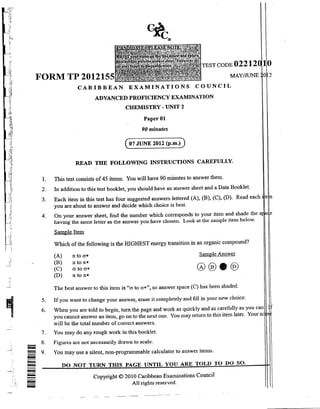
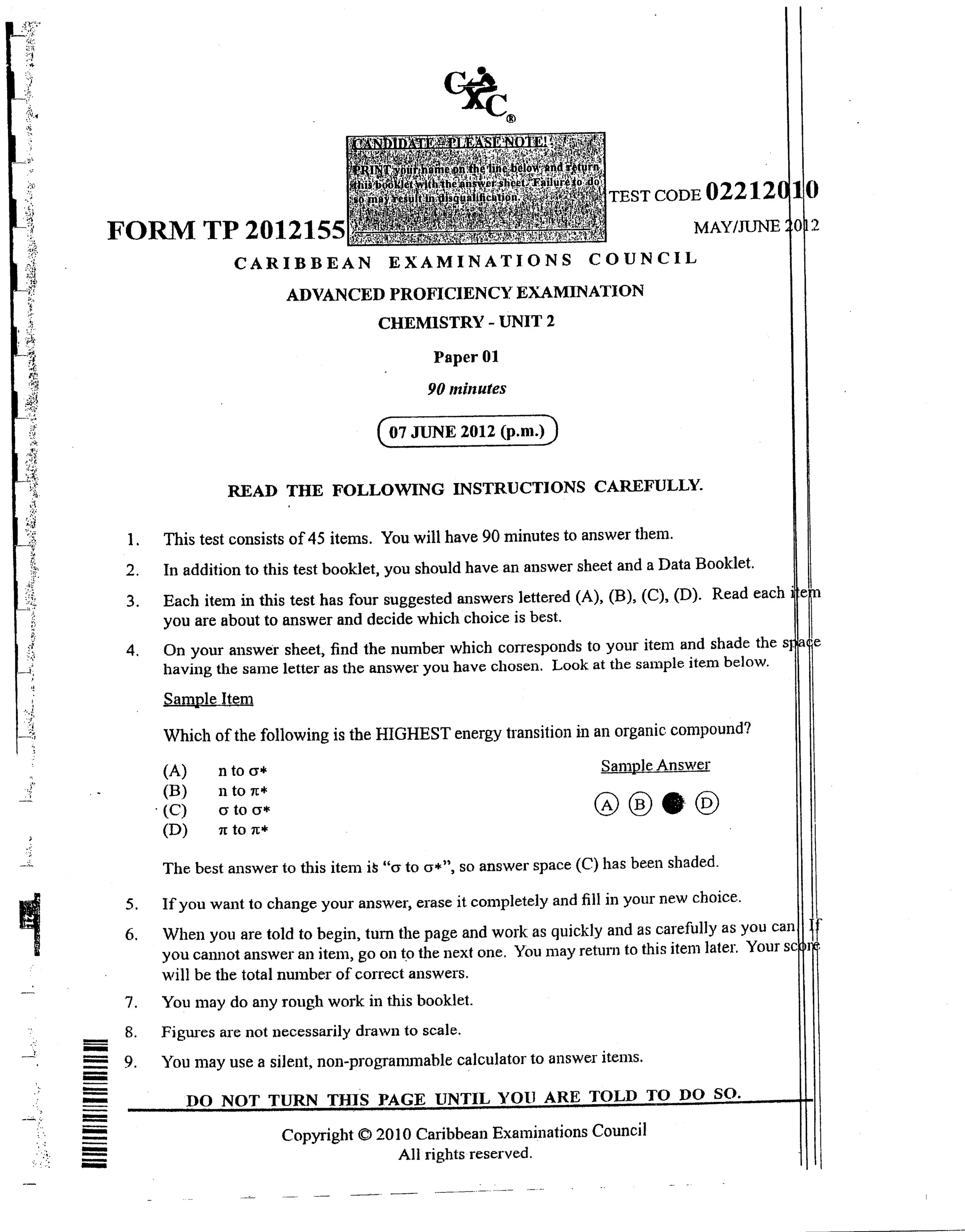
FORM TP 2012155 I·.
CARIBBEAN EXAMINATIONS COUNCIL
ADVANCED PROFICIENCY EXAMINATION
CHEMISTRY- UNIT 2
Paper 01
90 minutes
( 07 JUNE 2012 (p.m.))
READ THE FOLLOWING INSTRUCTIONS CAREFULLY.
1. This test consists of45 items. You will have 90 n1inutes to answer then1.
2. In addition to this test booklet, you should have an answer sheet and a Data Booklet.
3. Each itetn in this test has four suggested answers lettered (A), (B), (C), (D). Read each · e
you are about to answer and decide which choice is best.
4. On your answe'r sheet, find the number which corresponds to your item and shade the s.
having the san1e letter as the answer you have chosen. Look at the sample item below.
Sample Iten1
Which of the following is the HIGHEST energy transition in an organic con1pound?
(A)
(B)
. (C)
(D)
n to a+
n ton:+
a to a*
1t ton:*
Satnple Answer
The best answer to this iten1 is "a to cr*", so answer space (C) has been shaded.
5. If you want to change your answer, erase it completely and fill in your new choice.
6. When you are told to begin, tum the page and work as quickly and as careful1y as you can ~f
you cannot answer an iten1, go on ~o the next one. You n1ay return to this item later. Your sc 1 .
will be the total nmnber of correct answers.
7.
8.
9.
You tnay do any rough work in this booklet.
Figures are not necessarily drawn to scale.
You n1ay use a silent, non-progranunable calculator to answer iten1s.
DO NOT TURN THIS PAGE UNTIL YOU ARE TOLD TO DO SO.
Copyright© 2010 Caribbean Examinations Council
All rightsreserved.
l
-2- I
!
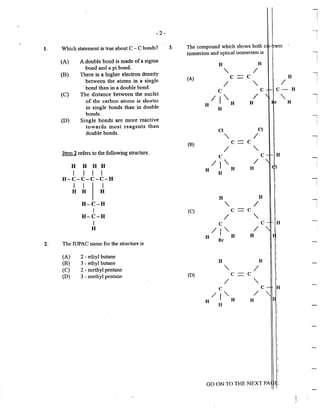
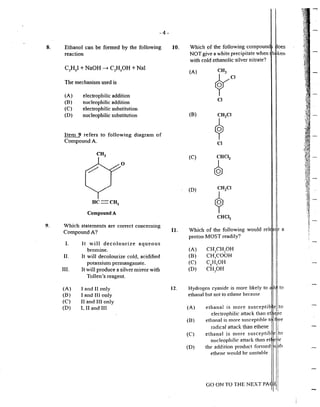
1. Which statement is true about C - C bonds? 3. The compound which shows both ci - rans
isomerism and optical isomerism is ----,
I
(A) A double bond is made of a sigma !
bond and a pi bond.
H H
(B) There is a higher electron density
" /
between the atoms in a single (A) c c H I
bond than in a double bond. I
"
I I
(C) The distance between the nuclei
c c C- H
of the carbon atoms is shorter /I' I ' I
in single bonds than in double
H H H r H !
bonds.
H
(D) Single bonds are more reactive
I
I
towards most reagents than I
double bonds.
Cl Cl
' / l
(B) c= c
"
I
Item 2 refers to the following structure.
/
c c
IJ"- /
--,
H H H H.
I I I I
H H H
H
H-C-C-C-C-H
I I I l
H H H
H H
H-C-H
" I I
I (C) c c
I
H-C-H /
"I c c
H
II'- /
H H H
2. The IUPAC name for the structure is
Br
(A) 2- ethyl butane
(B) 3 - ethyl butane H H
. (C) 2 - methyl pentane
" I
(D) 3 - methyl pentane (D) c c
/
"c
/j"-
H H
H
H
GO ON TO THE NEXT PA ~,
4.
I:,
I:::~
l 5.
l
L
I_
l_
L
l_
l_
L
l_
-3-
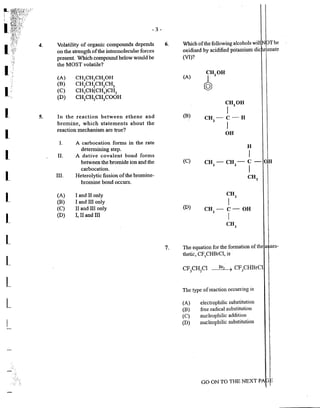
Volatility of organic compounds depends
on the strength ofthe inten11olecular forces
present. Which compound below would be
the MOST volatile?
(A) CH3
CH2
CH2
0H
(B) CH3
CH2
CH2
CH3
(C) CH3
CH(CH3
)CH3
(D) CH3
CH2
CH2
COOH
In the reaction between ethene and
bron1ine, which statements about the
reaction mechanism are true?
I.
II.
III.
(A)
(B)
(C)
(D)
A carbocation forn1s in the rate
detennining step.
A dative covalent bond forms
between the bron1ide ion and the
carbocation.
Heterolytic fission ofthe bromine-
bromine bond occurs.
I and II only
I and III only
II and III only
I, II and III
6.
7.
Which ofthe following alcohols will N The
oxidised by acidified potassium die mate
(VI)?
(A) ~H1 0H
(B)
CH1
0H
I
CH- C-H
3 I
OH
H
I
CH -CH -C-OH
3 1 I
(C)
CH3
(D)
CH3
I
CH- C- OH
3 I
CH3
The equation for the fom1ation of the a aes-
thetic, CF3
CHBrCl, is
Br2 > CF CHBrCl3
The type ofreaction occun·ing is
(A)
(B)
(C)
(D)
electrophilic substitution
free radical substitution
nuc.Ieophilic addition
nucleophilic substitution
GO ON TO THE NEXT P r
8.
9.
-4-
Ethanol can be fonned by the fo11owing
reaction
The mechanism used is
(A) eJectrophilic addition
(B) nucleophilic addition
(C) electrophilic substitution
(D) nucleophilic substitution
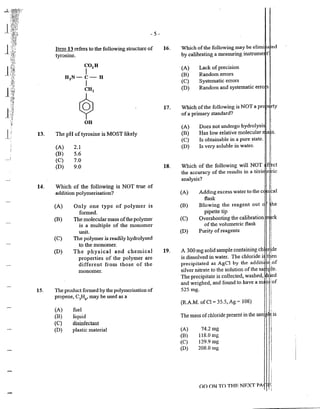
Iten1 9 refers to folJowing diagram of
Compound A.
0
nc==cn2
Compound A
Which statements are cmTect concerning
Cmnpound A?
I. It will decolourize aqueous
bromine.
II. It will decolourize cold, acidified
potassimn pennanganate.
111. It will produce a silv~r mirror with
(A)
(B)
(C)
(D)
Tollen's reagent.
I and Il only
I and 11I only
II and JII only
I., II and HI
10.
11.
12.
Which of the following compoun oes
NOT give a white precipitate when h ken
with cold ethanolic silver nitrate?
(A)
(B)
(C)
(D)
Cl
CJ
I
i
i
I
I
I
I
I
II
i
I
I
Which of the foJJowing would rei
proton MOST readily?
I
l
f a
I
(A)
(B)
(C)
(D)
CH3
CH2
0H
CH.COOH
·'
C"'H50H
CH3
0H
!
Hydrogen cyanide is more likely to
ethanal but not to ethene because
i to
I
(A)
(B)
(C)
(0)
i
ethanal is more susceptible Ito
e)ectrophilic attack than et ~:~i,1e
ethan~I is more susceptible t tl'jee
rsd1caf attack than ethene 1
ethanal is more susceptib ito
nucleophilic attack than et et~e
the addition product formed '- ~th
ethene would be unstable
I
GO ON TO THE NEXT PA ~.
I .......
-l J~fl~J1
?·''
1;1
::;i~~..
1~
l
'.:i
...:..~
·;;:J
!'
j·[ 13.
14.
15.
- 5-
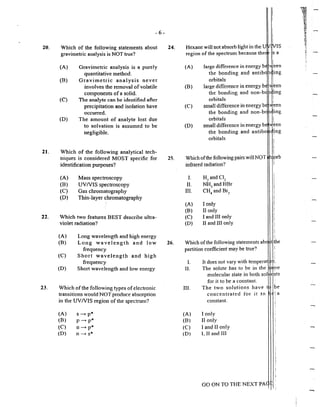
Jten1 13 refers to the following structure of
tyrosine.
The pH of tyrosine is MOST likely
(A) 2.1
(B) 5.6
(C) 7.0
(D) 9.0
Which of the following is NOT true of
addition poly1nerisation?
(A) Only one type of polyn1er is
fon11ed.
(B) The 1nolecularmass ofthe polymer
is a multiple of the monomer
unit.
(C) The polymer is readily hydrolysed
to the monomer.
(D) The physical and chetnical
properties of the polymer are
different fron1 those of the
n1onon1er.
The product fanned by the polymerisation of
propene, C3
H6
, may be used as a
(A)
(B)
{C)
(D)
fuel
liquid
disinfectant
plastic material
16.
17.
18.
19.
I
Which ofthe following may be elimi ~fed
by calibrating a measuring instrume t I
Lack of precision
Random en-ors
Systematic errors
(A)
(B)
(C)
(D) Random and systematic erro s 1
I
i
I
Which ofthe following is NOT apr ;rty
of a prhnary standard? i
(A)
(B)
(C)
(D)
I
Does not undergo hydrolysi 1
Has low relative molecular 's.
Is obtainable in a pure state.
Is very soluble in water.
Which of the following will NOT
the accuracy of the results in a titri
analysis?
(A) Adding excess water to the c
flask
(B) Blowing the reagent out
pipette tip
(C) Overshooting the calibration
of the volun1etric flask
(D) Purity ofreagents
A 300 mg solid sample containing ch
is dissolved in water. The chloride i
precipitated as AgCl by the additi
silver nitrate to the solution ofthe sa
The precipitate is collected, washed,
and weighed, and found to have a m
525 mg.
(R.A.M. ofCl = 35.5, Ag = 108)
The mass ofchloride present in the sat
(A) 74.2 mg
(B) 118.0 mg
(C) 129.9 mg
(D) 208.0 mg
i
GO ON TO THF. NEXT PA fli
-6-
20. Which of the following statements about 24.
21.
gravimetric analysis is NOT true?
(A)
(B)
(C)
(D)
Gravimetric analysis is a purely
quantitative method.
Gravimetric analysis never
involves the removal of volatile
components of a solid~
The analyte can be identified after
precipitation and isolation have
occurred.
The amount of analyte lost due
to solvation is assumed to be
negligible.
Which of the following analytical tech-
niques is considered MOST specific for
identification purposes?
(A) Mass spectroscopy
(B) UVNIS spectroscopy
(C) Gas chromatography
(D) Thin-layer chromatography
22. Which two features BEST describe ultra-
violet radiation?
23.
(A)
(B)
(C)
(D)
Long wavelength and high energy
Long wavelength and low
frequency
Short wavelength and high
fi~equency
Shot1 wavelength and low energy
Which ofthe following types ofelectronic
transitions would NOT produce absorption
in the UVNIS region ofthe spectrum?
(A)
(B)
(C)
(D)
s __... p*
p-+ p"'
n __... p*
n-+ s*
25.
26.
Hexane will not absorb light in the U
region of the spectrum because ther ;s a
(A)
(B)
(C)
(D)
large difference in energy b
the bonding and antib
orbitals
large difference in energy b
the bonding and non-b
orbitals
small difference in energy b
the bonding and non-b
orbitals
sma11 difference in energy b
the bonding and antibo
orbitals
Which ofthe following pairs will NOT
infrared radiation?
I. H:! and Cl2
II. NH3
and HBr
III. CH4
and Br1
(A) I only
(B) 11 only
(C) I and III only
(D) II and III only
Which ofthe following statements ab
patiition coefficient may be true?
l. It does not vary with temperat r ;.
I1. The soJute has to be in the ,1pe
molecular state in both sol e.nts
HI.
(A)
(B)
{C)
(D)
for it to be a constant.
The two solutions have be
con centrated for it to <i' a
constant.
I only
11 only
J and l1 only
I. II and Ill
GO ON TO THE NEXT PA
-...,
27.
l
I
····..
.j
28.
29.
-7-
Which ofthe following is NOT a stationary
phase used in chron1atography?
(A) Alumina
(B) Cellulose
(C) Silica gel
(D) Starch
Item 28 refers to the following information.
A student canies out an experiment using
thin-layer chron1atography separation on
silica gel and obtains the following results:
Compound Distance Travelled
(em)
Compound A 1.5
CompoundB 9.1
Solvent 12.5
The Rr value of Compound A is
(A) 0.07
(B) 0.12
(C) 0.16
(D) 0.73
A solution of 10 g of a carboxylic acid
(weak acid) in 100 cm3 of water is shaken
with 100 cm3
of ethoxyethane. It is found
that only 6.5 g of the acid remains in
aqueous solution at equilibrimn. The
pa1tition coefficient is
(A) 0.054
(B) 0.54
(C) 5.4
(D) 54.0
30.
31.
32.
Which of the following are advant g is of
stean1 distillation? I
I
I. It occurs under reduced pre s~re.
II. The components do not deco 1~ose.
Ill. It provides savings in fuel t.
(A) I and II only
(B) I andl Ill only
(C) II and III only
(D) I, 11 and III
i
I
I
Which ofthe following are important l~ors
to consider in detennining the locati 1 ?f a
factory? i
I
I. Prox~mity.t~ a potential work o~:ce
II. Availability to a mea s i of
. I
transpm1atwn ,
III. Potential pollution ofair, lat ·nd
water
IV. Proximity to raw materials
(A) I, II and III only
(B) I, II and IV only
(C) I, Ill and IV only
(D) I, II, III and IV
Along with silicon dioxide, which
following compounds constitutes the
impurities of bauxite?
(A) lron(II) oxide
(B) lron(IIJ) oxide
(C) Carbon dioxide
(D) Carbon monoxide
GO ON TO THF. NF.XT PAr,
- 8 -
33.
34.
35.
Item 33 refers to the following fractions of
crude oil.
I.
II.
III.
IV.
Diesel
Petrol
Refinery gas
Kerosene
The correct order in tenns ofINCREASING
boiJing points is
(A) I, II, Ill, IV
(B) III,I,IV,II
(C) III, II, IV. I
(D) IV, II, I, Ill
Which of the following products is NOT
produced for commercial purposes by the
e]ectroJysis ofconcentrated brine?
(A) Chlorine
(B) Oxygen
(C) Hydrogen
(D) Sodium chlorate (V)
In the Bosch-Haber process, N., and H~ can
be obtained from X and Y respecti~eJy.
Which of the following pairs BEST
describes X and Y?
X y
(A) Ammonium salts Naphtha
(B) Ammonium salts Air
(C) Air Naphtha
(D) Air Ammonium salts
36. Which of the following statements does
NOT accurateJy describe a result ofethanol
consumption?
(A) Digestion occurs in the stomach.
(B) Natural inhibitions are re]axed
(reduced).
(C) Oxidation occurs in the blood.
(D) Reaction time is reduced.
37.
38.
39.
40.
In the electrolysis of brine u ing the·
diaphragm cell, two by-produc s re
(A)
(B)
(C)
(D)
chlorine and oxygen
chlorine and sodium
hydrogen and mercury
hydrogen and sodium h
The presence ofphosphate ions ( . 4
J-) can
be detected using
(A)
(B)
(C)
(D)
ammonium molybdate
potassium hexacyano
solution
potassium thiocyanate s
sodiun1 thiosulphate
J
1
tion
I
l
ate(II)
C d f l I I II I .
mnpoun s o · su P. 1~r sue 1 .as. s~ p 11tes
are used as food additives. This 1 l1
.ecause
they I
I
(A) improve the flavour of ft i
(B) help to enhance the colo ~f food
(C) inhibit the oxidation ofun a: trated
(D)
fats
help to preserve the
dehydration
Which of the following
sulphuric acid'?
I. Fet1ilizer
n. Paint
IIJ. Fibre
IV. Detergent
(A) I. II and Ill only
(B) 1, Ill and lV only
(C) II, Ill and JV only
(D) L 11, JH and JV
GO ON TO THE NEXT P Cftf.
by
use
-
I
..
'.·
j
.ii,i·
~ :~~-
_~i
J:l,·:t.f•.t;;:.:·1
··;o-.:,-•·
1
1tJ'l'i~t···
-·I_j ·..
_j
41.
42.
43.
Which of the following is NOT a green-
house gas?
(A)
(B)
(C)
(D)
Amn1onia
Carbon dioxide
Methane
Water vapour
-9-
,
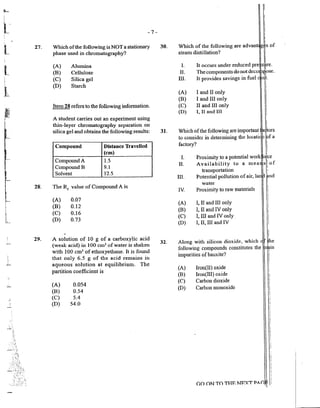
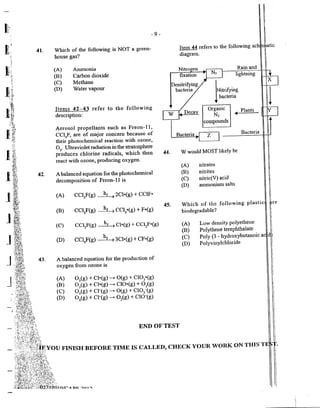
Item 44 refers to the following sch 1 atic
diagram.
Nitrogen _., N ~~--:-:R:-:-ai_n7a_n_d-tt--;r-,
fixation ...-l 2 J lightning Li
Denitrifying
bacteria
)
Nitrifying
bacteria
!X
l
J
Items 42-43 refer to the following
description:
Organic
f
wr..._Decay. N
~~~r 2
4
Plants yI
J
Aerosol propellants such as Freon-11,
CC13F, are of 111ajor concern because of
their photochen1icaJ reaction with ozone,
0 3• Ultraviolet radiation in the stratosphere
produces chlorine radicals, which th(m
react with ozone, producing oxygen.
A balanced equation for the photochemical
decon1position of Freon-II is
(A} CC13
F(g) hr ) 2Cl•(g) + CCIF•
(B) CC13
F(g) hr >CCl3
•(g) + F•(g)
(C) CC13
F(g) hf ) Cl•(g) + CCl2
F•(g)
(D) CC13
F(g) hr ) 3Cl•(g) +CF•(g)
A balanced equation for the production of
oxygen from ozone is
(A)
(B)
(C)
(D)
0 1(g) + Cl·(g)---.. O(g) + CIO,•(g)
O~(g) + Cl•(g)---.. CIO•(g) + 07
(g)
O~(g) + CI-(g) ~ O(g) + ClO.,:(g)
O~(g) + CI-(g)---.. O.,(g) +CJO-(g)
44.
45.
compounds
Bacteria ...~
W would MOST JikeJy be
(A)
(B)
(C)
(D)
nitrates
nitrites
nitric(V) acid
ammonium salts
i.i
IIBacteria
Which of the following plastic ~~re
biodegradable? :
.
(A) Low density polyethene
(B) Polythene terephthalate . 1
(C) Po1y (3 - hydroxybutano1c ac dO
(D) Polyvinylchloride Ii
END OF TEST
CHECK YOUil WORK ON THIS TE ~ ~.
.......'il.....~:.••;s...:,J;..•,;.,;,D2::u~n1 ntr" nu "lnl "l

CAPE Chemistry Unit 2 Paper 1 2012

  • 1.
    ···.!. ··s· _1~ .r .·; ... =__J =-=~ -- ==iiiiiiiiiiil - =iiiiiiii FORM TP2012155 I·. CARIBBEAN EXAMINATIONS COUNCIL ADVANCED PROFICIENCY EXAMINATION CHEMISTRY- UNIT 2 Paper 01 90 minutes ( 07 JUNE 2012 (p.m.)) READ THE FOLLOWING INSTRUCTIONS CAREFULLY. 1. This test consists of45 items. You will have 90 n1inutes to answer then1. 2. In addition to this test booklet, you should have an answer sheet and a Data Booklet. 3. Each itetn in this test has four suggested answers lettered (A), (B), (C), (D). Read each · e you are about to answer and decide which choice is best. 4. On your answe'r sheet, find the number which corresponds to your item and shade the s. having the san1e letter as the answer you have chosen. Look at the sample item below. Sample Iten1 Which of the following is the HIGHEST energy transition in an organic con1pound? (A) (B) . (C) (D) n to a+ n ton:+ a to a* 1t ton:* Satnple Answer The best answer to this iten1 is "a to cr*", so answer space (C) has been shaded. 5. If you want to change your answer, erase it completely and fill in your new choice. 6. When you are told to begin, tum the page and work as quickly and as careful1y as you can ~f you cannot answer an iten1, go on ~o the next one. You n1ay return to this item later. Your sc 1 . will be the total nmnber of correct answers. 7. 8. 9. You tnay do any rough work in this booklet. Figures are not necessarily drawn to scale. You n1ay use a silent, non-progranunable calculator to answer iten1s. DO NOT TURN THIS PAGE UNTIL YOU ARE TOLD TO DO SO. Copyright© 2010 Caribbean Examinations Council All rightsreserved.
  • 2.
    l -2- I ! 1. Whichstatement is true about C - C bonds? 3. The compound which shows both ci - rans isomerism and optical isomerism is ----, I (A) A double bond is made of a sigma ! bond and a pi bond. H H (B) There is a higher electron density " / between the atoms in a single (A) c c H I bond than in a double bond. I " I I (C) The distance between the nuclei c c C- H of the carbon atoms is shorter /I' I ' I in single bonds than in double H H H r H ! bonds. H (D) Single bonds are more reactive I I towards most reagents than I double bonds. Cl Cl ' / l (B) c= c " I Item 2 refers to the following structure. / c c IJ"- / --, H H H H. I I I I H H H H H-C-C-C-C-H I I I l H H H H H H-C-H " I I I (C) c c I H-C-H / "I c c H II'- / H H H 2. The IUPAC name for the structure is Br (A) 2- ethyl butane (B) 3 - ethyl butane H H . (C) 2 - methyl pentane " I (D) 3 - methyl pentane (D) c c / "c /j"- H H H H GO ON TO THE NEXT PA ~,
  • 3.
    4. I:, I:::~ l 5. l L I_ l_ L l_ l_ L l_ -3- Volatility oforganic compounds depends on the strength ofthe inten11olecular forces present. Which compound below would be the MOST volatile? (A) CH3 CH2 CH2 0H (B) CH3 CH2 CH2 CH3 (C) CH3 CH(CH3 )CH3 (D) CH3 CH2 CH2 COOH In the reaction between ethene and bron1ine, which statements about the reaction mechanism are true? I. II. III. (A) (B) (C) (D) A carbocation forn1s in the rate detennining step. A dative covalent bond forms between the bron1ide ion and the carbocation. Heterolytic fission ofthe bromine- bromine bond occurs. I and II only I and III only II and III only I, II and III 6. 7. Which ofthe following alcohols will N The oxidised by acidified potassium die mate (VI)? (A) ~H1 0H (B) CH1 0H I CH- C-H 3 I OH H I CH -CH -C-OH 3 1 I (C) CH3 (D) CH3 I CH- C- OH 3 I CH3 The equation for the fom1ation of the a aes- thetic, CF3 CHBrCl, is Br2 > CF CHBrCl3 The type ofreaction occun·ing is (A) (B) (C) (D) electrophilic substitution free radical substitution nuc.Ieophilic addition nucleophilic substitution GO ON TO THE NEXT P r
  • 4.
    8. 9. -4- Ethanol can befonned by the fo11owing reaction The mechanism used is (A) eJectrophilic addition (B) nucleophilic addition (C) electrophilic substitution (D) nucleophilic substitution Iten1 9 refers to folJowing diagram of Compound A. 0 nc==cn2 Compound A Which statements are cmTect concerning Cmnpound A? I. It will decolourize aqueous bromine. II. It will decolourize cold, acidified potassimn pennanganate. 111. It will produce a silv~r mirror with (A) (B) (C) (D) Tollen's reagent. I and Il only I and 11I only II and JII only I., II and HI 10. 11. 12. Which of the following compoun oes NOT give a white precipitate when h ken with cold ethanolic silver nitrate? (A) (B) (C) (D) Cl CJ I i i I I I I I II i I I Which of the foJJowing would rei proton MOST readily? I l f a I (A) (B) (C) (D) CH3 CH2 0H CH.COOH ·' C"'H50H CH3 0H ! Hydrogen cyanide is more likely to ethanal but not to ethene because i to I (A) (B) (C) (0) i ethanal is more susceptible Ito e)ectrophilic attack than et ~:~i,1e ethan~I is more susceptible t tl'jee rsd1caf attack than ethene 1 ethanal is more susceptib ito nucleophilic attack than et et~e the addition product formed '- ~th ethene would be unstable I GO ON TO THE NEXT PA ~. I .......
  • 5.
    -l J~fl~J1 ?·'' 1;1 ::;i~~.. 1~ l '.:i ...:..~ ·;;:J !' j·[ 13. 14. 15. -5- Jten1 13 refers to the following structure of tyrosine. The pH of tyrosine is MOST likely (A) 2.1 (B) 5.6 (C) 7.0 (D) 9.0 Which of the following is NOT true of addition poly1nerisation? (A) Only one type of polyn1er is fon11ed. (B) The 1nolecularmass ofthe polymer is a multiple of the monomer unit. (C) The polymer is readily hydrolysed to the monomer. (D) The physical and chetnical properties of the polymer are different fron1 those of the n1onon1er. The product fanned by the polymerisation of propene, C3 H6 , may be used as a (A) (B) {C) (D) fuel liquid disinfectant plastic material 16. 17. 18. 19. I Which ofthe following may be elimi ~fed by calibrating a measuring instrume t I Lack of precision Random en-ors Systematic errors (A) (B) (C) (D) Random and systematic erro s 1 I i I Which ofthe following is NOT apr ;rty of a prhnary standard? i (A) (B) (C) (D) I Does not undergo hydrolysi 1 Has low relative molecular 's. Is obtainable in a pure state. Is very soluble in water. Which of the following will NOT the accuracy of the results in a titri analysis? (A) Adding excess water to the c flask (B) Blowing the reagent out pipette tip (C) Overshooting the calibration of the volun1etric flask (D) Purity ofreagents A 300 mg solid sample containing ch is dissolved in water. The chloride i precipitated as AgCl by the additi silver nitrate to the solution ofthe sa The precipitate is collected, washed, and weighed, and found to have a m 525 mg. (R.A.M. ofCl = 35.5, Ag = 108) The mass ofchloride present in the sat (A) 74.2 mg (B) 118.0 mg (C) 129.9 mg (D) 208.0 mg i GO ON TO THF. NEXT PA fli
  • 6.
    -6- 20. Which ofthe following statements about 24. 21. gravimetric analysis is NOT true? (A) (B) (C) (D) Gravimetric analysis is a purely quantitative method. Gravimetric analysis never involves the removal of volatile components of a solid~ The analyte can be identified after precipitation and isolation have occurred. The amount of analyte lost due to solvation is assumed to be negligible. Which of the following analytical tech- niques is considered MOST specific for identification purposes? (A) Mass spectroscopy (B) UVNIS spectroscopy (C) Gas chromatography (D) Thin-layer chromatography 22. Which two features BEST describe ultra- violet radiation? 23. (A) (B) (C) (D) Long wavelength and high energy Long wavelength and low frequency Short wavelength and high fi~equency Shot1 wavelength and low energy Which ofthe following types ofelectronic transitions would NOT produce absorption in the UVNIS region ofthe spectrum? (A) (B) (C) (D) s __... p* p-+ p"' n __... p* n-+ s* 25. 26. Hexane will not absorb light in the U region of the spectrum because ther ;s a (A) (B) (C) (D) large difference in energy b the bonding and antib orbitals large difference in energy b the bonding and non-b orbitals small difference in energy b the bonding and non-b orbitals sma11 difference in energy b the bonding and antibo orbitals Which ofthe following pairs will NOT infrared radiation? I. H:! and Cl2 II. NH3 and HBr III. CH4 and Br1 (A) I only (B) 11 only (C) I and III only (D) II and III only Which ofthe following statements ab patiition coefficient may be true? l. It does not vary with temperat r ;. I1. The soJute has to be in the ,1pe molecular state in both sol e.nts HI. (A) (B) {C) (D) for it to be a constant. The two solutions have be con centrated for it to <i' a constant. I only 11 only J and l1 only I. II and Ill GO ON TO THE NEXT PA -...,
  • 7.
    27. l I ····.. .j 28. 29. -7- Which ofthe followingis NOT a stationary phase used in chron1atography? (A) Alumina (B) Cellulose (C) Silica gel (D) Starch Item 28 refers to the following information. A student canies out an experiment using thin-layer chron1atography separation on silica gel and obtains the following results: Compound Distance Travelled (em) Compound A 1.5 CompoundB 9.1 Solvent 12.5 The Rr value of Compound A is (A) 0.07 (B) 0.12 (C) 0.16 (D) 0.73 A solution of 10 g of a carboxylic acid (weak acid) in 100 cm3 of water is shaken with 100 cm3 of ethoxyethane. It is found that only 6.5 g of the acid remains in aqueous solution at equilibrimn. The pa1tition coefficient is (A) 0.054 (B) 0.54 (C) 5.4 (D) 54.0 30. 31. 32. Which of the following are advant g is of stean1 distillation? I I I. It occurs under reduced pre s~re. II. The components do not deco 1~ose. Ill. It provides savings in fuel t. (A) I and II only (B) I andl Ill only (C) II and III only (D) I, 11 and III i I I Which ofthe following are important l~ors to consider in detennining the locati 1 ?f a factory? i I I. Prox~mity.t~ a potential work o~:ce II. Availability to a mea s i of . I transpm1atwn , III. Potential pollution ofair, lat ·nd water IV. Proximity to raw materials (A) I, II and III only (B) I, II and IV only (C) I, Ill and IV only (D) I, II, III and IV Along with silicon dioxide, which following compounds constitutes the impurities of bauxite? (A) lron(II) oxide (B) lron(IIJ) oxide (C) Carbon dioxide (D) Carbon monoxide GO ON TO THF. NF.XT PAr,
  • 8.
    - 8 - 33. 34. 35. Item33 refers to the following fractions of crude oil. I. II. III. IV. Diesel Petrol Refinery gas Kerosene The correct order in tenns ofINCREASING boiJing points is (A) I, II, Ill, IV (B) III,I,IV,II (C) III, II, IV. I (D) IV, II, I, Ill Which of the following products is NOT produced for commercial purposes by the e]ectroJysis ofconcentrated brine? (A) Chlorine (B) Oxygen (C) Hydrogen (D) Sodium chlorate (V) In the Bosch-Haber process, N., and H~ can be obtained from X and Y respecti~eJy. Which of the following pairs BEST describes X and Y? X y (A) Ammonium salts Naphtha (B) Ammonium salts Air (C) Air Naphtha (D) Air Ammonium salts 36. Which of the following statements does NOT accurateJy describe a result ofethanol consumption? (A) Digestion occurs in the stomach. (B) Natural inhibitions are re]axed (reduced). (C) Oxidation occurs in the blood. (D) Reaction time is reduced. 37. 38. 39. 40. In the electrolysis of brine u ing the· diaphragm cell, two by-produc s re (A) (B) (C) (D) chlorine and oxygen chlorine and sodium hydrogen and mercury hydrogen and sodium h The presence ofphosphate ions ( . 4 J-) can be detected using (A) (B) (C) (D) ammonium molybdate potassium hexacyano solution potassium thiocyanate s sodiun1 thiosulphate J 1 tion I l ate(II) C d f l I I II I . mnpoun s o · su P. 1~r sue 1 .as. s~ p 11tes are used as food additives. This 1 l1 .ecause they I I (A) improve the flavour of ft i (B) help to enhance the colo ~f food (C) inhibit the oxidation ofun a: trated (D) fats help to preserve the dehydration Which of the following sulphuric acid'? I. Fet1ilizer n. Paint IIJ. Fibre IV. Detergent (A) I. II and Ill only (B) 1, Ill and lV only (C) II, Ill and JV only (D) L 11, JH and JV GO ON TO THE NEXT P Cftf. by use -
  • 9.
    I .. '.· j .ii,i· ~ :~~- _~i J:l,·:t.f•.t;;:.:·1 ··;o-.:,-•· 1 1tJ'l'i~t··· -·I_j ·.. _j 41. 42. 43. Whichof the following is NOT a green- house gas? (A) (B) (C) (D) Amn1onia Carbon dioxide Methane Water vapour -9- , Item 44 refers to the following sch 1 atic diagram. Nitrogen _., N ~~--:-:R:-:-ai_n7a_n_d-tt--;r-, fixation ...-l 2 J lightning Li Denitrifying bacteria ) Nitrifying bacteria !X l J Items 42-43 refer to the following description: Organic f wr..._Decay. N ~~~r 2 4 Plants yI J Aerosol propellants such as Freon-11, CC13F, are of 111ajor concern because of their photochen1icaJ reaction with ozone, 0 3• Ultraviolet radiation in the stratosphere produces chlorine radicals, which th(m react with ozone, producing oxygen. A balanced equation for the photochemical decon1position of Freon-II is (A} CC13 F(g) hr ) 2Cl•(g) + CCIF• (B) CC13 F(g) hr >CCl3 •(g) + F•(g) (C) CC13 F(g) hf ) Cl•(g) + CCl2 F•(g) (D) CC13 F(g) hr ) 3Cl•(g) +CF•(g) A balanced equation for the production of oxygen from ozone is (A) (B) (C) (D) 0 1(g) + Cl·(g)---.. O(g) + CIO,•(g) O~(g) + Cl•(g)---.. CIO•(g) + 07 (g) O~(g) + CI-(g) ~ O(g) + ClO.,:(g) O~(g) + CI-(g)---.. O.,(g) +CJO-(g) 44. 45. compounds Bacteria ...~ W would MOST JikeJy be (A) (B) (C) (D) nitrates nitrites nitric(V) acid ammonium salts i.i IIBacteria Which of the following plastic ~~re biodegradable? : . (A) Low density polyethene (B) Polythene terephthalate . 1 (C) Po1y (3 - hydroxybutano1c ac dO (D) Polyvinylchloride Ii END OF TEST CHECK YOUil WORK ON THIS TE ~ ~. .......'il.....~:.••;s...:,J;..•,;.,;,D2::u~n1 ntr" nu "lnl "l