1.
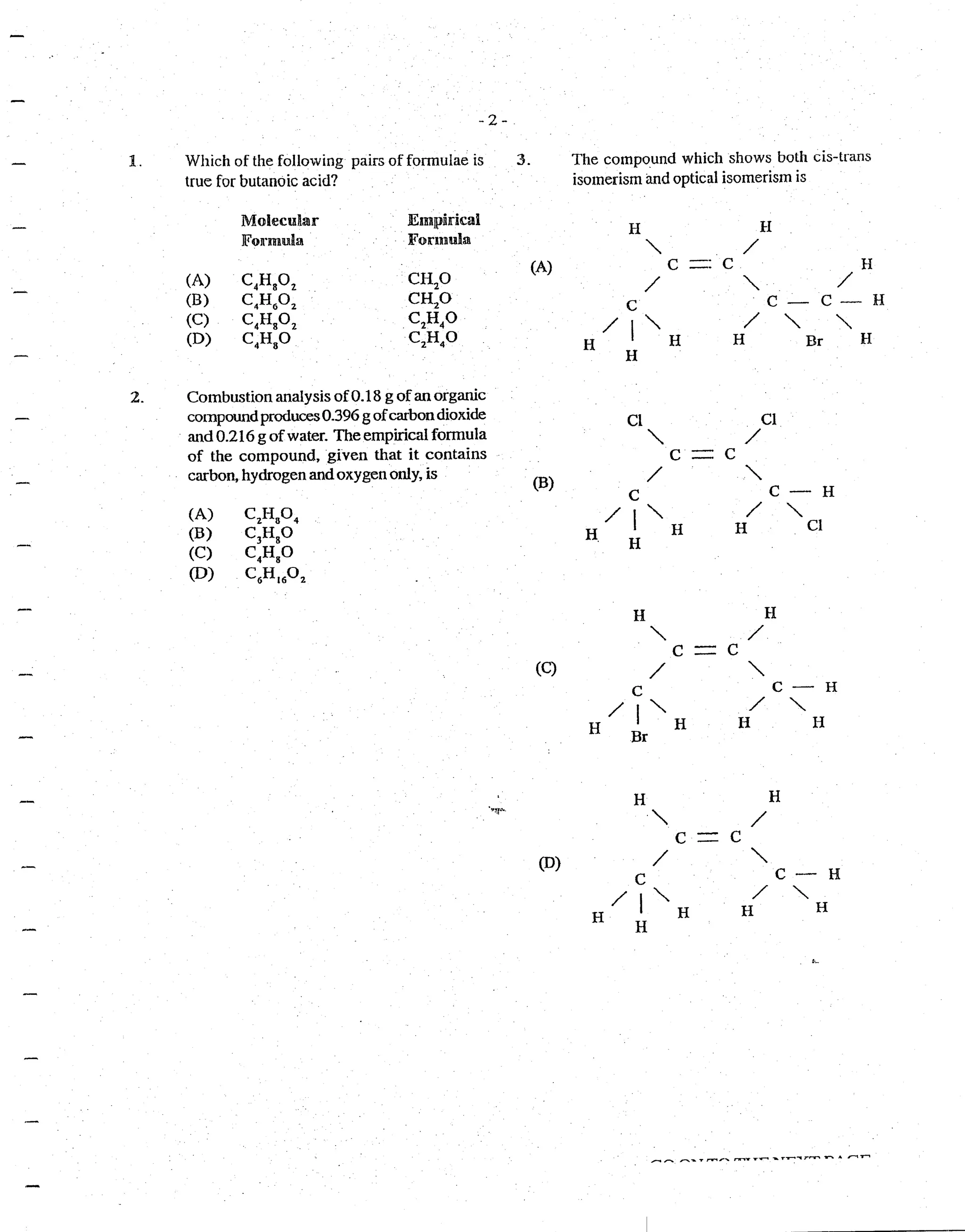
2.
-2-
Which of the following pairs of formulae is
true for butanoic acid?
Molecuhnr EmpJirical
lFon·nu.nla Formula
(A) C4Hs02 CH20
(B) C4H60z CH2
0
(C) C4Hs02 .C2H40
(D) C4
H8
0 C2
H4
0
Cotnbustion analysis of0.18 g ofan organic
cmnpoundproduces0.396 g ofcarbondioxide
· and 0.216 g ofwater. Theempirical formula
of the compound, given that it contains
carbon, hydrogen andoxygen only, is
(A) CzHs04
(B) C3
H8
0
(C) C4
H8
0
(D) C6Hl60z
·,w··
3.
(A)
(B)
(C)
(D)
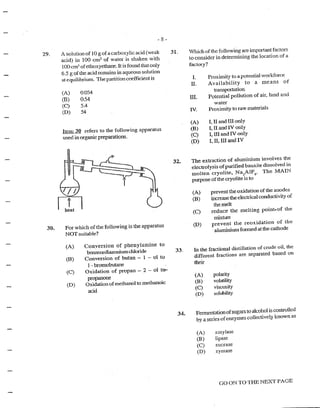
The compo_und which shows both cis-trans
isomerism and optical isomerism is
H H
""
/
c c H
/
""
/
c c C-H
/j"'- /
" "H H H Br H
H
Cl Cl
" /
c c
/
"c C-H
/I" /
"H H H Cl
. H
H H
"" /
c c
/
""c c- H
/I"- /
"H H H H
Br
H H
., /
c c
/
"c C-H
/I"- /
"H H H H
H
4.
- 3-
When propane reacts with CI2
(g) in the
presence of sunlight, two possible mono-
substituted products, 1-chloropropane and
2-chloropropane areformed. What is the ratio
of 1-chloropropaneto 2-chloropropa.ne?
(A)
(B)
(C)
(D)
1:2
1:3
2:1
3: 1
5. The formula, C6~5 COOH. indicates that
6.
(A)
(B)
(C)
(D)
an acid group is present
the componnd is ketone
the cotnpound isderivedfrom hexane
seven carbon atoms are arranged in
a chain
In the reaction betweenethene and bromine,
which statements about the reaction
mechanism may be ttue?
I. A carbocation fonns in the rate
detennining step.
II. A dative covalent bond forms
between the bromide ion and
.ethene.
III. Heterolytic fission of the bromine-
bromine bond occurs.
(A) I only
(B) land II only
(C) II and III only
(D) I, II and III
1'1tf··
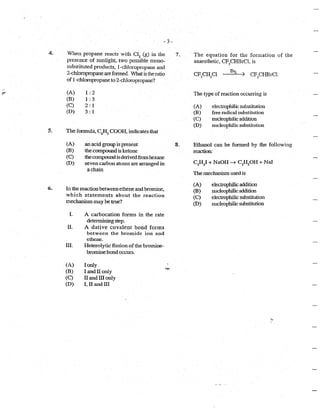
7.
8.
· The equation for the formation of the
anaesthetic, CF3
CHBrCI. is
CF CH Cl Brz --j. .CF
3
CHBrCI.·3 2
The type of reaction occurring is
(A) electrophilic substitution
(B) free radical substitution
(C) nucleophilic addition
(D) nucleophilic substitution
Ethanol can be formed by the following
reaction:
The mechanism used is
(A)
(B)
(C)
(D)
electrophilic addition
nucleophilic addition
electrophilic substitution
nucleophilic substitution
-4-
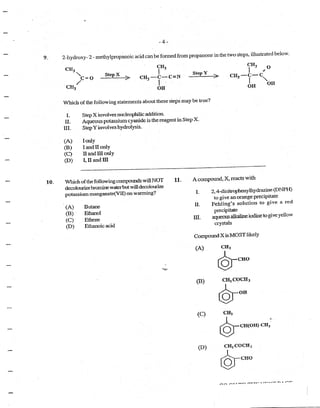
9. 2-hydroxy- 2 -tnethylpropanoic acid c~m befonned from propanone in the two steps, illustrated below.
10.
CH3
J
CH3 -C-C=N
. I ..
St~ep X >
OH
StepY
>
CH3 O
I · 4
CH3 -c-c
I "'OH . OH
Which of the following statements about these steps may be true?
L Step X involves nucleophilic addition.
II. Aqueous potassium cyanide is the reagent in Step X.
III. StepY involves hydrolysis.
(A) !only
(B) I and II only
(C) II and III only
(D) I, II and III
Which ofthe following compounds willNOT
decolotnizebromine waterbutwilldecoloUlize
potassium manganate(Vll) on wanning?
(A) Butane
(B) EU1a.nol
(C) Ethene
(D) Ethanoic acid
11. A compound, X, reacts with
I.
II.
III.
2, 4-dinitrophenylhydrazine(DNPH)
to give an orange precipitate
Fehling's solution to give a red
precipitate
aqueous alkaline iodineto giveyellow
crystals
CompoundX isMOST likely
(A)
(B)
(C)
(D) CH2 COCH3
@-cuo
12.
-5-
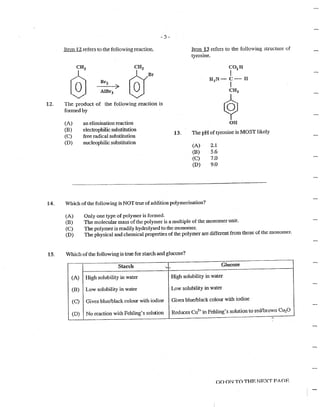
Ite1n 1Z refers to the following reaction.
c&Br
The product of the following reaction is
fonnedby
(A) an elimination reaction
(B) electrophilic substitution
(C) free radical substitution
(D) nucleophilic substitution
13.
hem 13 refers to the following structure of
tyrosine.
co2 n:
I
.iHlzN-~-- JHi
ClHI:z
¢Olffi
The pH of tyrosine is MOST likely
(A) 2.1
(B) 5.6
(C) 7.0
(D) 9.0
Jl4. Which of the following is NOT true ofaddition polymerisation?
(A) Only one type of polymer is formed.
(B) The molecular mass of the polymer is a multiple of the monomer unit.
(C) The polymer is readily hydrolysed to the monomer.
(D) The physical and chemical properties of the polymer are different from those of the monomer.
15. Which ofthe following is t:J.ue for starch and glucose?
Sta.:rd11 ""!t:r..a.,
Ghncos~
(A) High solubility in water High solubility in water
(B) Low solubility in water Low solubility in water
(C) Gives blue/black colour with iodine Gives blue/black colour with iodine
(D) No reaction with Fehling's solution Reduces Cu2
+ in Fehling's solution to red/brown CuzO
h·
GOONTOTHRNRXTPAGE
16.
17.
13.
19.
-6-
Which of the following sets of titration
readings is the MOST precise?
(A) 25.1 25.5 25.1 25.2
(B) 24.9 24.5 25.2 25.4
(C) 25.0 25.0 24.9 24.8
(D) 25.0 24.5 24.8 24.6
Which of the following is NOTa property of
a primary standard?
(A)
(B)
(C)
(D)
Does not undergo hydrolysis
Low relative molecular mass
Obtainable in a pure state
Very soluble in water
What is the concentration (tnol dm-3) of an
aqueous solution that contains 63.3g of
K3
Fe(CN)6
in 1.0 dm3
of solution? [The
relative formula mass ofiSFe(CN)5
is 329.2.]
(A) 1.92 x 1o-1
(B) 2.95 X 1()4
(C) 3.11 X l0-3
(D) 5.77 X lo-1
Naturally occurring Element X has four
isotopes: 50
X, 52
:X, 53
X and 54
X. They hav~
percentage abundance of4.31, 83.76, 9.55/··
and 2.38 respectively.
What is the relative atomic tnass of X?
(A) 52.00
(JB) 52.06
(C) 52.25
(D) 53.00
20.
21.
22.
Treatment ofa 10.00 g sample containing a
chloride salt with ex:cess silver nitrate solution
produces 8.08 g ofsilver chloride.
(Ag= 108, Cl = 35.5)
The expression for the percentage ofchloride
in the sample is
(A)
(B)
(C)
(D)
35.5Xl0.00 xlOO
108X8.08
35.5x8.08 x
100
108><10.00
35.5xlO.OO xlOO
143.5x8.08
35.5x8.08 ><lOO
143.5xl0.00
A compound absorbs light offrequency 940
MHz. The wavelength. in em. of the light
absorbed is (c = 3.0 x 10⁸
m s·1
)
(A) 31.91
(B) 31.91 X lQ-2
(C) 31.91 X lo-1
(D) 31.91 X 1()"
Which two fean.u·es BEST describe ultraviolet
radiation?
(A)
(B)
(C)
(D)
Long wavelength and high energy
Long wavelength and low frequency
Shortwavelength and hlgh frequency
Short wavelength and low energy
GO ON TO THE NEXT PAGE
-7-
23. vVhich ofthe following alkenes has the wavelength ofmaximtun absorption, A.max ?
24.
25.
26.
(A)o (B)o~
~· /}
(C)o (D)o
Which ofthe following equations goven1s the
determination ofan unknown compound, X,
in a solution by UVNIS spectroscopy?
(A)
(B)
(C)
(D)
log10
(I/1) = E c L
1ogiO (IIlo) = E c L
log10
(!0
/I) =E L [X]
1og10
(I/10
) = E L [X]
Which of the following pairs do NOT absorb
infrared radiation?
I. H2
0 and HI
II. H2
and Cl2
III. Nl-13
and HBr
IV. CH4
and Br2
(A) I and III only
(B) I and IV only
(C) II and III only
(D) II and IV only
Which of the following species is NOT a·,,.~
significant fragment from the mass spectrum
ofethanol?
(A)
(B)
(C)
(D)
C2
H5
0H+
CzHs+
CH3
+
OH+
27.
28.
Which of the following is NOT a stationary
phase used in chromatography?
(A)
(B)
(C)
(D)
Alumina
Cellulose
Silicagel
Starch
Item 28 refers to the following information.
Sample X is a mixture of substances. X was
separated into its components using paper
chromatography simultaneously with
individual samples of e, f, g and h. The
chromatograph produced is shown below.
Sample X e f g h
Which substances are MOST likely present
in Sample X?
(A) e, f, g
(B) e,f, h
(C) e,g,h
(D) e, f, g, h
29.
3({).
- 8-
A solution of 10 g ofa carboxylic acid (weak
acid) in J 00 cxn3 of water is shaken with
100 cm3
ofethoxyethane. It is found thaton.ly
6.5 g ofthe acid remains in aqueous solution
at equilibrium. The pattitioncoefficient is
(A) 0.054
(B) 0.54
(C) 5.4
(D) 54
!tern 30 refers to the following apparatus
used in organic preparations.
For which ofthe following is the apparatus
NOT suitable?
(A) Conyersion of phenylamine to
31. Which ofthe follownng are important factors
to consider in detennining the location ofa
factory?
I. Prmdmity to a potential workforce
II. Availability to a xneans of
transportation
HI. Potential pollution of air, land and
water
IV. Proximity to raw materials
(A)
(B)
(C)
(D)
I, II and III only
I, II and IV only
I, III and IV only
I, II, III and IV
32. The extraction of aluminiuxn involves the
electrolysis ofpurified bauxite dissolved in
molten cryolite, Na3
AIF6
. The MAIN
purpose ofthe cryolite is to
(A)
(B)
(C)
(D)
prevent the oxidation of the anodes
increase the electrical conductivity of
the melt
reduce the: Inelting point...of the
mixture
prevent the reoxidation of the
·alwniniurn formed at the cathode
bew.....enediazoniumchloride 33. In the fractional distillation of crude oil, the
different fractions are separated based on
their
(B)
(C)
(D)
Conversion of butan .._, 1 - ol to
1- bromobutane
Oxidation of propan - 2 - ol to-"
propanone
0Jlidation of methanol to methanoic
acid
(A) polarity
(B) volatility
(C) viscosity
(D) solubility
34. Pennentationofsugars to alcohol is controlled
by a sexies ofenzytnes collectively known as
(A) amylase
(B) lipase
(C) sucrase
(D) zymase
GOONTOTHENEXTPAGE
35.
36.
37.
-9-
In the Bosch-Haber process, N2
and H2
can
be obtained from X andY respectively. Which
of lhe: following pairs BEST describes these
sources?
X y
(A)
Ammonium
salts Naphtha
(B)
Ammonium
Air
salts
(C) Air Naphtha
(D) Air
Ammonium
salts
Which of the following ate consequences of
the consmnption ofalcohol?
I.
II.
III.
(A)
(B)
(C)
(D)
Depresses the central nervous
system
May cause liver disease
Reduces manual dexterity
I and II only
I and III only
II and III only
I, II and III
In the electrolysis of brine using the
diaphragm cell, two by-products are
(A) chlorine and oxygen
(B) chlorine and sodimn
(C) hydrogen and mercury
(D) hydrogen and sodiwn hydroxide
38. Chlorine is the active component for
swimming pool disinfectants, although it is a
poisonous gas. Which salt below is used as a
safe chlorine source?
(A) HClO
(B) CaCI2
(C) NaClO
(D) NaC103
39. Vfhich of the following industries use
sulphuric acid?
40.
I.
II.
III.
IV.
(A)
(B)
(C)
(D)
·Fettilizer
Paint
Fibre
Detergent-
I, II and III only
I, III and IV only
II, III and IV only
I, II, III and IV
The biological oxygen demand (BOD) of
water measures the amount ofoxygen
(A)
(B)
(C)
(D)
present in a fKxed volume of water
produced by aquatic plants in
photosynthesis
needed by microorganisms as they
decompose organic matter
used by aquatic organisms during
respiration
;..,
4JL
42.
- 10-
The presence of phosphate ions (PO/-) can
be detected using
(A)
(B)
(C)
(D)
arrunoniwn molybdate
sodiwn th.iosulphate
potassium thiocyanate solution
potassium hexacyarioferrate(Il)
solution
. Chlorofluorocarbons undergo homolytic
fission by being exposed to ultraviolet light in
the stratosphere.
Which radical could result from CI-IzFCF2
Cl?
(A)
(B)
(C)
(D)
"CH2
CF2
Cl
CH2
F"CF2
"CHFCF2
Cl
CH2
F"CFCI
43. Which of the following statements on
environmental effects is true?
(A)
(B)
(C)
(D)
Greenhouse effect leads to global
wanning.
Global warming leads to greenhouse
effect.
Photochemical smog leads to global
warming.
Eutrophication leads to greenhouse
effect. ·
44.
45.
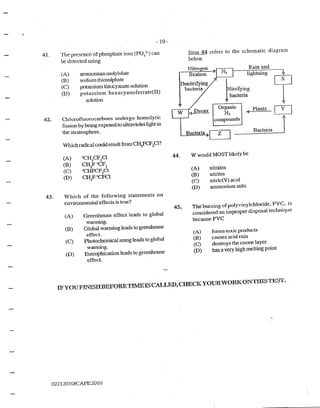
Item 44 refers to the schematic diagram
below.
Nitro~ Rain and
,_~fi,_x-a~tion ~ lightning
Denitrizying • jbacteria Nitrifying
bacteria
Organic
N2
compounds
~ Plants
Bacteria z Bacteria
W would MOST likely be
(A) nitrates
(B) nitrites
(C) nitric(V) aci.d
(D) · ammonium salts
The burning of polyvinylchloride, PVC, is
considered an improper disposal tedmique
because PVC
(A) forms toxic products
(B) causes acid rain
(C) destroys the ozone layer
(D) has a very high melting point
IFYOUF!NJI§lt-IBEJl.iORET!MEISCALLED,CHECJKYOUl-tWORJI'ONTillS'IEST.,
0221201 O/CAPE20l0

CAPE Chemistry Unit 2 Paper 1 2010

  • 1.
    1. 2. -2- Which of thefollowing pairs of formulae is true for butanoic acid? Molecuhnr EmpJirical lFon·nu.nla Formula (A) C4Hs02 CH20 (B) C4H60z CH2 0 (C) C4Hs02 .C2H40 (D) C4 H8 0 C2 H4 0 Cotnbustion analysis of0.18 g ofan organic cmnpoundproduces0.396 g ofcarbondioxide · and 0.216 g ofwater. Theempirical formula of the compound, given that it contains carbon, hydrogen andoxygen only, is (A) CzHs04 (B) C3 H8 0 (C) C4 H8 0 (D) C6Hl60z ·,w·· 3. (A) (B) (C) (D) The compo_und which shows both cis-trans isomerism and optical isomerism is H H "" / c c H / "" / c c C-H /j"'- / " "H H H Br H H Cl Cl " / c c / "c C-H /I" / "H H H Cl . H H H "" / c c / ""c c- H /I"- / "H H H H Br H H ., / c c / "c C-H /I"- / "H H H H H
  • 2.
    4. - 3- When propanereacts with CI2 (g) in the presence of sunlight, two possible mono- substituted products, 1-chloropropane and 2-chloropropane areformed. What is the ratio of 1-chloropropaneto 2-chloropropa.ne? (A) (B) (C) (D) 1:2 1:3 2:1 3: 1 5. The formula, C6~5 COOH. indicates that 6. (A) (B) (C) (D) an acid group is present the componnd is ketone the cotnpound isderivedfrom hexane seven carbon atoms are arranged in a chain In the reaction betweenethene and bromine, which statements about the reaction mechanism may be ttue? I. A carbocation fonns in the rate detennining step. II. A dative covalent bond forms between the bromide ion and .ethene. III. Heterolytic fission of the bromine- bromine bond occurs. (A) I only (B) land II only (C) II and III only (D) I, II and III 1'1tf·· 7. 8. · The equation for the formation of the anaesthetic, CF3 CHBrCI. is CF CH Cl Brz --j. .CF 3 CHBrCI.·3 2 The type of reaction occurring is (A) electrophilic substitution (B) free radical substitution (C) nucleophilic addition (D) nucleophilic substitution Ethanol can be formed by the following reaction: The mechanism used is (A) (B) (C) (D) electrophilic addition nucleophilic addition electrophilic substitution nucleophilic substitution
  • 3.
    -4- 9. 2-hydroxy- 2-tnethylpropanoic acid c~m befonned from propanone in the two steps, illustrated below. 10. CH3 J CH3 -C-C=N . I .. St~ep X > OH StepY > CH3 O I · 4 CH3 -c-c I "'OH . OH Which of the following statements about these steps may be true? L Step X involves nucleophilic addition. II. Aqueous potassium cyanide is the reagent in Step X. III. StepY involves hydrolysis. (A) !only (B) I and II only (C) II and III only (D) I, II and III Which ofthe following compounds willNOT decolotnizebromine waterbutwilldecoloUlize potassium manganate(Vll) on wanning? (A) Butane (B) EU1a.nol (C) Ethene (D) Ethanoic acid 11. A compound, X, reacts with I. II. III. 2, 4-dinitrophenylhydrazine(DNPH) to give an orange precipitate Fehling's solution to give a red precipitate aqueous alkaline iodineto giveyellow crystals CompoundX isMOST likely (A) (B) (C) (D) CH2 COCH3 @-cuo
  • 4.
    12. -5- Ite1n 1Z refersto the following reaction. c&Br The product of the following reaction is fonnedby (A) an elimination reaction (B) electrophilic substitution (C) free radical substitution (D) nucleophilic substitution 13. hem 13 refers to the following structure of tyrosine. co2 n: I .iHlzN-~-- JHi ClHI:z ¢Olffi The pH of tyrosine is MOST likely (A) 2.1 (B) 5.6 (C) 7.0 (D) 9.0 Jl4. Which of the following is NOT true ofaddition polymerisation? (A) Only one type of polymer is formed. (B) The molecular mass of the polymer is a multiple of the monomer unit. (C) The polymer is readily hydrolysed to the monomer. (D) The physical and chemical properties of the polymer are different from those of the monomer. 15. Which ofthe following is t:J.ue for starch and glucose? Sta.:rd11 ""!t:r..a., Ghncos~ (A) High solubility in water High solubility in water (B) Low solubility in water Low solubility in water (C) Gives blue/black colour with iodine Gives blue/black colour with iodine (D) No reaction with Fehling's solution Reduces Cu2 + in Fehling's solution to red/brown CuzO h· GOONTOTHRNRXTPAGE
  • 5.
    16. 17. 13. 19. -6- Which of thefollowing sets of titration readings is the MOST precise? (A) 25.1 25.5 25.1 25.2 (B) 24.9 24.5 25.2 25.4 (C) 25.0 25.0 24.9 24.8 (D) 25.0 24.5 24.8 24.6 Which of the following is NOTa property of a primary standard? (A) (B) (C) (D) Does not undergo hydrolysis Low relative molecular mass Obtainable in a pure state Very soluble in water What is the concentration (tnol dm-3) of an aqueous solution that contains 63.3g of K3 Fe(CN)6 in 1.0 dm3 of solution? [The relative formula mass ofiSFe(CN)5 is 329.2.] (A) 1.92 x 1o-1 (B) 2.95 X 1()4 (C) 3.11 X l0-3 (D) 5.77 X lo-1 Naturally occurring Element X has four isotopes: 50 X, 52 :X, 53 X and 54 X. They hav~ percentage abundance of4.31, 83.76, 9.55/·· and 2.38 respectively. What is the relative atomic tnass of X? (A) 52.00 (JB) 52.06 (C) 52.25 (D) 53.00 20. 21. 22. Treatment ofa 10.00 g sample containing a chloride salt with ex:cess silver nitrate solution produces 8.08 g ofsilver chloride. (Ag= 108, Cl = 35.5) The expression for the percentage ofchloride in the sample is (A) (B) (C) (D) 35.5Xl0.00 xlOO 108X8.08 35.5x8.08 x 100 108><10.00 35.5xlO.OO xlOO 143.5x8.08 35.5x8.08 ><lOO 143.5xl0.00 A compound absorbs light offrequency 940 MHz. The wavelength. in em. of the light absorbed is (c = 3.0 x 10⁸ m s·1 ) (A) 31.91 (B) 31.91 X lQ-2 (C) 31.91 X lo-1 (D) 31.91 X 1()" Which two fean.u·es BEST describe ultraviolet radiation? (A) (B) (C) (D) Long wavelength and high energy Long wavelength and low frequency Shortwavelength and hlgh frequency Short wavelength and low energy GO ON TO THE NEXT PAGE
  • 6.
    -7- 23. vVhich ofthefollowing alkenes has the wavelength ofmaximtun absorption, A.max ? 24. 25. 26. (A)o (B)o~ ~· /} (C)o (D)o Which ofthe following equations goven1s the determination ofan unknown compound, X, in a solution by UVNIS spectroscopy? (A) (B) (C) (D) log10 (I/1) = E c L 1ogiO (IIlo) = E c L log10 (!0 /I) =E L [X] 1og10 (I/10 ) = E L [X] Which of the following pairs do NOT absorb infrared radiation? I. H2 0 and HI II. H2 and Cl2 III. Nl-13 and HBr IV. CH4 and Br2 (A) I and III only (B) I and IV only (C) II and III only (D) II and IV only Which of the following species is NOT a·,,.~ significant fragment from the mass spectrum ofethanol? (A) (B) (C) (D) C2 H5 0H+ CzHs+ CH3 + OH+ 27. 28. Which of the following is NOT a stationary phase used in chromatography? (A) (B) (C) (D) Alumina Cellulose Silicagel Starch Item 28 refers to the following information. Sample X is a mixture of substances. X was separated into its components using paper chromatography simultaneously with individual samples of e, f, g and h. The chromatograph produced is shown below. Sample X e f g h Which substances are MOST likely present in Sample X? (A) e, f, g (B) e,f, h (C) e,g,h (D) e, f, g, h
  • 7.
    29. 3({). - 8- A solutionof 10 g ofa carboxylic acid (weak acid) in J 00 cxn3 of water is shaken with 100 cm3 ofethoxyethane. It is found thaton.ly 6.5 g ofthe acid remains in aqueous solution at equilibrium. The pattitioncoefficient is (A) 0.054 (B) 0.54 (C) 5.4 (D) 54 !tern 30 refers to the following apparatus used in organic preparations. For which ofthe following is the apparatus NOT suitable? (A) Conyersion of phenylamine to 31. Which ofthe follownng are important factors to consider in detennining the location ofa factory? I. Prmdmity to a potential workforce II. Availability to a xneans of transportation HI. Potential pollution of air, land and water IV. Proximity to raw materials (A) (B) (C) (D) I, II and III only I, II and IV only I, III and IV only I, II, III and IV 32. The extraction of aluminiuxn involves the electrolysis ofpurified bauxite dissolved in molten cryolite, Na3 AIF6 . The MAIN purpose ofthe cryolite is to (A) (B) (C) (D) prevent the oxidation of the anodes increase the electrical conductivity of the melt reduce the: Inelting point...of the mixture prevent the reoxidation of the ·alwniniurn formed at the cathode bew.....enediazoniumchloride 33. In the fractional distillation of crude oil, the different fractions are separated based on their (B) (C) (D) Conversion of butan .._, 1 - ol to 1- bromobutane Oxidation of propan - 2 - ol to-" propanone 0Jlidation of methanol to methanoic acid (A) polarity (B) volatility (C) viscosity (D) solubility 34. Pennentationofsugars to alcohol is controlled by a sexies ofenzytnes collectively known as (A) amylase (B) lipase (C) sucrase (D) zymase GOONTOTHENEXTPAGE
  • 8.
    35. 36. 37. -9- In the Bosch-Haberprocess, N2 and H2 can be obtained from X andY respectively. Which of lhe: following pairs BEST describes these sources? X y (A) Ammonium salts Naphtha (B) Ammonium Air salts (C) Air Naphtha (D) Air Ammonium salts Which of the following ate consequences of the consmnption ofalcohol? I. II. III. (A) (B) (C) (D) Depresses the central nervous system May cause liver disease Reduces manual dexterity I and II only I and III only II and III only I, II and III In the electrolysis of brine using the diaphragm cell, two by-products are (A) chlorine and oxygen (B) chlorine and sodimn (C) hydrogen and mercury (D) hydrogen and sodiwn hydroxide 38. Chlorine is the active component for swimming pool disinfectants, although it is a poisonous gas. Which salt below is used as a safe chlorine source? (A) HClO (B) CaCI2 (C) NaClO (D) NaC103 39. Vfhich of the following industries use sulphuric acid? 40. I. II. III. IV. (A) (B) (C) (D) ·Fettilizer Paint Fibre Detergent- I, II and III only I, III and IV only II, III and IV only I, II, III and IV The biological oxygen demand (BOD) of water measures the amount ofoxygen (A) (B) (C) (D) present in a fKxed volume of water produced by aquatic plants in photosynthesis needed by microorganisms as they decompose organic matter used by aquatic organisms during respiration ;..,
  • 9.
    4JL 42. - 10- The presenceof phosphate ions (PO/-) can be detected using (A) (B) (C) (D) arrunoniwn molybdate sodiwn th.iosulphate potassium thiocyanate solution potassium hexacyarioferrate(Il) solution . Chlorofluorocarbons undergo homolytic fission by being exposed to ultraviolet light in the stratosphere. Which radical could result from CI-IzFCF2 Cl? (A) (B) (C) (D) "CH2 CF2 Cl CH2 F"CF2 "CHFCF2 Cl CH2 F"CFCI 43. Which of the following statements on environmental effects is true? (A) (B) (C) (D) Greenhouse effect leads to global wanning. Global warming leads to greenhouse effect. Photochemical smog leads to global warming. Eutrophication leads to greenhouse effect. · 44. 45. Item 44 refers to the schematic diagram below. Nitro~ Rain and ,_~fi,_x-a~tion ~ lightning Denitrizying • jbacteria Nitrifying bacteria Organic N2 compounds ~ Plants Bacteria z Bacteria W would MOST likely be (A) nitrates (B) nitrites (C) nitric(V) aci.d (D) · ammonium salts The burning of polyvinylchloride, PVC, is considered an improper disposal tedmique because PVC (A) forms toxic products (B) causes acid rain (C) destroys the ozone layer (D) has a very high melting point IFYOUF!NJI§lt-IBEJl.iORET!MEISCALLED,CHECJKYOUl-tWORJI'ONTillS'IEST., 0221201 O/CAPE20l0