Skeletal and muscular system
Concept
mapping
What is skeleton?
 Skeleton: collection of bones that
holds our body up.
 Baby has 305 bones and an adult
has 206 bones
 Why ?
 because as we grown some of our bones
join together to form one bone
Types of skeletons
 Exo-skeleton: animals that have
shells
 Endo-skeleton: hard structure
inside the animal.
 Hydrostatic skeleton:
 Fluid held inside the body
 No skeleton
Five functions of our
skeletons
1. Protect the vital organs
2. Give us shape
3. Allow us to move because our muscles are
attached to our bones
4. Storage of nutrients such as calcium and
silicon
5. Formation of blood cells
Human
skeletons
Clavicle
Cranium
Mandible
Scapula
Rib
Vertebra
Innominate
Sacrum
Sternum
Humerus
Radius
Ulna
Patella
Tibia
Fibula
Tarsals
Carpals
Meta carpals
Falangs
Femur
Metatarsals
X-rays
The tool used to examine bones
6-9
Components of Skeletal System
 Bone
 Cartilage: three types
 Hyaline
 Fibro cartilage
 Elastic
Bone Shapes
 Long / Pipe
 Ex. Upper and lower
limbs
 Short
 Ex. Carpals and
tarsals, bones in
wrist and ankles
 Flat
 Ex. Ribs, sternum,
skull, scapulae
 Irregular
 Ex. Vertebrae, facial
6-10
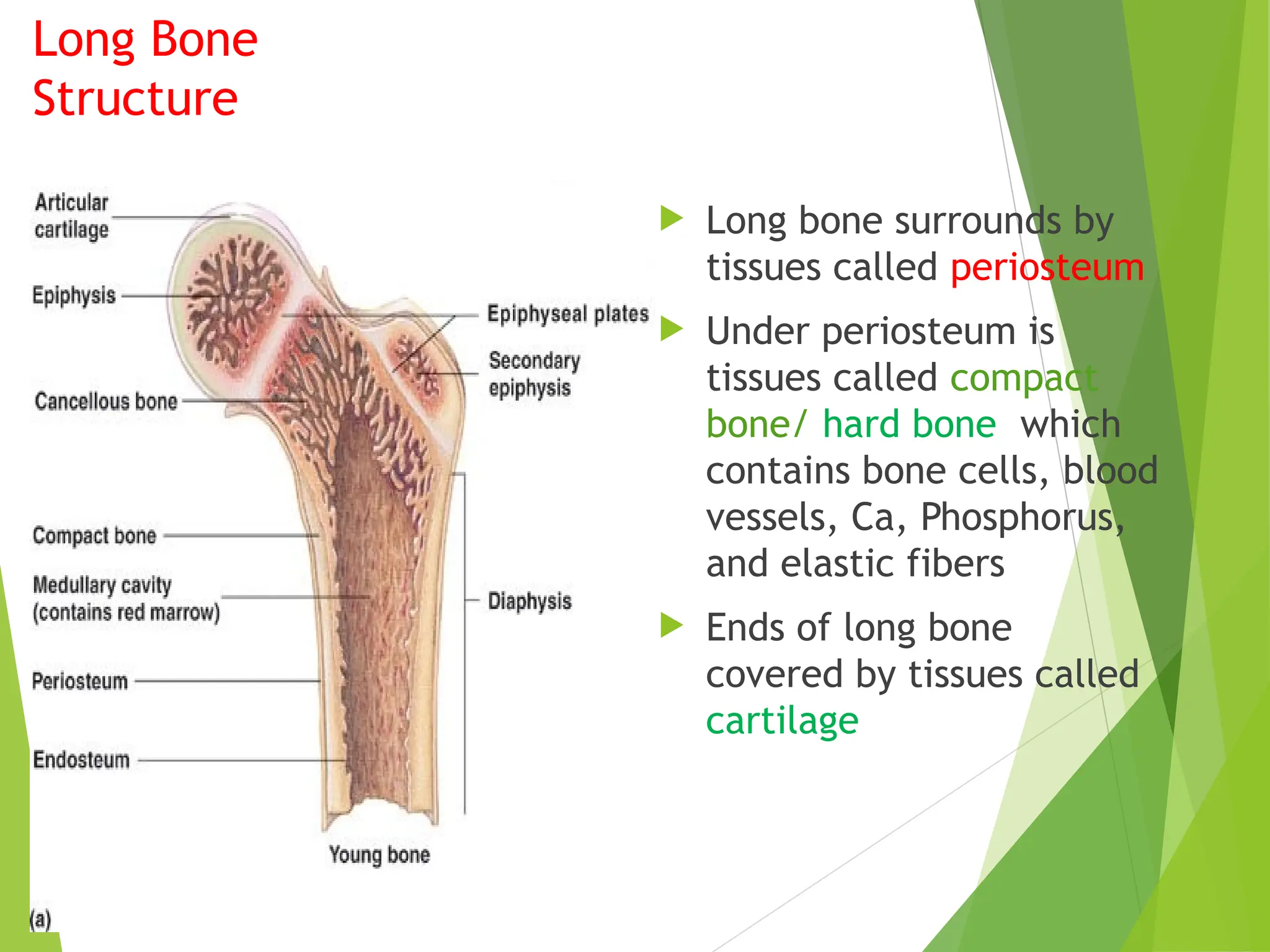
Long Bone
Structure
 Long bone surrounds by
tissues called periosteum
 Under periosteum is
tissues called compact
bone/ hard bone which
contains bone cells, blood
vessels, Ca, Phosphorus,
and elastic fibers
 Ends of long bone
covered by tissues called
cartilage
What is bone marrow?
 Fatty tissue, located in the cavities in the center of long bones or
spaces of spongy bones
 Red marrow produce erythrocytes, most of leucocytes and platelets
 Yellow marrow produce some leucocytes. It colors is due to the much
higher number of fat cells
No diaphysses and
not elongated
Compact Bone
6-14
 Central or Haversian canals: parallel to long axis
 Perforating or Volkmann’s canal: perpendicular
to long axis. Both perforating and central canals
contain blood vessels. Direct flow of nutrients
from vessels through cell processes of osteoblasts
and from one cell to the next.
 Lamellae: concentric, circumferential, interstitial
 Osteon or Haversian system: central canal,
contents, associated concentric lamellae and
osteocytes
 Osteocytes. Mature bone cells. Surrounded by
matrix
 Lacunae: spaces occupied by osteocyte cell body
 Canaliculi: canals occupied by osteocyte cell
processes
Osteocytess
6-16
Bone Histology
 Bone matrix. Like reinforced concrete. Rebar is collagen
fibers, cement is hydroxyapetite
 Organic: collagen and proteoglycans
 Inorganic: hydroxyapetite. CaPO4 crystals
 Bone cells (see following slides for particulars)
 Osteoblasts Formation of bone through ossification or osteogenesis.
 Osteocytes
 Osteoclasts Resorption of bone
 Stem cells or osteochondral progenitor cells
 Woven bone: collagen fibers randomly oriented
 Lamellar bone: mature bone in sheets
 Cancellous bone: trabeculae
 Compact bone: dense
6-17
Bone
Matrix
 If mineral removed, bone is too bendable
 If collagen removed, bone is too brittle
 Extracellular matrix contains mineralization by crystal
which contains Ca, Phosphate, and Carbonate
(Hydroxyapetite)
6-18
Cancellouss (Spongy) Bone
 Trabeculae: interconnecting rods or plates of bone.
Like scaffolding.
 Spaces filled with marrow.
 Covered with endosteum.
 Oriented along stress lines
6-19
Bone Development
cartilages (before born)
Osteoblast (bone forming cells contains Ca and
P)
Osteocytes (bone cells)
Osteoclast (destroy bone tissues and release
Ca and P in blood circulation)
Chicken Bone Experiment
Aim
To see what happens to bones when we leave them in acid
(vinegar) and water.
This experiment can be set up and left in your classroom for the
next four days after which the students will see the results.
Students mission is to write up what they think will happen to the
chicken bones in each bottle and why?
Materials and Equipment
Clean chicken bones ( thigh bones)
Two glass jars with lids per group
Water
White vinegar
Paper towels
PROCEDURE
 Place some chicken bones in each jar.
 Label one jar with your groups name, date and ‘water’ – add
the bones and water
 Label the second jar with your groups name, date and
‘vinegar’ – add bones and vinegar
 Leave the jars for about 3 weeks after which you can remove
and dry the bones on some paper towels
 Observe the difference in the two sets of bones
 DISCUSSION
 What has happened to each set of bones and why?
6-23
Factors Affecting Bone Growth
 Size and shape of a bone determined genetically but can
be modified and influenced by nutrition and hormones
 Nutrition
 Lack of calcium, protein and other nutrients during growth and
development can cause bones to be small
 Vitamin D
 Necessary for absorption of calcium from intestines
 Can be eaten or manufactured in the body
 Rickets: lack of vitamin D during childhood
 Osteomalacias: lack of vitamin D during adulthood leading
to softening of bones
 Vitamin C
 Necessary for collagen synthesis by osteoblasts
 Scurvy: deficiency of vitamin C
 Lack of vitamin C also causes wounds not to heal, teeth to
fall out
6-24
Factors Affecting Bone Growth, cont.
 Hormones
 Growth hormone from anterior pituitary.
Stimulates interstitial cartilage growth and
appositional bone growth
 Thyroid hormone required for growth of all
tissues
 Sex hormones such as estrogen and
testosterone
 Cause growth at puberty, but also cause closure of
the epiphyseal plates and the cessation of growth
6-25
Bone Fractures
 Open (compound)- bone
break with open wound.
Bone may be sticking out of
wound.
 Closed (simple)- Skin not
perforated.
 Incomplete- doesn’t extend
across the bone. Complete-
does
 Comminuted fractures:
complete with break into
more than two pieces
Joints
 Joints are the point were bones meet.
There are two groups, movable and
immovable joints
 Ball-and-socket joints- formed when
a rounded head of one bone fits into
the rounded cavity of an jointed bone.
 Hinge joints-would include elbow,
knee, ankle, and fingers. Allows
extension and retraction of apendage
 Sadle joints- A saddle joint allows
movement back and forth and up and
down, bot does not allow for rotation
like a ball and socket joint.
 Gliding joints- In a
gliding or plane joint
bones slide past each
other. Midcarpal and
midtarsal joints are
gliding joints.
 Pivot joints- allow
limited rotation or
turning of the head
 Ellipsoidal joints- bone
in wrist, and a oval
shaped part that fits in a
curved space, the joints
slide over each other
Functions of the Muscular System
Involuntary
Some involuntary functions of the muscular system are
muscles to help you breathe, make your heart beat, and help
move food through the digestive system.
Voluntary
Some voluntary functions of the muscular system are like
playing piano, running, playing video games, and throwing a ball.
Muscles
Muscles
An organ that can contract to become shorter
Muscles
An organ that can contract to become shorter
Cardiac
Muscle
• One, centrally located nucleus
• Presence of striations
• Short, branched cells
• Presence of intercalated discs
• “involuntary”
• Myogenic (contraction originates within the muscle
cell)
• Does not fatigue
Skeletal
Muscle
 Many, peripherally located nuclei (develops from many myoblasts)
 Presence of striations
 Long (up to 30 cm), thin cells
 “voluntary”
 Neurogenic (contraction is initiated my motor neuron input)
 Can fatigue
Smooth Muscle
• One, centrally located nucleus
• No striations
• Short, tapered cells
• “involuntary”
• Myogenic with some neurogenic modulation
• Does not fatigue
 Synergists = muscles that work together to produce
certain movements (ex. Multiple arm muscles are
needed for flexion of the antibrachium)
 Antagonists = muscle(s) that work(s) to oppose
certain actions = moves the structure in the
opposite direction (ex. Triceps brachii is an
antagonist to the biceps brachii and causes
extension of the antibrachium)
Muscles consist of a –
Belly = the region with the muscle fibers
Tendon = connective tissue at the ends
of the muscle that is continuous with the
muscle and the connective tissue layer
of the bone to which the muscle attaches
Fascia = connective tissue layer that
surrounds the muscle
Fractures
Joints
Dislocation- is when the
ligaments attached to the
bone are torn or out of place
Torn cartilage- is a sharp blow
or twisting of the joint
Arthritis- inflammation of the
joint and is a result of natural
wear and tear
Fasiculus = a bundle of muscle
fibers, many per muscle
Muscle Fiber = a single muscle
cell
Epimysium (fascia) = connective
tissue layer that holds many
fasiculi together, with the
associated nerves, arteries and
veins, to form a muscle (an organ)
Perimysium = connective tissue
layer that surrounds and produces
a fasiculus
Endomysium =
connective layer
surrounding a single
muscle fiber
Microscopic anatomy of muscle cells
Sarcomere = smallest contractile unit in a
muscle fiber; extends from Z-line to Z-line
A (anisotrophic band) band = “without change
band” = at low magnification it looks the same
regardless of the contractile state of the muscle;
contains thick myofilaments overlapped with
thin myofilaments
I (isotrophic band) band = “with change band”
= density changes at low magnification
depending upon the contractile state of the
muscle; at rest, contains only thin
myofilaments
Z-lines = dense regions at the ends of
sarcomeres, serve as sites of thin filament
attachment
H-zone = region in the middle of the A-zone that
at rest contains only thick filaments
Muscular Contraction
 Impulse from nervous system
Sliding Filament Theory of
Muscular Contraction
Muscle contraction occurs
when thick (myosin) and thin
(actin) myofilaments are
allowed to interact; thin
filaments “slide” along thick
filaments to the center of the
sarcomere, thus shortening
the contractile unit
1. Gastrocnemius
2. Sartorius
3. Deltoid
4. Sternocleidomastoid
5. Tibialis
6. Hamstring group
7. Rectus Abdominus
8. Triceps
9. Biceps
10. Extensor Group

human movement or The Human System for ergonomics 1.ppt

  • 2.
  • 3.
  • 4.
    What is skeleton? Skeleton: collection of bones that holds our body up.  Baby has 305 bones and an adult has 206 bones  Why ?  because as we grown some of our bones join together to form one bone
  • 5.
    Types of skeletons Exo-skeleton: animals that have shells  Endo-skeleton: hard structure inside the animal.  Hydrostatic skeleton:  Fluid held inside the body  No skeleton
  • 6.
    Five functions ofour skeletons 1. Protect the vital organs 2. Give us shape 3. Allow us to move because our muscles are attached to our bones 4. Storage of nutrients such as calcium and silicon 5. Formation of blood cells
  • 7.
  • 8.
    X-rays The tool usedto examine bones
  • 9.
    6-9 Components of SkeletalSystem  Bone  Cartilage: three types  Hyaline  Fibro cartilage  Elastic
  • 10.
    Bone Shapes  Long/ Pipe  Ex. Upper and lower limbs  Short  Ex. Carpals and tarsals, bones in wrist and ankles  Flat  Ex. Ribs, sternum, skull, scapulae  Irregular  Ex. Vertebrae, facial 6-10
  • 11.
    Long Bone Structure  Longbone surrounds by tissues called periosteum  Under periosteum is tissues called compact bone/ hard bone which contains bone cells, blood vessels, Ca, Phosphorus, and elastic fibers  Ends of long bone covered by tissues called cartilage
  • 12.
    What is bonemarrow?  Fatty tissue, located in the cavities in the center of long bones or spaces of spongy bones  Red marrow produce erythrocytes, most of leucocytes and platelets  Yellow marrow produce some leucocytes. It colors is due to the much higher number of fat cells
  • 13.
  • 14.
  • 15.
     Central orHaversian canals: parallel to long axis  Perforating or Volkmann’s canal: perpendicular to long axis. Both perforating and central canals contain blood vessels. Direct flow of nutrients from vessels through cell processes of osteoblasts and from one cell to the next.  Lamellae: concentric, circumferential, interstitial  Osteon or Haversian system: central canal, contents, associated concentric lamellae and osteocytes  Osteocytes. Mature bone cells. Surrounded by matrix  Lacunae: spaces occupied by osteocyte cell body  Canaliculi: canals occupied by osteocyte cell processes
  • 16.
  • 17.
    Bone Histology  Bonematrix. Like reinforced concrete. Rebar is collagen fibers, cement is hydroxyapetite  Organic: collagen and proteoglycans  Inorganic: hydroxyapetite. CaPO4 crystals  Bone cells (see following slides for particulars)  Osteoblasts Formation of bone through ossification or osteogenesis.  Osteocytes  Osteoclasts Resorption of bone  Stem cells or osteochondral progenitor cells  Woven bone: collagen fibers randomly oriented  Lamellar bone: mature bone in sheets  Cancellous bone: trabeculae  Compact bone: dense 6-17
  • 18.
    Bone Matrix  If mineralremoved, bone is too bendable  If collagen removed, bone is too brittle  Extracellular matrix contains mineralization by crystal which contains Ca, Phosphate, and Carbonate (Hydroxyapetite) 6-18
  • 19.
    Cancellouss (Spongy) Bone Trabeculae: interconnecting rods or plates of bone. Like scaffolding.  Spaces filled with marrow.  Covered with endosteum.  Oriented along stress lines 6-19
  • 20.
    Bone Development cartilages (beforeborn) Osteoblast (bone forming cells contains Ca and P) Osteocytes (bone cells) Osteoclast (destroy bone tissues and release Ca and P in blood circulation)
  • 21.
    Chicken Bone Experiment Aim Tosee what happens to bones when we leave them in acid (vinegar) and water. This experiment can be set up and left in your classroom for the next four days after which the students will see the results. Students mission is to write up what they think will happen to the chicken bones in each bottle and why? Materials and Equipment Clean chicken bones ( thigh bones) Two glass jars with lids per group Water White vinegar Paper towels
  • 22.
    PROCEDURE  Place somechicken bones in each jar.  Label one jar with your groups name, date and ‘water’ – add the bones and water  Label the second jar with your groups name, date and ‘vinegar’ – add bones and vinegar  Leave the jars for about 3 weeks after which you can remove and dry the bones on some paper towels  Observe the difference in the two sets of bones  DISCUSSION  What has happened to each set of bones and why?
  • 23.
    6-23 Factors Affecting BoneGrowth  Size and shape of a bone determined genetically but can be modified and influenced by nutrition and hormones  Nutrition  Lack of calcium, protein and other nutrients during growth and development can cause bones to be small  Vitamin D  Necessary for absorption of calcium from intestines  Can be eaten or manufactured in the body  Rickets: lack of vitamin D during childhood  Osteomalacias: lack of vitamin D during adulthood leading to softening of bones  Vitamin C  Necessary for collagen synthesis by osteoblasts  Scurvy: deficiency of vitamin C  Lack of vitamin C also causes wounds not to heal, teeth to fall out
  • 24.
    6-24 Factors Affecting BoneGrowth, cont.  Hormones  Growth hormone from anterior pituitary. Stimulates interstitial cartilage growth and appositional bone growth  Thyroid hormone required for growth of all tissues  Sex hormones such as estrogen and testosterone  Cause growth at puberty, but also cause closure of the epiphyseal plates and the cessation of growth
  • 25.
    6-25 Bone Fractures  Open(compound)- bone break with open wound. Bone may be sticking out of wound.  Closed (simple)- Skin not perforated.  Incomplete- doesn’t extend across the bone. Complete- does  Comminuted fractures: complete with break into more than two pieces
  • 26.
    Joints  Joints arethe point were bones meet. There are two groups, movable and immovable joints  Ball-and-socket joints- formed when a rounded head of one bone fits into the rounded cavity of an jointed bone.  Hinge joints-would include elbow, knee, ankle, and fingers. Allows extension and retraction of apendage  Sadle joints- A saddle joint allows movement back and forth and up and down, bot does not allow for rotation like a ball and socket joint.
  • 27.
     Gliding joints-In a gliding or plane joint bones slide past each other. Midcarpal and midtarsal joints are gliding joints.  Pivot joints- allow limited rotation or turning of the head  Ellipsoidal joints- bone in wrist, and a oval shaped part that fits in a curved space, the joints slide over each other
  • 28.
    Functions of theMuscular System Involuntary Some involuntary functions of the muscular system are muscles to help you breathe, make your heart beat, and help move food through the digestive system. Voluntary Some voluntary functions of the muscular system are like playing piano, running, playing video games, and throwing a ball. Muscles Muscles An organ that can contract to become shorter
  • 29.
    Muscles An organ thatcan contract to become shorter
  • 30.
    Cardiac Muscle • One, centrallylocated nucleus • Presence of striations • Short, branched cells • Presence of intercalated discs • “involuntary” • Myogenic (contraction originates within the muscle cell) • Does not fatigue
  • 31.
    Skeletal Muscle  Many, peripherallylocated nuclei (develops from many myoblasts)  Presence of striations  Long (up to 30 cm), thin cells  “voluntary”  Neurogenic (contraction is initiated my motor neuron input)  Can fatigue
  • 32.
    Smooth Muscle • One,centrally located nucleus • No striations • Short, tapered cells • “involuntary” • Myogenic with some neurogenic modulation • Does not fatigue
  • 34.
     Synergists =muscles that work together to produce certain movements (ex. Multiple arm muscles are needed for flexion of the antibrachium)  Antagonists = muscle(s) that work(s) to oppose certain actions = moves the structure in the opposite direction (ex. Triceps brachii is an antagonist to the biceps brachii and causes extension of the antibrachium)
  • 35.
    Muscles consist ofa – Belly = the region with the muscle fibers Tendon = connective tissue at the ends of the muscle that is continuous with the muscle and the connective tissue layer of the bone to which the muscle attaches Fascia = connective tissue layer that surrounds the muscle
  • 36.
    Fractures Joints Dislocation- is whenthe ligaments attached to the bone are torn or out of place Torn cartilage- is a sharp blow or twisting of the joint Arthritis- inflammation of the joint and is a result of natural wear and tear
  • 37.
    Fasiculus = abundle of muscle fibers, many per muscle Muscle Fiber = a single muscle cell Epimysium (fascia) = connective tissue layer that holds many fasiculi together, with the associated nerves, arteries and veins, to form a muscle (an organ) Perimysium = connective tissue layer that surrounds and produces a fasiculus Endomysium = connective layer surrounding a single muscle fiber
  • 38.
    Microscopic anatomy ofmuscle cells Sarcomere = smallest contractile unit in a muscle fiber; extends from Z-line to Z-line A (anisotrophic band) band = “without change band” = at low magnification it looks the same regardless of the contractile state of the muscle; contains thick myofilaments overlapped with thin myofilaments I (isotrophic band) band = “with change band” = density changes at low magnification depending upon the contractile state of the muscle; at rest, contains only thin myofilaments Z-lines = dense regions at the ends of sarcomeres, serve as sites of thin filament attachment H-zone = region in the middle of the A-zone that at rest contains only thick filaments
  • 39.
  • 40.
    Sliding Filament Theoryof Muscular Contraction Muscle contraction occurs when thick (myosin) and thin (actin) myofilaments are allowed to interact; thin filaments “slide” along thick filaments to the center of the sarcomere, thus shortening the contractile unit
  • 41.
    1. Gastrocnemius 2. Sartorius 3.Deltoid 4. Sternocleidomastoid 5. Tibialis 6. Hamstring group 7. Rectus Abdominus 8. Triceps 9. Biceps 10. Extensor Group

Editor's Notes

  • #8 Some examples of x-ray images. Get the students to bring in some if they have them at home.
  • #21 Experiment to show that calcium is an important chemical which given bones it’s hardness and strength. Over a period of 3 weeks, vinegar breaks down calcium in bones which causes them to become soft and pliable. Water has no effect on them so bones in water remain hard.
  • #41 Show students some of the major muscles. Use books, internet and pictures to explore other muscles.