Evaluate strategies for improving household nutritional diversity in Mali
C.M. Sobgui1, H. Diarra1, P. Coulibaly2, J.B. Tignegre1 and A. Tenkouano1
1AVRDC-The world Vegetable Centre
2Association Malienne pour le Développement Durable (AMEDD)
Corresponding author email: caroline.sobgui@worldveg.org
Key research activities
• Strengthen the capacity of agriculture extension agents to deliver
nutrition message
• Develop Behavior Change Communication approach to foster
adoption of infant, young child and women optimal nutrition
practices.
• Evaluate strategies for improving household nutritional diversity in
Mali
Results and main findings
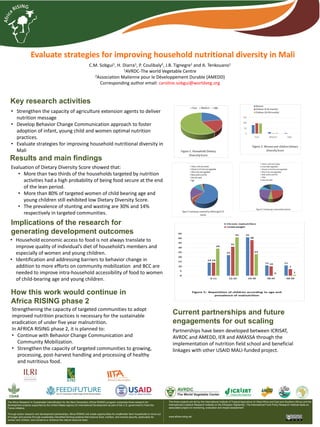
Evaluation of Dietary Diversity Score showed that:
• More than two thirds of the households targeted by nutrition
activities had a high probability of being food secure at the end
of the lean period.
• More than 80% of targeted women of child bearing age and
young children still exhibited low Dietary Diversity Score.
• The prevalence of stunting and wasting are 30% and 14%
respectively in targeted communities.
Implications of the research for
generating development outcomes
• Household economic access to food is not always translate to
improve quality of individual’s diet of household’s members and
especially of women and young children.
• Identification and addressing barriers to behavior change in
addition to more efforts on community mobilization and BCC are
needed to improve intra-household accessibility of food to women
of child-bearing age and young children.
Strengthening the capacity of targeted communities to adopt
improved nutrition practices is necessary for the sustainable
eradication of under five year malnutrition.
In AFRICA RISING phase 2, it is planned to:
• Continue with Behavior Change Communication and
Community Mobilization.
• Strengthen the capacity of targeted communities to growing,
processing, post-harvest handling and processing of healthy
and nutritious food.
How this work would continue in
Africa RISING phase 2
The Africa Research In Sustainable Intensification for the Next Generation (Africa RISING) program comprises three research-for-
development projects supported by the United States Agency for International Development as part of the U.S. government’s Feed the
Future initiative.
Through action research and development partnerships, Africa RISING will create opportunities for smallholder farm households to move out
of hunger and poverty through sustainably intensified farming systems that improve food, nutrition, and income security, particularly for
women and children, and conserve or enhance the natural resource base.
The three projects are led by the International Institute of Tropical Agriculture (in West Africa and East and Southern Africa) and the
International Livestock Research Institute (in the Ethiopian Highlands). The International Food Policy Research Institute leads an
associated project on monitoring, evaluation and impact assessment.
www.africa-rising.net
Partnerships have been developed between ICRISAT,
AVRDC and AMEDD, IER and AMASSA through the
implementation of nutrition field school and beneficial
linkages with other USAID MALI-funded project.
Current partnerships and future
engagements for out scaling

Evaluate strategies for improving household nutritional diversity in Mali

  • 1.
    Evaluate strategies forimproving household nutritional diversity in Mali C.M. Sobgui1, H. Diarra1, P. Coulibaly2, J.B. Tignegre1 and A. Tenkouano1 1AVRDC-The world Vegetable Centre 2Association Malienne pour le Développement Durable (AMEDD) Corresponding author email: caroline.sobgui@worldveg.org Key research activities • Strengthen the capacity of agriculture extension agents to deliver nutrition message • Develop Behavior Change Communication approach to foster adoption of infant, young child and women optimal nutrition practices. • Evaluate strategies for improving household nutritional diversity in Mali Results and main findings Evaluation of Dietary Diversity Score showed that: • More than two thirds of the households targeted by nutrition activities had a high probability of being food secure at the end of the lean period. • More than 80% of targeted women of child bearing age and young children still exhibited low Dietary Diversity Score. • The prevalence of stunting and wasting are 30% and 14% respectively in targeted communities. Implications of the research for generating development outcomes • Household economic access to food is not always translate to improve quality of individual’s diet of household’s members and especially of women and young children. • Identification and addressing barriers to behavior change in addition to more efforts on community mobilization and BCC are needed to improve intra-household accessibility of food to women of child-bearing age and young children. Strengthening the capacity of targeted communities to adopt improved nutrition practices is necessary for the sustainable eradication of under five year malnutrition. In AFRICA RISING phase 2, it is planned to: • Continue with Behavior Change Communication and Community Mobilization. • Strengthen the capacity of targeted communities to growing, processing, post-harvest handling and processing of healthy and nutritious food. How this work would continue in Africa RISING phase 2 The Africa Research In Sustainable Intensification for the Next Generation (Africa RISING) program comprises three research-for- development projects supported by the United States Agency for International Development as part of the U.S. government’s Feed the Future initiative. Through action research and development partnerships, Africa RISING will create opportunities for smallholder farm households to move out of hunger and poverty through sustainably intensified farming systems that improve food, nutrition, and income security, particularly for women and children, and conserve or enhance the natural resource base. The three projects are led by the International Institute of Tropical Agriculture (in West Africa and East and Southern Africa) and the International Livestock Research Institute (in the Ethiopian Highlands). The International Food Policy Research Institute leads an associated project on monitoring, evaluation and impact assessment. www.africa-rising.net Partnerships have been developed between ICRISAT, AVRDC and AMEDD, IER and AMASSA through the implementation of nutrition field school and beneficial linkages with other USAID MALI-funded project. Current partnerships and future engagements for out scaling