Addressing Equity & Access Issues in ICDS
1. ICDS is a means for protecting the rights of children under six including
their right to nutrition, health and joyful learning.
2. Supreme Court issued orders that the ICDS should be universalized to
cover all settlements in the country, reaching out to every child under six
years of age, mother and adolescent girl with supplementary nutrition,
expressed as “Universalization of ICDS with Quality” giving priority
to the underprivileged group, specially to the working and migrant
population who do not find convenient time to attend the centers.
WHAT IS EQUITY?
•Equity in ICDS refers to fair distribution of services among different
individuals and groups in society.
•Equity in ICDS in West Bengal context mainly focuses on the nutrition status
of the vulnerable population.
•Exclusion from one service is often reproduced across others - resulting in
multiple deprivations and increasing vulnerability of the mother, infant or child
to disease, malnutrition, morbidity and death i.e no individual or group should be
left out.
UNIVERSALIZATION OF ICDS
Universalization of ICDS clearly reflects equity:
•It mainly focuses on the nutrition status of the vulnerable population.
•No one should be left out, i.e inclusion of all.
•Universalization with quality must encompass every aspect of ICDS and not
just SNP.
•Need to pay attention to children under the age of two years because in this
critical period 90 per cent of the brain development takes place which
determines a child capability in every aspect in future and this should be an
integral part of the task “Universalization with Quality”.
ACCESS
WHAT IS ACCESS?
Access pertains to the availability and acceptability of ICDS services. It
also refers to barriers faced by potential users mainly social and
geographical. Here services must be provided in appropriate time and
geographical setting and be responsive to the preferences of its
recipients.
“EQUITY AND ACCESS ISSUES CAN BE INTERPRETED
THROUGH ANALYSIS OF DEMAND-SUPPLY OF ICDS
SERVICES”
SUPPLY & ITS MAJOR CONCERNS
Supply of ICDS services relates to the supply of supplementary nutrition
services, Vitamin A oil as part of Biannual Strategy, medicine kit and pre-
school education offered by DWCD.
Major concerns:
•Shortage of required infrastructure with adequate and functional equipment
and supplies for effective services.
•Irregular supply of commodity at the AWC level.
•Need based allocation not done.
•Supply of medicine kit irregularly.
DEMAND & ITS MAJOR CONCERNS
Demand for ICDS services refers to the community’s felt and expressed
need for specific services.
Major concerns:
•Cultural, Religious and household barriers.
•Lack of information and knowledge among needy groups about
services, schemes, etc.
•Lack of inclusion of people, especially the underprivileged
communities /users groups in the identification and location of AWCs.
•Lack of inclusion of mothers and their children who cannot attend
AWC because of unsuitable timing.
What are the questions that may be asked to initiate and
plan to address these issues?
•Who are the un-reached in a particular village?
•What is expected to be done to reach these groups/ individuals-prioritization of
services, outreach sessions?
•What are the efforts made to bring under 2 children to the centers?
•What are the efforts made to bring all pregnant and lactating mothers for
mothers’ meeting?
•What are the efforts made to make priority home visits?
•Do the AWW/ Supervisors have adequate knowledge of infant and young child
feeding, home based new born care and essential services available to address
these problems?
•Is there any communication to the communities about mothers’ meeting?
VOICE OF COMMUNITY
The voice of community through feedback from the local
Panchayat, especially strengthening the fourth Saturday meeting
will enhance the quality of the program.
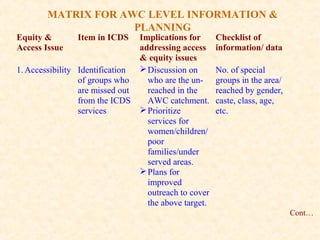
MATRIX FOR AWC LEVEL INFORMATION &
PLANNING
Equity &
Access Issue
Item in ICDS Implications for
addressing access
& equity issues
Checklist of
information/ data
1.Accessibility Identification
of groups who
are missed out
from the ICDS
services
Discussion on
who are the un-
reached in the
AWC catchment.
Prioritize
services for
women/children/
poor
families/under
served areas.
Plans for
improved
outreach to cover
the above target.
No. of special
groups in the area/
reached by gender,
caste, class, age,
etc.
Cont…
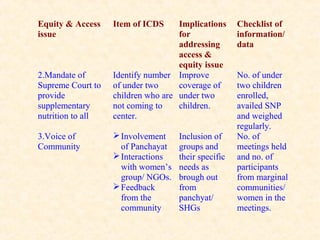
Equity & Access
issue
Item of ICDS Implications
for
addressing
access &
equity issue
Checklist of
information/
data
2.Mandate of
Supreme Court to
provide
supplementary
nutrition to all
Identify number
of under two
children who are
not coming to
center.
Improve
coverage of
under two
children.
No. of under
two children
enrolled,
availed SNP
and weighed
regularly.
3.Voice of
Community
Involvement
of Panchayat
Interactions
with women’s
group/ NGOs.
Feedback
from the
community
Inclusion of
groups and
their specific
needs as
brough out
from
panchyat/
SHGs
No. of
meetings held
and no. of
participants
from marginal
communities/
women in the
meetings.

Equity & Access

  • 1.
    Addressing Equity &Access Issues in ICDS 1. ICDS is a means for protecting the rights of children under six including their right to nutrition, health and joyful learning. 2. Supreme Court issued orders that the ICDS should be universalized to cover all settlements in the country, reaching out to every child under six years of age, mother and adolescent girl with supplementary nutrition, expressed as “Universalization of ICDS with Quality” giving priority to the underprivileged group, specially to the working and migrant population who do not find convenient time to attend the centers.
  • 2.
    WHAT IS EQUITY? •Equityin ICDS refers to fair distribution of services among different individuals and groups in society. •Equity in ICDS in West Bengal context mainly focuses on the nutrition status of the vulnerable population. •Exclusion from one service is often reproduced across others - resulting in multiple deprivations and increasing vulnerability of the mother, infant or child to disease, malnutrition, morbidity and death i.e no individual or group should be left out.
  • 3.
    UNIVERSALIZATION OF ICDS Universalizationof ICDS clearly reflects equity: •It mainly focuses on the nutrition status of the vulnerable population. •No one should be left out, i.e inclusion of all. •Universalization with quality must encompass every aspect of ICDS and not just SNP. •Need to pay attention to children under the age of two years because in this critical period 90 per cent of the brain development takes place which determines a child capability in every aspect in future and this should be an integral part of the task “Universalization with Quality”.
  • 4.
    ACCESS WHAT IS ACCESS? Accesspertains to the availability and acceptability of ICDS services. It also refers to barriers faced by potential users mainly social and geographical. Here services must be provided in appropriate time and geographical setting and be responsive to the preferences of its recipients. “EQUITY AND ACCESS ISSUES CAN BE INTERPRETED THROUGH ANALYSIS OF DEMAND-SUPPLY OF ICDS SERVICES”
  • 5.
    SUPPLY & ITSMAJOR CONCERNS Supply of ICDS services relates to the supply of supplementary nutrition services, Vitamin A oil as part of Biannual Strategy, medicine kit and pre- school education offered by DWCD. Major concerns: •Shortage of required infrastructure with adequate and functional equipment and supplies for effective services. •Irregular supply of commodity at the AWC level. •Need based allocation not done. •Supply of medicine kit irregularly.
  • 6.
    DEMAND & ITSMAJOR CONCERNS Demand for ICDS services refers to the community’s felt and expressed need for specific services. Major concerns: •Cultural, Religious and household barriers. •Lack of information and knowledge among needy groups about services, schemes, etc. •Lack of inclusion of people, especially the underprivileged communities /users groups in the identification and location of AWCs. •Lack of inclusion of mothers and their children who cannot attend AWC because of unsuitable timing.
  • 7.
    What are thequestions that may be asked to initiate and plan to address these issues? •Who are the un-reached in a particular village? •What is expected to be done to reach these groups/ individuals-prioritization of services, outreach sessions? •What are the efforts made to bring under 2 children to the centers? •What are the efforts made to bring all pregnant and lactating mothers for mothers’ meeting? •What are the efforts made to make priority home visits? •Do the AWW/ Supervisors have adequate knowledge of infant and young child feeding, home based new born care and essential services available to address these problems? •Is there any communication to the communities about mothers’ meeting?
  • 8.
    VOICE OF COMMUNITY Thevoice of community through feedback from the local Panchayat, especially strengthening the fourth Saturday meeting will enhance the quality of the program.
  • 9.
    MATRIX FOR AWCLEVEL INFORMATION & PLANNING Equity & Access Issue Item in ICDS Implications for addressing access & equity issues Checklist of information/ data 1.Accessibility Identification of groups who are missed out from the ICDS services Discussion on who are the un- reached in the AWC catchment. Prioritize services for women/children/ poor families/under served areas. Plans for improved outreach to cover the above target. No. of special groups in the area/ reached by gender, caste, class, age, etc. Cont…
  • 10.
    Equity & Access issue Itemof ICDS Implications for addressing access & equity issue Checklist of information/ data 2.Mandate of Supreme Court to provide supplementary nutrition to all Identify number of under two children who are not coming to center. Improve coverage of under two children. No. of under two children enrolled, availed SNP and weighed regularly. 3.Voice of Community Involvement of Panchayat Interactions with women’s group/ NGOs. Feedback from the community Inclusion of groups and their specific needs as brough out from panchyat/ SHGs No. of meetings held and no. of participants from marginal communities/ women in the meetings.