Matching Headings
Reading: Tips & Strategy
Reading
• Content
• What do you need to do?
• What does it test?
• Examples
• Common problems
• Tips and advice
• Strategy
Reading
• What do you need to do?
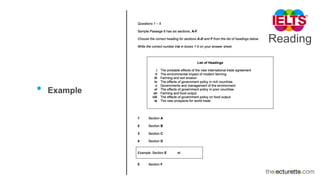
• You will be asked to match headings to
sections of text.
• The headings consist of short sentences
that summarize the information in a
paragraph and you will need to select the
best one.
• You will be given 5 to 7 headings and there
will be more headings than paragraphs.
Reading
• What does it test?
• The ability to understand the main idea of
each paragraph.
• Example
Reading
Reading
• Common Problems
• Reading through all the information takes
too much time.
• Trying to match words from the heading to
words from the text.
• Some headings appear to have similar
meanings.
Reading
• More Common
Problems
• Not understanding the main idea of each
paragraph when only reading the first
sentence.
• Spending too much time on one paragraph
or heading.
• The answers not being in the same order
as the text.
Reading
• Tips
• Do this question first. It is an effective way to
understand the general meaning of the text.
This may also help you answer more detailed
questions later on.
• Don’t read every word of the text because the
questions only test whether you understand
the main idea. Just reading the first two and
the last sentence of each paragraph is usually
enough.
Reading
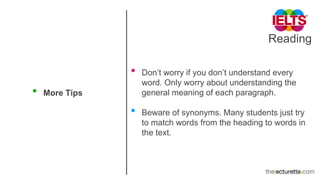
• More Tips
• Don’t worry if you don’t understand every
word. Only worry about understanding the
general meaning of each paragraph.
• Beware of synonyms. Many students just try
to match words from the heading to words in
the text.
Reading
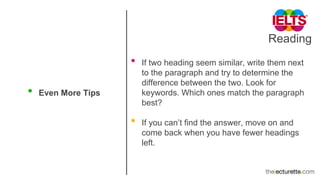
• Even More Tips
• If two heading seem similar, write them next
to the paragraph and try to determine the
difference between the two. Look for
keywords. Which ones match the paragraph
best?
• If you can’t find the answer, move on and
come back when you have fewer headings
left.
Reading
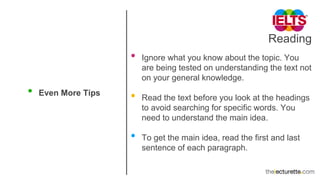
• Even More Tips
• Ignore what you know about the topic. You
are being tested on understanding the text not
on your general knowledge.
• Read the text before you look at the headings
to avoid searching for specific words. You
need to understand the main idea.
• To get the main idea, read the first and last
sentence of each paragraph.
Reading
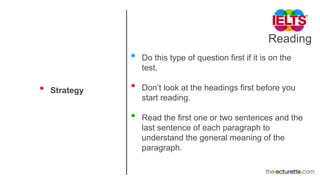
• Strategy
• Do this type of question first if it is on the
test.
• Don’t look at the headings first before you
start reading.
• Read the first one or two sentences and the
last sentence of each paragraph to
understand the general meaning of the
paragraph.
Reading
• More Strategy
• Try to sum up the meaning of each
paragraph in one or two words.
• Identiy to keywords in the headings.
• Match the headings that you are sure about
first.
Reading
• Even More Strategy
• For the paragraphs you are not sure about,
write 2 or 3 possible headings in the margins
and identify the difference between them.
Also, check whether any synonyms in the
paragraph match keywords in the headings.
• If you can’t decide on the answer, move on
to the next question. Come back later after
you have fewer headings left.
• Repeat this strategy until finished.

IELTS Reading: Matching Headings

  • 1.
  • 2.
    Reading • Content • Whatdo you need to do? • What does it test? • Examples • Common problems • Tips and advice • Strategy
  • 3.
    Reading • What doyou need to do? • You will be asked to match headings to sections of text. • The headings consist of short sentences that summarize the information in a paragraph and you will need to select the best one. • You will be given 5 to 7 headings and there will be more headings than paragraphs.
  • 4.
    Reading • What doesit test? • The ability to understand the main idea of each paragraph.
  • 5.
  • 6.
    Reading • Common Problems •Reading through all the information takes too much time. • Trying to match words from the heading to words from the text. • Some headings appear to have similar meanings.
  • 7.
    Reading • More Common Problems •Not understanding the main idea of each paragraph when only reading the first sentence. • Spending too much time on one paragraph or heading. • The answers not being in the same order as the text.
  • 8.
    Reading • Tips • Dothis question first. It is an effective way to understand the general meaning of the text. This may also help you answer more detailed questions later on. • Don’t read every word of the text because the questions only test whether you understand the main idea. Just reading the first two and the last sentence of each paragraph is usually enough.
  • 9.
    Reading • More Tips •Don’t worry if you don’t understand every word. Only worry about understanding the general meaning of each paragraph. • Beware of synonyms. Many students just try to match words from the heading to words in the text.
  • 10.
    Reading • Even MoreTips • If two heading seem similar, write them next to the paragraph and try to determine the difference between the two. Look for keywords. Which ones match the paragraph best? • If you can’t find the answer, move on and come back when you have fewer headings left.
  • 11.
    Reading • Even MoreTips • Ignore what you know about the topic. You are being tested on understanding the text not on your general knowledge. • Read the text before you look at the headings to avoid searching for specific words. You need to understand the main idea. • To get the main idea, read the first and last sentence of each paragraph.
  • 12.
    Reading • Strategy • Dothis type of question first if it is on the test. • Don’t look at the headings first before you start reading. • Read the first one or two sentences and the last sentence of each paragraph to understand the general meaning of the paragraph.
  • 13.
    Reading • More Strategy •Try to sum up the meaning of each paragraph in one or two words. • Identiy to keywords in the headings. • Match the headings that you are sure about first.
  • 14.
    Reading • Even MoreStrategy • For the paragraphs you are not sure about, write 2 or 3 possible headings in the margins and identify the difference between them. Also, check whether any synonyms in the paragraph match keywords in the headings. • If you can’t decide on the answer, move on to the next question. Come back later after you have fewer headings left. • Repeat this strategy until finished.