IELTS Reading Test
Feb. 15, 2023
Created by Alexander Benito
Academic module
Start an undergraduate or postgraduate program, or professional registration e.g.
doctors, nurses.
General training module
Migration to an English-speaking country, (e.g. Australia, Canada, New Zealand,
UK) or train or study at below degree level.
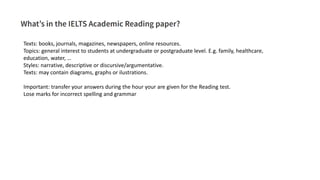
Texts: books, journals, magazines, newspapers, online resources.
Topics: general interest to students at undergraduate or postgraduate level. E.g. family, healthcare,
education, water, …
Styles: narrative, descriptive or discursive/argumentative.
Texts: may contain diagrams, graphs or ilustrations.
Important: transfer your answers during the hour your are given for the Reading test.
Lose marks for incorrect spelling and grammar
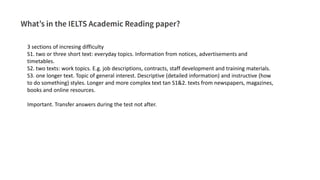
3 sections of incresing difficulty
S1. two or three short text: everyday topics. Information from notices, advertisements and
timetables.
S2. two texts: work topics. E.g. job descriptions, contracts, staff development and training materials.
S3. one longer text. Topic of general interest. Descriptive (detailed information) and instructive (how
to do something) styles. Longer and more complex text tan S1&2. texts from newspapers, magazines,
books and online resources.
Important. Transfer answers during the test not after.
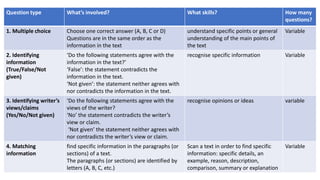
Question type What’s involved? What skills? How many
questions?
1. Multiple choice Choose one correct answer (A, B, C or D)
Questions are in the same order as the
information in the text
understand specific points or general
understanding of the main points of
the text
Variable
2. Identifying
information
(True/False/Not
given)
‘Do the following statements agree with the
information in the text?’
‘False’: the statement contradicts the
information in the text.
‘Not given’: the statement neither agrees with
nor contradicts the information in the text.
recognise specific information Variable
3. Identifying writer’s
views/claims
(Yes/No/Not given)
‘Do the following statements agree with the
views of the writer?
‘No’ the statement contradicts the writer’s
view or claim.
‘Not given’ the statement neither agrees with
nor contradicts the writer’s view or claim.
recognise opinions or ideas variable
4. Matching
information
find specific information in the paragraphs (or
sections) of a text.
The paragraphs (or sections) are identified by
letters (A, B, C, etc.)
Scan a text in order to find specific
information: specific details, an
example, reason, description,
comparison, summary or explanation
Variable
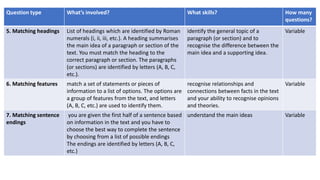
Question type What’s involved? What skills? How many
questions?
5. Matching headings List of headings which are identified by Roman
numerals (i, ii, iii, etc.). A heading summarises
the main idea of a paragraph or section of the
text. You must match the heading to the
correct paragraph or section. The paragraphs
(or sections) are identified by letters (A, B, C,
etc.).
identify the general topic of a
paragraph (or section) and to
recognise the difference between the
main idea and a supporting idea.
Variable
6. Matching features match a set of statements or pieces of
information to a list of options. The options are
a group of features from the text, and letters
(A, B, C, etc.) are used to identify them.
recognise relationships and
connections between facts in the text
and your ability to recognise opinions
and theories.
Variable
7. Matching sentence
endings
you are given the first half of a sentence based
on information in the text and you have to
choose the best way to complete the sentence
by choosing from a list of possible endings
The endings are identified by letters (A, B, C,
etc.)
understand the main ideas Variable
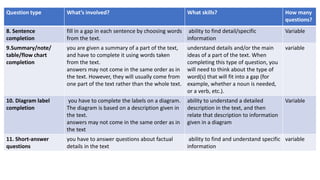
Question type What’s involved? What skills? How many
questions?
8. Sentence
completion
fill in a gap in each sentence by choosing words
from the text.
ability to find detail/specific
information
Variable
9.Summary/note/
table/flow chart
completion
you are given a summary of a part of the text,
and have to complete it using words taken
from the text.
answers may not come in the same order as in
the text. However, they will usually come from
one part of the text rather than the whole text.
understand details and/or the main
ideas of a part of the text. When
completing this type of question, you
will need to think about the type of
word(s) that will fit into a gap (for
example, whether a noun is needed,
or a verb, etc.).
variable
10. Diagram label
completion
you have to complete the labels on a diagram.
The diagram is based on a description given in
the text.
answers may not come in the same order as in
the text
ability to understand a detailed
description in the text, and then
relate that description to information
given in a diagram
Variable
11. Short-answer
questions
you have to answer questions about factual
details in the text
ability to find and understand specific
information
variable
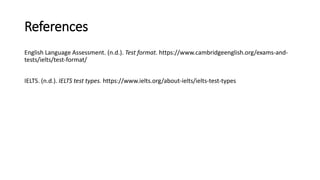
References
English Language Assessment. (n.d.). Test format. https://www.cambridgeenglish.org/exams-and-
tests/ielts/test-format/
IELTS. (n.d.). IELTS test types. https://www.ielts.org/about-ielts/ielts-test-types

IELTS Reading Test intro.pptx

  • 1.
    IELTS Reading Test Feb.15, 2023 Created by Alexander Benito
  • 2.
    Academic module Start anundergraduate or postgraduate program, or professional registration e.g. doctors, nurses. General training module Migration to an English-speaking country, (e.g. Australia, Canada, New Zealand, UK) or train or study at below degree level.
  • 4.
    Texts: books, journals,magazines, newspapers, online resources. Topics: general interest to students at undergraduate or postgraduate level. E.g. family, healthcare, education, water, … Styles: narrative, descriptive or discursive/argumentative. Texts: may contain diagrams, graphs or ilustrations. Important: transfer your answers during the hour your are given for the Reading test. Lose marks for incorrect spelling and grammar
  • 5.
    3 sections ofincresing difficulty S1. two or three short text: everyday topics. Information from notices, advertisements and timetables. S2. two texts: work topics. E.g. job descriptions, contracts, staff development and training materials. S3. one longer text. Topic of general interest. Descriptive (detailed information) and instructive (how to do something) styles. Longer and more complex text tan S1&2. texts from newspapers, magazines, books and online resources. Important. Transfer answers during the test not after.
  • 7.
    Question type What’sinvolved? What skills? How many questions? 1. Multiple choice Choose one correct answer (A, B, C or D) Questions are in the same order as the information in the text understand specific points or general understanding of the main points of the text Variable 2. Identifying information (True/False/Not given) ‘Do the following statements agree with the information in the text?’ ‘False’: the statement contradicts the information in the text. ‘Not given’: the statement neither agrees with nor contradicts the information in the text. recognise specific information Variable 3. Identifying writer’s views/claims (Yes/No/Not given) ‘Do the following statements agree with the views of the writer? ‘No’ the statement contradicts the writer’s view or claim. ‘Not given’ the statement neither agrees with nor contradicts the writer’s view or claim. recognise opinions or ideas variable 4. Matching information find specific information in the paragraphs (or sections) of a text. The paragraphs (or sections) are identified by letters (A, B, C, etc.) Scan a text in order to find specific information: specific details, an example, reason, description, comparison, summary or explanation Variable
  • 8.
    Question type What’sinvolved? What skills? How many questions? 5. Matching headings List of headings which are identified by Roman numerals (i, ii, iii, etc.). A heading summarises the main idea of a paragraph or section of the text. You must match the heading to the correct paragraph or section. The paragraphs (or sections) are identified by letters (A, B, C, etc.). identify the general topic of a paragraph (or section) and to recognise the difference between the main idea and a supporting idea. Variable 6. Matching features match a set of statements or pieces of information to a list of options. The options are a group of features from the text, and letters (A, B, C, etc.) are used to identify them. recognise relationships and connections between facts in the text and your ability to recognise opinions and theories. Variable 7. Matching sentence endings you are given the first half of a sentence based on information in the text and you have to choose the best way to complete the sentence by choosing from a list of possible endings The endings are identified by letters (A, B, C, etc.) understand the main ideas Variable
  • 9.
    Question type What’sinvolved? What skills? How many questions? 8. Sentence completion fill in a gap in each sentence by choosing words from the text. ability to find detail/specific information Variable 9.Summary/note/ table/flow chart completion you are given a summary of a part of the text, and have to complete it using words taken from the text. answers may not come in the same order as in the text. However, they will usually come from one part of the text rather than the whole text. understand details and/or the main ideas of a part of the text. When completing this type of question, you will need to think about the type of word(s) that will fit into a gap (for example, whether a noun is needed, or a verb, etc.). variable 10. Diagram label completion you have to complete the labels on a diagram. The diagram is based on a description given in the text. answers may not come in the same order as in the text ability to understand a detailed description in the text, and then relate that description to information given in a diagram Variable 11. Short-answer questions you have to answer questions about factual details in the text ability to find and understand specific information variable
  • 10.
    References English Language Assessment.(n.d.). Test format. https://www.cambridgeenglish.org/exams-and- tests/ielts/test-format/ IELTS. (n.d.). IELTS test types. https://www.ielts.org/about-ielts/ielts-test-types