Idiopathic Inflammatory Myopathies
(IIM)
Ade Wijaya, MD – January 2020
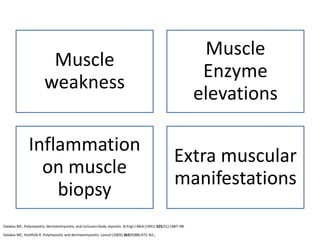
Muscle
weakness
Muscle
Enzyme
elevations
Inflammation
on muscle
biopsy
Extra muscular
manifestations
Dalakas MC. Polymyositis, dermatomyositis, and inclusion-body myositis. N Engl J Med (1991) 325(21):1487–98.
Dalakas MC, Hohlfeld R. Polymyositis and dermatomyositis. Lancet (2003) 362(9388):971–82.
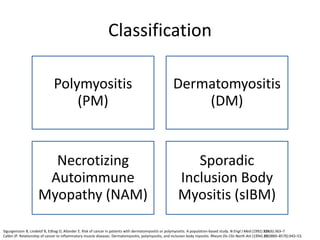
Classification
Polymyositis
(PM)
Dermatomyositis
(DM)
Necrotizing
Autoimmune
Myopathy (NAM)
Sporadic
Inclusion Body
Myositis (sIBM)
Sigurgeirsson B, Lindelof B, Edhag O, Allander E. Risk of cancer in patients with dermatomyositis or polymyositis. A population-based study. N Engl J Med (1992) 326(6):363–7
Callen JP. Relationship of cancer to inflammatory muscle diseases. Dermatomyositis, polymyositis, and inclusion body myositis. Rheum Dis Clin North Am (1994) 20(0889–857X):943–53.
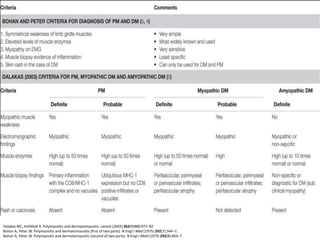
Dalakas MC, Hohlfeld R. Polymyositis and dermatomyositis. Lancet (2003) 362(9388):971–82
Bohan A, Peter JB. Polymyositis and dermatomyositis (first of two parts). N Engl J Med (1975) 292(7):344–7.
Bohan A, Peter JB. Polymyositis and dermatomyositis (second of two parts). N Engl J Med (1975) 292(8):403–7.
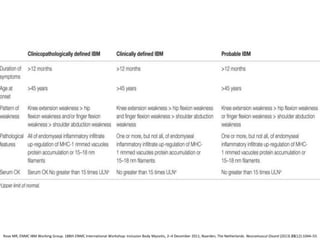
Rose MR, ENMC IBM Working Group. 188th ENMC International Workshop: Inclusion Body Myositis, 2–4 December 2011, Naarden, The Netherlands. Neuromuscul Disord (2013) 23(12):1044–55.
Epidemiology
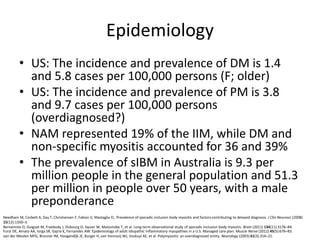
• US: The incidence and prevalence of DM is 1.4
and 5.8 cases per 100,000 persons (F; older)
• US: The incidence and prevalence of PM is 3.8
and 9.7 cases per 100,000 persons
(overdiagnosed?)
• NAM represented 19% of the IIM, while DM and
non-specific myositis accounted for 36 and 39%
• The prevalence of sIBM in Australia is 9.3 per
million people in the general population and 51.3
per million in people over 50 years, with a male
preponderance
Furst DE, Amato AA, Iorga SR, Gajria K, Fernandes AW. Epidemiology of adult idiopathic inflammatory myopathies in a U.S. Managed care plan. Muscle Nerve (2012) 45(5):676–83.
van der Meulen MFG, Bronner IM, Hoogendijk JE, Burger H, van Venrooij WJ, Voskuyl AE, et al. Polymyositis: an overdiagnosed entity. Neurology (2003) 61(3):316–21.
Needham M, Corbett A, Day T, Christiansen F, Fabian V, Mastaglia FL. Prevalence of sporadic inclusion body myositis and factors contributing to delayed diagnosis. J Clin Neurosci (2008)
15(12):1350–3.
Benveniste O, Guiguet M, Freebody J, Dubourg O, Squier W, Maisonobe T, et al. Long-term observational study of sporadic inclusion body myositis. Brain (2011) 134(11):3176–84.
CLINICAL FEATURES
Dermatomyositis
• Acute or insidiously progressive proximal
weakness + skin rash
• Some patients develop dyspnea related to
Interstitial lung disease or ventilatory muscle
weakness, dysphagia due to esophageal or
pharyngeal involvement, congestive heart
failure or arrhythmia from myocarditis, and
gastrointestinal bleeding due to vasculopathy
of the gut.
Hochberg MC, Feldman D, Stevens MB. Adult onset polymyositis/dermatomyositis: an analysis of clinical and laboratory features and survival in 76 patients with a review of the literature.
Semin Arthritis Rheum (1986) 5(3):168–78
Amato AA, Barohn RJ. Idiopathic inflammatory myopathies. Neurol Clin (1997) 15(3):615–48.
Sontheimer RD. Cutaneous features of classic dermatomyositis and amyopathic dermatomyositis. Curr Opin Rheumatol (1999) 11(6):475–82.
Dermatomyositis
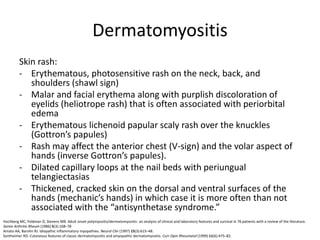
Skin rash:
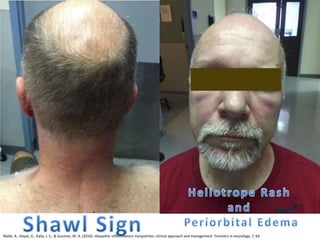
- Erythematous, photosensitive rash on the neck, back, and
shoulders (shawl sign)
- Malar and facial erythema along with purplish discoloration of
eyelids (heliotrope rash) that is often associated with periorbital
edema
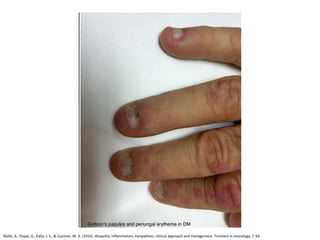
- Erythematous lichenoid papular scaly rash over the knuckles
(Gottron’s papules)
- Rash may affect the anterior chest (V-sign) and the volar aspect of
hands (inverse Gottron’s papules).
- Dilated capillary loops at the nail beds with periungual
telangiectasias
- Thickened, cracked skin on the dorsal and ventral surfaces of the
hands (mechanic’s hands) in which case it is more often than not
associated with the “antisynthetase syndrome.”
Hochberg MC, Feldman D, Stevens MB. Adult onset polymyositis/dermatomyositis: an analysis of clinical and laboratory features and survival in 76 patients with a review of the literature.
Semin Arthritis Rheum (1986) 5(3):168–78
Amato AA, Barohn RJ. Idiopathic inflammatory myopathies. Neurol Clin (1997) 15(3):615–48.
Sontheimer RD. Cutaneous features of classic dermatomyositis and amyopathic dermatomyositis. Curr Opin Rheumatol (1999) 11(6):475–82.
Malik, A., Hayat, G., Kalia, J. S., & Guzman, M. A. (2016). Idiopathic inflammatory myopathies: clinical approach and management. Frontiers in neurology, 7, 64.
Dermatomyositis
• Dermatomyositis may present by itself or be a part of
other syndromes, e.g., antisynthetase syndrome and
overlap syndromes
• Antisynthetase syndrome is the constellation of
Raynaud’s phenomenon, arthritis, and ILD. It presents
with mechanic’s hands (as mentioned above). It is
characterized by the presence of antibodies to
aminoacyl transfer ribonucleic acid (RNA) synthetases
• Overlap syndrome is an entity that satisfies criteria of
at least two connective tissue diseases most notably
systemic sclerosis, PM/DM, Sjogrens syndrome, and
SLE.
Chatterjee S, Prayson R, Farver C. Antisynthetase syndrome: not just an inflammatory myopathy. Cleve Clin J Med (2013) 80(10):655–66.
Balbir-Gurman A, Braun-Moscovici Y. Scleroderma overlap syndrome. Isr Med Assoc J (2011) 13(1):14–20.
Vancsa A, Gergely L, Ponyi A, Lakos G, Németh J, Szodoray P, et al. Myositis-specific and myositis-associated antibodies in overlap myositis in comparison to primary dermatopolymyositis:
relevance for clinical classification: retrospective study of 169 patients. Jt Bone Spine (2010) 77(2):125–30.
Dermatomyositis
• Ammyopathic DM: cutaneous manifestations without the
muscle involvement
• Adermatopathic DM: isolated myositis and has pathological
features of DM on muscle biopsy
• Juvenile DM: affects children <18 years of age; commonly
presents after a febrile episode and skin rash. Multisystem
involvement is common in JDM and is associated with
calcinosis cutis and vasculopathy affecting the
gastrointestinal tract. The presence of calcinosis cutis
suggests active disease in JDM and may be associated with
delay to diagnosis and treatment. Classically, calcinosis is
found at the subcutaneous level, but it may be seen
intramuscularly
Euwer RL, Sontheimer RD. Amyopathic dermatomyositis: a review. J Invest Dermatol (1993) 100(1):124S–7S.
Rider LG, Miller FW. Classification and treatment of the juvenile idiopathic inflammatory myopathies. Rheum Dis Clin North Am (1997) 23:619–55.
Lorenzoni PJ, Scola RH, Kay CSK, Prevedello PG, Espindola G, Werneck LC. Idiopathic inflammatory myopathies in childhood: a brief review of 27 cases. Pediatr Neurol (2011) 45(1):17–22.
Pachman LM, Hayford JR, Chung A, Daugherty CA, Pallansch MA, Fink CW, et al. Juvenile dermatomyositis at diagnosis: clinical characteristics of 79 children. J Rheumatol (1998) 25(6):1198–204.
Polymyositis
• A rare entity and an exclusionary diagnosis
• DM without rash
• It usually manifests in adults, more commonly in
women, over the age of 20 years
• It presents typically with progressive neck flexor and
symmetric proximal limb muscle weakness, which
develops over weeks to months.
• Myalgia and tenderness
• Dysphagia occurs in one-third of patients.
• The most common extra muscular involvement is ILD
and myocarditis.
Malik, A., Hayat, G., Kalia, J. S., & Guzman, M. A. (2016). Idiopathic inflammatory myopathies: clinical approach and management. Frontiers in neurology, 7, 64.
Necrotizing Autoimmune Myopathy
• An adult onset subacute, progressive proximal muscle
weakness without a rash.
• Weakness generally develops more rapidly than PM,
and is markedly severe
• There may be associated myalgias and dysphagia.
• CK is usually higher than seen with other IIM
• NAM is thought to be immune mediated with a trigger
such as drugs
• Paraneoplastic-necrotizing myopathy, which is a severe
and rapidly progressive disease that affects adults over
the age of 40.
Malik, A., Hayat, G., Kalia, J. S., & Guzman, M. A. (2016). Idiopathic inflammatory myopathies: clinical approach and management. Frontiers in neurology, 7, 64.
Necrotizing Autoimmune Myopathy
• Necrotizing myopathy with pipestem capillaries affects a
similar age group and is associated with sub-acute
weakness, brain infarction due to vasculitis, or connective
tissue disease
• Signal recognition particle (SRP) autoantibodies affect
younger NAM patients, women more than men. It results in
fulminant weakness and congestive heart failure.
• Statin-induced autoimmune NAM (SANAM) affects
individuals between 46 and 89 years of age. The onset may
be delayed up to 10 years following statin initiation and
may occur several months after statin discontinuation
Dimachkie MM, Barohn RJ. Idiopathic inflammatory myopathies. Semin Neurol (2012) 32(3):227–36.
Grable-Esposito P, Katzberg HD, Greenberg SA, Srinivasan J, Katz J, Amato AA. Immune-mediated necrotizing myopathy associated with statins. Muscle Nerve (2010) 41(2):185–90.
Sporadic Inclusion Body Myositis
• Presents in-patients over the age of 40 years, with a male
to female ratio of 3:1
• Insidious over several years
• Proximal + distal (symmetric or asymmetric)
• The weakness starts in flexor forearm muscles in two-thirds
of patients along with significant atrophy, particularly the
deep finger flexors
• The quadriceps and anterior tibial muscles are also affected
early in IBM leading to tripping and falling.
• Dysphagia is very common in sIBM and may be the
presenting feature
• Mild facial weakness
Malik, A., Hayat, G., Kalia, J. S., & Guzman, M. A. (2016). Idiopathic inflammatory myopathies: clinical approach and management. Frontiers in neurology, 7, 64.
DIAGNOSTIC EVALUATION
Laboratory
• Serum Creatine Kinase
• Other muscle enzymes include lactate dehydrogenase (LDH),
aspartate aminotransferase (AST), alanine aminotransferase (ALT),
and aldolase levels; Aldolase can be selectively high in myositis with
perimysial pathology
• Myosities specific antibodies
• Connective Tissue Disease Autoantibodies.
The presence of these antibodies suggests that the myopathy may
be secondary to a connective tissue disease (overlap syndrome).
Antinuclear antibodies (ANA) are detected in 24–60% of DM, 16–
40% of PM, and in as many as 20% of patients with IBM. Anti-
Ro(SSA) and Anti-La(SSB), anti-Smith, anti-RNP, anti-Scl70, and anti-
centromere antibodies should be also checked.
Malik, A., Hayat, G., Kalia, J. S., & Guzman, M. A. (2016). Idiopathic inflammatory myopathies: clinical approach and management. Frontiers in neurology, 7, 64.
Other Diagnostic Evaluations
• Screening for Malignancy
• Electrophysiology
• Skeletal Muscle Imaging
• Histopathology
Malik, A., Hayat, G., Kalia, J. S., & Guzman, M. A. (2016). Idiopathic inflammatory myopathies: clinical approach and management. Frontiers in neurology, 7, 64.
TREATMENT
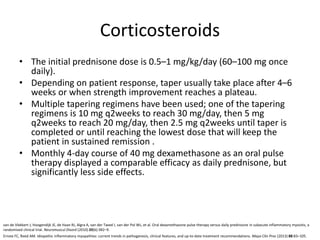
Corticosteroids
• The initial prednisone dose is 0.5–1 mg/kg/day (60–100 mg once
daily).
• Depending on patient response, taper usually take place after 4–6
weeks or when strength improvement reaches a plateau.
• Multiple tapering regimens have been used; one of the tapering
regimens is 10 mg q2weeks to reach 30 mg/day, then 5 mg
q2weeks to reach 20 mg/day, then 2.5 mg q2weeks until taper is
completed or until reaching the lowest dose that will keep the
patient in sustained remission .
• Monthly 4-day course of 40 mg dexamethasone as an oral pulse
therapy displayed a comparable efficacy as daily prednisone, but
significantly less side effects.
Ernste FC, Reed AM. Idiopathic inflammatory myopathies: current trends in pathogenesis, clinical features, and up-to-date treatment recommendations. Mayo Clin Proc (2013) 88:83–105.
van de Vlekkert J, Hoogendijk JE, de Haan RJ, Algra A, van der Tweel I, van der Pol WL, et al. Oral dexamethasone pulse therapy versus daily prednisone in subacute inflammatory myositis, a
randomised clinical trial. Neuromuscul Disord (2010) 20(6):382–9.
Other Medications
• Methotrexate
• Azathioprine
• Mycophenolate mofetil
Malik, A., Hayat, G., Kalia, J. S., & Guzman, M. A. (2016). Idiopathic inflammatory myopathies: clinical approach and management. Frontiers in neurology, 7, 64.
Treatment Approach for Severe or
Refractory Disease
• Intravenous Methylprednisone
• Intravenous Immunoglobulin
• Rituximab
• Cyclophosphamide
• CyclosporineA (CSA) and tacrolimus
• Tumor necrosis factor alpha (TNF-a) blockers
like infliximab and etanercept
Malik, A., Hayat, G., Kalia, J. S., & Guzman, M. A. (2016). Idiopathic inflammatory myopathies: clinical approach and management. Frontiers in neurology, 7, 64.
Emerging Therapies
• Anakinra
• Alemtuzumab
• Belimumab
• Sifalimumab
Malik, A., Hayat, G., Kalia, J. S., & Guzman, M. A. (2016). Idiopathic inflammatory myopathies: clinical approach and management. Frontiers in neurology, 7, 64.
Management of Skin Disease
• Avoid UV rays
• Topical steroids and tacrolimus
• Hydrochloroquine
Yoshimasu T, Ohtani T, Sakamoto T, Oshima A, Furukawa F. Topical FK506 (tacrolimus) therapy for facial erythematous lesions of cutaneous lupus erythematosus and dermatomyositis. Eur J
Dermatol (2002) 12(1):50–2.
Marmor MF, Kellner U, Lai TY, Lyons JS, Mieler WF, American Academy of Ophthalmology. Revised recommendations on screening for chloroquine and hydroxychloroquine retinopathy.
Ophthalmology (2011) 118(2):415–22.
Management of Calcinosis
• Diltiazem
• Abatacept
• Sodium thiosulfate
• Surgical
Balin SJ, Wetter DA, Andersen LK, Davis MD. Calcinosis cutis occurring in association with autoimmune connective tissue disease: the Mayo Clinic experience with 78 patients, 1996-2009. Arch
Dermatol (2012) 148(4):455–62.
Arabshahi B, Silverman RA, Jones OY, Rider LG. Abatacept and sodium thiosulfate for treatment of recalcitrant juvenile dermatomyositis complicated by ulceration and calcinosis. J Pediatr
(2012) 160(3):520–2.
Summary

Idiopathic Inflammatory Myopathies

  • 1.
  • 2.
    Muscle weakness Muscle Enzyme elevations Inflammation on muscle biopsy Extra muscular manifestations DalakasMC. Polymyositis, dermatomyositis, and inclusion-body myositis. N Engl J Med (1991) 325(21):1487–98. Dalakas MC, Hohlfeld R. Polymyositis and dermatomyositis. Lancet (2003) 362(9388):971–82.
  • 3.
    Classification Polymyositis (PM) Dermatomyositis (DM) Necrotizing Autoimmune Myopathy (NAM) Sporadic Inclusion Body Myositis(sIBM) Sigurgeirsson B, Lindelof B, Edhag O, Allander E. Risk of cancer in patients with dermatomyositis or polymyositis. A population-based study. N Engl J Med (1992) 326(6):363–7 Callen JP. Relationship of cancer to inflammatory muscle diseases. Dermatomyositis, polymyositis, and inclusion body myositis. Rheum Dis Clin North Am (1994) 20(0889–857X):943–53.
  • 4.
    Dalakas MC, HohlfeldR. Polymyositis and dermatomyositis. Lancet (2003) 362(9388):971–82 Bohan A, Peter JB. Polymyositis and dermatomyositis (first of two parts). N Engl J Med (1975) 292(7):344–7. Bohan A, Peter JB. Polymyositis and dermatomyositis (second of two parts). N Engl J Med (1975) 292(8):403–7.
  • 5.
    Rose MR, ENMCIBM Working Group. 188th ENMC International Workshop: Inclusion Body Myositis, 2–4 December 2011, Naarden, The Netherlands. Neuromuscul Disord (2013) 23(12):1044–55.
  • 6.
    Epidemiology • US: Theincidence and prevalence of DM is 1.4 and 5.8 cases per 100,000 persons (F; older) • US: The incidence and prevalence of PM is 3.8 and 9.7 cases per 100,000 persons (overdiagnosed?) • NAM represented 19% of the IIM, while DM and non-specific myositis accounted for 36 and 39% • The prevalence of sIBM in Australia is 9.3 per million people in the general population and 51.3 per million in people over 50 years, with a male preponderance Furst DE, Amato AA, Iorga SR, Gajria K, Fernandes AW. Epidemiology of adult idiopathic inflammatory myopathies in a U.S. Managed care plan. Muscle Nerve (2012) 45(5):676–83. van der Meulen MFG, Bronner IM, Hoogendijk JE, Burger H, van Venrooij WJ, Voskuyl AE, et al. Polymyositis: an overdiagnosed entity. Neurology (2003) 61(3):316–21. Needham M, Corbett A, Day T, Christiansen F, Fabian V, Mastaglia FL. Prevalence of sporadic inclusion body myositis and factors contributing to delayed diagnosis. J Clin Neurosci (2008) 15(12):1350–3. Benveniste O, Guiguet M, Freebody J, Dubourg O, Squier W, Maisonobe T, et al. Long-term observational study of sporadic inclusion body myositis. Brain (2011) 134(11):3176–84.
  • 7.
  • 8.
    Dermatomyositis • Acute orinsidiously progressive proximal weakness + skin rash • Some patients develop dyspnea related to Interstitial lung disease or ventilatory muscle weakness, dysphagia due to esophageal or pharyngeal involvement, congestive heart failure or arrhythmia from myocarditis, and gastrointestinal bleeding due to vasculopathy of the gut. Hochberg MC, Feldman D, Stevens MB. Adult onset polymyositis/dermatomyositis: an analysis of clinical and laboratory features and survival in 76 patients with a review of the literature. Semin Arthritis Rheum (1986) 5(3):168–78 Amato AA, Barohn RJ. Idiopathic inflammatory myopathies. Neurol Clin (1997) 15(3):615–48. Sontheimer RD. Cutaneous features of classic dermatomyositis and amyopathic dermatomyositis. Curr Opin Rheumatol (1999) 11(6):475–82.
  • 9.
    Dermatomyositis Skin rash: - Erythematous,photosensitive rash on the neck, back, and shoulders (shawl sign) - Malar and facial erythema along with purplish discoloration of eyelids (heliotrope rash) that is often associated with periorbital edema - Erythematous lichenoid papular scaly rash over the knuckles (Gottron’s papules) - Rash may affect the anterior chest (V-sign) and the volar aspect of hands (inverse Gottron’s papules). - Dilated capillary loops at the nail beds with periungual telangiectasias - Thickened, cracked skin on the dorsal and ventral surfaces of the hands (mechanic’s hands) in which case it is more often than not associated with the “antisynthetase syndrome.” Hochberg MC, Feldman D, Stevens MB. Adult onset polymyositis/dermatomyositis: an analysis of clinical and laboratory features and survival in 76 patients with a review of the literature. Semin Arthritis Rheum (1986) 5(3):168–78 Amato AA, Barohn RJ. Idiopathic inflammatory myopathies. Neurol Clin (1997) 15(3):615–48. Sontheimer RD. Cutaneous features of classic dermatomyositis and amyopathic dermatomyositis. Curr Opin Rheumatol (1999) 11(6):475–82.
  • 10.
    Malik, A., Hayat,G., Kalia, J. S., & Guzman, M. A. (2016). Idiopathic inflammatory myopathies: clinical approach and management. Frontiers in neurology, 7, 64.
  • 11.
    Malik, A., Hayat,G., Kalia, J. S., & Guzman, M. A. (2016). Idiopathic inflammatory myopathies: clinical approach and management. Frontiers in neurology, 7, 64.
  • 12.
    Dermatomyositis • Dermatomyositis maypresent by itself or be a part of other syndromes, e.g., antisynthetase syndrome and overlap syndromes • Antisynthetase syndrome is the constellation of Raynaud’s phenomenon, arthritis, and ILD. It presents with mechanic’s hands (as mentioned above). It is characterized by the presence of antibodies to aminoacyl transfer ribonucleic acid (RNA) synthetases • Overlap syndrome is an entity that satisfies criteria of at least two connective tissue diseases most notably systemic sclerosis, PM/DM, Sjogrens syndrome, and SLE. Chatterjee S, Prayson R, Farver C. Antisynthetase syndrome: not just an inflammatory myopathy. Cleve Clin J Med (2013) 80(10):655–66. Balbir-Gurman A, Braun-Moscovici Y. Scleroderma overlap syndrome. Isr Med Assoc J (2011) 13(1):14–20. Vancsa A, Gergely L, Ponyi A, Lakos G, Németh J, Szodoray P, et al. Myositis-specific and myositis-associated antibodies in overlap myositis in comparison to primary dermatopolymyositis: relevance for clinical classification: retrospective study of 169 patients. Jt Bone Spine (2010) 77(2):125–30.
  • 13.
    Dermatomyositis • Ammyopathic DM:cutaneous manifestations without the muscle involvement • Adermatopathic DM: isolated myositis and has pathological features of DM on muscle biopsy • Juvenile DM: affects children <18 years of age; commonly presents after a febrile episode and skin rash. Multisystem involvement is common in JDM and is associated with calcinosis cutis and vasculopathy affecting the gastrointestinal tract. The presence of calcinosis cutis suggests active disease in JDM and may be associated with delay to diagnosis and treatment. Classically, calcinosis is found at the subcutaneous level, but it may be seen intramuscularly Euwer RL, Sontheimer RD. Amyopathic dermatomyositis: a review. J Invest Dermatol (1993) 100(1):124S–7S. Rider LG, Miller FW. Classification and treatment of the juvenile idiopathic inflammatory myopathies. Rheum Dis Clin North Am (1997) 23:619–55. Lorenzoni PJ, Scola RH, Kay CSK, Prevedello PG, Espindola G, Werneck LC. Idiopathic inflammatory myopathies in childhood: a brief review of 27 cases. Pediatr Neurol (2011) 45(1):17–22. Pachman LM, Hayford JR, Chung A, Daugherty CA, Pallansch MA, Fink CW, et al. Juvenile dermatomyositis at diagnosis: clinical characteristics of 79 children. J Rheumatol (1998) 25(6):1198–204.
  • 14.
    Polymyositis • A rareentity and an exclusionary diagnosis • DM without rash • It usually manifests in adults, more commonly in women, over the age of 20 years • It presents typically with progressive neck flexor and symmetric proximal limb muscle weakness, which develops over weeks to months. • Myalgia and tenderness • Dysphagia occurs in one-third of patients. • The most common extra muscular involvement is ILD and myocarditis. Malik, A., Hayat, G., Kalia, J. S., & Guzman, M. A. (2016). Idiopathic inflammatory myopathies: clinical approach and management. Frontiers in neurology, 7, 64.
  • 15.
    Necrotizing Autoimmune Myopathy •An adult onset subacute, progressive proximal muscle weakness without a rash. • Weakness generally develops more rapidly than PM, and is markedly severe • There may be associated myalgias and dysphagia. • CK is usually higher than seen with other IIM • NAM is thought to be immune mediated with a trigger such as drugs • Paraneoplastic-necrotizing myopathy, which is a severe and rapidly progressive disease that affects adults over the age of 40. Malik, A., Hayat, G., Kalia, J. S., & Guzman, M. A. (2016). Idiopathic inflammatory myopathies: clinical approach and management. Frontiers in neurology, 7, 64.
  • 16.
    Necrotizing Autoimmune Myopathy •Necrotizing myopathy with pipestem capillaries affects a similar age group and is associated with sub-acute weakness, brain infarction due to vasculitis, or connective tissue disease • Signal recognition particle (SRP) autoantibodies affect younger NAM patients, women more than men. It results in fulminant weakness and congestive heart failure. • Statin-induced autoimmune NAM (SANAM) affects individuals between 46 and 89 years of age. The onset may be delayed up to 10 years following statin initiation and may occur several months after statin discontinuation Dimachkie MM, Barohn RJ. Idiopathic inflammatory myopathies. Semin Neurol (2012) 32(3):227–36. Grable-Esposito P, Katzberg HD, Greenberg SA, Srinivasan J, Katz J, Amato AA. Immune-mediated necrotizing myopathy associated with statins. Muscle Nerve (2010) 41(2):185–90.
  • 17.
    Sporadic Inclusion BodyMyositis • Presents in-patients over the age of 40 years, with a male to female ratio of 3:1 • Insidious over several years • Proximal + distal (symmetric or asymmetric) • The weakness starts in flexor forearm muscles in two-thirds of patients along with significant atrophy, particularly the deep finger flexors • The quadriceps and anterior tibial muscles are also affected early in IBM leading to tripping and falling. • Dysphagia is very common in sIBM and may be the presenting feature • Mild facial weakness Malik, A., Hayat, G., Kalia, J. S., & Guzman, M. A. (2016). Idiopathic inflammatory myopathies: clinical approach and management. Frontiers in neurology, 7, 64.
  • 18.
  • 19.
    Laboratory • Serum CreatineKinase • Other muscle enzymes include lactate dehydrogenase (LDH), aspartate aminotransferase (AST), alanine aminotransferase (ALT), and aldolase levels; Aldolase can be selectively high in myositis with perimysial pathology • Myosities specific antibodies • Connective Tissue Disease Autoantibodies. The presence of these antibodies suggests that the myopathy may be secondary to a connective tissue disease (overlap syndrome). Antinuclear antibodies (ANA) are detected in 24–60% of DM, 16– 40% of PM, and in as many as 20% of patients with IBM. Anti- Ro(SSA) and Anti-La(SSB), anti-Smith, anti-RNP, anti-Scl70, and anti- centromere antibodies should be also checked. Malik, A., Hayat, G., Kalia, J. S., & Guzman, M. A. (2016). Idiopathic inflammatory myopathies: clinical approach and management. Frontiers in neurology, 7, 64.
  • 20.
    Other Diagnostic Evaluations •Screening for Malignancy • Electrophysiology • Skeletal Muscle Imaging • Histopathology Malik, A., Hayat, G., Kalia, J. S., & Guzman, M. A. (2016). Idiopathic inflammatory myopathies: clinical approach and management. Frontiers in neurology, 7, 64.
  • 21.
  • 22.
    Corticosteroids • The initialprednisone dose is 0.5–1 mg/kg/day (60–100 mg once daily). • Depending on patient response, taper usually take place after 4–6 weeks or when strength improvement reaches a plateau. • Multiple tapering regimens have been used; one of the tapering regimens is 10 mg q2weeks to reach 30 mg/day, then 5 mg q2weeks to reach 20 mg/day, then 2.5 mg q2weeks until taper is completed or until reaching the lowest dose that will keep the patient in sustained remission . • Monthly 4-day course of 40 mg dexamethasone as an oral pulse therapy displayed a comparable efficacy as daily prednisone, but significantly less side effects. Ernste FC, Reed AM. Idiopathic inflammatory myopathies: current trends in pathogenesis, clinical features, and up-to-date treatment recommendations. Mayo Clin Proc (2013) 88:83–105. van de Vlekkert J, Hoogendijk JE, de Haan RJ, Algra A, van der Tweel I, van der Pol WL, et al. Oral dexamethasone pulse therapy versus daily prednisone in subacute inflammatory myositis, a randomised clinical trial. Neuromuscul Disord (2010) 20(6):382–9.
  • 23.
    Other Medications • Methotrexate •Azathioprine • Mycophenolate mofetil Malik, A., Hayat, G., Kalia, J. S., & Guzman, M. A. (2016). Idiopathic inflammatory myopathies: clinical approach and management. Frontiers in neurology, 7, 64.
  • 24.
    Treatment Approach forSevere or Refractory Disease • Intravenous Methylprednisone • Intravenous Immunoglobulin • Rituximab • Cyclophosphamide • CyclosporineA (CSA) and tacrolimus • Tumor necrosis factor alpha (TNF-a) blockers like infliximab and etanercept Malik, A., Hayat, G., Kalia, J. S., & Guzman, M. A. (2016). Idiopathic inflammatory myopathies: clinical approach and management. Frontiers in neurology, 7, 64.
  • 25.
    Emerging Therapies • Anakinra •Alemtuzumab • Belimumab • Sifalimumab Malik, A., Hayat, G., Kalia, J. S., & Guzman, M. A. (2016). Idiopathic inflammatory myopathies: clinical approach and management. Frontiers in neurology, 7, 64.
  • 26.
    Management of SkinDisease • Avoid UV rays • Topical steroids and tacrolimus • Hydrochloroquine Yoshimasu T, Ohtani T, Sakamoto T, Oshima A, Furukawa F. Topical FK506 (tacrolimus) therapy for facial erythematous lesions of cutaneous lupus erythematosus and dermatomyositis. Eur J Dermatol (2002) 12(1):50–2. Marmor MF, Kellner U, Lai TY, Lyons JS, Mieler WF, American Academy of Ophthalmology. Revised recommendations on screening for chloroquine and hydroxychloroquine retinopathy. Ophthalmology (2011) 118(2):415–22.
  • 27.
    Management of Calcinosis •Diltiazem • Abatacept • Sodium thiosulfate • Surgical Balin SJ, Wetter DA, Andersen LK, Davis MD. Calcinosis cutis occurring in association with autoimmune connective tissue disease: the Mayo Clinic experience with 78 patients, 1996-2009. Arch Dermatol (2012) 148(4):455–62. Arabshahi B, Silverman RA, Jones OY, Rider LG. Abatacept and sodium thiosulfate for treatment of recalcitrant juvenile dermatomyositis complicated by ulceration and calcinosis. J Pediatr (2012) 160(3):520–2.
  • 28.