EPIDURAL BLOOD PATCH
Ade Wijaya, May 2023
INTRODUCTION
 For treatment of CSF leakage
 Conservative treatments: bedrest, analgesics,
NSAIDs, hydration, intravenous (IV) caffeine, or
consumption of caffeinated products
 Epidural blood patch effective with approximately
85% success rate. EBP may be repeated and is
reported to have a 90% success rate
 In rare refractory instances, surgical exploration
and placement of fat graft may be considered
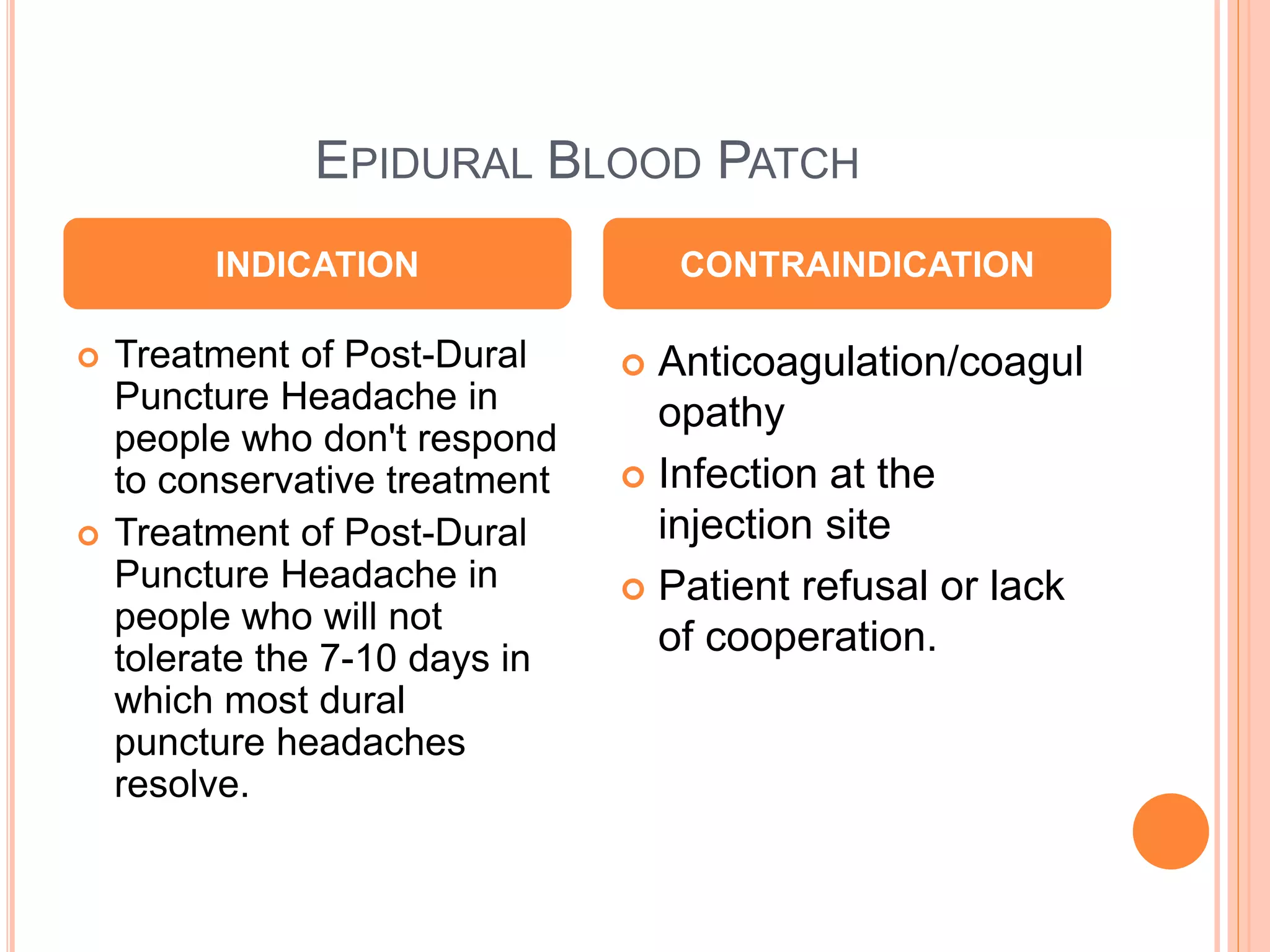
EPIDURAL BLOOD PATCH
 Treatment of Post-Dural
Puncture Headache in
people who don't respond
to conservative treatment
 Treatment of Post-Dural
Puncture Headache in
people who will not
tolerate the 7-10 days in
which most dural
puncture headaches
resolve.
 Anticoagulation/coagul
opathy
 Infection at the
injection site
 Patient refusal or lack
of cooperation.
INDICATION CONTRAINDICATION
EQUIPMENT AND PERSONNELS
 Equipments: a standard epidural kit and an 18-
gauge or 20-gauge angiocatheter
 Personnels : 3 persons
- Operator
- Second operator for a sterile blood draw and,
possibly
- A third assistant to help with patient positioning.
PROCEDURE
 Lateral or seated position, preferably lateral to prevent
symptoms of PDPH
 The back injection site, either from previous dural
puncture or a vertebral interspace one above or below,
is sterilely prepped and draped as well as the extremity
from which blood is to be drawn
 The epidural space is identified in the standard fashion
using loss-of-resistance to air or saline. In particularly
difficult instances the use of C-arm radiography or
ultrasound guidance may be used
 Approximately (5-25 mL) of autologous blood is drawn
from the patient in a sterile fashion. The blood is injected
slowly (30 to 60 seconds) to create a blood patch.
COMPLICATIONS
 Failure in 15-20 % procedures
 Worsening of PDPH by inadvertently creating
additional dural rent(s)
 Back pain. Mild to moderate back pain is commonly
reported. This is self-limited, generally resolving in
days and preferable to the discomfort of a PDPH
 Infection at the injection site: fever, malaise,
erythema, or purulence as injected blood may serve
as a nidus for infection.
SUMMARY
 Epidural blood patch effective for PDPH treatment
 Treatment of Post-Dural Puncture Headache in
people who don't respond to conservative treatment
and in people who will not tolerate the 7-10 days in
which most dural puncture headaches resolve
THANK YOU

Epidural Blood Patch.pptx

  • 1.
    EPIDURAL BLOOD PATCH AdeWijaya, May 2023
  • 2.
    INTRODUCTION  For treatmentof CSF leakage  Conservative treatments: bedrest, analgesics, NSAIDs, hydration, intravenous (IV) caffeine, or consumption of caffeinated products  Epidural blood patch effective with approximately 85% success rate. EBP may be repeated and is reported to have a 90% success rate  In rare refractory instances, surgical exploration and placement of fat graft may be considered
  • 3.
    EPIDURAL BLOOD PATCH Treatment of Post-Dural Puncture Headache in people who don't respond to conservative treatment  Treatment of Post-Dural Puncture Headache in people who will not tolerate the 7-10 days in which most dural puncture headaches resolve.  Anticoagulation/coagul opathy  Infection at the injection site  Patient refusal or lack of cooperation. INDICATION CONTRAINDICATION
  • 4.
    EQUIPMENT AND PERSONNELS Equipments: a standard epidural kit and an 18- gauge or 20-gauge angiocatheter  Personnels : 3 persons - Operator - Second operator for a sterile blood draw and, possibly - A third assistant to help with patient positioning.
  • 5.
    PROCEDURE  Lateral orseated position, preferably lateral to prevent symptoms of PDPH  The back injection site, either from previous dural puncture or a vertebral interspace one above or below, is sterilely prepped and draped as well as the extremity from which blood is to be drawn  The epidural space is identified in the standard fashion using loss-of-resistance to air or saline. In particularly difficult instances the use of C-arm radiography or ultrasound guidance may be used  Approximately (5-25 mL) of autologous blood is drawn from the patient in a sterile fashion. The blood is injected slowly (30 to 60 seconds) to create a blood patch.
  • 6.
    COMPLICATIONS  Failure in15-20 % procedures  Worsening of PDPH by inadvertently creating additional dural rent(s)  Back pain. Mild to moderate back pain is commonly reported. This is self-limited, generally resolving in days and preferable to the discomfort of a PDPH  Infection at the injection site: fever, malaise, erythema, or purulence as injected blood may serve as a nidus for infection.
  • 7.
    SUMMARY  Epidural bloodpatch effective for PDPH treatment  Treatment of Post-Dural Puncture Headache in people who don't respond to conservative treatment and in people who will not tolerate the 7-10 days in which most dural puncture headaches resolve
  • 8.