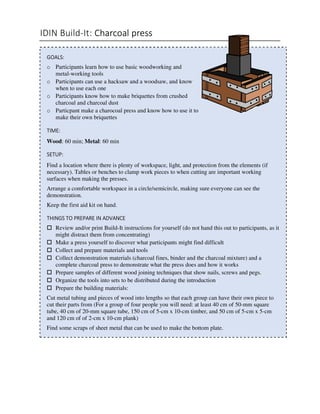
IDIN Build-It: Charcoal press
GOALS:
o Participants learn how to use basic woodworking and
metal-working tools
o Participants can use a hacksaw and a woodsaw, and know
when to use each one
o Participants know how to make briquettes from crushed
charcoal and charcoal dust
o Particpant make a charocoal press and know how to use it to
make their own briquettes
TIME:
Wood: 60 min; Metal: 60 min
SETUP:
Find a location where there is plenty of workspace, light, and protection from the elements (if
necessary). Tables or benches to clamp work pieces to when cutting are important working
surfaces when making the presses.
Arrange a comfortable workspace in a circle/semicircle, making sure everyone can see the
demonstration.
Keep the first aid kit on hand.
THINGS TO PREPARE IN ADVANCE
Review and/or print Build-It instructions for yourself (do not hand this out to participants, as it
might distract them from concentrating)
Make a press yourself to discover what participants might find difficult
Collect and prepare materials and tools
Collect demonstration materials (charcoal fines, binder and the charcoal mixture) and a
complete charcoal press to demonstrate what the press does and how it works
Prepare samples of different wood joining techniques that show nails, screws and pegs.
Organize the tools into sets to be distributed during the introduction
Prepare the building materials:
Cut metal tubing and pieces of wood into lengths so that each group can have their own piece to
cut their parts from (For a group of four people you will need: at least 40 cm of 50-mm square
tube, 40 cm of 20-mm square tube, 150 cm of 5-cm x 10-cm timber, and 50 cm of 5-cm x 5-cm
and 120 cm of of 2-cm x 10-cm plank)
Find some scraps of sheet metal that can be used to make the bottom plate.
2014-04-1 2
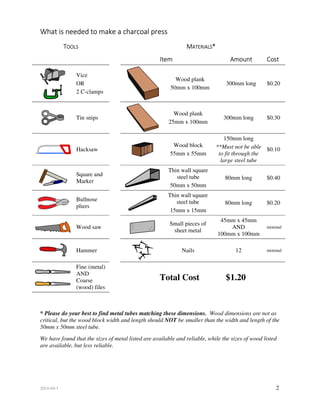
What is needed to make a charcoal press
TOOLS MATERIALS*
Item Amount Cost
Vice
OR
2 C-clamps
Wood plank
50mm x 100mm
300mm long $0.20
Tin snips
Wood plank
25mm x 100mm
300mm long $0.30
Hacksaw
Wood block
55mm x 55mm
150mm long
**Must not be able
to fit through the
large steel tube
$0.10
Square and
Marker
Thin wall square
steel tube
50mm x 50mm
80mm long $0.40
Bullnose
pliers
Thin wall square
steel tube
15mm x 15mm
80mm long $0.20
Wood saw
Small pieces of
sheet metal
45mm x 45mm
AND
100mm x 100mm
minimal
Hammer Nails 12 minimal
Fine (metal)
AND
Coarse
(wood) files
Total Cost $1.20
* Please do your best to find metal tubes matching these dimensions. Wood dimensions are not as
critical, but the wood block width and length should NOT be smaller than the width and length of the
50mm x 50mm steel tube.
We have found that the sizes of metal listed are available and reliable, while the sizes of wood listed
are available, but less reliable.
2014-04-1 3
1. What is a Build-It?
A Build-It is a lesson where people make a small technology and learn some workshop skills.
Everyone will build together, step by step. As you build the technology, you will learn good
techniques for handling metal and wood. Each member will have an opportunity to learn these
hands-on skills by using some tools and materials. At the end of the Build-It, you will have had
some practice using tools and also have a technology for you to take home.
2. What is a charcoal press?
Charcoal dust is in plenty in places where charcoal is made and sold. This dust, when mixed with
a cassava porridge, can be formed into charcoal briquettes. The charcoal dust is no longer wasted,
but recovered and used as a fuel.
Some people currently make charcoal briquettes by hand, but these briquettes are very weak and
don't burn for long. This charcoal press makes very strong briquettes from the charcoal dust
mixture. After the briquettes are dried in the sun, they are ready for use as an effective cooking
fuel.
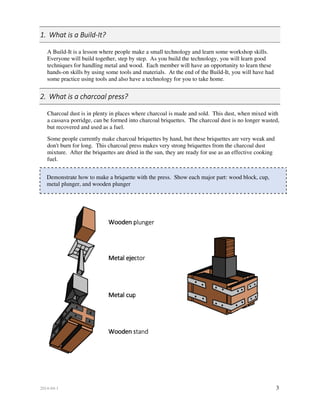
Demonstrate how to make a briquette with the press. Show each major part: wood block, cup,
metal plunger, and wooden plunger
Wooden plunger
Metal ejector
Metal cup
Wooden stand
2014-04-1 4
3. Setting up the Build-It
ENCOURAGE PARTICIPANTS TO ENGAGE FULLY
• Ask, “Why?” “Where?” “What?” “How?” at any time during the session
• Engage everyone in the building activities and be sure that each person in the group can both
observe and participate in learning and doing all of the different techniques
DIVIDE INTO PAIRS AND INTRODUCE THE STATIONS
• Half of the pairs will make the wooden base with one facilitator; the other half of the pairs will
make the metal pieces with the other facilitator. Then, the pairs will switch and those who were
making the wooden base will make the metal pieces, and vice versa.
• Single-gender pairings often work best for allowing all members of the group to participate
evenly. Explain which tools need to be shared by the larger group, and where they will be
located.
2014-04-1 5
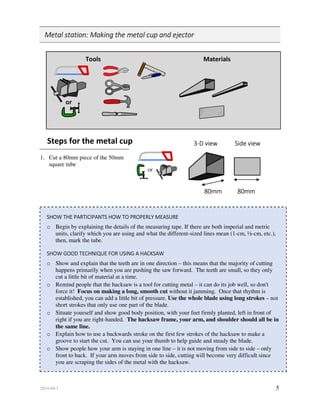
Metal station: Making the metal cup and ejector
Tools Materials
or
Steps for the metal cup
1. Cut a 80mm piece of the 50mm
square tube
SHOW THE PARTICIPANTS HOW TO PROPERLY MEASURE
o Begin by explaining the details of the measuring tape. If there are both imperial and metric
units, clarify which you are using and what the different-sized lines mean (1-cm, ½-cm, etc.),
then, mark the tube.
SHOW GOOD TECHNIQUE FOR USING A HACKSAW
o Show and explain that the teeth are in one direction – this means that the majority of cutting
happens primarily when you are pushing the saw forward. The teeth are small, so they only
cut a little bit of material at a time.
o Remind people that the hacksaw is a tool for cutting metal – it can do its job well, so don't
force it! Focus on making a long, smooth cut without it jamming. Once that rhythm is
established, you can add a little bit of pressure. Use the whole blade using long strokes – not
short strokes that only use one part of the blade.
o Situate yourself and show good body position, with your feet firmly planted, left in front of
right if you are right-handed. The hacksaw frame, your arm, and shoulder should all be in
the same line.
o Explain how to use a backwards stroke on the first few strokes of the hacksaw to make a
groove to start the cut. You can use your thumb to help guide and steady the blade.
o Show people how your arm is staying in one line – it is not moving from side to side – only
front to back. If your arm moves from side to side, cutting will become very difficult since
you are scraping the sides of the metal with the hacksaw.
3-D view Side view
80mm 80mm
or
2014-04-1 6
WALK AROUND TO FACILITATE SHARING AND PROPER HACKSAW USE
o Reiterate the dimensions by using the measuring tape as a reference. Continue to demonstrate
how to use the measuring tape with precision as you explain the dimensions.
o Walk around to ensure each participant has used the hacksaw.
o As you walk around, make sure everyone is using the correct units and marking their pieces
accurately.
o It may be necessary to have teams share lengths of metal and/or hacksaws.
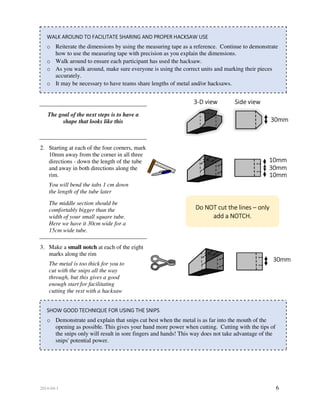
The goal of the next steps is to have a
shape that looks like this
2. Starting at each of the four corners, mark
10mm away from the corner in all three
directions - down the length of the tube
and away in both directions along the
rim.
You will bend the tabs 1 cm down
the length of the tube later
The middle section should be
comfortably bigger than the
width of your small square tube.
Here we have it 30cm wide for a
15cm wide tube.
3. Make a small notch at each of the eight
marks along the rim
The metal is too thick for you to
cut with the snips all the way
through, but this gives a good
enough start for facilitating
cutting the rest with a hacksaw
SHOW GOOD TECHNIQUE FOR USING THE SNIPS
o Demonstrate and explain that snips cut best when the metal is as far into the mouth of the
opening as possible. This gives your hand more power when cutting. Cutting with the tips of
the snips only will result in sore fingers and hands! This way does not take advantage of the
snips' potential power.
3-D view Side view
Do NOT cut the lines – only
add a NOTCH.
30mm
30mm
10mm
10mm
30mm
2014-04-1 7
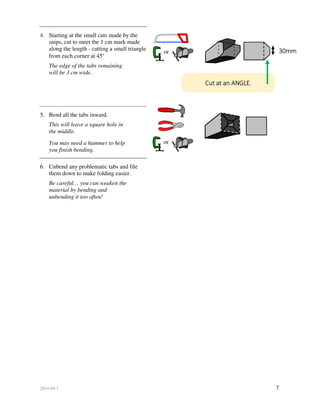
4. Starting at the small cuts made by the
snips, cut to meet the 1 cm mark made
along the length - cutting a small triangle
from each corner at 45°
The edge of the tabs remaining
will be 3 cm wide.
5. Bend all the tabs inward.
This will leave a square hole in
the middle.
You may need a hammer to help
you finish bending.
6. Unbend any problematic tabs and file
them down to make folding easier.
Be careful… you can weaken the
material by bending and
unbending it too often!
Cut at an ANGLE.
30mm
or
or
2014-04-1 8
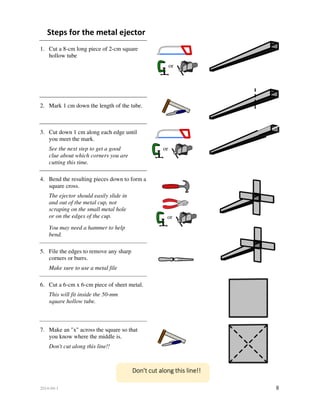
Steps for the metal ejector
1. Cut a 8-cm long piece of 2-cm square
hollow tube
2. Mark 1 cm down the length of the tube.
3. Cut down 1 cm along each edge until
you meet the mark.
See the next step to get a good
clue about which corners you are
cutting this time.
4. Bend the resulting pieces down to form a
square cross.
The ejector should easily slide in
and out of the metal cup, not
scraping on the small metal hole
or on the edges of the cup.
You may need a hammer to help
bend.
5. File the edges to remove any sharp
corners or burrs.
Make sure to use a metal file
6. Cut a 6-cm x 6-cm piece of sheet metal.
This will fit inside the 50-mm
square hollow tube.
7. Make an "x" across the square so that
you know where the middle is.
Don't cut along this line!!
or
Don't cut along this line!!
or
or
2014-04-1 9
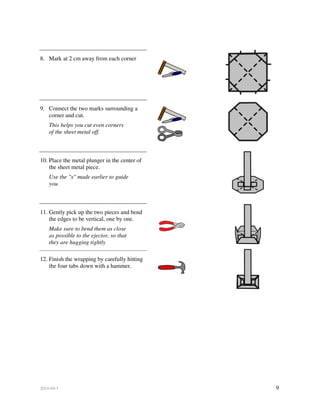
8. Mark at 2 cm away from each corner
9. Connect the two marks surrounding a
corner and cut.
This helps you cut even corners
of the sheet metal off.
10. Place the metal plunger in the center of
the sheet metal piece.
Use the "x" made earlier to guide
you.
11. Gently pick up the two pieces and bend
the edges to be vertical, one by one.
Make sure to bend them as close
as possible to the ejector, so that
they are hugging tightly
12. Finish the wrapping by carefully hitting
the four tabs down with a hammer.
2014-04-1 10
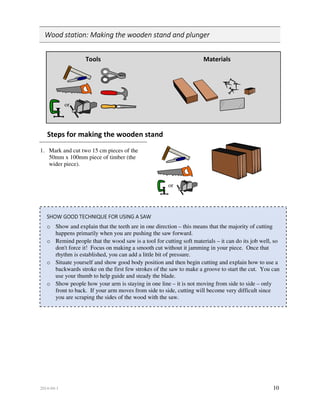
Wood station: Making the wooden stand and plunger
Tools Materials
Steps for making the wooden stand
1. Mark and cut two 15 cm pieces of the
50mm x 100mm piece of timber (the
wider piece).
SHOW GOOD TECHNIQUE FOR USING A SAW
o Show and explain that the teeth are in one direction – this means that the majority of cutting
happens primarily when you are pushing the saw forward.
o Remind people that the wood saw is a tool for cutting soft materials – it can do its job well, so
don't force it! Focus on making a smooth cut without it jamming in your piece. Once that
rhythm is established, you can add a little bit of pressure.
o Situate yourself and show good body position and then begin cutting and explain how to use a
backwards stroke on the first few strokes of the saw to make a groove to start the cut. You can
use your thumb to help guide and steady the blade.
o Show people how your arm is staying in one line – it is not moving from side to side – only
front to back. If your arm moves from side to side, cutting will become very difficult since
you are scraping the sides of the wood with the saw.
or
or
2014-04-1 11
WALK AROUND TO FACILITATE SHARING AND PROPER WOOD SAW USE
o As you walk around, make sure everyone is using the correct units and marking their pieces
accurately.
o Reiterate the dimensions by using the measuring tape as a reference. Continue to demonstrate
how to use the measuring tape with precision as you explain the dimensions.
o Walk around to ensure each participant has used the saw.
o It may be necessary to have teams share lengths of wood and/or saws.
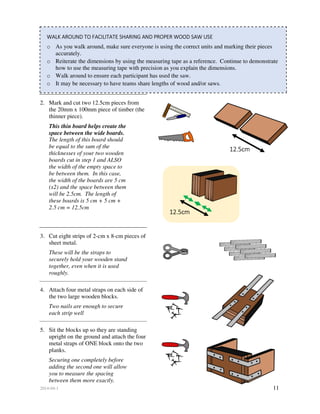
2. Mark and cut two 12.5cm pieces from
the 20mm x 100mm piece of timber (the
thinner piece).
This thin board helps create the
space between the wide boards.
The length of this board should
be equal to the sum of the
thicknesses of your two wooden
boards cut in step 1 and ALSO
the width of the empty space to
be between them. In this case,
the width of the boards are 5 cm
(x2) and the space between them
will be 2.5cm. The length of
these boards is 5 cm + 5 cm +
2.5 cm = 12.5cm
3. Cut eight strips of 2-cm x 8-cm pieces of
sheet metal.
These will be the straps to
securely hold your wooden stand
together, even when it is used
roughly.
4. Attach four metal straps on each side of
the two large wooden blocks.
Two nails are enough to secure
each strip well
5. Sit the blocks up so they are standing
upright on the ground and attach the four
metal straps of ONE block onto the two
planks.
Securing one completely before
adding the second one will allow
you to measure the spacing
between them more exactly.
12.5cm
12.5cm
2014-04-1 12
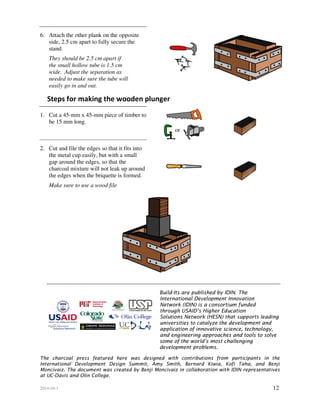
6. Attach the other plank on the opposite
side, 2.5 cm apart to fully secure the
stand.
They should be 2.5 cm apart if
the small hollow tube is 1.5 cm
wide. Adjust the separation as
needed to make sure the tube will
easily go in and out.
Steps for making the wooden plunger
1. Cut a 45-mm x 45-mm piece of timber to
be 15 mm long.
2. Cut and file the edges so that it fits into
the metal cup easily, but with a small
gap around the edges, so that the
charcoal mixture will not leak up around
the edges when the briquette is formed.
Make sure to use a wood file
Build-Its are published by IDIN. The
International Development Innovation
Network (IDIN) is a consortium funded
through USAID’s Higher Education
Solutions Network (HESN) that supports leading
universities to catalyze the development and
application of innovative science, technology,
and engineering approaches and tools to solve
some of the world’s most challenging
development problems.
The charcoal press featured here was designed with contributions from participants in the
International Development Design Summit, Amy Smith, Bernard Kiwia, Kofi Taha, and Benji
Moncivaiz. The document was created by Benji Moncivaiz in collaboration with IDIN representatives
at UC-Davis and Olin College.
or

Build-It: Charcoal press

  • 1.
    IDIN Build-It: Charcoalpress GOALS: o Participants learn how to use basic woodworking and metal-working tools o Participants can use a hacksaw and a woodsaw, and know when to use each one o Participants know how to make briquettes from crushed charcoal and charcoal dust o Particpant make a charocoal press and know how to use it to make their own briquettes TIME: Wood: 60 min; Metal: 60 min SETUP: Find a location where there is plenty of workspace, light, and protection from the elements (if necessary). Tables or benches to clamp work pieces to when cutting are important working surfaces when making the presses. Arrange a comfortable workspace in a circle/semicircle, making sure everyone can see the demonstration. Keep the first aid kit on hand. THINGS TO PREPARE IN ADVANCE Review and/or print Build-It instructions for yourself (do not hand this out to participants, as it might distract them from concentrating) Make a press yourself to discover what participants might find difficult Collect and prepare materials and tools Collect demonstration materials (charcoal fines, binder and the charcoal mixture) and a complete charcoal press to demonstrate what the press does and how it works Prepare samples of different wood joining techniques that show nails, screws and pegs. Organize the tools into sets to be distributed during the introduction Prepare the building materials: Cut metal tubing and pieces of wood into lengths so that each group can have their own piece to cut their parts from (For a group of four people you will need: at least 40 cm of 50-mm square tube, 40 cm of 20-mm square tube, 150 cm of 5-cm x 10-cm timber, and 50 cm of 5-cm x 5-cm and 120 cm of of 2-cm x 10-cm plank) Find some scraps of sheet metal that can be used to make the bottom plate.
  • 2.
    2014-04-1 2 What isneeded to make a charcoal press TOOLS MATERIALS* Item Amount Cost Vice OR 2 C-clamps Wood plank 50mm x 100mm 300mm long $0.20 Tin snips Wood plank 25mm x 100mm 300mm long $0.30 Hacksaw Wood block 55mm x 55mm 150mm long **Must not be able to fit through the large steel tube $0.10 Square and Marker Thin wall square steel tube 50mm x 50mm 80mm long $0.40 Bullnose pliers Thin wall square steel tube 15mm x 15mm 80mm long $0.20 Wood saw Small pieces of sheet metal 45mm x 45mm AND 100mm x 100mm minimal Hammer Nails 12 minimal Fine (metal) AND Coarse (wood) files Total Cost $1.20 * Please do your best to find metal tubes matching these dimensions. Wood dimensions are not as critical, but the wood block width and length should NOT be smaller than the width and length of the 50mm x 50mm steel tube. We have found that the sizes of metal listed are available and reliable, while the sizes of wood listed are available, but less reliable.
  • 3.
    2014-04-1 3 1. Whatis a Build-It? A Build-It is a lesson where people make a small technology and learn some workshop skills. Everyone will build together, step by step. As you build the technology, you will learn good techniques for handling metal and wood. Each member will have an opportunity to learn these hands-on skills by using some tools and materials. At the end of the Build-It, you will have had some practice using tools and also have a technology for you to take home. 2. What is a charcoal press? Charcoal dust is in plenty in places where charcoal is made and sold. This dust, when mixed with a cassava porridge, can be formed into charcoal briquettes. The charcoal dust is no longer wasted, but recovered and used as a fuel. Some people currently make charcoal briquettes by hand, but these briquettes are very weak and don't burn for long. This charcoal press makes very strong briquettes from the charcoal dust mixture. After the briquettes are dried in the sun, they are ready for use as an effective cooking fuel. Demonstrate how to make a briquette with the press. Show each major part: wood block, cup, metal plunger, and wooden plunger Wooden plunger Metal ejector Metal cup Wooden stand
  • 4.
    2014-04-1 4 3. Settingup the Build-It ENCOURAGE PARTICIPANTS TO ENGAGE FULLY • Ask, “Why?” “Where?” “What?” “How?” at any time during the session • Engage everyone in the building activities and be sure that each person in the group can both observe and participate in learning and doing all of the different techniques DIVIDE INTO PAIRS AND INTRODUCE THE STATIONS • Half of the pairs will make the wooden base with one facilitator; the other half of the pairs will make the metal pieces with the other facilitator. Then, the pairs will switch and those who were making the wooden base will make the metal pieces, and vice versa. • Single-gender pairings often work best for allowing all members of the group to participate evenly. Explain which tools need to be shared by the larger group, and where they will be located.
  • 5.
    2014-04-1 5 Metal station:Making the metal cup and ejector Tools Materials or Steps for the metal cup 1. Cut a 80mm piece of the 50mm square tube SHOW THE PARTICIPANTS HOW TO PROPERLY MEASURE o Begin by explaining the details of the measuring tape. If there are both imperial and metric units, clarify which you are using and what the different-sized lines mean (1-cm, ½-cm, etc.), then, mark the tube. SHOW GOOD TECHNIQUE FOR USING A HACKSAW o Show and explain that the teeth are in one direction – this means that the majority of cutting happens primarily when you are pushing the saw forward. The teeth are small, so they only cut a little bit of material at a time. o Remind people that the hacksaw is a tool for cutting metal – it can do its job well, so don't force it! Focus on making a long, smooth cut without it jamming. Once that rhythm is established, you can add a little bit of pressure. Use the whole blade using long strokes – not short strokes that only use one part of the blade. o Situate yourself and show good body position, with your feet firmly planted, left in front of right if you are right-handed. The hacksaw frame, your arm, and shoulder should all be in the same line. o Explain how to use a backwards stroke on the first few strokes of the hacksaw to make a groove to start the cut. You can use your thumb to help guide and steady the blade. o Show people how your arm is staying in one line – it is not moving from side to side – only front to back. If your arm moves from side to side, cutting will become very difficult since you are scraping the sides of the metal with the hacksaw. 3-D view Side view 80mm 80mm or
  • 6.
    2014-04-1 6 WALK AROUNDTO FACILITATE SHARING AND PROPER HACKSAW USE o Reiterate the dimensions by using the measuring tape as a reference. Continue to demonstrate how to use the measuring tape with precision as you explain the dimensions. o Walk around to ensure each participant has used the hacksaw. o As you walk around, make sure everyone is using the correct units and marking their pieces accurately. o It may be necessary to have teams share lengths of metal and/or hacksaws. The goal of the next steps is to have a shape that looks like this 2. Starting at each of the four corners, mark 10mm away from the corner in all three directions - down the length of the tube and away in both directions along the rim. You will bend the tabs 1 cm down the length of the tube later The middle section should be comfortably bigger than the width of your small square tube. Here we have it 30cm wide for a 15cm wide tube. 3. Make a small notch at each of the eight marks along the rim The metal is too thick for you to cut with the snips all the way through, but this gives a good enough start for facilitating cutting the rest with a hacksaw SHOW GOOD TECHNIQUE FOR USING THE SNIPS o Demonstrate and explain that snips cut best when the metal is as far into the mouth of the opening as possible. This gives your hand more power when cutting. Cutting with the tips of the snips only will result in sore fingers and hands! This way does not take advantage of the snips' potential power. 3-D view Side view Do NOT cut the lines – only add a NOTCH. 30mm 30mm 10mm 10mm 30mm
  • 7.
    2014-04-1 7 4. Startingat the small cuts made by the snips, cut to meet the 1 cm mark made along the length - cutting a small triangle from each corner at 45° The edge of the tabs remaining will be 3 cm wide. 5. Bend all the tabs inward. This will leave a square hole in the middle. You may need a hammer to help you finish bending. 6. Unbend any problematic tabs and file them down to make folding easier. Be careful… you can weaken the material by bending and unbending it too often! Cut at an ANGLE. 30mm or or
  • 8.
    2014-04-1 8 Steps forthe metal ejector 1. Cut a 8-cm long piece of 2-cm square hollow tube 2. Mark 1 cm down the length of the tube. 3. Cut down 1 cm along each edge until you meet the mark. See the next step to get a good clue about which corners you are cutting this time. 4. Bend the resulting pieces down to form a square cross. The ejector should easily slide in and out of the metal cup, not scraping on the small metal hole or on the edges of the cup. You may need a hammer to help bend. 5. File the edges to remove any sharp corners or burrs. Make sure to use a metal file 6. Cut a 6-cm x 6-cm piece of sheet metal. This will fit inside the 50-mm square hollow tube. 7. Make an "x" across the square so that you know where the middle is. Don't cut along this line!! or Don't cut along this line!! or or
  • 9.
    2014-04-1 9 8. Markat 2 cm away from each corner 9. Connect the two marks surrounding a corner and cut. This helps you cut even corners of the sheet metal off. 10. Place the metal plunger in the center of the sheet metal piece. Use the "x" made earlier to guide you. 11. Gently pick up the two pieces and bend the edges to be vertical, one by one. Make sure to bend them as close as possible to the ejector, so that they are hugging tightly 12. Finish the wrapping by carefully hitting the four tabs down with a hammer.
  • 10.
    2014-04-1 10 Wood station:Making the wooden stand and plunger Tools Materials Steps for making the wooden stand 1. Mark and cut two 15 cm pieces of the 50mm x 100mm piece of timber (the wider piece). SHOW GOOD TECHNIQUE FOR USING A SAW o Show and explain that the teeth are in one direction – this means that the majority of cutting happens primarily when you are pushing the saw forward. o Remind people that the wood saw is a tool for cutting soft materials – it can do its job well, so don't force it! Focus on making a smooth cut without it jamming in your piece. Once that rhythm is established, you can add a little bit of pressure. o Situate yourself and show good body position and then begin cutting and explain how to use a backwards stroke on the first few strokes of the saw to make a groove to start the cut. You can use your thumb to help guide and steady the blade. o Show people how your arm is staying in one line – it is not moving from side to side – only front to back. If your arm moves from side to side, cutting will become very difficult since you are scraping the sides of the wood with the saw. or or
  • 11.
    2014-04-1 11 WALK AROUNDTO FACILITATE SHARING AND PROPER WOOD SAW USE o As you walk around, make sure everyone is using the correct units and marking their pieces accurately. o Reiterate the dimensions by using the measuring tape as a reference. Continue to demonstrate how to use the measuring tape with precision as you explain the dimensions. o Walk around to ensure each participant has used the saw. o It may be necessary to have teams share lengths of wood and/or saws. 2. Mark and cut two 12.5cm pieces from the 20mm x 100mm piece of timber (the thinner piece). This thin board helps create the space between the wide boards. The length of this board should be equal to the sum of the thicknesses of your two wooden boards cut in step 1 and ALSO the width of the empty space to be between them. In this case, the width of the boards are 5 cm (x2) and the space between them will be 2.5cm. The length of these boards is 5 cm + 5 cm + 2.5 cm = 12.5cm 3. Cut eight strips of 2-cm x 8-cm pieces of sheet metal. These will be the straps to securely hold your wooden stand together, even when it is used roughly. 4. Attach four metal straps on each side of the two large wooden blocks. Two nails are enough to secure each strip well 5. Sit the blocks up so they are standing upright on the ground and attach the four metal straps of ONE block onto the two planks. Securing one completely before adding the second one will allow you to measure the spacing between them more exactly. 12.5cm 12.5cm
  • 12.
    2014-04-1 12 6. Attachthe other plank on the opposite side, 2.5 cm apart to fully secure the stand. They should be 2.5 cm apart if the small hollow tube is 1.5 cm wide. Adjust the separation as needed to make sure the tube will easily go in and out. Steps for making the wooden plunger 1. Cut a 45-mm x 45-mm piece of timber to be 15 mm long. 2. Cut and file the edges so that it fits into the metal cup easily, but with a small gap around the edges, so that the charcoal mixture will not leak up around the edges when the briquette is formed. Make sure to use a wood file Build-Its are published by IDIN. The International Development Innovation Network (IDIN) is a consortium funded through USAID’s Higher Education Solutions Network (HESN) that supports leading universities to catalyze the development and application of innovative science, technology, and engineering approaches and tools to solve some of the world’s most challenging development problems. The charcoal press featured here was designed with contributions from participants in the International Development Design Summit, Amy Smith, Bernard Kiwia, Kofi Taha, and Benji Moncivaiz. The document was created by Benji Moncivaiz in collaboration with IDIN representatives at UC-Davis and Olin College. or