1
TOOLS
Toronto Brigantine Inc
2
TOOLS
• This lecture is designed to give you a
basic idea of the tools you will encounter
in our shop.
• We will mainly focus on identification and
tool care.
• Learning how to use the tools will come
with time.
3
Your Hands
• They are the most important and valuable
tools you have.
• Protect them from harm by working smart,
wearing gloves when necessary, and by
not taking chances.
• Without your hands, no other tool is any
good to you.
4
Good Tool Habits
• “A place for everything, and everything in
it’s place.”
– Keep each tool in its proper place
– Keep your tools in good condition
– Use tools only for the job they were designed
for
– Keep tools within easy reach, and where they
cannot fall
– Avoid damaged tools
• They will damage your work, and can cause injury.
5
Hand Tools
• There are many, many types of hand
tools:
– Striking tools (hammers, mallets, sledges)
– Turning tools (wrenches)
– Pliers (normal pliers, Channel-locks, Vice-
grips)
– Bladed tools (chisels and planes)
– Saws (for wood or metal)
– Abrasives (scrapers, sandpaper, files)
6
Striking Tools
• This includes all different types of
hammers, sledges and mallets.
• Each type is designed for a specific kind of
work, and misuse can damage the tool or
your work piece.
• You should avoid striking metal to metal.
Place a block of wood between the two
pieces if you must use a metal striking
tool.
7
Hammers
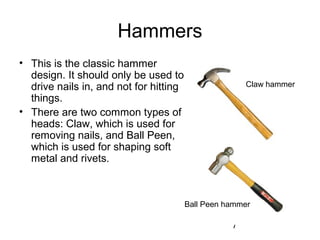
• This is the classic hammer
design. It should only be used to
drive nails in, and not for hitting
things.
• There are two common types of
heads: Claw, which is used for
removing nails, and Ball Peen,
which is used for shaping soft
metal and rivets.
Claw hammer
Ball Peen hammer
8
Sledgehammers
• Sledgehammer: Used
mainly for destruction.
Can be used for less
damaging applications if
used gently.
9
Mallets
• Mallet: Typically
made of rubber
or wood. Used
for assembling
tight-fitting
pieces, freeing
stuck objects,
and manipulating
other tools like
chisels.
10
Chipping Hammers
• This is one hammer
that you are
encouraged to
strike against metal.
• It is used to remove
rust when preparing
a metal surface for
painting.
11
Turning Tools
• Turning tools are used to turn objects. This will
usually be either a bolt, nut or piece of pipe.
• It is important to use the right wrench for a job,
or you will end up ‘stripping’ or ‘rounding’ what
you are trying to turn. This is bad.
• You should also always try to use the proper
size wrench for a job, and not just find an
adjustable. Adjustables will cause ‘rounding’
over time as well.
12
Open-end Wrenches
• Used for nuts and bolts.
13
• Also used for nuts and bolts, better than an open-end
wrench where usable, but without an open end it won’t
fit onto all jobs.
• If the wrench has an open end and a box end, it is known as a
‘combination wrench’.
Box Wrenches
14
Crescent Wrenches
• A crescent wrench is the term used for an adjustable
open-end wrench.
• The term crescent is actually a trademark, but it has
become synonymous with all makes of the type.
15
Pipe Wrenches
• As the name suggests, it is used for pipes. The jaws are designed to
bind onto the piece being turned, and so it will grip any circular
object.
16
Monkey Wrench?
• You won’t find any monkey wrenches
around our shop.
• The monkey wrench was used throughout
the 19th
century and was an early form of
adjustable.
17
Other Wrenches
Strap Wrench:
• The rubber strap is
infinitely adjustable, and
is very gentle on the
piece being turned.
• Generally used for oil
filters and other fragile
jobs.
Chain pipe
Wrench:
• Used in the same
fashion as a strap
wrench, but not as
gentle and meant for
large sections of pipe.
18
Pliers
• Pliers, regardless of the type, are used to
grip, turn, twist and pull. The many types
range from generic, square-nosed pliers to
incredibly specialized designs meant for
only one type of application.
19
Pliers
• Normal pliers come in many styles:
Needlenose Pliers
Linesman’s Pliers
20
Vise-Grip’s
• Vise-Grip is the trade name for a specific
type of locking, adjustable plier known as
‘wrench pliers’. It has since come to be
used when referring to any tool of this
type:
21
• There are two types of slip joint pliers. One which has
only two points of adjustment:
• The other type are sometimes referred to as ‘Water-
pump pliers’. They most commonly go under the name
Channel-Locks due to that being a well known and
successful brand.
Slip Joint Pliers
22
Adjustable Tools
• Many turning tools and pliers are adjustable. This does
not mean they are ‘one size fits all’.
• Not all sizes will adjust to the necessary dimensions, and
sometimes the size of the tool itself is a problem,
necessitating going down or up a size.
• If possible, always use a properly sized, non-adjustable
tool.
23
Bladed Tools
• These tools are used for shaping wood.
• They require some experience to use, and
are very fragile if treated improperly. The
blade in particular will chip and damage
easily if put in contact with the ground.
24
Planes
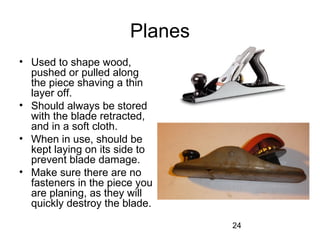
• Used to shape wood,
pushed or pulled along
the piece shaving a thin
layer off.
• Should always be stored
with the blade retracted,
and in a soft cloth.
• When in use, should be
kept laying on its side to
prevent blade damage.
• Make sure there are no
fasteners in the piece you
are planing, as they will
quickly destroy the blade.
25
Wood Chisels
• Used to shape
wood, and to
form insets,
cutouts and
other necessary
recesses in
wood.
26
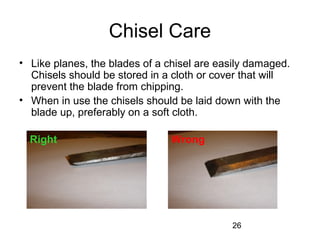
Chisel Care
• Like planes, the blades of a chisel are easily damaged.
Chisels should be stored in a cloth or cover that will
prevent the blade from chipping.
• When in use the chisels should be laid down with the
blade up, preferably on a soft cloth.
Right Wrong
27
Cold Chisels
• Used for metal, not wood.
• Can be used roughly if required, as the
blade is tough and sharpened readily.
28
Saws
• Saws are toothed cutting tools.
• They can be designed for wood or metal
cutting.
– A metal-cutting saw can cut wood in a pinch,
but never use a wood saw on metal.
• The difference is in the teeth: how many,
how big, and at what angle they are set.
29
Hacksaws
• Hacksaws have blades with lots of small
teeth. They are meant for cutting metal.
30
Wood Saws
• There are many types of wood saw. They
will have larger teeth than hacksaws, and
there is typically a large ‘kerf’ to the teeth.
31
Abrasives
• This is a general term for all tools and
materials used to ‘abrade’ an object.
• This can be surface abrasions for
smoothing or between coats of paint
• Or it can be material removal.
32
Sandpaper
• Different grits of sandpaper are used for different applications. The
number is in reference to how many particles of grit there are per
square inch. The less particles the bigger they are, and they rougher
it is.
• The grits range from about 40 all the way up to past 4000. For our
purposes we mostly use in the 80-220 range.
This is 320 grit
sandpaper.
Look at all the
particles in the
magnified view.
33
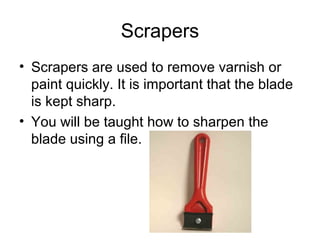
Scrapers
• Scrapers are used to remove varnish or
paint quickly. It is important that the blade
is kept sharp.
• You will be taught how to sharpen the
blade using a file.
34
Files/Rasps
• Files are fine-toothed bars used to file metal or wood. They are used
mainly for sharpening tools, but can also be used for shaping of
material.
• Rasps are similar to files but they have much bigger teeth. They are
used for woodworking only.
35
Hand Tool Care
• Hand tools need to be treated gently, and
only used for their intended tasks.
• An occasional wipedown with light oil or
WD-40 will help prevent surface rust and
ensure the tool lasts a long, long time.
36
Power Tools
• There are as many power tools as there
are hand tools. Each one as specialized
as the hand variety.
• Use special care as they can be very
dangerous if misused.
37
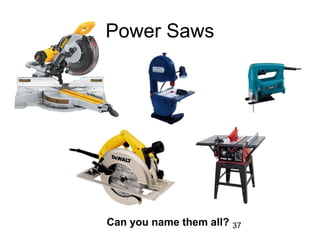
Power Saws
Can you name them all?
38
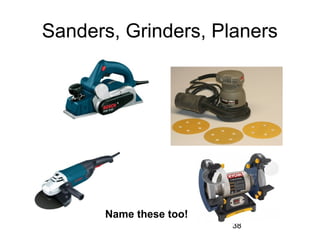
Sanders, Grinders, Planers
Name these too!
39
Power Tool Stowage
• DO NOT WRAP THE CORD AROUND
TIGHTLY.
– This will damage the cord and either cause
injury or lead to an early demise for the tool.
• If the tool has a case, put it back in the
case tidily when you are done. Have
nothing sticking out.
40
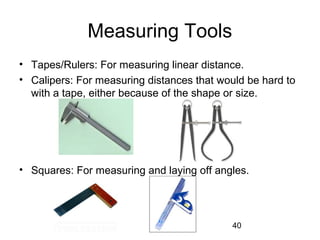
Measuring Tools
• Tapes/Rulers: For measuring linear distance.
• Calipers: For measuring distances that would be hard to
with a tape, either because of the shape or size.
• Squares: For measuring and laying off angles.
41
Metric vs. Imperial
• You will encounter both metric and Imperial tool
sizes in the shop. (Metric in millimeters, Imperial
in inches and fractions such as 3/8”)
• European and Asian tools and equipment use
metric, Americans use Imperial, and the
Canadians use both.
• Ensure you are using Metric tools with metric
fasteners, and Imperial tools with Imperial
fasteners. Mixing will damage tools and your
work.
42
Fasteners
• The generic term for all pieces used to
fasten parts together.
• There are many different types, each with
their own tools to use them.
• Do not use the wrong tool with the wrong
fastener, or even the wrong size.
43
Screws:
There are many, many
types of screws. The
three most common
drive types are:
RobertsonSlot Phillips
There is also a huge variety when it comes to head type, shank size,
thread type, etc.
Know what your job is and find a fastener that will work, there is a type
for every application
44
Screwdrivers
• There are screwdrivers for every type of screw.
• Both screwheads and screwdrivers come in
multiples sizes, depending on what the actual
size of the screw is. Use the right size.
• Do not use screwdrivers for other applications,
like as a marlinespike, as this will bend them
45
Nuts and Bolts
• Nuts and bolts are
excellent fasteners. They
are strong, secure, and
easy to remove when the
time comes.
• They are also relatively
expensive, so they are not
used in every application.
• They are the only fastener
that will join metal to metal,
though a hole needs to be
pre-drilled.
46
Nails
Nails are simple
and cheap. They
are also hard to
remove without
damaging the
material and they
do not hold well
over a long period.
Because of this
we try to avoid
nails, especially
onboard the
ships.
47
Drill Bits
• Drill bits are as varied as the fasteners.
• There are 3 main types: Metal, Wood and
Concrete.
• This is a ‘twist drill’ it is the classic drill-bit.
It is meant for metal but can be used in
wood.
48
Drill Bits
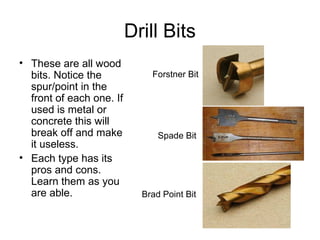
• These are all wood
bits. Notice the
spur/point in the
front of each one. If
used is metal or
concrete this will
break off and make
it useless.
• Each type has its
pros and cons.
Learn them as you
are able.
Forstner Bit
Spade Bit
Brad Point Bit
49
Drill Bits
•These are masonry
bits. Do not use them
for any other
application as they will
damage themselves
and the work.
•Notice the
‘Hammerhead’ which
bores through the
masonry.
50
Clamps
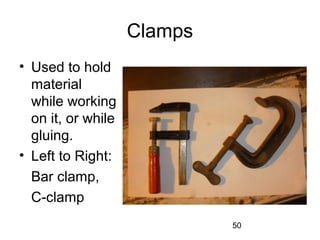
• Used to hold
material
while working
on it, or while
gluing.
• Left to Right:
Bar clamp,
C-clamp
51
Rigging Tools
• Tools used for rigging work are not to be used for other jobs.
– They are very specific to their task.
– They are fragile if improperly used.
– They are expensive.
From left to right:
•Large Serving Mallet
•Small Serving Mallet
•Splicing Fid
•Swedish Fid
•Heaving/Seizing Mallets
52
Conclusion
• Most of the job is knowing which tools to
use. Using the right tool in the right way
will make your work go a lot easier, safer
and with a better end result.
• Please make sure you treat the tools with
respect, and put them back where they
belong so the next person can find them.

Wawire

  • 1.
  • 2.
    2 TOOLS • This lectureis designed to give you a basic idea of the tools you will encounter in our shop. • We will mainly focus on identification and tool care. • Learning how to use the tools will come with time.
  • 3.
    3 Your Hands • Theyare the most important and valuable tools you have. • Protect them from harm by working smart, wearing gloves when necessary, and by not taking chances. • Without your hands, no other tool is any good to you.
  • 4.
    4 Good Tool Habits •“A place for everything, and everything in it’s place.” – Keep each tool in its proper place – Keep your tools in good condition – Use tools only for the job they were designed for – Keep tools within easy reach, and where they cannot fall – Avoid damaged tools • They will damage your work, and can cause injury.
  • 5.
    5 Hand Tools • Thereare many, many types of hand tools: – Striking tools (hammers, mallets, sledges) – Turning tools (wrenches) – Pliers (normal pliers, Channel-locks, Vice- grips) – Bladed tools (chisels and planes) – Saws (for wood or metal) – Abrasives (scrapers, sandpaper, files)
  • 6.
    6 Striking Tools • Thisincludes all different types of hammers, sledges and mallets. • Each type is designed for a specific kind of work, and misuse can damage the tool or your work piece. • You should avoid striking metal to metal. Place a block of wood between the two pieces if you must use a metal striking tool.
  • 7.
    7 Hammers • This isthe classic hammer design. It should only be used to drive nails in, and not for hitting things. • There are two common types of heads: Claw, which is used for removing nails, and Ball Peen, which is used for shaping soft metal and rivets. Claw hammer Ball Peen hammer
  • 8.
    8 Sledgehammers • Sledgehammer: Used mainlyfor destruction. Can be used for less damaging applications if used gently.
  • 9.
    9 Mallets • Mallet: Typically madeof rubber or wood. Used for assembling tight-fitting pieces, freeing stuck objects, and manipulating other tools like chisels.
  • 10.
    10 Chipping Hammers • Thisis one hammer that you are encouraged to strike against metal. • It is used to remove rust when preparing a metal surface for painting.
  • 11.
    11 Turning Tools • Turningtools are used to turn objects. This will usually be either a bolt, nut or piece of pipe. • It is important to use the right wrench for a job, or you will end up ‘stripping’ or ‘rounding’ what you are trying to turn. This is bad. • You should also always try to use the proper size wrench for a job, and not just find an adjustable. Adjustables will cause ‘rounding’ over time as well.
  • 12.
    12 Open-end Wrenches • Usedfor nuts and bolts.
  • 13.
    13 • Also usedfor nuts and bolts, better than an open-end wrench where usable, but without an open end it won’t fit onto all jobs. • If the wrench has an open end and a box end, it is known as a ‘combination wrench’. Box Wrenches
  • 14.
    14 Crescent Wrenches • Acrescent wrench is the term used for an adjustable open-end wrench. • The term crescent is actually a trademark, but it has become synonymous with all makes of the type.
  • 15.
    15 Pipe Wrenches • Asthe name suggests, it is used for pipes. The jaws are designed to bind onto the piece being turned, and so it will grip any circular object.
  • 16.
    16 Monkey Wrench? • Youwon’t find any monkey wrenches around our shop. • The monkey wrench was used throughout the 19th century and was an early form of adjustable.
  • 17.
    17 Other Wrenches Strap Wrench: •The rubber strap is infinitely adjustable, and is very gentle on the piece being turned. • Generally used for oil filters and other fragile jobs. Chain pipe Wrench: • Used in the same fashion as a strap wrench, but not as gentle and meant for large sections of pipe.
  • 18.
    18 Pliers • Pliers, regardlessof the type, are used to grip, turn, twist and pull. The many types range from generic, square-nosed pliers to incredibly specialized designs meant for only one type of application.
  • 19.
    19 Pliers • Normal plierscome in many styles: Needlenose Pliers Linesman’s Pliers
  • 20.
    20 Vise-Grip’s • Vise-Grip isthe trade name for a specific type of locking, adjustable plier known as ‘wrench pliers’. It has since come to be used when referring to any tool of this type:
  • 21.
    21 • There aretwo types of slip joint pliers. One which has only two points of adjustment: • The other type are sometimes referred to as ‘Water- pump pliers’. They most commonly go under the name Channel-Locks due to that being a well known and successful brand. Slip Joint Pliers
  • 22.
    22 Adjustable Tools • Manyturning tools and pliers are adjustable. This does not mean they are ‘one size fits all’. • Not all sizes will adjust to the necessary dimensions, and sometimes the size of the tool itself is a problem, necessitating going down or up a size. • If possible, always use a properly sized, non-adjustable tool.
  • 23.
    23 Bladed Tools • Thesetools are used for shaping wood. • They require some experience to use, and are very fragile if treated improperly. The blade in particular will chip and damage easily if put in contact with the ground.
  • 24.
    24 Planes • Used toshape wood, pushed or pulled along the piece shaving a thin layer off. • Should always be stored with the blade retracted, and in a soft cloth. • When in use, should be kept laying on its side to prevent blade damage. • Make sure there are no fasteners in the piece you are planing, as they will quickly destroy the blade.
  • 25.
    25 Wood Chisels • Usedto shape wood, and to form insets, cutouts and other necessary recesses in wood.
  • 26.
    26 Chisel Care • Likeplanes, the blades of a chisel are easily damaged. Chisels should be stored in a cloth or cover that will prevent the blade from chipping. • When in use the chisels should be laid down with the blade up, preferably on a soft cloth. Right Wrong
  • 27.
    27 Cold Chisels • Usedfor metal, not wood. • Can be used roughly if required, as the blade is tough and sharpened readily.
  • 28.
    28 Saws • Saws aretoothed cutting tools. • They can be designed for wood or metal cutting. – A metal-cutting saw can cut wood in a pinch, but never use a wood saw on metal. • The difference is in the teeth: how many, how big, and at what angle they are set.
  • 29.
    29 Hacksaws • Hacksaws haveblades with lots of small teeth. They are meant for cutting metal.
  • 30.
    30 Wood Saws • Thereare many types of wood saw. They will have larger teeth than hacksaws, and there is typically a large ‘kerf’ to the teeth.
  • 31.
    31 Abrasives • This isa general term for all tools and materials used to ‘abrade’ an object. • This can be surface abrasions for smoothing or between coats of paint • Or it can be material removal.
  • 32.
    32 Sandpaper • Different gritsof sandpaper are used for different applications. The number is in reference to how many particles of grit there are per square inch. The less particles the bigger they are, and they rougher it is. • The grits range from about 40 all the way up to past 4000. For our purposes we mostly use in the 80-220 range. This is 320 grit sandpaper. Look at all the particles in the magnified view.
  • 33.
    33 Scrapers • Scrapers areused to remove varnish or paint quickly. It is important that the blade is kept sharp. • You will be taught how to sharpen the blade using a file.
  • 34.
    34 Files/Rasps • Files arefine-toothed bars used to file metal or wood. They are used mainly for sharpening tools, but can also be used for shaping of material. • Rasps are similar to files but they have much bigger teeth. They are used for woodworking only.
  • 35.
    35 Hand Tool Care •Hand tools need to be treated gently, and only used for their intended tasks. • An occasional wipedown with light oil or WD-40 will help prevent surface rust and ensure the tool lasts a long, long time.
  • 36.
    36 Power Tools • Thereare as many power tools as there are hand tools. Each one as specialized as the hand variety. • Use special care as they can be very dangerous if misused.
  • 37.
    37 Power Saws Can youname them all?
  • 38.
  • 39.
    39 Power Tool Stowage •DO NOT WRAP THE CORD AROUND TIGHTLY. – This will damage the cord and either cause injury or lead to an early demise for the tool. • If the tool has a case, put it back in the case tidily when you are done. Have nothing sticking out.
  • 40.
    40 Measuring Tools • Tapes/Rulers:For measuring linear distance. • Calipers: For measuring distances that would be hard to with a tape, either because of the shape or size. • Squares: For measuring and laying off angles.
  • 41.
    41 Metric vs. Imperial •You will encounter both metric and Imperial tool sizes in the shop. (Metric in millimeters, Imperial in inches and fractions such as 3/8”) • European and Asian tools and equipment use metric, Americans use Imperial, and the Canadians use both. • Ensure you are using Metric tools with metric fasteners, and Imperial tools with Imperial fasteners. Mixing will damage tools and your work.
  • 42.
    42 Fasteners • The genericterm for all pieces used to fasten parts together. • There are many different types, each with their own tools to use them. • Do not use the wrong tool with the wrong fastener, or even the wrong size.
  • 43.
    43 Screws: There are many,many types of screws. The three most common drive types are: RobertsonSlot Phillips There is also a huge variety when it comes to head type, shank size, thread type, etc. Know what your job is and find a fastener that will work, there is a type for every application
  • 44.
    44 Screwdrivers • There arescrewdrivers for every type of screw. • Both screwheads and screwdrivers come in multiples sizes, depending on what the actual size of the screw is. Use the right size. • Do not use screwdrivers for other applications, like as a marlinespike, as this will bend them
  • 45.
    45 Nuts and Bolts •Nuts and bolts are excellent fasteners. They are strong, secure, and easy to remove when the time comes. • They are also relatively expensive, so they are not used in every application. • They are the only fastener that will join metal to metal, though a hole needs to be pre-drilled.
  • 46.
    46 Nails Nails are simple andcheap. They are also hard to remove without damaging the material and they do not hold well over a long period. Because of this we try to avoid nails, especially onboard the ships.
  • 47.
    47 Drill Bits • Drillbits are as varied as the fasteners. • There are 3 main types: Metal, Wood and Concrete. • This is a ‘twist drill’ it is the classic drill-bit. It is meant for metal but can be used in wood.
  • 48.
    48 Drill Bits • Theseare all wood bits. Notice the spur/point in the front of each one. If used is metal or concrete this will break off and make it useless. • Each type has its pros and cons. Learn them as you are able. Forstner Bit Spade Bit Brad Point Bit
  • 49.
    49 Drill Bits •These aremasonry bits. Do not use them for any other application as they will damage themselves and the work. •Notice the ‘Hammerhead’ which bores through the masonry.
  • 50.
    50 Clamps • Used tohold material while working on it, or while gluing. • Left to Right: Bar clamp, C-clamp
  • 51.
    51 Rigging Tools • Toolsused for rigging work are not to be used for other jobs. – They are very specific to their task. – They are fragile if improperly used. – They are expensive. From left to right: •Large Serving Mallet •Small Serving Mallet •Splicing Fid •Swedish Fid •Heaving/Seizing Mallets
  • 52.
    52 Conclusion • Most ofthe job is knowing which tools to use. Using the right tool in the right way will make your work go a lot easier, safer and with a better end result. • Please make sure you treat the tools with respect, and put them back where they belong so the next person can find them.