Building a Cornhole Set
By: Christian Kline
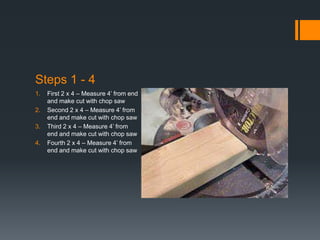
Steps 1 - 4
1.   First 2 x 4 – Measure 4’ from end
     and make cut with chop saw
2.   Second 2 x 4 – Measure 4’ from
     end and make cut with chop saw
3.   Third 2 x 4 – Measure 4’ from
     end and make cut with chop saw
4.   Fourth 2 x 4 – Measure 4’ from
     end and make cut with chop saw
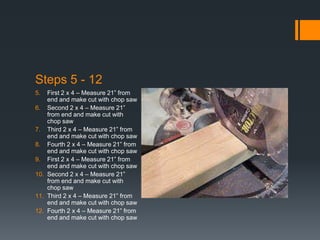
Steps 5 - 12
5.  First 2 x 4 – Measure 21” from
    end and make cut with chop saw
6. Second 2 x 4 – Measure 21”
    from end and make cut with
    chop saw
7. Third 2 x 4 – Measure 21” from
    end and make cut with chop saw
8. Fourth 2 x 4 – Measure 21” from
    end and make cut with chop saw
9. First 2 x 4 – Measure 21” from
    end and make cut with chop saw
10. Second 2 x 4 – Measure 21”
    from end and make cut with
    chop saw
11. Third 2 x 4 – Measure 21” from
    end and make cut with chop saw
12. Fourth 2 x 4 – Measure 21” from
    end and make cut with chop saw
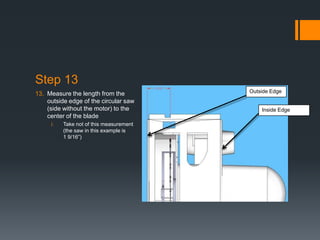
Step 13
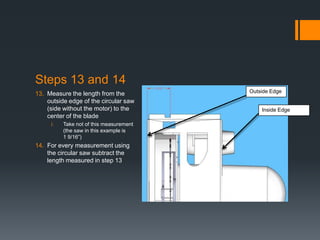
13. Measure the length from the          Outside Edge
    outside edge of the circular saw
    (side without the motor) to the          Inside Edge
    center of the blade
     i.   Take not of this measurement
          (the saw in this example is
          1 9/16”)
Steps 13 and 14
13. Measure the length from the          Outside Edge
    outside edge of the circular saw
    (side without the motor) to the          Inside Edge
    center of the blade
     i.   Take not of this measurement
          (the saw in this example is
          1 9/16”)
14. For every measurement using
    the circular saw subtract the
    length measured in step 13
Steps 15 - 17
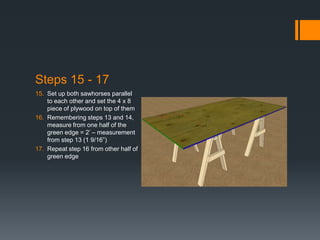
15. Set up both sawhorses parallel
    to each other and set the 4 x 8
    piece of plywood on top of them
16. Remembering steps 13 and 14,
    measure from one half of the
    green edge = 2’ – measurement
    from step 13 (1 9/16”)
17. Repeat step 16 from other half of
    green edge
Steps 18 and 19
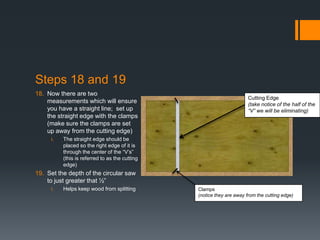
18. Now there are two
                                                                       Cutting Edge
    measurements which will ensure                                     (take notice of the half of the
    you have a straight line; set up                                   “V” we will be eliminating)
    the straight edge with the clamps
    (make sure the clamps are set
    up away from the cutting edge)
     i.   The straight edge should be
          placed so the right edge of it is
          through the center of the “V’s”
          (this is referred to as the cutting
          edge)
19. Set the depth of the circular saw
    to just greater that ½”
     i.   Helps keep wood from splitting        Clamps
                                                (notice they are away from the cutting edge)
Steps 20 and 21
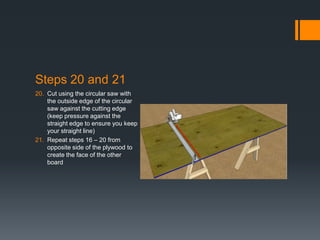
20. Cut using the circular saw with
    the outside edge of the circular
    saw against the cutting edge
    (keep pressure against the
    straight edge to ensure you keep
    your straight line)
21. Repeat steps 16 – 20 from
    opposite side of the plywood to
    create the face of the other
    board
Step 22
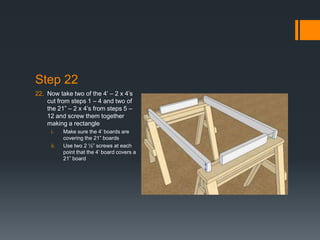
22. Now take two of the 4’ – 2 x 4’s
    cut from steps 1 – 4 and two of
    the 21” – 2 x 4’s from steps 5 –
    12 and screw them together
    making a rectangle
     i.    Make sure the 4’ boards are
           covering the 21” boards
     ii.   Use two 2 ½” screws at each
           point that the 4’ board covers a
           21” board
Step 23
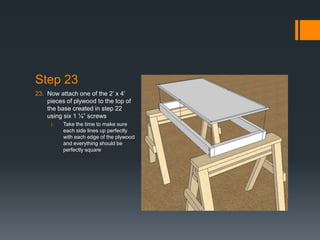
23. Now attach one of the 2’ x 4’
    pieces of plywood to the top of
    the base created in step 22
    using six 1 ¼” screws
     i.   Take the time to make sure
          each side lines up perfectly
          with each edge of the plywood
          and everything should be
          perfectly square
Steps 24 and 25
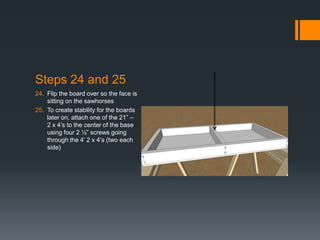
24. Flip the board over so the face is
    sitting on the sawhorses
25. To create stability for the boards
    later on, attach one of the 21” –
    2 x 4’s to the center of the base
    using four 2 ½” screws going
    through the 4’ 2 x 4’s (two each
    side)
Steps 26 - 29
26. Flip back over and put two 1 ¼”
    screws into the board just
    installed
     i.    Pretend to split the board in
           thirds with two screws
     ii.   This will keep the board from
           twisting and keep from having a
           spring action during play
27. Now pick a 2’ side and this
    becomes the top of the board.
    Measure to the center of the
    board (1’ from either end)
28. Do the same on the other end of
    the board
29. With steps 27 and 28 a center
    line is created. Measure down
    9” from the top of the board and
    this is the center of the hole to
    be cut out
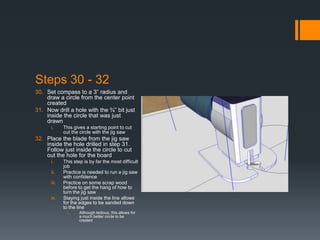
Steps 30 - 32
30. Set compass to a 3” radius and
    draw a circle from the center point
    created
31. Now drill a hole with the ¾” bit just
    inside the circle that was just
    drawn
      i.     This gives a starting point to cut
             out the circle with the jig saw
32. Place the blade from the jig saw
    inside the hole drilled in step 31.
    Follow just inside the circle to cut
    out the hole for the board
      i.     This step is by far the most difficult
             job
      ii.    Practice is needed to run a jig saw
             with confidence
      iii.   Practice on some scrap wood
             before to get the hang of how to
             turn the jig saw
      iv.    Staying just inside the line allows
             for the edges to be sanded down
             to the line
               i.    Although tedious, this allows for
                     a much better circle to be
                     created
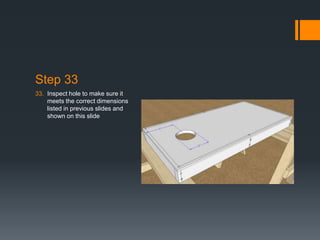
Step 33
33. Inspect hole to make sure it
    meets the correct dimensions
    listed in previous slides and
    shown on this slide
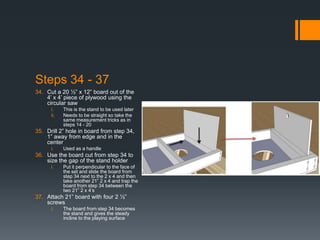
Steps 34 - 37
34. Cut a 20 ½” x 12” board out of the
    4’ x 4’ piece of plywood using the
    circular saw
      i.    This is the stand to be used later
      ii.   Needs to be straight so take the
            same measurement tricks as in
            steps 14 - 20
35. Drill 2” hole in board from step 34,
    1” away from edge and in the
    center
      i.    Used as a handle
36. Use the board cut from step 34 to
    size the gap of the stand holder
      i.    Put it perpendicular to the face of
            the set and slide the board from
            step 34 next to the 2 x 4 and then
            take another 21” 2 x 4 and trap the
            board from step 34 between the
            two 21” 2 x 4’s
37. Attach 21” board with four 2 ½”
    screws
      i.    The board from step 34 becomes
            the stand and gives the steady
            incline to the playing surface
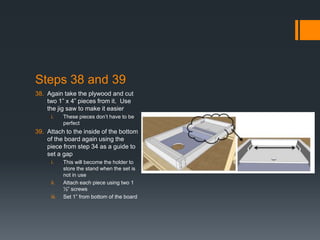
Steps 38 and 39
38. Again take the plywood and cut
    two 1” x 4” pieces from it. Use
    the jig saw to make it easier
     i.     These pieces don’t have to be
            perfect
39. Attach to the inside of the bottom
    of the board again using the
    piece from step 34 as a guide to
    set a gap
     i.     This will become the holder to
            store the stand when the set is
            not in use
     ii.    Attach each piece using two 1
            ½” screws
     iii.   Set 1” from bottom of the board
Steps 40 - 45
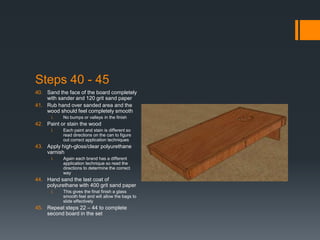
40. Sand the face of the board completely
    with sander and 120 grit sand paper
41. Rub hand over sanded area and the
    wood should feel completely smooth
      i.   No bumps or valleys in the finish
42. Paint or stain the wood
      i.   Each paint and stain is different so
           read directions on the can to figure
           out correct application techniques
43. Apply high-gloss/clear polyurethane
    varnish
      i.   Again each brand has a different
           application technique so read the
           directions to determine the correct
           way
44. Hand sand the last coat of
    polyurethane with 400 grit sand paper
      i.   This gives the final finish a glass
           smooth feel and will allow the bags to
           slide effectively
45. Repeat steps 22 – 44 to complete
    second board in the set
Making Cornhole Bags
By: Christian Kline
Steps 1 - 8
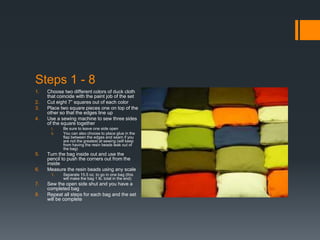
1.   Choose two different colors of duck cloth
     that coincide with the paint job of the set
2.   Cut eight 7” squares out of each color
3.   Place two square pieces one on top of the
     other so that the edges line up
4.   Use a sewing machine to sew three sides
     of the square together
      i.    Be sure to leave one side open
      ii.   You can also choose to place glue in the
            flap between the edges and seam if you
            are not the greatest at sewing (will keep
            from having the resin beads leak out of
            the bag)
5.   Turn the bag inside out and use the
     pencil to push the corners out from the
     inside
6.   Measure the resin beads using any scale
      1.    Separate 15.5 oz. to go in one bag (this
            will make the bag 1 lb. total in the end)
7.   Sew the open side shut and you have a
     completed bag
8.   Repeat all steps for each bag and the set
     will be complete
For Help
•   For additional help with this
    process go to:
     •    http://www.cornholehowto.com/
          sew-up-some-bags/how-to-
          sew/


•   They have very detailed
    instructions and excellent
    pictures to go along with the
    instructions

Building a cornhole set

  • 1.
    Building a CornholeSet By: Christian Kline
  • 2.
    Steps 1 -4 1. First 2 x 4 – Measure 4’ from end and make cut with chop saw 2. Second 2 x 4 – Measure 4’ from end and make cut with chop saw 3. Third 2 x 4 – Measure 4’ from end and make cut with chop saw 4. Fourth 2 x 4 – Measure 4’ from end and make cut with chop saw
  • 3.
    Steps 5 -12 5. First 2 x 4 – Measure 21” from end and make cut with chop saw 6. Second 2 x 4 – Measure 21” from end and make cut with chop saw 7. Third 2 x 4 – Measure 21” from end and make cut with chop saw 8. Fourth 2 x 4 – Measure 21” from end and make cut with chop saw 9. First 2 x 4 – Measure 21” from end and make cut with chop saw 10. Second 2 x 4 – Measure 21” from end and make cut with chop saw 11. Third 2 x 4 – Measure 21” from end and make cut with chop saw 12. Fourth 2 x 4 – Measure 21” from end and make cut with chop saw
  • 4.
    Step 13 13. Measurethe length from the Outside Edge outside edge of the circular saw (side without the motor) to the Inside Edge center of the blade i. Take not of this measurement (the saw in this example is 1 9/16”)
  • 5.
    Steps 13 and14 13. Measure the length from the Outside Edge outside edge of the circular saw (side without the motor) to the Inside Edge center of the blade i. Take not of this measurement (the saw in this example is 1 9/16”) 14. For every measurement using the circular saw subtract the length measured in step 13
  • 6.
    Steps 15 -17 15. Set up both sawhorses parallel to each other and set the 4 x 8 piece of plywood on top of them 16. Remembering steps 13 and 14, measure from one half of the green edge = 2’ – measurement from step 13 (1 9/16”) 17. Repeat step 16 from other half of green edge
  • 7.
    Steps 18 and19 18. Now there are two Cutting Edge measurements which will ensure (take notice of the half of the you have a straight line; set up “V” we will be eliminating) the straight edge with the clamps (make sure the clamps are set up away from the cutting edge) i. The straight edge should be placed so the right edge of it is through the center of the “V’s” (this is referred to as the cutting edge) 19. Set the depth of the circular saw to just greater that ½” i. Helps keep wood from splitting Clamps (notice they are away from the cutting edge)
  • 8.
    Steps 20 and21 20. Cut using the circular saw with the outside edge of the circular saw against the cutting edge (keep pressure against the straight edge to ensure you keep your straight line) 21. Repeat steps 16 – 20 from opposite side of the plywood to create the face of the other board
  • 9.
    Step 22 22. Nowtake two of the 4’ – 2 x 4’s cut from steps 1 – 4 and two of the 21” – 2 x 4’s from steps 5 – 12 and screw them together making a rectangle i. Make sure the 4’ boards are covering the 21” boards ii. Use two 2 ½” screws at each point that the 4’ board covers a 21” board
  • 10.
    Step 23 23. Nowattach one of the 2’ x 4’ pieces of plywood to the top of the base created in step 22 using six 1 ¼” screws i. Take the time to make sure each side lines up perfectly with each edge of the plywood and everything should be perfectly square
  • 11.
    Steps 24 and25 24. Flip the board over so the face is sitting on the sawhorses 25. To create stability for the boards later on, attach one of the 21” – 2 x 4’s to the center of the base using four 2 ½” screws going through the 4’ 2 x 4’s (two each side)
  • 12.
    Steps 26 -29 26. Flip back over and put two 1 ¼” screws into the board just installed i. Pretend to split the board in thirds with two screws ii. This will keep the board from twisting and keep from having a spring action during play 27. Now pick a 2’ side and this becomes the top of the board. Measure to the center of the board (1’ from either end) 28. Do the same on the other end of the board 29. With steps 27 and 28 a center line is created. Measure down 9” from the top of the board and this is the center of the hole to be cut out
  • 13.
    Steps 30 -32 30. Set compass to a 3” radius and draw a circle from the center point created 31. Now drill a hole with the ¾” bit just inside the circle that was just drawn i. This gives a starting point to cut out the circle with the jig saw 32. Place the blade from the jig saw inside the hole drilled in step 31. Follow just inside the circle to cut out the hole for the board i. This step is by far the most difficult job ii. Practice is needed to run a jig saw with confidence iii. Practice on some scrap wood before to get the hang of how to turn the jig saw iv. Staying just inside the line allows for the edges to be sanded down to the line i. Although tedious, this allows for a much better circle to be created
  • 14.
    Step 33 33. Inspecthole to make sure it meets the correct dimensions listed in previous slides and shown on this slide
  • 15.
    Steps 34 -37 34. Cut a 20 ½” x 12” board out of the 4’ x 4’ piece of plywood using the circular saw i. This is the stand to be used later ii. Needs to be straight so take the same measurement tricks as in steps 14 - 20 35. Drill 2” hole in board from step 34, 1” away from edge and in the center i. Used as a handle 36. Use the board cut from step 34 to size the gap of the stand holder i. Put it perpendicular to the face of the set and slide the board from step 34 next to the 2 x 4 and then take another 21” 2 x 4 and trap the board from step 34 between the two 21” 2 x 4’s 37. Attach 21” board with four 2 ½” screws i. The board from step 34 becomes the stand and gives the steady incline to the playing surface
  • 16.
    Steps 38 and39 38. Again take the plywood and cut two 1” x 4” pieces from it. Use the jig saw to make it easier i. These pieces don’t have to be perfect 39. Attach to the inside of the bottom of the board again using the piece from step 34 as a guide to set a gap i. This will become the holder to store the stand when the set is not in use ii. Attach each piece using two 1 ½” screws iii. Set 1” from bottom of the board
  • 17.
    Steps 40 -45 40. Sand the face of the board completely with sander and 120 grit sand paper 41. Rub hand over sanded area and the wood should feel completely smooth i. No bumps or valleys in the finish 42. Paint or stain the wood i. Each paint and stain is different so read directions on the can to figure out correct application techniques 43. Apply high-gloss/clear polyurethane varnish i. Again each brand has a different application technique so read the directions to determine the correct way 44. Hand sand the last coat of polyurethane with 400 grit sand paper i. This gives the final finish a glass smooth feel and will allow the bags to slide effectively 45. Repeat steps 22 – 44 to complete second board in the set
  • 18.
    Making Cornhole Bags By:Christian Kline
  • 19.
    Steps 1 -8 1. Choose two different colors of duck cloth that coincide with the paint job of the set 2. Cut eight 7” squares out of each color 3. Place two square pieces one on top of the other so that the edges line up 4. Use a sewing machine to sew three sides of the square together i. Be sure to leave one side open ii. You can also choose to place glue in the flap between the edges and seam if you are not the greatest at sewing (will keep from having the resin beads leak out of the bag) 5. Turn the bag inside out and use the pencil to push the corners out from the inside 6. Measure the resin beads using any scale 1. Separate 15.5 oz. to go in one bag (this will make the bag 1 lb. total in the end) 7. Sew the open side shut and you have a completed bag 8. Repeat all steps for each bag and the set will be complete
  • 20.
    For Help • For additional help with this process go to: • http://www.cornholehowto.com/ sew-up-some-bags/how-to- sew/ • They have very detailed instructions and excellent pictures to go along with the instructions