CONTENTS
C
O
N
T
E
N
T
S
Introduction
1
The Address outline
2
Importance
3
References
4
01 INTRODUCTION
INTRODUCTION
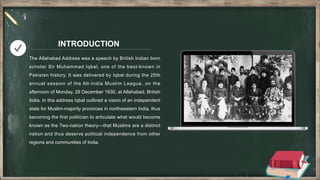
The Allahabad Address was a speech by British Indian born
scholar Sir Muhammad Iqbal, one of the best-known in
Pakistan history. It was delivered by Iqbal during the 25th
annual session of the All-India Muslim League, on the
afternoon of Monday, 29 December 1930, at Allahabad, British
India. In this address Iqbal outlined a vision of an independent
state for Muslim-majority provinces in northwestern India, thus
becoming the first politician to articulate what would become
known as the Two-nation theory—that Muslims are a distinct
nation and thus deserve political independence from other
regions and communities of India.
02 The Address
outline
Muslim India within India
In his address, Iqbal called for the creation of "a Muslim India within India", especially in North-western
India. Iqbal demanded the right of self-government for the Muslim as he said:
India is a continent of human groups belonging to different races, speaking different languages, and
professing different religions. Personally, I would like to see the Punjab, North-West Frontier Province,
Sindh and Baluchistan amalgamated into a single State. Self-government within the British Empire, or
without the British Empire, the formation of a consolidated North-West Indian Muslim State appears to
me to be the final destiny of the Muslims, at least of North-West India.
Allama Iqbal's Fear
Within his address, Iqbal also touched on his fear that Islam may have a similar fate as Christianity. "To Islam,
matter is spirit realising itself in space and time" whereas Europe had "accepted the separation of Church and
State and disliked the fact that their leaders were "indirectly forcing the world to accept it as unquestionable dogma.
Iqbal spoke of:
The unity of an Indian nation, therefore, must be sought not in the negation, but in the mutual harmony and
cooperation, of the many. True statesmanship cannot ignore facts, however unpleasant they may be And it is on
the discovery of Indian unity in this direction that the fate of India as well as of Asia really depends If an effective
principle of cooperation is discovered in India it will bring peace and mutual goodwill to this ancient land which has
suffered so long And it will at the same time solve the entire political problem of Asia.
Hindu Fears
Commenting on the Hindu fears of religious rule in the Muslim autonomous states, Iqbal said:
Muslim demand is not actuated by the kind of motive he imputes to us; it is actuated by a genuine desire for free
development which is practically impossible under the type of unitary government contemplated by the nationalist
Hindu politicians with a view to secure permanent command dominance in the whole of India. Nor should the
Hindus fear that the creation of autonomous Muslim states will mean the introduction of a kind of religious rule in
such states. I have already indicated to you the meaning of the word religion, as applied to Islam. The truth is that
Islam is not a Church I, therefore, demand the formation of a consolidated Muslim State in the best interests of
India and Islam. For India, it means security and peace resulting from an internal balance of power; for Islam, an
opportunity to rid itself of the stamp that Arabian Imperialism was forced to give it, to mobilize its law, its education,
its culture, and to bring them into closer contact with its own original spirit and with the spirit of modern times.
[12]
Concluding Remarks
In his concluding remarks, Iqbal said:
India demands complete organization and unity of will and purpose in the Muslim community, both in your own
interest as a community and in the interest of India as a whole. We have a duty toward India where we are
destined to live and die. We have a duty towards Asia, especially Muslim Asia. And since 70 millions of Muslims in
single country constitute a far more valuable asset to Islam than all the countries of Muslim Asia put together, we
must look at the Indian problem not only from the Muslim point of view but also from the standpoint of the Indian
Muslim as such.
03 Importance
Territorial adjustments will enable the Muslims to develop themselves in accordance with their
ideas and serve the cause of Ummah.
He further expressed these ideas in letters to Jinnah from May 1936 to November 1937. He
talked of a separate federation of Muslim provinces. The ( North Western India and Bengal
can be considered as entitled to self-determination like other nations in India and outside.
Shariah's development is impossible without a free Muslim state or states. He advised the
Muslims to be above self-interest and devote themselves to Islam.
Faith, culture and historical traditions are more important than patriotism.
References
ü " T h e s t a t e m e n t - A l l a m a I q b a l ' s P r e s i d e n t i a l A d d r e s s a t A l l a h a b a d 1 9 3 0 " . T h e Q u a i d . g o v .
A r c h i v e d f r o m t h e o r i g i n a l o n 4 M a r c h 2 0 1 6 . R e t r i e v e d 1 N o v e m b e r 2 0 1 5 .
ü " T h e A l l a h a b a d A d d r e s s - H i s t o r y , p h a s e s , b a c k g r o u n d a n d i m p o r t a n c e " . N o t e s P a k i s t a n .
R e t r i e v e d 1 N o v e m b e r 2 0 1 5 .
ü S a l i m , S a q u i b . " S i r / A l l a m a M u h a m m a d I q b a l ' s P r e s i d e n t i a l A d d r e s s t o t h e A l l a h a b a d
S e s s i o n o f t h e A l l - I n d i a M u s l i m L e a g u e i n 1 9 3 0 " . H e r i t a g e T i m e s . R e t r i e v e d 2 3
S e p t e m b e r 2 0 1 9 .
ü h t t p s : / / e n . w i k i p e d i a . o r g / w i k i / A l l a h a b a d _ A d d r e s s # T h e _ A d d r e s s _ o u t l i n e
THANK YOU

Allahabad address 1930

  • 3.
  • 4.
  • 5.
    INTRODUCTION The Allahabad Addresswas a speech by British Indian born scholar Sir Muhammad Iqbal, one of the best-known in Pakistan history. It was delivered by Iqbal during the 25th annual session of the All-India Muslim League, on the afternoon of Monday, 29 December 1930, at Allahabad, British India. In this address Iqbal outlined a vision of an independent state for Muslim-majority provinces in northwestern India, thus becoming the first politician to articulate what would become known as the Two-nation theory—that Muslims are a distinct nation and thus deserve political independence from other regions and communities of India.
  • 6.
  • 8.
    Muslim India withinIndia In his address, Iqbal called for the creation of "a Muslim India within India", especially in North-western India. Iqbal demanded the right of self-government for the Muslim as he said: India is a continent of human groups belonging to different races, speaking different languages, and professing different religions. Personally, I would like to see the Punjab, North-West Frontier Province, Sindh and Baluchistan amalgamated into a single State. Self-government within the British Empire, or without the British Empire, the formation of a consolidated North-West Indian Muslim State appears to me to be the final destiny of the Muslims, at least of North-West India.
  • 9.
    Allama Iqbal's Fear Withinhis address, Iqbal also touched on his fear that Islam may have a similar fate as Christianity. "To Islam, matter is spirit realising itself in space and time" whereas Europe had "accepted the separation of Church and State and disliked the fact that their leaders were "indirectly forcing the world to accept it as unquestionable dogma. Iqbal spoke of: The unity of an Indian nation, therefore, must be sought not in the negation, but in the mutual harmony and cooperation, of the many. True statesmanship cannot ignore facts, however unpleasant they may be And it is on the discovery of Indian unity in this direction that the fate of India as well as of Asia really depends If an effective principle of cooperation is discovered in India it will bring peace and mutual goodwill to this ancient land which has suffered so long And it will at the same time solve the entire political problem of Asia.
  • 10.
    Hindu Fears Commenting onthe Hindu fears of religious rule in the Muslim autonomous states, Iqbal said: Muslim demand is not actuated by the kind of motive he imputes to us; it is actuated by a genuine desire for free development which is practically impossible under the type of unitary government contemplated by the nationalist Hindu politicians with a view to secure permanent command dominance in the whole of India. Nor should the Hindus fear that the creation of autonomous Muslim states will mean the introduction of a kind of religious rule in such states. I have already indicated to you the meaning of the word religion, as applied to Islam. The truth is that Islam is not a Church I, therefore, demand the formation of a consolidated Muslim State in the best interests of India and Islam. For India, it means security and peace resulting from an internal balance of power; for Islam, an opportunity to rid itself of the stamp that Arabian Imperialism was forced to give it, to mobilize its law, its education, its culture, and to bring them into closer contact with its own original spirit and with the spirit of modern times. [12]
  • 11.
    Concluding Remarks In hisconcluding remarks, Iqbal said: India demands complete organization and unity of will and purpose in the Muslim community, both in your own interest as a community and in the interest of India as a whole. We have a duty toward India where we are destined to live and die. We have a duty towards Asia, especially Muslim Asia. And since 70 millions of Muslims in single country constitute a far more valuable asset to Islam than all the countries of Muslim Asia put together, we must look at the Indian problem not only from the Muslim point of view but also from the standpoint of the Indian Muslim as such.
  • 12.
  • 13.
    Territorial adjustments willenable the Muslims to develop themselves in accordance with their ideas and serve the cause of Ummah. He further expressed these ideas in letters to Jinnah from May 1936 to November 1937. He talked of a separate federation of Muslim provinces. The ( North Western India and Bengal can be considered as entitled to self-determination like other nations in India and outside. Shariah's development is impossible without a free Muslim state or states. He advised the Muslims to be above self-interest and devote themselves to Islam. Faith, culture and historical traditions are more important than patriotism.
  • 14.
    References ü " Th e s t a t e m e n t - A l l a m a I q b a l ' s P r e s i d e n t i a l A d d r e s s a t A l l a h a b a d 1 9 3 0 " . T h e Q u a i d . g o v . A r c h i v e d f r o m t h e o r i g i n a l o n 4 M a r c h 2 0 1 6 . R e t r i e v e d 1 N o v e m b e r 2 0 1 5 . ü " T h e A l l a h a b a d A d d r e s s - H i s t o r y , p h a s e s , b a c k g r o u n d a n d i m p o r t a n c e " . N o t e s P a k i s t a n . R e t r i e v e d 1 N o v e m b e r 2 0 1 5 . ü S a l i m , S a q u i b . " S i r / A l l a m a M u h a m m a d I q b a l ' s P r e s i d e n t i a l A d d r e s s t o t h e A l l a h a b a d S e s s i o n o f t h e A l l - I n d i a M u s l i m L e a g u e i n 1 9 3 0 " . H e r i t a g e T i m e s . R e t r i e v e d 2 3 S e p t e m b e r 2 0 1 9 . ü h t t p s : / / e n . w i k i p e d i a . o r g / w i k i / A l l a h a b a d _ A d d r e s s # T h e _ A d d r e s s _ o u t l i n e
  • 15.