By: Saif Khalid khan Kakar
Lecturer (Civics/Pol. Sci)
Pakistan Education Center
Background
• After publication of the Nehru report 1928, Quaid E
Azam Published his 14 point agenda in 1929.
• Quaid E Azam left his membership of congress party
and revised the objectives of Muslim league in favor of
self rule in India.
• formation of congress ministries from 1937-1939
clarified the political future of Indian Muslims in
united India.
• During September 1939 world war II had initiated
and the political condition in India dramatically
changed.
Introduction
 During the 27th annual session of all India Muslim League
held in Lahore the Muslim leaders decided to pass a resolution in
favor of a separate Muslim state.
 on 21st March 1940 working committee of All India Muslim
League appointed a Drafting committee to prepare a draft of
resolution.
 on 22nd March 1940 Drafting committee prepared a draft and
submitted it to the working committee for consideration.
 on 23rd March 1940 Maulvi Fazlul Haq moved the resolution,
it was supported by Zafar Ali Khan, Saradar Aurengzeb, Sir
Abdullah Haroon, Qazi Isa, Abdul Hamid Khan, Maulana Abdul
Hameed Bayouni, Begum M. Ali Johar……….etc
 on 24th March it was adopted by Muslim League.
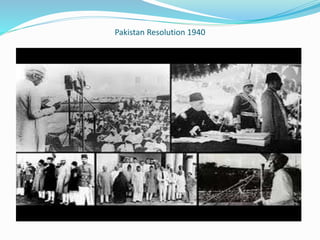
Pakistan Resolution 1940
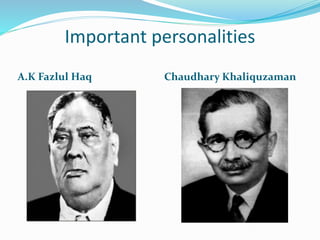
Important personalities
A.K Fazlul Haq Chaudhary Khaliquzaman
GOALS
 Geographically contiguous units be demarcated
into regions where Muslims are in numerical majority.
Adequate, effective and mandatory safeguards
should be provided for minorities.
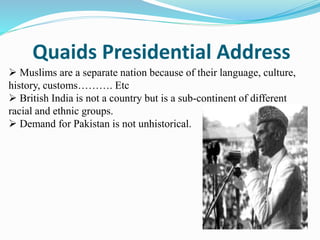
Quaids Presidential Address
 Muslims are a separate nation because of their language, culture,
history, customs………. Etc
 British India is not a country but is a sub-continent of different
racial and ethnic groups.
 Demand for Pakistan is not unhistorical.
Importance of Pakistan resolution
 Muslims of India set their National objective.
 All important personalities attended this Session.
 Muslims had adopted a clear agenda regarding their
struggle.
 It was unanimously adopted.

Lahore resolution

  • 1.
    By: Saif Khalidkhan Kakar Lecturer (Civics/Pol. Sci) Pakistan Education Center
  • 2.
    Background • After publicationof the Nehru report 1928, Quaid E Azam Published his 14 point agenda in 1929. • Quaid E Azam left his membership of congress party and revised the objectives of Muslim league in favor of self rule in India. • formation of congress ministries from 1937-1939 clarified the political future of Indian Muslims in united India. • During September 1939 world war II had initiated and the political condition in India dramatically changed.
  • 3.
    Introduction  During the27th annual session of all India Muslim League held in Lahore the Muslim leaders decided to pass a resolution in favor of a separate Muslim state.  on 21st March 1940 working committee of All India Muslim League appointed a Drafting committee to prepare a draft of resolution.  on 22nd March 1940 Drafting committee prepared a draft and submitted it to the working committee for consideration.  on 23rd March 1940 Maulvi Fazlul Haq moved the resolution, it was supported by Zafar Ali Khan, Saradar Aurengzeb, Sir Abdullah Haroon, Qazi Isa, Abdul Hamid Khan, Maulana Abdul Hameed Bayouni, Begum M. Ali Johar……….etc  on 24th March it was adopted by Muslim League.
  • 4.
  • 5.
    Important personalities A.K FazlulHaq Chaudhary Khaliquzaman
  • 6.
    GOALS  Geographically contiguousunits be demarcated into regions where Muslims are in numerical majority. Adequate, effective and mandatory safeguards should be provided for minorities.
  • 7.
    Quaids Presidential Address Muslims are a separate nation because of their language, culture, history, customs………. Etc  British India is not a country but is a sub-continent of different racial and ethnic groups.  Demand for Pakistan is not unhistorical.
  • 8.
    Importance of Pakistanresolution  Muslims of India set their National objective.  All important personalities attended this Session.  Muslims had adopted a clear agenda regarding their struggle.  It was unanimously adopted.