Ideologies of Education Year 3 Professional Studies
What is schooling for?
Where do you stand? Name one thing you feel very strongly about in education?
Where do you stand? I think... ... education is about helping children to get a good job … homework is a good thing … SATs should be abolished … teachers should be allowed to use corporal punishment … all subjects in the curriculum should have equal weighting … competition in school is a good thing
The Curriculum (HMI 1989) A school’s curriculum consists of all those  activities   designed …within its  organisational framework  to promote the  intellectual, personal, social & physical   development  of its pupils. It includes not only the  formal  programme of lessons, but also the  ‘informal’  programme of so-called extra-curricular activities, as well as those features which produce the school’s  ethos , such as the quality of  relationships , the concern for equal opportunity, the  values  exemplified in the way the school sets about its task and the ways in which it is  organised and managed .
Ideology “… a broad interlocked set of ideas and beliefs about the world held by a group of people operating at various levels in society and in various contexts and which is demonstrated in their behaviour.” Matheson & Limond (1999) on Marxist definition
Importance of ideologies everything we say, do or produce betrays us… ideologies are not uniformly held. ideologies are not fixed. different ideologies – different stakeholders mismatch between proclaimed ideologies and empirical evidence.
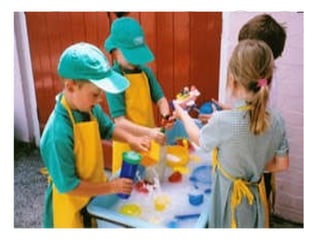
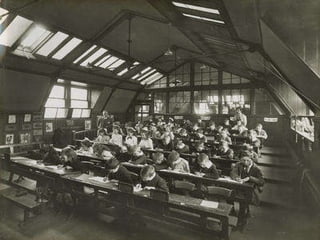
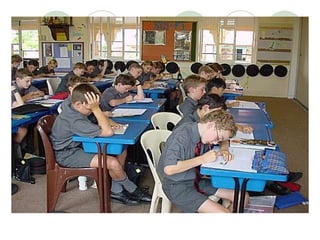
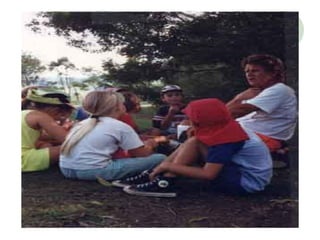
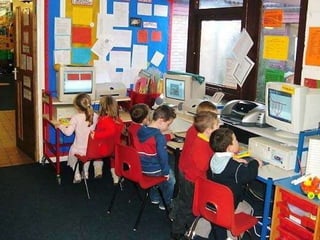
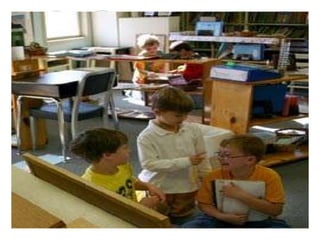
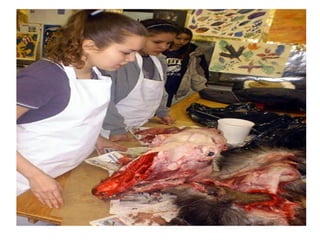
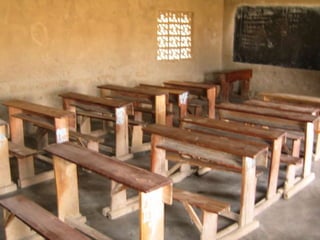
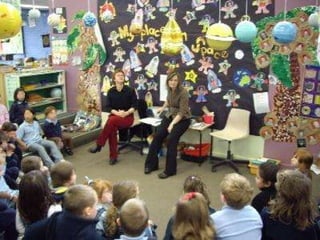
The sources of evidence Pictures or images alone can tell us a great deal about the underpinning ideology. What values, ideas and beliefs are conveyed in the following pictures?


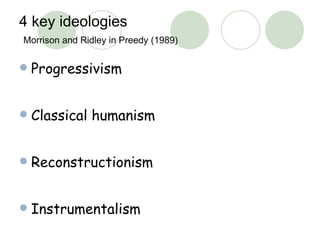
4 key ideologies   Morrison and Ridley in Preedy (1989) Progressivism Classical humanism Reconstructionism Instrumentalism
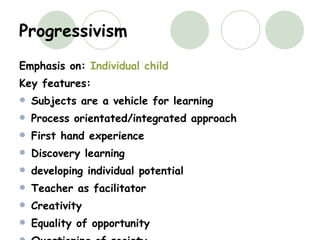
Progressivism Emphasis on:  Individual child Key features: Subjects are a vehicle for learning Process orientated/integrated approach First hand experience Discovery learning developing individual potential Teacher as facilitator Creativity Equality of opportunity Questioning of society
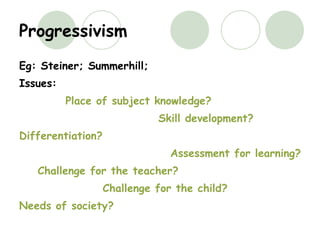
Progressivism Eg: Steiner; Summerhill;  Issues: Place of subject knowledge? Skill development? Differentiation? Assessment for learning? Challenge for the teacher? Challenge for the child? Needs of society?
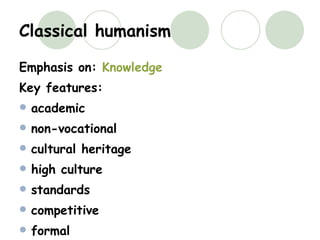
Classical humanism Emphasis on:  Knowledge Key features: academic non-vocational cultural heritage high culture standards competitive formal intrinsic worthwhileness
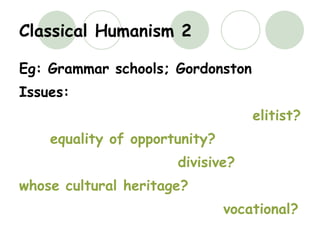
Classical Humanism 2 Eg: Grammar schools; Gordonston  Issues: elitist? equality of opportunity? divisive? whose cultural heritage? vocational?
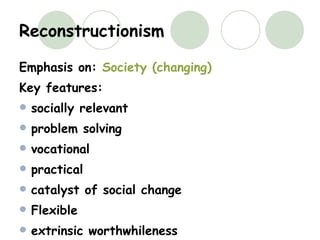
Reconstructionism Emphasis on:  Society (changing) Key features: socially relevant problem solving vocational practical catalyst of social change Flexible extrinsic worthwhileness
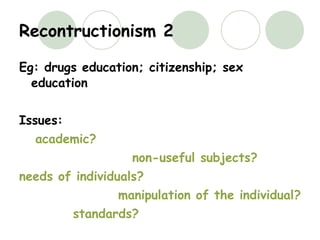
Recontructionism 2 Eg: drugs education; citizenship; sex education Issues: academic? non-useful subjects? needs of individuals? manipulation of the individual? standards?
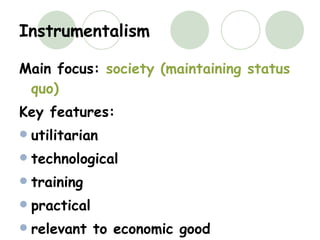
Instrumentalism Main focus:  society (maintaining status quo) Key features: utilitarian technological training  practical relevant to economic good extrinsic worthwhileness
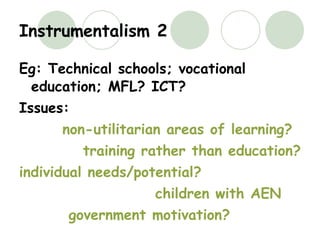
Instrumentalism 2 Eg: Technical schools; vocational education; MFL? ICT? Issues: non-utilitarian areas of learning? training rather than education? individual needs/potential? children with AEN government motivation?
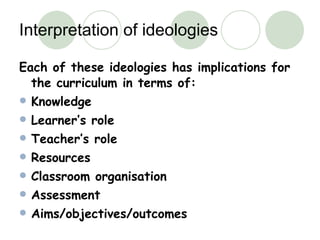
Interpretation of ideologies Each of these ideologies has implications for the curriculum in terms of: Knowledge Learner’s role Teacher’s role Resources Classroom organisation Assessment Aims/objectives/outcomes
Four extracts Which of the ideologies described above are ‘betrayed’ in the following extracts?
One obvious purpose is to fit children for the society into which they will grow up. To do this successfully it is necessary to predict what that society will be like. It will certainly be one marked by rapid and far reaching economic and social change. It is likely to be richer than now, with even more choice of goods, with tastes dominated by majorities and with more leisure for all; more people will be called upon to change their occupation.
Would it not now be better to approach the public, who know that economics is not everything, as whole men rather than economic men? Should we not deal with matters which concern the nation; respect for other people and for law, the welfare of young people, the state of family life, the moral welfare of all the people, cultural values, public-spiritedness or its lack, national defence, the tone of national life? These are at the centre of the public's concern. The economic situation is not an independent variable; it reflects the state of political life, the degree to which people are aware of realities, and the climate of opinion. You will only have a healthy economy in a sound body politic.
Children are not naturally good. They need firm, tactful discipline from parents and teachers with clear standards. Too much freedom for children breeds selfishness, vandalism and personal unhappiness. Schools are for schooling, not social engineering.
There is now wide acceptance that to build an economy that will continue our success in the global market place we will need an even better educated and more highly skilled workforce. Equally importantly, to build a fair and inclusive society everyone must have the opportunity to realise their full potential
Sources of extracts Plowden Report (1967) Sir Keith Joseph (1986) Rhodes Boysen (black paper) (1982) Department for Education and Skills: A strategy to 2006 (2003)
Your own ideology Reflect back on the questions posed earlier: 1. What is schooling for? 2. Name one thing you feel very strongly about in education? What do your answers tell you about your own ideology?
The Foundation Stage Curriculum What ideology underpins the Foundation Stage curriculum?   How does the Foundation Stage Curriculum differ from the National Curriculum in terms of ideology? What are the implications of running the Foundation Stage in Yr R and the NC in Yr 1?
Current developments The Curriculum in Successful Schools   www.ofsted.gov.uk/publications (2003) Excellence and enjoyment   www.qca.gov.uk  (2003) Creative Partnerships   www.creative-partnerships.com Expecting the unexpected :  developing creativity in Primary and Secondary Schools   www.ofsted.gov.uk/publications (2003 ) Cross-curricular approaches Every Child Matters  www.everychildmatters.gov.uk  Personalized Learning
Every Child Matters  be healthy  stay safe  enjoy and achieve  make a positive contribution  achieve economic well-being.  From OFSTED Framework for the inspection of children’s services (2005)
“ What is education for? None of the political parties seems to have a clue…” … politicians are not selling education as an end in itself. They are positioning it as a means of addressing wider social problems, such as apathy, exclusion, obesity and disorder - and the list grows longer by the day.  28 April 2005 Institute of Ideas
Critique: “ All our education prompts us to suppress imagination. The logical, numerate, literate, educated mind can kill ideas before they start…many formally educated people …have their imagination ironed out of them” James Pilditch  (1987) (from commercial world)
Conclusion We need to: maintain a critical stance - we are professionals not technicians know what we think - integrity in the face of compromise hang on to what it means to be an educated person ‘ ride’ fashions in education

Ideologies 2008 09

  • 1.
    Ideologies of EducationYear 3 Professional Studies
  • 2.
  • 3.
    Where do youstand? Name one thing you feel very strongly about in education?
  • 4.
    Where do youstand? I think... ... education is about helping children to get a good job … homework is a good thing … SATs should be abolished … teachers should be allowed to use corporal punishment … all subjects in the curriculum should have equal weighting … competition in school is a good thing
  • 5.
    The Curriculum (HMI1989) A school’s curriculum consists of all those activities designed …within its organisational framework to promote the intellectual, personal, social & physical development of its pupils. It includes not only the formal programme of lessons, but also the ‘informal’ programme of so-called extra-curricular activities, as well as those features which produce the school’s ethos , such as the quality of relationships , the concern for equal opportunity, the values exemplified in the way the school sets about its task and the ways in which it is organised and managed .
  • 6.
    Ideology “… abroad interlocked set of ideas and beliefs about the world held by a group of people operating at various levels in society and in various contexts and which is demonstrated in their behaviour.” Matheson & Limond (1999) on Marxist definition
  • 7.
    Importance of ideologieseverything we say, do or produce betrays us… ideologies are not uniformly held. ideologies are not fixed. different ideologies – different stakeholders mismatch between proclaimed ideologies and empirical evidence.
  • 8.
    The sources ofevidence Pictures or images alone can tell us a great deal about the underpinning ideology. What values, ideas and beliefs are conveyed in the following pictures?
  • 9.
  • 10.
  • 11.
  • 12.
  • 13.
  • 14.
  • 15.
  • 16.
  • 17.
  • 18.
    4 key ideologies Morrison and Ridley in Preedy (1989) Progressivism Classical humanism Reconstructionism Instrumentalism
  • 19.
    Progressivism Emphasis on: Individual child Key features: Subjects are a vehicle for learning Process orientated/integrated approach First hand experience Discovery learning developing individual potential Teacher as facilitator Creativity Equality of opportunity Questioning of society
  • 20.
    Progressivism Eg: Steiner;Summerhill; Issues: Place of subject knowledge? Skill development? Differentiation? Assessment for learning? Challenge for the teacher? Challenge for the child? Needs of society?
  • 21.
    Classical humanism Emphasison: Knowledge Key features: academic non-vocational cultural heritage high culture standards competitive formal intrinsic worthwhileness
  • 22.
    Classical Humanism 2Eg: Grammar schools; Gordonston Issues: elitist? equality of opportunity? divisive? whose cultural heritage? vocational?
  • 23.
    Reconstructionism Emphasis on: Society (changing) Key features: socially relevant problem solving vocational practical catalyst of social change Flexible extrinsic worthwhileness
  • 24.
    Recontructionism 2 Eg:drugs education; citizenship; sex education Issues: academic? non-useful subjects? needs of individuals? manipulation of the individual? standards?
  • 25.
    Instrumentalism Main focus: society (maintaining status quo) Key features: utilitarian technological training practical relevant to economic good extrinsic worthwhileness
  • 26.
    Instrumentalism 2 Eg:Technical schools; vocational education; MFL? ICT? Issues: non-utilitarian areas of learning? training rather than education? individual needs/potential? children with AEN government motivation?
  • 27.
    Interpretation of ideologiesEach of these ideologies has implications for the curriculum in terms of: Knowledge Learner’s role Teacher’s role Resources Classroom organisation Assessment Aims/objectives/outcomes
  • 28.
    Four extracts Whichof the ideologies described above are ‘betrayed’ in the following extracts?
  • 29.
    One obvious purposeis to fit children for the society into which they will grow up. To do this successfully it is necessary to predict what that society will be like. It will certainly be one marked by rapid and far reaching economic and social change. It is likely to be richer than now, with even more choice of goods, with tastes dominated by majorities and with more leisure for all; more people will be called upon to change their occupation.
  • 30.
    Would it notnow be better to approach the public, who know that economics is not everything, as whole men rather than economic men? Should we not deal with matters which concern the nation; respect for other people and for law, the welfare of young people, the state of family life, the moral welfare of all the people, cultural values, public-spiritedness or its lack, national defence, the tone of national life? These are at the centre of the public's concern. The economic situation is not an independent variable; it reflects the state of political life, the degree to which people are aware of realities, and the climate of opinion. You will only have a healthy economy in a sound body politic.
  • 31.
    Children are notnaturally good. They need firm, tactful discipline from parents and teachers with clear standards. Too much freedom for children breeds selfishness, vandalism and personal unhappiness. Schools are for schooling, not social engineering.
  • 32.
    There is nowwide acceptance that to build an economy that will continue our success in the global market place we will need an even better educated and more highly skilled workforce. Equally importantly, to build a fair and inclusive society everyone must have the opportunity to realise their full potential
  • 33.
    Sources of extractsPlowden Report (1967) Sir Keith Joseph (1986) Rhodes Boysen (black paper) (1982) Department for Education and Skills: A strategy to 2006 (2003)
  • 34.
    Your own ideologyReflect back on the questions posed earlier: 1. What is schooling for? 2. Name one thing you feel very strongly about in education? What do your answers tell you about your own ideology?
  • 35.
    The Foundation StageCurriculum What ideology underpins the Foundation Stage curriculum? How does the Foundation Stage Curriculum differ from the National Curriculum in terms of ideology? What are the implications of running the Foundation Stage in Yr R and the NC in Yr 1?
  • 36.
    Current developments TheCurriculum in Successful Schools www.ofsted.gov.uk/publications (2003) Excellence and enjoyment www.qca.gov.uk (2003) Creative Partnerships www.creative-partnerships.com Expecting the unexpected : developing creativity in Primary and Secondary Schools www.ofsted.gov.uk/publications (2003 ) Cross-curricular approaches Every Child Matters www.everychildmatters.gov.uk Personalized Learning
  • 37.
    Every Child Matters be healthy stay safe enjoy and achieve make a positive contribution achieve economic well-being. From OFSTED Framework for the inspection of children’s services (2005)
  • 38.
    “ What iseducation for? None of the political parties seems to have a clue…” … politicians are not selling education as an end in itself. They are positioning it as a means of addressing wider social problems, such as apathy, exclusion, obesity and disorder - and the list grows longer by the day. 28 April 2005 Institute of Ideas
  • 39.
    Critique: “ Allour education prompts us to suppress imagination. The logical, numerate, literate, educated mind can kill ideas before they start…many formally educated people …have their imagination ironed out of them” James Pilditch  (1987) (from commercial world)
  • 40.
    Conclusion We needto: maintain a critical stance - we are professionals not technicians know what we think - integrity in the face of compromise hang on to what it means to be an educated person ‘ ride’ fashions in education