Making it happen: Teaching
the Technology Generation


           Will Stewart
           University of Bradford
Beyond
“no significant impact”
Outline
•    Why “no significant difference”?
•    Impact of Government
•    Characteristics of today’s learners
•    Model for teaching & learning in 2020
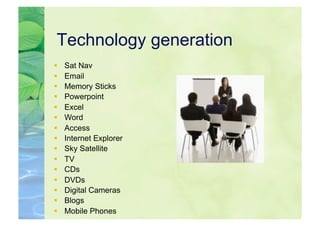
Technology generation
    Sat Nav
    Email
    Memory Sticks
    Powerpoint
    Excel
    Word
    Access
    Internet Explorer
    Sky Satellite
    TV
    CDs
    DVDs
    Digital Cameras
    Blogs
    Mobile Phones
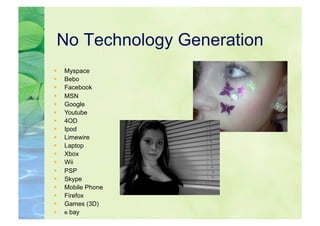
No Technology Generation
    Myspace
    Bebo
    Facebook
    MSN
    Google
    Youtube
    4OD
    Ipod
    Limewire
    Laptop
    Xbox
    Wii
    PSP
    Skype
    Mobile Phone
    Firefox
    Games (3D)
    e bay
 For the first time in history, children are
   more comfortable, knowledgeable, and
   literate than their parents about an
   innovation central to society.

(Don Tapscott (1998). Growing up Digital:The Rise of the Net Generation   )
Why “no significant impact”?

  Over the past 20 years technology has
   had no significant impact on teaching
   and learning.
No significant difference to:

    Curriculum

    Assessment

    Pedagogy

    Institution
We have used technology to:

  replicate our traditional, highly
    centralised, one-size-fits-all, industrial
    model of education

  To do what we have always done
 As technology has become more and
   more pervasive, our institutions have
   become less and less learner-centred
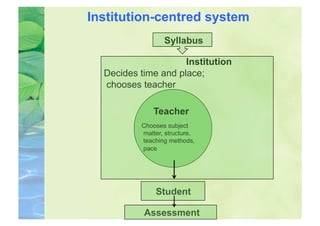
Institution-centred system
                 Syllabus

                     Institution
  Decides time and place;
  chooses teacher

             Teacher
          Chooses subject
          matter, structure,
          teaching methods,
          pace


              Student

           Assessment
Characteristics of today’s learners


    They want to learn

    They know what they want to learn

    They know how they want to learn

    They are all different – different
     experiences, different learning needs
 There is no standardised learner
Today’s 15 year olds were born in 1993
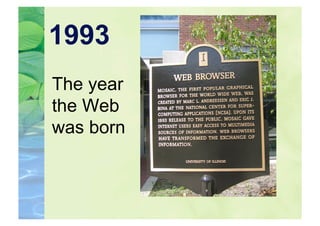
1993
The year
the Web
was born
The use of digital technology has been
 completely normalised and fully
 integrated by this generation…
 Because of this they have distinctive
   ways of thinking, communicating, and
   learning
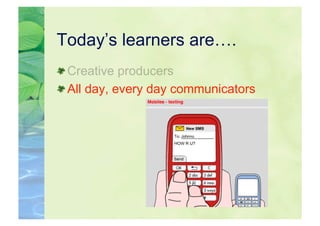
Today’s learners are….

  Creative producers
Today’s learners are….

  Creative producers
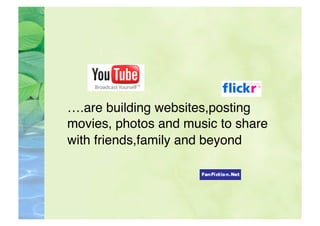
….are building websites,posting
 movies, photos and music to share
 with friends,family and beyond
Today’s learners are….

  Creative producers

  All day, every day communicators
…Texting and MSNing to maintain their
 network
One in three people would not sacrifice their
  mobile phone for one million pounds or more,
  with women leading the way on those most
  likely to refuse.


Carphone Warehouse and the London School of Economics: Mobile Life Survey (2007)
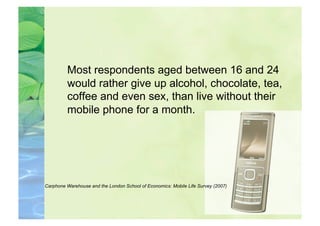
Most respondents aged between 16 and 24
         would rather give up alcohol, chocolate, tea,
         coffee and even sex, than live without their
         mobile phone for a month.


Carphone Warehouse and the London School of Economics: Mobile Life Survey (2007)
I'll give up money, sex ... but not the
mobile
Text not sex
I'll give up the mobile…but not
my favourite hot drink


Carphone Warehouse and the London School of Economics: Mobile Life Survey (2007)
Today’s learners are….

  Creative producers

  All day, every day communicators

  Information gatherers
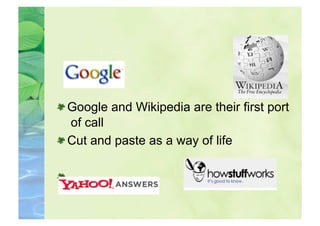
 Google and Wikipedia are their first port
   of call

  Cut and paste as a way of life
Today’s learners are….

    Creative producers

    All day, every day communicators

    Information gatherers

    Social networkers
 They share and collaborate

  They access a global audience
Question

  So how do these learners fit into our
   present education system?
Answer

  Not very easily
Maths failure 'threatening UK
economy’

  
   Britain's failure to teach mathematics at both
      school and university level to a high standard
      has cost the economy £9 billion
  
   Standards in maths are slipping due to
      government interference, the report concludes.

  
   (Reform, 03/06/08)
One million pupils 'failed by Labour exam policy


An 'entire generation' of school children has been
  let down by the Labour government, a new
  study has claimed. The report, by the Bow
  Group, reveals that almost a million teenagers
  failed to achieve even the lowest grade, a G, in
  five GCSEs since the party came to power.
  (Guardian, 20/04/08)
 In 2006 nearly 5% of pupils in state
    schools - 28,000 - got no GCSE
    passes

  almost 25% - 146,000 - got no more
    than D grades.
Schools below 30% GCSE target


  638 secondary schools in England
   below the government's "floor target"
   of 30% of pupils getting at least five
   good GCSEs including English and
   maths, in last year's results.
9th June 2008
Schools told to improve or close


  Almost one in five secondary schools in
   England is to be given a warning to
   improve exam results or face closure.

June 10th 2008
The National Challenge

  These National Challenge Trusts will
   see the shutting down of the failing
   school and a re-opening of a new
   school, to be run as a joint project with
   a high-performing local school and a
   partner such as a local business or
   university, with up to £750,000 funding.
The Pony Express
Government’s education ambitions
 
       * Joint Birth Registration: Recording Responsibility [2008]
 
         * Back on Track: A strategy for modernising alternative provision for young people [2008]
 
         * Raising Expectations: enabling the system to deliver [2008]
 
         * The Children's Plan: building brighter futures [2007]
 
         * Care Matters: Time for Change [2007]
 
         * FE Reform: Raising Skills, Improving Life Chances [2006]
 
         * Higher Standards, Better Schools for All [2005]
 
         * Skills: Getting on in business, getting on at work [2005]
 
         * 14-19 Education and Skills [2005]
 
         * 21st Century Skills - Realising our Potential [2003]
 
         * The Future of Higher Education [2003]
 
       * Promoting achievement, valuing success: a strategy for 14–19 qualifications [2008]
 
         * Raising Expectations: staying in education and training post-16 [2007]
 
         * Care Matters [2006]
 
         * Offender learning [2005]
 
         * Youth Matters [2005]
 
         * Parental separation [Jan 2005]
 
         * Every Child Matters [2003]
 
         * 14-19: Opportunity and Excellence [2002]
 
         * Schools: Building on Success [2001]
 
         * Meeting the childcare challenge [1998]

 
        * The Children's Plan: building brighter futures [2008]
 
        * Departmental Strategic Objective Indicators [2008]
 
        * Ten Year Youth Strategy [2007]
 
        * Progression through Partnership
 
        * Academies Sponsor Prospectus 2007
 
        * Department Equality Schemes
 
        * The Offer to Schools 2006-2007 (Secondary National Strategy - Pupils aged 11 to 16 years) [2006]
Vision 1

  Our vision is one in which these aspirations
   are realised for all children and young
   people. (Gilbert 2020, 2006)
Vision 2

  A compelling vision for the UK. The
   Review recommends that the UK
   commit to becoming a world leader in
   skills by 2020, benchmarked against
   the upper quartile of the OECD. This
   means doubling attainment at most
   levels. (Leitch, 2006)
Vision 3

  Our vision is that each individual
    maximises their potential through
    personalisation of their learning and
    development.

  (Harnessing Technology, 2005)
Vision 4


  The Vision – we need to maximise and
    fulfill the potential of all our people –
    young people and adults- to contribute
    knowledge and skills of world-class
    quality.

  (Foster Report – Realising the
    Potential, 2005)
Vision 5

  Our vision is that within the next 10
   years the Higher Education sector in
   England will be recognised as a major
   contributor to society’s efforts to
   achieve sustainability through the skills
   and knowledge that its graduates learn
   and put into practice.
(HEFCE e-Learning Strategy, 2005)
Principles of reform

   Greater personalisation and choice for every child

   Better teaching

   More flexibility to combine school,college and work-based
     learning

   More vocational provision

   A broader, richer and more interesting curriculum

   Support for every young person and adult to develop skills
     needed for employment and life

   Lifelong learning for all

   High quality university courses with excellent teaching

   Increased and more flexible access to higher education
Under 5s

  disadvantage starts early in life and
   children who get a poor start tend to
   fall further behind as they go through
   the education system. And despite the
   improvements we are still not providing
   enough childcare places in a flexible
   way that meets parents’ needs.
School age years

   There are still too few excellent
    secondary schools for parents and
    pupils. While standards have risen,
    they are not yet high enough for all.
    Parents and teachers worry about
    truancy and bad behaviour
14-19 year olds

  Too many pupils drift, become
   disenchanted with school or get into
   trouble and drop out at 16. Vocational
   learning is still seen as second best.
   And pupils leave school insufficiently
   prepared for the world of work.
The world of work

  The UK lags behind other countries in
   terms of output and skills. A large
   number of adults lack vital skills in
   literacy and numeracy. And too often
   the training system does not give
   employers the sort of courses and
   qualifications that suit their business.
Government’s education
ambitions

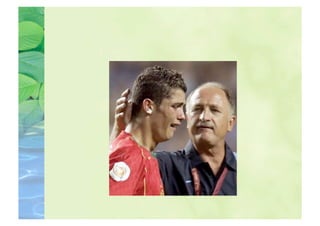
  Balls
What they don’t understand
is…

  No matter how many reports and
   initiatives you produce, there will be
   “no significant impact” to the education
   landscape until you replace the
   existing model
 As long as we continue to replicate
   traditional models of teaching and
   learning, and continue to treat all
   students as if they were the same, we
   will still find that, come 2020, that there
   has been “no significant impact” in
   terms of quality, achievement,
   relevance, skills
 As long as we continue to bolt on
   technology to the traditional teaching
   approaches we will continue to
   alienate a large proportion of learners
Making it happen
So, today’s learners…..

    Live on the Web

    Interact

    Network

    Aggregate resources

    Build communities

    Create

    Share

    collaborate
 How do design an education that is
   relevant to them?
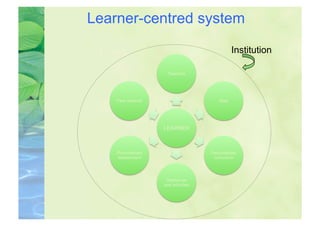
Learner-centred system

                                             Institution

                     Teachers


    Peer network                       Web


                   LEARNER


    Personalised                    Personalised
    assessment                       curriculum


                    Resources
                   and activities
Making it happen

  Re-visit our conceptualisation of
    teaching and learning

  Engage meaningfully with the world our
    learners live in

  Integrate the technologies that are
    relevant to the demands of their
    networked society
Enable

    real personalisation

    real collaboration

    real creativity

    real learner participation
Curriculum

    Dynamic

    Negotiated

    Interdisciplinary

    Blend formal and informal learning
Learning tasks

    Authentic

    Personalised

    Learner-driven

    Learner-designed

    Experiential

    Relevant

    Engaging
Resources

    Media rich

    Informal and formal sources

    Global

    Multiple

    Relevant
Communication

  Open

  Peer-to-peer

  Multiple types
Process

    Active

    Dynamic

    Reflective

    Collaborative

    Performance and inquiry based
Content

  Encourages thinking, understanding
    and discussion

  Offers diverse perspectives and
    representations

  Involve learners creating, sharing and
    revising ideas
Scaffolds

  Support for learners networks of peers,
   teachers, experts and communities
 We need new approaches to learning
   that go beyond “no significant impact”
Teaching and Learning for the
Web 3.0 generation


  It’s too late for the Google generation

  We weren’t ready for them and we
    have undersold them.

  We can be ready for the Web 3.0
    generation
The technology is here
 to make learning
 excellence happen
We owe it to the young people who will
be coming to ask us to help them with
their learning
So…


Make it happen!
Thank you for listening…..

….and any questions?
Will Stewart
   E-Learning Advisor
  University of Bradford

w.stewart@bradford.ac.uk
     07775 66 55 44

Making it happen: teaching the technology generation

  • 1.
    Making it happen:Teaching the Technology Generation Will Stewart University of Bradford
  • 2.
  • 3.
    Outline •  Why “no significant difference”? •  Impact of Government •  Characteristics of today’s learners •  Model for teaching & learning in 2020
  • 4.
    Technology generation   Sat Nav   Email   Memory Sticks   Powerpoint   Excel   Word   Access   Internet Explorer   Sky Satellite   TV   CDs   DVDs   Digital Cameras   Blogs   Mobile Phones
  • 5.
    No Technology Generation   Myspace   Bebo   Facebook   MSN   Google   Youtube   4OD   Ipod   Limewire   Laptop   Xbox   Wii   PSP   Skype   Mobile Phone   Firefox   Games (3D)   e bay
  • 6.
     For the firsttime in history, children are more comfortable, knowledgeable, and literate than their parents about an innovation central to society. (Don Tapscott (1998). Growing up Digital:The Rise of the Net Generation )
  • 7.
    Why “no significantimpact”?  Over the past 20 years technology has had no significant impact on teaching and learning.
  • 8.
    No significant differenceto:  Curriculum  Assessment  Pedagogy  Institution
  • 9.
    We have usedtechnology to:  replicate our traditional, highly centralised, one-size-fits-all, industrial model of education  To do what we have always done
  • 10.
     As technology hasbecome more and more pervasive, our institutions have become less and less learner-centred
  • 11.
    Institution-centred system Syllabus Institution Decides time and place; chooses teacher Teacher Chooses subject matter, structure, teaching methods, pace Student Assessment
  • 12.
    Characteristics of today’slearners  They want to learn  They know what they want to learn  They know how they want to learn  They are all different – different experiences, different learning needs
  • 13.
     There is nostandardised learner
  • 14.
    Today’s 15 yearolds were born in 1993
  • 15.
  • 16.
    The use ofdigital technology has been completely normalised and fully integrated by this generation…
  • 17.
     Because of thisthey have distinctive ways of thinking, communicating, and learning
  • 18.
    Today’s learners are….  Creative producers
  • 19.
    Today’s learners are….  Creative producers
  • 20.
    ….are building websites,posting movies, photos and music to share with friends,family and beyond
  • 21.
    Today’s learners are….  Creative producers  All day, every day communicators
  • 22.
    …Texting and MSNingto maintain their network
  • 23.
    One in threepeople would not sacrifice their mobile phone for one million pounds or more, with women leading the way on those most likely to refuse. Carphone Warehouse and the London School of Economics: Mobile Life Survey (2007)
  • 24.
    Most respondents agedbetween 16 and 24 would rather give up alcohol, chocolate, tea, coffee and even sex, than live without their mobile phone for a month. Carphone Warehouse and the London School of Economics: Mobile Life Survey (2007)
  • 25.
    I'll give upmoney, sex ... but not the mobile
  • 26.
  • 27.
    I'll give upthe mobile…but not my favourite hot drink Carphone Warehouse and the London School of Economics: Mobile Life Survey (2007)
  • 28.
    Today’s learners are….  Creative producers  All day, every day communicators  Information gatherers
  • 29.
     Google and Wikipediaare their first port of call  Cut and paste as a way of life
  • 30.
    Today’s learners are….  Creative producers  All day, every day communicators  Information gatherers  Social networkers
  • 31.
     They share andcollaborate  They access a global audience
  • 32.
    Question  So howdo these learners fit into our present education system?
  • 33.
  • 34.
    Maths failure 'threateningUK economy’   Britain's failure to teach mathematics at both school and university level to a high standard has cost the economy £9 billion   Standards in maths are slipping due to government interference, the report concludes.   (Reform, 03/06/08)
  • 35.
    One million pupils'failed by Labour exam policy An 'entire generation' of school children has been let down by the Labour government, a new study has claimed. The report, by the Bow Group, reveals that almost a million teenagers failed to achieve even the lowest grade, a G, in five GCSEs since the party came to power. (Guardian, 20/04/08)
  • 36.
     In 2006 nearly5% of pupils in state schools - 28,000 - got no GCSE passes  almost 25% - 146,000 - got no more than D grades.
  • 37.
    Schools below 30%GCSE target  638 secondary schools in England below the government's "floor target" of 30% of pupils getting at least five good GCSEs including English and maths, in last year's results. 9th June 2008
  • 38.
    Schools told toimprove or close  Almost one in five secondary schools in England is to be given a warning to improve exam results or face closure. June 10th 2008
  • 39.
    The National Challenge  These National Challenge Trusts will see the shutting down of the failing school and a re-opening of a new school, to be run as a joint project with a high-performing local school and a partner such as a local business or university, with up to £750,000 funding.
  • 40.
  • 41.
    Government’s education ambitions   * Joint Birth Registration: Recording Responsibility [2008]   * Back on Track: A strategy for modernising alternative provision for young people [2008]   * Raising Expectations: enabling the system to deliver [2008]   * The Children's Plan: building brighter futures [2007]   * Care Matters: Time for Change [2007]   * FE Reform: Raising Skills, Improving Life Chances [2006]   * Higher Standards, Better Schools for All [2005]   * Skills: Getting on in business, getting on at work [2005]   * 14-19 Education and Skills [2005]   * 21st Century Skills - Realising our Potential [2003]   * The Future of Higher Education [2003]   * Promoting achievement, valuing success: a strategy for 14–19 qualifications [2008]   * Raising Expectations: staying in education and training post-16 [2007]   * Care Matters [2006]   * Offender learning [2005]   * Youth Matters [2005]   * Parental separation [Jan 2005]   * Every Child Matters [2003]   * 14-19: Opportunity and Excellence [2002]   * Schools: Building on Success [2001]   * Meeting the childcare challenge [1998]   * The Children's Plan: building brighter futures [2008]   * Departmental Strategic Objective Indicators [2008]   * Ten Year Youth Strategy [2007]   * Progression through Partnership   * Academies Sponsor Prospectus 2007   * Department Equality Schemes   * The Offer to Schools 2006-2007 (Secondary National Strategy - Pupils aged 11 to 16 years) [2006]
  • 42.
    Vision 1  Ourvision is one in which these aspirations are realised for all children and young people. (Gilbert 2020, 2006)
  • 43.
    Vision 2  Acompelling vision for the UK. The Review recommends that the UK commit to becoming a world leader in skills by 2020, benchmarked against the upper quartile of the OECD. This means doubling attainment at most levels. (Leitch, 2006)
  • 44.
    Vision 3  Ourvision is that each individual maximises their potential through personalisation of their learning and development.  (Harnessing Technology, 2005)
  • 45.
    Vision 4  TheVision – we need to maximise and fulfill the potential of all our people – young people and adults- to contribute knowledge and skills of world-class quality.  (Foster Report – Realising the Potential, 2005)
  • 46.
    Vision 5  Ourvision is that within the next 10 years the Higher Education sector in England will be recognised as a major contributor to society’s efforts to achieve sustainability through the skills and knowledge that its graduates learn and put into practice. (HEFCE e-Learning Strategy, 2005)
  • 47.
    Principles of reform   Greater personalisation and choice for every child   Better teaching   More flexibility to combine school,college and work-based learning   More vocational provision   A broader, richer and more interesting curriculum   Support for every young person and adult to develop skills needed for employment and life   Lifelong learning for all   High quality university courses with excellent teaching   Increased and more flexible access to higher education
  • 48.
    Under 5s  disadvantagestarts early in life and children who get a poor start tend to fall further behind as they go through the education system. And despite the improvements we are still not providing enough childcare places in a flexible way that meets parents’ needs.
  • 49.
    School age years   There are still too few excellent secondary schools for parents and pupils. While standards have risen, they are not yet high enough for all. Parents and teachers worry about truancy and bad behaviour
  • 50.
    14-19 year olds  Too many pupils drift, become disenchanted with school or get into trouble and drop out at 16. Vocational learning is still seen as second best. And pupils leave school insufficiently prepared for the world of work.
  • 51.
    The world ofwork  The UK lags behind other countries in terms of output and skills. A large number of adults lack vital skills in literacy and numeracy. And too often the training system does not give employers the sort of courses and qualifications that suit their business.
  • 52.
  • 54.
    What they don’tunderstand is…  No matter how many reports and initiatives you produce, there will be “no significant impact” to the education landscape until you replace the existing model
  • 55.
     As long aswe continue to replicate traditional models of teaching and learning, and continue to treat all students as if they were the same, we will still find that, come 2020, that there has been “no significant impact” in terms of quality, achievement, relevance, skills
  • 56.
     As long aswe continue to bolt on technology to the traditional teaching approaches we will continue to alienate a large proportion of learners
  • 57.
  • 58.
    So, today’s learners…..  Live on the Web  Interact  Network  Aggregate resources  Build communities  Create  Share  collaborate
  • 59.
     How do designan education that is relevant to them?
  • 60.
    Learner-centred system Institution Teachers Peer network Web LEARNER Personalised Personalised assessment curriculum Resources and activities
  • 61.
    Making it happen  Re-visit our conceptualisation of teaching and learning  Engage meaningfully with the world our learners live in  Integrate the technologies that are relevant to the demands of their networked society
  • 62.
    Enable  real personalisation  real collaboration  real creativity  real learner participation
  • 63.
    Curriculum  Dynamic  Negotiated  Interdisciplinary  Blend formal and informal learning
  • 64.
    Learning tasks  Authentic  Personalised  Learner-driven  Learner-designed  Experiential  Relevant  Engaging
  • 65.
    Resources  Media rich  Informal and formal sources  Global  Multiple  Relevant
  • 66.
  • 67.
    Process  Active  Dynamic  Reflective  Collaborative  Performance and inquiry based
  • 68.
    Content  Encourages thinking,understanding and discussion  Offers diverse perspectives and representations  Involve learners creating, sharing and revising ideas
  • 69.
    Scaffolds  Support forlearners networks of peers, teachers, experts and communities
  • 70.
     We need newapproaches to learning that go beyond “no significant impact”
  • 71.
    Teaching and Learningfor the Web 3.0 generation  It’s too late for the Google generation  We weren’t ready for them and we have undersold them.  We can be ready for the Web 3.0 generation
  • 72.
    The technology ishere to make learning excellence happen
  • 73.
    We owe itto the young people who will be coming to ask us to help them with their learning
  • 74.
  • 75.
    Thank you forlistening….. ….and any questions?
  • 76.
    Will Stewart E-Learning Advisor University of Bradford w.stewart@bradford.ac.uk 07775 66 55 44