A THEORETICAL INVESTIGATION OF PBL USING POPPER’S PHILOSOPHY OF EPISTEMOLOGY. GRAHAM PARTON  Why Problem Based Learning?
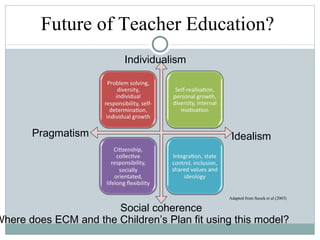
Future of Teacher Education? Where does ECM and the Children’s Plan fit using this model? Adapted from Snoek et al (2003) ‏ Idealism Individualism Social coherence Pragmatism
The State of Teacher Education Competency-based Teacher Education (Standards) ‏ Government control of teaching and teacher education (ECM, Children’s Plan) ‏ Non-theoretical models of teacher education (GRTP) ‏ . A set of practises (Edwards, 2007) ‏
What type of Teacher is needed Teachers are required to operate in ever-changing situations (Van Mahen, 1994). Critique of apprenticeship models of Teacher Education (Lawlor, 1990) ‏ De-professionalising teacher education- challenging and  restricting teacher autonomy and agency (Furlong, 2000).
What type of Teacher is needed A teacher that can: Think critically  Collaborate as a team  Reflect and adapt to change  Have the ability to make judgements on effective practice, through expert knowledge, theory and values Encourage creativity
"The theory of knowledge which I wish to propose is a largely Darwinian theory of the growth of knowledge. From the amoeba to Einstein, the growth of knowledge is always the same: we try to solve our problems, and to obtain, by a process of elimination, something approaching adequacy in our tentative solutions." Popper, 1966 "I  may  be  wrong  and you  may  be right, and by an effort, we  may  get nearer to the truth." Popper 1966
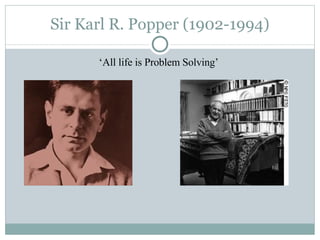
Sir Karl R. Popper (1902-1994) ‘ All life is Problem Solving’
Characteristics of Popper’s Philosophy Francis Bacon- Induction:  Observations lead to general hypotheses and confirmed laws. David Hume:  problems with induction. He demonstrated that no number of repeated observations in and of themselves can add up to a general principle or law  Popper attempts to solve the problem of induction 'The formation of belief by repetition is a myth'  Popper 1973
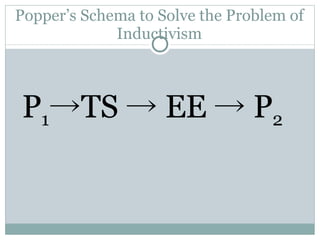
Popper’s Schema to Solve the Problem of Inductivism P 1 ->TS -> EE -> P 2
What does this mean? The learner is faced with a problem (P 1 ), usually when some expectation is disappointed, and a situation arises for which she is not prepared. In response, she throws up a new situation (TS), a trial that makes allowance for this new situation. The trial is tested in a process of error-elimination (EE), to see if it is adequate, and as a consequence, a new problem (P 2 ) arises that is different from the initial problem as it is now in a new situation. The schema indicates the pivotal role that problems play in learning, and that learning is an open ended and never-ending process.
How does it relate to PBL? What are the problems?- These problems are the scenario’s given to you. They are issues or debates within Education such as classroom management and ideologies of education. Even though these problems are generated for you, you will begin to create your own problems when you discover a mismatch between theories you hold at the moment. Eg. questioning your ideas of intelligence/ learning styles, do children really learn like this? Is it that simple? Tentative Solutions- When this mismatch is discovered, you will try to make solutions and then discuss these with your group. Eg. Maybe children need a range of learning styles, not just their preferred one? What does research say about this? Error Elimination- Students will criticise your views, and useful elements to your theories will remain. New Problems- The problem or issues will become more complex and open new areas for discussion. As learners we need to try to improve these skills. Critical Thinking Handbook.
Popper’s Problem with Dualism Dualism: The mind and body not working together. Two separate entities Poppers solution is a Pluralist position which contains physical objects and experience (Dualist) but extends to another position which explains human values and standards, something that dualists couldn’t explain. Popper’s Three Worlds
Popper’s Three Worlds World One: Physical Objects- Bodies, Brains, houses, mountains etc World Two: Conscious experience- Sensory Perception, feelings of pain and pleasure, joy and anger- Subjective as it cannot be experienced by anyone else World Three: Human thought: Theories, conjectures, critical arguments, informed discussion and intellectual efforts
How does relate to PBL? Problem solving: problem-solving is at the heart of Popper’s World three of objective knowledge. It is when students use their tentative solutions and discuss these solutions with other students, who will criticise and create new problems that World three objects are used.  Expert or Decision Maker: within a problem based learning scenario, the PBL group must have a chairperson, who is in charge of some of the key decision-making within the group. The chairperson decides with the help of the other team members, the lines of inquiry that the other students were going to take. The chairperson must exhibit, good communication skills and decision-making within the scenario in order to allow critical discussion to flow students to feel confident to state their theories.
How does relate to PBL? Self-directed learner: within problem based learning. Students are encouraged to take an active independent approach to learning by determining which issues to pursue and directing their own inquiry (Savin-Baden, 2004 p. 83). Self-directed learning is a process in which individuals take the initiative to diagnose their learning needs formulate learning goals identify resources are learning, select an implement learning strategies and evaluate learning outcomes (Knowles, 1978). Creative and Critical Thinker: as creative thinkers, students will come to problems and solutions with original and inventive ideas and solutions. In order to the scenario to work effectively they should also be inquisitive and motivated throughout the process. Within a scenario, the student should analyse information by clarifying and setting the purpose and then selecting a strategy to achieve the purpose (Savin- Baden, 2004 p. 85).

Why Problem Based Learning

  • 1.
    A THEORETICAL INVESTIGATIONOF PBL USING POPPER’S PHILOSOPHY OF EPISTEMOLOGY. GRAHAM PARTON Why Problem Based Learning?
  • 2.
    Future of TeacherEducation? Where does ECM and the Children’s Plan fit using this model? Adapted from Snoek et al (2003) ‏ Idealism Individualism Social coherence Pragmatism
  • 3.
    The State ofTeacher Education Competency-based Teacher Education (Standards) ‏ Government control of teaching and teacher education (ECM, Children’s Plan) ‏ Non-theoretical models of teacher education (GRTP) ‏ . A set of practises (Edwards, 2007) ‏
  • 4.
    What type ofTeacher is needed Teachers are required to operate in ever-changing situations (Van Mahen, 1994). Critique of apprenticeship models of Teacher Education (Lawlor, 1990) ‏ De-professionalising teacher education- challenging and restricting teacher autonomy and agency (Furlong, 2000).
  • 5.
    What type ofTeacher is needed A teacher that can: Think critically Collaborate as a team Reflect and adapt to change Have the ability to make judgements on effective practice, through expert knowledge, theory and values Encourage creativity
  • 6.
    "The theory ofknowledge which I wish to propose is a largely Darwinian theory of the growth of knowledge. From the amoeba to Einstein, the growth of knowledge is always the same: we try to solve our problems, and to obtain, by a process of elimination, something approaching adequacy in our tentative solutions." Popper, 1966 "I may be wrong and you may be right, and by an effort, we may get nearer to the truth." Popper 1966
  • 7.
    Sir Karl R.Popper (1902-1994) ‘ All life is Problem Solving’
  • 8.
    Characteristics of Popper’sPhilosophy Francis Bacon- Induction: Observations lead to general hypotheses and confirmed laws. David Hume: problems with induction. He demonstrated that no number of repeated observations in and of themselves can add up to a general principle or law Popper attempts to solve the problem of induction 'The formation of belief by repetition is a myth' Popper 1973
  • 9.
    Popper’s Schema toSolve the Problem of Inductivism P 1 ->TS -> EE -> P 2
  • 10.
    What does thismean? The learner is faced with a problem (P 1 ), usually when some expectation is disappointed, and a situation arises for which she is not prepared. In response, she throws up a new situation (TS), a trial that makes allowance for this new situation. The trial is tested in a process of error-elimination (EE), to see if it is adequate, and as a consequence, a new problem (P 2 ) arises that is different from the initial problem as it is now in a new situation. The schema indicates the pivotal role that problems play in learning, and that learning is an open ended and never-ending process.
  • 11.
    How does itrelate to PBL? What are the problems?- These problems are the scenario’s given to you. They are issues or debates within Education such as classroom management and ideologies of education. Even though these problems are generated for you, you will begin to create your own problems when you discover a mismatch between theories you hold at the moment. Eg. questioning your ideas of intelligence/ learning styles, do children really learn like this? Is it that simple? Tentative Solutions- When this mismatch is discovered, you will try to make solutions and then discuss these with your group. Eg. Maybe children need a range of learning styles, not just their preferred one? What does research say about this? Error Elimination- Students will criticise your views, and useful elements to your theories will remain. New Problems- The problem or issues will become more complex and open new areas for discussion. As learners we need to try to improve these skills. Critical Thinking Handbook.
  • 12.
    Popper’s Problem withDualism Dualism: The mind and body not working together. Two separate entities Poppers solution is a Pluralist position which contains physical objects and experience (Dualist) but extends to another position which explains human values and standards, something that dualists couldn’t explain. Popper’s Three Worlds
  • 13.
    Popper’s Three WorldsWorld One: Physical Objects- Bodies, Brains, houses, mountains etc World Two: Conscious experience- Sensory Perception, feelings of pain and pleasure, joy and anger- Subjective as it cannot be experienced by anyone else World Three: Human thought: Theories, conjectures, critical arguments, informed discussion and intellectual efforts
  • 14.
    How does relateto PBL? Problem solving: problem-solving is at the heart of Popper’s World three of objective knowledge. It is when students use their tentative solutions and discuss these solutions with other students, who will criticise and create new problems that World three objects are used. Expert or Decision Maker: within a problem based learning scenario, the PBL group must have a chairperson, who is in charge of some of the key decision-making within the group. The chairperson decides with the help of the other team members, the lines of inquiry that the other students were going to take. The chairperson must exhibit, good communication skills and decision-making within the scenario in order to allow critical discussion to flow students to feel confident to state their theories.
  • 15.
    How does relateto PBL? Self-directed learner: within problem based learning. Students are encouraged to take an active independent approach to learning by determining which issues to pursue and directing their own inquiry (Savin-Baden, 2004 p. 83). Self-directed learning is a process in which individuals take the initiative to diagnose their learning needs formulate learning goals identify resources are learning, select an implement learning strategies and evaluate learning outcomes (Knowles, 1978). Creative and Critical Thinker: as creative thinkers, students will come to problems and solutions with original and inventive ideas and solutions. In order to the scenario to work effectively they should also be inquisitive and motivated throughout the process. Within a scenario, the student should analyse information by clarifying and setting the purpose and then selecting a strategy to achieve the purpose (Savin- Baden, 2004 p. 85).