Identity & access management
Aspects gestion - INFOSAFE 17/2/2012


                         Jacques Folon
                    Chargé de cours ICHEC
        Professeur invité Université de Lorraine (Metz)
                   Partner Edge-Consulting
Le powerpoint est
                                    accessible ici


http://aliaz.com/jacques-folon


                                             2
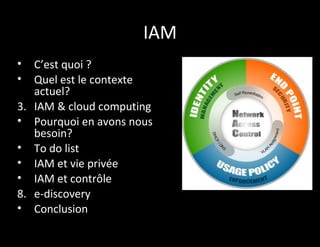
IAM
•  C’est quoi ?
•  Quel est le contexte
   actuel?
3. IAM & cloud computing
• Pourquoi en avons nous
   besoin?
• To do list
• IAM et vie privée
• IAM et contrôle
8. e-discovery
• Conclusion
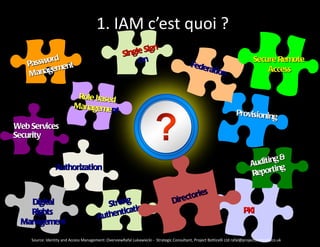
1. IAM c’est quoi ?
                                                               ign
                                                       Single S
        ord                                                 On                                                                   Secure Remote
   Passw ment                                                                                Fede
                                                                                                 ration
         e                                                                                                                           Access
   Manag

                            Role based
                           Managemen
                                      t                                                                                Provisioning
Web Services
Security

                                                                                                                                      ng &
                 Authorization                                                                                                  Auditi g
                                                                                                                                       tin
                                                                                                                                Repor

                                                                                            es
                                                                                   Directori
   Digital                                   Strong on
                                                   ati                                                                     PKI
   Rights
                                         Authentic
 Management

    Source: Identity and Access Management: OverviewRafal Lukawiecki - Strategic Consultant, Project Botticelli Ltd rafal@projectbotticelli.co.uk
5 Questions
to ask your CISO
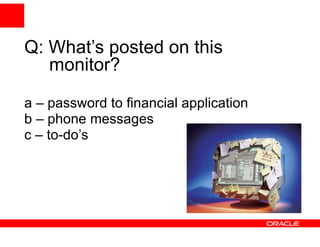
Q: What’s posted on this
   monitor?

a – password to financial application
b – phone messages
c – to-do’s
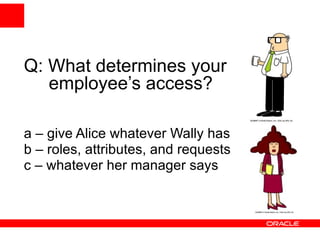
Q: What determines your
   employee’s access?

a – give Alice whatever Wally has
b – roles, attributes, and requests
c – whatever her manager says
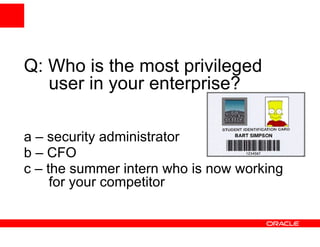
Q: Who is the most privileged
   user in your enterprise?

a – security administrator
b – CFO
c – the summer intern who is now working
     for your competitor
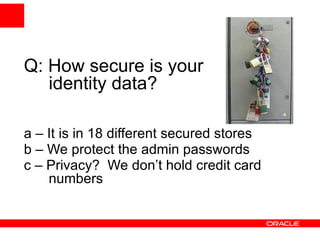
Q: How secure is your
   identity data?

a – It is in 18 different secured stores
b – We protect the admin passwords
c – Privacy? We don’t hold credit card
    numbers
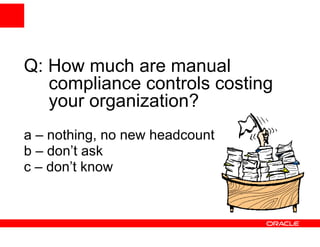
Q: How much are manual
   compliance controls costing
   your organization?
a – nothing, no new headcount
b – don’t ask
c – don’t know
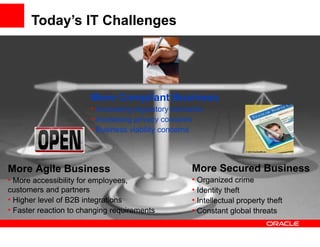
Today’s IT Challenges


                       More Compliant Business
                       • Increasing regulatory demands
                       • Increasing privacy concerns
                       • Business viability concerns


More Agile Business                               More Secured Business
• More accessibility for employees,               • Organized crime
customers and partners                            • Identity theft
• Higher level of B2B integrations                • Intellectual property theft
• Faster reaction to changing requirements        • Constant global threats
State Of Security In Enterprise


• Incomplete
  • Multiple point solutions from many vendors
  • Disparate technologies that don’t work together


• Complex
  • Repeated point-to-point integrations
  • Mostly manual operations


• ‘Non-compliant’
  • Difficult to enforce consistent set of policies
  • Difficult to measure compliance with those policies
Identity Management Values


• Trusted and reliable security

• Efficient regulatory compliance

• Lower administrative and development costs

• Enable online business networks

• Better end-user experience
IAM n’est pas uniquement une tâche informatique !


La gestion des identités consiste à gérer le cycle de vie des personnes
(embauche, promotion, mutation, départ, etc.) au sein de la société et les
impacts induits sur le système d’information (création de Comptes
utilisateurs, attribution de Profils utilisateurs, mise en œuvre du contrôle
d'accès, etc.).

Cette gestion des identités doit pouvoir être faite d'un point de vue
fonctionnel par des non-informaticiens (exemple : Ressources Humaines,
Maîtrise d’ouvrage, l’utilisateur lui-même) et d'un point de vue technique
par des informaticiens (exemple : administrateur, Maîtrise d’œuvre).


source clusif                                                              14
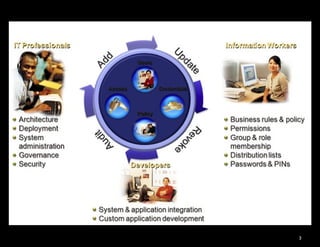
La solution de gestion d’identités doit être une solution globale sur la
   base d’une infrastructure centralisée avec une gestion fonctionnelle
   distribuée et qui intègre les fonctionnalités suivantes :
   • la gestion du référentiel central des utilisateurs (alimentation à partir
   de référentiels utilisateurs sources),
   • la gestion du référentiel central des ressources concernées par la
   gestion des droits d’accès,
   • la gestion des habilitations (gestion des Profils, Rôles, gestion des
   utilisateurs, workflow),
   • le provisioning (synchronisation des référentiels cibles de sécurité),
   • l’administration décentralisée,
   • l’auto-administration, gestion par les utilisateurs des mots de passe et
   des données privées,
   • l’audit et le reporting,
   • le contrôle d’accès (authentification, autorisation).


source clusif                                                              15
Définition
• What is Identity Management ?
    “Identity management is the set of
    business processes, and a
    supporting infrastructure, for the
    creation, maintenance, and use of
    digital identities.” The Burton
    Group (a research firm specializing
    in IT infrastructure for the
    enterprise)
• Identity Management in this
  sense is sometimes called
  “Identity and Access
  Management” (IAM)
Identity and Access Management is the process for
          managing the lifecycle of digital identities and access for
          people, systems and services. This includes:
        User Management – management of large, changing user
          populations along with delegated- and self-service
          administration.
        Access Management – allows applications to authenticate
          users and allow access to resources based upon policy.
        Provisioning and De-Provisioning – automates account
          propagation across applications and systems.
        Audit and Reporting – review access privileges, validate
          changes, and manage accountability.


                       CA


IAM : J. Tony Goulding CISSP, ITIL CA t
          ony.goulding@ ca.com                                          17
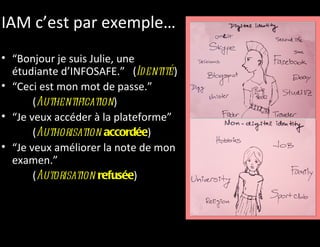
IAM c’est par exemple…
• “Bonjour je suis Julie, une
  étudiante d’INFOSAFE.” (Identité)
• “Ceci est mon mot de passe.”
       (Authentification)
• “Je veux accéder à la plateforme”
       (Authorisation accordée)
• “Je veux améliorer la note de mon
  examen.”
       (Autorisation refusée)
Mais c’est aussi…

• Un nouveau professeur
• Donc une adresse email, à
  donner dès que possible
• Un mot de passe sur ICHEC
  Campus
• Un mot de passe Intranet
• Un mot de passe IE Campus
• Définir les autres services
  auxquel il a accès
Quelles sont les questions à se poser??

• Les personnes sont-elles ce
  qu’elles disent être?
• Sont-elles des membres réels
  de notre communauté ?
• Ont-elles reçu les
  autorisations nécessaires ?
• Le respect de leurs données
  personnelles est-il mis en
  place?
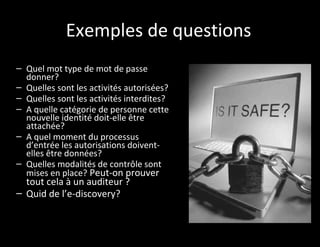
Exemples de questions
– Quel mot type de mot de passe
  donner?
– Quelles sont les activités autorisées?
– Quelles sont les activités interdites?
– A quelle catégorie de personne cette
  nouvelle identité doit-elle être
  attachée?
– A quel moment du processus
  d’entrée les autorisations doivent-
  elles être données?
– Quelles modalités de contrôle sont
  mises en place? Peut-on prouver
  tout cela à un auditeur ?
– Quid de l’e-discovery?
Le triple A de l’IAM
•   Authentication
    WHO ARE YOU?
•   Authorization / Access Control
•   WHAT CAN YOU DO?
    Audit
•   WHAT HAVE YOU DONE?

                                     22
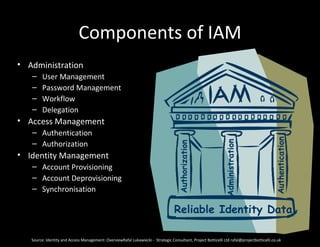
Components of IAM
• Administration
   –     User Management
   –     Password Management
   –     Workflow
   –     Delegation
• Access Management
   – Authentication


                                                                                                                                            Authentication
   – Authorization


                                                                                                                Administration
                                                                                     Authorization
• Identity Management
   – Account Provisioning
   – Account Deprovisioning
   – Synchronisation

                                                                                   Reliable Identity Data

   Source: Identity and Access Management: OverviewRafal Lukawiecki - Strategic Consultant, Project Botticelli Ltd rafal@projectbotticelli.co.uk
2. Contexte actuel


Quel est le contexte actuel
qui est à la base du
développement de l’IAM?
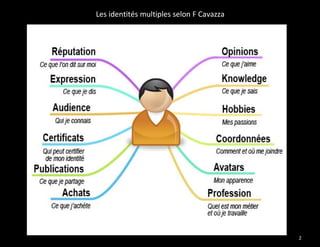
Les identités multiples selon F Cavazza


                                          25
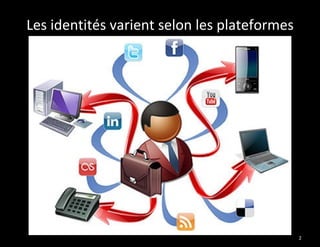
Les identités varient selon les plateformes


                                              26
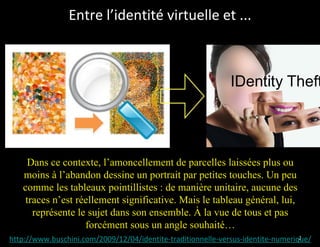
Entre l’identité virtuelle et ...


     Dans ce contexte, l’amoncellement de parcelles laissées plus ou
   moins à l’abandon dessine un portrait par petites touches. Un peu
   comme les tableaux pointillistes : de manière unitaire, aucune des
    traces n’est réellement significative. Mais le tableau général, lui,
      représente le sujet dans son ensemble. À la vue de tous et pas
                   forcément sous un angle souhaité…
http://www.buschini.com/2009/12/04/identite-traditionnelle-versus-identite-numerique/
                                                                                  27
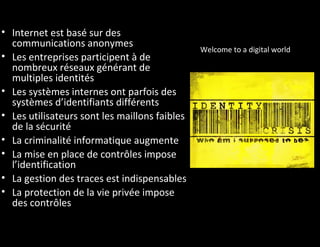
• Internet est basé sur des
  communications anonymes
                                               Welcome to a digital world
• Les entreprises participent à de
  nombreux réseaux générant de
  multiples identités
• Les systèmes internes ont parfois des
  systèmes d’identifiants différents
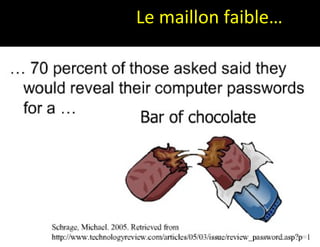
• Les utilisateurs sont les maillons faibles
  de la sécurité
• La criminalité informatique augmente
• La mise en place de contrôles impose
  l’identification
• La gestion des traces est indispensables
• La protection de la vie privée impose
  des contrôles
Sujet d’actualité…
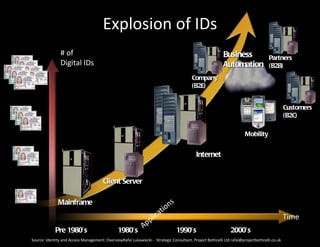
Explosion of IDs
                # of                                                                                        Business                  Partners
                Digital IDs                                                                                 Automation                (B2B)
                                                                                          Company
                                                                                          (B2E)


                                                                                                                                                Customers
                                                                                                                                                (B2C)

                                                                                                                        Mobility


                                                                                             Internet


                                        Client Server

               Mainframe                                                     s
                                                                         ion
                                                                       at
                                                          p         lic                                                                         Time
             Pre 1980’s                         1980’s
                                                       Ap                        1990’s                         2000’s
Source: Identity and Access Management: OverviewRafal Lukawiecki - Strategic Consultant, Project Botticelli Ltd rafal@projectbotticelli.co.uk
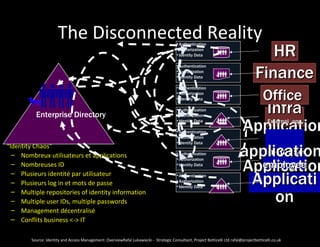
The Disconnected Reality
                                                                                                                                         HR
                                                                                         •Authentication
                                                                                         •Authorization
                                                                                         •Identity Data


                                                                                                                                      Finance
                                                                                         •Authentication
                                                                                         •Authorization
                                                                                         •Identity Data

                                                                                         •Authentication
                                                                                         •Authorization
                                                                                         •Identity Data                                   Office
          Enterprise Directory
                                                                                         •Authentication
                                                                                         •Authorization
                                                                                                                                 Infra
                                                                                                                             Application     External app
                                                                                         •Identity Data

                                                                                         •Authentication
                                                                                         •Authorization
                                                                                         •Identity Data
“Identity Chaos”
 –   Nombreux utilisateurs et applications                                               •Authentication                     application
                                                                                                                                In-House
                                                                                                                             Application
                                                                                         •Authorization
 –   Nombreuses ID                                                                       •Identity Data                        employee
                                                                                                                              Applicati
 –   Plusieurs identité par utilisateur                                                  •Authentication
                                                                                         •Authorization
 –   Plusieurs log in et mots de passe                                                   •Identity Data
 –
 –
     Multiple repositories of identity information
     Multiple user IDs, multiple passwords                                                                                         on
 –   Management décentralisé
 –   Conflits business <-> IT

        Source: Identity and Access Management: OverviewRafal Lukawiecki - Strategic Consultant, Project Botticelli Ltd rafal@projectbotticelli.co.uk
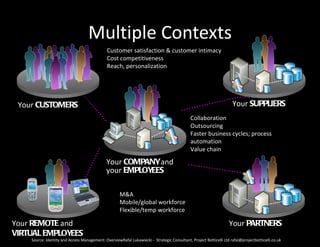
Multiple Contexts
                                              Customer satisfaction & customer intimacy
                                              Cost competitiveness
                                              Reach, personalization


 Your CUSTOMERS                                                                                                      Your SUPPLIERS
                                                                                             Collaboration
                                                                                             Outsourcing
                                                                                             Faster business cycles; process
                                                                                             automation
                                                                                             Value chain

                                              Your COMPANYand
                                              your EMPLOYEES

                                                     M&A
                                                     Mobile/global workforce
                                                     Flexible/temp workforce

Your REMOTE and                                                                                                    Your PARTNERS
VIRTUAL EMPLOY EES
    Source: Identity and Access Management: OverviewRafal Lukawiecki - Strategic Consultant, Project Botticelli Ltd rafal@projectbotticelli.co.uk
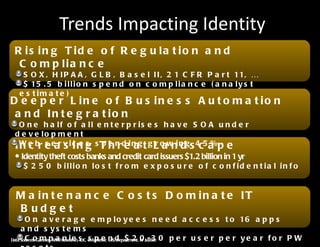
Trends Impacting Identity
 R is in g T id e o f R e g u la t io n a n d
  C o m p lia n c e
    S O X , H I P A A , G L B , B a s e l I I , 2 1 C F R P a r t 11, …
    $ 15 . 5 b i l l i o n s p e n d o n c o m p l i a n c e ( a n a l y s t
   e s t im a t e )
D e e p e r L in e o f B u s in e s s A u t o m a t io n
 a n d In t e g r a t io n
   O n e h a lf o f a ll e n t e r p r is e s h a v e S O A u n d e r
 d e v e lo p m e n t
 I W e br e ear v i c n g s T h n dei n g t g L o wni n gs 4c5 a p e
   nc s s i es pe r a r a d                                    %
 • Identity theft costs banks and credit card issuers $1.2 billion in 1 yr
    $ 2 5 0 b illio n lo s t f r o m e x p o s u r e o f c o n f id e n t ia l in f o


 M a in t e n a n c e C o s t s D o m in a t e IT
 B udg et
       O n a v e r a g e e m p l o y e e s n e e d a c c e s s t o 16 a p p s
     a n d s ys te m s
Data Sources: Gartner, AMR Research, s eMarketer, n d $ 2 0Justice 0 p e r u s e r p e r y e a r f o r P W
       C o m p a n i e IDC, s p e U.S. Department. of - 3
35
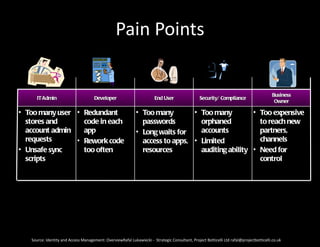
Pain Points


                                                                                                                                           Business
      IT Admin                        Developer                         End User                  Security/ Compliance
                                                                                                                                            Owner

• Too many user • Redundant                                   • Too many        • Too many         • Too expensive
  stores and      code in each                                  passwords         orphaned           to reach new
  account admin   app                                         • Long waits for    accounts           partners,
  requests      • Rework code                                   access to apps, • Limited            channels
• Unsafe sync     too often                                     resources         auditing ability • Need for
  scripts                                                                                            control


   Source: Identity and Access Management: OverviewRafal Lukawiecki - Strategic Consultant, Project Botticelli Ltd rafal@projectbotticelli.co.uk
3. IAM & Cloud computing
Cloud Computing: Definition
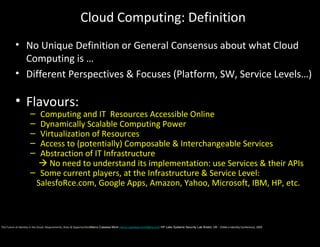
          • No Unique Definition or General Consensus about what Cloud
            Computing is …
          • Different Perspectives & Focuses (Platform, SW, Service Levels…)

          • Flavours:
                     – Computing and IT Resources Accessible Online
                     – Dynamically Scalable Computing Power
                     – Virtualization of Resources
                     – Access to (potentially) Composable & Interchangeable Services
                     – Abstraction of IT Infrastructure
                        No need to understand its implementation: use Services & their APIs
                     – Some current players, at the Infrastructure & Service Level:
                      SalesfoRce.com, Google Apps, Amazon, Yahoo, Microsoft, IBM, HP, etc.


The Future of Identity in the Cloud: Requirements, Risks & OpportunitiesMarco Casassa Mont marco.casassa-mont@hp.com HP Labs Systems Security Lab Bristol, UK - EEMA e-Identity Conference, 2009
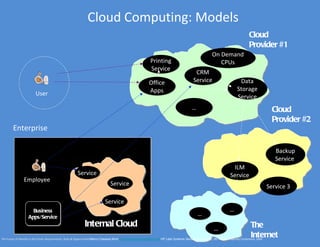
Cloud Computing: Models
                                                                                                                                                                                      Cloud
                                                                                                                                                                                      Provider #1
                                                                                                                                                           On Demand
                                                                                                             Printing                                         CPUs
                                                                                                             Service
                                                                                                                                              CRM
                                                                                                            Office                           Service                          Data
                                                                                                            Apps                                                             Storage
                         User                                                                                                                                                Service
                                                                                                                                            …                                                        Cloud
                                                                                                                                                                                                     Provider #2
        Enterprise

                                                                                                                                                                                                      Backup
                                                                                                                                                                                                      Service
                                                                                                                                                                         ILM
                                                        Service                                                                                                         Service
                Employee
                                                                                Service                                                                                                            Service 3

                                                                            Service
                      Business                                                                                                                                         …
                    Apps/Service
                                                                                                                                                …
                                                             Internal Cloud                                                                                 …                          The
                                                                                                                                                                                       Internet
The Future of Identity in the Cloud: Requirements, Risks & OpportunitiesMarco Casassa Mont marco.casassa-mont@hp.com HP Labs Systems Security Lab Bristol, UK - EEMA e-Identity Conference, 2009
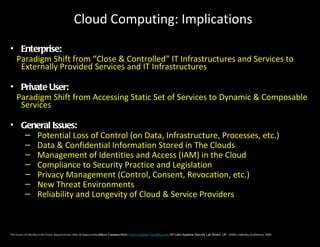
Cloud Computing: Implications
• Enterprise:
 Paradigm Shift from “Close & Controlled” IT Infrastructures and Services to
  Externally Provided Services and IT Infrastructures

• Private User:
 Paradigm Shift from Accessing Static Set of Services to Dynamic & Composable
  Services

• General Issues:
   – Potential Loss of Control (on Data, Infrastructure, Processes, etc.)
   – Data & Confidential Information Stored in The Clouds
   – Management of Identities and Access (IAM) in the Cloud
   – Compliance to Security Practice and Legislation
   – Privacy Management (Control, Consent, Revocation, etc.)
   – New Threat Environments
   – Reliability and Longevity of Cloud & Service Providers


The Future of Identity in the Cloud: Requirements, Risks & OpportunitiesMarco Casassa Mont marco.casassa-mont@hp.com HP Labs Systems Security Lab Bristol, UK - EEMA e-Identity Conference, 2009
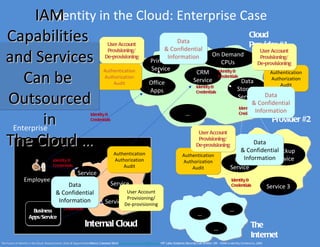
IAM  Identity in the Cloud: Enterprise Case
   Capabilities                                   Cloud
                                                  Provider #1                User Account
                                                                                                                       Data
                                                                                                                  & Confidential
   and Services
                                                                             Provisioning/                                                                       User Account
                                                                            De-provisioning                        Information        On Demand                  Provisioning/
                                                                                                            Printing                       CPUs                 De-provisioning
                                                                                                             Service
       Can be
                                                                           Authentication                                    CRM Identity &                          Authentication
                                                                           Authorization                                                 Credentials
                                                                                                                                                                      Authorization
                                                                               Audit                        Office          Service                    Data
                                                                                                                             Identity &                                   Audit
                                                                                                            Apps                                    Storage
   Outsourced
                                                                                                                             Credentials
                                                                                                                                                    Service Data
                                                                                                                                                             & Confidential
                                                        Cloud                                                                                        Identity &
                                                                                                                                                               Information
             in                                                  Identity &                                               …                          Credentials
                                                        Provider #2
                                                                 Credentials

    Enterprise
   The Cloud …
                                                                                                                                                User Account
                                                                                                                                                Provisioning/
                                                                                                                                               De-provisioning                  Data
                                                                                  Authentication
                                                                                                                                                                            & Confidential
                                                                                                                                                                                        Backup
                                                                                                                                     Authentication
                                     Identity &                                   Authorization                                      Authorization                       ILMInformationService
                                     Credentials                                      Audit                                              Audit                          Service
                                                        Service
                Employee                                                                                                                                                 Identity &
                                              Data                              Service                                                                                  Credentials               Service 3
                                        & Confidential                               User Account
                                                                                     Provisioning/
                                         Information
                                           Identity &                       Service De-provisioning
                      Business               Credentials                                                                                                               …
                    Apps/Service
                                                                                                                                                …
                                                             Internal Cloud                                                                                 …                          The
                                                                                                                                                                                       Internet
The Future of Identity in the Cloud: Requirements, Risks & OpportunitiesMarco Casassa Mont marco.casassa-mont@hp.com HP Labs Systems Security Lab Bristol, UK - EEMA e-Identity Conference, 2009
Identity in the Cloud: Enterprise Case
  Issues and Risks [1/2]

  • Potential Proliferation of Required Identities & Credentials to Access Services
     Misbehaviours when handling credentials (writing down, reusing, sharing, etc.)

  • Complexity in correctly “enabling” Information Flows across boundaries
     Security Threats
      (Enterprise  Cloud & Service Providers, Service Provider  Service Provider, …_

  • Propagation of Identity and Personal Information across Multiple Clouds/Services
    Privacy issues (e.g. compliance to multiple Legislations, Importance of Location, etc.)
    Exposure of business sensitive information
     (employees’ identities, roles, organisational structures, enterprise apps/services, etc.)
    How to effectively Control this Data?

  • Delegation of IAM and Data Management Processes to Cloud and Service Providers
    How to get Assurance that these Processes and Security Practice are Consistent with
     Enterprise Policies?
     - Recurrent problem for all Stakeholders: Enterprise, Cloud and Service Providers …
    Consistency and Integrity of User Accounts & Information across various Clouds/Services
    How to deal with overall Compliance and Governance issues?
The Future of Identity in the Cloud: Requirements, Risks & OpportunitiesMarco Casassa Mont marco.casassa-mont@hp.com HP Labs Systems Security Lab Bristol, UK - EEMA e-Identity Conference, 2009
Identity in the Cloud: Enterprise Case
  Issues and Risks [2/2]

  • Migration of Services between Cloud and Service Providers
    Management of Data Lifecycle

  • Threats and Attacks in the Clouds and Cloud Services
     Cloud and Service Providers can be the “weakest links” in Security & Privacy
     Reliance on good security practice of Third Parties


The Future of Identity in the Cloud: Requirements, Risks & OpportunitiesMarco Casassa Mont marco.casassa-mont@hp.com HP Labs Systems Security Lab Bristol, UK - EEMA e-Identity Conference, 2009
4.Pourquoi en avons nous besoin?

•Sécurité
•Compliance
•Réduction des coûts
•Support pour l’audit
•Contrôle d’accès
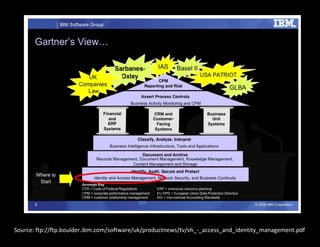
Source: ftp://ftp.boulder.ibm.com/software/uk/productnews/tv/vh_-_access_and_identity_management.pdf
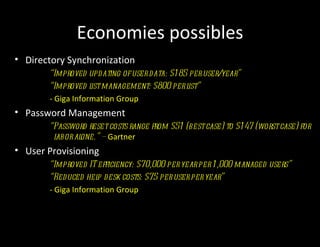
Economies possibles
• Directory Synchronization
       “Improved updating of user data: $1 85 per user/year”
       “Improved l management: $800 per l
                   ist                        ist”
       - Giga Information Group
• Password Management
       “Password reset costs range from $51 (best case) to $1 47 (worst case) for
        labor alone.” – Gartner
• User Provisioning
       “Improved IT efficiency: $70,000 per year per 1 ,000 managed users”
       “Reduced hel desk costs: $75 per user per year”
                    p
       - Giga Information Group
Can We Just Ignore It All?
 • Today, average corporate user
   spends 16 minutes a day logging on
 • A typical home user maintains 12-18
   identities
 • Number of phishing sites grew over
   1600% over the past year
 • Corporate IT Ops manage an average
   of 73 applications and 46 suppliers,
   often with individual directories
 • Regulators are becoming stricter
   about compliance and auditing
 • Orphaned accounts and identities
   lead to security problems


Source: Microsoft’s internal research and Anti-phishing Working Group
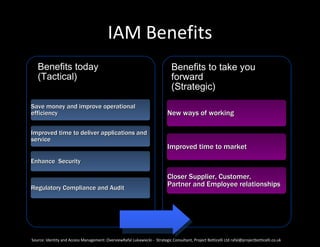
IAM Benefits
   Benefits today                                                              Benefits to take you
   (Tactical)                                                                  forward
                                                                               (Strategic)
Save money and improve operational
efficiency                                                                  New ways of working

Improved time to deliver applications and
service
                                                                            Improved time to market
Enhance Security

                                                                            Closer Supplier, Customer,
Regulatory Compliance and Audit
                                                                            Partner and Employee relationships


Source: Identity and Access Management: OverviewRafal Lukawiecki - Strategic Consultant, Project Botticelli Ltd rafal@projectbotticelli.co.uk
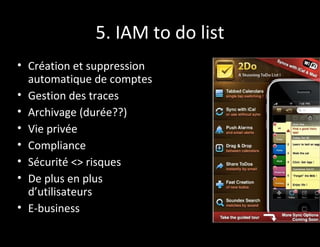
5. IAM to do list
• Création et suppression
  automatique de comptes
• Gestion des traces
• Archivage (durée??)
• Vie privée
• Compliance
• Sécurité <> risques
• De plus en plus
  d’utilisateurs
• E-business
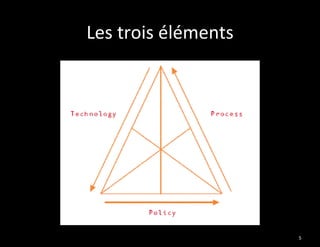
Les trois éléments


                     50
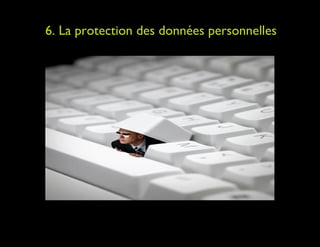
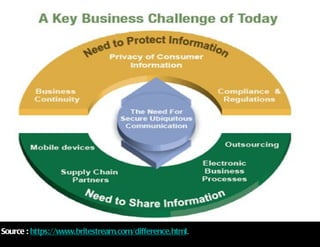
6. La protection des données personnelles
Source : https://www.britestream.com/difference.html.
Les informations circulent
        Qui vérifie?
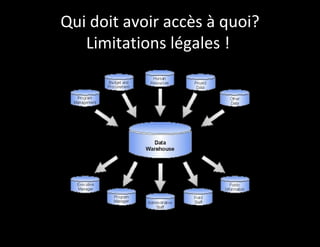
Qui doit avoir accès à quoi?
   Limitations légales !
Responsabilités de l’organisation
TELETRAVAIL
Informations sensibles
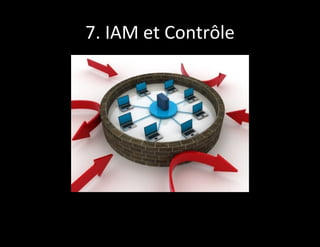
7. IAM et Contrôle
Le maillon faible…
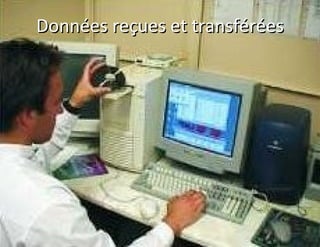
Données reçues et transférées
• Que peut-on
  contrôler?
• Limites?
• Correspondance
  privée
• Saisies sur salaire
• Sanctions réelles
• Communiquer les
  sanctions?
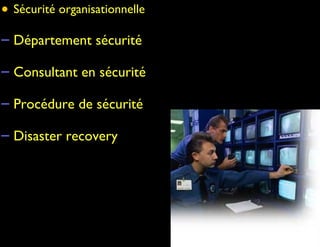
• Sécurité organisationnelle

– Département sécurité

– Consultant en sécurité

– Procédure de sécurité

– Disaster recovery
• Sécurité technique
–   Risk analysis
–   Back-up
–   Procédure contre incendie, vol, etc.
–   Sécurisation de l’accès au réseau IT
–   Système d’authentification (identity management)
–   Loggin and password efficaces
• Sécurité juridique
– Contrats d’emplois et
  information
– Contrats avec les sous-
  contractants
– Code de conduite
– Contrôle des employés
– Respect complet de la
  réglementation
Qui contrôle quoi ?
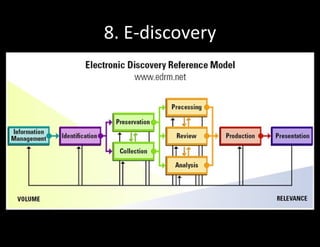
8. E-discovery
Definition of e-discovery
• Electronic discovery (or e-discovery) refers to discovery in civil
  litigation which deals with information in electronic format
  also referred to as Electronically Stored Information (ESI).
• It means the collection, preparation, review and production of
  electronic documents in litigation discovery.
• Any process in which electronic data is sought, located,
  secured, and searched with the intent of using it as evidence
  in a civil or criminal legal case
• This includes e-mail, attachments, and other data stored on a
  computer, network, backup or other storage media. e-
  Discovery includes metadata.
Recommandations
Organizations should update and/or create information
  management policies and procedures that include:
   – e-mail retention policies, On an individual level, employees tend
     to keep information on their hard drives “just in case” they might
     need it.
   – Work with users to rationalize their storage requirements and
     decrease their storage budget.
   – off-line and off-site data storage retention policies,
   – controls defining which users have access to which systems
     andunder what circumstances,
   – instructions for how and where users can store data, and •
     backup and recovery procedures.
   – Assessments or surveys should be done to identify business
     functions, data repositories, and the systems that support them.
   – Legal must be consulted. Organizations and their legal teams
     should work together to create and/or update their data
     retention policies and procedures for managing litigation holds.
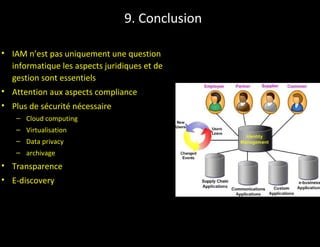
9. Conclusion

• IAM n’est pas uniquement une question
  informatique les aspects juridiques et de
  gestion sont essentiels
• Attention aux aspects compliance
• Plus de sécurité nécessaire
   – Cloud computing
   – Virtualisation
   – Data privacy
   – archivage
• Transparence
• E-discovery
L’IAM est aussi une opportunité

• Repenser la sécurité
• Limiter les risques
• Réduire les coûts
• Repréciser les rôles et
  responsabilités
• Appréhender les risques futurs
Jacques Folon
Jacques.folon@ichec.be
Je suis prêt à répondre à vos questions

Identity access management

  • 1.
    Identity & accessmanagement Aspects gestion - INFOSAFE 17/2/2012 Jacques Folon Chargé de cours ICHEC Professeur invité Université de Lorraine (Metz) Partner Edge-Consulting
  • 2.
    Le powerpoint est accessible ici http://aliaz.com/jacques-folon 2
  • 3.
    IAM • C’estquoi ? • Quel est le contexte actuel? 3. IAM & cloud computing • Pourquoi en avons nous besoin? • To do list • IAM et vie privée • IAM et contrôle 8. e-discovery • Conclusion
  • 4.
    1. IAM c’estquoi ? ign Single S ord On Secure Remote Passw ment Fede ration e Access Manag Role based Managemen t Provisioning Web Services Security ng & Authorization Auditi g tin Repor es Directori Digital Strong on ati PKI Rights Authentic Management Source: Identity and Access Management: OverviewRafal Lukawiecki - Strategic Consultant, Project Botticelli Ltd rafal@projectbotticelli.co.uk
  • 5.
  • 6.
    Q: What’s postedon this monitor? a – password to financial application b – phone messages c – to-do’s
  • 7.
    Q: What determinesyour employee’s access? a – give Alice whatever Wally has b – roles, attributes, and requests c – whatever her manager says
  • 8.
    Q: Who isthe most privileged user in your enterprise? a – security administrator b – CFO c – the summer intern who is now working for your competitor
  • 9.
    Q: How secureis your identity data? a – It is in 18 different secured stores b – We protect the admin passwords c – Privacy? We don’t hold credit card numbers
  • 10.
    Q: How muchare manual compliance controls costing your organization? a – nothing, no new headcount b – don’t ask c – don’t know
  • 11.
    Today’s IT Challenges More Compliant Business • Increasing regulatory demands • Increasing privacy concerns • Business viability concerns More Agile Business More Secured Business • More accessibility for employees, • Organized crime customers and partners • Identity theft • Higher level of B2B integrations • Intellectual property theft • Faster reaction to changing requirements • Constant global threats
  • 12.
    State Of SecurityIn Enterprise • Incomplete • Multiple point solutions from many vendors • Disparate technologies that don’t work together • Complex • Repeated point-to-point integrations • Mostly manual operations • ‘Non-compliant’ • Difficult to enforce consistent set of policies • Difficult to measure compliance with those policies
  • 13.
    Identity Management Values •Trusted and reliable security • Efficient regulatory compliance • Lower administrative and development costs • Enable online business networks • Better end-user experience
  • 14.
    IAM n’est pasuniquement une tâche informatique ! La gestion des identités consiste à gérer le cycle de vie des personnes (embauche, promotion, mutation, départ, etc.) au sein de la société et les impacts induits sur le système d’information (création de Comptes utilisateurs, attribution de Profils utilisateurs, mise en œuvre du contrôle d'accès, etc.). Cette gestion des identités doit pouvoir être faite d'un point de vue fonctionnel par des non-informaticiens (exemple : Ressources Humaines, Maîtrise d’ouvrage, l’utilisateur lui-même) et d'un point de vue technique par des informaticiens (exemple : administrateur, Maîtrise d’œuvre). source clusif 14
  • 15.
    La solution degestion d’identités doit être une solution globale sur la base d’une infrastructure centralisée avec une gestion fonctionnelle distribuée et qui intègre les fonctionnalités suivantes : • la gestion du référentiel central des utilisateurs (alimentation à partir de référentiels utilisateurs sources), • la gestion du référentiel central des ressources concernées par la gestion des droits d’accès, • la gestion des habilitations (gestion des Profils, Rôles, gestion des utilisateurs, workflow), • le provisioning (synchronisation des référentiels cibles de sécurité), • l’administration décentralisée, • l’auto-administration, gestion par les utilisateurs des mots de passe et des données privées, • l’audit et le reporting, • le contrôle d’accès (authentification, autorisation). source clusif 15
  • 16.
    Définition • What isIdentity Management ? “Identity management is the set of business processes, and a supporting infrastructure, for the creation, maintenance, and use of digital identities.” The Burton Group (a research firm specializing in IT infrastructure for the enterprise) • Identity Management in this sense is sometimes called “Identity and Access Management” (IAM)
  • 17.
    Identity and AccessManagement is the process for managing the lifecycle of digital identities and access for people, systems and services. This includes: User Management – management of large, changing user populations along with delegated- and self-service administration. Access Management – allows applications to authenticate users and allow access to resources based upon policy. Provisioning and De-Provisioning – automates account propagation across applications and systems. Audit and Reporting – review access privileges, validate changes, and manage accountability. CA IAM : J. Tony Goulding CISSP, ITIL CA t ony.goulding@ ca.com 17
  • 18.
    IAM c’est parexemple… • “Bonjour je suis Julie, une étudiante d’INFOSAFE.” (Identité) • “Ceci est mon mot de passe.” (Authentification) • “Je veux accéder à la plateforme” (Authorisation accordée) • “Je veux améliorer la note de mon examen.” (Autorisation refusée)
  • 19.
    Mais c’est aussi… •Un nouveau professeur • Donc une adresse email, à donner dès que possible • Un mot de passe sur ICHEC Campus • Un mot de passe Intranet • Un mot de passe IE Campus • Définir les autres services auxquel il a accès
  • 20.
    Quelles sont lesquestions à se poser?? • Les personnes sont-elles ce qu’elles disent être? • Sont-elles des membres réels de notre communauté ? • Ont-elles reçu les autorisations nécessaires ? • Le respect de leurs données personnelles est-il mis en place?
  • 21.
    Exemples de questions –Quel mot type de mot de passe donner? – Quelles sont les activités autorisées? – Quelles sont les activités interdites? – A quelle catégorie de personne cette nouvelle identité doit-elle être attachée? – A quel moment du processus d’entrée les autorisations doivent- elles être données? – Quelles modalités de contrôle sont mises en place? Peut-on prouver tout cela à un auditeur ? – Quid de l’e-discovery?
  • 22.
    Le triple Ade l’IAM • Authentication WHO ARE YOU? • Authorization / Access Control • WHAT CAN YOU DO? Audit • WHAT HAVE YOU DONE? 22
  • 23.
    Components of IAM •Administration – User Management – Password Management – Workflow – Delegation • Access Management – Authentication Authentication – Authorization Administration Authorization • Identity Management – Account Provisioning – Account Deprovisioning – Synchronisation Reliable Identity Data Source: Identity and Access Management: OverviewRafal Lukawiecki - Strategic Consultant, Project Botticelli Ltd rafal@projectbotticelli.co.uk
  • 24.
    2. Contexte actuel Quelest le contexte actuel qui est à la base du développement de l’IAM?
  • 25.
    Les identités multiplesselon F Cavazza 25
  • 26.
    Les identités varientselon les plateformes 26
  • 27.
    Entre l’identité virtuelleet ... Dans ce contexte, l’amoncellement de parcelles laissées plus ou moins à l’abandon dessine un portrait par petites touches. Un peu comme les tableaux pointillistes : de manière unitaire, aucune des traces n’est réellement significative. Mais le tableau général, lui, représente le sujet dans son ensemble. À la vue de tous et pas forcément sous un angle souhaité… http://www.buschini.com/2009/12/04/identite-traditionnelle-versus-identite-numerique/ 27
  • 28.
    • Internet estbasé sur des communications anonymes Welcome to a digital world • Les entreprises participent à de nombreux réseaux générant de multiples identités • Les systèmes internes ont parfois des systèmes d’identifiants différents • Les utilisateurs sont les maillons faibles de la sécurité • La criminalité informatique augmente • La mise en place de contrôles impose l’identification • La gestion des traces est indispensables • La protection de la vie privée impose des contrôles
  • 29.
  • 31.
    Explosion of IDs # of Business Partners Digital IDs Automation (B2B) Company (B2E) Customers (B2C) Mobility Internet Client Server Mainframe s ion at p lic Time Pre 1980’s 1980’s Ap 1990’s 2000’s Source: Identity and Access Management: OverviewRafal Lukawiecki - Strategic Consultant, Project Botticelli Ltd rafal@projectbotticelli.co.uk
  • 32.
    The Disconnected Reality HR •Authentication •Authorization •Identity Data Finance •Authentication •Authorization •Identity Data •Authentication •Authorization •Identity Data Office Enterprise Directory •Authentication •Authorization Infra Application External app •Identity Data •Authentication •Authorization •Identity Data “Identity Chaos” – Nombreux utilisateurs et applications •Authentication application In-House Application •Authorization – Nombreuses ID •Identity Data employee Applicati – Plusieurs identité par utilisateur •Authentication •Authorization – Plusieurs log in et mots de passe •Identity Data – – Multiple repositories of identity information Multiple user IDs, multiple passwords on – Management décentralisé – Conflits business <-> IT Source: Identity and Access Management: OverviewRafal Lukawiecki - Strategic Consultant, Project Botticelli Ltd rafal@projectbotticelli.co.uk
  • 33.
    Multiple Contexts Customer satisfaction & customer intimacy Cost competitiveness Reach, personalization Your CUSTOMERS Your SUPPLIERS Collaboration Outsourcing Faster business cycles; process automation Value chain Your COMPANYand your EMPLOYEES M&A Mobile/global workforce Flexible/temp workforce Your REMOTE and Your PARTNERS VIRTUAL EMPLOY EES Source: Identity and Access Management: OverviewRafal Lukawiecki - Strategic Consultant, Project Botticelli Ltd rafal@projectbotticelli.co.uk
  • 34.
    Trends Impacting Identity R is in g T id e o f R e g u la t io n a n d C o m p lia n c e S O X , H I P A A , G L B , B a s e l I I , 2 1 C F R P a r t 11, … $ 15 . 5 b i l l i o n s p e n d o n c o m p l i a n c e ( a n a l y s t e s t im a t e ) D e e p e r L in e o f B u s in e s s A u t o m a t io n a n d In t e g r a t io n O n e h a lf o f a ll e n t e r p r is e s h a v e S O A u n d e r d e v e lo p m e n t I W e br e ear v i c n g s T h n dei n g t g L o wni n gs 4c5 a p e nc s s i es pe r a r a d % • Identity theft costs banks and credit card issuers $1.2 billion in 1 yr $ 2 5 0 b illio n lo s t f r o m e x p o s u r e o f c o n f id e n t ia l in f o M a in t e n a n c e C o s t s D o m in a t e IT B udg et O n a v e r a g e e m p l o y e e s n e e d a c c e s s t o 16 a p p s a n d s ys te m s Data Sources: Gartner, AMR Research, s eMarketer, n d $ 2 0Justice 0 p e r u s e r p e r y e a r f o r P W C o m p a n i e IDC, s p e U.S. Department. of - 3
  • 35.
  • 36.
    Pain Points Business IT Admin Developer End User Security/ Compliance Owner • Too many user • Redundant • Too many • Too many • Too expensive stores and code in each passwords orphaned to reach new account admin app • Long waits for accounts partners, requests • Rework code access to apps, • Limited channels • Unsafe sync too often resources auditing ability • Need for scripts control Source: Identity and Access Management: OverviewRafal Lukawiecki - Strategic Consultant, Project Botticelli Ltd rafal@projectbotticelli.co.uk
  • 37.
    3. IAM &Cloud computing
  • 38.
    Cloud Computing: Definition • No Unique Definition or General Consensus about what Cloud Computing is … • Different Perspectives & Focuses (Platform, SW, Service Levels…) • Flavours: – Computing and IT Resources Accessible Online – Dynamically Scalable Computing Power – Virtualization of Resources – Access to (potentially) Composable & Interchangeable Services – Abstraction of IT Infrastructure  No need to understand its implementation: use Services & their APIs – Some current players, at the Infrastructure & Service Level: SalesfoRce.com, Google Apps, Amazon, Yahoo, Microsoft, IBM, HP, etc. The Future of Identity in the Cloud: Requirements, Risks & OpportunitiesMarco Casassa Mont marco.casassa-mont@hp.com HP Labs Systems Security Lab Bristol, UK - EEMA e-Identity Conference, 2009
  • 39.
    Cloud Computing: Models Cloud Provider #1 On Demand Printing CPUs Service CRM Office Service Data Apps Storage User Service … Cloud Provider #2 Enterprise Backup Service ILM Service Service Employee Service Service 3 Service Business … Apps/Service … Internal Cloud … The Internet The Future of Identity in the Cloud: Requirements, Risks & OpportunitiesMarco Casassa Mont marco.casassa-mont@hp.com HP Labs Systems Security Lab Bristol, UK - EEMA e-Identity Conference, 2009
  • 40.
    Cloud Computing: Implications •Enterprise: Paradigm Shift from “Close & Controlled” IT Infrastructures and Services to Externally Provided Services and IT Infrastructures • Private User: Paradigm Shift from Accessing Static Set of Services to Dynamic & Composable Services • General Issues: – Potential Loss of Control (on Data, Infrastructure, Processes, etc.) – Data & Confidential Information Stored in The Clouds – Management of Identities and Access (IAM) in the Cloud – Compliance to Security Practice and Legislation – Privacy Management (Control, Consent, Revocation, etc.) – New Threat Environments – Reliability and Longevity of Cloud & Service Providers The Future of Identity in the Cloud: Requirements, Risks & OpportunitiesMarco Casassa Mont marco.casassa-mont@hp.com HP Labs Systems Security Lab Bristol, UK - EEMA e-Identity Conference, 2009
  • 41.
    IAM Identityin the Cloud: Enterprise Case Capabilities Cloud Provider #1 User Account Data & Confidential and Services Provisioning/ User Account De-provisioning Information On Demand Provisioning/ Printing CPUs De-provisioning Service Can be Authentication CRM Identity & Authentication Authorization Credentials Authorization Audit Office Service Data Identity & Audit Apps Storage Outsourced Credentials Service Data & Confidential Cloud Identity & Information in Identity & … Credentials Provider #2 Credentials Enterprise The Cloud … User Account Provisioning/ De-provisioning Data Authentication & Confidential Backup Authentication Identity & Authorization Authorization ILMInformationService Credentials Audit Audit Service Service Employee Identity & Data Service Credentials Service 3 & Confidential User Account Provisioning/ Information Identity & Service De-provisioning Business Credentials … Apps/Service … Internal Cloud … The Internet The Future of Identity in the Cloud: Requirements, Risks & OpportunitiesMarco Casassa Mont marco.casassa-mont@hp.com HP Labs Systems Security Lab Bristol, UK - EEMA e-Identity Conference, 2009
  • 42.
    Identity in theCloud: Enterprise Case Issues and Risks [1/2] • Potential Proliferation of Required Identities & Credentials to Access Services  Misbehaviours when handling credentials (writing down, reusing, sharing, etc.) • Complexity in correctly “enabling” Information Flows across boundaries  Security Threats (Enterprise  Cloud & Service Providers, Service Provider  Service Provider, …_ • Propagation of Identity and Personal Information across Multiple Clouds/Services  Privacy issues (e.g. compliance to multiple Legislations, Importance of Location, etc.)  Exposure of business sensitive information (employees’ identities, roles, organisational structures, enterprise apps/services, etc.)  How to effectively Control this Data? • Delegation of IAM and Data Management Processes to Cloud and Service Providers  How to get Assurance that these Processes and Security Practice are Consistent with Enterprise Policies? - Recurrent problem for all Stakeholders: Enterprise, Cloud and Service Providers …  Consistency and Integrity of User Accounts & Information across various Clouds/Services  How to deal with overall Compliance and Governance issues? The Future of Identity in the Cloud: Requirements, Risks & OpportunitiesMarco Casassa Mont marco.casassa-mont@hp.com HP Labs Systems Security Lab Bristol, UK - EEMA e-Identity Conference, 2009
  • 43.
    Identity in theCloud: Enterprise Case Issues and Risks [2/2] • Migration of Services between Cloud and Service Providers  Management of Data Lifecycle • Threats and Attacks in the Clouds and Cloud Services  Cloud and Service Providers can be the “weakest links” in Security & Privacy  Reliance on good security practice of Third Parties The Future of Identity in the Cloud: Requirements, Risks & OpportunitiesMarco Casassa Mont marco.casassa-mont@hp.com HP Labs Systems Security Lab Bristol, UK - EEMA e-Identity Conference, 2009
  • 44.
    4.Pourquoi en avonsnous besoin? •Sécurité •Compliance •Réduction des coûts •Support pour l’audit •Contrôle d’accès
  • 45.
  • 46.
    Economies possibles • DirectorySynchronization “Improved updating of user data: $1 85 per user/year” “Improved l management: $800 per l ist ist” - Giga Information Group • Password Management “Password reset costs range from $51 (best case) to $1 47 (worst case) for labor alone.” – Gartner • User Provisioning “Improved IT efficiency: $70,000 per year per 1 ,000 managed users” “Reduced hel desk costs: $75 per user per year” p - Giga Information Group
  • 47.
    Can We JustIgnore It All? • Today, average corporate user spends 16 minutes a day logging on • A typical home user maintains 12-18 identities • Number of phishing sites grew over 1600% over the past year • Corporate IT Ops manage an average of 73 applications and 46 suppliers, often with individual directories • Regulators are becoming stricter about compliance and auditing • Orphaned accounts and identities lead to security problems Source: Microsoft’s internal research and Anti-phishing Working Group
  • 48.
    IAM Benefits Benefits today Benefits to take you (Tactical) forward (Strategic) Save money and improve operational efficiency New ways of working Improved time to deliver applications and service Improved time to market Enhance Security Closer Supplier, Customer, Regulatory Compliance and Audit Partner and Employee relationships Source: Identity and Access Management: OverviewRafal Lukawiecki - Strategic Consultant, Project Botticelli Ltd rafal@projectbotticelli.co.uk
  • 49.
    5. IAM todo list • Création et suppression automatique de comptes • Gestion des traces • Archivage (durée??) • Vie privée • Compliance • Sécurité <> risques • De plus en plus d’utilisateurs • E-business
  • 50.
  • 51.
    6. La protectiondes données personnelles
  • 52.
  • 53.
  • 54.
    Qui doit avoiraccès à quoi? Limitations légales !
  • 55.
  • 56.
  • 57.
  • 59.
    7. IAM etContrôle
  • 60.
  • 61.
    Données reçues ettransférées
  • 63.
    • Que peut-on contrôler? • Limites? • Correspondance privée • Saisies sur salaire • Sanctions réelles • Communiquer les sanctions?
  • 64.
    • Sécurité organisationnelle –Département sécurité – Consultant en sécurité – Procédure de sécurité – Disaster recovery
  • 65.
    • Sécurité technique – Risk analysis – Back-up – Procédure contre incendie, vol, etc. – Sécurisation de l’accès au réseau IT – Système d’authentification (identity management) – Loggin and password efficaces
  • 66.
    • Sécurité juridique –Contrats d’emplois et information – Contrats avec les sous- contractants – Code de conduite – Contrôle des employés – Respect complet de la réglementation
  • 67.
  • 68.
  • 69.
    Definition of e-discovery •Electronic discovery (or e-discovery) refers to discovery in civil litigation which deals with information in electronic format also referred to as Electronically Stored Information (ESI). • It means the collection, preparation, review and production of electronic documents in litigation discovery. • Any process in which electronic data is sought, located, secured, and searched with the intent of using it as evidence in a civil or criminal legal case • This includes e-mail, attachments, and other data stored on a computer, network, backup or other storage media. e- Discovery includes metadata.
  • 70.
    Recommandations Organizations should updateand/or create information management policies and procedures that include: – e-mail retention policies, On an individual level, employees tend to keep information on their hard drives “just in case” they might need it. – Work with users to rationalize their storage requirements and decrease their storage budget. – off-line and off-site data storage retention policies, – controls defining which users have access to which systems andunder what circumstances, – instructions for how and where users can store data, and • backup and recovery procedures. – Assessments or surveys should be done to identify business functions, data repositories, and the systems that support them. – Legal must be consulted. Organizations and their legal teams should work together to create and/or update their data retention policies and procedures for managing litigation holds.
  • 71.
    9. Conclusion • IAMn’est pas uniquement une question informatique les aspects juridiques et de gestion sont essentiels • Attention aux aspects compliance • Plus de sécurité nécessaire – Cloud computing – Virtualisation – Data privacy – archivage • Transparence • E-discovery
  • 72.
    L’IAM est aussiune opportunité • Repenser la sécurité • Limiter les risques • Réduire les coûts • Repréciser les rôles et responsabilités • Appréhender les risques futurs
  • 73.
  • 74.
    Je suis prêtà répondre à vos questions