B.Sc. Chemistry
A. Kannan
Assistant Professor of Chemistry
Vivekananda College
Tiruvedakam West
ALKALOIDS
Alkaloids
• Alkaloids (which mean alkali like, alkal - alkali, oid-
like)
• Basic nitrogeneous plant product
• Possessing nitrogen heterocycles as their structural
units
• Having pharmacological activity and mostly optically
active
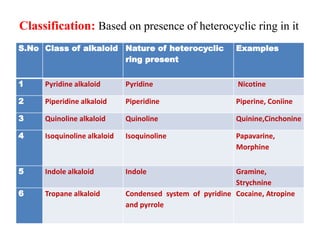
S.No Class of alkaloid Nature of heterocyclic
ring present
Examples
1 Pyridine alkaloid Pyridine Nicotine
2 Piperidine alkaloid Piperidine Piperine, Coniine
3 Quinoline alkaloid Quinoline Quinine,Cinchonine
4 Isoquinoline alkaloid Isoquinoline Papavarine,
Morphine
5 Indole alkaloid Indole Gramine,
Strychnine
6 Tropane alkaloid Condensed system of pyridine
and pyrrole
Cocaine, Atropine
Classification: Based on presence of heterocyclic ring in it
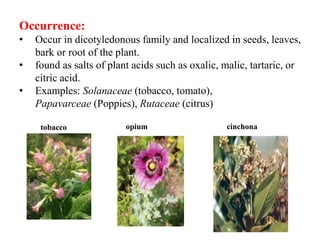
Occurrence:
• Occur in dicotyledonous family and localized in seeds, leaves,
bark or root of the plant.
• found as salts of plant acids such as oxalic, malic, tartaric, or
citric acid.
• Examples: Solanaceae (tobacco, tomato),
Papavarceae (Poppies), Rutaceae (citrus)
tobacco opium cinchona
Extraction of alkaloids from powdered plant
Method-I: The powder is treated with alkalis to liberate the free
bases that can then be extracted with water immiscible organic
solvents.
Method-II: The powdered material is extracted with water or
aqueous alcohol containing dilute acid. Alkaloids are extracted as
their salts together with accompanying soluble impurities.
Method-III: The powder is extracted with water soluble organic
solvents such as MeOH or EtOH which are good solvents for both
salts and free bases.
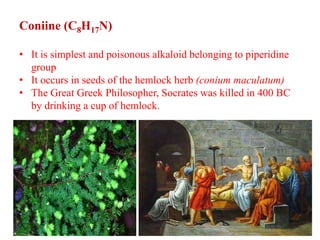
Coniine (C8H17N)
• It is simplest and poisonous alkaloid belonging to piperidine
group
• It occurs in seeds of the hemlock herb (conium maculatum)
• The Great Greek Philosopher, Socrates was killed in 400 BC
by drinking a cup of hemlock.
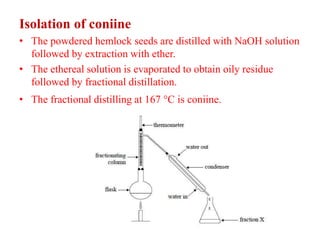
Isolation of coniine
• The powdered hemlock seeds are distilled with NaOH solution
followed by extraction with ether.
• The ethereal solution is evaporated to obtain oily residue
followed by fractional distillation.
• The fractional distilling at 167 °C is coniine.
Properties of coniine
• Coniine is a colourless unpleasant smelling liquid
bpt: 167 °C)
• Sparingly soluble in water and fairly soluble in organic
solvents.
• It is basic in nature and forms salt with mineral acids.
• Highly toxic to humans causing paralysis, convulsions
and death.
Structural Elucidation
(1) Molecular formula of coniine is C8H17N.
(2) Coniine contains piperidine ring with side chain in 2-position
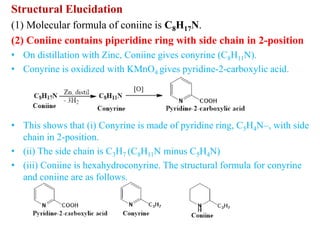
• On distillation with Zinc, Coniine gives conyrine (C8H11N).
• Conyrine is oxidized with KMnO4 gives pyridine-2-carboxylic acid.
• This shows that (i) Conyrine is made of pyridine ring, C5H4N–, with side
chain in 2-position.
• (ii) The side chain is C3H7 (C8H11N minus C5H4N)
• (iii) Coniine is hexahydroconyrine. The structural formula for conyrine
and coniine are as follows.
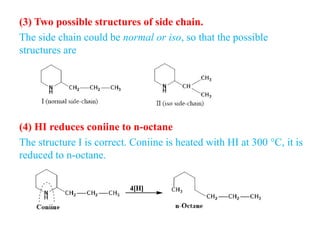
(3) Two possible structures of side chain.
The side chain could be normal or iso, so that the possible
structures are
(4) HI reduces coniine to n-octane
The structure I is correct. Coniine is heated with HI at 300 °C, it is
reduced to n-octane.
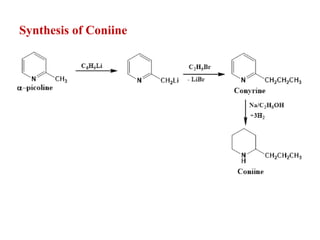
Synthesis of Coniine
Piperine (C17H19O3N)
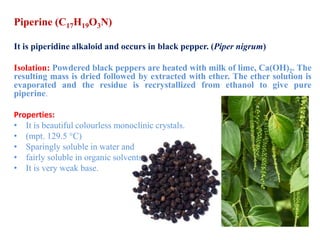
It is piperidine alkaloid and occurs in black pepper. (Piper nigrum)
Isolation: Powdered black peppers are heated with milk of lime, Ca(OH)2. The
resulting mass is dried followed by extracted with ether. The ether solution is
evaporated and the residue is recrystallized from ethanol to give pure
piperine.
Properties:
• It is beautiful colourless monoclinic crystals.
• (mpt. 129.5 °C)
• Sparingly soluble in water and
• fairly soluble in organic solvents.
• It is very weak base.
Structural Elucidation of Piperine
(1) Elemental analysis and molecular weight determination showed
the molecular formula of piperine is C17H19O3N.
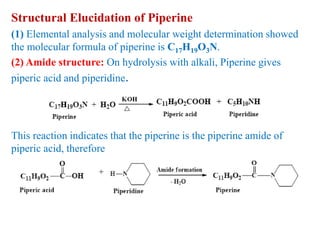
(2) Amide structure: On hydrolysis with alkali, Piperine gives
piperic acid and piperidine.
This reaction indicates that the piperine is the piperine amide of
piperic acid, therefore
(3) Structure of piperic acid
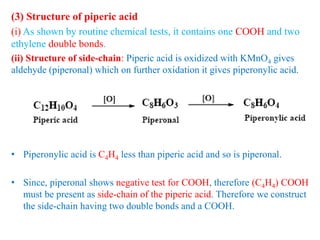
(i) As shown by routine chemical tests, it contains one COOH and two
ethylene double bonds.
(ii) Structure of side-chain: Piperic acid is oxidized with KMnO4 gives
aldehyde (piperonal) which on further oxidation it gives piperonylic acid.
• Piperonylic acid is C4H4 less than piperic acid and so is piperonal.
• Since, piperonal shows negative test for COOH, therefore (C4H4) COOH
must be present as side-chain of the piperic acid. Therefore we construct
the side-chain having two double bonds and a COOH.
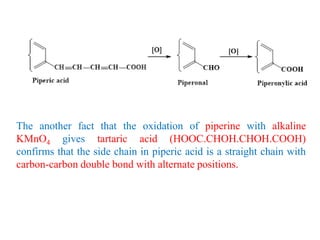
The another fact that the oxidation of piperine with alkaline
KMnO4 gives tartaric acid (HOOC.CHOH.CHOH.COOH)
confirms that the side chain in piperic acid is a straight chain with
carbon-carbon double bond with alternate positions.
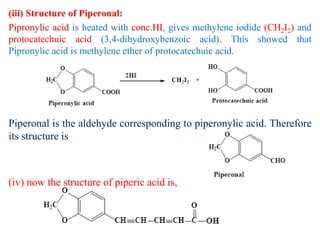
(iii) Structure of Piperonal:
Pipronylic acid is heated with conc.HI, gives methylene iodide (CH2I2) and
protocatechuic acid (3,4-dihydroxybenzoic acid). This showed that
Pipronylic acid is methylene ether of protocatechuic acid.
Piperonal is the aldehyde corresponding to piperonylic acid. Therefore
its structure is
(iv) now the structure of piperic acid is,
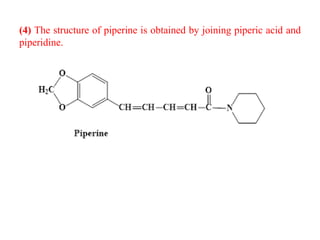
(4) The structure of piperine is obtained by joining piperic acid and
piperidine.
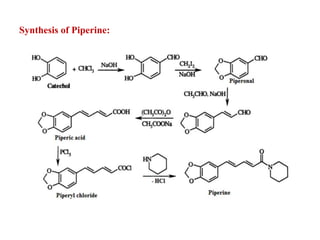
Synthesis of Piperine:
Alkaloids

Alkaloids

  • 1.
    B.Sc. Chemistry A. Kannan AssistantProfessor of Chemistry Vivekananda College Tiruvedakam West ALKALOIDS
  • 2.
    Alkaloids • Alkaloids (whichmean alkali like, alkal - alkali, oid- like) • Basic nitrogeneous plant product • Possessing nitrogen heterocycles as their structural units • Having pharmacological activity and mostly optically active
  • 3.
    S.No Class ofalkaloid Nature of heterocyclic ring present Examples 1 Pyridine alkaloid Pyridine Nicotine 2 Piperidine alkaloid Piperidine Piperine, Coniine 3 Quinoline alkaloid Quinoline Quinine,Cinchonine 4 Isoquinoline alkaloid Isoquinoline Papavarine, Morphine 5 Indole alkaloid Indole Gramine, Strychnine 6 Tropane alkaloid Condensed system of pyridine and pyrrole Cocaine, Atropine Classification: Based on presence of heterocyclic ring in it
  • 4.
    Occurrence: • Occur indicotyledonous family and localized in seeds, leaves, bark or root of the plant. • found as salts of plant acids such as oxalic, malic, tartaric, or citric acid. • Examples: Solanaceae (tobacco, tomato), Papavarceae (Poppies), Rutaceae (citrus) tobacco opium cinchona
  • 5.
    Extraction of alkaloidsfrom powdered plant Method-I: The powder is treated with alkalis to liberate the free bases that can then be extracted with water immiscible organic solvents. Method-II: The powdered material is extracted with water or aqueous alcohol containing dilute acid. Alkaloids are extracted as their salts together with accompanying soluble impurities. Method-III: The powder is extracted with water soluble organic solvents such as MeOH or EtOH which are good solvents for both salts and free bases.
  • 6.
    Coniine (C8H17N) • Itis simplest and poisonous alkaloid belonging to piperidine group • It occurs in seeds of the hemlock herb (conium maculatum) • The Great Greek Philosopher, Socrates was killed in 400 BC by drinking a cup of hemlock.
  • 7.
    Isolation of coniine •The powdered hemlock seeds are distilled with NaOH solution followed by extraction with ether. • The ethereal solution is evaporated to obtain oily residue followed by fractional distillation. • The fractional distilling at 167 °C is coniine.
  • 8.
    Properties of coniine •Coniine is a colourless unpleasant smelling liquid bpt: 167 °C) • Sparingly soluble in water and fairly soluble in organic solvents. • It is basic in nature and forms salt with mineral acids. • Highly toxic to humans causing paralysis, convulsions and death.
  • 9.
    Structural Elucidation (1) Molecularformula of coniine is C8H17N. (2) Coniine contains piperidine ring with side chain in 2-position • On distillation with Zinc, Coniine gives conyrine (C8H11N). • Conyrine is oxidized with KMnO4 gives pyridine-2-carboxylic acid. • This shows that (i) Conyrine is made of pyridine ring, C5H4N–, with side chain in 2-position. • (ii) The side chain is C3H7 (C8H11N minus C5H4N) • (iii) Coniine is hexahydroconyrine. The structural formula for conyrine and coniine are as follows.
  • 10.
    (3) Two possiblestructures of side chain. The side chain could be normal or iso, so that the possible structures are (4) HI reduces coniine to n-octane The structure I is correct. Coniine is heated with HI at 300 °C, it is reduced to n-octane.
  • 11.
  • 12.
    Piperine (C17H19O3N) It ispiperidine alkaloid and occurs in black pepper. (Piper nigrum) Isolation: Powdered black peppers are heated with milk of lime, Ca(OH)2. The resulting mass is dried followed by extracted with ether. The ether solution is evaporated and the residue is recrystallized from ethanol to give pure piperine. Properties: • It is beautiful colourless monoclinic crystals. • (mpt. 129.5 °C) • Sparingly soluble in water and • fairly soluble in organic solvents. • It is very weak base.
  • 13.
    Structural Elucidation ofPiperine (1) Elemental analysis and molecular weight determination showed the molecular formula of piperine is C17H19O3N. (2) Amide structure: On hydrolysis with alkali, Piperine gives piperic acid and piperidine. This reaction indicates that the piperine is the piperine amide of piperic acid, therefore
  • 14.
    (3) Structure ofpiperic acid (i) As shown by routine chemical tests, it contains one COOH and two ethylene double bonds. (ii) Structure of side-chain: Piperic acid is oxidized with KMnO4 gives aldehyde (piperonal) which on further oxidation it gives piperonylic acid. • Piperonylic acid is C4H4 less than piperic acid and so is piperonal. • Since, piperonal shows negative test for COOH, therefore (C4H4) COOH must be present as side-chain of the piperic acid. Therefore we construct the side-chain having two double bonds and a COOH.
  • 15.
    The another factthat the oxidation of piperine with alkaline KMnO4 gives tartaric acid (HOOC.CHOH.CHOH.COOH) confirms that the side chain in piperic acid is a straight chain with carbon-carbon double bond with alternate positions.
  • 16.
    (iii) Structure ofPiperonal: Pipronylic acid is heated with conc.HI, gives methylene iodide (CH2I2) and protocatechuic acid (3,4-dihydroxybenzoic acid). This showed that Pipronylic acid is methylene ether of protocatechuic acid. Piperonal is the aldehyde corresponding to piperonylic acid. Therefore its structure is (iv) now the structure of piperic acid is,
  • 17.
    (4) The structureof piperine is obtained by joining piperic acid and piperidine.
  • 18.