Cyber Security in the Commercial Sector
IDC Private Study: Final Report
Steve Conway
Earl Joseph
Bob Sorensen
July 24, 2015
Project Objectives
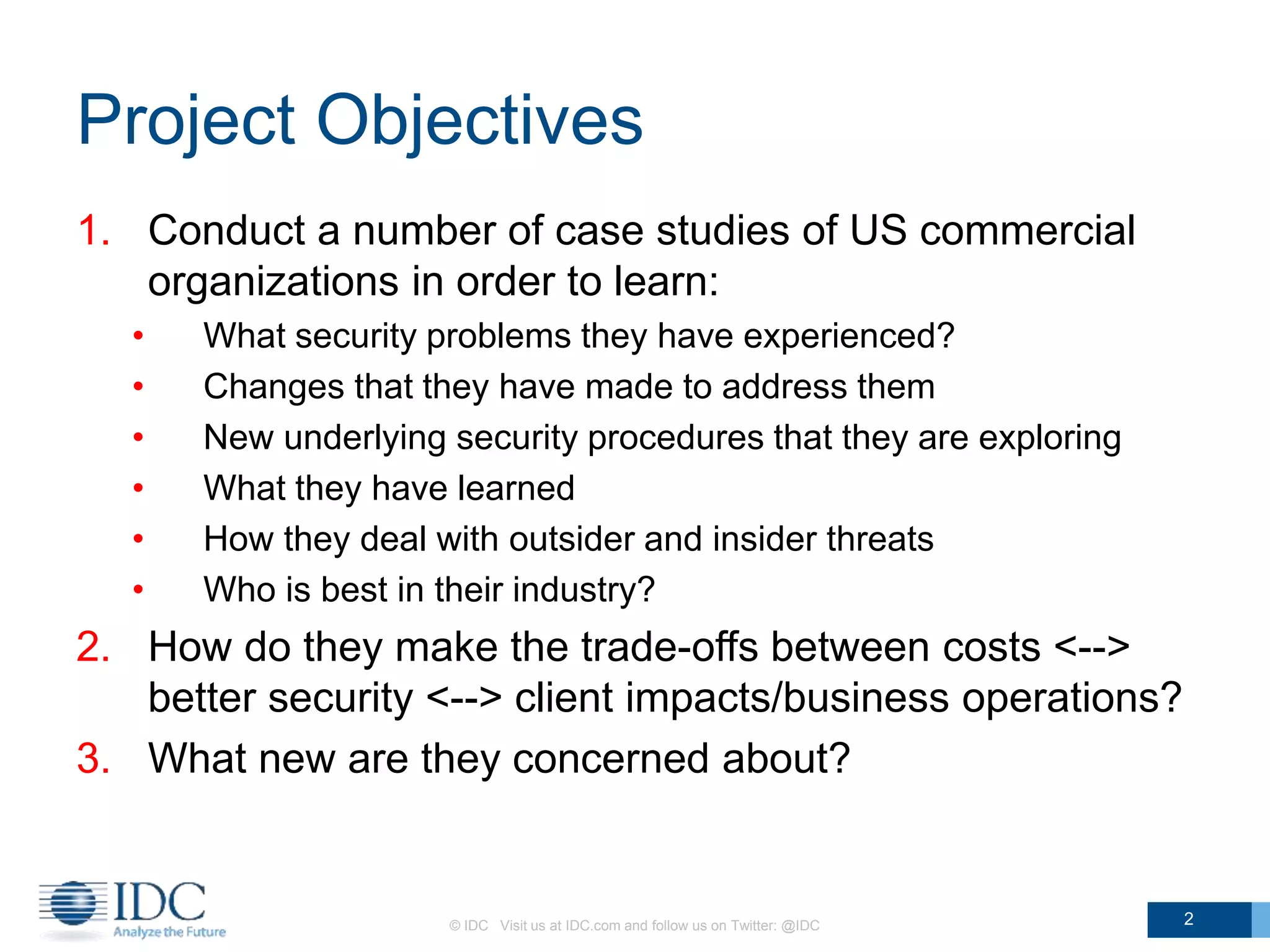
1. Conduct a number of case studies of US commercial
organizations in order to learn:
• What security problems they have experienced?
• Changes that they have made to address them
• New underlying security procedures that they are exploring
• What they have learned
• How they deal with outsider and insider threats
• Who is best in their industry?
2. How do they make the trade-offs between costs <-->
better security <--> client impacts/business operations?
3. What new are they concerned about?
© IDC Visit us at IDC.com and follow us on Twitter: @IDC 2
Research Approach
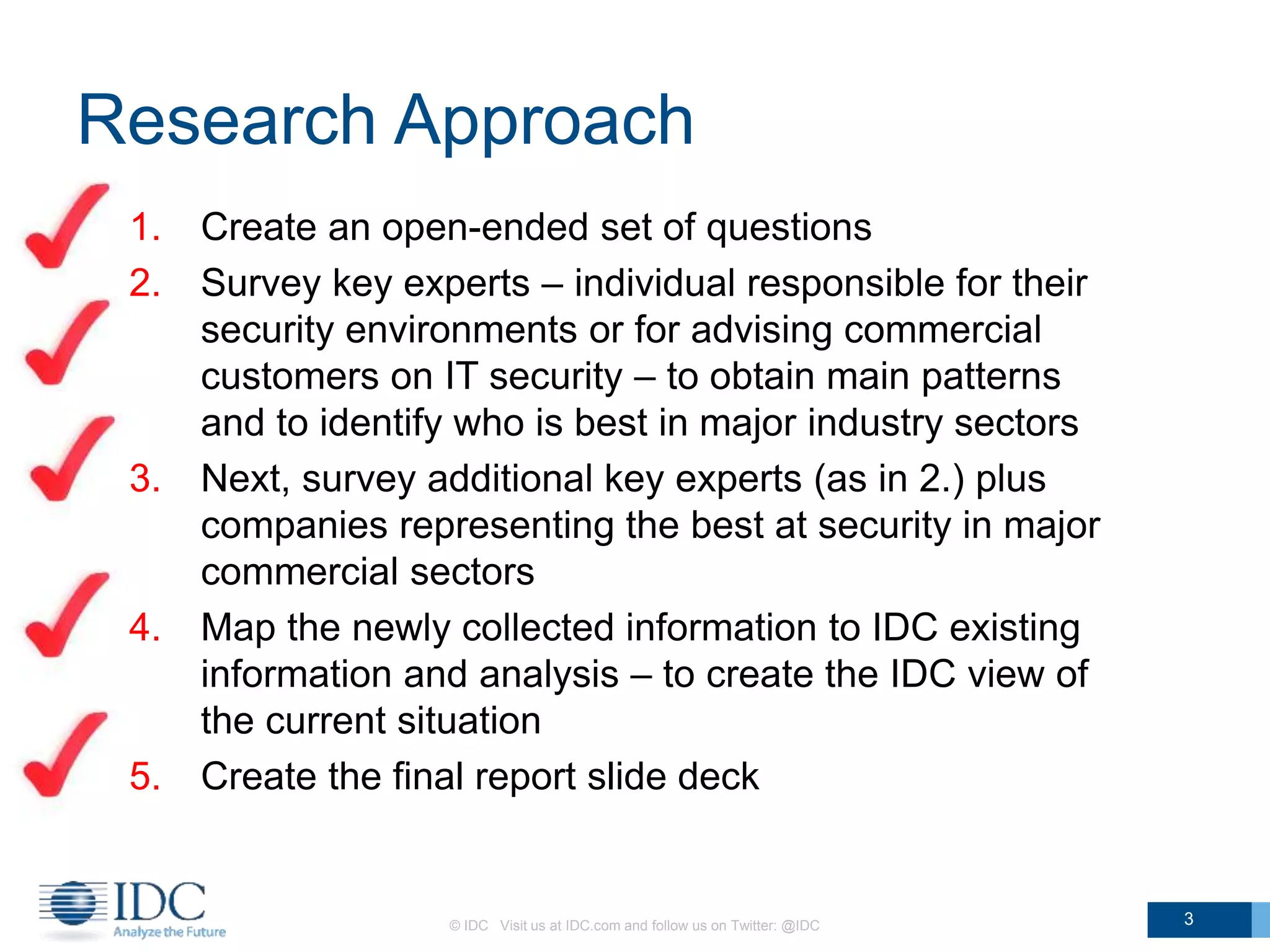
1. Create an open-ended set of questions
2. Survey key experts – individual responsible for their
security environments or for advising commercial
customers on IT security – to obtain main patterns
and to identify who is best in major industry sectors
3. Next, survey additional key experts (as in 2.) plus
companies representing the best at security in major
commercial sectors
4. Map the newly collected information to IDC existing
information and analysis – to create the IDC view of
the current situation
5. Create the final report slide deck
© IDC Visit us at IDC.com and follow us on Twitter: @IDC 3
Sectors of Organizations Interviewed
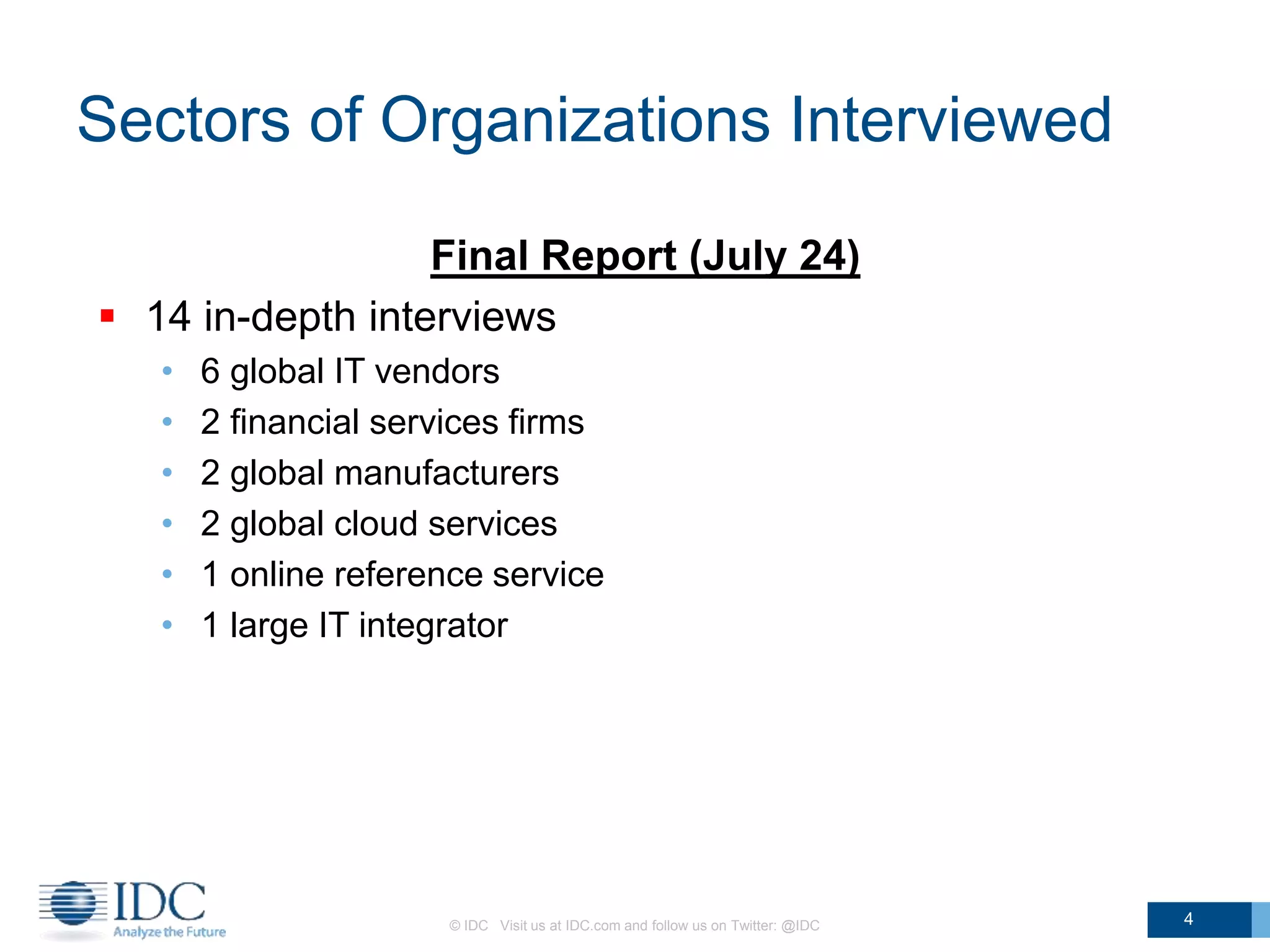
Final Report (July 24)
 14 in-depth interviews
• 6 global IT vendors
• 2 financial services firms
• 2 global manufacturers
• 2 global cloud services
• 1 online reference service
• 1 large IT integrator
© IDC Visit us at IDC.com and follow us on Twitter: @IDC 4
Main Areas of Concerns Around
Security
 Trade-offs between security and easy access
 Access from network edges (suppliers, remote
employees, others)
 Heterogeneity (BYOD, multiple OS, public/hybrid clouds,
etc.)
© IDC Visit us at IDC.com and follow us on Twitter: @IDC 5
Impact of Recent Major Breaches
(e.g., Target, Sony) on Your Company
 Elevated concerns but have not led to much action yet in
the commercial world
© IDC Visit us at IDC.com and follow us on Twitter: @IDC 6
Who In Your Industry Is Best At Dealing
with Security?
 Best: FBI, financial services firms (Deloitte, Mandian),
large retailers, life sciences firms, large technology firms,
large public cloud services. Walmart is outstanding: 150
incident response people at HQ and a forensics lab
judged as good as the FBI's.
 Worst: Universities, manufacturers, public utilities
© IDC Visit us at IDC.com and follow us on Twitter: @IDC 7
What Do The Best Do That Makes
Them Best?
 Hire top talent at top salaries to create and run the
security system
 Use proven methods, such as redundant controls and
not giving anyone full control. Use ISO, other industry
standards
 Create a detailed crisis plan that includes
communications/PR.
© IDC Visit us at IDC.com and follow us on Twitter: @IDC 8
How Do You Deal with Insider Threats?
 Most respondents worry more about hacking than insider
threats, although they see both as important.
 The best screen candidates well at hire, use MLS/RBAC
(multilevel security, role-based access control) employee
education, entitlement management
© IDC Visit us at IDC.com and follow us on Twitter: @IDC 9
How Do You Trade Off between Better
Security, Costs, and Business Disruption?
 Many companies want better security but not the
increasing operating expenses and immediate
productivity loss needed to achieve it.
 The best invest heavily in security to prevent loss of
credibility that could kill their businesses.
© IDC Visit us at IDC.com and follow us on Twitter: @IDC 10
Is It Worth Encrypting Everything?
 Respondents all agreed this is unfeasible for financial
and other practical reasons.
 A few firms encrypt everything in transit, but not
everything at rest.
© IDC Visit us at IDC.com and follow us on Twitter: @IDC 11
The Most Important Security Threat For
Your Organization Today
 The most frequently mentioned threats were “bring your
own device” (BYOD) and everything outside the firewall.
© IDC Visit us at IDC.com and follow us on Twitter: @IDC 12
Best Practices To Address Security
Threats Today
© IDC Visit us at IDC.com and follow us on Twitter: @IDC 13
 Use proven methods, such as redundant controls and
not giving anyone full control. Use ISO, industry
standards.
 NIST standards are seen as comprehensive but hard for
most companies to implement; MLS, role-based access
control (RBAC) is getting more serious in the private
sector.
How You Measure the Effectiveness of
Your Cyber Security Program
 Adequate security is in the mind of the beholder.
 Most firms track easy numbers: number of days without
incidents, number of blocked/mitigated threats.
 The best firms say these numbers alone are
meaningless. Instead, they create their own metrics,
such as % of customers protected in a phishing attack.
© IDC Visit us at IDC.com and follow us on Twitter: @IDC 14
Importance of Security in Your Supply
Chain
 One of the important concerns, along with everything
else outside the firewall
 A bigger concern for government than the private sector
© IDC Visit us at IDC.com and follow us on Twitter: @IDC 15
Increased Use of Analytics in Cyber
Security
 At the discussion stage – not widely used yet
© IDC Visit us at IDC.com and follow us on Twitter: @IDC 16
Actual Breaches and Responses
 Once a breach occurs, the damage can’t be undone and
the focus is on learning from it (and catching the bad
guys)
 The biggest challenge is keeping up with the increasing
sophistication of the bad guys
© IDC Visit us at IDC.com and follow us on Twitter: @IDC 17
Questions?
ejoseph@idc.com
sconway@idc.com
bsorensen@idc.com

IDC Best Practices in Private Sector Cyber Security

  • 1.
    Cyber Security inthe Commercial Sector IDC Private Study: Final Report Steve Conway Earl Joseph Bob Sorensen July 24, 2015
  • 2.
    Project Objectives 1. Conducta number of case studies of US commercial organizations in order to learn: • What security problems they have experienced? • Changes that they have made to address them • New underlying security procedures that they are exploring • What they have learned • How they deal with outsider and insider threats • Who is best in their industry? 2. How do they make the trade-offs between costs <--> better security <--> client impacts/business operations? 3. What new are they concerned about? © IDC Visit us at IDC.com and follow us on Twitter: @IDC 2
  • 3.
    Research Approach 1. Createan open-ended set of questions 2. Survey key experts – individual responsible for their security environments or for advising commercial customers on IT security – to obtain main patterns and to identify who is best in major industry sectors 3. Next, survey additional key experts (as in 2.) plus companies representing the best at security in major commercial sectors 4. Map the newly collected information to IDC existing information and analysis – to create the IDC view of the current situation 5. Create the final report slide deck © IDC Visit us at IDC.com and follow us on Twitter: @IDC 3
  • 4.
    Sectors of OrganizationsInterviewed Final Report (July 24)  14 in-depth interviews • 6 global IT vendors • 2 financial services firms • 2 global manufacturers • 2 global cloud services • 1 online reference service • 1 large IT integrator © IDC Visit us at IDC.com and follow us on Twitter: @IDC 4
  • 5.
    Main Areas ofConcerns Around Security  Trade-offs between security and easy access  Access from network edges (suppliers, remote employees, others)  Heterogeneity (BYOD, multiple OS, public/hybrid clouds, etc.) © IDC Visit us at IDC.com and follow us on Twitter: @IDC 5
  • 6.
    Impact of RecentMajor Breaches (e.g., Target, Sony) on Your Company  Elevated concerns but have not led to much action yet in the commercial world © IDC Visit us at IDC.com and follow us on Twitter: @IDC 6
  • 7.
    Who In YourIndustry Is Best At Dealing with Security?  Best: FBI, financial services firms (Deloitte, Mandian), large retailers, life sciences firms, large technology firms, large public cloud services. Walmart is outstanding: 150 incident response people at HQ and a forensics lab judged as good as the FBI's.  Worst: Universities, manufacturers, public utilities © IDC Visit us at IDC.com and follow us on Twitter: @IDC 7
  • 8.
    What Do TheBest Do That Makes Them Best?  Hire top talent at top salaries to create and run the security system  Use proven methods, such as redundant controls and not giving anyone full control. Use ISO, other industry standards  Create a detailed crisis plan that includes communications/PR. © IDC Visit us at IDC.com and follow us on Twitter: @IDC 8
  • 9.
    How Do YouDeal with Insider Threats?  Most respondents worry more about hacking than insider threats, although they see both as important.  The best screen candidates well at hire, use MLS/RBAC (multilevel security, role-based access control) employee education, entitlement management © IDC Visit us at IDC.com and follow us on Twitter: @IDC 9
  • 10.
    How Do YouTrade Off between Better Security, Costs, and Business Disruption?  Many companies want better security but not the increasing operating expenses and immediate productivity loss needed to achieve it.  The best invest heavily in security to prevent loss of credibility that could kill their businesses. © IDC Visit us at IDC.com and follow us on Twitter: @IDC 10
  • 11.
    Is It WorthEncrypting Everything?  Respondents all agreed this is unfeasible for financial and other practical reasons.  A few firms encrypt everything in transit, but not everything at rest. © IDC Visit us at IDC.com and follow us on Twitter: @IDC 11
  • 12.
    The Most ImportantSecurity Threat For Your Organization Today  The most frequently mentioned threats were “bring your own device” (BYOD) and everything outside the firewall. © IDC Visit us at IDC.com and follow us on Twitter: @IDC 12
  • 13.
    Best Practices ToAddress Security Threats Today © IDC Visit us at IDC.com and follow us on Twitter: @IDC 13  Use proven methods, such as redundant controls and not giving anyone full control. Use ISO, industry standards.  NIST standards are seen as comprehensive but hard for most companies to implement; MLS, role-based access control (RBAC) is getting more serious in the private sector.
  • 14.
    How You Measurethe Effectiveness of Your Cyber Security Program  Adequate security is in the mind of the beholder.  Most firms track easy numbers: number of days without incidents, number of blocked/mitigated threats.  The best firms say these numbers alone are meaningless. Instead, they create their own metrics, such as % of customers protected in a phishing attack. © IDC Visit us at IDC.com and follow us on Twitter: @IDC 14
  • 15.
    Importance of Securityin Your Supply Chain  One of the important concerns, along with everything else outside the firewall  A bigger concern for government than the private sector © IDC Visit us at IDC.com and follow us on Twitter: @IDC 15
  • 16.
    Increased Use ofAnalytics in Cyber Security  At the discussion stage – not widely used yet © IDC Visit us at IDC.com and follow us on Twitter: @IDC 16
  • 17.
    Actual Breaches andResponses  Once a breach occurs, the damage can’t be undone and the focus is on learning from it (and catching the bad guys)  The biggest challenge is keeping up with the increasing sophistication of the bad guys © IDC Visit us at IDC.com and follow us on Twitter: @IDC 17
  • 18.