Application Portfolio Rationalization Methodologybase on”IT Portfolio Rationalization: 1”  by PrashantHalari, SushilPaigankar, Hitesh Salla, RajaramVengurlekarPresented by:Alain Charpentier
Table of contentOrigin of the methodologyObjectivesPresent the methodologyLessons learnedRecommendationQuestionsCopyright © 2009 by Alain CharpentierPage: 2
The methodology is based on the book:“IT Portfolio Rationalization: 1”  by PrashantHalari, SushilPaigankar, Hitesh Salla, RajaramVengurlekar.IT Application Portfolio Rationalization/Management(APM) is a practice that has emerged in mid to large size organizations in the mid 1990s. It attempts to use the lessons of financial portfolio management to justify and measure the financial benefits of each application in comparison to the costs of the application's maintenance and operations.Origin of the methodologyCopyright © 2009 by Alain CharpentierPage: 3
Establish a quantitative baseline on the efficiency and effectiveness of the current application landscape so that prudent management decisions, in terms of current and future application development, application phase-out or remediation (e.g., re-write), can be made
Ensure proper Business-IT alignment (i.e., IT is working on those things that business values the most)
Prioritize the applications that need attention
Determine the several management options for undertaking the application value improvement initiativesObjectives Page: 4Copyright © 2009 by Alain Charpentier
Copyright © 2009 by Alain CharpentierThe methodology Participant selectionPlanningData collectionRoadmapValidationAnalysis CategoryPage 5
Copyright © 2009 by Alain CharpentierStep 1: Participant SelectionSelection of appropriate:Business relationship managers (BRM)
Business owners
Application owners
Application support teams
IT development teamsPage: 6
Copyright © 2009 by Alain CharpentierStep 2 : Filtering & Data collectionOverall Portfolio Application ListAppln 3Appln 41000Appln 2Appln 5Appln nAppln 11Filter Criteria – Filter out non-applications, unused applications and applications under rewriting1700Step 1Step 1Filer out unused andapplications under rewritingFiler outNon-applications2Filter Criteria – Filter out applications which are not under the responsibility of IT or supported by other parties 2Step 2Filter out Applications not  under IT5003Filter Criteria – Filter out applications for which we don't have maintenance investment information 3Step 3Filter out based on Maintenance investment1504Filter Criteria – Filter based on the data gathering exercise4Step 4Filter on data gathering100Note:  The number of applications is representative of a large organization.Final “In Scope” Application List“In scope” application listPage: 7
Copyright © 2009 by Alain CharpentierStep 3 : AnalysisConduct analysis on dimensions of cost vs benefit, current capability vs. future capability, etc.Page: 8
Step 4 : CategorizationThe dimensions used are

Application Portfolio Management

  • 1.
    Application Portfolio RationalizationMethodologybase on”IT Portfolio Rationalization: 1” by PrashantHalari, SushilPaigankar, Hitesh Salla, RajaramVengurlekarPresented by:Alain Charpentier
  • 2.
    Table of contentOriginof the methodologyObjectivesPresent the methodologyLessons learnedRecommendationQuestionsCopyright © 2009 by Alain CharpentierPage: 2
  • 3.
    The methodology isbased on the book:“IT Portfolio Rationalization: 1” by PrashantHalari, SushilPaigankar, Hitesh Salla, RajaramVengurlekar.IT Application Portfolio Rationalization/Management(APM) is a practice that has emerged in mid to large size organizations in the mid 1990s. It attempts to use the lessons of financial portfolio management to justify and measure the financial benefits of each application in comparison to the costs of the application's maintenance and operations.Origin of the methodologyCopyright © 2009 by Alain CharpentierPage: 3
  • 4.
    Establish a quantitativebaseline on the efficiency and effectiveness of the current application landscape so that prudent management decisions, in terms of current and future application development, application phase-out or remediation (e.g., re-write), can be made
  • 5.
    Ensure proper Business-ITalignment (i.e., IT is working on those things that business values the most)
  • 6.
    Prioritize the applicationsthat need attention
  • 7.
    Determine the severalmanagement options for undertaking the application value improvement initiativesObjectives Page: 4Copyright © 2009 by Alain Charpentier
  • 8.
    Copyright © 2009by Alain CharpentierThe methodology Participant selectionPlanningData collectionRoadmapValidationAnalysis CategoryPage 5
  • 9.
    Copyright © 2009by Alain CharpentierStep 1: Participant SelectionSelection of appropriate:Business relationship managers (BRM)
  • 10.
  • 11.
  • 12.
  • 13.
  • 14.
    Copyright © 2009by Alain CharpentierStep 2 : Filtering & Data collectionOverall Portfolio Application ListAppln 3Appln 41000Appln 2Appln 5Appln nAppln 11Filter Criteria – Filter out non-applications, unused applications and applications under rewriting1700Step 1Step 1Filer out unused andapplications under rewritingFiler outNon-applications2Filter Criteria – Filter out applications which are not under the responsibility of IT or supported by other parties 2Step 2Filter out Applications not under IT5003Filter Criteria – Filter out applications for which we don't have maintenance investment information 3Step 3Filter out based on Maintenance investment1504Filter Criteria – Filter based on the data gathering exercise4Step 4Filter on data gathering100Note: The number of applications is representative of a large organization.Final “In Scope” Application List“In scope” application listPage: 7
  • 15.
    Copyright © 2009by Alain CharpentierStep 3 : AnalysisConduct analysis on dimensions of cost vs benefit, current capability vs. future capability, etc.Page: 8
  • 16.
    Step 4 :CategorizationThe dimensions used are
  • 17.
    *Technology Appreciation includesapplication owner and technical scores and covers aspects of
  • 18.
  • 19.
  • 20.
  • 21.
  • 22.
  • 23.
  • 24.
  • 25.
  • 26.
  • 27.
  • 28.
  • 29.
  • 30.
    High Business AppreciationTechnologyAppreciation*Category3Category4Re-engineerReplace / RetireLow Technology Appreciation
  • 31.
  • 32.
  • 33.
    Low Business AppreciationLowHighLowBusinessAppreciation** Copyright © 2009 by Alain CharpentierPage: 9
  • 34.
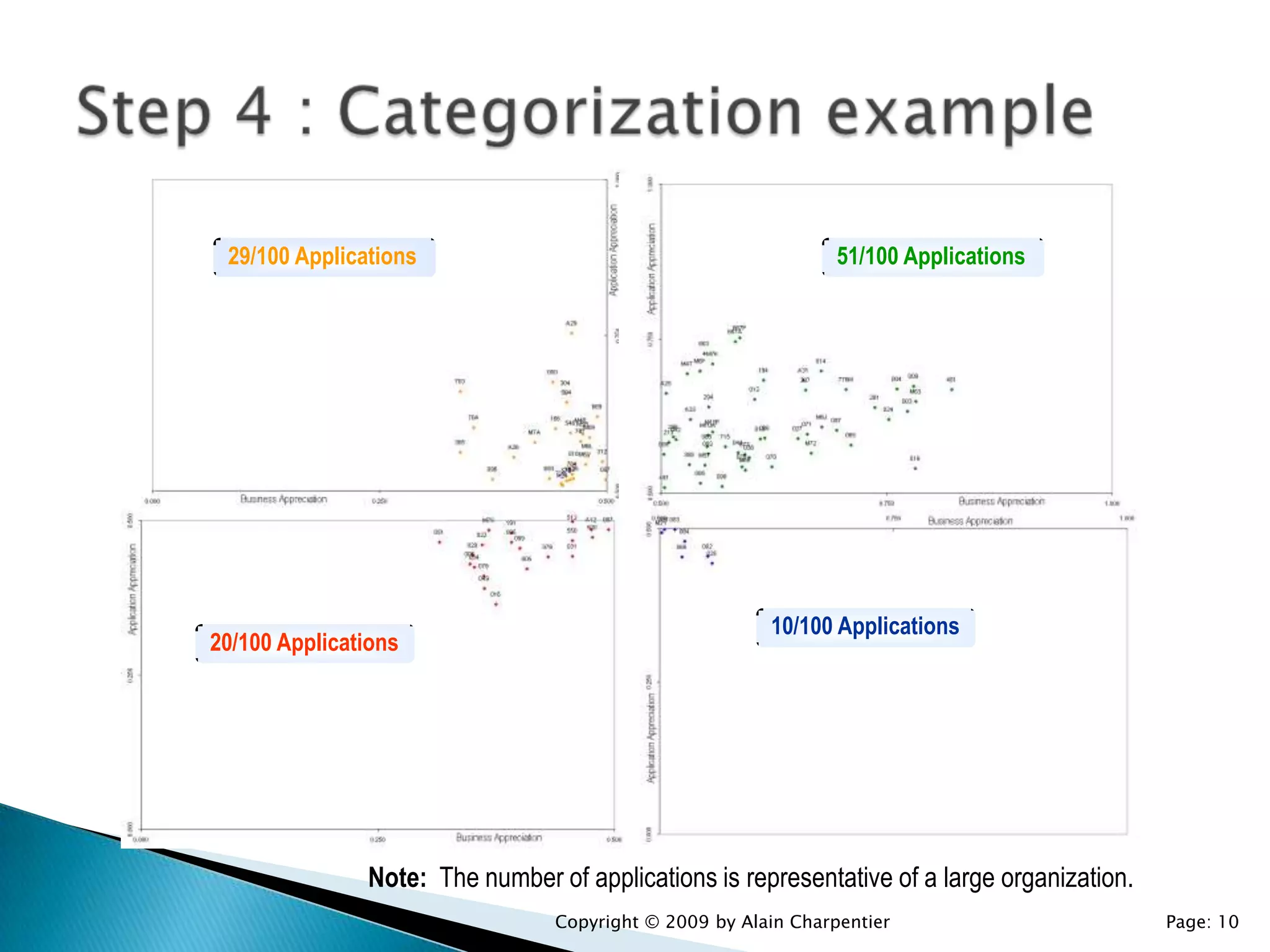
    Copyright © 2009by Alain CharpentierStep 4 : Categorization example29/100 Applications51/100 Applications10/100 Applications20/100 ApplicationsNote: The number of applications is representative of a large organization.Page: 10
  • 35.
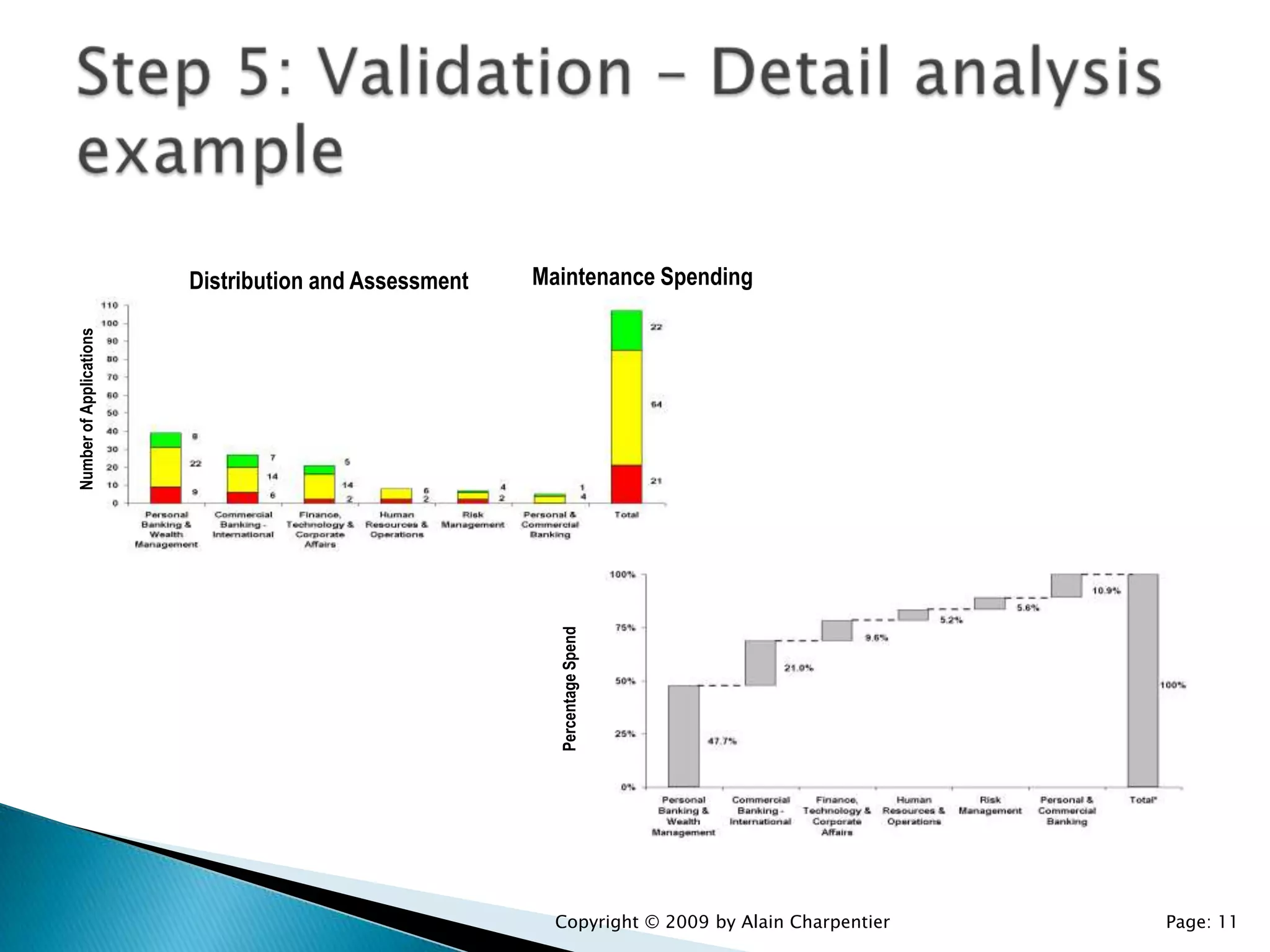
    Maintenance SpendingCopyright ©2009 by Alain CharpentierStep 5: Validation – Detail analysis exampleDistribution and AssessmentNumber of ApplicationsPercentage SpendPage: 11
  • 36.
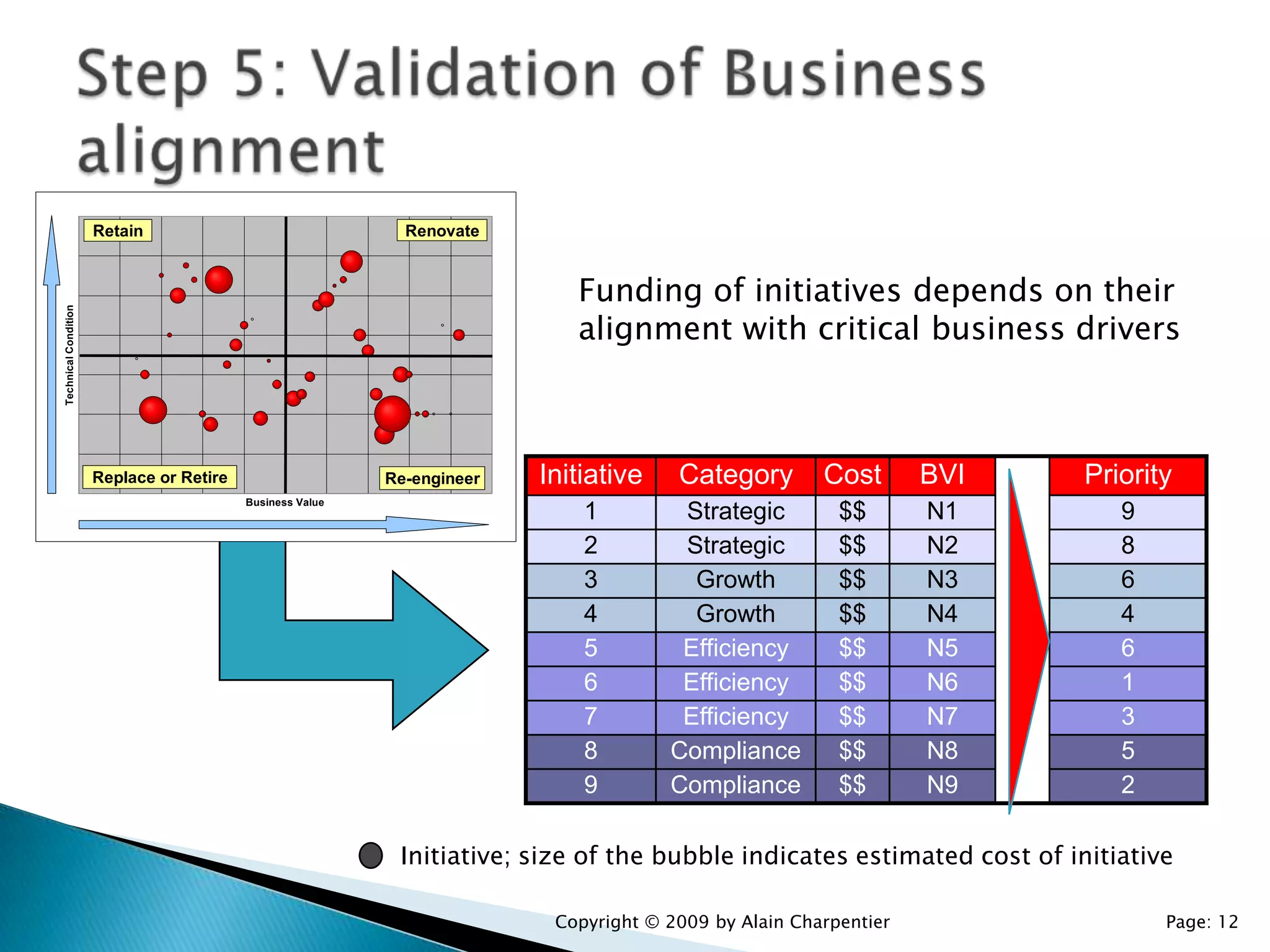
    Copyright © 2009by Alain CharpentierStep 5: Validation of Business alignmentFunding of initiatives depends on their alignment with critical business driversInitiative; size of the bubble indicates estimated cost of initiativePage: 12
  • 37.
    Copyright © 2009by Alain CharpentierStep 6: Roadmap developmentImmediateNear termLong termTo ensure proper Business-IT alignment the roadmap is develop after proper validation with the key stakeholderSavings TimelinePage: 13
  • 38.
    Managing “projects” andmanaging “applications” are not the same Change the organization’s culture — from the top downEstablish an enterprise architecture framework to provide focusInclude APR as part of a broader decision-making processHave a destination in mind and communicate it throughout the organizationUse tools as productivity aids, but they do not replace tough human decisionsMeasure operation of the application over its life cycleAPR is not just an IT decisionCopyright © 2009 by Alain CharpentierLessons LearnedPage: 14
  • 39.
    Establish a strongbaselineAgree on how to measure “value”Identify operational “costs”Ensure fairness throughout the processMatch decision making to organizational style — edict or democracy?Institutionalize the process, not the eventCopyright © 2009 by Alain CharpentierRecommendationsPage: 15
  • 40.
    Questions?Copyright © 2009by Alain CharpentierPage: 16