Malaysian Smart School  ICT IN BIOLOGY GROUP MEMBER’S : ~ NASUHA MUHAMMAD   ~ ILANI JAILANI ~ MAHIRAH MAZLAN ~ NUR AMALINA ROHAIZAN
What is the SS concept? A learning  institution that has been systemically reinvented in terms of teaching-learning practices and school management in order to prepare children for the Information Age.
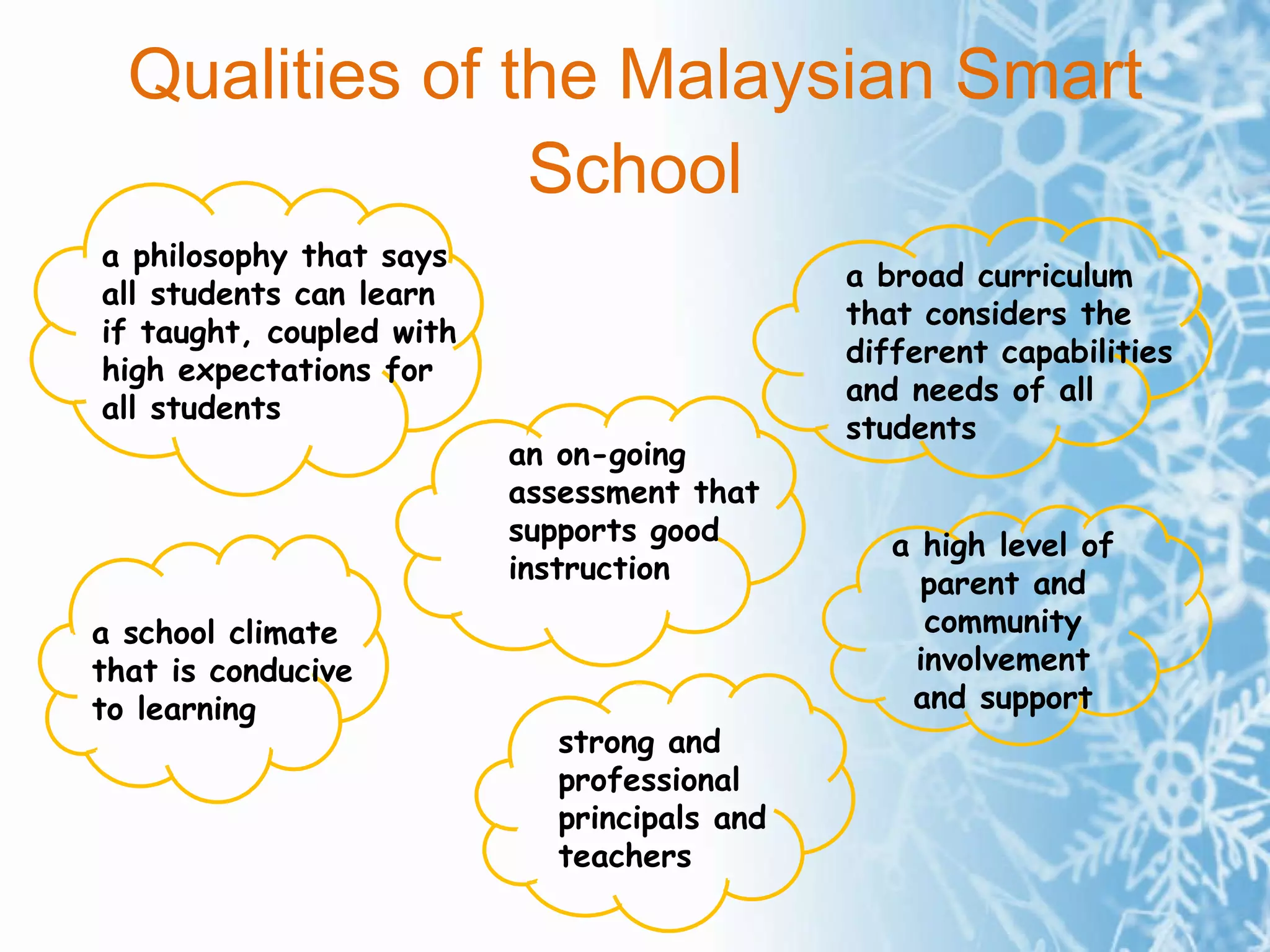
Qualities of the Malaysian Smart School a philosophy that says all students can learn if taught, coupled with high expectations for all  students a broad curriculum that considers the different capabilities and needs of all students a school climate that is conducive to learning an on-going assessment that supports good instruction strong and professional principals and teachers a high level of parent and community involvement and support
Key Components of a Smart School Teaching and Learning Management and Administration People, Skills and Responsibilities Technology Processes Policies
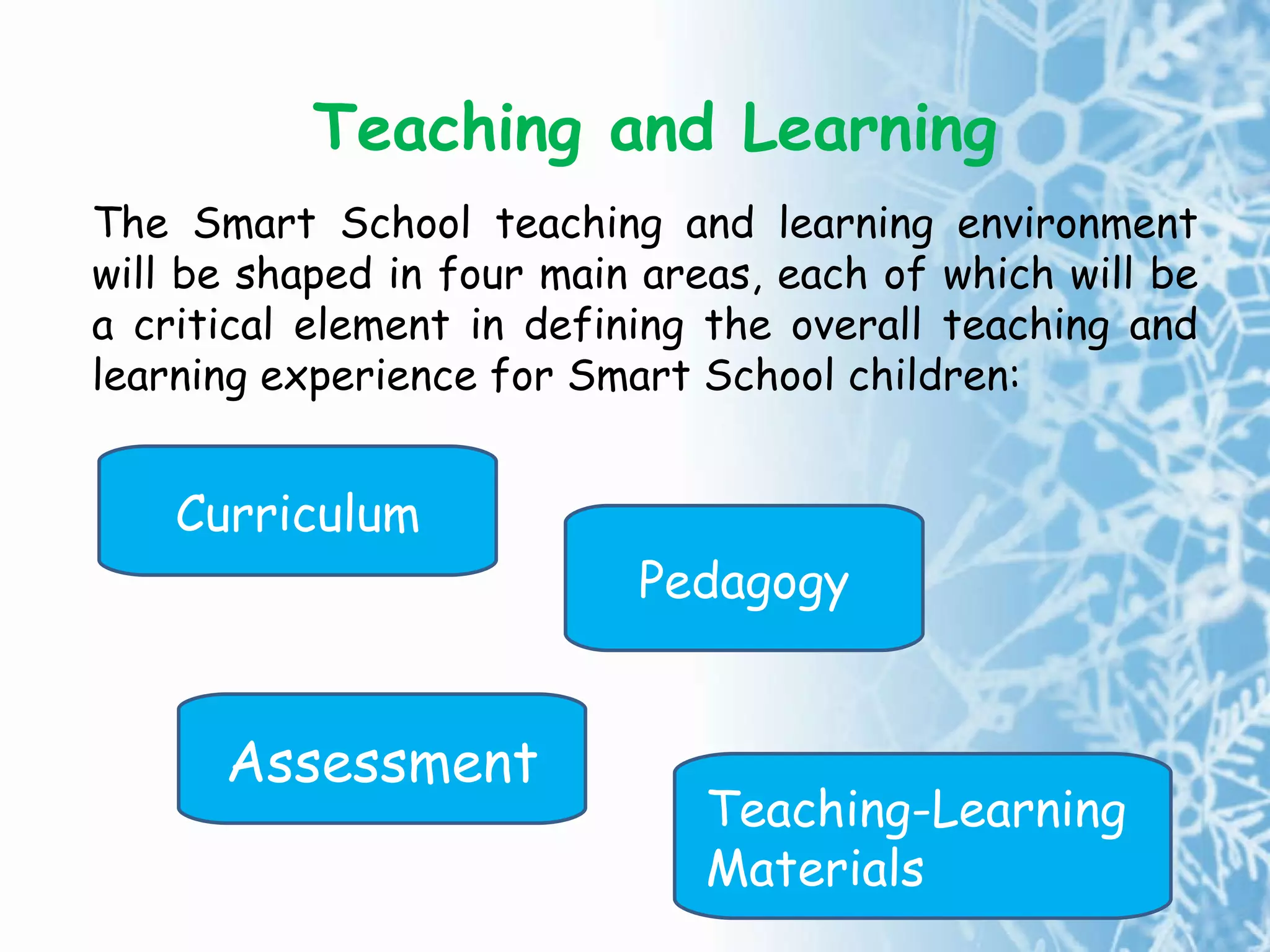
Teaching and Learning The Smart School teaching and learning environment will be shaped in four main areas, each of which will be a critical element in defining the overall teaching and learning experience for  Smart School children: Curriculum Pedagogy Assessment Teaching-Learning Materials
CURRICULUM CHARACTERISTICS Designed  to help students achieve overall and balanced development. Integration of knowledge, skills, values and correct  use of language across the  curriculum Intended learning outcomes explicitly stated for different levels of abilities, ensuring all students gain access to quality learning, and allowing for self-paced learning across grades Multidisciplinary, thematic and continuous across learning areas Integration of knowledge, skills, and attitudes suitable for the Information Age BENEFITS Children educated with critical and creative thinking skills, inculcated with values, and encouraged to improve language proficiency Holistic learning promoted Children allowed to progress at their own pace Students’ varying capabilities, interests, and needs catered for
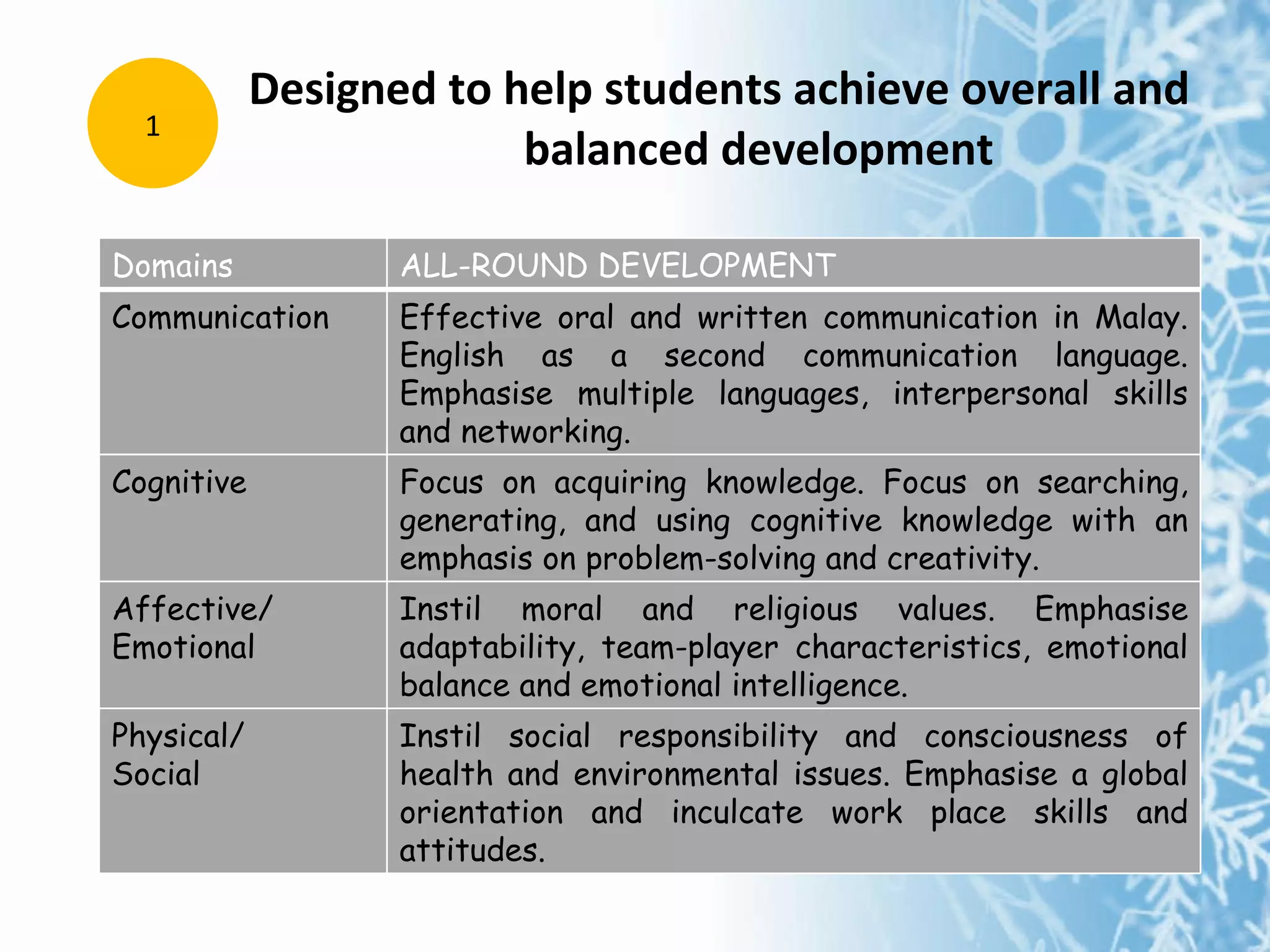
Designed to help students achieve overall and  balanced development 1 Domains ALL-ROUND DEVELOPMENT Communication Effective oral and written communication in Malay. English as a second communication language. Emphasise multiple languages, interpersonal skills and networking. Cognitive Focus on acquiring knowledge. Focus on searching, generating, and using cognitive knowledge with an emphasis on problem-solving and creativity. Affective/ Emotional Instil moral and religious values. Emphasise adaptability, team-player characteristics, emotional balance and emotional intelligence. Physical/ Social Instil social responsibility and consciousness of health and environmental issues. Emphasise a global orientation and inculcate work place skills and  attitudes.
Integration of knowledge, skills, values and  correct  use of language across the  curriculum 2 KNOWLEDGE -Content knowledge -Problem solving knowledge -Epistemic knowledge - Inquiry knowledge . SKILLS -Creative and critical thinking skill -Personal skills -Social skills VALUES -Self-reliance -Humanity -Respect -Love LANGUAGE -Reading, writing and oral communication
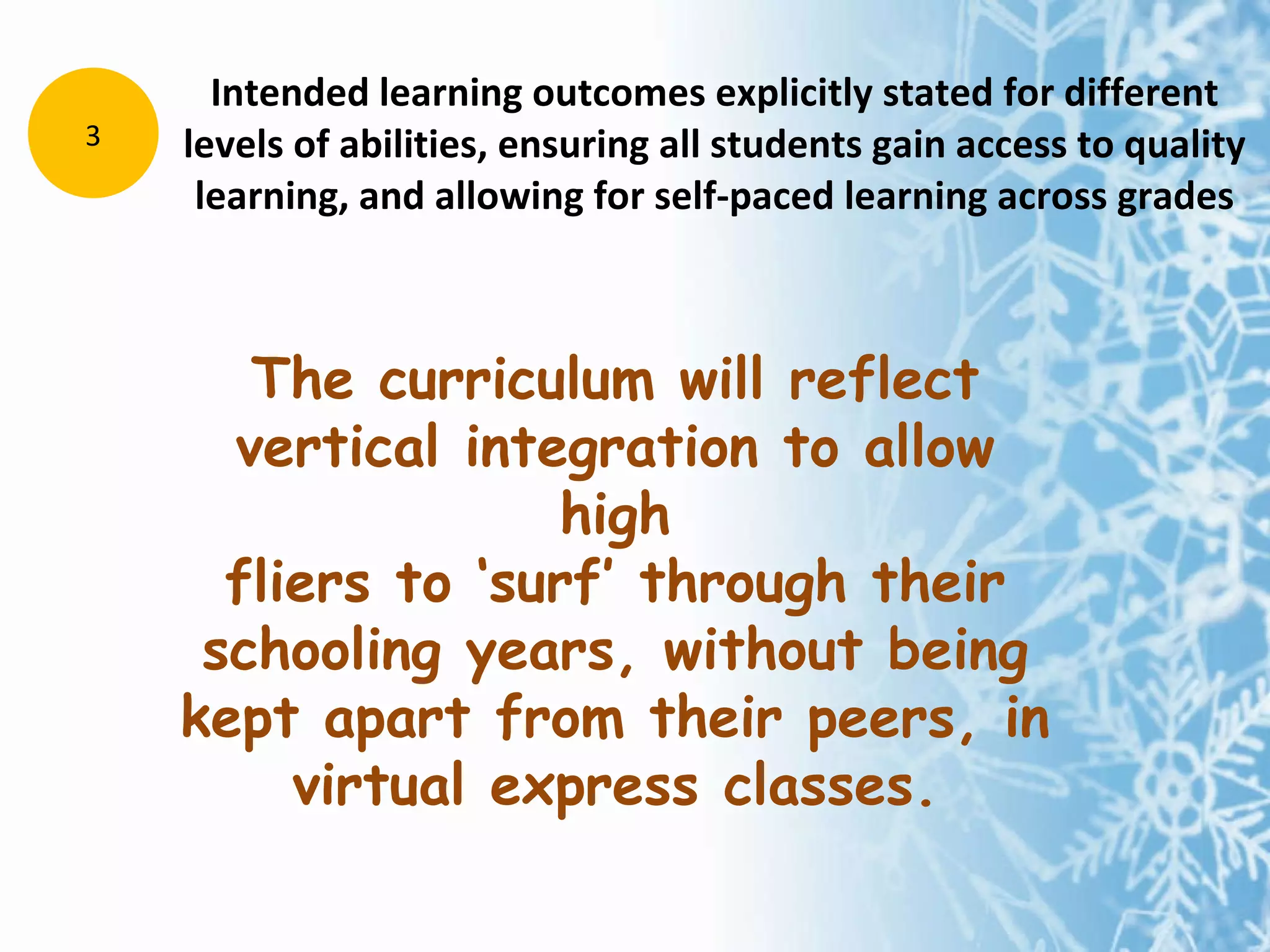
Intended learning outcomes explicitly stated for different levels of abilities, ensuring all students gain access to quality learning, and allowing for self-paced learning across grades 3 The curriculum will reflect vertical integration to allow high fliers to ‘surf’ through their schooling years, without being kept apart from their peers, in virtual express classes.
Multidisciplinary, thematic and continuous across learning areas A multidisciplinary  approach is one in which  two or three subject  areas are combined in a  single learning area that focuses on a theme, issue, problem, topic, or concept. An interdisciplinary approach combines all subject areas to focus the full array of disciplines on a theme, issue, problem, topic, or concept. 4
Integration of knowledge, skills, and attitudes suitable for the Information Age IT Literacy is the ability to use IT tools and IT sources to: collect,  analyse, process and present information support meaningful learning in a variety of contexts  prepare for working life. In addition, the Smart School co-curriculum programme will provide activities  that reinforce classroom learning for example community service activity, cultural activities, subject-related activities and social activities . 5
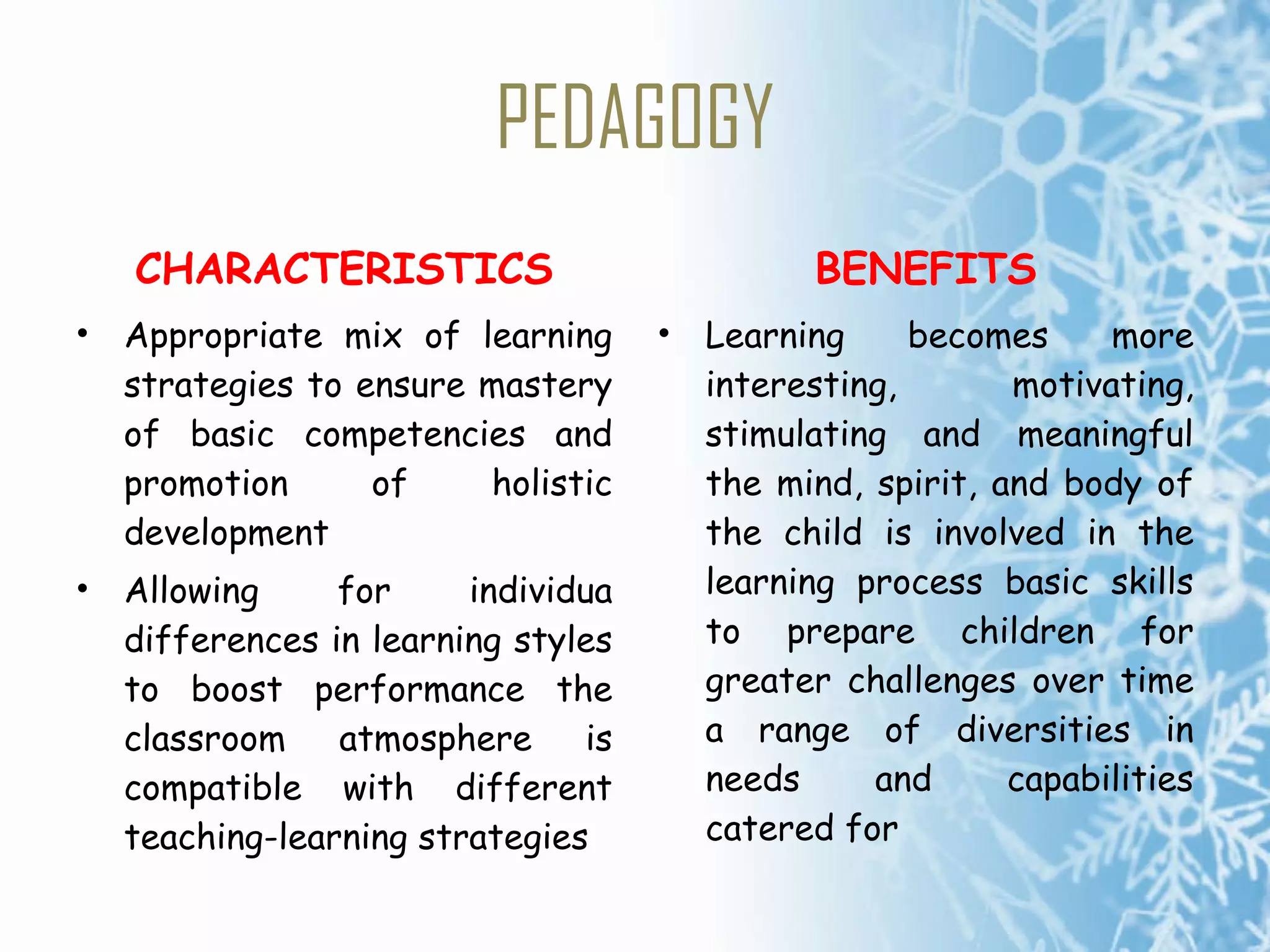
PEDAGOGY CHARACTERISTICS Appropriate mix of learning strategies to ensure mastery of basic competencies and promotion of holistic development Allowing for individua differences in learning styles to boost performance the classroom atmosphere is compatible with different teaching-learning strategies BENEFITS Learning becomes more interesting, motivating, stimulating and meaningful the mind, spirit, and  body of the child is  involved in the learning process basic skills to prepare children for greater challenges over time a range of diversities in needs and capabilities catered for
Appropriate mix of learning strategies using innovative methods of teaching  1 Process involves specific learning goals  active learning process, where learner constructs meaning  continuouS personalised Modes alone, in pairs, or in small teams with an expert (teacher or community member), a facilitator (teacher assistant, volunteer or student), non-human resources (hands-on materials, computer-based resources, multimedia resources, or print materials)  at a site in the community, a computer-based multimedia simulation, a hands-on learning lab, a meeting room or library Tasks authentic, often in real life environments, with real world challenges   interdisciplinary: * specific knowledge * general skills such as transfer of information across settings, negotiation and interpersonal skills, decision making skills   mastery of a task before progressing to next task   periodic performance mastery assessment  more responsibility to learner for directing and managing own learning
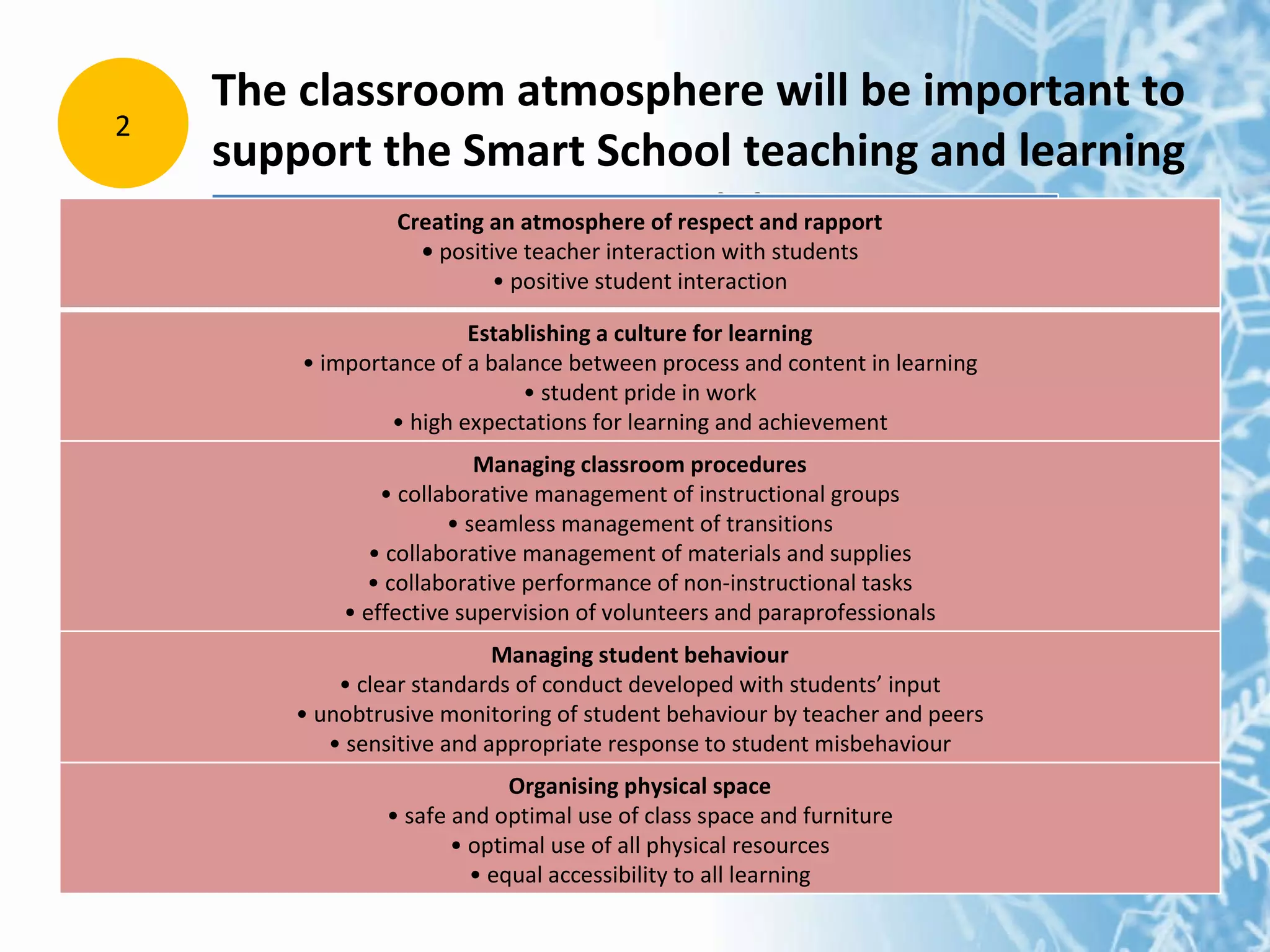
The classroom atmosphere will be important to support the Smart School teaching and learning model 2 Creating an atmosphere of respect and rapport •  positive teacher interaction with students •  positive student interaction Establishing a culture for learning •  importance of a balance between process and content in learning •  student pride in work •  high expectations for learning and achievement Managing classroom procedures •  collaborative management of instructional groups •  seamless management of transitions •  collaborative management of materials and supplies •  collaborative performance of non-instructional tasks •  effective supervision of volunteers and paraprofessionals Managing student behaviour •  clear standards of conduct developed with students’ input •  unobtrusive monitoring of student behaviour by teacher and peers •  sensitive and appropriate response to student misbehaviour Organising physical space •  safe and optimal use of class space and furniture •  optimal use of all physical resources •  equal accessibility to all learning
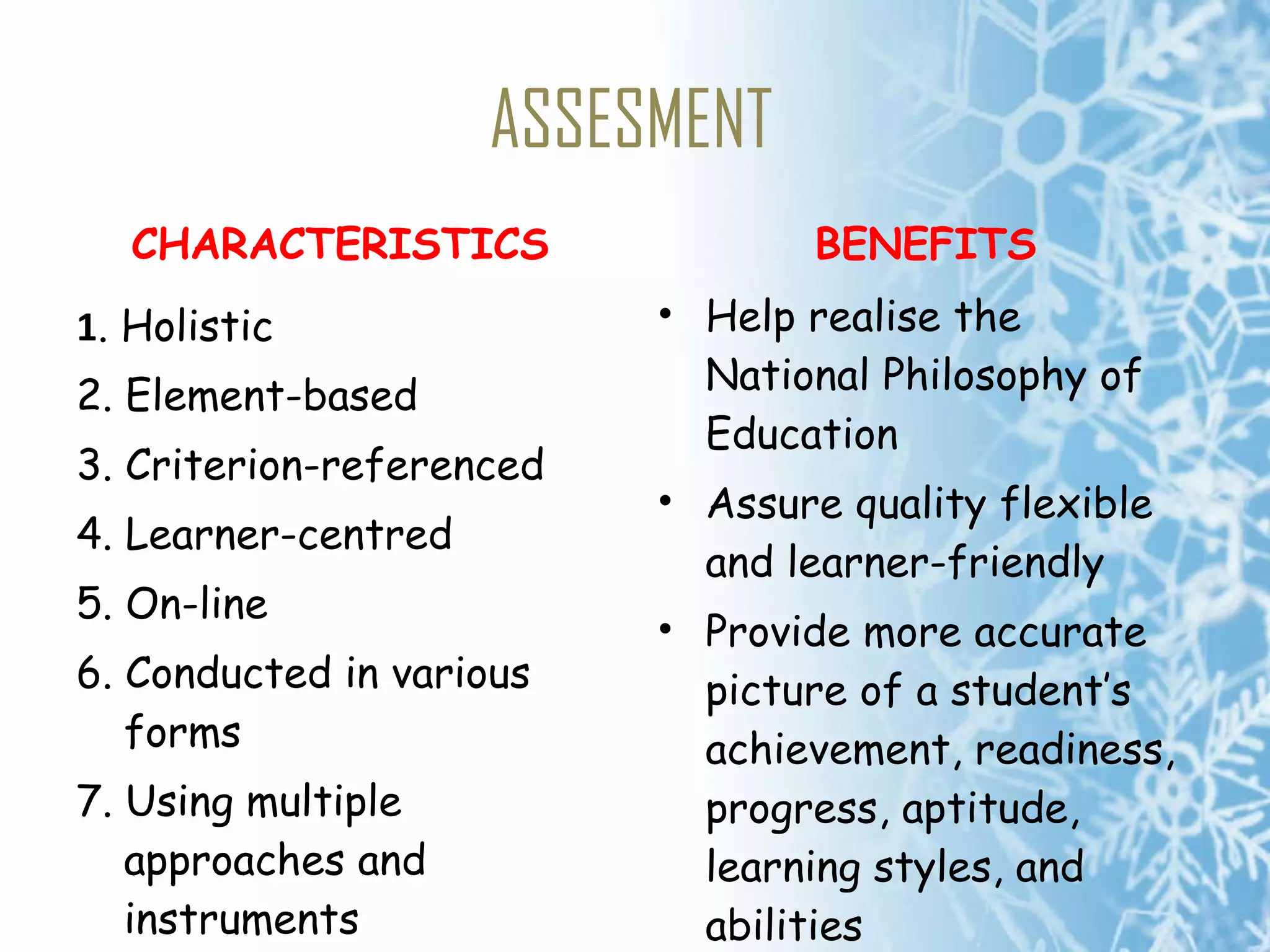
ASSESMENT CHARACTERISTICS 1 . Holistic 2. Element-based 3. Criterion-referenced 4. Learner-centred 5. On-line 6. Conducted in various forms 7. Using multiple approaches and instruments  8. On-going BENEFITS Help realise the National Philosophy of Education  Assure quality flexible and learner-friendly  Provide more accurate picture of a student’s achievement, readiness, progress, aptitude, learning styles, and abilities
HOLISTIC  in that it covers not only achievement but also readiness, progress and aptitude. Such an approach will give various information regarding the student’s learning styles and abilities. 1 ELEMENT-BASED  assessment focuses on the elements that students possess or must develop through the subjects in the school curriculum. This kind of assessment provides information on the mastery and achievement of elements by a student. 2 CRITERION-REFERENCED  assessment is a form of assessment that evaluates an individual’s performance based on a predetermined set of criteria.  3 LEARNER-CENTRED  assessment is a flexible system of assessment which is administered on an individual basis. 4
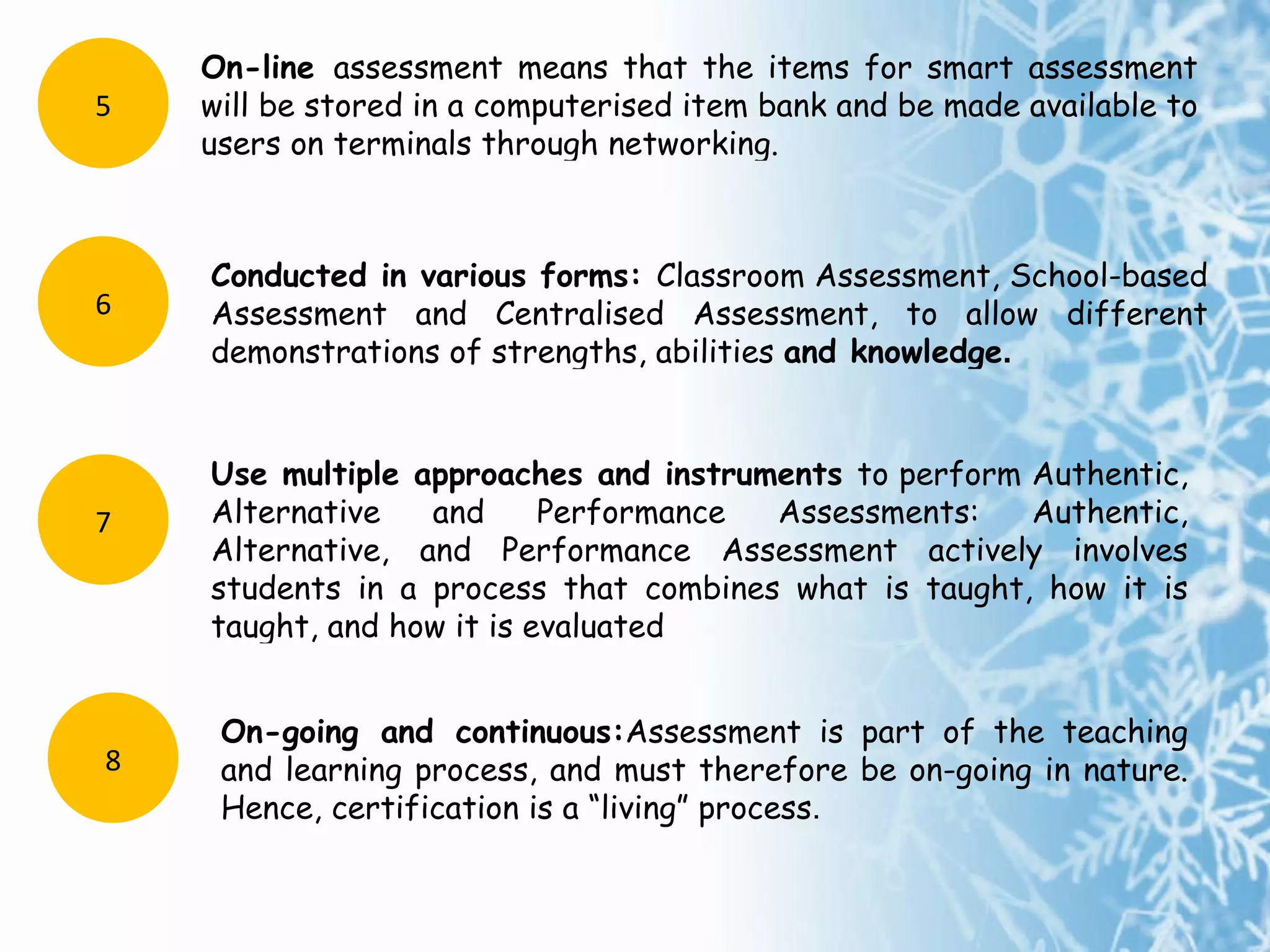
On-line  assessment means that the items for smart assessment will be stored in a computerised item bank and be made available to users on terminals through  networking. 5 Conducted in various forms:  Classroom Assessment, School-based Assessment and Centralised Assessment, to allow different demonstrations of strengths,  abilities  and knowledge . 6 Use multiple approaches and instruments  to perform Authentic, Alternative and Performance Assessments: Authentic, Alternative, and Performance Assessment actively involves students in a process that combines what is taught, how it is taught, and how it is evaluated 7 On-going and continuous: Assessment is part of the teaching and learning process, and must therefore be on-going in nature. Hence, certification is a “living” process . 8
TEACHING-LEARNING MATERIALS CHARACTERISTICS Meets curricular and instructional needs, is cost effective, as well as cosmetically and technically adequate Cognitively challenging, attractive, motivates students to learn, and encourages active participation Combines the best of network-based, teacher-based and courseware materials such as Edunet, Internet and Classified Printed Directories BENEFITS Accommodates student’s different need and abilities resulting in the fuller realisation of student’s capabilities and potential Students take responsibility for managing and directing their own learning.
Management and Administration CHARACTERISTICS 1. Strong, professional administrators and teachers 2. School goals articulated clearly 3. Leads teaching at the school 4. High level of parental and community  support and  involvement 5. Maintains open channels of communication with all constituencies 6. Allocates resources to benefit the greatest  number of students
BENEFITS •  Efficiency - Re-allocation of skilled human resources  to more valuable activities - Cost savings over the long term Effectiveness - Improves quality of decisions through better access to information - Improves speed of decision making
The Nine Primary Functions of Smart School Management 1 . School Governance 2. Student Affairs 3. Educational Resources 4. External Resources 5. Financial 6. Facilities 7. Human Resources 8. Security 9. Technology
People, Skills and Responsibilities The Smart School has a commitment to provide equal opportunities for all students with different needs and capabilities so as to enhance their capacity for learning. This commitment involves the development of the main stakeholders who are involved in the delivery of Smart School teaching. This will represent a revolutionary departure traditional modes of teaching currently practised .
The main stakeholders TEACHERS PRINCIPALS SUPPORT STAFF OTHER EDUCATION PERSONNEL PARENTS & COMMUNITY
Technology FUNCTION SCHOOL LEVEL TECHNOLOGY Facility for teaching and learning activities. Assist the school management  Fully equipment of school classrooms with multimedia courseware, computer laboratory, multimedia development centre etc. THE TECHNOLOGY DERIVATION PROCESS SMART SCHOOL PRACTISES Teaching and learning Management system External constituencies TECHNICAL REQUIREMENTS Sample application solutions Network requirements SMART SCHOOL  TECHNOLOGY SOLUTIONS School level District level State level National level
ENVISIONED FEATURES OF THE SMART SCHOOL Technology input- LAN, WAN hardware and courseware  Technology standards- common tech. for interoperability Data Security- Most data will be on-line and easily accessible Technology Architecture- A central agency will co-ordinate the introduction of technology into Smart Schoo ls
Processes Smart School processes are viewed as a system. When the system is provided with inputs, the Smart School processes will work to produce the desired outputs. The Smart School process will change the way children are taught. Learning is then optimised to each child. Individual minds, spirits and physical selves are catered to rather than the treatment of the class as a homogeneous  collective whole.
Viewing the Smart School process as a system Smart School Core Processes Apply RESOURCES Into the  system TO PRODUCE (DESIRED) OUTCOMES
Policies Policies is used as an umbrella term that encompasses both legistive policies and regulations that will influences SS and effective implementation. The whole range policies, regulations, procedures and practices both formal and informal, written and unwritten that will need to be changed to accommodate implementation of Smart Schools.  This complex task will be undertaken by numerous departmental committees in the Ministry of Education and will require time and several iterations to arrive at specific new approaches.
… .that all Thank you!!!!

Ict in biology-Smart School Project

  • 1.
    Malaysian Smart School ICT IN BIOLOGY GROUP MEMBER’S : ~ NASUHA MUHAMMAD ~ ILANI JAILANI ~ MAHIRAH MAZLAN ~ NUR AMALINA ROHAIZAN
  • 2.
    What is theSS concept? A learning institution that has been systemically reinvented in terms of teaching-learning practices and school management in order to prepare children for the Information Age.
  • 3.
    Qualities of theMalaysian Smart School a philosophy that says all students can learn if taught, coupled with high expectations for all students a broad curriculum that considers the different capabilities and needs of all students a school climate that is conducive to learning an on-going assessment that supports good instruction strong and professional principals and teachers a high level of parent and community involvement and support
  • 4.
    Key Components ofa Smart School Teaching and Learning Management and Administration People, Skills and Responsibilities Technology Processes Policies
  • 5.
    Teaching and LearningThe Smart School teaching and learning environment will be shaped in four main areas, each of which will be a critical element in defining the overall teaching and learning experience for Smart School children: Curriculum Pedagogy Assessment Teaching-Learning Materials
  • 6.
    CURRICULUM CHARACTERISTICS Designed to help students achieve overall and balanced development. Integration of knowledge, skills, values and correct use of language across the curriculum Intended learning outcomes explicitly stated for different levels of abilities, ensuring all students gain access to quality learning, and allowing for self-paced learning across grades Multidisciplinary, thematic and continuous across learning areas Integration of knowledge, skills, and attitudes suitable for the Information Age BENEFITS Children educated with critical and creative thinking skills, inculcated with values, and encouraged to improve language proficiency Holistic learning promoted Children allowed to progress at their own pace Students’ varying capabilities, interests, and needs catered for
  • 7.
    Designed to helpstudents achieve overall and balanced development 1 Domains ALL-ROUND DEVELOPMENT Communication Effective oral and written communication in Malay. English as a second communication language. Emphasise multiple languages, interpersonal skills and networking. Cognitive Focus on acquiring knowledge. Focus on searching, generating, and using cognitive knowledge with an emphasis on problem-solving and creativity. Affective/ Emotional Instil moral and religious values. Emphasise adaptability, team-player characteristics, emotional balance and emotional intelligence. Physical/ Social Instil social responsibility and consciousness of health and environmental issues. Emphasise a global orientation and inculcate work place skills and attitudes.
  • 8.
    Integration of knowledge,skills, values and correct use of language across the curriculum 2 KNOWLEDGE -Content knowledge -Problem solving knowledge -Epistemic knowledge - Inquiry knowledge . SKILLS -Creative and critical thinking skill -Personal skills -Social skills VALUES -Self-reliance -Humanity -Respect -Love LANGUAGE -Reading, writing and oral communication
  • 9.
    Intended learning outcomesexplicitly stated for different levels of abilities, ensuring all students gain access to quality learning, and allowing for self-paced learning across grades 3 The curriculum will reflect vertical integration to allow high fliers to ‘surf’ through their schooling years, without being kept apart from their peers, in virtual express classes.
  • 10.
    Multidisciplinary, thematic andcontinuous across learning areas A multidisciplinary approach is one in which two or three subject areas are combined in a single learning area that focuses on a theme, issue, problem, topic, or concept. An interdisciplinary approach combines all subject areas to focus the full array of disciplines on a theme, issue, problem, topic, or concept. 4
  • 11.
    Integration of knowledge,skills, and attitudes suitable for the Information Age IT Literacy is the ability to use IT tools and IT sources to: collect, analyse, process and present information support meaningful learning in a variety of contexts prepare for working life. In addition, the Smart School co-curriculum programme will provide activities that reinforce classroom learning for example community service activity, cultural activities, subject-related activities and social activities . 5
  • 12.
    PEDAGOGY CHARACTERISTICS Appropriatemix of learning strategies to ensure mastery of basic competencies and promotion of holistic development Allowing for individua differences in learning styles to boost performance the classroom atmosphere is compatible with different teaching-learning strategies BENEFITS Learning becomes more interesting, motivating, stimulating and meaningful the mind, spirit, and body of the child is involved in the learning process basic skills to prepare children for greater challenges over time a range of diversities in needs and capabilities catered for
  • 13.
    Appropriate mix oflearning strategies using innovative methods of teaching 1 Process involves specific learning goals active learning process, where learner constructs meaning continuouS personalised Modes alone, in pairs, or in small teams with an expert (teacher or community member), a facilitator (teacher assistant, volunteer or student), non-human resources (hands-on materials, computer-based resources, multimedia resources, or print materials) at a site in the community, a computer-based multimedia simulation, a hands-on learning lab, a meeting room or library Tasks authentic, often in real life environments, with real world challenges interdisciplinary: * specific knowledge * general skills such as transfer of information across settings, negotiation and interpersonal skills, decision making skills mastery of a task before progressing to next task periodic performance mastery assessment more responsibility to learner for directing and managing own learning
  • 14.
    The classroom atmospherewill be important to support the Smart School teaching and learning model 2 Creating an atmosphere of respect and rapport • positive teacher interaction with students • positive student interaction Establishing a culture for learning • importance of a balance between process and content in learning • student pride in work • high expectations for learning and achievement Managing classroom procedures • collaborative management of instructional groups • seamless management of transitions • collaborative management of materials and supplies • collaborative performance of non-instructional tasks • effective supervision of volunteers and paraprofessionals Managing student behaviour • clear standards of conduct developed with students’ input • unobtrusive monitoring of student behaviour by teacher and peers • sensitive and appropriate response to student misbehaviour Organising physical space • safe and optimal use of class space and furniture • optimal use of all physical resources • equal accessibility to all learning
  • 15.
    ASSESMENT CHARACTERISTICS 1. Holistic 2. Element-based 3. Criterion-referenced 4. Learner-centred 5. On-line 6. Conducted in various forms 7. Using multiple approaches and instruments 8. On-going BENEFITS Help realise the National Philosophy of Education Assure quality flexible and learner-friendly Provide more accurate picture of a student’s achievement, readiness, progress, aptitude, learning styles, and abilities
  • 16.
    HOLISTIC inthat it covers not only achievement but also readiness, progress and aptitude. Such an approach will give various information regarding the student’s learning styles and abilities. 1 ELEMENT-BASED assessment focuses on the elements that students possess or must develop through the subjects in the school curriculum. This kind of assessment provides information on the mastery and achievement of elements by a student. 2 CRITERION-REFERENCED assessment is a form of assessment that evaluates an individual’s performance based on a predetermined set of criteria. 3 LEARNER-CENTRED assessment is a flexible system of assessment which is administered on an individual basis. 4
  • 17.
    On-line assessmentmeans that the items for smart assessment will be stored in a computerised item bank and be made available to users on terminals through networking. 5 Conducted in various forms: Classroom Assessment, School-based Assessment and Centralised Assessment, to allow different demonstrations of strengths, abilities and knowledge . 6 Use multiple approaches and instruments to perform Authentic, Alternative and Performance Assessments: Authentic, Alternative, and Performance Assessment actively involves students in a process that combines what is taught, how it is taught, and how it is evaluated 7 On-going and continuous: Assessment is part of the teaching and learning process, and must therefore be on-going in nature. Hence, certification is a “living” process . 8
  • 18.
    TEACHING-LEARNING MATERIALS CHARACTERISTICSMeets curricular and instructional needs, is cost effective, as well as cosmetically and technically adequate Cognitively challenging, attractive, motivates students to learn, and encourages active participation Combines the best of network-based, teacher-based and courseware materials such as Edunet, Internet and Classified Printed Directories BENEFITS Accommodates student’s different need and abilities resulting in the fuller realisation of student’s capabilities and potential Students take responsibility for managing and directing their own learning.
  • 19.
    Management and AdministrationCHARACTERISTICS 1. Strong, professional administrators and teachers 2. School goals articulated clearly 3. Leads teaching at the school 4. High level of parental and community support and involvement 5. Maintains open channels of communication with all constituencies 6. Allocates resources to benefit the greatest number of students
  • 20.
    BENEFITS • Efficiency - Re-allocation of skilled human resources to more valuable activities - Cost savings over the long term Effectiveness - Improves quality of decisions through better access to information - Improves speed of decision making
  • 21.
    The Nine PrimaryFunctions of Smart School Management 1 . School Governance 2. Student Affairs 3. Educational Resources 4. External Resources 5. Financial 6. Facilities 7. Human Resources 8. Security 9. Technology
  • 22.
    People, Skills andResponsibilities The Smart School has a commitment to provide equal opportunities for all students with different needs and capabilities so as to enhance their capacity for learning. This commitment involves the development of the main stakeholders who are involved in the delivery of Smart School teaching. This will represent a revolutionary departure traditional modes of teaching currently practised .
  • 23.
    The main stakeholdersTEACHERS PRINCIPALS SUPPORT STAFF OTHER EDUCATION PERSONNEL PARENTS & COMMUNITY
  • 24.
    Technology FUNCTION SCHOOLLEVEL TECHNOLOGY Facility for teaching and learning activities. Assist the school management Fully equipment of school classrooms with multimedia courseware, computer laboratory, multimedia development centre etc. THE TECHNOLOGY DERIVATION PROCESS SMART SCHOOL PRACTISES Teaching and learning Management system External constituencies TECHNICAL REQUIREMENTS Sample application solutions Network requirements SMART SCHOOL TECHNOLOGY SOLUTIONS School level District level State level National level
  • 25.
    ENVISIONED FEATURES OFTHE SMART SCHOOL Technology input- LAN, WAN hardware and courseware Technology standards- common tech. for interoperability Data Security- Most data will be on-line and easily accessible Technology Architecture- A central agency will co-ordinate the introduction of technology into Smart Schoo ls
  • 26.
    Processes Smart Schoolprocesses are viewed as a system. When the system is provided with inputs, the Smart School processes will work to produce the desired outputs. The Smart School process will change the way children are taught. Learning is then optimised to each child. Individual minds, spirits and physical selves are catered to rather than the treatment of the class as a homogeneous collective whole.
  • 27.
    Viewing the SmartSchool process as a system Smart School Core Processes Apply RESOURCES Into the system TO PRODUCE (DESIRED) OUTCOMES
  • 28.
    Policies Policies isused as an umbrella term that encompasses both legistive policies and regulations that will influences SS and effective implementation. The whole range policies, regulations, procedures and practices both formal and informal, written and unwritten that will need to be changed to accommodate implementation of Smart Schools. This complex task will be undertaken by numerous departmental committees in the Ministry of Education and will require time and several iterations to arrive at specific new approaches.
  • 29.
    … .that allThank you!!!!