INCIDENT
COMMAND
SYSTEM
and
RESPONSE
CLUSTERS
Scope
1. Overview of ICS
2. Legal Bases of ICS
3. Incident Management Teams (IMTs)
4. Interoperability of IMTs and Response Clusters
Overview of ICS
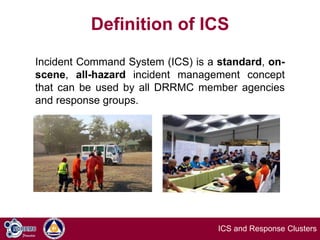
Incident Command System (ICS) is a standard, on-
scene, all-hazard incident management concept
that can be used by all DRRMC member agencies
and response groups.
Definition of ICS
ICS and Response Clusters
The purpose of the ICS is to help to ensure:
• Safety of responders and others
• Achievement of tactical objectives
• Efficient use of resources
Purpose of ICS
ICS and Response Clusters
• Meets the needs of incidents of any kind or size
• Allows personnel from a variety of agencies to meld
rapidly into a common management structure
• Provides accountability and a planning process
• Provides logistical and administrative support to
operational staff
• Is cost effective by avoiding duplication of efforts
Benefits of ICS
ICS and Response Clusters
Responsible Official (RO): the overall in charge of an
agency, organization or institution who has the full authority
for making decisions and providing directions to manage an
incident or planned event within his/her jurisdiction.
Emergency Operations Center (EOC): the facility that
serves as repository of information and main hub for
coordination of resources to support the management of an
incident or planned event.
Other Related Definitions
ICS and Response Clusters
References: Item 5, NDRRMC Memo Nos. 43 and 44 s 2016
Legal Bases of ICS
Section 9 (g): The Office of Civil Defense (OCD)
shall formulate standard operating procedures for
coordination…
Rule 7 (h), Implementing Rules and Regulations:
The OCD shall establish ICS as part of the
Philippines’ on- scene disaster response system.
Republic Act 10121, 2010
ICS and Response Clusters
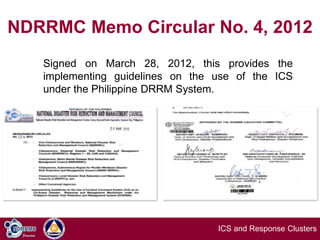
NDRRMC Memo Circular No. 4, 2012
Signed on March 28, 2012, this provides the
implementing guidelines on the use of the ICS
under the Philippine DRRM System.
ICS and Response Clusters
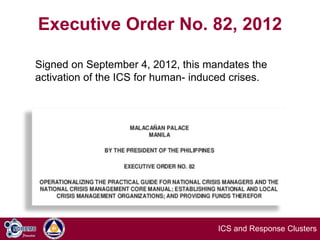
Executive Order No. 82, 2012
Signed on September 4, 2012, this mandates the
activation of the ICS for human- induced crises.
ICS and Response Clusters
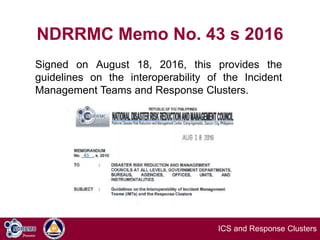
NDRRMC Memo No. 43 s 2016
Signed on August 18, 2016, this provides the
guidelines on the interoperability of the Incident
Management Teams and Response Clusters.
ICS and Response Clusters
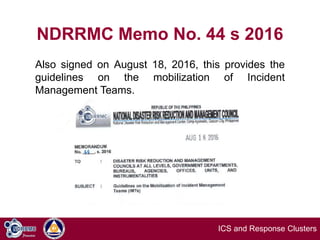
Also signed on August 18, 2016, this provides the
guidelines on the mobilization of Incident
Management Teams.
NDRRMC Memo No. 44 s 2016
ICS and Response Clusters
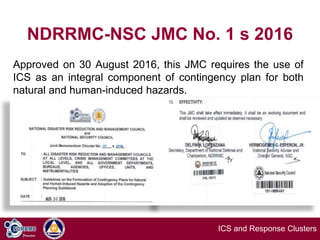
Approved on 30 August 2016, this JMC requires the use of
ICS as an integral component of contingency plan for both
natural and human-induced hazards.
NDRRMC-NSC JMC No. 1 s 2016
ICS and Response Clusters
Regional and local DMRRCs formulated issuances
to institutionalize ICS in their respective areas.
Regional and Local
Institutionalization of the ICS
ICS and Response Clusters
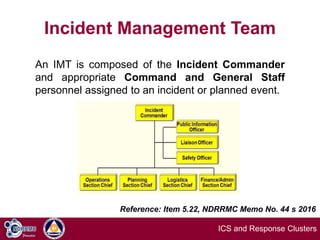
Incident Management Team
An IMT is composed of the Incident Commander
and appropriate Command and General Staff
personnel assigned to an incident or planned event.
ICS and Response Clusters
Reference: Item 5.22, NDRRMC Memo No. 44 s 2016
Duties and Responsibilities
• Overall in-charge of on-scene response decisions
• Manages all resources checked-in
• Receives and implements the directives of the RO
• Ensures the safety of all personnel and other
resources deployed for operations
ICS and Response Clusters
Duties and Responsibilities
• Manages the provision of logistical requirements to
support the conduct of the operations
• Documents and reports all situation updates and
actions taken to the RO through the EOC
• Requests for additional resources from the RO
through the EOC
• Facilitates the complete process on demobilization of
resources.
ICS and Response Clusters
Reference: Item 6.1, NDRRMC Memo No. 44 s 2016
IMT Qualifications
1. Must come from a government agency/ office, local
government unit, civil society organization or private
sector, or a private individual with authorization to
operate in the area
2. Preferably must have completed the ICS training
requirements and standards set by the OCD
3. Must be allowed by the sending agency/ office/ unit/
organization to be deployed as an IMT member
immediately even on short notice from the RO
ICS and Response Clusters
Reference: Item 6.2.1, NDRRMC Memo No. 44 s 2016
Selection
1. The RO shall select the IC through Delegation of
Authority.
2. The IC shall select the appropriate members of the
Command and General Staff to compose the whole IMT
3. All selected IMT members shall temporarily be relieved
from their regular office duties and responsibilities to
perform in full-time the expected functions of their
respective IMT positions
ICS and Response Clusters
Reference: Items 6.2.2 and 6.2.3, NDRRMC Memo No. 44 s 2016
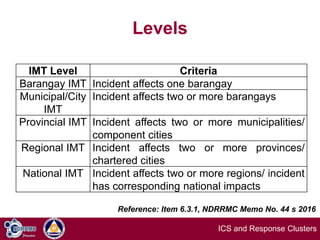
Levels
ICS and Response Clusters
Reference: Item 6.3.1, NDRRMC Memo No. 44 s 2016
IMT Level Criteria
Barangay IMT Incident affects one barangay
Municipal/City
IMT
Incident affects two or more barangays
Provincial IMT Incident affects two or more municipalities/
component cities
Regional IMT Incident affects two or more provinces/
chartered cities
National IMT Incident affects two or more regions/ incident
has corresponding national impacts
Interoperability
(NDRRMC Memo No. 43 s. 2016)
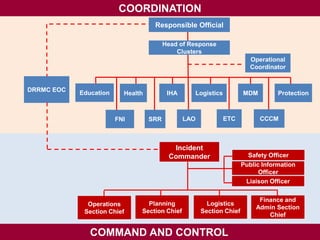
Coordination
The RO and the principals from other agencies, i.e.
Response Clusters, undertake coordination through the
following:
• Making policy decisions
• Establishing priorities
• Resolving critical resource issues
• Mobilizing and tracking resources
• Collecting, analyzing, and disseminating situation
report/information
ICS and Response Clusters
Command and Control
The IC undertakes the following:
• Commanding responders for on-scene operations
• Controlling and managing the resources deployed
tactically on the ground
• Reporting progress and updates on the
operations to the RO
ICS and Response Clusters
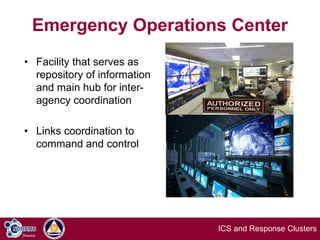
Emergency Operations Center
• Facility that serves as
repository of information
and main hub for inter-
agency coordination
• Links coordination to
command and control
ICS and Response Clusters
Operational
Coordinator
DRRMC EOC
Incident
Commander
COORDINATION
COMMAND AND CONTROL
Head of Response
Clusters
Responsible Official
Safety Officer
Liaison Officer
Public Information
Officer
Education Health IHA Logistics MDM Protection
FNI SRR LAO ETC CCCM
Operations
Section Chief
Planning
Section Chief
Logistics
Section Chief
Finance and
Admin Section
Chief
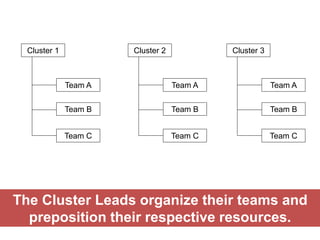
Cluster 1
The Cluster Leads organize their teams and
preposition their respective resources.
Team A
Team B
Team C
Cluster 2
Team A
Team B
Team C
Cluster 3
Team A
Team B
Team C
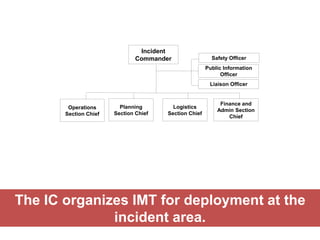
The IC organizes IMT for deployment at the
incident area.
Incident
Commander Safety Officer
Liaison Officer
Public Information
Officer
Operations
Section Chief
Planning
Section Chief
Logistics
Section Chief
Finance and
Admin Section
Chief
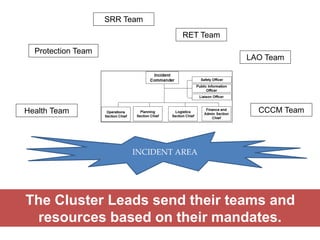
The Cluster Leads send their teams and
resources based on their mandates.
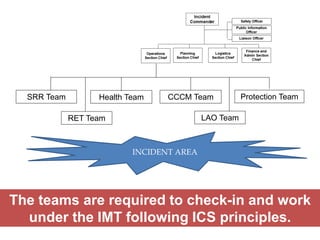
INCIDENT AREA
CCCM Team
Health Team
SRR Team
Protection Team
LAO Team
RET Team
The teams are required to check-in and work
under the IMT following ICS principles.
INCIDENT AREA
CCCM Team
Health Team
SRR Team Protection Team
LAO Team
RET Team
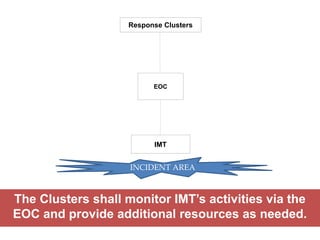
The Clusters shall monitor IMT’s activities via the
EOC and provide additional resources as needed.
EOC
IMT
Response Clusters
INCIDENT AREA
Important Points
• All authorities shall emanate from the RO.
• Clusters: force providers; where decision makers / high ranking
officials usually operate.
• IMT: force employer; where ICS trained responders operate (rank
does not apply)
• Clusters and IMT shall NEVER be collocated.
• At the national level, the IMT shall work as Area Command Team.
ICS and Response Clusters
Important Points
• Once checked-in:
– Clusters shall cease operational control over their resources.
– Cluster resources shall still perform according to their
mandates, SOPs and technical expertise. The IMT will just
manage them tactically for proper placement and efficiency.
• Clusters shall not send resources to the ground unless:
– Requested by the IC.
– Based on risks (e.g. PDRA-APP results)
– Based on needs (e.g. RDANA reports; IC should be notified)
– There is lack of contact from the ground
ICS and Response Clusters
Questions?

ICS-AND-RESPONSE-CLUSTERSICS-AND-RESPONSE-CLUSTERS.pptx.pptx

  • 1.
  • 2.
    Scope 1. Overview ofICS 2. Legal Bases of ICS 3. Incident Management Teams (IMTs) 4. Interoperability of IMTs and Response Clusters
  • 3.
  • 4.
    Incident Command System(ICS) is a standard, on- scene, all-hazard incident management concept that can be used by all DRRMC member agencies and response groups. Definition of ICS ICS and Response Clusters
  • 5.
    The purpose ofthe ICS is to help to ensure: • Safety of responders and others • Achievement of tactical objectives • Efficient use of resources Purpose of ICS ICS and Response Clusters
  • 6.
    • Meets theneeds of incidents of any kind or size • Allows personnel from a variety of agencies to meld rapidly into a common management structure • Provides accountability and a planning process • Provides logistical and administrative support to operational staff • Is cost effective by avoiding duplication of efforts Benefits of ICS ICS and Response Clusters
  • 7.
    Responsible Official (RO):the overall in charge of an agency, organization or institution who has the full authority for making decisions and providing directions to manage an incident or planned event within his/her jurisdiction. Emergency Operations Center (EOC): the facility that serves as repository of information and main hub for coordination of resources to support the management of an incident or planned event. Other Related Definitions ICS and Response Clusters References: Item 5, NDRRMC Memo Nos. 43 and 44 s 2016
  • 8.
  • 9.
    Section 9 (g):The Office of Civil Defense (OCD) shall formulate standard operating procedures for coordination… Rule 7 (h), Implementing Rules and Regulations: The OCD shall establish ICS as part of the Philippines’ on- scene disaster response system. Republic Act 10121, 2010 ICS and Response Clusters
  • 10.
    NDRRMC Memo CircularNo. 4, 2012 Signed on March 28, 2012, this provides the implementing guidelines on the use of the ICS under the Philippine DRRM System. ICS and Response Clusters
  • 11.
    Executive Order No.82, 2012 Signed on September 4, 2012, this mandates the activation of the ICS for human- induced crises. ICS and Response Clusters
  • 12.
    NDRRMC Memo No.43 s 2016 Signed on August 18, 2016, this provides the guidelines on the interoperability of the Incident Management Teams and Response Clusters. ICS and Response Clusters
  • 13.
    Also signed onAugust 18, 2016, this provides the guidelines on the mobilization of Incident Management Teams. NDRRMC Memo No. 44 s 2016 ICS and Response Clusters
  • 14.
    Approved on 30August 2016, this JMC requires the use of ICS as an integral component of contingency plan for both natural and human-induced hazards. NDRRMC-NSC JMC No. 1 s 2016 ICS and Response Clusters
  • 15.
    Regional and localDMRRCs formulated issuances to institutionalize ICS in their respective areas. Regional and Local Institutionalization of the ICS ICS and Response Clusters
  • 16.
  • 17.
    Incident Management Team AnIMT is composed of the Incident Commander and appropriate Command and General Staff personnel assigned to an incident or planned event. ICS and Response Clusters Reference: Item 5.22, NDRRMC Memo No. 44 s 2016
  • 18.
    Duties and Responsibilities •Overall in-charge of on-scene response decisions • Manages all resources checked-in • Receives and implements the directives of the RO • Ensures the safety of all personnel and other resources deployed for operations ICS and Response Clusters
  • 19.
    Duties and Responsibilities •Manages the provision of logistical requirements to support the conduct of the operations • Documents and reports all situation updates and actions taken to the RO through the EOC • Requests for additional resources from the RO through the EOC • Facilitates the complete process on demobilization of resources. ICS and Response Clusters Reference: Item 6.1, NDRRMC Memo No. 44 s 2016
  • 20.
    IMT Qualifications 1. Mustcome from a government agency/ office, local government unit, civil society organization or private sector, or a private individual with authorization to operate in the area 2. Preferably must have completed the ICS training requirements and standards set by the OCD 3. Must be allowed by the sending agency/ office/ unit/ organization to be deployed as an IMT member immediately even on short notice from the RO ICS and Response Clusters Reference: Item 6.2.1, NDRRMC Memo No. 44 s 2016
  • 21.
    Selection 1. The ROshall select the IC through Delegation of Authority. 2. The IC shall select the appropriate members of the Command and General Staff to compose the whole IMT 3. All selected IMT members shall temporarily be relieved from their regular office duties and responsibilities to perform in full-time the expected functions of their respective IMT positions ICS and Response Clusters Reference: Items 6.2.2 and 6.2.3, NDRRMC Memo No. 44 s 2016
  • 22.
    Levels ICS and ResponseClusters Reference: Item 6.3.1, NDRRMC Memo No. 44 s 2016 IMT Level Criteria Barangay IMT Incident affects one barangay Municipal/City IMT Incident affects two or more barangays Provincial IMT Incident affects two or more municipalities/ component cities Regional IMT Incident affects two or more provinces/ chartered cities National IMT Incident affects two or more regions/ incident has corresponding national impacts
  • 23.
  • 24.
    Coordination The RO andthe principals from other agencies, i.e. Response Clusters, undertake coordination through the following: • Making policy decisions • Establishing priorities • Resolving critical resource issues • Mobilizing and tracking resources • Collecting, analyzing, and disseminating situation report/information ICS and Response Clusters
  • 25.
    Command and Control TheIC undertakes the following: • Commanding responders for on-scene operations • Controlling and managing the resources deployed tactically on the ground • Reporting progress and updates on the operations to the RO ICS and Response Clusters
  • 26.
    Emergency Operations Center •Facility that serves as repository of information and main hub for inter- agency coordination • Links coordination to command and control ICS and Response Clusters
  • 27.
    Operational Coordinator DRRMC EOC Incident Commander COORDINATION COMMAND ANDCONTROL Head of Response Clusters Responsible Official Safety Officer Liaison Officer Public Information Officer Education Health IHA Logistics MDM Protection FNI SRR LAO ETC CCCM Operations Section Chief Planning Section Chief Logistics Section Chief Finance and Admin Section Chief
  • 28.
    Cluster 1 The ClusterLeads organize their teams and preposition their respective resources. Team A Team B Team C Cluster 2 Team A Team B Team C Cluster 3 Team A Team B Team C
  • 29.
    The IC organizesIMT for deployment at the incident area. Incident Commander Safety Officer Liaison Officer Public Information Officer Operations Section Chief Planning Section Chief Logistics Section Chief Finance and Admin Section Chief
  • 30.
    The Cluster Leadssend their teams and resources based on their mandates. INCIDENT AREA CCCM Team Health Team SRR Team Protection Team LAO Team RET Team
  • 31.
    The teams arerequired to check-in and work under the IMT following ICS principles. INCIDENT AREA CCCM Team Health Team SRR Team Protection Team LAO Team RET Team
  • 32.
    The Clusters shallmonitor IMT’s activities via the EOC and provide additional resources as needed. EOC IMT Response Clusters INCIDENT AREA
  • 33.
    Important Points • Allauthorities shall emanate from the RO. • Clusters: force providers; where decision makers / high ranking officials usually operate. • IMT: force employer; where ICS trained responders operate (rank does not apply) • Clusters and IMT shall NEVER be collocated. • At the national level, the IMT shall work as Area Command Team. ICS and Response Clusters
  • 34.
    Important Points • Oncechecked-in: – Clusters shall cease operational control over their resources. – Cluster resources shall still perform according to their mandates, SOPs and technical expertise. The IMT will just manage them tactically for proper placement and efficiency. • Clusters shall not send resources to the ground unless: – Requested by the IC. – Based on risks (e.g. PDRA-APP results) – Based on needs (e.g. RDANA reports; IC should be notified) – There is lack of contact from the ground ICS and Response Clusters
  • 35.