The implications of
soul and space for
our society.
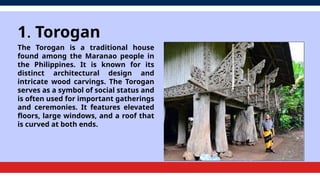
1. Torogan
The Torogan is a traditional house
found among the Maranao people in
the Philippines. It is known for its
distinct architectural design and
intricate wood carvings. The Torogan
serves as a symbol of social status and
is often used for important gatherings
and ceremonies. It features elevated
floors, large windows, and a roof that
is curved at both ends.
2. Ifugao Bale:
The Ifugao Bale is a traditional house
found among the Ifugao people in the
northern part of the Philippines. It is
primarily made of wood and thatch.
The Bale is designed to withstand the
region's mountainous terrain and
frequent earthquakes. It has a
steeply-pitched roof and raised
platforms for sleeping and storage.
The Ifugao Bale is not only a dwelling
but also a cultural symbol
representing the community's unity
and ancestral traditions.
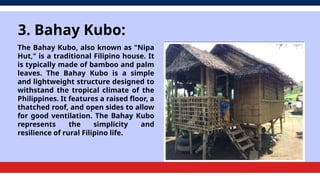
3. Bahay Kubo:
The Bahay Kubo, also known as "Nipa
Hut," is a traditional Filipino house. It
is typically made of bamboo and palm
leaves. The Bahay Kubo is a simple
and lightweight structure designed to
withstand the tropical climate of the
Philippines. It features a raised floor, a
thatched roof, and open sides to allow
for good ventilation. The Bahay Kubo
represents the simplicity and
resilience of rural Filipino life.
4. Bahay na Bato
The Bahay na Bato is a traditional
Filipino house that emerged during
the Spanish colonial period. It is
characterized by a combination of
indigenous and Spanish architectural
influences. The lower part of the
house is made of stone or brick, while
the upper part is made of wood. The
Bahay na Bato features large
windows, a spacious living area, and
decorative elements influenced by
European design. It represents the
fusion of Filipino and Spanish cultures
during that era.
How Filipinos utilize space to
determine its implications for
their identities, history, religion,
philosophy.
1. Communal Spaces: Filipinos have a
strong sense of community and often
utilize public spaces for social
interactions. Public plazas, parks, and
markets serve as gathering places where
people can connect, socialize, and engage
in various activities. This emphasis on
communal spaces reflects the collective
nature of Filipino identity and fosters a
2. Home as Center: The Filipino home holds
significant importance in shaping identity
and fostering a sense of belonging. The
home is often considered the center of
family life, where shared values, traditions,
and cultural practices are passed down
through generations. The arrangement
and organization of space within the home
reflect familial roles, hierarchies, and the
3. Sacred Spaces: Religion plays a vital
role in Filipino society, and sacred
spaces hold great significance.
Churches, mosques, and temples serve
as places of worship and spiritual
reflection. These spaces provide
Filipinos with a connection to their
religious beliefs, rituals, and traditions,
shaping their identities and providing a
4. Historical Sites: The Philippines has a rich
history, and historical sites play a crucial
role in preserving and promoting cultural
heritage. Spaces such as museums, heritage
sites, and landmarks serve as reminders of
the country's past, showcasing the diverse
influences that have shaped Filipino identity.
They also provide opportunities for Filipinos
to learn about their history, fostering a
sense of pride and national identity.
5. Natural Environment: The Philippines is
blessed with abundant natural beauty, and the
relationship between Filipinos and the natural
environment is deeply intertwined. From the
rice terraces of the Cordilleras to the pristine
beaches and lush mountains, Filipinos often find
solace and inspiration in nature. This connection
to the natural world influences Filipino
philosophy, emphasizing concepts such as
harmony, respect for nature, and the
interconnectedness of all living beings.
JENELYN INES
AYESA QUILANG

Art application pptx

  • 1.
    The implications of souland space for our society.
  • 2.
    1. Torogan The Toroganis a traditional house found among the Maranao people in the Philippines. It is known for its distinct architectural design and intricate wood carvings. The Torogan serves as a symbol of social status and is often used for important gatherings and ceremonies. It features elevated floors, large windows, and a roof that is curved at both ends.
  • 3.
    2. Ifugao Bale: TheIfugao Bale is a traditional house found among the Ifugao people in the northern part of the Philippines. It is primarily made of wood and thatch. The Bale is designed to withstand the region's mountainous terrain and frequent earthquakes. It has a steeply-pitched roof and raised platforms for sleeping and storage. The Ifugao Bale is not only a dwelling but also a cultural symbol representing the community's unity and ancestral traditions.
  • 4.
    3. Bahay Kubo: TheBahay Kubo, also known as "Nipa Hut," is a traditional Filipino house. It is typically made of bamboo and palm leaves. The Bahay Kubo is a simple and lightweight structure designed to withstand the tropical climate of the Philippines. It features a raised floor, a thatched roof, and open sides to allow for good ventilation. The Bahay Kubo represents the simplicity and resilience of rural Filipino life.
  • 5.
    4. Bahay naBato The Bahay na Bato is a traditional Filipino house that emerged during the Spanish colonial period. It is characterized by a combination of indigenous and Spanish architectural influences. The lower part of the house is made of stone or brick, while the upper part is made of wood. The Bahay na Bato features large windows, a spacious living area, and decorative elements influenced by European design. It represents the fusion of Filipino and Spanish cultures during that era.
  • 6.
    How Filipinos utilizespace to determine its implications for their identities, history, religion, philosophy.
  • 7.
    1. Communal Spaces:Filipinos have a strong sense of community and often utilize public spaces for social interactions. Public plazas, parks, and markets serve as gathering places where people can connect, socialize, and engage in various activities. This emphasis on communal spaces reflects the collective nature of Filipino identity and fosters a
  • 8.
    2. Home asCenter: The Filipino home holds significant importance in shaping identity and fostering a sense of belonging. The home is often considered the center of family life, where shared values, traditions, and cultural practices are passed down through generations. The arrangement and organization of space within the home reflect familial roles, hierarchies, and the
  • 9.
    3. Sacred Spaces:Religion plays a vital role in Filipino society, and sacred spaces hold great significance. Churches, mosques, and temples serve as places of worship and spiritual reflection. These spaces provide Filipinos with a connection to their religious beliefs, rituals, and traditions, shaping their identities and providing a
  • 10.
    4. Historical Sites:The Philippines has a rich history, and historical sites play a crucial role in preserving and promoting cultural heritage. Spaces such as museums, heritage sites, and landmarks serve as reminders of the country's past, showcasing the diverse influences that have shaped Filipino identity. They also provide opportunities for Filipinos to learn about their history, fostering a sense of pride and national identity.
  • 11.
    5. Natural Environment:The Philippines is blessed with abundant natural beauty, and the relationship between Filipinos and the natural environment is deeply intertwined. From the rice terraces of the Cordilleras to the pristine beaches and lush mountains, Filipinos often find solace and inspiration in nature. This connection to the natural world influences Filipino philosophy, emphasizing concepts such as harmony, respect for nature, and the interconnectedness of all living beings.
  • 24.