ICH GUIDELINES
Presented by: Guided by :
VIVEK BALASAHEB WAGH Dr. S.J.AHER
FY. M.PHARM ( PHARMACEUTICS )
ROLL NO.15
SANJIVANI COLLEGE OF PHARMACEUTICAL
EDUCATION AND RESEARCH
What does ICH stands for ?
• The complete name of ICH is the “International
Conference on Harmonisation of Technical
Requirements for Registration of Pharmaceuticals
for Human use”.
What is ICH ?
• ICH is a joint initiative involving both regulators
and research-based industry representatives of the
European Union, Japan and the USA in scientific
and technical discussions of the testing procedures
required to assess and ensure the safety, quality
and efficacy of medicines.
What is the goal of ICH ?
• The goal of ICH is to promote international harmonization by bringing
together representatives from the three ICH regions (EU, Japan and USA)
to discuss and establish common guidelines.
• Another goal of ICH is to make information available on ICH, ICH activities
and ICH guidelines to any country or company that requests the
information, and to promote a mutual understanding of regional initiative
in order to facilitate harmonisation processes related to ICH guidelines
regionally and globally, and to strengthen the capacity of drug regulatory
authorities and industry to utilise them.
• The ICH Global Cooperation Group (GCG) was formed in 1999 and is
charged with this task.
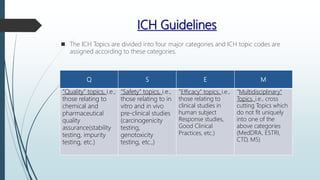
ICH Guidelines
 The ICH Topics are divided into four major categories and ICH topic codes are
assigned according to these categories.
Q S E M
“Quality” topics, i.e.,
those relating to
chemical and
pharmaceutical
quality
assurance(stability
testing, impurity
testing, etc.)
“Safety” topics, i.e.,
those relating to in
vitro and in vivo
pre-clinical studies
(carcinogenicity
testing,
genotoxicity
testing, etc.,)
“Efficacy” topics, i.e.,
those relating to
clinical studies in
human subject
Response studies,
Good Clinical
Practices, etc.)
“Multidisciplinary”
Topics, i.e., cross
cutting Topics which
do not fit uniquely
into one of the
above categories
(MedDRA, ESTRI,
CTD, M5)
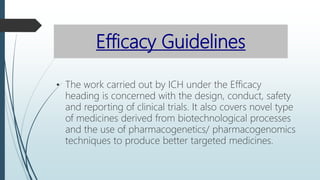
Efficacy Guidelines
• The work carried out by ICH under the Efficacy
heading is concerned with the design, conduct, safety
and reporting of clinical trials. It also covers novel type
of medicines derived from biotechnological processes
and the use of pharmacogenetics/ pharmacogenomics
techniques to produce better targeted medicines.
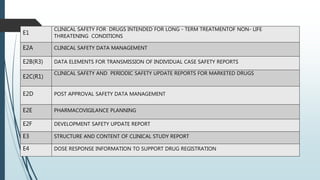
E1
CLINICAL SAFETY FOR DRUGS INTENDED FOR LONG - TERM TREATMENTOF NON- LIFE
THREATENING CONDITIONS
E2A CLINICAL SAFETY DATA MANAGEMENT
E2B(R3) DATA ELEMENTS FOR TRANSMISSION OF INDIVIDUAL CASE SAFETY REPORTS
E2C(R1)
CLINICAL SAFETY AND PERIODIC SAFETY UPDATE REPORTS FOR MARKETED DRUGS
E2D POST APPROVAL SAFETY DATA MANAGEMENT
E2E PHARMACOVIGILANCE PLANNING
E2F DEVELOPMENT SAFETY UPDATE REPORT
E3 STRUCTURE AND CONTENT OF CLINICAL STUDY REPORT
E4 DOSE RESPONSE INFORMATION TO SUPPORT DRUG REGISTRATION
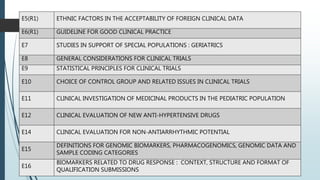
E5(R1) ETHNIC FACTORS IN THE ACCEPTABILITY OF FOREIGN CLINICAL DATA
E6(R1) GUIDELINE FOR GOOD CLINICAL PRACTICE
E7 STUDIES IN SUPPORT OF SPECIAL POPULATIONS : GERIATRICS
E8 GENERAL CONSIDERATIONS FOR CLINICAL TRIALS
E9 STATISTICAL PRINCIPLES FOR CLINICAL TRIALS
E10 CHOICE OF CONTROL GROUP AND RELATED ISSUES IN CLINICAL TRIALS
E11 CLINICAL INVESTIGATION OF MEDICINAL PRODUCTS IN THE PEDIATRIC POPULATION
E12 CLINICAL EVALUATION OF NEW ANTI-HYPERTENSIVE DRUGS
E14 CLINICAL EVALUATION FOR NON-ANTIARRHYTHMIC POTENTIAL
E15
DEFINITIONS FOR GENOMIC BIOMARKERS, PHARMACOGENOMICS, GENOMIC DATA AND
SAMPLE CODING CATEGORIES
E16
BIOMARKERS RELATED TO DRUG RESPONSE : CONTEXT, STRUCTURE AND FORMAT OF
QUALIFICATION SUBMISSIONS
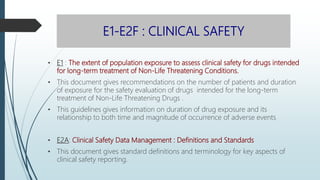
E1-E2F : CLINICAL SAFETY
• E1 : The extent of population exposure to assess clinical safety for drugs intended
for long-term treatment of Non-Life Threatening Conditions.
• This document gives recommendations on the number of patients and duration
of exposure for the safety evaluation of drugs intended for the long-term
treatment of Non-Life Threatening Drugs .
• This guidelines gives information on duration of drug exposure and its
relationship to both time and magnitude of occurrence of adverse events
• E2A: Clinical Safety Data Management : Definitions and Standards
• This document gives standard definitions and terminology for key aspects of
clinical safety reporting.
• E2B(R3): Clinical Safety Data Management Data: Elements for Transmission of
Individual Case Safety Reports
• The objectives of the working group is to identify, define and standardize the
data elements for the transmission of individual case safety reports(adverse
reactions, adverse event reports).
• E2C(R1): Clinical safety data management: Periodic safety update reports for
marketed drugs.
• This document gives guidance on the format and content of safety updates,
which need to be provided at regular intervals to regulatory authorities to
maximum efficacy and to avoid duplication of marketed drugs.
• E2D: Post-Approval Safety Data Management: Definitions and Standards
• This document provides a standardized procedure for post-approval safety
management.
• The definitions of the terms specific to post-approval phase are also provided.
• E2E: Pharmacovigilance Planning
• The main focus of this guideline is on a Safety Specification and
Pharmacovigilance Plan that might be submitted at the time of license
• The guideline describes a method for summarizing the important identified risks
of a drug, important potential risks, and important missing information, including
the potentially at-risk populations and situations where the product is likely to be
used that have not been studied.
• E2F: Development Safety Update Report
• The main focus of the DSUR is collection of data from clinical trials of
investigational drugs including biological's, with or without a marketing approval.
• The DSUR should provide safety information from all ongoing clinical trials that
the sponsor is conducting or has completed during the review period.
• E3: Structure and Content of Clinical Study Reports
• This document describes the format and content of a study report that will be
acceptable in all three ICH regions. It consists of a core report suitable for all
submissions and appendices.
• E4: Dose-Response Information to Support Drug Registration
• This document gives recommendations on the design and conduct of studies to
assess the relationship between doses, blood levels and clinical response
the clinical development of a new drug.
• This information can help in identifying an appropriate starting dose, to adjust
to the needs of a particular patient, and a dose beyond which unacceptable side
effects are seen.
• E5(R1): Ethnic Factors in the Acceptability of Foreign Clinical Data
• The purpose of this guidance is to facilitate the registration of medicines among
ICH regions.
• This document addresses the intrinsic characteristics of the drug recipient and
extrinsic characteristics associated with environment and culture that could affect
the results of clinical studies carried out in regions.
• E6(R1): Good Clinical Practice: Consolidated Guideline
• Good Clinical Practice (GCP) is an international ethical and scientific quality
for designing, conducting, recording and reporting trials that involve the
participation of human subjects.
• This Good Clinical Practices document describes the responsibilities and
expectations of all participants in the conduct of clinical trials, including
investigators, monitors, sponsors.
E7-E11 : CLINICAL TRIALS
• E7: Studies in Support of Special Populations : Geriatrics
• This document provides recommendations on the special considerations which apply
in the design and conduct of clinical trials of medicines that are likely to have
significant use in the elderly.
• E.g.: New Molecular Entities that are likely to have significant use in the elderly,
because the disease intended to be treated is characteristically a disease of ageing
(e.g., Alzheimer's disease)
• E8: General Considerations for Clinical Trials
• This document sets out the general scientific principles for the conduct, performance
and control of clinical trials.
• E9: Statistical Principles for Clinical Trials
• This biostatistical guideline describes essential considerations on the design and
analysis of clinical trials, especially the "confirmatory" (hypothesis-testing) trials that
are the basis for demonstrating effectiveness
• E10: Choice of Control Group and Related Issues in Clinical Trials
• This document addresses the choice of control groups in clinical trials.
• Control groups in clinical trials can be classified on the basis of two critical attributes:
(1) The type of treatment used and
(2) The method of determining who will be in the control group.
• E11: Clinical Investigation of Medicinal Products in the Pediatric Population
• This document addresses the conduct of clinical trials of medicines in pediatric populations.
This document will facilitate the development of safe and effective use of medicinal
in pediatrics.
• Specific clinical study include:
• (1) timing of initiation of pediatric studies during medicinal product development;
• (2) types of studies (pharmacokinetic, pharmacokinetic/ pharmacodynamic (PK/PD),
safety);
• (3) age categories;
• (4) ethics of pediatric clinical investigation.
• E12: Principles for Clinical Evaluation of New Antihypertensive Drugs
• This document provides general principles for the clinical evaluation of new anti-
hypertensive drugs.
• It describes core principles for the evaluation of antihypertensives that are accepted in
the three ICH regions, but some region-specific differences remain, therefore this
document should be considered an "ICH Principle Document rather than an "ICH
Guideline".
• E14: The Clinical Evaluation for Non-Antiarrhythmic Drugs
• This document provides recommendations to sponsors concerning the design,
analysis, and interpretation of clinical studies to assess the potential of a drug to delay
cardiac repolarization.
• This assessment should include testing the effects of new agents on the QT interval as
well as the collection of cardiovascular adverse events.
• E15: Definitions for Genomic Biomarkers, Pharmacogenomics, Pharmacogenetics,
Genomic Data and Sample Coding Categories
• In order to develop harmonised approaches to drug regulation, it is important to
that consistent definitions of terminology are being applied across all constituents of
the International Conference on Harmonisation (ICH).
• An agreement on definitions will facilitate the harmonization in the discipline of
pharmacogenomics and pharmacogenetics for global drug development and
processes.
• E16: Genomic Biomarkers Related to Drug Response: Context, Structure and Format of
Qualification Submissions
• The guideline describes recommendations regarding context, structure, and format of
regulatory submissions for qualification of genomic biomarkers(E15).
• Clinical and non-clinical genomic biomarkers related to drug response including
pharmacokinetics, pharmacodynamics, efficacy and safety aspects.
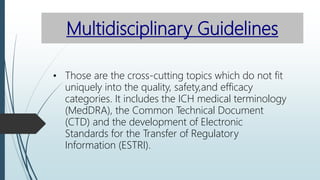
Multidisciplinary Guidelines
• Those are the cross-cutting topics which do not fit
uniquely into the quality, safety,and efficacy
categories. It includes the ICH medical terminology
(MedDRA), the Common Technical Document
(CTD) and the development of Electronic
Standards for the Transfer of Regulatory
Information (ESTRI).
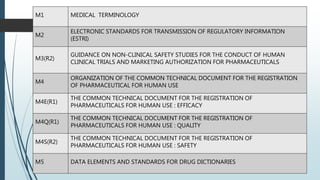
M1 MEDICAL TERMINOLOGY
M2
ELECTRONIC STANDARDS FOR TRANSMISSION OF REGULATORY INFORMATION
(ESTRI)
M3(R2)
GUIDANCE ON NON-CLINICAL SAFETY STUDIES FOR THE CONDUCT OF HUMAN
CLINICAL TRIALS AND MARKETING AUTHORIZATION FOR PHARMACEUTICALS
M4
ORGANIZATION OF THE COMMON TECHNICAL DOCUMENT FOR THE REGISTRATION
OF PHARMACEUTICAL FOR HUMAN USE
M4E(R1)
THE COMMON TECHNICAL DOCUMENT FOR THE REGISTRATION OF
PHARMACEUTICALS FOR HUMAN USE : EFFICACY
M4Q(R1)
THE COMMON TECHNICAL DOCUMENT FOR THE REGISTRATION OF
PHARMACEUTICALS FOR HUMAN USE : QUALITY
M4S(R2)
THE COMMON TECHNICAL DOCUMENT FOR THE REGISTRATION OF
PHARMACEUTICALS FOR HUMAN USE : SAFETY
M5 DATA ELEMENTS AND STANDARDS FOR DRUG DICTIONARIES
• M1 : Medical Terminology
• New Medical Dictionary for Regulatory Activities Terminology (MedDRA) was developed
by the working group of ICH and is owned by the International Federation of
Pharmaceutical Manufacturers and Associations (IFPMA) acting as trustee for the ICH
steering committee.
• It provides an international medical dictionary applicable to all phases of product
development.
• M2 : Electronic Standards for Transmission of Regulatory Information (ESTRI)
• The first Specification developed by the M2 was the Individual Case Safety Report (ICSR),
created as the electronic message for the ICH E2B(R2)
• The second Specification developed by the M2 EWG was the Electronic Common
Document (eCTD) created as the electronic message for the Common Technical
developed by the ICH M4.
• ICH M2 has initiated the development of the Next Major Version of the eCTD (eCTD
to improve robustness, flexibility and long term stability of the message.
• M3(R2): Guidance on Non-Clinical Safety Studies for the Conduct of Human Clinical Trials and
Marketing Authorization for Pharmaceuticals
• The nonclinical safety assessment for marketing approval of a pharmaceutical usually includes
pharmacology studies, general toxicity studies, toxicokinetic and nonclinical pharmacokinetic
studies, reproduction toxicity studies, genotoxicity studies and. for drugs that have special cause
for concern or are intended for a long duration of use
• M4:The Common Technical Document
• This Common Technical Document is divided into four separate sections. The four sections
address the application organisation (M4 organise), the Quality section (M4Q), the Safety
(M4S) and the Efficacy section (M4E) of the harmonised application.
• An electronic version of the Common Technical Document (eCTD) developed by the eCTD
Implementation Working Group. The Electronic Common Technical Document (eCTD) allows for
the electronic submission of the Common Technical Document (CTD) by an applicant to
• M5: Data Elements and Standards for Drug Dictionaries
• This document provides guidance on the harmonized standards related to core sets of
product information and medicinal product terminology.
• Facilitate the exchange and practical use of medicinal product data by regulators and
pharmaceutical industry.
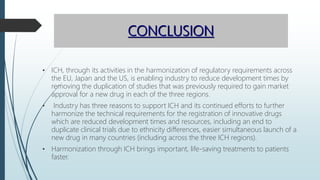
CONCLUSION
• ICH, through its activities in the harmonization of regulatory requirements across
the EU, Japan and the US, is enabling industry to reduce development times by
removing the duplication of studies that was previously required to gain market
approval for a new drug in each of the three regions.
• Industry has three reasons to support ICH and its continued efforts to further
harmonize the technical requirements for the registration of innovative drugs
which are reduced development times and resources, including an end to
duplicate clinical trials due to ethnicity differences, easier simultaneous launch of a
new drug in many countries (including across the three ICH regions).
• Harmonization through ICH brings important, life-saving treatments to patients
faster.
References
1. www.ich org
2. www.fda.gov
3. " Drug Regulatory Affairs " , by Gajendra singh, Gaurav Agarwal
and Vipul Gupta
4. www.wikipedia.com
THANK YOU :)

Ich guidelines Seminar ( Efficacy & Multidisciplinary)

  • 1.
    ICH GUIDELINES Presented by:Guided by : VIVEK BALASAHEB WAGH Dr. S.J.AHER FY. M.PHARM ( PHARMACEUTICS ) ROLL NO.15 SANJIVANI COLLEGE OF PHARMACEUTICAL EDUCATION AND RESEARCH
  • 2.
    What does ICHstands for ? • The complete name of ICH is the “International Conference on Harmonisation of Technical Requirements for Registration of Pharmaceuticals for Human use”.
  • 3.
    What is ICH? • ICH is a joint initiative involving both regulators and research-based industry representatives of the European Union, Japan and the USA in scientific and technical discussions of the testing procedures required to assess and ensure the safety, quality and efficacy of medicines.
  • 4.
    What is thegoal of ICH ? • The goal of ICH is to promote international harmonization by bringing together representatives from the three ICH regions (EU, Japan and USA) to discuss and establish common guidelines. • Another goal of ICH is to make information available on ICH, ICH activities and ICH guidelines to any country or company that requests the information, and to promote a mutual understanding of regional initiative in order to facilitate harmonisation processes related to ICH guidelines regionally and globally, and to strengthen the capacity of drug regulatory authorities and industry to utilise them. • The ICH Global Cooperation Group (GCG) was formed in 1999 and is charged with this task.
  • 5.
    ICH Guidelines  TheICH Topics are divided into four major categories and ICH topic codes are assigned according to these categories. Q S E M “Quality” topics, i.e., those relating to chemical and pharmaceutical quality assurance(stability testing, impurity testing, etc.) “Safety” topics, i.e., those relating to in vitro and in vivo pre-clinical studies (carcinogenicity testing, genotoxicity testing, etc.,) “Efficacy” topics, i.e., those relating to clinical studies in human subject Response studies, Good Clinical Practices, etc.) “Multidisciplinary” Topics, i.e., cross cutting Topics which do not fit uniquely into one of the above categories (MedDRA, ESTRI, CTD, M5)
  • 6.
    Efficacy Guidelines • Thework carried out by ICH under the Efficacy heading is concerned with the design, conduct, safety and reporting of clinical trials. It also covers novel type of medicines derived from biotechnological processes and the use of pharmacogenetics/ pharmacogenomics techniques to produce better targeted medicines.
  • 7.
    E1 CLINICAL SAFETY FORDRUGS INTENDED FOR LONG - TERM TREATMENTOF NON- LIFE THREATENING CONDITIONS E2A CLINICAL SAFETY DATA MANAGEMENT E2B(R3) DATA ELEMENTS FOR TRANSMISSION OF INDIVIDUAL CASE SAFETY REPORTS E2C(R1) CLINICAL SAFETY AND PERIODIC SAFETY UPDATE REPORTS FOR MARKETED DRUGS E2D POST APPROVAL SAFETY DATA MANAGEMENT E2E PHARMACOVIGILANCE PLANNING E2F DEVELOPMENT SAFETY UPDATE REPORT E3 STRUCTURE AND CONTENT OF CLINICAL STUDY REPORT E4 DOSE RESPONSE INFORMATION TO SUPPORT DRUG REGISTRATION
  • 8.
    E5(R1) ETHNIC FACTORSIN THE ACCEPTABILITY OF FOREIGN CLINICAL DATA E6(R1) GUIDELINE FOR GOOD CLINICAL PRACTICE E7 STUDIES IN SUPPORT OF SPECIAL POPULATIONS : GERIATRICS E8 GENERAL CONSIDERATIONS FOR CLINICAL TRIALS E9 STATISTICAL PRINCIPLES FOR CLINICAL TRIALS E10 CHOICE OF CONTROL GROUP AND RELATED ISSUES IN CLINICAL TRIALS E11 CLINICAL INVESTIGATION OF MEDICINAL PRODUCTS IN THE PEDIATRIC POPULATION E12 CLINICAL EVALUATION OF NEW ANTI-HYPERTENSIVE DRUGS E14 CLINICAL EVALUATION FOR NON-ANTIARRHYTHMIC POTENTIAL E15 DEFINITIONS FOR GENOMIC BIOMARKERS, PHARMACOGENOMICS, GENOMIC DATA AND SAMPLE CODING CATEGORIES E16 BIOMARKERS RELATED TO DRUG RESPONSE : CONTEXT, STRUCTURE AND FORMAT OF QUALIFICATION SUBMISSIONS
  • 9.
    E1-E2F : CLINICALSAFETY • E1 : The extent of population exposure to assess clinical safety for drugs intended for long-term treatment of Non-Life Threatening Conditions. • This document gives recommendations on the number of patients and duration of exposure for the safety evaluation of drugs intended for the long-term treatment of Non-Life Threatening Drugs . • This guidelines gives information on duration of drug exposure and its relationship to both time and magnitude of occurrence of adverse events • E2A: Clinical Safety Data Management : Definitions and Standards • This document gives standard definitions and terminology for key aspects of clinical safety reporting.
  • 10.
    • E2B(R3): ClinicalSafety Data Management Data: Elements for Transmission of Individual Case Safety Reports • The objectives of the working group is to identify, define and standardize the data elements for the transmission of individual case safety reports(adverse reactions, adverse event reports). • E2C(R1): Clinical safety data management: Periodic safety update reports for marketed drugs. • This document gives guidance on the format and content of safety updates, which need to be provided at regular intervals to regulatory authorities to maximum efficacy and to avoid duplication of marketed drugs. • E2D: Post-Approval Safety Data Management: Definitions and Standards • This document provides a standardized procedure for post-approval safety management. • The definitions of the terms specific to post-approval phase are also provided.
  • 11.
    • E2E: PharmacovigilancePlanning • The main focus of this guideline is on a Safety Specification and Pharmacovigilance Plan that might be submitted at the time of license • The guideline describes a method for summarizing the important identified risks of a drug, important potential risks, and important missing information, including the potentially at-risk populations and situations where the product is likely to be used that have not been studied. • E2F: Development Safety Update Report • The main focus of the DSUR is collection of data from clinical trials of investigational drugs including biological's, with or without a marketing approval. • The DSUR should provide safety information from all ongoing clinical trials that the sponsor is conducting or has completed during the review period.
  • 12.
    • E3: Structureand Content of Clinical Study Reports • This document describes the format and content of a study report that will be acceptable in all three ICH regions. It consists of a core report suitable for all submissions and appendices. • E4: Dose-Response Information to Support Drug Registration • This document gives recommendations on the design and conduct of studies to assess the relationship between doses, blood levels and clinical response the clinical development of a new drug. • This information can help in identifying an appropriate starting dose, to adjust to the needs of a particular patient, and a dose beyond which unacceptable side effects are seen.
  • 13.
    • E5(R1): EthnicFactors in the Acceptability of Foreign Clinical Data • The purpose of this guidance is to facilitate the registration of medicines among ICH regions. • This document addresses the intrinsic characteristics of the drug recipient and extrinsic characteristics associated with environment and culture that could affect the results of clinical studies carried out in regions. • E6(R1): Good Clinical Practice: Consolidated Guideline • Good Clinical Practice (GCP) is an international ethical and scientific quality for designing, conducting, recording and reporting trials that involve the participation of human subjects. • This Good Clinical Practices document describes the responsibilities and expectations of all participants in the conduct of clinical trials, including investigators, monitors, sponsors.
  • 14.
    E7-E11 : CLINICALTRIALS • E7: Studies in Support of Special Populations : Geriatrics • This document provides recommendations on the special considerations which apply in the design and conduct of clinical trials of medicines that are likely to have significant use in the elderly. • E.g.: New Molecular Entities that are likely to have significant use in the elderly, because the disease intended to be treated is characteristically a disease of ageing (e.g., Alzheimer's disease) • E8: General Considerations for Clinical Trials • This document sets out the general scientific principles for the conduct, performance and control of clinical trials. • E9: Statistical Principles for Clinical Trials • This biostatistical guideline describes essential considerations on the design and analysis of clinical trials, especially the "confirmatory" (hypothesis-testing) trials that are the basis for demonstrating effectiveness
  • 15.
    • E10: Choiceof Control Group and Related Issues in Clinical Trials • This document addresses the choice of control groups in clinical trials. • Control groups in clinical trials can be classified on the basis of two critical attributes: (1) The type of treatment used and (2) The method of determining who will be in the control group. • E11: Clinical Investigation of Medicinal Products in the Pediatric Population • This document addresses the conduct of clinical trials of medicines in pediatric populations. This document will facilitate the development of safe and effective use of medicinal in pediatrics. • Specific clinical study include: • (1) timing of initiation of pediatric studies during medicinal product development; • (2) types of studies (pharmacokinetic, pharmacokinetic/ pharmacodynamic (PK/PD), safety); • (3) age categories; • (4) ethics of pediatric clinical investigation.
  • 16.
    • E12: Principlesfor Clinical Evaluation of New Antihypertensive Drugs • This document provides general principles for the clinical evaluation of new anti- hypertensive drugs. • It describes core principles for the evaluation of antihypertensives that are accepted in the three ICH regions, but some region-specific differences remain, therefore this document should be considered an "ICH Principle Document rather than an "ICH Guideline". • E14: The Clinical Evaluation for Non-Antiarrhythmic Drugs • This document provides recommendations to sponsors concerning the design, analysis, and interpretation of clinical studies to assess the potential of a drug to delay cardiac repolarization. • This assessment should include testing the effects of new agents on the QT interval as well as the collection of cardiovascular adverse events.
  • 17.
    • E15: Definitionsfor Genomic Biomarkers, Pharmacogenomics, Pharmacogenetics, Genomic Data and Sample Coding Categories • In order to develop harmonised approaches to drug regulation, it is important to that consistent definitions of terminology are being applied across all constituents of the International Conference on Harmonisation (ICH). • An agreement on definitions will facilitate the harmonization in the discipline of pharmacogenomics and pharmacogenetics for global drug development and processes. • E16: Genomic Biomarkers Related to Drug Response: Context, Structure and Format of Qualification Submissions • The guideline describes recommendations regarding context, structure, and format of regulatory submissions for qualification of genomic biomarkers(E15). • Clinical and non-clinical genomic biomarkers related to drug response including pharmacokinetics, pharmacodynamics, efficacy and safety aspects.
  • 18.
    Multidisciplinary Guidelines • Thoseare the cross-cutting topics which do not fit uniquely into the quality, safety,and efficacy categories. It includes the ICH medical terminology (MedDRA), the Common Technical Document (CTD) and the development of Electronic Standards for the Transfer of Regulatory Information (ESTRI).
  • 19.
    M1 MEDICAL TERMINOLOGY M2 ELECTRONICSTANDARDS FOR TRANSMISSION OF REGULATORY INFORMATION (ESTRI) M3(R2) GUIDANCE ON NON-CLINICAL SAFETY STUDIES FOR THE CONDUCT OF HUMAN CLINICAL TRIALS AND MARKETING AUTHORIZATION FOR PHARMACEUTICALS M4 ORGANIZATION OF THE COMMON TECHNICAL DOCUMENT FOR THE REGISTRATION OF PHARMACEUTICAL FOR HUMAN USE M4E(R1) THE COMMON TECHNICAL DOCUMENT FOR THE REGISTRATION OF PHARMACEUTICALS FOR HUMAN USE : EFFICACY M4Q(R1) THE COMMON TECHNICAL DOCUMENT FOR THE REGISTRATION OF PHARMACEUTICALS FOR HUMAN USE : QUALITY M4S(R2) THE COMMON TECHNICAL DOCUMENT FOR THE REGISTRATION OF PHARMACEUTICALS FOR HUMAN USE : SAFETY M5 DATA ELEMENTS AND STANDARDS FOR DRUG DICTIONARIES
  • 20.
    • M1 :Medical Terminology • New Medical Dictionary for Regulatory Activities Terminology (MedDRA) was developed by the working group of ICH and is owned by the International Federation of Pharmaceutical Manufacturers and Associations (IFPMA) acting as trustee for the ICH steering committee. • It provides an international medical dictionary applicable to all phases of product development. • M2 : Electronic Standards for Transmission of Regulatory Information (ESTRI) • The first Specification developed by the M2 was the Individual Case Safety Report (ICSR), created as the electronic message for the ICH E2B(R2) • The second Specification developed by the M2 EWG was the Electronic Common Document (eCTD) created as the electronic message for the Common Technical developed by the ICH M4. • ICH M2 has initiated the development of the Next Major Version of the eCTD (eCTD to improve robustness, flexibility and long term stability of the message.
  • 21.
    • M3(R2): Guidanceon Non-Clinical Safety Studies for the Conduct of Human Clinical Trials and Marketing Authorization for Pharmaceuticals • The nonclinical safety assessment for marketing approval of a pharmaceutical usually includes pharmacology studies, general toxicity studies, toxicokinetic and nonclinical pharmacokinetic studies, reproduction toxicity studies, genotoxicity studies and. for drugs that have special cause for concern or are intended for a long duration of use • M4:The Common Technical Document • This Common Technical Document is divided into four separate sections. The four sections address the application organisation (M4 organise), the Quality section (M4Q), the Safety (M4S) and the Efficacy section (M4E) of the harmonised application. • An electronic version of the Common Technical Document (eCTD) developed by the eCTD Implementation Working Group. The Electronic Common Technical Document (eCTD) allows for the electronic submission of the Common Technical Document (CTD) by an applicant to • M5: Data Elements and Standards for Drug Dictionaries • This document provides guidance on the harmonized standards related to core sets of product information and medicinal product terminology. • Facilitate the exchange and practical use of medicinal product data by regulators and pharmaceutical industry.
  • 22.
    CONCLUSION • ICH, throughits activities in the harmonization of regulatory requirements across the EU, Japan and the US, is enabling industry to reduce development times by removing the duplication of studies that was previously required to gain market approval for a new drug in each of the three regions. • Industry has three reasons to support ICH and its continued efforts to further harmonize the technical requirements for the registration of innovative drugs which are reduced development times and resources, including an end to duplicate clinical trials due to ethnicity differences, easier simultaneous launch of a new drug in many countries (including across the three ICH regions). • Harmonization through ICH brings important, life-saving treatments to patients faster.
  • 23.
    References 1. www.ich org 2.www.fda.gov 3. " Drug Regulatory Affairs " , by Gajendra singh, Gaurav Agarwal and Vipul Gupta 4. www.wikipedia.com
  • 24.