
ICH SAFETY GUIDELINES
Presentation by:
M. GANESH SAI
M. PHARMACY (PHARMACEUTICS)
121925101004
Semester - 1
What is ICH....?
• ICH – “International Council for Harmonization”.
Mission:
• Unique in bringing together the regulatory
authorities and pharmaceutical industries to
discuss scientific and technical aspects of drug
registration.
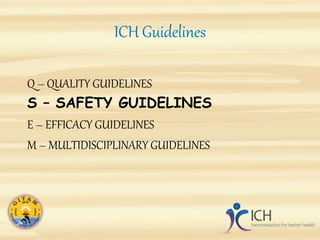
ICH Guidelines
Q – QUALITY GUIDELINES
S – SAFETY GUIDELINES
E – EFFICACY GUIDELINES
M – MULTIDISCIPLINARY GUIDELINES
SAFETY GUIDELINES
• Those relating to invitro and invivo pre-clinical
studies.
• ICH has produced a comprehensive set of
SAFETY GUIDELINES to uncover potential risks.
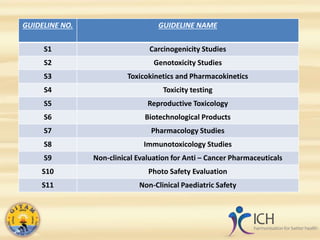
GUIDELINE NO. GUIDELINE NAME
S1 Carcinogenicity Studies
S2 Genotoxicity Studies
S3 Toxicokinetics and Pharmacokinetics
S4 Toxicity testing
S5 Reproductive Toxicology
S6 Biotechnological Products
S7 Pharmacology Studies
S8 Immunotoxicology Studies
S9 Non-clinical Evaluation for Anti – Cancer Pharmaceuticals
S10 Photo Safety Evaluation
S11 Non-Clinical Paediatric Safety
S1 – CARCINOGENICITY STUDIES (S1A – S1C)
 S1A – Need for Carcinogenicity Studies Of
Pharmaceuticals.
• Carcinogenicity Studies are to identify a tumorigenic
potential in animals and to assess the relevant risk in
humans.
• These studies were needed if the clinical use was
expected to be continuously for 6 months or longer.
• Whereas, According to the US Food and Drug
Administration, Pharmaceuticals generally used for 3
months or more, require this studies.
• This document provides a consistent
definition of the circumstances under
which it is necessary to undertake
carcinogenicity studies on new drugs.
• These recommendations take into
account the known risk factors as well as
the intended indications and duration of
exposure.
 S1B – Testing for Carcinogenicity of
Pharmaceuticals
• This document provides the guidance on
the need to carry out carcinogenicity
studies in both mice and rats.
• This document also provides the guidance
that is also given on alternative testing
procedures which may be applied without
jeopardizing safety.
• This guidelines include the data of mechanistic
studies which has cellular changes, biochemical
measurements, considerations for additional
genotoxicity testing an modified protocols.
• This guideline also helps in the choosing of an
appropriate species for long term carcinogenicity
testing based on general considerations and also
provides the information about the evaluation of
carcinogenic potential.
 S1C (R2) – Dose selection for Carcinogenicity
Studies of Pharmaceuticals.
• This document addresses the criteria for the
selection of the high dose to be used in
carcinogenicity studies on new therapeutic agents
to harmonize current practices and improve the
design of studies.
• In this revision, pharmacokinetic endpoint of 25 is
declared to be applicable also for pharmaceuticals
with positive genotoxicity signals. This change has
implications on “Refinement” (one of the 3R’s) in
enhancing the welfare, i.e., reducing the pain or
discomfort of the animals at the MTD.
• This guidelines provides data for the
conducting of dose-ranging studies,
Toxicity endpoints, Maximum feasible
dose, limit dose, additional endpoints in
high dose selection and selection of
middle & low doses in this studies.
S2 – GENOTOXICITY STUDIES
(S2A – S2B)
• S2A: Guidance on Specific Aspects of
Regulatory Genotoxicity Tests for
Pharmaceuticals.
• This document provided specific guidance and
recommendations for in vitro and in vivo tests
and on the evaluation of test results. It
includes a glossary of terms related to
genotoxicity tests to improve consistency in
applications.
• S2B: Genotoxicity: A Standard Battery for Genotoxicity
Testing for Pharmaceuticals
• This document addressed two fundamental areas of
genotoxicity testing.
• The identification of a standard set of assays to be
conducted for registration, and the extent of
confirmatory experimentation in any particular
genotoxicity assay in the standard battery.
• Registration of pharmaceuticals requires a
comprehensive assessment of their genotoxic
potential. It is clear that no single test is capable of
detecting all relevant genotoxic agents. Therefore,
the usual approach should carryout a battery of
invitro & invivo tests for genotoxicity.
S3 – TOXICOKINETICS AND
PHARMACOKINETICS (S3A – S3B)
• S3A Note for the assessment of systemic
exposure in toxicity studies
• This document gives guidance on developing
test strategies in toxicokinetics and the need
to integrate pharmacokinetics into toxicity
testing, in order to aid in the interpretation of
the toxicology findings and promote rational
study design development.
• This document gives guidance on developing
test strategies in toxicokinetics and the need to
integrate these pharmacokinetics into toxicity
testing, in order to aid in the interpretation of
the toxicology findings and their relevance to
clinical safety issues.
• The primary objective of toxicokinetics is to
describe the systemic exposure achieved in
animals and its relationship to dose level and
the time course of the toxicity study.
 S3B: Pharmacokinetics: Guidance for repeated
dose tissue distribution studies.
 Tissue distribution studies are essential in
providing information on distribution and
accumulation of the compound and metabolites,
especially in relation to potential sites of action,
this information may be useful for designing
toxicology and pharmacology studies and for
interpreting the results of these experiments.
 This document gives guidance, when the repeated
dose tissue distribution studies should be
considered. It also gives recommendations on the
conduct of such studies.
S4 – TOXICITY GUIDELINES
S4 Duration of Chronic Toxicity Testing in Animals
(Rodent and Non Rodent Toxicity Testing)
• The objective of this guidance is to set out the
considerations that apply to chronic toxicity
testing in rodents and non rodents as part of the
safety evaluation of a medicinal product.
1. Rodents
(a study of 6 months duration)
2. Non-rodents
(a study of nine months duration)
S5 Reproductive Toxicology
S5(R2) Detection of Toxicity to Reproduction for
Medicinal Products & Toxicity to Male Fertility
This document provides guidance on tests for
reproductive toxicity. It defines the periods of
treatment to be used in animals to better
reflect human exposure to medical products
and allow more specific identification of
stages at risk.
S5(R3) Revision of S5 Guideline on Detection of Toxicity
to Reproduction for Medicinal Products & Toxicity to
Male Fertility
Since the adoption of the S5(R2) Guideline experience
has been gained with the testing of pharmaceuticals
using the current and novel testing paradigms.
Additionally, scientific, technological and regulatory
knowledge has evolved significantly. Consequently,
there are now opportunities for modernising testing
paradigms to enhance human risk assessment, while
also potentially reducing animal use. There are also
areas where the guideline could be revised or
amended for greater clarity as well as to align more
fully with other more recent ICH Guidelines, such as
ICH M3(R2), ICH S6(R1) as well as ICH S9.
S6 Biotechnological Products
S6(R1) Preclinical Safety Evaluation of
Biotechnology-Derived Pharmaceuticals
This document covers the pre-clinical safety
testing requirements for biotechnological
products. It addresses the use of animal models
of disease, determination of when genotoxicity
assays and carcinogenicity studies should be
performed, and the impact of antibody formation
on duration of toxicology studies.
S7A - S7B Pharmacology Studies
S7A Safety Pharmacology Studies for Human
Pharmaceuticals
This document addresses the definition,
objectives and scope of safety pharmacology
studies. It also addresses which studies are
needed before initiation of Phase 1 clinical
studies as well as information needed for
marketing.
S7B The Non-Clinical Evaluation of the Potential
for Delayed Ventricular Repolarization (QT Interval
Prolongation) by Human Pharmaceuticals
• This Guideline describes a non-clinical testing
strategy for assessing the potential of a test
substance to delay ventricular repolarization.
• This Guideline includes information concerning
non-clinical assays and integrated risk
assessments.
S8 ImmunotoxicologyStudies
S8 Immunotoxicity Studies for Human Pharmaceuticals
This Guideline addresses the recommendations on
nonclinical testing for immunosuppression induced
by low molecular weight drugs (non-biologicals). It
applies to new pharmaceuticals intended for use in
humans, as well as to marketed drug products
proposed for different indications or other
variations on the current product label in which the
change could result in unaddressed and relevant
toxicologic issues.
In addition, the Guideline might also apply to drugs in
which clinical signs of immunosuppression are
observed during clinical trials and following approval to
market. The term immunotoxicity in this guideline will
primarily refer to immunosuppression, i.e. a state of
increased susceptibility to infections or the
development of tumors.
S9 Nonclinical Evaluation for Anticancer
Pharmaceuticals
S9 Nonclinical Evaluation for Anticancer
Pharmaceuticals
This Guideline provides information for
pharmaceuticals that are only intended to treat
cancer in patients with late stage or advanced
disease regardless of the route of administration,
including both small molecule and biotechnology-
derived pharmaceuticals. It describes the type and
timing of nonclinical studies in relation to the
development of anticancer pharmaceuticals and
references other guidance as appropriate.
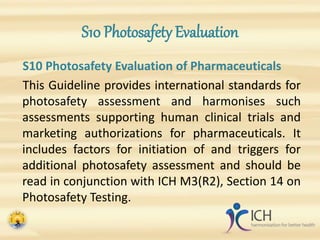
S10 Photosafety Evaluation
S10 Photosafety Evaluation of Pharmaceuticals
This Guideline provides international standards for
photosafety assessment and harmonises such
assessments supporting human clinical trials and
marketing authorizations for pharmaceuticals. It
includes factors for initiation of and triggers for
additional photosafety assessment and should be
read in conjunction with ICH M3(R2), Section 14 on
Photosafety Testing.
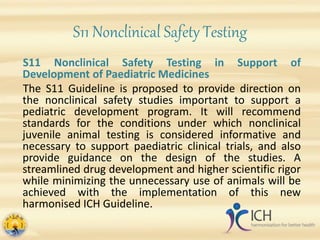
S11 Nonclinical Safety Testing
S11 Nonclinical Safety Testing in Support of
Development of Paediatric Medicines
The S11 Guideline is proposed to provide direction on
the nonclinical safety studies important to support a
pediatric development program. It will recommend
standards for the conditions under which nonclinical
juvenile animal testing is considered informative and
necessary to support paediatric clinical trials, and also
provide guidance on the design of the studies. A
streamlined drug development and higher scientific rigor
while minimizing the unnecessary use of animals will be
achieved with the implementation of this new
harmonised ICH Guideline.
ICH Safety Guidelines

ICH Safety Guidelines

  • 1.
    ICH SAFETY GUIDELINES Presentationby: M. GANESH SAI M. PHARMACY (PHARMACEUTICS) 121925101004 Semester - 1
  • 2.
    What is ICH....? •ICH – “International Council for Harmonization”. Mission: • Unique in bringing together the regulatory authorities and pharmaceutical industries to discuss scientific and technical aspects of drug registration.
  • 3.
    ICH Guidelines Q –QUALITY GUIDELINES S – SAFETY GUIDELINES E – EFFICACY GUIDELINES M – MULTIDISCIPLINARY GUIDELINES
  • 4.
    SAFETY GUIDELINES • Thoserelating to invitro and invivo pre-clinical studies. • ICH has produced a comprehensive set of SAFETY GUIDELINES to uncover potential risks.
  • 5.
    GUIDELINE NO. GUIDELINENAME S1 Carcinogenicity Studies S2 Genotoxicity Studies S3 Toxicokinetics and Pharmacokinetics S4 Toxicity testing S5 Reproductive Toxicology S6 Biotechnological Products S7 Pharmacology Studies S8 Immunotoxicology Studies S9 Non-clinical Evaluation for Anti – Cancer Pharmaceuticals S10 Photo Safety Evaluation S11 Non-Clinical Paediatric Safety
  • 6.
    S1 – CARCINOGENICITYSTUDIES (S1A – S1C)  S1A – Need for Carcinogenicity Studies Of Pharmaceuticals. • Carcinogenicity Studies are to identify a tumorigenic potential in animals and to assess the relevant risk in humans. • These studies were needed if the clinical use was expected to be continuously for 6 months or longer. • Whereas, According to the US Food and Drug Administration, Pharmaceuticals generally used for 3 months or more, require this studies.
  • 7.
    • This documentprovides a consistent definition of the circumstances under which it is necessary to undertake carcinogenicity studies on new drugs. • These recommendations take into account the known risk factors as well as the intended indications and duration of exposure.
  • 8.
     S1B –Testing for Carcinogenicity of Pharmaceuticals • This document provides the guidance on the need to carry out carcinogenicity studies in both mice and rats. • This document also provides the guidance that is also given on alternative testing procedures which may be applied without jeopardizing safety.
  • 9.
    • This guidelinesinclude the data of mechanistic studies which has cellular changes, biochemical measurements, considerations for additional genotoxicity testing an modified protocols. • This guideline also helps in the choosing of an appropriate species for long term carcinogenicity testing based on general considerations and also provides the information about the evaluation of carcinogenic potential.
  • 10.
     S1C (R2)– Dose selection for Carcinogenicity Studies of Pharmaceuticals. • This document addresses the criteria for the selection of the high dose to be used in carcinogenicity studies on new therapeutic agents to harmonize current practices and improve the design of studies. • In this revision, pharmacokinetic endpoint of 25 is declared to be applicable also for pharmaceuticals with positive genotoxicity signals. This change has implications on “Refinement” (one of the 3R’s) in enhancing the welfare, i.e., reducing the pain or discomfort of the animals at the MTD.
  • 11.
    • This guidelinesprovides data for the conducting of dose-ranging studies, Toxicity endpoints, Maximum feasible dose, limit dose, additional endpoints in high dose selection and selection of middle & low doses in this studies.
  • 12.
    S2 – GENOTOXICITYSTUDIES (S2A – S2B) • S2A: Guidance on Specific Aspects of Regulatory Genotoxicity Tests for Pharmaceuticals. • This document provided specific guidance and recommendations for in vitro and in vivo tests and on the evaluation of test results. It includes a glossary of terms related to genotoxicity tests to improve consistency in applications.
  • 13.
    • S2B: Genotoxicity:A Standard Battery for Genotoxicity Testing for Pharmaceuticals • This document addressed two fundamental areas of genotoxicity testing. • The identification of a standard set of assays to be conducted for registration, and the extent of confirmatory experimentation in any particular genotoxicity assay in the standard battery. • Registration of pharmaceuticals requires a comprehensive assessment of their genotoxic potential. It is clear that no single test is capable of detecting all relevant genotoxic agents. Therefore, the usual approach should carryout a battery of invitro & invivo tests for genotoxicity.
  • 14.
    S3 – TOXICOKINETICSAND PHARMACOKINETICS (S3A – S3B) • S3A Note for the assessment of systemic exposure in toxicity studies • This document gives guidance on developing test strategies in toxicokinetics and the need to integrate pharmacokinetics into toxicity testing, in order to aid in the interpretation of the toxicology findings and promote rational study design development.
  • 15.
    • This documentgives guidance on developing test strategies in toxicokinetics and the need to integrate these pharmacokinetics into toxicity testing, in order to aid in the interpretation of the toxicology findings and their relevance to clinical safety issues. • The primary objective of toxicokinetics is to describe the systemic exposure achieved in animals and its relationship to dose level and the time course of the toxicity study.
  • 16.
     S3B: Pharmacokinetics:Guidance for repeated dose tissue distribution studies.  Tissue distribution studies are essential in providing information on distribution and accumulation of the compound and metabolites, especially in relation to potential sites of action, this information may be useful for designing toxicology and pharmacology studies and for interpreting the results of these experiments.  This document gives guidance, when the repeated dose tissue distribution studies should be considered. It also gives recommendations on the conduct of such studies.
  • 17.
    S4 – TOXICITYGUIDELINES S4 Duration of Chronic Toxicity Testing in Animals (Rodent and Non Rodent Toxicity Testing) • The objective of this guidance is to set out the considerations that apply to chronic toxicity testing in rodents and non rodents as part of the safety evaluation of a medicinal product. 1. Rodents (a study of 6 months duration) 2. Non-rodents (a study of nine months duration)
  • 18.
    S5 Reproductive Toxicology S5(R2)Detection of Toxicity to Reproduction for Medicinal Products & Toxicity to Male Fertility This document provides guidance on tests for reproductive toxicity. It defines the periods of treatment to be used in animals to better reflect human exposure to medical products and allow more specific identification of stages at risk.
  • 19.
    S5(R3) Revision ofS5 Guideline on Detection of Toxicity to Reproduction for Medicinal Products & Toxicity to Male Fertility Since the adoption of the S5(R2) Guideline experience has been gained with the testing of pharmaceuticals using the current and novel testing paradigms. Additionally, scientific, technological and regulatory knowledge has evolved significantly. Consequently, there are now opportunities for modernising testing paradigms to enhance human risk assessment, while also potentially reducing animal use. There are also areas where the guideline could be revised or amended for greater clarity as well as to align more fully with other more recent ICH Guidelines, such as ICH M3(R2), ICH S6(R1) as well as ICH S9.
  • 20.
    S6 Biotechnological Products S6(R1)Preclinical Safety Evaluation of Biotechnology-Derived Pharmaceuticals This document covers the pre-clinical safety testing requirements for biotechnological products. It addresses the use of animal models of disease, determination of when genotoxicity assays and carcinogenicity studies should be performed, and the impact of antibody formation on duration of toxicology studies.
  • 21.
    S7A - S7BPharmacology Studies S7A Safety Pharmacology Studies for Human Pharmaceuticals This document addresses the definition, objectives and scope of safety pharmacology studies. It also addresses which studies are needed before initiation of Phase 1 clinical studies as well as information needed for marketing.
  • 22.
    S7B The Non-ClinicalEvaluation of the Potential for Delayed Ventricular Repolarization (QT Interval Prolongation) by Human Pharmaceuticals • This Guideline describes a non-clinical testing strategy for assessing the potential of a test substance to delay ventricular repolarization. • This Guideline includes information concerning non-clinical assays and integrated risk assessments.
  • 23.
    S8 ImmunotoxicologyStudies S8 ImmunotoxicityStudies for Human Pharmaceuticals This Guideline addresses the recommendations on nonclinical testing for immunosuppression induced by low molecular weight drugs (non-biologicals). It applies to new pharmaceuticals intended for use in humans, as well as to marketed drug products proposed for different indications or other variations on the current product label in which the change could result in unaddressed and relevant toxicologic issues.
  • 24.
    In addition, theGuideline might also apply to drugs in which clinical signs of immunosuppression are observed during clinical trials and following approval to market. The term immunotoxicity in this guideline will primarily refer to immunosuppression, i.e. a state of increased susceptibility to infections or the development of tumors.
  • 25.
    S9 Nonclinical Evaluationfor Anticancer Pharmaceuticals S9 Nonclinical Evaluation for Anticancer Pharmaceuticals This Guideline provides information for pharmaceuticals that are only intended to treat cancer in patients with late stage or advanced disease regardless of the route of administration, including both small molecule and biotechnology- derived pharmaceuticals. It describes the type and timing of nonclinical studies in relation to the development of anticancer pharmaceuticals and references other guidance as appropriate.
  • 26.
    S10 Photosafety Evaluation S10Photosafety Evaluation of Pharmaceuticals This Guideline provides international standards for photosafety assessment and harmonises such assessments supporting human clinical trials and marketing authorizations for pharmaceuticals. It includes factors for initiation of and triggers for additional photosafety assessment and should be read in conjunction with ICH M3(R2), Section 14 on Photosafety Testing.
  • 27.
    S11 Nonclinical SafetyTesting S11 Nonclinical Safety Testing in Support of Development of Paediatric Medicines The S11 Guideline is proposed to provide direction on the nonclinical safety studies important to support a pediatric development program. It will recommend standards for the conditions under which nonclinical juvenile animal testing is considered informative and necessary to support paediatric clinical trials, and also provide guidance on the design of the studies. A streamlined drug development and higher scientific rigor while minimizing the unnecessary use of animals will be achieved with the implementation of this new harmonised ICH Guideline.