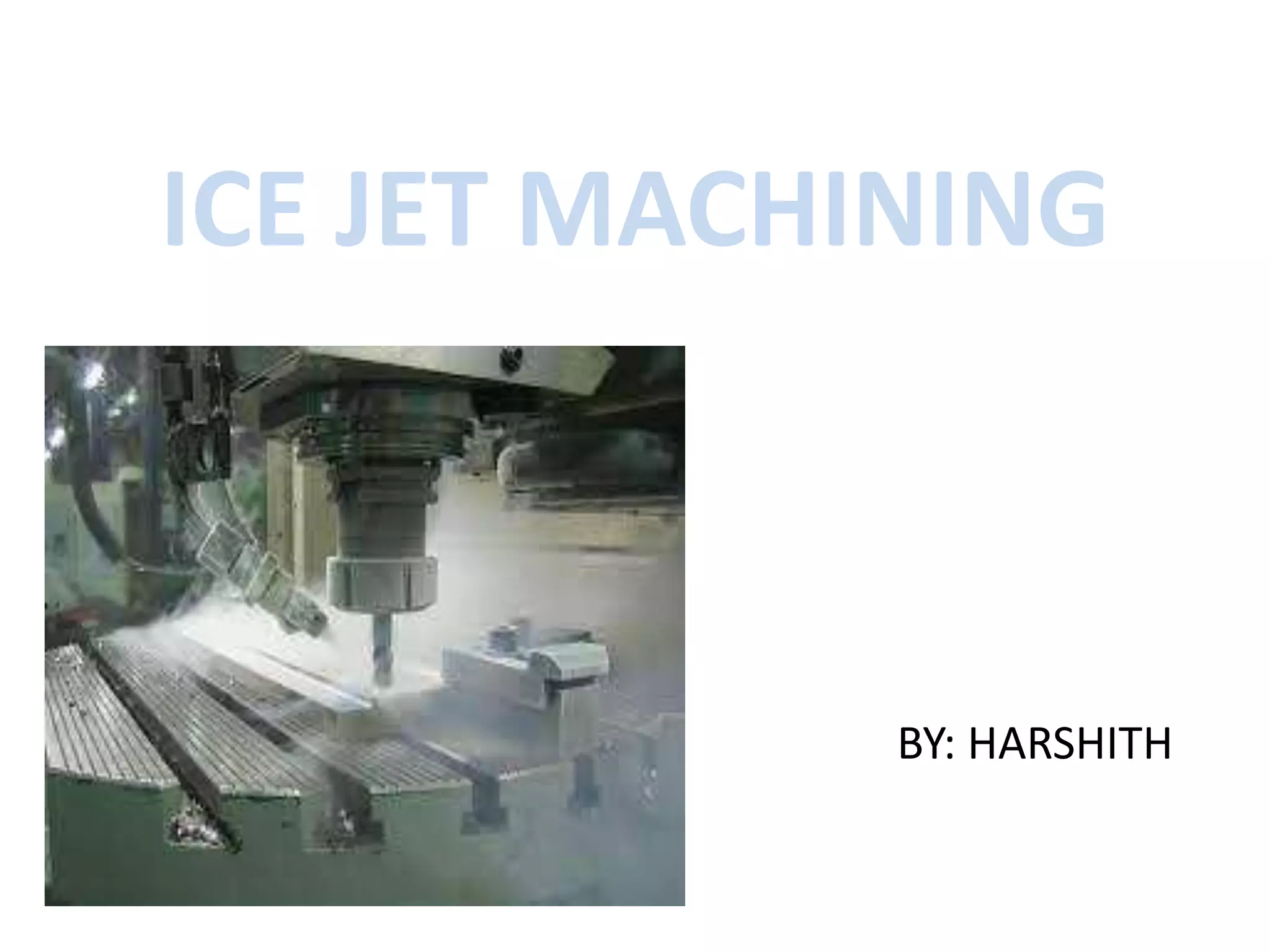
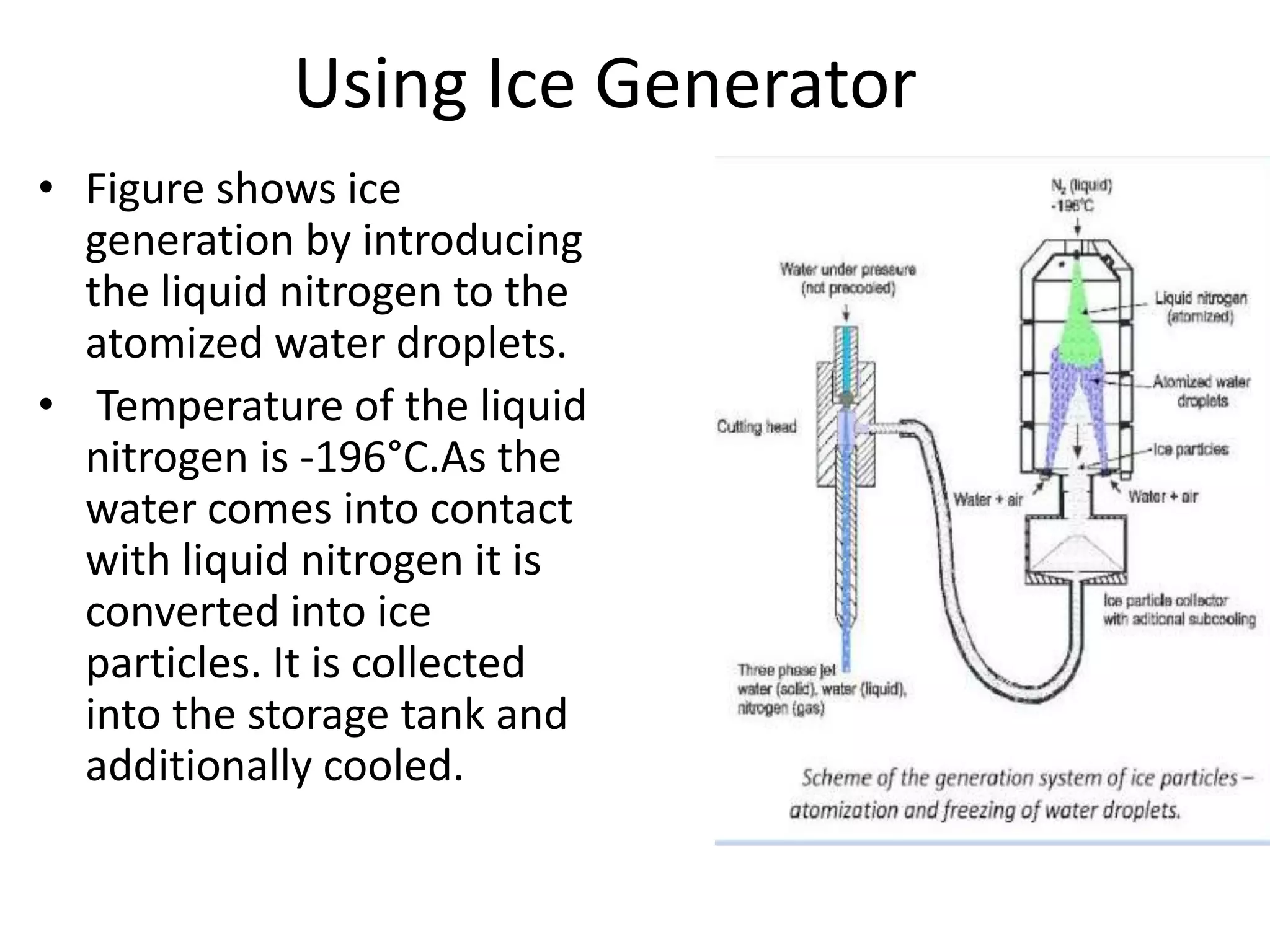
ICE JET MACHINING
BY: HARSHITH
INTRODUCTION
• Abrasives are used for many applications including cleaning,
depainting and cutting operations.
• There are, however, some applications where the use of
abrasives is not possible. These applications include, for
example, the processing of meat products and cleaning of
sensitive surfaces.
• An ice jet is a non-destructive, non-abrasive, residue-free,
and environmentally friendly way of machining.
• In Abrasive water Jet Machining process(AWJM) abrasive
particles like silicon carbide and aluminum oxide are used for
machining
• Ice jet machining is Derivative of AWJM machining
process in which ice particles are used in place of
abrasive particles.
• The ice particles can be prepared beforehand using an ice
particle generator, stored in a reservoir and then fed to
the conventional entrainment based jetting head.
• In AWJ, waste of water is very high as water jet contains
abrasive particles. To reuse the water very complicated
water cleaning system has to be employed.
• While in IJ, ice is used instead of Abrasives. So as ice
melts into the water, water treatment gets eliminated
and we can reuse the water.
Ice Jet Machining Process
• In ice jet machining (IJM), the abrasives are changed by
ice particles that form the ice jet.
• Since the hardness of the ice particles are fewer than
that of the abrasives, minor material removal rates are
expected, compared to AWJM.
• ice particles are created using either stream freezing
(<500 μm) or ice particles supply (>500 μm) into the
stream.
• In the latter case, ice cubes, supplied from an icemaker,
are fed to a grinder. Solid CO2 is added to prevent the
crushed ice from melting.
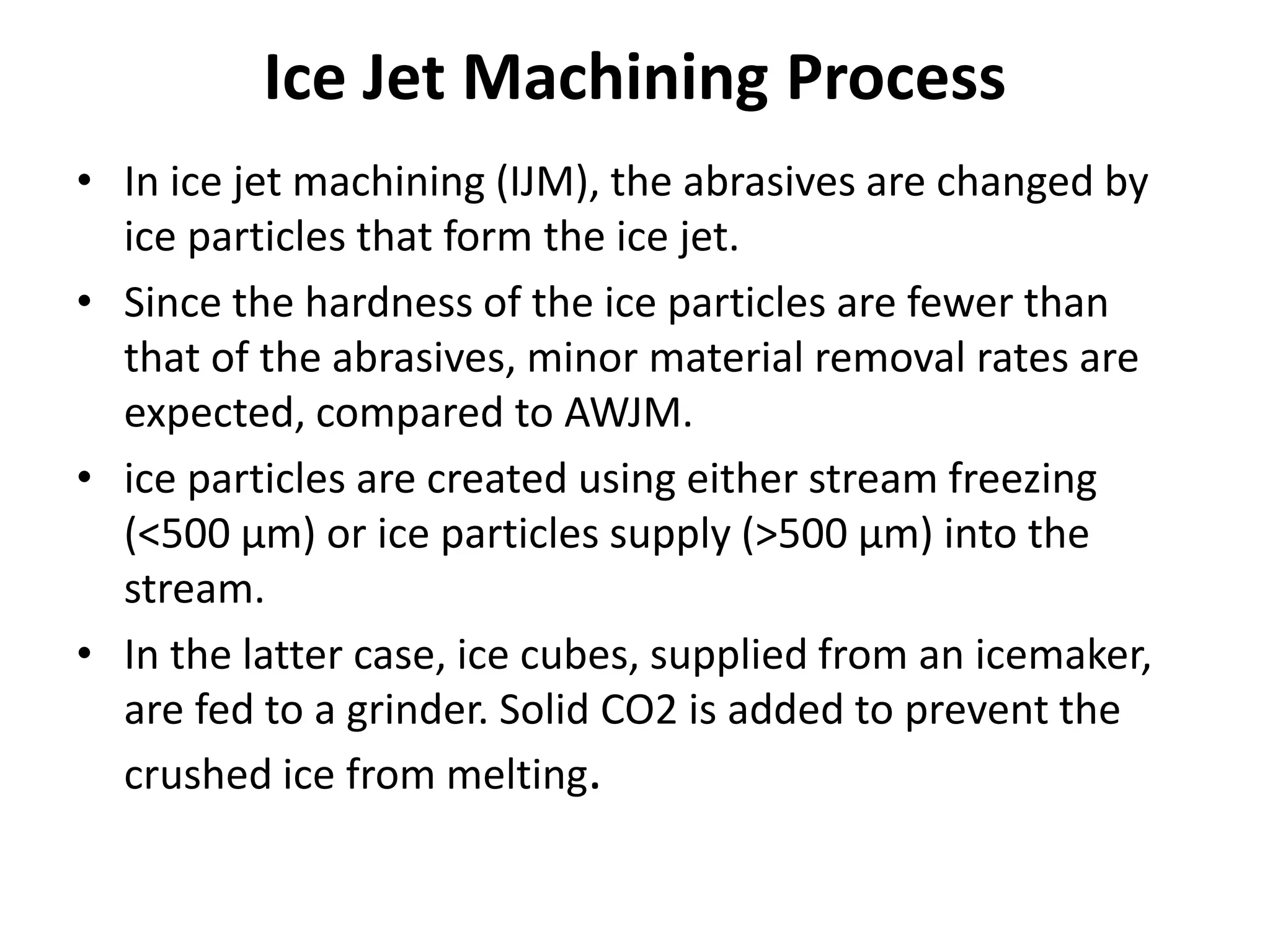
• The crushed ice is then fed
throughout the machining
nozzle.
• Prior to the nozzle the water is
also cooled by passing through a
coil that is submerged in liquid
nitrogen.
Generation of ice
There are 2 approaches:
 Generating the ice in a generator before
mixing it to the water jet.
Forming ice particles during water jet
formation by introducing a cooling gas like
liquid nitrogen.
Using Ice Generator
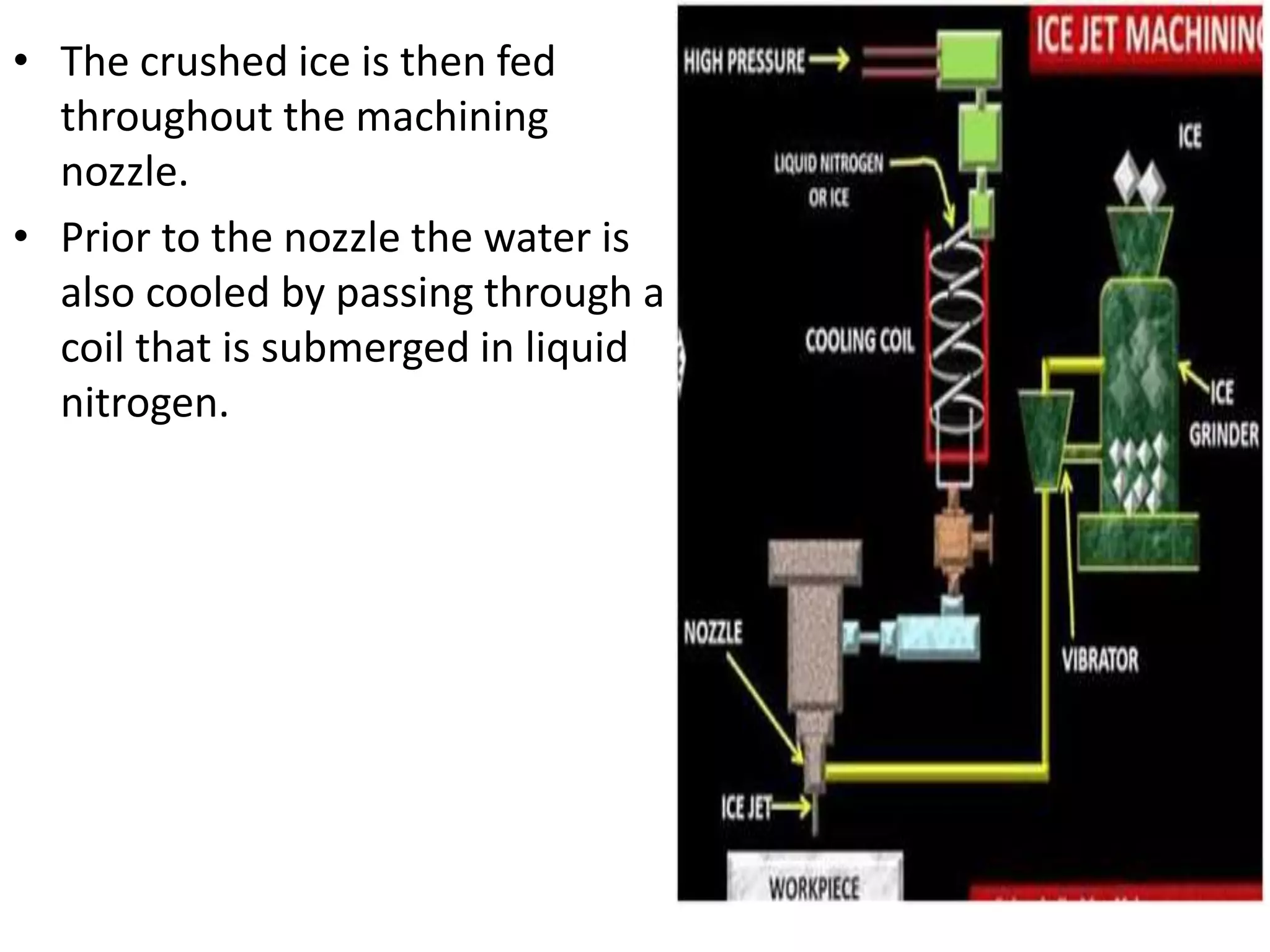
• Figure shows ice
generation by introducing
the liquid nitrogen to the
atomized water droplets.
• Temperature of the liquid
nitrogen is -196°C.As the
water comes into contact
with liquid nitrogen it is
converted into ice
particles. It is collected
into the storage tank and
additionally cooled.
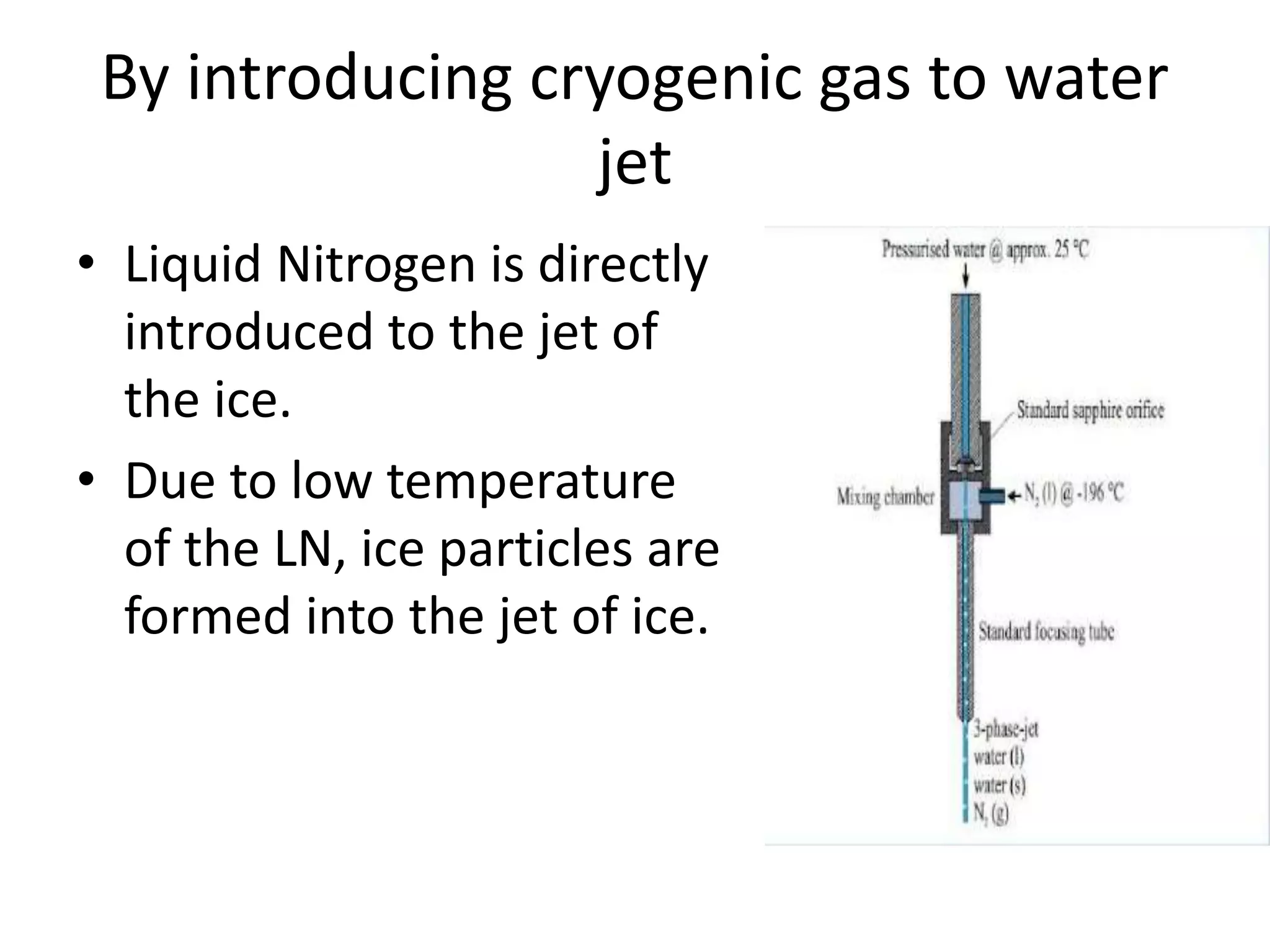
By introducing cryogenic gas to water
jet
• Liquid Nitrogen is directly
introduced to the jet of
the ice.
• Due to low temperature
of the LN, ice particles are
formed into the jet of ice.
Processes done with use of ice
Dry ICE DEBURRING PROCESS
• Removal of burrs from edges and holes.
• Where burrs could not be removed with any
other means like filing or grinding.
Dry ICE BLASTING PROCESSES
• Used for cleaning purpose Cleaning of engine
block can be done with ice blasting process
effectively Blasting process
APPLICATIONS
• The ice jet can be used for either initial or final
cleaning, and for numerous critical and non critical
cleaning applications in the semiconductor, disk
drive, vacuum technologies, surface science, surface
analysis, optical, medical, automotive, analytical
instrument, and manufacturing industries.
• IJM is used in the food, electronic, medical, and
space industries where contamination is impossible.
ADVANTAGES
 Environmentally safe
 Cost reduction
 No heat affected zone
 Low cost of operation
THANK YOU

Ice jet machining

  • 1.
  • 2.
    INTRODUCTION • Abrasives areused for many applications including cleaning, depainting and cutting operations. • There are, however, some applications where the use of abrasives is not possible. These applications include, for example, the processing of meat products and cleaning of sensitive surfaces. • An ice jet is a non-destructive, non-abrasive, residue-free, and environmentally friendly way of machining. • In Abrasive water Jet Machining process(AWJM) abrasive particles like silicon carbide and aluminum oxide are used for machining
  • 3.
    • Ice jetmachining is Derivative of AWJM machining process in which ice particles are used in place of abrasive particles. • The ice particles can be prepared beforehand using an ice particle generator, stored in a reservoir and then fed to the conventional entrainment based jetting head. • In AWJ, waste of water is very high as water jet contains abrasive particles. To reuse the water very complicated water cleaning system has to be employed. • While in IJ, ice is used instead of Abrasives. So as ice melts into the water, water treatment gets eliminated and we can reuse the water.
  • 4.
    Ice Jet MachiningProcess • In ice jet machining (IJM), the abrasives are changed by ice particles that form the ice jet. • Since the hardness of the ice particles are fewer than that of the abrasives, minor material removal rates are expected, compared to AWJM. • ice particles are created using either stream freezing (<500 μm) or ice particles supply (>500 μm) into the stream. • In the latter case, ice cubes, supplied from an icemaker, are fed to a grinder. Solid CO2 is added to prevent the crushed ice from melting.
  • 5.
    • The crushedice is then fed throughout the machining nozzle. • Prior to the nozzle the water is also cooled by passing through a coil that is submerged in liquid nitrogen.
  • 6.
    Generation of ice Thereare 2 approaches:  Generating the ice in a generator before mixing it to the water jet. Forming ice particles during water jet formation by introducing a cooling gas like liquid nitrogen.
  • 7.
    Using Ice Generator •Figure shows ice generation by introducing the liquid nitrogen to the atomized water droplets. • Temperature of the liquid nitrogen is -196°C.As the water comes into contact with liquid nitrogen it is converted into ice particles. It is collected into the storage tank and additionally cooled.
  • 8.
    By introducing cryogenicgas to water jet • Liquid Nitrogen is directly introduced to the jet of the ice. • Due to low temperature of the LN, ice particles are formed into the jet of ice.
  • 9.
    Processes done withuse of ice Dry ICE DEBURRING PROCESS • Removal of burrs from edges and holes. • Where burrs could not be removed with any other means like filing or grinding. Dry ICE BLASTING PROCESSES • Used for cleaning purpose Cleaning of engine block can be done with ice blasting process effectively Blasting process
  • 10.
    APPLICATIONS • The icejet can be used for either initial or final cleaning, and for numerous critical and non critical cleaning applications in the semiconductor, disk drive, vacuum technologies, surface science, surface analysis, optical, medical, automotive, analytical instrument, and manufacturing industries. • IJM is used in the food, electronic, medical, and space industries where contamination is impossible.
  • 11.
    ADVANTAGES  Environmentally safe Cost reduction  No heat affected zone  Low cost of operation
  • 12.