Electron Beam Machining
J. Hemwani. GPC, Betul
EBM ---Working Principle
▪Workpiece placed in vacuum chamber
▪ High-voltage electron beam directed toward workpiece
▪ Energy of electron beam melts/ vaporizes selected
region of workpiece
▪ Electron beam moved by deflection coils
J. Hemwani. GPC, Betul
EBM – PROCESS
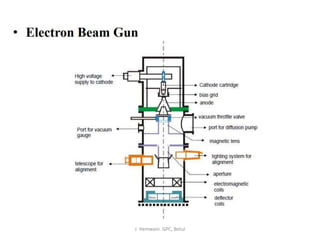
▪ Electron beam (negatively charged particles) is generated
in an electron beam gun.
▪The workpiece to be machined is located under the
electron beam and is kept under vacuum.
▪ Electron beam gun provides high velocity electrons over
a very small spot size.
▪ Due to pattern of electrostatic field produced by grid cup,
electrons are focused and made to flow in the form of a
converging beam through anode.
J. Hemwani. GPC, Betul
EBM – PROCESS
▪The electrons are accelerated while passing through the
anode by applying high voltage at anode.
▪ A magnetic deflection coil is used to make electron
beam circular and to focus electron beam at a point , this
results in localized heating.
▪ The high-energy focused electron beam is made to
impinge on the work piece with a spot size of 10 – 100
μm • The kinetic energy of the electrons, upon striking the
workpiece, changes to heat, which melts and vaporizes
minute amounts of the material.
J. Hemwani. GPC, Betul
EBM – ADVANTAGES
✓ • Extremely close tolerances can be maintained
✓ • Heat affected zone are minimum
✓ • It can machine almost any material irrespective of their
mechanical properties
✓ • The beam can be concentrated on a very small area
✓ • It produces better surface finish and narrow kerf
✓ • Thermal distortion is least
✓ • The process is fast because it is entirely non-
mechanical.
J. Hemwani. GPC, Betul
EBM – LIMITATIONS
▪ The equipment cost is very high because of vaccume
maintained.
▪ The interaction of the electron beam with work piece
surface produces hazardous X-ray. Hence shielding is
necessary.
▪ Because of very low material removal rate, the process is
economical only for small Material Removal .
▪ Skilled labour is required to operate the machine (Gun).
▪ The process can machine only thinner parts.
J. Hemwani. GPC, Betul
EBM – APPLICATIONS
➢ EBM is particularly suitable for micro-machining i.e.
producing very small diameter holes – down to 0.002 in.
➢Major applications of EBM include Machining of wire
drawing dies having small cross sectional area.
➢ EBM is also used as an alternative to light optics
manufacturing methods in the semiconductor industry.
➢EBM is useful for high-resolution lithography and for the
manufacture of complex integrated circuits.
➢EBM welding is also used for aircraft engine parts.
J. Hemwani. GPC, Betul
EBM CHARACTERISTICS
❖• Mechanics of material removal – melting, vaporization
❖• Medium – vacuum
❖• Tool – beam of electrons moving at very high velocity
❖• Maximum MRR = 10 mm3 /min
❖• Specific power consumption = 450 W/mm3 /min
❖•Critical parameters – accelerating voltage, beam diameter, work
speed, melting temperature
❖• Materials application – all materials
❖•Shape application – drilling fine holes, cutting contours in sheets,
cutting narrow slots
❖• Limitations – very high specific energy consumption, necessity of
vacuum, expensive machine
J. Hemwani. GPC, Betul

Electron Beam Machining

  • 1.
    Electron Beam Machining J.Hemwani. GPC, Betul
  • 2.
    EBM ---Working Principle ▪Workpieceplaced in vacuum chamber ▪ High-voltage electron beam directed toward workpiece ▪ Energy of electron beam melts/ vaporizes selected region of workpiece ▪ Electron beam moved by deflection coils J. Hemwani. GPC, Betul
  • 3.
  • 4.
  • 5.
    EBM – PROCESS ▪Electron beam (negatively charged particles) is generated in an electron beam gun. ▪The workpiece to be machined is located under the electron beam and is kept under vacuum. ▪ Electron beam gun provides high velocity electrons over a very small spot size. ▪ Due to pattern of electrostatic field produced by grid cup, electrons are focused and made to flow in the form of a converging beam through anode. J. Hemwani. GPC, Betul
  • 6.
    EBM – PROCESS ▪Theelectrons are accelerated while passing through the anode by applying high voltage at anode. ▪ A magnetic deflection coil is used to make electron beam circular and to focus electron beam at a point , this results in localized heating. ▪ The high-energy focused electron beam is made to impinge on the work piece with a spot size of 10 – 100 μm • The kinetic energy of the electrons, upon striking the workpiece, changes to heat, which melts and vaporizes minute amounts of the material. J. Hemwani. GPC, Betul
  • 7.
    EBM – ADVANTAGES ✓• Extremely close tolerances can be maintained ✓ • Heat affected zone are minimum ✓ • It can machine almost any material irrespective of their mechanical properties ✓ • The beam can be concentrated on a very small area ✓ • It produces better surface finish and narrow kerf ✓ • Thermal distortion is least ✓ • The process is fast because it is entirely non- mechanical. J. Hemwani. GPC, Betul
  • 8.
    EBM – LIMITATIONS ▪The equipment cost is very high because of vaccume maintained. ▪ The interaction of the electron beam with work piece surface produces hazardous X-ray. Hence shielding is necessary. ▪ Because of very low material removal rate, the process is economical only for small Material Removal . ▪ Skilled labour is required to operate the machine (Gun). ▪ The process can machine only thinner parts. J. Hemwani. GPC, Betul
  • 9.
    EBM – APPLICATIONS ➢EBM is particularly suitable for micro-machining i.e. producing very small diameter holes – down to 0.002 in. ➢Major applications of EBM include Machining of wire drawing dies having small cross sectional area. ➢ EBM is also used as an alternative to light optics manufacturing methods in the semiconductor industry. ➢EBM is useful for high-resolution lithography and for the manufacture of complex integrated circuits. ➢EBM welding is also used for aircraft engine parts. J. Hemwani. GPC, Betul
  • 10.
    EBM CHARACTERISTICS ❖• Mechanicsof material removal – melting, vaporization ❖• Medium – vacuum ❖• Tool – beam of electrons moving at very high velocity ❖• Maximum MRR = 10 mm3 /min ❖• Specific power consumption = 450 W/mm3 /min ❖•Critical parameters – accelerating voltage, beam diameter, work speed, melting temperature ❖• Materials application – all materials ❖•Shape application – drilling fine holes, cutting contours in sheets, cutting narrow slots ❖• Limitations – very high specific energy consumption, necessity of vacuum, expensive machine J. Hemwani. GPC, Betul
  • 11.