More Details blog:http://sandyclassic.wordpress.com
linkedin:https://www.linkedin.com/in/sandepsharma
slideshare:http://www.slideshare.net/SandeepSharma65
facebook:https://facebook.com/sandeepclassic
google+ http://google.com/+SandeepSharmaa
Twitter: https://twitter.com/sandeeclassic
IBM InfoSpheredatastage Tutorial part 1
1. Information Server Architecture
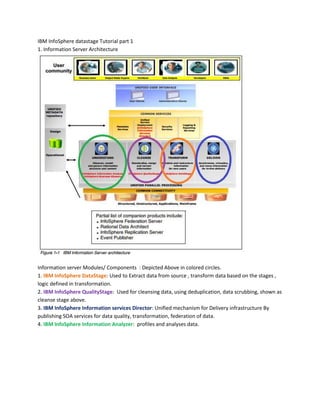
Information server Modules/ Components : Depicted Above in colored circles.
1. IBM InfoSphereDataStage: Used to Extract data from source , transform data based on the stages ,
logic defined in transformation.
2. IBM InfoSphereQualityStage: Used for cleansing data, using deduplication, data scrubbing, shown as
cleanse stage above.
3. IBM InfoSphere Information services Director: Unified mechanism for Delivery infrastructure By
publishing SOA services for data quality, transformation, federation of data.
4. IBM InfoSphere Information Analyzer: profiles and analyses data.
More Details blog:http://sandyclassic.wordpress.com
linkedin:https://www.linkedin.com/in/sandepsharma
slideshare:http://www.slideshare.net/SandeepSharma65
facebook:https://facebook.com/sandeepclassic
google+ http://google.com/+SandeepSharmaa
Twitter: https://twitter.com/sandeeclassic
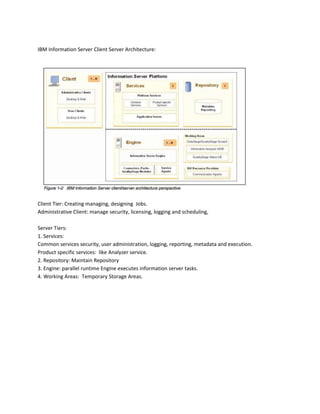
IBM Information Server Client Server Architecture:
Client Tier: Creating managing, designing Jobs.
Administrative Client: manage security, licensing, logging and scheduling,
Server Tiers:
1. Services:
Common services security, user administration, logging, reporting, metadata and execution.
Product specific services: like Analyzer service.
2. Repository: Maintain Repository
3. Engine: parallel runtime Engine executes information server tasks.
4. Working Areas: Temporary Storage Areas.
More Details blog:http://sandyclassic.wordpress.com
linkedin:https://www.linkedin.com/in/sandepsharma
slideshare:http://www.slideshare.net/SandeepSharma65
facebook:https://facebook.com/sandeepclassic
google+ http://google.com/+SandeepSharmaa
Twitter: https://twitter.com/sandeeclassic
Topologies: 2 tier, 3 tier, Cluster, Grid.
The processing Engine is distributed across multiple tier cluster taking up load dynamically.
While Client tier maintains client component , and Web server tier manage Web Server Components.
More Details blog:http://sandyclassic.wordpress.com
linkedin:https://www.linkedin.com/in/sandepsharma
slideshare:http://www.slideshare.net/SandeepSharma65
facebook:https://facebook.com/sandeepclassic
google+ http://google.com/+SandeepSharmaa
Twitter: https://twitter.com/sandeeclassic
Data Transformation
Stage
Description
Aggregation Consolidates aggregates data
Basic Conversion Ensure data type are properly Converted and mapped
Cleansing Data cleansing
Derivation Transforming data from multiple sources using complex business
Rule/algorithms.
Enrichment Combining data from internal and external sources
Normalizing Reducing redundancy or normalize data.
Combining Lookup, join or merge operation
Pivoting Converting input stream to multiple appropriate data marts.
Sorting Sort records
Source To Target job execution Parallelism
Pipeline parallelis: data is processed send to target databases As soon as it is available or read from
source rather than waiting for All data to read at once from source.
Partition Parallelism: The data table is partitioned at source horizontally or vertically so multiple records
can be read at once based on different partition set. Data is portioned using algorithm like Hash
partitioning.
Hash partitioning used hash key to distribute data across multiple data partitions(or subtables)
More Details blog:http://sandyclassic.wordpress.com
linkedin:https://www.linkedin.com/in/sandepsharma
slideshare:http://www.slideshare.net/SandeepSharma65
facebook:https://facebook.com/sandeepclassic
google+ http://google.com/+SandeepSharmaa
Twitter: https://twitter.com/sandeeclassic

Ibm info sphere datastage tutorial part 1 architecture examples