A vision of smarter cities: How cities can the lead way into a prosperous and sustainable future Susanne Dirks, Manager, Global Center for Economic Development Green Economy Conference, Dublin, 21 st  May 2010
The focus of our research is on topics relation to economics and the relationship between ICT and economics Institute for Business Value: IBV Centre for Economic Development
Agenda Cities take centre stage Cities are made up of a system of systems Cities face a number of challenges that threaten sustainability and prosperity Building a ‘smarter city’ Agenda
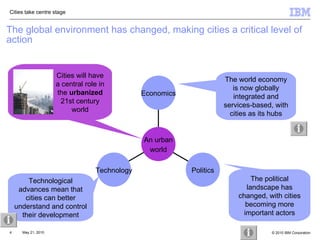
The global environment has changed, making cities a critical level of action Cities will have a central role in the  urbanized  21st century world The world economy   is now   globally integrated and services-based, with cities as its hubs Technological advances mean that cities can better understand and control their development Cities take centre stage A Vision for Smarter Cities  | July  2009 Technology Politics Economics An urban world The political   landscape has changed, with cities becoming more important actors
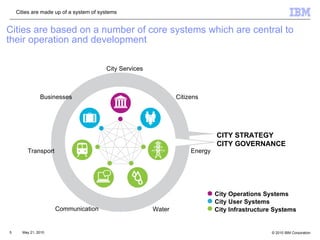
Cities are based on a number of core systems which are central to their operation and development Cities are made up of a system of systems A Vision for Smarter Cities  | July  2009 CITY STRATEGY CITY GOVERNANCE City Operations Systems City User Systems City Infrastructure Systems City Services Citizens Businesses Water Communication Energy Transport
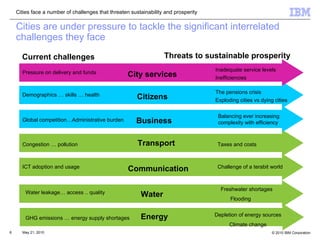
Current challenges Threats to sustainable prosperity Energy Depletion of energy sources Climate change Communication GHG emissions … energy supply shortages Water Challenge of a terabit world Business Global competition…Administrative burden Balancing ever increasing complexity with efficiency Transport Water leakage… access .. quality Freshwater shortages Flooding ICT adoption and usage Taxes and costs Congestion … pollution City services Pressure on delivery and funds Inadequate service levels Inefficiencies Cities are under pressure to tackle the significant interrelated challenges they face Cities face a number of challenges that threaten sustainability and prosperity Citizens Demographics … skills … health The pensions crisis Exploding cities vs dying cities
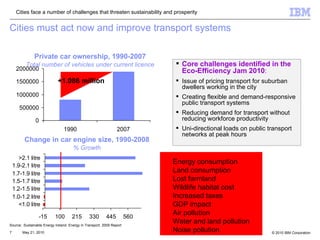
Private car ownership, 1990-2007 Total number of vehicles under current licence Cities must act now and improve transport systems  Source: Sustainable Energy Ireland. Energy in Transport. 2009 Report Change in car engine size, 1990-2008 % Growth +1.086 million Cities face a number of challenges that threaten sustainability and prosperity Core challenges identified in the Eco-Efficiency Jam 2010 : Issue of pricing transport for suburban dwellers working in the city Creating flexible and demand-responsive public transport systems Reducing demand for transport without reducing workforce productivity Uni-directional loads on public transport networks at peak hours Energy consumption Land consumption  Lost farmland Wildlife habitat cost Increased taxes GDP impact Air pollution Water and land pollution Noise pollution
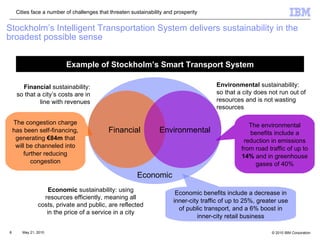
Stockholm’s Intelligent Transportation System delivers sustainability in the broadest possible sense Financial  Economic  sustainability: using resources efficiently, meaning all costs, private and public, are reflected in the price of a service in a city Financial  sustainability: so that a city’s costs are in line with revenues Environmental  sustainability: so that a city does not run out of resources and is not wasting resources Environmental Economic The congestion charge has been self-financing, generating  €84m  that will be channeled into further reducing congestion Example of Stockholm’s Smart Transport System The environmental benefits include a reduction in emissions from road traffic of up to  14%  and in greenhouse gases of 40% Economic benefits include a decrease in inner-city traffic of up to 25%, greater use of public transport, and a 6% boost in inner-city retail business A Vision for Smarter Cities  | July  2009 Cities face a number of challenges that threaten sustainability and prosperity
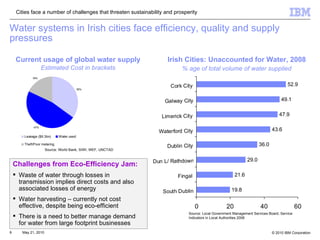
Water systems in Irish cities face efficiency, quality and supply pressures Irish Cities: Unaccounted for Water, 2008 % age of total volume of water supplied Source: Local Government Management Services Board, Service Indicators in Local Authorities 2008 Current usage of global water supply Estimated Cost in brackets Source: World Bank, SIWI, WEF, UNCTAD Cities face a number of challenges that threaten sustainability and prosperity Challenges from Eco-Efficiency Jam: Waste of water through losses in transmission implies direct costs and also associated losses of energy Water harvesting – currently not cost effective, despite being eco-efficient There is a need to better manage demand for water from large footprint businesses
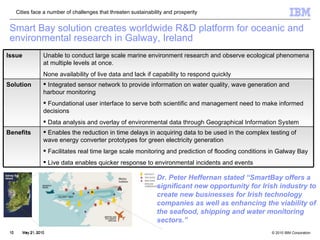
Smart Bay solution creates worldwide R&D platform for oceanic and environmental research in Galway, Ireland May 21, 2010 Dr. Peter Heffernan stated “SmartBay offers a significant new opportunity for Irish industry to create new businesses for Irish technology companies as well as enhancing the viability of the seafood, shipping and water monitoring sectors.”  Cities face a number of challenges that threaten sustainability and prosperity Integrated sensor network to provide information on water quality, wave generation and harbour monitoring Foundational user interface to serve both scientific and management need to make informed decisions Data analysis and overlay of environmental data through Geographical Information System Solution Issue Unable to conduct large scale marine environment research and observe ecological phenomena at multiple levels at once.  None availability of live data and lack if capability to respond quickly Benefits Enables the reduction in time delays in acquiring data to be used in the complex testing of wave energy converter prototypes for green electricity generation Facilitates real time large scale monitoring and prediction of flooding conditions in Galway Bay Live data enables quicker response to environmental incidents and events
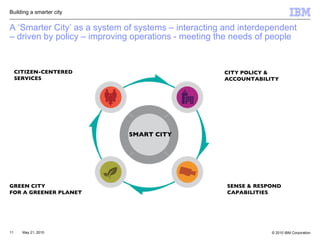
A ‘Smarter City’ as a system of systems – interacting and interdependent – driven by policy – improving operations - meeting the needs of people SENSE & RESPOND CAPABILITIES CITIZEN-CENTERED SERVICES GREEN CITY FOR A GREENER PLANET Building a smarter city CITY POLICY & ACCOUNTABILITY SMART CITY
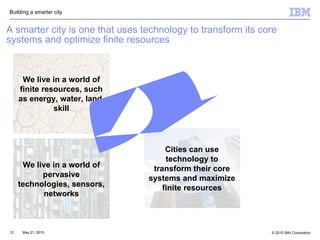
A smarter city is one that uses technology to transform its core systems and optimize finite resources We live in a world of pervasive technologies, sensors, networks We live in a world of finite resources, such as energy, water, land, skill Cities can use technology to transform their core systems and maximize finite resources Building a smarter city A Vision for Smarter Cities  | July  2009
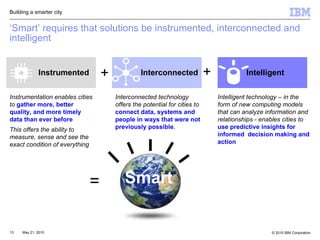
‘ Smart’ requires that solutions be instrumented, interconnected and intelligent Instrumented Intelligent technology – in the form of new computing models that can analyze information and relationships - enables cities to  use predictive insights for informed  decision making and action Instrumentation enables cities to  gather more, better quality, and more timely data than ever before   This offers the ability to measure, sense and see the exact condition of everything  Interconnected technology offers the potential for cities to  connect data, systems and people in ways that were not previously possible . Interconnected Intelligent + + = Smart Building a smarter city
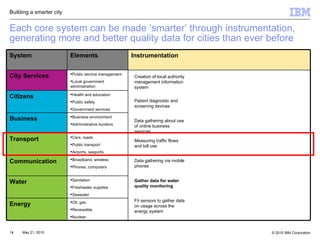
Each core system can be made ‘smarter’ through instrumentation, generating more and better quality data for cities than ever before Building a smarter city Oil, gas  Renewable Nuclear Energy Sanitation Freshwater supplies Seawater Water Broadband, wireless Phones, computers Communication Cars, roads Public transport Airports, seaports Transport Business environment Administrative burdens Business Health and education Public safety Government services Citizens Public service management Local government administration City Services Instrumentation Elements System Fit sensors to gather data on usage across the energy system Gather data for water quality monitoring Data gathering via mobile phones Measuring traffic flows and toll use Data gathering about use of online business services Patient diagnostic and screening devices Creation of local authority management information system
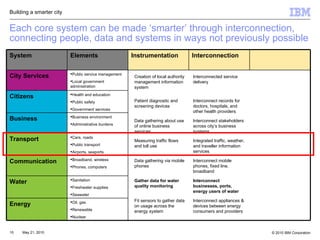
Each core system can be made ‘smarter’ through interconnection, connecting people, data and systems in ways not previously possible Building a smarter city Oil, gas  Renewable Nuclear Energy Sanitation Freshwater supplies Seawater Water Broadband, wireless Phones, computers Communication Cars, roads Public transport Airports, seaports Transport Business environment Administrative burdens Business Health and education Public safety Government services Citizens Public service management Local government administration City Services Interconnection Instrumentation Elements System Interconnect appliances & devices between energy consumers and providers Fit sensors to gather data on usage across the energy system Interconnect businesses, ports, energy users of water Gather data for water quality monitoring Interconnect mobile phones, fixed line, broadband Data gathering via mobile phones Integrated traffic, weather, and traveller information services Measuring traffic flows and toll use Interconnect stakeholders across city’s business systems Data gathering about use of online business services Interconnect records for doctors, hospitals, and other health providers Patient diagnostic and screening devices Interconnected service delivery Creation of local authority management information system
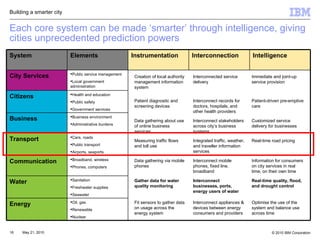
Each core system can be made ‘smarter’ through intelligence, giving cities unprecedented prediction powers Building a smarter city Oil, gas  Renewable Nuclear Energy Sanitation Freshwater supplies Seawater Water Broadband, wireless Phones, computers Communication Cars, roads Public transport Airports, seaports Transport Business environment Administrative burdens Business Health and education Public safety Government services Citizens Public service management Local government administration City Services Intelligence Interconnection Instrumentation Elements System Optimise the use of the system and balance use across time Interconnect appliances & devices between energy consumers and providers Fit sensors to gather data on usage across the energy system Real-time quality, flood, and drought control Interconnect businesses, ports, energy users of water Gather data for water quality monitoring Information for consumers on city services in real time, on their own time Interconnect mobile phones, fixed line, broadband Data gathering via mobile phones Real-time road pricing Integrated traffic, weather, and traveller information services Measuring traffic flows and toll use Customized service delivery for businesses Interconnect stakeholders across city’s business systems Data gathering about use of online business services Patient-driven pre-emptive care Interconnect records for doctors, hospitals, and other health providers Patient diagnostic and screening devices Immediate and joint-up service provision Interconnected service delivery Creation of local authority management information system
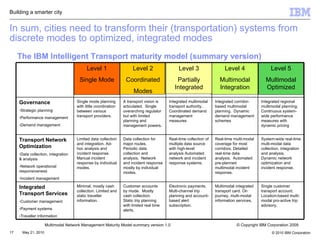
In sum, cities need to transform their (transportation) systems from discrete modes to optimized, integrated modes Multimodal Network Management Maturity Model summary version 1.0  © Copyright IBM Corporation 2009 The IBM Intelligent Transport maturity model (summary version)   Building a smarter city Single customer transport account. Location-based multi-modal pro-active trip advisory. Multimodal integrated transport card. On journey, multi-modal information services. Electronic payments. Multi-channel trip planning and account-based alert subscription. Customer accounts by mode.  Mostly cash collection.  Static trip planning with limited real time alerts. Minimal; mostly cash collection. Limited and static traveller information. Integrated Transport Services Customer management Payment systems Traveller information System-wide real-time multi-modal data collection, integration and analysis.  Dynamic network optimization and incident response. Real-time multi-modal coverage for most corridors. Detailed real-time data analysis.  Automated pre-planned multimodal incident response. Real-time collection of multiple data source with high-level analysis Automated network and incident response systems. Data collection for major routes.  Periodic data collection and analysis.  Network and incident response mostly by individual modes. Limited data collection and integration. Ad-hoc analysis and incident response. Manual incident response by individual modes. Transport Network Optimization Data collection, integration & analysis Network operational responsiveness Incident management Integrated regional multimodal planning. Continuous system-wide performance measures with dynamic pricing Integrated corridor-based multimodal planning.  Dynamic demand management schemes Integrated multimodal transport authority. Coordinated demand management measures A transport vision is articulated.  Single overarching regulator but with limited planning and management powers.  Single mode planning with little coordination between various transport providers.  Governance Strategic planning Performance management Demand management Level 5 Multimodal Optimized Level 4 Multimodal Integration Level 3 Partially Integrated Level 2 Coordinated Modes Level 1 Single Mode
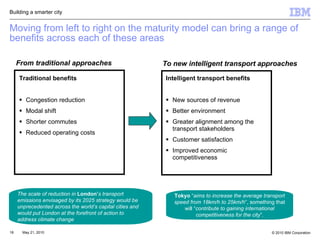
Moving from left to right on the maturity model can bring a range of benefits across each of these areas Traditional benefits Congestion reduction Modal shift Shorter commutes Reduced operating costs Intelligent transport benefits New sources of revenue Better environment Greater alignment among the transport stakeholders Customer satisfaction Improved economic competitiveness  Tokyo  “ aims to increase the average transport speed from 18km/h to 25km/h ”, something that will “ contribute to gaining international competitiveness for the city ”. From traditional approaches   To new intelligent transport approaches   The scale of reduction in  London’ s transport emissions envisaged by its 2025 strategy would be unprecedented across the world’s capital cities and would put London at the forefront of action to address climate change Building a smarter city
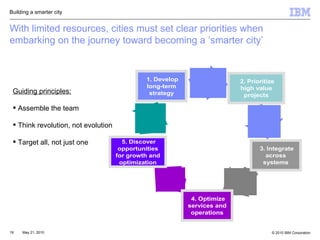
With limited resources, cities must set clear priorities when embarking on the journey toward becoming a ‘smarter city’ Guiding principles: Assemble the team Think revolution, not evolution Target all, not just one Building a smarter city

Ibm green expo

  • 1.
    A vision ofsmarter cities: How cities can the lead way into a prosperous and sustainable future Susanne Dirks, Manager, Global Center for Economic Development Green Economy Conference, Dublin, 21 st May 2010
  • 2.
    The focus ofour research is on topics relation to economics and the relationship between ICT and economics Institute for Business Value: IBV Centre for Economic Development
  • 3.
    Agenda Cities takecentre stage Cities are made up of a system of systems Cities face a number of challenges that threaten sustainability and prosperity Building a ‘smarter city’ Agenda
  • 4.
    The global environmenthas changed, making cities a critical level of action Cities will have a central role in the urbanized 21st century world The world economy is now globally integrated and services-based, with cities as its hubs Technological advances mean that cities can better understand and control their development Cities take centre stage A Vision for Smarter Cities | July 2009 Technology Politics Economics An urban world The political landscape has changed, with cities becoming more important actors
  • 5.
    Cities are basedon a number of core systems which are central to their operation and development Cities are made up of a system of systems A Vision for Smarter Cities | July 2009 CITY STRATEGY CITY GOVERNANCE City Operations Systems City User Systems City Infrastructure Systems City Services Citizens Businesses Water Communication Energy Transport
  • 6.
    Current challenges Threatsto sustainable prosperity Energy Depletion of energy sources Climate change Communication GHG emissions … energy supply shortages Water Challenge of a terabit world Business Global competition…Administrative burden Balancing ever increasing complexity with efficiency Transport Water leakage… access .. quality Freshwater shortages Flooding ICT adoption and usage Taxes and costs Congestion … pollution City services Pressure on delivery and funds Inadequate service levels Inefficiencies Cities are under pressure to tackle the significant interrelated challenges they face Cities face a number of challenges that threaten sustainability and prosperity Citizens Demographics … skills … health The pensions crisis Exploding cities vs dying cities
  • 7.
    Private car ownership,1990-2007 Total number of vehicles under current licence Cities must act now and improve transport systems Source: Sustainable Energy Ireland. Energy in Transport. 2009 Report Change in car engine size, 1990-2008 % Growth +1.086 million Cities face a number of challenges that threaten sustainability and prosperity Core challenges identified in the Eco-Efficiency Jam 2010 : Issue of pricing transport for suburban dwellers working in the city Creating flexible and demand-responsive public transport systems Reducing demand for transport without reducing workforce productivity Uni-directional loads on public transport networks at peak hours Energy consumption Land consumption Lost farmland Wildlife habitat cost Increased taxes GDP impact Air pollution Water and land pollution Noise pollution
  • 8.
    Stockholm’s Intelligent TransportationSystem delivers sustainability in the broadest possible sense Financial Economic sustainability: using resources efficiently, meaning all costs, private and public, are reflected in the price of a service in a city Financial sustainability: so that a city’s costs are in line with revenues Environmental sustainability: so that a city does not run out of resources and is not wasting resources Environmental Economic The congestion charge has been self-financing, generating €84m that will be channeled into further reducing congestion Example of Stockholm’s Smart Transport System The environmental benefits include a reduction in emissions from road traffic of up to 14% and in greenhouse gases of 40% Economic benefits include a decrease in inner-city traffic of up to 25%, greater use of public transport, and a 6% boost in inner-city retail business A Vision for Smarter Cities | July 2009 Cities face a number of challenges that threaten sustainability and prosperity
  • 9.
    Water systems inIrish cities face efficiency, quality and supply pressures Irish Cities: Unaccounted for Water, 2008 % age of total volume of water supplied Source: Local Government Management Services Board, Service Indicators in Local Authorities 2008 Current usage of global water supply Estimated Cost in brackets Source: World Bank, SIWI, WEF, UNCTAD Cities face a number of challenges that threaten sustainability and prosperity Challenges from Eco-Efficiency Jam: Waste of water through losses in transmission implies direct costs and also associated losses of energy Water harvesting – currently not cost effective, despite being eco-efficient There is a need to better manage demand for water from large footprint businesses
  • 10.
    Smart Bay solutioncreates worldwide R&D platform for oceanic and environmental research in Galway, Ireland May 21, 2010 Dr. Peter Heffernan stated “SmartBay offers a significant new opportunity for Irish industry to create new businesses for Irish technology companies as well as enhancing the viability of the seafood, shipping and water monitoring sectors.” Cities face a number of challenges that threaten sustainability and prosperity Integrated sensor network to provide information on water quality, wave generation and harbour monitoring Foundational user interface to serve both scientific and management need to make informed decisions Data analysis and overlay of environmental data through Geographical Information System Solution Issue Unable to conduct large scale marine environment research and observe ecological phenomena at multiple levels at once. None availability of live data and lack if capability to respond quickly Benefits Enables the reduction in time delays in acquiring data to be used in the complex testing of wave energy converter prototypes for green electricity generation Facilitates real time large scale monitoring and prediction of flooding conditions in Galway Bay Live data enables quicker response to environmental incidents and events
  • 11.
    A ‘Smarter City’as a system of systems – interacting and interdependent – driven by policy – improving operations - meeting the needs of people SENSE & RESPOND CAPABILITIES CITIZEN-CENTERED SERVICES GREEN CITY FOR A GREENER PLANET Building a smarter city CITY POLICY & ACCOUNTABILITY SMART CITY
  • 12.
    A smarter cityis one that uses technology to transform its core systems and optimize finite resources We live in a world of pervasive technologies, sensors, networks We live in a world of finite resources, such as energy, water, land, skill Cities can use technology to transform their core systems and maximize finite resources Building a smarter city A Vision for Smarter Cities | July 2009
  • 13.
    ‘ Smart’ requiresthat solutions be instrumented, interconnected and intelligent Instrumented Intelligent technology – in the form of new computing models that can analyze information and relationships - enables cities to use predictive insights for informed decision making and action Instrumentation enables cities to gather more, better quality, and more timely data than ever before This offers the ability to measure, sense and see the exact condition of everything Interconnected technology offers the potential for cities to connect data, systems and people in ways that were not previously possible . Interconnected Intelligent + + = Smart Building a smarter city
  • 14.
    Each core systemcan be made ‘smarter’ through instrumentation, generating more and better quality data for cities than ever before Building a smarter city Oil, gas Renewable Nuclear Energy Sanitation Freshwater supplies Seawater Water Broadband, wireless Phones, computers Communication Cars, roads Public transport Airports, seaports Transport Business environment Administrative burdens Business Health and education Public safety Government services Citizens Public service management Local government administration City Services Instrumentation Elements System Fit sensors to gather data on usage across the energy system Gather data for water quality monitoring Data gathering via mobile phones Measuring traffic flows and toll use Data gathering about use of online business services Patient diagnostic and screening devices Creation of local authority management information system
  • 15.
    Each core systemcan be made ‘smarter’ through interconnection, connecting people, data and systems in ways not previously possible Building a smarter city Oil, gas Renewable Nuclear Energy Sanitation Freshwater supplies Seawater Water Broadband, wireless Phones, computers Communication Cars, roads Public transport Airports, seaports Transport Business environment Administrative burdens Business Health and education Public safety Government services Citizens Public service management Local government administration City Services Interconnection Instrumentation Elements System Interconnect appliances & devices between energy consumers and providers Fit sensors to gather data on usage across the energy system Interconnect businesses, ports, energy users of water Gather data for water quality monitoring Interconnect mobile phones, fixed line, broadband Data gathering via mobile phones Integrated traffic, weather, and traveller information services Measuring traffic flows and toll use Interconnect stakeholders across city’s business systems Data gathering about use of online business services Interconnect records for doctors, hospitals, and other health providers Patient diagnostic and screening devices Interconnected service delivery Creation of local authority management information system
  • 16.
    Each core systemcan be made ‘smarter’ through intelligence, giving cities unprecedented prediction powers Building a smarter city Oil, gas Renewable Nuclear Energy Sanitation Freshwater supplies Seawater Water Broadband, wireless Phones, computers Communication Cars, roads Public transport Airports, seaports Transport Business environment Administrative burdens Business Health and education Public safety Government services Citizens Public service management Local government administration City Services Intelligence Interconnection Instrumentation Elements System Optimise the use of the system and balance use across time Interconnect appliances & devices between energy consumers and providers Fit sensors to gather data on usage across the energy system Real-time quality, flood, and drought control Interconnect businesses, ports, energy users of water Gather data for water quality monitoring Information for consumers on city services in real time, on their own time Interconnect mobile phones, fixed line, broadband Data gathering via mobile phones Real-time road pricing Integrated traffic, weather, and traveller information services Measuring traffic flows and toll use Customized service delivery for businesses Interconnect stakeholders across city’s business systems Data gathering about use of online business services Patient-driven pre-emptive care Interconnect records for doctors, hospitals, and other health providers Patient diagnostic and screening devices Immediate and joint-up service provision Interconnected service delivery Creation of local authority management information system
  • 17.
    In sum, citiesneed to transform their (transportation) systems from discrete modes to optimized, integrated modes Multimodal Network Management Maturity Model summary version 1.0 © Copyright IBM Corporation 2009 The IBM Intelligent Transport maturity model (summary version) Building a smarter city Single customer transport account. Location-based multi-modal pro-active trip advisory. Multimodal integrated transport card. On journey, multi-modal information services. Electronic payments. Multi-channel trip planning and account-based alert subscription. Customer accounts by mode. Mostly cash collection. Static trip planning with limited real time alerts. Minimal; mostly cash collection. Limited and static traveller information. Integrated Transport Services Customer management Payment systems Traveller information System-wide real-time multi-modal data collection, integration and analysis. Dynamic network optimization and incident response. Real-time multi-modal coverage for most corridors. Detailed real-time data analysis. Automated pre-planned multimodal incident response. Real-time collection of multiple data source with high-level analysis Automated network and incident response systems. Data collection for major routes. Periodic data collection and analysis. Network and incident response mostly by individual modes. Limited data collection and integration. Ad-hoc analysis and incident response. Manual incident response by individual modes. Transport Network Optimization Data collection, integration & analysis Network operational responsiveness Incident management Integrated regional multimodal planning. Continuous system-wide performance measures with dynamic pricing Integrated corridor-based multimodal planning. Dynamic demand management schemes Integrated multimodal transport authority. Coordinated demand management measures A transport vision is articulated. Single overarching regulator but with limited planning and management powers. Single mode planning with little coordination between various transport providers. Governance Strategic planning Performance management Demand management Level 5 Multimodal Optimized Level 4 Multimodal Integration Level 3 Partially Integrated Level 2 Coordinated Modes Level 1 Single Mode
  • 18.
    Moving from leftto right on the maturity model can bring a range of benefits across each of these areas Traditional benefits Congestion reduction Modal shift Shorter commutes Reduced operating costs Intelligent transport benefits New sources of revenue Better environment Greater alignment among the transport stakeholders Customer satisfaction Improved economic competitiveness Tokyo “ aims to increase the average transport speed from 18km/h to 25km/h ”, something that will “ contribute to gaining international competitiveness for the city ”. From traditional approaches To new intelligent transport approaches The scale of reduction in London’ s transport emissions envisaged by its 2025 strategy would be unprecedented across the world’s capital cities and would put London at the forefront of action to address climate change Building a smarter city
  • 19.
    With limited resources,cities must set clear priorities when embarking on the journey toward becoming a ‘smarter city’ Guiding principles: Assemble the team Think revolution, not evolution Target all, not just one Building a smarter city