May 2014
In-band Full-duplex Wireless
Communications – from Echo-
cancellation to Self-interference Cancellation
Fuyun Ling
Twinclouds Consulting, LLC
© 2013 Fuyun Ling
fling@twinclouds.com
May 2014
OUTLINE
• Overview of In-band Full-duplex Communication (IBFC)
• From Echo-cancellation to Self-interference Cancellation
• Characteristics of Echo/Self-interference Cancellers
• IBFD’s Achievable Performance Evaluation and Possible
Applications
• Concluding Remarks and Potential Research Areas
2Fuyun Ling
fling@twinclouds.com
May 2014
OVERVIEW OF IN-BAND FULL-DUPLEX
COMMUNICATION (IBFC)
3Fuyun Ling
fling@twinclouds.com
May 2014
What Is In-Band Full-Duplex Communications
• Historically, wireless systems use different frequency
bands (FDM) or time slots (TDM) for forward and reverse
link communications
• The same frequency band are used for the two links at
the same time because the transmitted signal interferes
the received signal
– Such interference is called Self-Interference
• The In-Band Full-Duplex (IBFD) method reduces the
interference of the transmitted signal to the received
signal to achieve full-duplex operation by
– Spatial isolation and
– Self-interference cancellation
4Fuyun Ling
fling@twinclouds.com
May 2014
Why and When to Use IBFD
• It has generated a lot of interest in wireless
communications recently because
– IBFD have the potential to double spectrum efficiency to meet
the increasing demand of wireless communications
– Due to the advance in communication and computer
engineering, processing power is greatly increased and could
fit in the physical dimensions of wireless devices
– The recent trend of wireless communication is towards near
field from far field
• Smaller link loss to make IBFD possibly feasible
• However, IBFD has its limitations
– We need to understand the limitations to determine what are
its possible applications
– It is not a magic formula to double spectrum efficiency
5Fuyun Ling
fling@twinclouds.com
May 2014
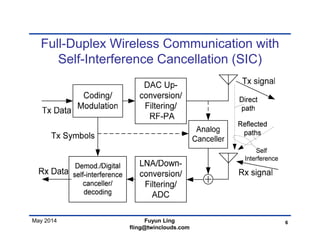
Full-Duplex Wireless Communication with
Self-Interference Cancellation (SIC)
6Fuyun Ling
fling@twinclouds.com
May 2014
Key Components and Features of IBFD
• In a wireless system, the Tx signal interferes the Rx
signal through direct paths and reflected paths.
• The self interference is reduced in RF by Tx/Rx isolation
– Spatial isolation (beam-forming) in multi-antenna systems
– Using circulator (similar to hybrid coupler) in single antenna
systems
• The residual self interference is further reduced by self-
interference canceller (SIC)
• SIC can be implemented in analog and/or digital forms
– The analog SIC is for facilitating digital SIC implementations,
e.g., ADC word length
– It can also compensate for some of the non-linear effects
• Linear SIC cannot do better than the non-linear effects in
the interferences
7Fuyun Ling
fling@twinclouds.com
May 2014
Predecessors of IBFD Wireless Communications
• Predecessor 1: IBFD in radar systems
– This concept has been used in radar systems since 1940’s
– The isolation between the Tx and Rx signals are achieved by
• Reduction of the leaked Tx signal back to the Rx side by antenna
beam forming in a multiple antenna systems
• Using Circulators in a single antenna system to isolate Tx/Rx signals
• Analog self-interference cancellation in 1960’s
• Predecessor 2: Echo cancellation in wireline modems
– Echo Cancellation (EC) technology has been widely used in
commercial wireline modems since 1980’s
– The reduction between the Tx and Rx signals are achieved by
using hybrid coupler and adaptive echo canceller
– Many techniques developed and understood for EC
technology are directly applicable to IBFD wireless systems
8Fuyun Ling
fling@twinclouds.com
May 2014
FROM ECHO-CANCELLATION TO
SELF-INTERFERENCE CANCELLATION
9Fuyun Ling
fling@twinclouds.com
May 2014
The Echo Cancellation Technology
• Echo cancellation technology was developed since 1960’s
• The wireline communication products employing EC has
been commercialized since mid 80’s
• The reduction of the Tx signal coming into the Rx signal
(echo) is achieved by adaptive echo-canceller after initial
attenuation using hybrid coupler
• Echo cancellation technology has been studied carefully
by researchers and engineers over decades
• EC and SIC has many commonalities
• The result of such studies on EC can be directly applied to
IBFD and provide guidance for IBFD system development
• We shall discuss their similarities and differences
10Fuyun Ling
fling@twinclouds.com
May 2014
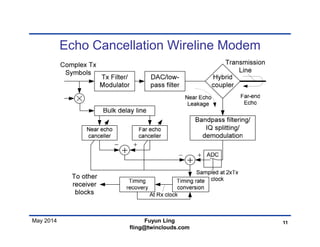
Echo Cancellation Wireline Modem
11Fuyun Ling
fling@twinclouds.com
May 2014
Key Components and Features of EC
• Hybrid coupler can create about 6-15 dB echo reduction
• The residual echo is reduced or eliminated by EC
• Characteristics of the echo
– Echo can be modeled by known transmitted symbol
convolved with the echo channel
• In modem signals there are near and far echo components
– The echo can be emulated by convolving the known Tx
symbols with accurately estimated echo channel and known
– Echo in the received signal can be removed by subtracting
the emulated echo from the Rx signal
– If the channel is truly linear and the channel estimate is
accurate, echoes can be perfectly eliminated
– Non-linearities in echoes are the main limiting factor
– It is difficult to achieve echo cancellation of over 70 dB
12Fuyun Ling
fling@twinclouds.com
May 2014
Key Components and Features of EC (cont.)
• Echo canceller implementation considerations
– Received signal is sampled at TTx/M (usually, M = 2)
– EC is has M (independent) sub-cancellers
– EC has a tapped delay line (TDL) structure
– The adaptive EC estimates the channel using LMS algorithm
– The estimation accuracy, which determines the achievable
EC ratio, is controlled by the adaptation step size
• Rate conversion
– After echo cancellation the sampling rate need to be
converged to synchronize with TRx for receiver functions
– The rate conversion can be done by analog or digital means
• All of these features discussed are applicable to the self-
interference cancellation of IBFD wireless systems
13Fuyun Ling
fling@twinclouds.com
May 2014
EC/IBFC – Commonalities and Differences
• Commonalities:
– The main objective is to remove the leaked Tx signal from the
Rx signals in both cases
– Need isolations between the Tx and Rx signals to reduce the
self-interferences in the Rx signals
– The residual interference are removed by interference
cancellation techniques
• The replica of interference signals are synthesized using known Tx
signal and estimated/emulated interference channels
• LMS algorithm is used for channel estimation/interference cancellation
• The synthesized interference are subtracted from the Rx signal
• Input data are known uncorrelated Tx symbols
• Achievable cancellation is mainly determined by the accuracy of
channel estimation
– Non-linearity is the main limiting factor
14Fuyun Ling
fling@twinclouds.com
May 2014
Commonalities and Differences (cont.)
• Differences:
– Isolation can be achieved more effectively in wireless systems if
using separate Tx and Rx antennas is feasible
– Non-linearity is usually more severe in wireless systems
• High power RF amplifier has high non-linearity
• Reduction of phase-noise is also difficult in such systems
• Analog canceller may be able to cancel part of such non-linear
interferences already existed in the RF (Tx) signal
• Non-linear modeling of the Tx signal may be used to improve further
SIC performance
– Wireless channels always have some time variations
• It is true even for the self-interference channels
• Time variation imposes another limit to the channel estimation
accuracy
– Due to high sampling rate in SIC, it is more difficult to employ high
precision ADCs resuling the need of analog canceller
15Fuyun Ling
fling@twinclouds.com
May 2014
CHARACTERISTICS OF ECHO/SELF-
INTERFERENCE CANCELLERS
16Fuyun Ling
fling@twinclouds.com
May 2014
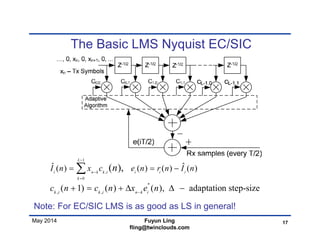
The Basic LMS Nyquist EC/SIC
Note: For EC/SIC LMS is as good as LS in general!
17Fuyun Ling
fling@twinclouds.com
1
,
0
ˆ ˆ( ) ( ) ( ) ( )( ),
L
i n k k i i i i
k
I n x c e n r n I nn



  
*
, ,
( 1) ( ) ( ), adaptation step-sizek i k i n k i
c n c n x e n
     
May 2014
Excess noise in LMS Nyquist EC/SIC
• The coefficients converge towards its optimal value
when n goes to infinity.
– The noise in ri(n) will introduce errors in the coefficients.
• Analysis of MSE of excess error (also valid for LS)
– This results in an error term proportional to the irreducible error
in ei(n), called excess error denoted by eex.
– The MSE of eex can be expressed as:
– normalized step size, e– MSE of irreducible error, L –
the number of coefficients of each sub-canceler
– For EC/SIC eis the received signal power
• Residual echo/SI is proportional to the received signal power
• The residual echo/SI should be 6 dB below the noise level
– Example: 1. Required SNR g= 27 dB and L = 100, m< 10-5
– Example: 2: Required SNR g= 21 dB and L = 40, m< 10-4
(These are very small number – very long time constant)
18Fuyun Ling
fling@twinclouds.com
( / 2)ex
L  
2
/ [| | ]nLE x  
May 2014
Tracking Performance of LMS EC/SIC
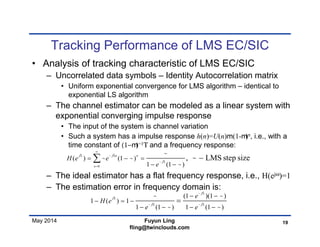
• Analysis of tracking characteristic of LMS EC/SIC
– Uncorrelated data symbols – Identity Autocorrelation matrix
• Uniform exponential convergence for LMS algorithm – identical to
exponential LS algorithm
– The channel estimator can be modeled as a linear system with
exponential converging impulse response
• The input of the system is channel variation
• Such a system has a impulse response h(n)=U(n)m(1-m)n, i.e., with a
time constant of (1−m)−1Τ and a frequency response:
– The ideal estimator has a flat frequency response, i.e., H(ejω)=1
– The estimation error in frequency domain is:
19Fuyun Ling
fling@twinclouds.com
0
( ) (1 )
1 (1 )
, LMS step sizej j n n
j
n
H e e
e
 


 






  
 

(1 )(1 )
1 ( ) 1
1 (1 ) 1 (1 )
j
j
j j
e
H e
e e


 
 
 

 
 
  
   

May 2014
Cancelation Limit due to Time Variation
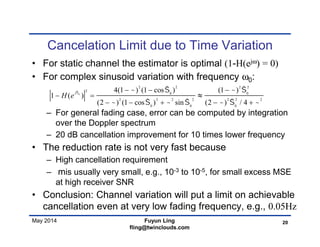
• For static channel the estimator is optimal (1-H(ejω) = 0)
• For complex sinusoid variation with frequency ω0:
– For general fading case, error can be computed by integration
over the Doppler spectrum
– 20 dB cancellation improvement for 10 times lower frequency
• The reduction rate is not very fast because
– High cancellation requirement
– mis usually very small, e.g., 10-3 to 10-5, for small excess MSE
at high receiver SNR
• Conclusion: Channel variation will put a limit on achievable
cancellation even at very low fading frequency, e.g., 0.05Hz
20Fuyun Ling
fling@twinclouds.com
0
2 2 2 2
2
0 0
2 2 2 2 2 2 2
0 0 0
4(1 ) (1 cos ) (1 )
1 ( )
(2 ) (1 cos ) sin (2 ) / 4
j
H e
    
      
  
 
    

May 2014
IBFD’S ACHIEVABLE PERFORMANCE
AND POSSIBLE APPLICATIONS OF
21Fuyun Ling
fling@twinclouds.com
May 2014
Achievable Performance of IBFD
• Total achievable cancelation can be summarized by the
following empirical formula:
• The first term normally would be in the range of 30-60 dB
– The non-linearity is usually around −30 dB for higher power
amplifiers and may be lower for lower power ones
• Analog canceller is less impacted by the non-linearity in Tx signal
• By establish a non-linearity model, the input to the SIC can be pre-
distorted and less impacted by the non-linearity
– There’s also non-linearity in the receiver side, which is difficult
to compensate
– The channel variation impacts more on the time-varying path,
which yield an interference with lower power
• It may have less impact to the residual interference
22Fuyun Ling
fling@twinclouds.com
, var varmin[( ), ( / ) ]c total NL NL compensation Total ch ch IsolationR R R P P R R     
May 2014
Achievable Performance of IBFD (cont.)
• Isolation gain depending on the environment and possible
antenna arrangement
– It is essentially achieved by beam forming in a multiple
antenna environment
• Higher gain can be achieved in a base station environment, where
multiple transmitter antennas can be deployed
• It is difficult to achieve isolation gains in a portable device due to
close spacing between antennas
– If there is only a single antenna, circulator is to be used
• Circulator can only achieve less than 15 dB isolation with reasonable
size
• Using circulator will require higher SIC gain
– This will be difficult due to the existence of non-linearity?
– Isolation gain need to be analyzed for specific applications
23Fuyun Ling
fling@twinclouds.com
May 2014
Possible Applications of IBFD
• It is difficult to achieve high Self-interference rejection
• High isolation need multiple widely spaced antennas
• It would not be appropriate for applications when the
channel attenuation is too high
– e.g. in large cell mobile communication systems, where link
attenuation can be more than 100 dB
• It would be more appropriate for wireless systems with
low and/or symmetric link attenuations, such as
– point to point systems
– repeaters
– on base station side of small cell systems
– In WIFI type of systems
24Fuyun Ling
fling@twinclouds.com
May 2014
Possible Applications of IBFD (cont.)
• Another possible applications is to use it in a multi-user
environment
– It is a kind similar to multi-user MIMO
– The base station transmitter is operate in full-duplex mode
• It transmits to one user device while receives from another user
device
– The user devices can be operated in half-duplex mode or
communicating with other devices (full-duplex)
• To determine the appropriate applications of IBFC, the
most important factor is to determine the possible
isolation/cancellation gain vs. the worst case self-
interference to received signal ratio
25Fuyun Ling
fling@twinclouds.com
May 2014
TOPICS OF FUTURE RESEARCH
AND FINAL REMARKS
26Fuyun Ling
fling@twinclouds.com
May 2014
Possible Research Topics
• Physical Layer:
– The environmental study of various potential systems
• For any potential candidate of using IBFD, it is necessary to achieve
best possible signal isolation
• It is necessary to investigate the operating environment by
characterization of self-interference channels
– Direct and reflective channel characteristics
– Fading characteristic of the channels
– Validation of the tracking performance of adaptive algorithms
in fading environment
• The given derivation is based on the linear system model
• While it is reasonable assumption, further validation is needed
• It will be desirable to also verify using real (measured) system
model
27Fuyun Ling
fling@twinclouds.com
May 2014
Possible Research Topics (cont.)
• Physical Layer (cont.)
– The compensation techniques for non-linearities
• Model the non-linearity of practical RF amplifiers
• Utilize the model to pre-distorted Tx symbols before enter the SIC
canceller
– It is theoretically possible but no reported result to show what has been
and or can be done
– Impact of phase-noise and its compensation
• Techniques of reducing phase noise in RF amplifier/components
• Compensation techniques
– Analog canceller implementation and adaptation algorithms
• Reduction of the impact of non-linearity: what is the achievable
performance?
• What is the best practical way to implement analog canceller?
• System topology and upper layer study of IBFD
– I would let others to propose 
28Fuyun Ling
fling@twinclouds.com
May 2014
Concluding Remarks
• IBFD have the potential to double spectrum efficiency for
certain applications under appropriate environments
• So far it has been demonstrated for limited circumstances
– Mainly point-to-point system such as repeaters and backhaul
connections
• It is important to determine such applications that can
utilize this technology
• Effort should be made to analyze the achievable self
interference reduction under different environments
• Experience obtained from echo cancellation in past
decades can provide useful information and guideance for
development of IBFD systems
29Fuyun Ling
fling@twinclouds.com
May 2014
Concluding Remarks (cont.)
• For being useful in practical applications, we need to
consider the worst case
– Robustness is more important than best achievable
performance
• Cost factors need to be considered for its applicability
– There’s many different ways to improve spectrum efficiency
• Total achievable cancellation is usually less than the sum
of the individually achievable cancelations of the blocks
• It is not a miracle formula of doubling capacity of any
existing applications
30Fuyun Ling
fling@twinclouds.com
May 2014
References
• A tutorial paper from Rice University
– In-band Full-duplex Wireless: Challenges and Opportunities
(http://arxiv.org/abs/1311.0456)
• Kumu Networks
– http://kumunetworks.com/
31Fuyun Ling
fling@twinclouds.com
May 2014
THANK YOU!
32Fuyun Ling
fling@twinclouds.com

Ibfd presentation

  • 1.
    May 2014 In-band Full-duplexWireless Communications – from Echo- cancellation to Self-interference Cancellation Fuyun Ling Twinclouds Consulting, LLC © 2013 Fuyun Ling fling@twinclouds.com
  • 2.
    May 2014 OUTLINE • Overviewof In-band Full-duplex Communication (IBFC) • From Echo-cancellation to Self-interference Cancellation • Characteristics of Echo/Self-interference Cancellers • IBFD’s Achievable Performance Evaluation and Possible Applications • Concluding Remarks and Potential Research Areas 2Fuyun Ling fling@twinclouds.com
  • 3.
    May 2014 OVERVIEW OFIN-BAND FULL-DUPLEX COMMUNICATION (IBFC) 3Fuyun Ling fling@twinclouds.com
  • 4.
    May 2014 What IsIn-Band Full-Duplex Communications • Historically, wireless systems use different frequency bands (FDM) or time slots (TDM) for forward and reverse link communications • The same frequency band are used for the two links at the same time because the transmitted signal interferes the received signal – Such interference is called Self-Interference • The In-Band Full-Duplex (IBFD) method reduces the interference of the transmitted signal to the received signal to achieve full-duplex operation by – Spatial isolation and – Self-interference cancellation 4Fuyun Ling fling@twinclouds.com
  • 5.
    May 2014 Why andWhen to Use IBFD • It has generated a lot of interest in wireless communications recently because – IBFD have the potential to double spectrum efficiency to meet the increasing demand of wireless communications – Due to the advance in communication and computer engineering, processing power is greatly increased and could fit in the physical dimensions of wireless devices – The recent trend of wireless communication is towards near field from far field • Smaller link loss to make IBFD possibly feasible • However, IBFD has its limitations – We need to understand the limitations to determine what are its possible applications – It is not a magic formula to double spectrum efficiency 5Fuyun Ling fling@twinclouds.com
  • 6.
    May 2014 Full-Duplex WirelessCommunication with Self-Interference Cancellation (SIC) 6Fuyun Ling fling@twinclouds.com
  • 7.
    May 2014 Key Componentsand Features of IBFD • In a wireless system, the Tx signal interferes the Rx signal through direct paths and reflected paths. • The self interference is reduced in RF by Tx/Rx isolation – Spatial isolation (beam-forming) in multi-antenna systems – Using circulator (similar to hybrid coupler) in single antenna systems • The residual self interference is further reduced by self- interference canceller (SIC) • SIC can be implemented in analog and/or digital forms – The analog SIC is for facilitating digital SIC implementations, e.g., ADC word length – It can also compensate for some of the non-linear effects • Linear SIC cannot do better than the non-linear effects in the interferences 7Fuyun Ling fling@twinclouds.com
  • 8.
    May 2014 Predecessors ofIBFD Wireless Communications • Predecessor 1: IBFD in radar systems – This concept has been used in radar systems since 1940’s – The isolation between the Tx and Rx signals are achieved by • Reduction of the leaked Tx signal back to the Rx side by antenna beam forming in a multiple antenna systems • Using Circulators in a single antenna system to isolate Tx/Rx signals • Analog self-interference cancellation in 1960’s • Predecessor 2: Echo cancellation in wireline modems – Echo Cancellation (EC) technology has been widely used in commercial wireline modems since 1980’s – The reduction between the Tx and Rx signals are achieved by using hybrid coupler and adaptive echo canceller – Many techniques developed and understood for EC technology are directly applicable to IBFD wireless systems 8Fuyun Ling fling@twinclouds.com
  • 9.
    May 2014 FROM ECHO-CANCELLATIONTO SELF-INTERFERENCE CANCELLATION 9Fuyun Ling fling@twinclouds.com
  • 10.
    May 2014 The EchoCancellation Technology • Echo cancellation technology was developed since 1960’s • The wireline communication products employing EC has been commercialized since mid 80’s • The reduction of the Tx signal coming into the Rx signal (echo) is achieved by adaptive echo-canceller after initial attenuation using hybrid coupler • Echo cancellation technology has been studied carefully by researchers and engineers over decades • EC and SIC has many commonalities • The result of such studies on EC can be directly applied to IBFD and provide guidance for IBFD system development • We shall discuss their similarities and differences 10Fuyun Ling fling@twinclouds.com
  • 11.
    May 2014 Echo CancellationWireline Modem 11Fuyun Ling fling@twinclouds.com
  • 12.
    May 2014 Key Componentsand Features of EC • Hybrid coupler can create about 6-15 dB echo reduction • The residual echo is reduced or eliminated by EC • Characteristics of the echo – Echo can be modeled by known transmitted symbol convolved with the echo channel • In modem signals there are near and far echo components – The echo can be emulated by convolving the known Tx symbols with accurately estimated echo channel and known – Echo in the received signal can be removed by subtracting the emulated echo from the Rx signal – If the channel is truly linear and the channel estimate is accurate, echoes can be perfectly eliminated – Non-linearities in echoes are the main limiting factor – It is difficult to achieve echo cancellation of over 70 dB 12Fuyun Ling fling@twinclouds.com
  • 13.
    May 2014 Key Componentsand Features of EC (cont.) • Echo canceller implementation considerations – Received signal is sampled at TTx/M (usually, M = 2) – EC is has M (independent) sub-cancellers – EC has a tapped delay line (TDL) structure – The adaptive EC estimates the channel using LMS algorithm – The estimation accuracy, which determines the achievable EC ratio, is controlled by the adaptation step size • Rate conversion – After echo cancellation the sampling rate need to be converged to synchronize with TRx for receiver functions – The rate conversion can be done by analog or digital means • All of these features discussed are applicable to the self- interference cancellation of IBFD wireless systems 13Fuyun Ling fling@twinclouds.com
  • 14.
    May 2014 EC/IBFC –Commonalities and Differences • Commonalities: – The main objective is to remove the leaked Tx signal from the Rx signals in both cases – Need isolations between the Tx and Rx signals to reduce the self-interferences in the Rx signals – The residual interference are removed by interference cancellation techniques • The replica of interference signals are synthesized using known Tx signal and estimated/emulated interference channels • LMS algorithm is used for channel estimation/interference cancellation • The synthesized interference are subtracted from the Rx signal • Input data are known uncorrelated Tx symbols • Achievable cancellation is mainly determined by the accuracy of channel estimation – Non-linearity is the main limiting factor 14Fuyun Ling fling@twinclouds.com
  • 15.
    May 2014 Commonalities andDifferences (cont.) • Differences: – Isolation can be achieved more effectively in wireless systems if using separate Tx and Rx antennas is feasible – Non-linearity is usually more severe in wireless systems • High power RF amplifier has high non-linearity • Reduction of phase-noise is also difficult in such systems • Analog canceller may be able to cancel part of such non-linear interferences already existed in the RF (Tx) signal • Non-linear modeling of the Tx signal may be used to improve further SIC performance – Wireless channels always have some time variations • It is true even for the self-interference channels • Time variation imposes another limit to the channel estimation accuracy – Due to high sampling rate in SIC, it is more difficult to employ high precision ADCs resuling the need of analog canceller 15Fuyun Ling fling@twinclouds.com
  • 16.
    May 2014 CHARACTERISTICS OFECHO/SELF- INTERFERENCE CANCELLERS 16Fuyun Ling fling@twinclouds.com
  • 17.
    May 2014 The BasicLMS Nyquist EC/SIC Note: For EC/SIC LMS is as good as LS in general! 17Fuyun Ling fling@twinclouds.com 1 , 0 ˆ ˆ( ) ( ) ( ) ( )( ), L i n k k i i i i k I n x c e n r n I nn       * , , ( 1) ( ) ( ), adaptation step-sizek i k i n k i c n c n x e n      
  • 18.
    May 2014 Excess noisein LMS Nyquist EC/SIC • The coefficients converge towards its optimal value when n goes to infinity. – The noise in ri(n) will introduce errors in the coefficients. • Analysis of MSE of excess error (also valid for LS) – This results in an error term proportional to the irreducible error in ei(n), called excess error denoted by eex. – The MSE of eex can be expressed as: – normalized step size, e– MSE of irreducible error, L – the number of coefficients of each sub-canceler – For EC/SIC eis the received signal power • Residual echo/SI is proportional to the received signal power • The residual echo/SI should be 6 dB below the noise level – Example: 1. Required SNR g= 27 dB and L = 100, m< 10-5 – Example: 2: Required SNR g= 21 dB and L = 40, m< 10-4 (These are very small number – very long time constant) 18Fuyun Ling fling@twinclouds.com ( / 2)ex L   2 / [| | ]nLE x  
  • 19.
    May 2014 Tracking Performanceof LMS EC/SIC • Analysis of tracking characteristic of LMS EC/SIC – Uncorrelated data symbols – Identity Autocorrelation matrix • Uniform exponential convergence for LMS algorithm – identical to exponential LS algorithm – The channel estimator can be modeled as a linear system with exponential converging impulse response • The input of the system is channel variation • Such a system has a impulse response h(n)=U(n)m(1-m)n, i.e., with a time constant of (1−m)−1Τ and a frequency response: – The ideal estimator has a flat frequency response, i.e., H(ejω)=1 – The estimation error in frequency domain is: 19Fuyun Ling fling@twinclouds.com 0 ( ) (1 ) 1 (1 ) , LMS step sizej j n n j n H e e e                   (1 )(1 ) 1 ( ) 1 1 (1 ) 1 (1 ) j j j j e H e e e                     
  • 20.
    May 2014 Cancelation Limitdue to Time Variation • For static channel the estimator is optimal (1-H(ejω) = 0) • For complex sinusoid variation with frequency ω0: – For general fading case, error can be computed by integration over the Doppler spectrum – 20 dB cancellation improvement for 10 times lower frequency • The reduction rate is not very fast because – High cancellation requirement – mis usually very small, e.g., 10-3 to 10-5, for small excess MSE at high receiver SNR • Conclusion: Channel variation will put a limit on achievable cancellation even at very low fading frequency, e.g., 0.05Hz 20Fuyun Ling fling@twinclouds.com 0 2 2 2 2 2 0 0 2 2 2 2 2 2 2 0 0 0 4(1 ) (1 cos ) (1 ) 1 ( ) (2 ) (1 cos ) sin (2 ) / 4 j H e                       
  • 21.
    May 2014 IBFD’S ACHIEVABLEPERFORMANCE AND POSSIBLE APPLICATIONS OF 21Fuyun Ling fling@twinclouds.com
  • 22.
    May 2014 Achievable Performanceof IBFD • Total achievable cancelation can be summarized by the following empirical formula: • The first term normally would be in the range of 30-60 dB – The non-linearity is usually around −30 dB for higher power amplifiers and may be lower for lower power ones • Analog canceller is less impacted by the non-linearity in Tx signal • By establish a non-linearity model, the input to the SIC can be pre- distorted and less impacted by the non-linearity – There’s also non-linearity in the receiver side, which is difficult to compensate – The channel variation impacts more on the time-varying path, which yield an interference with lower power • It may have less impact to the residual interference 22Fuyun Ling fling@twinclouds.com , var varmin[( ), ( / ) ]c total NL NL compensation Total ch ch IsolationR R R P P R R     
  • 23.
    May 2014 Achievable Performanceof IBFD (cont.) • Isolation gain depending on the environment and possible antenna arrangement – It is essentially achieved by beam forming in a multiple antenna environment • Higher gain can be achieved in a base station environment, where multiple transmitter antennas can be deployed • It is difficult to achieve isolation gains in a portable device due to close spacing between antennas – If there is only a single antenna, circulator is to be used • Circulator can only achieve less than 15 dB isolation with reasonable size • Using circulator will require higher SIC gain – This will be difficult due to the existence of non-linearity? – Isolation gain need to be analyzed for specific applications 23Fuyun Ling fling@twinclouds.com
  • 24.
    May 2014 Possible Applicationsof IBFD • It is difficult to achieve high Self-interference rejection • High isolation need multiple widely spaced antennas • It would not be appropriate for applications when the channel attenuation is too high – e.g. in large cell mobile communication systems, where link attenuation can be more than 100 dB • It would be more appropriate for wireless systems with low and/or symmetric link attenuations, such as – point to point systems – repeaters – on base station side of small cell systems – In WIFI type of systems 24Fuyun Ling fling@twinclouds.com
  • 25.
    May 2014 Possible Applicationsof IBFD (cont.) • Another possible applications is to use it in a multi-user environment – It is a kind similar to multi-user MIMO – The base station transmitter is operate in full-duplex mode • It transmits to one user device while receives from another user device – The user devices can be operated in half-duplex mode or communicating with other devices (full-duplex) • To determine the appropriate applications of IBFC, the most important factor is to determine the possible isolation/cancellation gain vs. the worst case self- interference to received signal ratio 25Fuyun Ling fling@twinclouds.com
  • 26.
    May 2014 TOPICS OFFUTURE RESEARCH AND FINAL REMARKS 26Fuyun Ling fling@twinclouds.com
  • 27.
    May 2014 Possible ResearchTopics • Physical Layer: – The environmental study of various potential systems • For any potential candidate of using IBFD, it is necessary to achieve best possible signal isolation • It is necessary to investigate the operating environment by characterization of self-interference channels – Direct and reflective channel characteristics – Fading characteristic of the channels – Validation of the tracking performance of adaptive algorithms in fading environment • The given derivation is based on the linear system model • While it is reasonable assumption, further validation is needed • It will be desirable to also verify using real (measured) system model 27Fuyun Ling fling@twinclouds.com
  • 28.
    May 2014 Possible ResearchTopics (cont.) • Physical Layer (cont.) – The compensation techniques for non-linearities • Model the non-linearity of practical RF amplifiers • Utilize the model to pre-distorted Tx symbols before enter the SIC canceller – It is theoretically possible but no reported result to show what has been and or can be done – Impact of phase-noise and its compensation • Techniques of reducing phase noise in RF amplifier/components • Compensation techniques – Analog canceller implementation and adaptation algorithms • Reduction of the impact of non-linearity: what is the achievable performance? • What is the best practical way to implement analog canceller? • System topology and upper layer study of IBFD – I would let others to propose  28Fuyun Ling fling@twinclouds.com
  • 29.
    May 2014 Concluding Remarks •IBFD have the potential to double spectrum efficiency for certain applications under appropriate environments • So far it has been demonstrated for limited circumstances – Mainly point-to-point system such as repeaters and backhaul connections • It is important to determine such applications that can utilize this technology • Effort should be made to analyze the achievable self interference reduction under different environments • Experience obtained from echo cancellation in past decades can provide useful information and guideance for development of IBFD systems 29Fuyun Ling fling@twinclouds.com
  • 30.
    May 2014 Concluding Remarks(cont.) • For being useful in practical applications, we need to consider the worst case – Robustness is more important than best achievable performance • Cost factors need to be considered for its applicability – There’s many different ways to improve spectrum efficiency • Total achievable cancellation is usually less than the sum of the individually achievable cancelations of the blocks • It is not a miracle formula of doubling capacity of any existing applications 30Fuyun Ling fling@twinclouds.com
  • 31.
    May 2014 References • Atutorial paper from Rice University – In-band Full-duplex Wireless: Challenges and Opportunities (http://arxiv.org/abs/1311.0456) • Kumu Networks – http://kumunetworks.com/ 31Fuyun Ling fling@twinclouds.com
  • 32.
    May 2014 THANK YOU! 32FuyunLing fling@twinclouds.com