 Computers- Produced in USA
 Television- Produced in Japan
 Electronic Items- From Japan
 Beverages (Coca-Cola, Amul Cool, Etc.)
 Bikes & Cars- From Other Countries
 Perfumes- Manufactured in France.
 Buying products from internet.
 Clothing's-
  Footwear, Casuals, Capri, Bermuda, etc.
 First began in the year 1870 and ended in
  1919 (end of World War-I).
 Main objective was to import raw materials
  and export finished goods. GDP was 22.1.
 Drawbacks: Imposition of trade barriers by
  the government, to protect domestic
  producers. GDP fell to 9.1.
 This phase has been described as
  “BEGGAR-MY-NEIGHBOUR”.
   Growth Strategy- Leads to geographical
    expansion.
   Managing Product life-cycle- Shifting of the
    market.
   Technology Advantages- Core competencies.
   New business opportunity- entering new
    market.
   Proper use of resources- proper utilization of
    natural resources of countries
    (material, labor, etc.)
                                               Conti.
   Availability of quality product- Foreign
  companies market latest products at reasonable
  price.
 Earning foreign exchange- Foreign exchange
  may be required for importing many products
  (crude oil, equipments, etc.)
 Helps in Mutual growth- India depends on
  gulf countries for its crude oil supplies.
 Investment in infrastructure- Investment in
  roads, etc.
   Advanced countries felt a severe set back.
   Production increased more than Demand.
   Decline in International Trade.
   Breakdown of Gold Standard (Bretton Woods
    System).
   Decline in trade/investment barriers.
   Increase in FDI.
   Technology changes and growth of MNC’s.
 Due to the above limitations, a need for the international
  co-operation was felt.
 It led to the establishment of institutions such as:
  IMF, IBRD, ITO,GATT/ WTO, etc.
 Establishment of these institutions led to
  globalization, and many new trends took place.
 Shifting from exporting & importing to international
  marketing.
 Shifting from international marketing to international
  business.
 Establishment of WTO, IMF and IBRD.
 Regional integration
  (NAFTA, SAARC, ASEAN, APEC, EFTA, etc.
  )
 Decline in trade/investment barriers.
 Increase in FDI/FII/QDII.
 Technology changes and growth of MNC’s.
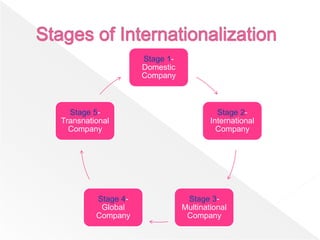
Stage 1-
                    Domestic
                    Company


  Stage 5-                               Stage 2-
Transnational                          International
  Company                                Company


         Stage 4-               Stage 3-
          Global               Multinational
         Company                Company
 Focus on domestic market/suppliers/financial
  companies/customers/etc.
 Motto- if it is not happening in home
  country, it is not happening.
 Selects diversification strategy for domestic
  market.
 Does not select the strategy of
  expansion/penetrating into international
  market.
 Growth of domestic company leads to
  internationalization.
 Exploits the opportunities outside the
  domestic country.
 These are Ethnocentric- domestic country
  oriented.
 Extends the domestic
  product/price/promotion/practice to the
  foreign market.
 International company turn MNC when they
  start responding to the needs of the different
  country.
 They shift from ethnocentric to polycentric
  (i.e. company establishes foreign
  subsidiary).
 They manufacture product as per the
  demand of the specific country.
 Example: Toyota’s Toyopet car’s in USA.
 Produces in a home/single country.
 Markets the same product globally.
 They have global marketing strategy.
 Produces for the global market but focuses
  domestically.
 Example: Harley Davidson- Produced in
  USA, Focused globally.
 Dr. Reddy’s Lab- Produces in India but
  market globally.
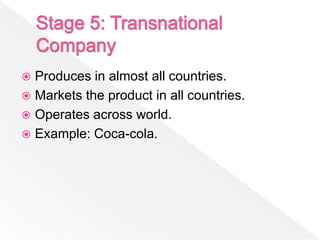
 Produces in almost all countries.
 Markets the product in all countries.
 Operates across world.
 Example: Coca-cola.
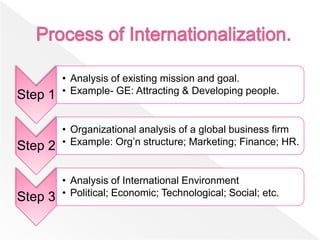
• Analysis of existing mission and goal.
Step 1   • Example- GE: Attracting & Developing people.


         • Organizational analysis of a global business firm
Step 2   • Example: Org’n structure; Marketing; Finance; HR.


         • Analysis of International Environment
Step 3   • Political; Economic; Technological; Social; etc.
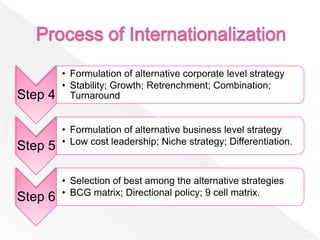
• Formulation of alternative corporate level strategy
         • Stability; Growth; Retrenchment; Combination;
Step 4     Turnaround


         • Formulation of alternative business level strategy
         • Low cost leadership; Niche strategy; Differentiation.
Step 5

         • Selection of best among the alternative strategies
         • BCG matrix; Directional policy; 9 cell matrix.
Step 6
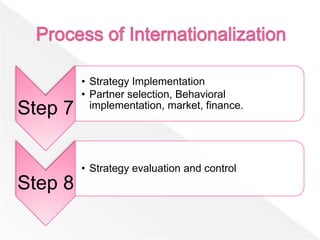
• Strategy Implementation
         • Partner selection, Behavioral
Step 7     implementation, market, finance.


         • Strategy evaluation and control
Step 8
 International business firms either perform
  their business operations on their own or
  collaborate with other countries/companies.
 Sometimes, companies collaborate with their
  competitors also.
 Factors affecting collaboration:
  physical, economical, scale of
  operation, make or buy, or competitive
  environment.
   Spread and reduced cost- reducing the start up cost
    and reducing the time by outsourcing.
   Specialize in core competency: companies perform
    the activities concerning core competencies most
    efficiently compared to other activities.
   Avoid or counter competencies: Some market are not
    large enough to accommodate competitors.
   Minimize exposure in risky environment:
    Political/economic and security factors create risky
    business environment in different countries.
   Vertical or horizontal integration: Linkage or integration
    allow companies to concentrate on the core-
    competencies, operate on small scale and emphasize on a
    portion of supply chain.
   Sharing capacities: Companies can jointly share their
    production/service/HR and other capacities in order to
    operate on optimum scale.
   Gain location: Sometimes it is difficult for MNC’s to conduct
    business in some countries on their own.
   Overcome governmental constraint: Imposing limit on
    foreign ownership or prohibit exclusive foreign companies.
   Diversify globally: Diverse culture and geographical
    location temp companies to collaborate.
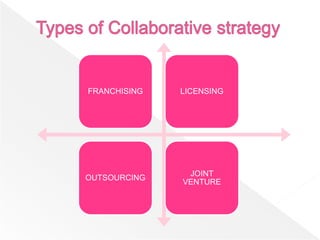
FRANCHISING   LICENSING


               JOINT
OUTSOURCING
              VENTURE
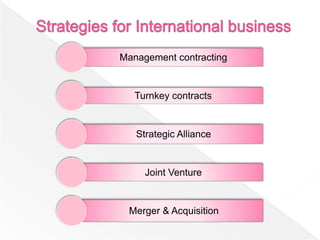
Management contracting


   Turnkey contracts


   Strategic Alliance


     Joint Venture


 Merger & Acquisition
 Firm providing management know-how may not have
  any equity stake in the enterprise.
 Low-risk, and starts yielding income from the very
  beginning.
 Helps in commercializing he existing know-how built up
  with significant investment.
 Supports in reducing fluctuations in business volume.
 Brings additional benefit for managing company.
 Example: Tata tea, Harrison malayalam and AVT have
  contract to manage the number of plantations in Sri
  Lanka.
 Mostly fund in supply, erection and
  commissioning of plants.
 Example: Oil refinery, steel mills, cement and
  fertilizer plant, etc.
 Agreement by the seller to supply a buyer with
  a facility fully equipped and ready to be
  operated by the buyer’s personnel.
 Fast-food franchising- when a franchiser agrees
  to select a store site, build the store, equip
  it, train the franchisee and employees and
  sometimes arrange the finance.
   Also known as “entete & coalition”.
   Enhances the long term competitive advantage by
    forming alliance with its competitors (existing or
    potential).
   Example: A firm may enter the foreign market by
    forming alliance with a firm in te foreign market for
    marketing or distributing the former’s products.
   A US pharmaceutical company may use the
    promotion and distribution infrastructure of
    Japanese pharmaceuticals to sell its product in
    Japan.
   It is a type of competitive strategy rather than an
    entry strategy.
 Technological development alliance:
  research consortia, simultaneous
  engineering agreement, liasioning or joint
  venture.
 Marketing, sales and service alliance.
 Multiple activity alliance.
 Cross-Border alliance
 Examples:
 Tata & TFR, Tata & Tetley,
 Tariff Barriers- Specific Tariffs and Valorem
  Tariffs.
 Non-Tariff Barriers-
  Quotas, Licensing, Voluntary Export
  Restraint (VER), Subsidies, Local Content
  Requirement.
 Tariff is the tax imposed on imports.
 Specific tariff- it refers to a fixed charge
  levied on the units of the product imported.
 Example: Rs. 1000/- levied on each T.V.
  imported.
 Ad-Valorem tariff- Tariff levied as a
  proportion of the value of the imported goods
  (30% on the Total value).
 Protect domestic industries.
 Increasing cost of imported goods.
 Automobile/sugar/cement industry.
 Govt. of importing country (revenue in the
  form of import duty).
 Industries of importing country (Market
  share).
 Jobs are saved of domestic country.
 Protection of business- ancillary
  industry, servicing, market
  intermediaries, etc.
 Consumer pay higher price (due to the
  inefficiency of domestic producers).
 Exporting country looses the demand, sales
  and profit for its product.
 Motive is to encourage domestic production
  and to protect domestic producers from
  foreign competitors.
 Govt. pays to domestic producers by
  reducing their operation cost.
 Forms of subsidies- cash grants, loan and
  advances, tax holidays, govt. procurement of
  output at a higher rate, equity participation
  and supply of input at lower prices.
Merits:
   International competitiveness of domestic
    industry.
   Provide large scale economies.
   Low cost production.
   Early entry to foreign market.
   First mover advantage.
Demerits:
 Protect inefficiency & lethargy of the domestic
  firms
 Do not enhance international competitiveness.
 Direct restriction on quantity of goods
  imported.
 License are issued to certain firms and
  individuals.
 License are issued for importing certain
  quantity of goods.
 Example: Car, Bikes, Milk, etc.
Merits
   Protect domestic produces from foreign
    competition.
 Opposite form of import quotas.
 It is a quota on exports of the domestic
  firms, imposed by the exporting country.
 Imposed on the request of the imorting
  country.
Merits:
 Its violation leads to imposition of tariff.
 Protect from foreign competitors.
 Makes domestic goods cheap.
 Some specific portion/fraction of a product
  imported to be produced domestically.
 Requirements can be (50% of the
  component should be from the domestic
  country).
 In value terms (50% of the value of the
  product should be produced domestically).
Merits:
 Employment opportunities
 Utilization of local resources and economic
  activities
   It is a type of inter-governmental
    arrangement.
 Concerned with the production of , and trade
    in, certain primary products.
 Objective was to stabilizing the prices.
It takes place in three forms:
 Quota
 Buffer stock and
 Bilateral or Multilateral contract.
 Objective is to prevent a fall in commodity
  prices by regulating the supply.
 Countries undertake to restrict export or
  production by a certain percentage of the
  basic quota decided by the central
  committee or council.
 Example:
 Coffee agreement among the major
  producers of Latin America and
  Africa, limited the amount that could be
  exported by each country.
 Seeks to stabilize commodity prices by
  maintaining accurate demand and supply.
 Stabilizes the prices by increasing the
  market supply.
 When the price tends to rise and absorbing
  the excess supply to prevent a fall in the
  prices.
Bilateral-
 Purchase & sale certain quantities of a
   commodity at agreed prices (between major
   importer & exporter).
 Upper & lower prices are specified.
 If the market price remain within this
   limit, agreement becomes inoperative.

Unit 1

  • 2.
     Computers- Producedin USA  Television- Produced in Japan  Electronic Items- From Japan  Beverages (Coca-Cola, Amul Cool, Etc.)  Bikes & Cars- From Other Countries  Perfumes- Manufactured in France.  Buying products from internet.  Clothing's- Footwear, Casuals, Capri, Bermuda, etc.
  • 3.
     First beganin the year 1870 and ended in 1919 (end of World War-I).  Main objective was to import raw materials and export finished goods. GDP was 22.1.  Drawbacks: Imposition of trade barriers by the government, to protect domestic producers. GDP fell to 9.1.  This phase has been described as “BEGGAR-MY-NEIGHBOUR”.
  • 4.
    Growth Strategy- Leads to geographical expansion.  Managing Product life-cycle- Shifting of the market.  Technology Advantages- Core competencies.  New business opportunity- entering new market.  Proper use of resources- proper utilization of natural resources of countries (material, labor, etc.)  Conti.
  • 5.
    Availability of quality product- Foreign companies market latest products at reasonable price.  Earning foreign exchange- Foreign exchange may be required for importing many products (crude oil, equipments, etc.)  Helps in Mutual growth- India depends on gulf countries for its crude oil supplies.  Investment in infrastructure- Investment in roads, etc.
  • 6.
    Advanced countries felt a severe set back.  Production increased more than Demand.  Decline in International Trade.  Breakdown of Gold Standard (Bretton Woods System).  Decline in trade/investment barriers.  Increase in FDI.  Technology changes and growth of MNC’s.
  • 7.
     Due tothe above limitations, a need for the international co-operation was felt.  It led to the establishment of institutions such as: IMF, IBRD, ITO,GATT/ WTO, etc.  Establishment of these institutions led to globalization, and many new trends took place.  Shifting from exporting & importing to international marketing.  Shifting from international marketing to international business.
  • 8.
     Establishment ofWTO, IMF and IBRD.  Regional integration (NAFTA, SAARC, ASEAN, APEC, EFTA, etc. )  Decline in trade/investment barriers.  Increase in FDI/FII/QDII.  Technology changes and growth of MNC’s.
  • 9.
    Stage 1- Domestic Company Stage 5- Stage 2- Transnational International Company Company Stage 4- Stage 3- Global Multinational Company Company
  • 10.
     Focus ondomestic market/suppliers/financial companies/customers/etc.  Motto- if it is not happening in home country, it is not happening.  Selects diversification strategy for domestic market.  Does not select the strategy of expansion/penetrating into international market.
  • 11.
     Growth ofdomestic company leads to internationalization.  Exploits the opportunities outside the domestic country.  These are Ethnocentric- domestic country oriented.  Extends the domestic product/price/promotion/practice to the foreign market.
  • 12.
     International companyturn MNC when they start responding to the needs of the different country.  They shift from ethnocentric to polycentric (i.e. company establishes foreign subsidiary).  They manufacture product as per the demand of the specific country.  Example: Toyota’s Toyopet car’s in USA.
  • 13.
     Produces ina home/single country.  Markets the same product globally.  They have global marketing strategy.  Produces for the global market but focuses domestically.  Example: Harley Davidson- Produced in USA, Focused globally.  Dr. Reddy’s Lab- Produces in India but market globally.
  • 14.
     Produces inalmost all countries.  Markets the product in all countries.  Operates across world.  Example: Coca-cola.
  • 15.
    • Analysis ofexisting mission and goal. Step 1 • Example- GE: Attracting & Developing people. • Organizational analysis of a global business firm Step 2 • Example: Org’n structure; Marketing; Finance; HR. • Analysis of International Environment Step 3 • Political; Economic; Technological; Social; etc.
  • 16.
    • Formulation ofalternative corporate level strategy • Stability; Growth; Retrenchment; Combination; Step 4 Turnaround • Formulation of alternative business level strategy • Low cost leadership; Niche strategy; Differentiation. Step 5 • Selection of best among the alternative strategies • BCG matrix; Directional policy; 9 cell matrix. Step 6
  • 17.
    • Strategy Implementation • Partner selection, Behavioral Step 7 implementation, market, finance. • Strategy evaluation and control Step 8
  • 18.
     International businessfirms either perform their business operations on their own or collaborate with other countries/companies.  Sometimes, companies collaborate with their competitors also.  Factors affecting collaboration: physical, economical, scale of operation, make or buy, or competitive environment.
  • 19.
    Spread and reduced cost- reducing the start up cost and reducing the time by outsourcing.  Specialize in core competency: companies perform the activities concerning core competencies most efficiently compared to other activities.  Avoid or counter competencies: Some market are not large enough to accommodate competitors.  Minimize exposure in risky environment: Political/economic and security factors create risky business environment in different countries.
  • 20.
    Vertical or horizontal integration: Linkage or integration allow companies to concentrate on the core- competencies, operate on small scale and emphasize on a portion of supply chain.  Sharing capacities: Companies can jointly share their production/service/HR and other capacities in order to operate on optimum scale.  Gain location: Sometimes it is difficult for MNC’s to conduct business in some countries on their own.  Overcome governmental constraint: Imposing limit on foreign ownership or prohibit exclusive foreign companies.  Diversify globally: Diverse culture and geographical location temp companies to collaborate.
  • 21.
    FRANCHISING LICENSING JOINT OUTSOURCING VENTURE
  • 22.
    Management contracting Turnkey contracts Strategic Alliance Joint Venture Merger & Acquisition
  • 23.
     Firm providingmanagement know-how may not have any equity stake in the enterprise.  Low-risk, and starts yielding income from the very beginning.  Helps in commercializing he existing know-how built up with significant investment.  Supports in reducing fluctuations in business volume.  Brings additional benefit for managing company.  Example: Tata tea, Harrison malayalam and AVT have contract to manage the number of plantations in Sri Lanka.
  • 24.
     Mostly fundin supply, erection and commissioning of plants.  Example: Oil refinery, steel mills, cement and fertilizer plant, etc.  Agreement by the seller to supply a buyer with a facility fully equipped and ready to be operated by the buyer’s personnel.  Fast-food franchising- when a franchiser agrees to select a store site, build the store, equip it, train the franchisee and employees and sometimes arrange the finance.
  • 25.
    Also known as “entete & coalition”.  Enhances the long term competitive advantage by forming alliance with its competitors (existing or potential).  Example: A firm may enter the foreign market by forming alliance with a firm in te foreign market for marketing or distributing the former’s products.  A US pharmaceutical company may use the promotion and distribution infrastructure of Japanese pharmaceuticals to sell its product in Japan.  It is a type of competitive strategy rather than an entry strategy.
  • 26.
     Technological developmentalliance: research consortia, simultaneous engineering agreement, liasioning or joint venture.  Marketing, sales and service alliance.  Multiple activity alliance.  Cross-Border alliance  Examples:  Tata & TFR, Tata & Tetley,
  • 29.
     Tariff Barriers-Specific Tariffs and Valorem Tariffs.  Non-Tariff Barriers- Quotas, Licensing, Voluntary Export Restraint (VER), Subsidies, Local Content Requirement.
  • 30.
     Tariff isthe tax imposed on imports.  Specific tariff- it refers to a fixed charge levied on the units of the product imported.  Example: Rs. 1000/- levied on each T.V. imported.  Ad-Valorem tariff- Tariff levied as a proportion of the value of the imported goods (30% on the Total value).
  • 31.
     Protect domesticindustries.  Increasing cost of imported goods.  Automobile/sugar/cement industry.
  • 32.
     Govt. ofimporting country (revenue in the form of import duty).  Industries of importing country (Market share).  Jobs are saved of domestic country.  Protection of business- ancillary industry, servicing, market intermediaries, etc.
  • 33.
     Consumer payhigher price (due to the inefficiency of domestic producers).  Exporting country looses the demand, sales and profit for its product.
  • 34.
     Motive isto encourage domestic production and to protect domestic producers from foreign competitors.  Govt. pays to domestic producers by reducing their operation cost.  Forms of subsidies- cash grants, loan and advances, tax holidays, govt. procurement of output at a higher rate, equity participation and supply of input at lower prices.
  • 35.
    Merits:  International competitiveness of domestic industry.  Provide large scale economies.  Low cost production.  Early entry to foreign market.  First mover advantage. Demerits:  Protect inefficiency & lethargy of the domestic firms  Do not enhance international competitiveness.
  • 36.
     Direct restrictionon quantity of goods imported.  License are issued to certain firms and individuals.  License are issued for importing certain quantity of goods.  Example: Car, Bikes, Milk, etc. Merits  Protect domestic produces from foreign competition.
  • 37.
     Opposite formof import quotas.  It is a quota on exports of the domestic firms, imposed by the exporting country.  Imposed on the request of the imorting country. Merits:  Its violation leads to imposition of tariff.  Protect from foreign competitors.  Makes domestic goods cheap.
  • 38.
     Some specificportion/fraction of a product imported to be produced domestically.  Requirements can be (50% of the component should be from the domestic country).  In value terms (50% of the value of the product should be produced domestically). Merits:  Employment opportunities  Utilization of local resources and economic activities
  • 39.
    It is a type of inter-governmental arrangement.  Concerned with the production of , and trade in, certain primary products.  Objective was to stabilizing the prices. It takes place in three forms:  Quota  Buffer stock and  Bilateral or Multilateral contract.
  • 40.
     Objective isto prevent a fall in commodity prices by regulating the supply.  Countries undertake to restrict export or production by a certain percentage of the basic quota decided by the central committee or council.  Example:  Coffee agreement among the major producers of Latin America and Africa, limited the amount that could be exported by each country.
  • 41.
     Seeks tostabilize commodity prices by maintaining accurate demand and supply.  Stabilizes the prices by increasing the market supply.  When the price tends to rise and absorbing the excess supply to prevent a fall in the prices.
  • 42.
    Bilateral-  Purchase &sale certain quantities of a commodity at agreed prices (between major importer & exporter).  Upper & lower prices are specified.  If the market price remain within this limit, agreement becomes inoperative.

Editor's Notes

  • #9 WTO: World Trade Organization; IMF- International Monetary Fund; IBRD- International Bank For Reconstruction And Development; NAFTA- North American Free Trade Agreement; SAARC- South Asian Association For Regional Cooperation; ASEAN- Association Of South East Asian Nation; APEC- Asia Pacific Economic Co-operation; EFTA- European Free Trade Association; FDI- Foreign Direct Investment; FII- Foreign Institutional Investments; QDII- Qualified Domestic Institutional Investment.