TEACHER – Mr. AMARESHTYAGI CLASS – BBA
SUBJECT - ADVERTISING MANAGEMENT YEAR – 2nd
SUBJECT CODE – BBA N 301 SEM. - 3rd
UNIT - 1
 The word advertising comes form the latin word
"advertere meaning” to turn the minds of
towards".
 Advertising is used for communicating business
information to the present and prospective
customers.
 It usually provides information about the
advertising firm, its product qualities, place of
availability of its products, etc.
 Advertisement is indispensable for both the
sellers and the buyers. However, it is more
important for the sellers.
 According to William J. Stanton "Advertising
consists of all the activities involved in
presenting to an audience a non-personal,
sponsor-identified, paid-for message about a
product or organization.“
 According to American Marketing Association
"advertising is any paid form of non-personal
presentation and promotion of ideas, goods and
services by an identified sponsor".
Now we analyses this definition , it includes following terms
 Paid form – ( Advertiser has to pay to buy the media space
& time)
 Non- personal presentation – (There is no face to face
comunication.it uses mediated form of communication
via- media)
 Ideas – ( to change mindset , attitude , behavior and life
style)
 Goods – ( these are tangible and transferable of
ownership)
 Services – ( these are intangible.You can not touch , only
experienced)
 Identified sponsor – (The adv. Should disclose or identify
the sources of opinions and ideas it presents)
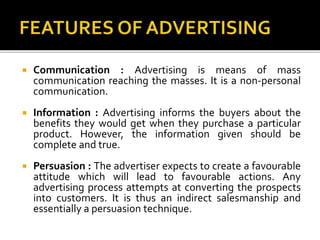
 Communication : Advertising is means of mass
communication reaching the masses. It is a non-personal
communication.
 Information : Advertising informs the buyers about the
benefits they would get when they purchase a particular
product. However, the information given should be
complete and true.
 Persuasion : The advertiser expects to create a favourable
attitude which will lead to favourable actions. Any
advertising process attempts at converting the prospects
into customers. It is thus an indirect salesmanship and
essentially a persuasion technique.
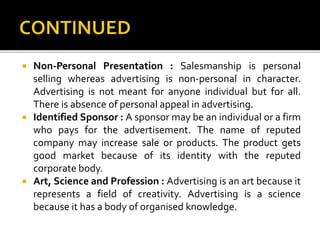
 Non-Personal Presentation : Salesmanship is personal
selling whereas advertising is non-personal in character.
Advertising is not meant for anyone individual but for all.
There is absence of personal appeal in advertising.
 Identified Sponsor : A sponsor may be an individual or a firm
who pays for the advertisement. The name of reputed
company may increase sale or products. The product gets
good market because of its identity with the reputed
corporate body.
 Art, Science and Profession : Advertising is an art because it
represents a field of creativity. Advertising is a science
because it has a body of organised knowledge.
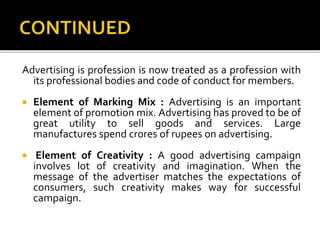
Advertising is profession is now treated as a profession with
its professional bodies and code of conduct for members.
 Element of Marking Mix : Advertising is an important
element of promotion mix. Advertising has proved to be of
great utility to sell goods and services. Large
manufactures spend crores of rupees on advertising.
 Element of Creativity : A good advertising campaign
involves lot of creativity and imagination. When the
message of the advertiser matches the expectations of
consumers, such creativity makes way for successful
campaign.
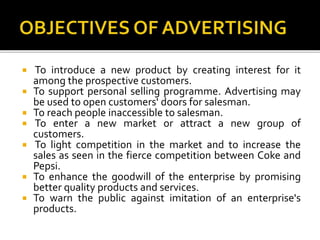
 To introduce a new product by creating interest for it
among the prospective customers.
 To support personal selling programme. Advertising may
be used to open customers' doors for salesman.
 To reach people inaccessible to salesman.
 To enter a new market or attract a new group of
customers.
 To light competition in the market and to increase the
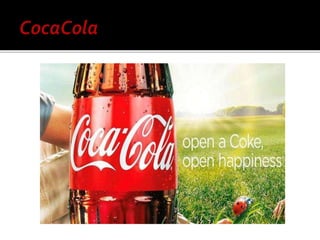
sales as seen in the fierce competition between Coke and
Pepsi.
 To enhance the goodwill of the enterprise by promising
better quality products and services.
 To warn the public against imitation of an enterprise's
products.
 To improve dealer relations. Advertising supports
the dealers in selling he product. Dealers are
attracted towards a product which is advertised
effectively.
1. Importance to the manufacturers and traders
 Introducing new product
 Increase the sale
 Create steady demand
 Help in meeting in competition
 Increase the morale of employee
 Facilitates mass production
2. Importance to consumer
 To know about the existence of various products
 Educates customer
 Utility of existing products
 Receive the quality products
3. Importance to the society
 Provides employment
 Promote the standard of living
 Educates the people
 Sustain the press and other media
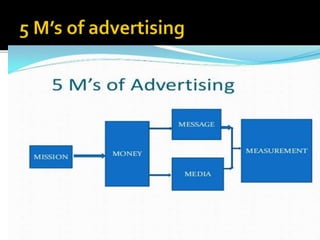
 Mission - (purpose or objective, ex.sales,
brand loyalty, information etc.)
 Money – ( finance provided to the adv.
Purpose)
 Message – ( how to deliver the message ,
creativity)
 Media - ( Coverage , cost , time, impact etc.)
 Measurement – ( effectiveness of adv.)
 Adv. Improves standard of living
 Consumer welfare and protection
 Effect cultural values of society
 Advertisement and social awareness
 Effects on values of products
 Effects on prices and monopoly
 Advertising and business cycle( Stable,
management of demand)
 Adv. and national income
 Boost the economy by achieve economies of
scale
 Employment generation
Ethics is a set of moral principles, norms or values. It
deals with good and bad with reference to a
particular culture. It refers to the moral duty and
obligation and advertiser has towards the society.
Moral principles are the rules or standards of what is
“right” or “wrong”.
If unethical practices are continued they will destroy
the image of the business as a whole and
advertising itself will become less effective. Some of
the moral codes developed in advertising are :
 It should avoid attacking competitors unfairly.
 It shall be free from offensive to public decency.
 It shall make clearest claims regarding price reduction
guarantees etc.
Ethics that are accepted and upheld by the society as
essential to good life should be followed while advertising
any products or service, or, idea.
 Ethics in advertising means that the advertisers should do
only good advertising, meaning thereby honest
advertising. It means that only true facts, no exaggeration
and no lies, about the product, service, idea or institution
should be stated, in clear in the ad.
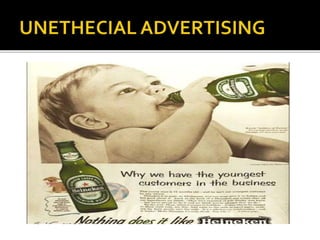
 Ethics in advertising also means that only good
products, services and ideas should be advertised and
that too to the right consumers. Advertising for
products like cigarettes, beer, whisky, rum, gin,
tobacco, pan parag and other harmful products
should be avoided.
 Ads showing testimonials should be restricted to
competent persons, who must express honest views
and choices.
 Ads in poor taste and offensive to public decency with
double meaning tone must be avoided.
 Ads should avoid attacking unfairly
competitors.
In sum, advertising should be honest, objective,
informative and persuasive in contents.
Truth refers to facts which can be observed and
verifiable.
A wrong or untrue information presented by advertising
damage the image of the company. They are different
ways of presenting untruth in advertising.
 Misrepresentation : This is a deliberate attempt to
tell untruth. It takes place by attributing to good
qualities which the products may not possess quoting
names of users not in existence, giving statistics of
assumptions not justified by the facts.
 Make-Believe Statistics : The idea in these is to give
such statistics as to make the readers believe that the
figures are concise and precise while actually they
may not be so.
 Total Lies : Advertisements of products which claim
mirage e.g.,reduction of 10kg. weight in 8 days or
white hairs will become black within one month.
 Misuse of Testimonials : Advertisements in which
testimonials of firm stars and sportsmen are used
simply for sales promotion.
 Alcohol and Tobacco Advertising : Advertising which
induce people to use tobacco and alcohol are harmful
to human life e.g.,pan masala and gutka.
 Vulgar Taste : Advertisements in which undue
importance is given to women or sex objects are
unethical.
 Awards / Prizes : Advertisements wherein consumers
are asked to send entries against which awards /prizes
and free gifts are offered are unethical.
 Undue Emphasis : In this, information is carried beyond
truth. Emphasis is laid on certain factors which may not be in
reality existing or pertaining to the company concerned.
 Misleading Names and Brands : Name of persons, areas or
countries well-known for certain things are associated with
the names of goods in order to create favourable
impressions about the attributes of such goods.
 Fantastic Claims : By fantastic claims, minor virtues are
magnified. Small things are exaggerated beyond limits.
Advertising management unit 1

Advertising management unit 1

  • 1.
    TEACHER – Mr.AMARESHTYAGI CLASS – BBA SUBJECT - ADVERTISING MANAGEMENT YEAR – 2nd SUBJECT CODE – BBA N 301 SEM. - 3rd UNIT - 1
  • 3.
     The wordadvertising comes form the latin word "advertere meaning” to turn the minds of towards".  Advertising is used for communicating business information to the present and prospective customers.  It usually provides information about the advertising firm, its product qualities, place of availability of its products, etc.  Advertisement is indispensable for both the sellers and the buyers. However, it is more important for the sellers.
  • 4.
     According toWilliam J. Stanton "Advertising consists of all the activities involved in presenting to an audience a non-personal, sponsor-identified, paid-for message about a product or organization.“  According to American Marketing Association "advertising is any paid form of non-personal presentation and promotion of ideas, goods and services by an identified sponsor".
  • 5.
    Now we analysesthis definition , it includes following terms  Paid form – ( Advertiser has to pay to buy the media space & time)  Non- personal presentation – (There is no face to face comunication.it uses mediated form of communication via- media)  Ideas – ( to change mindset , attitude , behavior and life style)  Goods – ( these are tangible and transferable of ownership)  Services – ( these are intangible.You can not touch , only experienced)  Identified sponsor – (The adv. Should disclose or identify the sources of opinions and ideas it presents)
  • 6.
     Communication :Advertising is means of mass communication reaching the masses. It is a non-personal communication.  Information : Advertising informs the buyers about the benefits they would get when they purchase a particular product. However, the information given should be complete and true.  Persuasion : The advertiser expects to create a favourable attitude which will lead to favourable actions. Any advertising process attempts at converting the prospects into customers. It is thus an indirect salesmanship and essentially a persuasion technique.
  • 7.
     Non-Personal Presentation: Salesmanship is personal selling whereas advertising is non-personal in character. Advertising is not meant for anyone individual but for all. There is absence of personal appeal in advertising.  Identified Sponsor : A sponsor may be an individual or a firm who pays for the advertisement. The name of reputed company may increase sale or products. The product gets good market because of its identity with the reputed corporate body.  Art, Science and Profession : Advertising is an art because it represents a field of creativity. Advertising is a science because it has a body of organised knowledge.
  • 8.
    Advertising is professionis now treated as a profession with its professional bodies and code of conduct for members.  Element of Marking Mix : Advertising is an important element of promotion mix. Advertising has proved to be of great utility to sell goods and services. Large manufactures spend crores of rupees on advertising.  Element of Creativity : A good advertising campaign involves lot of creativity and imagination. When the message of the advertiser matches the expectations of consumers, such creativity makes way for successful campaign.
  • 9.
     To introducea new product by creating interest for it among the prospective customers.  To support personal selling programme. Advertising may be used to open customers' doors for salesman.  To reach people inaccessible to salesman.  To enter a new market or attract a new group of customers.  To light competition in the market and to increase the sales as seen in the fierce competition between Coke and Pepsi.  To enhance the goodwill of the enterprise by promising better quality products and services.  To warn the public against imitation of an enterprise's products.
  • 10.
     To improvedealer relations. Advertising supports the dealers in selling he product. Dealers are attracted towards a product which is advertised effectively.
  • 11.
    1. Importance tothe manufacturers and traders  Introducing new product  Increase the sale  Create steady demand  Help in meeting in competition  Increase the morale of employee  Facilitates mass production 2. Importance to consumer  To know about the existence of various products  Educates customer  Utility of existing products  Receive the quality products
  • 12.
    3. Importance tothe society  Provides employment  Promote the standard of living  Educates the people  Sustain the press and other media
  • 14.
     Mission -(purpose or objective, ex.sales, brand loyalty, information etc.)  Money – ( finance provided to the adv. Purpose)  Message – ( how to deliver the message , creativity)  Media - ( Coverage , cost , time, impact etc.)  Measurement – ( effectiveness of adv.)
  • 15.
     Adv. Improvesstandard of living  Consumer welfare and protection  Effect cultural values of society  Advertisement and social awareness
  • 16.
     Effects onvalues of products  Effects on prices and monopoly  Advertising and business cycle( Stable, management of demand)  Adv. and national income  Boost the economy by achieve economies of scale  Employment generation
  • 17.
    Ethics is aset of moral principles, norms or values. It deals with good and bad with reference to a particular culture. It refers to the moral duty and obligation and advertiser has towards the society. Moral principles are the rules or standards of what is “right” or “wrong”. If unethical practices are continued they will destroy the image of the business as a whole and advertising itself will become less effective. Some of the moral codes developed in advertising are :
  • 18.
     It shouldavoid attacking competitors unfairly.  It shall be free from offensive to public decency.  It shall make clearest claims regarding price reduction guarantees etc. Ethics that are accepted and upheld by the society as essential to good life should be followed while advertising any products or service, or, idea.  Ethics in advertising means that the advertisers should do only good advertising, meaning thereby honest advertising. It means that only true facts, no exaggeration and no lies, about the product, service, idea or institution should be stated, in clear in the ad.
  • 19.
     Ethics inadvertising also means that only good products, services and ideas should be advertised and that too to the right consumers. Advertising for products like cigarettes, beer, whisky, rum, gin, tobacco, pan parag and other harmful products should be avoided.  Ads showing testimonials should be restricted to competent persons, who must express honest views and choices.  Ads in poor taste and offensive to public decency with double meaning tone must be avoided.
  • 20.
     Ads shouldavoid attacking unfairly competitors. In sum, advertising should be honest, objective, informative and persuasive in contents.
  • 22.
    Truth refers tofacts which can be observed and verifiable. A wrong or untrue information presented by advertising damage the image of the company. They are different ways of presenting untruth in advertising.  Misrepresentation : This is a deliberate attempt to tell untruth. It takes place by attributing to good qualities which the products may not possess quoting names of users not in existence, giving statistics of assumptions not justified by the facts.
  • 23.
     Make-Believe Statistics: The idea in these is to give such statistics as to make the readers believe that the figures are concise and precise while actually they may not be so.  Total Lies : Advertisements of products which claim mirage e.g.,reduction of 10kg. weight in 8 days or white hairs will become black within one month.  Misuse of Testimonials : Advertisements in which testimonials of firm stars and sportsmen are used simply for sales promotion.
  • 24.
     Alcohol andTobacco Advertising : Advertising which induce people to use tobacco and alcohol are harmful to human life e.g.,pan masala and gutka.  Vulgar Taste : Advertisements in which undue importance is given to women or sex objects are unethical.  Awards / Prizes : Advertisements wherein consumers are asked to send entries against which awards /prizes and free gifts are offered are unethical.
  • 25.
     Undue Emphasis: In this, information is carried beyond truth. Emphasis is laid on certain factors which may not be in reality existing or pertaining to the company concerned.  Misleading Names and Brands : Name of persons, areas or countries well-known for certain things are associated with the names of goods in order to create favourable impressions about the attributes of such goods.  Fantastic Claims : By fantastic claims, minor virtues are magnified. Small things are exaggerated beyond limits.