“The World has become small and completely
interdependent.”
Wendell L. Wilkie, Republican presidential
nominee defeated by Franklin D. Roosevelt in
1940
BY: SEQUOAH LLOYD
Table of Contents
Global Management
• Absolute Advantage
• Comparative Advantage
Exporting and
Importing
• Exports
• Imports
• The Trade Balance
• Foreign Exchange
Protectionism
• Tariffs
• Quotas
• Embargoes
• Free Trade Areas
Doing Business Globally
• Forms of International
Operations
• Working Through a
Foreign Intermediary
• Signing a Licensing
Agreement With a
Foreign Company
• Forming a Strategic
Alliance
Global Management - refers to the way an organization manages its business
internationally, including its sales, marketing, hiring and finance practices.
International trade – consists of the exchange of goods and services by different
countries.
Absolute Advantage – is the ability to produce more of a good than another
producer with the same quantity of inputs .
Comparative Advantage - is an economic theory about the potential gains from
trade for individuals, firms, or nations that arise from differences in their factor
endowments or technological progress.
Law of comparative advantage – states that producers should produce the goods
they are efficient at producing and purchase from others the goods they are less
efficient at producing.
Exports – Goods and services that are sold abroad.
Imports - Goods and services purchased abroad.
Exports
Exports represent an important resource of revenue for many companies.
Northwest Airlines earns about a third of its revenue outside of the
United States.
Diversification – is engaging to diversify their sales so that
sluggish sales in one market be offset by stronger sales
elsewhere.
American companies import billions of dollars worth
of goods and services every year.
Import Of Materials
Many companies import some or all of the materials
they use in order to reduce their production costs.
The Trade Balance
Balance of Trade
is the difference between the value of goods a country exports and the
value of goods it imports.
A country that exports more than it imports runs a trade surplus.
A country that imports more than it exports runs a trade deficit.
Companies that purchase goods from foreign countries may
be asked to pay for them with foreign currency, depending on
the contract governing the purchase.
Tariff – is a tax on imports.
Quotas – are restrictions on the quantity of a good that can enter
a country.
Embargo – is a total ban on impact of a good from a particular
country.
A free trade area – is a region within which trade
restrictions are reduced or eliminated.
Doing Business Globally
Forms of International Operations
Small companies often work through local companies, which are
familiar with local markets.
-Large companies often establish sales, manufacturing, and
distribution facilities in foreign countries.
Working Through a Foreign Intermediary
Companies that are not willing or able to invest millions of dollars in
operations abroad often export their products through foreign
company’s product.
Foreign intermediary is a wholesaler or agent that markets products
for companies wanting to do business abroad.
Another way companies can reach foreign consumers is by licensing a
foreign company to sell their products or services abroad.
Licensing agreement – is an agreement that permits one company to
sell another’s companies revenues.
Forming a Strategic Alliance
Some companies can expand into foreign markets by forming strategic
alliances with foreign companies.
Strategic alliance – involves pooling resources and skills in order to
achieve common goals.
Becoming a Multinational Corporation
Companies willing to make a significant financial commitment often
establish manufacturing and distribution facilities in foreign countries.
Businesses with a Multinational Corporation sell their products or
services in other countries.
Challenges of Working in an International
Environment
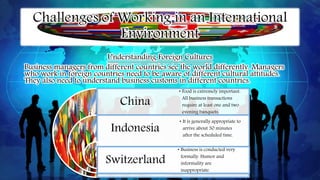
Understanding Foreign Cultures
Business managers from different countries see the world differently. Managers
who work in foreign countries need to be aware of different cultural attitudes.
They also need to understand business customs in different countries.
China
Indonesia
Switzerland
• Food is extremely important.
All business transactions
require at least one and two
evening banquets.
• It is generally appropriate to
arrive about 30 minutes
after the scheduled time.
• Business is conducted very
formally. Humor and
informality are
inappropriate.
Challenges of Working in an International
Environment
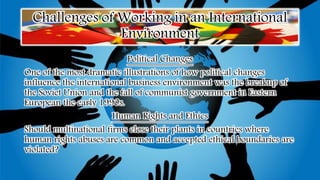
Political Changes
One of the most dramatic illustrations of how political changes
influence the international business environment was the breakup of
the Soviet Union and the fall of communist government in Eastern
European the early 1990s.
Human Rights and Ethics
Should multinational firms close their plants in countries where
human rights abuses are common and accepted ethical boundaries are
violated?
Define global management
Compare and contrast importing and exporting.
Explain the advantages and disadvantages of protectionism.
Discuss the challenges of doing business globally.
As technology continues to connect the world, many organizations have
taken advantage of the opportunity to conduct business globally. Global
management combines knowledge of business, culture, history and social
practices to help companies find their niches in the international business
community and successfully work with other cultures.
Overview

Global Management Presentation

  • 1.
    “The World hasbecome small and completely interdependent.” Wendell L. Wilkie, Republican presidential nominee defeated by Franklin D. Roosevelt in 1940 BY: SEQUOAH LLOYD
  • 2.
    Table of Contents GlobalManagement • Absolute Advantage • Comparative Advantage Exporting and Importing • Exports • Imports • The Trade Balance • Foreign Exchange Protectionism • Tariffs • Quotas • Embargoes • Free Trade Areas Doing Business Globally • Forms of International Operations • Working Through a Foreign Intermediary • Signing a Licensing Agreement With a Foreign Company • Forming a Strategic Alliance
  • 3.
    Global Management -refers to the way an organization manages its business internationally, including its sales, marketing, hiring and finance practices. International trade – consists of the exchange of goods and services by different countries. Absolute Advantage – is the ability to produce more of a good than another producer with the same quantity of inputs . Comparative Advantage - is an economic theory about the potential gains from trade for individuals, firms, or nations that arise from differences in their factor endowments or technological progress. Law of comparative advantage – states that producers should produce the goods they are efficient at producing and purchase from others the goods they are less efficient at producing.
  • 5.
    Exports – Goodsand services that are sold abroad. Imports - Goods and services purchased abroad.
  • 6.
    Exports Exports represent animportant resource of revenue for many companies. Northwest Airlines earns about a third of its revenue outside of the United States. Diversification – is engaging to diversify their sales so that sluggish sales in one market be offset by stronger sales elsewhere.
  • 7.
    American companies importbillions of dollars worth of goods and services every year. Import Of Materials Many companies import some or all of the materials they use in order to reduce their production costs.
  • 8.
    The Trade Balance Balanceof Trade is the difference between the value of goods a country exports and the value of goods it imports. A country that exports more than it imports runs a trade surplus. A country that imports more than it exports runs a trade deficit.
  • 9.
    Companies that purchasegoods from foreign countries may be asked to pay for them with foreign currency, depending on the contract governing the purchase.
  • 10.
    Tariff – isa tax on imports. Quotas – are restrictions on the quantity of a good that can enter a country. Embargo – is a total ban on impact of a good from a particular country. A free trade area – is a region within which trade restrictions are reduced or eliminated.
  • 11.
    Doing Business Globally Formsof International Operations Small companies often work through local companies, which are familiar with local markets. -Large companies often establish sales, manufacturing, and distribution facilities in foreign countries.
  • 12.
    Working Through aForeign Intermediary Companies that are not willing or able to invest millions of dollars in operations abroad often export their products through foreign company’s product. Foreign intermediary is a wholesaler or agent that markets products for companies wanting to do business abroad.
  • 13.
    Another way companiescan reach foreign consumers is by licensing a foreign company to sell their products or services abroad. Licensing agreement – is an agreement that permits one company to sell another’s companies revenues.
  • 14.
    Forming a StrategicAlliance Some companies can expand into foreign markets by forming strategic alliances with foreign companies. Strategic alliance – involves pooling resources and skills in order to achieve common goals.
  • 15.
    Becoming a MultinationalCorporation Companies willing to make a significant financial commitment often establish manufacturing and distribution facilities in foreign countries. Businesses with a Multinational Corporation sell their products or services in other countries.
  • 16.
    Challenges of Workingin an International Environment Understanding Foreign Cultures Business managers from different countries see the world differently. Managers who work in foreign countries need to be aware of different cultural attitudes. They also need to understand business customs in different countries. China Indonesia Switzerland • Food is extremely important. All business transactions require at least one and two evening banquets. • It is generally appropriate to arrive about 30 minutes after the scheduled time. • Business is conducted very formally. Humor and informality are inappropriate.
  • 17.
    Challenges of Workingin an International Environment Political Changes One of the most dramatic illustrations of how political changes influence the international business environment was the breakup of the Soviet Union and the fall of communist government in Eastern European the early 1990s. Human Rights and Ethics Should multinational firms close their plants in countries where human rights abuses are common and accepted ethical boundaries are violated?
  • 18.
    Define global management Compareand contrast importing and exporting. Explain the advantages and disadvantages of protectionism. Discuss the challenges of doing business globally.
  • 19.
    As technology continuesto connect the world, many organizations have taken advantage of the opportunity to conduct business globally. Global management combines knowledge of business, culture, history and social practices to help companies find their niches in the international business community and successfully work with other cultures. Overview