Introduction to
International Business
Learning Objectives
1.What is international business?
2.What are the key concepts in international
trade and investment?
3.How does international business differs
from domestic business?
4.Who participates in international business?
5.Why do firms pursue internationalization
strategies?
6.Why should you study international
business?
International Business – A Firm Level Activity
Performance of trade and investment
activities by firms across national
borders.
Internationalization of Business
• Companies conduct value-adding activities on a
global scale, i.e. organize, source, manufacture,
market, etc.
• Firm’s international expansion is made more
compelling and easier due to market and
product globalization- for firms small and large.
The Nature of International Business
• All value-adding activities including
sourcing, manufacturing, and marketing,
can be performed in international locations
• The subject of cross-border trade can be
products, services, capital, technology,
know how, and labour
• Firms internationalize through exporting,
foreign direct investment, licensing,
franchising, and collaborative ventures
Globalization of Markets – a Macro Concept
Ongoing economic integration and growing
interdependency of countries worldwide.
• Integration is central to globalization,
which has resulted in the widespread
diffusion of products, technology, and
knowledge worldwide, regardless of where
they originate.
Dimensions of Market Globalization
• Greater integration and interdependency of
national economies; leading to freer
movement of goods, services, capital, and
knowledge
• Rise of regional economic integration blocs
• Growth of global investment and financial
flows
• Convergence of consumer lifestyles and
preferences
• Globalization of production
International Trade
Exchange of products and services across
national borders; typically through
exporting and importing.
Exporting
Sale of products or services to customers
located abroad, from a base in the home
country or a third country.
Importing or Global Sourcing
Procurement of products or services from
suppliers located abroad for consumption
in the home country or a third country.
International investment
Transfer of assets to another country or the
acquisition of assets in that country.
• International Portfolio investment (typically short-
term) is the passive ownership of foreign securities
such as stocks and bonds for the purpose of
generating financial returns.
• Foreign direct investment (FDI) (typically long-
term) is an internationalization strategy in which the
firm establishes a physical presence abroad through
acquisition of productive assets such as capital,
technology, labor, land, plant, and equipment.
The Nature of FDI
• Foreign Direct Investment (FDI) - (asset ownership
and long time frame) is the ultimate commitment-
level of internationalization, and thus this text
focuses primarily on FDI as opposed to
International Portfolio investment.
• Large, resourceful companies with substantial
international operations are able to leverage FDI to:
– Manufacture/assemble products in low-cost labor
countries, i.e. India, Russia, Brazil, China, and
Mexico;
– Invest in western markets, even though they may
originate from emerging economies themselves.
International Services Trade
• Larger, developed economies account for the
greatest proportion of services.
• EBay- the largest auction-based retailer on the
Internet, earned $6 billion in 2006, 40 percent of
which came from international sales.
• China has 1.3 billion people with an estimated
132 million Internet users.
• India has 1 billion people with an estimated 40
million Internet users.
• U.S. has an estimated 210 million Internet users.
• EBay expanded to India, China, Korea, and
Europe in anticipation of most of its future
revenue growth coming from abroad.
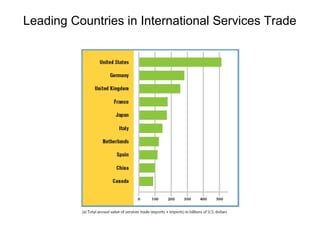
Leading Countries in International Services Trade
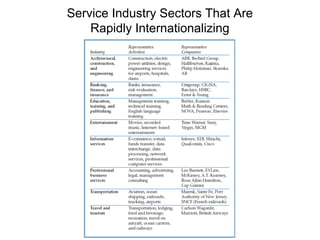
Service Industry Sectors That Are
Rapidly Internationalizing
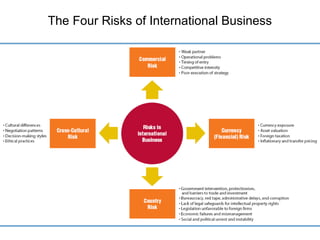
The Four Risks of International Business
The Four Types of Risks in IB
• Cross-cultural risk: a situation or event where
a cultural miscommunication puts some human
value at stake
• Country risk: potentially adverse effects on
company operations and profitability holes by
developments in the political, legal, and
economic environment in a foreign country
• Currency risk: risk of adverse unexpected
fluctuations in exchange rates
• Commercial risk: firms potential loss or failure
from poorly developed or executed business
strategies, tactics, or procedures
Cross-Cultural Risk
• Differences in language, lifestyles, attitudes,
customs, and religion, where a cultural
miscommunication jeopardizes a culturally-
valued mindset or behavior.
• Cultural blunders- hinder the effectiveness of
foreign managers.
• Language- critical dimension of culture- a
window to people’s values
• Language differences impede effective
communication.
• Cultural differences may lead to suboptimal
business strategies.
Country Risk (Political Risk)
• Differences in host country political, legal and
economic regimes may adversely impact firm
profitability.
• Laws, regulations and indigenous factors e.g.,
property rights, intellectual-property protection,
product liability, taxation policies, inflation, national
debt, and unbalanced international trade, may
encumber firm operations and performance.
• Government intervention: restricts market access;
imposes bureaucratic procedures hindering
business transactions; and limits the amount of
earned income that firms may repatriate from
foreign operations.
Currency Risk (Financial Risk)
• Risk of adverse exchange rate
fluctuations, inflation and other
harmful economic conditions create
uncertainty of returns.
• When currencies fluctuate
significantly, the value of the firm’s
assets, liabilities and/or operating
income may be substantially reduced.
Commercial Risk
• Less than optimal formulation and/or
implementation of strategies, tactics or
procedures, e.g. partnering selections,
market entry timing, pricing, product
features, and promotional themes
• Failures in international markets are far
more costly than domestic business
blunders.
Risks: Always Present but Manageable
• Managers need to understand their implications,
anticipate them, and take proactive action to reduce
adverse effects.
• Some risks are extremely challenging, e.g., the East
Asian economic crisis of 1998 generated substantial
commercial, currency, and country risks- several
East Asian countries lost currency values of
between 35 and 70 percent, leading to the collapse
of national stock markets, deepening trade deficits,
and suspension of normal business activity.
• Political and social unrest surged to Indonesia,
Malaysia, South Korea, Thailand, and the
Philippines.
Participants in IB
• Multinational enterprise (MNE): A large company
with substantial resources that performs various
business activities through a network of subsidiaries
and affiliates located in multiple countries.
• In addition to a home office, an MNE owns a
worldwide network of subsidiaries.
• Examples- Caterpillar, Kodak, Nokia, Samsung,
Unilever, Citibank, Vodafone, Carrefour, Bechtel,
Four Seasons Hotels, Disney, DHL, & Nippon Life
Insurance.
• Examples of Fortune’s Global 500- Exxon Mobil,
Royal Dutch Shell, BP, General Motors,
DaimlerChrysler, Toyota, Ford, and Wal-Mart.
Why do Firms Internationalize?
1.Seek opportunities for growth through market
diversification
2.Earn higher margins and profits
3.Gain new ideas about products, services, and
business methods
4.Better serve key customers that have relocated
abroad
5.Be closer to supply sources, benefit from
global sourcing advantages, or gain flexibility
in the sourcing of products
25
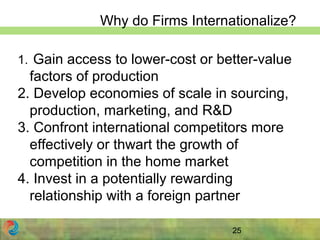
Why do Firms Internationalize?
1. Gain access to lower-cost or better-value
factors of production
2. Develop economies of scale in sourcing,
production, marketing, and R&D
3. Confront international competitors more
effectively or thwart the growth of
competition in the home market
4. Invest in a potentially rewarding
relationship with a foreign partner
Why Study International Business?
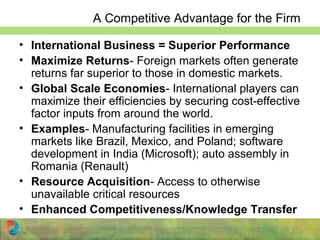
A Competitive Advantage for the Firm
• International Business = Superior Performance
• Maximize Returns- Foreign markets often generate
returns far superior to those in domestic markets.
• Global Scale Economies- International players can
maximize their efficiencies by securing cost-effective
factor inputs from around the world.
• Examples- Manufacturing facilities in emerging
markets like Brazil, Mexico, and Poland; software
development in India (Microsoft); auto assembly in
Romania (Renault)
• Resource Acquisition- Access to otherwise
unavailable critical resources
• Enhanced Competitiveness/Knowledge Transfer

1 introd. to international_

  • 1.
  • 2.
    Learning Objectives 1.What isinternational business? 2.What are the key concepts in international trade and investment? 3.How does international business differs from domestic business? 4.Who participates in international business? 5.Why do firms pursue internationalization strategies? 6.Why should you study international business?
  • 3.
    International Business –A Firm Level Activity Performance of trade and investment activities by firms across national borders.
  • 4.
    Internationalization of Business •Companies conduct value-adding activities on a global scale, i.e. organize, source, manufacture, market, etc. • Firm’s international expansion is made more compelling and easier due to market and product globalization- for firms small and large.
  • 5.
    The Nature ofInternational Business • All value-adding activities including sourcing, manufacturing, and marketing, can be performed in international locations • The subject of cross-border trade can be products, services, capital, technology, know how, and labour • Firms internationalize through exporting, foreign direct investment, licensing, franchising, and collaborative ventures
  • 6.
    Globalization of Markets– a Macro Concept Ongoing economic integration and growing interdependency of countries worldwide. • Integration is central to globalization, which has resulted in the widespread diffusion of products, technology, and knowledge worldwide, regardless of where they originate.
  • 7.
    Dimensions of MarketGlobalization • Greater integration and interdependency of national economies; leading to freer movement of goods, services, capital, and knowledge • Rise of regional economic integration blocs • Growth of global investment and financial flows • Convergence of consumer lifestyles and preferences • Globalization of production
  • 8.
    International Trade Exchange ofproducts and services across national borders; typically through exporting and importing.
  • 9.
    Exporting Sale of productsor services to customers located abroad, from a base in the home country or a third country.
  • 10.
    Importing or GlobalSourcing Procurement of products or services from suppliers located abroad for consumption in the home country or a third country.
  • 11.
    International investment Transfer ofassets to another country or the acquisition of assets in that country. • International Portfolio investment (typically short- term) is the passive ownership of foreign securities such as stocks and bonds for the purpose of generating financial returns. • Foreign direct investment (FDI) (typically long- term) is an internationalization strategy in which the firm establishes a physical presence abroad through acquisition of productive assets such as capital, technology, labor, land, plant, and equipment.
  • 12.
    The Nature ofFDI • Foreign Direct Investment (FDI) - (asset ownership and long time frame) is the ultimate commitment- level of internationalization, and thus this text focuses primarily on FDI as opposed to International Portfolio investment. • Large, resourceful companies with substantial international operations are able to leverage FDI to: – Manufacture/assemble products in low-cost labor countries, i.e. India, Russia, Brazil, China, and Mexico; – Invest in western markets, even though they may originate from emerging economies themselves.
  • 13.
    International Services Trade •Larger, developed economies account for the greatest proportion of services. • EBay- the largest auction-based retailer on the Internet, earned $6 billion in 2006, 40 percent of which came from international sales. • China has 1.3 billion people with an estimated 132 million Internet users. • India has 1 billion people with an estimated 40 million Internet users. • U.S. has an estimated 210 million Internet users. • EBay expanded to India, China, Korea, and Europe in anticipation of most of its future revenue growth coming from abroad.
  • 14.
    Leading Countries inInternational Services Trade
  • 15.
    Service Industry SectorsThat Are Rapidly Internationalizing
  • 16.
    The Four Risksof International Business
  • 17.
    The Four Typesof Risks in IB • Cross-cultural risk: a situation or event where a cultural miscommunication puts some human value at stake • Country risk: potentially adverse effects on company operations and profitability holes by developments in the political, legal, and economic environment in a foreign country • Currency risk: risk of adverse unexpected fluctuations in exchange rates • Commercial risk: firms potential loss or failure from poorly developed or executed business strategies, tactics, or procedures
  • 18.
    Cross-Cultural Risk • Differencesin language, lifestyles, attitudes, customs, and religion, where a cultural miscommunication jeopardizes a culturally- valued mindset or behavior. • Cultural blunders- hinder the effectiveness of foreign managers. • Language- critical dimension of culture- a window to people’s values • Language differences impede effective communication. • Cultural differences may lead to suboptimal business strategies.
  • 19.
    Country Risk (PoliticalRisk) • Differences in host country political, legal and economic regimes may adversely impact firm profitability. • Laws, regulations and indigenous factors e.g., property rights, intellectual-property protection, product liability, taxation policies, inflation, national debt, and unbalanced international trade, may encumber firm operations and performance. • Government intervention: restricts market access; imposes bureaucratic procedures hindering business transactions; and limits the amount of earned income that firms may repatriate from foreign operations.
  • 20.
    Currency Risk (FinancialRisk) • Risk of adverse exchange rate fluctuations, inflation and other harmful economic conditions create uncertainty of returns. • When currencies fluctuate significantly, the value of the firm’s assets, liabilities and/or operating income may be substantially reduced.
  • 21.
    Commercial Risk • Lessthan optimal formulation and/or implementation of strategies, tactics or procedures, e.g. partnering selections, market entry timing, pricing, product features, and promotional themes • Failures in international markets are far more costly than domestic business blunders.
  • 22.
    Risks: Always Presentbut Manageable • Managers need to understand their implications, anticipate them, and take proactive action to reduce adverse effects. • Some risks are extremely challenging, e.g., the East Asian economic crisis of 1998 generated substantial commercial, currency, and country risks- several East Asian countries lost currency values of between 35 and 70 percent, leading to the collapse of national stock markets, deepening trade deficits, and suspension of normal business activity. • Political and social unrest surged to Indonesia, Malaysia, South Korea, Thailand, and the Philippines.
  • 23.
    Participants in IB •Multinational enterprise (MNE): A large company with substantial resources that performs various business activities through a network of subsidiaries and affiliates located in multiple countries. • In addition to a home office, an MNE owns a worldwide network of subsidiaries. • Examples- Caterpillar, Kodak, Nokia, Samsung, Unilever, Citibank, Vodafone, Carrefour, Bechtel, Four Seasons Hotels, Disney, DHL, & Nippon Life Insurance. • Examples of Fortune’s Global 500- Exxon Mobil, Royal Dutch Shell, BP, General Motors, DaimlerChrysler, Toyota, Ford, and Wal-Mart.
  • 24.
    Why do FirmsInternationalize? 1.Seek opportunities for growth through market diversification 2.Earn higher margins and profits 3.Gain new ideas about products, services, and business methods 4.Better serve key customers that have relocated abroad 5.Be closer to supply sources, benefit from global sourcing advantages, or gain flexibility in the sourcing of products
  • 25.
    25 Why do FirmsInternationalize? 1. Gain access to lower-cost or better-value factors of production 2. Develop economies of scale in sourcing, production, marketing, and R&D 3. Confront international competitors more effectively or thwart the growth of competition in the home market 4. Invest in a potentially rewarding relationship with a foreign partner
  • 26.
  • 27.
    A Competitive Advantagefor the Firm • International Business = Superior Performance • Maximize Returns- Foreign markets often generate returns far superior to those in domestic markets. • Global Scale Economies- International players can maximize their efficiencies by securing cost-effective factor inputs from around the world. • Examples- Manufacturing facilities in emerging markets like Brazil, Mexico, and Poland; software development in India (Microsoft); auto assembly in Romania (Renault) • Resource Acquisition- Access to otherwise unavailable critical resources • Enhanced Competitiveness/Knowledge Transfer

Editor's Notes

  • #2 Sincere congratulations to the entire Wolverine team! 17 consecutive quarter of record revenue and earnings per share is no small feat. Your brand portfolio is strong and covers much competitive space. the company has not been content with its success; and is looking to leverage its brands beyond food rather than across apparel and accessories. You have set ambitious goals for the future.
  • #25 Fundamental changes in the business landscape
  • #26 Fundamental changes in the business landscape