Globalization
www.StudsPlanet.com
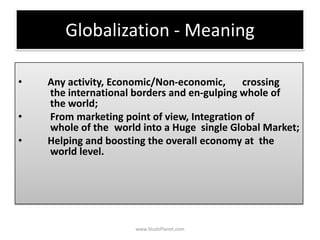
Globalization - Meaning
• Any activity, Economic/Non-economic, crossing
the international borders and en-gulping whole of
the world;
• From marketing point of view, Integration of
whole of the world into a Huge single Global Market;
• Helping and boosting the overall economy at the
world level.
www.StudsPlanet.com
Components of
Globalization
www.StudsPlanet.com
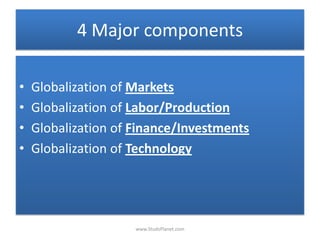
4 Major components
• Globalization of Markets
• Globalization of Labor/Production
• Globalization of Finance/Investments
• Globalization of Technology
www.StudsPlanet.com
Globalization of Markets
www.StudsPlanet.com
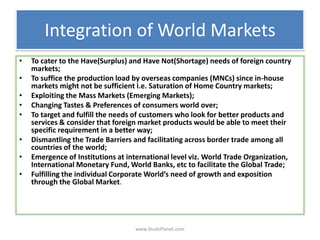
Integration of World Markets
• To cater to the Have(Surplus) and Have Not(Shortage) needs of foreign country
markets;
• To suffice the production load by overseas companies (MNCs) since in-house
markets might not be sufficient i.e. Saturation of Home Country markets;
• Exploiting the Mass Markets (Emerging Markets);
• Changing Tastes & Preferences of consumers world over;
• To target and fulfill the needs of customers who look for better products and
services & consider that foreign market products would be able to meet their
specific requirement in a better way;
• Dismantling the Trade Barriers and facilitating across border trade among all
countries of the world;
• Emergence of Institutions at international level viz. World Trade Organization,
International Monetary Fund, World Banks, etc to facilitate the Global Trade;
• Fulfilling the individual Corporate World’s need of growth and exposition
through the Global Market.
www.StudsPlanet.com
Globalization of
Production/Labor
www.StudsPlanet.com
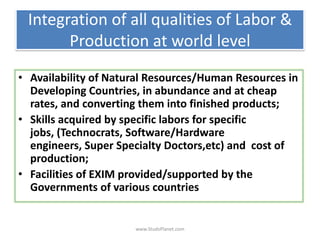
Integration of all qualities of Labor &
Production at world level
• Availability of Natural Resources/Human Resources in
Developing Countries, in abundance and at cheap
rates, and converting them into finished products;
• Skills acquired by specific labors for specific
jobs, (Technocrats, Software/Hardware
engineers, Super Specialty Doctors,etc) and cost of
production;
• Facilities of EXIM provided/supported by the
Governments of various countries
www.StudsPlanet.com
Globalization of Finance
www.StudsPlanet.com
Integration of Resources of Funds
exploiting all the possible Financial
Markets at world level
• While Developed Countries are bestowed with Capital and Capital
Goods, Developing Countries do not have them and hence need
capital to convert their natural resources into finished goods;
• Foreign Direct Investment (FDI) – (Growth & Promotion);
• By controlling the equilibrium of Foreign Trade;
• Direction of FDIs is re-focused on the Developing Countries, since
they have tremendous growth potential compared to Developed
Countries; GDP Growth Rate among different countries;
• Permission by the apex institutes of various countries to the
Foreign Institutional Investors (FIIs) to invest in capital markets
www.StudsPlanet.com
Globalization of Technology
www.StudsPlanet.com
Integration of all possible Technologies
from all over the world
• While Developed Countries possess Have Technologies, Developing ones
lag behind due to Have Not Technologies. Hence Developed Countries
have Competitive Advantages over their counter parts;
• Prevailing Cut Throat Competition in order to excel each other and the
sense of competition for betterment and crucial advantage; MNCs, in
the modern world, are successful due to Price Leadership. Quality
Leadership and Superior Service Quality Leadership;
• Technological Collaboration of Have Technology Countries with Have Not
Technologies countries;
• Heavy flow of Transfer of Technology (both – Internalized as well as
Externalized)
• Joint Ventures (JVs) and Mergers & Acquisitions (M&As) have played a
significant role for Globalization of Technology;
www.StudsPlanet.com
Advantages - Disadvantages
www.StudsPlanet.com
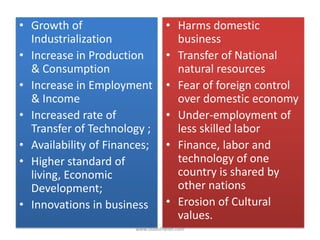
• Growth of
Industrialization
• Increase in Production
& Consumption
• Increase in Employment
& Income
• Increased rate of
Transfer of Technology ;
• Availability of Finances;
• Higher standard of
living, Economic
Development;
• Innovations in business
• Harms domestic
business
• Transfer of National
natural resources
• Fear of foreign control
over domestic economy
• Under-employment of
less skilled labor
• Finance, labor and
technology of one
country is shared by
other nations
• Erosion of Cultural
values.
www.StudsPlanet.com
Effects of Globalization
Indian Context
www.StudsPlanet.com
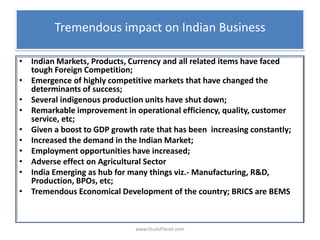
Tremendous impact on Indian Business
• Indian Markets, Products, Currency and all related items have faced
tough Foreign Competition;
• Emergence of highly competitive markets that have changed the
determinants of success;
• Several indigenous production units have shut down;
• Remarkable improvement in operational efficiency, quality, customer
service, etc;
• Given a boost to GDP growth rate that has been increasing constantly;
• Increased the demand in the Indian Market;
• Employment opportunities have increased;
• Adverse effect on Agricultural Sector
• India Emerging as hub for many things viz.- Manufacturing, R&D,
Production, BPOs, etc;
• Tremendous Economical Development of the country; BRICS are BEMS
www.StudsPlanet.com
M N Cs
www.StudsPlanet.com
Meaning
A company with HEADQUARTERS in one country and
various Branches/Subsidiaries across the Globe for
business at international level.
“A Corporation that controls Production facilities in
more than one country , such facilities having been
acquired through the process of Foreign Direct
Investment”
“The essential nature of the Multi National Enterprise
lies in the fact that its Managerial Headquarters lies in
one country (Home Country) while the enterprise
carries out operations in a number of countries.”
www.StudsPlanet.com
Role of MNCs in
Economic Growth
www.StudsPlanet.com
• Availability of Goods & Services of
international standard;
• Improvement of overall quality of Goods &
Services in the national market;
• Generation of Revenue through taxation;
• They trigger the need for better and improved
infrastructure;
• Employment Generation and Economic
Development.
www.StudsPlanet.com
Approaches to INTERNATIONAL BUSINESS
www.StudsPlanet.com
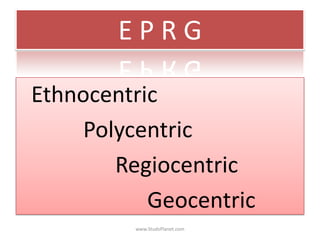
E P R G
Ethnocentric
Polycentric
Regiocentric
Geocentric
www.StudsPlanet.com
Ethnocentric
• As compared to the Domestic Business
Operations, the Overseas Business Operations are
considered to be secondary. OLD IS GOLD Philosophy;
• Usually happens when demand of goods in domestic
market is less and companies look for demand in outside
market to meet its supply
• There is no difference in the goods, marketing
strategy & basic business operations for exports purpose.
Maintaining the in-house/domestic approach towards
the exports market – Is called Ethnocentric Approach
www.StudsPlanet.com
Polycentric
• As compared to Ethnocentric approach , this
Philosophy believes that each and every market has its
own typical/unique Tastes & Preferences that have to
be addressed differently. Hence the company steps
forward to opening up branches/ a subsidiary in the
foreign market for varied operations;
• The key personnel in the foreign subsidiary company is
appointed by and from the domestic country;
• The environment of the host country is considered for
Marketing Mix
www.StudsPlanet.com
Regiocentric
• The people in a Continent/Zone share common border,
culture, language, buying habits, economic and
political system. Hence different Regions of the world
are considered as different markets.
• Hence, once the Polycentric approach is successful,
the subsidiary company in the Host Country
approaches and encroaches the neighboring country
markets (in the same region) and hence applies a
Regiocentric approach/strategy.
www.StudsPlanet.com
Geocentric
• This approach considers the entire world as one
huge single market or Global Market;
• Under this approach, the companies have a
series of subsidiaries in multiple foreign countries
• They hire Human Resources from all over the
world and their deployment is not limited to their
home country
• They develop Marketing Mix at the international
level, keeping in mind the business specific
environment of the countries they do business
with though GLOCALIZATION Strategy
www.StudsPlanet.com
www.StudsPlanet.com

Globaliation p point

  • 1.
  • 2.
    Globalization - Meaning •Any activity, Economic/Non-economic, crossing the international borders and en-gulping whole of the world; • From marketing point of view, Integration of whole of the world into a Huge single Global Market; • Helping and boosting the overall economy at the world level. www.StudsPlanet.com
  • 3.
  • 4.
    4 Major components •Globalization of Markets • Globalization of Labor/Production • Globalization of Finance/Investments • Globalization of Technology www.StudsPlanet.com
  • 5.
  • 6.
    Integration of WorldMarkets • To cater to the Have(Surplus) and Have Not(Shortage) needs of foreign country markets; • To suffice the production load by overseas companies (MNCs) since in-house markets might not be sufficient i.e. Saturation of Home Country markets; • Exploiting the Mass Markets (Emerging Markets); • Changing Tastes & Preferences of consumers world over; • To target and fulfill the needs of customers who look for better products and services & consider that foreign market products would be able to meet their specific requirement in a better way; • Dismantling the Trade Barriers and facilitating across border trade among all countries of the world; • Emergence of Institutions at international level viz. World Trade Organization, International Monetary Fund, World Banks, etc to facilitate the Global Trade; • Fulfilling the individual Corporate World’s need of growth and exposition through the Global Market. www.StudsPlanet.com
  • 7.
  • 8.
    Integration of allqualities of Labor & Production at world level • Availability of Natural Resources/Human Resources in Developing Countries, in abundance and at cheap rates, and converting them into finished products; • Skills acquired by specific labors for specific jobs, (Technocrats, Software/Hardware engineers, Super Specialty Doctors,etc) and cost of production; • Facilities of EXIM provided/supported by the Governments of various countries www.StudsPlanet.com
  • 9.
  • 10.
    Integration of Resourcesof Funds exploiting all the possible Financial Markets at world level • While Developed Countries are bestowed with Capital and Capital Goods, Developing Countries do not have them and hence need capital to convert their natural resources into finished goods; • Foreign Direct Investment (FDI) – (Growth & Promotion); • By controlling the equilibrium of Foreign Trade; • Direction of FDIs is re-focused on the Developing Countries, since they have tremendous growth potential compared to Developed Countries; GDP Growth Rate among different countries; • Permission by the apex institutes of various countries to the Foreign Institutional Investors (FIIs) to invest in capital markets www.StudsPlanet.com
  • 11.
  • 12.
    Integration of allpossible Technologies from all over the world • While Developed Countries possess Have Technologies, Developing ones lag behind due to Have Not Technologies. Hence Developed Countries have Competitive Advantages over their counter parts; • Prevailing Cut Throat Competition in order to excel each other and the sense of competition for betterment and crucial advantage; MNCs, in the modern world, are successful due to Price Leadership. Quality Leadership and Superior Service Quality Leadership; • Technological Collaboration of Have Technology Countries with Have Not Technologies countries; • Heavy flow of Transfer of Technology (both – Internalized as well as Externalized) • Joint Ventures (JVs) and Mergers & Acquisitions (M&As) have played a significant role for Globalization of Technology; www.StudsPlanet.com
  • 13.
  • 14.
    • Growth of Industrialization •Increase in Production & Consumption • Increase in Employment & Income • Increased rate of Transfer of Technology ; • Availability of Finances; • Higher standard of living, Economic Development; • Innovations in business • Harms domestic business • Transfer of National natural resources • Fear of foreign control over domestic economy • Under-employment of less skilled labor • Finance, labor and technology of one country is shared by other nations • Erosion of Cultural values. www.StudsPlanet.com
  • 15.
    Effects of Globalization IndianContext www.StudsPlanet.com
  • 16.
    Tremendous impact onIndian Business • Indian Markets, Products, Currency and all related items have faced tough Foreign Competition; • Emergence of highly competitive markets that have changed the determinants of success; • Several indigenous production units have shut down; • Remarkable improvement in operational efficiency, quality, customer service, etc; • Given a boost to GDP growth rate that has been increasing constantly; • Increased the demand in the Indian Market; • Employment opportunities have increased; • Adverse effect on Agricultural Sector • India Emerging as hub for many things viz.- Manufacturing, R&D, Production, BPOs, etc; • Tremendous Economical Development of the country; BRICS are BEMS www.StudsPlanet.com
  • 17.
  • 18.
    Meaning A company withHEADQUARTERS in one country and various Branches/Subsidiaries across the Globe for business at international level. “A Corporation that controls Production facilities in more than one country , such facilities having been acquired through the process of Foreign Direct Investment” “The essential nature of the Multi National Enterprise lies in the fact that its Managerial Headquarters lies in one country (Home Country) while the enterprise carries out operations in a number of countries.” www.StudsPlanet.com
  • 19.
    Role of MNCsin Economic Growth www.StudsPlanet.com
  • 20.
    • Availability ofGoods & Services of international standard; • Improvement of overall quality of Goods & Services in the national market; • Generation of Revenue through taxation; • They trigger the need for better and improved infrastructure; • Employment Generation and Economic Development. www.StudsPlanet.com
  • 21.
    Approaches to INTERNATIONALBUSINESS www.StudsPlanet.com
  • 22.
    E P RG Ethnocentric Polycentric Regiocentric Geocentric www.StudsPlanet.com
  • 23.
    Ethnocentric • As comparedto the Domestic Business Operations, the Overseas Business Operations are considered to be secondary. OLD IS GOLD Philosophy; • Usually happens when demand of goods in domestic market is less and companies look for demand in outside market to meet its supply • There is no difference in the goods, marketing strategy & basic business operations for exports purpose. Maintaining the in-house/domestic approach towards the exports market – Is called Ethnocentric Approach www.StudsPlanet.com
  • 24.
    Polycentric • As comparedto Ethnocentric approach , this Philosophy believes that each and every market has its own typical/unique Tastes & Preferences that have to be addressed differently. Hence the company steps forward to opening up branches/ a subsidiary in the foreign market for varied operations; • The key personnel in the foreign subsidiary company is appointed by and from the domestic country; • The environment of the host country is considered for Marketing Mix www.StudsPlanet.com
  • 25.
    Regiocentric • The peoplein a Continent/Zone share common border, culture, language, buying habits, economic and political system. Hence different Regions of the world are considered as different markets. • Hence, once the Polycentric approach is successful, the subsidiary company in the Host Country approaches and encroaches the neighboring country markets (in the same region) and hence applies a Regiocentric approach/strategy. www.StudsPlanet.com
  • 26.
    Geocentric • This approachconsiders the entire world as one huge single market or Global Market; • Under this approach, the companies have a series of subsidiaries in multiple foreign countries • They hire Human Resources from all over the world and their deployment is not limited to their home country • They develop Marketing Mix at the international level, keeping in mind the business specific environment of the countries they do business with though GLOCALIZATION Strategy www.StudsPlanet.com
  • 27.