Infrastructure as a Service
The Past, Present and The Future
Frank Zhang (Xin Zhang)
Founder of ZStack
Email: xing5820@gmail.com WeChat: zhangxin315866
ZStack QQ group: 410185063
Cloud is not
everything
IaaS
PaaS
SaaS
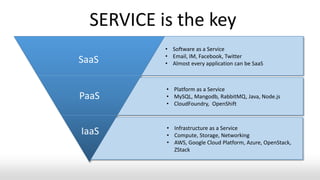
• Infrastructure as a Service
• Compute, Storage, Networking
• AWS, Google Cloud Platform, Azure, OpenStack,
ZStack
• Platform as a Service
• MySQL, Mangodb, RabbitMQ, Java, Node.js
• CloudFoundry, OpenShift
• Software as a Service
• Email, IM, Facebook, Twitter
• Almost every application can be SaaS
SERVICE is the key
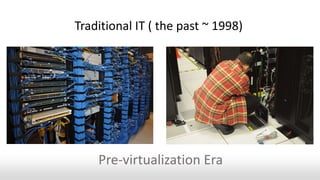
Traditional IT ( the past ~ 1998)
Pre-virtualization Era
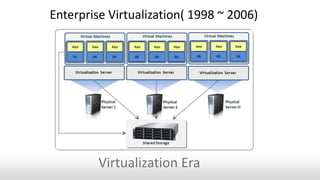
Enterprise Virtualization( 1998 ~ 2006)
Virtualization Era
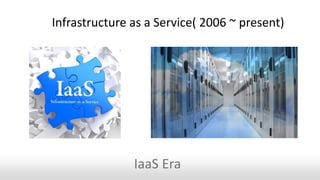
Infrastructure as a Service( 2006 ~ present)
IaaS Era
VMWare is still considered as a virtualization
provider rather than an IaaS provider
• Refuse to embrace
Amazon’s IaaS model
• Fragmented production
line
• Legacy burden
IaaS is evolved from
traditional technologies, not
an accidental invention
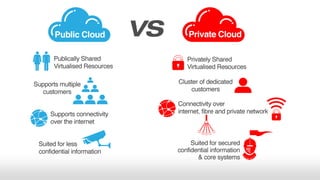
Public Cloud
Private Cloud
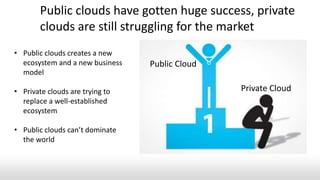
Public clouds have gotten huge success, private
clouds are still struggling for the market
• Public clouds creates a new
ecosystem and a new business
model
• Private clouds are trying to
replace a well-established
ecosystem
• Public clouds can’t dominate
the world
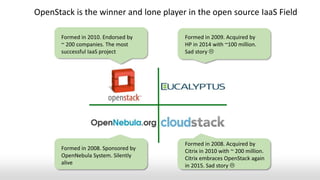
Formed in 2009. Acquired by
HP in 2014 with ~100 million.
Sad story 
Formed in 2008. Sponsored by
OpenNebula System. Silently
alive
Formed in 2008. Acquired by
Citrix in 2010 with ~ 200 million.
Citrix embraces OpenStack again
in 2015. Sad story 
Formed in 2010. Endorsed by
~ 200 companies. The most
successful IaaS project
OpenStack is the winner and lone player in the open source IaaS Field
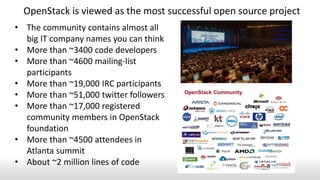
• The community contains almost all
big IT company names you can think
• More than ~3400 code developers
• More than ~4600 mailing-list
participants
• More than ~19,000 IRC participants
• More than ~51,000 twitter followers
• More than ~17,000 registered
community members in OpenStack
foundation
• More than ~4500 attendees in
Atlanta summit
• About ~2 million lines of code
OpenStack is viewed as the most successful open source project
• Rackspace, the founder of OpenStack, quitted public IaaS area in
2014
• HP, contributing the most codes to OpenStack, quitted public
IaaS area in 2015
• Nebula, the famous OpenStack startup, shutdown in 2015 after
exhausting ~ 40 million funding
• CloudScaling, Piston, BlueBox, and MetaCloud get acquired
• Gartner said:
 Don’t be blinded by OpenStack marketing hype (2012)
 Why vendors can’t sell OpenStack to enterprises (2013)
 Reflections on the OpenStack Atlanta summit (2014)
 Is OpenStack a Success? (2015)
 OpenStack is a science project (2015)
No OpenStack based products really get success
Community success is not
a business success
Simple Stable
Flexible Scalable
All customers want is a real product
But that is not easy …
Product
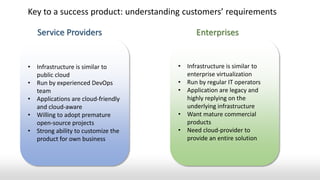
Service Providers Enterprises
• Infrastructure is similar to
public cloud
• Run by experienced DevOps
team
• Applications are cloud-friendly
and cloud-aware
• Willing to adopt premature
open-source projects
• Strong ability to customize the
product for own business
• Infrastructure is similar to
enterprise virtualization
• Run by regular IT operators
• Application are legacy and
highly replying on the
underlying infrastructure
• Want mature commercial

products
• Need cloud-provider to
provide an entire solution
Key to a success product: understanding customers’ requirements
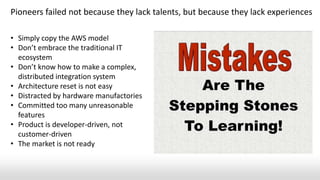
• Simply copy the AWS model
• Don’t embrace the traditional IT
ecosystem
• Don’t know how to make a complex,
distributed integration system
• Architecture reset is not easy
• Distracted by hardware manufactories
• Committed too many unreasonable
features
• Product is developer-driven, not
customer-driven
• The market is not ready
Pioneers failed not because they lack talents, but because they lack experiences
People usually think
technique doesn’t matter,
but it does matter
• Founded by Frank Zhang(Xin Zhang) and
YongKang You in 2015
• The first release was on April 6th, 2015
ZStack aims to solve problems by a well-designed product
• One-installation in 5 minutes
• Seamless upgrade in 3 minutes
• Full-API delivery
• SQL-like query in APIs with
more than 4 million query
conditions
• Self-managed, not external HA
or monitoring methods needed
Simplicity: the first step to get you customers
• Stability is guaranteed by the architecture
• Adding or removing features won’t impact
existing code
• Rollbackable workflows guarantee the
system consistency
• Test-driven development
 ~ 700 integration test cases
 ~ 200 system test cases
 ~ 8 model-based test cases
Stability: the only way to keep your customers
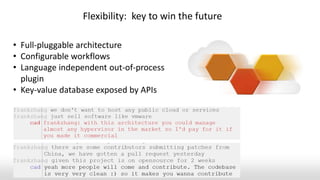
• Full-pluggable architecture
• Configurable workflows
• Language independent out-of-process
plugin
• Key-value database exposed by APIs
Flexibility: key to win the future
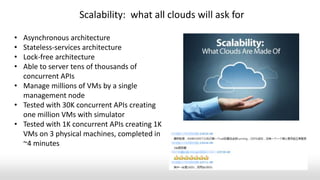
• Asynchronous architecture
• Stateless-services architecture
• Lock-free architecture
• Able to server tens of thousands of
concurrent APIs
• Manage millions of VMs by a single
management node
• Tested with 30K concurrent APIs creating
one million VMs with simulator
• Tested with 1K concurrent APIs creating 1K
VMs on 3 physical machines, completed in
~4 minutes
Scalability: what all clouds will ask for
Checkout 16 blogs for the architecture details on http://zstack.org/blog
The question you still need
to answer: where is the
market? How large is it?
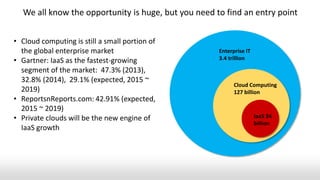
Enterprise IT
3.4 trillion
Cloud Computing
127 billion
IaaS 34
billion
• Cloud computing is still a small portion of
the global enterprise market
• Gartner: IaaS as the fastest-growing
segment of the market: 47.3% (2013),
32.8% (2014), 29.1% (expected, 2015 ~
2019)
• ReportsnReports.com: 42.91% (expected,
2015 ~ 2019)
• Private clouds will be the new engine of
IaaS growth
We all know the opportunity is huge, but you need to find an entry point
• Container is not a new technique, but a new usage
model
• Container is considered as PaaS rather than IaaS
• Container blurs the boundary between IaaS and PaaS
• Users of container are different people from users of
IaaS
• The emergency of container is not for the traditional
enterprise IT but for web giants and service providers
• It’s hard to anticipate how it will impact the traditional
enterprise IT
Containers are not replacing IaaS
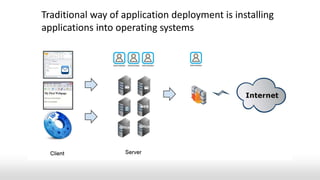
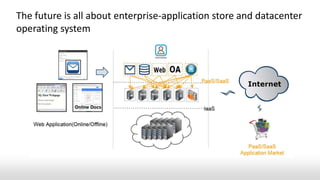
Traditional way of application deployment is installing
applications into operating systems
The future is all about enterprise-application store and datacenter
operating system
Missing this opportunity will
miss the next 20 years of
enterprise IT
Thank you!
Questions?

IaaS: the past, present and the future

  • 1.
    Infrastructure as aService The Past, Present and The Future
  • 2.
    Frank Zhang (XinZhang) Founder of ZStack Email: xing5820@gmail.com WeChat: zhangxin315866 ZStack QQ group: 410185063
  • 3.
  • 4.
    IaaS PaaS SaaS • Infrastructure asa Service • Compute, Storage, Networking • AWS, Google Cloud Platform, Azure, OpenStack, ZStack • Platform as a Service • MySQL, Mangodb, RabbitMQ, Java, Node.js • CloudFoundry, OpenShift • Software as a Service • Email, IM, Facebook, Twitter • Almost every application can be SaaS SERVICE is the key
  • 5.
    Traditional IT (the past ~ 1998) Pre-virtualization Era
  • 6.
    Enterprise Virtualization( 1998~ 2006) Virtualization Era
  • 7.
    Infrastructure as aService( 2006 ~ present) IaaS Era
  • 8.
    VMWare is stillconsidered as a virtualization provider rather than an IaaS provider • Refuse to embrace Amazon’s IaaS model • Fragmented production line • Legacy burden
  • 9.
    IaaS is evolvedfrom traditional technologies, not an accidental invention
  • 11.
    Public Cloud Private Cloud Publicclouds have gotten huge success, private clouds are still struggling for the market • Public clouds creates a new ecosystem and a new business model • Private clouds are trying to replace a well-established ecosystem • Public clouds can’t dominate the world
  • 12.
    Formed in 2009.Acquired by HP in 2014 with ~100 million. Sad story  Formed in 2008. Sponsored by OpenNebula System. Silently alive Formed in 2008. Acquired by Citrix in 2010 with ~ 200 million. Citrix embraces OpenStack again in 2015. Sad story  Formed in 2010. Endorsed by ~ 200 companies. The most successful IaaS project OpenStack is the winner and lone player in the open source IaaS Field
  • 13.
    • The communitycontains almost all big IT company names you can think • More than ~3400 code developers • More than ~4600 mailing-list participants • More than ~19,000 IRC participants • More than ~51,000 twitter followers • More than ~17,000 registered community members in OpenStack foundation • More than ~4500 attendees in Atlanta summit • About ~2 million lines of code OpenStack is viewed as the most successful open source project
  • 14.
    • Rackspace, thefounder of OpenStack, quitted public IaaS area in 2014 • HP, contributing the most codes to OpenStack, quitted public IaaS area in 2015 • Nebula, the famous OpenStack startup, shutdown in 2015 after exhausting ~ 40 million funding • CloudScaling, Piston, BlueBox, and MetaCloud get acquired • Gartner said:  Don’t be blinded by OpenStack marketing hype (2012)  Why vendors can’t sell OpenStack to enterprises (2013)  Reflections on the OpenStack Atlanta summit (2014)  Is OpenStack a Success? (2015)  OpenStack is a science project (2015) No OpenStack based products really get success
  • 15.
    Community success isnot a business success
  • 16.
    Simple Stable Flexible Scalable Allcustomers want is a real product But that is not easy … Product
  • 17.
    Service Providers Enterprises •Infrastructure is similar to public cloud • Run by experienced DevOps team • Applications are cloud-friendly and cloud-aware • Willing to adopt premature open-source projects • Strong ability to customize the product for own business • Infrastructure is similar to enterprise virtualization • Run by regular IT operators • Application are legacy and highly replying on the underlying infrastructure • Want mature commercial products • Need cloud-provider to provide an entire solution Key to a success product: understanding customers’ requirements
  • 18.
    • Simply copythe AWS model • Don’t embrace the traditional IT ecosystem • Don’t know how to make a complex, distributed integration system • Architecture reset is not easy • Distracted by hardware manufactories • Committed too many unreasonable features • Product is developer-driven, not customer-driven • The market is not ready Pioneers failed not because they lack talents, but because they lack experiences
  • 19.
    People usually think techniquedoesn’t matter, but it does matter
  • 20.
    • Founded byFrank Zhang(Xin Zhang) and YongKang You in 2015 • The first release was on April 6th, 2015 ZStack aims to solve problems by a well-designed product
  • 21.
    • One-installation in5 minutes • Seamless upgrade in 3 minutes • Full-API delivery • SQL-like query in APIs with more than 4 million query conditions • Self-managed, not external HA or monitoring methods needed Simplicity: the first step to get you customers
  • 22.
    • Stability isguaranteed by the architecture • Adding or removing features won’t impact existing code • Rollbackable workflows guarantee the system consistency • Test-driven development  ~ 700 integration test cases  ~ 200 system test cases  ~ 8 model-based test cases Stability: the only way to keep your customers
  • 23.
    • Full-pluggable architecture •Configurable workflows • Language independent out-of-process plugin • Key-value database exposed by APIs Flexibility: key to win the future
  • 24.
    • Asynchronous architecture •Stateless-services architecture • Lock-free architecture • Able to server tens of thousands of concurrent APIs • Manage millions of VMs by a single management node • Tested with 30K concurrent APIs creating one million VMs with simulator • Tested with 1K concurrent APIs creating 1K VMs on 3 physical machines, completed in ~4 minutes Scalability: what all clouds will ask for
  • 25.
    Checkout 16 blogsfor the architecture details on http://zstack.org/blog
  • 26.
    The question youstill need to answer: where is the market? How large is it?
  • 27.
    Enterprise IT 3.4 trillion CloudComputing 127 billion IaaS 34 billion • Cloud computing is still a small portion of the global enterprise market • Gartner: IaaS as the fastest-growing segment of the market: 47.3% (2013), 32.8% (2014), 29.1% (expected, 2015 ~ 2019) • ReportsnReports.com: 42.91% (expected, 2015 ~ 2019) • Private clouds will be the new engine of IaaS growth We all know the opportunity is huge, but you need to find an entry point
  • 28.
    • Container isnot a new technique, but a new usage model • Container is considered as PaaS rather than IaaS • Container blurs the boundary between IaaS and PaaS • Users of container are different people from users of IaaS • The emergency of container is not for the traditional enterprise IT but for web giants and service providers • It’s hard to anticipate how it will impact the traditional enterprise IT Containers are not replacing IaaS
  • 29.
    Traditional way ofapplication deployment is installing applications into operating systems
  • 30.
    The future isall about enterprise-application store and datacenter operating system
  • 31.
    Missing this opportunitywill miss the next 20 years of enterprise IT
  • 32.

Editor's Notes

  • #5 Introduce the concept of the three-tired service model An example of deploying a website to explain three-tired model from an end-user perspective The example in #2 is not a cloud computing example So what is the service? Use a restaurant example to explain the service Back to the example in #2, re-tell it in the cloud computing example Why the shape is a reverse-triangle A brief explanation of three eras of IaaS and why An example of game company. The requirements to the IaaS
  • #6 Everything is people-defined and hardware-defined It’s hard to change the infrastructure once it’s deployed Admins have to manually change the infrastructure if the upper business changes
  • #7 VMware brings the industry to the virtualization era Virtualization is not begun from VMWare vmware fasts the operating system provisioning, and virtual networking eases the network deployment Admins still need to manually do advanced networking stuff Some ideas of IaaS showed up, but they didn’t form a completed ecosystem Most of enterprises still stay in this era
  • #8 AWS starts this era because it defines a clear IaaS model Resource pooling hides details from end users. Compared to the VMWare, it can be called as cloud Innovation on networking and storage makes the IaaS model complete It solves the problem of huge datacenters which vmware didn’t solve The IaaS model people refer to is actually the AWS model
  • #11 Public clouds open to all customers in the world; private clouds open to users inside enterprise Public clouds are public connected; private clouds may not Different security level
  • #12 Everything getting huge success are creating new models Replacing existing ecosystem is hard Public clouds say they will dominate the world The analogy of water, electricity and gas Why public clouds will not dominate the world It cannot be versatile It’s not cheap It’s not secure The analogy of building