


OpenStack
Presented by : Seyyed Ehsan Beheshtian
Winter 2018
1
Agenda
• What is Cloud?
• What is openStack?
• OpenStack Architecture
• Compute Architecture
• Cloud platforms
• OpenStackVsVMWareVcloud
2
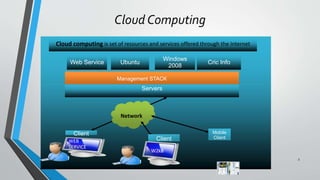
Cloud Computing
3
Cloud computing is set of resources and services offered through the Internet
Windows
2008
Cric InfoUbuntuWeb Service
Management STACK
Servers
Network
Client
WEB
SERVICE
Client
W2k8
Mobile
Client
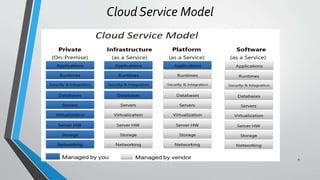
Cloud Service Model
4
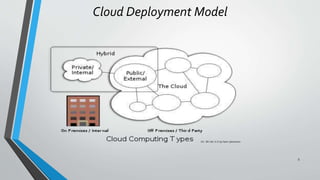
Cloud Deployment Model
5
What is openstack?
As described byWikipedia :
“OpenStack is a cloud computing project aimed at providing an infrastructure
as a service (IaaS).The software platform consists of interrelated components
that control hardware pools of processing, storage and networking”
Another description:
“OpenStack is an Infrastructure as a service which is known as a Cloud
Operating System, that takes resources such as compute, storage, network,
virtualization technologies and controls those resources at a data center level”
6
What is OpenStack?
• What it is
• Abstraction Layer
• A group of interrelated projects
• IaaS Solution
• Community Driven
• What it isn’t
• Interdependent project (ExceptionsApply)
• A complete standalone solution, extra components are needed
• StandaloneVirtualization solution
7
History
• Started in 2010 by Rackspace and Nasa
• Foundation created in 2012
• Latest release was onAugust 30th 2017 and is named Pike
The Mission:
“To produce the ubiquitous Open SourceCloud Computing platform that will
meet the needs of public and private clouds regardless of size, by being
simple to implement and massively scalable”.
8
9
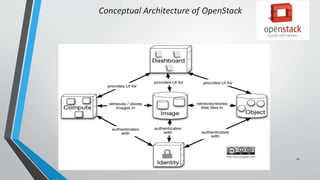
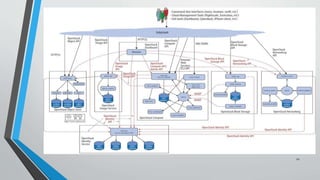
Conceptual Architecture of OpenStack
10
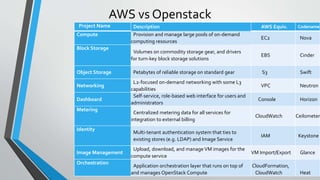
AWS vs Openstack
11
Project Name Description AWS Equiv. Codename
Compute Provision and manage large pools of on-demand
computing resources
EC2 Nova
Block Storage
Volumes on commodity storage gear, and drivers
for turn-key block storage solutions
EBS Cinder
Object Storage Petabytes of reliable storage on standard gear S3 Swift
Networking
L2-focused on-demand networking with some L3
capabilities
VPC Neutron
Dashboard
Self-service, role-based web interface for users and
administrators
Console Horizon
Metering
Centralized metering data for all services for
integration to external billing
CloudWatch Ceilometer
Identity
Multi-tenant authentication system that ties to
existing stores (e.g. LDAP) and Image Service
IAM Keystone
Image Management
Upload, download, and manage VM images for the
compute service
VM Import/Export Glance
Orchestration
Application orchestration layer that runs on top of
and manages OpenStack Compute
CloudFormation,
CloudWatch Heat
12
Source: docs.openstack.org
13
Openstack vs vcloud
14
The advantage of OpenStack
• The most successfulOpen Source project after Linux kernel
• Support from many OEMs and OS vendors
• Interoperability with many components, just pick your favorite one and
plug it in
• Standard and well accepted APIs
15
The disadvantage of OpenStack
• Very complex to setup and troubleshoot
• Although common code base, might differ from implementations
• Need high numbers of management nodes
• High skills required to run the cluster
16
The advantage ofVMware vCloud
• Feature rich (vSphere HA, vMotion, DRS, I/O control)
• Very large ecosystems
• All os vendors make it supported and certified under ESXi
• ESXi can be downloaded and used freely
17
The disadvantage ofVMware vCloud
• Per core license – expensive
• Proprietary platform
• ESXi can not be APIs accessed - need to buy licenses
• Most of applications are based onWindows
18
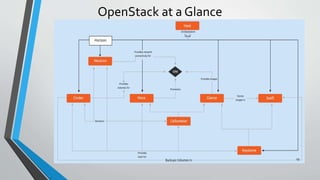
OpenStack at a Glance
19
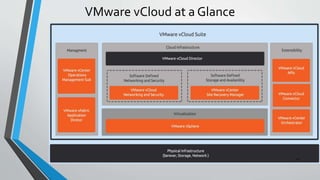
VMware vCloud at a Glance
20
Technical Compare
21
Hypervisor:
• OpenStack supports variants of hypervisor and container such as KVM, Xen,
VMware ESXi, Microsoft Hyper-V, Citrix XEN, Docker, LXC
• VMware vCloud supports ESXi as the only and default hypervisor
22
Customer and operations access :
• OpenStack native dashboard, 3rd parties dashboards, CLI
• VMware Windows clients, vCloud Director (EOL’d)
23
Storage:
• OpenStack Default non-persistent images. Pluggable Cinder:block
volumes, Ceph, Several vendor SAN
• VMwareVMFS over SAN and iSCSI
24
Network:
• Traditional switching and Software Defined Network
• VMware traditional switching infrastructure, SDN with additional products
25
Image management:
• OpenStack Glance Image Service, support all popular image formats
• VMware Catalogs & templates, OVF import
26
Management System:
• Nova (Cluster Controller)
• VMware vCenter
27
High Availability:
• Nova forVMs HA; OpenStack HA project for infrastructure components
• VMware vCenter Heartbeat
28
APIs:
• For OpenStack based on Open REST APIs, compatibility with Amazon EC2 &
S3
• ForVMware is Proprietary, mostly only under Perl and Powershell
29
Non-technical Compare
30
Costs
• For OpenStack everything is free but Some might charge for a
maintenance fee for enterprise support
• InVMware the costs contains License + Maintenance fee
31
Industries :
• OpenStack is for cloud management platform for large providers, carriers
and large outsourcers
• VMware is for virtualization for enterprises
32
Skills:
• For OpenStack high-end skills required, including system and network
• ForVMware, basic system administration is needed
33
Expansion :
• No actual limitation on OpenStack (might be handy create different
Availability Zones)
• Max 32 physical nodes onVMware vCloud, though not recommended
34
Migration:
• OpenStack any to any through built-in qemu tools
• VMware converter for P2V and other virtualization formats
35
Certifications:
• Certification by training companies such as Mirantis & Red Hat
• All Certifications byVMware company
36
Who Should Use OpenStack ?
If you are a large company or ISP with hundreds ofVMs and networks being
destroyed and created daily and have budget of having more than 15 physical
nodes to start, go for OpenStack
37
Who Should UseVMware ?
If you need certified traditional workloads (ex: Oracle, SAP, Microsoft
Dynamics, ...) and you have money and also you want all the point-and-click
features, this is a no-brainer decision go forVMware
38
Questions?
39
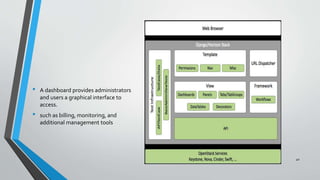
Horizon
• A dashboard provides administrators
and users a graphical interface to
access.
• such as billing, monitoring, and
additional management tools
40
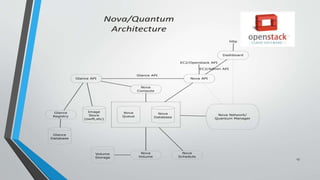
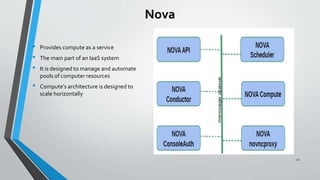
Nova
• Provides compute as a service
• The main part of an IaaS system
• It is designed to manage and automate
pools of computer resources
• Compute's architecture is designed to
scale horizontally
41
Nova - Components
• nova-conductor: Provides database-access support for Compute nodes
• nova-consoleauth: Handles console authentication
• nova-novncproxy: Provides aVNC proxy for browsers
42
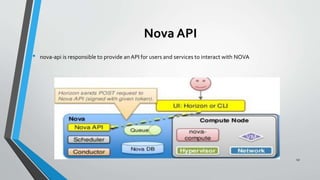
Nova API
• nova-api is responsible to provide an API for users and services to interact with NOVA
43
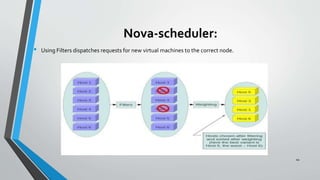
Nova-scheduler:
• Using Filters dispatches requests for new virtual machines to the correct node.
44
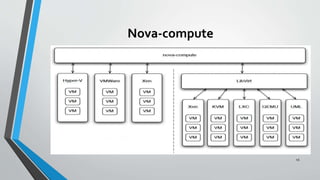
Nova-compute
45
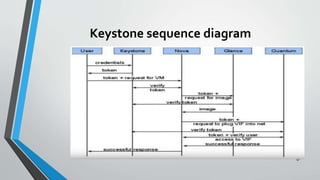
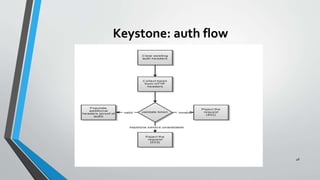
Keystone
• Keystone is the identity service used for Authentication
• Set of assigned user rights and privileges for performing a specific set of operations
• A user token issued by Keystone includes a list of that user’s roles. Services then determine
how to interpret those roles
46
Keystone sequence diagram
47
Keystone: auth flow
48
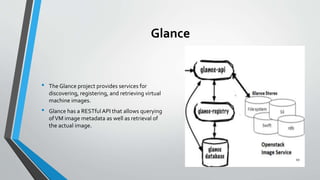
Glance
• The Glance project provides services for
discovering, registering, and retrieving virtual
machine images.
• Glance has a RESTfulAPI that allows querying
ofVM image metadata as well as retrieval of
the actual image.
49
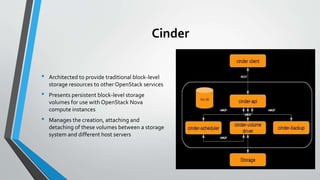
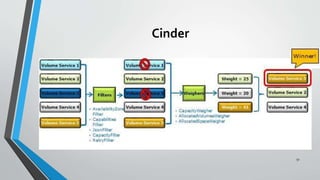
Cinder
• Architected to provide traditional block-level
storage resources to other OpenStack services
• Presents persistent block-level storage
volumes for use with OpenStack Nova
compute instances
• Manages the creation, attaching and
detaching of these volumes between a storage
system and different host servers
50
Cinder
51
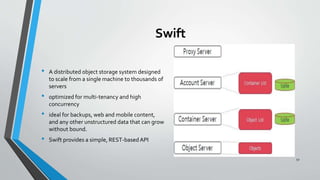
Swift
• A distributed object storage system designed
to scale from a single machine to thousands of
servers
• optimized for multi-tenancy and high
concurrency
• ideal for backups, web and mobile content,
and any other unstructured data that can grow
without bound.
• Swift provides a simple, REST-basedAPI
52
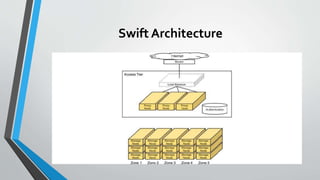
Swift Architecture
53
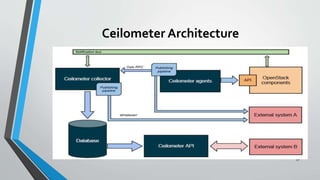
Ceilometer
• OpenStackTelemetry provides common infrastructure to collect usage and
performance measurements within an OpenStack cloud.
• Its primary initial targets are monitoring and metering
• collect data for other needs.
• Ceilometer was promoted from incubation status to an integrated component of
OpenStack.
54
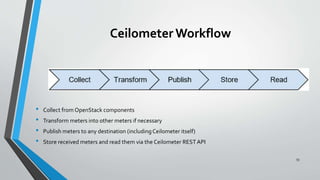
Ceilometer Workflow
• Collect from OpenStack components
• Transform meters into other meters if necessary
• Publish meters to any destination (includingCeilometer itself)
• Store received meters and read them via the Ceilometer RESTAPI
55
Ceilometer Architecture
56
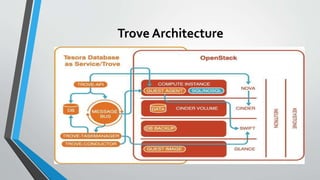
Trove
• OpenStack Database as a Service
• high performance ,scalable and reliable
• relational and non-relational database engines
• Trove was promoted from incubation status to an integrated component of OpenStack.
57
Trove Architecture
58
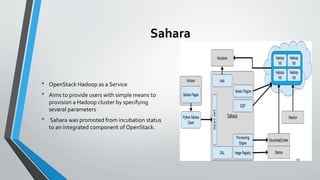
Sahara
• OpenStack Hadoop as a Service
• Aims to provide users with simple means to
provision a Hadoop cluster by specifying
several parameters
• Sahara was promoted from incubation status
to an integrated component of OpenStack.
59
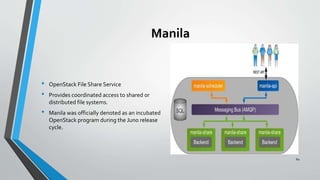
Manila
• OpenStack File Share Service
• Provides coordinated access to shared or
distributed file systems.
• Manila was officially denoted as an incubated
OpenStack program during the Juno release
cycle.
60
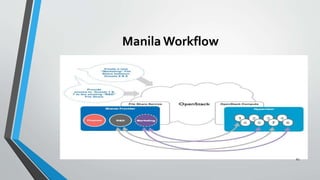
Manila Workflow
61
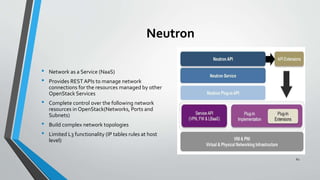
Neutron
• Network as a Service (NaaS)
• Provides REST APIs to manage network
connections for the resources managed by other
OpenStack Services
• Complete control over the following network
resources in OpenStack(Networks, Ports and
Subnets)
• Build complex network topologies
• Limited L3 functionality (IP tables rules at host
level)
62
• Neutron Plug-Ins
• Modular Layer 2 (ML2)
• Linux Bridge
• Open vSwitch
• Neutron Services
• Load Balancer as a Service (LBaaS)
• Virtual Private Network as a Service (VPNaaS)
• Firewall as a Service (FWaaS)
63
Neutron
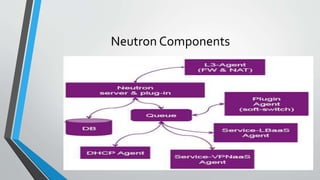
Neutron Components
64
Neutron Components
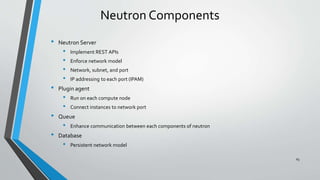
• Neutron Server
• Implement REST APIs
• Enforce network model
• Network, subnet, and port
• IP addressing to each port (IPAM)
• Plugin agent
• Run on each compute node
• Connect instances to network port
• Queue
• Enhance communication between each components of neutron
• Database
• Persistent network model
65
Neutron Components
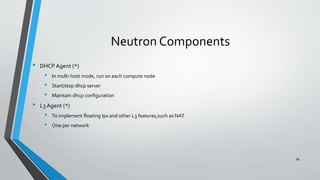
• DHCP Agent (*)
• In multi-host mode, run on each compute node
• Start/stop dhcp server
• Maintain dhcp configuration
• L3 Agent (*)
• To implement floating Ips and other L3 features,such as NAT
• One per network
66
Questions?
67

Cloud and OpenStack

  • 1.
    OpenStack Presented by :Seyyed Ehsan Beheshtian Winter 2018 1
  • 2.
    Agenda • What isCloud? • What is openStack? • OpenStack Architecture • Compute Architecture • Cloud platforms • OpenStackVsVMWareVcloud 2
  • 3.
    Cloud Computing 3 Cloud computingis set of resources and services offered through the Internet Windows 2008 Cric InfoUbuntuWeb Service Management STACK Servers Network Client WEB SERVICE Client W2k8 Mobile Client
  • 4.
  • 5.
  • 6.
    What is openstack? Asdescribed byWikipedia : “OpenStack is a cloud computing project aimed at providing an infrastructure as a service (IaaS).The software platform consists of interrelated components that control hardware pools of processing, storage and networking” Another description: “OpenStack is an Infrastructure as a service which is known as a Cloud Operating System, that takes resources such as compute, storage, network, virtualization technologies and controls those resources at a data center level” 6
  • 7.
    What is OpenStack? •What it is • Abstraction Layer • A group of interrelated projects • IaaS Solution • Community Driven • What it isn’t • Interdependent project (ExceptionsApply) • A complete standalone solution, extra components are needed • StandaloneVirtualization solution 7
  • 8.
    History • Started in2010 by Rackspace and Nasa • Foundation created in 2012 • Latest release was onAugust 30th 2017 and is named Pike The Mission: “To produce the ubiquitous Open SourceCloud Computing platform that will meet the needs of public and private clouds regardless of size, by being simple to implement and massively scalable”. 8
  • 9.
  • 10.
  • 11.
    AWS vs Openstack 11 ProjectName Description AWS Equiv. Codename Compute Provision and manage large pools of on-demand computing resources EC2 Nova Block Storage Volumes on commodity storage gear, and drivers for turn-key block storage solutions EBS Cinder Object Storage Petabytes of reliable storage on standard gear S3 Swift Networking L2-focused on-demand networking with some L3 capabilities VPC Neutron Dashboard Self-service, role-based web interface for users and administrators Console Horizon Metering Centralized metering data for all services for integration to external billing CloudWatch Ceilometer Identity Multi-tenant authentication system that ties to existing stores (e.g. LDAP) and Image Service IAM Keystone Image Management Upload, download, and manage VM images for the compute service VM Import/Export Glance Orchestration Application orchestration layer that runs on top of and manages OpenStack Compute CloudFormation, CloudWatch Heat
  • 12.
  • 13.
  • 14.
  • 15.
    The advantage ofOpenStack • The most successfulOpen Source project after Linux kernel • Support from many OEMs and OS vendors • Interoperability with many components, just pick your favorite one and plug it in • Standard and well accepted APIs 15
  • 16.
    The disadvantage ofOpenStack • Very complex to setup and troubleshoot • Although common code base, might differ from implementations • Need high numbers of management nodes • High skills required to run the cluster 16
  • 17.
    The advantage ofVMwarevCloud • Feature rich (vSphere HA, vMotion, DRS, I/O control) • Very large ecosystems • All os vendors make it supported and certified under ESXi • ESXi can be downloaded and used freely 17
  • 18.
    The disadvantage ofVMwarevCloud • Per core license – expensive • Proprietary platform • ESXi can not be APIs accessed - need to buy licenses • Most of applications are based onWindows 18
  • 19.
    OpenStack at aGlance 19
  • 20.
    VMware vCloud ata Glance 20
  • 21.
  • 22.
    Hypervisor: • OpenStack supportsvariants of hypervisor and container such as KVM, Xen, VMware ESXi, Microsoft Hyper-V, Citrix XEN, Docker, LXC • VMware vCloud supports ESXi as the only and default hypervisor 22
  • 23.
    Customer and operationsaccess : • OpenStack native dashboard, 3rd parties dashboards, CLI • VMware Windows clients, vCloud Director (EOL’d) 23
  • 24.
    Storage: • OpenStack Defaultnon-persistent images. Pluggable Cinder:block volumes, Ceph, Several vendor SAN • VMwareVMFS over SAN and iSCSI 24
  • 25.
    Network: • Traditional switchingand Software Defined Network • VMware traditional switching infrastructure, SDN with additional products 25
  • 26.
    Image management: • OpenStackGlance Image Service, support all popular image formats • VMware Catalogs & templates, OVF import 26
  • 27.
    Management System: • Nova(Cluster Controller) • VMware vCenter 27
  • 28.
    High Availability: • NovaforVMs HA; OpenStack HA project for infrastructure components • VMware vCenter Heartbeat 28
  • 29.
    APIs: • For OpenStackbased on Open REST APIs, compatibility with Amazon EC2 & S3 • ForVMware is Proprietary, mostly only under Perl and Powershell 29
  • 30.
  • 31.
    Costs • For OpenStackeverything is free but Some might charge for a maintenance fee for enterprise support • InVMware the costs contains License + Maintenance fee 31
  • 32.
    Industries : • OpenStackis for cloud management platform for large providers, carriers and large outsourcers • VMware is for virtualization for enterprises 32
  • 33.
    Skills: • For OpenStackhigh-end skills required, including system and network • ForVMware, basic system administration is needed 33
  • 34.
    Expansion : • Noactual limitation on OpenStack (might be handy create different Availability Zones) • Max 32 physical nodes onVMware vCloud, though not recommended 34
  • 35.
    Migration: • OpenStack anyto any through built-in qemu tools • VMware converter for P2V and other virtualization formats 35
  • 36.
    Certifications: • Certification bytraining companies such as Mirantis & Red Hat • All Certifications byVMware company 36
  • 37.
    Who Should UseOpenStack ? If you are a large company or ISP with hundreds ofVMs and networks being destroyed and created daily and have budget of having more than 15 physical nodes to start, go for OpenStack 37
  • 38.
    Who Should UseVMware? If you need certified traditional workloads (ex: Oracle, SAP, Microsoft Dynamics, ...) and you have money and also you want all the point-and-click features, this is a no-brainer decision go forVMware 38
  • 39.
  • 40.
    Horizon • A dashboardprovides administrators and users a graphical interface to access. • such as billing, monitoring, and additional management tools 40
  • 41.
    Nova • Provides computeas a service • The main part of an IaaS system • It is designed to manage and automate pools of computer resources • Compute's architecture is designed to scale horizontally 41
  • 42.
    Nova - Components •nova-conductor: Provides database-access support for Compute nodes • nova-consoleauth: Handles console authentication • nova-novncproxy: Provides aVNC proxy for browsers 42
  • 43.
    Nova API • nova-apiis responsible to provide an API for users and services to interact with NOVA 43
  • 44.
    Nova-scheduler: • Using Filtersdispatches requests for new virtual machines to the correct node. 44
  • 45.
  • 46.
    Keystone • Keystone isthe identity service used for Authentication • Set of assigned user rights and privileges for performing a specific set of operations • A user token issued by Keystone includes a list of that user’s roles. Services then determine how to interpret those roles 46
  • 47.
  • 48.
  • 49.
    Glance • The Glanceproject provides services for discovering, registering, and retrieving virtual machine images. • Glance has a RESTfulAPI that allows querying ofVM image metadata as well as retrieval of the actual image. 49
  • 50.
    Cinder • Architected toprovide traditional block-level storage resources to other OpenStack services • Presents persistent block-level storage volumes for use with OpenStack Nova compute instances • Manages the creation, attaching and detaching of these volumes between a storage system and different host servers 50
  • 51.
  • 52.
    Swift • A distributedobject storage system designed to scale from a single machine to thousands of servers • optimized for multi-tenancy and high concurrency • ideal for backups, web and mobile content, and any other unstructured data that can grow without bound. • Swift provides a simple, REST-basedAPI 52
  • 53.
  • 54.
    Ceilometer • OpenStackTelemetry providescommon infrastructure to collect usage and performance measurements within an OpenStack cloud. • Its primary initial targets are monitoring and metering • collect data for other needs. • Ceilometer was promoted from incubation status to an integrated component of OpenStack. 54
  • 55.
    Ceilometer Workflow • Collectfrom OpenStack components • Transform meters into other meters if necessary • Publish meters to any destination (includingCeilometer itself) • Store received meters and read them via the Ceilometer RESTAPI 55
  • 56.
  • 57.
    Trove • OpenStack Databaseas a Service • high performance ,scalable and reliable • relational and non-relational database engines • Trove was promoted from incubation status to an integrated component of OpenStack. 57
  • 58.
  • 59.
    Sahara • OpenStack Hadoopas a Service • Aims to provide users with simple means to provision a Hadoop cluster by specifying several parameters • Sahara was promoted from incubation status to an integrated component of OpenStack. 59
  • 60.
    Manila • OpenStack FileShare Service • Provides coordinated access to shared or distributed file systems. • Manila was officially denoted as an incubated OpenStack program during the Juno release cycle. 60
  • 61.
  • 62.
    Neutron • Network asa Service (NaaS) • Provides REST APIs to manage network connections for the resources managed by other OpenStack Services • Complete control over the following network resources in OpenStack(Networks, Ports and Subnets) • Build complex network topologies • Limited L3 functionality (IP tables rules at host level) 62
  • 63.
    • Neutron Plug-Ins •Modular Layer 2 (ML2) • Linux Bridge • Open vSwitch • Neutron Services • Load Balancer as a Service (LBaaS) • Virtual Private Network as a Service (VPNaaS) • Firewall as a Service (FWaaS) 63 Neutron
  • 64.
  • 65.
    Neutron Components • NeutronServer • Implement REST APIs • Enforce network model • Network, subnet, and port • IP addressing to each port (IPAM) • Plugin agent • Run on each compute node • Connect instances to network port • Queue • Enhance communication between each components of neutron • Database • Persistent network model 65
  • 66.
    Neutron Components • DHCPAgent (*) • In multi-host mode, run on each compute node • Start/stop dhcp server • Maintain dhcp configuration • L3 Agent (*) • To implement floating Ips and other L3 features,such as NAT • One per network 66
  • 67.