© 2015 IBM Corporation
Software Defined Infrastructure
from IBM
Jay Muelhoefer
Director, Software Defined Solutions
© 2015 IBM Corporation2
Innovation and Design
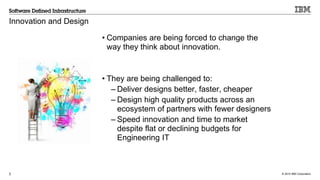
• Companies are being forced to change the
way they think about innovation.
• They are being challenged to:
– Deliver designs better, faster, cheaper
– Design high quality products across an
ecosystem of partners with fewer designers
– Speed innovation and time to market
despite flat or declining budgets for
Engineering IT
© 2015 IBM Corporation3
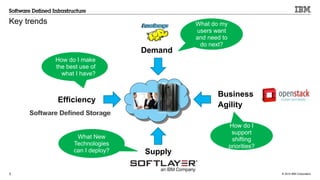
What do my
users want
and need to
do next?
Key trends
Demand
Supply
Business
Agility
Efficiency
What New
Technologies
can I deploy?
How do I
support
shifting
priorities?
How do I make
the best use of
what I have?
© 2015 IBM Corporation4
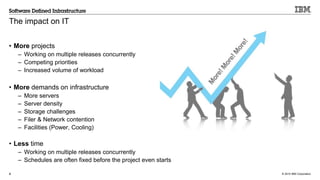
The impact on IT
• More projects
– Working on multiple releases concurrently
– Competing priorities
– Increased volume of workload
• More demands on infrastructure
– More servers
– Server density
– Storage challenges
– Filer & Network contention
– Facilities (Power, Cooling)
• Less time
– Working on multiple releases concurrently
– Schedules are often fixed before the project even starts
© 2015 IBM Corporation5
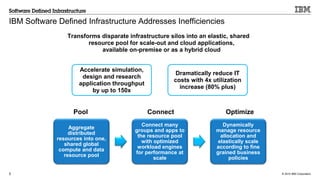
IBM Software Defined Infrastructure Addresses Inefficiencies
Transforms disparate infrastructure silos into an elastic, shared
resource pool for scale-out and cloud applications,
available on-premise or as a hybrid cloud
Accelerate simulation,
design and research
application throughput
by up to 150x
Dramatically reduce IT
costs with 4x utilization
increase (80% plus)
Aggregate
distributed
resources into one,
shared global
compute and data
resource pool
Connect many
groups and apps to
the resource pool
with optimized
workload engines
for performance at
scale
Dynamically
manage resource
allocation and
elastically scale
according to fine
grained business
policies
Pool Connect Optimize
© 2015 IBM Corporation6
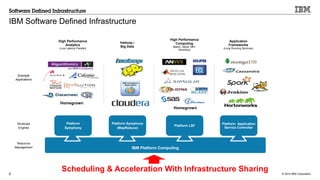
IBM Software Defined Infrastructure
IBM Platform Computing
Workload
Engines
Resource
Management
Platform Symphony
(MapReduce)
Platform
Symphony
Platform Application
Service Controller
Platform LSF
High Performance
Analytics
(Low Latency Parallel)
Hadoop /
Big Data
Application
Frameworks
(Long Running Services)
High Performance
Computing
(Batch, Serial, MPI,
Workflow)
Example
Applications
Homegrown
Homegrown
Scheduling & Acceleration With Infrastructure Sharing
© 2015 IBM Corporation7
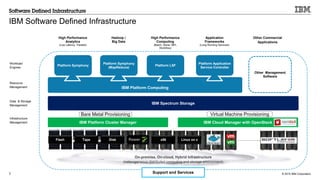
IBM Software Defined Infrastructure
Infrastructure
Management
Data & Storage
Management
On-premise, On-cloud, Hybrid Infrastructure
(heterogeneous distributed computing and storage environment)
IBM Platform Computing
Platform LSFPlatform Symphony
Platform Application
Service Controller
Platform Symphony
(MapReduce)
Other Management
Software
Workload
Engines
Resource
Management
High Performance
Computing
(Batch, Serial, MPI,
Workflow)
High Performance
Analytics
(Low Latency Parallel)
Application
Frameworks
(Long Running Services)
Hadoop /
Big Data
Other Commercial
Applications
IBM Spectrum Storage
IBM Platform Cluster Manager IBM Cloud Manager with OpenStack
x86 Linux on zDiskFlash Tape
Support and Services
Bare Metal Provisioning Virtual Machine Provisioning
© 2015 IBM Corporation8
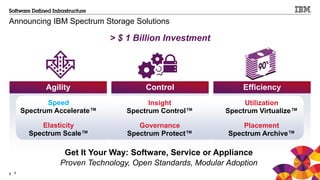
Agility Control Efficiency
Get It Your Way: Software, Service or Appliance
Proven Technology, Open Standards, Modular Adoption
Announcing IBM Spectrum Storage Solutions
Insight
Spectrum Control™
Governance
Spectrum Protect™
Speed
Spectrum Accelerate™
Elasticity
Spectrum Scale™
Utilization
Spectrum Virtualize™
Placement
Spectrum Archive™
> $ 1 Billion Investment
8
© 2015 IBM Corporation9
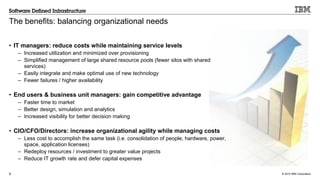
The benefits: balancing organizational needs
• IT managers: reduce costs while maintaining service levels
– Increased utilization and minimized over provisioning
– Simplified management of large shared resource pools (fewer silos with shared
services)
– Easily integrate and make optimal use of new technology
– Fewer failures / higher availability
• End users & business unit managers: gain competitive advantage
– Faster time to market
– Better design, simulation and analytics
– Increased visibility for better decision making
• CIO/CFO/Directors: increase organizational agility while managing costs
– Less cost to accomplish the same task (i.e. consolidation of people, hardware, power,
space, application licenses)
– Redeploy resources / investment to greater value projects
– Reduce IT growth rate and defer capital expenses
9
© 2015 IBM Corporation10
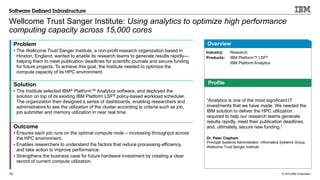
Wellcome Trust Sanger Institute: Using analytics to optimize high performance
computing capacity across 15,000 cores
Problem
• The Wellcome Trust Sanger Institute, a non-profit research organization based in
Hinxton, England, wanted to enable its research teams to generate results rapidly—
helping them to meet publication deadlines for scientific journals and secure funding
for future projects. To achieve this goal, the Institute needed to optimize the
compute capacity of its HPC environment.
Solution
• The Institute selected IBM® Platform™ Analytics software, and deployed the
solution on top of its existing IBM Platform LSF® policy-based workload scheduler.
The organization then designed a series of dashboards, enabling researchers and
administrators to see the utilization of the cluster according to criteria such as job,
job submitter and memory utilization in near real time.
Outcome
• Ensures each job runs on the optimal compute node – increasing throughput across
the HPC environment.
• Enables researchers to understand the factors that reduce processing efficiency,
and take action to improve performance.
• Strengthens the business case for future hardware investment by creating a clear
record of current compute utilization.
Industry: Research
Products: IBM Platform™ LSF®
IBM Platform Analytics
Overview
Profile
“Analytics is one of the most significant IT
investments that we have made. We needed the
IBM solution to deliver the HPC utilization
required to help our research teams generate
results rapidly, meet their publication deadlines
and, ultimately, secure new funding.”
Dr. Peter Clapham
Principal Systems Administrator, Informatics Systems Group,
Wellcome Trust Sanger Institute
© 2015 IBM Corporation11
Thank You

Software Defined Infrastructure

  • 1.
    © 2015 IBMCorporation Software Defined Infrastructure from IBM Jay Muelhoefer Director, Software Defined Solutions
  • 2.
    © 2015 IBMCorporation2 Innovation and Design • Companies are being forced to change the way they think about innovation. • They are being challenged to: – Deliver designs better, faster, cheaper – Design high quality products across an ecosystem of partners with fewer designers – Speed innovation and time to market despite flat or declining budgets for Engineering IT
  • 3.
    © 2015 IBMCorporation3 What do my users want and need to do next? Key trends Demand Supply Business Agility Efficiency What New Technologies can I deploy? How do I support shifting priorities? How do I make the best use of what I have?
  • 4.
    © 2015 IBMCorporation4 The impact on IT • More projects – Working on multiple releases concurrently – Competing priorities – Increased volume of workload • More demands on infrastructure – More servers – Server density – Storage challenges – Filer & Network contention – Facilities (Power, Cooling) • Less time – Working on multiple releases concurrently – Schedules are often fixed before the project even starts
  • 5.
    © 2015 IBMCorporation5 IBM Software Defined Infrastructure Addresses Inefficiencies Transforms disparate infrastructure silos into an elastic, shared resource pool for scale-out and cloud applications, available on-premise or as a hybrid cloud Accelerate simulation, design and research application throughput by up to 150x Dramatically reduce IT costs with 4x utilization increase (80% plus) Aggregate distributed resources into one, shared global compute and data resource pool Connect many groups and apps to the resource pool with optimized workload engines for performance at scale Dynamically manage resource allocation and elastically scale according to fine grained business policies Pool Connect Optimize
  • 6.
    © 2015 IBMCorporation6 IBM Software Defined Infrastructure IBM Platform Computing Workload Engines Resource Management Platform Symphony (MapReduce) Platform Symphony Platform Application Service Controller Platform LSF High Performance Analytics (Low Latency Parallel) Hadoop / Big Data Application Frameworks (Long Running Services) High Performance Computing (Batch, Serial, MPI, Workflow) Example Applications Homegrown Homegrown Scheduling & Acceleration With Infrastructure Sharing
  • 7.
    © 2015 IBMCorporation7 IBM Software Defined Infrastructure Infrastructure Management Data & Storage Management On-premise, On-cloud, Hybrid Infrastructure (heterogeneous distributed computing and storage environment) IBM Platform Computing Platform LSFPlatform Symphony Platform Application Service Controller Platform Symphony (MapReduce) Other Management Software Workload Engines Resource Management High Performance Computing (Batch, Serial, MPI, Workflow) High Performance Analytics (Low Latency Parallel) Application Frameworks (Long Running Services) Hadoop / Big Data Other Commercial Applications IBM Spectrum Storage IBM Platform Cluster Manager IBM Cloud Manager with OpenStack x86 Linux on zDiskFlash Tape Support and Services Bare Metal Provisioning Virtual Machine Provisioning
  • 8.
    © 2015 IBMCorporation8 Agility Control Efficiency Get It Your Way: Software, Service or Appliance Proven Technology, Open Standards, Modular Adoption Announcing IBM Spectrum Storage Solutions Insight Spectrum Control™ Governance Spectrum Protect™ Speed Spectrum Accelerate™ Elasticity Spectrum Scale™ Utilization Spectrum Virtualize™ Placement Spectrum Archive™ > $ 1 Billion Investment 8
  • 9.
    © 2015 IBMCorporation9 The benefits: balancing organizational needs • IT managers: reduce costs while maintaining service levels – Increased utilization and minimized over provisioning – Simplified management of large shared resource pools (fewer silos with shared services) – Easily integrate and make optimal use of new technology – Fewer failures / higher availability • End users & business unit managers: gain competitive advantage – Faster time to market – Better design, simulation and analytics – Increased visibility for better decision making • CIO/CFO/Directors: increase organizational agility while managing costs – Less cost to accomplish the same task (i.e. consolidation of people, hardware, power, space, application licenses) – Redeploy resources / investment to greater value projects – Reduce IT growth rate and defer capital expenses 9
  • 10.
    © 2015 IBMCorporation10 Wellcome Trust Sanger Institute: Using analytics to optimize high performance computing capacity across 15,000 cores Problem • The Wellcome Trust Sanger Institute, a non-profit research organization based in Hinxton, England, wanted to enable its research teams to generate results rapidly— helping them to meet publication deadlines for scientific journals and secure funding for future projects. To achieve this goal, the Institute needed to optimize the compute capacity of its HPC environment. Solution • The Institute selected IBM® Platform™ Analytics software, and deployed the solution on top of its existing IBM Platform LSF® policy-based workload scheduler. The organization then designed a series of dashboards, enabling researchers and administrators to see the utilization of the cluster according to criteria such as job, job submitter and memory utilization in near real time. Outcome • Ensures each job runs on the optimal compute node – increasing throughput across the HPC environment. • Enables researchers to understand the factors that reduce processing efficiency, and take action to improve performance. • Strengthens the business case for future hardware investment by creating a clear record of current compute utilization. Industry: Research Products: IBM Platform™ LSF® IBM Platform Analytics Overview Profile “Analytics is one of the most significant IT investments that we have made. We needed the IBM solution to deliver the HPC utilization required to help our research teams generate results rapidly, meet their publication deadlines and, ultimately, secure new funding.” Dr. Peter Clapham Principal Systems Administrator, Informatics Systems Group, Wellcome Trust Sanger Institute
  • 11.
    © 2015 IBMCorporation11 Thank You

Editor's Notes

  • #4 Summarize the trends into 4 big buckets relative to the pressures and evolution of the technical computing environment. Demand These are the trends driven by the needs of the users, their applications and their workloads – the demands placed on the technical computing environment 2. Supply These are the trends driven by and impacting the evolution of the technologies that organizations deploy in their environment to build their technical computing infrastructure 3. Business Agility These are the trends driven by the increasing need for business agility and responsiveness. (connects to the overall value prop of wider SDE discussion) 4. Efficiency - Trends that relate to driving maximum utilization, usage, efficiency from the environment. These include cost constraints